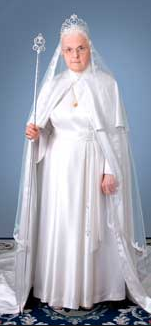
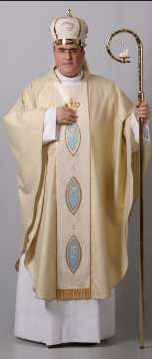
Ammachi

AMMACHI TIMELINE

1953 (September 27) Ammachi was born Sudhamani Idamannel in Kerala, India.

1975 Ammachi experienced an identification with Sri Krishna ( Krishnabhava) and with Devi (Devi bhava).

1981 An ashram, Amritapuri, was established in India.

1987 Ammachi visited the U.S. and became very popular with Western religious seekers.

1989 An ashram was established in San Ramon, California.

1993 Ammachi delivered a speech at the World Parliament of Religions in Chicago.

2002 Ammachi received the Gandhi-King Award for Non-Violence.

FOUNDER/GROUP HISTORY

Sri Mata Amritanandamayi Devi, also known as Amma or Ammachi, was born Sudhamani (“Pure Jewel”) Idamannel on September 27, 1953, as the fourth child to a poor fishing family in Kerala, India. Sudhamani suspended her formal education during the fourth grade at the age of nine to raise her younger siblings and assist with domestic tasks in her family’s household after her mother became ill. She never married. Beyond these few basic facts, information on Sudhamani’s early life is almost exclusively drawn from hagiographic accounts, with Amritaswarupanada (1994) being the primary source.

In the hagiographic accounts, Sudhamani is depicted as spiritual from birth, having chosen a self-sacrificial way of life, and
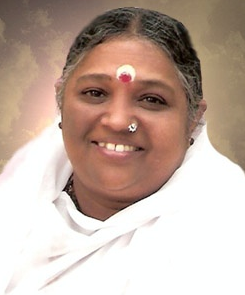
possessing extraordinary powers. According to these accounts, the signs of Sudhamani’s future spirituality began prior to her birth. During pregnancy her mother “began having strange visions. Sometimes she had wonderful dreams of Lord Krishna. At others she beheld the divine play of Lord Shiva and Devi, the Divine Mother” (Amritaswarupanada 1994:13). When Sudhamani was born she had a dark blue complexion and would lay in the lotus position of hatha yoga (chinmudra). By the time that she was six months old “she began speaking in her native tongue, and at the age of two began singing devotional songs to Sri Krishna…[E]even at an early age Sudhamani exhibited certain mystical and suprahuman traits, including compassion for the destitute. In her late teens, she developed an intense devotion to and longing for Krishna…sometimes she danced in spiritual ecstasy, and at other times she wept bitterly at the separation from her beloved Krishna” (Raj 2004:206). Sudhanami reportedly was so absorbed with Lord Krishna that “If she suddenly realized she had taken several steps without remembering Krishna, she would run back and walk those steps again, repeating the Lord’s name” (Johnsen 1994:95).

Sudhamani’s childhood is described as very difficult. According to Johnsen (1994:95) she was “the victim of years of physical and psychological abuse.” Her duties in taking care of her mother reduced her to a virtual “house slave” who was “beaten and treated as a servant” (Associated Press 2009). Sudhamani demonstrated great compassion for the suffering and poverty that she encountered in her hometown, and she began comforting and hugging the impoverished and ill, even those deemed untouchable by society. As a result, she was regarded by her family as mentally ill, and her brother is said to have attacked her with a knife for the embarrassment she was causing the family. Sudhamani’s parents attempted to arrange a marriage for her, but Sudhamani had decided not to marry and vigorously rejected their initiative (Raj 2004:206). As a result of these various difficulties, Sudhamani ran away from home on occasion and even considered drowning herself.

The transformational moments during which Sudhamani moved toward her spiritual identity as Ammachi began in September, 1975. As she was returning home after tending cattle, she reported having had a “spiritual rapture” and became aware of her identification and oneness with Krishna (Raj 2004:206). For the next two years Ammachi was said to be in the mood of Krishna ( Krishnabhava). Just six months after her initial rapture she had a second rapture in which she experienced oneness with Devi, the divine mother (Devi bhava). It is this latter identity as the Divine Mother that she has continued to express. By the late 1970s Ammachi was gathering a coterie of disciples. In 1978, a young man named Balu became one of Ammachi’s first disciples, followed in 1979 by two Westerners, an American, now Swami Amritswarupananda, and an Australian, now Armritswarupananda. The movement created its first formal ashram, Amritapuri, in 1981. Ammachi first visited the U.S. in 1987; she was enthusiastically received and gathered a devoted following of religious seekers who consider her a personal guru. Every year Ammachi makes an annual tour to nations around the world. There are now santangs in over thirty countries.

DOCTRINES/BELIEFS

Ammachi’s followers consider her both a manifestation of the Divine Mother goddess and a guru. According to Kremer (2009:5), “Devotees look to Ammachi, not to scriptures, ideas, philosophy, or traditional theology. Ammachi is their foundation, their ideal to strive for, their lens to view other religious ideas and texts through, and their example for moral action. Ammachi is the ultimate authority, and as a living symbol and mother goddess incarnated, she is the base for divine knowledge.” Despite her lack of formal training, Ammachi is believed by her followers to be a true spiritual master (satguru).

Ammachi’s primary teaching to her followers is to seek liberation by serving God and surrendering ego and desire. It is devotion to God that leads to a loss of ego. Devotees seek this goal through meditation, recitation, and community service. As an incarnation of the Divine on earth ( avatar), Ammachi is believed to have completely eliminated her ego, a separate sense of selfhood (Edelstein 2000). As Ammachi has put it: “Reasoning is necessary, but we should not let it swallow the faith in us. We should not allow the intellect to eat up our heart. Too much knowledge means nothing but a big ego. The ego is a burden, and a big ego is a big burden” (Johnsen 1994:99). She teaches that “The love of awakened motherhood is a love and compassion felt not only towards one’s own children, but towards all people … to all of nature,” she says. “This motherhood is Divine Love – and that is God” (Lampman 2006). The ideal of “universal awakened motherhood” is one of Ammachi’s central tenets. She exalts motherhood, love and compassion, and exhorts her followers to be true mothers, regardless of their gender, by exhibiting these maternal qualities to all of creation.

Gender equality plays a major role in Ammachi’s doctrines. She seeks to empower women through her spiritual practices and teachings. In her scripture Awaken, Children!, Ammachi proclaims that “spiritual realization is easier for a woman to attain than for a man, provided she has the proper discrimination and determination” and that “women are the repositories of infinite power. In spiritual matters they can surpass what many men attempt to do; therefore, do not think that women are lower than men” (Kremer 2009:10). Ammachi “teaches men to see their wives as the Divine Mother and women to see their husbands as the Lord of the World, and also to serve their families, the community, and the world. Humility and service are her constant themes” (Johnsen 1994:101).

RITUALS/PRACTICES

Ammachi’s central ritual is the Devi bhava darshan, which allows a devotee to experience a mystical connection with a deity by seeing and being seen by the deity. Ammachi’s darshan features hugging, which is atypical since physical contact is generally eschewed by Hindu gurus. This has led to Ammachi’s sobriquet, “the hugging saint.” Ammachi reportedly developed and then ritualized this practice in the course of soothing those who came to her for advice and consolation.

Ammachi’s Devi bhava is elaborate and highly ritualized. She is seated on a floor mat, often decorated with flowers, and attendedby a female disciple who performs the ritual foot worship (pada puja) by sprinkling water on Ammachi’s feet, then placing sandal paste and flowers on them. Two monks recite from the Sanskritic slokas, followed by the ceremonial waving of a lamp. Another devotee decorates Ammachi with a garland. There is a lecture on Ammachi’s message and spirituality. Finally, Ammachi and an Indian band lead the devotional singing (bhajan). After a period of meditation, Ammachi’s devotees are invited to approach her individually for her trademark embrace.
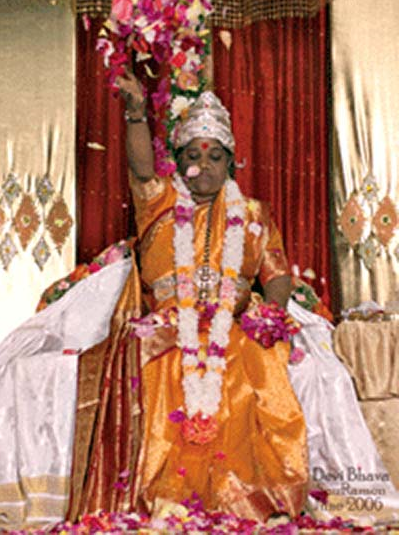
Each devotee receives a hug from Ammachi, as well as words of comfort (Ammachi speaks her native language, Malayalam, and has limited fluency in English). She then presents each follower with a small token piece of chocolate, rose petals and sacred ash. Each hug is treated as “a hug from the mother goddess herself” as Ammachi is understood to be “a vessel for the goddess to communicate through her” and “a passive recipient of a transcendent deity” (Kremer 2009:3). Ammachi has reportedly administered over thirty million hugs in sessions that can last up to twenty hours. Vasudha Narayanan, director of the Center for the Study of Hindu Traditions at the University of Florida, described Ammachi’s hugs as “a sermon,” and the “experience so moves some that they give up their lives to follow the guru” (Associated Press 2009). Johnsen points out that “Many teachers emphasize the importance of love, but Ammachi’s words have particularly potent impact on so many who have met her because they see that she walks her talk” (Johnsen 1994:100). Ammachi herself has described the hugs as having great spiritual significance: “Amma’s hugs and kisses should not be considered ordinary. When Amma embraces or kisses someone, it is a process of purification and inner healing. Amma is transmitting a part of Her pure vital energy into Her children. It also allows them to experience unconditional love. When Amma holds someone it can help to awaken the dormant spiritual energy within them, which will eventually take them to the ultimate goal of Self-realization” (Raj 2005:136-7). One of Ammachi’s devotees communicates the power of this encounter as follows: “Ammachi gives all the time, twenty four hours a day…She lavishes her love freely on everyone who comes to her. She may be firm with them, but she always radiates unconditional love. That’s why people are so shaken after they meet her. She’s a living example of what she teaches, of what all the scriptures teach” (Johnsen 1994:100).
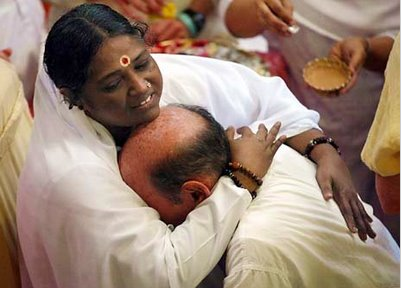
During the early years Ammachi would give hugs to as many as one thousand visitors each day, with double that number receiving hugs on Devi Bhava nights. In India the hugs sometime lasted for ten minutes. As the ritual has become institutionalized and the size of audiences has increased dramatically, each individual has received less personal time with Ammachi, now only a few seconds to a few minutes. Devotees receive a personal initiation and mantra from Ammachi. Consistent with “one Truth” message, Ammachi’s devotees are allowed to select a Hindu, Devi, Christian, Buddhist mantra, or even one in which the deity is not specified.

ORGANIZATION/LEADERSHIP

Amachi has never been initiated as a guru but is treated as a perfect spiritual master (sat guru) by her devotees, one who is capable of achieving god realization. Her devotees credit her with extraordinary powers. Reportedly she eats very little and often sleeps only a few hours a night. Her spokesman, Rob Sidon, remarks that ”We can’t keep up with her. I have to go to bed. She keeps going. You wake up and she’s still at it. After 15 hours she’s radiant” (Reuters 2001). Her powers are said to include levitation, clairvoyance, being in two locations simultaneously (bilocation), healing of both physical and emotional disorders; creating children for childless couples and absorbing or inhaling devotees’ negative karma” (Raj 2004:207). Some of Ammachi’s most famous miracles include turning water to milk, healing a leper, and permitting “a poisonous cobra to flick its tongue against her own” (Associated Press 2009). Ammachi’s first Western disciple, Neal Rosner, related the story of Ammachi healing a leper by “lick[ing] the pus out of his sores’” until the leprosy disappeared except for one sore (Johnsen 1994:106). Ammachi herself refers to such power: “If you were to really see Amma as She is, it would overwhelm you – you couldn’t possible bear it. Because of this, Amma always covers herself with a thick layer of Maya (illusion)” (Raj 2005:127). In addition to spiritual leadership, Ammachi oversees the movement’s extensive charitable activities.

In the late 1970s Ammachi and her small group of devotees established her first ashram, a simple thatched hut near her home. Two years later Amritapuri, her first formal ashram, was constructed. The ashram has continued to grow and now includes a temple a large dormitory. There are several hundred permanent residents and several hundred more visitors along with a small coterie of initiated, renunciate sannyasis and sannyasinis. The permanent residents at Ammachi’s ashrams, brahmacharins, follow a strict program of discipline (tapas), which “stipulates eight hours of meditation daily in addition to constant social service activities.

Ammachi first visited the U.S. in 1987, and an ashram that became her headquarters in the U.S. was established in San Ramon, California in 1989 on land donated by a devotee. This ashram houses a group of celibate devotees who practice meditation, recitation, and community service. Local chapters have been established in a number of large cities around the U.S. that are administered primarily by volunteers. American devotees are predominantly Caucasian and female, and women occupy the majority of local leadership positions. According to Raj (2005:130), “Western disciples seem more attracted to the asceticism of Ammachi’s spirituality….Indians seem more drawn to the devotional tradition Ammachi embodies.” The highest levels of movement leadership continue to be held by male renunciant devotees. Converts from Siddha Yoga and Transcendental Meditation are commonplace (Raj 2004:210).
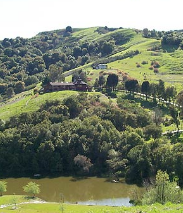
Ammachi also operates a number of charitable organizations, including “four hospitals, 33 schools, 12 temples, 25,000 houses for the poor, an orphanage, pensions for 50,000 destitute women, a home for senior citizens, a battered women’s shelter and various technical education projects” (Reuters 2001). The Mata Amritanandamayi (M.A.) Center in the U.S. donated one million dollars to the Bush-Clinton Katrina Fund. And Ammachi committed $23 million for rebuilding after the South Asian tsunami (Lampman 2006). Visitors are not charged for darshan or for receiving mantras; instead the movement supports its charitable activity through donations and sale of a variety of souvenir items.

ISSUES/CHALLENGES

Ammachi has generated only a modest amount of controversy (Falk 2009). Predictably, there have been Christian critiques of her teachings (Jones 2009). Other critics have taken issue with her directives to separate couples as part of their spiritual practice (sadhana) in order to “put pressure on their egos,” to maintain celibacy, and to engage in long periods of meditation with limited hours of sleep (Edelstein 2000). They dismiss Ammachi’s following as a personality cult and “they question the finances of her organization or even claim it is linked to radical groups” (Associated Press 2009). The legitimacy of Ammachi’s miracles also has been challenged, particularly in India where the tensions between traditionalist Hindus and secular rationalists remain high (Pattahanam 1985). Her followers claim that opponents have made several attempts on her life (Kremer 2009:7).

Some members of the traditional Hindu community resist Ammachi’s egalitarian teachings and practices as they violate traditional Hindu purity/pollution and gender norms. She allows menstruating women, who are considered impure, to participate in her darshan. She has elevated the status of women by allowing them to be priests within her movement. Ammachi also rarely holds gatherings in Hindu temples, preferring secular venues that are accessible to and comfortable for Western devotees. At the same time she requires modest dress for women and uses women as models of selfless service. It is the combination of her empowerment of women together with her commitment to the Hindu tradition and a divine mother model for women that is the source of her enormous appeal to women caught between traditional and modern worlds.

These various criticisms of Ammachi have been far outweighed by the adulation she continues to receive from disciples, the honors that she has received, the support of influentials around the world, and the popularity she enjoys on her annual world tours. She was invited to speak at the World Parliament of Religions in Chicago in 1993. She was invited to speak at the UN’s 50th anniversary in 1995 and at the Millennium World Peace Summit in 2000. In 2002, Ammachi won the Gandhi-King Award for her promotion of nonviolence. In the same year she delivered the keynote address at The Global Peace Initiative of Women Religious and Spiritual Leaders. In 2006, Ammachi received an interfaith award that previously had been given to only the Dalai Lama and Bishop Desmond Tutu. She has been compared to Mother Teresa and heralded a mystic and a saint, and she is now “one of the most recognizable and popular Hindu female gurus in India” (Kremer 2009:8).

REFERENCES

Amritaswarupananda, Swami. 1994. Ammachi: A Biography of Mata Amritanandamayi. San Ramon, CA: Mata Amritanandamayi Center.

Associated Press, 2009. “Millions Flock to India’s Hugging Guru.” AP. 8 March 2009. Accessed from http://thestar.com.my/news/story.asp?file=/2009/3/8/apworld/20090308082927&sec=apworld on February 5, 2012.

Edelstein, Amy. 2000. “Ammachi the ‘Mother of Immortal Bliss’.” EnlightenNext Magazine (Spring-Summer). Accessed at http://www.throughyourbody.com/fantastic-interview-with-mata-amritanandamayi-the-mother-of-immortal-bliss/ on 13 February 2012.

Falk, Geoffrey. 2009. Stripping the Gurus. Toronto: Million Monkeys Press.

Johnsen, Linda. 1994. “Ammachi: In the Lap of the Mother.” In Daughters of the Goddess: The Women Saints of India., 95-110. St. Paul, MN: Yes International Publishers.

Jones, Jovan. 2009. Chasing the Avatar. Shippensburg, PA: Destiny Image.

Kremer, Michael. 2009. Is The Guru a Feminist? Charismatic Female Leaders and Gender Roles in India. M.A. Thesis. Columbia: University of Missouri.

Lampman, Jane. 2006. “Hugging Saint is Compassion in Action.” Christian Science Monitor, July 27. Accessed from http://www.csmonitor.com/2006/0727/p14s01-lire.html on 10 February 2012.

Pattahanam, Sreeni. 1985. Matha Amritanandamayi: Sacred Stories and Realities . Kollam, Kerala, India: Mass Publicationas.

Raj, Selva J. 2005. “Passage to America: Ammachi on American Soil.” In Gurus in America, edited by Thomas Forsthoefel and Cynthia Ann Humes, 123-46. Albany: State University of New York Press.

Raj, Selva J. 2004. “Ammachi, the Mother of Compassion.” In The Graceful Guru: Hindu Female Gurus in India and the United States, edited by Karen Pechilis, 203-17. New York: Oxford University Press.

Tippit, Sarah. 2001. “Indian Guru Seeks to Love the World Personally.” Reuters. 27 June 2001. Accessed from http://wwrn.org/articles/13398/?&place=united-states&section=hinduism on 5 February 2012.

Authors:
David G. Bromley
Stephanie Edelman

Post Date:
15 March 2012


Share

Army of Mary / Community of the Lady of All Peoples

ARMY OF MARY / COMMUNITY OF THE LADY OF ALL PEOPLES TIMELINE

1921 (September 14):  On the feast day of the Holy Cross, Marie-Paule Giguère was born in Sainte-Germaine du Lac-Etchemin, Quebec, Canada.

1944 (July 1):  Marie-Paule Giguère married Georges Cliche.

1945 (March 25):  A series of apparitions and messages of the Lady of All Nations to visionary Ida Peerdeman began in Amsterdam, The Netherlands.

1950 (January 2):  Giguère heard a voice stating that the reason for her suffering “will be all unveiled.”

1954:  Giguère started working for the radio and adopted her media identity as Marie-Josée. God spoke to her about The Army of Mary.

1957 (April):  Giguère became a member of local groups of the earlier established Legion of Mary.

1957 (September):  Cliche and Giguère divorced and their children were placed out of house.

1958:  Giguère was ordered by her spiritual leader to start writing on her life and mystical-spiritual experiences.

1968:  Giguère formed a prayer group with lay and religious friends.

1971 (August 28):  During a pilgrimage with her prayer group to the Marian shrine at Lac Etchémin, the creation of an Army of Mary was revealed to Giguère.

1971:  The first contact with French eschatology author, Raoul Auclair, was established; Giguère gets knowledge from him of the Amsterdam apparitions and the messages of the Lady of All Nations.

1973 (March 20):  For the first time Giguère met Lady of All Nations-visionary Ida Peerdeman in Amsterdam.

1975 (March 10):  Cardinal Maurice Roy of Quebec approved the Army of Mary as a formal Roman Catholic pious association.

1978:  Giguère introduced herself as the (mystical) reincarnation of Mary.

1979:  The publication of the autobiographical and spiritual writings (“Vie d’amour”) of Marie-Paule Giguère started.

1983:  Major land acquisitions were realized in Lac-Etchémin for the creation of a major devotional complex for the movement.

1987 (February 27):  The congregation of the Doctrine of the Faith declared the writings of the movement to be in “major and severe error.”

1987 (May 4):  A declaration by archbishop Louis-Albert Vachon of Quebec called the Army of Mary schismatic; it ceased to be a Catholic association.

1988 (March 2):  An appeal by the movement to annul the declaration of May 4, 1987 was rejected by the Canadian archbishop.

1991 (20 April):  The Supreme Tribunal of the Apostolic Signatura in Rome confirmed the declaration of May 4, 1987; it was the ‘final’ decision in the appeal of the Army of Mary to the verdict of being schismatic.

1997:  Giguère is elected as Superior-General of the Community.

1998:  The sympathizing Canadian bishops of Antigonish and Alexandria-Cornwall secretly ordained Army of Mary priests.

2001 (June 29):  A doctrinal note of the Canadian Bishops Conference on the Army of Mary stated that the doctrines are contrary to those of the Catholic Church.

2002 (May 31):  Bishop Punt of Haarlem-Amsterdam declared the Amsterdam apparitions and messages for authentic; he rejected the pretentions of Marie-Paule regarding the devotion of the Lady of All Nations/Peoples within her movement.

2007 (March 26):  Archbishop Marc Ouellet of Quebec stated that the teachings of the Army of Mary are false and that its leaders are excluded form the Catholic Church.

2007 (May 31):  Padre Jean-Pierre, superior Father of the movement and newly called the “Church of John,” promulgated the dogma of Mary Coredemptrix, Mediatrix and Advocate under the title of Lady of All Peoples.

2007 (July 11):  The Roman Congregation for the Doctrine of the Faith excommunicated the regular members and ordained deacons and priests of the Community of the Lady of All Peoples; the movement was judged as “heretical.”

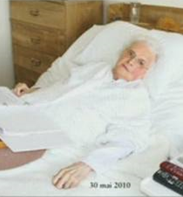
2013:  Visionary Giguère, old and bedridden, was supposed to pass away on her birthday, September 14, day of the Holy Cross; the movement keeps low profile.

2015 (April):  Visionary Giguère died at age ninety-three.

2020:   The Amsterdam apparitions were again declared  not to be of a supernatural nature.

FOUNDER/GROUP HISTORY

Marie-Paule Giguère was born in the French Canadian municipality of Sainte-Germaine du Lac-Etchemin (sixty miles southeast ofQuebec) on September 14, 1921. Despite an early wish to live a celibate religious life, she was advised against that course by the Church. In 1944, she married Georges Cliche (1917- 1997 ) who worked at various jobs and also went into local politics. In 1948, they moved to the town Saint-Georges de Beauce. A life full of sickness and suffering for both her and her husband ensued. Her marital life proved to be so problematic (a “nightmare” in her words) that it led to a divorce in 1957 and an out-of-home placement of her five children (André Louise, Michèle, Pierre, and Danielle). However, much later, after she had established the Army of Mary, she partially reconciled with her husband when he became a member of the movement. Meanwhile, while trying to overcome her traumas by giving a place to the celestial voices she had been hearing since she was twelve, Giguère was increasingly drawn into Marian spirituality and devotionalism. Although Giguere had been hearing certain “interior voices” since her teenage years, these mystical encounters increased significantly after 1957. The unveiling of her providential destiny, which was first announced to her in 1950, finally took place in 1958. While hearing voices and receiving messages from Jesus Christ and Mary, she started writing down her life story and started interpreting the mystical phenomena she was experiencing. The titles of her autobiographical volumes, such as Vie Purgative (Purgative Life), Victoire (Victory), and Vie Céleste (Heavenly Life), indicate the progressive transformations she experienced.

In her journalistic work for magazines and radio during the 1950’s, she used the pen name Marie-Josée. After 1958, she referred to herself as Marie-Paule (although also sometimes “Mère Paul-Marie”). She established a foundation for moral support to other organizations and to stimulate priestly vocations under the name Mère Paul-Marie.

After participating in a group visit to an existing small Marian shrine on the edge of Lake Etchemin in the evening on August 28, 1971, Marie-Paule received a revelation confirming the necessity of creating an Army of Mary (“Armée du Marie”). She started the new religious community with approximately seventy five like-minded devotees. This new Army of Mary group was meant to be an alternative to the existing Legion of Mary ( Legio Mariae ), the lay Marian world association founded in 1921 in which she had been involved previously. Against the backdrop of the 1960s counterculture and the Second Vatican Council, her new Army required for members to manifest “personal interior reform” toward the traditional devotional trinity: “The Triple White” (the Eucharist, Mary and the Pope) was to be performed in “an authentically Christian way of life” and also in “fidelity to Rome and the Pope.”

Through the appeal of her messages, her charismatic gifts and her vocal and singing capacities, she enthused her followers and established a successful traditionalist grass-roots Marian movement. The next year, in 1972, a Quebec priest, Philippe Roy, joined the movement and became its director.

It was due to the friendship (through their joint Militia of Jesus Christ membership) of Marie-Paule with an important Church official, the Dutch-Belgian Jean-Pierre van Lierde, sacrista/vicar general of the Vatican State and supporter of the Amsterdam apparitions, that Québecqois archbishop Maurice Roy was persuaded to acknowledge the movement in 1975 as a formal pious association of the Church. This move was the result of inattention and eagerness from his side towards religious initiatives in a time of decay of the Church. He neglected – whether or not intentiously – to conduct a proper investigation on the movement’s ideological stance. Presumably due to the fact that the texts with Marie-Paule’s views were not published before 1979, the movement remained under the radar and unknown to those who were responsible to check its compliance with the doctrines of the faith. It has been reported that Van Lierde stimulated both visionaries, Ida and Marie-Paule, to meet each other.

As a consequence of recognition by the Church, the now formalized movement peaked in the following years. In about ten years the movement, stimulated by their own proselytes and official status, the movement started to expand outside Quebec, finding some thousands of devotees (and not more than that) distributed over approximately twenty (Western) countries.

In 1977, due to another revelation to Marie-Paule, the Militia of Jesus Christ was introduced in Canada and connected to the Army of Mary. That year 200 soldiers of the Army also joined the Militia Christi. The Militia, a chivalric neo-order for stimulating Marian devotion and doing social work, was instituted in France in 1973 without approval of the Church. In 1981, Giguère’s Army of Mary movement modernized its name as the Family and the Community of the Sons and Daughters of Mary. Although this renaming seems less offensive, it connected the movement or “Family” provocatively and directly to its leader, Mary (her reincarnation), or Marie-Paule.

The growth of the movement since the 1970’s also quietly generated a strong flow of financial resources. The Quebec community was therefore taken by surprise when in 1983 major land acquisitions and investments took place in and around Lac-Etchemin in order to create a world center for the Army of Mary and its Militia. These expansions created for the sectarian group a closed, supportive, social and ideological habitat, one that was hostile to external world and authorities and one where not only the ideas grew and the mission started but also the religious practice took place. The group not only organized itself internally. It also created a semi-independent geographical zone, the international center, with monastery-like housing facilities, noviciate, retraites (Spiri-Maria-Alma and Spiri-Maria-Pietro), ateliers, guest houses, press office and radio station, in and around Lac-Etchemin, but mainly at the Route du Sanctuaire 626.

“ Misled” by the formal approbation of the Church, a part of the following did not fully realize the implications of the new teachings when they were published. But, from the early 1980s, people became increasingly worried after closely reading the first published volume of Marie-Paule’s Vie d’Amour. In addition, regional authorities and media were alarmed by the building activities of the Army at the edge of the lake, activities that strengthened the idea of an institutionalizing, self-supportive sectarian community. Nonetheless, it was only after a stream of newspaper articles expressing astonishment at what was actually professed in her scriptures that the bishop of Quebec realized his misjudgment and started to take action against the doctrinal deviations. It caused the new archbishop of Quebec to withdraw the approval of his predecessor. On May 4, 1987, he declared the movement schismatic and disqualified it as a Catholic association because of its false teachings. The Vatican judged their doctrine to be “heretical.” To be completely sure, the archbishop-to-be asked Cardinal Ratzinger to have Marie-Paule’s scriptures also screened by the Congregation for the Doctrine of the Faith. In a brief note of February 27, 1987, Ratzinger, too, concluded that the movement was in “major and very severe error.” The particular concern was the idea of the alleged existence of an Immaculate Marian Trinity, in which Mary is no longer just Mother of the Son of God, but the divine spouse of God. As a consequence, the theological exegesis of Marie-Paule’s writing by her “theologian,” Marc Bosquart, was likewise condemned. Hence, the Army was forbidden to organize any celebration or to propagate their devotion for the Lady of All Peoples. Priests from the Quebec diocese who got involved would be removed from their priestly functions, although the penalty of excommunication or condemnation was not yet called for.
Despite all measures, the movement did not seem to decline. On the contrary, its mission continued as members were convinced of the real truth that was revealed to them. In 2001, the media frequently reported that the movement consisted of 25,000 followers. In fact, the movement never reached that size; the movement itself estimated in 1995 that its membership was “several thousand” followers spread over fourteen countries. This included forty brothers/seminarians, forty three priests as The Sons of Mary (“Les Fils de Marie”), and 75 celibate women known as members of The Daughters of Mary (“Les Filles de Marie”). There were convents in Green Valley and Little Rock. Most of the following were located in Canada and the U.S., with a few hundred in the Western part of Europe. For example, in the Netherlands a group of approximately twenty devotees was and is active in a Nijmegen-based prayer group. After the interventions of the Church, many left the movement again, and a smaller group of dedicated followers remained.

2007 seems to have been a pivotal year for the movement. When the movement and its teachings were declared false in March, the group strongly reacted with a series of ceremonial feasts (May 31–June 3). During this period, their own new “pope,” Padre Jean-Pierre, promulgated the dogma of Mary/Lady as Coredemptrix, canonized the group’s first saint, Raoul-Marie, and ordained six priests. As a planned final blow to the movement, the Vatican excommunicated the whole movement in July. Since then, not much seems to have changed in community’s policy, although the various measures did winnow the following and, presumably, reduced its means for mission and propaganda. Following this period, the power of Marie-Paule appears to have declined while the influence of her theologians increased. The teachings became increasingly esoteric and the idea of an alternative Church of John (in place of the “degenerated” Church of Petrus) came into being (Martel 2010). After their excommunication, the core following has become more convinced on the demise of the Roman Church of Petrus and the false path the bishop walks by dancing to the tune of Rome and leaving out the major line within the prayer that was given by the Lady. That line (“the Lady who once was Mary”) demonstrated that Marie-Paule was indeed the incarnated, new Mary and Co-Redemptor.

A passing of bedridden Marie-Paule had been predicted for her birthday on September 14, 2013. The prophecy was based on an
“apocalyptic calculation” of verse 5-6 of the book of Revelation. Her passing was expected to take place 1260 days after the start of the Terrestrial Paradise on April 4, 2010. The day passed peacefully, however.
DOCTRINES/BELIEFS

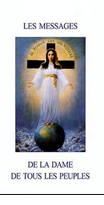
The Community of the Lady of All Peoples regards itself a Catholic movement claiming “ Providential Work with Universal Dimensions.” With this phrasing and by positioning their “Church of St. John” in opposition to the apostolic Catholic tradition of the “Church of St. Peter,” they have distanced themselves from Rome. The group has been declared “non-Catholic” by the Vatican, as it is understood to be a schismatic movement with excommunicated leaders and “heretic” writings. Although it still spreads its theological material, which continues to assert its fidelity to Rome and the Pope, its actual practices are the opposite. The former Army/present-day Community is better understood as a visionary movement with Catholic roots that transformed into a millennial sectarian group with mixed Catholic-esoteric beliefs. They regard their deviating views as Catholic but with “extra” beliefs, for which the Roman Church, they explain, “is not yet ready.”

At the outset, the Army of Mary seemed to be more a new Catholic revival movement reacting to debated modernizations of the Church after the Second Vatican Council. As the role and position of the idiosyncratic visionary and leader Giguère became stronger, especially after her election as Superior-General in 1997, the movement showed more and more characteristics of a sectarian movement. The mystic prose was not focused on God, but became fully centered on Giguère as Mary and/or the Lady of All Peoples reincarnated in her. The Mother (Mary/Marie-Paule) is in their view equal to the Father and of the same nature as Jesus Christ, and so is represented in the Eucharist. Maria has become God for them. Given that position, the theology was not complementary to Christology or Mariology; it was replacement with a completely new doctrine. A growing distinction between adherents and non-adherents to her Vie d’Amour theology came to the surface, leaving less and less space for individual mysticism. New revelations to Marie-Paule, who had first-hand experiences with the divine, changed the movement into a cult of a revelatory kind, where the truth is revealed and individual seekers have to become strict adherents. However, the Army of Mary/Community is in fact not fully a closed cult. The Community has a particularized revealed truth that only partly rejects the paradigms of the Church. It elaborated on the public revelation of the Roman Catholic Church and on fundamental principles, but it started to deviate on some of the basic teachings and the course set out by the Vatican. The Army of Mary claims their teachings overrule verified truth, as mediated by Mary herself and adapted to the modern state of the world, despite their rejection and suppression by the ecclesiastical powers and institutions.

Although Giguère is the divine medium, she did not produce a full exegesis on all dimensions of her mystic experiences. Therefore, two “theologians” were appointed to systematize, elaborate and interpret her mystic writings into a more coherent theology and to elaborate her providential role within the universality of Christianity. This development enhanced the group’s sectarian character. Although the theology is Christian-based, it integrates millennial views, with Marie-Paule as savior (Mary/God), in combination with heretical theological, gnostic esoteric and cosmological teachings. The themes were documented in detail in the research of the movement’s teachings by the Canadian theologian Raymond Martel in 2010 . He described the theology of the Quebec movement as the making of a “Marian gnosis.” In this way the Quebec teachings also deviated from the apocalyptic and end-time interpretations of Hans Baum (1970) for whom the Amsterdam messages are anti-gnostic.

The basis of the theology, redemptive prophecies and eschatology, can be traced to two major sources. The first is Marie-Paule’s scriptures. These include a “revelation” consisting of a series of fifteen volumes titled Life of Love (Vie d’Amour), an auto-biographical and auto-hagiographical corpus of thousands of pages that deals with her life story and mystical experiences. Reading Theresia of Lisieux’s inspirational autobiography, The Story of a Soul (L’histoire d’une âme), and being active as a writer for journals, made Marie-Paule think of putting her life to paper. In 1958, her spiritual superior told her to commence. The text was said to be partly dictated by the Lord himself, not by means of voices or apparitions but by a communication, as she stated, “from spirit to spirit,” initially at the “level of the heart” and later at the level “of the head,” underlining in this way their concurrence. The books form the paradigm and the underpinning of her concept of the Lady of All Peoples and her role within the divine salvific plan. The works also ultimately position Giguère as the embodied appearance of the Lady of All Peoples.

The French Raoul Auclair (1906-1996), radio journalist and author of books on Nostradamus, apparitions, revelations and eschatology (nicknamed “The Poet of the End of the Times”) got notice of the Amsterdam apparitions. By 1966, he had already organized a successful conference on the Amsterdam Lady in Paris where he tried to connect the outcome of the Second Vatican Council on Mary to the Amsterdam messages. He stated that all issues that were brought up during and around the Council had to be interpreted as a confirmation of what was revealed in the Amsterdam messages. The text of the conference was published under the transparent title, La Dame de tous les peuples, and he became the single major international propagandist for the Amsterdam cultus. The French book found its way to Catholic Quebec and was given to Giguère by a friend. After rereading it several times, she recognized the resemblances in the messages she and Peerdeman received and became convinced of the structured connection of both mystic experiences. This idea ultimately brought Auclair and Giguère into contact with each other in 1971. Five years later he joined the Army. In those years, with the Church’s condemnation of the Amsterdam cultus and suppression of its local devotional practice, Marie-Paule’s interest in the Lady of All Nations became stronger. The universality of the Amsterdam messages matched her divine promptings and personal ambitions for a global Marian movement within the Marian era. As a result Marie-Paule wanted to meet visionary Peerdeman. In 1973, 1974 and 1977, she visited the Amsterdam shrine of the Lady of All Nations. Her last visit proved to constitute a new sequel to the Amsterdam apparitions and created an impulse for a shift of the core of cultus to Quebec. Marie-Paule claimed that during mass at the shrine in Amsterdam the visionary Peerdeman pointed at her (Giguère) while saying, “She is the Handmaiden.” This was taken as proof of what was proclaimed in the Lady’s fifty first message, in which Mary announced her return to earth: “I will return, but in public.” This moment was understood to be a recognition of The Lady of All Nations in the person of Giguère by the visionary Peerdeman. Through this maneuver, Marie-Paule retrospectively appropriated the prophesized public return of Mary on Earth ( Messages 1999: 151). Hence, Giguère claimed the devotion of the Lady in Lac-Etchemin to be the sole continuation of the Amsterdam cultus.

RITUALS/PRACTICES

In order to give public access to Our Lady of All Peoples in Lac-Etchemin, a church was built within the international Spiri-Marie Center complex. The complex is more a headquarters of an international movement than a dedicated shrine for the Lady of All Peoples or her reincarnation. In an adjacent building to the church, a big shop where books, images, DVD’s are stacked and show the missionary character of the center. Candles, rosaries and all kinds of other devotional material also can be bought for home use or in the Spiri-church. The morphology of the objects seems to be mainstream Catholic, although the symbolism is adapted to the Community’s teachings. Many of the devotional practices are to a large extent in line with those of the formal Catholic Church. The whole décor of the interior is directly inspired by the “original” Amsterdam shrine of the Lady and its imagery. However, a closer look at the décor also shows the symbolism and texts of the movement’s heretical doctrines. For example, one can pray with a combined image of Jesus and Mary that suggests that Mary is present in the eucharist. The central devotional practice is dedicated to the “Triple White” (the eucharist, the Immaculate Mary, and the Pope) through which the sanctification of one’s soul should be realized, inspire the world and the spread the evangelical message of love and peace in anticipation of the return of Christ. Within the cultus no public Marian apparition rituals are known; all messages and appearances seem to be privately received by Giguère.
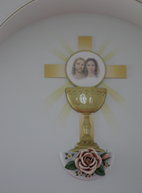

In the Spiri-church, the devotion for the “Quinternity” is presented. The sacred number, 55 555, was introduced into the teachings as the basis for explaining the logic of the Marian Trinity, consisting of the Immaculate Mary, Marie-Paule, and the Holy Spirit. The devotion states that the combination of the Marian Trinity with the classic trinity (the Father, the Son and the Holy Spirit) creates a total of five “elements,” as the Holy Spirit is regarded as the same for both Trinities. This ensemble is said to be one aswell, as the feminine (the immaculate) is also present in God. Their explanation states that the first coming of the Immaculate Mary is symbolized in the first number 5, and the second coming (Marie-Paule) is represented in double five’s. The double fives represents her actions with the “True Spirit,” namely the Holy Spirit of Mary, a work that started in the year 2000 and which will realize the number 555 when it is finished. This will occur when the new millennium has arrived. In the movement’s systematization, the numbers are supposed to connect the cultus to its origins and close the circle. It would place the formation of the cultus in line with what God reportedly prophesied to Giguère in 1958 about her crucifixion and reincarnation, and about the existence of a Marian trinity. The full number of 55 555 then (the Quinternity ) is the symbol of the actions of the Lady of All Peoples with the True (Marian) Holy Spirit. The figure is presented as a holy number that symbolizes future victory over evil (symbolized in the human number of the beast (666)) and the conditional coming of the new millennium (cf Baum 1970:49-63).
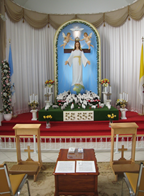
Apart from pilgrimages to the Spiri-Marie center, most of the devotional practices among the adherents take place in the various countries locally within prayer groups. These groups usually meet in informally constructed chapels in houses or garages, as the movement is not allowed to make use of Catholic church buildings. The clean and smooth Spiri-Maria buildings show few decorations and symbolism and do not have burning candles or offerings. An adapted (including a Holy Spirit) painting of the Lady of All Peoples is positioned next to the altar. A sign explains for the visitors the “quinternity.”

ORGANIZATION/LEADERSHIP

New branches have been added to the original Army of Mary since 1980. The present overall Community of the Lady of All Peoples consists of five “works” or branches:

● The Army of Mary (l’Armée de Marie ), established in 1971.
● The Family of Sons and Daughters of Mary (La Famille des Fils et Filles de Marie), established in the early 1980s.
● The Community of Sons and Daughters of Mary (la Communauté des Fils et Filles de Marie) established in 1981. This organization is a religious, pastoral order of priests and sisters, with Marie-Paule as Superior-General since 1997.
● Les Oblats-Patriotes, established in 1986 (August 15). The goal of this organization is renewal of society.
● The Marialys Institute, established in 1992. This organization serves priests who are not part of the Community but share the doctrines.

Those outside of the movement, the media and the Roman Catholic Church, usually still depict the overall movement in a reductionist way as the Army of Mary.

From the beginning, Marie-Paule Giguère has been the central figure. There is considerable information about her past due to her writings. There is less information about her later life as her movement came under pressure, she appeared less often in public, and the group became a more closed sect. Most of the contact with the outside world took place through her assistant, the Belgian sister Chantal Buyse, who also takes care of her hospitalization.

When in 1978 Raoul Auclair moved to Quebec and became the editor of L’Etoile (The Star), the then journal of the movement (since 1982 Le Royaume ), his role as intellectual within the Community started to rise. Ultimately he became the central theologian and interpreter of the movement, for which he was canonized by the Community after his death.

Since 2007, Father Jean-Pierre Mastropietro, wearing a Byzantine crown, has been “acting like a pope” according to the CatholicChurch. Father Jean-Pierre is the head of the Church of John, the Church of Love, which is described by the movement as a “transmutation” of the Roman Church of Peter.
ISSUES/CHALLENGES

As of 2007, the Army of Mary was excommunicated, and the movement has been placed outside the Catholic Church and will not be allowed to return. The question is whether the Roman Catholic Church will fully ignore the movement or will continue to actively oppose it as the Community seems to still be able to contact and attract the “ignorant.” Presumably the Church will take a practical stance and will wait for the death of the visionary who reached the age of 92 in 2013, is half paralyzed, has mentally deteriorated, and lives in “great agony.” It is likely that after the death of the visionary, their leader and reincarnated Mary, the movement will fall into a crisis. However, followers state that then her Church will be taken over by others within the movement.

A second issue is the relation with the Amsterdam-based shrine of the Lady of All Nations, the inspirational apparitional source for Giguère. It had become a formally acknowledged apparitional site through the recognition by Bishop Jozef Punt of Haarlem-Amsterdam in 2002. Both sites and devotions became in competition with one another, while the organization in Amsterdam started, given its official recognition, to distance itself more strongly than ever from Giguère and her movement. Within the movement the number of references to its roots, the Amsterdam visions of Ida Peerdeman of the Lady of All Nations (instead of Peoples) has been reduced to a functional minimum and is usually limited to texts of the messages and the transfer of the status of being chosen from Ida to Marie-Paule. Since, on December 30, 2020 the Congregation for the Doctrine of the Faith in Rome, has also rejected the supernaturality claim by the Amsterdam bishop Jozef Punt. Nevertheless some of Marie-Paule’s following does not reject Amsterdam and its messages, as this is perceived as the basis for Marie-Paule’s church. The Community’s name and its logo are, however, still based on the Amsterdam apparitions. The Spiri-Maria center in Lac-Etchemin still functions as the religious heart of the Giguère-movement. Since the death of its leader in 2015, it has been reduced to the small, tightly organized religious community in Lac Etchemin (with approximately 100 members?) that has retained its infrastructure, but which attracts few devotees from the rest of the world.

REFERENCES

Au Sujet de l’Armée de Marie. 2000. Revue Pastorale Quebec 112, no. 8 (June 26).

Auclair, Raoul. 1993. La fin des temps . Quebec: Ed. Stella.

Baum, Hans. 1970. Die apokalyptische Frau aller Völker. Kommentare zu den Amsterdamer Erscheinungen en Prophezeiungen . Stein am Rhein: Christiana-Verlag.

Bosquart, Marc . 2003. Marie-Paule and Co-Redemption . Lac-Etchemin: Ed. du Nouveau Monde.

Bosquart, Marc . 2003. The Immaculate, the Divine Spouse of God . Lac-Etchemin: Ed. du Nouveau Monde.

Bosquart, Marc. 2002. New Earth New Man . Lac-Etchemin: Ed. du Nouveau Monde.

Communauté de la Dame de Tous Les Peuples. n.d. Accessed from http://www.communaute-dame.qc.ca/oeuvres/OE_cinq-oeuvres_FR.htm on 17 May 2013.

De Millo, Andrew. 2007. “Six Catholic Nuns In Arkansas Excommunicated For Heresy.” The Morning News , September 26, 2007.

“Note Doctrinale des Évêques Catholiques du Canada sur l’Armée de Marie.” n.d. Accessed from www.cccb.ca/site/Files/NoteArDeMarie.html on 17 May 2013.

“Declaration of the bishop of Haarlem-Amsterdam on the Amsterdam and Quebec Devotions.” 2007. Accessed from http://www.de-vrouwe.info/en/notice-regarding-the-qarmy-of-maryq-2007 on 20 May 2013.

“Declaration of the Congregation of the Doctrine of the Faith. 2007 ( July 11). Accessed from www.cccb.ca/site/images/stories/pdf/decl_excomm_english.pdf on 17 May 2013.

Geoffroy, Martin and Jean-Guy Vaillencourt. 2001. ‘Les groupes catholiques intégristes. Un danger pour les institutions sociales?’ Pp. 127-41 i n La peur des sects , edited by Jean Duhaime and Guy-Robert St-Arnaud. Montréal: Editions Fides.

Kruk, Ester. 2003. Zoals sneeuwvlokken over de wereld dwarrelen. De hedendaagse devotie rond Maria, de Vrouwe van Alle Volkeren. Amsterdam: Aksant.

Laurentin, René and Patrick Sbalchiero eds. 2007. Pp. 1275-76 in Dictionnaire des “apparitions“ de la Vierge Marie. Inventaire des origines à nos jours. Méthodologie, bilan interdisciplinaire, prospective . Paris: Fayard.

Marie-Paule [Giguère]. 1979-1987. Vie D’Amour , 15 vols. Lac-Etchemin: Vie D’Amour Inc.

Margry, Peter Jan. 2012. “Mary’s Reincarnation and the Banality of Salvation: The Millennialist Cultus of the Lady of All Nations/Peoples.” Numen: International Review for the History of Religions 59:486-508.

Margry, Peter Jan . 2009a. “Paradoxes of Marian Apparitional Contestation: Networks, Ideology, Gender, and The Lady of All Nations.” Pp. 182-99 in Moved by Mary: The Power of Pilgrimage in the Modern World , edited by Anna-Karina Hermkens, Willy Jansen, and Catrien Notermans. Aldershot: Ashgate.

Margry, Peter Jan . 2009b. “Marian Interventions in the Wars of Ideology: The Elastic Politics of the Roman Catholic Church on Modern Apparitions.” History and Anthropology 20:245-65.

Margry, Peter Jan. 1997. “Amsterdam, Vrouwe van Alle Volkeren.” Pp. 161-70 i n Bedevaartplaatsen in Nederland , volume 1, edited by Peter Jan Margry and Charles Caspers. Hilversum: Verloren.

Martel, Raymond. 2010. La face cachée de l’Armée de Marie . Anjou, Quebec: Fides.

Matter, Ellen A. 2001. “Apparitions of the Virgin Mary in the Late Twentieth Century: Apocalyptic, Representation, Politics.” Religion 31:125-53.

Messages of the Lady of All Nations, The New Edition . 1999. Amsterdam: The Lady of All Nations Foundation.

Paul-Marie, Mère. 1985. Lac-Etchemin. La Famille des Fils et Filles de Marie . Limoilou: Vie D’Amour.

Poulin, Andree, ‘Achats énigmatiques des terrains’, in La Voix de Ste-Germaine , 31 January 1984.

Robinson, Bruce. n.d. “Roman Catholicism. The Army of Mary: An Excommunicated Roman Catholic Group.” Accessed from http://www.religioustolerance.org/army_mary.htm on 9 June 2013.

Le Royaume. Périodique bimestriel christique, marial et oecuménique, organe de formation spirituelle et d’information de la Communauté de la Dame de Tous les Peuples . Accessed from http://www.communaute-dame.qc.ca/actualites-royaume/fr/archives.html.

Post Date:
28 October 2013


Share

Alma White

ALMA WHITE TIMELINE

1862 (June 16):  Mollie Alma Bridwell was born in Lewis County, Kentucky.

1878:  Mollie Alma Bridwell experienced conversion at a Methodist revival service conducted by William B. Godbey.

1887 (December 21):  Mollie Alma Bridwell married Kent White in Denver.

1893 (March 6):  Alma White experienced sanctification after a prolonged quest.

1896 (July 7):  Alma White established her first independent mission in Denver.

1901:  Alma White traveled to Chicago to attend the General Holiness Assembly as well as a meeting sponsored by the Metropolitan Church Association.

1901 (December 29):  Alma White founded the Pentecostal Union, later known as the Pillar of Fire, in Denver.

1902 (March 16):  Alma White was ordained along with another woman and three men as clergy in the Pentecostal Union.

1904 (December 1):  Alma White began a revival in London, England which lasted three months.

1908:  Alma White transferred church headquarters from Denver to Zarephath, New Jersey.

1909 (August 11):  Kent separated from Alma, and they were never reconciled.

1918 (September 1):  Alma White was consecrated by the Pentecostal Union as the first woman bishop in the United States and the Pentecostal Union adopted its church discipline.

1919:  The Pentecostal Union officially became the Pillar of Fire.

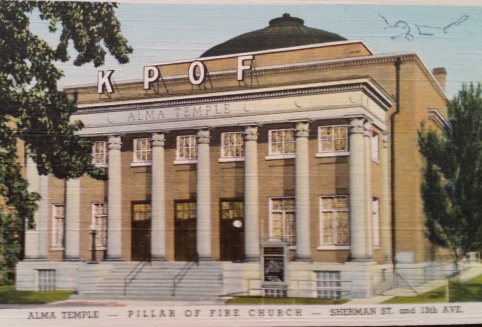
1927:  Pillar of Fire purchased KPOF radio station in Denver.

1931:  Pillar of Fire purchased WAWZ radio station in New Jersey.

1937 (October 31):  Alma Temple in Denver was dedicated.

1946 (June 26):  Alma White died at Zarephath, New Jersey.

FOUNDER/GROUP HISTORY

Mollie Alma Bridwell was one of eleven children born to William and Mary Ann Bridwell on June 16, 1862. She reported an unhappy childhood because she believed her parents had hoped for another boy. She also was compared unfavorably to her sisters who were said to be prettier and smarter.

After earning her teaching certificate and teaching locally for a short time, Mollie Alma Bridwell moved to Montana to teach in 1882 at the invitation of an aunt. After securing an advanced teaching certificate back in Kentucky, she taught in Utah and again inMontana before moving to Denver. On December 21, 1887 she married Kent White, an aspiring Methodist minister whom she had met in Montana in 1883. After completing his studies at University of Denver, he was ordained in 1889.
Mollie Alma White had experienced conversion as a teenager in Kentucky under the preaching of the well-known evangelist William B. Godbey (1833–1920). Later, she understood that sanctification or holiness was a subsequent religious experience that was to be sought following conversion. Holiness was a Methodist doctrine that became the hallmark of the Wesleyan/Holiness movement, which consisted of organizations and denominations that emerged during the nineteenth and twentieth centuries. Despite her prolonged quest, White initially felt that sanctification eluded her. It was not until she followed the teaching of Phoebe Palmer (1807–1874), completely consecrating her life to Christ and claiming the experience by faith, that she was able to claim sanctification on March 18, 1893.

Mollie Alma White believed that sanctification resulted not only in purity of heart by removing inbred sin but that it conferred power for ministry. She called it “the great event of my life, fitting me for the preaching of the gospel” (Alma White 1939:62). The birth of two sons did not deter her from fulfilling her calling to preach. She began preaching later in 1893, first on Kent’s Methodist circuit, and soon branched out by conducting independent revival meetings initially in Colorado and then throughout the West. The doctrine of sanctification became a prominent sermon topic for her.

Dropping her first name, Alma White established her first independent mission in Denver on July 7, 1896. Within two years, she was supervising four other missions in Colorado and Wyoming. On February 1, 1899 she started a religious training school inDenver for her followers. Alma White purchased the property and supervised construction of the building, which seated 1,000 and had thirty-four bedrooms. Adopting the pattern of other Wesleyan/Holiness groups, she founded her own church, the Pentecostal Union on December 29, 1901 with fifty charter members. In 1902 Alma White participated in services in New England with the Burning Bush, the popular name of the Metropolitan Church Association, whose leaders she had met in Chicago the prior year. They cooperated in other services in Illinois, Iowa, California, Texas and London until they parted ways in a dispute over land in 1905. Alma White persevered, securing property in New Jersey. There, she established Zarephath, which replaced Denver as church headquarters in 1908.
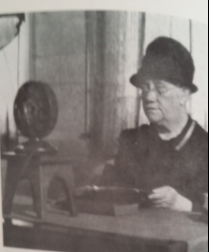
Alma White had been ordained in 1902 in the Pentecostal Union. The possibility of ordination had been one reason for leaving Methodism. This represented a major milestone because the Methodist Episcopal Church did not ordain women at the time and refused to grant women full ordination rights until 1956. The Pentecostal Union recognized her leadership by consecrating her as bishop on September 1, 1918, making her the first woman bishop in the United States. At this time, the church adopted its book of discipline, which regulated church life. While the name Pillar of Fire was used as early as 1904 with the publication of Pillar of Fire magazine, the church did not officially change its name to Pillar of Fire until 1919.

Alma White continued to purchase properties for branches throughout the country. She also bought a 100-room estate inLondon. Arthur White (1889-1981), Alma’s son, stated in 1948, “some 50 branches of the society were organized” (Arthur White 1939:391). An unpublished list itemized 82 properties including buildings and lots purchased between 1902 and 1946. There were approximately 5,000 members at the church’s height. By 1940 the church sponsored eighteen private Christian schools throughout the United States. The outreach of Pillar of Fire extended to the acquisition of radio stations in Denver and New Jersey. Publications were also an important aspect of the church’s outreach. White wrote more than thirty-five books and edited six magazines. She played an active role in the leadership of the church, preaching until shortly before her death on June 26, 1946. Her son Arthur led the church until 1978 when his daughter, Arlene White Lawrence (1916–1990), took over, serving as president and general superintendent until 1984.

TEACHINGS/DOCTRINES

While Alma White rejected the Methodist Episcopal Church, she maintained allegiance to the doctrines she identified as old-fashioned Methodism. Prominent among these was the belief in sanctification or holiness, also known as the second work of grace. John Wesley (1703–1791), the founder of Methodism, had promoted the experience as occurring after conversion, the first work of grace, which was when seekers confessed their sins and accepted Christ’s forgiveness. Wesley taught that holiness resulted in death to sin and a life of love modeled after Christ. Phoebe Palmer popularized the doctrine in the United States through her writings and preaching. Alma White adopted Palmer’s understanding of the means of achieving holiness even though she did not acknowledge this indebtedness. This theology places the Pillar of Fire in the Wesleyan/Holiness tradition.

Alma White rejected modernist theology as did fundamentalists. However, she did not share the fundamentalist doctrines of predestination, inerrancy or biblical prophecy with respect to end times. Another difference from the fundamentalists, illustrated by her view of conversion and sanctification, was that experience took priority over reason as a source of theology.

Alma White espoused an anti-worldly posture toward the surrounding society. Despite her emphasis on separation from the world, she contributed a vitriolic voice to the anti-Catholic movement, understanding her nativism as an expression of patriotism. She formed an unholy alliance with the Ku Klux Klan, primarily to further her agenda of promoting “100% Americanism.” One of her magazines, Good Citizen, was dedicated to “exposing political Romanism [Catholicism] in its efforts to gain the ascendancy in the United States” (White 1935-1943 3:293).

Alma White also departed from her commitment to separation from the world by promoting feminism, not only in the church butalso in the public arena. She promoted a standard definition of feminism: “In every sphere of life, whether social, political, or religious, there must be equality between the sexes” (“A Woman Bishop” 1922). Like other Christian feminists, she maintained that Jesus was “the great emancipator of the female sex.” Believing women’s equality was God’s will, she listed the religious and political equality of the sexes as a part of the Pillar of Fire creed (White 1935-1943 5:229). She documented a biblical precedent for her views, quoting from the story of Pentecost (Acts 2), Paul’s statement of equality in Galatians 3:28, and offering a litany of women in the Bible who operated outside the patriarchal women’s sphere. She supported suffrage for women. Pillar of Fire became the first religious group and one of the first organizations to endorse the Equal Rights Amendment when it was introduced by the National Woman’s Party in 1923. Alma White established the magazine Woman’s Chains in 1924 as a forum for her feminist message.
RITUALS/PRACTICES

Alma White’s anti-worldly position manifested itself most notably in Zarephath, which became a self-sustaining community. Pillar of Fire branches also provided housing for its workers. They operated on “the faith line” by relying on unsolicited donations to support their work rather than seeking money to pay their bills. Separation extended to requiring followers to give up secular employment and work solely for the church. Pillar of Fire presses published their own books and magazines, which members sold door to door.

Worship was not confined to church buildings. Alma White and her followers conducted tent meetings and open-air street meetings. They engaged in parades to attract a crowd, which they would then lead to the branch where they would conduct a church service.

In its early years, the Pentecostal Union received attention for its exuberant worship. Newspaper reporters documented the jumping that took place during worship services, soon giving the group the nickname “Jumpers.” Alma White initially embraced the designation but, when the Pentecostal movement emerged in 1906, she soon abandoned the term to avoid identification with Pentecostalism, which had become known for its lively worship style and speaking in tongues. The name “Pentecostal Union” continues to cause confusion with people assuming that Alma White and her group spoke in tongues. However, she chose the name prior to the emergence of the Pentecostal movement and never advocated speaking in tongues.

LEADERSHIP

When a reporter asked Alma White about her leadership style, she responded, “my word is final.” The reporter accurately concluded that she was “a dominating personality with no nonsense about her, she rules her people with a beneficent hand” (“A Jersey Bishop” 1926). Alma White closely supervised her branches. From the first land purchase in Denver, she personally handled the myriad details associated with property acquisitions, never relinquishing power of attorney to someone else. She closely oversaw building construction of branches.

Alma White frequently visited her church’s branches to monitor their activities. Her comprehensive supervision of her followers extended far beyond ministerial placement. For instance, one member noted that Alma White had admonished members to spend thirty minutes outdoors daily (Huffman 1908). Most members did not seem to mind her far-reaching control over their lives.

ISSUES/CHALLENGES

In her early years of preaching, Alma White faced opposition from Methodist clergy who questioned her right to preach because she was a woman. She was well aware of the sexism that motivated their attempts to restrain her within their notion of woman’s sphere. She remembered, “the pastors said it was a woman’s place to stay home and look after husband and children” (White 1935-1943 2:30). Likewise, they were upset by her renown as an evangelist and her preaching of holiness. She founded Pillar of Fire to escape limitations on her preaching and provide the chance for women as well as men to become ministers. Her ordination symbolized White’s final break from Methodist control.

Kent White’s support of his wife’s ministry was inconsistent. Initially, he opposed the founding of the Pentecostal Union.However, he relinquished his Methodist ministerial credentials and aligned with the group on March 14, 1902, two months after its founding. At times, he championed her preaching, no doubt because it reflected well on his own ministry. On other occasions, he sided with Methodist clergy who opposed his wife. He particularly challenged her preaching on the doctrine of holiness. Sexism more than likely also fueled his opposition. He had expected his wife to play a supportive role in his ministry but she had rejected this status. Instead, she assumed the primary leadership position. He resented being labeled “Mrs. Alma White’s husband” (White 1935-1943 3:144). In 1909, he made good on prior threats to leave, primarily over the issue of speaking in tongues. Alma White refused to embrace this practice despite her husband’s urging. Notwithstanding several attempts, the two were never reconciled. In 1920, Kent White intended to sue Alma White, claiming he was co-founder of the Pillar of Fire and therefore entitled to one-half of the church’s assets. Alma White believed this action was motivated by the Apostolic Faith Church, which Kent had joined in England. She sued him for desertion to make the case that he had no role in the church. While the judge dismissed her case, the information revealed in the trial allowed her to maintain control of her church. Kent’s ongoing efforts to squelch her autonomy in doctrinal issues and church leadership repeatedly failed.

REFERENCES

“A Jersey Bishop on Her Travels.” 1926. Newark News (New Jersey), April 9. 2:73-74 in Alma White’s Evangelism: Press Reports . 2 vols., edited by C. R. Paige and C. K. Ingler, Zarephath, NJ: Pillar of Fire, 1939-1940.

“A Woman Bishop.” 1922. Woman’s Outlook. January. 1:222 in Alma White’s Evangelism: Press Reports. 2 vols., edited by C. R. Paige and C. K. Ingler,. Zarephath, NJ: Pillar of Fire, 1939-1940.

Huffman, Della. 1908. Diary, January 29. Copy in the author’s possession.

Stanley, Susie Cunningham. 1993. Feminist Pillar of Fire: The Life of Alma White. Cleveland, OH: The Pilgrim Press.

White, Alma. 1935-1943. The Story of My Life and the Pillar of Fire. 5 vols. Zarephath, NJ: Pillar of Fire.

White, Alma. 1939. Modern Miracles and Answers to Prayer. Zarephath, NJ: Pillar of Fire.

White, Arthur K. 1939. Some White Family History. Denver: Pillar of Fire.

Woman’s Chains. 1924-1970. Zarephath, NJ: Pillar of Fire.

Post Date:
16 November 2015


Share

Amanda Berry Smith


AMANDA BERRY SMITH TIMELINE

1837 (January 23):  Amanda Berry was born to slave parents, Samuel Berry and Mariam Matthews Berry, in Long Green, Maryland.

1854 (September):  Amanda Berry married Calvin Devine who subsequently fought and died in the Civil War.

1856 (March 17):  Amanda Berry Devine was converted to Christianity.

1865:  Amanda Berry Devine married James Smith and moved to New York City.

1868 (September):  Amanda Berry Smith experienced sanctification at Green Street Methodist Church in New York City.

1869:  James Smith died.

1870 (October):  Amanda Berry Smith began preaching full-time.

1875:  Amanda Berry Smith joined the Woman’s Christian Temperance Union.

1878–1890:  Amanda Berry Smith traveled abroad, preaching and advocating temperance.

1893:  Amanda Berry Smith moved to Chicago.

1899 (June 28):  The Amanda Smith Orphan Home and Industrial School opened in Harvey, Illinois.

1915 (February 25):  Amanda Berry Smith died in Florida and was buried in Illinois.

BIOGRAPHY

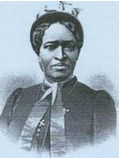
Amanda Berry [Image at right] was born a slave in Long Green, Maryland on January 23, 1837. Her father, Samuel Berry, subsequently bought his freedom and later the freedom of his wife, Mariam Matthews Berry and five children. Amanda’s father was active in the Underground Railroad and their home served as a prominent station. She grew up in Maryland and central Pennsylvania, often working as a servant in other people’s homes. Her formal education consisted of three-months’ schooling. Her parents taught her to read and write. Amanda Berry married Calvin Devine in September 1854. They had one child, Mazie, who was her only child to live to adulthood. Calvin Devine died while serving in the Civil War. Amanda Berry Devine moved to Philadelphia where she continued to do housework and cooking for others. There she met James Smith whom she married in 1865. They moved to New York City where she took in people’s washing and cleaned houses. James Smith died in November 1869, and Amanda Berry Smith never remarried.
Amanda Berry Smith was converted to Christ on March 17, 1856 in the home of her employer. In September 1868 she was sanctified at Green Street Methodist Episcopal Church in New York City with Rev. John Inskip (1816–1884) as pastor. He preached that sanctification occurred instantaneously and was “the blessing of purity like pardon [which] is received by faith” (Smith 1893:77). Pardon referred to conversion while purity was a synonym for sanctification. Inskip’s understanding of sanctification mirrored that of Phoebe Palmer (1807–1874), who also maintained that sanctification resulted from faith.

Amanda Berry Smith attended Phoebe Palmer’s Tuesday Meeting for the Promotion of Holiness in New York City and testified there. She began her public ministry by sharing her experience of sanctification in local churches that were primarily African American. She responded to what she believed was God’s call to “go, and I will go with you” (Smith 1893:132) and commenced full-time evangelistic work in October 1870. She consistently preached holiness, which was the doctrine promoted by the Wesleyan/Holiness Movement.

Smith became a popular preacher on the camp meeting circuit. She was also known for her singing and her testimonies. Her involvement at Palmer’s Tuesday Meeting enhanced her reputation since prominent leaders in the Wesleyan/Holiness Movement heard her there. She began preaching more to white congregations, including the two churches in Brooklyn of Rev. Henry Ward Beecher (1813-1887) where she held week-long services.

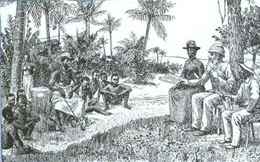
Amanda Berry Smith traveled to England in 1878 to begin twelve years of ministry abroad. Her preaching engagements in England included the Keswick camp meeting. During her time in England, she traveled to Scotland and held services in a Presbyterian church there. She journeyed to India in the fall of 1879 and preached in Methodist Episcopal churches. She returned to England and soon traveled to Ireland where she preached in several denominations. Her next destination was Liberia where she arrived in January 1882.

In Liberia, as in England, she promoted temperance along with her evangelistic campaigns. [Image at right] She had joined the Woman’s Christian Temperance Union (WCTU) in 1875, shortly after it was organized. She played an active role in its meetings, both in the United States and later in England. In Liberia, she urged her listeners to sign a pledge to forego drinking alcohol and organized temperance societies. After eight years, she left Africa, visiting England, Scotland, and Ireland for several months before returning to the United States in September 1890. She maintained her dual emphases on temperance and evangelism, preaching at camp meetings and churches. She traveled to California and Canada before traveling to Great Britain and Ireland in 1893.
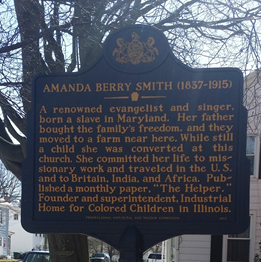
Amanda Berry Smith relied on unsolicited contributions to cover her ministerial and living expenses. In 1894, she began to play an active role in raising money for a home she envisioned for black orphans in Chicago. She did so while maintaining her busy preaching schedule. The Amanda Smith Orphanage and Industrial Home for Abandoned and Destitute Colored Children opened in 1899. She continued to solicit funds for the orphanage while preaching at revivals, camp meetings and temperance gatherings.

Amanda Berry Smith moved to Florida in 1912 to live in a home provided by a supporter. She died there on February 25, 1915. [Image at right].

TEACHINGS/DOCTRINES

Amanda Berry Smith’s theological emphasis was sanctification or holiness. Other than conversion, she did not address the other doctrines of Methodism that she had affirmed as a member of the African Methodist Episcopal Church. Her experience of achieving holiness paralleled Phoebe Palmer’s description of the means of holiness. This involved consecration and faith followed by the conviction that since the Bible promised holiness, all a Christian must do is claim the biblical promise to have the experience.

In her preaching, Smith focused on the results of holiness more than the means of holiness. She testified to the fact that holiness helped her overcome a “man-fearing spirit” (Smith 1893:111) and enabled her to tell others about her sanctification even when she faced opposition. Power was a manifestation of holiness. Like Palmer, Smith relied on the Holy Spirit’s power in her ministry and preached for the power of Pentecost to be manifested in the present.

While some adherents appeared to believe that experiencing holiness indicated the completion of the spiritual journey, Amanda Berry Smith contended that holiness entailed growth: “There is much of the human nature for us to battle with, even after we are wholly sanctified”(Smith 1893:119–20). She spoke of multiple baptisms of the Holy Ghost rather than one all-encompassing experience.

Amanda Berry Smith was one of the few to examine the relationship between prejudice and holiness. “If they are wholly sanctified to God . . . all their prejudices are completely killed out” (Smith 1893:423). She believed that purity imparted by holiness removed prejudice from the heart of the believer. A clean heart that resulted from sanctification was devoid of prejudice, which Smith clearly believed was a sin. However, she did concede that sometimes there was the need for growth when a sanctified individual still harbored prejudicial attitudes.

ISSUES/CHALLENGES

Amanda Berry Smith disclosed numerous instances of racism she encountered in her ministry. Traveling to engagements required negotiating segregated facilities. She could never be sure if there would be a place en route where she could get a meal or find a place to stay overnight. Once she was taking an omnibus to her destination. Since she was not allowed to ride inside, she sat outside on the top. The vehicle discharged all the white passengers before blacks could get off, even when this meant backtracking (Smith 1893:153).

Adrienne Israel, Smith’s biographer, maintained that the holiness movement contributed to Smith’s success as an evangelist. She credits “the egalitarian thrust of the holiness revival that temporarily crossed boundaries of race, gender, and class, bringing together society’s disparate groups in camp meetings and other kinds of protracted revival meetings” (Israel 1998:154). Holiness worship services were among the few places that provided opportunities for blacks and whites to meet together. Even this supportive climate was not immune to the prejudice prevalent in society, however. Sometimes, the congregational seating was segregated by race. At one camp meeting, Smith wondered if she would be allowed in the dining tent. Her concern turned out to be unfounded but it does indicate that there were probably other instances where this had been the case (Smith 1893:173–74).

Amanda Berry Smith did not shy away from the issue of prejudice. When someone who was apparently white insisted that no one would treat her unkindly, she responded: “But if you want to know and understand properly what Amanda Smith has to contend with, just turn black and go about as I do, and you will come to a different conclusion” (Smith 1893:116). She likewise refused to succumb to the inferior status that others sought to impose on her. She referred to herself as one of “the Royal Black” (Smith 1893:118). She was a charter member of the Illinois NAACP (Israel 1998:154), which was founded in 1909. She deserves to be listed among the forerunners of the civil rights movement.

Amanda Smith also encountered sexism as a woman preacher. Adversaries quoted the scriptural admonition to “Let your women keep silent in the churches” (1 Cor. 14:34) in their attempts to inhibit her ministry. She sought to avoid arguments with opponents of women ministers and relied on divine ordination to validate her ministry: “[God] had indeed chosen, and ordained and sent me” (Smith 1893:159). Her denomination, the African Methodist Episcopal Church, did not grant women full ordination privileges until 1948. While lacking denominational credentials, Smith benefited from the support of male clergy and other church leaders. The Wesleyan/Holiness Movement’s affirmation of women preachers also provided a positive climate for her ministry. A historical roadside marker in Shrewsbury, Pennsylvania where she lived growing up attests to her prominence as an evangelist. However, it mistakenly identifies the location of her conversion experience.

IMAGES
Image #1: Photograph of Amanda Berry Smith. Taken from the Illinois State Historical Library collection.
Image #2: Sketch of Amanda Berry Smith on mission in Liberia with Methodist Episcopal Bishop William Taylor.
Image #3: Photograph of a historical marker honoring Amanda Berry Smith. The content on the marker, however, is incorrect.

REFERENCES

Israel, Adrienne M. 1998. Amanda Berry Smith: From Washerwoman to Evangelist. Lanham, MD: Scarecrow Press.

Smith, Amanda. 1893. An Autobiography: Amanda Smith. Chicago: Meyer.

Post Date:
8 April 2016


Share

Women Founders, Leaders, and Pioneers


A

B

C

D

E

F

G

H

I

  • Fadia Ibrahim
    (Primary listing: Religious and Spiritual Movements)

J

K

L

M

N

P

R

S

T

U

V

W

Z


Share

Saints and Goddesses

    WRSP PROFILES OF RELATED INTEREST


    Share

    Santa Muerte

    Santa Muerte Slideshows

    The Many Representations of Santa Muerte: A Slideshow
    Photographer: Fabiola Chesnut
    Post Date: 10/09/2013

    Santa Muerte Shrines: A Slideshow
    Photographer: Fabiola Chesnut
    Post Date: 10/09/2013

    Santa Muerte Devotees: A Slideshow
    Photographer: Fabiola Chesnut
    Post Date: 10/09/2013

    Media Coverage of Santa Muerte in the Huffington Post

    R. Andrew Chesnut and David Metcalfe, “Mexico’s Trinity of Death: Santa Muerte, Day of the Dead and Calavera Catrina”
    Post Date: 10/24/2013

    R. Andrew Chesnut, “Santa Muerte: The Skeleton Saint’s Deadly American Debut”
    Post Date: 10/24/2013

    R. Andrew Chesnut, “Santa Muerte and Black Magic Murder on the Border”
    Post Date: 10/24/2013

    R. Andrew Chesnut, “Death to Santa Muerte: The Vatican vs. the Skeleton Saint”
    Post Date: 10/24/2013


    Share

    Fundamentalist Latter-Day Saints


    ]]>]]>]]>]]>

    THE FUNDAMENTALIST LATTER-DAY SAINTS (FLDS)
    (1843-2002)

    FLDS TIMELINE

    1843 Joseph Smith announced his revelation on plural marriage.

    1862 The U.S. Congress passed the Morrill Anti-Bigamy Act.

    1882 The U.S. Congress passed the Edmunds Anti-Polygamy Act.

    1886 (September 26-27) Fundamentalists claimed that John Taylor received a revelation about the continuation of plural marriage while on the underground.

    1887 The U.S. Congress passed the Edmunds-Tucker Act.

    1890 (October 6) Wilfred Woodruff announced a Manifesto forbidding plural marriage.

    1904-07 Hearings were held in the U.S. Senate on the seating of Reed Smoot as Senator from Utah.

    1904 (April 6) A second Manifesto was issued by Joseph F. Smith that threatened excommunication for LDS members who engaged in plural marriage.

    1910 LDS Church began a policy of excommunication for new plural marriages.

    1929-1933 Lorin C. Woolley created the “Priesthood Council.”

    1935 (September 18) Lorin C. Woolley died, and Joseph Leslie Broadbent became head of the Priesthood Council.

    1935 Broadbent died, and John Y. Barlow became head of the Priesthood Council.

    1935 Truth magazine began publication.

    1941 Leroy S. Johnson and Marion Hammon were ordained to the Priesthood Council by John Y. Barlow

    1942 The United Effort Plan Trust was established.

    1944 (March 7-8) The Boyden polygamy raid was conducted.

    1949 (December 29) John Y. Barlow died, leading to a succession crisis in the Priesthood Council.

    1952 The Priesthood Council split when Joseph W. Musser announced that Rulon Allred would become a new member. Result was two factions: the FLDS (Leroy S. Johnson) and the Apostolic United Brethren (Rulon Allred).

    1953 (August 16) In the case of In re Black the U.S. Supreme Court held that polygamous parents have no rights as parents.

    1953 (July 26) The raid on the polygamist community at Short Creek was conducted.

    1954 (January 12) With Joseph Musser’s death, Rulon Allred became the head of the Priesthood Council.

    1985 Colorado City was incorporated.

    1986 Fundamentalist Church of Jesus Christ of Latter-day Saints organized.

    1986 (September 26) J. Marion Hammon dedicated Centennial Park (new intentional community formed by the Second Warders).

    1986 (November 25) Leroy S. Johnson died, and Rulon T. Jeffs became the FLDS leader.

    2002 (September 8) Rulon Jeffs died.

    FOUNDER/GROUP HISTORY

    Mormon fundamentalism originated in the teachings of the Latter-day Saint Prophet, Joseph Smith, who introduced the doctrineof a plurality of wives to a select group of his followers in the 1840s. By the time of his death in 1844, according to scholar George D. Smith’s analysis, at least 196 men and 717 women had entered the practice privately (Smith 2008:573-639). His vision for the “new and everlasting covenant of marriage” became part of LDS scripture on July 12, 1843 with the 132 nd section of the Doctrine and Covenants. He positioned the uniquely Mormon interpretation of the significance of marriage, in the restoration of the model of Abraham, Isaac and Jacob. According to the revelation, “Celestial marriage” was marriage for time and eternity. Men with priesthood authority had the power to seal men and women for eternity. Essential for the highest level of salvation in what Smith described as the “Celestial” kingdom, Smith interpreted plural marriage “as a uniquely exalted form of ‘celestial marriage’—the ‘further order’ of the patriarchal order of marriage mentioned in Doctrine of Covenants” (Bradley 1993:2)

    The next three presidents of the LDS church were also polygamists. Brigham Young, John Taylor and Wilford Woodruff led a church that had at its center the doctrine of plural marriage. As prophet and president of the Church of Jesus Christ of Latter-day Saints, Brigham Young expanded the practice of plurality, married at least fifty-five women himself, and had fifty-seven children (Johnson 1987). Like Young, President John Taylor and Wilford Woodruff continued to tie the Mormon concept of salvation and the afterlife to the doctrine of plural marriage. With the 1890 Manifesto, the church began a multi-year process of ending the official practice of plural marriage among the Latter-day Saints.

    Despite LDS claims to priesthood authority or the revelatory origins of the doctrine, the federal government fought the church and its practice of plural marriage through the second half of the nineteenth century. After the public announcement of the practice by Apostle Orson Pratt from the pulpit in front of an Utah audience of thousands of Latter-day Saints, the Congress passed a series of bills designed to limit the practice, punish those who continued to violate the law, and ultimately to damage the church corporation itself. These included the Morrill Anti-Bigamy Act of 1862, the Poland Act of 1874, the Edmunds Act of 1882, and, finally, the Edmunds-Tucker Act of 1887. During the 1880s and the federal pursuit of polygamists, men and women went on the “underground” to avoid arrest, hiding in Arizona, Nevada, Idaho and throughout Utah. Church president John Taylor went into hiding in January, 1885 and died two years later on the underground (Bradley 1993:5).

    In important ways, the story of the FLDS begins with the 1890 Manifesto. President Wilford Woodruff introduced the Manifesto at the October semiannual conference of the Church. Eventually included in the Doctrine and Covenants, it was initially essentially a press release. It denied that the LDS church advocated continuing in the practice of plural marriage, stating that “We are not teaching polygamy or plural marriage, nor permitting any person to enter into its practice….” It went on to assert:

    Inasmuch as laws have been enacted by Congress forbidding plural marriages, which laws have been pronounced constitutional by the court of last resort, I hereby declare my intention to submit to those laws, and to use my influence with the members of the Church over which I preside to have them do likewise….I now publicly declare that my advice to the Latter-day Saints is to refrain from contracting any marriage forbidden by the law of the land (Doctrine and Covenants).

    The impact of the Manifesto was neither absolute nor swift in causing plural marriages to cease. In fact, for the next two decades at least 250 new marriages were performed in secret in the Salt Lake Valley, the Canadian or Mexican colonies or in other areas throughout the church (Hardy 1992:167-335, Appendix II).

    During the U.S. Senate hearings over the confirmation of Utah Senator Reed Smoot between 1904-1907, plural marriage surfaced again as a national issue. Smoot was not himself a polygamist, but the issue was whether he would be loyal to the laws of the United States or those of his church. In response to this new pressure, President Joseph F. Smith in April conference, 1904 announced the “Second Manifesto” that added the threat of excommunication to those who failed to follow the prohibition against plural marriages. The document decried allegations that new marriages had occurred “with the sanction, consent or knowledge of the Church” (Allen and Leonard 1976:443).

    President Smith framed the discussion with reference to the church’s patriotism and particularly the importance of the guarantee of freedom of religion. “What our people did in disregard of the law and the decisions of the Supreme Court affecting plural marriages,” he said, “was in the spirit of maintaining religious rights under constitutional guarantees, and not in any spirit of defiance or disloyalty to the government.” Importantly, “the Church abandoned the controversy and announced its intention to be obedient to the laws of the land” (Clark 1965-75:4:151).

    Regardless of the Second Manifesto, considerable ambiguity still existed in the church over the issue of plural marriage. Marriages continued to be performed without the official sanction of the Church president and sometimes by General Authorities of the church. A significant tightening of the policy and punishment for disobedience of the prohibition occurred during the 1910s under presidents Joseph F. Smith and Heber Grant. Church President Grant spoke publicly about priesthood authority, and clarified the official LDS position, asserting that the “keys” rested only in the prophet and in the Church (Bradley 1933:13).

    Although Short Creek, Arizona became publicly identifiable in 1953 with the Arizona raid on its polygamous community, settlers first came to the area in the 1910’s. Nestled in the stark desert landscape at the base of the Vermillion Cliffs, beginning in the late 1920s, Short Creek became the home to polygamists seeking refuge from persecution from the world outside. When John Y. Barlow became senior member of the Priesthood Council and fundamentalist leader, he encouraged his followers to gather at Short Creek. Practicing the principle of the gathering, like mid-nineteenth century Latter-day Saints, true believers formed communities apart from the mainstream where they could continue in their practice of a plurality of wives. It is estimated that forty families settled in the isolated landscape of the Arizona strip country.

    In 1935, the LDS church excommunicated Short Creek polygamists, Price W. Johnson, Edner Allred, and Carling Spencer. While Barlow was absent from his leadership role and visiting with fundamentalists throughout the region, Joseph Jessop, and later his son, Fred Jessop, guided social life in Short Creek and helped with economic growth and development. The Barlows, Jessops and Johnsons became closely connected through religious and community ties through the 1940s and 1950s.

    In 1944, in the first mass arrest of polygamists, federal and state officials arrested fifty men and women in both Utah and Arizona. The Boyden Raid executed charges of conspiracy, Mann Act and Lindberg Act violations. Eventually, fifteen men served in the Utah State penitentiary before signing a loyalty oath that allowed some of them to return to their families before their terms had transpired (Bradley 1993:79).

    On July 26, 1953, the government of Arizona raided the polygamous community of Short Creek. As more than 100 vehicles of the state rolled over the rocky roadbeds leading into town, Governor Howard Pyle justified the raid over the radio, announcing his fight against “insurrection within [ Arizona’s] own borders,” with the intent “to protect the lives and future of 263 children . . . . the product and the victims of the foulest conspiracy . . . . a community dedicated to the production of white slaves. . . . degrading slavery.” He elaborated further on this theme.

    Here is a community—many of the women, sadly right along with the men—unalterably dedicated to the wicked theory that every maturing girl child should be forced into the bondage of multiple wifehood with men of all ages for the sole purpose of producing more children to be reared to become mere chattels of this totally lawless enterprise.

    As the highest authority in Arizona, on whom is laid the constitutional injunction to ‘take care that the laws be faithfully executed,’ I have taken the ultimate responsibility for setting into motion the actions that will end this insurrection (Pyle 1953).

    More than one hundred Arizona state officials brought with them the warrants for thirty-six men and eighty-six women. Thirty-nine of the warrants were for individuals who lived on the Utah side of town. The charges included: rape, statutory rape, carnal knowledge, polygamous living, cohabitation, bigamy, adultery, and misappropriation of school funds (Bradley 1993:131). The raid sought to “rescue 263 children from virtual bondage under the communal United Effort Plan,” according to Attorney General Paul LaPrade. “The principle objective is to rescue these children from a life-time of immoral practices without their ever having had an opportunity to learn of or observe the outside world and its concepts of decent living” (LaPrade 1953).

    Over the next three days the state set up a magistrate’s court in the schoolhouse at the center of town. The men would be transported for a preliminary hearing in Kingman on August 31, 1953. The state also held juvenile court where Judges Lorna Lockwood and Jesse Faulkner took custody of each child and made them wards of the court. Judges, deputy sheriffs and court photographers visited the homes of polygamous families in Short Creek gathering evidence to support the accusations. On the third day after the raid, the state gave mothers the chance to travel with their children (153 in total) to foster homes in Mesa, Phoenix and other locations nearby where they stayed for the next two years while their cases played out in the court and they appeared before state agencies. Two years after the raid all of the women had returned to Short Creek with the exception of one who had been a minor at the time of the raid, but who returned once she was legally old enough to do so.

    Utah took a different tack in attempting to dismantle plural families. Judge David F. Anderson, of Utah’s Sixth District Juvenile Court in St. George, Utah devised a legal tactic that attacked the alleged neglect of the children of polygamous children. Although Anderson filed twenty different petitions alleging that eighty children had been neglected, he chose to make Vera and Leonard Black a test case of the legitimacy of this approach. The polygamous couple had eight children together by 1953. Anderson depended on Section 55-10-6, Utah Code Annotated, 1953 for the definition of neglect: “A child who lacks proper parental care by reason of the fault or habits of the parent, guardian or custodian….A child whose parent, guardian or custodian neglects or refuses to provide proper or necessary subsistence, education, medical or surgical care or other care necessary for his health, morals or well-being. A child who is found in a disreputable place or who associates with vagrant, vicious, or immoral persons.”

    The case, In Re Black , moved through the courts for almost two years, eventually in 1955 ending up on appeal at the Utah Supreme Court. In 1955, the Court upheld the decision of the lower court against the mother, concluding that polygamists have no right to the custody of their children. The majority opinion stated: “the practice of polygamy, unlawful cohabitation and adultery are sufficiently reprehensible, without the innocent lives of children being seared by their evil influence. There can be no compromise with evil” (Driggs 1991:3) After staying in foster care for three years, Vera gained custody of her children, but only after she signed an oath denying she believed in plural marriage (Bradley 1993:178).

    Estimates of the number of individuals practicing plural marriage in the late twentieth century, ranged from thirty to fifty thousand. Before he died, polygamist Ogden Kraut estimated that “there are probably at least 30,000 people who consider themselves Fundamentalist Mormons, espousing at least the belief in the doctrine of plural marriage” (Kraut 1989). Historian Richard Van Wagoner also estimated 30,000 fundamentalists in 1986 (Van Wagoner 1992). In 2009, Melton offered the same estimate (Melton 2009:650). Since its inception among the Mormons in the 1840s, the practice of a plurality of wives has proceeded beneath the surface in a private, subterranean world protected by religious ritual and belief, behavior and life practice, and sometimes, as in the case of Short Creek, Arizona, by the protection provided by the natural world.

    DOCTRINES/BELIEFS

    The FLDS believe in the core doctrines of the nineteenth century Church of Jesus Christ of Latter-day Saints, including the Principle (the doctrine of plural marriage), consecration and stewardship (a type of communal organization), the plurality of Gods (the potential for every righteous man to become a God in the afterlife), and the right of a prophet to receive revelations from God. Many describe the LDS Church as God’s church and some participate in LDS temple rituals, serve LDS missions or pay tithes in LDS wards before they are excommunicated for their polygamous beliefs or life style.

    Although outsiders commonly describe Mormon fundamentalists as polygamists, the FLDS themselves use a variety of terms to describe their unique practice of a plurality of wives: “the Principle,” “Celestial Marriage,” the “New and Everlasting Covenant,” “plural marriage,” or the “Priesthood work” (Quinn 1993:240-41).

    The principal point of division between the FLDS and the Church of Jesus Christ of Latter-day Saints is over priesthood authority. The fundamentalists believe that the LDS Church moved off course with the 1890 Manifesto and eventually lost priesthood authority to perform Celestial marriages. The FLDS believe that a plurality of wives is a core doctrine of the Church of Jesus Christ of Latter-day Saints, essential to salvation and a sign of individual righteousness. Moreover, the FLDS recognize priesthood authority in their own leadership, authority they trace to 1886 through the narrative of Lorin C. Woolley. Woolley claimed that in 1886 President John Taylor was living in Centerville, Utah on the underground hiding from federal officials. He reported being was visited by the Prophet Joseph Smith and pledging that he would “suffer my right hand to be cut off” before he would sign a document ordering the desertion of plural marriage (Musser 1934). According to Joseph Musser’s 1912 account, Taylor allegedly instructed Woolley and the other men present: George Q. Cannon, L. John Nuttall, John W. Woolley, Samuel Bateman, Daniel R. Bateman, Charles H. Wilkins, Charles Birrell, and George Earl to continue the practice of plural marriages. If the LDS Church abandoned the practice, or the “Principle,” a smaller group of five men—Cannon, Wilkins, Bateman, John W. Woolley, and Lorin C. Woolley would carry priesthood authority forward to perform plural marriages and could ordain others to do the same (Bradley 1993: 19). By 1929, Woolley was the only one of these men still alive. He transferred the same priesthood power to a select group in the “Council of Friends or the Priesthood Council.” These men became the leaders of the movement that would eventually be known as Mormon fundamentalism, former Latter-day Saints who continued in the practice of a plurality of wives.

    For the FLDS, the marriage relationship was the nucleus of a family kingdom. The primary aim of marriage, however, was not love, but a celestial social order. Plural marriage was part of a deferential and hierarchical society strictly ordered along patriarchal lines. The child was subordinate to the mother; the mother bowed to her husband’s authority; he, in turn, looked to the prophet for direction; while the prophet was answerable to and spoke for Jesus Christ. As God was at the head of the world, the husband was the earthly head of the family. The appropriate behavior directed toward one’s superior consisted of deference and obedience. The appropriate behavior directed toward one’s subordinates consisted of instruction, benevolence, and the meting out of either rewards or punishments (Bradley 1993:101).

    Men and women married to “Multiply and replenish the earth.” Sexuality had religious significance and was tied to procreation. Musser taught that “every normal woman yearns for wifehood and motherhood. She yearns to wear the crown of glory. The most precious and yearned for jewels are children to call her mother” (Musser 1948:134).

    Joseph Musser articulated the meaning of the difference between men and women for Truth magazine in 1948: “Thy desire shall be to thy husband, and he shall rule over thee. In placing man at the head, he bearing the Priesthood, a law, an eternal law, was announced.” The roles of men and women were scripturally defined and existed to create social order. “Man, with divine endowments, was born to lead, and woman to follow, though often times the female is endowed with rare talents of leadership. But women, by right, look to the male members for leadership and protection.” According to Musser, women should “respect and revere themselves, as holy vessels, destined to sustain and magnify the eternal and sacred relationship of wife and mother.” Women’s role was related to that of men, as the “ornament and glory of man; to share with him a never fading crown, and an eternally increasing dominion” (Musser 1948:134).

    RITUALS

    The scriptures used by the FLDS are the same as those of the LDS church: the Book of Mormon, the Bible, the Pearl of Great Price and the Doctrine and Covenants. Beliefs such as the plurality of Gods, the Word of Wisdom, the nature of heaven and the afterlife are virtually the same. Both churches are founded on the structure of male, priesthood authority.

    Although many of the religious rituals practiced by the FLDS resemble those practiced by the Latter-day Saints, the tradition of holding Sunday School in private homes where the sacrament is served, rather than in the meetinghouse, is one significant difference. The Johnson meetinghouse at the center of the community in Colorado City is the size of two LDS stake centers and is the backdrop for group worship services, community dances, and community business meetings. The central meeting space holds an audience of between 1,500 and 2,500. Also, the FLDS hold worship meetings throughout the week as was true in the nineteenth century LDS church. Like the LDS, fundamentalists wear sacred priesthood undergarments and choose modest clothing over modern popular styles.

    Priesthood leaders, and ultimately the group’s prophet, arrange marriages among the FLDS in a practice called placement marriage. One plural wife commented that “we were raised believing that the Priesthood [Council] would choose our mate and that we were not to allow ourselves to fall in love with anybody,” and another FLDS youth said “In our group we don’t date” (Quinn 1992:257). The church president and leader of the Priesthood Council prays for God’s instruction about marriage partnerships. For the FLDS, arranged marriages create social stability and a sense of familial structure that has eternal significance.

    The FLDS family is strictly patriarchal, although in the day-to-day life of a family women play key economic and social roles. Many have a high degree of functional autonomy. There are multiple styles of housing for families in FLDS communities. Some families prefer to have all of the wives and their children in the same household and other have multiple households for different mothers and their children. Colorado City/Hildale and Centennial Park are distinguished by the number of large-scale family homes. Local architect, Edmund Barlow, in 2003 suggested that as homes became larger in terms of square footage, they had to accommodate housing codes for apartment units. Large families with multi-families under a single roof built Sunday School rooms for family worship in their homes.

    Joseph Smith revealed the principle of consecration and stewardship to the nineteenth century church. In Utah, the “United Order” functioned as an intentional community and the expression of religious ideals. Under the United Order, members consecrated property and received a stewardship that obligated them to use resources for the good of the group as well as the individual. Under Barlow’s leadership, the Priesthood Council in 1936 formed the United Trust. Besides land, the trust owned a sawmill and equipment used for agriculture “for the purpose of building up the Kingdom of God” (Driggs 2011:88). Six years later, the community dissolved the trust and returned the property. The second attempt at a communal organization of property was the United Effort Plan, which was a property holding or business trust rather than religious organization. At one point, the property in the UEP was valued at more than $100 million and “subject to the disposal of the UEP board or the Priesthood Council (Hammon and Jankowiak 2011:52).

    ORGANIZATION/LEADERSHIP

    The pinnacle of FLDS leadership and organization is the Priesthood Council, which they believe holds authority to perform plural marriages and which is considered higher in authority than the LDS church itself. Members of the group, also called the Council of Friends, are apostles of Jesus Christ or high priest apostles (Hammon and Jankowiak 2011:44). The president of the high priesthood, the senior member of the group, leads the council. According to the fundamentalists, John W. Woolley led the Priesthood Council until his death in 1928. At that time, Lorin Woolley called new members to the council, ordaining four new men as apostles: J. Leslie Broadbent, John Y. Barlow, Joseph W. Musser, and Charles F. Zitting (Hammon and Jankowiak 2011:45). Typically, the senior apostle or president of the council receives a revelation about who will be called to the council, or the Brethren. During these same years, the LDS church distanced itself from the practice of a plurality of wives. The movement eventually known as Mormon fundamentalism organized around those individuals who believed plural marriage was essential to their salvation and questioned both the authority and the course that the LDS church had taken.


    ISSUES/CHALLENGES

    Between the 1930s and the present, educational training has varied. In 1991, the community developed an elaborate plan for “Barlow University,” with a physical plan for a horseshoe loop of educational buildings like that at the University of Utah. Under the leadership of Warren Jeffs in the late 2000’s, parents took their children out of public schools and home schooled them. For decades before that, children attended schools funded with tax dollars including an elementary school, middle school and high school. Many members of the community attended Southern Utah State College at Cedar City to receive their teaching credentials, and according to D. Michael Quinn’s estimate in 1993, 85 percent of the young men and women in the group attended college, including Mohave County Community College that was located in town (Quinn 1993:267). In 1960, Short Creek changed its name to Colorado City/Hildale and built a community school—the Colorado City Academy. Until its closure in 1980, the Academy offered an education grounded in religious instruction as an alternative to public education.

    In 1981, the community of the FLDS divided into two groups over priesthood leadership (priesthood council vs. one man doctrine), different interpretations of private/collective property (entitlements), and social practices (varying degrees of scriptural and social orthodoxy). Known from that time forward as “First Warders” or “Second Warders,” the split created competing and sometimes hostile sects. After 1984, Leroy Johnson led the FLDS under the “one man doctrine” and dismantled the Priesthood Council until the second coming of Christ (Driggs 2011:91). When Rulon T. Jeffs succeeded Johnson as prophet of the First Ward in 1986, the newly organized Fundamentalist Church of Jesus Christ of Latter-day Saints, excommunicated the members of the Second Ward.

    REFERENCES

    Allen, James B. and Glen A. Leonard. 1976. The Story of the Latter-day Saints. Salt Lake City: Deseret Book Company and the Historical Department of the Church of Jesus Christ of Latter-day Saints.

    Bradley, Martha Sontag. 1993. The Government Raids on the Short Creek Polygamists. Salt Lake City: University of Utah Press.

    Clark, James R., ed. 1965-1975. Messages of the First Presidency. Vol. 4. Salt Lake City: Bookcraft.

    Hardy, B. Carmon. 1992. Solemn Covenant: The Mormon Polygamous Passage. Urbana, IL: University of Illinois Press.

    Johnson, Jeffrey Ogden. 1987. “Determining and Defining ‘Wife’ — The Brigham Young Households.” Dialogue: A Journal of Mormon Thought 20:57-70.

    Kraut, Ogden. 1989. “The Fundamentalist Mormon: A History and Doctrinal Review.” Paper presented at the Sunstone Theological Symposium. Salt Lake City, Utah.

    LaPrade, Paul, quoted in Arizona Daily Star. July 27, 1953.

    Melton, J. Gordon. 2009. “Fundamentalist Church of Jesus Christ of Latter-Day Saints.” Pp. 649-50 in Melton’s Encyclopedia of American Religion, 8 th Edition. Detroit, MI: Gale, Cengage Learning.

    Musser, Joseph White. 1948. “The Inalienable Rights of Women.” Truth , 14 October, p. 134.

    Musser, Joseph White. 1934. The New and Everlasting Covenant of Marriage an Interpretation of Celestial Marriage, Plural Marriage. Salt Lake City: Truth Publishing Company.

    “Official Declaration 1.” 1890. Doctrine and Covenants. Salt Lake City, UT, October 6. Accessed from http://www.lds.org/scriptures/dc-testament/od/1?lang=eng on 15 October 2012.

    Pyle, Howard W. 1993. Radio Address. July 26, 1953. KTAR Radio. Phoenix, Arizona.

    Quinn, D. Michael. 1993. “Plural Marriage and Fundamentalism.” Pp. 240-93 in Fundamentalisms and Society: Reclaiming the Sciences, the Family, and Education , edited by Martin E. Marty and R. Scott Appleby. Chicago : University of Chicago Press.

    Smith, George D. 2008. Nauvoo Polygamy: “But We Called It Celestial Marriage.” Salt Lake City, UT: Signature Books.

    Van Wagoner, Richard. 1992. Mormon Polygamy: A History. Salt Lake City, UT: Signature Books.

    ADDITIONAL RESOURCES

    Allred, B. Harvey. 1933. A Leaf in Review. 2d ed. Caldwell, ID: Caxton Printers.

    Allred, Rulon C. 1981. Treasures of Knowledge: Selected Discourses and Excerpts from Talks. 2 vols. Hamilton, MN: Bitterroot Publishing.

    Allred, Vance L. 1984. “Mormon Polygamy and the Manifesto of 1890: A Study of Hegemony and Social Conflict.” Senior Thesis. Missoula, MT: University of Montana.

    Altman, Irwin and Joseph Ginat. 1996. Polygamous Families in Contemporary Society. New York: Cambridge University Press.

    Anderson, J. Max. 1979. The Polygamy Story: Fiction and Fact. Salt Lake City: Publishers Press.

    Baird, Mark J. and Rhea A. Kunz Baird, eds. [ca. 2003] Reminiscences of John W. and Lorin C. Woolley. 5 vols. 2nd edition. Salt Lake City: Lynn L. Bishop.

    Barlow, John Y. 2005. “A Selection of the Sermons of John Y. Barlow, 1940-49.” ebooks@thoughtfactory. B17.

    Batchelor, Mary, Marianne Watson, and Anne Wilde. 2000. Voices in Harmony: Contemporary Women Celebrate Plural Marriage. Salt Lake City: Principle Voices.

    Bennion, Janet. 1998. Women of Principle: Female Networking in Contemporary Mormon Polygyny. New York: Oxford University Press.

    Bistline, Benjamin. 1998. The Polygamists: A History of Colorado City. Colorado City, Arizona: Ben Bistline and Associates.

    Bradley, Martha. 2004. “Cultural Configurations of Mormon Fundamentalist Polygamous Communities.” Nova Religio 8:5- 38.

    Bradley, Martha Sontag. 2012. Plural Wife: The Autobiography of Mabel Finlayson Allred. Logan, UT: Utah State University Press.

    Daynes, Kathryn M. 2001. More Wives Than One: Transformation of the Mormon Marriage System, 1840-1910. Urbana, IL: University of Illinois Press.

    Driggs, Ken. 2005. “Imprisonment, Defiance, and Division: A History of Mormon Fundamentalism in the 1940s and 1950s.” Dialogue: A Journal of Mormon Thought 38:65-95.

    Driggs, Ken. 2001. “This Will Someday Be the Head and Not the Tail of the Church.’” Journal of Church and State 43:49-80.

    Driggs, Ken. 1992. “’Who Shall Raise the Children?’ Vera Black and the Rights of Polygamous Utah Parents.” Utah Historical Quarterly 60:27-46.

    Driggs, Ken. 1991a. “Twentieth-Century Polygamy and Fundamentalist Mormons and Southern Utah.” Dialogue: A Journal of Mormon Thought 24:44-58.

    Driggs, Ken. 1991b. “ Utah Supreme Court Decides Polygamist Adoption Case.” Sunstone 15: 67-8. Accessed from http://www.childbrides.org/politics_sunstone_UT_Supreme_Court_decides_polyg_adoption_case.html on 15 October 2012.

    Driggs, Ken. 1990a. “After the Manifesto: Modern Polygamy and Fundamentalist Mormons.” Journal of Church and State 32:367-89.

    Driggs, Ken. 1990b. “Fundamentalist Attitudes toward the Church as Reflected in the Sermons of the Late Leroy S. Johnson.” Dialogue: A Journal of Mormon Thought 23: 38-60.

    Hales, Brian C. 2006. Modern Polygamy and Mormon Fundamentalism: The Generations after the Manifesto. Salt Lake City: Greg Kofford Books.

    Hales, Brian C., and J. Max Anderson. 1991. The Priesthood of Modern Polygamy: A LDS Perspective. Portland, OR: Northwest Publishers.

    Jacobson, Cardell. 2011. Mormon Polygamy in the United States: Historical, Cultural, and Legal Issues. New York: Oxford University Press.

    Johnson, Leroy S. The L. S. Johnson Sermons, 1983-1984. 7 vols. Hildale, Utah: Twin Cities Courier.

    Kunz, Rhea Allred. 1978. Voices of Women Approbating Celestial or Plural Marriage. Draper, UT: Review and Preview Publishers.

    Kunz, Rhea Allred, ed. 1984. A Second Leaf in Review. n.p.

    Marty, Martin, and R. Scott Appleby, eds. 1991-1995. The Fundamentalism Project. Chicago: University of Chicago Press.

    Musser, Joseph White. 1953-57. Star of Truth. 4 vols. n.p.

    Quinn, D. Michael. 1998. “Plural Marriage and Mormon Fundamentalism.” Dialogue: A Journal of Mormon Thought 311-68.

    Quinn, D. Michael. 1983. J. Reuben Clark: The Church Years. Provo, UT: Brigham Young University Press.

    Solomon, Dorothy Allred. 2003a. Daughter of the Saints: Growing Up in Polygamy. New York: W. W. Norton.

    Solomon, Dorothy Allred. 2003b. Predators, Prey, and Other Kinfold: Growing Up in Polygamy. New York: W. W. Norton.

    Solomon, Dorothy Allred. 1984. In My Father’s House. New York: Franklin Watts.

    Watson, Marianne T. 2003. “Short Creek: ‘A Refuge for the Saints.’” Dialogue: A Journal of Mormon Thought 36:71-87.

    Wright, Stuart A. and James T. Richardson. 2011. Saints under Siege: The Texas State Raid on the Fundamentalist Latter Day Saints. New York : New York University Press.

    Author:
    Martha Bradley-Evans

    Post Date:
    31 October 2012


    Home | About Us |Partnerships |Profiles |Resources |WRSP Authors |Donate |Contact
    Copyright © 2016 World Religions & Spirituality Project• All Rights Reserved

    Web Design by Luke Alexander

    Share