Lance Peng

Dr Lance Peng is a Cornwall-based researcher (Falmouth/Exeter) whose work moves between the human and the more-than-human. His research traces how cyber-marginalised voices, vulnerable agencies and posthuman memory-tech relations give rise to new architectures of care and collective remembering. Grounded in mnemohistory, monster culture and hauntology, his practice explores how the past lingers within contemporary life and cultural production. Cult culture, the curious worlds it opens up and the ways people create meaning and belonging are another of his interests, though he approaches it as an intrigued outsider rather than a specialist in religion or theology.

Share

Night Wolves Motorcycle Club

NIGHT WOLVES MOTORCYCLE CLUB (NWMC) TIMELINE

1983–1989:  Informal motorcycle and rock communities appeared during the late Soviet perestroika era. Aleksandr “Surgeon” Zaldostanov emerged as a leader, and in 1989 the collective formally adopted the name Night Wolves (Nochnye Volki).

1991–1995:  After the Soviet collapse, the Night Wolves expanded nationally as Russia’s leading biker organization. Early gatherings mixed biker culture with patriotic and moral motifs, foreshadowing later Orthodox alignment.

2005:  Orthodox clergy blessed biker rallies in Moscow and Rostov (including Night Wolves participants), marking the start of regular Church–biker ritual interaction.

2006:  Members joined a cross-procession ride through southern Russia, carrying icons and receiving priestly blessings at parish stops.

2009:  The first Sevastopol bike show presented a theatrical blend of Orthodox

ry and WWII commemoration, inaugurating the club’s signature civil-religious spectacle.

2011:  The club received a Patriarchal blessing at the Cathedral of Christ the Savior in Moscow, signaling deeper ritual integration into public Orthodoxy.

2014:  The Sevastopol show “Redemption” fused Orthodox, messianic, and anti-Western symbolism while the club’s patriotic rhetoric rose to prominence in the Crimea context.

2015:  The inaugural “Victory Roads” ride marked the seventieth anniversary of WWII, retracing the route from Moscow toward Berlin through Belarus, Slovakia, Czechia, and Germany (with routes via Austria/Hungary in some years and frequent Polish denials of entry). Blessings, hymns, and icon processions framed the ride as religious-patriotic memory work.

2017–2018:  Foreign activity expanded, including Serbia/Republika Srpska church-linked commemorations and a Slovak chapter at Dolná Krupá, hosting joint ceremonies with Orthodox clergy.

2023–2025:  Scholarship increasingly identified the Night Wolves as a hybrid religio-political actor whose Orthodox symbolism and ritualized memory practices serve civil-religious and influence functions in Russia and abroad..

FOUNDER/GROUP HISTORY

The Night Wolves Motorcycle Club (NWMC) emerged in 1989 from the late-Soviet underground of heavy-metal musicians and motorcyclists who had gathered informally since the early 1980s in Moscow’s “Sexton Club.” Its formation coincided with perestroika and glasnost, when new subcultures were experimenting with moral and civic identities outside official Soviet (Harris 2020; Zabyelina 2019). Scholars identify the NWMC as the first organized biker community in Russia and the nucleus of a distinctive post-Soviet moral subculture (Komarova 2011; Usov 2005).

In its first decade, the NWMC’s ethos combined rebellion, male camaraderie, and patriotism. Usov (2005) interpreted the early 2000s shift in Russian biker culture as a process of “cultural re-baptism,” in which previously secular communities absorbed Orthodox moral language and symbols. The Night Wolves became the leading example of this hybridization, retaining the aesthetics of Western biker brotherhoods while re-embedding them in a discourse of national morality and redemption (Usov 2005:118–22). Komarova (2011) offered one of the first sustained academic studies of the club’s partnership with the Russian Orthodox Church (ROC). She portrayed the Night Wolves as lay participants in a missionary revival that linked Orthodoxy, patriotism, and civic virtue. According to Komarova (2011:527–34), the club’s events (patriotic rides, war-memorial ceremonies, and charitable drives) functioned as “missionary service of the laity,” extending the Church’s reach into secular youth culture.

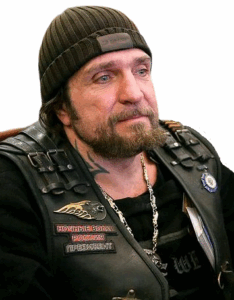
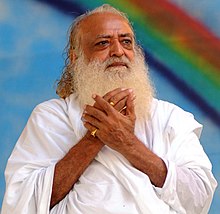
Aleksandr Sergeyevich Zaldostanov, [Image at right] widely known by his moniker Khirurg (“the Surgeon”), trained as a dental surgeon at the Moscow Medical Stomatological Institute before founding the Night Wolves Motorcycle Club in 1989. His nickname, originating from his early medical profession, came to symbolize discipline, healing, and masculine asceticism, traits that would later infuse the club’s self-presentation as a moral order rather than a leisure group (Harris 2020; Losh 2016). Western and Russian scholars alike depict Zaldostanov as a charismatic leader who transformed a marginal subculture into a vehicle of Orthodox-patriotic revival (Molnár et al. 2021; Zabyelina 2019). Under his direction, the club gradually aligned itself with the Kremlin’s civil-religious narrative, blending biker rebellion with Orthodox imagery and state-sponsored nationalism (Harris 2020; Kleiner, Gregor, et al. 2024).

By the early 2010s, Zaldostanov had become a public symbol of “patriotic orthodoxy,” regularly appearing alongside President Putin and receiving ecclesiastical blessings for large-scale biker shows in Sevastopol and Moscow (Losh 2016; Tabor 2015). During Russia’s 2014 annexation of Crimea, he and his followers were reported to have assisted local pro-Russian militias, merging ideological spectacle with logistical participation in hybrid operations (Harris 2020; Shuster 2014). Zaldostanov subsequently co-founded the Anti-Maidan movement to combat perceived Western-backed democratic protests (Walker 2015). His prominence and the club’s role in legitimizing Russian revisionism led to his inclusion on the EU sanctions list for undermining Ukraine’s sovereignty (Council of the European Union 2022).

By the mid-2000s, the NWMC had become an established participant in the ROC’s moral and missionary outreach. Komarova (2014) identified this cooperation as sorabotnichestvo, a partnership of “co-laboring” between clergy and lay activists. In her analysis, the ROC recognized the club’s capacity to reach non-churchgoing youth, especially men, through patriotic events that combined moral discipline with public spectacle. Western scholarship corroborates the institutionalization of this religious partnership. Zabyelina (2019) observes that the Night Wolves openly profess Orthodox belief and regularly seek Patriarch Kirill’s blessing before their long-distance rides, which often resemble pilgrimages to holy sites. She notes that the bikers display Easter symbols such as the letters “ХВ” (Khristos Voskrese, which is Christ is Risen) during public parades and describe the Church as the spiritual guardian of the Russian nation. The recurring blessings, icon processions, and joint commemorations gave the NWMC a measure of ecclesial legitimacy. The partnership transformed its rallies into quasi-liturgical processions where national history, Kremlin´s narratives and influence, and Orthodox piety have started to merge.

From the late 2000s onward, the Night Wolves consolidated their position as Russia’s leading patriotic motorcycle organization, expanding their activities across Russia and into neighboring states. A permanent chapter was founded in Slovakia, centered in Dolná Krupá, where members organize commemorative and religious events with local Orthodox clergy (Kleiner, Gregor, et al., 2024). In the Balkans, the club became especially active in the Republika Srpska, where Jackson and Jeffrey (2021) document joint memorial ceremonies with clergy and political leaders that fused Orthodox ritual, war commemoration (WWII), and expressions of Slavic brotherhood. Harris (2023) and Boichak (2023) also note rides through Serbia and other Balkan sites framed as pilgrimages celebrating Orthodox unity.

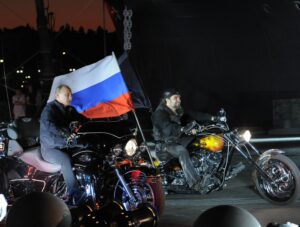
Formally known as the “Victory Roads” rides, inaugurated in 2015 to mark the seventieth anniversary of the Allied victory in World War II, they became the Night Wolves’ most emblematic transnational project. [Image at right] As documented by Kleiner, Gregor et al. (2024), the journey retraced the Red Army’s route from Moscow to Berlin, crossing Belarus, Slovakia, Czechia, and Germany, with later iterations extending into Austria and Hungary. Each stage combined military commemoration and Orthodox ritual: riders visited war cemeteries, received blessings from priests, and carried icons of military saints alongside Russian flags. The pilgrimage thus merged the cult of victory with the moral vocabulary of Orthodoxy, presenting the liberation of Europe as a sacred act and Russia as its redemptive agent. Harris (2020) interprets these journeys as expressions of imperial-Orthodox nationalism, designed to demonstrate unity among Slavic and Orthodox peoples, while Boichak (2023) situates them within Russia’s “human geopolitics,” where civic actors project Russkiy mir narratives abroad. Harris (2023) further emphasizes their theatrical dimension: processions, hymns, and public blessings turned the rides into performative rituals of national salvation. For Kleiner, Gregor et al. (2024), the Victory Roads functioned less as dialogue than as “show-up propaganda,” a moving spectacle of visibility that materialized Russian influence and sharp power through devotional and patriotic display. In this synthesis of religion, memory, and mobility, the Night Wolves translated the domestic alliance of Orthodoxy and patriotism into a transnational performance of Russia’s sacred history.

The international acceptance of the Victory Roads expeditions was uneven and often politically charged. While some segments of the public in Central Europe viewed the rides as commemorative events, others interpreted them as extensions of Kremlin soft (or sharp) power. The reception was particularly cold in Poland, where authorities repeatedly denied entry to Night Wolves convoys, citing security concerns and the group’s role in legitimizing Russian revisionism (Kleiner, Gregor, et al  2024). The tension was rooted in the club’s prior participation in the annexation of Crimea in 2014, when members assisted pro-Russian militias and produced media performances celebrating Crimea’s “spiritual return” to Russia (Harris 2020; Zabyelina 2019). These actions transformed the club from a patriotic motorcycle organization into an instrument of hybrid warfare, blurring the boundary between religious pilgrimage and political intimidation. As Laruelle (2019) notes, biker culture under Putin’s patronage became a vehicle for demonstrating loyalty and projecting ideological influence abroad. [Image at right] The Victory Roads therefore functioned simultaneously as civil-religious pageants and geopolitical performances, where the sacral language of Orthodoxy and liberation fused with the assertive symbolism of Russia’s post-Crimea foreign policy (Harris 2023).

Domestically, the club deepened its relationship with the ROC and state institutions during the 2020s. Patriarchal blessings at annual Sevastopol shows and joint charitable projects reinforced the group’s status as a lay auxiliary in Russia’s public Orthodoxy (Patriarchia.ru 2022).

By the early 2020s, the Night Wolves had completed their transformation from a marginal post-Soviet biker collective into an institutionalized actor within Russia’s civil religion. Through sustained collaboration with the ROC and endorsement from state officials, the club came to embody the fusion of patriotic ritual, masculine solidarity, and Orthodox moral discourse that characterizes Russia’s contemporary public spirituality (Harris 2023). Their rallies, pilgrimages, and theatrical shows projected a vision of Holy Rus’ that was defended not only by soldiers and clergy but also by lay believers mobilized through spectacle. In this sense, the NWMC illustrates how post-Soviet popular movements can sacralize national identity and translate political loyalty into religious symbolism.

DOCTRINES /BELIEFS

Unsurprisingly, there is no official doctrine when it comes to the NWMC. However, there is a set of “…seemingly incompatible and ideological motifs: Orthodox faith with Stalin´s cult, anti-American values with devotion to Western music and Harley-Davidson motorcycles” (Molnár et al. 2021:81) that the Night Wolves skillfully employ, making them a valuable non-state actor in the Moscow´s arsenal of hybrid warfare means (Kleiner, Mlejnková, et al. 2024)

The Night Wolves’ worldview fuses Orthodox Christianity with patriotic nationalism, producing what scholars describe as a form of Russian civil religion. Rather than emphasizing individual piety, this belief system sanctifies the nation itself as a divine project. The club’s rhetoric and performances portray Holy Rus’ as a moral community chosen to resist the secular and “decadent” West, a vision that mirrors the state’s broader narrative (Harris 2023; Laruelle 2019).

At the heart of this worldview lies the conviction that faith and citizenship are inseparable duties. Patriotism is framed as a religious vocation, and national defense as an act of spiritual service. As Harris (2020) observes, the Night Wolves describe themselves as “imperial-Orthodox supporters” united by “culture, language, and faith,” while their public rituals (parades, pilgrimages, and spectacles) dramatize this unity as sacred performance. Zabyelina (2019) interprets such expressions of Orthodoxy) as the moral language through which the club constructs belonging: Easter greetings, saintly icons, and Orthodox mottos serve as identity markers rather than liturgical obligations.

For Lauder (2018) and Laruelle (2019), this conflation of faith and patriotism reflects a broader political theology in which state and Church share symbolic authority. The biker brotherhood becomes a performative extension of state ideology, dramatizing the ideal of a spiritually regenerated Russia that unites religion, masculinity, and military virtue. The club’s imagery (crosses, angels, resurrected warriors) renders political loyalty as sacred duty and converts national triumph into collective redemption.

In this sense, the NWMC’s Orthodox patriotism does not articulate formal doctrine but rather an emotional theology of nationhood: Russia is holy because it suffers, endures, and protects; Orthodoxy is true because it binds citizens into moral unity. The result is a civil-religious cosmology that frames obedience, remembrance, and resistance to Western liberalism. All of this offers a convenient narrative for the Russian ruling elites with a considerable mobilizing potential.

Underlying the Night Wolves’ religious-patriotic worldview is a pronounced moral dualism that divides the world into two irreconcilable camps: sacred Russia, conceived as Holy Rus’, and a fallen West depicted as spiritually corrupt, consumerist, and aggressive. Harris (2023:1786) cites club leader Aleksandr Zaldostanov’s declaration that “Satan commands [Washington and London],” illustrating how political conflict is elevated into the metaphysical one. This approach is not a new one. The NWMC just reproduces Cold War-era propaganda scripts in which the United States is portrayed as the source of evil and Russia as its moral antithesis (Yatsyk 2018). Within this frame, defending the nation becomes a form of spiritual militancy, a continuation of the “holy defense (war)” narrative that runs from the Great Patriotic War to Crimea, Donbas (Harris 2023), and the full-scale Russo-Ukrainian war (Mefford 2024).

This dualistic language is deeply eschatological. Domańska (2019) and Černá (2022) show how the Kremlin’s myth of the Great Patriotic War has acquired a sacred aura, transforming historical victory into a tale of collective salvation. The NWMC reproduces this myth through symbols of resurrection, martyrdom, and final battle. Their Sevastopol shows and Victory Roads rides enact a story in which Russia’s wars are not episodes of politics but a narrative in which the nation’s suffering purifies the world. The Victory Roads take this type of remembrance outside Russia and enact what Molnár et al. (2023) call migrating memory, a transnational performance that projects Russia’s official narrative of liberation across European borders, embedding Orthodoxy and patriotism into the landscape of war memory.

As hinted by the previous paragraphs, the Night Wolves define themselves as a fraternity of men bound by discipline, loyalty, and spiritual service. Komarova (2018) uses the term “men’s union” (muzhskoi soyuz) that channels Orthodox moral ideals through masculine solidarity. The NWMC´s language of strength and obedience reimagines masculinity as a religious calling: men are defenders of faith and homeland, tasked with shielding “Holy Rus’” from moral decay (Harris 2020). Such an image is accompanied by a deliberate display of order and discipline. The biker aesthetic, once countercultural, is recast as an image of Orthodox virtue and patriotic control (Lauder 2018) that is brought to life by spectacle dramatizing salvation through male courage and featuring biblical scenes of struggle and resurrection performed through the bodies of bikers and soldiers (Černá 2022; Harris 2023). Furthermore, violence is not seen as transgression but purification and a proof of spiritual vitality (Harris 2022).

There is a gnawing question on which analysts disagree. That is whether the Night Wolves’ religiosity represents conviction or performance. On one hand, Harris (2023) describes the club as a hybrid religio-political actor whose rituals merge genuine expressions of faith with overt propaganda. Her examination of the Sevastopol shows demonstrates how Orthodox symbols and patriotic narratives are deployed simultaneously as devotional motifs and as tools of political communication.

Other scholars interpret the Night Wolves primarily as instruments of influence rather than as religious innovators. Both Lauder (2018) and Laruelle (2019) characterize the group as a proxy for the Russian government, arguing that its patriotic activism provides a culturally resonant vehicle for soft-power messaging abroad and they position it within Russia’s wider militia realm, a network of loyalist movements. Recent works expand this argument to the transnational level and view the NWMC as a tool of geopolitics promoting Russkiy mir values and the authority of the ROC (Boichak 2023) or as performances that materialize Russian presence and moral superiority through patriotic and religious spectacle (Kleiner, Gregor & Mlejnková 2024). In this prism, the Night Wolves’ Orthodox imagery functions less as theology and more as a legitimating style. However, pragmatically, the effect is still the same no matter the approach, mobilization of support for Russian-favoring narratives at the expense of Western liberalism.

The Night Wolves are both believers and performers, a movement in which faith, nationalism, and publicity are inseparable. Their Orthodox vocabulary offers moral credibility, while their pageantry projects political loyalty, making the club a prime example of Russia’s fusion of religion and soft or sharp power.

RITUALS/PRACTICES

Riding itself functions as a ritualized act within the Night Wolves’ public religiosity. Komarova (2011) documents early “cross-procession rides” in which bikers carried icons and received priestly blessings at parish stops, describing these events as missionary service of the laity that joined clergy and lay activists in common outreach (sorabotnichestvo). Zabyelina (2019) notes that the club seeks Patriarch Kirill’s blessing before pilgrimages to holy sites and stages Easter processions with balloons marked “ХВ.” She interprets these rides as patriotic pilgrimages that merge Orthodox devotion with demonstrations of civic loyalty. Harris (2020) adds that the Night Wolves organize pilgrimage-style motorcycle rallies, including state-funded journeys to Mount Athos and solidarity rides supporting the ROC after the 2012 Pussy Riot protest. In later work, Harris (2023) identifies the group’s Victory Day and Balkan rides as mobile rituals of sacred memory that reinforce the sacred geography linking Russia and the Slavic Orthodox world.

Across these accounts, blessings, icons, and liturgical greetings recur as fixed ritual elements. The Night Wolves’ rides thus operate simultaneously as patriotic demonstration and as popular Orthodox ceremony, forms of civic pilgrimage that translate ecclesial symbols into public, motorized performance.

Since 2009, the Night Wolves have staged large public bike shows in Sevastopol, Crimea, which have become central to their public image. These events attract tens of thousands of spectators and combine patriotic and religious themes, mock battles, and glorification of Russian leaders including Stalin (Harris 2023). Soviet war history is fused with current conflicts (especially the Ukrainian one) as a perpetuation of the continuous struggle against fascism to mythologize both the Second World War and the annexation of Crimea within one uninterrupted heroic narrative (Černá 2022; Laruelle 2019), which is also aimed to depict the West negatively. The 2015 show, broadcast on Russian state television, portrayed Ukraine as a Western puppet and the Maidan revolution as a fascist uprising, ending with a Russian victory over chaos and imperialism (Harris 2023). Circling back to the instrumentality of the performance, these events are often interpreted as tools of mass mobilization that conflate commemoration and spectacle (Schuler 2021).

Charitable work and war remembrance form the Night Wolves’ most consistent public activities outside their large-scale shows. There are documented early projects supporting veterans, orphanages, and hospitals that extended Orthodox ethics into everyday life (Komarova 2011). These practices fall under what Komarova (2014) identified as the above-mentioned cooperation with clergy (sorabotnichestvo). Club members also routinely visit war cemeteries and memorials, combining patriotic mourning with religious elements such as blessings and moments of prayer (Harris 2020). In her later study, Harris (2023:1791–93) interprets these practices as civic rituals reinforcing loyalty to the Church and the state. Acts of charity and commemoration thus function as moral performances that practically bind Orthodoxy, patriotism, and collective memory.

With the establishment of Victory Roads, the pilgrimages have begun to spill over internationally and have taken on a geopolitical dimension, or, as Boichak (2023) calls it, “human geopolitics.” Within the scope of the above-mentioned “show-up propaganda,” Kleiner, Gregor et al. (2024) document how the Victory Roads rides retrace the Red Army’s advance toward Berlin, combining war commemoration with Orthodox ritual. Each stop features ceremonies at military cemeteries, blessings by clergy, and displays of Russian and Church symbols. In the Balkans, Jackson & Jeffrey (2021) record similar commemorative rides and public events in the Republika Srpska, organized jointly with local Orthodox clergy and political leaders. These gatherings celebrate wartime fraternity and Orthodox unity, echoing the themes presented in the Sevastopol shows. The Night Wolves’ processions abroad thus act as symbolic extensions of Russian soft and sharp power: pilgrimages that have taken the mix of commemoration, Orthodoxy, and political visibility beyond national borders.

ORGANIZATION/LEADERSHIP

The Night Wolves Motorcycle Club is formally registered in Russia but functions as a movement centered on personal leadership rather than bureaucratic hierarchy. All sources identify Aleksandr Zaldostanov (“the Surgeon”) as its founder and enduring head. Zabyelina (2019) notes that the club’s internal organization reflects the U.S. biker model (chapters, hierarchies, and insignia, but that decision-making remains concentrated around Zaldostanov, whose authority rests on charisma and loyalty rather than elected office. Harris (2020) adds that Zaldostanov’s leadership combines biker discipline with patriotic and religious symbolism, turning the club into a moral brotherhood governed by personal obedience. Under his direction, the Night Wolves have developed a network of regional and international chapters, for example, in Slovakia or Serbia, that organize commemorations and public events under Moscow’s guidance. Each foreign unit operates semi-autonomously but maintains ideological alignment through shared imagery (Orthodox icons, military insignia, and Russian national symbols) (Kleiner, Mlejnková et al. 2024).

The club’s activities are supported by close ties to the ROC and state institutions. However, there is a certain distance maintained in order to provide (im)plausible deniability, a crucial component in Kremlin´s hybrid warfare arsenal. In this regard, Laruelle (2019) situates the Night Wolves within Russia’s “militia realm,” a constellation of patriotic organizations that operate alongside formal state structures and serve as loyal auxiliaries in public mobilization. Harris (2023) then describes routine participation of clergy in rallies and shows, while Patriarch Kirill blesses the Sevastopol event (Patriarchia.ru 2022).

Although the Night Wolves present themselves as a civic association, researchers consistently characterize them as a personalist and hybrid organization, part motorcycle club, part patriotic movement, and part state-sponsored actor. Leadership authority flows from Zaldostanov’s dual role as cultural entrepreneur and moral exemplar, ensuring ideological coherence while allowing flexible coordination across domestic and international chapters.

ISSUES/CHALLENGES

The Night Wolves occupy a prominent place in Russia’s public sphere while being perceived dominantly as a political instrument closely aligned with the Kremlin in the West. The group was involved in the 2014 annexation of Crimea directly with their members having boots on the ground. The NWMC provided logistical support and propagandist rallies in that case. As a result, several members, including Aleksandr Zaldostanov, were sanctioned by the United States and the European Union (Harris 2020).  Kleiner, Gregor et al. (2024) document repeated bans of Victory Roads convoys in Poland and other EU states, where authorities viewed them as vehicles of Russian influence rather than remembrance. These disputes illustrate how the club’s civil-religious performances have become entangled in geopolitical confrontation which well aligns with their anti-Western rhetoric.

Night Wolves are domestically perceived well by both public and the Russian regime skillfully mixing the almost bizarre features into coherent identity, especially Orthodoxy, Soviet nostalgia, and biker culture (Zabyelina 2019) which is often a counter-cultural phenomenon. The club´s autonomy is thus frequently questioned as they are perceived as being part of the Russia´s “human geopolitics” (Boichak 2023), sharp power (Kleiner, Gregor et al. 2024), or “militia realm” (Laruelle 2019). It is probably due to these aspects that the Night Wolves have retained strong institutional backing, including the religious one. Harris (2023) observes continued participation of Orthodox clergy and state officials in their events. In sum, the NWMC´s challenges lie not at home, but rather abroad where they have to navigate justified more (e.g., in Poland) or less (e.g., in Serbia) anti-Russian hybrid warfare sentiments every time they set on a pilgrimage like Victory Roads or establish a chapter. On the other hand, inciting and feeding these division lines in target populations is one of the hybrid warfare´s goals (McCulloh & Johnson 2013).

As of the mid-2020s, the Night Wolves Motorcycle Club represents one of the most visible intersections of religion, nationalism, and popular culture in contemporary Russia. Over three decades, the group evolved from a late-Soviet subcultural collective into a hybrid religio-political movement that merges Orthodox symbolism, patriotic ritual, and geopolitical messaging. Under the continuous leadership of Aleksandr “the Surgeon” Zaldostanov, the club maintains close relations with the ROC and open endorsement from state authorities, while cultivating a network of affiliated chapters across Europe and the Balkans.

Within Russia, the Night Wolves remain embedded in the state’s patriotic infrastructure, regularly receiving ecclesiastical blessings, participating in public commemorations, and producing large-scale performances such as the annual Sevastopol shows. Abroad, their activities provoke controversy and resistance, particularly in Central Europe, where officials view the club’s pilgrimages and commemorative rides as extensions of Russian influence. Scholars broadly agree that the Night Wolves embody the fusion of civil religion and sharp power in the post-Crimea era. Faith then probably serves as cultural legitimacy for geopolitical messaging, and spectacle becomes a medium of ideological outreach.

Despite international sanctions and travel restrictions, the group continues to operate openly within and outside Russia and maintains symbolic importance in state-sponsored patriotic culture. The Night Wolves’ trajectory, from countercultural bikers to sanctioned emissaries of “Holy Rus’,” illustrates how religious language and ritual performance can be mobilized to sustain national identity, moral order, and political loyalty in twenty-first-century Russia.

IMAGES

Image #1: Aleksandr Sergeyevich Zaldostanov. Credit: Creative Commons Attribution 4.0 International. Courtesy of duma.gov.ru.
Image #2: “Victory Roads” rides. Credit: Creative CommonsAttribution-ShareAlike 3.0. Credit www.volganet.ru.
Image #3: Vladimir Putin with the Night Wolves. Credit: Creative Commons Attribution 4.0. Courtesy of premier.gov.ru.

REFERENCES

Boichak, Olga. 2023. “Mapping the Russian political influence ecosystem: The Night Wolves biker gang.” Social Media + Society 9. Accessed from https://journals.sagepub.com/doi/full/10.1177/20563051231177920 on 10 October 2025.

Černá, Marie. 2022. “The eternal legacy of the Great Patriotic War? The political instrumentalization of the Soviet victory over fascism and its utilization in Czechoslovakia after 1968 and in the Czech Republic today. Soudobé Dějiny / Czech Journal of Contemporary History, 30:725–52.

Domańska, Maria. 2019. “The myth of the Great Patriotic War as a tool of the Kremlin’s great power” (OSW Commentary No. 316). Centre for Eastern Studies (OSW).

Gapova, J. 2011. Patriarkh Kirill blagoslovil “Nochnykh volkov.” Accessed from http://russkiymir.ru/news/29829/ on 10 October 2025.

Harris, Kira. 2023. “A hybrid threat: The Night Wolves Motorcycle Club.” Studies in Conflict & Terrorism, 46:1784–1816.

Harris, Kira. 2022. Russia’s Night Wolves in Australia: ГДЕ МЫ ТАМ РОССИЯ.” Aa. Journal of Policing, Intelligence and Counter Terrorism, 17:135–58.

Harris, Kira. 2020. “Russia’s fifth column: The influence of the Night Wolves Motorcycle Club.” Studies in Conflict & Terrorism 43:259–73.

Jackson, Thomas and Alex Jeffrey, 2021. “Improvising regions: Diplomatic practices between Russia and the Republika Srpska.” Territory, Politics, Governance 9:471–491.

Kleiner, Jan, Milos Gregor, and Petra Mlejnková. 2024. “The Night Wolves: Evidence of Russian Sharp Power and Propaganda from the Victory Roads’ Itinerary.” Problems of Post-Communism 7:145–55.

Kleiner, Jan, Petras Mlejnková, and Milos Gregor. 2024. “Night Wolves Motorcycle Club: A Long Way from Advocates of Democracy to Kremlin Propagandists.” Pp. 369–78 in The Palgrave Handbook of Non-State Actors in East-West Relations, edited by P. Marton, G. Thomasen, C. Békés, & A. Rácz. Springer International Publishing.

Komarova, Anna V. 2018. Subkul’tury v dukhovnoi zhizni obshchestva: Religiozno-nravstvennyi aspekt. Moscow.

Komarova, Anna. V. 2014. “Motoklub “Nochnye Volki” i novye formy patrioticheskogo vospitaniia molodezhi.” Gumanitarnye, Sotsial’no-Ekonomicheskie i Obshchestvennye Nauki 1:45–51.

Komarova, Anna V. 2011. “Uchastie russkikh mototsiklistov v missionerskoi deyatel’nosti Russkoi pravoslavnoi tserkvi.” Gosudarstvo, Religiia, Tserkov’ v Rossii i Za Rubezhom 29:43–46.

Laruelle, Marlène. (with Institut français des relations internationales). 2019. Russia’s militia groups and their use at home and abroad. French Institute of International Relations (Ifri).

Lauder, Matthew A. 2018. “Wolves of the Russian spring: An examination of the Night Wolves as a proxy for the Russian government.” Canadian Military Journal 18:35–16.

Losh, Jack. 2016. “Putin’s Angels: The bikers battling for Russia in Ukraine.” The Guardian, January 29. Accessed from https://www.theguardian.com/world/2016/jan/29/russian-biker-gang-in-ukraine-night-wolves-putin on 17 October 2025.

McCulloh, Tim and Rick Johnson. 2013. Hybrid Warfare. Joint Special Operations University. McCulloh, T., & Johnson, R. (2013). Hybrid Warfare. MacDill AFB FL. Accessed from https://apps.dtic.mil/sti/tr/pdf/ADA591803.pdf on 10 October 2025.

Mefford, Brian. 2024. “Russian Orthodox Church declares “Holy War” against Ukraine and West.” Atlantic Council. Accessed from https://www.atlanticcouncil.org/blogs/ukrainealert/russian-orthodox-church-declares-holy-war-against-ukraine-and-west/ on 10 October 2025.

Molnár, Virág, Karolina Koziura, and Franziska König-Paratore. 2021. “Russia’s Night Wolves, migrating memory and Europe’s eastern frontier.” European Journal of Sociology 62:71–103.

Pravoslavie.ru. (2006). Pravoslavnye baikery Rossii i Ukrainy provedut krestny motopokhod. Accessed from https://pravoslavie.ru/18129.html on 10 October 2025.

Schuler, Catherine. 2021. “Staging the Great Victory: Weaponizing story, song, and spectacle in Russia’s wars of history and memory.” TDR: The Drama Review 65:95–126.

Shuster, Simon. 2014. “Russia ups the ante in Crimea by sending in the “Night Wolves.” TIME, February 28. Accessed from https://time.com/11680/crimea-russia-putin-night-wolves/ on 15 October 2025.

Tabor, D. (2015, October 8). Putin’s Angels: Inside Russia’s most infamous motorcycle club. Rolling Stone. https://www.rollingstone.com/culture/culture-news/putins-angels-inside-russias-most-infamous-motorcycle-club-56360/

Usov, S. V. 2005. “Russkaia subkul’tura baikerov i ee otnoshenie k pravoslavnoi traditsii.” Religiovedenie 2:112–23.

Walker, Shaun. 2015,  “Patriotic group formed to defend Russia against pro-democracy protesters.” The Guardian. January 15. Accessed from https://www.theguardian.com/world/2015/jan/15/group-anti-maidan-defend-russia-pro-democracy-protesters on 15 October 2025.

Yatsyk, Alexandra. 2018. “Russia’s anti-American propaganda in the Euromaidan era” (Policy Memo No. 514). PONARS Eurasia.

Zabyelina, Yuliya. 2019. “Russia’s Night Wolves Motorcycle Club: From 1%ers to political activists.” Trends in Organized Crime 22:51–65. Accessed from https://doi.org/10.1007/s12117-017-9314-7 on 10 October 2025.

Publication Date:
20 October 2025


Share

Jan Kleiner

Jan Kleiner is an Assistant Professor of Security Studies in the Department of Political Science, Faculty of Social Studies, Masaryk University. He specializes in cybersecurity, state offensive cyber operations, and cognitive warfare. His research examines how political regimes shape cyber conflict and how emerging technologies — especially artificial intelligence and algorithmic governance — transform societal security. He employs mixed methods, combining statistical modelling and qualitative fieldwork with experimental wargaming and generative-agent simulations.


Share

Religion, Gender and Power

RELIGION, GENDER & POWER: Power, Privilege & Control**
**The project is currently in its initial developmental stage. Additional resources are being incorporated regularly.

The Religion, Gender & Power Project connects religion, gender, and power through a perspective that understands religion as a form of power. The objective of this WRSP SPECIAL PROJECT is to create theoretical frameworks for addressing this theoretical issue. Framework is used in the plural here because what is regarded as transgressive varies by factors such as historical era, prevailing sociocultural norms, and religious tradition. Further, transgressions occur at individual, social network, and institutional levels. At each level, however, the key ingredient in transgressive relationships is power. One specific goal of this project is a framework for understanding hegemonic sexual transgression where unlimited power leads to highly organized transgression.

The knowledge base of WRSP is new/emergent/alternative religious and spiritual movements, and this set of movements creates an organizational focus for the project. The project has significant implications for New Religions Studies. There are a sufficient number of cases that demonstrating that developmental histories of movements are being impacted, with significantly different outcomes. Further, research methodologies may require reassessment as it is clear that internal movement power centers were not accessible in most ethnographic research. Finally, the emerging results of the project suggest that scholars need to incorporate a broader range of stakeholders in their research as a valuable source of the emerging information on internal movement dynamics comes from movement leavetakers. There is, however, no implication that new movements are either more or less representative of the larger transgressive patterns that have been well documented across contemporary societal institutions.

The method for developing this project involves, first, assembling a data set. The approach used in this project is to use the WRSP profiles as the informational base as profiles offer a uniform presentational format and encompass the major components of movement organization, development, and relation to the larger social order. More focused perspective on transgressive practices is gained through the incorporation of investigatory reports and focused scholarly research material.

WRSP PROFILES*
*Profiles followed by a ** designation are supported by investigatory reports.

Agapemone

Against the Stream

Ananda

Anusara Yoga

Asaram Bapu

Association of Vineyard Churches**

Bikram Yoga**

Branch Davidians (1981-2006)   [Update forthcoming]

Association of Vineyard Churches / Calvary Chapel

College of Integrated Philosophy

Dera Sacha Sauda**

Emmaüss

Fundamentalist Church of Jesus Christ of Latter Day Saints

Gloriavale**

Guru Jára Path

Healthy, Happy, HoLly (3HO) **

Hillsong

Holy Apostolic Catholic Palmarian Church

International Society for Krishna Consciousness [Update forthcoming]

Jesus Fellowship Church (Jesus Army)

John of God

Kenja Communications

Kingdom of Jesus Christ

La Luz Del Mundo

L’Arche

Lord’s Resistance Army

Nine O’Clock Service

Nithyananda

NXIVM

Nuwaubians

One Taste

Order of St. Charbel

Providence (Christian Gospel Mission)

PTL

Quiverfull

Siddha Yoga

The Way International

Tony Alamo Christian Ministries **

Transcendental Meditation

Yogaville

INVESTIGATIVE REPORTS

Association of Vineyard Churches

Bikram Yoga

Dera Sacha Sauda

Emmaüss

Family of Saint John (Summary)
Family of Saint John (Full Report in French)

Gloriavale

Guru Jára Path

Healthy, Happy, Holy (3HO)

International House of Prayer  (Firefly Investigation of Mike Bickle and the International House of Prayer Kansas City)
International House of Prayer (Pastoral Recommendation Team for IHOPKC Investigation)

International Sivananda Yoga Vedanta Centres

Jesus Fellowship

Kenja

L’Arche  (English)
L’Arche  (French)

Mount Baldy Zen Center

Rigpa Fellowship

Satyananda Yoga Ashram at Mangrove

Shambhala (1)
Shambhala (2)
Shambhala (3)

Sodalithium

Southern Baptist Convention

Tony Alamo Christian Ministries

Willow Creek Community Church

INVESTIGATIVE ORGANIZATIONS

An Olive Branch 

Guideposts

Project  SATYA

RESEARCH PUBLICATIONS

Alexandera, Ryan and Michael Birzeb. 2016. “Changing Trajectory: An Integrated Theoretical View of the Roman Catholic Priest Sex Abuse Scandal.”  Deviant Behavior 37:977-88. https://wrldrels.org/wp-content/uploads/2025/10/Changing-Trajectory-An-Integrated-Theoretical-View-of-the-Roman-Catholic-Priest-Sex-Abuse-Scandal.pdf

Anders, Anne Iris Miriam. 2019. “Silencing and Oblivion of Psychological Trauma, Its Unconscious Aspects, and Their Impact on the Inflation of Vajrayana. An Analysis of Cross-Group Dynamics and Recent Developments in Buddhist Groups Based on Qualitative Data.” Religions. www.mdpi.com/journal/religions.

Barker, Eileen. 2018. “What Do They Do About It? Radical Reactions by NRMs to Internal Abuses by ISKCON, The Children of God/The Family International and the Jesus Fellowship.” In Radical Changes in Minority Religions, edited by Eileen Barker and Beth Singler. Abingdon, Oxon: Routledge.
Bivins, Jason. 2007. “Beautiful Women Dig Graves”: Richard Baker-roshi, Imported Buddhism, and the Transmission of Ethics at the San Francisco Zen Center.” Religion and American Culture: A Journal of Interpretation 17:57-93.  https://wrldrels.org/wp-content/uploads/2025/10/Beautiful_Women_Dig_Graves.pdf.
Bogdan, Henrik and James R. Lewis, eds. 2014. Sexuality and New Religious Movements. London: Palgrave Macmillan.
Brintnall, Kent. 2025. “Certainty, complicity, complexity: approaching sexual abuse.” Religion

Bromley, David and Clinton Cress. 2000. “Narratives of Sexual Danger: A Comparative Perspective on the Emergence of the Clergy Sexual Violation Scandal.” Pp. 39-68 in Bad Pastors: Clergy Malfeasance in Modern America, edited by Anson Shupe, William Stacey, and Susan Darnell. New York: New York University Press.  https://wrldrels.org/wp-content uploads/2025/10/3_Narratives_of_Sexual_Danger_A_Comparative_Perspe.pdf.

Bryant, Edwin and Maria Ekstrand, eds. 2004. The Hare Krishna Movement: The Postcharismatic Fate of a Religious Transplant. New York: Columbia University Press.

Caldwell, Sarah. 2001. “The Heart of the Secret: A Personal and Scholarly Encounter with Shakta Tantrism in Siddha Yoga.” Nova Religio: The Journal of Alternative and Emergent Religions  5:9-51. https://wrldrels.org/wp-content/uploads/2025/10/Caldwell-HeartSecretPersonal-2001.pdf .

Choedron, Karma Tashi and Tenzin Dadon. 2026. “Sacred Spaces, Silent Suffering: Sexual Abuse in Vajrayāna
Buddhist Contexts.” Journal of Global Buddhism 27:71–77. https://wrldrels.org/wp-content/uploads/2025/10/Sacred-Spaces-Silent-Suffering.pdf

Clities, Brian. 2025. “Priests on the prowl: monster talk within the discourse of clergy sexual abuse.” Religion, August. https://www.tandfonline.com/doi/abs/10.1080/0048721X.2025.2538956.

Clities, Brian. 2020. “Breaking Our Silence: A Primer for Research on Clergy Sexual Abuse.” American Catholic Studies Newsletter 47:6-17. https://wrldrels.org/wp-content/uploads/2025/10/Breaking_Our_Silence._A_Primer_for_Beginn.pdf 

Copeman, Jacob. 2025. “‘Mass Castration’, Mechanical Devotion? Slavery, Surgery and As-If Devotion in a North Indian Guru Movement. Religions 16. https://wrldrels.org/wp-content/uploads/2025/10/Mass-Castration.pdf.

Copeman, Jacob and Aya Ikegame. 2012. “Guru Logics.”  Journal of Ethnographic Theory 2: 289–336. https://wrldrels.org/wp-content/uploads/2025/10/Guru-Logics.pdf 

Downing, Michael. 2001. Shoes Outside the Door: Desire, Devotion, and Excess at San Francisco Zen Center. Berkeley: Counterpoint.

Figueroa, Rocio and David Tombs. 2023. “Discipline, Obedience and Abuse in the Sodalitium.” Pp. 46-65 in Abuses in the Church, edited by Michelle Becka, Po-Ho Huang and Gianluca Montaldi. London: SCM Press. https://wrldrels.org/wp-content/uploads/2025/10/Discipline-Obedience-and-Abuse-in-the-Sodalitium.pdf.

Gayley, Holly. 2025. “The arc of a crisis: in the aftermath of sexual abuse in Shambhala Buddhism.” Religion 55:846–64. https://doi.org/10.1080/0048721X.2025.2541489.

Gayley, Holly. 2018.  “Revisiting the “Secret Consort” (gsang yum) in Tibetan Buddhism.” Religions https://www.mdpi.com/2077-1444/9/6/179.

Gleig, Ann. 2020. “Sexual Violations in American Buddhism: Interpretive Frameworks and Generative Responses.” Ten Thousand Things, March 5. https://wrldrels.org/wp-content/uploads/2025/10/Sacred-Eroticism-Anti-Cultism.pdf.

Gleig, Ann and Amy Paris Langenberg. 2025. “Listening for and to survivors of sexual abuse and misconduct in Buddhism.” Religion 55:783-806. https://wrldrels.org/wp-content/uploads/2025/10/Listening_for_and_to_survivors_of_sexual.pdf.

Gleig, Ann and Amy Langenberg. 2024. “Buddhism, Sexual Abuse, and the Law.”Bloomsbury Religion in North America (Theology and Religion Online). https://www.theologyandreligiononline.com/article?docid=b-9781350883048&tocid=b-9781350883048-003.

Goodwin, Megan. 2020. Abusing Religion: Literary Persecution, Sex Scandals, and American Minority Religions. New Brunswick: Rutgers University Press.

Harris, Maureen.  2018. “Weapons of the Strong’: Reinforcing Complaints Against the Clergy in Post-Restoration Warwickshire, 1660-1720.” Midland History 43:190–207. https://wrldrels.org/wp-content/uploads/2025/10/EBSCO-FullText-02_10_2026.pdf.

Harvey, Sarah. 2025. Abuse in New Religious Movements. Cambridge: Cambridge University Press. https://www.cambridge.org/core/services/aop-cambridge-core/content/view/37CE4DA3B61779EC42C96F169A9973D5/9781009660839AR.pdf/abuse_in_new_religious_movements.pdf.

Harvey, Sarah and Suzanne Newcombe, 2025.‘”Hegemonic masculinities and sexual abuse: two case studies.”, Religions:55:4, 8. https://wrldrels.org/wp-content/uploads/2025/10/Hegemonic-masculinities-and-sexual-abuse.-two-case-studies.pdf.

Hollier, Joel, Shane Clifton, and Firew Bobo. 2026. “Mapping the Impact of Religious Harm: Results from a Large-Scale Qualitative Study.” Journal for the Academic Study of Religion 39:109-33. https://wrldrels.org/wp-content/uploads/2025/10/Mapping-the-Impact-of-Religious-Harm.pdf

Introvigne, Massimo. 2019.

Keul, Hildegund. 2022. “Vulnerability, Vulnerance and Resilience—Spiritual Abuse and Sexual Violence in New Spiritual Communities.” Religions.  https://wrldrels.org/wp-content/uploads/2025/10/religions-13-00425.pdf .

Jacobs, Janet. 2007. “Abuse in New Religious Movements: Challenges for the Sociology of Religion.” Pp. 231-44 in Teaching New Religious Movements, edited by David G. Bromley. New York: Oxford University Press.

Jacobs, Janet. 2000. “Charisma, Male Entitlement, and the Abuse of Power.” Pp. 123-30 in Bad Pastors: Clergy Misconduct in Modern America, edited by Anson Shupe, William A. Stacey, Susan E. Darnell. New York: NYU Press. https://wrldrels.org/wp-content/uploads/2025/10/Jacobs-CharismaMaleEntitlement-2000.pdf.

Jacobs, Janet. 1991 “Gender and Power in New Religious Movements.” Religion 21:345-56.Lachs, Stuart. 2019. “Tibetan Buddhism Enters the 21st Century: Trouble in Shangri-la.” Investigative Journalism focused on Buddhism. https://wrldrels.org/wp-content/uploads/2025/10/Tibetan-Buddhism-Enters-the-21st-Century.pdf.

Lachs, Stuart. 2019. “Tibetan Buddhism Enters the 21st Century: Trouble in Shangri-la.” Investigative Journalism focused on Buddhism. https://wrldrels.org/wp-content/uploads/2025/10/Tibetan-Buddhism-Enters-the-21st-Century.pdf.

Lachs, Stuart. 2002. “Richard Baker and the Myth of the Zen Roshi.” Dark Zen. https://www.academia.edu/944019/.

Lucia, Amanda. 2025. Waging War in Wild Wild Country: Regulating Sex and Nation in Osho’s Rajneeshpuram

Lucia, Amanda. 2020. “The Guru-Disciple Relationship and the Complications of Consent.” The Reveler, March 2. https://wrldrels.org/wp-content/uploads/2025/10/The-Guru-Disciple-Relationship.pdf.

Marin, Camelia. 2026. “Sacred Eroticism, Anti-Cultism, and the Revival of “Brainwashing” Narratives: An Emic View.” The Journal of CESNUR, 10:85—95. https://wrldrels.org/wp-content/uploads/2025/10/Sacred-Eroticism-Anti-Cultism.pdf.

McCartney, Patrick. 2018. “Downward facing dogs, core Indian values and institutionalised rape of children.” Sociology International Journal, Volume 2, Issue 6. https://wrldrels.org/wp-content/uploads/2025/10/Downward_facing_dogs_core_Indian_values.pdf.

Meyrick, Sarah. 2026. “Convent Was Run Like a Cult.” Bishop Accountability.org, July 25. https://wrldrels.org/wp-content/uploads/2025/10/BishopAccountability.pdf

Monahan, Brian, Joseph Marolla and David G. Bromley. 2005. “Constructing Coercion: The Organization of Sexual Assault.” Journal of Contemporary Ethnography 84:284-316.

Jordan Morehouse and Laura L. Lemon. “Beyond reputational and financial damage: Examining emotional and religious harm in a post-crisis case study of Hillsong Church.” https://wrldrels.org/wp-content/uploads/2025/10/Examining-emotional-and-religious-harm-.pdf

Newcombe, Suzanne and Sarah Harvey. 2025. “Hegemonic masculinities and sexual abuse: two case studies.”  RELIGION 55:865-83. https://wrldrels.org/wp-content/uploads/2026/01/Hegemonic-masculinities-and-sexual-abuse-two-case-studies-1.pdf.

Palmer, Susan. 2018. “Guru Pedophiles”, Neo-Polygamists, and Predatory Prophets: Exploring the Sex Scandals and Abuse Allegations Concerning “Cults”/NRMs, 1993–2017.” Pp. 146-62 in Catherine Holtmann Nancy Nason-Clark. Leiden: Brill. https://wrldrels.org/wp-content/uploads/2025/10/Guru-Peophiles.pdf

Pankhania, Josna and Jacqueline Hargreaves. 2017. “Culture of Silence: Satyananda Yoga.” TheLuminescent.blogspot.com, December. https://wrldrels.org/wp-content/uploads/2025/10/Culture-of-Silence-Satyananda-Yoga-Jacqueline-Hargreaves-Josna-Pankhania-The-Luminescent.pdf.

Priya Dasi, Kamala. 2015. “How a Religious Institution Dealt with Child Abuse: A case study of the International Society for Krishna Consciousness (ISKCON).” This article is a revised version of a paper that was presented by the author, at the conference of the International Cultic Studies Association (ICSA), on June 26, 2015 in Stockholm. https://wrldrels.org/wp-content/uploads/2025/10/Child_Protection_in_ISKCON.pdf 

Raine, Susan and Stephen Kent. 2019. “The Grooming of Children for Sexual Abuse in Religious Settings: Unique Characteristics and Select Case Studies.” Aggression and Violent Behavior 48:180–89. https://wrldrels.org/wp-content/uploads/2025/10/Grooming-of-Children.pdf.

Rochford, E. Burke. 1998. “Reactions of Hare Krishna Devotees to Scandals of Leaders’ Misconduct.” Pp. 101-17 in Wolves Within the Fold: Religious Leadership and Abuses of Power, edited by Anson Shupe. New Brunswick, NJ: Rutgers University Press.

Rochford. E. Burke, with Jennifer Heinlein. 1998, “Child Abuse in the Hare Krishna Movement: 1971-1986.” ISKCON Journal, Volume 6,  #1. https://wrldrels.org/wp-content/uploads/2025/10/1971-1986.pdf.

Rochford. E. Burke. 2025. “Accounting for Child Abuse in the Hare Krishna: Ethnographic Dilemmas and Reflections.” https://wrldrels.org/wp-content/uploads/2025/10/Rochford.pdf.

Rodarmor, William. 1983. “The Secret Life of Swami Muktananda.” Accessed from https://www.prem-rawat-bio.org/nrms/info/mukta1.htm. https://wrldrels.org/wp-content/uploads/2025/10/Secret-Life-of-Swami-Muktananda.pdf

Shupe, Anson, ed. 1998. Wolves Within the Fold. New Brunswick, NJ: Rutgers University Press.

Shupe, Anson, William Stacey, and Susan Darnell. 2000. Bad Pastors: Clergy Misconduct in Modern America. New York: New York University Press. https://wrldrels.org/wp-content/uploads/2026/01/Bad-Pastors.pdf.

Tanaka, Hiroki. 2026. “Control the uncontrollable: French secularism and ‘religious risk’,” Religion, State & Society 54:132-47. https://wrldrels.org/wp-content/uploads/2025/10/Tanaka-Control-religious-risk-2026.pdf.

Thomson, James G., Joseph Marolla and David G. Bromley. 1996. “Disclaimers and accounts in cases of Catholic priests accused of pedophilia.” Constructions of deviance : social power, context, and interaction” Pp. 443-53 in Deviance: The Interactionist Perspective (Ninth Edition), edited by Earl Rubington and Martin Weinberg. Boston: Allyn and Bacon. https://wrldrels.org/wp-content/uploads/2025/10/DISCLAIMERS-AND-ACCOUNTS-IN-CASES-OF.pdf 

TEACHING MATERIALS

Gleig, Ann and Amy Langenberg. 2021. “Collaboration as Care: Teaching Sexual Abuse in American Buddhism.” Journal of Feminist Studies in Religion 37:145-47. https://wrldrels.org/wp-content/uploads/2025/10/Collaboration-as-Care.-Teaching-Sexual-Abuse-in-American.pdf.

Haloff, Ann. 2021. “Teaching Sexual Abuse and Violence in Buddhism in Australia.” Journal of Feminist Studies in Religion. 37 141-43. https://wrldrels.org/wp-content/uploads/2025/10/Halafoff-TeachingSexualAbuse-2021.pdf

Schlemmer, Jimmy. 2026. “Centre students explore the psychology behind high-control groups.” Centre College News. January 27. https://wrldrels.org/wp-content/uploads/2025/10/Centre-Students.pdf.

RELATED PROJECTS**
** Some sources from these projects have been included in the Religion, Gender, and Power resource list.

Abuse in Religious Contexts

Religion and Sexual Abuse Project
The Religion & Sexuality Project: An Introduction

“Imagined futures beyond the Religion & Sexual Abuse Project (R&SAP)”0000000
Pages 898-904 | Published online: 17 Oct 2025
https://www.tandfonline.com/doi/epdf/10.1080/0048721X.2025.2538958


Share

International Enneagram Association

THE INTERNATIONAL ENNEAGRAM ASSOCIATION TIMELINE

1916:  George Gurdjieff taught Enneagram to his followers in Russia.

1922:  Gurdjieff moved to France.

1945:  Gurdjieff died.

1952:  Rodney Collin matched nine points of Enneagram with nine types of humanity.

1967:  Óscar Ichazo established a group at Arica, Chile.

1970:  Claudio Naranjo learned Enneagram from Ichazo.

1971:  Arica School was established in New York City. The Enneagram of Fixations was taught.

1971: Naranjo established a group in Berkeley, California. The Enneagram of personality was taught.

1971:  Enneagram was taught at Loyola University Chicago by Robert J. Ochs.

1984:  The first Catholic Enneagram book published.

1988:  Enneagram Professional Training Program (later Narrative Enneagram) was established.

1988:  Helen Palmer published The Enneagram.

1990:  Arica School sued Palmer.

1990:  Riso-Hudson Enneagram Type Indicator was published.

1994: Enneagram Institute established.

1994:  International Enneagram Association (IEA) was founded.

1998:  The first Jewish Enneagram book was published.

2013:  The first Islamic Enneagram book was published.

2016:  The first Protestant Enneagram book was published.

2022:  The first Buddhist Enneagram book was published.

FOUNDER/GROUP HISTORY

The International Enneagram Association (IEA) was founded in 1994 at the end of the first International Enneagram Conference, held at Stanford, California. The founding committee consisted of ten Enneagram teachers from different North American Enneagram schools, many of whom are discussed below (Daniels 2025). Since 1994, the IEA has organized a large annual conference and provided Enneagram teacher accreditation, as well as organizing regional and national chapters (IEA website 2025). The IEA is the leading umbrella organization in its field. It describes the Enneagram, a geometrical figure [Image at right], as the basis of “a psycho-spiritual system for mapping the nine possible personalities, like nine facets of a stone that develop through the natural growth of the human psyche” (IEA website 2025). The nine points of the Enneagram are commonly numbered, and individual points referred to by their numbers.

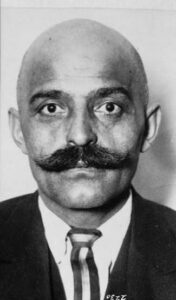
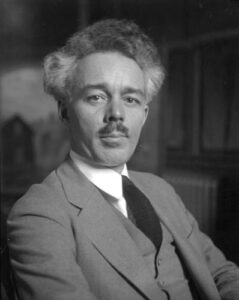
The history of the Enneagram starts in Russia in 1916 with the first known use of the Enneagram by the Greek-Armenian spiritual teacher George Gurdjieff (d. 1949) [Image at right], who (according to the Russian esotericist P. D. Ouspensky,1878-1947), described the Enneagram as a “universaIl symbol” (Ouspensky 1949/1957:294). He did not use it for mapping personalities, but for other purposes (discussed below). He also used it as a logo. It appears in 1919 as an element in an advertisement for a “Science of the harmonious development of man” that Gurdjieff was teaching in Tiflis (now Tbilisi), Georgia (Hartmann 1964/1992:140), and it continued to be used in similar ways after he moved to France, where he spent the rest of his life, in 1922. It hung over the stage at his Institute for the Harmonious Development of Man in Fontainebleau, France (Bennett 1973:140).

There are various accounts of the Enneagram’s earlier origins, but no evidence for any of them. Most accounts ascribe a Sufi origin to the Enneagram. Allegedly, Gurdjieff learned the Enneagram from a Central Asian Sufi order called the Sarmoung. This account draws on Gurdjieff’s accounts of his youth, which seem to be largely fictional. There is no independent evidence of any Sufi order called anything like “Sarmoung” ever having existed, and Gurdjieff’s account of the Sarmoung does not suggest anything resembling a normal Sufi order. In more sophisticated version, developed by the English Gurdjieff teacher J. G. Bennett (1897-1974), the “Sarmoung” received the Enneagram from the Naqshbandis, who received it from the Khwajas (Khwajagan), who learned it from the Zoroastrians (Bennett 1973:30, 50, 67). The Naqshbandis, Khwajagan, and of course the Zoroastrians are all well documented, but Bennett’s line of transmission is pure reconstruction, without any actual evidence.

In another version Gurdjieff learned the Enneagram from Shaykh Abdullah Daghestani (1891–1973), a Naqshbandi Sufi, in Turkey. Although it is not impossible that Gurdjieff might have met Shaykh Abdullah, this could not have been before 1920, four years after the Enneagram was first discussed in Russia (Sedgwick 2021 232-33). Other accounts ascribe the Enneagram to Pythagoras, ancient Afghanistan, and early Christians in Persia (Beesing, Nogosek, and O’Leary 1984:1). Although none of these myths of origin have any solid basis, they have still cast a romantic and mystic glow over the Enneagram, and contribute to its popularity.

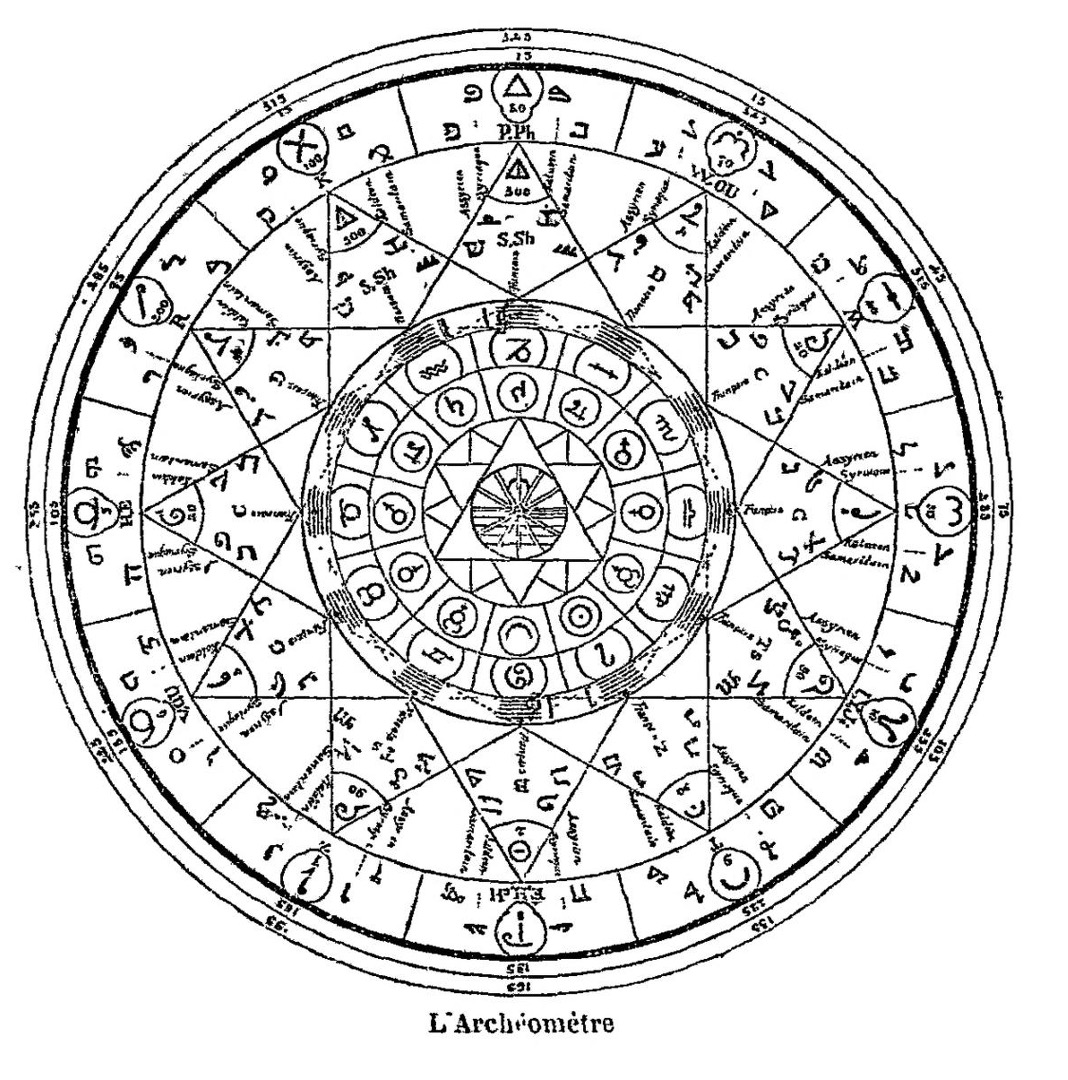
If any origin before Gurdjieff exists, it is likely to be parallel uses of other geometrical figures for esoteric purposes, such as the “archéomètre” [Image at right] of the French occultist Alexandre Saint-Yves, Marquis d’Alveydre (1842–1909) (Godwin 2020, Saint-Yves 2011), or even the Tree of Life in Kabbalah.

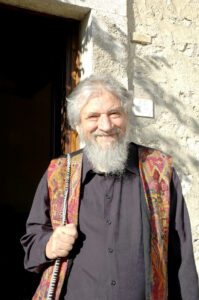
After Gurdjieff’s death in 1949, the main authority on the Enneagram became Bennett, a former follower of both Gurdjieff and Ouspensky who established and led the largest Gurdjieff group in England. He taught Gurdjieff’s system, including the Enneagram, on which he also published a short book (Bennett 1974, 1983: 85).So far as is known, no-one from the Bennett group continued work with the Enneagram after Bennett’s death in 1974.The next chapter in the history of the Enneagram opens in Chile, where Óscar Ichazo (1931-2020) [image at right], a Bolivian who had joined a Gurdjieff group in Buenos Aires in 1950, moved to Arica, a port city in northern Chile, where he established in 1967 what was at first seen as a Sufi group (Barron 1994:xviii), but which drew more on the teachings of Gurdjieff than on any other source. This became known as the Arica School when it moved to New York City in 1971, and still exists (in 2025). In 1973, it had 250 teachers and centers in New York, San Francsico, and Los Angeles (Keen 1973/1982:4-5). The Arica School, as we will see, incorporated the Enneagram into its teaching and practice in a new way, beginning the development of the contemporary Enneagram.

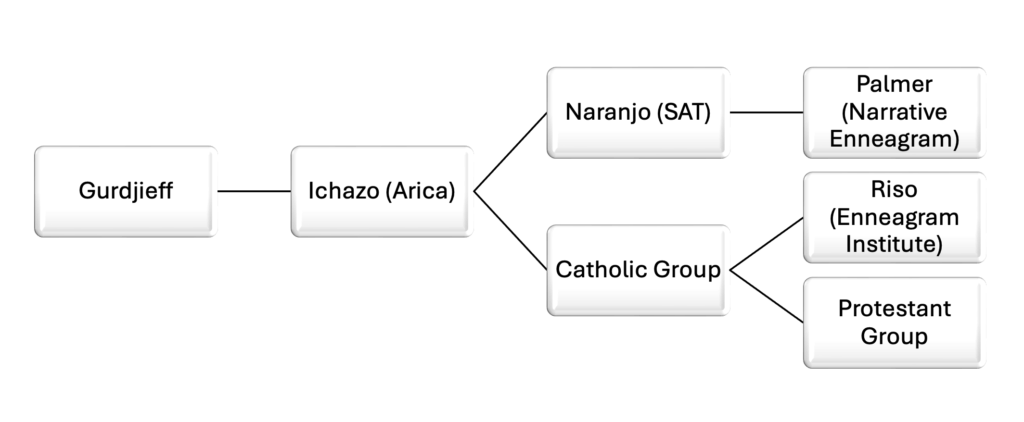
What happened next is illustrated by [Image at right]. One of those who studied with Ichazo in Arica was Claudio Naranjo (1932-2019) [Image at right], a California-based psychologist ofChilean origin who was part of the early New Age group based at Esalen. Naranjo established his own group in Berkeley, California, which later became known as Seekers After Truth (SAT, the name of a mythical group that Gurdjieff was said to have been part) (Naranjo n.d.). SAT also still exists, and continued the development of the Enneagram that Ichazo had started. Naranjo spoke (by video) at the first International Enneagram Conference at which the IEA was born (Daniels 2025).

Arica and SAT both used and developed the Enneagram, but neither were pure Enneagram groups. Arica aimed to “train sufficient teachers to help the new awakening happen fast enough to save Western culture from the death toward which it is otherwise speeding” (Keen 1973/82:5), and SAT was focused on psychotherapy.

The first pure Enneagram group was a network of Roman Catholic clergy, mostly Jesuit, that never adopted a name or formal structure, but was led initially by Robert J. Ochs (1930-2018), a Jesuit theologian who had spent a sabbatical at SAT. Ochs taught the Enneagram at Loyola University Chicago from 1971, initially as part of a course on religious experience. Participants in a seminar on the Enneagram that Ochs held included Jerome P. Wagner (b. 1941), a priest with an MA in Clinical Psychology (Wagner 1980:iv), Maria Beesing, a Dominican sister, and Patrick O’Leary, a Jesuit priest. Wagner was later a member of the board of directors of the IEA and a frequent keynote speaker at its conferences, while both Beesing and O’Leary were on the founding committee of the IEA (International Enneagram Association, Co-Founder, and History, 2025). Wagner wrote the first PhD thesis on the Enneagram (Wagner 1980), while Beesing and O’Leary developed a series of Enneagram workshops that were held at the Jesuit Retreat Center at Cleveland, Ohio (Beesing, Nogosek, and O’Leary 1984:1-2), where the Enneagram is still taught today (Cron 2025), and published the first book on the Enneagram since Bennett (Beesing, Nogosek, and O’Leary 1984). Wagner’s 1980 PhD thesis formed the basis of another book, published in 1996 (Wagener 1996).

Two more important groups then emerged, one out of SAT and one out of the Catholic group. The former was established in 1988 by Helen Palmer, a former pupil of Naranjo, and David Daniels (1934-2017), a clinical professor of psychiatry and behavioral sciences at Stanford Medical School, as the Enneagram Professional Training Program (EPTP), and is now known as the Narrative Enneagram Program (Narrative Enneagram, 2025). Palmer and Daniels were the directors of the first International Enneagram Conference and also on the founding committee of the IEA (International Enneagram Association, Co-Founder, and History, 2025). Palmer published one an early Enneagram book (Palmer 1988/1991). The Narrative Enneagram Program is currently one of the major Enneagram groups, organized as a non-profit corporation, with annual income in 2023 and 2024 of around $850,000, deriving partly from training programs and partly from donations (TNE Annual Report 2023, 2024)

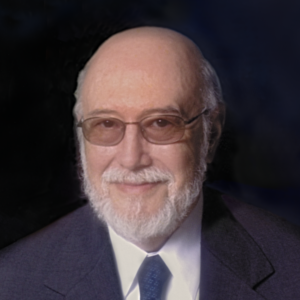
The other important group, the Enneagram Institute, was established in 1994 by Don Richard Riso (1946-2012), a former Jesuit novice who had learned of the Enneagram while studying theology at the University of Toronto in 1974 (Riso 1987/1990:17), and Russ Hudson, a younger associate. Riso’s first book on the Enneagram (Riso 1987/1990) was published the year before Palmer’s, and established itself as a best-seller. Riso and Hudson were also on the founding committee of the IEA (International Enneagram Association, Co-Founder, and History, 2025). The size of the Enneagram Institute is hard to judge, as it is a private for-profit corporation and so is not obliged to publish its accounts, but one (hostile) journalistic account reported annual income of $5,400,000 in 2022 (Myers, Leon, and Schwartz 2023), which is unlikely but not impossible.

The last group to emerge was, like the Catholic group, never formally organized, and was Protestant. Three books published in 2016-2017 (Cron and Stabile 2016, Heuertz 2017, and Fryling 2017) established the popularity of the Enneagram among Episcopal, Methodist, Baptist and Presbyterian Christians in the U.S. (McFarlan Miller 2016; Riess 2018), and one of these (Cron and Stabile 2016) remains among the top fifty best-selling “Christian self-help” titles on Amazon.com in 2025, nine years after its first publication. The point of departure of Ian Morgan Cron, an Episcopal priest and the earliest popular Protestant teacher, was in the Catholic group, with The Enneagram: A Christian Perspective (Cron and Stabile 2016:13-16), a collection of the lectures of Rochard Rohr, a Franciscan who had learned the Enneagram from an unnamed Jesuit spiritual director (Rohr 1992 9). This Protestant group was looser than the Catholic group had been.

In addition to these organizations, there are also many independent Enneagram teachers, some with smaller organizations and some working individually, some accredited by the IEA and some not. Individual authors have developed a Jewish Enneagram (Addison 1998), an Islamic Enneagram (Bakhtiar 2013), and a Buddhist Enneagram (Piver 2022).

DOCTRINES/BELIEFS

The doctrines and beliefs that have become attached to the Enneagram fall initially into two groups: the original version attributed to Gurdjieff and found in Ouspensky and Bennett, and the later version developed mostly by Ichazo and Naranjo. What the two versions have in common is reference to Gurdjieff’s fundamental distinction between essence and personality. “Essence is the truth in man; personality is the false,” said Gurdjieff, according to Ouspensky. Essence is what one starts with; personality is “what has come from outside, what [man] has learned, or reflects, all traces of exterior impressions left in the memory and in the sensations,” especially the consequences of the education of children; before this, children are pure essence. In the worst cases, “essence dies in a man while his personality and his body are still alive. A considerable percentage of the people we meet in the streets of a great town are people who are empty inside, that is, they are actually already dead” [emphasis in original]. At the other extreme, “liberation from personality” may allow the essence to develop (Ouspensky 1949/1957:161-65). Understanding this is key to “the realization of consciousness,” moving from the standard first stage of being “asleep” to being awake,  which Gurdjieff saw as “the subordination of the mechanical to the conscious” (Ouspensky 1949/1957:142, 282).

In this scheme, which has surely contributed to the later popularity of the Enneagram, essence and consciousness play a role similar to the scholastic conception of the spirit, while personality and the mechanical play a role similar to that of the lower self. Gurdjieff’s teaching, then, can be placed within the great mystical tradition that started somewhere before Plotinus. Even if the Enneagram itself cannot be traced back into prehistory, one doctrine that is closely associated with it can.

In Gurdjieff’s lifetime, the essence/personality pair remained separate from the Enneagram. The Enneagram was, as already noted, explained by Gurdjieff as a “universal symbol.” “All knowledge can be included in the enneagram and with the help of the enneagram it can be interpreted.” “The enneagram is the fundamental hieroglyph of a universal language which has as many different meanings as there are levels of men… a schematic diagram of perpetual motion.” In his lectures, Gurdjieff used his universal symbol to illustrate the relationship between the seven-tone musical scale, together with three intervals, and also to illustrate the different “systems” of the human organism: the digestive system, the breathing system, the blood stream, and so on (Ouspensky 1949/1957:278-94, 377). In these illustrations, he used not only the nine points of the Enneagram but also the various pathways between them: this is one sense in which the Enneagram is “in motion,” something much more complex than a simple list of nine points.

In principle, then, the Enneagram could be used for almost any purpose, and Bennett applied it to topics as various as cooking meals, manufacturing processes, and the symbiosis of the biosphere (Bennett 1983:7-12, 35-46, 66-77). An explanation of the Enneagram as universal symbol is found as late as 1977, in an account of Gurdjieff written by an American psychologist who came from a Gurdjieffian family and followed the teachings of Naranjo (Riordan 1977).

The second group of doctrines and beliefs attached to the Enneagram started in 1952 with Rodney Collin (1909-1956), an English follower of Ouspensky who moved to Mexico after the end of the Second World War and established a Gurdjieff group there, and also had followers elsewhere in Latin America. Colin matched the nine points of the Enneagram with nine “types of humanity” derived from astrology: mercurial types, jovial types, martial types, and so on (Collin 1952/2008:169). This may possibly have been inspired by Ouspensky, who had matched these nine points with the nine planets known to the ancient world (Ouspensky 1949/1957:378-79).

This development was continued by Ichazo, who may or may not have read Collin, but had certainly read Ouspensky, and whose starting point was the need to “distinguish between man as he is in essence, and as he is in ego or personality” (Keen 1973/1982:9). To this end, he proceeded to describe human personality in a series of Enneagrams, of which the most important was the Enneagram of “fixations,” “patterns of thinking” in the ego (as Ichazo had renamed Gurdjieff’s “personality”): resentment, flattery, vanity, melancholy, stringiness, cowardice, planning, vengeance, and indolence (Keen 1973/1982:15). These fixations needed to be identified and overcome in order to reach one’s essence in order to achieve “enlightenment” (Lilly and Hart 1977:332-33).

In addition, Ichazo also developed several other Enneagrams: of traps, ideas, passions, virtues (Keen 1973/1982: 16-18) and later also of Iies, the social, conservation, and “syntony” (by which he meant love and sex) (Lilly and Hart 1977:334-38, 347-49). Ichazo’s nine passions were anger, pride, deceit, envy, avarice, fear, gluttony, excess, laziness (Keen 1973/1982: 18). These included the seven deadly sins of Catholic teaching: pride, greed, wrath, envy, lust, gluttony, and sloth. Ichazo changed the classic order slightly and added deceit and fear make his nine passions, no longer pejoratively labelled “sins.”

Naranjo then developed Ichazo’s Enneagram of Passions into a single “Enneagram of Personality.” He modified Ichazo’s terminology somewhat, adding other characteristics and making slight modifications so that anger became “Anger and Perfectionism,” pride became “Pride and the Histrionic Personality,” deceit became “Vanity, Inauthenticity, and ‘the Marketing Orientation,’” envy became “Envy and Depressive Masochistic Character,” avarice became “Avarice and Pathological Detachment,” fear became “Cowardice, Paranoid Character, and Accusation,” gluttony became “Gluttony, Fraudulence, and ‘Narcissistic Personality,’” excess became “Sadistic Character and Lust,” and laziness became “Psychospiritual Inertia and the Over-adjusted Disposition” (Naranjo 1994:xii). Naranjo always remained a psychotherapist, if an unusually creative one, and his primary objective was psychotherapy to achieve healing. Beyond this he wanted to achieve “a continuous process of consciousness expansion,” which he saw as a “single journey of the soul” common to both “‘psychotherapy’ (rightly understood)” and “‘mysticism’ or ‘esotericism’ (rightly understood)” (Naranjo 1974:14). Naranjo also seems to have referred to the Diagnostic and Statistical Manual of Mental Disorders (DSM), published by the American Psychiatric Association to standardize classification and terminology across the profession.

Ironically, it was the Catholic teachers of the Enneagram who first distanced it from sin. Their personality types were understood in terms of “avoidance.” The started with anger, as Ichazo had, but followed avoidance of anger with avoidance of need, failure, ordinariness, emptiness, deviance, pain, weakness, and conflict (Beesing, Nogosek, and O’Leary 1984: 10-13). The point of this remained what it had been for Ichazo, drawing on Gurdjieff: “to live out the good qualities, or ‘essence,’ of human nature” (Beesing, Nogosek, and O’Leary 1984: 50). They do not say that the personality/essence binary comes from Gurdjieff, who is not mentioned; the origin of the Enneagram is given as Ichazo, and before him Sufis in Bolivia (Beesing, Nogosek, and O’Leary 1984:1). Whether or not the Catholics realized they were incorporating Gurdjieff, who was in no way Catholic, into their use of the Enneagram is not known.

A final development was of the personality types was then made by Riso, who thought that the original types were too negative and depressing, and noted that this also produced a practical problem in using them, as most people were reluctant to admit to negative things about themselves. He therefore decided to shift the focus from the negative to the positive aspects of each personality type, to what that type would be if healthy, not unhealthy, while at the same time “bring[ing] the personality types into clearer coherence with modem psychology” (Riso 1987/1990:16, 20). This gave him what became the more or less definitive types: The Reformer, The Helper, The Status Seeker, The Artist, The Thinker, The Loyalist, The Generalist, The Leader, and The Peacemaker (Riso 1987/1990:33).

Though Riso developed the types, he stayed close to an understanding of their use that followed on Ichazo and Gurdjieff. The types, he wrote, allowed people “to acknowledge and understand [their] inner states so that [they] can begin to move beyond them… beyond the ego and all that makes up what is called ‘false personality.’” This was not only about psychology. “If you learn to transcend your ego, then you are already on a spiritual path, whether you call it that or not… The Enneagram itself is not a form of spirituality but a means to spirituality of all kinds. It is psychology so profound and encompassing as to have spiritual overtones” (Riso 1989/1990:vii-viii). Riso himself did not teach the spirituality, however.

Riso’s personality type descriptors are not an exhaustive list. Palmer and Daniels, for example, made modifications to them (Narrative Enneagram n.d. ). Even Riso himself made changes to his descriptors over the years (Riso 1987/1990, Riso and Hudson 1990). Although the personality types certainly matter, the Enneagram “is not a fixed system,” as Palmer wrote. “It is a model of interconnecting lines that indicate a dynamic movement, in which each of us has the potentials of all nine points, or types” (Palmer 1988/1991:7). As Gurdjieff said, the Enneagram is not static, but in “perpetual motion.” It has indeed proved a universal symbol with which much knowledge, if not necessarily all knowledge, could be interpreted.

All of these Enneagram teachers (Collin, Ichazo, Naranjo, and even the Jesuits) followed Gurdjieff’s fundamental distinction between essence and personality and led groups of followers who were trying to free essence from personality. Even the Protestant Enneagram teachers followed this distinction. Cron recalled an elderly Benedictine monk telling him that “Most people aren’t aware of how things that helped them survive as kids are now holding them back as adults. They’re asleep” (Cron 2016:14). Cron follows this view: while growing up, in order to cope, we “place a mask called personality over parts of our authentic self.” Identifying personality thus “offer[s] spiritual counsel on how to open [one’s “shallow side”] to the transformative light of grace” (Cron 2016:22, 31). This emphasis on childhood fits well with the emphases of psychoanalysts from Freud onwards.

RITUALS/PRACTICES

The Enneagram is used by groups belonging to the IEA as a tool for personality typing, and those types are then used for a wide variety of other purposes. Some are spiritual, and some are practical. Some use the Enneagram only as a starting point, while some continue to use the Enneagram to assist future development. These practices have little in common with the practice originally taught by Gurdjieff, “movement of the enneagram,” which we will consider first.

Originally, under Gurdjieff’s direction, a large enneagram was drawn on the floor. In Ouspensky’s words, “the pupils who took part in the exercises stood on the spots marked by the numbers 1 to 9. Then they began to move in the direction of the numbers of the period in a very interesting movement, turning round one another at the points of meeting, that is, at the points where the lines intersect in the enneagram.” Of this, Gurdjieff reportedly said “The rhythm itself of these movements would suggest the necessary ideas and maintain the necessary tension; without them it is not possible to feel what is most important” (Ouspensky 1949/1957:294-95). This practice was continued into the “Gurdjieff Movements,” complex and intricate dances that became a central practice of many later Gurdjieff groups, notably that led by Bennet. It was also a practice of a Gurdjieff-descended group in Argentina led by “Silo,” Mario Rodríguez Cobos, during the 1960s (Huneeus 2018). It is still used today by Gurdjieff groups around the world that practice the movements; many examples can be seen on YouTube. These groups, however, are not Enneagram groups like those belonging to the IEA; they are Gurdjieff groups.

After the development of the Enneagram of Fixations by Ichazo, two varieties of practice emerged. One was the practice of discovering someone’s Enneagram type. Another was what followed, either to achieve spiritual or practical goals. Until Riso, all Enneagram practitioners had been interested in the spiritual or psychological: after Riso, various largely non-spiritual, practical applications were developed. As Riso himself put it, the Enneagram could not only help patients and therapists communicate, but also help lawyers understand their clients, teachers their pupils, and personnel directors their employees (Riso 1987/1990:9). Others added romantic understandings between partners, a genre that remains popular.

In the first area of practice, there was initially no formal way of finding someone’s personality type. Establishing a personality type had generally required long discussions, the method still favored by Palmer and Daniels, for whom the Narrative Tradition is “based on interviewing and interacting” (Saracino n.d.). An alternative method was first introduced by the Catholics, who gave twenty statements for each type with which they thought people with the personality type in question “will probably agree,” such as “many people depend on my help and generosity” for type twos, who  avoid need and so “need to be needed” (Beesing, Nogosek, and O’Leary 1984:19-48). This approach was taken further by Riso and Hudson, developed a list of 144 questions, with which a person can disagree, agree, or strongly agree. They termed this the Riso-Hudson Enneagram Type Indicator (RHETI®). Responses can be added up manually on a score sheet to find the person’s personality type (Riso and Hudson 1990: 174-188) or, more frequently nowadays, the responses can be given online and the type then calculated automatically by a computer program. This automatic test currently (2025) costs twenty dollars on the website of the Enneagram Institute, with discounts for quantity reaching fifty percent for those who order more than 100 tests (Enneagram Institute n.d.). Wagner followed the RHETI with an alternative system of his own, the Wagner Enneagram Personality Style Scales (WEPSS), and this is also widely used and can be taken online for fifteen dollars (ten percent discount for twenty-five tests or more) (WEPPS n.d.). Many other websites also offer automated Enneagram personality typing, including even the Narrative Enneagram (for ten dollars), some using deceptive practices, for example offering a free test and then requiring payment to release the results of the test, which the victim of the scheme has already spent quite a long time answering, making them more likely to pay the fee requested. That the RHETI and WEPPS offer discounts for quantity indicates that it is not only individuals who take the tests but also teachers of groups.

In the second area of practice, different teachers who have used the Enneagram as their starting point have used a wide variety of practices to achieve the next step. The earliest groups in Arica used “an amalgam of techniques and disciplines taken from esoteric and religious traditions of the East and West” (Keen 1973/82:5),“psychocalisthenics” (a form of yoga) and continued with “meditations, mantras, attentional division exercises, vocalizations, Plantar Listening (a method to listen to music with the body and not with the intellect)” (Pérez Benavides 2015). Naranjo, in contrast, aimed at “transformation through insight” using “enneatype-oriented Gestalt therapy” (Naranjo 1997:xiv). He had been working with Gestalt before meeting Ichazo. To this he added free association and meditation, including interpersonal mediation (Naranjo 2006:113-42). He also experimented with the concepts of integration and disintegration to describe movement between pairs of personality types, integration towards growth and disintegration towards neurosis, but seems only to have experimented with it briefly (Mosley 2023:51-52). Therapy remained his main practice.

The Catholics (Beesing, Nogosek, and O’Leary) recommended “acting against the compulsion” by moving against the arrows of the enneagram, from one type towards aspects of another, possibly on one’s own possibly with the aid of an Enneagram-trained friend who can push one in the right direction, or possible by developing “a direct personal relationship with God,” also with the aid of the Enneagram (Beesing, Nogosek, and O’Leary 1984:158-99). No other practices are mentioned, and although there are two brief quotes from the Spiritual Exercises of St Ignatius of Loyala in their book, the basis of Jesuit spirituality, the practice recommended is more psychological than Christian. Riso and Hudson also recommend using the Enneagram to identify “what is necessary for our real growth and transformation,” adding a division of each personality type into unhealthy, average, and healthy traits. “To get the full benefits of the Enneagram,” they advise, “one must integrate it into a genuine spiritual practice.” Riso and Hudson 2000:6), but what that spiritual practice they should be, they leave up to the individual.

Sometimes there is no practice of any sort. An example is provided by Shopify, a large and successful (2024 revenues of $8,800,000,000 billion): Shopify 2024) provider of global e-commerce platforms, which encourages employees to take an enneagram test and then display their personality type to facilitate cooperation with other colleagues (Stone and Knight 2022). Nothing more is done with the Enneagram.

A comparable practical use is an online event promoted on the website of the IEA in which Doug Lynam, an investment manager, offered “Nine Paths to Money Mastery with the Enneagram.” His premise was that “our financial struggles aren’t just about numbers—they’re deeply rooted in our personality types,” and he promised to “share practical strategies for transforming these money monsters into allies through contemplation, compassion, and action” (Lynam 2025). Unlike Shopify, there is some sort of practice (“practical strategies”), but these have nothing to do with the fundamental distinction between essence and personality.

ORGANIZATION/LEADERSHIP

The IEA is a non-profit organization led by a board that at the time of writing in 2025 consisted of eleven members, five from the U.S., others from Argentina, Egypt, Mexico, Norway, South Africa, and Spain, almost all working as Enneagram teachers (IEA Global Board of Directors 2025). Its membership directory listed 735 “professional” members offering services mostly in English, but also in Spanish and several other languages (IEA website 2025). Some of these work individually, and some through organizations, which may be non-profit, like the Narrative Enneagram, or for-profit, like the Enneagram Institute. There are also many individual teachers and coaches who are not affiliated with the IEA.

Earlier, Gurdjieff’s original group was based entirely on his own personal leadership, and had no organizational structures. This is why, on Gurdjieff’s death in 1949, his followers split into various groups with different leaders.

ISSUES/CHALLENGES

As the Enneagram became more popular and so more financially valuable, disputes emerged over its ownership and use. For some time, those associated with the Narrative Tradition and those associated with the Enneagram Institute refused to recognize each other (Heuertz 2025). In 1990, Arica sued Palmer for breach of copyright, an action that failed because although it was clear that Palmer had been using the enneagram to chart personality just as Ichazo had, Ichazo had repeatedly stated that the Enneagram and its uses were “facts,” not his own invention, and it is impossible to copyright a fact (Arica Institute v. Helen Palmer and Harper & Row 1992). Disputes continued with hostilities between the Narrative Tradition and the Enneagram Institute reduced by the foundation of the IEA (Heuertz 2025). In 2025, however, the Enneagram Institute sued the operator of several websites that offered different personality tests, including the Enneagram, for “infring[ing] on its intellectual property and engage in deceptive trade practices and unfair competition” (Enneagram Personality Types v. Kajtezovic et al 2025). The outcome of this case is unknown at the time of writing.

Although it is now reasonably clear that no-one owns the Enneagram, and although the IEA brings different groups together, there is still some competition. As has been recognized for many years, the road to professionalization of almost any practice runs through forming an association and introducing a system of certification (Jordan 1948). Although Enneagram practitioners have one professional association, they have multiple schemes for certification. Many of these are “closely tied to one or two teachers, so it’s not really a school verifying your understanding of the teaching… most certification programs aren’t comprehensive in their relationship to the larger field” (Heuertz 2025).

Another issue related to legitimacy. As the Enneagram presents itself as “a psycho-spiritual system” (IEA website 2025), it is open to attack on two fronts. For some of those who understand psychology as a science, the Enneagram is not truly scientific. For some of those who follow a particular spiritual or religious tradition, the Enneagram is not truly compatible with that tradition.

At the time of writing, Wikipedia (which is subject to constant revision) describes the Enneagram as “a pseudoscientific model of the human psyche” (Wikipedia 2025). “I myself could probably invent a system that has as much hope of scientific validation as the Enneagram,” concluded Kyle Whitaker, a philosopher and blogger. “And if I threw in a fun diagram and a mystical backstory, I could probably get people to use it” (Whitaker 2021). On the other hand, a meta study in the Journal of Clinical Psychology that looked at 104 studies of the Enneagram of varying quality was more nuanced in its conclusions, finding that “there has been some evidence for the validity of the RHETI” with “adequate to good internal consistencies and adequate test–retest reliabilities… [and] some evidence of validity, including theoretical predictions of attentional styles and theoretically consistent patterns of correlations with the Big 5 and the Myers‐Briggs” (Hook et al. 2021:873, 877). The Big 5 and the Myers‐Briggs are two alternative and widely-used personality testing systems. The study also noted that “the overall purpose of the Enneagram is not just the identification of one’s type but compassionate self‐awareness that promotes growth” and that there was evidence that it did indeed work for this purpose (Hook et al. 2021: 879).

Criticism of the Enneagram based in religious tradition has been primarily Christian. After the development of the Catholic Enneagram group, Thomas Wenski, Catholic Archbishop of Miami, objected that the Enneagram “introduces ambiguity into the doctrine and life of the Christian faith and therefore cannot be happily used to promote growth in an authentic Christian spirituality” (Wenski 2011). A Catholic journalist, Anna Abbott, focused on the Enneagram’s conception of sin (in fact, Ichazo’s concept): “The Enneagram redefines sin… by simply associating faults with personality types, which is particularly tempting in a cultural climate of irresponsibility and narcissism” (Abbott 2012).

When the Enneagram took off among Protestants, its Christian nature was again questioned. Kevin DeYoung, a Reformed (Calvinist) pastor and associate professor of systematic theology in North Carolina, concluded that “the Enneagram presents an approach to spirituality that is alien to, and often at odds with, the language and contours of Scripture” (DeYoung 2018). An Evangelical theologian, Kenneth Berding, came to the same conclusion, pointing out that Heurtz seemed to have no interest in salvation and that his idea that “we were born virtuous… but then developed a tragic flaw, often through disappointments or hurts from our parents or caretakers,” which is a good summary of what was originally Gurdjieff’s understanding of essence and personality, directly contradicted the Christian doctrine of original sin, according to which we were definitely not born virtuous. He too objected to the Enneagram’s conception of sin, reduced to “addictive tendencies or destructive patterns” (Berding 2018).

Perhaps the biggest challenge, however, it that the Enneagram may have passed peak popularity. Google Books Ngram Viewer shows references to “enneagram” increasing dramatically after 2019, the year after Google Trends shows searches for that term jumping. But searches fell a year later, and so did mentions in books, after peaking in 2021.

IMAGES

Image #1: The Enneagram. Author’s own drawing.
Image #2: George Gurdjieff. Public domain. Accessed from https://www.loc.gov/pictures/item/95507085/ on 5 October 2025.
Image #3: The Archéomètre. Saint-Yves 1911: 133. Public domain.
Image #4: Óscar Ichazo. CC BY-SA 4.0. Accessed from https://en.wikipedia.org/wiki/Oscar_Ichazo#/media/File:Oscar_Ichazo.png on 5 October 2025.
Image #5: Group history.
Image #6: Caludio Naranjo. CC0. Accessed from https://en.wikipedia.org/wiki/Claudio_Naranjo#/media/File:ClaudioNaranjo.JPG on 5 October 2025.

REFERENCES

Abbott, Anna, 2012. “A Dangerous Practice: Catholic interest in the Enneagram persists.” Catholic World Report. Accessed from https://www.catholicworldreport.com/2012/01/31/a-dangerous-practice/ on 5 October 2025.

Addison, Howard A. 1998. The Enneagram and Kabbalah: Reading your Soul. Woodstock, VT: Jewish Lights Publishing.

Arica Institute v. Helen Palmer and Harper & Row. 1992. US Court of Appeals for the Second Circuit – 970 F.2d 1067 (2d Cir. 1992). Justia. Accessed from https://law.justia.com/cases/federal/appellate-courts/F2/970/1067/269899/ on 5 October 2025.

Bakhtiar, Laleh, 2013. The Sufi Enneagram: The Secrets of the Symbol Unveiled. Chicago: Kazi Publications.

Barron, Frank. 1994. Preface to Character and Neurosis: An Integrative View by Claudio Naranjo. Nevada City, CA: Gateways/IDHHB, pp. xv-xx.

Beesing, Maria, Robert J.Nogosek, and Patrick H. O’Leary. 1984. The Enneagram: A Journey of Self-Discovery. Denville, N.J.: Dimension Books.

Bennett, J. G.  1983. Enneagram Studies. York Beach, ME: Samuel Weiser.

Bennett, J. G.  1974. The Enneagram. London: Coombe Springs Press.

Bennett, John G. 1973. Gurdjieff: Making a New World. New York: Harper.

Berding, Kenneth. 2018. “The Not-So-Sacred Enneagram: A Book Review of “The Sacred Enneagram” by Christopher L. Heuertz” Talbot School of Theology Faculty Blog. Accessed from https://www.biola.edu/blogs/good-book-blog/2018/the-not-so-sacred-enneagram on 5 October 2025.

Collin, Rodney. 2008. El desarollo de la luz. PDF. (Originally published Mexico City: Sol 1952).

Cron, Ian Morgan. 2025. “Journey to Wholeness: The Twelve Steps, the Enneagram, and You.” Jesuit Retreat Center. Accessed from https://www.jesuitretreatcenter.org/calendar/2025/09/06/journey-to-wholeness-the-twelve-steps-the-enneagram-and-you on 5 October 2025.

Cron, Ian Morgan, and Suzanne Stabile. 2016. The Road Back to You: An Enneagram Journey to Self-Discovery. Downers Grove, IL: IVP Books.

Cusack, Carole. 2020. “The Enneagram: G. I. Gurdjieff’s Esoteric Symbol.” Aries: Journal for the Study of Western Esotericism 20:31–54.

Daniels 2025. International Enneagram Association, Co-Founder, and History, David Daniels. Accessed from https://drdaviddaniels.com/international-enneagram-association-founder-history/ on 5 October 2025.

DeYoung, Kevin. 2018. “Enneagram: The Road Back to You, Or to Somewhere Else?” The Gospel Coalition. Accessed from https://www.thegospelcoalition.org/blogs/kevin-deyoung/enneagram-road-back-somewhere-else/ on 5 October 2025.

Egerton, Deborah et al. 2024. “Beyond the Mind: Awakening the Heart through the Enneagram”. IEA Nine Points. Accessed from https://ieaninepoints.com/iea-event-list/?_ga=2.232738331.568644796.1757320457158714761.1756895803#!event/2024/12/7/beyond-the-mind-awakening-the-heart-through-the-enneagram

Enneagram Institute. n.d. “Discover Your Enneagram Personality Type with RHETI® and IVQ.” The Enneagram Institute. Accessed from https://www.enneagraminstitute.com/get-started-with-enneagram-tests/ on 5 October 2025.

Enneagram Personality Types, Inc. d/b/a The Enneagram Institute v. Kajtezovic et al. 2025. United States District Court, Western District of New York. Justia. Accessed from https://law.justia.com/cases/federal/district-courts/new york/nywdce/6:2024cv06747/153825/21/ on 5 October 2025.

Fryling, Alice. 2017. Mirror for the Soul: A Christian Guide to the Enneagram. Downers Grove, IL: IVP Books.

Godwin, Joscelyn. 2020. Email to the author.

Hartmann, Thomas and Olga de. 1992. Our Life with Mr. Gurdjieff. London: Penguin, 1992. Originally published 1964.

Heuertz, Christipher L.  2025. “Beyond the Badge the Enneagram Certification Dilemma: A Guide to Making an Informed Choice.” Enneagram Monthly. Accessed from https://enneagrammonthly.com/beyond-the-badge-the-enneagram-certification-dilemma-a-guide-to-making-an-informed-choice/# on 5 October 2025.

Heuertz, Christopher L. 2017. The Sacred Enneagram: Finding Your Unique Path to Spiritual Growth. Grand Rapids, MI: Zondervan.

Hook, Joshua N. et al. 2021. “The Enneagram: A Systematic Review of the Literature and Directions for Future Research.” Journal of Clinical Psychology 77:865-83.

Huneeus, Sergio. 2018. Interview, Santiago de Chile. IEA Global Board of Directors, 2025, International Enneagram Association. Accessed from https://www.internationalenneagram.org/about/the-iea/global-board/ on 5 October 2025.

IEA website, 2025. International Enneagram Association. Accessed from https://www.internationalenneagram.org/ on 5 October 2025.

Jordan, Mildred. 1948. “Certification: A Stage of Professionalization.” Bulletin of The Medical Library Association 32:108-16.

Keen, Sam, 1982. “A Conversation about Ego Destruction with Oscar Ichazo.” Reprinted in Interviews with Oscar Ichazo. New York: Arica Institute Press. (Originally published in Psychology Today, July 1973).

Lilly, John C., and Joseph E. Hart. 1977. “The Arica Training.” Pp. 329-51 in Transpersonal Psychologies, edited by Charles T. Tart. New York: Harper & Row.

Lynam, Doug, 2025. “EA LIVE: Taming Your Money Monsters: Nine Paths to Money Mastery with the Enneagram.” IEA Nine Points. Accessed from https://ieaninepoints.com/iea-event-list/?_ga=2.232738331.568644796.1757320457-158714761.1756895803#!event/2025/9/19/iea-live-why-we-get-triggered-and-what-to-do-about-it on 5 October 2025.

McFarlan Miller, Emily. 2016 “Why Christians Love the Enneagram” Sojourners. Accessed from https://sojo.net/articles/why-christians-love-enneagram on 5 October 2025.

Mosley, Sterlin L. 2023. The Narcissist in You and Everyone Else: Recognizing the 27 Types of Narcissism. Lanham, MD: Rowman and Littlefield.

Myers, Aviva, Dassi Leon, and Tehilla Schwartz. 2023. “I’m Sorry, But I Really Just Don’t Care About Your Enneagram Number.” Mishpacha: Jewish Family Weekly, September 26. Accessed from https://mishpacha.com/im-sorry-but-i-really-just-dont-care-about-your-enneagram-number/ on 5 October 2025.

Naranjo, Claudio. 2006. The Way of Silence and the Talking Cure: On Meditation and Psychotherapy. Navada City, CA: Blue Dolphin Publishing.

Naranjo, Claudio. 1997. Transformation through Insight: Enneatypes in Life, Literature, and Clinical Practice. Prescott, AZ: Hohm Press.

Naranjo, Claudio. 1994. Character and Neurosis: An Integrative View. Nevada City, CA: Gateways/IDHHB.

Naranjo, Claudio. 1974. The Healing Journey: New Approaches to Consciousness. New York: Ballentine Books.

Naranjo, Claudio. n.d. Autobiography. Claudio Naranjo. Accessed from https://www.claudionaranjo.net/navbar_english/autobiography_english.html on 5 October 2025.

Narrative Enneagram. 2025. Founders. The Narrative Enneagram. Accessed from https://www.narrativeenneagram.org/team/2519/ on 5 October 2025.

Narrative Enneagram. n.d. “Tour of the Nine Types” The Narrative Enneagram. Accessed from https://www.narrativeenneagram.org/tour-the-nine-types/ on October 5 2025.

Ouspensky, P. D. 1957. In Search of the Miraculous: Fragments of an Unknown Teaching. London: Routledge & Kegan Paul. (Originally published New York: Harcourt Brace, 1949).

Palmer, Helen. 1991. The Enneagram: Understanding Yourself and the Others in Your Life. San Francisco: Harper San Francisco. (Originally published New York: Harper & Row, 1988).

Pérez Benavides, Gonzalo. 2015. “De cómo aprendí a observarme a mí mismo con científica precisión y amable ironía.” Manuscript later published in Los mundos del eneagrama: Miradas desde Chile. Santiago: Corporación Internacional de Eneagrama Chile.

Piver, Susan. 2022. The Buddhist Enneagram: Nine Paths to Warriorship. Somerville, MA: Lionheart Press.

Riess, Jana. 2018. “Why has the Enneagram Become so Popular among Christians?” Religion News Service 2018. Accessed from https://pres-outlook.org/2018/07/why-has-the-enneagram-become-so-popular-among-christians/ on 5 October 2025.

Riordan, Kathleen. 1977. “Gurdjieff.” Pp. 281-328 in Transpersonal Psychologies, edited by Charles T. Tart. New York: Harper & Row.

Riso, Don Richard, and Russ Hudson (2000). Understanding the Enneagram: The Practical Guide to Personality Types. Boston: Houghton Miflin. (Originally published 1990, 1999).

Riso, Don Richard. (1990). Personality Types: Using The Enneagram for Self Discovery. Boston: Houghton Mifflin. (Original publication 1987, 1989).

Rohr, Richard. 1992. Discovering the Enneagram: an Ancient Tool for a New Spiritual Journey. New York: Crossroad.

Romanelli Gonzalez, Gerardo. 2025. “IEA LIVE: From the Beliefs of the Enneatypes to the Metabeliefs of the Tritypes.” IEA Nine Points. Accessed from https://ieaninepoints.com/iea-event-list/?_ga=2.232738331.568644796.1757320457-158714761.1756895803#!event/2025/10/17/iea-live-from-the-beliefs-of-the-enneatypes-to-the-metabeliefs-of-the-tritypes on 5 October 2025.

Saint-Yves d’Alveydre, Joseph Alexandre, marquis de. 1911. L’Archéomètre.  Clé de toutes les religions & de toutes les sciences de l’antiquité. Paris: Dorbon-Ainé.

Saracino ND. “The Gifts of the Narrative Tradition.” The Narrative Enneagram. Accessed from https://www.narrativeenneagram.org/why-the-narrative-enneagram/ on 5 October 2025.

Sedgwick, Mark. 2021. 2021. “Sufism and the Enneagram.” Pp.  219-46 in Esoteric Transfers and Constructions: Judaism, Christianity, and Islam, edited by Mark Sedgwick and Francesco Piraino. New York: Palgrave.

Shopify 2024. Annual Report Pursuant to Section 13 or 15(D) of the Securities Exchange Act of 1934 for the Fiscal Year Ended December 31, 2024. United States Securities and Exchange Commission. Accessed from https://www.sec.gov/ix?doc=/Archives/edgar/data/0001594805/000159480525000012/shop-20241231.htm on 5 October 2025.

Stone, Madeline, and Rebecca Knight. 2022. “Shopify pushes employees to take personality tests and post their results for coworkers to analyze. It’s a divisive practice that’s sweeping across boardrooms globally.” Business Insider. Accessed from https://www.businessinsider.com/shopify-uses-ennegram-personality-tests-2022-1 on 5 October 2025.

TNE Annual Report 2023, 2024. TNE website. Accessed from https://www.narrativeenneagram.org/annual-report/ on October 5 2025.

Wagner, Jerome P. 1980. “A Descriptive, Reliability, and Validity Study of the Enneagram Personality Typology.” PhD thesis, Loyola University Chicago.

Wagner, Jerome P. 1996. The Enneagram Spectrum of Personality Styles: An Introductory Guide. Portland, OR: Metamorphous Press.

Wenski, Archbishop Thomas. 2011. “From the Bishops: ‘New Age’ is old Gnosticism.” Catholic News Agency. Accessed from https://www.catholicnewsagency.com/column/51502/new-age-is-old-gnosticism on 5 October 2025.

WEPPS. n.d. Website of the Wagner Enneagram Personality Style Scales. Accessed from https://www.wepss.com on 5 October 2025.

Whitaker, Kyle. 2021. “What’s Wrong with the Enneagram.” Medium. Accessed from https://robertkwhitaker.medium.com/whats-wrong-with-the-enneagram-95badcec3d70 on 5 October 2025.

Wikipedia. 2025. “Enneagram of Personality.” Wikipedia. Accessed from https://en.wikipedia.org/wiki/Enneagram_of_Personality on 5 October 2025.

Winter, Dayna. 2022. “The Founder’s Zodiac: What Type of Entrepreneur Are You?” Shopify. Accessed from https://www.shopify.com/nz/blog/founders-zodiac-entrepreneur-quiz# on 5 October 2025.

Publication Date:
5 October 2025

Share

Nine O’Clock Service (NOS) (1986-2025)

 NOS TIMELINE

1840:  St Thomas’s Anglican Church in the Sheffield suburb of Crooke opened with a mission of serving “destitute” populations.

1958:  Christopher (Chris) Brain was born.

1980:  Brain, his wife, Lynne (“Winnie”), and their daughter moved to Sheffield.

1986:  The Nine O’Clock Service (NOS) began at St. Thomas’ Church in Crookes, Sheffield.

1988:  The popularity of the service led the Anglican Bishop of Sheffield to approve the relocation of the service to the Ponds Forge Rotunda in Sheffield.

1991:  Brain was ordained as a deacon in the Anglican Church.

1992 (August):  Brain was accepted for ordination as a priest in the Anglican Church and celebrated his first communion. He wore the cassock worn by Robert de Niro in the 1986 film The Mission.

1992:  The Planetary Mass was performed at an annual Christian festival near Northampton, Greenbelt.

1994:  Brain began exploring potential expansion of NOS to the United States.

1994:  The BBC released a documentary reporting that Brain was moving away from traditional Christian doctrine and introducing his own innovations.

1995 (Summer):  Allegations of sexual abuse by Brain led to his resignation as a priest.

1995:  NOS services were halted following allegations that Brain had engaged in sexual and emotional abuse.

1995 (August):  NOS ceased to exist as a formal entity.

2019:  South Yorkshire Police opened an investigation into allegations of sexual abuse by Brain; he was formally charged for criminal offenses in 2024.

2024 (March 18): Brain appeared at Sheffield Magistrates’ Court to face thirty-four criminal charges of sexual offenses. He offered a not guilty plea on all charges.

2025 (June 30): Brain’s criminal trial began.

2025 (August 2025):  The jury delivered guilty verdicts on seventeen counts of indecent assault against nine women.

2025 (September):  The Crown Prosecution Service  announced that it was planning for retrial on the remaining charges in September.

FOUNDER/GROUP HISTORY

Graham St. John nicely describes the Rave scene as it emerged in England in the 1980s (2004:2):

Emerging in London in 1988, and subsequently exported around the world, rave has proliferated and mutated alongside associated music and body technologies. Its primary theatre of action was and remains the dance floor, a kinaesthetic maelstrom inflected by diverse sonic currents and technological developments influencing that which has been generically dubbed ‘house’, ‘electronica’ and ‘techno’. Throughout the 1990s rave grew prevalent in the experience of urban youth as vast numbers attached primary significance to raving. With the combined stimulus of electronic musics, psychotropic lighting, chemical alterants and all-night dancing, young novices and experienced habitues transcended the mundane in converted warehouses, wilderness areas, beaches, deserts and streets. Decked out in esoteric accessories, ultra violet (UV)- reactive clothing, personalized icons and an array of assimilated ‘religious’ glossolalia, their ecstatic experiences moved multitudes to draw on a plenitude of traditional interpretative religious frameworks – Hindu, Buddhist, Christian, pagan, Australian Aboriginal, mystical, etc.

The Nine O’Clock Service was one of the most visible of these groups, despite its relatively brief history (Robinson and Warne (2021) document the proliferation of rave groups across England).

There were a number of social and cultural influences that shaped the environment in which raves appeared in England in the 1980s. For example, John Wimber, who led the Vineyard churches visited in 1985 as did a leader of the Sojourners that same year. Winnie Brain had earlier met with prophets associated with the Toronto Blessing (Robinson and Warne 2021). More directly, Winnie enrolled in the music program at Sheffield University and Brain was a member of a Christian rock band, Present Tense.

The NOS emerged initially in St. Thomas’ Church as simply an alternative service under the leadership of Chris Brain (Till 2006). It immediately attracted the interest of primarily younger adult who were religiously unaffiliated. Anglican Church leaders were attracted by the prospect of new, young members as the church was (and has continued) experiencing steep membership decline. The service began with around a dozen participants but over time ultimately grew to about 600. In its rebellion against traditional religious structure, NOS began meeting as “worship in the round” at a local Shffield club, “Fruit.” It was not long before NOS received permission from the local Bishop to create a separate venue at the Ponds Forge leisure center. Winne Brain served as NOS’s designated DJ at the Fruit club-nights. (Robinson and Warne 2021). Chris Brain began training for the priesthood with enthusiastic support from Anglican clergy.

The visibility and popularity of NOS attracted attention in the United States. British real estate magnate, Dame Anita Lucia Roddick pledged substantial funding for a transplantation. In  2024, Episcopal priest Matthew Fox, a former priest in the Catholic Dominican Order, who was expelled in 1993 over theological disputes, subsequently joined the Episcopalian priesthood. Brain was invited to San Francisco by Fox and Bishop William Swing and performed his Planetary Mass in the Episcopal Grace Cathedral in October 2024. Fox continued Brain’s innovations in a variation he referred to as the Cosmic Mass. The Cosmic Mass shares in common with Brain’s vision the sacredness of earth, building community, joint creativity, rave dancing) but also incorporates a range of historic religious and spiritual traditions (Christian, Buddhist, Hindu, Muslim, Jewish, and Pagan).

According to the Cosmic Mass website (2025), its defining characteristics include:

So the Cosmic Mass replaces pews with a dance floor and replaces reading with dancing and meditation triggered by powerful imagery and music with DJ and VJ enhancement.  While a brief “teaching” is usually included,  the printed texts of modern worship are replaced in the Cosmic Mass by the context of experience.

While the Cosmic Mass was inspired by rave celebrations, its roots go deeper: to the ancient world traditions of ecstatic sacred dance. By enlivening the forms of modern worship with elements of rave and sacred dance, three things happen:

  • First, new life and inspiration flow, freed by ecstatic dance.

  • Second, ravers learn they can get high on worship itself, without the need for drugs.

  • Third, no single minister carries the responsibilities of leadership; everyone participates in midwifing the grace of the event (no vicarious prayer!). Because everyone dances, everyone is contributing their priestly offering.

The Planetory Mass was performed in San Francisco’s Episcopalian Grace Cathedral in October 2024 (Le Blanc 2024).

DOCTRINES/BELIEFS

NOS was created as an alternative to established religious doctrine and organization. Founder Chris Brain was granted permission to create an experimental form of religious service by Anglican leaders at a time that the denomination was losing members and failing to attract young adherents. At the heart of the experiment was a ritual, the Planetary Mass, that drew upon contemporary rave culture to connect young, religiously unaffiliated youth to the church. Bain’s innovation replicated the secular rave form in a spiritual setting. The Nine O’Clock Service’s ritual featured rave-style electric dance music coordinated by a DJ, sound and light projection, a club-like atmosphere, ecstatic dancing, and a celebrative and participatory style.

While Brain retained some elements of traditional Christian doctrine, he also redefined what it meant to be Christian. NOS advocated for a simple lifestyle that emphasized respect for the planet and concern about environmental abuse. Brain also advocated for a postmodern sexuality that abandoned traditional sexual constraints and allowed more free and open sexual activity. It was sexual activity, of course, that became the central issue in NOS’ ultimate downfall (See, Issues/Challenges).

ORGANIZATION/LEADERSHIP

Chris Brain’s ascendancy to leadership was rapid. Given that both he and Winnie had musical interests, their leadership in creating the Nine O’Clock Service was not surprising. His rapid rise to an independent status for NOS was also fueled by the Anglican hierarchy’s sense that he might help turn around a floundering denomination. And so his formal status was fast tracked. He was ordained as a deacon in the Anglican Church in 1991 and just a year later was accepted for ordination as a priest in the Anglican Church and celebrated his first communion. The media coverage of NOS also was relatively positive given its innovative and colorful quality. Brain received much of the attention.

Because NOS gatherings were organized as raves, each Planetary Mass required many dozens of individuals to assure a smooth performance. At the heart of each performance were teams of members to organize financial matters, music, prayer, venue, etc (O’Neill and Bradley 2025). These dedicated teams created energy and commitment, but also a certain amount of insularity as the goals of NOS became paramount (O’Neill and Bradley 2025).. There also was a special headquarters team of members who were dedicated to serving the Brain family and household. It was this insider team that was to become the primary source of controversy that engulfed NOS.

The group funded its operation largely through a ten percent tithe, but there also inheritance donations, and the Brain family was given use of a large farmhouse, Green Gates.

ISSUES/CHALLENGES

The situation in which NOS found itself shifted dramatically in a very short time. The movement was attracting young adults, receiving support from denominational leaders and favorable media coverage, and moving toward expansion into the U.S. in the early 1990s. By 1995, NOS was being disbanded and Chris Brain was facing criminal charges.

While there were other issues, the pivotal issue in the downfall of Chris Brain and NOS was the sexual violation allegations against Brain. As part of the organizational development, Brain had created the Homebase Team that attended to the needs of the Brain household and family. This insider group was small and insular within NOS (O’Neil 2025; Baynes and Evans. 2025). Brain developed a small coterie of women, often referred to as the “Lycra Lovelies.” Comprised of attractive young women whose attire consisted of black lingerie or tight Lycra outfits, these women not only performed household maintenance tasks and childrearing assistance but also provided sexual services when they “put Chris to bed” at night. One of the organizers of this system, Lori Camm, selected members of the Homebase Team and had an ongoing intimate relationship with Bain (O’Neill 2025; O’Neill and Bradley 2025).

While the crisis within NOS began in the 1990s and Brain resigned his priesthood in 1995, the legal case against him did not take shape until 2019. This created a difficult path for prosecutors as considerable time had elapsed since the events at issue and jurors needed to be convinced that the repeated sexual encounters could not have been consensual due to psychological coercion. The flood of media coverage created a highly charged atmosphere surrounding the legal proceedings.

Brain first appeared at Inner London Crown Court on April 30, 2024. and pleaded not guilty to one charge of rape and thirty-three charges of indecent assault against eleven female NOS members. The alleged assaults occurred between 1981 and 1995. His jury trial began on June 30, 2025.  On August 20, 2025 the jury delivered guilty verdicts on seventeen counts of indecent assault against nine women. He was found not guilty of another fifteen charges of indecent assault. On five cases the jury was unable to reach a verdict. The Crown Prosecution Service subsequently announced that it was planning for retrial on the remaining charges in September 2025 (Baynes 2025).

REFERENCES

Baynes, Chris. 2025. “Former priest faces retrial on sex assault charges.” BBC, September 4. Accessed from https://www.google.com/url?sa=t&source=web&rct=j&opi=89978449&url=https://www.bbc.com/news/articles/cq5jdy67p47o&ved=2ahUKEwid5aDfiPyPAxXBLlkFHb3vFAYQFnoECBwQAQ&usg=AOvVaw1CUOvZ83j9yCdXZSy4Uex8 on 1 October 2025.

Baynes, Chris and Alice Evans. 2025. “’Slave-like’ assistants and late-night massages: How a radical priest abused his congregation. BBC, August 21. Accessed from https://www.bbc.com/news/articles/cr4ezy3  on 29 September 2025.

Cosmic Mass website. 2025. Accessed from https://www.thecosmicmass.com/ on 28 September 2025.

Hutson, Scott. 2000. “The Rave: Spiritual Healing in Modern Western Subcultures.” Anthropological Quarterly 73:35-49.

Hutson, Scott. 1999. “Technoshamanism: Spiritual Healing in the Rave Subculture.” Popular Music and Society 23:53-77.

Le Blanc, Douglas. 2024. “Ex-Priest Christopher Brain Faces Sex Charges.” Accessed from https://livingchurch.org/news/news-anglican-communion/ex-priest-christopher-brain-faces-sex-charges/ on 28 October 2025.

O’Neill, Sean. 2025. “Ex-priest and ‘rave church’ leader guilty of 17 indecent assaults.” The Times, August 20. Accessed from https://www.thetimes.com/uk/crime/article/priest-guilty-indecent-assaults-rave-church-5jrwqkdb9 on 1 October 2025.

O’Neill, Sean. 2021. “The rise and fall of Chris Brain and the Nine O’Clock Service.” The Times, July 15. Accessed from https://www.thetimes.com/uk/religion/article/the-rise-and-fall-of-chris-brain-and-the-nine-oclock-service-ggknfzpvl on 29 September 2025.

O’Neill, Sean and Sian Bradley. 2025. “Chris Brain: ‘charismatic priest’ behind the Nine O’Clock Service.” The Times, August 21. Accessed from
https://www.thetimes.com/uk/crime/article/chris-brain-nine-o-clock-service-cult-abuse-5kk2pdmcl on 29 September 2025.

Robinson, Lucy and Christopher Warne. 2021. ‘Embracing the divine chaos’: transcending the sacred-secular divide in the 1990s British rave church movement.” Accessed from https://sussex.figshare.com/articles/chapter/_Embracing_the_divine_chaos_transcending_the_sacred-secular_divide_in_the_1990s_British_rave_church_movement/23473865 on 10/2/2025.

St. John, Graham. 2004. “Introduction.” Pp. 1-15 in Rave Culture and Religion, edited by Graham St. John. London: Routledge.

Till, Rupert. 2006. ‘The Nine O’clock Service: Mixing Club Culture and Postmodern Christianity.” Culture and  Religion 7:93-110.

Publication Date:
5 October 2025

Share

Lawren Harris

LAWREN HARRIS TIMELINE

1885 (October 23):  Lawren Stewart Harris was born in Brantford, Ontario.

1904–1908:  Harris studied art in Berlin.

1907:  Harris accompanied journalist Norman Duncan in his travels to the Middle East.

1908:  Upon his return to Toronto, Harris became friends with writers and artists interested in Theosophy.

1910:  Harris married Trixie Phillips.

1913:  Harris started the informal gatherings of artists with spiritualist and Theosophical interests that would later lead to the creation of the Group of Seven.

1920 (May):  The Group of Seven was formally established.

1922:  Although not yet a member, Harris was appointed to the Decoration Committee of the Toronto Theosophical Society.

1923 (March):  Harris joined the Theosophical Society.

1926:  Harris, who had emerged as a leading Canadian painter, published a seven-week course on “Theosophy in Its Relation to Art” in The Canadian Theosophist, the leading Canadian Theosophical journal.

1930:  Harris was the leading spokesperson for the Canadian Theosophical Society in a radio campaign to spread its ideas.

1934:  Harris divorced Trixie Phillips and started living with Bess Housser, a devout Christian Scientist who later became a Theosophist.

1934:  Harris married Bess Housser. His first wife, Trixie, claimed his divorce was invalid and accused him of bigamy. The scandal led Harris to leave Toronto and move to Hanover, New Hampshire.

1938:  Harris moved to Santa Fe, New Mexico, where he became a founding member of the Transcendental Painting Group.

1940:  Harris and his second wife, Bess, relocated to Vancouver.

1970 (January 29):  Harris died in Vancouver. The media celebrated him as the greatest artist in Canadian history.

2016:  “Mountain Forms” by Harris was sold at Heffel Auctions for Canadian $11,200,000 million (US $8,130,000), marking a record for the artist’s works.

BIOGRAPHY

Unlike other Theosophical artists who rarely explored the link between Theosophy and art in-depth, the prominent Canadian painter Lawren Stewart Harris (1885–1970) actively did so. Throughout his career, he produced several articles, manuscripts, and notes on Theosophy [Image at right]

Many artists in the twentieth century faced poverty. Harris was an exception. Born in Brantford, Ontario, on October 23, 1885, he came from a wealthy family that held significant shares in the Massey-Harris agricultural equipment company. His paternal lineage was Protestant, including several prominent Baptist and Presbyterian ministers. In contrast, his mother was a Christian Scientist, which exposed him to a different religious environment (Ambler 2002:19).

In 1884, just a year before Harris’ birth, Toronto journalist Albert Ernest Stafford Smythe (1861–1947) became interested in the Theosophical Society after an unexpected encounter with its American leader, William Quan Judge (1851–1896), while crossing the Atlantic on an ocean liner. Smythe later introduced several Toronto literary elite members to Theosophy, including noted occult enthusiast and novelist Algernon Blackwood (1869–1951). In 1891, Smythe and Blackwood helped establish the Toronto Theosophical Society (McCann 2012:23). As a well-known social figure in Toronto, Smythe enlisted several prominent local literary personalities for this new society, such as fellow journalist and art critic Frederick Housser (1889–1936) and playwright Roy Mitchell (1884–1944).

Housser, an old friend of Harris from their days as students at St. Andrew’s Presbyterian College, influenced Harris’ decision to seriously pursue Theosophy, which matured after he met Mitchell in 1908 (Ambler 2002:25). By then, Harris was already established as a painter, thanks to financial support from his affluent family, which enabled him to study the latest European artistic movements in Berlin. He learned from Franz Skarbina (1849–1910), a founder of the Berlin Secession, a group that championed Edvard Munch (1863–1944) against German academic opposition. Skarbina shared his admiration for Munch with Harris and introduced him to prominent Secession artists, including Paul Thiem (1858–1922) and Max Liebermann (1847–1935). Additionally, through Skarbina, Harris encountered the works of Caspar David Friedrich (1774–1840), the Romantic German painter who was a key influence on the Berlin Secession.

Harris, deeply influenced by Thiem and Friedrich, was introduced through them to what he later called religious “unorthodoxy” (Larisey 1993:10). This opportunity allowed the Canadian artist to delve into a spiritual realm beyond Christianity during his travels with journalist Norman Duncan (1871–1916) in the Middle East. Harris created fifty-nine illustrations to accompany Duncan’s articles on his journeys. [Image at right] Upon returning to Toronto, he remained under the sway of his German instructors, focusing on urban landscapes, particularly in very impoverished areas, a pursuit he maintained for several years. 

By 1908, he began to emulate Friedrich by venturing North to capture landscapes with snow and towering mountains. He often traveled to Northern Canada with fellow painter Tom Thomson (1877–1917), whom he greatly respected. Tragically, Thomson died in a somewhat mysterious boating accident at Canoe Lake in Ontario’s Nipissing District in 1917. Some critics observed a specific Theosophical influence in Harris’ early landscapes, especially when analyzing what they later termed his cycles of the North (Adamson 1978; Mesley 1978; Stoeber 2012, 2013).

In the 1910s, Harris was already familiar with Theosophy’s doctrines, although he was initially reluctant to join the Society formally. His skepticism towards organizations played a part in this hesitance, compounded by the fact that his wife, Beatrice (Trixie) Phillips (1886–1962), whom he married in 1910, came from a strict Episcopalian background that viewed Theosophy and similar beliefs as “heresies.” At that time, many of Harris’ closest companions were either members of the Theosophical Society or would become members, including artists James Edward Hervey MacDonald (1873–1932) and Arthur Lismer (1885–1969). [Image at right] MacDonald and Lismer were among the founders of the Group of Seven, which Harris established in 1920.
The Group of Seven was assembled to foster authentic Canadian art that was as free as possible from foreign influences. Harris, who was instrumental in selecting its members, also sought to use his means to assist less privileged Canadian artists. Despite its relatively brief existence (disbanding in 1933), the Group greatly impacted twentieth-century Canadian art. The Seven were not only connected by their focus on an independent Canadian art; they also had an interest in alternative spirituality. Three of the original Seven were or will become members of the Theosophical Society, while all shared a basic understanding of and affinity for Theosophical doctrines.

An article by Dennis Reid (1943–2023) from 1968 led several Canadian art historians to recognize the influence of the Theosophical Society on the Group of Seven (Reid 1968). However, they often neglected the similar impact of Christian Science, which the artists were exposed to, particularly its fundamental beliefs: that illness does not genuinely exist but is merely a mental error, and that any effort to sway others’ minds embodies a perilous form of “animal magnetism,” which contributes to numerous contemporary ills. Harris’ mother, J.E.H. Macdonald’s wife Joan Lavis (1871–1962), and Frank Hans (Franz) Johnston (1888–1949), one of the Seven, were practitioners of Christian Science. Another Christian Scientist in the proximity of the Seven was Bess Housser (1891–1969), who later became Harris’ cherished second wife and at that time was married to Frederick Housser, a Theosophist and the semi-official publicist and historian for the group (see Housser 1926). Poet and politician W. Gordon Mills (1886–1960: see Mills 1992:8), the closest friend of the Houssers, was also a Christian Scientist.

J.E.H. MacDonald should not be mistaken for James Williamson Galloway “Jock” Macdonald (1897–1969), a later painter influenced by the Group of Seven and by Piotr Demianovitch Ouspensky’s (1878–1945) esoteric ideas. Jock became captivated by Ouspensky’s A New Model of the Universe (Davis 1992:28), where the Russian author’s connections to the Theosophical Society are evident. Later, when Harris relocated to Vancouver, he became good friends with Jock Macdonald, noting with delight how the younger artist was intrigued by Eastern religious systems and Theosophical thought (King 2012:282).

Harris officially became a member of the Theosophical Society in March 1923. However, this does not mean his association with the Society started then. Correspondence shows that several years before 1923, he was already motivating friends to join. In 1922, he was appointed to the DecorationCommittee of the Toronto Theosophical Society, serving alongside Mitchell and Lismer (Ambler 2002:31). [Image at right] In the years that followed, Harris created his most renowned Canadian landscapes, including famous works like “North Shore, Lake Superior” (1926) and “Isolation Peak” (1929). His art is characterized by reducing shapes to their essential forms and featuring a stark contrast between light and dark. These elements form part of an aesthetic that Theosophists sought to extract from Madame Helena Blavatsky’s (1831–1891) teachings (Bauduin 2013).

From 1926 to 1933, Harris actively contributed to The Canadian Theosophist, Canada’s leading Theosophical magazine, and was involved in the activities and controversies of the Toronto Theosophical Society. The Toronto group maintained notable independence despite the conflicts that fractured the international Theosophical Society in the 1920s and 1930s (McCann 2012). In 1895, Judge led most American members into a schism from the Theosophical Society, which had its headquarters in Adyar, India, after Blavatsky’s death, with Colonel Henry Steel Olcott (1832–1907) serving as President. Following Judge’s death in 1896, his American branch faced another schism, where most followed Katherine Tingley (1847–1929), the founder of the Theosophical community in Lomaland, California. A minor faction sided with Ernest Temple Hargrove (1870–1939), Judge’s former secretary. Many members of the Toronto Lodge, who had historically allied with Judge, including Smythe and Mitchell, spent several years with Hargrove’s branch before rejoining the Adyar Theosophical Society in 1907 (Davy 2011:111–113). The Theosophical Society in Canada experienced significant turbulence. In 1924, just a year after Harris’ formal membership, what Canadian Theosophists referred to as “the split” or “the break” led to the division of Canadian members into two branches, both recognized by Adyar, referred to as the Canadian Section and the Canadian Federation of the Theosophical Society (Davy 2011:1–76).

In 1926, The Canadian Theosophist unveiled a seven-week course by Harris on “Theosophy in Its Relation to Art” ([Anonymous] 1926:220). In 1930, the artist contributed to the radio campaign organized by the Theosophical Society and was considered its most influential spokesperson (see Harris 1987). A noteworthy incident illustrating Harris’ advocacy for Theosophy involves British Columbia artist Emily Carr (1871–1945). Harris not only helped elevate this relatively unknown local artist to national fame but also sought to pique her interest in Theosophy. Carr first met Harris in Toronto on November 17, 1927. The two maintained regular correspondence for several years, during which Harris asserted that Theosophy could enrich Carr’s life and artistic endeavors. Although Carr never renounced her Protestant faith, she regarded Harris’ views with seriousness and started exploring Theosophical texts. She came to believe that Theosophy encompassed aspects akin to Native American spirituality, a topic she had previously delved into passionately. [Image at right] In her paintings “Nirvana” (1928) and “Blunden Harbour” (1930), Carr expressed her deep affection for Native American culture through a Theosophical lens. “Grey” (1931) was referred to as “the most Theosophical of her paintings” (Reed 1999:18), depicting the emergence of divine light from the primeval darkness of a Canadian forest. .

Lacking any Theosophical lodges in Victoria, Carr sought a faith she viewed as both Christian and similar to Theosophy: Unity School of Christianity, a loosely pantheistic group rooted in H. Nonetheless, her involvement with Unity did not strengthen Carr’s dedication to Theosophy, and she continued to be suspicious of Madame Blavatsky’s criticisms of Christianity. In 1934, she noted in her journal, “Somehow Theosophy makes me shudder now. It was reading H. Blavatsky that did it, her intolerance and particularly her attitude to Christianity” (Carr 2006:176). Ultimately, Carr destroyed her copy of Blavatsky’s The Key to Theosophy (Reed 1999:22) and told Harris she had reverted to “the beliefs of childhood.”

Harris sent a polite answer, explaining that, as a Theosophist, he believed that “Christianity for the first three centuries was pure Theosophy,” but that later it had become corrupted. Harris also insisted that Theosophy “is not a sect as is Christian Science, Unity, or New Thought, or in the same sense. For it advocates the study of all religions, philosophies, and science. It is the synthesis of all these—that is what makes it difficult” (Davis 1992:112). Carr was not persuaded. Later, she wrote that Theosophy “goes round and round in circles and makes you giddy,” and that it was “a sort of endless voyage with God always way, way beyond… without the love of a real Jesus Christ to bridge the gap” (Street 1979:90).

In 1934, shortly after completing some of his most famous paintings, including “Mount Robson” (1929), “Mount Lefroy” (1930), and several Arctic landscapes, Harris went through a significant personal crisis[Image at right] Some sources suggest he had been in love with Bess Housser, the wife of his friend Frederick Housser, since 1920, when he painted her portrait as “The Christian Scientist” (Ambler 2002:37). In 1934, Bess accepted Harris’ offer to move into the apartment where he had his studio. This situation was more than Harris’ wife, Trixie, could endure, leading to the end of their marriage that same year.

The friendship between Harris and Frederick Housser persisted despite these complications. Housser had started a relationship with artist and Theosophist Yvonne McKague (1898–1996) and was waiting for Bess to divorce him so he could marry Yvonne. The only person unhappy with this situation was Trixie Harris, who felt abandoned by Lawren while caring for their three children. In 1934, when Harris quickly obtained a divorce in Nevada and married Bess, Trixie argued that an American divorce was not valid in Canada. She and her influential family claimed that Harris had become a bigamist. Harris’ marriage to Bess was abstinent, and they both insisted that true couplehood needed chastity, aligning with a higher Theosophical and artistic ideal (Larisey 1993:118).

Whether through an abstinent marriage or otherwise, the divorce created quite a scandal in Toronto. In a letter sent to Harris in 1934, Bess described the situation using vintage Christian Science language, despite having joined the Theosophical Society in 1922 (Adamson 1978:132): “Animal magnetism is known with all its brutal and destructive force directed into one’s own life and vision. It seems to create a great vortex and it will with fiendish delight do away with you there if it can” (Adamson 1978:119).

Even after 1934, Harris and Bess occasionally referenced Christian Science while asserting that Theosophy presented a higher form of spirituality. This is evident in their correspondence with Yvonne McKague, the second wife of Frederick Housser, who also felt torn between Christian Science and Theosophy. Harris wrote to her (Davis 1992:114):

Yes, I believe that physical health is an effect of thought, but of right emotion just as much as right thought—and I am not at all convinced that Christian Science has an answer to that… To me the philosophical basis is finer—of Theosophy than it is of C[hristian] S[cience]—much broader and more embracing—it answers my inner questions with a more satisfying sweep and grandeur that thrills something inside me.

Several Christian Scientists were part of Harris’s circle of friends, including Eric Brown (1877–1939), who supported Harris as director of the National Gallery of Canada, and Doris Huestis Speirs (1894–1989), among others (Reid 1985:25). Speirs was a prominent Canadian ornithologist and the former wife of W. Gordon Mills. Bess maintained regular correspondence with Doris for thirty years (Falls 1990).

Fleeing the divorce scandal, Harris ultimately decided to leave Toronto and move with Bess to Dartmouth College at the University of New Hampshire in Hanover, where he offered to work for free. During his time in Hanover, Harris deepened his interest in abstract art, a passion that grew after meeting Wassily Kandinsky (1866–1944) and Katherine Dreier (1877–1952). [Image at right] Dreier, both an art patron and an artist, managed the Société Anonyme, and Harris became its only Canadian member (Reid 1985:14).  [Image at right] She was crucial in increasing Harris’ international recognition and introduced him to her friend and protégé, Marcel Duchamp (1887–1968). Although not a member, Dreier had a close connection to the Theosophical Society (Fowler 2000).

During this period, Duchamp delved into the concept of a fourth spatial dimension. American art historian Linda Dalrymple Henderson highlights the considerable influence of Theosophy and the works of P.D. Ouspensky on the conceptualization of this spatial fourth dimension (Dalrymple Henderson 1998, 2012). She underlines the pivotal contributions of Theosophist and architect Claude Bragdon (1866–1946), who played a crucial role in articulating a framework for understanding this dimensionality. This notion of a spatial fourth dimension should not be conflated with the temporal fourth dimension that gained prominence following Albert Einstein’s (1879–1955) work.

In Hanover, Harris took the opportunity to explore new artistic ideas, leading him to create his first abstract paintings. His work “Winter Comes from the Arctic to the Temperate Zone” (1935) marks a significant transition from depicting Canadian landscapes to embracing abstract art. Critics (Davis 1973; Adamson 1978:132–35; Davis 1992:116–17) have noted that this evolution may have been influenced by the book Thought-Forms, written by Theosophical Society leaders Annie Besant (1847–1933) and Charles Webster Leadbeater (1854–1934) (Besant and Leadbeater 1905).

Harris’ evolution continued when he moved to Santa Fe, New Mexico, where he and his wife Bess arrived in November 1938. He chose to focus exclusively on producing abstract art. Both Bess and Harris became interested in the concept of “dynamic symmetry,” developed by Canadian-born American artist Jay Hambidge (1867–1924). Dynamic symmetry is based on a mathematical study of proportions in ancient Greek art and has been explored by several Theosophists, including Bragdon. Hambidge was not a Theosophist and asserted his approach was purely scientific. His wife, Mary Crovatt Hambidge (1885–1973), took part in various cultural initiatives started by Eva Palmer Sikelianos (1874–1952), the spouse of Greek poet Angelos Sikelianos (1884–1951). In New York, along with the well-known journalist Alma Reed (1889–1966), Palmer organized a center for the arts that served as the American branch of the Delphic Movement, founded by Eva and Angelos Sikelianos in Greece, which was colloquially referred to as “the Ashram.” Several Theosophists frequented the Ashram, where Annie Besant personally lectured. At the Ashram, Mary Hambidge introduced Mexican muralist José Clemente Orozco (1883–1949) to the principles of dynamic symmetry. Orozco also learned about Theosophy during his time there (Barnitz 1983).

In this unique New York institution, visitors had the opportunity to meet Bragdon and several followers of the Russian Theosophist painter Nicholas Roerich (1874–1947). In 1932, Roerich hosted an exhibition featuring paintings by contemporary Canadian artists at his Roerich Museum in New York. This exhibition was organized in collaboration with Harris and Frederick Housser and laid the groundwork for establishing the Canadian Group of Painters in 1933. The Group, with Harris serving as President and Housser as Secretary, was regarded by many as the successor to the Group of Seven (Reid 1985:21).

Drawn by the favorable climate and the more affordable living expenses, many American artists eventually moved to New Mexico, where they met a diverse Theosophical community (Gibson 1983) influenced by the French astrologer, Theosophist, and artist Dane Rudhyar (born Daniel Chennevière, 1895–1985), who often visited to conduct courses and seminars (Ertan 2009). Rudhyar had contributed articles to The Canadian Theosophist under the pseudonym Zahaz D. Rudhyar (e.g., Rudhyar 1926) and was familiar to Harris. The impact of Roerich on this group remained significant. Among the followers of Roerich in New Mexico were painter Emil Bisttram (1895–1976) and his spouse Mayrion Huth Bisttram (1898–1984), painter Ralph Harris Houston (1908–1976), Chicago artist Raymond Jonson (1891–1982), who had formed the Cor Ardens (Burning Heart) Brotherhood in 1920 based on Roerich’s ideas, and Clyde Gartner (1900–1967), who established the Arsuna school and art gallery in Santa Fe in 1937 (Udall 1999).

Upon arriving in New Mexico, Harris was naturally drawn to this community, which had also been visited multiple times by Georgia O’Keeffe (1887–1986), who became acquainted with Theosophy through her friendship with Bragdon. O’Keeffe, however, made New Mexico her permanent home only in 1949, after Harris had returned to Canada. [Image at right]

Lawren and Bess Harris formed a close friendship with Raymond Jonson and Emil Bisttram. This bond also included Yvonne McKague Housser, who chose to live temporarily with the Harrises in New Mexico after her husband, Frederick (Bess Harris’ former spouse), passed away in 1936. In 1939, Harris, Bisttram, and Jonson established the Transcendental Painting Group. Most “transcendental” artists were Theosophists, and all were admirers of Kandinsky. However, the group maintained that its goals were exclusively artistic and did not involve promoting any religious or spiritual beliefs. Ultimately, the Group founded the parallel American Foundation for Transcendental Painting, Inc., where Rudhyar was Vice President (Hartel 2002:250). It co-organized several significant exhibitions and successfully engaged Kandinsky in its activities (Ambler 2002:42; Ertan 2009:145–48).

This activity in New Mexico did not endure after World War II, which posed a practical challenge for Harris in 1940. He found it increasingly difficult to receive dividends from his shares in the Canadian family business while in the U.S. Consequently, he and Bess decided to relocate to Vancouver, where they lived until they died in 1970 and 1969, respectively. Once Harris returned to Canada, his approach to abstract art gradually transformed. [Image at right] Initially, his early abstract works in Hanover simplified landscapes into abstract shapes. While he attempted to incorporate mathematical proportions based on dynamic symmetry in New Mexico, in Vancouver he moved away from mathematics and concentrated solely on his inner perceptions of beauty.

In the final years of Harris’ life, he received recognition as Canada’s national painter. However, his later abstract works were often underappreciated by critics, except for the renowned literary theorist Northrop Frye (1912–1991), who praised Harris “best abstractions [as] a unique and major contribution to Canadian painting” (Frye 1948:57). Harris’ reputation was primarily built on his earlier landscapes of Northern Canada. He also engaged in ongoing debates about government policies on the arts and museums, especially after assuming the role of President of the Federation of Canadian Artists in 1944.

Although he was less involved with the Theosophical Society during this time, his artworks and writings indicate that he considered himself a Theosophist until his death (Ambler 2002). The passing of his cherished second wife, Bess, on 28 September 1969, occurred just three months before Harris himself passed away on 29 January 1970. [Image at right] The remains of both Harris and Bess are interred in the small cemetery in the garden of the McMichael Collection of Canadian Art in Kleinburg, Ontario.

Harris cited various authors from Theosophy. However, in a December 1, 1937, letter addressed to Yvonne McKague Housser, he claimed that only Blavatsky and Judge “were in constant and direct contact with the Great Ones [the Masters], and only their works are truly dependable.” He stressed that one should read Blavatsky and Judge to genuinely understand authentic Theosophy, defined by him as “an all-comprehensive philosophy—a synthesis of Religion, science, and philosophy,” which “the West needed” and “the East had always had” (Ambler 2002:238).

In his impactful lectures and radio addresses promoting the Theosophical Society, Harris aimed to portray Theosophy as a straightforward system, centered on three key concepts: monism, karma, and reincarnation. He proposed that our belief in an ideal state reflects evidence of reincarnation. He contended that this conviction cannot stem from our experiences in this present life: “By virtue of what insight do we dare set ourselves up as judges of the imperfections of this world, unless we have known and know a superior realm of being?” (Harris 1933b:164). Is this “superior realm” accessible in our current lives? Yes, Harris affirmed, through what he termed a “sixth sense,” aligning with the “aesthetic attitude” (Harris 1933b:164). While the early Theosophists may have chosen other terms, the idea of a sixth sense recalling a divine plan remains orthodox within Theosophy.

Harris’ writings linked this to a polemical stance, influenced by Blavatsky, that critiques mainstream religion. He accused “religionists” of prioritizing morality over spirituality, thereby fostering a distorted view of God. According to him, “morals” suggest the existence of an external deity, a lawgiver positioned beyond our universe. In contrast, the aesthetic perspective asserts that a divine essence resides within each individual, gradually revealed through personal, creative endeavors and experiences. According to Harris, the moral viewpoint lacks creativity, is unadventurous, and follows rather than leads. Conversely, the aesthetic perspective is innovative, fertile, and embraces the spirit of adventure at the core of our existence (Harris 1993b:164). This text, written a year before Harris divorced, critiques the rigid moral standards of the Toronto Protestant establishment, which generally viewed divorce unfavorably. Yet, in 1922, Harris had already addressed in his sole poetry collection those who “succumb to second hand living” and “say nay, nay, and smile at aspirations, dreams and visions” due to their reliance on “old dead catch phrases” and antiquated beliefs (Harris 1922:80). This indicates that Harris adopted these views long before his family challenges arose.

Harris viewed aesthetic experience as fundamentally rooted in beauty. The arts, he believed, “epitomize, intensify and clarify the experience of beauty for us, as nothing else can” (Harris 1933a:130). Beauty is seen as a powerful force; it connects us to “the plane of being we Theosophists call buddhi, that is, that eternal plane of being wherein abides the immortal part of man and the universe, and which is beyond sensuality and the intellect and desires, and is the source of all high inspiration and devotion” (Harris 1933a:131). [Image at right] This concept of beauty fosters a dual movement: it lifts us towards the divine, to a higher reality, while simultaneously penetrating “all the secret places in the soul; that leaves no dark corner, no twist of hypocrisy, no petty motive, to its own devices, but shows us the stark truth of our pretenses, and our personal perversions, for exactly what they are” (Harris 1933a:132).

For Harris, art is universal, yet each culture should possess its unique expression. Romanticism brought forth the notion of “the North” as a region particularly conducive to spirituality, influenced by geography and climate. Harris embraced this established “Northern Romantic tradition” (Rosenblum 1975), integrating it with Theosophy, artistic expression, and Canadian nationalism. He critiqued Canadians who depended on European or American models instead of forming a genuinely Canadian art scene. Theosophy added a distinct perspective to his interpretation of Canada’s national tradition, rooted in Blavatsky’s belief that the sixth sub-race of the Aryan root-race was emerging on the American continent (Blavatsky 1888, II:444–445). According to Blavatsky, this sixth sub-race would be more spiritual than earlier sub-races, benefiting from North America’s climate, landscape, and burgeoning economic and technological progress.

In the early nineteenth century, Canadian nationalists asserted that Canada possessed a unique identity, separate from Europe and the United States. This identity was deeply rooted in the concept of the “Great North,” which held both geographical and mystical significance. In embracing this tradition, Harris claimed that being close to the Great North offered Canadians economic advantages, a strategic location, and health benefits, while enhancing their spirituality and fostering mysticism. He partially reframed Canadian nationalism through the perspective of American Transcendentalism, which resonated with many Canadian artists (Davis 1992). Additionally, he drew inspiration from the ideas of German painter Paul Thiem, whom he encountered during his early years in Berlin. Transcendentalists and Thiem posited that specific landscapes, such as vast wildernesses, forests, and abundant snow, heightened spiritual awareness.

The Transcendentalists and Blavatsky mainly focused on the spiritual characteristics of the Northern landscape in relation to the United States. Harris highlighted the uniqueness of Canadian geography: “The very coolness and clarity of its air, the feel of the soil and rocks, the rhythms of its hills and the rolls of its valleys, from its clear skies, great waters, endless little lakes, streams and forest, from snows and horizons and swift silver. These move into a man’s whole nature and evolve a growing, living response that melts his personal barriers, intensifies his awareness and projects his vision through appearances to the underlying hidden reality” (Harris 1926:86). “Indeed, no man can roam or inhabit the Canadian North”—Harris wrote—“without it affecting him […]. The North will give him a different outlook from men in other lands” (Harris 1926:86).

The artist argued that spending merely two months in Northern Canada would suffice to enhance the freedom and creativity of any true artist (Larisey 1993:63; Larisey 1974). Harris recognized that Blavatsky believed a new race was developing in the United States instead of Canada. Nevertheless, he maintained that the environment in Canada was even more favorable for spiritual growth. “The top of the continent,” he explained, “is a source of spiritual flow that will ever shed clarity into the growing race of America, and we Canadians, being close to this source, seem destined to produce an art somewhat different from our southern fellows, an art more spacious, of a greater living quiet, perhaps of a certain conviction of eternal values. We were not placed between the southern teeming of men and the ample, replenishing North for nothing” (Harris 1926:85). Like Harris, his associate, fellow Theosophist, and co-founder of the Seven, Arthur Lismer, also expressed in The Canadian Theosophist his belief that a new sub-race would arise in Canada, as opposed to United States (Lismer 1925).

The faith of Harris’ mother, Christian Science, supported his argument for Canada. Christian Science emphasized that densely populated areas increase the dangers of negative animal magnetism. Harris wrote, “We in Canada are in different circumstances than the people of the United States. [Image at right] Our population is sparse, the psychic atmosphere comparatively clean, whereas the States fill up and the masses crowd a heavy psychic blanket over nearly all the land” (Harris 1926:86). Critics believe that the already mentioned painting “Winter Comes from the Arctic to the Temperate Zone” epitomized this “clean” Canadian atmosphere (Davis 1992;116).

Harris recognized the importance of steering clear of any potential racist connotations related to Blavatsky’s concept of root races. In 1933, in response to the heightened focus on the Nazi threat by Canadian media, Harris released an analysis of European political affairs through a Theosophical lens. He reiterated his familiar tirades against organized religion and “the glib priests who turn their backs on any god worthy of the name and serve the god of enmities in man, the god of a tribe or class.” But he also lashed against “the devilish moral cowardice of Germany today, a people who under the cloak of a fanatical belief in the superiority of the Aryan-Germanic racial strain—a myth if there ever was one—make a scapegoat of another and utterly helpless people, the Jews” (Harris 1933c:286–89). Harris said that the transition from one race to another should be accomplished through peaceful methods, culture, and the arts rather than violence and warfare.

Harris expanded on his thoughts about art and Theosophy in an unpublished and undated manuscript titled “Abstract Art.” According to Harris, the human “races” progress through artistic expression. What type of art? Not the mere “imitation of anything in visible nature,” which is “nothing less than a prostitution of great powers.” The artistic creative force should transition from the natural world to the realm of art, though not via symbols (Ambler 2002:273). Harris emphasized that symbols hold significant value in Theosophy. “Theosophical Symbols contain the whole of the Philosophy.” Symbols “always refer to something—point to some quality or idea in man or the universe or in nature that is not actually in the symbol—Now the contrary is true of a work of art.” “Any symbol introduced into the work of art, if that symbol refers to something outside of the work tends to destroy or vitiate the unique experience a work of art embodies” (Ambler 2002:281–82).

Harris’ art intentionally avoids the use of symbols. He believed that symbols draw the viewer away from the artwork, and he wanted his audience to fully immerse themselves in his paintings, experiencing a sense of unity with them. While Harris attributed this idea to Blavatsky, the influence of Christian Science is also clear. He viewed the use of symbols to influence others as a form of “animal magnetism,” which is a dangerous evil for a Christian Scientist.

Harris regarded music as the only art form free from symbols, but he acknowledged that most significant religious and spiritual art has been symbolic. By adopting Blavatsky’s evolutionary perspective on history, he argued that modernity was so distinct from previous eras that it necessitated a new (post-symbolic) art form. He claimed that symbolic art was fitting for an earlier time when ideals like sainthood were represented by “beautiful halos.” Modern art should enable us to “experience within ourselves a touch of saintliness” without using halos (Ambler 2002:282). [Image at right] Harris contended that Theosophy enabled a genuinely modernist aesthetic, freeing artists from relying on symbols. He forcefully argued that a non-symbolic aesthetic could be drawn from Blavatsky, although the co-founder of the Theosophical Society had encouraged a symbolist and instructional art form.

The rejection of symbolism is vital for understanding Harris. The early researchers who acknowledged the substantial impact of Theosophy on Harris and the artists in his circle found Theosophical symbols in a range of his works. Notable among these scholars are Ann Davis, Father Peter Daniel Larisey, a Jesuit scholar (1928–2020), and Dennis Reid, who analyzed Harris’ later abstract pieces, where identifying symbols becomes more difficult (Davis 1992; Larisey 1993; Reid 1985). However, Harris had already dismissed this interpretation of his artworks: “A recent writer stated that in the Lake Superior, mountain, and Arctic paintings, I imposed forms on nature. I can understand the statement, but I am sure it is not true. I was so far as I know moved by the shapes and forms themselves to eliminate all irrelevant details in an endeavor to make essential forms” (Jackson 1991:31) Again, the idea of reducing forms to their essential elements can be found in Blavatsky (Bauduin 2013), although it was not necessarily understood by the artists she worked with, such as Heinrich Schmiechen (1855–1925) or Reginald Machell (1854–1927), as it would later be by Harris or Piet Mondrian (1872–1944), who was also a committed Theosophist.

For artists, exceptions exist to every rule. In 1960, at seventy-five, while primarily creating untitled abstractions, Harris produced what many critics consider the finest piece of his later work (Reid 1985). Entitled “Atma Buddhi Manas,” [Image at right] it reflects Harris’ 1960s style and is reminiscent of diagrams in early Theosophical literature. The painting illustrates three forms suspended in an energetic ocean. Atma, the undifferentiated absolute, descends from above into buddhi, which occupies the center as the first differentiation. Below lies manas, representing the consciousness of our current existence. The diagram can also be interpreted from bottom to top: after achieving manas as a higher intellectual state, one may strive to reach buddhi, a more elevated level of spiritual awareness, and gain a glimpse of atma, transcending consciousness. This painting is important as it demonstrates Harris’ continued dedication to Blavatsky’s ideas in 1960. It also implies that we should consider the artist’s strong dismissal of symbols and symbolism with a grain of salt.

This prompts an inquiry into whether, and how, Harris’ art can be defined as “Theosophical.” In a letter approved by her husband, his second wife, Bess, wrote, in 1968, to art historian Dennis Reid that the artist never intended to “paint the ‘dogmas and doctrines’ of the Theosophical Society” (Larisey 1993:50). At first glance, this might appear to be at odds with Harris’ extensive theoretical work regarding the connection between art and Theosophy. In reality, there is no such conflict. Harris maintained that once Blavatsky opened up a new aesthetic, art should no longer communicate doctrines through symbols. Modern art should express an inner experience of beauty for both the creator and the observer. Neither the artist nor the viewer should be directed to step outside the artwork for a separate doctrinal meaning. Harris grappled with this idea throughout his life. He believed it could be discovered in Blavatsky’s remarks about art and form, acknowledging that they could be interpreted in various ways. This partly explains his transition from his early, and quite successful, style to the more debated abstract works of his later years. He felt that while they were beautiful, his early Canadian landscapes could still risk leading the viewers’ thoughts beyond the painting to the actual mountains and lakes “out there.” Harris insisted that the experience of buddhi should happen within the artwork itself. The painter is the first to encounter buddhi through “ecstasy,” a term that Harris often used. Ecstasy is based on creativity as well as a specific type of asceticism.

The chastity observed in Harris’ relationship with his second wife, Bess, was not incidental but stemmed from their religious beliefs. Both he and Bess asserted in their letters that they adhered strictly to this commitment in the most literal sense, despite skepticism from some friends (Larisey 1993:118). This aesthetic asceticism led the artist to forgo any attempts to preach a doctrine or reflect his personality. Ultimately, Harris ceased to title his works and even stopped signing them. He created some pieces on jute, a material known to degrade quickly (Ambler 2002:407–08). He intended to affirm that the individual identity of the artist was unimportant and that even the wish to ensure the lasting material existence of artworks would contradict this Theosophical asceticism (which was influenced by Buddhism), where the artist fades away, leaving only beauty and art.

In an unsigned article published in 1933 in The Canadian Theosophist, whose author was not (contrary to what some later argued) Harris, but rather Frederick Broughton Housser, we read that “from a spiritual point of view the creative artist, not the business man, typifies America. The creative life, which the real artist represents, is the Theosophical life as it was understood and expounded by the founders of the Theosophical Society. The true artist is an occultist.” ([Housser] 1933:252). The article is significant for Harris, as he and Housser collaborated daily during that period. Housser, as an art critic, was considered a representative of Harris’ ideas on art and Theosophy.

Harris’ art was not Theosophical in the sense of illustrating or symbolizing Theosophy (“Atma Buddhi Manas” remains a special case). Instead, Harris contended that it was Theosophical as it represented a divine experience of essential forms. Artists could first encounter this divine reality themselves and then convey it to their audience, without highlighting their identities, instead drawing the viewer into the artwork, thus serving as the ultimate site for buddhi.

Harris theorized that there are four different forms of abstract art. The first is “painting which is abstracted from nature.” The second kind “is non-objective, in that it has no relation to anything seen in nature,” but instead tries to convey an idea or message. The third form is a geometrical organization of shapes and proportions, whose perfection Harris saw in the “best painting of the late Dutch artist Mondrian,” a fellow Theosophist. Harris, however, favored the fourth form, “abstract expressionism” (an expression coined by Jackson Pollock, 1912–1956, who also attended Theosophical meetings in his youth: Hoag 1965; Langhorne 1998, 2013; Solomon 2001), where the artists try to mobilize their “inner resources” (Ambler 2002:285–88).

Harris is still regarded as the most esteemed Canadian artist of the twentieth century. Though the styles of the two art movements he helped establish (the Group of Seven in Canada and the Transcendental Painting Group in New Mexico) faced later critique for being perceived as overly “spiritual” and shaped by the artists’ interest in the esoteric and occult, they played a crucial role in North American contemporary art. Theosophy was essential for Harris’ artistic journey throughout his entire mature career. His fascination with Theosophy was not a fleeting interest. Like Mondrian, he was an engaged member of the Theosophical Society, but he went further than Mondrian by actively promoting Theosophy through writings, lectures, and a radio program.

Mondrian and Harris dismissed symbolism and asserted that authentic Theosophical art should not “preach” Theosophy but instead utilize Blavatsky’s concepts about forms to create new works that evoke simplicity, beauty, and a connection with the deeper, divine essence of the universe. When considering how abstract art, produced by artists knowledgeable about Theosophy, could fulfill this purpose, Harris spoke of Mondrian’s method with respect. Still, he felt that the Dutch artist’s “geometrical” forms were less effective in facilitating the spiritual experiences he sought to evoke compared to “expressionist” abstract art. The differences in their viewpoints indicate that Blavatsky’s ideas on aesthetics and the arts were not fully fleshed out and could lead talented artists, who were also Theosophists, to arrive at varying conclusions.

IMAGES

Image #1: Lawren Harris. Credits.
Image #2: Lawren Harris, “A Row of Houses, Wellington Street” (1910).
Image #3: A meeting of the Group of Seven. Credits.
Image #4: Lawren Harris, “North Shore, Lake Superior” (1926).
Image #5: Emily Carr, “Grey” (1931).
Image #6: Lawren Harris, “The Christian Scientist” (1920).
Image #7: Lawren Harris, “Mount Lefroy” (1930).
Image #8: Lawren Harris, Sketch Painted in Santa Fe, New Mexico (1944).
Image #9: Lawren Harris, “Abstraction” (1964).
Image #10: The author, Massimo Introvigne, at the pyramid under which Lawren and Bess Harris are interred in the garden of the McMichael Collection of Canadian Art in Kleinburg, Ontario.
Image #11: Lawren Harris, “Baffin Island” (1931).
Image #12: Lawren Harris, “Winter Comes from the Arctic to the Temperate Zone” (1935).
Image #13: Lawren Harris, “Abstract No. 7” (1939).
Image #14: Lawren Harris, “ Atma Buddhi Manas” (1960).

REFERENCES**
**
Profile text is drawn from a series of articles published in Bitter Winter:

Lawren Harris, Theosophical Painter. 1. Discovering Theosophy
https://bitterwinter.org/lawren-harris-theosophical-painter-1-discovering-theosophy/.
Lawren Harris, Theosophical Painter. 2. Spokesperson for Theosophy.
https://bitterwinter.org/lawren-harris-theosophical-painter-2-spokesperson-for-theosophy/.
Lawren Harris, Theosophical Painter. 3. The Transcendental Painting Group.
https://bitterwinter.org/lawren-harris-theosophical-painter-3-the-transcendental-painting-group/.
Lawren Harris, Theosophical Painter. 4. Harris’ Writings on Theosophy and Art.

Lawren Harris, Theosophical Painter. 4. Harris’ Writings on Theosophy and Art


Lawren Harris, Theosophical Painter. 5. How to Be a Theosophist-Artist.https://bitterwinter.org/lawren-harris-theosophical-painter-5-how-to-be-a-theosophist-artist/

Adamson, Jeremy. 1978. Lawren S. Harris: Urban Scenes and Wilderness Landscapes, 1906-1930. Toronto: Art Gallery of Ontario.

Ambler, Dawn. 2002. Lawren Harris: A Theosophist Who Painted. Ph.D. Dissertation. Ottawa: University of Ottawa.

[Anonymous]. 1926. “Among the Lodges.” The Canadian Theosophist VII (10) (December 15, 1926):219–20.

Barnitz, Jacqueline. 1983. “Los años ‘délficos’ de Orozco.” Pp. 103-28 in Orozco: una relectura, edited by Octavio Rivero Serrano and Xavier Moyssén. Mexico City: Universidad Nacional Autónoma de México.

Bauduin, Tessel M. 2013. “Abstract Art as ‘By-product of Astral Manifestation’: The Influence of Theosophy on Abstract Art in Europe.” Pp. 429-51 in Handbook of the Theosophical Current, edited by Olav Hammer and Mikael Rothstein. Leiden: Brill.

Besant, Annie, and Charles Webster Leadbeater. 1905. Thought-Forms. London: The Theosophical Publishing House.

Blavatsky, Helena Petrovna. 1888. The Secret Doctrine: The Synthesis of Science, Religion, and Philosophy. 2 Volumes. London: The Theosophical Publishing Company.

Carr, Emily. 2006. Hundreds and Thousands: The Journal of Emily Carr. Madeira Park, British Columbia: Douglas & McIntyre.

Dalrymple Henderson, Linda. 2012. The Fourth Dimension and Non-Euclidean Geometry in Modern Art. Second Edition, Revised. Cambridge, MA: MIT Press.

Dalrymple Henderson, Linda. 1998. Duchamp in Context: Science and Technology in the Large Glass and Related Works. Princeton: Princeton University Press.

Davis, Ann. 1992. The Logic of Ecstasy: Canadian Mystical Painting 1920–1940. Toronto: University of Toronto Press.

Davis, Ann. 1973. An Apprehended Vision: The Philosophy of the Group of Seven. Ph.D. Dissertation. Toronto: York University.

Davy, Ted G. 2011. Theosophy in Canada: “The Split” and Other Studies in Early Canadian Theosophical History and Some Early Canadian Theosophists. Edmonton: Edmonton Theosophical Society.

Ertan, Deniz. 2009. Dane Rudhyar: His Music, Thought, and Art. Rochester, NY: University of Rochester Press.

Falls, J. Bruce. 1990. “Doris Huestis Speirs 1894-1989.” Picoides: Bulletin of the Society of Canadian Ornithologists 4:3–4.

Fowler, Cynthia. 2000. “The Intersection of Theosophy and Feminism: Katherine Dreier and the Modern Woman Artist.” Oculus 3:2–15.

Frye, Northrop. 1948. “The Pursuit of Form. “Canadian Art 6 (Christmas 1948):54–57.

Gibson, Arrell Morgan. 1983. The Santa Fe and Taos Colonies: Age of the Muses 1900–1942. Norman: University of Oklahoma Press.

Harris, Lawren. 1987. “Justice in Human Life.” The Canadian Theosophist LXVIII(1) (March-April 1987):1–4.

Harris, Lawren. 1933a. “Theosophy and Art (I).” The Canadian Theosophist XIV(5) (July 15, 1933):129–132.

Harris, Lawren. 1933b. Theosophy and Art (II). The Canadian Theosophist XIV(6) (July 15, 1933):161–166.

Harris, Lawren. 1933c. “Theosophy and the Modern World: War and Europe.” The Canadian Theosophist XIX(9) (November 15, 1933):281–288.

Harris, Lawren. 1926. “Revelation of Art in Canada.” The Canadian Theosophist VII(5) (July 15, 1926):85–88.

Harris, Lawren. 1922. Contrasts: A Book of Verse. Toronto: McClelland and Stewart.

Hartel, Herbert R., Jr. 2002. The Art and Life of Raymond Jonson (1891-1982): Concerning the Spiritual in American Abstract Art. Ph.D. Dissertation. New York: The City University of New York.

Hoag, Betty Lochrie. 1965. Oral history interview with Frederick Schwankovsky, March 1, 1965. Archives of American Art. Accessed from https://www.aaa.si.edu/collections/interviews/oral-history-interview-frederick-schwankovsky-12611 on 7 August 2025.

[Housser, Frederick B.] 1933. “Art and Artists.” The Canadian Theosophist XIV(8) (October 15, 1933):251–52.

Housser, Frederick B. 1926. A Canadian Art Movement: The Story of the Group of Seven. Toronto: Macmillan Canada.

Jackson, Christopher. 1991. Lawren Harris: North by West. The Arctic and Rocky Mountain Paintings of Lawren Harris, 1924-1931. Calgary: Glenbow Museum.

King, James. 2012. Inward Journey: The Life of Lawren Harris. Toronto: Thomas Allen Publishers.

Langhorne, Elizabeth. 2013. “The Teacher and his Student: Schwankovsky and Pollock in the Search of the Golden Flower.” Paper presented at the conference “Enchanted Modernities: Theosophy and the Arts in the Modern World,” University of Amsterdam, 25–27 September 2013.

Langhorne, Elizabeth. 1998. “The Magus and the Alchemist: John Graham and Jackson Pollock.” American Art 12:46–67.

Larisey, Peter, S.J. 1993. Light for a Cold Land: Lawren Harris’s Work and Life – An Interpretation. Toronto and Oxford: Dundurn Press.

Larisey, Peter, S.J. 1974. “Nationalist Aspects of Lawren S. Harris’s Aesthetics.” National Gallery of Canada Bulletin 23:3–9.

Lismer, Arthur. 1925. “Canadian Art.” The Canadian Theosophist V(12) (February 15, 1925):177–79.

McCann, Gillian. 2012. Vanguard of the New Age: The Toronto Theosophical Society. Toronto: McGill-Queen’s University Press.

Mesley, Roger J. 1978. “Lawren Harris’s Mysticism: A Critical View.” Art-Magazine 10:12–18.

Mills, W. Gordon. 1992. Legends of the Mississaugas. Toronto: Dundurn Press.

Reed, James Eldin. 1999. “Emily Carr in God’s Country.” Part of the project Pacific Northwest. Unpublished manuscript.

Reid, Dennis. 1985. Atma Buddhi Manas: The Later Work of Lawren S. Harris. Toronto: The Art Gallery of Toronto.

Reid, Dennis. 1968. Lawren Harris. ArtsCanada 25:9–16.

Rosenblum, Robert. 1975. Modern Painting and the Northern Romantic Tradition: Friedrich to Rothko. London: Thames and Hudson.

Rudhyar, Zahaz D. 1926. “Theosophy: The Triune Soul of the Cycles.” The Canadian Theosophist VII(2) (April 15, 1926):28–30.

Solomon, Deborah. 2001. Jackson Pollock: A Biography. New York: Cooper Square Press.

Stoeber, Michael. 2013. “Re-imagining Theosophy through Canadian art: Theosophical Influences on the Painting and Writing of Lawren Harris.” Pp. 195–220 in Re-imagining South Asian Religions: Essays in Honour of Professors Harold G. Coward and Ronald W. Neufelt, edited by Pashaura Singh and Michael Hawley. Leiden: Brill.

Stoeber, Michael. 2012. “Theosophical Influences on the Painting and Writing of Lawren Harris: Re-imagining Theosophy through Canadian Art.” Toronto Journal of Theology 28:81–104.

Street, Linda. 1979. Emily Carr: Lawren Harris and Theosophy, 1927-33. MA Thesis. Ottawa: Carleton University.

Udall, Sharyn R. 1999. Arsuna: The Culmination of an Ideal, 1937-1942. Albuquerque: The Jonson Gallery of the University of New Mexico Art Museum.

Publication Date:
16 August 2025


Share

Asaram Bapu

ASARAM BAPU TIMELINE

1941 (April 17):  Asumal Sirumalani Harpalani was born in Birani, Sindh Province (currently in Pakistan).

1947:  Asumal and his parents moved to Ahmedabad’s Maninagar locality.

1950-1960:  Asumal supported himself by doing odd jobs locally.

1956:  Asumal married Laxmi Devi; the couple had a son and daughter.

1960s:  Asumal moved in a more spiritual direction, learning meditation and yoga from Leelashah Baba, a respected sadhu in Adipur (Gujarat).

1964 (October 7):  Asumal attained enlightenment and became Asaram.

1973:  Asaram established an ashram near Ahmedabad after first establishing a hut in nearby Motera the preceding year.

1997:  In the first public allegation of sexual impropriety by Asaram, a twenty-year old disciple accused him of sexual assault.

1997-2008:  Numerous allegations of both public and private land-grabs by Asaram supporters surfaced.

2008 (July):  Public outrage erupted following the discovery of the bodies of two ten-year old students in a river bed at a school run Asaram’s ashram. The parents attributed the deaths to group rituals while Asaram suggested the boys were drowning victims.

2012 (December 16):  The brutal rape of Jyoti Singh took place. Asaram raised a public outcry a few months later by publicly declaring the victim as guilty as her attackers.

2012:  The Protection of Children from Sexual Offences (POCSO) Act, 2012 was passed creating stringent criminal penalties for sexual offenses against anyone under eighteen-years old.

2013:  The parents of a young girl who had been entrusted to Asaram’s care filed a criminal complaint against Asaram following an allegation by the girl.

2013:  In another rape case two sisters accused Asaram of raping them over a several year period in the early 2000s.

2017 (December):  Asaram was declared a “fake baba” by Akhil Bharatiya Akhara Parishad (All India Monastery Council).

2018:  Asaram was convicted of the 2013 charges of the rape of an underage girl and sentenced to life in prison.

2019:  Asaram’s son Narayan Sai was also sentenced to life imprisonment for also participating in rape.

2023:  Asaram received a second life in prison sentence that would run consecutively with his earlier conviction and sentence.

2025 (January 6):  The Supreme Court granted temporary bail to Asaramf March on medical grounds but restricted him from meeting with groups of followers.

2025 (July):  The Gujarat High Court issued a second and final temporary medical bail by one month. Asaram was already serving a life sentence on another rape case.

FOUNDER/GROUP HISTORY

Asumal Sirumalani Harpalani was born in Birani, Sindh Province (currently in Pakistan) on April 17, 1941. His father founded a coal and wood selling business. In 1947, following the partitioning of India and Pakistan, Asumal’s parents moved to Ahmedabad. After Asumal’s father died, he dropped out of school and took up odd jobs. In 1956, he married Laxmi Devi, and the couple had two children, a son Narayan and a daughter Bhartishree.

During the 1960s Asumal’s life moved in a more spiritual direction. He began learning meditation and Yoga from Leelashah Baba, a respected sadhu in Adipur (Gujarat), although it is unclear whether he ever formally became a disciple. During this period he also assumed the name Asaram. He settled in Ahmedabad in 1971 and created an Ashram by 1973. He quickly attracted a large following and began building a network of ashrams, gurukuls and mahila kendras (camps to educate women on their rights). His following included poor villagers but also celebrities and political leaders. By 2013, he claimed a network of 400 ashrams, forty resident schools in eighteen nations, and 40,000,000 followers. His following developed most rapidly in northern India, in part because his discourses were delivered in Hindi. He adopted the title of Sant Shri Asharamji Bapu.

While Asaram’s organizational network and his personal popularity were growing rapidly, so was his controversiality. There were allegations of sexual impropriety that stretched back to the late 1990s and ongoing controversy over land-grab schemes by his followers as they built his organizational network. There were controversial deaths of two students at one of his schools. He also made comments about a brutal rape case in 2012 that gained him national notoriety. However, it was in 2013 when he himself was arrested on rape charges that Asaram and his organization faced a transformative moment. [See, Issues/Challenges]

DOCTRINES/RITUALS

Asaram’s teachings were strongly rooted in traditional Hinduism, with an emphasis on Vedanta and Yoga. These teachings a presented in a fashion accessible to disciples. He encouraged study of a number of sacred scriptures related to Vedanta and Yoga.

At the core of Asaram’s teachings is an understanding of the true relationship between the disciple (Atman) and the Supreme Being (Brahman). Rituals are designed to transcend disciples’ identification with their physical selves to express their true selves. Central to spiritual progress are celibacy (Brahmacharya) and maintenance of a disciple-guru relationship in which the guru is accorded devotion and complete obedience from the disciple (shishya).

Asaram has been deeply opposed to Western culture and influence. He has actively opposed proselytization of Hindus by other faith traditions and sought to return converts to their former roots. He also has encouraged Ayurveda (which promotes a holistic approach to health and well-being through achieving a balance of mind, body, and spirit) while discouraging use of modern medicine. He has sought to replace Western days of celebration with traditional Hindu-oriented alternatives. For example, he promotes Parent Worship Day (Matri Pitri Poojan Divas) on February 14 rather than Valentine’s Day and Pujan Diwas (worship of the Tulsi plant, which brings blessings from Krishna) on December 25.

Satsangs feature soul cleansing rituals (Atmasudhar) and both mantra chanting and meditation practices to enhance spiritual growth and mental balance. Daily practices include veganism, which is designed to reduce sexual proclivities and increase focus on spiritual growth. For these reasons, celibacy is actively promoted. Several Gurupurnima functions are held annually.

As his son, Naryan Sai, described ashram daily life (Gulati 2000):

The regimen at the ashram is simple. Early in the morning there is puja (prayer), yoga and meditation. There is no emphasis on idol worship. But study of the scriptural texts—Yoga Vasistha, Bhagvad Gita and the Vedas—is encouraged. You have to cook your own food, which is simple and spartan. Social service is the norm, such as helping the poor and needy, teaching under-privileged children and holding camps in tribal areas.

ORGANIZATION/LEADERSHIP

Asaram Bapu [Image at right] had created a network of business and charitable organizations (Gulati 2000; Mahurkar 2008). The umbrella trust for the religious and charitable organizations is the Sant Shri Asaramji Bapu Ashram Trust. The Trust describes it mission in the following way (SSAAT n.d.):

Sant Shri Asharamji Ashram Trust is dedicated to serving humanity through various charitable and cultural activities. We provide relief to the poor by offering free food, medical aid, and educational support to the underprivileged. Our commitment to environmental preservation includes tree plantation drives, organic farming, and the protection and care of cows (Gau Seva). Through Shivir & Yoga sessions, we promote physical, mental, and spiritual well-being, helping individuals lead a balanced life. Additionally, our efforts in general public utility include disaster relief, community welfare programs, and initiatives that uplift society.

The main ashram is located in Ahmedabad and incorporates an ayurvedic clinic, gaushala (cow sheds) and sadhana (prayer) hall. In addition to his organizational authority, Asaram cultivated a variety of beliefs in his extraordinary personal powers, such as controlling the weather and curing incurable diseases (“Miracles, supernatural tales” 2018).

One of the major businesses sells products such as ayurvedic medicines, incense, soap and shampoo. In addition to his businesses, he has land holdings that number in the hundreds of acres. He publishes two magazines, the monthly RishiPrasad, and the weekly Lok Kalyan Setu.

Beyond his business interests, Asaram’s ashrams offer medical services; food, clothing and housing to his many poor followers; and anti-addiction and anti-conversion programs.

ISSUES/CHALLENGES

While Asaram’s movement became embroiled in a number of controversies through its history, most notably extra-legal land grabs of both public and private land for movement expansion,

India has emerged as one of the high-risk countries in the world for female sexual abuse; sexual assault rates are very high, particularly in rural areas (Singh 2018; Puniyani 2015; Krishnan 2022). There is a long history of sexual abuse cases that have received extensive media coverage and led to legislative actions addressing women’s rights issues. With respect to religion, historically there has been mutual reinforcement between Hindutva and guru esteem that had, at least until recently, insulated gurus from legal scrutiny (Copeman, Duggal, and Longkumer 2023; Nanda 2025).

Among the more contemporary legal cases that led up to the incidents involving Asaram, there were a dozen during the 1980s that drew national attention. The Mathura case actually took place in 1972 but reached the Supreme Court in 1983. In that case a tribal girl was raped while in police custody, but the police officers were acquitted on the grounds that the victim had not offered resistance (Nigam 2017). Amid public outcry, rape laws were amended the next year. In 2012, there was a brutal rape of Jyoti Singh. The young woman was raped on a moving bus by six men and then thrown off the bus. She ultimately died. The incident produced widespread anger and public protest. That year new legislation, Protection of Children from Sexual Offences (POCSO) Act, 2012 was passed. Key provisions included a definition child as individuals up to age eighteen, criminalization of a variety of sexual offenses against children, facilitation of abuse reporting, special courts for sexual offenses against children, and extremely stringent sentences for conviction (including life sentences and even the death penalty). This law was available to the prosecution when legal charges against Bapu were filed.

Allegations of sexual impropriety by Asaram himself date back to 1997 when a twenty-year old disciple accused him of sexual assault (Udaipur 2013). That allegation was reported in the press, but no formal action ensued. While Asaram was not involved in the 2012 rape of Jyoti Singh, his response to the incident was damaging to his public image. His public incendiary equation of equal guilt by both perpetrators and victim ignited a storm of anger and protest. Asaram was quoted as saying to his followers (Phillips 2015):

Only 5-6 people are not the culprits. The victim is as guilty as her rapists… She should have called the culprits brothers and begged before them to stop… This could have saved her dignity and life. Can one hand clap? I don’t think so.

It was just the following year when Asaram became personally accused of sexual violations. The young daughter of the parents of Asaram’s followers who had entrusted their sick daughter to Asaram (for treatment of “evil souls” that had been disturbing her mental health) filed a criminal complaint with her parents against Asaram accusing him of raping the daughter (Panwar 2013; Times of India News Desk 2025). Events were tumultuous following Asaram’s arrest. In the run-up to the trial in February one scheduled witness was shot, a second was stabbed, and a third declined to testify. The case was adjudicated under the Protection of Children from Sexual Offences (POCSO) Act. The case concluded on April 25 with a life prison sentence for Asaram (Nair 2018).

A separate rape case also began in 2013 when a woman follower filed a complaint alleging that Asaram had raped her on a number of occasions over several years at his Motera ashram in Ahmedabad. That case also was adjudicated under the Protection of Children from Sexual Offences (POCSO) Act. Following the trial in 2023, Asaram received a second life in prison sentence that would run consecutively with his earlier sentence. Previously, in 2019, Asaram’s son Narayan Sai was also sentenced to life imprisonment for raping the woman’s younger sister.

Following the imprisonment of Asaram and his son, Narayan, his daughter, Bhartishree, assumed leadership of the movement (News Desk 2023). Asaram’s attorneys have continued to file appeals on both rape convictions. On January 7, 2025 the Supreme Court granted Asaram interim bail until March 31 for medical reasons. He was subsequently granted one additional month on bail (Times of India News Desk 2025).

IMAGE

Image #1: Asaram Bapu. Wikimedia Commons. CC0 1.0 Universal.

REFERENCES

After Rape Convict Asaram Bapu’s Arrest, Daughter Bhartishree In Charge Of His Empire.” 2023. News18, February 1. Accessed from https://www.news18.com/news/india/after-rape-convict-asaram-bapus-arrest-daughter-bhartishree-in-charge-of-his-empire-6965425.html on 15 July 2025.

Ambica Gulati, Ambica. 2000. “Bapu Asaram.” Life Positive, December 20. Accessed from https://www.lifepositive.com/bapu-asaram/ on 26 July 2025.

“Asaram: Indian guru jailed for life in second rape case.” 2023. BBC, January 31. Accessed from https://www.bbc.com/news/world-asia-india-64462191 on 29 July 2025.

Copeman, Jacob, Koonal Duggal, and Arkotong Longkumer. 2023. “Hindu Nationalism, Gurus and Media.” Religions 14:1-26.

India Code. 2012. “THE PROTECTION OF CHILDREN FROM SEXUAL OFFENCES ACT, 2012.” Accessed from https://www.indiacode.nic.in/bitstream/123456789/2079/1/AA2012-32.pdf  on 29 July 2025.

Krishnan, Maya. 2022. Caste-ing Gender Violence in The Times of India, 1970-2020. MA Thesis, University of Chicago.

“Miracles, supernatural tales kept Asaram’s cult going.” 2018. Times of India, April 27. Accessed from https://timesofindia.indiatimes.com/city/jodhpur/miracles-supernatural-tales-kept-asarams-cult-going/articleshowprint/63932093.cms on 29 July 2025.

Nair, Aditya. 2018. “Asaram Case: How Did it All Begin and What Are the Charges?” News18.com. April 25. Accessed from https://www.news18.com/news/india/asaram-rape-case-verdict-timeline-of-the-asaram-bapu-case-how-did-it-all-begin-and-what-are-the-charges-1728611.html on 15 July 2025.

Nanda, Meera. 2025. Postcolonial Theory and the Making of Hindu Nationalism: The Wages of Unreason. New York: Routledge.

News Desk. 2023. “After Rape Convict Asaram Bapu’s Arrest, Daughter Bhartishree In Charge Of His Empire.” News 18, February 1. Accessed from https://www.news18.com/news/india/after-rape-convict-asaram-bapus-arrest-daughter-bhartishree-in-charge-of-his-empire-6965425.html on 27 July 2025.

Nigam, Shalu. 2017. “From Mathura to Farooqui Rape Case: The Regressive Patriarchy Found Its Way Back.” Accessed from https://www.studocu.com/fr/document/ecole-nationale-dadministration-france/fabriquer-les-politiques-publiques/from-mathura-to-farooqui-rape-case-the-r/61304550 on 27 July 2025.

Panwar, Preeti. 2013. “Asaram Bapu’s past-from a tea-seller to the spiritual guru.” One India, August 29. http://news.oneindia.in/2013/08/29/asaram-bapus-life-journey-from-a-tea-seller-to-the-spiritual-guru-1294490.html on 27 July 2025.

Parihar, Rohit. 2018. “Asaram conviction: How victim, police ensured self styled godman’s downfall.” India Today, April 26. Accessed from https://www.indiatoday.in/india/story/asaram-conviction-how-victim-police-ensured-self-styled-godman-s-downfall-1220410-2018-04-26 on 27 July 2025.

Phillips, Mark et al. 2015. “Media coverage of violence against women in India: a systematic study of a high profile rape case.” BMC Women’s Health. Accessed from https://www.businessinsider.com/asaram-bapu-criticizes-india-rape-victim-2013-1 on 27 July 2025.

Puniyani, Ram. 2015. “India’s Rape Culture: Urban versus Rural.” Accessed from http://site.voiceofbangladesh.us/voice/346 on 15 July 2025.

Purohit, Dishank. 2018. “Miracles, Supernatural Tales Kept Asaram’s Cult Going.” Times of India, April 27. Accessed from https://timesofindia.indiatimes.com/city/jodhpur/miracles-supernatural-tales-kept asarams cultgoing/articleshow/63932093.cms?utm_source=contentofinterest&utm_medium=text&utm_campaign=cppst on 15 July 2025..

Singh, Suman. 2018. “Self-Proclaimed God Convicted, POCSO Amended.” Space and Culture 6:7-15.

Sant Shri Asharamji Ashram Trust n.d. Accessed from https://santshriasharamjiashram.org/ on 26 July 2025.

Times of India News Desk. 2025. “’He Can Do Anything to Us’: Rape Survivor’s Father on Asaram Bapu’s Fresh Bail.” Times of India, March 30. Accessed from https://timesofindia.indiatimes.com/india/he-can-do-anything-to-us-rape-survivors-father-on-asaram-bapus-fresh-bail/articleshow/119742091.cms on 29 July 2025.

Udaipur, Chhota. 2013. “Asaram Bapu case: Modi asks saints to keep good conduct.” Business Standard, August 30. Accessed from https://www.business-standard.com/article/politics/asaram-bapu-case-modi-asks-saints-to-keep-good-conduct-113083000704_1.html on 29 July 2025.

Publication Date:
1 August 2025


Share

Coptic Orthodox Christians

COPTIC ORTHODOX CHRISTIANS TIMELINE

41-61 CE:  St. Mark evangelized Alexandria and, according to Coptic tradition, established the See of St. Mark.

180 CE:  The Catechetical School of Alexandria became a leading center of Christian learning in the Roman world.

~285 CE:  Anthony the Great entered the inner desert to practice seclusion as a monastic hermit.

313 CE:  Constantine’s Edict of Milan ended official Roman persecution of Christians.

431 CE:  Copts, represented by Cyril I, attended the Council of Ephesus held against Arius.

451 CE:  At the Council of Chalcedon, the Coptic Church rejected the Chalcedonian definition of Christ, initiating what would be a permanent schism.

642 CE:  Arab armies completed their conquest of Egypt, initiating a new chapter of Christian-Muslim coexistence and subjugation.

~700s CE:  During the reign of Alexander II, the Umayyad caliphs intensely persecuted the Copts, levying heavy taxes and desecrating religious sites.

~800s CE:  Copts, once the majority in Egypt, became a numerical minority. The decline of Sahidic Coptic and the emergence of Boharic as the lingua franca of the Copts.

1113 CE:  Pope Gabriel II (Ibn Turayk) ordered the Arabization of Coptic services, adopting the language of the conquerors.

1512 CE:  Ottoman forces captured Egypt and began a terrible reign of despotism against the Copts.

~1850s CE:  American Protestant Missionaries enter Egypt and begin proselytizing to the Copts, converting many to the new faith under the guarantees of a better life.

1854-1861:  Pope Kyrillos IV reformed Coptic education and introduced printing to the Church.

1874:  The Majlis al-Milli (lay council) was established, and Pope Kyrillos V was elected.

1911:  The First Coptic Conference convened in Asyut to press for communal rights under the monarchy.

1922:  Egypt received nominal independence from Britain; national tensions around identity intensified.

1923:  A new Egyptian constitution recognized Islam as the state religion.

1934:  The Ten Conditions decree severely restricted church construction and public procession.

1952:  The Free Officers overthrew the monarchy and declared Egypt a republic.

1959:  Pope Kyrillos VI was enthroned as the 116th Patriarch of Alexandria, inaugurating educational reforms.

1962:  Bishops Samuel and Shenouda were consecrated for general responsibilities, marking a new phase in the Church’s activism, ecumenical dialogue, and global expansion to serve emigrants.

1971:  Pope Shenouda III was enthroned as the 117th Pope of Alexandria.

1972:  Sectarian violence in Khanka led to public protest and sparked diasporic activism.

1976:  The Second Coptic Conference convened to oppose proposed Sharia amendments to the constitution.

1981:  Following clashes and arrests, President Sadat exiled Pope Shenouda; Bishop Samuel was assassinated alongside Sadat.

1985:  Pope Shenouda III was released by President Mubarak after four years of house arrest.

1990-2000:  A surge of sectarian violence in Upper Egypt culminated in the El-Kosheh massacre, which left twenty-one Copts dead.

2000:  Coptic activists convened in Paris and issued the Coptic Charter, which called for full citizenship and minority rights.

2004:  The First International Coptic Symposium was convened in Zurich, bringing diaspora and Egyptian activists together.

2011:  The Maspero Massacre saw twenty-eight Copts killed by military forces during a protest in Cairo.

2012:  Pope Tawadros II was enthroned as the 118th Patriarch of Alexandria.

2013:  Pope Tawadros stood with the military and Al-Azhar to endorse the ouster of President Morsi. Over sixty churches were attacked or destroyed in nationwide retaliatory violence by the Muslim Brotherhood.

2016:  Egypt passed a Church Building Law, attempting to regularize the process of church construction.

2017:  Bombings of Coptic churches in Cairo, Alexandria, and Tanta killed more than eighty worshippers.

2018: The state launched the “Sinai 2018” military campaign and formed the Supreme Committee for Confronting Sectarian Incidents.

2022:  A fire at Abu Sifin Church in Imbaba claimed the lives of forty-one Copts during Sunday liturgy.

2023-2024:  Copts continue to face violence in Upper Egypt; reconciliation processes remain opaque and often unjust.

FOUNDER/GROUP HISTORY

The word “Copt” is a European rendering of the Arabic Qibt, which is derived from the Greek Aigyptos, meaning Egyptian. The Coptic Orthodox Church traces its founding to the evangelization of Egypt by St. Mark, traditionally dated between 41-61 CE. His martyrdom in Alexandria is venerated as the beginning of a sacred lineage of unbroken patriarchal succession to the enthronement of its current head, Pope Tawadros II, the 118th Pope of the See of St. Mark. This continuity reifies the Church as an ancient body “free of the sins of the world,” sanctified by its monastic heritage and the sacrifices of its martyrs; the latter commemorated in the Coptic calendar, known as the Anno Martyrum or “Year of the Martyrs” (Atiya 1980).

Monasticism stands as one of the Coptic Church’s most enduring contributions to the Universal Church. Initiated by St. Anthony in the late third century, this “era of the desert fathers” gave rise to a monastic rule that spread far beyond Egypt’s borders. British orientalist Stanley Lane-Poole’s Cairo: Sketches of its History, Monuments, and Social Life (1898) observes: “that Irish Christianity, the great civilizing agent of the early Middle Ages among the northern nations, was the child of the Egyptian church. Seven Egyptian monks are buried at Disert Ulidh, and there is much in [the] ceremonies and architecture of Ireland in the earliest time that reminds one of still earlier Christian remains in Egypt”.

Eusebius of Caesarea recounts in his Ecclesiastical History that the Catechetical School of Alexandria was founded in 180 CE. It would go on to produce towering figures such as Saints Clement, Origen, Athanasius, and Cyril of Alexandria. The theological and intellectual legacy of Alexandrian Christianity placed it at the center of early Christian controversies, culminating in the Council of Chalcedon in 451 CE. There, the Alexandrian Christological formula of miaphysis (“one united nature out of two”) was rejected in favour of the Chalcedonian dyophysite position. In time, the Oriental Orthodox churches (Coptic, Syrian, Armenian, and Indian) separated from both Eastern and Western churches. [Image at right] The schism rested on theological nuance: Alexandrian bishops insisted that Christ was “from two natures,” while Roman bishops maintained he existed “in two natures” (Tadros 2013). This defining moment led to centuries of isolation for an Egyptian Church preserving the Alexandrian theology while enduring the weight of successive Byzantine, Arab, and eventually Ottoman empires.
The Arab conquest of Egypt in 642 CE transformed the nature of state-church relations. From that point onward, the Christian population of Egypt began a steady demographic decline. As Christiaan van Nispen tot Sevenaer notes in his contribution to Between Desert and City, “it was probably in the ninth century that the Egyptian Christians made the transition from being a numerical majority to a minority.” The long era of the Caliphate (646-1252) gave way to Mamluk rule (1250-1517), during which Coptic and Jewish communities (ahl al-kitab, or “people of the book”) found roles for themselves in minor administrative posts and as intermediaries between Muslim rulers and European merchants, diplomats, and traders. Their placement in these roles, especially under non-Sunni rulers, reflected a broader pattern of relying on religious minorities to help govern a Sunni majority. Under Mamluk persecution, “blue bones,” as Copts were derogatorily called, found linguistic proficiency and higher education as strategies for survival. Arabic gradually replaced Coptic as the language of administration and, eventually, of liturgy. Still, the Church retained its liturgical core, monastic life, and a cyclical rhythm of persecution, negotiation, and endurance. Patriarchs of the period navigated a fraught political terrain, often dependent on the protection of Muslim authorities even as their communities bore the weight of economic and social pressures to convert or submit to second-class status as dhimmi subjects, and later citizens (Armanios 2011).

As European states grew in power and influence over regional trade, they sought to secure more favourable conditions for their preferred Christian and Jewish middlemen. In this context, the Ottoman Empire, under direct pressure from the British, introduced the Hatt-ı Şerif of Gülhane (1839) and the Islahat Fermânı (1856). These Tanzimat-era reforms promised religious liberty and legal equality for dhimmīs, not as acts of goodwill, but as strategic efforts to shore up imperial sovereignty, foster loyalty among religious minorities, and stabilize fragmented societies. The reforms offered conditional rights: if non-Muslims acknowledged the primacy of Islam and accepted their subordinate position within it, they could receive state protection, worship freely, maintain communal institutions, and arbitrate disputes in their courts. Far from levelling the playing field, these reforms preserved the hierarchies of empire under the guise of inclusion (Mahmoud 2015).
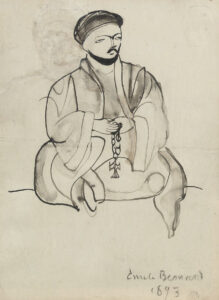
Modern Coptic Orthodox institutional history is shaped by a succession of reform efforts that brought both renewal and centralization. Pope Kyrillos IV (r. 1854-1861), often dubbed the “Father of Reform,” opened the first modern Coptic schools, introduced the first printing press, and strengthened church-state ties. [Image at right] His successor, Pope Kyrillos V (r. 1874-1927), led reforms in higher education and theological schooling but endured a forced exile, initiated in part by a dispute over control of educational and financial institutions with the lay-led Majlis al-Milli. His eventual restoration in 1893 marked the beginning of a long period in which the papacy reasserted control over church governance and positioned itself as the sole legitimate representative of the Coptic community (Sedra 2011).

The twentieth century brought increasing tension between a reform-oriented laity seeking greater authority and an embattled clerical establishment, as exemplified by the 1911 First Coptic Conference in Asyut. The rise of Egyptian nationalism further complicated these dynamics. On one hand, the Wafd movement and the 1919 Revolution momentarily presented a vision of Muslim-Christian unity. On the other hand, successive constitutions (notably that of 1923) institutionalized Islam as the state religion. This duality of national inclusion alongside formal religious hierarchy remains a persistent tension in the Egyptian polity (Carter 1986).
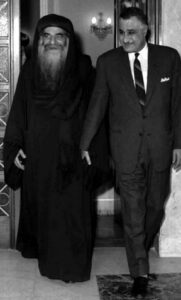
Following the Free Officers’ Revolution of 1952, the Egyptian state increasingly positioned itself as the primary arbiter of religion. President Nasser’s nationalization policies dismantled many of the civic institutions, publications, and schools maintained by Copts and other minorities. Within this environment, Pope Kyrillos VI (r. 1959-1971) emerged as a pious and apolitical patriarch, beloved for his sanctity rather than administrative prowess. [Image at right] He and Bishop Samuel were responsible for the canonization of saints and fostering spiritual revival, while laying the foundation for Church centralization and standardization that would grow dramatically under his successor (Ibrahim 2011).

The ascension of Pope Shenouda III (r. 1971-2012) marked a definitive shift toward greater centralization, charismatic authority, and transnational consolidation. Trained in history and theology and once a general bishop for education, Shenouda rapidly expanded the Church’s reach. He split dioceses, elevated general bishops, and extended the Church’s influence across the Coptic diaspora. When he assumed office in 1971, the Holy Synod included twenty-one bishops. When he died in 2012, there were ninety-six. This expansion of episcopal authority was strategic: he revitalized and extended pastoral oversight and ensured his theological and political vision dominated.

He reorganized Sunday School into the Harakat al-Tarbiyya al-Kanasiyya (the Church Upbringing Movement), personally oversaw theological seminaries, and built a robust media presence through his sermons, televised Q&A sessions, and the editorship of Al-Kiraza. His practical theology, often criticized by revivalist thinkers like Father Matta al-Miskīn as theologically superficial, nevertheless succeeded in embedding Church doctrine into the spiritual consciousness of millions (Akladios 2020).

Pope Shenouda’s clash with President Anwar Sadat over sectarian violence in the 1970s culminated in his internment at the Monastery of St. Bishoy from 1981 to 1985, a period that saw the state violently suppress Islamist and Coptic opposition alike. Upon his release, Shenouda emerged more cautious but no less influential. His Church became both the principal cultural institution for Copts and their primary civil society. Churches established summer retreats, expanded vocational training, social clubs, and many communal services. This development entrenched the clergy as the gatekeepers of collective identity, marriage, education, social recreation, and even political engagement (Elsässer 2014).

The 1990s witnessed a sharp escalation in sectarian violence, particularly in Upper Egypt, culminating in the 2000 El Kosheh massacre (Akladios 2022). The 2011 revolution and subsequent military overthrow of 2013 further exposed the precarious position of Copts in Egypt. Dozens of churches were burned or attacked in retaliation for the overthrow of Morsi and the Muslim Brotherhood. The Maspero Massacre of 2011, when state forces killed twenty-eight mostly Coptic protesters, galvanized a new generation of Coptic activism both in Egypt and abroad (Lukasik 2022).

Despite President al-Sisi’s promise of protection and symbolic gestures, such as the construction of the Nativity Cathedral in the New Administrative Capital, sectarian tensions persist. In 2016, a Church-Building Law formalized a long-demanded permit system but did little to dismantle the bureaucratic obstacles or informal barriers faced by many communities seeking to construct or repair churches. The creation of the Supreme Committee for Confronting Sectarian Incidents in 2018 suggests a securitized rather than transformative approach to intercommunal tensions (U.S. Department of State 2021).

Coptic emigration, which began in the 1950s as a movement of graduate students under Bishop Samuel’s vision of social development, became more permanent following Nasser’s nationalization efforts under an Arab socialist ethos. Pope Shenouda’s era transformed this emigration into a strategic opportunity. Diasporic communities grew exponentially: by 2013, there were over 200 churches in the U.S., fifty-one in Canada, and forty-seven in Australia. These churches provided not only liturgical continuity but also communal services, education, and a sense of rooted identity (Akladios 2020).

At the same time, diasporic organizations took divergent paths, some lobbying Western governments for religious freedom protections, others building charities and businesses aligned with Egyptian state priorities. By the time of Pope Tawadros II’s enthronement in 2012, the Church was no longer a strictly national institution. It had become a global one, bound by a shared liturgical tradition and a historically evolving relationship with political power, both at home and abroad.

DOCTRINES/BELIEFS

The Coptic Orthodox Church upholds a doctrinal system deeply rooted in the early ecumenical tradition of the Universal Church, shaped by the theological contributions of the Alexandrian School and lived out through a sacramental, ecclesial, and patristic worldview. Coptic belief is not a mere matter of intellectual assent but a daily practice, what is believed, taught, confessed, and lived in a liturgical and communitarian register. The Coptic tradition is experiential, formative, and relational: communion with the Father through the Incarnate Son, by the Holy Spirit, within the ecclesial body.

Dogma, for the Coptic Orthodox Church, is a lived truth, encompassing God, humanity, the Church, angels, demons, and the Day of Judgment. Dogmas are structured by the rhythm of prayer, fasting, and service that actualize the believer’s encounter with God through sacramental participation and ecclesial membership. As such, the Coptic theological worldview insists that dogma and daily life must be integrated, and that theology divorced from praxis is fundamentally deficient (Meawad 2025).

At the heart of Coptic theology is its miaphysite Christology, articulated at the Council of Ephesus (431 CE) and further clarified by Saint Cyril of Alexandria. The Coptic Church affirms that in the one incarnate nature (mia physis) of the Word of God, the divine and human natures are united “without mingling, without confusion, and without alteration.” This theological position, sometimes erroneously confused with monophysitism, emphasizes the unity of Christ’s person while safeguarding both His full divinity and full humanity (Awad and Moawad 1991).

Coptic sacred narratives are both scriptural and historical, unfolding through a liturgical imagination deeply rooted in Incarnation, martyrdom, and continuity with the apostolic Church. They are animated by three central axes: the redemptive work of Christ, the apostolic foundation laid by Saint Mark, and the endurance of the Church as a suffering but living body within Egyptian history. These narratives are not abstract; they are liturgically embodied, ritually commemorated, and socially transmitted in ways that merge theology with identity.
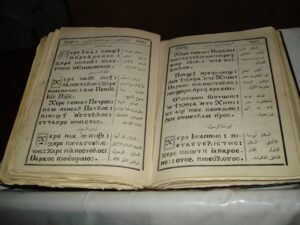
At the center of the Coptic sacred narrative is the Incarnation: The Word becoming flesh in the person of Jesus Christ so that we may become God.  [Image at right] This narrative is not merely a doctrinal claim but the cornerstone of all sacramental theology and spiritual life. Athanasius affirms in On the Incarnation that God’s entrance into human history is a concrete, bodily reality, allowing for the redemption and deification (theosis) of humankind. The doctrine of the Trinity is likewise central: one God in three persons (Father, Son, and Holy Spirit). Each person is co-equal, co-eternal, and consubstantial, and divine salvation is understood as the work of the Trinity in unison: the Father sending the Son, the Son accomplishing redemption, and the Spirit effecting sanctification within the Church.

Therefore, a theology of witness is rooted in the age of martyrdom, stretching from the Roman persecutions through the Diocletian era (284-305 CE), and holds a uniquely revered place in the Coptic calendar. So central is this epoch to the communal memory of suffering and sanctity that the Church’s calendar begins with the year of Diocletian’s accession. Known as the “Era of the Martyrs,” it anchors collective identity in blood witness (martyria) and in the conviction that faith must be lived, suffered, and preserved. The Coptic synaxarium (hagiographical calendar) is filled with daily remembrances of saints, martyrs, monks, bishops, and desert fathers, who shaped the sacred topography of the Church. These stories offer a theology of perseverance: that holiness is not bound by rank or role, and that the Church’s survival across centuries is a function of faith lived under pressure, not power. Martyrs are not distant ancestors; they are present in icons, intercessions, names, and liturgical cycles (Naguib 1997).

This theology is not static. It has been reactivated in modern memory, especially after the Maspero Massacre (2011), the beheading of twenty-one Copts by ISIS in Libya (2015), and continued attacks on churches in Egypt. These events have been ritually incorporated into liturgical life in Egypt and its diaspora as examples of contemporary martyrdom. The twenty-one killed in Libya were canonized by the Coptic Church, not only as victims of sectarian violence but as witnesses whose last words (“Jesus Christ”) reaffirm the ongoing sacred narrative of faith under fire (Lukasik 2025).
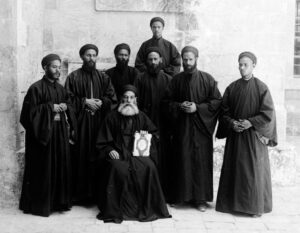
The monastic tradition forms a parallel sacred narrative of withdrawal and transformation. [Image at right] Saints Anthony the Great and Pachomius the Great are not simply monastic founders but spiritual archetypes whose paths to holiness (through solitude, community, asceticism, and vision) remain active models for the faithful. Their stories, preserved in the sayings of the desert fathers and the lives of the saints, constitute a spiritual cartography: the desert as a site of both testing and communion. The revival of monasticism in the twentieth century reanimated this narrative, especially through the work of figures like Father Matta al-Miskīn and the restoration of ancient monasteries. Yet, it also sparked theological tensions, particularly between revivalist visions rooted in patristic theology and the more centralized, ecclesio-political approach adopted under Pope Shenouda III. These tensions themselves are part of the ongoing sacred story: a struggle not only for power but for how to narrate the sacred in modernity (Akladios 2021).

The Coptic Church frames itself through the endurance of a Church that has survived Byzantine theological imperialism, Islamic conquest, Ottoman marginalization, colonial administration, and modern nationalism. This endurance is not interpreted as mere survival, but as divine vocation. The Church is the ark in the flood, the lamp in the darkness, the body of Christ in exile (Meinardus 1999). [Image at right] Even in diaspora, the sacred story is extended. Churches named for martyrs saints, and desert fathers anchor communities across continents. Iconography, architecture, and the liturgy in the Coptic language sustain this narrative continuity. While the Church resists being labelled a “minority,” the sacred narratives it perpetuates of persecution, perseverance, and presence constitute a theology of minority experience, reframed through hope in the Incarnation and divine Resurrection.
RITUALS/PRACTICES

Coptic Orthodox rituals embody a worldview in which divine grace is mediated through action, time, materiality, and community. Every Coptic practice (whether liturgical, ascetic, or devotional) participates in a sacred logic that bridges heaven and earth, and the structure of Coptic life is thus fundamentally ritualized, performed, and enacted.

At the heart of Coptic ritual life is the Divine Liturgy. It is immersive, multisensory, and deeply catechetical. Prayers are chanted in Coptic and Arabic, incense fills the sanctuary, icons surround the space, and the clergy and deacons perform highly structured actions that represent the story of salvation. It is a participatory liturgy involving call and response between clergy and congregation, where bread and wine become the real Body and Blood of Christ, and the faithful, in receiving, become one body in Him.

The liturgy culminates in the Eucharist, the “Sacrament of Sacraments,” celebrated most often using the Liturgy of Saint Basil. However, the Liturgies of Saint Gregory and Saint Cyril are also employed throughout the liturgical calendar. Each of these liturgies carries theological nuance but remains consistent in form and effect: the invocation of the Holy Spirit upon the gifts, the recitation of the anaphora, the epiclesis, and the communal reception of Christ Himself. Saint Basil’s liturgy is most frequently used for its address to God the Father and its theological depth and beauty. However, Saint Cyril’s liturgy, adapted from the original rite of Saint Mark, anchors the Alexandrian tradition in apostolic antiquity (Basilios “Mass of the Faithful” 1991).

Coptic liturgy is doctrinally instructive and theologically dense. The Church maintains the use of leavened bread in the Eucharist, affirming that Christ instituted the sacrament during a pre-Passover meal. The faithful receive both the Body and Blood in every liturgy, reinforcing the fullness of the sacrament and the nature of salvation. The Eucharist is not only communion but sacrifice: the perpetual offering of Christ for the life of the world (Basilios “Eucharist” 1991).

The Coptic Church holds to seven sacraments (Mysteria) as effective means of grace, instituted by Christ and administered by the Church:

Baptism: Entry into the Church, effected by triple immersion and understood as rebirth, sanctification, and adoption into divine life. It is essential for salvation (John 3:5) and should not be repeated.

Chrismation (Confirmation): Administered immediately after baptism, through anointing with the holy Myron oil. It imparts the Holy Spirit and empowers the believer to participate in ecclesial and spiritual life.

Eucharist: The “Sacrament of Sacraments,” in which the bread and wine become the true Body and Blood of Christ through the invocation of the Holy Spirit. Participation in the Eucharist is understood as union with Christ and the Church.

Repentance and Confession: A sacrament of reconciliation in which sins are confessed to a priest and absolved, restoring the believer’s relationship with God. It renews the graces of baptism and is integral to the spiritual life.

Anointing of the Sick: A sacrament for the healing of body and soul, rooted in James 5:14-15. It involves prayer and anointing with oil, often administered communally or during illness.

Matrimony: A sacrament uniting a man and woman in Christ. It signifies the union of Christ and the Church (Ephesians 5:32) and is understood as indissoluble, except in cases of adultery.

Holy Orders: Ordination to the diaconate, priesthood, or episcopate, through the laying on of hands. Clergy participate in the ministry of Christ, with bishops as successors to the apostles.

Christological confession undergirds the entire sacramental system. It is through the sacraments, particularly the Eucharist, that the faithful participate in the salvific life of Christ, receiving His body and blood as true nourishment and union with God. Salvation, in this framework, is a lifelong process of healing, repentance, and communion with the Divine.

Beyond the liturgy, prayer structures the day. The Agpeya, or Book of the Hours, organizes communal and private devotion into seven canonical hours, sanctifying the day through remembrance of Christ’s life and passion. Each hour corresponds to a salvific moment: Matins (resurrection); Terce (descent of the Spirit); Sext (crucifixion); None (death); Vespers, Compline, and Midnight prayers (burial and resurrection). The language of the Agpeya is rooted in the Psalms, the Gospels, and patristic reflections and forms the devotional bedrock of the faithful. Coptic households often structure their evening routines around these canonical hours, and monastic communities recite the Agpeya daily. In diaspora, its continued use in Arabic, English, French, or Coptic has become a powerful instrument of liturgical continuity and identity preservation.

Each hour of the Coptic canonical prayers concludes with a heartfelt petition: “Have mercy on us, O God, and have mercy on us. Thou who, at all times, and at every hour, in Heaven and on earth art worshiped and glorified….” This repeated plea anchors the devotion in humility and divine presence. Early Church Fathers affirmed the spiritual power of the Psalms, which form the core of each hour. Eusebius of Caesarea, quoting Philo, described the Alexandrian mode of worship where “one sings [the Psalms] regularly in time, the others listen in silence, and join in chanting only the close of the hymns.” Similarly, Athanasius of Alexandria called the Psalms “a balm which heals the spirit,” emphasizing their enduring role in personal and communal renewal. This sanctification of time reorients the believer’s day around God, anchoring personal piety in communal rhythm (Basilios “Canonical Hours” 1991).

As does fasting, which is perhaps the most publicly visible and widely observed ritual discipline in the Coptic Orthodox Church. Copts fast between 210 – 240 days of the year, abstaining from animal products and, during the early parts of the day, food and drink entirely. Fasts are both fixed and seasonal: the Great Lent, Advent, Apostles’ Fast, and St. Mary’s Fast being most prominent. Wednesdays and Fridays are weekly fasts, except during the fifty joyful days after Easter. Fasting is medicine for the soul, a mode of solidarity with Christ and the poor, and a preparation for receiving grace in the sacraments. The confessor plays a critical role in adapting fasting requirements to individual capacity, underscoring the Church’s pastoral approach to spiritual discipline and the love of Christ.
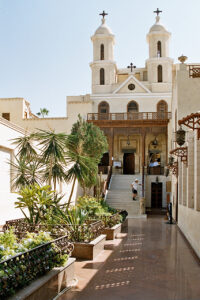
The Coptic parish church building is itself a ritual text. Often shaped as a cross (salvation), a ship (Noah’s ark), or a circle (eternity), the exterior encodes theological meaning. [Image at right] Internally, the tripartite division of narthex, nave, and sanctuary maps onto the spiritual progression of catechumen, communicant, and celebrant. Iconostasis screens the sanctuary, emphasizing both mystery and mediation, while icons animate the church’s interior with the cloud of witnesses. Diasporic churches often retain these spatial designs even in adapted or multi-use buildings, signalling continuity in the face of geographic displacement.

Coptic practice is deeply tactile and spatial, where pilgrimages to monasteries in Wadi Natrun, the Eastern Desert, and Upper Egypt remain a vital ritual. These journeys connect the faithful to the lives of saints, to ascetic landscapes, and to communal memory. Relics of saints are not abstract symbols but are physically present in churches, venerated with incense, and invoked during intercessory prayers. While worship is reserved for God alone, the veneration of saints, particularly the Virgin Mary or Holy Theotokos, is central to devotional life. Saints are mediators with the divine invoked during liturgy, remembered in the synaxarium, and addressed in hymns. Icons, relics, and the naming of churches serve as vehicles for this veneration. The saints are seen as companions and intercessors, living members of the Body of Christ.
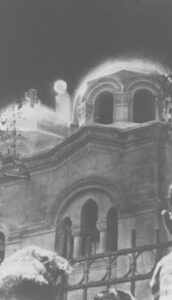
This communion across time and death is deeply affective. Saints are sought out in times of illness, sorrow, or gratitude. Dreams, miracles, and apparitions are not uncommon in Coptic spiritual narratives, reflecting a porous boundary between the temporal and the eternal in ritual imagination. This reality is exemplified by the Marian apparitions in 1968, which took place in Zaitun, Cairo. [Image at right] Witnessed by thousands (Muslims and Christians alike) the Virgin Mary appeared luminous above the domes of the Coptic Church of Saint Mary, offering a moment of collective awe during a time of national grief following Egypt’s defeat in the Six-Day War. No message was spoken, yet the silence was powerful. The Coptic Orthodox Church officially recognized the apparitions, and even government officials acknowledged the phenomenon. In a country marked by division and uncertainty, this shared experience of wonder served as a gesture of unity and consolation (Belli 2017).

ORGANIZATION/LEADERSHIP

The Coptic Orthodox Church is episcopal in polity, sacramental in governance, and centralized in its leadership through the person of the Pope of Alexandria and Patriarch of the See of Saint Mark. As both a spiritual and institutional office, the Papacy exercises supreme ecclesiastical authority and functions as the symbolic and administrative head of a deeply hierarchical body. At its core, the Church’s leadership structure fuses monastic asceticism with apostolic succession, anchoring its authority in a theology of stewardship, continuity, and suffering.

St. Mark is the founder and spiritual archetype: the itinerant evangelist, the faithful witness, and the shepherd willing to die for his flock. In this sense, every Coptic patriarch, bishop, and priest stands in his shadow. The Church’s sense of continuity with the apostolic age is not only institutional but sacramental. Each liturgy reaffirms the presence of Christ mediated through the body consecrated by apostolic hands. Papal elections are themselves highly ritualized events, blending modern organizational logistics with traditional spiritual rites. While a popular vote determines selection of finalists from among notable bishops, the final selection is made by the “altar lot,” a blindfolded child selecting one name from three finalists, symbolizing divine will acting through innocence.

The Patriarch of Alexandria, Pope Tawadros II, embodies the unity of the Church. The Pope is the first among equals, granted the authority to consecrate bishops, ordain priests, preside over synods, and articulate theological positions on behalf of the Church. Yet the office also bears a distinct symbolic weight in Egypt’s sectarian context: it is a representative voice for the Coptic people in state affairs (Guirguis and van Doorn-Harder 2022).
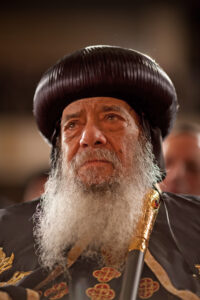
Pope Shenouda III (1971-2012) redefined the office in the post-Nasser era, centralizing ecclesial governance and curating a public identity for the papacy that merged pastoral authority with political activism and cultural stewardship. [Image at right] His successor, Pope Tawadros II, while continuing many of these functions, has articulated a vision of the papacy more attuned to diplomacy and dialogue, considering the post-2011 landscape.

Chaired by the Pope, the Holy Synod is composed of all bishops and is the highest ecclesiastical authority in the Coptic Orthodox Church. It governs the doctrinal, liturgical, pastoral, and disciplinary life of the Church. The Synod meets annually but may convene extraordinary sessions in times of crisis or major reform. Though consensus-driven, the Pope maintains a primacy of honour and often directs its theological and administrative agenda. The Synod is increasingly multinational, with bishops serving dioceses in North America, Europe, Australia, and the Gulf. This expansion has necessitated new organizational models and pastoral sensitivities, particularly in the realm of intergenerational diaspora tensions, youth catechesis, and ecumenical engagement.

Bishops oversee (“marry”) dioceses, each encompassing many churches, monasteries, schools, and social institutions. They are responsible for ordaining priests, administering the sacraments, and maintaining theological orthodoxy. Their authority derives from apostolic succession, and their elevation is through papal appointment, typically from among the celibate monastic clergy.

Priests serve local parishes, offering pastoral care, preaching, and liturgical services. They are expected to be married and often the primary mediators between ecclesial doctrine and lay experience. Deacons, who assist in the liturgy, may also teach, chant, and engage in administrative support, though they do not perform sacraments. Although women cannot be ordained priests or deacons, they participate actively in various roles, including singing in the choir, serving on parish boards, and working in religious education and committee leadership.

A hallmark of Coptic clerical formation is monasticism. Monks, especially those selected for episcopal office, undergo rigorous ascetic discipline, theological study, and spiritual apprenticeship. This grounding in monastic spirituality functions as a kind of institutional firewall against clericalism, ensuring that ecclesiastical authority is tempered by humility, celibacy, and personal holiness.

Monasteries are spiritual centers and critical nodes in the Church’s governance structure. Many bishops are selected from among their ranks, and monastic figures have historically played outsized roles in theological development, resistance to persecution, and missionary work. Monks are organized under abbots but maintain a semi-autonomous relationship to the episcopacy. Monastic revival since the 1930s has brought renewed vitality to these communities, and diaspora Copts often make pilgrimage to them for spiritual renewal, confession, and vocational discernment.

The rapid expansion of Coptic communities abroad in Canada, the United States, and Australia has reshaped the Church’s organizational structure. Since the late twentieth century, the Holy Synod has ordained bishops specifically for diaspora regions, many of whom oversee sprawling, culturally diverse territories. These bishops face unique challenges: linguistic shifts, generational divides, integration of converts, and the need to contextualize rituals and education for non-Egyptian settings. To maintain cohesion, the Pope often visits diaspora dioceses, and a growing number of synodal decrees are translated into English, French, and German. In many diaspora communities, lay councils and youth committees work alongside clergy to maintain the vibrancy and relevance of parish life. Monasteries and nunneries have been established outside Egypt, and retreat centres for Coptic youth in the diaspora have multiplied in recent years. However, significant tensions persist between centralized control from Cairo and the pastoral needs of communities abroad; a tension that is not new to Coptic history but is newly global.

ISSUES/CHALLENGES

The contemporary Coptic Orthodox Church confronts a host of complex, interwoven challenges shaped by its historical entanglements with the Egyptian state, its theological commitments, and the expansive realities of a global diaspora. The Church remains engaged in an enduring entente with the Egyptian regime, a political alignment that began under Pope Kyrillos VI and persists today under Pope Tawadros II (Tadros 2013). While this relationship offers select protections and public visibility, it comes at the cost of autonomy, internal pluralism, and a meaningful civic presence beyond state-scripted roles. This dependency has long stifled efforts to develop robust indigenous models for minority advocacy, let alone address the growing schism between homeland and diasporic communities.

The increasing securitization of Coptic life in Egypt and its diaspora has narrowed the Church’s theological voice and pastoral flexibility. Church leaders have sidelined dissent, curtailed ecumenical dialogue, and resisted liturgical reform. The legacy of Pope Shenouda’s centralization remains deeply felt. Despite his theological populism and immense popular appeal, Shenouda’s consolidation of ecclesial authority diminished the Church’s institutional adaptability and openness to alternative visions such as those of Bishop Samuel and Father Matta al-Miskīn (Akladios 2021).
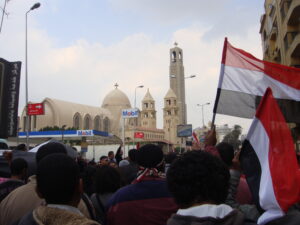
In Egypt, sectarian violence remains a persistent and unresolved concern. [Image at right] The state’s response oscillates between performative gestures, such as public funeral appearances and the construction of symbolic cathedrals, and opaque “reconciliation sessions” that consistently deny Copts legal recourse. These encounters are often mediated by local power brokers, resulting in the reinforcement of communal hierarchies and patriarchal authority. The Supreme Committee for Confronting Sectarian Incidents, formed in 2018, has failed to offer meaningful structural reform, functioning instead as an extension of the security apparatus.

For Copts in North America and Europe, theological formation and political engagement present additional challenges. The first-generation immigrant families who arrived in the 1960s and 1970s often held more fluid religious identities and engaged actively in broader civic life. In contrast, subsequent waves (shaped by a post-Shenouda clerical culture and Egypt’s sectarian turn) brought with them a more rigid and insular ecclesiology. As a result, diaspora communities have become increasingly centred around church buildings and hierarchies, mirroring the very ecclesial structures many early immigrants sought to move beyond (Akladios 2021). Community organizations, charities, and even social clubs often require tacit clerical approval, further entrenching Church dominance over public and private life.

Diasporic activism remains fractured. While some Coptic organizations have adopted a rights-based discourse critical of both Church and state, others have aligned with conservative Christian and pro-Israel lobbies to frame Copts as a “persecuted Christian minority,” reinforcing civilizational binaries that flatten the diversity of Coptic lived experience. These approaches risk instrumentalizing Coptic suffering for foreign policy leverage, while simultaneously alienating Copts who reject such frames (Lukasik 2025).

Finally, the Coptic Church faces a generational crisis. Young Copts, particularly in the diaspora, often feel estranged from both the ethno-nationalist rhetoric of older clergy and the moral conservatism of Church teachings. The rise of digital platforms has enabled some to cultivate new expressions of belonging and critique, but institutional recognition of these voices remains minimal. With over 200 churches now operating in the United States alone, the challenge for the Coptic Orthodox Church is no longer one of presence, but of purpose; how to remain authentically rooted in tradition while speaking credibly to pluralistic, multi-ethnic, and digitally interconnected generations.

IMAGES

Image #1: Andrew Shenouda, Saint Mark’s Church, Heliopolis, 2008.
Image #2: Emile Bernard sketch of a Coptic Priest, 1893.
Image #3: Nasser and Pope Kyrillos VI.].
Image #4: Coptic Orthodox Psalmody in the Coptic language with Arabic annotations.
Image#5: 1898-1914, Coptic Monks in Jerusalem.
Image #6: Inside Saint Samaan’s Cave Church, Cairo.
Image #7: Hanging Church in Old Cairo.
Image #8: Our Lady of Zaitun, Cairo, 1968.
Image #9: Pope Shenouda III by Chuck Kennedy, Official White House Photostream.
Image #10: Protesters gathered outside Coptic Orthodox Cathedral. The Day Mubarak Left, Al Jazeera.

REFERENCES

Akladios, Michael. 2022. “Critical Events and the Formation of a Coptic Diaspora in North America, from Al–Khanka to Al–Zāwiya Al–Hamrā.” Pp. 52-65 in Routledge Handbook on Middle Eastern Diasporas, edited by Dalia Abdelhady and Ramy Aly. New York: Routledge.

Akladios, Michael. 2021. “Competing Notions of Integration in Canada’s First Coptic Orthodox Parishes, 1971–1985.” Journal of the Canadian Society for Coptic Studies 13:79–91.

Akladios, Michael. 2020. “Heteroglossia: Interpretation and the Experiences of Coptic Immigrants from Egypt in North America, 1955–1975.” Histoire sociale / Social History 53:627–50.

Armanios, Febe. 2011. Coptic Christianity in Ottoman Egypt. New York: Oxford University Press.

Armanios, Febe. 2002. “The ‘Virtuous Woman’: Images of Gender in Modern Coptic Society.” Middle Eastern Studies 38:110–30.

Atiya, Aziz Suryal. 1980. A History of Eastern Christianity. Updated edition. Millwood, NY: Kraus Reprint.

Athanasius. 2011. On the Incarnation. Translated and edited by John Behr, Popular Patristics Series. St. Vladimir’s Seminary Press.

Ava Mina, Teddawos, and Youhanna Nessim Youssef. 2017. “Life of Pope Cyril VI (Kyrillos VI).” Christianity and Monasticism in Northern Egypt: Beni Suef, Giza, Cairo, and the Delta, edited by Gawdat Gabra and Hany Takla. New York: Oxford University Press.

Awad, Magdi, and Samuel Moawad. 1991. “Monophysitism, Response.” The Coptic Encyclopedia, edited by Aziz S. Atiya. New York: Macmillan.

Basilios, Archbishop. 1991. “Canonical Hours, Book of.” Pp. 446b–49a in The Coptic Encyclopedia, Volume 2, edited by Aziz S. Atiya. New York: Macmillan.

Basilios, Archbishop. 1991. “Eucharist.” Pp. 1056a–62a in The Coptic Encyclopedia, Volume 3, edited by Aziz S. Atiya. New York: Macmillan.

Basilios, Archbishop. 1991. “Martyrdom.” Pp. 1548a-49b in The Coptic Encyclopedia, Volume 5, edited by Aziz S. Atiya. New York: Macmillan.

Basilios, Archbishop. 1991. “Mass of the Faithful.” Pp. 1565a–68a in The Coptic Encyclopedia, Volume 5, edited by Aziz S. Atiya. New York: Macmillan.

Belli, Mériam N. 2017. An Incurable Past: Nasser’s Egypt Then and Now. Gainesville, FL: University Press of Florida.

Bingham-Kolenkow, Anitra. 1997. “The Copts in the United States of America.” Pp. 266–74 in Between Desert and City: The Coptic Orthodox Church Today, edited by Nelly Van Doorn-Harder and Kari Vogt. Eugene, OR: Wipf and Stock.

Carter, B. L. 1986. The Copts in Egyptian Politics. London: Croom Helm.

Elsässer, Sebastian. The Coptic Question in the Mubarak Era. Oxford: Oxford University Press, 2014.

Gabra, Gawdat, ed. 2009. The A to Z of the Coptic Church. Toronto: Scarecrow.

Guirguis, Magdi, and Nelly van Doorn-Harder. 2022. The Emergence of the Modern Coptic Papacy: The Popes of Egypt. Volume 3, edited by Stephen J. Davis and Gawdat Gabra. Cairo: American University in Cairo Press.

Hamilton, Alastair. 2006. The Copts and the West: 1439–1822: The European Discovery of the Egyptian Church. Oxford: Oxford University Press.

Lukasik, Candace. 2025. Martyrs and Migrants: Coptic Christians and the Persecution Politics of US Empire. New York: New York University Press.

Lukasik, Candace. 2022. “Beyond Church and State: Contentions of Minority Citizenship in Egypt.” Journal of Orthodox Christian Studies 5:179–201.

Mahmoud, Saba. 2015. Religious Difference in a Secular Age: A Minority Report. Princeton: Princeton University Press.

Martin, Maurice. 2012 “The Renewal in Context: 1960–1990.” Between Desert and City: The Coptic Orthodox Church Today, edited by Nelly Van Doorn-Harder and Kari Vogt, Wipf and Stock, 2012, pp. 15–21.

Meawad, Stephen. 2025. “‘Unethical’ Ethics: Toward an Ethical Transliteration of Coptic Orthodox Praxis.” Exchange 54:56-70.

Meinardus, Otto Friedrich August.1999. Two Thousand Years of Coptic Christianity. Cairo: American University in Cairo.

Naguib, Saphinaz-Amal. 1997. “The Era of Martyrs: Texts and Contexts of Religious Memory.” Between Desert and City: The Coptic Orthodox Church Today, edited by Nelly Van Doorn-Harder and Kari Vogt. Eugene, OR: Wipf and Stock.

Sedra, Paul. 2011. From Mission to Modernity: Evangelicals, Development, and Modern Egyptian Identity. New York: I.B. Tauris.

Shoucri, Mounir. 1991. “Cyril IV.” Pp. 677–79 in The Coptic Encyclopedia, edited by Aziz S. Atiya, Volume 3. New York: Macmillan.

Tadros, Mariz. 2013. Copts at the Crossroads: The Challenges of Building Inclusive Democracy in Egypt. Cairo: American University in Cairo Press.

Tadros, Samuel. 2013. Motherland Lost: The Egyptian and Coptic Quest for Modernity. Stanford: Hoover Institution Press.

U.S. Department of State. 2022. 2021 Report on International Religious Freedom: Egypt. Washington, DC: U.S. Department of State. Accessed from https://www.state.gov/reports/2021-report-on-international-religious-freedom/egypt/ on 4 August 2025.

Van Doorn-Harder, Nelly, ed. 2017. Copts in Context: Negotiating Identity, Tradition, and Modernity. University of South Carolina Press.

Van Nispen Tot Sevenaer, Christiaan. 2012. “Changes in Relations between Copts and Muslims (1952–1994) in the Light of the Historical Experience.” Pp. 22-34 in Between Desert and City: The Coptic Orthodox Church Today, edited by Nelly Van Doorn-Harder and Kari Vogt. Eugene, OR: Wipf and Stock.

SUPPLEMENTARY RESOURCES

Al-Masry, Iris Habib. 1986. Bishop Samuel of Public and Social Services. Cairo: Al-Mehaba Bookstore.

Al-Masry, Iris Habib. 1975. Qissat al-Kanīsa al-Qibtiyya [The History of the Coptic Church]. Alexandria: St. George Church Library.

Ayad, Maryam F., ed. 2024. Coptic Culture and Community: Daily Lives, Changing Times. Cairo: American University in Cairo Press.

Botros, Ghada. 2006. “Religious Identity as an Historical Narrative: Coptic Orthodox Immigrant Churches and the Representation of History.” Journal of Historical Sociology 19:174–201.

Botros, Ghada. 2005. “Competing for the Future: Adaptation and the Accommodation of Difference in Coptic Immigrant Churches.” PhD Dissertation, University of Toronto.

Fanous, Daniel. 2019. A Silent Patriarch: Kyrillos VI (1902-1971) Life and Legacy. New York: St. Vladimir’s Seminary Press.

Guirguis, Laure. 2017. Copts and the Security State: Violence, Coercion, and Sectarianism in Contemporary Egypt. Stanford: Stanford University Press.

Hasan, S. S. 2013. Christians versus Muslims in Modern Egypt: The Century-Long Struggle for Coptic Equality. Oxford: Oxford University Press.

Heo, Angie. 2018. The Political Lives of Saints: Christian-Muslim Mediation in Egypt. Oakland: University of California Press, 2018.

Ibrahim, Vivian.2011. The Copts of Egypt: Challenges of Modernisation and Identity. London: Tauris Academic Studies.

Iskander, Elizabeth. 2012. Sectarian Conflict in Egypt: Coptic Media, Identity and Representation. Abingdon, Oxon: Routledge.

Kamil, Jill. 2002. Christianity in the Land of the Pharaohs: The Coptic Orthodox Church. London: Routledge.

Michael, Maged S. A. 2014. From Byzantine to Islamic Egypt: Religion, Identity and Politics after the Arab Conquest. London: I.B. Tauris.

Philips, Miray. 2022. “‘We Love Martyrdom, but We Also Love Life’: Coptic Cultural Trauma between Martyrdom and Rights.” American Journal of Cultural Sociology 11:109–41.

Saad, Saad Michael. 2010. “The Contemporary Life of the Coptic Orthodox Church in the United States.” Studies in World Christianity 16:207–25.

Sharkey, Heather. 2008. American Evangelicals in Egypt: Missionary Encounters in an Age of Empire. Princeton University Press.

Wakin, Edward. 2000 [1963]. A Lonely Minority: The Modern Story of Egypt’s Copts. Lincoln, NE: An Author’s Guild Backprint.com Revised Edition.

Publication Date:
4 August 2025


Share

Michael Akladios

Dr. Michael Akladios is a lecturer in Historical Studies at the University of Toronto and the Founder & Executive Director of Egypt Migrations, an archival and educational non-profit organization. He is a historian of Egyptian immigration to North America and the Coptic diaspora. His first book project, Ordinary Copts: Ecumenism, Activism, and Belonging in Cold War North American Cities, explores the lived experiences of Coptic Orthodox Christians as they navigated geopolitics, race, and religion in postwar Egypt and across Canada and the United States.

Share