Charlotte Forten Grimké

CHARLOTTE FORTEN GRIMKÉ TIMELINE

1837 (August 17):  Charlotte Forten was born in Philadelphia, Pennsylvania to Robert Bridges Forten and Mary Virginia Wood Forten.

1840 (August):  Charlotte’s mother died from tuberculosis.

1850:  The U.S. Congress passed Fugitive Slave Act, which required seizure and return of runaway slaves who had escaped from slave-owning states; it was repealed in 1864.

1853 (November):  Charlotte Forten moved from Philadelphia to Salem, Massachusetts to the home of the Charles Lenox Remond family.

1855 (March):  Charlotte Forten graduated from the Higginson Grammar School and enrolled in Salem Normal School (now Salem State University).

1855 (September):  Forten joined the Salem Female Anti-Slavery Society.

1856 (June/July):  Forten graduated from Salem Normal School and took a teaching position at the Eppes Grammar School in Salem.

1857 (March 6):  The U.S. Supreme Court handed down the Dred Scott decision, which stated that African Americans were not and never could be U.S. citizens.

1857 (Summer):  Forten went to Philadelphia to recuperate from illness, then returned to Salem to continue teaching.

1858 (March):  Forten resigned her position at Eppes Grammar School due to ill health and returned to Philadelphia.

1859 (September):  Forten returned to Salem to teach at the Higginson Grammar School.

1860 (October):  Forten resigned Salem post due to continued poor health.

1861 (April 12):  The U.S. Civil War began.

1861 (Fall):  Forten taught in Philadelphia’s Lombard Street School, run by her paternal aunt Margaretta Forten.

1862 (October):  Forten left for South Carolina to teach under auspices of Port Royal Relief Association.

1862 (December):  Forten’s written accounts of her experiences in South Carolina were published in the national abolitionist journal The Liberator.

1863 (July):  Forten nursed wounded soldiers of the 54th Massachusetts regiment after their defeat at Fort Wagner, South Carolina.

1864 (April 25):  Forten’s father died of typhoid fever in Philadelphia.

1864 (May/June):  Forten’s two-part essay “Life on the Sea Islands” was published in the Atlantic Monthly.

1865 (May 9):  The U.S. Civil War ended.

1865 (October):  Forten accepted a position as Secretary of the Teachers Committee of the New England Branch of the Freedman’s Union Commission in Boston, Massachusetts.

1871:  Forten was employed as a teacher at the Shaw Memorial School in Charleston, South Carolina.

1872–1873:  Forten taught at Dunbar High School, a Black preparatory school in Washington, D.C.

1873–1878:  Forten took a position as first-class clerk in the Fourth Auditor’s Office of the U.S. Treasury Department.

1878 (December 19):  Forten married the Reverend Francis Grimké, minister of the Fifteenth Street Presbyterian Church in Washington, D.C.

1880 (January 1):  Forten Grimké’s daughter, Theodora Cornelia Grimké, was born.

1880 (June 10):  Theodora Cornelia Grimké died.

1885–1889:  Charlotte Grimké and her husband moved to Jacksonville, Florida where Francis Grimké was minister of the Laura Street Presbyterian Church.

1888 to late 1890s: Charlotte Forten Grimké continued to write and publish poetry and essays.

1896:  Forten Grimké became a founding member of the National Association of Colored Women.

1914 (July 22):  Charlotte Forten Grimké died in Washington, D.C.

BIOGRAPHY
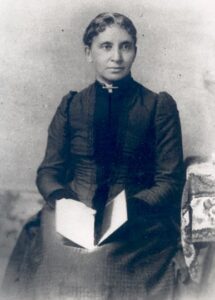
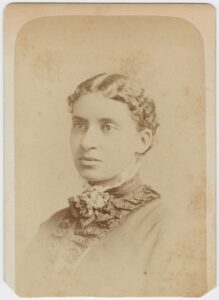
Charlotte Louise Bridges Forten [Image at right] was born on August 17, 1837 at 92 Lombard Street, Philadelphia, Pennsylvania, the home of her grandparents, a leading free Black family in the city that was active in the abolitionist movement (Winch 2002:280). She was the grandchild of James and Charlotte Forten, and the only child of their son Robert Bridges Forten and his first wife, Mary Virginia Wood Forten, who died of tuberculosis when Charlotte was three years old. Named after her grandmother, Charlotte was a fourth-generation free Black woman on her paternal side (Stevenson 1988:3). Her grandfather was the eminent James Forten, a reformer and antislavery activist who owned a successful sail-making business in Philadelphia, at one point amassing a fortune of more than $100,000, a huge sum for the times. Charlotte Forten grew up in relative economic security, was privately tutored, traveled widely, and enjoyed a variety of social and cultural activities (Duran 2011:90). Her extended family was deeply committed to ending slavery and combating racism. James Forten played a central role in the American Anti-Slavery Society and was a friend and supporter of the abolitionist William Lloyd Garrison (1805–1879). The Forten women helped found the Philadelphia Female Anti-Slavery Society. Her aunts, Sarah, Margaretta, and Harriet Forten, used their intellectual gifts to advance the antislavery movement (Stevenson 1988:8).

The Fortens were part of a large network of prosperous, well-educated, and socially active African Americans in New York, Boston, and Salem, Massachusetts, all of them engaged in the abolition movement. But by the early 1840s, the firm of James Forten & Sons declared bankruptcy and money did not flow as freely in the extended family (Winch 2002:344). Charlotte was sent to Salem in 1853 to live with the Remonds a few years after the death of her grandmother, Edy Wood, who had been raising Charlotte after her mother’s death. Forten grieved the loss of her mother and grandmother and her later estrangement from her father, who had moved with his second wife, first to Canada, and then to England. Charles Remond of Salem, the son of a successful caterer, had married Amy Williams, a former neighbor of the Fortens in Philadelphia, and they became a welcoming family to Charlotte Forten. Both Charles and Amy Remond were key players in the abolition network and were frequently visited in their home by such antislavery luminaries as Garrison, William Wells Brown, Lydia Marie Child, and John Greenleaf Whittier (Salenius, 2016:43). Salem had desegregated its schools in 1843, the first town in Massachusetts to do so (Noel 2004:144). Forten’s father sent her to Salem to attend a desegregated school, and she enrolled in the Higginson Grammar School for Girls under the tutelage of Mary L. Shepard whom Forten warmly referred to as her friend and “dear, kind teacher” (Grimké 1988: September 30, 1854:102).
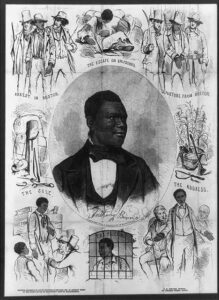
With her move to Massachusetts in 1854, Forten was a contemporary witness to the brutal effect of the federal Fugitive Slave Law (1850), which required seizure and return of runaway slaves who had escaped from slave-owning states. On Wednesday, May 24, 1854, an arrest warrant was issued in Boston for a fugitive slave, Anthony Burns. [Image at right] His trial riveted the abolitionist community, including Forten. The court found in favor of Burns’ owner, and Massachusetts prepared to return him to slavery in Virginia. Forten’s journals convey her outrage at this injustice, as she wrote:

Our worst fears are realized; the decision was against poor Burns, and he has been sent back to a bondage worse, a thousand times worse than death. . . . To-day Massachusetts has again been disgraced; again has she showed her submissions to the Slave Power. . . . With what scorn must that government be regarded which cowardly assembles thousands of soldiers to satisfy the demands of slaveholders; to deprive of his freedom a man, created in God’s own image, whose sole offense is the color of his skin! (Grimké 1988:June 2, 1854:65–66)

Her early journals, written while living in Salem, reveal a persistent sense of unworthiness. In June 1858, she wrote:

Have been under-going a thorough self-examination. The result is a mingled feeling of sorrow, shame and self-contempt. Have realized more deeply and bitterly than ever in my life my own ignorance and folly. Not only am I without the gifts of Nature, wit, beauty and talent; without the accomplishments which nearly every one of my age, whom I know, possesses; but I am not even intelligent. And for this there is not the shadow of an excuse (Grimké 1988:June 15, 1858:315–16).

As Forten matured, these self-critical thoughts seem to have subsided, and she pioneered many accomplishments as a Black woman. She had been the first Black student to have been admitted to Salem Normal School, and the first Black public school teacher in Salem. She became a well-published author and traveled to the South during the Civil War to teach newly freed slaves. She was highly regarded in prominent abolitionist circles and participated in the founding of reform organizations.

Forten’s father had wanted her to attend Salem Normal School (now Salem State University) to prepare for a career in teaching. Charlotte herself had not expressed interest in this path; her father had seen it as a way for Charlotte to support herself. She desired to please her father and was determined to find ways to uplift her race. “I will spare no effort to become what he desires that I should be . . . a teacher, and to live for the good that I can do my oppressed and suffering fellow creatures” (Grimké 1988:October 23, 1854:105). Forten considered her opportunity to engage in advanced study a blessing that suggested God had chosen her for an important mission: to use her talents to improve the lives of Black Americans. Through unswerving devotion to this idea, she sometimes denied herself personal pleasure and happiness.

On March 13, 1855, seventeen-year-old Charlotte Forten passed her entrance examination and enrolled in the second class of Salem Normal School. [Image at right] One of forty students, she did not have financial assistance from her father; her teacher Mary Shepard offered to pay or loan Forten the money for her education. Forten thrived intellectually at the school. Her low self-esteem was fueled by the insidious racism of the society in which she lived. Of course, Salem, Massachusetts of the 1850s and 1860s was progressive enough that she could attend an excellent teacher training school and be hired as a teacher in the city’s public schools. But her diary records the many slights she suffered from her classmates’ prejudice, and the pain of this made it difficult for Forten to maintain what she considered Christian fortitude:

I long to be good, to be able to meet death calmly, and fearlessly, strong in faith and holiness. But this I know can only be through the one who died for us, through the pure and perfect love of Him, who was all holiness and love. But how can I hope to be worthy of his love while I still cherish the feeling toward my enemies, this unforgiving spirit . . . hatred of oppression seems to me to be so blended with hatred of the oppressor I cannot seem to separate them (Grimké 1988: August 10, 1854:95).

The following year, Forten wrote:

I wonder that every colored person is not a misanthrope. Surely, we have everything to make us hate mankind. I have met girls in the schoolroom—they have been thoroughly kind and cordial to me—perhaps the next day met them in the street—they feared to recognize me; these I can but regard now with scorn and contempt, once I liked them, believing them incapable of such measures (Grimké 1988: September 12, 1855:140).

Forten persisted, though, believing that her scholarly advancement would “aid me in fitting myself for laboring in a holy cause, for enabling me to do much towards changing the condition of my oppressed and suffering people” (Grimké 1988:June 4, 1854:67). Later, she would expand on this vision:

We are a poor, oppressed people, with very many trials, and very few friends. The Past, the Present, the Future are alike dark and dreary for us. I know it is not right to feel thus. But I cannot help it always; though my own heart tells me that there is much to live for. That the more deeply we suffer, the nobler and holier is the work of life that lies before us! Oh! for strength; strength to bear the suffering, to do the work bravely, unfalteringly! (Grimké 1988: September 1, 1856:163–64).

Her firm Christian beliefs carried her through these challenging times, and she fully immersed herself in her academic work.

Forten performed well at the Normal School’s final examinations and was selected to write the class hymn for the graduating class of 1856. She began teaching at the Epps Grammar School in Salem on the day after her graduation, a position secured for her by the principal of Salem Normal, Richard Edwards. Her salary was $200 per year. The death of her beloved friend Amy Remond and her own continuing poor health plagued Forten during this time, and she resigned the position in March 1858, returning to Philadelphia to recover. Upon leaving her teaching post in Salem in 1858, Forten was commended by the Salem Register for her contributions. According to the article, Forten was highly successful in her educational endeavors, and “graciously received by the parents of the district,” despite being a “young lady of color, identified with that hated race whose maltreatment by our own people is a living reproach to us as a professedly Christian nation” (quoted in Billington 1953:19). The article suggested the praise for the “experiment” largely redounded to the Salem community which congratulated itself on its progressiveness (Noel 2004:154).

Forten returned to Salem in 1859 to teach at the Higginson School with Mary Shepard and enrolled in Salem Normal School’s Advanced Program. The famed Salem navigator, Nathaniel Ingersoll Bowditch, was her benefactor (Rosemond and Maloney 1988:6). She completed two terms before the outbreak of the Civil War. Then, in 1862, Forten answered the call to help in the education of newly freed persons in the Gullah communities in the Sea Islands in South Carolina.

This passion led to her decision to leave her teaching program to prepare for moving to the South to assist newly freed men and women. Union military officials had classified all land, property, and slaves on St. Helena Island in Beaufort County, South Carolina as “contrabands of war,” but it quickly became apparent that policies needed to be developed to deal with the major social and economic changes that resulted from their liberation. After years of perseverance in working toward her dream of useful, challenging, and satisfying reform work, she found it in the Port Royal Relief Association, headquartered in Philadelphia, Pennsylvania. Forten worked as a teacher in Beaufort County, South Carolina for more than a year, demonstrating what she had always declared in her journals: that Black people could be taught to excel academically. Forten found that educating the most downtrodden of her race was both rewarding and exhilarating. Forten partnered with other Northern teachers and immersed herself in the stories and music of the Creole-speaking Gullah islanders who lived there.
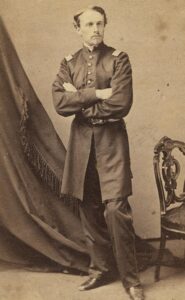
Thomas Wentworth Higginson, commander of the formerly enslaved first South Carolina Volunteers, appreciated that she taught many of his men to read, and was a close friend. Forten also writes affectionately of her meeting with Col. Robert Gould Shaw, [Image at right] the commander of the 54th Massachusetts Infantry Regiment consisting of African American soldiers (Grimké 1988:July 2, 1863:490). During the summer of 1863, the Union forces set out to conquer the port of Charleston. Col. Shaw led his 54th regiment in the doomed attack on Fort Wagner, in which scores of men, including Shaw, were killed. Forten waited to hear the outcome of the battle for two weeks from secluded St. Helena Island, and mourned the losses in her journal: “To-night comes news oh, so sad, so heart sickening. It is too terrible, too terrible to write. We can only hope it may not all be true. That our noble, beautiful Colonel [Shaw] is killed, and the regt. cut to pieces. . . . I am stunned, sick at heart . . . I can scarcely write. . . .” (Grimké 1988: Monday, July 20, 1863:494). Shaw was only a month younger than Forten when he died at age twenty-five. The next day, Forten volunteered as a nurse for the soldiers. Forten later wrote of her experiences, and in 1864, her two-part essay, “Life on the Sea Islands,” was published in the May and June issues of The Atlantic Monthly.

The following October 1865, Forten came back to Boston, Massachusetts, having accepted a position as Secretary of the Teachers Committee of the New England Branch of the Freedman’s Union Commission.  She lived in Massachusetts for six years before making arrangements to return to the South. During this period, she published her translation of Madame Thérèse (1869) and published in the Christian Register, the Boston Commonwealth, and The New England Magazine (Billington 1953:29). In fall 1871, Forten began a year of teaching at the Shaw Memorial School in Charleston, South Carolina, named after her friend, the late Robert Gould Shaw. She continued to teach the following year at a preparatory school for young Black men in Washington, D.C., later called Dunbar High School. Following that second year of teaching, Forten was offered a position as first-class clerk in the Fourth Auditor’s Office of the U.S. Treasury Department. She worked for five years in this role, from 1873–1878.
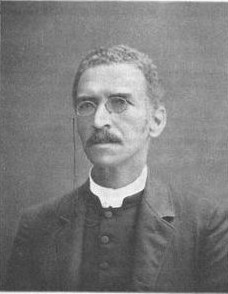
In 1878, at the age of forty-one, Forten married Reverend Francis Grimké, [Image at right] the twenty-eight-year-old minister of the Fifteenth Street Presbyterian Church in Washington, D.C. Thirteen years her junior, he was the manumitted Black nephew of White abolitionists Angelina and Sarah Grimké originally from a wealthy Charleston, South Carolina slave-owning family. Francis Grimké was intelligent, sensitive, and fiercely dedicated to his profession and the advancement of his race. The couple had one daughter who died in infancy, a deeply affecting loss. Charlotte Forten Grimké died July 22, 1914.

TEACHINGS/DOCTRINES

Forten was an ardently spiritual Christian believer. From a young age, she idolized her deceased mother as angelic and would have heard stories of her parent’s exceptional piety. Mary Virginia Wood Forten’s obituary in The Colored American quoted her saying as she lay dying, “You are moral and good but you need religion, you need the grace of God. O seek it!” (quoted in Glasgow 2019:38). Forten felt her mother’s loss keenly throughout her life, even though several other women mentors stepped in to help fill the role.


In her early journals, Forten expressed interest in the Spiritualism movement, which was then all the vogue, especially among abolitionists. Several prominent thinkers and writers were intrigued with the concept, including Garrison, who believed that it was possible to communicate with the dead through a medium. William Cooper Nell (1816–1874) was a prominent Black abolitionist and believer in Spiritualism, and a close friend of Forten’s. In August 1854, Forten made a few entries in her journal that touched on Spiritualism. On Tuesday, August 8, 1854, Forten wrote of walking through Harmony Grove Cemetery in Salem with her beloved teacher, Mary Shepard:

Never did it look so beautiful as on this very loveliest of summer mornings, so happy, so peaceful one almost felt like resting in that quiet spot, beneath the soft, green grass. My teacher talked to me of a beloved sister who is sleeping here. As she spoke, it almost seemed to me as if I had known her; one of those noble, gentle, warm-hearted spiritual beings, too pure and heavenly for this world (Grimké 1988: August 8, 1854:94).

A few days after this walk, Forten began reading Nathaniel Hawthorne’s mystical story of revenge, The House of the Seven Gables, and it affected her deeply. She wrote

That strange Mysterious, awful reality, that is constantly around and among us, that power which takes away from us so many of those whom we love and honor. . . . I feel that no other injury could be so hard to bear, so very hard to forgive, as that inflicted by cruel oppression and prejudice. How can I be a Christian when so many in common with myself, for no crime suffer so cruelly, so unjustly? It seems in vain to try, even to hope. And yet I still long to resemble Him that is really good and useful in life (Grimké 1988:August 10, 1854:95)

Finishing the novel in just a few days, Forten records a conversation with Nell on the day before her seventeenth birthday “about the ‘spiritual rappings’.”

He is a firm believer in their “spiritual” origin. He spoke of the different manner in which the different “spirits” manifested their presence,—some merely touching the mediums, others thoroughly shaking them, etc. I told him that I thought I required a very “thorough shaking” to make me a believer. Yet I must not presume to say that I entirely disbelieve that which the wisest cannot understand (Grimké 1988:August 16, 1854:96)

Spiritualism was again on her mind in November 1855, as she again walked through Harmony Grove and spied the tombstone of a friend who had passed away. Forten wrote, “Hard is it to realize that beneath lie the remains of one who was with us a few short months ago! The belief of the Spiritualists is a beautiful, and must be a happy one. It is that the future world is on the same plan as this, but far more beautiful and without sin” (Grimké 1988:November 26, 1855:145).

On August 5, 1857, Forten wrote of hearing an oration by a theologian at Church, “Most of it was excellent; but there was one part—a tirade against Spiritualism, which I disliked exceedingly; it seemed to me very inappropriate and uncharitable” (Grimké 1988:244). But in 1858, Forten again expressed skepticism about it, “This afternoon a little girl professing to be a medium, came in. Some raps were produced, but nothing more satisfactory. I grow more and more skeptical about Spiritualism” (Grimké 1988:January 16; 1858:278).

That same year, however, Forten penned a poem called “The Angel’s Visit” (Sherman 1992:213–15). Certainly, some lines from the poem seem compatible with a belief in Spiritualism:

“On such a night as this,” methought,
“Angelic forms are near;
In beauty unrevealed to us
They hover in the air.
O mother, loved and lost,” I cried,
“Methinks thou’rt near me now;
Methinks I feel thy cooling touch
Upon my burning brow.

“O, guide and soothe thy sorrowing child;
And if ‘tis not His will
That thou shouldst take me home with thee,
Protect and bless me still;
For dark and drear had been my life
Without thy tender smile,
Without a mother’s loving care,
Each sorrow to beguile.”

After this spiritual crisis, the poem continues,

I ceased: then o’er my senses stole
A soothing dreamy spell,
And gently to my ear were borne
The tones I loved so well;
A sudden flood of rosy light
Filled all the dusky wood,
And, clad in shining robes of white,
My angel mother stood.

She gently drew me to her side,
She pressed her lips to mine,
And softly said, “Grieve not, my child;
A mother’s love is thine.
I know the cruel wrongs that crush
The young and ardent heart;
But falter not; keep bravely on,
And nobly bear thy part.

“For thee a brighter day’s in store;
And every earnest soul
That presses on, with purpose high,
Shall gain the wished-for goal.
And thou, beloved, faint not beneath
The weary weight of care;
Daily before our Father’s throne
I breathe for thee a prayer.

“I pray that pure and holy thoughts
May bless and guard thy way;
A noble and unselfish life
For thee, my child, I pray.”
She paused, and fondly bent on me
One lingering look of love,
Then softly said, —and passed away, —
“Farewell! we’ll meet above.”

Though the poem concludes with the speaker’s realization that it was a dream from which she “woke,” the concept of communing with the dead so central to Spiritualism becomes a comfort to the speaker who finds her despair soothed, and a closer connection to God.

The injustices of her society took an emotional toll on Forten. While her early diaries indicate she suffered from depression, her staunch commitment to Christianity prevented her from thoughts of self-harm, as she believed only God could shape a person’s life course (Stevenson 1988:28). As an adolescent and young adult, Forten was often highly self-critical and condemned herself as selfish for not working harder to fulfill lofty Christian ideals. This was the theme of her graduation hymn, first published in the Salem Register, July 16, 1855. Later published as a poem called, “The Improvement of Colored People,” in The Liberator, the national journal of the abolition movement, August 24, 1856, the opening verse underscores the idea of Christian obligation:

In the earnest path of duty,
With the high hopes and hearts sincere,
We, to useful lives aspiring,
Daily meet to labor here (Stevenson 1988:25).

Forten wrote another hymn, also published in the Salem Register, February 14, 1856, which was sung during the Salem Normal School examination program:

When Winter’s royal robes of white
From hill and vale are gone,
And the glad voices of the spring
Upon the air are borne,
Friends, who have met with us before,
Within these walls shall meet no more.

Forth to a noble work they go:
O, may their hearts keep pure,
And hopeful zeal and strength be theirs
To labor and endure,
That they an earnest faith may prove
By words of truth and deeds of love.

May those, whose holy task it is
To guide impulsive youth,
Fail not to cherish in their souls
A reverence for truth;
For teachings which the lips impart
Must have their source within the heart.

May all who suffer share their love—
The poor and the oppressed;
So shall the blessing of our God
Upon their labors rest.
And may we meet again where all
Are blest and freed from every thrall.

The hymn meditates upon the important role of the teacher, especially in uplifting the downtrodden. The reference to being “freed from every thrall” speaks to the poem’s abolitionist theme. Forten held out hope that teachers would rise to the challenges of the times.

It seems her faith was more easily placed with teachers than with ordained members of the ministry. Like many abolitionists, Forten was concerned that the institution of slavery tainted American Christianity. In an early discussion with her mentor Mary Shepard, Charlotte writes that Shepard, while thoroughly opposed to slavery, “does not agree with me in thinking that the churches and ministers are generally supporters of the infamous system; I believe it freely (Grimké 1988:May 26, 1854:60–61). Forten shared the belief common to Garrisonian abolitionists that slavery had deeply infected “American Christianity” and appraised the ministers she encountered by this measure. Following the Anthony Burns ruling, Forten wondered in her journal “how many Christian ministers to-day will mention him, or those who suffer with him? How many will speak from the pulpit against the cruel outrage on humanity which has just been committed, or against the many, even worse ones, which are committed in this country every day?” (Grimké 1988:June 4, 1854:66) In answer to her own rhetorical question, Forten responds, “Too well do we know that there are but very few, and these few alone deserve to be called the ministers of Christ, whose doctrine was ‘Break every yoke, and let the oppressed go free’” (Grimké 1988:66). After attending an anti-slavery lecture by a Watertown, Massachusetts minister, Forten praised him as “one of the few ministers who dare speak and act as freemen, obeying the Higher Law, and scorning all lower laws which are opposed to Justice and Humanity” (Grimké 1988:November 26, 1854:113).

Despite Grimké’s continued skepticism about the purity of American churches, she remained a devout Christian throughout her life. After her death, her niece, Angelina Weld Grimké (2017), extolled her in a touching poem, “To Keep the Memory of Charlotte Forten Grimké.” The four-stanza poem ends with this summation of her spirituality:

Where has she gone? And who is there to say?
But this we know: her gentle spirit moves
And is where beauty never wanes,
Perchance by other streams, ’mid other groves;
And to us here, ah! she remains
A lovely memory
Until Eternity;
She came, she loved, and then she went away.

RITUALS/PRACTICES

In addition to participating in the rituals of Christian life, Charlotte Forten’s primary meditative practice was to maintain a journal. She began writing her diary on May 24, 1854 at age fifteen, having moved to Salem, Massachusetts to attend the newly integrated public schools in that city. In embracing this genre, she was engaging with a form of writing that signaled female gentility. In the introduction to her journal, Forten declared that one of the purposes of her diary was “to judge correctly of the growth and improvement of my mind from year to year” (Stevenson 1988:58). The journals span thirty-eight years, including the antebellum period, the Civil War, and its aftermath. There are five distinct journals:

Journal 1, Salem (Massachusetts), May 24, 1854 to ­December 31, 1856;
Journal 2, Salem, January 1, 1857 to January 27, 1858;
Journal 3, Salem, January 28, 1858­; St. Helena Island (South Carolina), February 14, 1863;
Journal 4, St. Helena Island, February 15, 1863 to ­May 15, 1864;
Journal 5, Jacksonville (Florida), November 1885­, Lee (Massachusetts), July 1892.

Historian Ray Allen Billington wrote that Forten “kept her journal in ordinary board-covered notebooks, writing in ink in a cultivated and legible hand” (Billington 1953:31). Grimké’s journals are now archived in the Moorland-Spingarn Research Center at Howard University.

Between October 28, 1862 and May 15, 1864, Forten chronicled her life among the South Carolina Sea Island “contrabands,” enslaved persons who escaped to assist Union forces during the Civil War. It was during this period that she began to speak to her journal as “Ami,” French for “friend.” She detailed her encounters with the 54th Massachusetts Infantry, the 1st and 2nd South Carolina Volunteer Infantry Regiments consisting of former slaves, and the culture of the Gullah people who inhabited the forfeited plantations of the island. With an ethnographer’s eye, Forten chronicled the social structures of the Gullah/Geechee peoples who lived off the coasts of South Carolina and Georgia on the Sea Islands. Sharing the locale with luminaries such as Colonel Robert Gould Shaw and Thomas Wentworth Higginson, and personally meeting with Harriet Tubman who led the 2nd South Carolina Volunteer Infantry Regiment in the Raid at Combahee Ferry, Forten was indeed an eyewitness to important moments in the Civil War. Her status as an elite Black female abolitionist and intellectual renders her journals historically significant.

Charlotte Forten movingly records the arrival of the hour of freedom on Thursday, New Year’s Day, 1863, when the Emancipation Proclamation was read to a crowd of slaves that had been placed under the protection of the Union Army. She wrote:

It all seemed, and seems still, like a brilliant dream. . . . As I sat on the stand and looked around on the various groups, I thought I had never seen a sight so beautiful. There were the black soldiers, in their blue coats and scarlet pants, the officers of this and other regiments in their handsome uniforms, and crowds of lookers­on, men, women and children. . . . Immediately at the conclusion, some of the colored people—of their own accord sang “My Country Tis of Thee.” It was a touching and beautiful incident (Grimké 1988:New Year’s Day, January 1, 1863:429–30).

In her journals and in her letters published in The Liberator, Forten meticulously described the people and culture of the Sea Islands. She presented them as God-fearing, polite, industrious people who were grateful to the Union Army for liberating them from slavery, humanizing her subjects and depicting them sympathetically. On November 20, 1862, the following letter from Forten was published in The Liberator:

As far as I have been able to observe—and although I have not been here long, I have seen and talked with many of the people—the Negroes here seem to be, for the most part, an honest, industrious, and sensible people. They are eager to learn; they rejoice in their new-found freedom. It does one good to see how jubilant they are over the downfall of their “secesh” masters, as they call them. I do not believe that there is a man, woman, or even a child that is old enough to be sensible, that would submit to being made a slave again. There is evidently a deep determination in their souls that never shall be. Their hearts are full of gratitude to the Government and the “Yankees.”

Emphasizing the steady and rapid progress made by her pupils, Forten wrote in her essay, “Life on the Sea Islands,” published in the Atlantic Monthly, 1864:

I wish some of those persons at the North, who say the race is so hopelessly and naturally inferior, could see the readiness with which these children, so long oppressed and deprived of every privilege, learn and understand.
Forten strongly argued that once freed from the horrors of slavery and given the opportunities of education, these formerly enslaved persons would prove to be responsible citizens. One scholar describes the journals this way: “The journals of Charlotte Forten are a hybrid mixture of diary writing, autobiography proper, and racial biography” (Cobb-Moore 1996:140). As an extensive cultural record, Forten’s journals explore her anomalous position as an elite Black woman in a white world and vividly trace her education and her development as a social reformer. The journals critically probe nineteenth-century constructs of womanhood and facilitate the development of both Forten’s political and artistic consciousness. Forten’s sophisticated rhetoric in her journals [Image at right] built on her awareness of them as future public documents intended for posterity that balanced a highly literate elicitation of sympathy with incisive criticism of racial injustice in the United States. Australian scholar Silvia Xavier has argued that Forten deserves recognition for her radical use of rhetoric to advance the cause of ending slavery (2005:438). “Forten’s work attests to the gulf between rhetoric and reality that belies the ‘democratizing’ culture of this period, revealing the limitations of the cultural and social role of rhetorical pedagogy in its failure to address the issue of race” (Xavier 2005:438). Xavier notes Forten also adopts nineteenth-century rhetorical practices that successfully mediate between speaker and auditor to elicit sympathy, move passions, and incite action (Xavier 2005:438), a familiar strategy for abolitionist literature. In later life, Forten Grimké wrote fewer entries; her final entry is dated July 1892 from Lee, Massachusetts, as she often spent a few summer weeks in the Berkshires to try to improve her health (Maillard 2017:150–51).

LEADERSHIP

From her earliest upbringing, Forten was involved in abolition work. Newly arrived in Salem, Forten helped the Remonds advocate for the freeing of captured runaway Anthony Burns. While studying in Salem, Forten sewed clothing and other articles to raise funds at fairs for abolitionist activities, such as the New England Anti-Slavery Christmas Bazaar in Boston. Forten made important contributions to nineteenth-century literary productions by African Americans, publishing accounts of her experiences in South Carolina in the prestigious Atlantic Monthly. As the Civil War ended, she moved to Boston in October 1865, where she became Secretary of the Teachers Committee of the New England Branch of the Freedmen’s Union Commission, recruiting and training teachers of freed enslaved people until 1871 (Sterling, 1997:285). She continued her work as a leading Black intellectual and linguist. In 1869, her translation of Emile Erckman and Alexandre Chartrain’s French novel, Madame Thérèse; or the Volunteers of ’92 was published, although her name does not appear on the edition. Billington quotes from a note by the publisher, likely from one of the editions, that states, “Miss Charlotte L. Forten has performed the work of translation with an accuracy and spirit which will, undoubtedly, be appreciated by all acquainted with the original” (Billington 1953:210). The following year, when she was living in Philadelphia with her grandmother and teaching in her aunt’s school, the census records her occupation as “Authoress” (Winch 2002:348).

Forten remained active in the struggle for her people even during lapses in her teaching career. She remained deeply committed to a life of service. Forten returned to the South for a year to teach freedmen in Charleston at a school named in honor of Robert Gould Shaw; in 1871, she taught at a Black preparatory school in Washington, D.C. For five years, from 1873 to 1878, she worked as a statistician in the Fourth Auditor’s Office of the U.S. Treasury Department. The New National Era reported, “It is a compliment to the race that Miss Forten should be one of fifteen appointed out of five hundred applicants” (quoted in Sterling,1997:285). It was at the Treasury that she met her future husband.
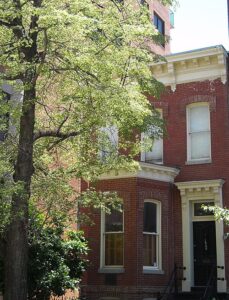
Following her marriage to Francis Grimké in 1878, Forten Grimké stepped back from public life, though she continued to write poetry and essays for publication. The Grimké home at 1608 R Street NW in Washington D.C. [Image at right] served as a social and cultural center for Black intellectuals. Mary Maillard’s research has uncovered details of its well-appointed and tasteful interior: polished furniture, inspirational artwork, and tables laden with fine French china and sparkling silver cutlery (Maillard, 2017:7–9). In 1887, the Grimkés began hosting weekly salons where guests discussed a range of topics, from art to civil rights (Roberts, 2018:69). She also helped organized a group known as the “Booklovers,” a club for elite Black women to discuss cultural and social issues (Roberts, 2018:70).  In 1896, though in poor health, Forten was one of the founding members of the National Association of Colored Women. Her Dupont Circle brick home was designated a National Historic Landmark in 1976.

ISSUES/CHALLENGES

Forten’s life in Salem, Massachusetts during the mid-1850s, compared with those of contemporary people of color, was relatively genteel. She read widely in such authors as Shakespeare, Chaucer, Milton, Phyllis Wheatley, Lord Byron, and Elizabeth Barrett Browning, among others. She attended lectures in Salem and Boston, and especially enjoyed learning about countries like Great Britain, where slavery had already been abolished. Forten was fascinated by historical and scientific exhibits such as could be seen in Salem’s East India Marine Society and the Essex Institute. At the same time, she suffered deeply from the racial prejudice that was deeply woven into the culture of the United States.

Though more privileged than many, Forten intermittently suffered from economic deprivation. Once the Philadelphia Forten enterprises went bankrupt, her father was unable to offer her much financial support. These economic pressures could easily have been ameliorated by her white grandfather, James Cathcart Johnston (1792–1865), son of a North Carolina governor and senator, who remained living until she was twenty-eight years old. Forten’s grandmother, manumitted bondswoman Edith Wood, had been the mistress of this prominent wealthy white southern planter before her death in 1846 (Maillard 2013:267). Historian Mary Maillard details the extent of his wealth: “Johnston possessed a vast estate; he was described at his death in 1865 as ‘one of the wealthiest men in the South.’ His property, spanning four counties, was valued at several million dollars and ‘his immense possessions on the Roanoke river comprise[d] the richest lands in the country’” (Maillard 2013:267). Forten did not receive any portion of this extensive estate, since Johnston left all his wealth, including three plantations, to three friends. No speculation about her grandmother’s former lover or mention of Johnston appears in her journals or letters, but it seems probable that she was aware of the lineage on her mother’s side, since she was raised almost as a sister to Johnston’s youngest daughter, her aunt, Annie J. Webb, who sued Johnston’s estate for her inheritance. Even late in Forten Grimke’s life, and throughout her successful marriage, true economic security remained elusive (Maillard 2017:150–51).
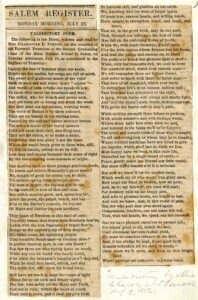
The final stanza of Charlotte Forten’s “Valedictory Poem,” [Image at right] written for the Farewell Exercises of the Second Graduating Class of Salem Normal School, and published in the Salem Register July 28, 1856, sums up her fierce dedication to the battle to end slavery and to the improvement of her society through reform. It also illustrates her unwavering Christian faith:

But we have pledged ourselves to earnest toil;
For others’ good to till, enrich the soil;
Until the abundant harvests it shall yield,
We must be ceaseless laborers in the field.
And, if the pledge be kept, if our good faith
Remain unbroken till we sleep in death,—
Once more we’ll meet, and form in that bright land
Where partings are unknown—a joyous band.

For forty years on her own, and for thirty-six years partnered with her husband, Forten Grimké strived to advance racial equality. The couple’s Washington, D.C. home was the setting for well-attended salons and meetings to help the causes they supported, such as racial and gender equality. Though Forten suffered greatly as an invalid during the last thirteen years of her life, the Grimké home remained a social and cultural center for activities to improve the lives of Black Americans (Sherman 1992:211). Charlotte Forten Grimké’s fifteen known poems, including the searing parody, “Red, White and Blue,” which turns her satirical eye on the hypocrisy of “Independence Day” celebrations in the United States, and as many essays appearing in leading periodicals from 1855–1890s were infused with her intense spirituality and deeply Christian consciousness. Charlotte Forten Grimké’s ground-breaking accomplishments as an educator, writer, and reformer, and her devoted work as the marriage partner of a Presbyterian minister, secure her place as an important figure in the realm of religion and spirituality.

IMAGES

Image #1: Charlotte Forten as a young scholar.
Image #2:  The Story of Anthony Burns, Library of Congress pamphlet.
Image #3:  Salem Normal School, Salem, Massachusetts.
Image #4: Colonel Robert Gould Shaw, commander of the 54th Massachusetts Infantry Regiment.
Image #5: Rev. Francis James Grimké, husband of Charlotte Forten.
Image #6: Charlotte Forten, circa 1870.
Image #7:  The Charlotte Forten Grimké House, Washington, D.C., National Register of Historic Places.
Image #8: Charlotte Forten’s “Valedictory Poem” published in the Salem Register, 1856.

REFERENCES

Billington, Ray Allen. 1953. “Introduction.” Pp. 1-32 in The Journal of Charlotte Forten: A Free Negro in the Slave Era, edited by Ray Allen Billington. New York: The Dryden Press.

Cobb-Moore, Geneva. 1996. “When Meanings Meet: The Journals of Charlotte Forten Grimké.” Pp. 139-55 in Inscribing the Daily: Critical Essays on Women’s Diaries, edited by Suzanne L. Bunkers and Cynthia A. Huff. Amherst: University of Massachusetts Press.

Duran, Jane. 2011. “Charlotte Forten Grimké and the Construction of Blackness.” Philosophia Africana, 13:89–98.

Forten, Charlotte. 1953. The Journals of Charlotte Forten: A Free Negro in the Slave Era, edited by Ray Allen Billington. New York: The Dryden Press.

Forten, Charlotte. 1862. “Letter from St. Helena’s Island, Beaufort, S.C.” The Liberator, December.

Forten, Charlotte. 1858. “Parody on ‘The Red, White, and Blue.’” Salem State University performance by Samantha Searles. Accessed from www.salemstate.edu/charlotte-forten on 20 June 2021. Original manuscript in the American Antiquarian Society, Worcester, Massachusetts.

Forten, Charlotte. 1856. “Valedictory Poem.” Salem Register, July 28. Salem State University Archives, Salem, MA.

Forten, Charlotte. 1855. “Hymn, for the Occasion, by one of the Pupils, Miss Charlotte Forten.” Salem Register, July 16. Salem State University Archives, Salem, MA.

Glasgow, Kristen Hillaire. 2019. “Charlotte Forten: Coming of Age as a Radical Teenage Abolitionist, 1854–1856.” Ph.D. dissertation, University of California, Los Angeles. Accessed from https://escholarship.org/content/qt9ss7c7pk/qt9ss7c7pk_noSplash_041462aa2440500cfe2d36f1e412dd0f.pdf on 20 June 2021

Grimké, Angelina Weld. 2017. “To Keep the Memory of Charlotte Forten Grimke.” Manuscripts for the Grimke Book 2. Digital Howard. https://dh.howard.edu/ajc_grimke_manuscripts/2

Grimké, Charlotte Forten. 1988. The Journals of Charlotte Forten Grimké, edited by Brenda E. Stevenson, New York: Oxford University Press.

Maillard, Mary. 2013. “‘Faithfully Drawn from Real Life:’ Autobiographical Elements in Frank J. Webb’s The Garies and Their Friends.” The Pennsylvania Magazine of History and Biography 137:261–300.

Maillard, Mary, ed. 2017. Whispers of Cruel Wrongs: The Correspondence of Louisa Jacobs and Her Circle, 1879–1911. Madison, WI: University of Wisconsin Press.

Noel, Rebecca R. 2004. “Salem as the Nation’s Schoolhouse.” Pp. 129-62 in Salem: Place, Myth and Memory. Edited by Dane Morrison and Nancy Lusignan Schultz. Boston: Northeastern University Press.

Roberts, Kim. 2018. A Literary Guide to Washington, D.C: Walking in the Footsteps of American Writers from Francis Scott Key to Zora Neale Hurston. Charlottesville: University of Virginia Press.

Rosemond, Gwendolyn, and Joan M. Maloney. 1988. “To Educate the Heart.” Sextant: The Journal of Salem State University 3:2–7.

Salenius, Sirpa. 2016. An Abolitionist Abroad: Sarah Parker Remond in Cosmopolitan Europe. Boston: University of Massachusetts Press.

Sherman, Joan R. 1992. African-American Poetry of the Nineteenth Century: An Anthology. Champaign, IL: University of Illinois Press.

Sterling, Dorothy, ed. 1997. We Are Your Sisters: Black Women in the Nineteenth Century. New York: W.W. Norton & Company.

Stevenson, Brenda. 1988. “Introduction.” Pp. 3-55 in The Journals of Charlotte Forten Grimké, edited by Brenda Stevenson. New York: Oxford University Press.

Winch, Julie. 2002. A Gentleman of Color: The Life of James Forten. New York: Oxford University Press.

Xavier, Silvia. 2005. “Engaging George Campbell’s Sympathy in the Rhetoric of Charlotte Forten and Ann Plato, African-American Women of the Antebellum North.” Rhetoric Review 24:438–56.

SUPPLEMENTARY RESOURCES

Braxton, Joanne. 1988. “Charlotte Forten Grimke and the Search for a Public Voice.” Pp. 254-71 in The Private Self: Theory and Practice of Women’s Autobiographical Writings, edited by Shari Benstock. Chapel Hill: University of North Carolina Press.

Long, Lisa A. 1999. “Charlotte Forten’s Civil War Journals and the Quest for ‘Genius, Beauty, and Deathless Fame.’” Legacy 16:37–48.

Stevenson, Brenda E. 2019. “Considering the War from Home and the Front: Charlotte Forten’s Civil War Diary Entries.”Pp. 171-00 in Civil War Writing: New Perspectives on Iconic Texts, edited by Gary W. Gallagher and Stephen Cushman. Baton Rouge: Louisiana State University Press.

Webb, Frank J. 1857. The Garies and Their Friends. London: Routledge.

Publication Date:
21 June 2021


Share

Sunburst (Brotherhood of the Sun)

SUNBURST TIMELINE

1929:  Norman Paulsen was born.

1947:  Paulsen joined Yogananda’s Self-Realization Fellowship (SRF).

1951:  Paulsen left SRF.

1969:  Paulsen founded the Brotherhood of the Sun in Santa Barbara, California.

1970:  Paulsen bought farmland, calling it Sunburst Farm.

1971:  The Brotherhood of the Sun incorporated as Sunburst Communities and founded Sunburst Natural Foods.

1975:  The Brotherhood of the Sun gained national media attention for its organic food operations; local newspapers reported on Sunburst’s stockpiled firearms and military drills.

1978:  Sunburst opened a supermarket; Paulsen was arrested amidst myriad allegations.

1980:  Paulsen published his autobiography, Sunburst.

1981:  Most members had left the group after a series of crises; Paulsen and remaining members moved to Nevada.

1983:  The group moved to Utah, where they were called The Builders.

1987:  Sunburst opened its first New Frontiers natural food store in Utah.

1991:  Paulsen relocated the group’s headquarters to California, renaming the group Solar Logos.

2006:  Paulsen died, and his wife Patty became spiritual director; the group reincorporated as Sunburst Church of Self Realization.

2014:  Sunburst sold all remaining New Frontiers stores except one in Solvang, California.

FOUNDER/GROUP HISTORY

Sunburst was formed in 1969 in Santa Barbara, California, by Norman Paulsen (1929-2006). Over the years, the group has called itself several names: The Brotherhood of the Sun, The Builders, Solar Logos Foundation, and Sunburst. In 2006, it incorporated as Sunburst Church of Self Realization.

Norman Paulsen was born in 1929 in California. His father, Charles Paulsen (d.1970), was a judge and Buddhist minister (known as the “Blind Buddha”) in Lompoc and San Luis Obispo. As a child, Norman had visions of illumined beings who visited to give him guidance or teach him skills (Paulsen 1980). Years later, he would claim these figures were Paramahansa Yogananda, Melchizedek, and Jesus Christ (Paulsen 1980). At sixteen, Paulsen became a merchant marine, traveled to Asia and the Middle East, and then enlisted in the U.S. Navy, receiving an honorable discharge after his mother’s death in 1947.

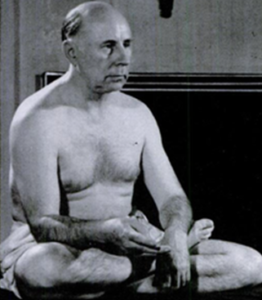
After reading Yogananda’s Autobiography of a Yogi (1946), Paulsen entered Yogananda’s Self-Realization Fellowship (SRF) in Los Angeles in 1947 to study at SRF’s Mount Washington monastery and be initiated as a monk. [Image at right] There, he studied Kriya Yoga, a meditation technique for obtaining self-realization and cosmic unity through directing mental energy along the spinal chakras. He also read widely about various religions. At SRF, he learned gardening, carpentry, and construction, and in 1951 helped build one of the first vegetarian restaurants in California, SRF’s India House Café.

Paulsen’s fellow students at SRF included his friends Bernard Cole (c.1922-c.1980), who as Yogacharya Bernard became an independent spiritual teacher; Daniel Boone (1930-2015), who helped build the Integratron, a large rejuvenation chamber and “time machine” in California’s Yucca Valley; Roy Eugene Davis (b. 1931), who would found New Life Worldwide and later lead the Center for Spiritual Awareness; and J. Donald Walters (1926-2013), better known as Swami Kriyananda, the founder of the Ananda Cooperative Communities (Kriyananda 2011; Paulsen 1980; Walters 1977).

While at SRF, Paulsen had a dream where he saw young people living on the land near Santa Barbara, a vision that presaged Sunburst (Hansen-Gates 1976; Paulsen 1980). He later wrote in his autobiography, Sunburst: Return of the Ancients (1980), that this dream would fulfill “Yogananda’s vision of self-sustaining world brotherhood colonies where men, women, and children could live harmoniously together practicing plain living and high thinking” and thus achieve union with the divine (Paulson 1980:485). For Yogananda, world brotherhood colonies could cure society of the root causes of depression, namely selfishness and consumerism (Yogananda 1939; Yogananda 1959). They involved a vow of simplicity, fellowship, joint ownership of property, living communally, perennialism, and spiritual exploration.

In 1951, Paulsen was pronounced a “minister” of the SRF, but he left the group later that year after a disagreement with Yogananda over maintaining chastity and the departure of his close friend Daniel Boone (Paulsen 1980). Paulsen spent the ensuing years working as a tradesman, particularly in construction and masonry, and researching spiritual movements. Soon after returning to Santa Barbara he had a direct encounter with what he variously called I AM THAT I AM, Christ, the Divine Solar Logos, or the Divine Mother and Father (Paulsen 1980). He saw a vision of a Golden Age of human beings living in cosmic consciousness, in which all are rightly recognized as sons and daughters of God.

In 1952, inspired by the publication of I Rode a Flying Saucer (1952), Paulsen met its author, famed UFO contactee George W. Van Tassel, and joined Van Tassel’s UFO study group at Giant Rock, California. Paulsen married and later divorced (1954-1957) Van Tassel’s daughter Glenda, had a son, and became an expert mason and novice electrician. Paulsen would have at least five wives during his life. Paulsen wrote that after one public recounting of Van Tassel’s alien contact experience, Paulsen and his friend Daniel Boone picked up an alien hitchhiker named Waldo who had arrived on earth in a spacecraft (Paulsen 1980). Paulsen also said he had his first encounter with an alien spaceship in 1953.

Throughout the 1950s, he continued to have visions, especially of visiting beings of light, whom he would later interpret as Christ and Melchizedek as well as enlightened beings he understood to be Lemurian space travelers or cosmic angels that he called the Ancients or, alternately, The Builders (Cusack 2021; Grünschloß 1998; Paulsen 1980; Trompf 1990). The beings told Paulsen that 500,000 years ago they came to earth to establish an ideal civilization, the lost continent of Mu, but that eventually war with an invading intergalactic malignant force caused them to leave. One day, they told him, the Ancients would return and Paulsen’s job was to help prepare the way for their return. Upon their return, an apocalyptic battle would take place between the “Forces of Light and the Forces of Darkness” (Paulsen 1980:285).

The early 1960s was a period of injury, illness, and poverty for Paulsen, including a medication overdose, his being involuntarily committed to a state mental institution, and having a near-death experience. But in 1964, after leaving the psychiatric hospital, The Builders instructed him to gather a community ready for them as a base station (Paulsen 1980). Much later, Paulsen would write that he was an ancient ruler of Mu who flew a spaceship on the side of Christ and that he would head the return of the Ancients when they arrive to establish “God’s Empire of the Sun” (Paulsen 1980; Trompf 2012).

By the late 1960s, living in Santa Barbara, Paulsen taught meditation classes and led spirituality discussion groups for disaffected youths seeking mystical experiences and clean living. In 1969, Paulsen and his followers formed the Brotherhood of the Sun, the name reflecting both their vision of the Spiritual Sun (the white light of the Creator, communion with which was the highest goal of the Brotherhood’s members) as well as a homophone of Jesus as the Son of God. As the group grew, they began meeting in an old ice cream factory. They supported themselves through construction jobs, housecleaning, and babysitting. However, members instead wanted to live communally on a farm, grow organic foods, and sell natural foods to the public as their means of support (Paulsen 1980).

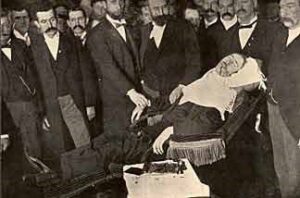
In 1970, Paulsen bought a 160-acre farm near Santa Barbara with proceeds from a workers’ compensation claim and donations from his followers. He called it Sunburst Farm. [Image at right] For Paulsen, the farm was a spiritual center and he described having visitations from intergalactic ancestral beings, The Builders or Ancient Ones, who blessed his project (Paulsen 1980). The next year, Sunburst bought a 220-acre farm that he called Lemuria Ranch.

In 1971, the Brotherhood of the Sun incorporated as a religious nonprofit, called Sunburst Communities, Inc., and created Sunburst Natural Foods as its member-run for-profit corporation to manage their health foods businesses. That same year they opened Sunburst Community Store to sell their organic produce, and soon formed a trucking company, also called Sunburst Natural Foods, to distribute organic food and natural dry goods to other stores and restaurants. The company became “one of the largest distributors of naturally grown foods in the United States,” trucking their own foods and those grown by other organic farms to health food stores and restaurants across America (Paulsen 1980; see also Chandler 1974; Corwin 1989; T. Miller 1999).

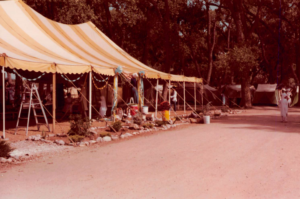
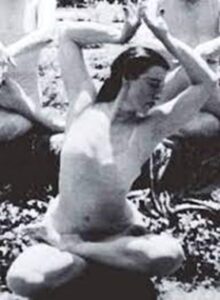
Throughout the early 1970s, Sunburst opened two local restaurants, a whole-grain bakery, a dairy, and a fruit juice-bottling company, among other enterprises, and bought a 2,000-acre farm. Paulsen hired lawyers, accountants, and investment staff to maximize profits in their commercial arm, the Brotherhood of Man, so that they could reinvest them in the community and in their farm properties. Sunburst marketed their products as healthier, more environmentally sustainable, and more spiritually nourishing than industrially processed or chemically-grown non-organic foods. Sunburst Organic Apple Juice sold well nationally. Commune members largely worked without pay, yet they received nutritious food, simple clothing, medical care, shared land, and housing. [Image at right] As its organic foods businesses grew, it helped create standards for the emerging organics industry (Hoesly 2019; S. Leslie 1979). Sunburst was an important part of 1970s back-to-the-land communes and the development of natural foods stores (Dobrow 2014; Edgington 2008; Hoesly 2019).

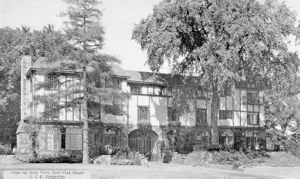
Sunburst’s operations diversified and expanded in the late 1970s as it became America’s leading grower and retailer of organic foods, what one journalist called a “Natural Foods Empire” (Meade 1981). [Image at right] The New York Times, Los Angeles Times, and Chicago Tribune reported on the success of the movement, which totaled over 340 members and earned over $3,000,000 in profits in 1975 (Chandler 1974; Nordheimer 1975; Zyda 1976). In 1976, Sunburst bought a 3,000-acre farm called Tajiguas Ranch, and a member, Susan Duquette, published the Sunburst Farm Family Cookbook (1976), which sold well in two editions and promoted the group and its spiritual intentions. Paulsen bought four large sailboats (the group owned only one at any given time) to catch fish for their Sunburst Pierce Fisheries business and for pleasure cruises. Sunburst also experimented with non-polluting energy sources, such as a homopolar free-energy generator (Schiff 1981; Zachary 1981a).

In 1978, Sunburst opened a large alternative supermarket, selling its own organic foods, organic produce from other farms, and other products. The store pioneered selling bulk items in clear, airtight food bins. Sunburst also distributed produce from other organic farmers throughout California and the Southwest, including shipping to Chicago, New York, Canada, and other major markets by truck and air freight. By 1980, Sunburst earned $16,000,000 through twelve wholesale and retail outlets in five cities (Meade 1981).

By 1978, a number of factors began to drive people from Sunburst (Beresford 2007; Black 1977; Cass 1975; Chandler 1981a; Corwin 1989; Every 1982; Hurst 1975a; Hurst 1975b; Ibáñez 1975; King 1980; Nordheimer 1975; Trompf 1990; Weaver 1982). Accusations in 1975 that Paulsen had brandished guns in public, stockpiled firearms, and oversaw military training drills in preparation for a coming apocalypse resulted in defections and bad publicity. As a result, Sunburst was investigated by anticult groups, leading to the kidnapping of two Sunburst members in 1976 by famed “deprogrammer” Ted Patrick (Brantingham 1977a; Brantingham 1977b). Later allegations that Paulsen abused painkillers, sexually abused minors, and evaded taxes, in addition to a threatened shoot-out with law enforcement after he was arrested for drunk driving and resisting arrest in 1978, led many members to turn against him publicly. These charges also led to increased government scrutiny, including by the Drug Enforcement Agency, the Federal Bureau of Investigation, and the Department of Justice (Hoesly 2019). Paulsen claimed that he took medications to soothe lingering pain from an earlier injury and to restore energy depleted by providing spiritual counsel, but many members were turned off by his alleged alcoholism and drug abuse, which violated Sunburst community rules (Corwin 1989). Sunburst’s arsenal and apocalypticism drew increased attention after the 1978 Peoples Temple mass suicide in Guyana and during the 1980 presidential campaign, since one Sunburst farm abutted Ronald Reagan’s ranch.

In addition to these concerns, members alleged that Sunburst did not fairly distribute the wealth from its businesses, instead aggrandizing wealth only for Paulsen’s inner circle. In 1980, store employees agitated for a union and later filed a grievance about anti-union intimidation by Sunburst’s management (Hall 1980; C. Miller 1981). Increasing competition in the organic foods market whittled away at revenues by undercutting Sunburst’s prices, and the national economy soured amid rising inflation, high unemployment, and a looming recession. By 1981, two-thirds of members had left, leaving the farm and markets with fewer workers. These economic and labor woes brought about Sunburst’s financial downfall. A 1981 lawsuit by over seventy former members, which was later dismissed, sought $1.300,000 of the group’s profits, and a separate lawsuit concerning Sunburst’s inability to pay its debts caused Sunburst to have to sell its Tajiguas Ranch (Mann 1982; Meade 1981; Zachary 1981b). Sunburst liquidated its other California properties by 1982.

In 1981-1982, Paulsen and about one hundred of the more committed members left California for a large ranch in Wells, Nevada, called Big Springs Ranch, and to a mobile home park in nearby Oasis, a small settlement where members operated a gas station, mini-mart, hotel, and restaurant (Chandler 1981b; Greverus 1990; Paulsen 2002). The half-million-acre cattle ranch was less hospitable for agricultural production, especially due to long, cold winters and short growing seasons. By 1983, after enduring harsh winters and facing a lien on the new ranch, Paulsen took most of the remnant to Salt Lake City, Utah, where he renamed them The Builders.

During the 1980s and into the mid-1990s, the community dwindled further, eventually down to about two or three dozen people (Corwin 1989). In Utah, they mostly abandoned farming to find other employment, living in a four-story mansion and then in an apartment complex they managed, meditating daily to sustain unity (Paulsen 2002). Others lived in the Nevada trailer park. Members stopped pooling resources collectively and began earning income individually. In Salt Lake City, they bought, remodeled, and sold houses; ran an excavation-demolition business; began offering weekend retreats for spiritual seekers; and opened several natural food stores, called New Frontiers (Hoesly 2019). Some members went to Arizona and opened three additional New Frontiers stores between 1988-1995.

Paulsen, who spent time in Salt Lake City and Las Vegas, returned to California in 1988, looking for land for a new commune (Corwin 1989). In 1991, he renamed the group Solar Logos and bought a 53-acre ranch near Buellton, California, calling it Sunburst Farm, where he relocated the group’s headquarters the following year. Paulsen soon bought a second property called Nojoqui Farm (also called New Frontiers Farm) to raise organic produce for their markets. In 1995-1996, most of the members moved back to the Santa Barbara area and built homes and a retreat center on the ranch.

New Frontiers natural markets has been the primary income generator for the community since the 1990s and serves as a pathway for Sunburst’s organic foods and spiritual values (Spaulding 2008). [Image at right] Paulsen said that each store was a “vortex of healing energy” that could be felt by customers as well as employees (Paulsen 2016:339). Yet, as the group relocated to California, operating the stores in other states became difficult. In 1996, they sold the three Utah stores to Wild Oats, a natural foods grocery chain. In 1997, they opened two new stores in California.

Norman Paulsen died in 2006 (Nisperos 2007). That year, his wife, Patty Paulsen, became spiritual director of the group and changed its name from Solar Logos to Sunburst, incorporating it as Sunburst Church of Self Realization. Since then, Sunburst has built a new sanctuary and retreat center at Sunburst Farm, from which it runs weekend retreats, permaculture workshops, meditation and yoga classes, and weekly services. About two dozen members live on the farm, which continues to grow, serve, and sell organic food (Knapp 2019). In 2014, Sunburst sold a New Frontiers store in California and all three Arizona stores to Whole Foods, leaving only their store in Solvang, California (K. Leslie 2014). Despite the declining membership, the group continues its spiritual practice of “personal and planetary awakening” through organic foods, meditation, and self-realization (Sunburst website n.d.).

DOCTRINES/BELIEFS

Paulsen espoused an eclectic, esoteric combination of spiritual beliefs. These include mystical Christianity, the Judaism of the Essenes, Hopi traditions, Buddhism, Hinduism, Theosophy, and Ufology. The largest influences in the Sunburst community are Paramahansa Yogananda and Jesus Christ (Paulsen 1980; Sunburst website n.d. “Spiritual Lineage”). Details of Paulsen’s complex, synthetic beliefs can be found in his autobiography, which he published in four versions during his lifetime (1980, 1984, 1994, 2002). His wife Patty published a fifth revised version posthumously (2016). Several scholarly articles have focused on Paulsen’s UFO visions and beliefs (Grünschloß 1998; Gruenschloss 2003; Grünschloß 2004; Grünschloß 2006; Trompf 1979; Trompf 1990; Trompf 2003; Trompf 2012; Trompf and Bernauer 2012).

Yogananda inspired Sunburst’s belief that meditation, and Kriya Yoga in particular, is the pathway to self-realization. Self-realization is the embodied understanding that one is divine and merges into oneness with universal energy or God. [Image  at right] This realization produces harmony in the world. For Sunbursters, self-realization through yogic mediation also produces Christ consciousness. Jesus Christ, according to Paulsen, taught that humans have God within them and that every person has divine potential. For Paulsen, Jesus taught the same self-realization as Yogananda (Paulsen 1980; Sunburst website n.d. “Spiritual Lineage”).

Sunburst members believe that living the group’s eightfold path and twelve virtues leads to Christ consciousness and cosmic consciousness, which Paulsen also called self-realization and God-realization (Paulsen 2000; Sunburst website n.d. “The Rainbow Path”). The Eightfold Path of Conscious Living includes meditation, conduct, study, speech, association, nourishment, work, and recreation. The twelve virtues are charity, faith, loyalty, patience, honesty, perseverance, temperance, humility, courage, equanimity, continence, and compassion. Through meditation and right living, people will awaken to the pure self within and realize their oneness with the Divine Spirit, the light of all creation, the consciousness and energy of Christ (Paulsen 1980; Sunburst website n.d. “The Rainbow Path”).

Sunburst’s website lists several other “Aims and Ideals” (Sunburst website n.d. “About Sunburst”):

To seek to know, by direct personal experience, the Infinite Being of eternal existence, pure consciousness and ever-new bliss. This is Self-realization!

To create inner and outer environments that encourage and cultivate Self-realization individually, collectively, and globally.

To offer love and energy to others and to the Divine through selfless service.

To embrace the timeless codes of virtue and paths of conscious living.

To recognize and study the sacredness of Mother Nature.

To use the gifts of imagination and will to design regenerative solutions, and become true caretakers of the Earth-garden.

To honor the truths underlying all wisdom traditions, and to embrace opportunities to share the teachings of Self-realization with those who seek to know their own true nature.

Sunburst members believe that UFOs and aliens inhabited this planet long before humans arrived and that they have come again to lead humans to a path of righteousness. Paulsen was familiar with Theosophical texts about Lemuria and Mu, which were popularized by authors such as W. S. Cervé and James Churchward, whom Paulsen had read and cited in his autobiography (Paulsen 1980). Paulsen connected these teachings to accounts of UFOs and intergalactic spiritual beings, formed in part by his involvement in Van Tassel’s UFO study group and reading of Ufological literature.

Building on Helena Blavatsky’s idea of “root races,” Paulsen developed a color-coded hierarchy of races corresponding to intergalactic beings and racial genealogies on earth (Cusack 2021; Paulsen 1980; Trompf 1990). Four human races (Red, Yellow, Blue, and White) originated in a heavenly realm in outer space and came to Earth as The Builders. Meso-American and Pacific Island civilizations were built by these Lemurians in human form. For Paulsen, these first people were White and they first landed in Latin America (Paulsen 1980).

Paulsen and Sunburst were also heavily influenced by White Bear (Oswald Fredericks), a Hopi writer who befriended Paulsen and who the recorded source material for Frank Waters’ bestselling Book of the Hopi (1963). Book of the Hopi was influential for Paulsen and popular within Sunburst (Blumrich 1979; Fredericks and King 2009; Paulsen 1980; Steiger 1974). Paulsen considered the indigenous Hopi people to be the remnants of the Red race and peaceful caretakers of Mother Earth. White Bear also inspired Paulsen’s view that the South Pacific marked a sacred place of wisdom and that Lemurians had created the earliest earthly civilization there.

In the 1970s, Sunburst members lived by formal rules structures initially but later gravitated toward community guidelines, allowing independence within spiritual belonging. Healthy living norms included no drugs, alcohol, tobacco, or premarital or extramarital sex; wearing simple clothes; living outdoors cleanly and naturally; and eating a nutritious, organic diet, preferably vegetarian. According to members Dusk and Willow Weaver, “For the member of Sunburst all physical endeavors are natural outgrowths of this divine plan,” of “attunement with nature and attainment of communion with the Creator” (Weaver 1982:10-11).

Today, the Sunburst community considers themselves a “global community of light workers, as well as an intentional cooperative community” (Sunburst website n.d. “About Sunburst”). This means creating a fertile environment for personal spiritual growth and self-realization. According the Sunburst’s “Spiritual Lineage” webpage: “Each one of us, made in the image of God, is destined to awaken the Christ consciousness, the pure Self within our souls. This is Self-realization, through whose emergence God is realized. Enlightened, God-realized souls from all spiritual paths continually exist in this consciousness, and can come forth to assist you on your life’s journey.” Sunburst members strive to guide people along this path of self-realization.

RITUALS/PRACTICES

Sunburst’s practices are rooted in yoga, meditation, and natural foods. The goal of Kriya Yoga and meditation is self-realization. The group’s organic farming and food cultivation, along with its natural foods stores, feed this goal by providing members conscious living and spiritually-sustaining work (Sunburst website n.d. “Earth Stewardship”). Organic food production and distribution also contribute to promoting Sunburst and its spiritual ideals. Paulsen’s goal was to create a “New Age” society of harmonial living and spiritual self-realization (Lillington 1979).

Kriya Yoga, which Norman Paulsen had studied with Yogananda, is a daily practice of sitting meditation and breathing that directs energies along the spinal chakras. Sunburst presents Kriya Yoga as a sacred science that leads to self-realization (Paulsen 2000; Sunburst website n.d. “Kriya Yoga Initiation”). Today, Sunburst also teaches the Hong Sau technique of meditation, guided visualization, and other pathways to self-realization.

Farm labor has also been a spiritual practice at Sunburst (Hoesly 2019). Cultivating and consuming organic foods, conscious living, and self-sufficiency converge with and were outgrowths of their spiritual aim of divine communion. Members woke up early for daily meditation, then ate together, then worked at farming, trucking, selling, and baking; evenings were spent in communal dinners, small group meditations, and social time (Allen 1982; Arcudi and Meyer 1985; R. Miller 1978; Paulsen 1980; Roth 2011). Meals were mostly fresh dairy products, vegetables, fruits, nuts, seeds and grains. Fish or meat was served several times a week by the late 1970s, although originally the diet was exclusively raw food, then lacto-ovo vegetarian, then choose-your-own.

In addition to growing hundreds of acres of fruit trees, vegetables, wheat, nuts, and other crops, members raised hundreds of naturally-fed, hormone-free goats, sheep, cows, and chickens.  [Image at right] They made wool clothes and an array of dairy products, including butter, yogurt, cheese, milk, and smoothies. They sold honey through beekeeping. Paulsen bought horses to work the farm pulling plows and to show competitively. The farm included machinery and tools for making furniture, brickmaking, welding, blacksmithing, pottery, and necessary items for the community and for use or sale in their businesses. A gift shop above the restaurant sold items crafted by Sunburst members. Today, Sunburst also sells Norman Paulsen’s books and CDs, religious literature, and other spiritual items online and at its gift shop.

As a “center for holistic learning, healing and conscious living,” Sunburst offers Sunday meditation gatherings, weekend retreats, Kriya Yoga initiations, spiritual and permaculture workshops, kirtan and song circles, and classes on the science of yoga and the path of self-realization (Sunburst website n.d. “Sunburst Farm & Sanctuary”). Weekly Sunday services include a guided meditation led by rotating leaders and communally performing original songs created by members of the group, followed by fellowship and a brunch of organic foods grown on the farm.

Regular weekend retreats revolve around themes such as permaculture, connection with Mother Earth, sacred silence, and Kriya Yoga (Sunburst website n.d. “Sunburst Events”). These retreats are usually led by Sunburst members, generate revenue for the group, and promote its teachings. In the Karma Yoga program, participants help with gardening, cooking, cleaning, and upkeep. Sunburst also offers a 200-hour yoga teacher training.

ORGANIZATION/LEADERSHIP

Norman Paulsen founded the Brotherhood of the Sun, later known Sunburst, in 1969. During his life, he was the leader of the spiritual community, although a circle of twelve elders helped him make decisions (Trompf 1990). Paulsen gave up leadership of Sunburst’s businesses in the mid-1970s so that he could focus on spiritual development of himself and the group. Its businesses were led by various core members of Sunburst. Paulsen led the community until his death in 2006. Since then, his wife, Patty Paulsen, [Image 9 at right] who joined in 1975, has led Sunburst Sanctuary as its spiritual director.

In addition to the Paulsens, Sunburst has always had a small council of devoted members to guide the community and its for-profit enterprises. In 2021, other leaders of Sunburst include: David Adolphsen, who leads its community development; Jake Collier, who manages the New Frontiers store and chairs Sunburst’s council; Valerie King, who serves as finance manager for Sunburst and its businesses; Jonathan King, who is Sunburst’s treasurer and long led its business enterprises; Emily Wirtz, who leads the retreat center and youth ministry team; Heiko Wirtz, who leads Sunburst’s property services crew; and Elena Andersen, who coordinates events and outreach for Sunburst (Sunburst website n.d. “Staff”). Adolphsen, Collier, and the Kings joined Sunburst in the early 1970s and have long been leaders in the group and its businesses.

ISSUES/CHALLENGES

Sunburst has faced several challenges, primarily involving allegations of Norman Paulsen’s illegal and unethical conduct in the late 1970s. These issues, described above in greater detail, include his alleged drug abuse, alcoholism, and abuse of minors; arrests; amassing weapons and threatening police; financial self-dealing; and self-deification. As a result of conflicts within the Sunburst community and with law enforcement, most members left Sunburst by 1981.

While many Sunburst members shared Paulsen’s beliefs and visions of ancient civilizations and intergalactic beings, some of Paulsen’s beliefs also caused dissention. In the late 1970s, Paulsen claimed that he was Jesus Christ returned, that he rode in spaceships with The Builders as one of the ancient rulers of Mu, and that he would restore the Garden of Eden, also known as Mu (Paulsen 1980; Trompf 1990; Weaver 1982). Some members, such as Michael Abelman, rejected his self-deification and were forced out of the group (Corwin 1989; Every 1982).

The group struggled to survive during the early 1980s due to mass defections, financial struggles, and relocation to an environment less hospitable to farming. Eventually, they founded a chain of successful natural foods stores, called New Frontiers. However, despite the success of these stores into the 2000s, Sunburst’s spiritual community has remained small. With just a few dozen members at most, Sunburst’s membership remains far below the 350-400 members it had at its peak in the mid-1970s.

Today, Sunburst’s largest challenge is how to survive given its small cohort of aging members. [Image at right] Most of the core members are Baby Boomers in their seventies. While some younger people participate in weekly mediation gatherings, workshops, or retreats, few are committed members of the community (Hoesly 2019). During the 2010s, Sunburst sold all but one of its New Frontiers stores. As of 2021, it owns two farms, although Sunburst has struggled to maintain its Nojoqui Farm (Minsky 2020).

IMAGES

Image #1: Norman Paulsen at SRF, c. 1950.
Image #2: Norman Paulsen at Sunburst Farm, 1972.
Image #3: Apple pickers at Sunburst’s Cuyama Orchard, mid-1970s.
Image #4: Sunburst member with bottle of Sunburst’s organic apple juice.
Image #5: New Frontiers store, 2018.
Image #6: Paulsen’s autobiography, Sunburst: Return of the Ancients (1980).
Image #7: Group prayer at Tajiguas Ranch, 1978.
Image #8: Patty Paulsen.
Image #9: Members at Sunburst Sanctuary, c. 2018.

REFERENCES

Allen, Steve. 1982. Beloved Son: A Story of the Jesus Cults. Indianapolis: Bobbs-Merrill.

Arcudi, Melanie, and Pauline Meyer. 1985. “The Brotherhood of the Sun, 1969–1985: A Memoir.” Communal Societies 5: 82-88.

Beresford, Hattie. 2007. “The Way It Was: The Many Faces of Ogilvy Ranch.” Montecito Journal, July 5.

Black, David. 1977. “Why Kids Join Cults.” Woman’s Day, February.

Blumrich, J. F. 1979. Kásskara und die sieben Welten: Weißer Bär erzählt den Erdmythos der Hopi-Indianer. Wien: Econ Verlag.

Brantingham, Barney. 1977a. “‘Brotherhood of the Sun’ Man Says Wealthy Parents Kidnapped Him.” Santa Barbara News-Press, January 26.

Brantingham, Barney. 1977b. “Professors’ Feelings Mixed on Youths’ ‘Deprogramming.’” Santa Barbara News-Press, January 28.

Cass, Ben. 1975. “Brotherhood of the Sun.” Seed: Journal of Organic Living 4:4–6.

Chandler, Russell. 1981a. “Religious Groups Head for Hills . . . and Survival.” Los Angeles Times, October 18.

Chandler, Russell. 1981b. “A Directory of the Country Retreats.” Los Angeles Times, October 18.

Chandler, Russell. 1974. “Sun Shines Bright on Brotherhood.” Los Angeles Times, February 3.

Corwin, Miles. 1989. “20 Years Later, Some Followers of Guru Still Keep the Faith.” Los Angeles Times, July 10.

Cusack, Carole M. 2021. “Norman Paulsen and the Brotherhood of the Sun/Sunburst.” Pp. 354-68 in Handbook of UFO Religions, edited by Benjamin E. Zeller. Boston: Brill.

Dobrow, Joe. 2014. Natural Prophets: From Health Foods to Whole Foods—How the Pioneers of the Industry Changed the Way We Eat and Reshaped American Business. New York: Rodale Books.

Duquette, Susan. 1976. Sunburst Farm Family Cookbook: Good Home Cookin’ the Natural Way. Santa Barbara: Woodbridge Press.

Edgington, Ryan H. 2008. “Be Receptive to the Good Earth: Health, Nature, and Labor in Countercultural Back-to-the-Land Settlements.” Agricultural History 82:279-308.

Every, Mary. 1982. “Evolving into—and out of—Sunburst Community.” Santa Barbara News-Press, February 7.

Fredericks, Oswald White Bear, and Kaih Khristé King. 2009. The History of the Hopi from Their Origins in Lemuria. Shreveport: King’s Bridge.

Greverus, Ina-Maria. 1990. Neues Zeithalter oder Verkehrte Welt: Anthropologie als Kritik Darmstadt: Wissenschaftliche Buchgesellschaft.

Grünschloß, Andreas. 2006. “‘Ancient Astronaut’ Narrations: A Popular Discourse on Our Religious Past.” Marburg Journal of Religion 11:1-25.

Grünschloß, Andreas. 2004. “Waiting for the ‘Big Beam’: UFO Religions and ‘Ufological’ Themes in New Religious Movements.” Pp. 419-44 in The Oxford Handbook of New Religious Movements, edited by James R. Lewis. New York: Oxford University Press.

Gruenschloss, Andreas. 2003. “When We Enter into My Father’s Spacecraft: Cargoistic Hopes and Millenarian Cosmologies in New Religious UFO Movements.” Pp. 17-42 in Encyclopedic Sourcebook of UFO Religions, edited by James. R. Lewis. Amherst: Prometheus Books.

Grünschloß, Andreas. 1998. “When We Enter into My Father’s Spacecraft: Cargoistic Hopes and Millenarian Cosmologies in New Religious UFO Movements.” Marburg Journal of Religion 3, no. 2: 1-24.

Hall, Bob. 1980. “Sunburst Employees Organize Campaign to Establish Union.” Daily Nexus, October 21.

Hansen-Gates, Jan. 1976. “Growing Outdoors: The Brotherhood of the Sun.” Santa Barbara Magazine 1:64–71.

Hoesly, Dusty. 2019. “Organic Farming as Spiritual Practice and Practical Spirituality at Sunburst Farms.” Nova Religio 23:60-88.

Hurst, John. 1975a. “Brotherhood of the Sun’s Arsenal for Armageddon.” Santa Barbara News & Review, March 7.

Hurst, John. 1975b. “The Brotherhood Dream Becomes a Nightmare,” Santa Barbara News & Review, March 21.

Ibáñez, José Enrique Rodríguez. 1975. “Patologia de la Countercultura: El caso de la ‘Brotherhood of the Sun.’” Triunfo XXX:40–41.

King, Wayne. 1980. “In California, the ‘Private Societies’ Flaunt Firepower.” New York Times, December 17.

Knapp, Francky. 2019. “The Last Great California Hippie Commune is Still Going Strong.” Messy Nessy Chic, April 23. Accessed from https://www.messynessychic.com/2019/04/23/the-last-great-california-hippie-commune-is-still-going-strong/ on 28 April 2021.

Kriyananda, Swami. 2011. Paramhansa Yogananda: A Biography, with Personal Reflections and Reminiscences. Nevada City: Crystal Clarity.

Leslie, Kaytlyn. 2014. “New Frontiers Selling SLO Store and Three Others to Whole Foods.” San Luis Obispo Tribune, April 1.

Leslie, Susan. 1979. “Sunburst Dedicated to Natural Foods.” Los Angeles Times, October 27.

Lillington, Karlin J. 1979. “One Man’s Visions Create a New-Age Society.” Daily Nexus, April 27.

Mann, Wesley. 1982. “Sunburst Pledges Assets to Meet $1.2 Million Debt.” Santa Barbara News-Press, September 17.

Meade, Charles. 1981. “The Sun Sets on a Natural Foods Empire.” Santa Barbara News & Review, June 25.

Miller, Chris. 1981. “Union Files Misconduct Charges.” Daily Nexus, May 29.

Miller, Ralph C. 1978. “Sunburst Farms.” Small Farmer’s Journal 2:43-46.

Miller, Timothy. 1999. The 60s Communes: Hippies and Beyond. Syracuse: Syracuse University Press.

Minsky, Dave. 2020. “Sunburst Farm Sues Neighbor, Cannabis Company over Access to Water Well.” Santa Maria Times, August 9.

Nisperos, Neil. 2007. “Late Spiritual Leader Honored.” Santa Maria Times, February 4.

Nordheimer, Jon. 1975. “Coast Religious Sect’s Life Is Tested by Prosperity.” New York Times, April 6.

Paulsen, Norman. 2016. Life-Love-God: Story of a Soul Traveler. Buellton, CA: Sunburst.

Paulsen, Norman. 2002. Christ Consciousness: Emergence of the Pure Self Within. Buellton, CA: Solar Logos Foundation.

Paulsen, Norman. 2000. Sacred Science: Meditation, Transformation, Illumination. Buellton, CA: Solar Logos Foundation.

Paulsen, Norman. 1994. The Christ Consciousness: The Pure Self Within You. Salt Lake City: The Builders.

Paulsen, Norman. 1984. Christ Consciousness. Salt Lake City: The Builders.

Paulsen, Norman. 1980. Sunburst: Return of the Ancients. Goleta, CA: Sunburst Farms.

Roth, Matthew. 2011. “Coming Together: The Communal Option.” Pp. 192-208 in Ten Years That Shook the City: San Francisco 1968-1978, edited by Chris Carlsson and Lisa Ruth Elliott. San Francisco: City Lights Foundation Books.

Schiff, J.-M. 1981. L’Age Cosmique aux U.S.A. Paris: Albin Michel.

Spaulding, Allie Kay. 2008. “There’s a Lot of Life in ‘Them Thar Hills.’” Lompoc Record, October 12.

Steiger, Brad. 1974. Medicine Power: The American Indian’s Revival of His Spiritual Heritage and Its Relevance for Modern Man. Garden City: Doubleday.

Sunburst. 2018. Meditations on the Eightfold Path of Conscious Living. Buellton, CA: Sunburst.

Sunburst website. n.d. Accessed from https://sunburst.org/ on 26 April 2021.

Sunburst website. n.d. “About Sunburst.” Accessed from https://sunburst.org/about/?v=f24485ae434a on 26 April 2021.

Sunburst website. n.d. “Earth Stewardship.” Accessed from https://sunburst.org/earth-stewardship/?v=f24485ae434a on 26 April 2021.

Sunburst website. n.d. “Kriya Yoga Initiation.” Accessed from https://sunburst.org/kriya-initiation/?v=f24485ae434a on 26 April 2021.

Sunburst website. n.d. “The Rainbow Path.” Accessed from https://sunburst.org/rainbow-path/?v=f24485ae434a on 26 April 2021.

Sunburst website. n.d. “Spiritual Lineage.” Accessed from https://sunburst.org/spiritual-lineage/?v=f24485ae434a on 26 April 2021.

Sunburst website. n.d. “Staff.” Accessed from https://sunburst.org/about/staff/?v=f24485ae434a on 26 April 2021.

Sunburst website. n.d. “Sunburst Events.” Accessed from https://sunburst.org/upcoming/?v=f24485ae434a on 26 April 2021.

Sunburst website. n.d. “Sunburst Farm & Sanctuary.” Accessed from https://sunburst.org/sunburst-farm-sanctuary/?v=f24485ae434a on 26 April 2021.

Trompf, Garry W. 2012. “History and the End of Time in New Religions.” Pp. 63-79 in The Cambridge Companion to New Religious Movements, edited by Olav Hammer and Mikael Rothstein. New York: Cambridge University Press.

Trompf, Garry W. 2003. “UFO Religions and Cargo Cults.” Pp. 221-38 in UFO Religions, edited by Christopher Partridge. New York: Routledge.

Trompf, Garry W. 1990. “The Cargo and the Millennium on Both Sides of the Pacific.” Pp. 35-94 in Cargo Cults and Millenarian Movements: Transoceanic Comparisons of New Religious Movements, edited by Garry W. Trompf. New York: de Gruyter.

Trompf, Garry W. 1979. “The Future of Macro-Historical Ideas.” Soundings 62: 70-89.

Trompf, Garry W., and Lauren Bernauer. 2012. “Producing Lost Civilisations: Theosophical Concepts in Literature, Visual Media and Popular Culture.” Pp. 101-131 in Handbook of New Religions and Cultural Production, edited by Carole M. Cusack and Alex Norman. Boston: Brill.

Van Tassel, George W. 1952. I Rode a Flying Saucer. Los Angeles: New Age Publishing.

Walters, J. Donald. 1977. The Path: Autobiography of a Western Yogi. Nevada City, CA: Ananda.

Waters, Frank. 1963. The Book of the Hopi. New York: Viking.

Weaver, Dusk, and Willow Weaver. 1982. Sunburst: A People, a Path, a Purpose: The Story of the Most Provocative Communal Group in America Today. San Diego: Avant Books.

Yogananda, Paramahansa. 1959. Autobiography of a Yogi (Eighth Edition). Los Angeles: Self Realization Fellowship.

Yogananda, Paramahansa. 1932. “How to Burn Out the Roots of Depression by Divine Methods.” East-West 4, no. 6: 5–8.

Zachary, G. Pascal. 1981a. “New Energy Source Caught in Sunburst-Physicist Conflict.” Santa Barbara News & Review, June 25.

Zachary, G. Pascal. 1981b. “Lawsuit Sparked Threats, Sunburst Defectors Say.” Santa Barbara News & Review, June 25.

Zyda, Joan. 1976. “Cult Profits from a Labor of Love.” Chicago Tribune, July 26.

PUBLICATION DATE:
19 June 2021


Share

Essene Church of Christ


ESSENE CHURCH OF CHRIST TIMELINE

1898-1901:  The pseudepigraphic Gospel of the Holy Twelve, which claimed Jesus was a vegetarian, was published in installments in the Lindsey and Lincolnshire Star newspaper.

1923:  While studying in the Vatican library. Edmund Bordeaux Szekeley claimed to have found several Hebrew and Aramaic texts that demonstrated Jesus was a vegetarian, and preached vegetarianism.

1958:  David Owen was born in San Diego, California.

1966:  Young David, age eight, saw an apparition of Mary Magdalene.

1960s:  Malachi, an Essene master of Lebanese descent, entered the United States from Mexico.

1965:  David Owen, age seventeen, picked up Malachi as a hitchhiker, and learned about vegetarianism.

1970s:  Malachi established an Essene Garden of Peace somewhere east of San Diego.

1970s (mid):  Day joined Malachi at the Essene garden and spent seven years learning from this teacher.

1970s (late):  Malachi’s Garden was sold to make way for a parking lot.

1976:  Day interviewed Malachi.  A cassette recording of this interview was the only evidence of Malachi’s existence.

1997:  Day embarked on a Holy Qara to Jamaica to introduce the Holy Megillah.

1998:  Essene Church of Christ received tax exempt status.

2011:  Supreme Master Ching Hai, a spiritual leader who started a chain of vegan restaurants, filmed a three-part documentary of the vegetarian Essene Church of Christ.

2019:  Day embarked on a second Holy Qara, beginning in Ashland, Oregon

FOUNDER/GROUP HISTORY

The Essene Church of Christ has claimed direct apostolic lineage to the ancient Essenes, a Jewish sect of antiquity often associated with the Dead Sea Scrolls. The church currently is run by Brother Day, born in 1958 as David Owen. [Image at right] Day has said he always felt a spiritual connection to Mary Magdalene, and she used to appear to him in dreams and visions when he was a child. Growing up in San Diego, Brother Day identified as a “surfer boy,” and often skipped school to go to the beach.  It was in this context that he met an Essene teacher who would guide his spiritual transformation.

Day met Malachi when he was seventeen years old and Malachi was an old man of undetermined age. Malachi was meditating on the side of a highway in Southern California. Brother Day offered him a ride and Malachi asked him to drop him at a vegetarian restaurant. He asked Malachi if vegetarian food tasted good, to which Malachi replied, “It tastes much better than dead cow.” In Day’s recounting of the meeting, this statement was transformative for his seventeen-year-old self, as he had never considered that burgers were slaughtered animals before. Brother Day joined Malachi for the meal and was surprised at how good it tasted. He became Malachi’s student.

Malachi had been sent by his own Essene teacher from the Middle East to train a disciple to found a modern Essene Church in America, the only place in the world, he was told, with freedom of religion. Malachi built a commune and planted some gardens in the ruins of an abandoned hotel near San Diego. In the commune-surfing era of the 1970s, many people came through Malachi’s Essene Garden of Peace and stayed for short visits. Day stayed for seven years, rising at dawn and working in the gardens. Day has insisted that he became the next teacher of the Essene Church because he stayed long enough to become Malachi’s disciple, and not because of any exceptional ability.

There is no way to prove or disprove this foundational narrative. Malachi and his commune no longer exist. The owner of the hotel had allowed him to build the garden on the defunct property, but after he passed away, the descendants turned the hotel into a parking lot. Consequently, there are no remains of the garden. Malachi has also passed away, and because he entered the country illegally through Mexico, there are no records of him either. In 1976, Day interviewed Malachi, and kept a cassette recording of the event. This cassette is all that remains of Malachi.

The Church headquarters, the Essene Garden of Peace, are located on a country road near Greenleaf, Oregon. The church runs a mystery school called the Essene Academy of Higher Learning. The Essene Church of Christ has also recently opened churches in Santa Cruz and San Francisco, California. Day of Greenleaf

DOCTRINES/BELIEFS

The Essene Church of Christ takes its name from an ancient Jewish sect called Essenes. The meaning of the word is obscure, but one proposed etymology is the Aramaic “assaya” (healer) (Goranson 1984:483-98). The Essene Church of Christ accepts this translation. Maintaining healthy bodies and encouraging environmental healing are central tenets. A vegetarian diet is an absolute requirement for membership, and some members hold to a vegan or fruitarian diet. Vegetarianism and environmentalism inform the group’s broader apocalyptic outlook: the church believes that humanity is living on the cusp of a new age, in which we court environmental disaster. It is the role of the Essene Church of Christ to guide humanity through this transition (Kreps 2018:156-61).

The Essene Church of Christ has twelve central doctrines, which are contained in the Essene Book of Doctrines, and summarized in “The Sacred Creed,” a poem composed by Brother Day, based on Essene scripture, divine revelation, and personal experience.

The church preaches a syncretic theology that joins Hebrew mysticism with eastern notions of reincarnation. Members believe in a Godhead “I AM,” which is neither male nor female, who created the “Elohim” the male and female deity. From the cosmic sexual embrace of the male and deity sprung all creation. All creation is composed of divinity, parts of both male and female deities. These deities conceived the Yashua ha Meshiakh (Jesus the Christ) and the Shekhinah (Holy Spirit), who are both the divine parents and the only begotten siblings of these divine parents. The cosmos is a school for souls who transmigrate through multiple heavenly and hellish realms based on laws of karmic retribution. Those who follow the way laid out by the Essene Church of Christ can be resurrected as angelic bodies and reside in heaven. These angelic bodies can return to earth as needed for service to humanity.

The church locates its own origins in primeval biblical history. It maintains that after the fall of humankind, which occurred after the first humans ate from a tree in Eden that grew meat-fruit, male and female Christ figures established a hidden religion to preserve the truth in an increasingly corrupt world. These Christs established the Nasarean Religion of the Essene Way as the Earth branch of an intergalactic Christ Family, active across the universe. The church believes that the Lord and Lady Christ instituted the Essene vegetarian diet at this time. The Essene movement primarily worked underground for most of human history. It was a hidden movement, which would surface from time to time, only to be violently repressed. The church interprets major biblical figures, such as Noah, Abraham, and Joseph as Essene leaders.

The church finds, in the historical Jesus, an example of the cyclical surfacing and suppression of the Essene church. In their narrative, Mary Magdalene and Jesus grew up as Essenes, eventually married, and had a child. [Image at right] Mary and Jesus preached an Essene message of peace that unnerved Roman and Jewish authorities, and ultimately led to Jesus’ torture and execution. Adopting the controversial claims of Baigent and Leigh’s Holy Blood, Holy Grail, the ECC holds that the Lady Christ, and her child, escaped to France after the crucifixion. This child became the first priest of the Essene Order of the Blue Rose, an esoteric order that Mary and Jesus founded the night before he died. The Essene Order of the Blue Rose would remain underground and become public when the time was right. The Essene Church believes that humankind is now living in the time of restoration; members are the public manifestation of this hidden church.

The primary holy text of the Essene Church of Christ is their self-published Holy Megillah: The Nasarean Bible of the Essene Way. [Image at right] The church claims these texts were originally contained in ancient Hebrew scrolls. Malachi bequeathed these scrolls to Brother Day when he passed. They are being translated piecemeal when historical circumstances prompt the church to do so. Thus, although the church has published several of the scrolls in their English Holy Megillah, the possibility remains that new revelatory texts may be introduced at a later date. Their Bible is structurally modeled on the canonical Bible. The Megillah is divided into two sections: an Old Testament currently comprising thirteen books, and the New Testament, a single Godspell. They attribute this text to Jahleel, the adopted daughter of Mary Magdalene. They also circulate two educational tractates, the Essene Book of Doctrines, and the Introduction to the Order of the Blue Rose. Much of the information in these volumes can be also be found on their website (www.essene.org).

While the church considers the Holy Megillah to be the pure, unadulterated divine revelation, members consult many texts for spiritual edification. They consider the pseudepigraphic Gospel of the Holy Twelve, and Szekeley’s Essene Gospel of Peace, authoritative but corrupt. These texts preserve the vegetarian teachings of Jesus but rejected the theology of a divine mother goddess. They also believe that portions of divine wisdom can be found fragmentarily in sacred texts across cultures, from the Lotus Sutra to the I Ching. They reject the writings of the apostle Paul, and teach he was a false apostle who corrupted the true teachings of the Church.

RITUALS/PRACTICES

The “Holy Qara” is a Nasarean Essene ritual that brings the Holy Megillah forth after it has been suppressed for a time. With two drummers, the current steward of the Essene sacred scriptures travels from town to town preaching and distributing copies to interested folks. Day embarked a Holy Qara in 1997 to Jamaica, and a second Holy Qara in 2019, which began in Ashland, Oregon.

Potential converts submit a mail order form to receive the Essene Bible (the Holy Megillah, the Essene Book of Doctrines, the Introduction to the Order of the Blue Rose, and the Forty-Nine Petals of the Blue Rose), the introductory study course for entry into the Essene Church of Christ. By sending away for this study material, one must pledge not to put any content of the Holy Megillah on-line for any purpose. One works through the home study course and sends written assignments to the church for evaluation. Once these assignments are completed, one is eligible to become a member of the Essene Order of the Blue Rose.

To be a member in good standing of the Essene Church of Christ, one must fulfill four requirements: send a small monthly donation to the church (donations are tax exempt); subscribe to The Essene Path quarterly journal; practice good citizenship as outlined in their “Precepts of Zahyen”; and maintain a vegetarian diet.

Members are baptized by immersion upon entry to the church, and they are given personal Essene mantras or Hebrew Words of Power, at various stages of their spiritual path. [Image at right] Disciples who advance to the highest level of the Order of the Blue Rose go through a baptism by fire. Devotees are encouraged to practice any form of yoga, which are considered to be branches of Essene yoga, the original yoga Jesus Christ taught. Other rituals include tree hugging, Sufi dancing, meditation, and chanting. Members avoid using Greek words like Jesus in favor of Hebraicized terms (Yashua). (Kreps: 161-3)

The Essene Church of Christ also hosts an annual summer gathering at Breitenbush Hot Springs, a holistic retreat center in Oregon.

ORGANIZATION/LEADERSHIP

The Essene Church of Christ is organized as in esoteric circles. The church considers itself the current manifestation of the Nasarean Religion of the Essene Way, established in the Garden of Eden. The Nasarean Religion of the Essene Way possesses a hidden arm (Zeroah Nistar) and the Revealed Arm (Zeroah Niglah). The Hidden Arm remains underground, maintaining control over the ancient scrolls and chooses which to make public and when. Revealed Arms, such as the Essene Church of Christ, appear at various points in history when it is safe enough to do so.

The Essene Church of Christ is headed by Brother Day, the High Priest. They view their leader as a human vehicle for restoring the church; he is not to be worshipped.

To become a member of the Essene Church of Christ, one must read a portion of the Holy Megillah, the Book of Doctrines, and the Introduction to the Essene Church and the Order of the Blue Rose. The Precepts of Zahyen, a section of their Holy Megillah, outlines the basic structure of their mystery school, the Essene Mountain of Peace. There are two paths an initiate must follow: the Scholarly Path, which involves study of scripture, and the Social Path, which comprises righteous social behavior. One rises and falls in standing within the community based on how one progresses on these paths.

If a potential convert is not willing to take a vow of vegetarianism, one can remain connected to the community by participating in Friends of the Essene Church of Christ. To access the more esoteric doctrines of the church, one can complete additional coursework to join the Order of the Blue Rose within the Essene Church. The Order of the Blue Rose was established on the night before Jesus died. Jesus gave Mary Magdalene a Blue Rose, a symbol of loyalty, and she founded the order to preserve the true teachings when the male disciples rejected her leadership and the grail child. [Image at right] As one progresses in coursework, one advances from novice of the first degree, to second degree, and third degree. By completing all coursework, one becomes an Adept.
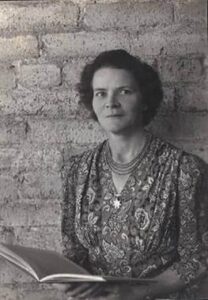
Two additional esoteric circles exist within Order of the Blue Rose: The Order of the Red Rose, and the Order of the White Rose. The Order of the Red Rose is also called the Lions of Zahyen and the Family of the Holy Grail Family. It was founded by Joseph of Arimathea, upon the instructions of Jesus to protect Mary after his death. The Lions of Zahyen is the religion’s “army of peace and love”; they do not use conventional weapons, although they do study martial arts. The Order of the White Rose is also called the Nasarean Order of Wizards. This order is also the upper division within the Lion of Zahyen. They represent the bridge between the Hidden and Revealed Arms of the Nasarean Religion of the Essene way.

ISSUES/CHALLENGES

The Essene Church of Christ emphatically rejects mainstream Christianity as a Pauline corruption of the true religion Jesus taught. In their reading of Paul, he rejected vegetarianism, the divine feminine, women’s rights, and accepted slavery (Kreps:159).

The church is also careful to distance itself from other modern Essene movements. On one hand, they are conscientious of the fact that most people find their own movement absurd. The introduction to the Holy Megillah states, “Our silence [on the provenance of their texts] will cause some to mock. However, the Holy Spirit has informed us that She will Herself reveal the authenticity of this manuscript to each soul whom has eyes to see and ears to hear. And they who mock this Bible have neither.” [Megillah: i]. On the other hand, the church is careful to distance itself from other Essene groups, whom they consider deeply misguided. The Book of Doctrines acknowledges other Essene movements exist, and cautions that “some of these individuals and groups are nice folk attempting to do good work. On the other hand, some are actually crazy and teach very wrong things in the name of the ‘Essenes.’” [Book of Doctrines:7]

Although it maintains a website, the church is generally hostile to technology. The church prohibits the on-line publication of the Holy Megillah because they believe that in the end times, the computer and internet will be used as a form of mind control and they do not want their scriptures corrupted [Megillah: ii]. Portions of their Bible make predictions about technological advances that signal demonic forces at work: the internet, computers, IVF, and other scientific advances are the antithesis of Essene natural living. [To respect the group’s wishes, the citation of their scripture here is omitted.]

IMAGES
Image #1: Brother Day, High Priest of the Essene Church of Christ.
Image #2: Mary Magdalene.
Image #3: Cover of Holy Megillah.
Image #4: Essene Baptism.
Image #5: Cover of Introduction to the Essene Church and the Order of the Blue Rose.

REFERENCES**

** Unless otherwise noted, the material in this profile is drawn from the Essene Church of Christ Website (www.essene.org) and Brother Day’s personal testimony as recorded in the documentary The Essene Church of Christ and the Order of the Blue Rose, available on YouTube.

Baigent, Michael, Richard Leigh, and Henry Lincoln. 1982. The Holy Blood and the Holy Grail. London: Jonathan Cape.

Day, Brother [Nazariah]. 1998. The Book of Doctrines of the Essene Church of Christ. Elmira, Oregon: Essene Church of Christ.

Day, Brother [Nazariah]. n.d. Introduction to the Essene Church of Christ and the Order of the Blue Rose. Elmira, Oregon: Essene Church of Christ.

Essene Church of Christ. Holy Megillah: The Nasarean Bible of the Essene Way. Elmira, Oregon: Essene Church of Christ.

Essene Church of Christ. n.d. The Forty-Nine Petals of the Blue Rose: The Primary Study Course of the Order of the Blue Rose with an Introduction to the Mystery School known as Essene Mountain of Peace. Elmira, Oregon: Essene Church of Christ.

Essene website. n.d. Accessed from www.essene.org on 19 March 2020.

Goranson, Stephen. 1984. “Essenes: Etymology from ‘sh,” RevQ 11:483-98.

Kreps, Anne. 2018. “Reading History with the Essenes of Elmira.” New Antiquities: Transformations of Antiquity in the New Age and Beyond, edited by Dylan Burns and Almut Barbara Ranger, 149-174. Equinox, Sheffield. Reprinted in the International Journal for the Study of New Religions 9(1): 5-31.

Szekely, Edmone B. 1977. The Discovery of the Essene Gospel of Peace. International Biogenic Society.

Szekely, Edmone B. 1976. The Gospel of the Essenes: The Unknown Book of the Essenes, Lost Scrolls of the Essene Brotherhood. Essex, England: C.W. Daniel Co. Ltd.

Publication Date:
28 June 2021


Share

Judith Tyberg

JUDITH TYBERG TIMELINE

1902 (May 16):  Tyberg was born at Point Loma, California.

1920:  Tyberg began to study for a bachelor’s degree at Theosophical University, Point Loma, California.

1921:  Tyberg officially joined the Theosophical Society headquartered at Point Loma, California.

1922–1934:  Tyberg taught lower grades at the Raja Yoga School, Point Loma, California.

1929:  Tyberg received a bachelor’s degree from Theosophical University.

1929–1943:  Tyberg studied Sanskrit and Hindu literature with Gottfried de Purucker, a leader of the Theosophical Society at Point Loma.

1932:  Tyberg received a Bachelor of Theosophy degree from Theosophical University.

1932–1935:  Tyberg served as assistant principal, Raja Yoga School at Point Loma.

1934–1940:  Tyberg taught high school at Raja Yoga School.

1934:  Tyberg received a Master of Theosophy degree from Theosophical University.

1935:  Tyberg received a Master’s degree from Theosophical University.

1935–1945: Tyberg served as Dean of Studies at Theosophical University.

1935–1936:  Tyberg toured several European countries to boost Theosophical groups and their work, and she taught Sanskrit to those who were interested.

1937–1946:  Tyberg contributed articles and book reviews to The Theosophical Forum, the monthly journal of ideas published by the Point Loma Theosophical community.

1940:  Tyberg became Head of the Sanskrit and Oriental Division of the Theosophical University.

1940:  Tyberg became member of the American Oriental Society.

1940:  Tyberg published the first edition of Sanskrit Keys to the Wisdom Religion.

1944:  Tyberg received a doctorate degree from Theosophical University.

1946:  Tyberg resigned as Trustee of Theosophical University and left the Theosophical Society (now located in Covina, California) over a leadership dispute.

1946–1947:  Tyberg lived independently of any organization in Los Angeles, California. She supported herself through book sales, speaking to groups, and teaching.

1947:  Tyberg traveled to India to study at Banaras Hindu University.

1947 (August 15):  Tyberg was present for the celebration of India’s Independence.

1947:  Tyberg had her first darshan with Sri Aurobindo and Mirra Alfassa (the Mother) at their ashram in Pondicherry, India.

1949:  Tyberg received a Master’s degree in Hindu Religion and Philosophy from Banaras Hindu University.

1950:  Tyberg returned to the United States and gave public lectures.

1951:  Tyberg became Professor of Indian Religion and Philosophy at the American Academy of Asian Studies, San Francisco, California.

1951:  Tyberg published First Lessons in Sanskrit Grammar and Reading.

1953:  Tyberg established the East-West Cultural Center in Los Angeles.

1953–1973:  Tyberg founded the East-West Cultural Center School for gifted children, which operated for twenty years.

1970:  Tyberg published The Language of the Gods: Sanskrit Keys to India’s Wisdom.

1973–1976:  Tyberg taught courses on Sanskrit, Indian religion, philosophy and literature, and Sri Aurobindo’s thought, at the College (later University) of Oriental Studies in Los Angeles; she also served as Dean of Undergraduate School, College of Oriental Studies.

1976:  Tyberg served as field faculty member for the Los Angeles branch of Goddard Graduate Program, Goddard College, Plainfield, Vermont.

1977:  The East-West Cultural Center became debt-free. The Center subsequently became the Sri Aurobindo Center of Los Angeles and the East-West Cultural Center

1980 (October 3):  Tyberg died in Los Angeles, California.

BIOGRAPHY

Judith Tyberg [Image at right] was a white American born at the Theosophical community of Point Loma (also called Lomaland), in San Diego, California. Her parents were Marjorie M. Somerville Tyberg from Ontario, Canada and Oluf Tyberg from Denmark. Not only were children raised at Point Loma, they were also educated there. Many Theosophists who came to live there were highly qualified to teach a variety of subjects at all grade levels, including mathematics, history, literature, and music. The only major area in the curriculum that Point Loma schools could not adequately staff were the sciences. Tyberg would have taken classes in all of these subjects, with her own mother Marjorie Tyberg being one of the most active of the teachers. Theosophy was not taught to the children directly.[Image at right] Instead, they absorbed it in day-to-day conversations, community practices like meditation in the morning and before bedtime at night, and observing nature closely. At the time, the Point Loma peninsula was sparsely settled, and Point Loma pupils had some freedom in roaming about the area, as well as taking group trips into the interior of San Diego County. Many ex-students of Point Loma schools, when interviewed by this writer, looked back upon their educational years with fondness. Others had negative memories of Point Loma, because individual instructors and caregivers among the adults were not closely supervised and were responsible for mistreatment and abuse of children and adolescents, especially those who objected to community demands for conformity in thought and behavior. Tyberg did not seem to be among the disaffected, however. Quite the opposite: she embraced the ethos of Point Loma. As a young adult, she in turn taught younger children, and earned several degrees from the Theosophical University that the Point Loma community created to provide post-high school education for their college-aged youth. The leader who succeeded Tingley in 1929 was Gottfried de Purucker (1874–1942), a self-taught polymath who could work with several ancient languages and read widely during his years at the community. As the leader of Point Loma, he gave hundreds of lectures about all facets of Theosophy, which were transcribed and published in many volumes. Among his strengths was a facility with South Asian studies, and Tyberg became one of his star pupils in learning Sanskrit, the language of ancient Hindu scriptures.
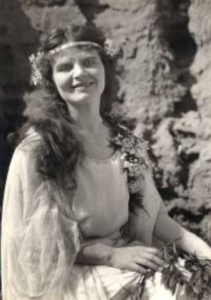
In the 1930s, [Image at right] when Tyberg was still a young woman, she journeyed to England, Wales, Germany, Sweden, and Holland to visit Theosophists. They saw Point Loma as the mothership of their movement. Many of them had lived at Point Loma. The purpose of Tyberg’s tour was to encourage these Theosophists, to lecture at their meetings, and to provide guidance on an individual basis.

During World War II, the Point Loma community relocated to a campus in Covina, California, in the Los Angeles area. When de Purucker died, a council took over leadership responsibilities. After the war, a Theosophist named Arthur Conger (1872–1951), a U.S. Army officer, was brought forward by some members of the community as the next leader, even though he had not resided at Point Loma. Others disagreed. Among them was Tyberg. An emotionally difficult period ensued, when lifelong members of the community contended with one another for the future of the movement by either supporting or rejecting Conger. Eventually the Conger advocates won, and Tyberg left the community, which had been home for her entire life.

From 1946 to 1947, Tyberg lived in the Los Angeles area, lecturing for fees on South Asian philosophy and literature, as well as Theosophy, to groups in peoples’ homes and various other locations. She also established a small bookstore in her residence. Had her life not made a radical turn toward India, it is likely she would have continued to live and work in Los Angeles and eventually find a steady source of income, probably through teaching. She had an earned Ph.D. in Sanskrit from Theosophical University. Sanskritists at mainstream universities would not have recognized this school as a legitimate educational institution of higher learning; nonetheless, Tyberg’s skills and breadth of knowledge in teaching Sanskrit were gradually becoming known among people in Southern California desirous of knowing more about India, Asia generally, and the languages of Asian religious texts.

Serendipitously, an opportunity presented itself for her to travel to India in 1947 and enroll at Banaras Hindu University in a Master’s degree program in Indian thought. It was still not common for American women to travel to Asia, particularly by themselves. Tyberg was a pioneer in this regard. Once in India, she made contact with a host of religious teachers, some from India, others from the United States or Europe. One of her philosophy instructors told her about Sri Aurobindo (1872–1950), a religious leader who lived in an ashram in Pondicherry (now Puducherry). Also living in the ashram was a European woman named Mirra Alfassa (1878–1973), whom devotees called the Mother. In the fall of 1947, Tyberg traveled from Benares (now Varanasi) to Pondicherry to have darshan (a spiritually-charged audience or encounter involving viewing the guru or deity figure and being seen by him or her) with these two spiritual figures. It transformed Tyberg’s life. She felt she had finally found her true spiritual home, and devoted the rest of her years to teaching the thought of Sri Aurobindo and the Mother.

After graduating from Banaras Hindu University, Tyberg returned to the United States. At first she taught at the American Academy of Asian Studies (AAAS) in San Francisco. At this time, there were few educational opportunities for Americans who wanted to pursue intensive study of Asian texts, philosophies, and practices. The AAAS attempted to rectify this. It included among its faculty Alan Watts (1915–1973), already a famous writer and speaker on Asian approaches to philosophical questions. But the school could not continue as it was (although a version of it exists today as the California Institute of Integral Studies), and Tyberg left. She went back to Los Angeles, where she had success in the past, and founded the East-West Cultural Center. Over the years the Center was located at several addresses. Today it is in a house in Culver City, California. Tyberg spent these years between the ages of fifty and seventy-eight (when she died) teaching gifted children, holding regular programs for the public about India and especially Sri Aurobindo’s thought, and providing all manner of spiritual celebrities from around the world a place to lecture and/or perform. The East-West Cultural Center became a node for a vast, international network of people who brought Asia to the West before the heyday of the 1960s. Tyberg also supported endeavors similar to her own. For example, the College of Oriental Studies (today called the University of Oriental Studies) tried to fill the gap that the AAAS had also tried to fill: providing advanced training in Asian languages and texts as well as fostering an appreciation for Asian contributions to world cultures.

As Tyberg aged, younger adults stepped in to help her run the Center. Her days were filled with teaching appointments (both groups and individuals), planning evening programming, and attending to the million worries that come with ownership of a house or building: maintaining the plumbing, seeing to electrical repairs, purchasing food as well as materials for building upkeep, and so on. When she died in 1980, her death certificate listed several medical problems that Tyberg had struggled with in her later years.

Tyberg did not try to build up a network of devotees who would then go out into the world to deliberately foster Sri Aurobindo’s teachings. Rather, this happened in an almost haphazard way, similar to the way that Point Loma Theosophists foresaw the spread of their own message. For Tyberg, coming to the insights of Sri Aurobindo was a deeply personal, individualized process. Those who were affected by this great Hindu teacher would then seek to realize his teachings in their own ways. In India, however, there was a more deliberate program of institution building based on the worldview of Sri Aurobindo and the Mother. This was the agrarian community of Auroville, which had great significance for followers around the world. It would provide the setting for a new breed of spiritual workers. Educational and agricultural experimentation went on there, as it still does today. Tyberg, like other devotees, supported Auroville, but did so by channeling individuals who would discover Sri Aurobindo first at the East-West Cultural Center, then later journey to Auroville. Among these were a handful of students at Chapman College (now Chapman University), who in the 1960s, like millions of other young adults, sought new ways to understand their place in the world by immersing themselves in Asian philosophies and spiritualities. They found their way to the East-West Cultural Center, then several of them later lived for various periods of time in Auroville.

Tyberg never sought public acclaim, which may help to explain why someone of her intellectual and spiritual caliber was quickly forgotten after she died. She had been a noted personality in Southern California, but aside from her modest Center she never established any institutions to carry on her work, and did not leave behind a corpus of texts outlining her worldview. Her greatest claim to publishing fame was the production in 1940 of Sanskrit Keys to the Wisdom Religion, a compilation of lessons for learning Sanskrit and getting a little dose of Theosophy mixed in. Many people who later became Sanskritists credited Tyberg with first enabling them to enter into study of the language through this book.

TEACHINGS/DOCTRINES

Judith Tyberg’s teachings and beliefs were grounded in both Theosophy and in the thought of Sri Aurobindo and the Mother.

Point Loma was started by Katherine Tingley (1847–1929), who was seen by followers as the Leader of the outward aspects of the community while Mahatmas (see below) were the spiritual guides of all members’ inward aspirations. Tingley persuaded middle- and upper-class Theosophists from the United States and Europe to relocate to Point Loma. They believed that Point Loma was something new in human history, a community that would train the coming generation of children [Image at right] to take their rightful place as spiritual leaders in the world. The childrearing practices that Tyberg would undoubtedly have been exposed to included self-discipline, personal and constant inspection of one’s motives, and living life according to higher purposes that had cosmic dimensions (Ashcraft 2002). Much of the child-rearing conformed to conventional ideas about how to raise children. Similar practices and motivations could be found in the homes of many middle-class families across the United States.

The Theosophical Society was founded in 1875 with Three Objectives:

To form a nucleus of the universal brotherhood of humanity, without distinction of race, creed, sex, caste or color.
To encourage the comparative study of religion, philosophy, and science.
To investigate unexplained laws of nature and the powers latent in humanity (Theosophical Society in America [2021]).

These Three Objects served as the basis for all later developments in Theosophical worldviews. As the movement expanded from its initially small membership and diversified into several related movements, the three aspirations quoted here continued to sustain a certain unity across various organizations. Theosophists, no matter their organizational affiliation, also acknowledged the centrality of the writings of Helena P. Blavatsky (1831–1891). Blavatsky published a considerable body of work, but her most popular and highly regarded books were Isis Unveiled (1877) and The Secret Doctrine (1888). From all of these sources, then, the following summation of Theosophical ideas can be made.

All of reality is living and interconnected. Theosophists believe that even the tiniest cells in molecular structures are alive in some fundamental way.

All is evolving. Neither spirit nor matter remain the same, but evolve according to processes as eternal as the cosmos itself. Theosophists, taking their cue from Blavatsky, talked in terms of cycles: vast periods of time during which countless planets, stars, and species arise and fall, from the spiritual to the material, then back again. The key to appreciating this cyclical view lies in the direction of evolution: it is always toward greater coherence, vitality, compassion, and spirituality.

Humanity plays a key role in our own species’ progress. Human beings have existed in one form or another over countless generations, progressing always upward toward greater fulfillment.

Humanity has helpers, called Masters or Mahatmas. These entities have developed long past most of humanity’s present evolutionary state, defying the constrictions of time and space and taking on what appears as supernatural status. But in reality they have simply evolved according to timeless principles of spiritual advancement.

Humanity can also rely on the many religious and spiritual traditions in human history to point toward Theosophical truths. Although these truths are embedded in myths, legends, scriptures, and communities that outwardly seem to differ radically from one another, in reality, argue Theosophists, all religions and spiritualities strive toward the same eternal goal (Blavatsky 1877, 1880).

Sri Aurobindo wrote extensively when he moved to Pondicherry from Bengal in 1910 to live a semi-secluded lifestyle, supported by devotees who lived with him. He had received a western education and was also conversant in Indian texts. Thus his literary output in English was accessible to both western and Indian readers. The Frenchwoman Mirra Alfassa, or the Mother, joined Aurobindo later and became his partner in spiritual advancement. Many of her writings were based on remarks made to various individuals and answers given to questions posed by devotees. From these sources, we can posit the following ideas as being of central importance to an Aurobindonian worldview:

As with Theosophy, so here, the first basic belief is that all things are alive and interconnected. In the ancient Hindu texts called the Upanishads, this is called Brahman, the Absolute.

The world is alive with the Absolute, and upward bound in evolution toward greater consciousness.

Existing between the Absolute and humanity is the Supermind. It is not alien to human beings. Indeed, Sri Aurobindo argued that it appears in ancient Indian texts called the Vedas. It functions as a layer of truth and mind that enables human beings to evolve into higher species. Aurobindo argued that Supermind descends onto our earthly plane while we ascend to higher realms of spiritual awareness.

The individual devotee’s purpose is to realize the Supermind within themselves through acts of devotion (such as meditation) and good works.

More important than any other action they may take, the devotee surrenders to Sri Aurobindo and the Mother, perceived as divine and absolute in their own right.

The Mother references Shakti or the Great Goddess in various Hindu systems. Mirra Alfassa as the Mother embodies this divine power. She in effect becomes the Absolute. (Sri Aurobindo 1914)

One question that anyone who knows about Tyberg might legitimately raise is: how did she reconcile these two great systems in her life, Theosophy as the metaphysical basis for the first half of her life, Sri Aurobindo’s thought for the second half? Tyberg herself referred to this matter from time to time. She perceived Sri Aurobindo’s views as the fulfillment or completion of Theosophy. As noted above, both systems are non-dual and decidedly atheistic (according to a western conception of God). All things participate in Oneness. Both systems also posit a relationship between the world as it is and the world as it will be. Both use the metaphor of evolution to describe how this transformation from the now to the future will occur. Both also hallow advanced spiritual entities, the Theosophists with their Mahatmas or Masters, devotees of Sri Aurobindo with Sri Aurobindo himself as well as the Mother.

These resemblances are understandable. Theosophy borrows heavily from South Asian, especially Hindu, scriptures and teachings. So, too, did Sri Aurobindo rely on traditional Hindu texts like the Upanishads and Vedas. But there are divergences as well. Theosophy does not teach anything quite like the Supermind as Aurobindo described it. Although both systems see the cosmos as layered with spirit and matter, in Theosophy the upgrading of this world happens according to timeless cyclic processes, while Sri Aurobindo understood Supermind to be a projection of sorts from the Absolute onto this world.

RITUALS/PRACTICES

The rituals and practices observed by Judith Tyberg fall into two distinct phases: the Theosophical and Aurobindonian.

The Theosophical Society, in crafting rituals, early on borrowed from Freemasonry, but by the time Tyberg was old enough to comprehend rituals at Point Loma it is questionable how much Masonic influence remained. What others of her generation reported were rituals designed to sustain inner piety and discipline: brief meditations practiced early in the morning and before retiring for the night, observing moments of silence, and integrating one’s inner convictions into daily routines. Point Loma Theosophists gathered for programs of cultural and spiritual enrichment: musical performances of the works of great western composers, and productions of ancient Greek as well as Shakespearean plays. They also observed the birthdays of important Theosophical leaders like Blavatsky and Tingley. And the community had programs marking holidays common in American society, such as the Fourth of July, Armistice Day, Easter, and Christmas (Ashcraft 2002).

At the East-West Cultural Center, [Image at right] Tyberg supervised a wide variety of programming. Public readings of Sri Aurobindo and the Mother would be followed by periods of meditation. Asian spiritual figures other than Sri Aurobindo and the Mother would make guest appearances at the Center, too.  Yogi Bhajan (Harbhajan Singh Khalsa, 1929–2004) of Healthy, Happy, Holy Organization (3HO) fame gave some lectures and Chögyam Trungpa Rinpoche (1939–1987) of Shambhala Buddhism. And Tyberg fostered interest in Hindu chanting, dance, and music. Performers traveling through or resident in the Los Angeles area found receptive audiences at the Center. These included dancers Indira Devi and Dilip Kumar Roy, and tabla master Zakhir Hussein (names found in interviews conducted by the author). Finally, important dates in the history of the Sri Aurobindo movement, such as the birthdays of Sri Aurobindo and the Mother, were consistently observed each year (news items in Collaboration, a magazine for devotees of Sri Aurobindo and the Mother.

Much of Tyberg’s spirituality derived from reading and interpreting Hindu scriptures, and she fostered that spirituality among others, children as well as adults, through instruction in Sanskrit. She would teach people one-on-one, or in groups if there was interest. Using her own publications, she would guide the student through the basics of Sanskrit, and for those who wanted more in-depth study, she would tutor them as well.

It should be noted, [Image 7 at right] based on the above description, that ritual in Tyberg’s life was quietistic. That is, rather than ecstatic bodily motions related to possession, or even extensive liturgical observance requiring audience participation in the form of congregational singing and recitation, for Tyberg ritual performance was tied to meditative exercises, listening to texts being read aloud, discussion of ideas in those texts, and perhaps some chanting (see for example, “Jyotipriya – A Tribute” [2021]). This style of ritual, not unheard of in other contexts, pointed toward the spiritual priorities in Tyberg’s life: integration of one’s inner life, pulling together disparate parts of the self, and reflection on one’s motivations and emotions.

LEADERSHIP

The classical understanding of religious leadership is taken from the writings of German sociologist Max Weber (1864–1920), who argued for three kinds of authority: traditional, legal-rational, and charismatic. Traditional leaders rely upon long-term precedent. Their followers assume that traditional leaders have always ruled as they rule now. Legal authority is associated with the modern era, and in particular, bureaucracy. Legally defined leaders use reason to discern the needs of those they lead, then defer to bureaucracies to meet those needs. A third model of leadership, one that religious studies scholars have cited on numerous occasions, is charismatic authority. A charismatic leader has personal magnetism, and can inspire people to work together, or fight enemies together. Charismatic authority is socially constructed by followers who believe that the leader has received a “gift” of empowerment or authority from a higher source. In the study of new religious movements, charismatic leaders often are depicted as abusing and manipulating their followers. The leader is unethical, the followers easily misled (Gerth and Mills 1946:54).

It is true that charisma can be used for unpalatable ends by religious leaders, in both new religions and more established ones. Tyberg, however, does not fall into that category. She had personal charisma, but there is no indication in the sources available that she ever used her charisma to bolster her ego or compel people to act contrary to their conscience. Her charisma was manifested in her role as a teacher, which she believed herself to be: first, last, and always. For many years, beginning at Point Loma and later at the East-West Cultural Center, she led pupils in their lessons on many subjects, from the commonplace to the spiritual. In addition, her adult students came in all ages, and from all walks of life. She never seemed to reject anyone who had an earnest desire for greater spiritual insight.

The casual observer of Tyberg might conclude that she was too good to be true. She is like those whom American philosopher William James (1842–1910) called the healthy-minded in The Varieties of Religious Experience (1928). Such persons are happy and content with their spiritual state. They naturally put aside their own needs and wants for those of others. Suffering due to sin and chance alike is not within the register of their emotions. In all ways they seem naturally religious and are deeply satisfied with that state. They are contrasted by James with the “sick soul.” This is someone who grapples with sin and suffering in titanic struggles of inward despair. They are often melancholy or depressed. They cannot see the natural goodness all around them, and are jaded and wounded by their struggles (James 1928:78 ff.).

Tyberg was not a sick soul, to use James’s words. She was far more like the healthy-minded. In numerous interviews conducted with those who had first-hand knowledge of Tyberg, the overwhelming opinion was that Tyberg had the ability, coming from deep within her spiritual core, to focus her gaze upon the eternal. When the worries and cares of life became burdensome, she found ways to turn negatives into positives, as when she left the Point Loma Theosophical Society. She carried on her work in Sanskrit and South Asian philosophy by launching a career as an independent teacher, speaking in the homes of private citizens who invited her, and running a bookstore out of the house she was living in that specialized in titles about Hinduism, India, and South Asia generally.

ISSUES/CHALLENGES

Tyberg’s life was remarkably free of controversies as far as we know. Most people who came in contact with her liked and trusted her, especially if they were pupils in her classroom or spiritual nomads seeking greater enlightenment. Two incidents stand out, when Tyberg faced difficult ethical choices of a personal nature. Both of them are related to the Theosophical portion of her life.

The first occurred while she was a young woman still living at Point Loma. Tyberg was one of several women who acted as servers when Point Loma’s leader, Tingley, hosted individuals of some prominence at her residence for dinner. Tyberg relayed to her parents what was said at these dinners, and when Tingley heard this, she banned Tyberg from continuing as a server (Ashcraft 2002:85–87). Apparently Tingley thought that the conversations at these dinner parties were of a sensitive nature, and might impact either Tingley’s status and well-being, or the health of the Point Loma community, or both. But Tingley’s action had a severe impact on Tyberg. The latter had spent her life striving to be the model child and adult that her parents and other Point Loma residents wanted her to be. They expected their youth to exhibit Victorian values: sobriety, discretion, and courtesy. This may have been Tyberg’s first wrestling with cognitive dissonance. The woman she idolized, Katherine Tingley, had rejected Tyberg for behavior unbecoming a young Point Loma resident.

Eventually Tyberg was permitted to resume her role as a server. Only a few short years later, Tingley died in 1929 from injuries sustained in an automobile accident, and the famous dinner parties became things of the past.

The second controversy occurred some years later. When Point Loma leader Gottfried de Purucker died in 1942, a council of peers, mostly individuals who had been in his inner circle, directed the community until such time as a new leader would be revealed by the Mahatmas or Masters. Some in the community believed that the new leader was Colonel Arthur Conger, a military man who had not lived at Point Loma for very long. Technically, the issue that divided Theosophists was that Conger was made Outer Head of the Esoteric Section (ES). This meant that he was the earthly leader of the organization that was the heart of the Theosophical movement, an organization whose members knew secret information and insights not shared by most Theosophists. The Inner Heads were the Mahatmas or Masters, who were believed to guide Theosophists in making important decisions. Tyberg was among a group of ES members who did not think Conger was the legitimate Outer Head. In 1946, she left Covina. She was deeply disappointed and hurt that some of the people she had known all her life opposed her. She was also scandalized when, after she relocated to Los Angeles, she learned that she was accused of spreading false rumors about Conger. She wrote to him asking him to clear her name. Because the accusation included sexual innuendo, Tyberg was especially incensed that she would be associated with something so tawdry. But she rose above it, as she wrote to her mother, “The whole affair is like a shadow I’ve stepped out of into a light” (Judith Tyberg to Marjorie Tyberg, 10 Feb. 1947, Archive, East-West Cultural Center).

Did Tyberg’s experiences with factional strife at Covina sour her in some way? It is hard to know. The documentary evidence available does not show that. Perhaps, however, being so Victorian in her personal life, she did not share this dark period with just anyone, and if she did share it, that person must have been a trusted friend who would keep Tyberg’s thoughts in confidence.

If there is one overriding priority that Tyberg consistently fostered throughout her life, it was her desire to introduce the wisdom of India, and Asia in general, to westerners through exposure to Asian religious texts and their languages. Today we would call her approach “Orientalist,” meaning the western interpreter of an Asian text brings their own biases to that text. Orientalists tended to downplay Asian interpretations. One of the more famous instances of this tendency was the western presentation of the Buddha as an intellectual who taught a universal ethic of compassion and self-denial. This westernized Buddha was stripped of ritual importance, seeming to exist in suspended animation above the fray of actual Buddhist communities. In Tyberg’s case, her Orientalist penchant inherited from Blavatsky was to see Hindu scriptures as the basis for Theosophy. The title of the book that gave her notoriety as a Sanskritist, Sanskrit Keys to the Wisdom Religion, says it all. Sanskrit is not valuable in and of itself. Nor is it useful in shedding light on ancient Indian practice and thought. It is important, according to Tyberg, because it reveals the “Wisdom Religion,” that is, the timeless teachings of Theosophy. She even says in the Preface to this book that her hope is that when the reader learns Sanskrit terms, they will then progress onward to the Theosophical text of greatest importance, Blavatsky’s The Secret Doctrine (Tyberg 1940:vii).

SIGNIFICANCE TO THE STUDY OF WOMEN IN RELIGIONS

Judith Tyberg conformed to a pattern, which emerged in the later nineteenth century and early twentieth century, of western women who embraced Asian spiritualities and cultures, and became public figures noted for that embrace of India. They included the second president of the parent Theosophical Society, author, and speaker Annie Besant (1847–1933), Margaret Elizabeth Noble/Sister Nivedita (1867–1911) of the Ramakrishna Movement, and the Mother herself of the Sri Aurobindo movement. These women pursued careers in India, whereas Tyberg went to India for inspiration and education but lived in the United States. But in important ways, Tyberg shared certain traits with these women. Like them, she was a westerner who took to South Asian spiritual movements as if coming to her true home. Like them, too, she was a public participant in such movements, through published writings, speeches, holding instructional sessions, and so on. Third, she was like them in rejecting fundamental ideas in the monotheistic traditions, such as the creator God of the universe, or the need to reconcile the reality of suffering with that God’s omnipotence and omniscience (see Jayawardena 1955, especially Parts III and IV).

Tyberg was a pioneer [Image at right] in the study of Sanskrit and ancient Hindu scriptures such as the Vedas. Up to that time, these areas had been almost exclusively male domains in western scholarship. In India, tradition held that only high-caste men could study Sanskrit texts. However, this did not stop de Purucker from training Tyberg, so that eventually she became a well-known and professionally recognized Sanskritist. Tyberg herself did not comment on the fact that she was a woman in a male-dominated field. For one thing, most women at that time were, like her, pioneers in professions previously closed to them. For another, it is very possible that, given the understanding of gender with which she was raised, Tyberg did not find gender categories to be important. In the Point Loma Theosophical tradition, which claimed to be continuous with the teachings of Helena P. Blavatsky, gender was somewhat malleable. Souls reincarnated as sometimes male and sometimes female. The gender binaries had essential traits, however, meaning that a soul incarnated in a given lifetime as a woman, for instance, would learn about the grand meaning of all things as a woman, with a woman’s supposedly innate sensibilities (Ashcraft 2002:116).

Although Judith Tyberg resembled other western women spiritual leaders of her time, she made a marked contribution to her era. The counterculture revolution of the 1960s and 1970s, which so transformed the landscape of western cultures, relied heavily on appropriation of Asian texts, ideas, and rituals. The revolution integrated disparate elements to form a major alternative worldview to that which had been generally accepted in the west. Before the hippies, before the rise of recreational drug use, before all these hallmarks of that moment in western history, Tyberg was steadily working away at her Los Angeles Center, making others aware of the rich heritage that South Asia had bequeathed to the world. Once the cultural revolution was in full swing, her East-West Center was a landmark on that revolution’s map. While her personal ethic did not approve of the excesses of the counterculture, Judith Tyberg stayed at her post until her death, providing instruction and inspiration to anyone who cared to listen.

IMAGES

Image # 1: Judith Tyberg, founder of East-West Cultural Center.
Image # 2: Children at Raja Yoga School in Lomaland, 1911. Photo from the Library of Congress, courtesy Wikimedia.
Image # 3: Judith Tyberg teaching sanskrit at the Theosophical University, 1943.
Image # 4: Judith Tyberg, age 20, in theatrical production at Lomaland, 1922.
Image # 5: Fourth location of the East-West Cultural Center, Los Angeles, 1963.
Image # 6: Anie Nunnally and Jyotipriya (Judith Tyberg), 1964. Nunnally is currently President of the East-West Cultural Center.
Image # 7: Judith Tyberg in her later years.

REFERENCES

Ashcraft, W. Michael. 2002. The Dawn of the New Cycle: Point Loma Theosophists and American Culture. Knoxville: University of Tennessee Press.

Aurobindo, Sri. 1990. The Life Divine. Twin Lakes, WI: Lotus Press. Originally published serially in Arya beginning in 1914.

Blavatsky, Helena P. 1988. Isis Unveiled: A Master-Key to the Mysteries of Ancient and Modern Science and Theology. 2 Volumes. Pasadena, CA: Theosophical University Press. [Originally published 1877].

Blavatsky, Helena P. 1988. The Secret Doctrine: The Synthesis of Science, Religion, and Philosophy. 2 volumes. Pasadena, CA: Theosophical University Press. [Originally published 1888].

Gerth, H. H. and C. Wright Mills, eds. 1946. From Max Weber: Essays in Sociology. New York: Oxford University Press.

James, William. 1928 The Varieties of Religious Experience. New York: Longmans, Green and Co.

Jayawardena, Kumari. 1995. The White Woman’s Other Burden: Western Women and South Asia during British Rule. London: Routledge.

“Jyotipriya – A Tribute.” 2021. Sri Aurobindo Center of Los Angeles and the East-West Cultural Center. Accessed from https://sriaurobindocenterla.wordpress.com/jyoti/ on 16 February 2021.

Theosophical Society in America. 2021. “Three Objects.” Accessed from https://www.theosophical.org/about/about-the-society on 16 February 2021.

Tyberg, Judith M. 1940. Sanskrit Keys to the Wisdom-Religion: An Exposition of the Philosophical and Religious Teachings Imbodied in the Sanskrit Terms Used in Theosophical and Occult Literature. Point Loma, CA: Theosophical University Press.

Tyberg, Judith M. 1947. Letter to Marjorie Tyberg. 10 February. Archive. Los Angeles: East-West Cultural Center.16

SUPPLEMENTARY RESOURCES

Aurobindo, Sri. 1995. The Secret of the Veda. Pondicherry, India: Sri Aurobindo Ashram Trust. Originally published serially in Arya beginning in 1914.

Ellwood, Robert. 2006. “The Theosophical Society.” In Introduction to New and Alternative Religions in America. Vol. 3, Metaphysical, New Age, and Neopagan Movements. Edited by Eugene V. Gallagher and W. Michael Ashcraft, 48–66. Westport, CT: Greenwood Press, 2006.

Greenwalt, Emmett A. 1978. California Utopia: Point Loma: 1897–1942. rev. ed. San Diego: Point Loma Publications. Originally published 1955.

Harvey, Andrew. 1995. “Aurobindo and the Transformation of the Mother.” Chapter Four in The Return of the Mother, 115–54. Berkeley, CA: Frog Ltd.

Mandakini (Madeline Shaw). 1981. “Jyotipriya (Dr. Judith M. Tyberg) May 16, 1902–October 3, 1980.” Mother India (February): 92–97.

Mandakini (Madeline Shaw). 1981. “Jyotipriya (Dr. Judith M. Tyberg) May 16, 1902–October 3, 1980 II.” Mother India (March): 157–62.

Mandakini (Madeline Shaw). 1981. “Jyotipriya (Dr. Judith M. Tyberg) May 16, 1902–October 3, 1980 III.” Mother India (1981): 210–19.

Tyberg, Judith M. 1941. First Lessons in Sanskrit Grammar and Reading. Point Loma, CA: Theosophical University Press.

Tyberg, Judith M. 1970. The Language of the Gods: Sanskrit Keys to India’s Wisdom. Los Angeles: East-West Cultural Center.

Publication Date:
17 June 2021


Share

Bernardino del Boca


BERNARDINO DEL BOCA TIMELINE

1919:  Bernardino del Boca was born in Crodo, Italy.

1921:  Del Boca moved to Novara with his family. There, Del Boca received his first education. The partner of his grandfather Bernardo introduced Del Boca to Theosophy.

1932:  Del Boca attended the international boarding school, Institut Le Rosey, in Lausanne (Switzerland).

1935 (May):  Del Boca enrolled into the Brera Art High School (Liceo artistico di Brera) in Milan.

1937 (April 29):  Del Boca joined the Theosophical Society.

1939:  Del Boca held his first solo exhibition. He graduated from Brera Art High School. He founded an underground Theosophical group, “Arundale,” in Novara.

1941:  Del Boca held an exhibition in Domodossola, and was part of the Thirteenth Exposition of Figurative Arts of the Fascist Unions in Turin. He performed his military service first in Verona, then in Florence.

1945:  Del Boca revived the Theosophical group “Arundale.”

1946:  Del Boca left Italy for Siam (present-day Thailand).

1947:  Del Boca worked as an architect and interior designer in Singapore. In October, he received his “second Buddhist initiation” on a mysterious island of the Linga archipelago (Nawa Sangga).

1948 (September 26):  Del Boca held a shared exhibition with artist and naval war hero, Commander Robin A. Kilroy, at Queen Victoria Memorial in Penang, Malesia. He published his first novel, Nightly Face.

1949:  Del Boca published Nawa Sangga. He left Singapore for Italy.

1951:  Del Boca took part in a collective exhibition in the Broletto di Novara, Italy.

1952:  Del Boca taught Art at the Ferrandi high school in Novara.

1959:  Del Boca took part in an economic and trade mission to West Africa as representative of the National Institute for Geographic Research and Cartographic Studies (Istituto Nazionale per le ricerche geografiche e gli studi cartografici).

1961:  Del Boca published an anthropology manual for university students, Storia dell’Antropologia.

1964:  Del Boca contributed to the encyclopedia Il Museo dell’Uomo.

1970:  Together with Theosophist and publisher Edoardo Bresci, Del Boca founded the journal L’Età dell’Acquario – Rivista sperimentale del Nuovo Piano di Coscienza.

1971:  Del Boca published La dimensione umana.

1975:  Del Boca published Guida internazionale dell’Età dell’Acquario.

1976:  Del Boca published Singapore-Milano-Kano.

1977:  Del Boca published La quarta dimensione.

1978:  Del Boca retired from teaching at secondary schools. and moved in with his sister Aminta to Alice Castello, in Piedmont.

1980:  Del Boca published La casa nel tramonto.

1981:  Del Boca published La dimensione della conoscenza. He started a fundraising campaign for creating a series of Aquarian communities he called “Villaggi Verdi” (Green Villages). He published La dimensione della conoscenza.

1985:  Del Boca published Iniziazione alle strade alte.

1986:  Del Boca moved in to the first (and only) Villagio Verde ever to be established, founded in San Germano di Cavallirio. He published Il segreto.

1988:  Del Boca organized a series of collective trips (which would also involve the residents of Villaggio Verde). Among their destinations: Burma, Thailand, Laos, Vietnam, India, Nepal, Tibet, Mongolia, China, and Bhutan. He published Il servizio.

1989:  Del Boca published Birmania un paese da amare.

1990:  De Boca continued to offer conferences and talks at the Villaggio Verde, and he edited and contributed to L’Età dell’Acquario.

2001 (December 9):  Del Boca died at the hospital of Borgomanero, Novara (Italy).

BIOGRAPHY

The artistic production of Bernardino del Boca was, for the most part, neglected until the 1960s, when the “visionary feature” of his art (Mandel 1967) was analyzed for the first time. Only through a series of recent publications, conferences, and posthumous exhibitions (Tappa 2011; Fondazione Bernardino del Boca 2015, 2017) have del Boca’s artworks been thoroughly studied and promoted. One of the reasons for his being scarcely known was connected to the fact that del Boca held only a few exhibitions during his lifetime.

Besides his polyhedric personality (he was a painter, a Theosophist, an anthropology scholar, an advocate for sexual liberation), del Boca was known for founding and constantly collaborating with the publisher L’età dell’acquario (“The Age of Aquarius”). A journal with the same name (i.e., L’età dell’acquario) was founded and directed by del Boca, who also illustrated several of its issues. Although as an artist del Boca was mainly known to the general public as a book illustrator, his artwork had a crucial impact on both Theosophical and New Age milieus in Italy in the 1970s.

Bernardino del Boca was born on August 9, 1919 in Crodo (Piedmont) to Giacomo del Boca and Rosa Silvestri. His family owned mountain springs (the Fonte Rossa springs) and spas in Crodo. Based on the noble lineage of his family, del Boca claimed the titles “Count of Villaregia” and “Count of Tegerone” (Del Boca 1986; Giudici 2017). The adoption of aristocratic titles had two implications within his production: on the one hand, he signed some of his artworks and novels with the pseudonym “Bernardino di Tegerone,” on the other hand the theme of “seeking the origins” would constantly characterize his art.

According to a 1941’s newspaper review of one of his exhibitions, del Boca inherited his artistic abilities from one of his ancestors, who happened to have been an amateur painter at the court of King Victor Amadeus II of Sardinia (1666–1732) (“Ida” 1941). Therefore, del Boca’s family origins were intertwined with his artistic dimension. Further proof of this is given by an anecdote of his life. His grandfather Bernardo del Boca (1838–1916: his nephew was named after him), after the death of his wife, entered into a relationship with a Hungarian princess of the noble family of Esterházy (whose name I could not find). The princess introduced (Bernardino) del Boca to Spiritualism and Theosophy, in addition to bringing him with her on several trips around Europe (del Boca 1986). While in Nice with the princess, del Boca made the acquaintance of the second wife of Khedive Abbas Helmi II of Egypt, Princess Djavidan Hanem (née May Torok von Szendro, 1877–1968), who suggested that he keep a journal. This event played a crucial role in the life of del Boca, since writing his journal represented his introduction to the “universal aspects of human culture” (del Boca 1986). More specifically, the theme of “seeking his origins” involved a genealogical dimension as well as a spiritual one. This was a crucial component in his future artistic production.

Despite his noble lineage, del Boca and his family had to move to Novara due to financial problems in 1921. In order to cope with the financial needs of the family, del Boca’s mother, Rosa, took over the restaurant and coffee shop of the local movie theatre, called Faraggiana. In Novara, del Boca also received his first education: he had excellent skills in drawing, but he did not excel in other subjects (Giudici 2017). However, del Boca’s educational path went beyond the ordinary when, in 1932, he had the opportunity to study at a renowned international boarding school, the Institut Le Rosey, in Lausanne (Switzerland). What led del Boca to Switzerland was an unexpected event: a young American he knew. connected with the aristocrat Kent family, fell from a horse during a riding session. Given the fact that the institute fees for the young American had already been paid, while he was unable to move to Switzerland, del Boca attended that year at the Lerosey in his stead (Giudici 2017). The acquaintances del Boca made at Lerosey were also interesting: his roommate was Mohammad Reza Pahlavi (1919–1980), who later became the Shah of Iran, and del Boca also became a close friend of the future monarch of Siam, Ananda Mahidol (1925–1946).

By the mid-1930s, del Boca had already travelled to the Netherlands, France, Germany, and Switzerland. During these trips, he visited, along with the princess, several personalities who were also connected to Theosophy. Among these, it is worth mentioning the acquaintance of Jiddu Krishnamurti (1895–1986), who held a series of lectures in Alpino and Stresa, in Piedmont from June 30 to July 9, 1933 (Krishnamurti 1934 del Boca 1991).

Besides his enthusiastic attitude towards international travels and exploration (a feature that thoroughly characterized his personality and production), del Boca was eager to develop his artistic potential. He noted in his journal (on May 20, 1935), “my biggest dream is to enter the Brera Academy” (del Boca 1933-1935). A few weeks later, del Boca would enroll in the Brera Art High School (Liceo artistico di Brera) in Milan. At the time, the latter shared the same palace (a former Jesuit college) with the Brera Fine Arts Academy (Accademia delle Belle Arti di Brera) and the School of Craft and Nude Art (Scuola degli Artefici). It happened that the same teachers taught both at the Academy and the Art High School (Giudici 2017) where del Boca studied. Among the Academy teachers that influenced del Boca, the names of painters Felice Casorati (1883–1963) and Achille Funi 1890–1972) deserve to be mentioned.

Del Boca’s stay in Milan represented a further step in the evolving path of both his artistic and spiritual dimensions. Besides his artistic formation, the turning point which characterized del Boca’s life in this period is connected to a specific factor: his involvement in Theosophy. In the 1930s, del Boca constantly corresponded with Tullio Castellani (1892–1977), who was the general secretary of the Italian Theosophical branch at the time. By the time he moved to Milan in 1935, del Boca had already asked Castellani to join the Theosophical Society (del Boca 1937–1939). However, his involvement in the Society came about gradually: his introduction to Theosophical doctrine had come at a very young age, and del Boca’s first significant experiences within the Theosophical milieu would happen in the late 1930s.

In 1936, del Boca took part in the Fourth World Congress of the Theosophical Society in Geneva serving as secretary to Tullio Castellani’s wife, Elena Castellani, Countess of Colbertaldo. Following that event, Castellani suggested del Boca get in touch with an artist who was mainly active in Milan at the time, Felix de Cavero (1908–1996). De Cavero also presided over one of the main Theosophical groups in Milan, namely the “Gruppo d’Arte Spirituale” (Spiritual Art Group) (Girardi 2014). Del Boca and de Cavero spent their whole first meeting talking about art and painting techniques (del Boca 1937–1939): de Cavero expressed his preference for watercolor techniques, given their “spiritual” features.

On April 29, 1937, del Boca officially joined the Theosophical Society of Milan (Società Teosofica di Milano) by entering the Spiritual Art Group. For the same group, del Boca compiled a “Manifesto d’Arte Spirituale” (“Spiritual Art Manifesto”), which included seven points. Some of the points were devoted to the improvement of the spiritual conduct of the members of the Art Spiritual Group. To list three significant points: “Independence and individual freedom are necessary conditions for every artistic production” (no. 2), “No one is a disciple, no one is a master” (no. 4), “The authorship of artistic creations and statements must be absolutely preserved” (no. 5) (del Boca 2004).

In November 1937, based on del Boca’s active role and support for the cause of Spiritual Art, Castellani decided to promote an exhibition of his works (del Boca 1937–1939). While it seems that no traces or documents related to this event have survived, a list of fifty artworks testifies to the achievement of this first solo exhibition of Bernardino del Boca. The exhibition was held at the cultural circle Gioventù Italiana del Littorio (the Fascist regime’s youth organization) in January 1939, in Borgomanero, and included a series of oil, watercolor paintings, and ink artworks (Giudici 2017). Although most of the exhibited artworks were landscapes, in the early 1940s del Boca’s artistic production specifically focused on portraits. Starting with his first samples of portraits, it is possible to discern some peculiar features which characterized del Boca’s art.

The representation of religious subjects, like in the case of Madonna con bambino, [Image at right] was strongly influenced by a “classicist” use of colors and shapes. How the Virgin Mary and the Infant Jesus were depicted not only recalled the female figures of Piero della Francesca (1415ca.–1492), but also evoked the reinterpretations of the same subject by del Boca’s Milan teachers, including Funi and Casorati. In addition, the painting bears a further peculiar trait: the Infant Jesus holds a volume where the following sentence is displayed “Suffering is permanent, obscure and dark. And it has the nature of infinity.” The passage was borrowed from The White Doe of Rylstone (1569) by the English poet William Wordsworth (1770–1850). The combination of the verse and the figure of the Infant Jesus shed a new perspective on the subject. The emphasis is put on the thanatological dimension of the group of elements, rather than on their purely religious meanings. The figure of the Infant Jesus has a double meaning: it reminds us of the transience of life, as well as the status of innocence.

These two features (i.e., innocence and transience), along with others, later flowed into a recurring leitmotiv of del Boca’s artistic production, also known as “archaic candor” (Tappa 2017). Some characters from del Boca’s paintings and drawings were reminiscent of Romantic and Medievalist reinterpretations. The delicate and pale traits of the young couple in Thou and I [Image at right] revealed del Boca’s interest towards the artists of the Pre-Raphaelite Brotherhood. More specifically, del Boca highly appreciated Edward Burne-Jones (1833–1898), as well as the earlier painter Bernardino Luini (1482–1532). whose “essential and simplified” style expressed the search for primeval features and values in his paintings (Shield 1982).

According to del Boca, the aesthetic features and the faces of characters within Pre-Raphaelites artworks were to some extent revelatory of the dimension of the soul. Therefore, del Boca acknowledged in this Pre-Raphaelite style a spiritual inclination or feature. Even the classical combination of essential figures and words including literary quotes in del Boca’s ink drawings had a spiritual meaning. Although it bears some similarities with the way the Pre-Raphaelite painter Dante Gabriel Rossetti (1828–1882) borrowed sentences from the production of Dante Alighieri (1265–1321), the purpose of including quotes in del Boca’s artworks was different. In Thou and I, del Boca included a quote from a poem of American folklorist Charles Godfrey Leland (1824–1903), “Thou and I in spirit land one thousand years ago, watched the waves heat on the strand, ceaseless ebb and flow, vowed to love and ever love, one thousand years ago.” The reference to the feeling of love (and its eternity) in the poem and in the painting is not a mere stylistic exercise, but an expression of the artist’s spiritual vision. Del Boca channeled Pre-Raphaelite style into the spiritual characterization of the two lovers (which is the expression of their “archaic candor”). In addition, Leland’s poem is crucial to envisioning a spiritual dimension of the artwork, both for its content and author. Del Boca was aware of the connection of Leland with Western Esotericism and his influence om neopaganism, through his research on witchcraft in Italy (Leland 1899). Therefore, the American folklorist was included by del Boca in the list of “pioneers” endorsing a specific spiritual vision.

Although del Boca developed his spiritual vision of art throughout all his life, there are some crucial steps that need to be stressed. In his biographical work, La casa nel tramonto (1980), del Boca mentioned a recurring dream he had. He found himself in a secret room in a mysterious house in front of a veiled painting. Once the painting was unveiled, he discovered that it was a portrait of himself at seventeen, surrounded by several objects and characters. In Autoritratto con giovani [Image at right], del Boca reproduced the painting he dreamt of. An idealized version of the artist at seventeen is accompanied by two young men who symbolize respectively life (the blonde boy) and death (the boy with dark hair). In front of him, an hourglass (where Medusa’s head and a curled-up Adam are included), a key, and an opened book (where four ancient tokens, a lithography from Cesare Beccaria’s Dei delitti e delle pene, and long quotation from Ashley Montagu’s The Origins and Meaning of Love are displayed) are located on the table, and a hill scenery and a statue of Aesculapius (both reminders of Greek mythology) stand at his back. This was the only self-portrait that the artist ever produced. The painting was highly symbolical in all its aspects. According to del Boca, boys between the ages of thirteen and seventeen tend to develop themes whose evolutive value for their consciousness is unique (del Boca 1980). Given this insight of his esoteric perspective, it makes sense to associate the figurative dimension of the “archaic candor” of del Boca’s characters to an initiatory feature. The key symbolizes the connection between two dimensions, the oneiric one and the beyond.

The rest of symbols and elements in the painting are connected to two main themes: love and beauty. The quotation from Montagu’s work (as well as a small figure pasted on del Boca’s breast, which represents the embrace of Paolo and Francesca in Dante’s Inferno) recalls the multifaceted nature of love. The references to Greek mythology (i.e., the hill scenery and Aesculapius statue) allude to a classical conception of beauty. Throughout all his life, del Boca studied and researched myths from all over the world. He concluded that the canon which underlies the classical mythology was limited and outdated, when compared to other mytho-symbolical visions. The whole conception of del Boca’s spiritual art was focused on the “pure fire of beauty.” Although del Boca entirely approved of the ancient Greek motto καλὸς κἀγαθός (“beautiful and good”), he also perceived a limitation inherent in its classical formula. According to del Boca “Beauty (with all its countless and inexpressible expressions of harmony and elegance) has the purpose, along with Truth and Goodness, to lead humans towards the invisible world of the Deva” (del Boca 1986).

This is where del Boca’s conception of spiritual art crossed paths with Theosophical doctrine. This was not just a mere declination of the Theosophical motto “There is no religion higher than truth,” but an illustration of how the artist developed a peculiar way of perceiving and approaching the divine reality by means of his own soul. Del Boca called this methodology “Psicotematica” (“Psychothematic approach”). Although del Boca developed this original approach by himself, Theosophists like Annie Besant (1847–1933) and Laurence J. Bendit (1898–1974) played no minor role in its conception. More specifically, del Boca translated Bendit’s work, Lo yoga della bellezza (The Yoga of Beauty 1969), and wrote a long preface to its Italian edition. In this introduction, del Boca stated that, “the Yoga of Beauty is the conscious search for the Spirit through development of the way of the heart” (Bendit 1975). He also stressed that the artistic conception of beauty is not limited to its hedonistic/aesthetic factor. Del Boca’s original search for his origins had morphed into a Theosophical quest for the “Truth behind the veil.” According to del Boca, to reach this spiritual achievement (i.e., the development of the way of the heart), a preliminary artistic education was necessary.

Once del Boca graduated from Brera Art School in 1939, he decided to enroll in academic courses both of Paleontology and Anthropology in Lausanne (Switzerland) and of Architecture in Milan. Unfortunately, no record of del Boca’s studies in this period has been found. Thus, it is uncertain for how long, and where exactly, he attended college. However, both anthropological and architectural studies proved to be incredibly useful for del Boca in his later experience around the world. Meanwhile, in Italy, the advent of Fascism imposed serious restrictions on the Italian section of the Theosophical Society. In January 1939, the Prefect of Genoa decreed the dissolution of the Society in Italy. However, the Italian members of the Theosophical Society continued to operate underground. Even though disguised as a “Centro di Cultura Spirituale” (Centre of Spiritual Culture), del Boca founded in Novara the Theosophical group “Arundale” (Girardi 2014). In 1941, after taking part in a couple of exhibitions, del Boca was recruited for his military service in Verona first, and Florence then. Here he made the acquaintance of the Italian Theosophist Edoardo Bresci (1916–1990), who later became the publisher of most of del Boca’s works.

In May 1945, del Boca revived the Theosophical group “Arundale.” At the same time, Colonel Aurelio Cariello founded the group “Besant” in Novara. These two groups would later merge into the group “Besant-Arundale” in 1951, which del Boca would preside over from 1962 to 1989. In 2000, del Boca would be nominated President of yet another Theosophical group, “Villaggio Verde.”

On November 27, 1946, del Boca left Italy for Siam. He moved first to Singapore, then to Bangkok. He earned his living as a portraitist, one of his first commissioned portraits being of the daughter of the Thai Minister for Justice, Luang Dhamrong Navasvasti (del Boca 1986). Meanwhile, the Italian General Consul in Bangkok, Goffredo Bovo, was informed that del Boca could serve as honorary consul for Italy in Singapore. Thus, del Boca moved back to Singapore, where he started his honorary diplomatic career. There, he also worked as an interior designer and portraitist: he portrayed a prominent lawyer and one of “Malaya’s foremost legal authorities,” Sir Roland Braddell (1880–1966). Besides Braddell and his wife Estell, del Boca also became friends with the Duchess of Sutherland, Millicent Leveson-Gower (1867–1955), and the Bishop of the Theosophically oriented Liberal Catholic Church, Sten Herman Philip von Krusenstierna (1909–1992). He decorated the office of the British Overseas Airways Corporation at the Raffles Hotel. While he was performing his service as consul, del Boca was nominated Italian representative of the World University Roundtable. The latter was an educational network (whose courses and teachers were strongly influenced by Theosophy and, later, New Age theories) created by John Howard Zitko (1911–2003) with other members of a steering committee in Tucson (Arizona) in 1947.

In the same period, del Boca’s artistic production included a further technique, collage. During his stay in Singapore, having traveled extensively throughout South-East Asia (del Boca 1976), an episode marked another turning point in his life: on October 21, del Boca left Singapore to join the monks of the Temple of Han for three days [Image at right]. According to del Boca, the temple was located on the mysterious island of Nawa Sangga (in the Lingga Archipelago), and there he received his second Buddhist initiation. The achievement of this initiatory step entailed a series of life tasks, including “service to anyone in need;” “the promotion of his art around the world;” “the collection of objects in order to magnetically charge them and locate them around the world as potential witnesses of a new era” (del Boca 1985).

The initiation on Nawa Sangga represented a further evolution of del Boca’s vision of spiritual art. Del Boca projected an archetype into the children and Javanese dancers portrayed in the series of drawings Dal tempio di Han [Image at right]. Their androgynous traits were connected (besides a spiritual feature) to the acquisition of a “new state of consciousness.” According to del Boca, this spiritual consciousness was the main path to the pure fire of beauty (del Boca 1981). Del Boca believed he had experienced a direct access to this hidden dimension of beauty, and this event radically changed his life and artistic production.

During his three-years stay in the Far East, del Boca started to experience some visual phenomena: sudden appearances of ultraviolet lights were the immediate manifestation of hidden energies. Del Boca named these energies “Zoit,” after the sound they produced whenever they appeared (Fondazione Bernardino del Boca 2015). The materialization of these energies was associated with a sort of telepathic contact. This extra-ordinary reception of “information, contents, and/or energies” was intrinsically connected to the psychothematic approach. Perceiving a hidden reality (whose main features were its omni-pervasiveness and unity) by means of these sudden perceptions was strictly connected to a new form of consciousness. In other words, the artist-initiate “consciously” (and instantaneously) realized to be part of a greater dimension. The continual flow of these energies into del Boca’s life also influenced his artistic production. The Italian artist drafted a lanceolate symbol to indicate the presence of the Zoit.

Both in the India ink drawing, Il Tao, and in the watercolor, Elementali e danzatore, it is possible to discern the reference to the Zoit, although its function differs between the two. In the drawing, del Boca draws an amalgam of symbols and faces in order to establish a connection with the observer; in the watercolor, the artist organizes this link between the inner and outer dimension of the artwork. The use of bright colors, along with the introduction of the Zoit symbols, defines the manifestation of the spiritual world. Therefore, the elemental-dancers of the paintings show del Boca’s psychothematic approach: the elementals are real and palpable (in the artist’s spiritual vision) as well as Zoit energies.

In addition, del Boca’s interest in world mythologies led him to further research a series of “invisible spirits of nature.” They included the Nat deities from Myanmar mythology, the Phi spirits from Thailand, Kami from Japan, Thien Tirong from Vietnam, and many other entities from the folklore of Cambodia, the Javanese islands, Siberia, etc. The representation of ghosts, spirits, deities, and fetishes, like in the case of Demone e feticci, involved del Boca’s Theosophical conception: he believed that, besides the great religions, local cults and primitive religions also had access to universal truth. [Image at right]

Del Boca traveled extensively during his three-years stay in the Far East, and one mythological system that greatly influenced his artistic production and conception was the Indian one. Although his travels played no minor role in the development of his mythological preferences, the main reason del Boca considered the Indian mythology superior to others was strictly connected to Blavatsky’s statements in The Secret Doctrine (1888) (del Boca 1981). Therefore, del Boca’s Theosophical conception further structured the theme of his “search for the origins” in his paintings. One of the main features that characterized his production from the late 1940s was a significant horror vacui (fear of emptiness), [Image at right] and every space of his artworks was filled with figures and symbols. This was also a further development of the participation in “the world of the Deva” which characterized the artist’s conception. In Coppia con pantheon induista it is possible to see how the “archaic candor” of the couple not only refers to a primeval spiritual value, but to a condition where the whole universe—which also includes the space or dimension between the painting and the observer—is populated by gods.

In October 1948, del Boca held two main solo exhibitions at the Raffles Hotel and the University of Bangkok. The following year, he held a shared exhibition with the artist and naval war hero Commander Robin A. Kilroy at the Queen Victoria Memorial in Penang, Malesia. Along with Kilroy, del Boca planned to establish an international artist club, which would host Malay and Chinese artists as well.

In the same year, del Boca published his first novel, Nightly Face. No exemplar of the novel has survived, but part of its content probably flowed into his later work, La lunga notte di Singapore (1952), where del Boca told the story of a homosexual aristocrat who initially feels guilty because of his sexual orientation but eventually embraces it. Del Boca won a novel-writing competition in Italy by submitting this text, only for local authorities to ban and confiscate the volume before its official publication, allegedly because of its “obscene content” (Giudice 2017).

Since his stay in Singapore, del Boca began to advocate for sexual rights and sexual liberation. He considered sexuality to be a source of spiritual energy, and therefore endorsed the liberation of sexual life (and its representation in art and literature) from any form of social control. To this end, he corresponded with several international supporters of sexual liberation, including the French jurist René Guyon (1876–1963) (whose text Éros, ou la sexualité affranchie (1952) del Boca later translated into Italian) and the American sexologist Alfred C. Kinsey (1894–1956). In the same year, Del Boca also took part the first International Congress for Sexual Equality (ICSE) in Amsterdam, and became the Italian representative of network that had organized it. He also published various articles in the periodical Scienza e sessualità, which was directed by the anarchist artist Luigi Pepe Diaz (1909–1970).

Before leaving Singapore in November 1948, del Boca collaborated with an architectural project, and was commissioned to paint twelve zodiacal panels for the nephew of the Chinese entrepreneur Aw Boon Haw (1882–1954). Unfortunately, del Boca had to sell and leave in Singapore most part of his production before his return, because it would have been too expensive to bring his artworks with him. Therefore, after founding the International Artists Association in Singapore, and completing a fresco for the Saint Anthony Convent, del Boca left Singapore aboard the ship Peonia on November 19. On his way back to Italy (he landed in Genoa on December 20), del Boca also stopped in Adyar, where he visited the general headquarters of the Theosophical Society [Image at right] and met its president, Curuppumullage Jinarajadasa (1875–1953).

He also constantly corresponded with another president of the Theosophical Society, John B.S. Coats (1906–1979) (Fondazione Bernardino del Boca 2015). The places del Boca visited played no minor role in his artistic production. The production of landscapes and maps—which was also connected with del Boca’s contribution to the anthropological field—involved the artist’s spiritualconception, as well. The “spiritual meaning” of Pianta del Quartier Generale della Società Teosofica ad Adyar was related to the personal involvement of del Boca in the Theosophical Society, while Paesaggio psicotematico [Image at right] showed another spiritual feature: a “psychothematic” approach underlying the structure and conception of the painting. The landscape offered some familiar elements in the life of del Boca (like the belltower of Novara on the left) in a dreamlike vision, where a bridge in the foreground served as trait-d’union between the nature and the town.

If on the one hand the visual metaphor of the bridge—for which, according to del Boca, he was inspired by the Russian Theosophist and artist Nicholas Roerich (1874–1947)—introduced an initiatory feature into the landscape, the rest of the painting implied a specific vision. According to del Boca, “the artist must create in the fifth dimension,” that is, the dimension of the soul. The latter exists beyond time and space, future and past. Therefore, the artist must plunge himself into the “continuo-infinito-presente” (“continual-endless-present”), in order to operate at the spiritual-artistic level. It could be said that the psychothematic approach pervaded the whole production of del Boca: from the creation of ethnographic maps to landscape paintings, the “vision of the soul” represented a necessary, preliminary step. Although he received several critiques for this heterodox vision, del Boca tried to integrate the psychothematic approach into academic disciplines, including anthropology. Strictly related to that, del Boca wrote an anthropology manual for university students, Storia dell’antropologia (1961), in which he tried to introduce some Theosophical considerations from the first and second volume of Blavatsky’s Secret Doctrine.

Thus, a dialogue between art and anthropology was not uncommon in del Boca’s production. Upon his return to Italy, del Boca held an exhibition at the Broletto di Novara, where his impressions on the South-Eastern Asian context—the travelled through Singapore, Siam (Myanmar nowadays), Thailand, Malaysia, Vietnam, and India—were documented both by his artworks and lyrics. In 1959, Del Boca took part in an economic and trade mission to West Africa as a representative of the National Institute for Geographic Research and Cartographic Studies (Istituto Nazionale per le ricerche geografiche e gli studi cartografici). Following this experience, Del Boca designed several cartographic maps for the encyclopedia of the same institute, Imago Mundi, and contributed to the Atlas of the De Agostini Geographic Institute.

In the 1960s, besides his teaching activity, del Boca contributed to several encyclopedic works and continued his work as an anthropologist. He became a member of the American Anthropological Association, the New York Academy of Sciences, and the International Human Rights League. He regularly lectured and visited several Theosophical groups in Italy (including those in Milan, Biella, Turin, Vicenza, and Novara). He also continued to travel to Asia. During one of these trips, he managed—thanks to the mediation of Jinarajadasa and the dean of the University of Poona—to make the acquaintance of Osho Rajneesh (aka Chandra Mohan Jain, 1931–1990).

In 1970, del Boca founded the journal L’Età dell’Acquario – Rivista Sperimentale del Nuovo Piano di Coscienza. The periodical was launched by del Boca and Edoardo Bresci, who, in the same year, also established a publishing house of the same name (i.e., L’Età dell’Acquario) to print the journal and publish other works by del Boca. As one can discern from the title of the periodical, the purpose of L’Età dell’Acquario was to prepare humanity for the advent of the Age of Aquarius. According to del Boca and Bresci’s version of the theory, every 2,155 years, humankind enters a new era of spiritual evolution. According to del Boca, humanity was about to see the end of the “Age of the Pisces” and enter the new Age of Aquarius. The precise date was identified with the year 1975 (del Boca 1975). The symbolism of the macro-historical cycles (which in fact was reversely applied within this sequence, given the fact that, on astrological basis, the zodiacal sign of Pisces should in fact follow that of Aquarius [Hanegraaff 1996]) pervaded the whole New Age phenomenon and was characterized in many cases by a Manichean division. The Piscean Age was connoted by a dark atmosphere, obscure and morbid features, and a global state of spiritual ignorance, while the Age of Aquarius was animated by a very auspicious enthusiasm and optimism about future developments.

Although the Piscean phase was often associated with the domination of the Judeo-Christian conception (the early church having adopted the fish as symbol of Christ), Christianity as a whole (and its related symbolism) was far from being negatively connotated by del Boca. In fact, the New Age phenomenon (which in its heterogenous nature and forms was far from being distinctively defined) was strongly influenced by Theosophical speculations. The Christian-oriented interpretation of the Theosophical doctrine by Alice A. Bailey (1880–1949) played a significant role in some of the branches/groups germinating from the larger New Age movement (Hanegraaff 1996). Within this macro-historical conception of recurring cycles, the advent or return of a golden age was not associated with the coming of a Messiah, but, referred to the establishment of a new spiritual race of humanity. Besides the references to Blavatsky’s theory of root races (where the mythical, primeval Lemurians might be associated with the future Aquarians), del Boca’s conception of a humankind freed from “fear, selfishness, ignorance, and pain” was strictly associated with the emergence of new forms of consciousness.

The main way for humans to access this new dimension, del Boca believed, is the psychothematic approach. Among those thinkers whose work and life were characterized by an Aquarian vision, del Boca included “Charles Fort, Georges Ivanovitch Gurdjieff, Pierre Teilhard de Chardin, George Oshawa, Herman A. von Keyserling, Albert Schweitzer, Wilhelm Reich, Nicholas Roerich, René Guyon, Ian Fearn, Jiddu Krishnamurti, Alan Watts, etc.” (del Boca 1975). In his Guida internazionale dell’Età dell’Acquario, del Boca offered a collection of hundreds of names (and addresses) of associations characterized by an “Aquarian” conception. In the list of associations were included the Theosophical Society and minor Theosophical branches (which also involved those inspired by Krishnamurti), Spiritualist organizations, new religious movements, occult and esoteric groups, yoga and astrological associations, and utopian movements as well.

Among the features that characterized the “active promoters” of the Aquarian vision, del Boca included “mental health.” This requirement may sound rather obvious, but if applied to del Boca’s artistic production, shows that one name stands out among others for its influence on this Italian artist, namely Georges Ivanovitch Gurdjieff (1866-1949). This Greek-Armenian philosopher maintained (through the mediation of his pupil Peter D. Ouspensky (1878–1947)) that the only form of authentic artistic production was “objective art.” This latter implied a conscious involvement of the artist, who should abide not by his mental dimension, but by that of the soul. Therefore, according to Gurdjieff every pure form of art, and all aspects related to its genesis, is “premeditated and definite” (Ouspensky 1971). In order to establish this set of circumstances for artistic creation, the mental dimension should be kept in check.

According to del Boca, the main factor relevant to the creation of objective artwork is linked to the “continual-endless-present.” In order to create, the artist must operate in the fifth dimension, where future and past are suspended. The preliminary condition for the genesis of a genuine (spiritual) artwork is the absolute focus of the artist on the immediate present. This requirement is strictly connected to the emergence of a new form of consciousness. In del Boca’s production the theme of a next level of consciousness is symbolized by the carriage [Image at right]. As it is possible to discern in the painting La carrozza, metafora dell’uomo, the carriage is a metaphor of the spiritual-existential situation of modern human beings: the passenger represents the soul, the carriage driver represents the mind. In the painting, the driver is personified by a thanatological character, the Grim Reaper. The metaphor exemplifies how the life of humans is at the mercy of the lunacy of the mind, as well as where the authentic source of consciousness lies. Del Boca also made recourse to Plato’s “Chariot Allegory” to explain how the artist-charioteer had to deal with opposite forces: one horse (i.e., the mind) leads the chariot in one direction, the other horse (i.e., the soul) steers elsewhere.

According  to del Boca, all those he acknowledged as supporters of the Aquarian vision were involved in an active endorsement of the new level of consciousness. Among these, del Boca also included an artist whose visionary poems and paintings deeply influenced his own work, namely, William Blake (1757–1827). According to del Boca, an Aquarian vision underlies the whole production of this English artist. Although his work had been compared by critics to those of Blake (Mandel 1967), del Boca was afraid to “mirror himself” into the paintings of the English master (del Boca 1976). The main difference between del Boca and Blake lies in the different purpose of their visions. While in Blake’s vivid, nightmarish, prophetic paintings it is possible to find the extreme outcome of a spiritual quest, the characters painted by del Boca were supposed to take an active role in the new plan of consciousness.

Hence his representation of Sviatovida (which is the Italian transliteration of Световид) [Image at right], an ancient god of the Slavic peoples, in which del Boca filled the whole space not with the gargantuan body of the deity, but with all divine characters and events that characterized the spiritual history of humankind up to the advent of the Age of Aquarius. According to del Boca, he got to know this mythologic figure thanks to his meeting with a mysterious Russian man in Bangkok. The Russian gave to del Boca as a gift an illustration (which was later included into La dimensione umana (1988)) of the four-headed pagan god Sviatovida, torn from an eighteenth-century volume (del Boca 1988).

All aspects of del Boca’s spiritual art flowed into the painting of Sviatovida: the dense presence of the divine (horror vacui), the idealized faces and shapes of the portrayed characters (archaic candor), and the introduction of several mythological-religious entities are all patterns of a “psychothematic representation.” Besides the explicit reference to Blake’s Newton (1805) on the left side of the artwork, the thick symbolism of the painting creates a peculiar, unique pantheon of the Piscean era: the Indian goddess Kali holding the head of Ganesh, Buddha, a couple holding Chinese ideograms, Vishnu, the bird-god Garuda, the winged-horse Pegasus, and many others seminude figures revolve around the god who harmoniously rules over the universe. At the Slavic god’s waist, the Egyptian god Horus is holding a young man in his arms, while underneath, between Sviatovida’s legs, the Golden Calf dominates the lower part of the painting. Every aspect and section of the artwork was accurately selected to show the idea of a spiritual evolutive order. This representation of Sviatovida was used as the cover for the first issue of L’età dell’acquario.

The Aquarian vision, and journal, of del Boca addressed the spiritual needs of the younger generations (in the 1970s) as well as countercultural movements. Thus, besides his activity as a high school teacher and his several trips to Asia, del Boca founded the Aquarius Centre (Centro dell’Acquario) in Milan, where he regularly lectured and hosted various initiatives on astrology, the psychothematic approach, collage techniques, etc. He published several books with the publishing house he founded with Bresci, and he edited the journal L’età dell’acquario, until his final days.

However, the quest for the new plan of consciousness was not limited to the publishing level. In the 1980s, del Boca started to raise funds for the creation of a model community which might abide by the Aquarian vision. The Villaggio Verde was the kind of community del Boca had always wanted to promote, and in 1983 the foundation stone of the first “Green Village” was laid in San Germano di Cavallirio, near Novara (in Piedmont). In del Boca’s mind, this was intended to be the first community of a long series. Due to a number of circumstances, however, this remained the only Aquarian community Del Boca was able to establish. Del Boca moved there with other residents, and kept selling his paintings to financially support the community. He lectured every fifteen days and held collage technique workshops. On December 9, 2001, del Boca died in the hospital of Borgomanero, Novara (Italy).

IMAGES**
**All images are clickable links to enlarged representations.

Image #1: Bernardino del Boca, Madonna con Bambino / Madonna and Child (early 1940s).
Image #2: Bernardino del Boca, Thou and I (early 1950s).
Image #3: Bernardino del Boca, Autoritratto con giovani / Self-portrait with Young Men (mid-1970s).
Image #4: Bernardino del Boca, Dal tempio di Han / From the Temple of Han (1950s–1960s).
Image #5: Bernardino del Boca, Dal tempio di Han / From the Temple of Han (1950s–1960s).
Image #6: Bernardino del Boca, Pianta del Quartier Generale della Società Teosofica ad Adyar / Map of General Headquarters of Theosophical Society in Adyar (1949).
Image #7: Bernardino del Boca, Paesaggio psicotematico / Psychothematic Landscape (1974).
Image #8: Bernardino del Boca, La carrozza, metafora dell’uomo / The Carriage, Metaphor of Man (1970s)
Image #9: Bernardino del Boca, Sviatovida (1970 ca.)

REFERENCES

Bendit, Laurence J. 1975. Lo yoga della bellezza, edited by Bernardino del Boca. Turin: Bresci editore.

Del Boca. Bernardino. 2004. Scritti giovanili. Edited by Giorgio Pisani and Maria Luisa Zanaria. Novara: Editrice Libreria Medusa.

Del Boca. Bernardino. 1991. “La Villa di Alpino sopra Stresa dove Krishnamurti tenne i suoi discorsi dal 30 giugno al 9 luglio 1933.” L’età dell’acquario XXI 70:7–10.

Del Boca, Bernardino. 1988. Il servizio. Turin: Bresci editore.

Del Boca, Bernardino. 1986. La casa nel tramonto. Il libro della psicotematica e del continuo-infinito-presente. Turin: Bresci editore.

Del Boca. Bernardino. 1985. Iniziazione alle strade alte. Turin: Bresci editore.

Del Boca, Bernardino. 1981. La dimensione della conoscenza. Dalla paleontologia all’esoterismo. Turin: Bresci editore.

Del Boca, Bernardino. 1976. Singapore-Milano-Kano. Gli ultimi sette anni di un’età. Turin: Bresci editore.

Del Boca, Bernardino. 1975. Guida internazionale dell’Età dell’Acquario. Turin: Bresci editore.

Del Boca, Bernardino. 1937–1939. Unpublished journal. Archives of the Fondazione Bernardino del Boca, San Germano Cavallirio.

Del Boca, Bernardino. 1933–1935. Unpublished journal. Archives of the Fondazione Bernardino del Boca, San Germano Cavallirio.

Fondazione Bernardino del Boca. 2017. Bernardino del Boca: 1919–2001, il fuoco sacro della bellezza. San Germano Cavallirio: Fondazione Bernardino del Boca.

Fondazione Bernardino del Boca. 2015. Bernardino del Boca e il nuovo umanesimo. Un pioniere del pensiero spirituale. San Germano Cavallirio: Fondazione Bernardino del Boca.

Girardi, Antonio, ed. 2014. La Società Teosofica. Storia, valore e realtà attuale. Vicenza: Edizioni Teosofiche Italiane.

Giudici, Lorella. 2017. “Alla bellezza. Immagini di un mondo parallelo.” Pp. 27–44 in Bernardino del Boca e il nuovo umanesimo. Un pioniere del pensiero spirituale. San Germano Cavallirio: Fondazione Bernardino del Boca.

Hanegraaff, Wouter. 1996. New Age Religion and Western Culture: Esotericism in the Mirror of Secular Thought. Leiden: Brill.

“Ida.” 1941. “Bernardino del Boca pittore novarese.” La Gazzetta del Lago Maggiore (Verbania), December 20.

Krishnamurti, Jiddu. 1934. Discorsi ad Alpino e Stresa. Trieste: Artim.

Leland, Charles Godfrey. 1899. Aradia, or the Gospel of the Witches. London: David Nutt.

Mandel, Gabriele. 1967. La Peinture italienne, du Futurisme à nos jours. Milan: Istituto Europeo di Storia d’Arte.

Ouspensky, Peter D. 1971. In Search of the Miraculous. New York: Random House.

Shield, E. (pseud. of Del Boca, Bernardino). 1982. “L’anima della Fratellanza dei Pre-Raffaelliti.” L’Età dell’Acquario, XI 22:39–41.

Tappa, Marina. 2017. “Il simbolo, la vita e l’arte.” Pp. 45–57 in Bernardino del Boca e il nuovo umanesimo. Un pioniere del pensiero spirituale. San Germano Cavallirio: Fondazione Bernardino del Boca.

Tappa, Marina, ed. 2011. Sogni. Mostra di Bernardino del Boca, vicende e opere di un artista. San Germano Cavallirio: Fondazione Bernardino del Boca.

Publication Date:
25 June 2021

Share

Oneida Community


ONEIDA COMMUNITY TIMELINE

1768:  Essay Concerning Human Understanding by John Locke was published.

1769:  Dartmouth College was founded as a school of Christian Congregationalist theology and the liberal arts in Hanover, New Hampshire.

1776:  Propertied colonialists cited Locke’s “natural rights” philosophy in their Declaration of Independence, asserting their inalienable right to “life, liberty and the pursuit of happiness” and to combine as the United States of America.

1790-1840:  A “Second Great Awakening” of Protestant religious revivalism pulsed through the outlying Anglo-Scottish settlements in the new United States, particularly New York state and the Ohio River valley.

1784-1830:  Following the 1783 Treaty of Paris, many Oneida and other Haudenosaunee people were driven out of New York state.

1822:  Yale Theological Seminary, with a curriculum of Congregationalist Christian theology, was established by Yale College in New Haven Connecticut.

1830:  The Indian Removal Act was adopted as law by the United States government.

1831:  Charles Finney and others led Christian revival meetings throughout New York state and the northeastern United States.

1831:  A revivalist religious meeting was held at the Noyes home at Putney, Vermont. Shortly thereafter, the recent Dartmouth College graduate John H. Noyes decided to study theology at Andover Theological Seminary.

1832:  Noyes transferred from Andover to the Yale Theological School.

1833:  Noyes professed Christian Perfectionism, citing Paulist and other early Christian communalist practices. He was subsequently suspended as a Congregationalist minister and asked to withdraw from Yale Theological School.

1841:  Noyes, John Skinner, George Cragin, Mary Cragin, John Miller and others formed the Society of Inquiry at Putney, based on a theology of Perfectionism.

1843:  The Society of Inquiry members, now numbering thirty-five persons, re-characterized themselves as the Putney Corporation with pooled resources totaling $38,000, including funds inherited by Noyes and his siblings from their late father.

1844: Explanatory Notes upon the New Testament by John Wesley was published.

1846:  A Statement of Principles was drafted for the Putney Community. George Cragin, Harriet Noyes, Charlotte Miller, Harriet Skinner, Mary Cragin, John Skinner, and John Miller, pledged “to John H. Noyes as such we submit ourselves in all things spiritual and temporal, appealing from his decisions only to the spirit of God.”

1847:  Perfectionist conventions were held in upstate New York (Lairdsville and Genoa) and attended by individuals and groups from New England, New Jersey and New York. Some attendees, including the Putney Community, reconstituted themselves as the communal Oneida Association and took up residence on land obtained by Jonathan and Lorlinda Burt, formerly part of the Oneida tribal Reserve in central New York state.

1848:  The State of New York adopted the Married Women’s Property Act that provided limited rights to real property but not to wages.

1850:  The original Italianate “Mansion House” was built at Oneida.

1852 (March):  Oneida Community rescinded its practice of complex marriage.

1852 (December):  Oneida Community resumed its practice of complex marriage.

1855:  The Commonwealth of Massachusetts adopted a limited Married Women’s Property Act.

1860:  The Oneida Community borrowed $30,000 to construct a large brick water-powered factory along Sconondoa Creek.

1861:  The United States descended into civil war. No one from the Oneida Community was drafted into the Union army, but at least one member, Edwin Nash, enlisted.

1863: On Liberty by John Stuart Mill was published.

1865:  Noyes renounced “free love” and asserted “permanent union” in marriage.

1877:  A “new house” was designed for the Mansion House site to accommodate the Wallingford branch, but it was not completed due to lack of funds.

1879 (August):  Oneida Community abandoned complex marriage. Female members of commune were encouraged to assume the surnames of their monogamous partners.

1880:  The Oneida Community voted to transfer its communal property to a joint-stock corporation owned by shareholders.

1881 (January 1):  Oneida Community Limited assumed control of communal assets, formally ending the commune; many members dispersed.

FOUNDER/GROUP HISTORY

Christian Perfectionism has a complex history of development. Modern conceptualizations draw from the teachings of John Wesley (and Methodism), who proposed that “instantaneous deliverance from all sin” was possible by living in accordance with the “ordinances of God.” Thereby, the Wesleyan could live a sinless life. Wesley grounded his theology in epistles of the Christian apostle Paul (Wesley 1827, 1844, 1847).

During the eighteenth and nineteenth centuries, the worldview that asserted the “natural rights” of human agency that acted in accordance with divine law proliferated in Europe and its North American colonies. The writings of notable “natural rights” theorists, such as John Locke and John Stuart Mill, were kept in the Oneida Community reading room and discussed in their newsletter (Locke 1768a, 1768b; Mill 1863, 1866; Circular 1869:375-76).

John Humphrey Noyes (1811-1886) [Image at right] is generally acknowledged as the principal leader of the Oneida Community. He was born in Brattleboro, Vermont, to John Noyes and Polly Hayes. The elder Noyes was a moderately prosperous capitalist and one-time Congressional representative for the state. John H. Noyes attended Dartmouth College and after graduation attended Andover Seminary and then the Yale College divinity school. Following expulsion from Yale College, ostensibly for his Perfectionist beliefs, Noyes returned to the family home in Putney, Vermont. There, three of his siblings (Harriett, Charlotte, and George), as well as his mother Polly, joined him in Perfectionist belief and, using funds inherited from the late father, formed the Putney Association. In 1847, that group decamped to central New York, in part to avoid prosecution. Noyes resided at Oneida, New York until 1878 when he reportedly fled during the night of June 27 for Niagara Falls, Ontario, Canada, to escape possible prosecution for polygamy. Noyes remained  at Niagara from 1878 until his death in April 1886. His body was returned to Oneida and is buried in the Community cemetery (Teeple 1985:2-3; G. W. Noyes 1931:25-33, 46-62).

As the Second Great Awakening pulsed during the early decades of the nineteenth century, Wesleyan thought found sympathetic minds in New England and upstate New York. Thereby a youthful John Humphrey Noyes (who had studied at Congregationalist-led Dartmouth and Yale colleges and Andover Seminary) encountered Perfectionism and was soon enthralled by it. That enthusiasm interrupted his divinity studies at Yale Seminary, specifically when he incorporated Perfectionist theology in his sermons to a Free Church congregation at North Salem, Connecticut. Noyes’s Perfectionist preaching drew the ire of some Free Church congregants and then of the Association of the Western District of New Haven County, which rescinded his license to preach. Noyes left New Haven for New York City where he attempted to meet with but was rebuffed by Charles Finny, one of the principal agents of the Great Awakening. Noyes knocked about New York for a time, becoming increasingly desolate, until he was rescued back to his father’s home in Vermont by a family friend (Parker 1973:22-29).

During this same period, and following a series of Perfectionist meetings held in central New York state, in 1847, Jonathan Burt, Lorlinda Burt, Daniel Nash, Sophia Nash, Joseph Ackley, Julia Ackley, and Hial Waters, formed the Oneida Association on land obtained by Burt from the State of New York. Joseph Ackley later recalled thinking that they had been “called of God …to build up a society where the love of God would be the prevailing spirit.” (Teeple 1985:xv)

In fact, the land had been a part of the Oneida Nation (Haudenosaunee) Reserve in central New York and near the site of the historic Oneida village of Kanonwalohale (now named Oneida Castle). The property included woodland, cultivated land, and a saw mill that Oneida nationals had built along Oneida Creek. During the 1790s and first decades of the 1800s, the Oneida people were compelled to concede their land in central New York to the state government, which intended to provide it to European settlers (OIN 2019).

In 1848, the Perfectionist Oneida group invited co-religionists living in Vermont to join them in central New York. The Vermont group included John H. Noyes, Harriet Holton Noyes, George Cragin, Mary Cragin, John Skinner, and Harriet Noyes Skinner. The merged groups renamed themselves the Oneida Community.

Although official histories written or commissioned by his son Pierrepont Burt Noyes and nephew George Wallingford Noyes, present John Humphrey Noyes as founder and leader of the Oneida Community, the documentary record suggests that he was one of several acknowledged leaders who only later was asserted (or asserted himself) to be first among equals.

During its first five years (1848-1853), the Community grew to include 134 adults. [Image at right] In 1868, they reported 280 members at Oneida; thirty-five at their Willow Place site; eighty-eight in the branch at Wallingford, Connecticut; and ten in New York City, where they kept a business office on lower Broadway. By 1872, membership at Oneida had declined to 205 at Oneida; nineteen at Willow Place; and forty-five in Wallingford. By the late 1870s, they had relocated all members to Oneida and group population hovered around 200. From 1850 through 1879, more than 150 members left the commune (Circular 1868:24; Oneida Circular 1872:9; “Ledger Showing Settlement, November–December 1880;” “Receipts and settlements with seceders” 1855-1892).

Members were primarily societal refugees from other parts of the northeast United States (Nordhoff 1875:263-64). The commune lived as an extended cooperative family, sharing property and affections with each other. Their polyamorous relationships were characterized as “Complex Marriage” and promoted as a means to civil equality and explicitly to free women from the slave-like conditions of coverture, which was law in many northeastern American states.

H. Noyes was a regular contributor to the Community’s newsletters and, according to those publications, wrote about theology and current affairs and presented weekly talks meetings in the great hall of their Oneida residence (c.f. every issue of The Circular and Oneida Circular). [Image at right]

Initial efforts in subsistence farming were unsuccessful, and the commune turned its economic focus to market horticulture and light manufacturing. They produced and sold preserved fruits and vegetables, silk thread, and iron-jawed animal traps (c.f. Oneida Circular 1868:8).

As their manufacturing operations expanded, the Community became a significant regional employer, especially of young women, hiring year-round and seasonal workers in the Community silk factory, cannery, sawmill, and metalworking shop. Most operations were conducted at a water-powered Willow Place mill complex built along the Sconondoa Creek. These market-driven operations became the central activity of the commune and were cited as proof of the theological righteousness of the “business communism” and espoused by Noyes and others throughout the 1860s and 1870s (Circular 1864:52; Oneida Circular 1872:242; Oneida Circular 1873:14).

The Community’s dependence upon waged employees and market exchange of manufactures was undermined by the same stressors affecting the rest of the nineteenth century capitalist world. Especially influential was the great depression of 1873-1880. The collapse of markets and increase in debt incurred before, during, and as a result of the collapse left the Community insolvent. That insolvency exacerbated the growing social inequities within the Community and prompted the leaders (who held the legal title to the Community’s property) to propose transferring all assets to a joint-stock company, which would be sold as shares to former members. The Oneida Community formally dissolved on December 31, 1880 (“Record of the proceedings of the Commission” 1880)

The failure of the Community’s “business communism” prompted many members to leave Oneida. Some attempted to reconstitute the commune in southern California. Others stayed on in Oneida as employees or managers of the company’s remaining metalworking operation. A few leaders of the commune became major shareholders, and J.H. Noyes’s son P.B. Noyes ultimately became chief executive of Oneida Community Ltd.

The principal residential buildings and the 1860 factory have remained extant at Oneida. The residential Mansion House complex is used as rental apartments and listed as a National Historical Landmark.

DOCTRINES/BELIEFS

 Central to the Oneida Community’s belief system was the premise that persons were capable of living in a Perfect state of sinlessness, with proscribed behaviors obviated by Christian communal practices. This Perfectionist belief system was their interpretation of early Christian communities depicted in Pauline New Testament epistles. In this, they drew directly from the writings of John Wesley. Perfectionists believe that if persons follow the perceived “ordinances of God” they can lead sinless, “perfect” lives. This belief arose in contradistinction to other Protestant Christian beliefs, namely that human beings were inherently fallible and capable of sin.

Upon their foundational belief in sinlessness, the Oneida Community constructed a series of associated beliefs, which they conceptualized as following from divine “ordinances” and specifically practices described in various epistles written by the Christian apostle Paul (c.f. Hinds 1908:154-207; Parker 1973:89-119). First among those was living in community as civil and economic equals. That equality required full and equal participation of women in all aspects of communal life, whose economic and political equality in the outside world was constrained by law. Actualizing that sexual equality was the practice of “complex marriage” and the abolition of monogamous “special love.” Further enabling the full participation of women in the community, men were expected to practice a form of birth control they called “male continence” (Parker 1973:177-89).

In time, Noyes conceptualized the social stratification of “ascending fellowship” within the Community. Noyes himself claimed to be in regular communication with divine predecessors, specifically the apostle Paul, and thereby most perfect of the group.  As the Community matured in the late 1860s and early 1870s, it further articulated “ascending fellowship” as an inherited trait. Following on that biological determinism, the Community embarked on a eugenic program they described as “stirpiculture,” through which the more perfect among them would breed new Perfectionists. A committee of Community leaders received applications from prospective couples and either approved or denied requests to procreate. Fifty-eight children were born out of this process, including thirteen by Noyes with thirteen different women members (Parker 1973:253-64).

Mainline Christians denounced the Oneida Community’s practice of complex marriage as simply “free love” by another name. In practice, complex marriage was a communal life in which all men and all women acted as partners. Complex marriage effectively abolished the unequal property relationships then normative in nineteenth century law between men and women by abolishing the nuclear family as a basic economic unit. Individuals were discouraged from developing “special love” (pair bond) relationships with each other, but were not dissuaded from polyamorous relationships. Reportedly, sexual relationships in the Community were consensual, and combined with the birth control practice known as male continence to effectively limit child births. Complex marriage thereby enabled more equitable participation by women in communal affairs (Noyes 1849 [1931], 116-22; New York Times, August 10 1878; American Socialist 1879:282).

More importantly, however, the framework of “complex marriage” was the premise of the entire set of communitarian lifeways, and challenges to complex marriage threatened to undermine those practices, too. At several points in the Community’s existence, it voted to rescind the practice and to follow traditional marriage practices. In each of those instances, except the last instance in 1879, the Community recognized the existential threat that traditional marriage posed to their commune and subsequently decided to reverse itself and reinstitute “complex marriage” and the shared economy it enabled.

Fundamental to achieving Perfection was the Community’s conduct as an economic unit within the larger societal frame of industrial production and market exchange. Noyes and other Community leaders viewed financial success of the Community as an important proof of their theological probity, which Noyes and some others eventually described as “business communism.” The prolonged economic decline and especially the Great Depression of 1873-1880 greatly undermined that assertion and exacerbated internal tensions, leading to the Community’s dissolution in 1880 (Coffee 2019:8-12).

RITUALS/PRACTICES

“I believe this is the gospel method of saving people from sin, and the old Primitive Church way. In respect to marriage Paul did not forbid it, but claimed the right of controlling and checking it by moderate measures, and set the standard of the resurrection, ‘where they neither marry nor are given in marriage’ as the ultimate state” (John Humphrey Noyes, “Tobacco Reform, Home Talk, 1853,” Circular, March 28 1868).

Complex Marriage sanctioned episodic polyamorous heterosexual relationships among members, ostensibly as an equitable alternative to the “special love” of monogamy in which women were subordinate to men. Although this non-monogamous love was officially advocated, the specific sexual activity of members was monitored by commune elders, who sanctioned liaisons and sometimes “initiated” the sexual activity of adolescent youth. [Image at right]

Weekly community meetings in the main hall of their Mansion House were venues for readings or sermons by John Humphrey Noyes and other leaders and for the discussion of communal business and individual duties (c.f. any issue of The Circular or Oneida Circular).

Community bonds and discipline were maintained through the practice of public and holistic “mutual criticism” meetings, during which individuals and practices perceived as transgressing Community principles were critiqued. Transgressors were addressed by their fellow members and especially by most-perfect elders, thereby reinforcing proper behavior and thinking. In a pamphlet about mutual criticism, they wrote that “our object being self-improvement, we have found by much experience that free criticism – faithful, honest, sharp, truth-telling – is one of the best exercises for the attainment of that object” (Mutual Criticism 1876:19).  Conversely and perhaps instead revealing its own Whiggish perspective, the August 11, 1878 New York Times reported “that Noyes could bind his followers together by the bond of mutual hate stamps him as a man of real, if perverted, genius.”

We are in suffering, but it is not caused by quarreling among ourselves; the Community is not hell in that respect. Everybody sees that we live in peace with one another, to a very remarkable extent. The tribulations that we have, are that deep kind of discipline of spirit by which God is refining, purifying and perfecting our characters. It would be very pleasant if we could hold up to the world a picture of unalloyed happiness; but until we are perfected it is a great deal better for us to have hard times. We ought not to wish to deceive people with the idea that it is nothing but child’s play to save our souls and go to heaven.” (John Humphrey Noyes, “The Helmet, Home Talk, March 14, 1868.” Circular March 30, 1868).

Thus, while residing at Oneida, J.H. Noyes fathered at least thirteen children with as many women members. Between 1848 and 1880, approximately 104 children were born into the commune (Teeple 1985:209). [Image at right]

Real property and money became joint property of the Community upon membership. However, legal title to real property, bank deposits, and debt was held by a small group of male leaders, including Noyes, Erastus Hamilton, William Woolworth, and Charles Kellogg (Charles A. Burt v. Oneida Community Ltd. 1889:195, 357).

Work was to be shared equally by commune members.  Episodically and increasingly in later years, some members were critical of perceived evasion of duties by other members, and of the unequal distribution of property when the Community was liquidated. Most productive work was performed by scores of waged workers, in service at the Mansion House or as industrial labor in a modern water-powered factory adjacent to the Seneca Turnpike and the rail line connecting Utica and Syracuse. All waged workers were overseen by commune managers.

Community operations were sufficiently profitable in the 1850s and 1860s to support more than 300 individuals. Among other endeavors, revenue was used to enroll several male children in Yale University for advanced education in medicine, law, and biochemistry. Ostentatiously, between 1850 and 1877, the Community commissioned construction of three large Italianate and one Victorian Gothic residential buildings near the site of Burt’s original landholding. Eventually comprising 90,000 square feet, this Mansion House [Image at right] featured some of the latest conveniences including indoor plumbing and steam heat. Waged employees prepared meals and maintained living quarters and grounds.

ORGANIZATION/LEADERSHIP

The avowed structure of the Oneida Community was as an extended family that shared all work and its results. The Community’s “bible communism” took its inspiration from the Christian apostle Paul and Noyes’s interpretation of early Christian communities (Handbook 1867).

J.H. Noyes and close confidants considered him to be prime theologian and “spiritual father” of the commune, more perfect than others and in communication with divinity. Noyes sermonized during meetings and in essays published in Community newsletters. His exalted position was further actualized by his selection of community women as “stirpicultural” sexual partners.

Noyes was at the center of an inner circle of older men and women who had participated in the establishment of the Community in 1847. These included his sister, Jonathan Burt, George Cragin, Erastus Hamilton, William Hinds, John Miller, and a few others. In the 1860s, the central core group was Noyes, Hamilton, Burt, Cragin, with an orbiting group of supervisors responsible for specific operations. With the crash of 1873, the Community reorganized under a Business Board whose membership morphed as operations were started or stopped (Nordhoff 1875:278-80).

Community organizational coherence was reproduced in part through the practice of “mutual criticism,” whereby individual members behavior was collectively examined and critiqued. Mutual criticism reinforced conformity as well as recognized abnormalities within the commune, according to the guiding ideologies of commune leaders.

By the late 1850s, most of the productive work at the Oneida Community was performed by scores of waged workers, overseen by commune foremen and managers. Workers were recruited from surrounding subsistence farms and, as elsewhere in the industrializing northeast, were predominantly young women. Waged employees also serviced the living quarters and grounds of the Mansion House.

No existing records indicate whether members questioned the egality or fraternity of living off the waged labor of others, although narrators do describe an occasional paternalistic act as the beneficence of the Community bestowed upon one or another domestic worker, such as providing time off to get married, or scheduling work breaks so that the “mill girls” could bathe in the mill pond.

ISSUES/CHALLENGES

The Oneida Community shared some of the characteristics of other American nineteenth century communitarian experiments. The unity of will expressed by the ideology of Perfectionism was repeatedly challenged by internal and external stressors.

Internally, divergent perceptions and rationalizations of daily operations-as-politics and of strategic objectives-as-ideologies were bound to arise. The Community’s efforts to resolve those contradictions via the forum of “mutual criticism” were only intermittently successful. During the life of the commune, at least one-third of all adult joiners quit. Included in that group were several young adults born into the commune, suggesting that dissension was not solely imported from “the world” or an expression of prior understandings (“Ledger Showing Settlement, November–December 1880;” “Receipts and settlements with seceders 1855-1892;” Burt v. Oneida Community Ltd. 1889).

Externally, the commune was pushed and pulled by social forces (subsistence agriculture, industrialization, debt finance, plantation slave labor) and was increasingly at odds with those social forces. The sweeping change to industrialization brought about by U.S. civil war, the subsequent period of Reconstruction, and then the Great Depression of 1873-1880, undermined political and economic relationships in America, including those that had engendered communitarian experiments such as the Oneida Community. The “business communism” espoused by the leaders of the Community was undermined by dramatic changes in finance and debt, by newly capitalized competitors in industrial centers with better access to labor and capital, and by evolving public attitudes about class and gender roles. Thereby, the fundamental challenge to the communitarian premise of the Oneida Community was its operation as a capitalist enterprise. The Oneida Community attempted to coexist with the subsistence farmsteads that surrounded it but in unequal relationships: as a major buyer of farm produce and as a major employer of waged labor (Coffee 2019).

Especially after the Civil War transformed the U.S. economy, the Community faced an increasingly industrial and finance capitalist society. The Community simultaneously competed with and depended upon other actors in the regional, national and trans-oceanic economy. The equation by Noyes and other leaders of financial success with blessedness was subverted by those transformations and most dramatically so when the larger economy collapsed in the 1870s.

However, several alternate explanatory analyses have been presented since 1880 with which to frame our understanding of the Oneida Community’s dissolution.


Dominant among those is the official history written by Pierrepont Burt Noyes, one of J. H. Noyes’s “stirpiculture” children who became chief executive of the Oneida Community Limited corporation. Leaning heavily on his own class prejudice to undergird his father’s premise of a theological elite, the younger Noyes wrote several memoirs that glorified that legacy (e.g. Noyes 1937). As head of the OCL company, P. B. Noyes also commissioned an “official history” written by historical fiction writer Walter Edmonds (1948). Edmonds has been taken as given by many subsequent scholars. Most notable of Noyes’s and Edmond’s histories is the assertion that the joint-stock company (eventually a silverware manufacturer) was the logical continuation of the commune’s Perfectionist beliefs. Adding to the irony of that assertion is the fact that the Oneida Limited company became insolvent in the late 1990s and its trademark was sold to a competitor.

A second thread of inquiry traces a renewed interest among historians and social theorists in the internal dynamics of intentional communities as key events in nineteenth and twentieth century United States history. This thread was partly animated by later twentieth century social movements for equality in the United States and throughout the world. Robert S. Fogarty (1990) especially situates the Oneida Community within a continuum of intentional and counter-cultural communal experiments. Fogarty (Miller and Fogarty 2000) and Lawrence Foster (1992) have also explored the lives of women in the Oneida Community, complex marriage, and consensual adult sexual practices. Important in this examination is Fogarty’s edited publication of the dairy of female commune member Tirzah Miller (Miller and Fogarty 2000).

A third thread of examination is more specifically focused on the sexual practices of the Community, especially intergenerational relationships. Important contributors to that thread are, separately, Spencer Klaw (1993) and Ellen Wayland-Smith (2016). Although importantly distinct from each other, these authors each focus on sexual practices as personal psychologies. Wayland-Smith specifically situates the Community’s demise in its subordination of the individual personalities of Community youth.

Those who formed or joined the Oneida Community in its first years sought to escape the chaos of trans-Atlantic capitalist society, and they were attracted to John Humphrey Noyes’s charismatic profession of the alternative based on an extended cooperative family, the validity of which was taken from readings of the New Testament. The Noyesians sought to build a regime of reason and eternal justice out of their own theology, which explicitly linked religious fidelity with economic profit. Viewed through that lens, the commune’s economic decline complicated the distinction between good and evil, between perfect and imperfect souls. A theocracy that equated blessedness with wealth turned in on itself. Fellowship dissolved, pitting member against member.

IMAGES

Image #1: John Humphrey Noyes.
Image #2:  Oneida community members circa 1860.
Image #3: An issue of the Oneida Circular.
Image #4: Front cover of Sexual Relations in the Oneida Community.
Image #5: John H. Noyes with his children.
Image #6: Mansion House

REFERENCES

American Socialist, 1877-1878. Oneida Community: Oneida, NY.

Charles A. Burt v. Oneida Community Ltd. New York State Supreme Court, Madison County, February 14, 1889.

Coffee, Kevin. 2019. “The Oneida Community and the utility of liberal capitalism.” Radical Americas 4:122.

Cooper, Matthew. 1987. “Relations of Modes of Production in Nineteenth Century America: The Shakers and Oneida.” Ethnology 26:1-16.

Edmonds, Walter D. 1948. The First Hundred Years. Oneida: OCL.

Miller, Tirzah and Robert S. Fogarty.  2000. Desire & Duty at Oneida. Bloomington, IN: Indiana University Press.

Foster, Lawrence. 1992. Women, Family, and Utopia. Syracuse NY: Syracuse University Press.

Handbook of the Oneida Community. 1867. Wallingford CT: Office of Oneida Circular.

Hinds, William Alfred. 1908. American Communities and Co-operative Colonies. Chicago: Charles H. Kerr.

Locke, John. 1768a. An Essay Concerning Human Understanding: Vol. 1. London: Woodfall.

Locke, John. 1768b. An Essay Concerning Human Understanding: Vol. 2. London: Woodfall.

‘Ledger Showing Settlement, November–December 1880’, Box 20, Oneida Community Collections, Special Collections Research Center, Syracuse University Libraries.

Klaw, Spencer. 1993. Without Sin. New York: Penguin.

Mill, John Stuart. 1866a. Principles of Political Economy, Volume 1. New York: Appleton & Co.

Mill, John Stuart. 1866b. Principles of Political Economy, Volume 2. New York: Appleton & Co.

Mill, John Stuart. 1863. On Liberty. Boston: Ticknor and Fields.

Mutual Criticism. 1876. Oneida NY: Office of the American Socialist.

Nordhoff, Charles. 1875. The Communistic Societies of the United States from Personal Visit and Observation, New York: Harper & Brothers.

Noyes, George Wallingford. 1931. John Humphrey Noyes, The Putney Community. Oneida: G.W. Noyes.

Noyes, John Humphrey. 1849 [1931]. “Bible Communism.” In John Humphrey Noyes, edited by G. W. Noyes, Oneida: G.W. Noyes.

Noyes, Pierrepont Burt. 1937. My Father’s House. New York: Holt Rinehart Winston.

Oneida Circular, 1872-1876. Oneida Community: Wallingford, CT and Oneida, NY.

Oneida Indian Nation (OIN). 2019. “Historical Timeline.” Accessed from  https://www.oneidaindiannation.com/wp-content/uploads/2019/03/Historical-Timeline-2019.pdf on 15 April 2021.

“Our Books.” 1869. The Circular, February 8, 1869, 375-76.

Parker, Robert Allen. 1973 [1935]. A Yankee Saint. Hamden, CT: Archon Books.

“Receipts and settlements with seceders, 1855-1892,”’ Box 19, Oneida Community Collection, Special Collections Research Center, Syracuse University Libraries.

“Record of the proceedings of the Commission, 1880,” Box 19, Oneida Community Collection, Special Collections Research Center, Syracuse University Libraries

Robertson, Constance Noyes. 1970. Oneida Community. Syracuse, NY: Syracuse University Press.

The Circular, 1851-1870. Oneida Community: Brooklyn, NY and Oneida, NY.

Wayland-Smith, Ellen. 2016. Oneida. New York: Picador.

Wesley, John. 1844. Explanatory Notes upon the New Testament. New York: Lane & Sanford.

Wesley, John. 1840. Wesleyana: A Complete System of Wesleyan Theology. New York: Mason & Lane.

Wesley, John. 1827. The Works of John Wesley. New York: J & J Harper.

Teeple, John. 1985. The Oneida Family. Oneida, NY: Oneida Historical Association.

Publication Date:
17 April 2021


Share

Healthy, Happy, Holy (3HO)


HEALTHY, HAPPY, HOLY ORGANIZATION (3HO) TIMELINE

1929 (August 26):  Harbhajan Singh Puri (Yogi Bhajan) was born.

1968 (September):  Yogi Bhajan arrived in Canada from India.

1969-1970:  Bhajan settled in Los Angeles and briefly taught yoga at the YMCA and the East West Cultural Center. He and students then founded the Healthy Happy Holy Organization. Bhajan’s first students were largely drawn from the counterculture and he  spoke and taught yoga at the solstice celebrations and music festivals that were an essential part of that culture.

1971:  Bhajan and eighty-four students traveled to India. They originally stayed with Virsa Singh, who Bhajan referred to as his yoga teacher, but then left his center and began to visit Sikh sites, including the Golden Temple and Akal Takht, where Bhajan was received by authorities.

1972-1973:  Bhajan’s students increasingly embraced Sikhism, and Sikh prayers were added to an already established morning yoga and meditation practice. The Sikh Dharma Brotherhood was incorporated and the Guru Ram Das gurdwara was established in Los Angeles.

1972-1974:  Students established ashrams/teaching centers beyond Los Angeles, many quite small. Approximately ninety-four ashrams created.

1974:  The Khalsa Council was established as an administrative body for Sikh Dharma. Some of Bhajan’s students participated in the European Yoga Festival.

1976:  The Golden Temple of Oregon Inc., a bakery and distribution business, was established, combining previously existing smaller businesses.

1977:  3HO celebrated its first Summer Solstice, beginning a lasting tradition of solstice events, and held its first European yoga festival.

1980:  Akal Security was created. It began by providing security to local businesses and later grew to become a major national security business.

1980s:  Ashrams consolidated as many adherents established families and moved to the suburbs from urban areas. Bhajan had arranged many of the marriages.

1983-1984:  The Yogi Tea Company was established. It later grew into a successful national company.

1984:  Many leaders at the Espanola ashram left the organization complaining of intense discipline and excessive structure.

1985:  The head of the Washington ashram was arrested and indicted on drug smuggling charges. Many individuals left the ashram.

1986:  Two women ex-members brought a suit against Bhajan, the 3HO Foundation, Sikh Dharma Brotherhood and the Siri Singh Sahib of Sikh Dharma (a business holding company) on a number of counts.

1994:  The International Kundalini Yoga Teachers Association was formed as 3HO began to focus increasingly on training yoga teachers.

1996:  Sikhnet, a digital resource for Sikhs worldwide, was launched.

1997:  The Miri Piri Academy was established in Amritsar, India,  the most recent of several Indian boarding schools to which many members sent their children.

2003:  As his health deteriorated, Bhajan centralized control of the profit and non-profit businesses.

2004:  Yogi Bhajan died of heart failure.

2007:  The bakery business was sold by its managers.

2010:  The first Kundalini Yoga and Music Festival was held in the fall. It was renamed in 2011 as the Sat Nam Fest and became a regular event.

2011:  Members of Sikh Dharma International reacted to the sale of the bakery and the restructuring of the businesses by bringing suit in  Sardarni Guru Amrit Kaur Khalsa, et al v Kartar Singh Khalsa et al and State of Oregon v Siri Singh Sahib Corporation et al.

2012:  A court settlement, favoring the plantiffs, was made final, and the Bhajan-related organizations began to restructure and plan for the future.

2019:  An ex-member, and a central figure in the early years of 3HO and Sikh Dharma, Pamela Saharah Dyson (who was named Premka by Yogi Bhajan), published her memoir.

2020-2021:  In reaction to Premka’s memoir, members and ex-members revealed incidents of abuse by Yogi Bhajan. Members of the younger generation spoke out about conditions in the 3HO schools they attended. A Collaborative Response Team was created and an independent organization was hired to investigate the accusations and hosted online listening sessions. The investigation found reason to believe that Bhajan engaged in sexual abuse and harassment. Leadership hired consultants to advise on a process of “compassionate reconciliation.”

2020-2021:  Akal Security ceased operations.

2021:  In response to Covid, an increasing number of yoga and other courses moved online or were not offered.

2022: Individual ashrams and central leadership continued their efforts to understand and assess the impact of Bhajan’s alleged misconduct and to decide on the stance and actions they should take under the circumstances. An Independent Healing and Reparations Program was established. 

FOUNDER/GROUP HISTORY

As was the case for many of the alternative religions that originated in the 1960s and 1970s in the United States, the Healthy Happy Holy Organization (3HO) grew up around a central charismatic figure. Harbhajan Singh Puri was born on August 26, 1929 in modern-day Pakistan. His mother was Hindu, his father was Sikh, and his schooling was Catholic. In 1947, the partitioning of India resulted in the family becoming refugees and fleeing to to New Delhi. In 1954, he married Inderjit Kaur Uppal, and the couple subsequently had three children. In New Delhi he attended college, and 3HO accounts report that he obtained a degree in Economics at Punjab University and then was employed as a customs and security officer at Delhi airport.  He also pursued an interest in yoga.  Accounts of his early life and of the circumstances under which he came to North America vary, but most agree that he arrived in Toronto in 1968, expecting to take up a position teaching yoga. A 3HO history website states that Harbhajan taught yoga to James George, Canadian High Commissioner to India at the time, and that the Commissioner encouraged him to consider teaching yoga at Toronto University.  When Harbhajan arrived in Canada, however, the teaching position failed to materialize. The would-be yogi was aided by acquaintances and relatives and was finally invited to Los Angeles. There he began to teach yoga at a YMCA and at the East-West Cultural Center (Khalsa, Hari Singh Bird and Khalsa, Hari Kaur Bird n.d.).

His arrival coincided with a surge of interest in eastern religions as youth who had been active in the countercultural and political movements of the time increasingly embraced spiritual pursuits.  Thus, while many of his original students at the East-West Center were residual, older, students of yoga, Bhajan’s classes soon were joined by young hip students. Some of his early students belonged to communal groups: the Juke (or Jook) Savage performance group, the Hog Farm commune, and The Committee, a comedy collective, all significant in counterculture history.

Harbhajan’s stay at the East-West Cultural Center was brief, but one of his students, Jules Buccieri, and a number of figures in the Los Angeles music and countercultural worlds, offered support and a place to teach. They dubbed him “Yogi Bhajan” the name by which he is best known.  A building known as “the Castle” served as a gathering place for members of various communal groups, some of whom took yoga classes with Bhajan (Law 2000:93). Also, at the time, rock music festivals were becoming a significant cultural phenomenon, and various Eastern spiritual figures attended these festivals and related events such as Solstice celebrations and an event called “The Holy Man Jam” in June 1970 in Boulder Colorado. The spiritual teachers would speak or offer yoga classes. 3HO members locate Bhajan at a number of these early festivals (see Khalsa, H.S.B and Khalsa, K.B no date; Law 2000; Mankin 2012; Barrett 2007). [Image at right] Some of the attendees became his students.  One, for example, named Dawson evidently wanted to try communal living and had purchased land for that purpose.  As soon as he met Bhajan he offered his twelve acres as an ashram site (Gardner 1978:123-28).

Thus Bhajan gathered many of his first students in a rather haphazard way, at such events or through contacts with his yoga students, but a certain amount of order and planning soon followed.  Both he and the students were disposed to create communities, and they quickly established centers which they referred to as ashrams. At first, their centers resembled the communes that were a hallmark of counterculture life, although the routines that residents followed within them were strict compared to the lifestyles of many of the communes formed at the time.  Bhajan advocated early morning yoga, meditation, and a vegetarian diet.  He trained students as yoga teachers and then sent them out to establish teaching centers, evidently intending to create a network of ashrams, just as other spiritual teachers were doing. He formed 3HO as an umbrella organization.

Bhajan led a group of eighty of his students to India in 1970. The original purpose of the visit was evidently to visit Maharaj Virsa Singh, who Bhajan referred to as his teacher or master. But there appears to have been a falling out between the two when Bhajan and his students arrived, and the group left Virsa Singh’s compound, Gobind Sadan, and went instead to visit a number of Sikh gurdwaras (See, Deslippe 2012:369-87). They eventually went to Amritsar and the Golden Temple where Bhajan and his students were recognized at an official reception, and some students took Amrit (initiation into the Khalsa, a community created by the tenth Guru, Gobind Singh).  After that visit Bhajan and his students claimed that Bhajan had been named as the Siri Singh Sahib, which they rendered as Chief Sikh Religious Authority for the Western Hemisphere. The actual nature of the recognition has, however, been an occasional source of contention (See, Issues/Challenges).

After the visit to India, 3HO ashram residents who evinced an interest in Bhajan’s religion were encouraged to learn about it and even to become Sikhs. Slowly but steadily the numbers who adopted a Sikh identity, or at least increasingly oriented their behavior and outlook towards India, increased. Students began to adopt Indian clothing and soon to “tie turbans.” The organization had attracted a number of skilled musicians, and some of them began to learn to play and sing Sikh kirtan. In 1972, they opened their first gurdwara (Sikh temple) at the Guru Ram Das Ashram, in Los Angeles, and in 1973 they created a new organization, the Sikh Dharma Brotherhood (later renamed as Sikh Dharma International). Ashram residents were increasingly encouraged to convert to Sikhism. 3HO and Sikh Dharma remained separate legal entities, with 3HO dedicated primarily to yoga and Sikh Dharma to the religious faith, but in daily life their membership, beliefs and practices were often entwined.

Bhajan toured the country teaching at the different centers. He also served as a spiritual advisor and leader and soon began to arrange, or approve, marriages for ashram residents.  He encouraged them to settle down and become “householders,” saying that good Sikhs should not withdraw from the world, but rather live ethically within it. His adherents turned their attention to adapting to their new lifestyle, raising children, and finding ways to earn a living. As the 1970s ended, a recession made this more difficult, and practical matters loomed large. Ashrams were consolidated as students left center cities, seeking better places to raise children.

Although this was a time of establishing a lifestyle and legitimizing the organization in the eyes of the public, and in the eyes of Punjabi Sikhs, the 1980s were also a time of considerable stress. The organization showed signs of fragmentation. Much of the leadership of the Espanola ashram left in the mid-1980s, complaining of “intense discipline” (Lewis 1998:113). 3HO and Sikh Dharma were embroiled in a number of legal cases. For Bhajan, upheaval in Punjab compounded the strain.

Nonetheless, businesses grew slowly and steadily through the 1980s and then surged in the 1990s. Yogi Tea, today one of the nation’s largest natural tea companies, originated with an entrepreneurial idea to market Bhajan’s version of spiced Indian tea. Similarly, a small bakery, Golden Temple Bakery, grew slowly through the 1980s and then began to expand along with a growing market for health foods in the U.S. A security company, Akal Security, began as a local business in New Mexico, then grew in the wake of the September 11 attacks and became a major U.S. security company before closing in February 2021. With the growth of successful companies and an intensifying interest in yoga in North America and Europe, 3HO and related organizations slowly changed.

By the 1990s, there was a culture shift. There were few communal businesses left, and rising early and overtly being a Sikh was considered more of an option than an implied directive. This period also saw an increased interest in yoga world-wide. To serve the changing times, Yogi Bhajan created the International Kundalini Yoga Teachers Association, dedicated to setting standards for teachers and the propagation of the teachings” (Sikhi Wiki n.d.).

Multiple centers of activity had arisen around Bhajan. But Bhajan’s health was failing, and he died of heart failure and related problems in 2004. Before his death he made plans for the future, laying out the nature of a future leadership structure. Rather than name a successor he divided leadership responsibilities among a number of roles. He also consolidated the for-profit businesses under a holding company. With several leadership roles and centers of activity it is probably not surprising that tensions surfaced, particularly when the management of one of the businesses, Golden Temple Inc., sold that company without consulting with the other related organizations and leaders. This led to a trial in 2011 that pitted different parts of the 3HO/Sikh Dharma family of organizations against each other as Sikh Dharma International (joined by the state of Oregon) took the managers to court and prevailed. (See, Issues/Challenges)

Early members strongly critiqued North American culture, depicting it largely as a wasteland, but, in spite of their critiques and roots in the counterculture, it is striking how closely 3HO and Sikh Dharma have followed broader cultural trends. The organizations grew out of the counterculture, music festivals, communalism, and experimentation of the 1960s and early 1970s.Then members grew more conservative, religious, family oriented, and entrepreneurial as did the country in the later 1970s and the 1980s. Their companies rode the wave when the natural food business grew dramatically in the late 1980s and in the 1990s. They also became larger and more assertive, as did corporations around the world. The recent discussions of abuse parallel the current revelations of the Me Too Movement, and the Sikh Dharma International website features a “mantra…for healing and support during this time of COVID-19.”

DOCTRINES/BELIEFS

The doctrines and beliefs described here have been embraced within 3HO and Sikh Dharma for fifty years.  They were laid out in linear and prescriptive form in classes and online.  Recently, however, the 3HO website has been reworked so that it is now much more “user friendly” and self-directed. The individual can look for knowledge of a kriya or a mantra or whatever is desired. One user may focus on diet, another on kirtan, another on the steps to follow during a kundalini yoga session.  Bhajan is not often mentioned and the reader is even told that languages other than gurbani or Punjabi may be employed. The basics are still there, but the individual is free to choose from the offerings.

Bhajan and his students adopted what they called a “technology for living.” It consisted primarily of yoga, meditation, a vegetarian (mostly Ayurvedic) “yogic diet” and a variety of healthy routines. 3HO was created as a vehicle for sharing and elaborating on the lifestyle. As the website described it:

There’s a yogic art and science to all aspects of human life. There’s a yogic way to get up in the morning, to go to sleep at night, to eat, to breathe, to brush your teeth, to take a shower, to communicate, to raise children. Every aspect of life has an enlightened, efficient, and effective way to do it. Yogi Bhajan studied and mastered this technical and spiritual knowledge in India, and brought this gift to the West (Previous Healthy Happy Holy website n.d. “The Healthy Happy Holy Lifestyle.” Now this information is available under various headings in the new website: practice, beginner’s basics yogic wisdom).

One of Bhajan’s particular skills as a leader was his ability to connect his students’ backgrounds to his own and to integrate a variety of values, beliefs and orientations. For example, as many early members brought countercultural and New Age values to their new life in 3HO, Bhajan borrowed from the language of the New Age Movement and referred to the current time period as the Piscean, a time marked by greed, inequality, materialism and insecurity. He told his students that he would prepare them for the new age, the Aquarian.  This would be a better time, but the transition would be difficult and so they must strengthen and purify themselves to withstand the passage by following the lifestyle that he prescribed.

Values his students brought from the counterculture to 3HO included a holistic approach to life, a desire for community, a distrust of large-scale corporations and of bureaucracy and materialism, a commitment to social change, a willingness to experiment with lifestyles and individual consciousness, and a hunger for meaning, They also sought empowerment in the face of a culture they found at the least unsatisfying, or, at worst, oppressive and destructive. (Elsberg 2003:55-72; Miller 1991; Tipton 1982) Many of Bhajan’s teachings addressed these values and concerns.

Bhajan taught classes that he referred to as kundalini yoga classes, and others that he called “White Tantric.” The Kundalini yoga, he said, was suitable for daily practice, but White Tantric required his presence. Although Bhajan spoke about the two types of yoga as if they were separate entities, in fact, Tantra traditionally is the broader term that encompasses kundalini teachings. Bhajan assured his students that his yoga would eventually lead to individual enlightenment and to an experience of oneness with the universal consciousness. He taught that Kundalini energy, said to lie at the base of the spine, rose through the invisible “subtle body” with its channels and nodes (chakras) until it was finally united with pure consciousness. In addition to leading to eventual enlightenment, in 3HO the yoga was said to cleanse and heal, especially by strengthening the nervous system and balancing the glandular systems. Many physical positions and movements were also said to perform various practical functions such as easing stress, enhancing stamina, and improving digestion. These practices addressed his students’ interest in consciousness and change, their desire to create congruence in all arenas of life including mind and body, and their need for personal empowerment.

The early growth of 3HO coincided with the burgeoning women’s movement, and so gender roles were significant and even more so given the significance of Tantra in 3HO life.  In Tantra,  the divine is said to have both a male and a female aspect, and the feminine energy is sometimes referred to as a goddess or Shakti. Bhajan drew on such Tantric beliefs, sometimes referring to women as shaktis and as “the grace of God.”  He also favored traditional male and female roles, seemingly justifying them in part by referencing Tantra. He complained that women in North America had become “imitation men.”  A woman, he said, should be “a living tranquility, peace, harmony, grace and sophistication” (Bhajan 1986: 30).A woman was able to “change every negative thing around her to be positive” (Bhajan 1979:211).

Women, however, he taught have to use their powers wisely. If they do not  then they can, and often do, cause great trouble. In fact, he often criticized women students, and women in general. He attributed some of what he perceived as bad behavior to exploitation and insecurity created by western society, and some to a failure to yield to men and simply be pleasant and womanly (Bhajan 1986:30, “Women in Training series”).

In its earliest manifestation, 3HO was influenced primarily by yogic and Hindu traditions.  But Bhajan soon added another layer of Sikh beliefs and practices and integrated those with the earlier teachings. Some adherents took organizationally specific vows which combined aspects of Bhajan’s “technology” with Sikh beliefs.  Some took actual Sikh vows (amrit).  They established Sikh gurdwaras (places of worship) and many began to wear the Sikh markers of identity. In fact, there was much to appeal to a countercultural sensibility and to the need to find a meaningful way to live in the world. Not only did the students gain through Sikhism an additional set of beliefs and practices that could structure their lives and provide meaning, they also learned to perform beautiful music (kirtan), and gained access to another continent and another culture with its traditions and stories, to a whole new identity in fact. They were told that yoga would awaken their spiritual energies, and empower them as individuals, and the Sikh teachings and practices would channel the unleashed energies in positive directions. Sikh values would foster “group consciousness” and piety (Kundalini Research Institute. 1978:18). And Bhajan clearly benefited as well, gaining increased stature and authority as he became not only a yoga teacher but a representative of a major religion.

In spite of the appeal of many Sikh principles and practices, there were difficulties implicit in taking a new and religious direction. The counterculture was not friendly to organized religion, valuing self-expression and improvisation over piety or submission. In fact, many members left when Sikhism was introduced. Bhajan had to take some care to continue to frame Sikhism in such a way that the remaining members could accept it and align it with their pasts and his yoga teachings.

One way that Bhajan did this was to offer a vision in which he and they created a western Khalsa (The Khalsa translates as “the pure ones” and refers to all initiated Sikhs. It is sometimes referred to as a brotherhood). Thus they would still be part of a movement, as they had been in countercultural and New Age circles, and could still bring about social change, but it would be embedded in the Sikh religion: “We will have our own industries, our own businesses, and we will provide our own jobs and our own culture. We will grow to be a nation of 960,000,000 Sikhs in fulfillment of the prophecy of Guru Gobind Singh” (Khalsa 1972:343).

Bhajan also maintained that yoga and Sikhism were historically entwined (a claim with which many Sikhs would disagree), and he merged Sikh and yogic traditions with his emphasis on “sound currents.”  From the earliest days, Bhajan included phrases from Sikh prayers and scripture into some of the yoga sets that he taught. Students chanted these although they did not know then that Bhajan was incorporating the Sikh Shabd Guru (the songs and words of the Guru). He emphasized the sounds and sound patterns of the prayers as much as the actual words. Also central is the idea that the Shabad Guru is another “technology” that enables users to cope with the rapid change associated with transitioning to the Aquarian age.

According to Bhajan’s predictions, November 11, 2011 marked the start of the transition to the New Age, and adaptation during the transition has remained a central concept. [Image at right] In his later years, Bhajan spoke more frequently about the coming pace of change and its impact on the “sensory system.”  He predicted that people would be “more perturbed, not able to bear enough, not having much tolerance, and very argumentative” (Bhajan n.d. 3HO website), and now 3HO yoga teachers talk about managing in the new environment and “beginning to evolve a sensory system that allows them to live as intuitive, multi-faceted beings” (Healthy Happy Holy Organization website n.d. “The Sensory Human”).

Given the growth of public interest in yoga, kundalini has increased its reach, and there are numerous teachers and teacher training courses. These courses have been taught with the requirement that all teachers carefully follow Bhajan’s instructions. Recently, however, accusations against Bhajan and some teachers have surfaced, and there are yoga teachers who no longer feel they should follow in Bhajan’s footsteps. There is considerable internal questioning and division, and the future outlines of the belief system are difficult to discern (See, Issues/Challenges).

RITUALS/ PRACTICES

3HO and Sikh Dharma offer a varied ritual life. Major rituals and practices include performing kundalini and white tantric yoga, Aquarian Sadhana, and attendance at Solstice celebrations. Specifically Indian or Sikh practices include wearing Indian clothing and Sikh markers of identity, including turbans (men wear turbans in India whereas 3HO women may also wear them), attending a gurdwara, accepting arranged marriages, singing of kirtan, the celebration of Sikh holidays and rites of passage, and visits to the Golden Temple in India.

Bhajan told his first students that he was teaching them Kundalini yoga because it was a particularly powerful form of yoga, a practice that would answer the needs of youth as they faced rapid social change. Kundalini yoga, as Bhajan taught it, is physically vigorous, combining controlled deep breathing with a variety of yoga postures and mantra recitations, some of which may be maintained for long periods of time.

If Bhajan taught that Kundalini yoga would enable people to navigate the new Aquarian Age, he also taught that the yoga would empower each practitioner so that he or she was less at the mercy of personal needs and emotions and better able to shape the world, rather than simply respond to it. His students would be able to not only weather the changes wrought by the transition to the Aquarian Age but also to guide others who found the transition difficult.

All of these benefits were said to apply to white tantric yoga, along with other benefits as well. Tantric thought assumes an ultimate Oneness that has dual aspects: matter and spirit, formless consciousness and the natural world.  Spirit is identified with the male principle and matter with the female, with the feminine giving form to infinite consciousness (Pintchman 1994:110). “White Tantric” appears to build on these ideas, but with Bhajan’s distinctive additions. The classes include many of the same movements and chants that are used in a kundalini yoga session. One difference, however, is that white tantric is performed in rows, men facing women, each with a partner. [Image at right] Additionally, the anticipated effects are different. Tantra is said to “balance” male and female energies and to “cleanse” the individual.   Each person’s experience is said to be different, but each “gets what he or she needs at that point in their journey along the path. It is a very deep and transformational cleansing process…” (Khalsa 1996:180). Bhajan was said to take on the karma of participants so that leading a session was a difficult and painful process for him. Bhajan claimed to have inherited the title “Mahan Tantric,” which, he said, made him the only person who could officially teach White Tantric.  Originally, his presence was said to be necessary so that he could internalize and alleviate the pain and subconscious struggles of the individuals participating (Elsberg 2003:44-53) Later, he videotaped his classes, and the videos are said to have the same effects as Bhajan’s physical presence. Music also became an important part of the practice and Bhajan asked musicians to record chants and mantras (Sikh Dharma website “50 Years of Music”). White Tantric classes were suspended during the pandemic but resumed in 2022.

Yoga and Sikhism are brought together in the practice of Aquarian Sadhana, which includes prayer, meditation, yoga and Sikh worship. Evidently Bhajan originally varied the format every year and then finally settled on a specific version that is continued today (Khalsa, Nirvair Singh n.d. Sikh Dharma website). As officially described, “Morning Sadhana is the daily practice of waking up in the amrit vela time (two-and-one-half hours before the sun rises) to meditate and chant God’s Name….”  (Sikh Dharma .org website). It begins with Japji, the Sikh morning prayer composed by Guru Nanak. That is followed by Sikh prayers, Kundalini yoga sets, and then by specific “Aquarian Meditations.” These meditations are short songs of praise which are performed for a designated period of time. They are said to accomplish specific purposes such as “protection against all negative forces, inner and outer, which are blocking us on our true path” (Aquarian Sadhana 3HO organization website). Sadhana may be performed individually or in a group and may last for two-and-one-half hours (See, Har Nal Kaur n.d. ). The recommendation to rise early and meditate during the “amrit vela” is a Sikh universal. The Aquarian Sadhana is the distinctive 3HO and Sikh Dharma version (See, Elsberg 2003: xiii-xvi, 174-77).

Kirtan refers to devotional chanting and song, and it has long been an essential part of Sikh practice and important in 3HO and Sikh Dharma. There is also a broader spiritual kirtan movement which appeals to practitioners from several religious traditions, including Sikh Dharma. In this form, chants and mantras may be set to New Age or blues forms, or may reflect other musical genres and may be accompanied by dancing. Sites include yoga studios and yoga festivals, concerts, and gurdwaras. The tone may be devotional, or may tilt toward entertainment. A 3HO-related business called Spirit Voyage sells recordings of kirtan and organizes some events, and 3HO holds “Sat Nam Fests” in different parts of the country  (Khalsa, N.K. 2012:438).

Members of Sikh Dharma also participate in more traditional Sikh events. They may choose initiation into the Khalsa (amrit sanskar). They attend Sikh festivals, such as gurpurbs (celebrations marking historical events such as the births of gurus) and hold Sikh weddings [Image at right] and other rites of passage. They may join an Akhand Path, a continuous reading of the Guru Granth Sahib from beginning to end, to mark a gurpurb, a wedding, birth, death, or a move to a new home.

Sikh Dharma also helps to coordinate Baisakhi Day celebrations in Los Angeles.  This major festival marks the birth of the Khalsa (and is a harvest festival as well in Punjab). The Guru Granth Sahib (Sikh scripture) is escorted to the Los Angeles Convention Center where kirtan is performed by major musical groups, there are speakers, langar (free meals), and a parade through downtown Los Angeles. (Recently it has been held virtually.)

3HO was originally a syncretic form, blending a number of traditions.  It required some emotional and intellectual agility to maneuver between varied perspectives, and required considerable perseverance to follow the required discipline. Early adherents rose early, attended sadhana, worked a full day, and tried to maintain positive relationships in an ashram. They adopted Indian clothing and Sikh names and turbans and were sometimes mocked for their garb. Many had their marriages arranged by Yogi Bhajan. They aimed to reach enlightenment and to be constantly aware of a higher reality, yet had to live everyday lives. Sadhana, kirtan, special clothing, and Sikh symbols have been aids in their effort to connect higher and everyday realities and to create a meaningful spiritual life. For those whose attachment is primarily as yoga teachers and students (not as Sikhs), there is perhaps less need to blend traditions, but the vision of the body as a series of energy channels and chakras, of the self-evolving towards a higher consciousness via diet, yoga, kirtan and discipline, and of the group as dedicated to the task of guiding people through the changing times still apply.  The symbolism, imagery and actions associated with their ritual life provide a means to tie self and organization, past and present, imagination and practical life.

ORGANIZATION/ LEADERSHIP

Over the years, the original 3HO Foundation was joined by a number of related organizations as members converted to Sikhism, established businesses, and expanded the number of ashrams within and beyond North America. Indeed, 3HO members have evinced a propensity for creating organizations.  Bhajan encouraged his first students to become teachers and to establish ashrams, which they did, so that by 1972 there were ninety-four official ashrams, (albeit many quite small), as well as a number of teaching centers. There were over 200 3HO Kundalini Yoga centers in twenty-eight countries by 1995 (Stoeber 2012:351-68).  As they began to adopt Sikhism, the students also opened gurdwaras and created the Sikh Dharma Brotherhood (later Sikh Dharma and then Sikh Dharma International) to oversee and administer them. Bhajan and some students founded the Kundalini Research Institute (KRI) in 1972 to research the impacts of yoga, to publish yoga instruction manuals, and, later, to oversee the training and certification of yoga teachers. Today, the KRI website says its mission is to “uphold and preserve the authenticity, integrity, and accuracy of the Teachings of Yogi Bhajan through trainings, research, publishing and resources” (Kundalini Research Institute website. 2020 “About”). Its Aquarian Trainer Academy lists 530 yoga teachers/trainers and 414 teacher training programs worldwide.  (Kundalini Research Institute Trainer and Program Directory 2020) There is also IKYTA, the International Kundalini Yoga Teachers Association created originally “to oversee teaching standards and propagate the practice,” and now also serving to provide resources and support to KRI certified teachers. The IKYTA website lists approximately 2,300 teachers, but it is not clear how active they are. (IKYTA website 2022). 3HO says that it has “certified 32,000 teachers and held teacher trainings in72 countries” (3HO website “History and Timeline” 2020)

As the women’s movement spread in the U.S. and Canada in the 1970s, 3HO women established the International Women’s Camp, also known as the Khalsa Women’s Training Camp, which was originally held at the ashram in Espanola New Mexico. As their families grew, they also organized camps for the children as well, and soon their parents began to send them to boarding schools in India. The most recent is the Miri Piri Academy in Amritsar, and practices there have recently been questioned. (See Issues/Challenges)

Bhajan encouraged his students to start businesses, and in many cases these newly-minted  entrepreneurs hired fellow yoga students or contributed some of their earnings to local ashrams or to the 3HO Foundation or to Sikh Dharma. These were known as “family businesses.” One early observer noted that 3HO Foundation members are found nationwide in many professional and technical fields.  Some have started manufacturing businesses such as health food products, furniture, and massage tools; others have become very successful in sales and distribution of products such as insurance, health food, shoes, and school supplies; and 3HO Foundation restaurants can be found in many cities in the country….” (Khalsa, Kirpal Singh 1986:236). Other businesses have provided services such as counseling and therapy and treatment for drug addiction based on yoga.  (See, Mooney 2012:427)

The largest of the businesses have been Golden Temple Bakery, Yogi Tea (affiliated with East-West Tea Company), and, until recently, Akal Security.  The Bakery at one point was providing products for Trader Joes and Pepperidge Farm, as well as selling its own brands. Its managers, however, sold their cereal division to Hearthside Foods Solutions for $71,000,000 million in 2010, a deal which was followed by protracted internal legal disputes (See, Issues/Challenges). Yogi Tea is blended and packaged in Oregon and also overseas in Italy and Germany. The company describes the teas as ayurvedic, and many are intended to accomplish specific healing purposes (stress relief, digestive support, etc.). These teas are sold by Whole Foods, Giant, Trader Joes and CVS, among others.  Akal provided airport security and screening, facility security, and security for DHS Federal Protective Services (See, Issues/Challenges).  Through a subsidiary, Coastal International Security, it also worked overseas, providing security for consulates under construction, protective services consulting, and emergency response services.  (see Akal Global; Elsberg 2019:89-111;  Khalsa International Industries and Trade; Siri Singh Sahib Corporation; Yogi Tea Official Site.) The health food stores and restaurants have mostly closed.

As the number and scope of businesses grew, Bhajan established organizations to train and support managers and oversee the businesses. He created an entity called the Core Management Team which consisted of individuals with business knowledge and experience.  Their task was to spot talent, provide guidance and advice, weed out ineffective managers, and report to Bhajan.

There were also charities established by people associated with 3HO/Sikh Dharma, to which the businesses contributed.  At the time of Bhajan’s death there was an entity called the Charitable Contributions Committee tasked with deciding how to allocate funds given by the for-profit businesses to the nonprofits, including 3HO.

As his health failed, he created holding companies for all of the businesses and left fairly complicated instructions for the governance of 3HO and related entities after his death. Administrative authority went to one of the boards he created, Unto Infinity LLC. The boards of directors and CEOs of the corporations were to continue in their positions.  Bhajan’s wife already held the title of “Bhai Sahiba for Sikh Dharma of the Western Hemisphere.” Upon her husband’s death she was given the responsibility to advise Unto Infinity and the Khalsa Council (an advisory council made up of Sikh ministers) on religious matters and made “responsible for the perpetuation and standardization of the teachings on the practice of Sikh Dharma as taught by the Siri Singh Sahib.”

The various entities were all to be overseen by the Siri Singh Sahib Corporation (SSSC), which would be activated upon Bhajan’s death. Because of the trial, it was not actually functioning until 2012. It is described as “the highest governance authority for the Sikh Dharma-3HO Family of constituent organizations.” It is tasked with integrating the affairs of the profits and non-profits, managing assets, and serving an oversight role.

These arrangements appear to place significant power in the hands of Sikh Dharma personnel, (as opposed to purely yoga-oriented organizations). perhaps because it was members of the Khalsa Council and Sikh Dharma International who prevailed in the lawsuit. The Khalsa Council, created in the 1970s and originally an organization of ministers appointed by Bhajan, seems, along with the SSSC, to have taken on new and broader responsibilities. The Khalsa Council did not meet during the 2011 trial and its aftermath.  Since then it has been trying to define a new role for itself and to address divisions between organizations, generations, and overseas and U.S. groups. In 2017, Gurujodha Singh, as president of the Siri Singh Sahib Corporation, reported to the Khalsa council and spoke on “Aquarian Leadership and group consciousness.” Agenda items reveal a number of concerns at the time: a desire to integrate Kundalini Yoga and Sikh Dharma, to update organizational practices, to clarify ethical standards, to improve oversight of boards, to better include and empower members of the millennial generation, to respond to younger people’s desires for efficient use of technology, and to find ways to work better with overseas constituents (Khalsa Council 2017).  At a 2015 meeting younger speakers said that they would like “the legacy generation and millennial generation to move forward with efficiency and purpose,” and “create an online showcase of the diverse programs and services being offered by our global sangat.” There is now an extensive  program under the E-Learning Center. (See, Kundalini Research Institute e-learning).

ISSUES/CHALLENGES

Those of Bhajan’s students who embraced the Sikh religion found that they were required to position themselves within the wider world of Sikhism. The syncretic quality of 3HO life may have been at the heart of its appeal to many of its practitioners, but it also offended some ethnic Sikhs who thought that Bhajan’s teachings violated Sikh orthodoxy and basic principles. Criticism was particularly strong when 3HO and Sikh Dharma were first founded. Sikhs of Punjabi descent living in the United States criticized Bhajan for teaching yoga, for awarding a number of titles that do not exist in other Sikh communities, and for encouraging devotion to himself as if he were a guru (the only Sikh guru is the holy book, the Guru Granth Sahib), among other criticisms.  Members of Sikh Dharma, in turn, criticized ethnic Sikhs for being insufficiently devout and for not always adhering to the dress and behavior standards of the Khalsa. They did not appear to recognize, or accept, the varying degrees of devotion and adherence that exist within the ethnic Sikh community or the extent to which identity has been rooted not only in the Sikh religion but in Punjabi culture. Bhajan and his adherents claimed that Bhajan had been appointed as “Chief Religious and Administrative Authority of Sikh Dharma of the Western Hemisphere,” and viewed this title as equivalent to appointing him as the leader of all Sikhs in the West, while ethnic Sikhs saw the title as being relevant only to Bhajan’s organizations. Such criticisms are muted now as 3HO/Sikh Dharma has been established for some time and has taken its place among many Sikh groupings that are not entirely orthodox. However, Bhajan’s tendency to draw on multiple sources when it suited his purposes remains an issue for scholars and many ex-members (Dusenbery 2012:335-48; Dusenbery 2008:15-45; Nesbitt 2005; Dusenbery 1990:117-35; Dusenbery 1989:90-119; Dusenbery 1988:13-24). Indeed, Philip Deslippe finds that in Bhajan’s spiritual narratives “there lies a progression of forgotten and abandoned teachers, figures invented and introduced, and a process of narration and mythologizing born out of cultural context, temporal events, and pragmatic necessity” (Deslippe 2012:370).

Initially, Bhajan spoke of his teacher, Maharaj Virsa Singh, and said that he had become enlightened as Virsa Singh’s student. But Bhajan appears to have broken with this mentor in the course of the visit to India in 1971. Bhajan later claimed to have studied with a different teacher, Sant Hazara Singh.  He said that Hazara Singh had anointed him as the “Mahan Tantric,” the only person in the world who had approval to teach Tantric yoga. This is the version of Bhajan’s yoga background that can be found today on the Sikh Dharma website, (Sikh Dharma International website Siri Singh Sahib nd) but it is not to be found on a new 3HO website. (“3HO annual report” 2021)

A potentially serious issue is that of safety. Sikhs of Punjabi descent living in the United States have been attacked by white nationalists and by individuals who evidently view them as potential terrorists or as unwelcome Muslims. The best known incident is the tragic shooting at the Oak Creek gurdwara in Wisconsin in 2012, but there has been other incidents of violence directed at Sikhs.

Sikhs worldwide are known for their entrepreneurship, and people in Sikh Dharma International have embraced that heritage. The results have included some impressive corporate successes (See, Organization/Leadership), but there have also been ethical transgressions. In the 1980s, the then head of the Washington ashram and an associate were accused of “the importation of multi-ton quantities of marijuana during the 1983-1987 time period.”  (Elsberg 2003:211; United States of America v. Gurujot Singh Khalsa 1988) Several telemarketing scams have been prosecuted.

On a larger scale are the events that led to a trial which took place in 2011. Sikh Dharma International was directly involved, but the conflict reverberated throughout the various organizations related to Sikh Dharma and suggested tensions between different centers of power. In this case, the managers of the Golden Temple Bakery, working with one of the holding companies that Bhajan had established, Khalsa International Industries and Trades Company, created a joint venture, one which enabled them to sell the bakery for $71,000,000  and keep a considerable share of the profits. A final settlement in 2012 required the board members to step down, although they received settlements. It was a costly trial.

Another business, Akal Security, was a source of concern from time to time over the years and ceased doing business in February 2021. In 2007, the Department of Justice announced that Akal Security “will pay the United States $18,000,000 to resolve allegations that it violated the terms of it contract to provide trained civilian guards at eight U.S. Army bases” (Department of Justice: July 13, 2007). There have also been several filings citing alleged violations of the Fair Labor Standards Act (Shaak March 20, 2017).

Bhajan’s teachings about women reveal, at best, considerable ambivalence.  Although he referred to women as “shaktis” endowed with great creative power, he also criticized them for being manipulative, sensual, loud-mouthed, changeable, shallow and even “obnoxious.” (Elsberg 2010:310-13) These attitudes, and Bhajan’s behavior towards women, appear to have had significant long-term consequences. In 1986, two female ex-members accused Bhajan of assault and battery and other charges. The case was settled out of court (Felt, Katherine v. Harbhajan Singh Khalsa Yogiji et al; Khalsa, S. Premka Kaur v. Harbhajan Singh Khalsa Yogiji et al). Recently, one of the Plaintiffs (then known as Premka, now as Pamela Saharah Dyson) published an account of her association with Bhajan. Her description of his manipulation of her own and others’ lives and his sexual relationships with his “secretaries” (Dyson 2019) has led to an outpouring of allegations and bitterness.  Members and ex-members have accused Bhajan of sexual harassment and abuse. The leadership sponsored a number of listening sessions (SSSC “Listening tour” 2020; “Committees and Commissions”). This led to the SSSC hiring a private firm to investigate, to whom thirty six individuals reported abuses. The firm also interviewed individuals who wished to defend Bhajan’s record and speak of the good that he had done. The resulting report finds that, more likely than not, “Yogi Bhajan engaged in sexual battery and other sexual abuse, sexual harassment and conduct that violates Sikh vows and ethical standards.” (An Olive Branch 2020:6) The report also finds instances of Bhajan, and some of his associates, using threats, slander and even armed guards to control members’ behavior. Members of the second generation have also reported bullying, beatings, unsanitary conditions and poor nutrition at the schools they attended in India.  Many evidently thought that their parents were condoning these conditions since they continued to send their children back to the school year after year.  (See Protocol 2022; Deslippe and Stukin 2020; Stukin 2020)

These troubling allegations have led many to question their loyalty to 3HO and associated organizations. Some argue that the practices that Bhajan taught are valuable and can be separated from his personal behavior, others that all he touched is tainted and that it is unconscionable to continue as before. This has been a concern to Kundalini yoga teachers who are deciding whether to continue to instruct students in a practice so closely tied to Bhajan’s name and version of yoga.

In- person classes were restricted during the pandemic, which probably has allowed some time for considering the issues. The training courses for teachers have been somewhat reworked, with the final level being essentially self-guided (Kundalini Research Institute Trainings and Courses). The White Tantric video course resumed in March 2022, with the CEO saying that the “based on our research and experience of the practice and input of attendees for the past 33 years of the video taped series, including the recent past, we have decided that we will continue to make the WTY meditative experience available for those who want it” (White Tantric Yoga letter from the CEO), presumably putting aside Bhajan’s  transgressions in favor of the good the teachers believe will accrue to the students.  3HO Europe appears to have grown and gained staff (3HO Europe 2022). In general the numbers of teachers and trainers are solid, with 477 trainers and approximately 2300 teachers listed worldwide (IKYTA).

Nevertheless, there is considerable polarization, distrust, and anger, along with a desire to find a way forward. A “Compassionate Reconciliation Commission” was created by the SSSC and is intended to aid in finding that way forward, but its success is certainly not guaranteed.  It is sponsoring an “Independent Healing and Reparations Program for the Sikh Dharma Community” which is currently registering claims. Victims of harm will be able to submit their claims and meet with independent Administrators. (Kundalini Research Institute Acknowledgment, Apology and Reparations Program Announcement 2022. Also Ethics and Professional Standards website. Reparations) That process runs through Dec. 31, 2022, and then a determination is expected to take approximately 90 days, with a 60 day decision period for a claimant to decide whether to accept the board’s decision. It appears to be a transparent arrangement, and the SSSC states that it will be “non-adversarial” and “trauma-informed”. There is, however, one piece of the process that is not so transparent: the Administrators “will request and consider documentation from an SSSC liaison bound by confidentiality” and the claimant will not be able to see those documents.  (Protocol for the Independent Healing and Reparations Program for the Sikh Dharma Community. 2022) .  Those who accept reparations from the Administration will sign a release saying that they will take no further legal actions, but they will be free to speak publicly about their experience and the claims process.

3HO formal statements have been supportive of those who were harmed.  The website states that “3HO stands in solidarity with the reporters of harm, united against abuse of any kind” (3HO History and Timeline 2020). And 3HO has created a new website which gives little attention to Yogi Bhajan. It launched in March 2022, declaring that it “focused on the invitation to practice, learn, and experiment, as well as to share more community voices” (3HO History and Timeline 2022). Some individual ashram webpages have also reduced the space provided to Bhajan and his story and teachings. The printed trend seems to be to condemn Bhajan’s behavior, but not necessarily his teachings and to offer a variety of online courses that are not only kundalini yoga classes, but also courses in meditation and various forms of healing, and even hatha yoga (See for example Raj Yoga Center Virginia; Yoga West Vancouver 2021).

These excerpts from a statement on the Vancouver ashram website seem to  summarize the rather contradictory state of members’ emotions, plans, and commitments:

We cannot state strongly enough how much we condemn Yogi Bhajan’s behaviour and the betrayal of our core values. We are all in a kind of shock: as these actions run completely contrary to what we practice and how we live. Unbearable heartbreak this has brought, so many emotions: anger, betrayal, disappointment, outrage, deep sadness, disillusionment …. Each of us going through our own personal process. We honour that. No one is in denial. It is messy and uncomfortable. We sit together….Let it be clear that here at Yoga West in Vancouver, we have already distanced ourselves from the personality of Yogi Bhajan, though remain grateful to him for delivering these amazing Teachings. The integrity and grace of these Teachings are very important to us, and we will always carry them in the highest frequency here at Yoga West. We believe that the Teachings which have served us all for so long will be carried into the future, in an honest, authentic and empowering way, and are more important and needed now more than ever.” (Yoga West Moving Forward)

These are official statements, and ex-members’ perceptions, of course, are strikingly different.  A website called Beyond the Cage (private) is open to ex members, and there they recount anguish, fury, constant silencing by 3HO authorities, rape, physically painful abuse, fear, distrust of their own instincts, years of therapy, and slander directed at anyone who spoke up.

Given the findings of the Olive Branch report, the loss of income from Akal Inc., the after-effects of Covid, the potential costs of reparations and potential legal suits, and the pain and skepticism of ex-members, 3HO and associated organizations are likely to face significant challenges in the months ahead. As the report concludes, “A key question for the community will be how to identify, restore, preserve, and take forward what is of value to the community as a whole.” (An Olive Branch 2020:71) Many ex-members would ask whether there is enough of value to warrant such a continued institutional presence.

IMAGES
Image #1: Yogi Bhajan (Harbhajan Singh Puri).
Image #2: Bhajan at the pop festival in Palm Beach.
Image #3: 3HO Solstice class “Carrying Us into the Aquarian Age.”
Image #4: White tantric yoga ritual.
Image #5: Preparations for a wedding.

REFERENCES

Akal Security. “Coastal International Security.” Accessed from https://akalglobal.com/ on 5 May 2019.

An Olive Branch Associates. 2020. “Report on Investigation into Allegations of Sexual-Related Misconduct by Yogi Bhajan,” 10 August. Accessed from https://epsweb.org/aob-report-into-allegations-of-misconduct/ on 28 February 2020.

“Aquarian Sadhana.” Accessed from https://www.3ho.org/kundalini-yoga/sadhana-daily-spiritual-practice/aquarian-sadhana on 3 February 2021.

“Aquarian Sadhana Timing Guidelines.” Accessed from https://www.harnalkaur.co.uk/materials/aquarian-sadhana-guidelines.pdf on 2 February 2021.

Barrett, Ganga (Bhajan Kaur). 2007. “Visions.”  In “Our True Tales,” July 23. Accessed from https://www.ourtruetales.com/ on 13 August 2020.

Bhajan, Yogi. n.d. “The Sensory Human.”  Accessed from https://www.3ho.org/3ho-lifestyle/aquarian-age/sensory-human  on 1 February 2021.

Bhajan, Yogi. n.d. “Quotes on men: Quotes from Man to Man: A Journal of Discovery for the Conscious Man -The Men’s Teachings of Yogi Bhajan.” Accessed from https://www.3ho.org/3ho-lifestyle/men/yogi-bhajan-quotes-men on 1 February 2021.

Bhajan, Yogi. 1986. Women in Training Series, edited by Sat Kirpal Kaur Khalsa. Eugene Oregon: 3HO Foundation.

Bhajan, Yogi. 1979. Women in Training Series, edited by Sat Kirpal Kaur Khalsa. Eugene Oregon: 3HO Foundation.

Bhajan, Yogi. 1979. “The Blue Gap.” Pp 348-50 in The Man Called the Siri Singh Sahib, edited by Premka Kaur Khalsa and Sat Kirpal Kaur Khalsa. Los Angeles: Sikh Dharma.

Bhajan, Yogi. 1974. Beads of Truth, Volume 23.

Bhajan, Yogi. 1973. “Remember the Martyrs of The Aquarian Age.” Pp. 331-34 in The Man Called the Siri Singh Sahib, edited by Premka Kaur Khalsa and Sat Kirpal Kaur Khalsa. Los Angeles: Sikh Dharma.

Collaborative Response Team.  Accessed from https://www.ssscresponseteam.org on 21 February 2021.

Department of Justice. 2007. “Security Firm to Pay U.S. $18 Million to Resolve Allegations that Firm Failed to Provide Qualified Guards for Amy Bases,” July 13. Accessed from http://www.justice.gov/opa/pr/2007/July/07_civ_500.html  on June 2019.

Deslippe, Philip and Stacie Stukin. 2020. “Yogi Bhajan, Yoga Guru and Founder of 3HO, ‘more likely than not’ sexually abused followers, says report.” Religion News Service, August 18.  Accessed from https://religionnews.com/2020/08/18/yogi-bhajan-yoga-guru-and-founder-of-3ho-more-likely-than-not-sexually-abused-followers-says-report/ on 10 August 2020.

Deslippe, Philip. 2012. “From Maharaj to Mahan Tantric: The Construction of Yogi Bhajan’s Kundalini Yoga.” Sikh Formations 8:369-87.

Dusenbery, Verne A. 2012. “3HO/Sikh Dharma: Some Issues for Consideration.” Sikh Formations 8:335-49.

Dusenbery, Verne A. 2008; “Punjabi Sikhs and Gora Sikhs: Conflicting assertions of Sikh identity in North America. Pp. 15-45 in Sikhs at large: Religion, culture and politics in global perspective. Delhi: Oxford University Press.

Dusenbery, Verne A. 1990. “The Sikh person, the Khalsa Panth, and Western Sikh converts.” Pp. 117-35 in Religious movements and social identity: Continuity and change in India, edited by Bardwell L. Smith.  Leiden: E.J Brill Delhi Chanakkya Publications.

Dusenbery, Verne A. 1989. “Of Singh Sabhas, Siri Singh Sahibs, and Sikh Scholars: Sikh discourse from North America in the 1970s.” Pp. 90-119 in The Sikh diaspora: Migration and experience beyond Punjab, edited by N. Gerald Barrier and Verne A. Dusenbery. Delhi: Chanakya Publications.

Dusenbery, Verne A. 1988. “On Punjabi Sikh-Gora Sikh relations in North America.” Pp. 13-24 in Aspects of Modern Sikhism (Michigan papers on Sikh Studies, #1.). Ann Arbor: University of Michigan.

Dyson, Pamela Saharah. 2019. White Bird in a Golden Cage: My Life with Yogi Bhajan. Maui, Hawaii: Eyes Wide Publishing.

Elsberg, Constance Waeber. 2019:  “Bootstraps and Turbans: Sustenance, Belief and Entrepreneurship in 3HO/Sikh Dharma.” Nova Religio 23:89–111.

Elsberg, Constance Waeber. 2010: “By an Indirect Route: Women in 3HO/Sikh Dharma.” Pp. 299-328 in Sikhism and Women, edited by Doris R. Jakobsh. New Delhi: Oxford University Press.

Elsberg, Constance Waeber. 2003. Graceful Women: Gender and Identity in an American Sikh Community. Knoxville: University of Tennessee Press.

Ethical and Professional Standards Website. 2022. Accessed from https://epsweb.org/reparations on 8 August 2022.

Felt, Katherine v. Harbhajan Singh Khalsa Yogiji et al. 1986. Civil Action 86-0839, US District Court, Albuquerque, N.M.

Gardner, Hugh. 1978. The Children of Prosperity: Thirteen Modern American Communes. New York: St. Martin’s Press.

GuruNischan. 2020. “Uncomfortable Conversations: The Untold Stories of the 3HO Kundalini Yoga Community” podcast. Dr. Ron Alexander, December 21. Accessed from https://www.gurunischan.com/uncomfortableconversations/ on 10 August 2022.

Har Nal Kaur. No date. “Aquarian Sadhana Timing Guidelines” Accessed from https://www.harnalkaur.co.uk/materials/aquarian-sadhana-guidelines.pdf on 2 February 2021.

3HO Europe website. 2022.”Home.” 2022. Accessed from https://www.3ho-europe.org  on 8 August 2022.

(3HO) Healthy Happy Holy Organization website. 2021. Annual Report 2021. Accessed from https://www.3ho.org/annual-report-2021/ on 10 August 2022.

(3HO) Healthy Happy Holy Organization website. “Aquarian Age.”  Accessed from https://www.3ho.org/3ho-lifestyle/aquarian-age on 2 February 2021.

(3HO) Healthy Happy Holy Organization website. “The Sensory Human.” Accessed from https://www.3ho.org/3ho-lifestyle/aquarian-age/sensory-human  on 1 February 2021.

(3HO) Healthy Happy Holy Organization website. “Summer Solstice.” Accessed from https://www.3ho.org/summer-solstice/about/summer-solstice on 2 February 2021.

(3HO) Healthy Happy Holy Organization website. “Summer Solstice Sadhana Celebration Opening Celebration.”  Accessed from https://www.facebook.com/watch/live/?v=653889758385335&ref=watch_permalink On February 4, 2021.

(3HO) Healthy Happy Holy Organization website. “The Healthy Happy Holy Lifestyle.” Accessed from https://www.3ho.org/3ho-lifestyle/healthy-happy-holy-lifestyle/ on 1 February 2021.

(3HO) Healthy Happy Holy Organization website. “3HO Letter on Investigation Findings.” Accessed from https://www.3ho.org/3ho-letter-investigation-findings on 28 February 2021.

IKYTA (International Kundalini Yoga Teachers Association) website. “About.” Accessed from https://www.ikyta.org/about-ikyta on 20 November 2020.

Khalsa Council Reports 2013-2019. Accessed from https://www.sikhdharma.org/category/sikh-dharma-international/khalsa-council/ on February 14, 2021.

Khalsa, Ek Ong Kaar Kaur. “Japji Sahib and the Shabad Guru.” n.d.c Accessed from https://www.sikhdharma.org/japji-sahib-and-the-shabad-guru/ on 25 January 2021.

Khalsa, Guru Terath Singh. 2004. “Leadership Structure for Sikh Dharma.” Accessed from http://fateh.sikhnet.com/s/SDLeadership2 on 11 March 2005.

Khalsa Hari Singh Bird and Khalsa Hari Kaur Bird. 3HO History.com. n.d. Accessed from https://www.harisingh.com/3HOHistory.htm on 13 August 2020.

Khalsa International Industries and Trade (KIIT).  Accessed from http://www.kiit.com on 8 August 2020.

Khalsa, Kirpal Singh. 1986. “New Religious Movements Turn to Worldly Success.” Journal for the Scientific Study of Religion 25:236.

Khalsa, Nirinjan Kaur. 2012. “When Gurbani Sings a Healthy, Happy, Holy Song.” Sikh Formations 8:437-76.

Khalsa, Nirvair Singh. n.d. “Questions about the Aquarian Sadhana.” Accessed from https://www.sikhdharma.org/sadhana on 3 February 2021.

Khalsa, S. Premka Kaur v. Harbhajan Singh Khalsa Yogiji et al. 1986. Civil Action No. 86-0838. US District Court, Albuquerque, N.M. Filed July, 1986.

Khalsa, Premka Kaur. 1972. “Birth of a Spiritual Nation.” P. 343 in The Man Called the Siri Singh Sahib, edited by Premka Kaur Khalsa and Sat Kirpal Kaur Khalsa. Los Angeles: Sikh Dharma.

Khalsa, Shakti Parwha Kaur. 1996. Kundalini Yoga: The Flow of Eternal Power. Los Angeles: Time Capsule Books.

Kundalini Research Institute Acknowledgment, Apology, and Reparations Program Announcement.”  Accessed from https://kundaliniresearchinstitute.org/en/acknowledgment-apology-and-reparations-program-announcemenent on 2 August 2022.

Kundalini Research Institute Trainings and Courses. Accessed from https://kundaliniresearchinstitute.org on 2 August 2022.

Kundalini Research Institute e-learning.  Accessed from  https://Kundaliniresearchinstitute.org/en/e-learning-center on 8 August 2022.

Kundalini Research Institute. “About.” Accessed from https://kundaliniresearchinstitute.org/about-kri/e on 5 August 2020.

Kundalini Research Institute KRI Trainer and Program Directory. 2020 Accessed from \\https://trainerdirectory.kriteachings.org/ on 5 August 2020.

Kundalini Research Institute. 1978. Kundalini Yoga/Sadhana Guidelines. Pomona CA: KRI Publications.

Law, Lisa. 2000. Flashing on the Sixties. Berkeley, CA: Squarebooks.

Mankin, Bill. 2012. “We Can All Join In: How Rock Festivals Helped Change America.” In Like the Dew: A Progressive Journal of Southern Culture and Politics. Accessed from https://likethedew.com/2012/03/04/we-can-all-join-in-how-rock-festivals-helped-change-america on 10 April 2021.

Mooney, Nicola. 2012. “Reading Weber Among the Sikhs: Asceticism and Capitalism in the 3HO/Sikh Dharma.” Sikh Formations 8:417-36.

Monterey County (California) Herald. 1992a. “Seaside Man Cleared in Bilking Scheme.” October 15, 3c.

Monterey County (California) Herald 1992b. “Man Pleads Guilty in Phone Fraud.” Peninsula Edition, August 25, 1c-2c.

Monterey County (Calif.) Herald 1992c. “Khalsa Gets 3-year Jail Sentence.” Oct 28.

Nesbitt, Eleanor. 2005. Sikhism: A Very Short Introduction. New York: Oxford University Press.

Pintchman, Tracy. 1994. The Rise of the Goddess in the Hindu Tradition. Albany: State University of New York Press.

“Protocol for the Independent Healing and Reparations Program for the Sikh Dharma Community: A component of the Compassionate Reconciliation Project.” 2022, May 25. Accessed from https://epsweb.org/reparations on 8 August 2022.

Raj Yoga Center ( Sterling VA) Website. Accessed from https://www.rajyoga.org/ on 11 August 2022.

Roberts, Leslie. 2011. “Findings and Conclusions.” December 12. Sardarni Guru Amrit Kaur Khalsa, et al v Kartar Singh Khalsa et al and State of Oregon v Siri Singh Sahib Corporation et al.

Shaak, Erin. 2017.  “Akal Security Sued for Alleged FLSA Violations.” March 20. Accessed from https://www.classaction.org/news/akal-security-sued-for-alleged-flsa-violations on 13 August 2020.

Sikh Dharma.org. “A Joyful Noise.” Accessed from https://www.sikhdharma.org/a-joyful-noise on 1 February 2021.

Sikh Dharma. Org.  “Sadhana.” Accessed from https://www.sikhdharma.org/sadhana/ on 3 February  2021.

Sikh Dharma.org. “50 years of Music.” Accessed from https://www.sikhdharma.org/be-the-light-50-years-of-music-volume-1/ on 4 February 2021.

Sikh Dharma.org. n.d. “Siri Singh Sahib Amazing Journey.” Accessed from  https://www.sikhdharma.org/siri-singh-sahib-ji-an-amazing-journey/ on 10 August 2022.

Sikhi Wiki. n.d. ”Siri Singh Sahib Harbhajan Singh Khalsa Yogi, Healthy, Happy, Holy Organization.” Accessed from https://www.sikhiwiki.org/index.php/Siri_Singh_Sahib_Harbhajan_Singh_Khalsa_Yogi on 24 February 2021.

SikhNet.com. Accessed from https://www.sikhnet.com on 2 February 2021.

Singh, Nikky-Guninder Kaur. 2013. “Sikhism.” World Religions and Spirituality Project. Accessed from https://wrldrels.org/2016/10/08/sikhism/ on 10 April 2021.

Singh, Trilochan. 1977.  Sikhism and Tantric Yoga. Model Town Ludhiana, India. Privately printed.

Stukin, Stacie. 2020.  “Yogi Bhajan Turned an L.A. Yoga Studio into a Juggernaut, and Left Two Generations of Followers Reeling from Alleged Abuse.” Los Angeles Magazine, July 15.

White Tantric Yoga Website. Accessed from https://www.whitetantricyoga.com/letter-from-the-ceo  on 2 August 2022.

Yoga West Website. Accessed from https://www.yogawest.ca/moving-forward-from-allegations-concerning-yogi-bhajan on 10 August 2022.

Publication Date:
11 April 2021


Share

Oom the Omnipotent


OOM THE OMNIPOTENT TIMELINE

1876 (October 31):  Pierre Bernard was born as Perry Arnold Baker in Leon, Iowa.
1889:  Bernard met his yoga teacher, Sylvais Hamati.
1893:  Bernard and Hamati traveled to California.
1898:  Bernard ran the San Francisco College for Suggestive Sciences. He performed the “Kali Mudra” stunt to advertise the power of yoga.
1902:  Bernard was arrested for practicing medicine illegally.
1906:  Bernard published Vira Sadhana: The International Journal of the Tantrik Order of America
1906:  Bernard left San Francisco, traveling to Seattle and then New York City.
1910:  Bernard was arrested in New York City on charges of abduction. The charges were subsequently dropped.
1918:  Bernard and Blanche DeVries married.
1919:  Bernard created the Braeburn Country Club in Nyack, New York, with funding provided by Anne Vanderbilt.
1919:  State police raided the Braeburn Country Club
1924:  Bernard expanded the Braeburn Country Club to become the Clarkstown Country Club.
1933:  Bernard created the Clarkstown Country Club Sports Centre, with a baseball diamond and a football field.
1939:  Boxer Lou Nova trained under Bernard for his bout against Max Baer.
1941:  DeVries resigned from the Clarkstown Country Club, formalizing her separation from Bernard.
1955:  Bernard died.
1956:  DeVries sold the Clarkstown Country Club to the Missionary Training Institute.

FOUNDER/GROUP HISTORY

Pierre Bernard, sometimes referred to as “Oom the Omnipotent,” was an early advocate of postural yoga in America. He created a number of short-lived organizations to promote yoga, Sanskri, and tantric teachings, including San Francisco College for Suggestive Therapeutics, The Tantrik Order of America, and the New York Sanskrit College. He finally found success in the Clarkstown Country Club, where he popularized postural yoga by training the wealthy, athletes, and celebrities.

Bernard demonstrated some genuine knowledge of hatha yoga, Vedic philosophy, and even tantric practices. However, he embellished this training with a good measure of charlatanism, especially in the first part of his career. After meeting his wife, Blanche DeVries, Bernard was able to make postural yoga acceptable to Americans by re-branding it as “physical culture” and a technique for achieving health, beauty, and athleticism. Prior to this, many Americans associated yoga and Hinduism with sexual deviance, primitivism, and white slavery. At their country club in Nyack New York, they trained heiresses, athletes, and celebrities, who further popularized yoga. For better or worse, Bernard pioneered an American movement that separated postural yoga from its Hindu roots, transforming it into a secular exercise form.

Pierre Bernard’s biography[Image at right]  is challenging because he used numerous aliases and provided false details about his origins. The most authoritative sources record that he was born in 1876 as Perry Arnold Baker in Leon, Iowa (Love 2010:9). Bernard often claimed he had travelled in India, although this seems implausible. He did, however, meet a man named Sylvais Hamati in 1889 in Lincoln, Nebraska, who taught him hatha yoga and Vedic philosophy. Hamati’s background is also murky. He had come to America from Calcutta and may have worked as a performer prior to meeting Bernard. Bernard began studying under Hamati for three hours a day and, in 1893, they travelled to California (Love 2010:12-13). In San Francisco, Bernard was able to meet some early representatives of Hinduism in America, including Swami Vivekananda and Swami Ram Tirath (Laycock 2013:104).

With help from his uncle, Dr. Clarence Baker, Bernard established a business using his yogic training as a sort of holistic medicine. By 1898, Bernard had established a business called the San Francisco College for Suggestive Therapeutics. That year, he performed a stunt called “the Kali Mudra” [Image at right] as a public demonstration of the power of yoga: Bernard entered a death-like trance and doctors were invited to probe or cut him in an attempt to elicit a response. In 1902, Bernard was arrested for practicing medicine illegally. This was the first of many obstacles as Bernard sought a way to earn a livelihood training Americans in yoga (Laycock 2013:104).

Bernard and Hamati were also experimenting with an esoteric group called The Tantrik Order of America. This group drew bohemians, actors, and artists, and offered training in Vedic philosophy, yoga, and tantra. Bernard had plans to create a network of Tantrik lodges in different cities; however, it remains unclear if significant groups were ever formed outside of San Francisco. In 1906, Bernard published the first and only volume of Vira Sadhana: The International Journal of the Tantrik Order of America.  [Image at right] Bernard also created a social club known as “The Bacchante Club,” where men dressed in Oriental-inspired robes, smoked hookahs, and watched women perform Oriental dances. The San Francisco police monitored The Bacchante Club, even sending in officers undercover (Love 2010:40). The police may have been motivated by sensationalized media stories about Hindu gurus mesmerizing and enslaving white women.

Bernard left San Francisco in 1906, possibly hoping to avoid police scrutiny. He and a few followers travelled to Seattle before re-locating to New Yo rk City. By 1910, Bernard had created a new Tantrik Order lodge on 74th Street in Manhattan. Once again, Bernard’s operation presented both an esoteric and an exoteric face: The lodge offered yoga classes to promote health and vigor as well as initiation into the secrets of the Tantrik Order (Laycock 2013:105).

Many of Bernard’s students were young women who had become interested in yoga after watching vaudeville performances of Oriental dancing. Bernard had a number of romantic relationships with his female students. One such student was Gertrude Leo, who had met Bernard in and followed him to New York. Bernard also had a relationship with Zelia Hopp. Hopp suffered from health problems and Bernard had approached her under the alias “Dr. Warren” and offered to help. On May 2, 1910, Hopp, along with Leo’s Sister, Jennie Miller, led detectives to Bernard’s school whereupon Bernard was arrested for abduction (Laycock 2013:105-06).

1910 was the same year that the Mann Act, also known as the White-Slave Traffic Act, was passed. Hopp and Leo’s story seemed to confirm many Americans’ worst fears about women being trafficked, and Bernard’s trial became a media coup. It was covered not only in New York City’s forty daily newspapers, but also in Seattle and San Francisco. Leo and Hopp reported that Bernard sometimes referred to himself as “the Great Om,” and by the afternoon after his arrest, headlines were calling him “Oom the Omnipotent.” They also claimed that Bernard had kept them in captivity using a combination of threats and hypnotic power. Bernard spent more than three months awaiting trial in the infamous Manhattan jail known as “The Tombs.” The case collapsed after Bernard’s lawyer was able to get Leo disqualified as a witness, and Hopp dropped all charges and fled New York City. With no witnesses, Bernard was released (Laycock 2013:107).

Bernard seems to have learned from this episode that Orientalist fantasies about yoga were a double-edged sword: They could attract clients in search of adventure, but they also played into a moral panic about gurus using nefarious forms of mind control to prey on women. During the trial Bernard insisted that yoga was merely “physical culture,” a talking point that he would continue to raise in the face of criticism.

Upon his release from The Tombs, Bernard moved to Leonia, New Jersey. When he returned to New York, he set up a new school, but this time he branded his teachings as academic, rather than esoteric. He called his new business the New York Sanskrit College and took the alias Homer Stansbury Leeds. He hired faculty from India to teach courses in Sanskrit, Vedic philosophy, Ayurvedic medicine, and Indian music. Unfortunately, the New York Sanskrit College was immediately the subject of rumors by neighbors and media in search of stories. The State Board of Education sent police to arrest him for running a “college” without any license or academic credentials. This time, Bernard evaded arrest end returned to Leonia (Laycock 2013:107-08).

In Leonia, Bernard began a new romance with the woman who would change his fortunes: Dace Shannon Charlot. Charlot had come to New York after leaving her abusive husband. Her divorce attorney also represented Bernard. Charlot’s divorce had attracted some media attention, which she hoped to use to launch a career in vaudeville. She changed her name to Blanche DeVries and studied dance at the New York Sanskrit College. [Image at right] Bernard and DeVries married in 1918, and in their letters the two refer to each other as “Shiva” and “Shakti,” respectively. DeVries understood how to find the right market for Bernard’s teachings. Bernard ceased fleeing police, holding “Bacchante Club” meetings, or using aliases. With DeVries’s guidance, Bernard opened several yoga studios around New York aimed exclusively at women (Laycock 2013:108).

One of Bernard’s new students was Margaret Rutherford, daughter of Anne Vanderbilt. In 1919, Mrs. Vanderbilt funded the Braeburn Country Club in Nyack, New York (Laycock 2013:108). The Club attracted wealthy aristocrats who sought to improve their health and relieve their boredom by studying yoga. The town was initially hostile to Bernard. There were rumors that Bernard ran “a love cult” and that he performed abortions. In its first year, mounted state police raided the club (Randall 1995:83). But Bernard soon became an important taxpayer and even a pillar of the community. In 1922, the New York Times wrote of him, “The ‘‘Omnipotent Oom’ . . . is known here simply as Mr. Bernard, one of the most active and patriotic townspeople of Nyack.”

In 1924, Bernard spent $200,000 purchasing and developing an additional seventy-six acres for his estate, renaming it the Clarkstown Country Club (Laycock 2013:108). This was followed by the creation of the massive Clarkstown Country Club Sports Centre in 1933, which featured a baseball diamond, a football field, and impressive electric lights (Love 2010:250). At the height of his career, Bernard owned $12,000,000 in real estate. He was the president of a county bank, owned a mortgage company, a reconstruction corporation, and a large realty company, and was the treasurer of the Rockland County Chamber of Commerce (Clarkstown Country Club 1935:124).

However, Bernard never shed his flamboyant style completely, which attracted more patrons to his club. He purchased a troupe of elephants as well as several apes and other exotic animals. The elephants were featured in an annual circus in which students performed as acrobats. Bernard also invented the sport of “donkey ball,” a variant of baseball with all players (save the catcher and pitcher) mounted on donkeys (Love 2010:274).

The club became a hub for Americans who were integrating Asian religions into American culture. Bernard’s nephew, Theos Bernard, travelled to Tibet before receiving his doctorate from Columbia University and publishing a classical text on hatha yoga. Bernard’s half-sister married Hazra Inayat Khan, the founder of The Sufi Order International (Ward 1991:40). The biochemist Ida Rolf studied under Bernard, and her physical therapy technique of structural integration or “rolfing” has similarities to the scientific approach to yoga advocated by Bernard (Stirling and Snyder 2006:8). In her youth, Ruth Fuller Sasaki spent time at the Clarkstown Country Club as therapy for her asthma (Stirling and Snynder 2006:6). She went on to be instrumental in importing Zen Buddhism to America, translating important several important texts into English.

In 1939, heavyweight boxer Lou Nova arrived at the country club to study yoga. The training had been conceived as a stunt to promote his upcoming fight with Max Baer. Nova learned headstands, meditation, and boxed with one of Bernard’s elephants, which had been trained to wear one oversized glove on its trunk. Newspapers reported that Nova had mastered “the cosmic punch” under Bernard’s training. Later, Nova patented a device called the “yogi nova” to assist practice with headstands (Laycock 2013:125). Figures like Nova helped to broadcast the idea to Americans that yoga could give athletes an edge.

By the end of the 1930s the Clarkstown Country Club had started a slow decline. Bernard also became estranged from DeVries, and in 1941 she resigned from the Club, formalizing her separation from Bernard (Love 2010:304). Bernard died in 1955. The following year, the nearby Missionary Training Institute purchased the land. Today, Nyack College stands on the former site of the Clarkstown Country Club. The campus folklore includes stories about paranormal phenomena left behind by the strange rituals allegedly performed by Pierre Bernard (Swope 2008).

DOCTRINES/BELIEFS

 The Clarkstown Country Club had a sizeable library and Bernard lectured on a wide variety of topics. However, little is known about his actual beliefs regarding yoga and tantra. This problem is rendered more difficult by the fact that he catered his teachings to his audience, presenting himself as an esoteric master in some contexts, a holistic healer in others, and an athletic trainer in still others. There is no record of Bernard discussing doctrines of Hinduism such as karma, reincarnation, or moksha (liberation from the cycle of death and rebirth). Perhaps Bernard was most honest in a 1939 interview for American Weekly when he stated, “Yoga’s my bug, that’s all. Like another guy will go in for gardening or collecting stamps” (Love 2010:296).

There is some evidence that while he was running The Tantrik Order Bernard understood himself to be a traditional tantric guru and expected his initiates to regard him as having a quasi-divine status. This may be how Bernard regarded his own teacher, Sylvais Hamati. Intriguingly, Bernard’s publication Vira Sadhana contains an illustration of the Greek god Bacchus holding a staff and states that he came from India (Tantrik Order of America 1906:49). There are, of course, legends tying Bacchus’s Greek counterpart, Dionysus, to Asia. Bernard’s Bacchante club was named after Bacchus and Bernard may have believed that the Greek mystery schools were, in fact, a form of tantra imported from India.


RITUALS/PRACTICES

Little is known about the Tantrik Order of America. [Image at right] It apparently had seven degrees of initiation, each of which required a blood oath. Women were allowed to join, as was revealed by testimony during Bernard’s 1910 trial for abduction. The Order seemed loosely modeled on Freemasonry, and its chapters were called “lodges.”

In New York City, we have some descriptions of Bernard’s yoga classes, which seem to have added elements of the exotic. A detective testifying at Bernard’s trial described students tumbling on a mat with “strange figures” on it while Bernard stood near a crystal ball (Laycock 2013:106). These esoteric elements were largely dropped by the time Bernard was running a country club. Bernard does seem to have pioneered important material aspects of American postural yoga, such as having specialized mats and having students wear tights while training.

The Clarkstown Country Club emphasized physical culture and adult education with a heavy dose of play and whimsy. A stone pediment at the gate stated, “HERE THE PHILOSOPHER MAY DANCE AND THE FOOL MAY WEAR A THINKING CAP” (Boswell 1965). In addition to yoga classes, Bernard would lecture on a wide range of topics and maintained a large library. The Club forbade sex, liquor, and smoking, at least officially. Bernard still consumed cigars, and skinny-dipping was reported to be a popular activity.

ORGANIZATION/LEADERSHIP

Bernard seems to have regarded Sylvais Hamati as his guru. During his time in New York there were rumors that Bernard encouraged his students to think of him as a god. While this behavior disturbed Americans, it makes more sense in the context of tantra where gurus are understood as having a divine status. Bernard was also rumored to sometimes be deliberately off-putting around new students, doing things like chomping cigars and spitting near their feet, to test whether they were worthy to study under him (Watts 2007:120).

DeVries seems to have been essential in helping Bernard to rebrand himself. However, she does not seem to have been an equal partner in teaching yoga or running the finances of the Clarkstown Country Club. Despite their estrangement, she was left as Bernard’s sole heir and executress upon his death.

ISSUES/CHALLENGES

Bernard’s lifelong challenge was getting Americans to overcome their negative attitudes toward yoga, which were rooted in bigoted fear of Hinduism, racist attitudes toward Asians, Victorian attitudes about the body and sexuality, and a moral panic over white slavery. Of course, many Americans were interested in yoga because of Orientalist fantasies about beautiful dancing harem girls and athletic, savage men. Bernard was not above catering to these fantasies, which caused many to perceive him as a charlatan. He was ultimately able to strike a balance in which he made yoga appealing to those seeking beauty and athleticism without seeming scandalous.

Since Bernard, many Americans now associate yoga not with mysticism but with posh yoga supplies and vain people sculpting their bodies. Groups such as the Hindu American Foundation have expressed frustration that Americans have divorced yoga from its roots in Hinduism and turned it into a form of secular exercise (Vitello 2010). Bernard was clearly interested in Vedanta philosophy and would likely have taught a less secular form of yoga, if only Americans been ready for this in the first decades of the twentieth century.

IMAGES
Image #1: Pierre Bernard.
Image #2: Bernard performing the Kali Mudra.

Image #3: Vira Sadhana: The International Journal of the Tantrik Order of America.
Image #4: Blan.che DeVries.
Image #5: Clarkstown Country Club.
Image #6: Tantric Order of America charter document.

REFERENCES

Boswell, Charles. 1965. “The Great Fuss and Fume Over the Omnipotent Oom.” True: The Man’s
 Magazine, January. Accessed from http://people.vanderbilt.edu/~richard.s.stringer-hye/fuss.htm on 22 November 2008.

Clarkstown Country Club. 1935. Life at the Clarkstown Country Club. Nyack, NY: The Club.

Laycock, Joseph. 2013. “Yoga for the New Woman and the New Man The Role of Pierre Bernard and Blanche DeVries in the Creation of Modern Postural Yoga.” Religion and American Culture: A Journal of Interpretation 23:101-36.

Love, Robert. 2010. The Great Oom: The Improbable Birth of Yoga in America. New York: Viking.

Randall, Monica. 1995. Phantoms of the Hudson Valley: the Glorious Estates of Lost Era. New York: Overlook Press.

Stirling, Isabel and Gary Snyder. 2006. Ruth Fuller Sasaki: Zen Pioneer. New York: Shoemaker and Hoard Publishers.

Swope, Robin S. 2008. “The Specters of Oom” The Paranormal Pastor, July 1. Accessed from http://theparanormalpastor.blogspot.com/2008/07/specters-of-oom.html on 3 March 2021.

Tantrik Order of America. 1906. Vira Sadhana: International Tantrik Order vol 1: issue 1. New York: Tantrik Press.

Ward, Gary L. 1991. “Bernard, Pierre Arnold.” Pp. 39-40 in Religious Leaders of America, edited by J. Gordon Melton. New York: Gale.

Watts, Alan. 2007. In My Own Way: An Autobiography 1915-1965. New York: New World Library.

Vitello, Paul. 2010. “Hindu Group Stirs a Debate Over Yoga’s Soul” New York Times, November 27. Accessed from https://www.nytimes.com/2010/11/28/nyregion/28yoga.html on 3 March 2021.

Publication Date:
9 April 2021

Share

Santa Muerte


SANTA MUERTE TIMELINE

850:  Zapotecs built Lyobaa, City of the Dead, later called Mitla (the Aztec appellation for it as it they saw it as linked to Mictlan, their name for the underworld). This was the most important religious center for the Zapotec where they worshiped their primary deities, two death deities, consisting of a couple who were sacrificed to and propitiated for healing. This was also where they honored their deceased ancestors.

1019:  Beneath the city of Chichen Itza, the Mayans built a series of cave chambers that represent Xibalba, the underworld. They held rituals to death deities such as Cizen, Ah Puch, among others.

1375:  Aztecs established their capital at Tenochtitlan (the site of modern Mexico City). Their empire dominates central Mexico culturally and politically until 1519. The Aztec belief system included Mictecacihuatl, the Aztec goddess of death traditionally represented as a human skeleton or carnal body with a skull for a head.

1519-1521:  The Spanish conquest of the Aztecs, Zapotecs, Mayans and other groups who worshipped death deities such as the Mixtec took place, driving traditional Indigenous beliefs and devotions underground as the colonial era commenced. The Spanish brought in the figure of the Grim Reaper who was interpreted by some Indigenous groups to be a death deity and locals began to worship the figure.

1700’s:  Spanish Inquisition documents recorded that clergy castigated locals for worship of figures of the Grim Reaper and for conducting rituals in her honor, in some cases this figure was documented as being called “Santa Muerte.” The practice remained occult as those who practiced such worship were accused of heresy and punished; the deathly figures were destroyed by the clergy.

1860s:  On the northern frontier of what had been until recently the Viceroy of New Spain, in New Mexico and southern Colorado, a group of mestizo Penitentes were discovered worshiping death. The figure was venerated and referred to interchangeably as Santa Muerte and Comadre (co-godmother) Sebastiana.

1870s-1900:  There was virtually no mention of Santa Muerte in the traditional written historical record.

1940’s:  Santa Muerte reappeared in ethnographies penned by Mexican and North American anthropologists, primarily as a folk saint being appealed to by women seeking the saint’s help to bring back errant husbands and boyfriends.

2001:  On All Saints Day, Enriqueta Romero Romero placed her Santa Muerte statue outside the shop where she sold quesadillas. She thereby established the first public shrine dedicated to the devotion of death in the downtown Mexico City neighborhood of Tepito.

2003:  Self-declared “Archbishop” David Romo’s temple, the Traditional Holy Catholic Apostolic Church, Mex-USA was granted official recognition by the Mexican government. On August 15, the feast day of the Assumption of the Virgin Mary, the church celebrated the inclusion of Santa Muerte in its set of beliefs and practices.

2003:  The Santuario Universal de Santa Muerte (Universal Sanctuary of Santa Muerte) was founded by “Professor” Santiago Guadalupe, a Mexican immigrant from the state of Veracruz, in Los Angeles.

2004:  One of Romo’s disgruntled priests filed a formal complaint over the church’s inclusion of the Santa Muerte in its devotional paradigm.

2005:  The Mexican government stripped the Traditional Holy Catholic Apostolic Church, Mex-USA of its official recognition. However, Mexican law did not require such sanctions, and the incident provoked political controversy.

2008:  After the death of her son, Jonathan Legaria Vargas, who had erected the largest effigy of Santa Muerte in Tultitlán Mexico City, his mother Enriqueta Vargas established the largest Santa Muerte network of transnational churches to honor Santa Muerte.

2009:  A growing number of people, in particular women, started establishing shrines to Santa Muerte across Mexico.

FOUNDER/GROUP HISTORY

Santa Muerte’s name reveals much about her identity. La Muerte means death in Spanish and is a feminine noun (denoted by the feminine article “la”) as it is in all Romance languages. “Santa” is the feminine version of “santo,” which can be translated as “saint” or “holy,” depending on the usage. Santa Muerte is a folk saint, that is to say a saint of the folk, who is not recognized by the Catholic Church. Unlike official saints, who have been canonized by the Catholic Church, folk saints are spirits of the dead. [Image at right] They are considered holy for their miracle working powers by the local populace, to whom they are linked by locality and culture. Generally, they are local people who died tragic deaths and who thereafter were believed to listen to prayers and answer them with miracles. In Mexico and Latin America in general, folk saints command widespread devotion and are often more popular than the official saints. Where Santa Muerte differs from other folk saints is that for most devotees, she is the personification of death itself and not of a deceased human being.

The folk saint was created by the folk from an admixture of Indigenous death deities and the Grim Reaper during the colonial era when the Spanish introduced Catholicism.  The most common version of the story of the saint’s indigenous identity in Northern Mexico gives her Aztec origins but others give her Purépecha, Mayan or even Zapotec origins. For those in Northern Mexico, Santa Muerte is thought to have originated as Mictecacihuatl, the Aztec goddess of death who, along with her husband Mictlantecuhtli, ruled over the underworld, Mictlan. Like Santa Muerte, the deathly couple was traditionally represented as human skeletons or carnal bodies with skulls for heads. Aztecs believed that those who died of natural causes ended up in Mictlan, and they also invoked the gods’ supernatural powers for earthly causes.

When Spanish clergy came as part of the colonial conquest of the “New World,” they brought with them the figures of Mary, Jesus, the saints and the Grim Reaper to teach catechism during their conversion mission. While for the Spanish the Grim Reaper was but a representation of death, Indigenous people, following on from their devotion to death deities, took the Grim Reaper as a saint of death to be venerated for favors just like other saints, and Jesus. Drawing on traditions of sacred ancestral bones, worship of death deities and interpreting Christianity through their own cultural lens, they took the church’s skeletal figure of death for a saint in its own right. She was worshiped covertly for hundreds of years in total secrecy, due to punishment by the Spanish when they discovered Indigenous worshipers supplicating Santa Muerte.

Spanish colonial documents from 1793 and 1797 housed in the archives of the Inquisition describe local devotion to Santa Muerte in the present-day Mexican states of Querétaro and Guanajuato. The inquisitorial documents describe separate cases of “Indian idolatry” revolving around skeletal figures of death petitioned by Indigenous citizens for political favors and justice. [Image at right] Neither Mexican nor foreign observers recorded her presence again until the 1940s.

The first written references to the skeleton saint in the twentieth century mention her in the context of acting as a supernatural love doctor summoned by a red candle. Saint Death of the crimson candle comes to the aid of women and girls who feel betrayed by the men in their lives. Three anthropologists, one Mexican and two American, mentioned her role as a love sorceress in their research conducted in the 1940s and 1950s.

From the 1790s until 2001, Santa Muerte was venerated clandestinely. Altars were kept in private homes, out of public sight, and medallions and scapulars of the skeleton saint were hidden underneath the shirts of devotees, unlike today when many proudly display them, along with T-shirts, tattoos, and even tennis shoes as badges of their belief.

The folk saint emerged publicly when Enriqueta Romero, a quesadilla-seller in Tepito, Mexico City placed her statue outside her modest home in 2001 in thanks to the folk saint for her son’s manumission from gaol. After this, devotion to death exploded, with many becoming devotees or declaring their faith publicly. Following in the footsteps of Romero, men and women began opening temples to the saint of death. Jonathan Legaria Vargas, aka Comandante Pantera, started a temple which was later expanded by his mother, Enriqueta Vargas, upon his death by gunfire. She established the largest transnational ministry to the skeleton saint in 2008, and many others followed suit, opening their own churches to the saint of death.

It is female leaders who have been at the forefront of this movement, given its focus on the female folk saint of death. Unlike the Catholic Church, which precludes women from accessing positions of power, Santa Muerte considers all equal before death, and that includes all genders. This has allowed women to emerge as prestigious and powerful spiritual leaders from Yuri Mendez in Cancun, who established the largest shrine in the city, and perhaps even in Quintana Roo. Over a decade ago Elena Martinez Perez established the largest shrine to the folk saint in the region of Oaxaca. A prayer to Santa Muerte for women, originally written by Yuri Mendez, reveals the importance of women not only in spreading devotion but also in the many needs they have, their desires, their fears and why they turn to the female folk saint of death who they believe will treat them as an equal.

Santa Muerte, I, your fervent servant, ask you for me and for all those women who work hard every day to bring sustenance to the home, that we do not lack prosperity, that the doors of success be opened, I also ask for those who are studying, help them to fulfill their objectives satisfactorily.
“Protect our path, remove all evil and danger that surrounded us.
Drive away any man who wants to harm us, bless our marriage or our courtship.
Ensure that love is not lacking in our lives.
Santa Muerte, whatever my problems are, I trust you and I know that you will not leave me alone and you will help me (here the devotee should make their request as per the problem that they are going through)
I am a woman, I am your devotee, and I will be until the last day of my life, my life is in your hands, and I will walk calmly because I know that you are with me and you will not leave me all alone.
Bless and protect my family, my friends, keep all falsehood and hypocrisy away from me.
I thank you, I know that you listen to me and that always will listen to whatever I have to say. Give me much wisdom and sufficient temperance to walk within this society.
And I ask for nothing but respect, because I am a woman and I have the same rights as anyone else.
You are fair, and you will not allow me to suffer any humiliation from anyone.
I am a woman, I am your devotee and I will be until the last day of my life, may my requests will be heard
Amen

Several notable men have also established churches, but these have been fleeting. For example, David Romo who established the Traditional Holy Catholic Apostolic Church, Mex-USA was arrested in 2011 on various charges, including kidnapping, and his Church abruptly closed. Jonathan Legaria Vargas, also known as “Comandante Pantera” (Commander Panther) and “Padrino (Godfather) Endoque,” was a charismatically outspoken leader in the growing public devotional tradition surrounding Santa Muerte. He had built a towering seventy-five-foot-tall effigy of Santa Muerte in Tultitlan on the gritty outskirts of Mexico City, and was on his way to becoming a centralizing figure in the loose knit community of Santa Muertistas.  However, in 2008 he was gunned down in his car as assailants sprayed it with 150 bullets, killing him instantly. His mother, Enriqueta Vargas however, made Santa Muerte spread transnationally by opening churches in Colombia, Costa Rica and across Mexico.

Trans figures have also been drawn to the folk saint. Since death judges no one since death comes to us all, the saint has a large LGBTQ+ following. One such trans leader in New York is Arely Vasquez who opened a shrine to Santa Muerte in Queens about a decade ago.

Santa Muerte is prayed to by a motley crew of followers from businesswomen and men, to housewives and lawyers to politicians and nurses. She is known above all for her appeal to those living at the margins of society and close to death. Indeed, much of the Saint’s popularity comes from a context of heightened awareness of death in Mexico, given the tragic amount of violence, death and destruction caused by the ongoing drug war which has been raging across Mexico for many decades and is only escalating under the current president, Andres Manuel Lopez Obrador, whose policy of “abrazos no balazos,” (“hugs not bullets”) has proved ineffectual and only worsened the lives of those who must face narcoviolence on their doorstep daily. Femicide is also a major issue in Mexico with ten women murdered daily and a woman is raped every twenty seconds. Such gendered violence is treated with impunity. In such an environment, many rather than fearing death have forged a relationship with a saint of death, whom they ask for life and for protection from the heinous violence on the streets on Mexico.

Santa Muerte provides miracles to devotees, granting them love, luck, health, wealth, protection, well-being and much more. Santa Muerte is the only female saint of death in the Americas. She is most often depicted as a female Grim Reaper outfitted with a scythe and wearing a shroud. [Image at right] Often, she holds a set of scales representing her ability to deliver justice to those in trouble with the law, or who require revenge. Santa Muerte sometimes holds a globe that symbolizes her global dominion over the world as death herself. She typically appears with an owl perched at her feet. In Western iconography, the owl symbolizes wisdom, and some Mexicans view this nocturnal bird similarly. However, the Mexican interpretation relates much more to death. Indigenous death deities, the underworld and night were often linked to owls in precolonial times. Owls and their linkage as a harbinger of death are encapsulated in the popular Mexican proverb: “When the owl screeches, the Indian dies.”

The Pope and many bishops have decried Santa Muerte as a narco-saint and those who follow her as heretical. Even the government has followed this tack, especially under Calderon, who destroyed thousands of shrines on the US-Mexico border in a futile attempt to expunge the drug trade. Sometimes exorcisms are even carried out by Catholic Clergy to expunge apostates of her spirit. However, most Santa Muertistas (followers of Santa Muerte) view devotion to the folk saint as complementary to their Catholic faith or even a part of it, despite condemnation.

Santa Muerte has many familiar nicknames. She is known variously as the Skinny Lady, the Bony Lady, White Sister, Godmother, co-Godmother, Powerful Lady, White Girl, and Pretty Girl, among others. As godmother and sister, and often described as a mother, the saint becomes a supernatural family member, approached with the same type of intimacy Mexicans would typically accord their relatives. She is seen as caring, kind but also like any woman who is scorned, may also be wrathful. As part of their offerings, devotees may share their meals, alcoholic beverages, and tobacco, as well as marijuana products, with her.

In some ways adherents view her as a supernatural version of themselves. One of the main attractions of folk saints is their similarities with devotees and often a favorite offering, such as a particular brand of beer is also the devotee’s favorite. For this very reason people feel closer to folk saints and believe they can establish stronger bonds as they typically share the same nationality and social class with their folk saint. This is much the case with Santa Muerte, who is said to understand the needs of her devotees. Additionally, many devotees are attracted by the leveling effect of Santa Muerte’s scythe, which obliterates divisions of race, class and gender. One of the most oft-repeated acclamations is that the Bony Lady “doesn’t discriminate.”

Herein lies one of Santa Muerte’s great advantages in the increasingly competitive religious marketplace of Mexico and in the greatest faith economy on earth here in the United States. Much more than Jesus, the canonized saints, and the myriad advocations of Mary, Saint Death’s present identity is highly flexible. It is largely dependent on how individual devotees perceive her. Despite her skeletal form, which suggests death and dormancy to the uninitiated, the Bony Lady is a supernatural action figure who heals, provides, and punishes, among other things.

It has been estimated that 5,000,000 to 7,000,000 Mexicans venerate Santa Muerte, but numbers are hard to gauge and no official polls exist to date. The folk saint appeals to a motley crew that includes high school students, nurses, housewives, taxi drivers, drug traffickers, politicians, musicians, doctors, teachers, farmers and lawyers. Because of her condemnation by both Catholic and Protestant churches, more affluent believers tend to keep their devotion to the saint of death private, adding to the difficulty of quantifying just how many individuals are devoted to the skeleton saint. The saint has a huge following among the most marginalized and those whose professions entail that death is always at their door. This could be drug dealers, but also policemen, prostitutes, prisoners, delivery drivers, taxi drivers, firefighters, or miners. In Mexico, many occupations we consider safe in the U.S. are perilous. For example, delivery drivers are at high risk of being held at gunpoint by criminals and having their merchandise and van stolen, they may not live to tell the tale. Poverty is also high in Mexico, over Sixty-two percent of people live on very low income and forty-two percent below the poverty line. Given lack of income, precarious living conditions and narco-violence, death is never far away, and so many poor feature among the Bony Lady’s faithful. Women are also very drawn to the folk saint because, as pointed out, the religion proffers them opportunities in leadership roles. But women also join as they are a high-risk group in Mexico given that femicide is severe; over ten women murdered daily and many more kidnapped to be raped, killed or sold into prostitution. Narcos do not only peddle drugs, they also work in the sex trade, the slave trade and the organs trafficking trade, among other iniquitous industries.  Many women ask the Bone Mother to proffer protection to them from such nefarious characters, and to keep their families safe from them too.

In terms of regions, the saint is most popular in the following five areas:  Guerrero, San Luis Potosi, Chiapas, Veracruz, Oaxaca and Mexico City. Guerrero, home to Acapulco has a fervent following due to high criminality in the area. However, the saint is venerated across the country where she occupies more shelf and floor space than any other saint in dozens of shops and market stalls specializing in the sale of religious and devotional items throughout Mexico. Her candles are often sold in mainstream supermarkets, especially in areas where many worship her. Votive candles are the best selling of all the Santa Muerte products. Costing only a dollar or two, they afford believers a relatively cheap way of thanking or petitioning the saint, but some unable to afford them may use any candle they can find.

Santa Muerte, as a new religious movement, is generally informal and unorganized and only recently became widespread in 2001. Because of this and the lack of any official body overseeing the faith, it has absorbed many influences from other religions such as Palo Mayombe and Santeria (in Veracruz and other places where Cubans interact with Mexicans, especially in such regions in the U.S.). New Age influences have also become integral to Santa Muerte, with the most obvious example of this being the use of the seven colors corresponding to the seven chakras being integrated into the faith as Santa Muerte’s seven powers.

Over the last two decades, the Bony Lady has been accompanying her devotees in their crossings into the United States, establishing herself along the 2,000 milelong border and in U.S. cities with Mexican immigrant communities. It is in the border states where she is most popular: Texas, New Mexico, Nevada, California, and Arizona. The faith as practised by Latino/as, although similar, tends to differ in some respects, especially in second generation devotees whose praxis changes from that of their parents who brought with them more Mexican traditions. In the younger generations, praxis becomes especially syncretic, absorbing influences from other Hispanic faiths as well as incorporating Heavy Metal elements popular in the U.S. Beyond these border states, devotion to Santa Muerte has spread to cities and towns deeper within the U.S., as indicated by the increasing availability of her devotional paraphernalia.

Los Angeles is the American mecca of the skeleton saint. It has two religious article stores bearing her name (Botanica Santa Muerte and Botanica De La Santa Muerte), and most botanicas stock many shelves of Santa Muerte paraphernalia. The City of Angels offers devotees three places of worship where they can thank the Angel of Death for miracles granted or petition her for assistance: Casa de Oración de la Santísima Muerte (Most Holy Death House of Prayer) and Templo Santa Muerte (Saint Death Temple) and one of the largest shrines to the folk saint, La Basilica de la Santa Muerte. These are three of the first temples dedicated to her in the United States.

In Mexican, Texan, and Californian penitentiaries, worship of the Bony Lady is so widespread that in many she is the leading object of devotion and even prison guards may worship her. In less than a decade the folk saint has become the matron saint of the Mexican penal system and is also popular in American prisons. Almost all TV news coverage of her rapidly increasing folk faith in the United States has been provided by local stations in border cities. These news reports tend to be sensationalistic, playing up Saint Death’s alleged ties to drug trafficking, murder, and even human sacrifice, but these fail to portray the more commonplace devotion among the many other groups who worship the folk saint. The mushrooming devotional base is a heterogeneous group with various afflictions and aspirations who turn to her for a range of favors the most popular of which tend to be love, health and wealth.

The media portray the skeleton saint as a dark deity turned to for dirty deeds, since like most folk saints she is amoral she can be asked for anything, including to bless criminal activities. Nevertheless, Santa Muerte as worshiped by most believers is neither the morally pure virgin nor the amoral spiritual mercenary who perpetrates all kinds of dark deeds but a flexible supernatural figure who can be called on for all manner of miracles and it is precisely her multifaceted miracle-working that has ensured her flourishing follower among devotees from all walks of life.

Much more than an object of contemplation, [Image at right] the Bony Lady is a saint of action. Santa Muerte’s popularity as a folk saint also derives from her unique control over life and death. This is especially appealing in spaces of violence, such as prisons or drug-riddled neighborhoods; however, this does not mean only narcos worship her, for their violence puts many other populations at risk, including children who also feature among her followers. Devotion, as I have noted in my fieldwork, can start very young. Children fearing danger for themselves or their parents may turn to the folk saint and although unable to buy her lavish offerings they may express their faith in other ways, such as cleaning an altar, gifting a candy they got to her or saying a novena (a nine-day prayer) to the folk saint. [Image at right]

Her reputation as the most powerful and fastest acting saint is above all what attracts results-oriented believers to her altar. Most devotees perceive her as ranking higher than other saints, martyrs, and even the Virgin Mary in the celestial hierarchy. Saint Death is sometimes conceived of as an archangel (of death) who only takes orders from God himself. At other times she may be even considered more powerful than God since death is the ultimate power and become Goddess-like in her omnipotence and omniscience.

DOCTRINES/BELIEFS

The logic of reciprocity underlies the way in which rank and file believers seek divine intervention. Much as in Christian contexts, the request for a miracle begins with a vow or promise. Thus, devotees request miracles from Saint Death in the same way they would from other saints, both folk and official, they then promise to repay her, often with offerings of victuals or libations, but they might also offer to change their ways, such as to stop gambling, taking drugs, drinking or driving recklessly.

Since many devotees are extremely poor even the smallest offering can be of significance, such as a bottle of water, especially in a country where clean water is a precious commodity. What distinguishes contracts with Santa Muerte is their binding power. If she is considered by many to be the most potent miracle worker on the religious landscape, she also has a reputation as a harsh punisher of those who disrespect her. Santa Muerte is said to bring revenge on those who break their promises, [Image at right] this could be by causing minor misfortunes or even visiting death upon their family or friends.

Most devotees visit shrines to pay their respects to the folk saint and give her offerings; this is also where they say prayers and light candles. However, most largely practice the faith within the privacy of their own homes, at ad hoc altars that they have assembled. These may be simple or ornate, depending on the income of the devotee and the space they have. They might consist of nothing but a small statue of Santa Muerte or even just a votive with offerings to the folk saint, or the altar could contain many large and lavish statues of the saint and figurines, such as owls and other items related to the folk saint, like skulls. Offerings at altars and chapels often consist of alcohol, sometimes tequila or other hard liquors, such as mezcal and whisky for the more affluent and beer for the impecunious. Devotees also love to offer flowers, the colors of which general correspond to the favor being asked; the more lavish and larger the bouquet the better. They also gift her foods; these may be homemade items such as tamales, or they may be fruits. Apples are a favorite offering. They may also provide nuts, bread rolls chocolate and candy, among other foods. In Mexico cigarettes are typically offered, while taking from the Cuban influence in the U.S. cigars are also frequently offered. The Bony Lady is always offered glasses or bottles of water as, like her forebear la Parca, she is said to be perpetually parched.

Prayers, novenas, rosaries, and even “masses” for Santa Muerte generally preserve Catholic form and structure if not content. In this way, the new religious movement offers neophytes the familiarity of Mexican Catholicism along with the novelty of venerating an emerging folk saint. Most shrines and chapels hold a rosary once a month in the honor of the folk saint. However, witchcraft and folk medicine beliefs are also central to the faith. Devotees believe in hexes and the need to seek protection from the folk saint to break them. They also often believe in folk medicine and the importance of spiritual cleansing.

RITUALS/PRACTICES

Drawing heavily on Catholic modes of worship, devotees employ a colorful range of rituals, however, they also practice witchcraft, and, as detailed, the rituals also incorporate elements from New Age spirituality. The general lack of formal doctrine and organization means that adherents are free to communicate with Saint Death in whatever manner suits them, and so there is tremendous heteropraxy, with some devotees using tarot, dreams or other methods to “talk” to their saint. Prayers are sometimes impromptu and designed ad hoc for the purpose. However, as chap books and other tomes, such as the Biblia de la Santa Muerte (a prayer book featuring petitions to the folk saint featured on amazon) circulate, a certain amount of orthopraxy is emerging.

One such typical prayer that has emerged was pioneered by the godmother of the new religious movement, Enriqueta Romero Romero (affectionately known as Doña Queta). She created the rosary to Santa Muerte (el rosario) by adapting a Catholic series of prayers dedicated to the Virgin. She took these prayers and largely swapped the Virgin’s name for Santa Muerte’s to honor the folk saint within a Catholic framework. Doña Queta organized the first public rosaries at her Tepito shrine in 2002, and since then the practice has proliferated throughout Mexico and in the United States. The monthly worship service at Doña Queta’s altar regularly attracts several thousand faithful.

Among the most common ways to petition Santa Muerte is through votive candles, often color coded for the specific type of intervention desired. Santa Muertistas may employ votive candles in the traditional Catholic way or they may add to this ritual with witchcraft rites. Spell books circulate which often advise devotees to recite prayers, light candles, but also use items as used in witchcraft during rituals. For example, a love spell may feature the use of a red Santa Muerte image, [Image at right] a red Santa Muerte statue but also a lock of hair or piece of clothing from a loved on that will need to be used in a specific way for the spell to be cast.

Most devotees use votive candles as mainline Catholics would, offering these wax lights as symbols of vows, for thanks or prayers. In addition to candles, devotees make offerings that correspond to things they desire. For example, red roses may be given for a petition for love, or money may be offered for good fortune. The main colors used in Santa Muerte rituals are red, white and black. This trio dominated in the earlier stages, but many have been added since then. Red has typically been for favors related to love and passion. White has been for cleansing, healing and harmony. Black has notoriously been said to be the color of black magic, hexing and for narcos and criminals seeking blessings and help with their nefarious activities. However, this is an incorrect portrayal; many use black for protection and safety and more recently, since COVID-19, this color is being used for protection and healing from the virus.

Votive candles, flowers and statue colors correspond to the favors being asked:

red: love, romance, passion, petitions of a sexual nature
black: vengeance, harm; protection and safety from coronavirus
white: purity, protection, gratitude, consecration, health, cleansing
blue: focus, insight and concentration; popular with students
brown: enlightenment, discernment, wisdom
gold: money, prosperity, abundance
purple: supernatural healing, for working magic, access to spiritual realms
green: justice, equality before the law
yellow: overcoming addiction
yellow, white and blue: road opener
yellow and green: business prosperity and money
black and red: reversing black magic and ill fortune, sending hexes back to sender
multicolored: multiple interventions

ORGANIZATION/LEADERSHIP

The long period of furtive devotion ended on All Saints Day, 2001. Doña Queta, [Image at right] who at the time worked as a quesadilla vendor, publicly displayed her life-size Santa Muerte effigy outside her home in Tepito, Mexico City’s most notoriously dangerous barrio. In the decade since then, her historic shrine has become the new religious movement’s most popular in Mexico. More than any other devotional leader, Doña Queta has played the starring role in transforming occult veneration of the saint into a very public new religious movement.

Just a few miles away, self-declared “Archbishop” David Romo founded the first church dedicated to the Santa Muerte. Borrowing heavily from Roman Catholic liturgy and doctrine, the Traditional Holy Catholic Apostolic Church Mex-USA offered “masses,” weddings, baptisms, exorcisms, and other services commonly found at most Catholic churches in Latin America, but it was closed down in 2011 when Romo was arrested for multiple criminal charges, including kidnapping.

In the United States, the Los Angeles based Templo Santa Muerte offers a full range of Catholic-like sacraments and services, including weddings, baptisms, and monthly rosaries. The Templo’s website hosts a chat room and streams music and podcasts of masses to those who cannot make it to the services offered by “Professors” Sahara and Sisyphus, founders of the Templo. Both leaders emigrated to the United States from Mexico. The latter’s training included an apprenticeship with two Mexican shamans, one of whom “taught him to speak to Most Holy Death.” Their rituals are very much influenced by New Age rites and are highly syncretic due to the U.S. influence.

A few miles across town is the Santuario Universal de Santa Muerte (Saint Death Universal Sanctuary). The Sanctuary is located in the heart of LA’s Mexican and Central American immigrant community. “Professor” Santiago Guadalupe, originally from Catemaco, Veracruz, a town famous for witchcraft, is the Santa Muerte shaman who presides over this storefront church. Faithful believers visit the Sanctuary for baptisms, weddings, rosaries, novenas, exorcisms, cleansings, and individual spiritual counseling.

Enriqueta Vargas [Image at right] was one of the most famous leaders. She started The SMI (Santa Muerte Internacional) temple in Tultitlan in 2008, beneath the feet of the largest statue of Santa Muerte in the world, which her son had built before his murder. She established a network of shrines across Mexico and into other Latin American countries, such as Costa Rica, spreading the faith. Through her innovative use of social media platforms and digital communication tools, along with her charismatic Evangelical-style leadership, the organization has become a popular source for information on Santa Muerte. It is built upon a strong global community of devotees connected through live video coverage of regular worship services at the shrine and digital outreach on Facebook. When she died in 2018 from cancer, her daughter took over and continues her mother’s work.

Aside from these most famous shrines, innumerable chapels have been started across Mexico, with men and women spreading the faith. In large part it has been women who have established the most shrines to the Saint of Death, creating prestige and power for themselves and guiding community relations. Other famous female shrine owners and Santa Muerte leaders include Yuri Mendez, who over a decade ago established the largest shrine to Santa Muerte in Cancun; it is also the most prominent in the region of Quintana Roo.  The chapel features innumerable statues of the female folk saint of death, and some have Mayan-derived names, such as Yuritzia, the most important and powerful statue in the shrine with whom Mendez has a special bond. Mendez is considered a guide within her community. As a self-identified witch, shaman and healer, she offers services of healing, magic and curanderismo (curing through plant medicines). As a “bruja de la 3 virtudes” (witch of the three virtues), she offers red, black and white magic to devotes. Her rosary every second day of the month attracts hundreds of devotees. Mendez has a distinctly feminist outlook on devotion to death, using her prestige and social capital as a Santa Muerte leader to highlight women’s issues. These include femicide, and aiding women with distinctly feminine issues, such as domestic violence or men who do not pay for child support.
Elena Martinez Perez [Image at right] is another notorious Santa Muerte figure in the region of Oaxaca. The Indigenous Zapotec sabia (wise woman) established her shrine in Oaxaca to thank Santa Muerte for a miracle of healing in c. 2002. It has expanded from a small makeshift structure and has been rebuilt several times; it is now a large and renowned chapel that receives hundreds of weekly visits. Her family, largely the female members, help her run, clean and decorate it, while her sons and grandsons play a lesser but still important role in construction and other tasks that require heavy lifting. Her daughter-in-law and daughter more recently opened a shop by the shrine where they sell candles to the many devotees who come to pray. The shrine is famous in the region for its incredible celebrations honoring Santa Muerte during Day of the Dead in November. This includes two days of rituals, music and festivities during which the shrine is decorated sumptuously. These celebrations are uniquely Oaxacan and influenced by Indigenous culture.

Other notable female shrine owners are Adriana Llubere who became a devotee in the year 2000 and in 2010 erected a chapel featuring a statue which she calls Cañitas, in San Mateo Atenco. [Image at right] Measuring one meter eighty centimeters high, Cañitas is perhaps the only representation of Santa Muerte that is capable of standing or sitting, as required for different times or circumstances. Llubere is known for rolling her statue around in a wheelchair, especially during special occasions. The statue is the unofficial matron saint of those who have been falsely incarcerated. After being freed from jail for what she claims was bogus charges, Llubere commissioned the prisoners of Almoloya de Juárez to make the statue for her. To this day the prisoners there, in penitentiaries across Mexico, and even in the U.S., have a special attachment to this effigy, especially those who believe they were innocent. Upon their release, many make a pilgrimage to thank Cañitas, whose name means little inmate, as being “en cana” (slang for being in jail).

Other notable shrine owners are Sorraya Arredondo who owns a large chapel called “Angel Alas Negras” (Angel with Black Wings) in Tula in Hidalgo that is dedicated uniquely to Santa Muerte in her black form and features a large befeathered statue known as La Guerrera Azteca, the Aztec Warrior. It honors the folk saint as of Nahua origin. About an hour and a half away in Tizayuca Hidalgo, Maria Dolores Hernández owns a shrine known as La Niña Blanca de Tizayuca, the White Girl of Tizayuca where she offers tarot and other spiritual services. Michelle Aguilar Espinoza and her family own a famous shrine in San Juan Aragon called la Capilla de Alondra since its wooden effigy of Santa Muerte is called Alondra. It wields a wooden scythe that has been passed down for generations and is believed to have special powers.

ISSUES/CHALLENGES

The Catholic Church in Mexico has taken a decisive stance against Santa Muerte, denouncing the new religious movement on the grounds that the veneration of death is tantamount to honoring an enemy of Christ. [Image at right] The Church argues that Christ defeated death through resurrection; therefore, his followers must align themselves against death and its representatives, including Santa Muerte. The previous Mexican president, Felipe Calderon, was a member of the National Action Party (PAN), founded by conservative Roman Catholics in 1939. Calderon’s administration declared Santa Muerte religious enemy number one of the Mexican state. In March 2009 the Mexican army bulldozed dozens of roadside shrines dedicated to the folk saint along the US-Mexico border. However, under the current president, AMLO, there has been less pressure to destroy shrines.

A number of high-profile drug kingpins and individuals affiliated with kidnapping organizations are Santa Muertistas. The prevalence of Santa Muerte altars at crime scenes and in the cells of those imprisoned has created the impression that she is a narco-saint; however, this is due to press sensationalism. Many narcos worship St. Jude, Jesus, the Virgin of Guadalupe, El Nino de Atocha (an advocation of the Christ Child), these figures have not attracted the same media attention. Many of her devotees are members of society who have been marginalized by the prevailing socio-order. This could be due to their sexual orientation or due to their class, since the working class is typically looked down upon. In either event, because of their low status in the eyes of the upper classes and the powerful, they and their faith are often dismissed as deviant.

IMAGES**
** All photos contained herein are the intellectual property of Kate Kingsbury or R. Andrew Chesnut. They are featured in the profile as part of a one-time licensing agreement with the World Religions and Spirituality Project. Reproduction or other use is prohibited.

Image #1: A volcanic rock statue of Santa Muerte in the temple to the folk saint in Morelia, Michoacán with votive candles burning.
Image #2: An Indigenous depiction of Santa Muerte replete with Aztec plumed headdress.
Image #3: Santa Muerte depicted as she who delivers justice, holding the scales in her hand.
Image #4: Devotee of Santa Muerte holding his two statues, which he has brought to Tepito to be blessed at the Rosary held at Doña Queta’s famous shrine.
Image #5: Young female devotee of Santa Muerte clutching her statue of the Saint of Death just as she clutches onto life living in the dangerous neighbourhood of Tepito.
Image #6: A Santa Muerte Addiction card on which a devotee makes a pledge to the folk saint to stop drinking or taking drugs or engaging in other vices for a specific period of time.
Image #7: Santa Muerte Votive Candle burning brightly with the deepest desires of a Santa Muerte devotee who has lit it to supplicate the saint for a special favour.
Image #8: Doña Queta blessing a child in her shop in Tepito that abuts the world famous shrine she established to Santa Muerte.
Image #9: Enriqueta Vargas, the other major devotional pioneer, who established a transnational network of churches known as SMI (Santa Muerte Internacional) that extends across the Americas and even into the U.K.
Image #10: Yuri  Mendez, leader of the largest shrine to Santa Muerte in Quintana Roo, She self-identifies as a bruja (witch), curandera (healer) and shaman of Santa Muerte.
Image #11: Doña Elena, leader of the first and most important chapel to Santa Muerte in the region of Oaxaca. The Zapotec leader stands before a statue of Santa Muerte depicted as Indigenous.
Image #12: Poster denouncing Santa Muerte as satanic.

REFERENCES**

** The material in this profile is drawn from the following papers and book: Kingsbury, Kate and Andrew Chesnut. 2020. “Mexican Folk Saint Santa Muerte: The Fastest Growing New Religious Movement in the West,” The Global Catholic Review;  Kingsbury, Kate and Andrew Chesnut. 2021. “Syncretic Santa Muerte: Holy Death and Religious Bricolage.” Religions 12:212-32; and R. Andrew Chesnut, Devoted to Death (Oxford 2012).

SUPPLEMENTARY RESOURCES

Aguirre, Beltran. 1958. Cuijla esbozo etnográfico de un pueblo negro Lecturas Mexicanas.

Aridjis, Eva, dir. 2008. La Santa Muerte. Navarre, FL: Navarre Press.

Aridjis, Homero. 2004. La Santa Muerte: Sexteto del amor, las mujeres, los perros y la muerte. Mexico City: Conaculta.

Bernal S., María de la Luz. 1982. Mitos y magos mexicanos. Second Edition. Colonia Juárez, Mexico: Grupo Editorial Gaceta.

Chesnut, R. Andrew. 2012. “Santa Muerte: Mexico’s Devotion to the Saint of Death.” Huffington Post, January 7. Accessed from http://www.huffingtonpost.com/r-andrew-chesnut/santa-muerte-saint-of-death_b_1189557.html
on 25 March 2021.

Chesnut, R. Andrew. 2003. Competitive Spirits: Latin America’s New Religious Economy. New York: Oxford University Press.

Cortes, Fernando, dir. 1976. El miedo no anda en burro. Diana Films.

Del Toro, Paco, dir. 2007. La Santa Muerte. Armagedon Producciones.

Graziano, Frank. 2007. Cultures of Devotion: Folk Saints of Spanish America. New York: Oxford University Press.

Grimm, Jacob, and Wilhelm Grimm. 1974. “Godfather Death.” Tale 44 in The Complete Grimm’s Fairy Tales. New York: Pantheon. Accessed from http://www.pitt.edu/~dash/grimm044.html on 20 February 2012.

Holman, E. Bryant. 2007. The Santisima Muerte: A Mexican Folk Saint. Self-published.

Kelly, Isabel. 1965. Folk Practices in North Mexico: Birth Customs, Folk Medicine, and Spiritualism in the Laguna Zone. Austin: University of Texas Press.

Kingsbury, Kate 2021. “Danger, Distress and Death: Female Followers of Santa Muerte.” In A Global Vision of Violence: Persecution, Media, and Martyrdom in World Christianity, edited by D. Kirkpatrick and J. Bruner. New Brunswick: Rutgers University Press.

Kingsbury, Kate. 2021.”Death in Cancun: Sun, Sea and Santa Muerte.”’Anthropology and Humanism Quarterly 46:1-16

Kingsbury, Kate. 2020. “At Death`s Door in Cancun:  Meeting Santa Muerte Witch Yuri Mendez.” Skeleton Saint. Accessed from https://skeletonsaint.com/2020/02/21/at-deaths-door-in-cancun-meeting-santa-muerte-witch-yuri-mendez/ on 25 March 2021.

Kingsbury, Kate. 2020. “Death is Women’s Work: the Female Followers of Santa Muerte.”’ International Journal of Latin American Religions 5:1-23.

Kingsbury, Kate. 2020. “Doctor Death and Coronavirus.” Anthropologica 63:311-21.

Kingsbury, Kate. 2018. “Mighty Mexican Mothers: Santa Muerte as Female Empowerment in Oaxaca.” Skeleton Saint. Accessed from https://www.google.com/search?client=firefox-b-1-d&q=Mighty+Mexican+Mothers%3A+Santa+Muerte+as+Female+Empowerment+in+Oaxaca  on 25 March 2021.

Kingsbury, Kate and Andrew Chesnut. 2021. “Syncretic Santa Muerte: Holy Death and Religious Bricolage.” Religions 12:212-32.

Kingsbury, Kate and Andrew Chesnut. 2020. “Holy Death in Times of Coronavirus: Santa Muerte, the Salubrious Saint of Mexico.” International Journal of Latin American Religions 4:194-217.

Kingsbury, Kate and Andrew Chesnut. 2020. “Life and Death in the Time of Coronavirus: Santa Muerte, the ‘Holy Healer’,” The Global Catholic Review. Accessed from https://www.patheos.com/blogs/theglobalcatholicreview/2020/03/life-and-death-in-the-time-of-coronavirus-santa-muerte-the-holy-healer/ on 25 March 2021.

Kingsbury, Kate and Andrew Chesnut. 2020. “Mexican Folk Saint Santa Muerte: The Fastest Growing New Religious Movement in the West,” The Global Catholic Review. Accessed from https://www.patheos.com/blogs/theglobalcatholicreview/2019/10/mexican-folk-saint-santa-muerte-the-fastest-growing-new-religious-movement-in-the-west/ on 25 March 2021.

Kingsbury, Kate and Andrew Chesnut. 2020. “Not Just a Narcosaint: Santa Muerte as Matron Saint of the Mexican Drug War.” International Journal of Latin American Religions 4:25-47.

Kingsbury, Kate and Chesnut, Andrew. 2020. “Santa Muerte: Sainte Matronne de l’amour et de la mort.” Anthropologica 62:380-93.

Kingsbury, Kate and Andrew Chesnut. 2020. “The Materiality of Mother Muerte in Michoacan: The Tangibility of Devotion to Saint Death.” Skeleton Saint. Accessed from https://skeletonsaint.com/2020/12/12/the-materiality-of-mother-muerte-in-michoacan/ on 25 March 2021.

La Biblia de la Santa Muerte. 2008. Mexico City: Editores Mexicanos Unidos.

Lewis, Oscar. 1961. The Children of Sánchez: Autobiography of a Mexican Family. New York: Random House.

Lomnitz, Claudio. 2008. Death and the Idea of Mexico. New York: Zone Books.

Martínez Gil, Fernando. 1993. Muerte y sociedad en la España de los Austrias. Mexico: Siglo Veintiuno Editores.

Navarrete, Carlos. 1982. San Pascualito Rey y el culto a la muerte en Chiapas. Mexico City: Universidad Nacional Autónoma de México, Instituto de Investigaciones Antropológicas.

Olavarrieta Marenco, Marcela. 1977. Magia en los Tuxtlas, Veracruz. Mexico City: Instituto Nacional Indigenista.

Perdigón Castañeda, J. Katia. 2008. La Santa Muerte: Protectora de los hombres. Mexico City: Instituto Nacional de Antropología e Historia.

Thompson, John. 1998. “Santísima Muerte: On the Origin and Development of a Mexican Occult Image.” Journal of the Southwest 40:405-436.

Toor, Frances. 1947. A Treasury of Mexican Folkways. New York: Crown.

Villarreal, Mario. “Mexican Elections: The Candidates.” American Enterprise Institute. Accessed from http://www.aei.org/docLib/20060503_VillarrealMexicanElections.pdf. on 20 February 2012.

Publication Date:
26 March 2021


Share

Glastonbury Goddess Religion

GLASTONBURY GODDESS RELIGION TIMELINE

1983:  Glastonbury Goddess group founders participated in the anti-nuclear protests at Greenham Common Peace Camp, Berkshire, England.

1996:  The first Glastonbury Goddess Conference was held, co-organised by Kathy Jones and Tyna Redpath. First procession.

2000:  The Glastonbury Goddess Temple was created in the form of a “pop up” Temple at several locations around Glastonbury. It was said to the be the first Temple dedicated to a Goddess in the British Isles in over 1,500 years.

2002 (February 1- 2):  The Temple was opened at Imbolc.

2003:  The Glastonbury Goddess Temple became the first officially registered Goddess Temple in England and recognized as a place of worship.

2008:  The Temple changed from an Association to being a “Not-for-Profit” Social Enterprise, enabling the group to purchase the Goddess Hall.

FOUNDER/GROUP HISTORY

As a local organisation, the Glastonbury Goddess religion’s history is complex and varied, and can be situated within the wider spiritual feminist movements that began in the late 1960’s and early 1970’s, and gained popularity throughout the United States, Europe and Australasia. Influential to these movements were the writings of authors such as Monica Sjöö, Maria Gambutas, Lynn White, Starhawk, and many more, all of whom lead to a variety of political and spiritual critiques of mainstream Western society and its style of thinking) that highlight the ecological, social, and personal damages done by a perceived patriarchy responsible for modern neoliberalism, capitalism, and industrialization. At the heart of many, but not all, of these critiques rests the thesis of a perceived pre-Christian past where the monotheistic male God replaced, by way of force and domination, female Goddesses at different sites throughout Europe and beyond.

The wider feminist eco-spiritual wider movement within which the Glastonbury Goddess movement sits is significant to understanding the motivations of the founders and foundation of the Glastonbury Goddess religion for two main reasons:  First, the origins of the Glastonbury Goddess movement can be traced to the anti-nuclear protests that took place at a site called Greenham Common in Berkshire, England, in the early 1980’s protest and to Kathy Jones’ involvement in the protests. According to Christina Welch: “At Greenham common there existed among the protestors the ‘not uncontroversial existence of an ancient matriarchal religion was, and still is, understood as important in reclaiming both the land, and the power of women, as well as the Goddess (Mother Earth) as a signifier for the importance of both’” (Welch 2010:240-41). “Healing” the land and emotional wounds inflicted by perceived patriarchy-colonisers is also a significant part of this movement and drives much of the reason for its foundation.

Second, in line with eco-feminist movements in Europe, the Americas, and the Antipodes, the Glastonbury Goddess religion is motivated by acts of “reclaiming.” This reclamation focusses on the land in and around Glastonbury, female bodies, and the historical (or herstorical) and mythical narratives that surround Glastonbury. The Glastonbury Goddess group actively challenges neoliberal attitudes toward the planet’s natural resources. This has led to the development of their corresponding, localised eco-matriarchal spirituality that recognizes the Glastonbury Goddess as both the land itself around Glastonbury, and Mother Goddess who takes the place of a monotheistic God.

Although there are many significant figures and events in the creation, success, and continuation of the movement, the more recognizable origins of the religion as it manifests contemporarily in Glastonbury can be traced to three main elements: one particular person, Kathy Jones; one successful event, the first Goddess Conference held in Glastonbury in 1996; and the establishment of a fixed Goddess Temple in 2002.

Kathy Jones has been hugely significant throughout the movement. Marion Bowman tells us that “Kathy Jones has been particularly influential in promoting the vision of Glastonbury as an important pre-Christian site of Goddess devotion, and is extremely keen to help others ‘rediscover’ and promote the Goddess in their own locations” (2009:165). Jones has written several works based on the Glastonbury Goddess. She has also written books such as The Ancient British Goddess (2001) where she acknowledges a few of her sources of inspiration. These include Robert Graves’ The White Goddess, Marija Gimbutas’ Language of the Goddess and Civilisation of the Goddess, Caitlin and John Matthews’ Ladies of the Lake, and ‘Michael Dames for his Goddess inspired views of landscape in The Avebury Cycle and Silbury Treasure’ (2001:ii).

The first Goddess Conference was co-organised and founded by Jones and Tyna Redpath, owner of one of Glastonbury’s hallmark High Street shops, “The Goddess and The Greenman.” First held in 1996, the Goddess Conference has become an annual event in Glastonbury that brings people from all over the world to experience a host of events that include a variety of workshops involving ritual making, the production of Goddess religious material cultures, healing ceremonies, and priestess trainings. These events culminate in the colour and vibrant event of a statue of the Glastonbury Goddess being processed through Glastonbury’s High Street, around different significant sites, and up to the Glastonbury Tor. According to Marion Bowman, the Goddess Conference:

has not only been important in the consolidation and celebration of Goddess spirituality in the town itself, it has become influential in Europe, the USA, the Antipodes and elsewhere. Speakers, writers and figures inspirational to the nation and international Goddess movement, such as Starhawk, come to Glastonbury for the conference. The conference has created a number of ‘traditions’, and has proved a great forum for creativity in relation to Goddess-related music, drama and material culture, as well as ritual and myth, which then gets disseminated by attendees (Bowman 2009:165).

The Goddess Conference is a hugely significant for the group’s foundation and current success. As Bowman suggests, this is the site where people, who come from different parts of the planet, are able to experience and take away a localised and specific form of Goddess devotion with clear instruction on how to erect temples and bring back the Goddess of attendees’ own lands, thus inspiring movements in other parts of the world.

From the time of the first Goddess Conference in 1996, a few “pop up” Goddess temples could soon be found around Glastonbury. This eventually led to the opening of the Glastonbury Goddess Temple in a prime location off Glastonbury’s High Street in 2002 and served to root the temple to Glastonbury itself. [Image at right] The Glastonbury Goddess Temple is currently a “welcome to all” fixed site within which to attend group events and gatherings, make offerings at an altar, seek healing services, and meditate.

It was, therefore, the combination of the initiatives of a core group of founders, the efforts of Kathy Jones and her particular vision, and the opening of the Glastonbury Goddess Temple that has led to the group being what it is today. It is a successful, localised new religious movement that is both situated in its place while being a powerful inspiration for the growth of a wider emergence of similar movements, all of whom creatively interpret ancient links to the past while firmly rooting themselves as active participants in their localised present.

DOCTRINES/BELIEFS

The Glastonbury Goddess Temple religion is a materially rich, colourful, and vibrant, traditionally non-doctrinal, new religious movement. It has claims on Britain’s ancient past whose beliefs, narratives and practices are bound up explicitly with the land/landscape features, historical, mythical and newly creative narratives. Glastonbury’s specific interpretations of the contemporary Pagan ritual “wheel of the year” mean that festivals and events are organised around equinoxes, solstices, Imboc, Beltane, Lammas, and Samhain. The Glastonbury Goddess movement is not, however, a ‘native faith’ movement as neither ethnic connections with Glastonbury nor Somerset are sought or claimed. In fact, the devotees themselves do not necessarily claim to be indigenous but focus outwardly on the Goddess who is claimed to be indigenous to Glastonbury, and devotees report a sense or feeling of “coming home” to Glastonbury.

On the whole, the Glastonbury Goddess group tends to distance itself from Wicca and practice forms of spirituality that are found most commonly within the “holistic milieu” (Heelas and Woodhead 2005:1, 31). The primary emphasis tends to be on healing, as well as psychic and personal development, only here the focus is on healing from patriarchal damage and “male-inflicted” wounds. Cynthia Eller says,

In spiritual feminist thought, it is a given that all women need healing: if not from specific illnesses or infirmities, then from the pains suffered as a result of growing up female in a patriarchal world. Spiritual feminists aspire to healing themselves and their sisters through a variety of less than medically and psychotherapeutically orthodox techniques, including homeopathy, chakra balancing, massage, Bach flower remedies, acupressure, and so on (Eller 1995:1096).

The Glastonbury Goddess group employs these methods, but believe that the damage is personal, as well as social and cultural, and is a result of the wider, damaging effects of Christianity. The group carries out cultural work whereby new Goddess oriented traditions are created and ritually maintained. A significant aspect of the work rests on the establishment of the Glastonbury Goddess Temple, which claimed to be the first Temple dedicated to an indigenous Goddess in Britain, indeed in Europe, in over 1,500 years. At the heart of this community lies the belief/understanding that both women and the Goddess of the land have been suppressed and oppressed by the onset of Christianity, and it is their mission to restore Her, not only to Glastonbury, but to all parts of the world.

Locally, however, Glastonbury itself is a small town in the South West of England with a population of around 9,000 people, but with many names: the “Isle of Apples,” the “Isle of Glass,” the “Isle of the Dead,” and most famously, “Isle of Avalon” (Glastonbury’s mythical counterpart). Glastonbury Goddess group members assert that there are certain sacred places in the world where the upwelling of Goddess energy can be felt strongly. One of these places is Glastonbury, which is a gateway to the mythical Isle of Avalon (Glastonbury Goddess Temple 2019). The word “isle” is used due to the prominence of the Glastonbury Tor mound which, along with Chalice Hill, Wearyall Hill, Windmill Hill and Stone Down, stands out amongst an otherwise flat range of levels that were once covered by water.

The Glastonbury Tor is the most iconic feature in Glastonbury; it sits atop a large mound with naturally occurring spiral-shaped tiered pathways that lead to its summit. The Tor itself is the tower remnant of a Catholic chapel that was burned down during King Henry VIII’s desolation of the monasteries. Dominating the Somerset Levels, it can been seen from as far as South Wales on a clear day, and has served as a visible land marker for those making religious pilgrimages to Glastonbury for centuries. The Tor is both a famous visitor’s attraction, and the focus for many of Glastonbury’s alternative religious activities, including that of the Glastonbury Goddess religion. However, according to Bowman, for the Goddess religion the Tor mound forms part of the larger body of the Goddess that devotees discern in the land (Bowman 2004:273). Therefore, if it were to have a doctrine per se, the doctrine would be carved into the landscape where the body of the Goddess is discerned in its features. When asked in an interview with the BBC: “How does the Goddess relate to Glastonbury in particular?” Kathy Jones reported that the Goddess is found

through the shapes of the hills and valleys. Glastonbury is a town situated on a small group of hills, composed of Glastonbury Tor, the Chalice Hill, Wearyall Hill, Windmill Hill, and Stone Down. These hills rise out of the flat lands surrounding Glastonbury, and when you look at the shape of them, you can see different outlines from the contours of the hills. One of the forms that we see is the shape of a giant woman lying on her back on the land. She is the mother Goddess in the landscape (interview with Kathy Jones, BBC 2005).

A further indication is revealed by a priestess of Avalon who states: ‘Our Lady of Avalon, keeper of the mysteries, and Lady of the Mists of Avalon presides over the lands from which the Tor is visible to the naked eye’ (Anonymous 2010).

As for the mythic narratives that inspire the beliefs of Goddess devotees, the links with “Celtic Christianity” and stories connected with St Bride also play large roles in the current construction of the movement (Bowman 2007). We might, therefore, begin to learn about the beliefs of the group with a story of St Bridget. Bowman writes: “It is said that St Bridget visited Glastonbury in 488 and spent time at Beckery or Bride’s Mound, an area on the edge of Glastonbury where there seems to have been a chapel dedicated to St Mary Magdalene” (2007:24). And, “In the late nineteenth century John Arthur Goodchild claimed that there had been in Glastonbury the survival of an ancient Irish cult venerating the female aspect of the deity which became attached to the figure of St Bride (Benham 1993; Bowman 2007: 25). Kathy Jones, one of the group’s founders, along with a core group of other devotees, such as Tyna Redpath, adopted this idea of a surviving “cult” dedicated to the feminine divine as the foundation upon which the contemporary Goddess movement in Glastonbury was created. Jones claims, for example, that “Where we find St Bridget we know that the goddess Bridie was once honoured” (Bowman 2004: 281, citing Jones 2000:16). This forms a kind of Glastonbury Goddess mission statement that underpin strategies of reclamation and restoration of the Goddess to the land, as well as to the adaptation of the narratives found in Glastonbury’s history, legends and mythologies in an attempt to re-present “Herstory.” Kathy Jones writes,

The Lady of these islands who was lost in the mists of history is being rediscovered and brought back into the light of day, wearing new clothes, shining with renewed radiance. She is whispering in our ears, appearing in our visions, calling to us across time to remember Her and we are responding. All over Britain thousands of women and men now celebrate the Goddesses of this land in ways which probably haven’t happened for a thousand years or more (2001:i).

Indication of the word “strategy” above is deliberate. I have argued elsewhere (Whitehead 2019) that the Glastonbury Goddess religion employs the use of a series of strategies intended to restore the Goddess the land, and to missionize about Her “return” and Her healing benefits for Mother Earth, communities, and to women and men generally. As outlined above, there is an activist element to the group that is not only politically and socially engaged but is fully active in its efforts in spreading the religion worldwide. Therefore, actions such as the establishment of the Goddess Temple, the annual Goddess Conference, the Goddess processions, [Image at right] the crafting of its material cultures and rituals, the training of priestesses in a particular fashion, performances, healing events, and more are created in such a way as to set an active example to people from different parts of the globe. They exemplify how Goddess religions (starting with temples) might be established and take root and grow in relation to their own land and localised female deities who may have also been suppressed or mostly forgotten.

These local actions with deliberate global consequence can be understood through what Gilles Deleuze and Pierre-Felix Guattari (1972) refer to as “reterritorialisation.” Kellie Jones builds on this, saying: “Reterritorialisation includes recapturing one’s (combined and various) history, much of which has been dismissed as an insignificant footnote to the dominant culture” (Kellie Jones 2007). In the case of the Glastonbury Goddess religion, “reterritorialization” is part of an initiative to “reclaim” the land from the patriarchy, i.e. male dominated Christianity and oppression where the Goddess is perceived to have been deliberately suppressed and destroyed. To Glastonbury Goddess devotees, reterritorialisation also takes the form of “re-membering” their ancestral heritage, and “re-turning” to the Goddess’ “loving embrace” (Glastonbury Goddess Temple 2019).

Reterritorialisation also takes place through belief in claims to authenticity, i.e. Christianity is the later arrival to Glastonbury, and the Goddess was “there first.” “For the Goddess religion, a link to the past has been created that establishes a valid, authentic claim to Glastonbury where the Lady of Avalon can be championed and restored to her rightful place. This reclamation of the feminine satisfies the need to celebrate that which had been previously overlooked, forgotten and/or oppressed” (Whitehead 2013:71).

A sub-set of the strategy of reterritorialization in the Glastonbury Goddess movement is that of “indigenizing.” Building on Paul C. Johnson’s assertion that “indigenizing” is a style of relating (Johnson 2002), I wrote: “Indigeneity is used as a central identifier from which clear relationships with Glastonbury as a geographical site are claimed, expressed, and stylized, communities are “imagined” and built, and the movement’s religious material cultures are crafted” (Whitehead 2019:215-16). Belief that the group are indigenizing, reterritorializing, re-inventing and restoring the Goddess to the land manifests materially through the purchase of several properties in town (See, Timeline), the preference for the use of indigenous materials to make the statues the Temple, and the visibility of colourful vibrancy with which the religion is expressed. Jones says, “Together we are bringing the Goddess alive once again through our worship of Her, through spiritual practice, ceremonies, actions, creative expression, study, writing, artwork, music, dance and in our daily lives’ (Jones 2001:i, in Whitehead 2013:70).

For most Glastonbury Goddess devotees, the Goddess is “everywhere and in all things.” Therefore, in terms of analytic categories, locating the Goddess is a complex undertaking. Accounts from group members reveal that the Goddess can be framed as monotheistic, duo-theistic, polytheistic, and animist, and can be all of these things at once, or none of them at all. She is also known by many names and through a variety of different manifestations, locally, and in different locations globally. She is represented in Her Temple through a variety of female deities that have associations with specific aspects of Glastonbury’s surrounding landscape (springs, wells, groves, hills, the Tor mound). These are all “aspects” of the “one.” It can be suggested that when one refers to “the Goddess” in Glastonbury, either one is referring to all of them as one, a particular face” of the Goddess that “resonates” with an individual devotee, or with the goddess that is being celebrated at that particular point in the wheel of the year.

However, the main sources for “who the Goddess is” within the Goddess religion at Glastonbury come from founding member, Kathy Jones. According to an online article from the BBC titled “Goddess Spirituality in Glastonbury” (BBC 2008), Jones states that the main Goddesses worshipped are the Lady of Avalon (who is Morgen la Fey), the Nine Morgens, Brigit or Bridie of the Sacred Flame, Modron who is Great Mother of the lineage of Avallach, Our Lady Mary of Glastonbury, the Crone of Avalon, the Tor Goddess, Lady of the Hollow Hills, Lady of the Lake and the Lady of the Holy Springs and Wells. The roles of the Nine Morgens specifically can be best described as healing Goddesses who are connected to different parts of the landscape around the town such as springs, mounds, and groves. Kathy Jones says that the Nine Morgens are a ninefold Sisterhood who “rule over the Isle of Avalon surrounded by the Lake of Mysts” (2001:213). The names were recorded by Geoffrey of Monmouth in the Vita Merlini in the twelfth century as Moronoe, Mazoe, Gliton ea, Gliten, Cliton, Tyrone, Thitis, Thetis and Morgen La Fey’. There were also nine legendary ladies of the lake named by John and Caitlin Matthews as ‘Igraine, Guinevere, Morgan, Argant, Nimue or Vivienne, Enit, Kundry, Dindraine and Ragness, who derive their powers from the Otherworld (Jones 2001:213). The Nine Morgens play a significant role in Temple life (See, Rituals/Practices).

“MotherWorld” is a vision that is held by the Glastonbury Goddess group that mobilises its members into social justice activism and sums up the group’s beliefs and motivations. According to the Glastonbury Goddess Temple website, the primary values for the MotherWorld vision are:

Honouring Mother Earth as a living being. Taking care of Her world. Love for each other, kindness, support, respect, care and compassion. Honoouring all forms of mother, honouring fathers, and the celebration and nurture of children and young people. Protecting and taking care of the earth, water, fire, air and space in Her world’ (Glastonbury Goddess Temple 2019).

In addition to the values found in the MotherWorld initiative, the Glastonbury Goddess movements’ situatedness within wider eco-matriarchal feminist movements in North America, Europe and Australasia can be gleaned through this statement:

MotherWorld is the society where the patriarchal structures and values of dominance, power-over control and coercion, greed, excessive profit, destructive competition, violence, rape, war, slavery, suffering, hunger, poverty and the pollution of Mother Earth and Her atmosphere, are recognized as shadow expressions of humanity, which need to be challenged, deconstructed, transformed and healed. In MotherWorld healing practices for individuals, communities and for the Earth Herself are encouraged and made readily available to all (Glastonbury Goddess Temple 2019).

This statement both reflects the anti-nuclear sentiments of earlier Greenham Common protestors in Berkshire, England in the 1980’s, one of whom was Kathy Jones, and signals a continuation of such sentiments into the beliefs, practices, mission, and motivations of the movement in its current form.

RITUALS/PRACTICES

Ritual creativity sits at the heart of Glastonbury Goddess ritual practice, and ritual practices are entangled with belief, as well as with the strategies of reterritorialization and indigenizing outlined in the previous section. As change, renovation, innovation and devotion are encouraged, countless forms of volatile, votive expressions, ad hoc rituals are continually carried out. Outlined here are a selection of two such “ritual zones” where different rituals take place: the annual Goddess procession that takes place during the Goddess Conference and the veneration of the Goddess figures (and the Nine Morgens, see below).

In order to gain ground and prominence, the Glastonbury Goddess religion has established itself as a visible and active force in Glastonbury. This is most visibly performed in the Goddess processions that take place once a year, around Lammas (August 1), and during the time of the annual Goddess conference, the first of which set both the Goddess and the movement in motion in Glastonbury in 1996. This first procession is significant because it ritually marked off territory and re-staked a claim on the land that is Glastonbury, publicly signalling that the Glastonbury Goddess movement was back in the running.

To this day, the procession continues to be a beautifully colourful, loud, and joyful event, involving the use of flags, banners, candles, costumes, drumming, singing, and shouting to express devotion. The Goddess is processed up Glastonbury’s High Street to the Chalice Well, through the Victorian Well House that houses the White Spring, then up the hill to Glastonbury Tor, and then back down again. Bowman suggests that the procession mirrors Christian Pilgrimage processions that begin from the Tor and proceed to the Abbey (2004:283). The Goddess procession is, however, far more colourful, loud and vibrant than that of the Anglican and Catholic processions. Arguably, Goddess material culture and performances are bright, colourful, and eye-catching for this very reason. As noted by Bowman (2004), the more material and performance cultures are created in relation to the Goddess movement, the more visible the Goddess religiosity becomes in Glastonbury.

The Glastonbury Goddess Temple sits just off the Glastonbury High Street and serves as a hub of more highly ritualized activity, as well daily devotional practice. When I have visited the Temple, I have found that it is usually dimly lit and candles and incense create a mood of tranquillity and calm. Soothing, devotional “Goddess music” is usually playing softly in the background. I have also noted how the materials are in a continual state of flux and change (in keeping with the cyclic nature of this religion), and how the many of the materials used to decorate and facilitate the temple aesthetic often come either from the land, or from the homes of devotees.

In the centre of the Temple there is a main altar, on which I have documented bones, acorns, flowers, feathers, leaves, and stones. Daily ritual offerings are the source of these natural objects and are indicative of what is “acceptable” to the Goddess in terms of spiritual currency. Small clay and bronze goddess figures, such as the Venus of Willendorf, are also often seen. Plastics and artificial materials are, however, also present within the temple, despite the understanding that “things indigenous” to the land around Glastonbury are preferred (and more ecologically friendly). Further, the Goddess takes the form of different willow wickerwork statues who are venerated, spoken with, petitioned, ritually implored, and understood to “embody” Her.

The figures of the Nine Morgens [Image at right] are permanent residents in the Goddess Temple. The Nine Morgens form a protective circle around a small space in the Temple that is, according to a conversation with one of the Temple Melissas (See, Organization/Leadership), dedicated to those who want or need healing. Ritual healing is available daily in the Temple. All one needs to do is to enter the Temple and request it, and the circle is opened in order to allow access. Once the person requesting the healing is inside, the circle of statues is closed so that they can begin to do their work on the person in need.

ORGANISATION/LEADERSHIP

The organisation and leadership of the Temple, although shaped primarily by the vision of Kathy Jones, now presents itself as a collective group akin to a board of directors. According to the Glastonbury Goddess Temple website, the Glastonbury Goddess Temple “is a social enterprise, a not for profit company limited by guarantee. All profits are reinvested in the Temple’s work. No profits are taken out of the Temple by any individuals” (Glastonbury Goddess Temple 2019c). The structure is complex, but the group members have organised themselves into “three overlapping circles” that both manage the Temple’s activity, and play key roles in Temple life: First, there are Temple Directors who ensure that the integrity of the vision of the Temple is maintained and who oversee major decisions, especially regarding finance. Second, there are Temple Tinglers who “are the circle of Temple staff and tutors…responsible for the everyday running of all Temple venues and activities, as well as Temple teachings.” Third, there are the Temple Weavers who form the “wider circle of all Temple directors, staff and volunteers that are involved in serving the local Temple community.” This group organises Temple seasonal ceremonies and online activities (Glastonbury Goddess Temple 2019c).

Three further groups support the inner workings of the Temple. These are the Temple Melissas who “serve regularly in the Glastonbury Goddess Temple” and hold “the space open to the public each day” (Glastonbury Goddess Temple 2019c). Melissas are likened to “worker bees” who work for the “queen bee” (i.e. the Goddess of Glastonbury). In order to become a Melissa, one must go through a period of training, including how to ritually open and close the Temple daily. The Melissas are also in charge of making sure that visitors receive information, and they facilitate the Nine Morgens to do their healing upon request. Melissas will also cleanse and purify Temple goers through smudging, if asked.

The second group of individuals is known as Temple Madrons. The word “madron” is used deliberately instead of “patron” to indicate those who make regular supportive donations to the Temple. The third group is comprised of trained Priestesses and Priests of Avalon, along with other Temple students and graduates. These members form “a global network of people and are bringing Goddess alive in a myriad of ways all over Her world” (Glastonbury Goddess Temple 2019c).

The Glastonbury Goddess Temple can be considered the “parent temple to the ones affiliated in England (Kent, Norfolk, Sheffield, Nottingham), Austria, Italy, the U.S. (California, Oregon, Utah), and Australia (New South Wales, Victoria) since the Glastonbury Goddess Temple has ‘trained’ many of the founding members of these temples (Glastonbury Goddess Temple 2019d). Training Priestesses and Priests in Avalon helps ensure that appropriate inspiration has been given that will continue to shape the materiality, terminology, ethos, and rituals of the movement as it goes beyond the scope of Somerset, England.

ISSUES/CHALLENGES

The Glastonbury Goddess religion faces a number of issues and challenges, including charges of spiritual materialism, the “whiteness” of members of the movement, and “class.” According to Bowman:

…issues related to race, class and elitism, due to the mainly white, middle class attendance of the conference, reflecting the charge that the Goddess spirituality movement is a predominantly white, middle-class, middle-aged, European/North American phenomenon, neither representative of nor involved with the less privileged women of the world (Bowman, 2005:176).

Similarly, this has been observed by other scholars such as Kavita Maya, who states that

Race has long been a contentious undercurrent in the movement: as British feminist theologian Melissa Raphael noted, ‘the perceived lack of an ethnic mix in Goddess feminism is something of a vexed issue’ (Raphael 1999:25–26 in Maya, 2019:53).

The “whiteness,” middle-age, and middle-classness of members of the group is somewhat of a shared phenomenon among similar ways of thinking, believing, and practicing in the North America and Australasia. Similar to what was observed by Eller in her observation of feminist Goddess movements in North America, the disproportionate numbers of white, middle-class, middle-aged entrepreneurs that form part of the Glastonbury Goddess movement disrupts the MotherWorld vision (outlined in the Doctrine/Beliefs section) whereby the movement aims to be globally encompassing (and economically) encompassing. Additionally, since the Goddess conference invites speakers and attendees from all over the world, many eco-feminists have argued that air travel and other forms of spiritual tourism (Bowman 2005:177) belittle the religion’s emphasis on environmental sustainability.

Following from the criticism of the predominant “whiteness” found in the movement, other criticisms involve the group’s claims to indigeneity. Arguably, use of the term “indigenous” demonstrates a recklessness or lack of awareness of the way in which the term has become politicised, the power dynamics, and struggles that many indigenous groups (for example, in Latin America, Native North America, Australia, and even Northern Europe, among many others) continue to undergo. As many aspects of Goddess spirituality form part of the holistic milieu where appropriation of different cultures forms part of a valid critique, it can be argued that those who form new religious movements in Western Europe could better problematise how indigeneity is constructed or imagined. However, movements such as these can also be seen in the more positive light of cultural and religious creativity, especially since much of the aim is to redress a cultural imbalance of injustice and marginalisation of both nature and the feminine. Kathryn Rountree writes (citing Barnard) ‘while anthropologists hotly debate “the indigenous” as an anthropological concept, the concept is “defined intuitively by ordinary people – indigenous and non-indigenous alike – around the world, it does have meaning” (Barnard in Rountree 2015:8).

Rountree has further outlined the challenges that spiritual feminist movements like the Glastonbury Goddess Temple face, which supports observations that Goddess worship is both structurally similar to and a substitute for the worship of a monotheistic male God (Rountree 1999:138). Local backlashes against the movement in Glastonbury itself have included the opening of a shop dedicated to phalluses, a reclamation of “Hern the Hunter” by male (and some female) contemporary Pagans, and Beltane (May 1 / May Day) celebrations that heavily feature phallic symbols in order to counter what is perceived by some to be an imbalance of femininity in Glastonbury.

IMAGES

Image 1: The Glastonbury Goddess Temple.
Image 2: The Glastonbury Tor with the Goddess during the Goddess Conference Procession, 2010.
Image 3: The Nine Morgens in the Glastonbury Goddess Temple.

REFERENCES

Bowman, Marion 2009. “Learning from experience: The value of analysing Avalon.” Religion 39:161-68.

Bowman, Marion. 2007. “Arthur and Bridget in Avalon: Celtic Myth, Vernacular Religion and Contemporary Spirituality in Glastonbury” Fabula 48:16-32.

Bowman, Marion. 2005. “Ancient Avalon, New Jerusalem, Heart Chakra of Planet Earth: The Local and the Global in Glastonbury.” Numen. 52:157-90.

Bowman, Marion. 2004. “Procession and possession in Glastonbury: continuity, change and the manipulation of tradition.” Folklore 115:273-85.

Deleuze, Giles and Guattari, Felix. 2004. Anti-Œdipus. Translated by Robert Hurley, Mark Seem and Helen R. Lane. London and New York: Continuum.

Eller, Cynthia. 1995. Living in the Lap of the Goddess: The Feminist Spirituality Movement in America. Boston: Beacon Press.

Heelas, Paul and Linda Woodhead. 2005. The Spiritual Revolution: Why Religion is Giving Way to Spirituality. Oxford: Blackwell.

Glastonbury Goddess Temple. 2019a. Beliefs, Rites & Practices, Glastonbury Goddess Temple. Accessed from https://goddesstemple.co.uk/beliefs-and-practices/ on 12 January 2021.

Glastonbury Goddess Temple. 2019b. Mother World. Accessed from  https://goddesstemple.co.uk/beliefs-and-practices/ on 15 February 2021.

Glastonbury Goddess Temple. 2019c. Management Structure. Accessed from https://goddesstemple.co.uk/our-structure/ on 27 February 2021.

Glastonbury Goddess Temple. 2019d. Goddess Temples around the World. Accessed from https://goddesstemple.co.uk/goddess-temples-around-the-world/ on 15 February 2021.

Johnson, Paul C. 2002. “Migrating Bodies, Circulating Signs: Brazilian Candomblé, the Garifuna of the Caribbean, and the Category of Indigenous Religions.” History of Religions 41:301-27.

Jones, Kathy. 2005. “The Goddess in Glastonbury.” Interview by Helen Otter. Where I Live, Somerset, Faith, BBC, Last updated: December 11, 2008. Accessed from http://www.bbc.co.uk/somerset/content/articles/2005/09/13/goddess_in_glastonbury_feature.shtml on 15 February 2021.

Jones, Kathy. 2001, The Ancient British Goddess: Goddess Myths, Legends, Sacred Sites and Present Revelation. Glastonbury: Ariadne Publications.

Jones, Kellie. 2007. Culture Rights: An International Advocacy Network. “At the Edge of the Frame.” Accessed from http://culturerights.co.uk/content/view/18/45/ on 29 March 2009.

Maya, Kavita .2019. “Arachne’s Voice: Race, Gender, and the Goddess.” Feminist Theology 28:52-65.

Rountree, Kathryn, ed. 2015. Contemporary Pagan and Native Faith Movements in Europe: Colonialist and Nationalist Impulses. New York and Oxford: Berghahn.

Rountree, Kathryn. 1999. “The Politics of the Goddess: Feminist Spirituality and the Essentialism Debate.” Social Analysis 43:138-65.

Welch, Christina. 2010. “The Spirituality of, and at, Greenham Common Peace Camp.” Feminist Theology 18:230-48.

Whitehead, Amy 2019. “Indigenizing the Goddess: Reclaiming Territory, Myth and Devotion in Glastonbury.” International Journal for the Study of New Religions 9:215-34.

Whitehead, Amy. 2013. Religious Statues and Personhood: Testing the Role of Materiality. London: Bloomsbury.

Publication Date:
26 March 2021


Share