Janet Farrar


JANET FARRAR TIMELINE

1950 (June 24):  Janet Owen was born in Leyton, Essex, United Kingdom.

1970:  Owen was initiated into Alex and Maxine Sanders’ Alexandrian Wiccan coven in West London; later that year she was upgraded to the second degree in its tripartite ritual system.

1971:  Janet Owen and Stewart Farrar “hived off” of the Sanders’ coven to form their own, which met in Leyton and Wood Green. Owen left the group later that year and started working with a Qabalist ceremonial magic group.

1972 (January 1):  Janet Owen married Victor Ewer. She broke from the Qabalist group and re-joined Farrar’s coven in June.

1974 (January 31):  Janet Owen and Stewart Farrar entered a handfasting, a Wiccan marriage ceremony.

1975 (July 19):  Owen and Farrar were legally married, both having divorced their previous spouses.

1976: Janet and Stewart Farrar relocated to County Wexford in Ireland, where they established a Wiccan coven.

1978:  Janet and Stewart Farrar moved to County Mayo.

1980:  Janet and Stewart Farrar moved to County Dublin.

1981:  Eight Sabbats for Witches published, co-written by Janet and Stewart Farrar.

1982:  Janet and Stewart Farrar moved to County Louth.

1984:  The Witches’ Way was published, co-written by Farrar and Farrar.

1985:  Janet and Stewart Farrar moved to County Meath.

1987:  The Witches’ Goddess: The Feminine Principle of Divinity was published, co-written by Farrar and Farrar.

1989:  The Witches’ God: Lord of the Dance was published, co-written by Farrar and Farrar.

1990:  Spells and How They Work was published, co-written by Farrar and Farrar.

1992:  The Magical History of the Horse was published, co-written by Janet Farrar and Stewart Farrar with Virginia Russell, although Stewart’s name was not included as author

1995:  The Pagan Path: The Wiccan Way of Life was published, co-written by Janet Farrar, Stewart Farrar, and Gavin Bone. That year Janet and Stewart joined the Church of All Worlds.

1999:  The Healing Craft: Healing Practices for Witches and Pagans was published, co-written by Janet Farrar, Stewart Farrar, and Gavin Bone.

2000 (February 7):  Stewart Farrar died.

2000:  The Complete Dictionary of European Gods and Goddesses was published, co-written by Janet Farrar, Stewart Farrar, and Gavin Bone.

2001:  Janet Farrar and Gavin Bone were handfasted. That year they established a new coven, the Coven Na Callaighe.

2004:  Progressive Witchcraft: Spirituality, the Mysteries and Training in Modern Wicca was published, co-written by Janet Farrar and Gavin Bone.

2008:  Janet Farrar and Gavin Bone were made honorary elders by a group of sangoma in South Africa.

2013:  A second edition of Progressive Witchcraft was published, retitled The Inner Mysteries: Progressive Witchcraft and Connection with the Divine.

2014:  Janet Farrar and Gavin Bone were legally married.

2016:  Lifting the Veil: A Witches’ Guide to Trance-Prophesy, Drawing Down the Moon, and Ecstatic Ritual was published, co-written by Janet Farrar and Gavin Bone.

BIOGRAPHY

Janet Farrar [Image at right] is one of the most significant figures among the third generation of Wiccans. Through a series of books co-written with her second husband, Stewart Farrar, during the 1980s, she played a prominent role in popularizing this Pagan new religious movement across a wider, international audience. With Stewart, she was also responsible for establishing what is probably the first Wiccan coven in the Republic of Ireland. Through her writing and later her public speaking, she became a key voice for reform within the Wiccan movement, arguing for its democratization and urging its practitioners not to blindly follow the ritual liturgies and systems set forth by the religion’s founders. Through her publications, she also became one of the earliest figures to promote historical scrutiny of Wicca’s origins. Probably the most famous British Wiccan alive today, she is an internationally known and well-respected figure in Pagan circles.

Janet Mary Owen was born June 24, 1950 in Leyton, Essex, an area that would be absorbed into Greater London during the following decade. Her father, Ron Owen, was from a working-class English background and was then employed as a care assistant at the Royal Free Hospital in London. Her mother, Ivy Owen (née Craddock), was of Scottish ancestry; she died in 1955, leaving Janet with very few memories of her (Guerra 2008:73–76). Ron Owen was a practicing Protestant but was tolerant and interested in religions other than his own, adopting something of a universalist attitude that all religions ultimately led to the same God. His own father, who played a major role in Janet’s upbringing, took a similar attitude (Guerra 2008:76–77). After her earliest years in Essex, Janet was sent to a state-funded boarding school, the Royal Wanstead School in Hertfordshire (Guerra 2008:79–80). On graduating at the age of sixteen, she returned to Greater London to secure work, initially in a furrier’s shop and then for a succession of music companies, supplementing this with occasional modeling work.

It was at this point in her life that she became involved in Wicca. One of Janet’s friends had read King of the Witches, a book by the journalist June Johns. Published in 1969, it provided a biography of the prominent Wiccan high priest Alex Sanders (1926–1988). With his wife Maxine (b. 1946), Sanders had moved from Manchester to the Bayswater area of West London in 1967, where they established a coven of practitioners. Intrigued, Janet’s friend decided to go along and meet the Sanders. Janet was concerned about this and decided to accompany her friend, largely to try and keep her safe. To her surprise, Janet was attracted to Alex Sanders’ ideas and decided to start attending his twice-weekly classes (Guerra 2008:90).

Sanders was the founder of the Alexandrian tradition, now one of the best-known forms of Wicca. A new religious movement that had arisen in the early to mid-twentieth century, Wicca drew on the (since discredited) claims of the Egyptologist Margaret Murray (and others) that the alleged witches of early modern Christendom had been members of a secretive pre-Christian religion revolving around the worship of a horned god. Although there is much diversity among Wiccans, most practitioners call themselves witches and Pagans, venerate deities whose names and identities are (at least partly) drawn from those of pre-Christian Europe, celebrate seasonal festivals known as Sabbats, and cast spells utilizing what they regard as magic (Doyle White 2016). Sanders appears to have been initiated into an older form of Wicca, the Gardnerian tradition, in 1963. He had subsequently used its liturgies and ritual structure as the basis for his own, Alexandrian system, which he then falsely claimed had been passed down to him by his grandmother (Hutton 1999:320–24; Di Fiosa 2010:51–64).

Sanders was very keen to attract as many new recruits as he could. A running joke emerged among his followers that even the milkman would get initiated into Wicca if he stood on Sanders’ doorstep for too long (Farrar and Bone 2004:31). Janet was initiated into his coven early in 1970 (Guerra 2008:97). In the coven she met Stewart Farrar (1916–2000), a journalist, novelist, and television scriptwriter who had been initiated into the Alexandrian tradition not long prior, and they began working together in a ritual capacity. On October 17, 1970, in a house in Sydenham, South London, Sanders oversaw a rite during which both Janet and Stewart were upgraded to the second degree. This was a step up in the Masonic-derived threefold initiatory structure used in both Gardnerian and Alexandrian Wicca (Guerra 2008:103).

Janet Owen and Stewart Farrar [Image at right] then “hived off” of Sanders’ coven to form their own group, of which they served as the presiding high priestess and high priest. This initially held its meetings at both Janet’s home in Leyton and the Wood Green home of two of their initiates, Barbara and Don Pleasance (Guerra 2008:103). Not long after, on April 24, 1971, Sanders oversaw a rite to upgrade both Janet and Stewart to the third and final degree of his tradition. At the time, both Janet and Stewart were in relationships with other people, but Stewart began to develop romantic feelings towards his high priestess, who was thirty-four years his junior. Learning of this, Janet decided to leave the coven in September; she then married her fiancé, Victor Ewer, in January 1972 (Guerra 2008:110–12).

No longer working with her Wiccan coven, Janet began conducting rituals with an occultist group in London that mixed Qabalah with a system of ceremonial magic drawing on the imagery of ancient Egypt. It was run by Walter Johns, who regarded Janet as a gifted spirit medium whose powers could assist his activities. Janet and her husband Victor moved in to live in the lower half of Johns’ house. However, Janet’s relationship with Johns grew strained and after the latter tried to ritually invoke an “Angel of Death” against Stewart Farrar, she cut all contact with her new mentor (Guerra 2008:111–12, 114–15).  In June 1972 she re-joined the coven she had founded with Stewart, resuming her role as its high priestess.

Much as Sanders had sought to attract publicity for his tradition (and himself), so Janet and Stewart Farrar began engaging with the media, giving a number of television and radio interviews about Wicca, as well as several public lectures on the topic. Their approach, however, tended to be less overtly sensationalistic than that of their initiator. As the historian Ronald Hutton later commented, Janet and Stewart demonstrated themselves to be “the most articulate” of the Sanders’ initiates (Hutton 1999:338; Hutton 2019:351). Stewart also began drawing on Wicca for his novels; one such example was his 1973 book, The Twelve Maidens, which he dedicated to Janet.

In December 1973, Janet and her husband Victor agreed to a divorce. Soon after, in January 1974, Stewart moved in with Janet and her father in Leyton; it was at this point that the relationship between the two friends took on a romantic dimension (Guerra 2008:117). On January 31, their initiates Don and Barbara Pleasance oversaw a “handfasting” ritual (a form of Wiccan wedding ceremony) between Stewart and Janet. After their respective divorces were formally confirmed, they legally married on July 19, 1975. To please Christian relatives, they also had a nuptial mass overseen by a friend who was a priest of the Liberal Catholic Church and an occultist. Their honeymoon was then spent in Egypt, where they believed that they had both previously lived in past lives. There they met Olivia Robertson (1917-2013), the co-founder of a Goddess-worshipping occult order called the Fellowship of Isis (Guerra 2008:118, 120–21).

Growing dissatisfaction with Sanders’ behavior led the Farrars to increasingly distance themselves from him and by 1974 they were no longer referring to themselves as “Alexandrians.” They decided to move away from London, relocating to Ireland in May 1976 and bringing Janet’s father with them. Initially settling near Ferns in County Wexford, it was here that they launched a new coven, the first known Wiccan group to be established in the republic (Guerra 2008:122, 125–27). They were not Ireland’s only modern Pagans, however, and in the 1970s and 1980s they regularly visited the Fellowship of Isis’ headquarters in Clonegal Castle, County Carlow, becoming members of the group (Farrar and Bone, personal communication). Reflecting a growing divergence from more dominant views in the Wiccan community, the Farrars began initiating gay individuals into their coven, something strictly prohibited by many other groups (Farrar and Farrar 1984:170; Farrar and Bone 2012:25). In December 1978, they relocated again, this time to Ballycroy in County Mayo, where they lived with their friend Virginia “Ginny” Russell and her mother. Their economic situation became strained; Janet contributed to the group’s finances with occasional tarot readings. They faced some local opposition, and in April 1980 they moved near Swords in County Dublin (Guerra 2008:130, 133).

In March 1978, Stewart first began corresponding with Doreen Valiente (1922–1999), [Image at right] a prominent Wiccan who had played an important role in editing and expanding the Gardnerian liturgy. As well as becoming a friend of the Farrars, she confirmed Stewart’s suspicions that much of what Sanders had presented as his own family tradition was simply taken largely wholesale from the Gardnerians (Guerra 2008:130–32). In 1981, the publisher Robert Hale released Eight Sabbats for Witches, co-written by Janet and Stewart. In this book, the Farrars highlighted that the traditional Book of Shadows used in Gardnerian and Alexandrian covens gave little detail regarding how to celebrate the eight seasonal festivals known in Wicca as “Sabbats” and so set out to provide ritual exemplars that the Farrars had largely devised themselves (Farrar and Farrar 1981:15).

The Farrars continued to move around Ireland, in 1982 settling in Beltichburne, County Louth, and in 1985 in Ethelstown, County Meath. Janet’s father, Ron, lived with them until his death in 1987. In 1984, the Farrars’ second co-written book, The Witches’ Way, was published. This incorporated much of the Gardnerian-Alexandrian Book of Shadows, discussed its chronological development, and then outlined the Farrars’ own thoughts on a wide range of issues, from reincarnation to the practicalities of running a coven. Next came The Witches’ Goddess (1987) and The Witches’ God (1989), perhaps the earliest concerted explorations of Wiccan theology. They followed this with Spells and How They Work (1990), which was one of the earliest focused studies of magic from a Wiccan perspective. With Stewart, Janet then co-wrote The Magical History of the Horse (1992). Janet had originally planned to write the book with Virginia Russell, who had a great deal of experience with horses, and the latter’s name remains on the cover despite the fact she did not involve herself heavily in the project (Guerra 2008:142–43).

The Farrars accompanied these literary projects with personal appearances, lecturing in various parts of Europe and speaking to the media. In September 1989, they lectured at the first open Pagan Festival to be held in Britain, the Link Up ’89 near Leicester, and in 1991 they embarked on a four-month lecture tour of the United States. There, they first met Oberon Zell-Ravenheart (b. 1942), one of the founders of the Church of All Worlds, an influential American Pagan group established in 1962. They would subsequently join his Church in 1995 (Guerra 2008:190–91). Although they would be listed as one of the Church’s “nests,” they took little active role in its activities (Farrar and Bone personal communication). Another U.S. organization that the Farrars engaged with was the Aquarian Tabernacle Church (ATC), a Wiccan group based in Index, Washington that had been established in 1979 and which was known for its attempts to secure legal recognition for Wicca. They attended its Rites of Spring in 1991 and 1993 and later that decade were appointed third-level clergy in its hierarchy. Through the ATC, they were later able to help secure legal recognition for Wicca in Ireland (Farrar and Bone personal communication).

The Farrars had struck up a friendship with Gavin Bone (b. 1964), an English Pagan who visited them in Ireland on several occasions. Aware that he was entering his own twilight years and would be unable to care for his wife, Stewart encouraged Janet and Bone to establish a romantic relationship, a situation he called “Pan Fidelity.” A trained nurse, Bone moved in with the couple and helped to care for Stewart, while Janet slept with each of them on alternating nights (Guerra 2008:150–51). The trio embarked on U.S. lecture tours in 1993, 1995, and 1996, meanwhile co-authoring The Pagan Path: The Wiccan Way of Life (1995), and then The Healing Craft: Healing Practices for Witches and Pagans (1999). In deteriorating health, Stewart died on February 7, 2000. The Complete Dictionary of European Gods and Goddesses, the final book co-written by Bone and the two Farrars, appeared that year.

Janet Farrar handfasted Gavin Bone in 2001 and they legally married in 2014. The same year as their handfasting, they established a new coven, the Coven Na Callaighe, around which was also established an “outer court” group with a broader membership, the Teampall Na Callaighe (Farrar and Bone, pers. comm.). Through this group they focused on the development of what they called “Progressive Wicca,” viewing this not as a distinct tradition (akin to Alexandrian, Gardnerian, Dianic, etc.) but as a general ethos or approach to the religion. Their co-written book, Progressive Witchcraft: Spirituality, the Mysteries and Training in Modern Wicca, came out in 2004, with a retitled second edition in 2013. With other Wiccan groups that shared their perspective, they launched the Alliance of Progressive Covens, although this proved short-lived (Farrar and Bone, personal communication).

Farrar and Bone [Image at right] placed an increasing focus on practical workshops as a means of disseminating their ideas and experience throughout the international Pagan community. By the latter part of the 2000s this included online courses that they were teaching through the College of the Sacred Mists (Farrar, Bone, and Pitzl-Waters 2008). One of their workshops, The Inner Mysteries, was launched in 2002, subsequently taking place in various parts of Europe as well as in the United States and Australia (Farrar and Bone 2004:14). In 2008, they started undertaking intensive workshops in Italy, with some of their Italian followers subsequently establishing the Tempio di Callaighe, named in honor of the Irish group that Farrar and Bone had established several years prior (Farrar and Bone, personal communication). The duo’s travels took them to new parts of the world, including Australia, New Zealand, and South Africa, where they participated in ceremonies conducted by a range of indigenous communities (Guerra 2008:164; Farrar and Bone personal communication). While in South Africa in 2008 they were made honorary elders by several Transki-Lesotho sangoma (traditional healing) elders as part of a two-day ceremony. During their travels in North America, they participated in rituals by practitioners of African diasporic traditions such as Santería and Vodou (Farrar and Bone personal communication). Informed by these encounters, they took a growing interest in the role of trance, the process by which gods or spirits are perceived to possess a human in order to impart messages to practitioners. Their book Lifting the Veil: A Witches’ Guide to Trance-Prophesy, Drawing Down the Moon, and Ecstatic Ritual (2016) reflects this influence.

TEACHING/DOCTRINES

Janet Farrar was originally initiated into Alexandrian Wicca, a variant of the religion developed primarily by Alex Sanders in the 1960s. Sanders was probably an initiate of the Gardnerian tradition of Wicca, and Alexandrianism largely used Gardnerianism as a basis, although added further elements drawn from the ceremonial magical systems in which Sanders was interested. As the Farrar couple established their own coven, they used the Alexandrian system as a basis but also introduced their own innovations and alterations. By 1974, they were no longer comfortable referring to themselves as Alexandrians (Guerra 2008:118–19), although they continued to do so, for instance in their first book Eight Sabbats for Witches. They nevertheless noted that some had referred to them as “reformed” Alexandrians, a description “which has some truth,” but that more importantly they were “unsectarian by temperament” and preferred to simply be called “witches” (Farrar and Farrar 1981:17).

By the early twenty-first century, Janet Farrar and Gavin Bone were describing their approach to Wicca as “Progressive.” In their understanding, this did not designate a distinct tradition in its own right, but rather characterized “a way of seeing the spiritual truths that underlie all nature based religions, especially the truth that they must be able to adapt if they would cater to the spiritual needs of the individual” (Farrar and Bone 2004:10). For them, the “Progressive Witch puts spirituality and therefore divinity at the centre of their practice.” Thus, in their view, Wicca’s future lay more in “a spiritual rather than a magical direction” (Guerra 2008:166). In this sense, Janet Farrar emphasized Wicca as a theologically-oriented tradition rather than as a system of operative magic. Janet and Stewart Farrar believed that the purpose of Wicca was to “put the individual and the group in harmony with the Divine creative principle of the Cosmos, and its manifestations, at all levels” (Farrar and Farrar 1981:12). Janet Farrar and Gavin Bone affirmed that at “the core” of Wicca is “reverence for Nature and the belief that we are not separate from it” (Farrar and Bone 2004:43), underscoring Janet’s view that Wicca was “above all a natural religion” (Farrar and Farrar 1981:154). This idea of Wicca, and modern Paganism more widely, as a form of “nature religion” or “earth religion” was one that had emerged in the United States during the 1970s before spreading rapidly to Western Europe (Clifton 2008).

While expressing a belief in a singular, “ultimate Creator” (Farrar and Farrar 1989:51) or “Ultimate Divine” (Farrar and Bone 2004:86), Janet Farrar has argued that this is an entity so complex that we cannot possibly comprehend it. To attempt to do so, humans must turn to “aspects of Divinity” (Farrar and Farrar 1987:52), such as the various deities found in the world’s many mythologies. In her 1980s writings, Farrar highlighted a gendered polarity with a division between a Goddess and a God, the standard duotheistic system found in Gardnerian and Alexandrian Wicca. Following the example set by the influential British occultist Dion Fortune (1890–1946), Farrar took the view that different deities of the same gender are ultimately reflections of the same entity; that “All Gods are one God, all Goddesses are one Goddess” (Farrar and Farrar 1989:67). Drawing on ideas that were prevalent in various occultist and feminist circles in the twentieth century, she claimed that humanity originally worshipped a Goddess, with veneration of the God coming later (Farrar and Farrar 1987:7–8). While European and European-derived societies have long been patriarchal and focused on a male God monotheism, she held the view that they are increasingly restoring the gendered balance by embracing a Goddess as part of their worldview (Farrar and Farrar 1987:1–2).

By the twenty-first century her approach to theology had shifted. Janet now criticized the duotheism she had formerly adhered to as exhibiting the same problems as God-oriented monotheism: “It tries to make a faceless God and Goddess” that was simply not relatable for most humans (Farrar and Bone 2004:87). Instead, she and Bone embraced a more “polytheistic/animistic” approach to their deities, for instance by affirming the importance of honoring the “spirits of the place” where one is performing ritual (Farrar, Bone, and DF 2019). This was informed by increasing knowledge of living polytheistic traditions around the world, such as Hinduism, Shinto, and African diasporic traditions like Vodou, accompanied by an awareness that these religions probably better capture the attitude to deity that would have been present across pre-Christian Europe than the traditional Gardnerian/Alexandrian duotheistic system (Farrar and Bone 2004:82–83). While engaging with a broad range of deities from various different cultural and geographical backgrounds, Farrar and Bone have described Freya, the goddess drawn from Norse mythology, as their “principal deity” (Farrar and Bone 2004:78). Although very interested in the idea of Jungian archetypes, Janet Farrar has maintained that these entities nevertheless have an independent, objective existence of their own (Farrar and Bone 2004:87).

Adopting the attitude of universalism and religious pluralism that she inherited from her father, Farrar has argued that Wicca and modern Paganism should not be seen as some sort of one true religion. Rather, with Stewart she has written that “all religions are different ways of expressing the same truths” (Farrar and Farrar 1981:154). This tolerance has facilitated various friendships and close relationships with practicing Christians, although it has not stopped her from being highly critical of certain tendencies within Christian thought. References to Christianity in her writing are often negative, connecting it with misogyny (Farrar and Farrar 1981:74; Farrar and Farrar 1987:18–19; Farrar and Bone 2004:17–18, 20), the suppression of sexuality (Farrar and Farrar 1981:74), and the rejection of science (Farrar and Bone 2004:42–43). She has nevertheless spoken positively of Jesus himself, suggesting that he might be a bodhisattva (Farrar and Farrar 1984:121–22), an interesting syncretization of Christianity, Mahayana Buddhism, and Wicca.

Janet Farrar, along with her second and third husbands, has never been a figure to accentuate tradition for the sake of tradition when it comes to Wicca. Opening their book on Progressive Witchcraft, Farrar and Bone stress Wicca’s capacity “to change with the times, to evolve and adapt culturally and socially” (Farrar and Bone 2004:9). Perhaps not surprisingly, they describe how as time went on they found themselves drawing greater inspiration not from the evidence for Europe’s pre-Christian past (the traditional storehouse of imagery which gave birth to modern Paganism) but from living traditions elsewhere in the world, such as Santería and Vodou (Farrar and Bone 2004:12).

In part, this willingness to adapt the tradition stems from Farrar’s longstanding acknowledgement that a great deal of Wicca was created in the mid-twentieth century by Gerald Gardner (1884–1964) and Doreen Valiente. Initially, she retained a belief that Gardner had inherited a core of genuinely traditional material passed down by Wiccans through the centuries. In The Witches’ Way, she and Stewart wrote that the Gardnerian initiation rites represented something that had been “carefully preserved, probably for centuries,” before Gardner received them in 1939 (Farrar and Farrar 1984:3). As belief in the historic witch-cult has eroded in much of the Wiccan community, in large part due to the popularity of Professor Ronald Hutton’s 1999 work The Triumph of the Moon, Farrar has come to reject this belief. In more recent writings, she has acknowledged Wicca as a new religion rather than as the survival of any pre-Christian witches’ cult (Farrar and Bone 2004:13). Linkages with the pre-Christian past nevertheless remain important for her, as for virtually all Pagans, and more recently she has characterized Wicca as “the reconstructed remnants of Western European Shamanism” (Farrar and Bone 2012:27).

RITUALS/PRACTICE

Just as Janet Farrar and her working partners have been open to shifting away from the beliefs that she inherited from their Alexandrian initiators, so they were also interested in developing new rituals. [Image at right] One of the central rites within the Alexandrian tradition, as in the Gardnerian tradition before it, is that known as “drawing down the moon.” This entails the high priestess invoking the Goddess to come down and enter her (Doyle White in press). The Farrars developed a counterpart to this rite that they called “drawing down the sun,” which involved the God then being invoked into the body of the high priest (Farrar and Farrar 1984, 68–70). This new addition demonstrates the importance that they placed on a gendered polarity in their theology at that time.

While innovating, Farrar has nevertheless  maintained many core elements of Wiccan practice. She has for instance observed and celebrated eight festivals throughout the year, known as Sabbats, which are collectively termed the Wheel of the Year. The idea of witches celebrating “sabbaths” was one that derived from early modern stereotypes and was subsequently absorbed into Margaret Murray’s argument that the witch-cult was a pre-Christian survival. Gardner had drawn this system of seasonal festivals into his Gardnerian tradition, celebrating the four cross-quarter days (May Eve, August Eve, November Eve, and February Eve). In 1958, members of his Bricket Wood coven decided to add the equinoxes and solstices to this list, creating the eightfold system that has since proved popular not just among Wiccans but also various other Pagan groups (Hutton 2008). In Eight Sabbats for Witches, Janet and Stewart drew upon folkloric associations linked with the changing seasons in Irish and British folklore so as to flesh out the rites that can take place at these Sabbats (Farrar and Farrar 1981).

Janet Farrar has also stressed that Wiccans should not follow the ritual liturgies for the sake of form alone. Arguing that the Book of Shadows, a liturgical collection deriving from Gardnerianism, should not be blindly followed as if it were a sacred text, she has declared: “We’re not People of the Book—we’re free thinkers!” (Farrar and Bone 2015).

LEADERSHIP

Although it is as a writer that she has exerted the greatest impact on the wider Wiccan community, Janet Farrar has been involved in running a coven since the 1970s. In this capacity she has served as a high priestess, a role initially operating parallel to her husband Stewart as high priest. As noted above, this was based on the Alexandrian model, itself based on the older Gardnerian model, although Janet and her respective high priests have introduced changes to the way that the coven operates.

Both Gardnerianism and Alexandrianism traditionally operate on a three-degree system, with each degree conferring greater knowledge and responsibilities on the initiate. This tripartite system can be traced to Gardner’s borrowings from Freemasonry, although it also parallels the multi-degree system evident in those ceremonial magic orders (such as the Hermetic Order of the Golden Dawn and Ordo Templi Orientis) which influenced the formation of early Wicca. Deeming this system to be excessively hierarchical, in the 1990s Janet Farrar and her partners tried to do away with the three-degree system although found that many of their coven members continued to think of themselves along these traditional lines (Farrar and Bone 2004:50).

While it is not difficult to find accolades proclaiming her importance within the modern Wiccan community, Janet Farrar has typically responded to such adulation with modesty. Unlike Wiccans such as Alex Sanders, she has not sought any title such as “Queen of the Witches.” She has stressed that like all practitioners, there is still a great deal that she has to learn (Farrar, Bone, and d’Este 2019). The lack of arrogance or self-importance on Farrar’s part, coupled with her significant and influential publication output, has earned her a considerable amount of respect within Wiccan circles. It has also perhaps ensured that, although sometimes adopting perspectives and reforms that some practitioners dislike, she has escaped the levels of lasting internal vitriol that sectors of the community directed toward both Gardner and Sanders.

ISSUES/CHALLENGES

During the 1970s, a major area of dispute within the Wiccan community focused on how the religion should correctly be transmitted to new converts. Gardnerian Wicca, and subsequently Alexandrian Wicca, were initiatory traditions. One could only become a member by undergoing an initiation ritual overseen by a pre-existing initiate, usually (although not always) by joining the latter’s coven. This system was never going to adequately cater to the growing number of people who wanted to be Wiccans, geographically dispersed and isolated from existing groups as they often were. The only way to reach this broader pool of interested persons was to give them the material through which they could self-initiate (or self-dedicate) and establish their own covens from scratch. To this end, various books were published in the 1970s that outlined how readers could set themselves up as Wiccans.

Some, like Raymond Buckland’s The Tree (1974), promulgated altogether new traditions distinct from Gardnerianism and Alexandrianism. Others, most notably The Book of Shadows (1971) of Lady Sheba (Jessie Bell), just published much Gardnerian ritual liturgy wholesale, albeit concealing its true pedigree. Many members of the established initiatory traditions were incensed by this new trend. They felt that this sullied the religion and encouraged disturbed or inexperienced individuals to dabble in things that could prove dangerous. Along with her husband Stewart, Janet Farrar was among those who disagreed with such an exclusionary approach and argued in favor of allowing anyone to set themselves up as a Wiccan should they wish to do so. Their view was in some respects pragmatic. As they noted in their 1980s publications, most of the Gardnerian-Alexandrian ritual liturgy had already been “leaked, plagiarized . . . or distorted either deliberately or by careless copying” (Farrar and Farrar 1984:1) in books like Lady Sheba’s Book of Shadows, the latter of which they called “garbled, illiterate and better ignored” (Farrar and Farrar 1981:179).

They went beyond this and provided a self-initiation rite for any readers who wanted to begin practicing Wicca without access to an existing coven (Farrar and Farrar 1984:248–50). Like their friend Doreen Valiente, they were advocates of the idea that anyone should be able to set themselves up as a Wiccan if they wanted to become one and that Gardnerians and Alexandrians should not claim that they were the only “true” Wiccans. Farrar and Bone later described themselves as being among those who “have challenged whether lineage, which is of Christian origin, has any place in modern witchcraft” (Farrar and Bone 2004:32). In a sense, Janet Farrar and her partners were aligning themselves with the inevitable. Books teaching the reader how to become a Wiccan would proliferate in increasing numbers over subsequent decades, having a huge impact on the demographics of the Wiccan community. By the early twenty-first century, the majority of Wiccans were self-initiated solitary practitioners (Berger 2019).

Janet Farrar represents an interesting case study for scholars exploring the role of women in religions. It is significant that all of her books have been co-written with a male partner, even when (as in the case of The Magical Hero of the Horse), this was not publicly declared at the time. In certain respects, this is an unusual position to be in, at least within the remit of Wicca and related forms of modern Paganism. In Wicca, women have tended to either establish themselves as prominent authors in their own right (for example, Sybil Leek, Starhawk, Silver RavenWolf) or have had their contributions to literary projects overlooked in favor of their male co-author (as with Doreen Valiente’s contribution to The Meaning of Witchcraft, which was published only under Gerald Gardner’s name). Janet’s role in co-authoring books with her male partners has thus demonstrated a collaborative ethos and clear message of gender equity, one which is in accordance with the traditional gendered duotheism of Wiccan theology.

IMAGES

Image #1: Janet Farrar, photographed in the 1970s or early 1980s.
Image #2: Janet Farrar with her second husband, Stewart.
Image # 3: Janet with her second husband Stewart and Doreen Valiente (left), circa 1989.
Image #4: Janet Farrar with her third husband, Gavin Bone.
Image # 5: Janet at a ritual overseen by Alex Sanders (right), probably performed for publicity purposes.

REFERENCES

Berger, Helen. 2019. Solitary Pagans: Contemporary Witches, Wiccans and Others Who Practice Alone. Columbia: University of South Carolina Press.

Clifton, Chas S. 2008. “Earth Day and Afterwards: American Paganism’s Appropriation of ‘Nature Religion.’” Pp. 109–18 In Handbook of Contemporary Paganism, edited by Murphy Pizza and James R. Lewis. Leiden: Brill.

Di Fiosa, Jimahl. 2010. A Coin for the Ferryman: The Death and Life of Alex Sanders. N.p.: Logios.

Doyle White, Ethan. Personal Communication with Janet Farrar and Gavin Bone. 14 December 2020.

Doyle White, Ethan. 2016. Wicca: History, Belief, and Community in Modern Pagan Witchcraft. Brighton: Sussex Academic Press.

Doyle White, Ethan. In press. “Drawing Down the Moon: From Classical Greece to Modern Wicca?” In Fictional Practice: Magic, Narration, and the Power of Imagination, edited by Bernd-Christian Otto and Dirk Johannsen. Leiden: Brill.

Farrar, Janet, and Stewart Farrar. 1990. Spells and How They Work. London: Robert Hale.

Farrar, Janet, and Stewart Farrar. 1989. The Witches’ God: Lord of the Dance. London: Robert Hale.

Farrar, Janet, and Stewart Farrar. 1987. The Witches’ Goddess: The Feminine Principle of Divinity. London: Robert Hale.

Farrar, Janet, and Stewart Farrar. 1984. The Witches’ Way. London: Robert Hale.

Farrar, Janet, and Stewart Farrar. 1981. Eight Sabbats for Witches. London: Robert Hale.

Farrar, Janet, and Gavin Bone. 2016. Lifting the Veil: A Witches’ Guide to Trance-Prophesy, Drawing Down the Moon, and Ecstatic Ritual. Portland, OR: Marion Street Press.

Farrar, Janet, and Gavin Bone. 2015. “TWIH Episode 29: The Evolution of Progressive Witchcraft with Janet Farrar and Gavin Bone.” This Week in Heresy. January 31. Accessed from https://thisweekinheresy.libsyn.com/webpage/twih-episode-29-the-evolution-of-progressive-witchcraft-with-janet-farrar-and-gavin-bone on 15 March 2021.

Farrar, Janet, and Gavin Bone. 2012. “Witchcraft and Sexuality: The Last Taboos.” Pp. 25–28 in Gender and Transgender in Modern Paganism, edited by Calyxa Omphalos, Jacobo Polanshek, Gina Pond, Philip Tanner, and Sarah Thompson. Cupertino, CA: Circle of Cerridwen Press.

Farrar, Janet, and Gavin Bone. 2004. Progressive Witchcraft: Spirituality, Mysteries, and Training in Modern Wicca. Franklin Lakes, NJ: New Page Books.

Farrar, Janet, Stewart Farrar, and Gavin Bone. 2000. The Complete Dictionary of European Gods and Goddesses. Chieveley, U.K.: Capall Bann.

Farrar, Janet, Stewart Farrar, and Gavin Bone. 1999. The Healing Craft: Healing Practices for Witches and Pagans. Blaine, WA: Phoenix.

Farrar, Janet, Stewart Farrar, and Gavin Bone. 1995. The Pagan Path: The Wiccan Way of Life. London: Robert Hale.

Farrar, Janet, Gavin Bone, and DF. 2019. “Interview with Janet Farrar And Gavin Bone.” AnimaMonday, February 20. Accessed from https://animamonday.wordpress.com/2019/02/20/interview-with-janet-farrar-and-gavin-bone/ on 15 March 2021.

Farrar, Janet, Gavin Bone, and Sorita d’Este. 2019. “Janet Farrar & Gavin Bone – Children of Earth Interviews.” Patheos, June 10. Accessed from https://www.patheos.com/blogs/adamantinemuse/2019/06/janet-farrar-gavin-bone-childrenofearth/ on 15 March 2021.

Farrar, Janet, Gavin Bone, and Jason Pitzl-Waters. 2008. “Interview with Janet Farrar and Gavin Bone.” The Wild Hunt, March 30. Accessed from https://wildhunt.org/2008/03/interview-with-janet-farrar-and-gavin.html on 15 March 2021.

Farrar, Janet, and Virginia Russell. 1992. The Magical History of the Horse. Chieveley, U.K.: Capall Bann.

Guerra, Elizabeth, with Janet Farrar. 2008. Stewart Farrar: Writer on a Broomstick. Arcata, CA: R J Stewart Books.

Hutton, Ronald. 2019. The Triumph of the Moon: A History of Modern Pagan Witchcraft. New edition. Oxford: Oxford University Press.

Hutton, Ronald. 2008. “Modern Pagan Festivals: A Study in the Nature of Tradition.” Folklore 11, no. 3: 251–73.

Hutton, Ronald. 1999. The Triumph of the Moon: A History of Modern Pagan Witchcraft. Oxford: Oxford University Press.

SUPPLEMENTARY RESOURCES

Buckland, Raymond. 1974. The Tree: The Complete Book of Saxon Witchcraft. York Beach, ME: Samuel Weiser.

Lady Sheba [Jessie Bell] 1971. The Book of Shadows. St Paul: Llewellyn.

Farrar, Stewart, 1973. The Twelve Maidens. London: St Martin’s Press.

Teampall Na Callaighe: The Website of Janet Farrar and Gavin Bone. Accessed from https://www.callaighe.com/ on 23 February 2021.

Publication Date:
18 March 2021

Share

Marpingen


MARPINGEN TIMELINE

1858:  St. Bernadette reported a series of apparitions in Lourdes, France.

1868:  Margaretha Kunz, Katharina Hubertus and Susanna Leist were born in Marpingen.

1870-18/71:  The French-German War took place and the German Empire was established.

1875:  The first organized pilgrimage from Germany to Lourdes took place.

1876 (July 3):  At Lourdes, a statue in honor of the Virgin was consecrated.

1876 (July 3):  Margaretha, Katharina and Susanne saw a figure in white in the forest.

1876 July):  There was an imitation of the Marpingen apparition by children in Poznan (Prussia).

1877:  An apparition of Mary in a medicine bottle was discovered close to Koblenz.

1877 (September 3):  The apparitions stopped abruptly.

1878 (January 16):  A debate about Marpingen was held in the Prussian lower house.

1879:  A trial against nineteen individuals took place in Saarbrücken.

1883:  Elisa Recktenwald claimed a new apparition.

1889:  Margaretha revealed the apparitions were “one big lie.”

1932:  A chapel was built at the site where Mary appeared.

1999:  New apparitions occurred in Marpingen.

2005:  The bishop of Trier declared that the supposed apparitions of 1876-1877 and 1999 were not confirmed by the church.

FOUNDER/GROUP HISTORY

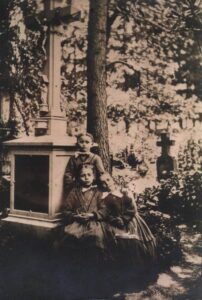
The apparitions of Mother Mary in the German village Marpingen originated with three girls and their families. On Monday, July 3, 1876, the adult population of the village was engaged in haymaking. Since this work was too difficult for children, the eight year-old girls, Margaretha Kunz (1868-1905), Katharina Hubertus (1868-1904) and Susanna Leist (1868-1884) were sent out to pick berries in the nearby forest, called Härtelwald. [Image at right] As they were turning to go home, after the Angelus sounded before dawn, one of the three saw a white figure, which was confirmed by the two others. At home they shared their experience with their parents, who were skeptical initially. They might have seen a woman from the village, the father of Susanna Leist suggested. His wife ordered the girls: “Go back into the woods tomorrow, pray, and if you see her again ask who she is; if she says she is the Immaculately Conceived, then she is the Blessed Virgin.” The girls did what they were asked, and they soon the figure was identified as the Virgin Mary. Families and neighbours became more and more convinced, all the more as Mary began to appear more often to the girls.

There were some miraculous cures, and the visionaries invited the villagers to follow them to the place in the Härtel-forest and to touch the feet of the Mother of God in order to be cured. The pride of the girls, who suddenly stood in the centre of the community’s interest, and the Marian piety of the villagers went hand in hand to broaden interest in the events. Within days, Catholics from neighbouring locations were attracted, and pilgrims from the Saarland and even places much further away visited Marpingen. Some estimated 20,000 visitors in the first week, exceeding the numbers of Lourdes in 1876. July and August of 1877 saw between 600 and 1,200 believers daily taking communion in the parish church. Finally, the apparitions stopped on September 3, 1877. The three visionaries and their families were removed from Marpingen in May 1878, and they were required to stay in the Convent of the Poor Child Jesus in Echternach, Luxembourg.
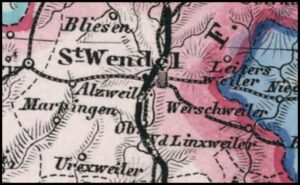
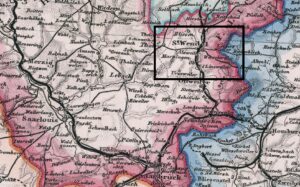
Social, social-psychological, cultural and other context are critical to understanding the Marian apparitions at Marpingen. In the 1870s, Marpingen was a poor, small village of 1,600 inhabitants in the Saarland, the western part of Germany. Located twenty-five kilometers north of Saarbrücken, the secluded place became the center of Marian interest in 1876. [Image at right]

Economically, Germany experienced a Great Depression beginning in 1873 (Gründerkrach), which didn’t leave Marpingen untouched. The village was impoverished enough and could not live on its own agrarian products. Most farmers were poor goat peasants. During the week, the men had to earn extra wages in the mines outside the village. The farmer-miners were complaining about low wages in these years, since the mines also paid a price for the economic depression. The economic crisis was accompanied by a serious religious and political crisis: The culture war (Kulturkampf) between state and church reached its peak in the mid-1870s. Marpingen was close to the border of France, which longed for revenge for the lost war and Alsace-Lorraine. [Image at right] This was not the only transnational aspect of the story, since Lourdes and the tendencies toward standardization of Marian devotion in the wake of ultramontanism turned out to be crucial for the apparitions in Marpingen. Thus, there were plenty of reasons for villagers to be fearful, to complain and to imitate role models which were successful abroad.
The apparitions met the expectation that in times of crisis the Blessed Virgin would give comfort. Her appearance also made villagers hope to profit from the positive commercial effects of becoming a prominent place of pilgrimage. Marpingen hoped to become the “German Lourdes.”

The apparitions at Marpingen also had an important gender dimension. Because most able-bodied men worked in the mines during the week, the population of Marpingen on those days predominantly consisted of women, children, and old men. Wives were left alone to run the village. Marian apparitions fell on fruitful ground in this female context. This was the situation when the first apparitions started on Monday, July 3, 1876. Until the next Friday there were five days in which the situation dramatized without the working men. The first supporters of the apparitions were women like Katharina Leist, while her husband, who was sick and retired and thus in Marpingen, wiped the thing away as some misconception. On the second evening, twenty children and six women, from the families or neighbours, gathered in the Härtel-forest. Men only appeared on July 5. They included the father of Katharina Hubertus, the publican, the schoolteacher, and later that evening Nikolaus Recktenwald, an unemployed miner suffering from rheumatism. After the children told him to touch Mary’s foot, he felt that he had been cured. This miracle was of considerable importance in shaping the opinion of the villagers as was the fact that men of reputation on that evening approved the apparition claims of the three children. Nevertheless, the role of the local women in nursing the cult remained central. Women also comprised the vast majority of the pilgrims, which can be understood in the wider context of the feminization of Catholic piety during the nineteenth century.

The situation in Marpingen had many collateral effects. The wish to profit from adult attention drove some other children in 1877 to claim Our Lady has also appeared to them. These “rival children,” though, were unable to gain any of the prominence of the three original seers. The satirical journals took full advantage of the events. Apparitions of the Holy Virgin were imitated in other places like in Poznan (Prussia), where in 1877 Polish children claimed to have seen her. Variations of Marpingen became popular. For example, people saw an apparition of Mary in a medicine bottle filled with water from Marpingen that was located in the window of a house. This attracted more than 5.000 pilgrims in the area close to the city of Koblenz.

In the years and decades after 1877, the number of pilgrims fell to a handful daily. Even the claim of Elisa Recktenwald in 1883 (one of the “rival children” of 1877) that Our Lady had appeared to her could not slow the downturn. The complaint and message from Mary to her was “Have I not appeared already to so many children? Yet so few have believed.” There was a new peak of pilgrims in the early years under Adolf Hitler and another one in the post-war years. A visitors-book of 1947 shows that the average number of visitors to the chapel was as high as twenty-two a day.

Another brief revival of Marian apparition claims emerged in the late 1990s. Between May and October 1999, three women again claimed to have had contact to Mary, although they reported different experiences. Marion Guttmann, a thirty year-old housewife, reported seeing her; Christine Ney, who was twenty-four and learning musical education, reported hearing her; and Judith Hiber, who was thirty-five and an assistant in law, reported to badly hear and badly see her. None of them was from Marpingen, however, and community inhabitants were skeptical about the “humbug.”

DOCTRINES/BELIEFS

The apparitions in Marpingen lacked any kind of special doctrine or belief, rather they were a typical manifestation of the pious fashion concerning Our Lady in the nineteenth century, one which incorporated all the typical ingredients which had emerged since the beginning of the century. Earlier Marian phenomena were reported by men, mostly priests, while in the nineteenth century it was women and children who dominated the scene. Classic Marian cults like Guadalupe in Spain or Czestochowa in Poland, both originating in the fourteenth century, dealt with miraculous objects attracting adoration.

The rejuvenated cultic activity in the nineteenth century was centred around apparitions of the Virgin Mary herself, often revealing messages or admonitions, such as to pray more frequently. After these sorts of apparitions happened to Cathérine Labouré in a cloister in Paris (1830/1831) and to two young cowherds in La Salette (1846) during a famine, the most famous event involved Bernardette Soubirous in Lourdes (1858). Finally, all the necessary elements of the modern Marian apparition were complete: the simplicity of the female, young visionary, a message, miraculous cures, the sceptical reactions of the parish priest and over-reacting civil authorities. The new type of Marian apparitions in the nineteenth century was “a French creation” (Blackbourn 1995:4). The apparitions of the Blessed Virgin in Lourdes provided a transnational text to refer to from different angles: for Catholics as a blueprint, for national liberals as a sign of lacking national loyalty. Catholics explicitly hoped to establish a “German Lourdes” in Marpingen. The international charisma of Lourdes appeared infectious. But how could Margaretha, Katharina and Susanne know about this blueprint? How could eight year-old girls contribute to the standardization of Marian devotion in Europe? Their parents and older sisters (one of them wanted to become a nun) and the teacher in primary school were dwelling in Marian piety, and the local priest Jakob Neureuter preached about the apparitions in Lourdes. The French events were a major topic in the media during these years, especially since the first organized German pilgrimage to Lourdes in 1875. The whole village was deeply immersed in Marian adoration. Soon after the apparitions, Catholic newspapers discussed the “German Lourdes,” the “Rhenish Lourdes,” the “second Lourdes,” or the “Bethlehem of Germany.”

Part of the standardization of Marian cult was that most messages delivered by her were quite similar to those uttered in Lourdes and other places: To pray more. Prophecies of the girls were hardly touching major issues like war or starvation, but rather local situations. One of the visionaries later confessed: the people asked for miracles and so we gave them some. Some messages were adapted to Marpingen if the situation required it. The priest, who went after the girls in order to observe them, was informed that the Virgin did not want him to follow the girls. Another message addressed the commercial interests of Catholic merchants. The Blessed Virgin, as a rumor in Marpingen went round, instructed people, “not to shop any longer with the Jews,” some of whom were traders and lived in the neighboring Tholey.

Another part of this standardization was that Mary no longer appeared in colourful clothes anymore but rather in white or blue. After the three girls have learned that they met the Immaculately Conceived, the visions were constantly “improved” and “corrected” by the parents. It was the parents, not the children, who reported a blue sash that Mary was wearing, a detail known from the role model in Lourdes. Many ideas were simply proposed to the children who just agreed to the suggestions. When the children were asked whether the Virgin was carrying a golden Crown and Jesus in her arm, the children readily agreed. The Marpingen Mary more and more resembled the one in Lourdes.

The messages of Our Lady in 1999 were given to the three female seers, who recorded them, and when Mary was gone, the cassette was played to the excited audience. One of the messages was: “It is all in my plan for this place to grow together. Do not be afraid, my children. Trust, trust with all your heart; and place your fears and needs in my Immaculate Heart.” Though the messages were quite minor (to pray along the rosary, to stop abortion and to obey the pope), thousands came to participate in the events, which happened only on weekends. Church services were offered for the public in the chapel, which was built in 1932, and thousands went to the near-by dwell which they believed to contain holy water. Hermann-Joseph Spital, the bishop of Trier, forbade talk about “apparitions” and about the “visionaries.” Instead, acceptable discussion should be about “events in the Härtel-forest.” Marpingen is a place where Mary continues to be worshiped.

RITUALS/PRACTICES

Soon after the initial apparitions, women from the village went to the place of the apparitions in the forest to place flowers. People came from near and far to participate in the phenomenon. The most compelling reason to go there was the prospect of miraculous healing. People who were blind, deaf, rheumatic, arthritic, or who suffered from the consequences of typhoid or smallpox, went to the site of the apparitions. They repeated the prescribed prayers while their hands were guided to the spot where the Virgin supposedly appeared. Some were disabled and arrived in wheelchairs, hoping for grace and cure. Many visitors were welcomed to stay overnight in private rooms, since Marpingen was hard to reach. The nearest train station was located in St. Wendel, seven kilometers away. The business of quartering boomed, and the taverns were full.

In the first days after July 3, 1876 about 4,000 people visited the site; in the second week of the apparitions 20,000 people came to Marpingen. Since that time, people came more frequently on weekends or for Marian festivals. They received communion and went to the site of the apparitions in order to pray. There was a final wave of pilgrims in the phase between July and September 1877, sometimes reaching 9,000 pilgrims a day, because the Holy Virgin had announced that she was ending her visits. Especially on the predicted last days of the apparitions during the first three days of September 1877, there were 30,000 visitors. In her last appearance Our Mary reportedly said: “I will be back in hard times”.

Most also drank the miraculous water in the Härtel-forest. The water from the dwell near the apparitions was believed to have miraculous potential and was sold for consumption by the needy. A pilgrim from Trier filled a twelve liter jug and carried it home by foot in February 1877. Not only the villagers profited. Retailers from outside Marpingen opened ambulant shops in order to sell devotional objects.

ORGANIZATION/LEADERSHIP

Many famous sites of pilgrimage in the nineteenth century were gathering places, such as the pilgrimage to the Holy Robe in Trier 1844 or Lourdes since 1858. Many organizations formed or were involved in bringing the pilgrims in such places. Marpingen is an example of the opposite. The movement came from below. There was no ecclesiastical architecture which supported the events and no hierarchical institution which could evaluate the evidence of the apparitions. Marpingen belonged to the diocese of Trier. During the culture war between state and church (Kulturkampf), which raged between 1871 and 1878, the bishop of Trier, Matthias Eberhard, was arrested in 1874. Thus, the diocese was left without a bishop. Eberhard died in May 1876, shortly before the apparitions in Marpingen began. It was not until 1881 before a new bishop was elected, Michael Felix Korum. Also, there was no dean in St. Wendel, the deanary responsible for Marpingen. The church suffered losses not only on the top level but also on the level of ordinary staff. Many priests were arrested or, if they had died, were not replaced by a new one because, among other things, the state asked for an official state exam in higher education (Kulturexamen), which the church refused. Of the 731 parishes of the diocese, 230 were without leadership.

The position of Jakob Neureuter, the parish-priest who supervised his flock in Marpingen since 1864, was particularly stressful. He personally believed in the apparitions but was ecclesiastically required to be cautious until an official investigation approved them. But without a bishop there was no official investigation of the type that the bishop of Regensburg could initiate for the apparitions in Mettenbuch (1876). Neureuter was left alone in keeping the collective emotions under control, standing between the emphatic expectations of his flock, the regulations of the church, and the hostility challenging his village from outside.

In the absence of a bishop in Trier, Johann Theodor Laurent (1804-1884), Apostolic Vicar in Luxembourg and titular bishop of Chersones, was asked to write a report on the apparitions. He uttered serious doubts about them, about Mary’s “frequent changes of dress,” and of her words, which often were only a “mere aping” of Lourdes. He suggested that perhaps everything was a diabolical delusion, since the visionaries also met Lucifer sometimes. The bishop played a crucial role in the fact that the apparitions at Trier were never approved.

The pilgrims, who flooded Marpingen, represented lower social status groups; the bourgeoisie, such as academics (Bildungsbürger) and upper status businessmen (Wirtschaftsbürger) was missing. Some wives of the Catholic nobility were committed, most prominent among them: Princess Helene of Thurn und Taxis, and in 1877 the mother of the Bavarian King and the sister of the Austrian Kaiser.

The apparitions and religious worship in Marpingen, as in many places, were part of a strong wave of Marian apparitions that occurred during the Italian and German unification wars in the decade between 1866 (Philippsdorf) and 1877, with a peak around 1870 in Italy and in Alsace. The events and their consequences were not isolated phenomena but rather were national and transnational. Embedded in European texts and contexts, Marpingen both resulted from previous apparitions in other places in other countries and also inspired new apparitions in different places. Marian apparitions were communicated beyond borders and sparked off new events. For example, when a statue in honour of the Virgin was consecrated in Lourdes, 100,000 Catholics were present, among them thirty-five bishops and 5,000 priests. This event happened on July 3, 1876, the very same day when 894 kilometres away from Lourdes three girls in the Härtel-forest reported seeing a white figure during early evening.

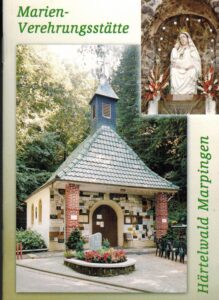
The (missing) church hierarchy in Trier and the centre of ultramontane adoration, Rome, played a minor role in the events in Marpingen. A correspondent from the Berlin Catholic newspaper “Germania” wrote an article in the “Civiltà Cattolica,” promulgating the consecration of a chapel at the place of the apparitions. It was not until 1932 that private initiative lead to the erection of a Marian chapel for pilgrims at the site of the apparitions. [Image at right] All of this occurred during years that saw dramatic unemployment in the region. The authorities of the church in Trier refused to consecrate the chapel because they didn’t want to encourage superstition. Some elderly women in 1934, 1935 and 1937 tried to move the situation forward by claiming to have seen Mother Mary. While the church labeled them “hysterical women,” the flow of pilgrims to Marpingen grew again during the regime of National-Sozialism. In the post-war years and through the 1950s, there was pressure from pious agitators who tried to convince the ecclesiastical hierarchy to consecrate the chapel but they failed. A consecration, which would have been an official approval of the visions, has never happened.

ISSUES/CHALLENGES

Ten days after the first apparition, armed infantry invaded the village expelling the pilgrims with means of force. Some people were seriously injured, and access to the forest was closed. But neither the army nor the additional gendarmes, who were sent to Marpingen to control the situation and to seal the area where the pilgrims gathered, could stop the Holy Virgin. Now she appeared in barns and houses within the village. The army occupied the village for a couple of weeks. Authorities interviewed the people involved. Among those examined were the parish-priest Jakob Neureuter and the visionaries.

Catholic and liberal newspapers across Germany reported the events from different angles. While Catholic newspapers emphasized the status of the villagers as victims, the liberal position surmised a clerical complot behind the events. For them Catholics were superstitious and nationally not reliable. They considered the gathering of thousands of people as a case of breach of the public peace. The parish priest and several villagers were arrested and put on trial. The three girls, who started it all, were the subjects of intense interrogations. Nevertheless, the events extended into the year 1877.

Marpingen had to pay a high price for wishing to become a “German Lourdes” and to improve the low community income by means of becoming a centre for pilgrims. The events had a serious aftermath. The penalties included that the village was liable to pay 4,000 marks for hosting troops it never asked for, and also that the investigations involved hundreds of people, villagers and priests. On January 16, 1878, the conduct of the army and bureaucracy in Marpingen was discussed prominently in the Prussian lower house. Members of the Centre party had tabled a motion, calling for reimbursement of the 4,000 marks, the rescinding or the ban to enter the Härtel-forest, and disciplinary measures against the officials involved.

The most serious cases against agitators involved led to a legal tribunal. In the beginning, the investigations concentrated on sedition, riotous assembly, and breach of the peace. After realizing that these accusations were untenable, investigators moved to accuse individuals of fraud and deception. The trial against nineteen individuals started in March 1879 in Saarbrücken with 170 witnesses against the defendants and only twenty-six supporting them.

In both cases, before trial and in parliament, the prominent attorney Julius Bachem was one of the fiercest defenders of the Catholic case, not in the sense that he believed in the apparitions of the Virgin Mary in Marpingen, but in the social and legal sense and because he belonged to the same Catholic milieu. At the end, the motion in Parliament was denied, but in court none of the nineteen people charged was convicted.

Later avowals of Margaretha Kunz reveal that they probably only had seen stacked-up wood with the white side pointing outwards. But it was half-dark, and Susanna Leist’s outcry “Grechten, Kätchen, look, over there is a women in white” frightened them and created a collective suggestion. The “great mistake” had been “to believe us immediately instead of calming us down.” It was all “one big lie,” Margaretha confessed in 1889. But as they were climbing in the hierarchy of respect among the villagers, as reporters and priests idolized them, they enjoyed their growing prominence and kept playing the role expected from them.

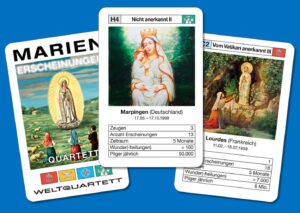
Marpingen continues to attract some individual pilgrims who worship Mother Mary. After some years of investigation, the bishop of Trier, Reinhard Marx, declared in 2005 that neither the supposed apparitions of 1876 nor those of 1999 were confirmed by the church. The chapel was never consecrated. Marpingen never made it to become the “German Lourdes.” But the Marpingen-Mary of 1999 made it at least into a quartet with the topic Marian apparitions (“the most glamorous appearances of the Holy Virgin in 32 playing cards”), even if only in the category: “not approved.”

IMAGES

Image #1: The three seers of 1876 (photo: Stiftung Marpinger Kulturbesitz).
Image #2: Stielers Karte von Deutschland in 25 Blatt, Gotha 1875.
Image #3: Section of the Map containing Marpingen.
Image #4: Gregor Hinsberger, Marien-Verehrungsstätte Härtelwald Marpingen, Marpingen, 2003.
Image #5: Marpingen and Lourdes in the quartet of Weltquartett, Hamburg.

REFERENCES

Blackbourn, David. 1995. Marpingen. Apparitions of the Virgin Mary in a Nineteenth-Century German Village. New York: Vintage.

Blackbourn, David. 2007. Marpingen. Das deutsche Lourdes in der Bismarckzeit. Saarbrücken: Association for the Promotion of the Saarbrücken State Archive.

Blaschke, Olaf. 2020. “Vom ‘Kulturkampf‘ an der Saar bis zum ‘Burgfrieden‘ (1870–1918).” Pp. 255-86 in Reformation, Religion und Konfession an der Saar (1517–2017), edited by Gabriele Clemens and Stephan Laux. Saarbrücken.

Blaschke, Olaf. 2020. “Pilgrimages, Modernity, and Ultramontanism in Germany.” Pp. 166-89 in Nineteenth-Century European Pilgrimages: A New Golden Age, edited by Antón M. Pazos. Abingdon.

Blaschke, Olaf. 2016. “Marpingen: A Remote Village and its Virgin in a Transnational Context.” Pp. 83-107 in Roberto di Stefano and Francisco Javier Ramón Solans (Hg.), Marian Devotions, Political Mobilization, and Nationalism in Europe and America. Houndmills: Palgrave MacMillan.

Rebbert, Joseph. 1877. Marpingen und seine Gegner. Apologetische Zugabe zu den Schriften und Berichten über Marpingen, Metenbuch und Dittrichswalde. Ein Schutz- und Trutzbüchlein für das katholische Volk. Paderborn.

Schneider, Bernhard. 2008. Ein “deutsches Lourdes”? Der “Fall” Marpingen (1876 und 1999) und die Elemente eines kirchlichen Prüfungsverfahrens. Pp. 178-99 in Maria und Lourdes. Wunder und Marienerscheinungen in theologischer und kulturwissenschaftlicher Perspektive, edited by Bernhard Schneider. Münster.

Publication Date:
15 March 2021

Share

Eddy Family


EDDY FAMILY TIMELINE

1842:  Horatio Eddy was born.

1841 (or 1842):  William Eddy was born.

1844:  Mary Eddy was born.

1848: Two young teenage sisters, Kate and Maggie Fox of Hydesville, New York, claimed to be in communication with a spirit through “rappings.”

1849 (November 14):  Kate and Maggie Fox, along with sister Leah, billed as “The Fox Sisters;” demonstrated their spirit communications at Rochester, New York’s Corinthian Hall.

1862 (July 13):  Zephania Eddy died.

1864:  William, Horatio, and Mary Eddy began their career performing public séances, staged and managed by the “magnetic practitioner” William Fitzgibbons.

1865:  After a time staging public séances in Chittenden, Vermont, the three siblings become a traveling act managed by J.H. Randall.

1866 (December):  William and Mary toured with Ira Davenport, founder of the Davenport Brothers.

1872 (December 29):  Julia Eddy died.

1873 (September):  Increasingly elaborate séances staged both indoors and outdoors drew increasingly large audiences to the Eddy farm in Chittenden.

1874 (August):  Journalist Henry Steel Olcott visited the Spirit Vale for five days, on assignment from the New York Sun. He published a letter in the Sun the following week, describing his experience. He returned shortly afterward as an investigator for the Daily Graphic, stayed for twelve weeks, and reported his experiences in a series of articles.

1874 (November):  Shaker Elder Frederick Evans witnessed a series of séances at the Eddy farm, reporting that over thirty spirits materialized in one session.

1875 (March):  An Eddy-trained assistant confessed to fraud after a highly public exposure, claiming that he was performing as the Eddys taught him.

1875 (April):  Olcott published People from the Other World.

1875 (July):  Mary Eddy no longer was involved in family performances, instead giving séances solo, in Chittenden.

1875 (November 26):  The New York Sun published a detailed expose of fraudulent practices at the Eddy Homestead. Operations in the house ceased, and the family scattered, taking up separate careers.

1910 (December 31):  Mary Eddy died.

1922 (September 8):  Horatio Eddy died.

1932 (October 25):  William Eddy died.

FOUNDER/GROUP HISTORY

Simultaneously a religion, a focus of scientific study, and a highly popular form of public entertainment, Spiritualism, and the practice of public mediumship that purportedly validated it, perfectly exemplified the confluence of religious enthusiasm, empirical inquiry, and popular entertainment that characterized American culture in the mid-nineteenth century. When the teenage sisters, Kate, Maggie, and Leah Fox of Hydesville, New York launched the Spiritualist movement in 1949 by performances in front of fascinated Rochester audiences in which they claimed to be communicating with spirits, their resultant fame inspired any number of similar performances. The Eddy Family were among the most famous, and most notorious, of the many public medium entertainment acts that rose up in the wake of the Fox Sisters’ celebrity.

In their 1870s heyday, the spectacular séances the Eddy Family conducted on their family farm in Chittenden, Vermont [Image at right] brought them international attention in the form of newspaper coverage and thousands of visitors who believed they were truly witnessing spirit materializations. Factual information concerning the history or background of the Eddys, however, is scarce. The parents Zephaniah (1804-1862) and his wife Julia (1813-1872), made a living as farmers, supplemented their income by taking boarders and travelers into their home, and together had eleven children. Of the siblings, Horatio, William, and Mary were the most active, first performing public séances as spiritual and physical mediums on a traveling circuit, and eventually in their own home and on the family land.

The most extensive account of the Eddys, Henry Steel Olcott’s People From the Other World, contains enough unverifiable information as to not be fully credible, despite the author’s solid journalistic credentials. According to him, the children inherited from their Scottish mother Julia the power of “foreseeing,” which was passed down the female line of her family, and Julia identified as a Spiritualist, over her husband’s objections. The epitaph on Julia’s tomb, “Entered the World of Spirits Dec 29, 1972” does suggest genuine Spiritualist inclinations [Image at right]. No historical record exists, however, to support Olcott’s additional assertion that Julia’s great-great-great grandmother was tried and sentenced to death at Salem for witchcraft in 1692, and neighbors cited in newspaper accounts dispute it. Olcott’s claim that Zephaniah hired out several of the children as a traveling act, during which time they suffered various forms of physical and emotional abuse, is often repeated in stories about the family circulated in popular media. No record of any public performance by any member of the family is available before William, Mary, and Horatio’s debut in 1864, however, which was two years after Zephaniah’s death, when the siblings were all well into their early twenties. Such elements of the family’s backstory, their mother’s hereditary gifts, the early childhood communication with spirits, and ill-treatment and physical abuse in the hands of cruel family members or over-enthusiastic skeptics, are in fact typical of the genre of Spiritualist origin narratives.

For many believers, their apparently spectacular performances summoning and interacting with spirits justified the validity of Spiritualism. Perhaps in order to lend credence to the veracity of spirit encounters, the earliest public séances that William, Horatio, and Mary endeavored were billed as scientific exhibitions rather than religious experiences. William Fitzgibbons, who managed their first traveling exhibition, had previously advertised himself as a magnetic practitioner. For whatever reason, this framing failed to attract audiences. An early performance, staged in Fitzgibbons’ home as a scientific exhibition of “Human Magnetism and Human Electricity,” was pronounced “tedious” by a visiting reporter, and the Eddys “homely and awkward and badly dressed.” Appearing with the Eddys at this same exhibition was professional medium Jennie Ferris, described by the same reporter as “more intelligent and attractive.” Shortly thereafter, the three Eddys and Mrs. Ferris toured as a troupe under Fitzgibbons, very likely learning more professional staging methods and manners during that time. The troupe apparently disbanded in January 1865.

After a few months during which the family conducted public séances in Chittenden, Mary, William, and Horatio resumed traveling performances under the management of J.H. Randall for the remainder of 1865. Probably in response to an exposure scandal as well as an apparent falling-out among the siblings (both notably frequent occurrences in their career), the Eddys retreated from public performances until about December 1866. At that time, William and Mary began traveling (without Horatio) with Ira Davenport on a well-established Spiritualist circuit.

Ira Davenport was father and manager of the Davenport Brothers. Ira and William, the eponymous brothers, were among the first and most famous of the big-name traveling medium acts. Stage magicians by training, their séances featured a piece of stage furniture called a spirit cabinet, a long, narrow box just large enough for two mediums to sit opposite each other within, with holes in various locations that allowed assistants to tie their hands with ropes to prevent trickery, and through which the spirits could emerge to interact with the audience. [Image at right] Another feature of their act was a variety of musical instruments arranged on the cabinet floor that spirits supposedly picked up and played (badly, according to some reports). When some years later the Eddys began conducting séances on their family farm, they notably adapted both of these staging elements.

William and Mary Eddy continued touring with Davenport until January 1867, when they were arrested in Syracuse for performing without a license. After several more exposure scandals, including quarreling siblings exposing each other mid-séance, William, Mary, and Horatio toured separately until approximately 1869.

After a three-year hiatus, during which their mother and an older sister died, the Eddys began to hold daily séances, with increasingly spectacular manifestations. The séances were held on their family farm, which came to be known as The Spirit Vale. Thousands of visitors came to witness these performances, often staying for days or even weeks at a time in the family home, run as a separate business called The Green Tavern. Visitors paid only a modest fee for room and board; the daily séances were conducted free of charge.

The spectacular, seemingly authentic, and apparently convincing Spirit Vale performances soon attracted high-profile attention. On August 28, 1874, the highly respected lawyer, journalist, and military officer Col. Henry Steel Olcott, visited the Spirit Vale, on assignment from the New York Sun. After publishing a letter in the Sun on September 5 describing his experience, Olcott returned as an investigative correspondent for the Daily Graphic. During his stay, he published a lengthy series of letters, detailing the various phenomena he witnessed and relating the history of the Eddy family. He provided detailed drawings of the house and its architecture, the indoor séance room, and the outdoor site, along with his own eyewitness account, as evidence of the authenticity of the manifestations.

During Olcott’s stay, two other important figures also visited the Spirit Vale. One was Helena Blavatsky, who became Olcott’s life partner and co-founder of the Theosophical Society. The other was Elder Frederick Evans, one of the pre-eminent public figures of the Shaker movement. For Evans and other like-minded Shakers, the Eddy séances justified and reinforced the role of Spiritualism in Shaker belief, a position by no means universally held within the movement itself.

Although Olcott’s publication in 1875 of People from the Other World, his book-length account of his experience with the Eddys, brought them greater fame, their reputation precipitously declined near the end of that year. The Eddys, famously intolerant of skeptics and unhappy with what they perceived as Olcott’s failure to fully authenticate their performances, began banning journalists from their séances altogether. While rumors of fraud and the ill-will of the Eddy’s Chittenden neighbors had been a recurrent theme in various newspaper accounts, negative reporting intensified after an incident in March. When D.F. Westcott, a Spiritualist from nearby Fair Haven, hired an Eddy assistant named Chaplin for one of his own séances, the performance at first was disappointing. After a tall spirit emerged and did nothing in particular, soon “a little, dumpy” one appeared and “began to mope about in the darkness, whereupon a skeptic in the audience “made a spring and landed square on the back of the supposed spirit.” Thus literally caught in blatant fakery, Chaplin not only “acknowledged that the whole thing was a humbug,” but asserted that he was performing as the Eddy’s taught him.

On November 26, 1875, The New York Sun ran a spectacular expose providing detailed evidence of the Eddy’s fraudulent practices. Their account and that of other major east coast newspapers that quickly picked up the story suggest that the evidence was provided by one of the sisters, and allude as well to violent quarreling among the siblings. The account included a description of the secret passage that ran between the chimney of the home and the spirit cabinet [Image at right] where family members sat during their sessions, with siblings not typically seen during the sessions donning an array of costumes for the performances.

In the aftermath of the sustained negative publicity, most of the family went their separate ways. According to one account, William had moved out just before the scandal, leaving the house to Horatio. After a short time in Moravia, New York then Ancora, New Jersey with some other siblings, William resumed life as a traveling medium. After another arrest in February 1878, when family members were arrested in Albany for practicing Spiritualism without an entertainer’s license, the sympathetic Shaker Elder Evans invited William and the other family members who had been traveling with them to come to his community in Mt. Lebanon. William and unnamed other sibling  resumed conducting séances there in a Shaker-built spirit cabinet.  Horatio remained in the house, and by June was practicing spirit photography.  Mary continued to work as a medium until the 1800s. Her death in December 1910 permanently ended her long career. Horatio lived until 1922, and William until 1932. [Image at right]

DOCTRINES/BELIEFS

Little available evidence suggests that the Eddys were practicing Spiritualists, or that their performances originated out of any specific religious beliefs. Henry Olcott’s account describes their father, and most of the families of the region, as strict Methodists but that their mother Julia had Spiritualist affiliation.  The epitaph “Passed to Spirit Life” on William’s gravestone suggests that he at least took some spiritualist tenets seriously. Nonetheless, the influence, the Eddy séances exerted a remarkable influence on other important religious movements of the time. Helena Blavatsky apparently traveled to Chittenden in October 1874 on behest of her Master. Had she not done so and not met Olcott, Theosophy, one of the foundations of twentieth-century Western occultism, may not have developed. Marc Demarest asserts: “Henry Steel Olcott’s People from the Other World, as much as any document, marks the beginning of Spiritualism’s declension, and the first tentative constructions of the modern occult.” In his study of the relationship between the Eddys and the Mt. Lebanon Shakers, Christian Goodwillie concludes that despite the evident fraudulence of the Eddy performances, their mutual association furthered “the broader goals of Shakerism in concert with the global explosion of Spiritualism as a practical religion.” Even the most scathing and skeptical of the many newspaper exposes published during their career were hesitant to conclude that the fraudulence of the Eddys meant that Spiritualism itself was fraudulent.

RITUALS/PRACTICES

Little available evidence suggests that the Eddys were practicing Spiritualists, or that their performances originated out of any specific religious beliefs.Once the family had stopped traveling and settled down at the Spirit Vale, séances took place in the Circle Room, a large, long loft above the main family quarters,with the spirit cabinet placed at one end and the audience in rows some distance away. A rail separated the audience from the mediums. During a day’s session, the Eddys typically offered three types of séances: light (held in daylight), dark (at night or in darkness), and outdoors. The favored locale for the outdoor sessions was a rock formation known as Honto’s Cave, so named for the spirit of a Native American woman who was supposed to reside there, and who was a favorite manifestation. [Image at right] The Eddys specialized in multiple manifestations, several spirits at a time and/or large numbers (twenty or fifty or so) in one session. Sometimes the spirits would appear as loved ones of audience members and converse with them; at other times the spirits took the form of local Native people. During Madame Blavatsky’s visit, many of the spirits were European, and the Shaker audiences found themselves communicating with the spirits of their departed elders. [Image at right]

ORGANIZATION/LEADERSHIP

The three primary mediums in the Eddy performances were William, Horatio, and Mary. Their career underwent three phases: traveling as part of a performing troupe between 1864 and 1869 under various managers, the Spirit Vale period between 1873 and 1875, during which the entire family participated in séances, and after 1875, when the family scattered. William and some other siblings lived among the Shakers, and other siblings took up solo careers as mediums, spirit photographers, and the like. The most significant period of traveling troupe performances began in December 1866 when William and Mary began traveling with The Davenport Brothers who innovated much of the stagecraft the Eddy’s and other acts successfully appropriated. The Spirit Vale sessions apparently involved the entire family, with William, Mary, and Horatio as primary mediums and other siblings assisting behind the scenes. After these sessions ended, the family went their separate ways in different groupings.

ISSUES/CHALLENGES

Unlike the Fox Sisters, who themselves confessed to the fraudulence of their spirit communications, the similarly and repeatedly discredited Eddys were clearly more focused on mediumship as money-making entertainment than as a spiritual practice. Threats of exposure were part and parcel of any mediumistic exhibition, if for no other reason than any failure of skeptics to prove fraud enhanced the reputation of the mediums. Thus skeptics as well as true believers made up a significant portion of any public séance audience, and the tone of the many newspaper accounts of mediumistic performances alternated between celebratory affirmation of the existence of an afterlife and ironic mockery of audience credulity. Although the Eddy séances were celebrated for their seeming authenticity and their Spirit Vale performances drew the attention of intelligent scholars and religious leaders, the self-evident fraudulence of their performances undermined not only their credibility, but the credibility of serious and authentic practicing Spiritualists.

Numerous other factors besides the perennial issue of authenticity led to a general erosion of Spiritualism in the early twentieth century. Nonetheless, some other forms of Spiritualism have persevered in the United States, such as Spiritualist churches and camps, and Spiritualist practice within Black communities that finds current expression in cultural, African-centered practices.

IMAGES

Image #1: The Eddy Homestead.
Image #2: Julia Eddy’s gravestone.
Image #3: Davenport Poster.
Image #4: The Eddy’s Cabinet.
Image #5: William and Horario Eddy.
Image #7: Honto’s Cave.
Image #8: Spirits Visitation.

REFERENCES

“An Evening with the Spirits.” 1864. Brooklyn Daily Eagle, November 11.

Benoit, Brian. 2020. “Ghosted: The Eddy Family’s Questionable Claims to Occult Powers in Nineteenth Century Vermont.” Readex Blog. Accessed from https://www.readex.com/blog/ghosted-eddy-family%E2%80%99s-questionable-claims-occult-powers-nineteenth-century-vermont on 8 March 2021.

Demarest, Marc. 2015, “Honto’s Cave: Some Notes on the Mediumship of the Eddy Family.” Chasing Down Emma: Resolving the Contradictions of, and Filling the Gaps in, the Live, Work and World of Emma Hardinge Britten. Accessed from http://ehbritten.blogspot.com/2015/10/hontos-cave-some-notes-on-mediumships.html on 8 March 2021.

Goodwillie, Christian. 2015. “Light and Dark Sides of Spiritualism: The Eddy Brothers and the Shakers.” Communal Societies Quarterly 9:200-22.

“The Eddy Brothers.” 1875. Boston Globe, February 2.

“The Eddy’s Humbug Exposed.” 1875. The Albany Times, March 23.

“The Latest Performance of the Eddys.” 1876. Rutland Daily Globe, June 22.

The Theosophist. 1908. 29:9.

Land, Grebory R. 2020. Spiritualism in the American Civil War. Jefferson, NC: McFarland and Company.

Olcott, Henry Steel. 1875. People from the Other World. Hartford, CT: American Publishing Company. 1875.

Publication Date:
15 March 2021


Share

Catholic Charismatic Renewal


CATHOLIC CHARISMATIC RENEWAL TIMELINE

1967:  The Catholic Charismatic Renewal (CCR) was founded.

1967–1980s (early):  Protestant expansion and acculturation took place.

1975 (May 18-19):  The first world Charismatic Renewal gathering took place in the presence of Pope Paul VI in St Peter’s Square, Rome.

1978:  The International Catholic Charismatic Renewal Services (ICCRS) was founded.

1980s-1990s:  The Catholic Charismatic Renewal integrated within the Catholic matrix.

1981:  The International Catholic Charismatic Renewal Offices (ICCRO) were created.

1998 (May 27-29):  The founders and leaders of fifty-seven ecclesial movements and new communities met with Pope John Paul II in St Peter’s Square, Rome.

1990s (late)-2020:  Rapprochement with neo-Pentecostals was achieved.

2000s:  Evangelical and Pentecostal elements were introduced into the wider Catholicism, going beyond the Charismatic Renewal in the strict sense of the term.

2017 (June 3):  A CCR gathering celebrated its fiftieth anniversary in the presence of Pope Francis in Circus Maximus, Rome.

2018:  The Catholic Charismatic Renewal International Service (CHARIS) was founded.

FOUNDER/GROUP HISTORY

The Charismatic Renewal was born in January 1967 when four lay teachers from Duquesne University in Pittsburgh, Pennsylvania, experienced baptism in the Holy Spirit in a group of Episcopalian Pentecostals. Their experience quickly spread outside student circles and the United States, giving rise to a multitude of Catholic assemblies gathering to pray “the Pentecostal way.” In less than ten years, the movement became established on all continents: in 1969 thirteen countries hosted charismatic prayer groups, and by 1975,  ninety-three countries were involved. In Africa it was so successful that the anthropologist and Jesuit Meinrad Hebga spoke of a “veritable tidal wave” (Hebga 1995:67).

Currently the Charismatic Renewal comprises 19,000,000, representing around ten percent of all Catholics (Barrett and Johnson 2006). The movement has 148,000 prayer groups in 238 countries. Group sizes vary from two to one thousand participants. These groups bring together 13,400,000 people every week. 10,600 priests and 450 bishops around the world are charismatic. But the Charismatic Renewal is mainly a lay movement. After an initial exponential growth (more than twenty percent per year until the 1980s), the advance of the Catholic charismatic movement slowed down considerably. It has nevertheless continued at a rate of 2.7 percent per year since the beginning of the twenty-first century (Barrett and Johnson 2006). It is in the South that growth is currently at its highest, where the charismatic movement particularly resonates with traditional cultures (Aubourg 2014a; Bouchard 2010; Massé 2014; Hoenes del Pinal 2017) while encouraging the rise of leaders such as the Congolese Mama Régine (Fabian 2015), the Cameroonian Meinrad Hebga (Lado 2017), the Beninese Jean Pliya, the Indian James Manjackal, etc.

Four phases can be distinguished in the development of the Charismatic Renewal. The first corresponds to the years of its emergence (1972-1982) during which the Pentecostal experience entered Catholicism. Both sides of the Atlantic saw what the Canadians Pauline Côté and Jacques Zylberberg (1990) called “a Protestant expansion and acculturation.” All over the world prayer groups were formed, some of which gave rise to so-called “new” communities (Landron 2004). These include The Word of God  in the United States (1969); Sodalitium Vita Christianae in Peru (1969); Canção Nova (1978) and Shalom (1982) in Brazil; Emmanuel (1972), Théophanie (1972), Chemin Neuf (1973), Rocher (1975), Pain de vie (1976), and Puits de Jacob (1977) in France; etc. Prayer groups and communities regularly organized large common gatherings conducive to ecumenical relations. It is worth pointing out that links were established not only between Catholic charismatics and Pentecostals, but also with Lutheran and Reformed circles caught up in the “charismatic wave” (Veldhuizen 1995:40).

The initial opening up to Pentecostalism was followed by a phase of withdrawal during which the Charismatic Renewal refocused on its Catholic identity (1982-1997). The Roman institution took care to control it by strengthening its affiliation to the church community as a whole. It sought to contain its effervescence by normalizing its rites and practices. The Renewal also took root within the Catholic matrix out of a conscious desire on the part of the movement itself. Having initially represented an “implicit protest” (Seguy 1979) against the Roman institution, it then made a number of pledges: to use emblematic figures (saints, mystics, popes), reappropriate the history of church tradition, and revive practices that were no longer in use (adoration of the Blessed Sacrament, individual confessions, pilgrimages, Marian devotion, etc.). As expressed by Michel de Certeau, in the Catholic charismatic movements “charisma becomes part of the institution it both upholds and wraps itself in” (De Certeau 1976:12). In some dioceses the Renewal found itself under leaders who imposed prudence and reserve with regard to charismatic expressions. This led to a very clericalized Renewal, which gradually lost its vigor. Emotional expressions became less exuberant. The idea of conversion associated with baptism in the Holy Spirit was euphemized.  Groups such as the Emmanuel community replaced it with the term “outpouring of the Spirit” in order to distance themselves from the experience lived in Protestant circles and diminish its importance in relation to the sacrament of baptism. There were fewer, less spectacular healings. Prayer meetings were conducted in an increasingly repetitive way, becoming veritable paraliturgical assemblies. The regulation of the Renewal eventually led to what sociologist Max Weber describes as the “routinization of charisma” and the “Catholic resocialization of emotions” (Cohen 2001), which was coupled with a decrease in its attractiveness among young people and especially in Western countries. 

The third period is that of rapprochement with the neo-Pentecostals in an effort to revive the Renewal (since 1997). As prayer groups were running out of steam, steps were taken to rekindle the charismatic emotion. They took the form of training courses, prayer meetings, evangelization days, individualized welcome cells, and large gatherings. All these initiatives mobilized elements of the third neo-Pentecostal wave which is characterized by its encouragement of extraordinary divine manifestations under the effect of “Power Evangelism.” The phenomenon spread thanks to specialized preachers who operated within interfaith and international networks and sparked a new religious effervescence that the church institution tried very hard to control.

The fourth so-called “post-charismatic” phase began in the early 2000s.  It corresponds to the introduction of evangelical and Pentecostal elements into Catholicism, going beyond the Charismatic Renewal in the strict sense of the term (Aubourg 2020). This introduction could happen “quietly,” in a capillary fashion, without the faithful necessarily being aware of it, using music (e.g. the pop rock songs of the Australian megachurch Hillsong), books (e.g. The Purpose Driven Church by Californian pastor Rick Warren), discursive practices (e.g. real-life testimony), body techniques (e.g. the prayer of the brothers), objects (e.g. the baptistery for adults), and so on. Prayer groups were also created which were linked to the Charismatic Renewal but did not see themselves as belonging to it, their members coming from a wider range of categories than just Catholic charismatics. This was the case of the Mother’s Prayer groups founded by the Englishwoman Veronica Williams which are now present in ninety-five countries. So-called “missionary” parishes also took their inspiration from evangelical megachurches fully consciously but without being affiliated to the Charismatic Renewal. In doing so, Catholicism borrowed powerful tools from evangelical churches in order to revitalize Catholic practice and slow down the rising curve of religious disaffiliation. In this process of borrowing from the evangelical and Pentecostal world it is worth noting the importance of one particular approach: the Alpha Courses (Rigou Chemin 2011; Labarbe, 2007; Stout and Dein 2013). This evangelizing tool, which is characterized by the conviviality it tries to foster and its well-honed logistical organization, is similar to Pentecostalism in that it focuses its message on developing a personal relationship with Christ, reading the Bible, and “acquiring” the Holy Spirit. Having started in the London Anglican parish of Holy Trinity Brampton (HTB) in 1977, its success has spread throughout the world and in different Christian communities. It has played a key role at three levels: disseminating evangelical practices and tools in the Catholic world, building an international interfaith network of leaders, and implementing a new parish organization model.

DOCTRINES/BELIEFS

“A child of Pentecostalism” in the words of Christine Pina (2001:26), the charismatic movement was initially very directly linked to this branch of evangelical Protestantism since it focused first of all on the practice of charisms: glossolalia (Aubourg 2014b), prophecy (McGuire 1977), healing (Csordas 1983; Charuty 1990; Ugeux 2002). It then emphasized the centrality of the biblical text, conversion (or reconversion), and the explicit proclamation of the kerygma (a message centered on “Jesus Christ having died on the cross for the salvation of humankind”).  Moreover, in the wake of Pentecostalism, the charismatic movement revived the confession of the existence of Satan and his demonic manifestations. It dealt with requests for exorcisms and presented itself as a means to fight against threats of witchcraft (Sagne 1994).

However, from the outset the connection with Pentecostalism raised questions, and Catholics were not content to simply copy its ways. The church institution took care to channel them by setting aside certain elements, such as the insistence on apocalyptic discourse, in favor of others such as respect for hierarchical and governing bodies.

RITUALS/PRACTICES

The Charismatic Renewal includes many diverse individuals from all over the world who occasionally take part in various groups and activities: prayer assemblies, conferences, conventions, spiritual retreats, evangelization schools, publishing houses, new communities, etc. However, the Catholic charismatic landscape is organized around two main types of religious groups: communities and prayer groups (Vetö 2012). [Image at right]

Prayer groups do not require intensive commitment from their members and tend to blend in with local church life. Even though their audience is fluid and mobile, prayer groups nevertheless have made an effort at structuring themselves by setting up national coordinating bodies. Prayer groups are led by a shepherd surrounded by a core. In the vast majority of cases, these are lay individuals elected by the other group members. Like Pentecostal assemblies, prayer groups started by Catholics encourage new forms of warm, close-knit sociability. Charismatic prayer puts a lot of emphasis on religious emotions, real-life testimonies, and free expressions of faith. The body plays a central role through rhythmic songs, dances, and numerous gestures and postures such as clapping hands or raising arms.

While spontaneity is the essential feature of charismatic prayer, the latter nevertheless follows a pattern that is repeated every week: the session begins with prayers of praise followed by one or more biblical readings. It ends with collective prayers of intercession and the laying of hands on those individual participants who wish it. Hymns and charismatic manifestations punctuate the meetings (Parasie 2005).

Communities are more visible and better organized than prayer groups. They assert their specific features in relation to each other. Competitive relationships develop among them but also in relation to autonomous prayer groups. Some offer an intense communal life (such as The Word of God in the United States, Béatitudes and Pain de Vie in France) while others (such as Emmanuel) offer a less restrictive way of life. Two processes are at work in these religious groups, which Thomas Csordas describes in terms of “ritualization and radicalization of charisma” (Csordas 2012:100-30). From an administrative point of view they have led to the acquisition of canonical statutes (religious institutes; private or public associations of worshippers governed by diocesan or pontifical law). These communities offer new ways of living together since some are mixed (men and women / priests and lay people / Catholics and Protestants) while others welcome married couples with their children. Most of them encourage their members to wear distinctive clothing or signs: specific shape and color of clothing, stylized cross worn around the neck, sandals, etc. Having gradually taken their place within the Church, the new communities are today entrusted with parishes, abbeys, and ecclesial responsibilities (Dolbeau 2019).

Apart from Pentecostal practices and beliefs, most communities emerging from the Charismatic Renewal have adopted a rigorous orthopraxy, which is characteristic of evangelical milieux. These include strict condemnation of behavior deemed immoral, such as adultery; prohibition of the use of tobacco; mistrust of music, and in particular rock music; prohibition of gambling; and condemnation of yoga, divinatory astrology, or spiritualism (there is, however, a gradation between communities that strongly condemn such practices and those that are less critical of them). Over and above the strictly religious sphere, the changes brought by the experience of being baptized in the Holy Spirit are meant to affect the whole life of a converted Catholic, from their social relations to their daily attitude and representation of society. This ethical dimension also affects gender relations.

ORGANIZATION/LEADERSHIP

After first calling itself “Catholic Pentecostalism,” “neo-Pentecostalism,” or “the Pentecostal movement in the Catholic Church” (O’Connor 1975:18), the charismatic movement came to be referred to as the “Charismatic Renewal.” Very often it is simply called the “Renewal.” Its name aside, there is an ongoing debate between scholars, such as Thomas Csordas, who believe that the Catholic Charismatic Renewal could be characterized as a movement (in the sociological sense of the term), and the leaders of this religious grouping, who refuse to be associated with this theoretical category (Csordas 2012:43).

Initially, the Roman Catholic Church viewed this “Renewal” in a largely skeptical, even negative light. It was deemed uncontrollable and its innovations seemed potentially destabilizing for the institutional system. The movement was also discredited because of its tendency towards an emotional Christianity that seemed to devalue engagement in society and of the perceived arrogant attitude of these newconverts who presented themselves as “the future of the Church.” On May 18 and 19, 1975, on the feast of Pentecost, 12,000 people from over sixty countries took part in the 3rd International Congress of the Catholic Charismatic Renewal held in Rome. [Image at right] Pope Paul VI asked them this question, which would go down in the annals of the Renewal: “How could this Renewal not be an opportunity for the Church and for the world? And how, in this case, could one not take all steps necessary to ensure that it remains so?” By calling the Renewal an “opportunity,” the Pope not only gave the charismatic movement the legitimacy it had hoped for, he also encouraged the development of this “new spring for the Church.” Nevertheless, this support for the Charismatic Renewal has, since 1974, been accompanied by an ecclesial control closely interwoven with the endogenous structuring of the Charismatic Renewal. A series of documents were produced with the aim of regulating charismatic practice, such as those written by Léon-Joseph Suenens, Cardinal of Mechelen-Brussels. Subsequent popes have continued to support the Charismatic Renewal whilst constantly enjoining it to safeguard its Catholic identity. [Image at right]

At an international level, whilst refusing to set up an international governing structure, the Charismatic Renewal did acquire a world coordination office, which in 1981 became known as ICCRO (International Catholic Charismatic Renewal Offices). Originally based in Ann Arbor where Ralph Martin was in charge of a liaison and information bulletin, in 1975 the office was transferred to the bishopric of Mechelen-Brussels, and in 1982 to Rome, in the building that housed the Pontifical Council for the Laity (to be replaced by a dicastery in 2016). The latter recognized it in 1983 (as a private association of worshippers endowed with legal status). The organization was renamed ICCRS (International Catholic Charismatic Renewal Services), its aim being to promote relations between Catholic charismatic entities as well as liaise with the Holy See. In 2018, CHARIS (Catholic Charismatic Renewal International Service) replaced ICCRS. It presents itself as “a communion service and not a governing body,” reaffirming its ecumenical scope. [Image at right]

Locally, bishops designate “diocesan delegates” in their dioceses: priests, deacons, or laypersons whose role is to accompany the Charismatic Renewal groups.

As for the larger communities, the relations of authority within them have given rise to debates and analyses (Plet 1990).

ISSUES/CHALLENGES

Ultimately, two challenges seem to be facing the CCR and having an impact on its development, if not survival. The first challenge concerns its denominational positioning. From its origin to the present day, the CCR has been navigating between Protestant waters on one side and Catholic waters on the other. It has borrowed from the former (Pentecostalism) the elements that give it its originality and ensure its dynamism, and at the same time it has kept its place within the latter (Catholicism), thus ensuring its durability. This tension between the two denominational worlds (Protestantism and Catholicism) largely overlaps with the tension between charisma and institution which has classically been brought to light in the sociology of religions.

The second challenge relates to its sociographic make-up. In Europe the middle and upper classes have deserted the diocesan prayer groups which, conversely, have increasingly been welcoming members from migrant and diaspora backgrounds. As for new communities, they attract the upper classes with a strong “traditional” sensibility. Generally speaking, Western interest in the CCR has been declining. This evolution is in line with a major trend in contemporary Catholicism which has seen its growth in emerging countries gather pace, while a decline can be observed in the West.

Several important observations may be made concerning the sociocultural profile of the members of the Catholic charismatic movement:

According to Jacques Zylberberg and Pauline Côté, the charismatic movement in Quebec attracted a largely female, middle-aged, single population at first. They further noted the crucial role played by monks and nuns within the movement, as well as the prevalence of the middle classes and the primacy of cultural rationales over economic ones (Côté and Zylberberg 1990:82). In the United States, the Charismatic Renewal primarily involved white urban middle-class individuals (McGuire 1982). It should be stressed that, according to Bernard Ugeux, the Renewal was born in North America at the same time and in the same sociocultural environment as a number of new religious movements that were later identified with the New Age. In France, at first the Charismatic Renewal reached people from extremely varied social backgrounds and in particular two opposite population groups: the middle and upper strata, and the marginalized (the homeless, psychiatric patients, backpackers, former drug addicts, conscientious objectors). Most of the Renewal leaders, however, were from the upper and middle classes.

Over time the type of population joining the Renewal has changed. Nowadays migrants from Latin America and Haiti are strongly involved in the charismatic movement in Quebec (Boucher 2021) and the United States (Pérez 2015:196). In France, migrants from Creole and African societies as well as the lower strata are increasingly present in prayer groups alongside the middle classes. The Renewal has virtually disappeared from the rural world and the upper strata dominate the larger charismatic communities (Emmanuel and Chemin Neuf). The history of the Charismatic Renewal in the Mascarene Islands (Mauritius, Réunion) [Image at right] shows a very similar evolution: the “white” middle class who started the charismatic movement is now virtually absent from the Renewal groups, with the latter recruiting most of their members from the African and Malagasy Creoles who come from much more disadvantaged social backgrounds (Aubourg 2014a). In Africa and Latin America, the Charismatic Renewal is present in the same social circles as Pentecostalism; it involves the middle class but above all simple ordinary people.

Do members of the Charismatic Renewal represent a traditionalist and politically conservative current within the Church? In the United States the answer to this question is generally yes. The charismatic movement saw its ranks grow, for example, with the arrival of Nicaraguan refugees, who opposed to the Sandinista regime, and Lebanese, who held traditionalist views on marital and sexual morality. As for the founders of The Word of God community, they were far from belonging to the hippie movement. In France, the answer to this question is more nuanced as there is greater heterogeneity (Champion and Cohen 1993; Pina 2001:30). Most community founders subscribed to the ideals of May 1968 (aspiring to self-management, non-violence, denouncing the consumer society) and the choices made by Vatican II (valuing the laity, ecumenism, fairly non-hierarchical organization). On the other hand, communities developed which strongly defended traditional Catholic positions on sexual and family morality, distancing themselves from Protestantism, whose members’ political voting leaned to the right. The Emmanuel community is an example of this (Itzhak 2014). As for the autonomous prayer groups, their main characteristic is a lack of political involvement. Like first-wave Pentecostals, these charismatic Catholics favor prayer over engaging in “the world,”

IMAGES

Image #1: France, prayer group, 2019.
Image #2: Rome, first charismatic international gathering, 1975,
Image #3: Paul VI with Ralph Martin, Steve Clark and  Renewal Leaders, 1973.
Image #4: CHARIS, 2020.

REFERENCES

Aubourg Valérie. 2020,  Réveil catholique. Emprunts évangéliques dans le catholicisme, Genève, Labor et Fides

Aubourg Valérie. 2014a. Christianismes charismatiques à l’Ile de La Réunion. Paris: Karthala.

Aubourg Valérie. 2014b. “Chant céleste: la glossolalie en milieu pentecôtiste charismatique à l’île de La Réunion”,  Anthropologie et Sociétés 38:245-64.

Barrett, David et Todd M. Johnson. 2006. “Le Renouveau charismatique catholique, 1959-2025.” Pp. 163-78 in: “Et Pierre se leva…”, Nouan-le-Fuzelier, Éd. des Béatitudes, edited by Oreste Pesare,

Bouchard, Melissa.  2010. “Les relations entre catholiques et hindous chez les Tamouls sri lankais à Montréal et la notion de syncrétisme: l’exemple des pèlerinages et de la dévotion mariale.” Mémoire de Master en anthropologie, Université de Montréal.

Boucher, Guillaume. 2021. “Transcendance transnationale : étude comparée de congrégations catholiques charismatiques latino-américaine et québécoise à Montréal.” Pp. 211-24 in Aubourg V., Meintel D., et Servais O. (dir.), Ethnographies du catholicisme contemporain. Paris, Karthala.

Champion, Françoise et Martine Cohen. 1993. “Recompositions, décompositions: Le Renouveau charismatique et la nébuleuse mystique-ésotérique depuis les années soixante-dix.” Le Débat 75:77-85.

Charuty, Giordana. 1990. “Les liturgies du malheur. Le souci thérapeutique des chrétiens charismatiques.” Le Débat 59:68-89.

Cohen, Martine. 2002. “Le renouveau charismatique catholique: des hippies, mais aussi des traditionnels.” Pp. 69-74 in Le renouveau religieux, de la quête de soi au fanatisme. A. Houziaux (dir.), Paris.

Côté, Pauline et  Jacques Zylberberg. 1990. “Univers catholique romain, charisme et individualisme: les tribulations du renouveau charismatique canadien francophone.” Sociologie et Sociétés 22:81-94.

Dolbeau, Samuel. 2019. “Le rapport de la Communauté de l’Emmanuel avec ses paroisses parisiennes. S’accommoder sans se diluer, se spécifier sans s’isoler.” Émulations – Revue de sciences sociales, En ligne.

Csordas, Thomas J. 2012. Language, Charisma, & Creativity. Ritual Life in the Catholic Charismatic Renewal. New York: Palgrave.

Csordas Thomas, 1983, “The Rhetoric of transformation in Ritual Healing.” Culture, Medicine, and Psychiatry 7: 333-75.

de Certeau,  Michel. 1976. “Le mouvement charismatique: nouvelle pentecôte ou nouvelle aliénation.” La Lettre 211:7-18.

Hebga, Meinrad. 1995. “Le mouvement charismatique en Afrique.” Etudes 383:67-75.

Hoenes del Pinal, Eric. 2017. “The Paradox of Charismatic Catholicim. Rupture and Continuity in a Q’eqchi’-Maya Parish.” Pp. 170-83 in The anthropology of Catholicism, edited by K. Norget, V. Napolitano and M. Mayblin.  Berkeley: University of California Press.

Itzhac Nofit, 2014, “Freedom to Love? Moral Sentiments and the Catholic Response to Gay Marriage in France.” Conference of the Association for Social Anthropologists of the UK (ASA) in Edinburgh, Scotland.

Fabian, Johannes. 2015. Talk about Prayer. An Ethnographic Commentary. New York: Palgrave Macmillan.

La Barbe, Frank. 2007. “Un ethnologue au Cours Alpha. Evangélisation et cure d’âme en milieu charismatique – Un exemple montpelliérain.” PentecoStudies 6:150-87.

Lado, Ludovic. 2017, “Experiments of Inculturation in a Catholic Charismatic Movement in Cameroun.” Pp. 227-42 in The anthropology of Catholicism, edited by K. Norget, and V. Napolitan. Berkeley: University of California Press..

Landron, Olivier. 2004. Les communautés nouvelles: nouveaux visages du catholicisme français. Paris: Cerf.

Masse, Raymond. 2014. “Inculturation et catholicisme créole à la Martinique.” Pp. 131-48 in Mobilité religieuse. Retours croisés des Afriques aux Amériques, edited by P. Chanson, Y. Droz, Y. Gez, and E. Soares. Paris: Karthala.

McGuire, Meredith. 1982. Pentecostal Catholics ; Power, Charisma, and Order in a Religious Movement. Philadelphia: Temple University Press.

McGuire Meredith. 1977.  “The Social Context of Prophecy: Word Gifts of the Spirit among Catholic Pentecostals.” Review of Religious Research 18:134-47.

O’Connor, Edward Denis. 1975. Le Renouveau Charismatique. Origines et Perspectives. Paris: Beauchesne.

Parasie, Sylvain. 2005. “Rendre présent l’Esprit-Saint. Ethnographie d’une prière charismatique.” Ethnologie française XXXV:347-54.

Perez, Salim Tobias. 2015. Religion, Immigration et intégration aux Etats-Unis. Une communauté hispanique à New-York. Paris: L’Harmattan.

Pina, Christine. 2001. Voyage au pays des charismatiques. Paris: Les Editions de l’Atelier.

Plet, Philippe. 1990. “L’autorité dans le mouvement charismatique contemporain.” Thèse de sociologie, Université Paris 4.

Rigou-Chemin, Bénédicte. 2011. “Les virtuoses religieux en paroisse. Une ethnographie du catholicisme en acte.” Thèse de doctorat en anthropologie, EHESS.

Sagne, Jean-Claude. 1994. “Le ministère d’exorciste.” Pp. 121-23 in Le Défi magique, Volume 2, Satanisme et sorcellerie. Lyon: CREA.

Séguy, Jean. 1979. “La protestation implicite. Groupes et communautés charismatiques.” Archives de sciences sociales des religions 48:187-212.

Stout, Anna et Simon Dein. 2013. “Alpha and evangelical conversion.” Journal of Beliefs & Values 34:256-61.

Ugeux, Bernard. 2002. “À propos de l’évolution de la conception du miracle de guérison dans le catholicisme au XXe siècle.” Pp. 23-40 in Convocations thérapeutiques du sacré, edited by J. Benoist et R. Massé. Paris: Karthala..

Velduizen, Evert. 1995. Le Renouveau charismatique protestant en France (1968-1988). Lille: Atelier National de la Reproduction des Thèses.

Vetö, Miklos. 2012. “Le Renouveau charismatique dans l’Église Catholique.” Les cahiers psychologie politique [En ligne] Janvier 20. Accessed from https://doi.org/10.34745/numerev_708 on 23 December 2017.

Publication Date:
3 March 2021


Share

Sacred Living Movement


SACRED LIVING MOVEMENT TIMELINE

1970:  Anni Daulter was born.

2005:  Anni Daulter founded Bohemian Baby.

2012 (May):  Sacred Pregnancy: A Loving Guide and Journal for Expectant Moms was published.

2012 (November):  The first Sacred Pregnancy retreat was held in California.

2015 (June):  A campaign was initiated on the Go Fund Me crowd fundraising platform to raise money for a Retreat Center for the Sacred Living Movement.

2016 (July):  Anni Daulter and Niki Dewart published Sacred Motherhood: An Inspirational Guide and Journal for Mindfully Mothering Children of All Ages.

2017 (January):  Anni Daulter, Jessica Booth and Jessica Smithson published Sacred Medicine Cupboard: A Holistic Guide and Journal for Caring for Your Family Naturally.

2017 (August):  Anni Daulter published Sacred Pregnancy Journey Deck: Inspirational Guidance for Your Pregnancy

2017 (September):  Anni and Tim Daulter published Sacred Relationship: Heart Work for Couples: Daily Practices and Inspirations for a Deeper Connection

FOUNDER/GROUP HISTORY

Anni Daulter was born in 1970. [Image at right] She attributes her early interest in storytelling to her mother, who she has described as unusually adept at making space for and encouraging others to tell their stories to her (Ramakrishna n.d.). She pursued her education at the University of Southern California and received a Masters Degree in Social Work.

Anni’s husband, Tim Daulter, earned a PhD in Chemical Engineering from the University of Delaware and in 2001 a MBA in Business Management from Pepperdine University. In addition to co-founding Sacred Relationship with Anni, Tim is Founder of Sacred Men. [Image at right] The couple has had four children (Zoë, Lotus Sunshine, Bodhi Ocean and River Love).

It was after the birth of their first child that Anni Daulter began a writing career, authoring four books on organic and healthy living lifestyles. She was founder and owner of Bohemian Baby, an organic baby food company, between 2005 and 2008. It was her fourth book, Sacred Pregnancy, published in 2012, that led her to shift her career emphasis and form the Sacred Living Movement with her husband.

As Anni Daulter describes, the Sacred Living Movement was born out of a need Daulter herself sensed as she negotiated the world of pregnancy, birth and early childhood as a young mother. Attending a prenatal yoga class, she noticed that the most meaningful experiences women enjoyed were the connections made around the water cooler or over tea after class. It was the connections, the story telling and community that women craved and that Daulter then strove to create. What began with a single Sacred Pregnancy Retreat in Ojai, California in November 2012 has grown to a movement that has held retreats in over ten countries and has trained hundreds of women to be instructors and practitioners in their own communities. While the movement began with small scale retreats focused primarily on pregnancy and birth, the movement has since grown to include retreats and trainings for rites of passage from girl’s first menstruation to breastfeeding to pregnancy loss, infertility, menopause and themes such as relationships, brotherhood, and financial success. In each of these retreats, the focus is to bring the sacred to the mundane and to infuse community into what has become individualized and isolated.

When Daulter talks about her hope for the movement and her motivations for creating it, she reflects on a return to primordial religion and to paradigms of the divine feminine, before patriarchy worked its way in, before society created barriers to religious and spiritual expression. In her retreats and communities, she hopes to create space where women (and occasionally men) can access the divine within them and connect with the sacred within themselves but also within the rites of passage in their own lives and in their connections to other women and men in their families and communities. She is not creating a new religion and does not seek exclusive commitment or a particular label. Her movement, her retreats, books, trainings are meant to help supplement, deepen, enrich whatever path people are already on just as they might chart a path for someone searching for a path anew.

DOCTRINES/BELIEFS

The Sacred Living Movement does not profess any institutional doctrines or beliefs that its members, attendees, leaders, must adhere to or affirm. Instead, the movement welcomes participants from any religious tradition and does not suggest nor require that any participants renounce or replace any of those religious doctrines with those of the movement. As such, the books, websites and other publications of the movement do not contain belief statements or membership guidelines. The Movement instead is meant to supplement, enrich, and enhance the religious and spiritual life of the participant, whether that fits within an institutional religious tradition or not. In interviews, Daulter describes how this works in practice. Recognizing that some of the particular rituals or practices of the movement might conflict with the doctrines or practices of an individual participant, she encourages people to change the words, the meanings, abstain or reorient as they desire. The emphasis is not on conformity to a doctrine or orthodoxy or orthopraxy but rather to a deepening of experience and a sense of the sacred for the individual. In order for that to be authentic and true, it might look different for each and every person.

With these caveats in mind, a general philosophy can be gleaned from the offerings of the Sacred Living University website, from the various books published by Anni Daulter and her co-authors, from the content of the trainings, and from descriptions of the retreats themselves. The term “sacred” infuses the entire movement and belies a sense that all aspects of the immanent realm, from the mundane tasks of everyday life to the very basic of bodily functions and abilities, have the potential to be carried out with elevated focus and reverence. To see the sacred in the mundane but also in the less mundane (the rites of passage that mark the lives of women, in particular) those rites of passage that have been, of late, medicalized, isolated, and made impersonal, is both a radical and transformative move in the eyes of the movement. To elevate not just pregnancy and birth but menstruation, breastfeeding, menopause, sexuality to the level of the sacred means to embrace the human, the divine feminine, and life in new and powerful ways. [Image at right] The rituals practiced at retreats and suggested in the books all help to infuse the reader or attendees life with these new sensibilities. To do these rituals in connection with other people, either in a community at a retreat or with the support of a trained practitioner, deepens the experience of connection as well.

And it is this focus on infusing sacrality into life that is the most central belief of the movement. The wide spectrum of religions, spiritual and cultural traditions that influence the rituals and practices that the movement utilizes to achieve that goal demonstrate that the focus is on the goal more than on any commitment to orthodoxy or orthopraxy. The movement makes no attempt to define ultimate reality or even define the “sacred” but rather is a collective effort to elevate the human experience to greater connection, greater beauty and reverence. And it is this broad and intentionally vague language that makes the movement potentially accessible to a broad range of people. Participants range from devout practitioners of institutional religions that demand exclusive commitments but who are seeking something to supplement what they find in their religious community to the Spiritual but not Religious for whom this might be their only spiritual practice and community.

RITUALS/PRACTICES

The Sacred Living Movement would have little meaning without ritual. Each of the retreats and trainings center around carefully designed rituals meant to build community, [Image at right] encourage reflection, and bring a sense of the sacred to the rite of passage. The rituals and practices of the Sacred Living Movement differ based upon the particular retreat and/or training but all borrow freely from a variety of traditions and cultures. Anni Daulter herself ascribes to a mix of Buddhist and Pagan traditions and has recently begun to integrate a variety of Wiccan traditions into the Movement’s offerings.

The rituals used are very much dependent on the focus of a particular training or retreat. For example, if a retreat or training is focused on a particular aspect of pregnancy, birth or postpartum care, the rituals will be a combination of emotional, spiritual, and physical focus. For a women taking part in a postpartum retreat, there might be opportunities for journaling and processing of the birth experience, recording of the story in a beautiful journal as a keepsake as well as sharing the story with other women for affirmation and community formation. Women might also take part in rituals that involve holistic care for the body, the use of herbal and traditional remedies to heal traumatized parts of the body as well as floral baths and tinctures to elevate the woman’s spirit and bring about a re-connection with her physical self. Rituals provide opportunities to recognize the power and beauty of the mother, encourage bonding with the baby, and care for and heal the body. Each ritual is performed with attention to the psychological effects of the dramatic and life-altering experience of giving birth and transitioning into motherhood, thus elevating even the most basic aspects of postpartum care to the level of spiritual ritual and sacred practice.

ORGANIZATION/LEADERSHIP

The Sacred Living Movement [Image at right] is now organized online under the title “Sacred Living University” as a means of emphasizing the use of retreats and online forum for training and community building. Anni Daulter is listed as the founder and creator and she is joined in the leadership team by her husband Tim Daulter and nine women. Each of these eleven individuals is connected to one, two, or three of the specific programs on offer. These individuals usually coordinate the specific trainings under their purview and lead in-person retreats when offered.

The movement now holds retreats throughout the world though its primary focus remains in the continental United States. Moreover, local groups often meet regularly, sometimes without direct connection to the national movement. The online presence of the movement has increased and now includes several avenues for training that enable trainees to use the skills and techniques gained to lead spiritual communities or to provide paid services to people in their communities. In recent years, the movement’s internet presence has evolved from advertising upcoming retreats to focusing on online trainings. Designed by Jessica Rose Booth, the website displays these offerings in the characteristic style of the movement.

What is now called “Sacred Living University” is a series of online trainings to enable individuals to gain training and certification in a variety of rituals and services that they might then offer to individuals and groups in their community. These trainings are grouped into three categories. The first, “Rites of Passage” focus on bringing “mindfulness, ceremony and beauty to life’s milestones & transitions” (Sacred Living University. n.d. “Rites of Passage”). These include Sacred Menarche, Sacred Blood Mysteries, Conscious Conception, Sacred Fertility, Sacred Mother Blessing, Sacred Pregnancy, Sacred Birth Journey, The Art of Sacred Postpartum, Sacred Belly Bind, Sacred Milk Tent, Sacred V Steams & Teas, and Sacred Menopause. In all cases, these classes are “grounded in heart work, and include practical skills, ceremony, intentional rituals and holistic wellness” (Sacred Living University n.d. “Rites of Passage”). The second category, “Intentional Living,” promises “approaches to life that help you thrive in all ways” but does not yet have any classes listed (Sacred Living University n.d. “Online Classes”). The third category of classes is “Touching Your Magic.” The track has two pathways: “Claiming Your Power” classes, which “focus on claiming your strength, your unfolding truths and your potent visions” and “Practical Magic” Classes, which offer guidance on specific daily practice of magic (Sacred Living University. n.d. “Touching Your Magic”). Among the offerings for “Claiming Your Power” are “I Am Sisterhood, Priestess Path and Sacred Brotherhood. For “Practical Magic,” they offer Intro to Spell Craft, Potions, Rebel Rose Reiki, Sacred Crystals, Sacred Elements, Sacred Money Manifestation, Sacred Ritual Dance, Sacred Ritual Dream, Sacred Sex Magick, Sacred Goddess Red Drum, Sacred Cacao Ceremony and Sacred Year.

As Daulter describes it, the movement has grown organically as the need for new and different retreats and trainings has arisen. Different members of the organization have been tapped to take on the leadership of these new initiative based on their expertise. The women and few men who now oversee particular aspects of the movement have expertise in those areas and thus have authority to develop the particular curriculum for trainings and agenda for retreats. All areas of the movement operate within the general philosophy of the movement, and all are influenced by the “beauty way” that Daulter infuses throughout the movement.

Though not listed anywhere formally on the Sacred Living Movement’s website, there exist a number of local affiliates of the movement that offer local retreats and community connections that build on the philosophy and model of the Sacred Living Movement. Often started by women who have attended Sacred Living Movement retreats and participated in trainings, these local affiliates have varying levels of conformity to the national movement and go by a variety of names.

ISSUES/CHALLENGES

The challenges facing the Sacred Living Movement are those shared by many similar movements that are loosely organized, relatively new, and geographically dispersed. Some of these challenges have also enabled the movement to pivot and grow in ways that are difficult for more established and institutionalized religious organizations and has also allowed the movement to continue its work in the midst of the Covid-19 pandemic of 2020-2021.

One challenge to movement integration is that the Sacred Living Movement does not have a central location and so any community gatherings that happen would be in varied locals or even only in cyberspace. The movement did undertake a fundraising campaign to raise money for a central retreat center (Crowder n.d.). This does not seem to have come to fruition. While the fundraising effort was begun in June of 2015 with a goal of raising $300,000 to establish a space for live retreats and a tiny house village for year-round living, the site has currently raised less than $5,000 and does not appear to be active. The last donation was made fifty-six months prior to this writing. Interestingly, the virtual focus of the movement and the transitory nature of the retreats has made the movement able to weather the financial strains of the Covid-19 pandemic in ways that other more geographically-fixed movements have not. While other movements have had to learn how to create community online or to complete instruction and trainings through the internet, this was already the model on which this movement operates.

A second challenge is the movement’s cultural appropriation of ideas and practices. A spiritual movement without ties to a particular religious tradition, the Sacred Living Movement frequently adapts and applies practices and ideas from a variety of religious and spiritual traditions as well as cultures from throughout the world. While attribution is sometimes given in the books that spell out particular rituals or in training manuals and materials, this is not always the case in the midst of a retreat or community gathering. This issue of potential cultural appropriation has brought some conflict or tension between the national and local movements. A predominantly white leadership and difficulty in diversifying participation in retreats and trainings have exacerbated these tensions. Local affiliates have been able to tailor their activities to cast a wider net and potentially to offer a more palatable experience to a broader cross-section of women.

The Sacred Living Movement is still in its organizational infancy and has evolved and changed substantially over its short history. It clearly has resonated, primarily with women, who are seeking to connect with the divine feminine they understand to reside within them. [Image at right] It has adopted easily to online presence. At the same time, though Anni Daulter provides strong creative leadership to the movement, the movement does not possess a number of the integrative mechanisms commonly found in emerging spiritual and religious movements: a clear set of doctrines and practices that define movement identity and boundaries, mechanisms for producing membership growth and a successor generation, and a geographic base. Though such challenges might affect the continued success and growth of the movement, its focus on sacralizing and elevating rites of passage and bringing the sacred to pregnancy and birth in particular, are likely to continue to have significant cultural relevance for years to come.

IMAGES

Image #1: Anni Daulter.
Image #2: Tim Daulter
Image #3: The cover of Sacred Pregnancy: A Loving Guide and Journal for Expectant Moms by Anni Daulter.
Image #4: Sacred Living Movement ritual gathering.
Image #5: Sacred Living Movement logo.
Image #6: Sacred Living Movement symbolism.

REFERENCES**
** Unless otherwise noted, the material in this profile is drawn from Ann Duncan.
“Sacred Pregnancy in the Age of the ‘Nones’.” Journal of the American Academy of Religion 85:4 (December 2017): 1089-1115.

Crowder, Sue. n.d. “Sacred Living Center.” Gofundme. Accessed from https://www.gofundme.com/f/sacredlivingcenter on 15 January 2021.

Duncan, Ann. 2017. “Sacred Pregnancy in the Age of the ‘Nones,.” Journal of the American Academy of Religion 85:1089-1115.

Ramakrishna, Asha D. n.d. “Claiming Sacred Witch in Modern Times with Anni Daulter.” Women on Purpose. Accessed from https://soundcloud.com/ashaisnow/claiming-sacred-witch-in on 15 January 2021.

Sacred Living University. n.d. “Online Classes.” Accessed from http://www.sacredlivinguniversity.com/classes.html on 15 January 2021.

Sacred Living University. n.d. “Rites of Passage.” Accessed from http://www.sacredlivinguniversity.com/rites-744908.html on 15 January 2021.

Sacred Living University. n.d. “Touching Your Magic.” Accessed from http://www.sacredlivinguniversity.com/magic-467514.html on 15 January 2021.

SUPPLEMENTARY RESOURCES

Blumberg, Antonia. 2014. “A Woman’s Quest to Reinvigorate the Sacred Nature of Pregnancy,” HuffPost Religion, November 5. Accessed from http://www.huffingtonpost.com/entry/sacred-pregnancy-anni-daulter_us_563be540e4b0b24aee49af97 on 23 April 2020.

Daulter, Anni. 2017. Sacred Pregnancy Journey Deck: Inspirational Guidance for Your Pregnancy. Berkeley, CA: North Atlantic Books.

Daulter, Anni. 2012. Sacred Pregnancy: A Loving Guide and Journal for Expectant Moms. Berkeley, CA: North Atlantic Books.

Daulter, Anni. n.d. “Sacred Manifesto.” Sacred Pregnancy: The Deep Drink. Accessed from https://www.sacred-pregnancy.com/about-us on 20 April 2020.

Daulter, Anni, Jessica Booth and Jessica Smithson. 2017. Sacred Medicine Cupboard: A Holistic Guide and Journal for Caring for Your Family Naturally. Berkeley, CA: North Atlantic Books.

Daulter, Anni and Niki Dewart. 2016. Sacred Motherhood: An Inspirational Guide and Journal for Mindfully Mothering Children of All Ages. Berkeley, CA: North Atlantic Books.

Daulter, Anni and Tim Daulter. 2017. Sacred Relationship: Heart Work for Couples – Daily Practices and Inspirations for a Deeper Connection. Berkeley, CA: North Atlantic Books.

Publication Date:
29 January 2021

Share

Cassadaga Spiritual Camp


CASSADAGA SPIRITUAL CAMP TIMELINE

1848 (January 6):  George P. Colby was born.

1875:  George Colby relocated to Florida.

1893:  The National Spiritualist Association (now the National Spiritualist Association of Churches) was established.

1893 (January):  George Colby announced in January 1893 that the National Spiritual and Liberal Association would soon meet at DeLeon Springs in Volusia County, Florida.

1894:  The Cassadaga Spiritualist Camp Meeting Association (CSCMA) incorporated.

1895:  George Colby deeded thirty-five acres of land to the CSCMA to make a Spiritualist Camp.

1895 (February 8):  The Association opened for its first season and one hundred people attended the three-day event held at Colby’s home.

1922:  The original Cassadaga hotel was constructed on the Association grounds.

1926:  The original Cassadaga Hotel burned down. Reconstruction began the following year and was completed in 1928.

1933:  The community trustees sold the Cassadaga Hotel to a non-member purchaser.

1933 (July 27):  George Colby died in Deland, Florida.

1991:  Cassadaga Spiritual Camp was placed on the National Register of Historic Places.

2019:  The 125th anniversary of the founding of Cassadaga took place.

FOUNDER/GROUP HISTORY

Cassadaga, Lily Dale, and Camp Chesterfield are three of the most significant remaining spiritual camps in the U.S. (Compton 2019). While there remain a number of other active  camps in the U.S., such as Camp Etna in rural Maine (Yechivi 2019), most have shuttered or operate seasonally (Leonard 2020). Cassadaga (a Seneca Indian tribal phrase meaning “rocks beneath the water”), which was established in 1894, is the oldest spiritual camp in the South. The name for the camp was taken from Lake Cassadaga where Lily Dale is located. It is often referred to as the “Psychic Capital of the World.” 2019 marked the 125th anniversary [Image at right] of the founding of Cassadaga. Despite the camp’s prominence, there are only a few comprehensive historical sources on Cassadaga (United States Department of the Interior 1991; Schaleman n.d.; Leonard 2020, 2017).

George P. Colby, [Image at right] the principal founder of Cassadaga, was born on January 6, 1848 (the same year that the Fox Sisters made spirit contact in Hydesville, New York, which started the Modern Spiritualist movement and eventual religion) to Baptists James Colby and Elminia (Lewis) Colby in Pike, New York (Colby 2020; Mimna 2017; Leonard 2020). When Colby was eight years-old, the family moved to Minnesota. Colby was baptized when he was twelve. As a young teenager, Colby apparently began to develop his psychic abilities. He soon became known in the area for healing and  clairvoyant powers. He had left the Baptist church by 1867 and had begun traveling and making a living through displays of his abilities during private readings and seances as well as public appearances. He frequently visited Lily Dale in New York, as well as other Spiritualist associations and camps. As an adult, Colby remained unmarried, but he did adopt several boys and supported their education. He enjoyed a measure of prosperity during his life, [Image at right] but also experienced prolonged illness and poverty toward the end of his life.

Colby reported that early in his development as a medium he received a message from his uncle’s spirit that he would one day establish a Spiritualist camp in the South. Seneca instructed Colby to visit T. D. Giddings in Wisconsin, and the pair then traveled together to Florida to establish a spiritualist center, with the location to be determined by a “Congress of Spirits.” Colby also had begun to suffer from ill health and was advised by a doctor to seek out a warmer climate in order to convalesce (Awtry 2014:44; Karcher and Hutchison 1980:67).

Colby and his traveling party arrived at Blue Springs in Volusia County on November 1 (Karcher and Hutchinson 1980:67-68). They report that during the evening Seneca appeared to the party with a vision of the future community.

Most of the party had never before that night experienced the manifestation of a spirit entity but George Colby, in his convincing way, explained the phenomena and gained the confidence of his companions. That night, Colby had a dream about Spiritualism—how it would someday be organized as a religion. In his dream, he saw a small community in Central Florida which consisted entirely of Spiritualists—a place where people would come from all over the country to learn about and experience Spiritualism.

Well prior to locating the actual Cassadaga camp site, in 1875 Colby had already begun homesteading land in Volusia County, which he pursued for twenty years. In 1880, Colby filed a homestead claim and was granted a 145-acre tract in 1884. After a charter was granted to the Cassadaga Spiritualist Camp Meeting Association in 1894, he deeded the thirty-five acres of land to the association in 1895. The association later was able to acquire additional acreage increasing its area to fifty-seven acres (Leonard 2020).

On February 8, 1895, the Association inaugural took place with 100 people in attendance for a three-day event that was held in Colby’s home. Once the Association was established, Colby became one of the resident mediums. As time went on, however, his health continued to decline, as did his financial fortunes. He died impoverished on July 27, 1933.

DOCTRINES/BELIEFS

Cassadaga subscribes to central tenets of Spiritualism (Cassadaga website n.d. “Who We Are”):

We believe in Infinite Intelligence.

We believe that the phenomena of nature, both physical and spiritual, are the expression of Infinite Intelligence.

We affirm that a correct understanding of such expression and living in accordance therewith constitute true religion.

We affirm that the existence and personal identity of the individual continue after the change called death.

We affirm that communication with the so-called dead is a fact, scientifically proven by the phenomena of Spiritualism

We believe that the highest morality is contained in the Golden Rule: “Whatsoever ye would that others should do unto you, do ye also unto them.”

We affirm the moral responsibility of the individual, and that he makes his own happiness or unhappiness as he obeys or disobeys Nature’s physical and spiritual laws.

We affirm that the doorway to reformation is never closed against any human soul, here or hereafter.

We affirm that the Precepts of Prophecy and Healing contained in the Bible are Divine attributes proven through Mediumship.

Spiritualism bases its claim to be scientific on the assertion that life is continuous; that is, everyone is a unique, eternal entity. Validation is found through mediums who receive and share information from the unseen spiritual realm. At the same time, Spiritualism is also a religion. It teaches that there is a God, who is the infinite intelligence and force that created the Natural Laws which govern the universe.

Cassadaga is careful not to assert exclusive validity for its beliefs and practices, noting that “Spiritual Healing does not deny that physicians and surgeons are necessary. We believe Spiritual Healing complements traditional as well as alternative medical practitioners and we cooperate with them at all times.” Further, Cassadaga acknowledges that self-healing may be an important part of the process. The medium channels “God’s healing energies” to the individual, even when the individual is not physically present in some cases (Cassadaga website n.d. “Who We Are”).

RITUALS/ACTIVITIES

The central rituals at Cassadaga are conducted by mediums and healers. A medium is understood to be “one who is capable of receiving communication from people who were once living on the earth and have passed into the spirit world. This communication from entities may be spontaneous or opened and comes in the form of seeing, hearing, smelling and sensing.” A healer is one who acts as a channel to convey God’s healing energies to others, whether for physical, emotional, mental or spiritual healing. This occurs through the laying on of hands.” (Cassadaga website n.d. “Mediums and Healers). Cassadaga underscores the authenticity of mediums and healers through its assertion that each must have a minimum of four years’ certification process (Cassadaga website “List of Mediums” n.d.). In addition to the spiritual power generated by individual mediums and healers, Cassadaga itself is understood to be a spiritual vortex created by the cumulation of psychic and spiritual activities within the community.

Several dozen mediums and healers are listed on the Cassadaga Camp website. [Image at right] Each provides a profile of their personal history, certification, services provided. In general, these profiles trace their medium and healing skills to a lifelong history of spiritual and psychic proclivities, transformative experiences, and professional training (See, Fernandez 2015). All mediums offering services within the camp are required to have certification, with the exception of the privately owned Cassadaga Hotel which provides its own mediums and healers.

The authenticity and power of healings and seances is buttressed by testimonials from clients. Williamson (2008), for example, reports

Once, he was in the temple’s seance room with seven people when money started falling from the air. Another time, a spirit holding a lighted candle followed him and five other people from the room.

“We have had the room get very cold and then real hot. We have also heard voices in the walls and people moving around,” he said. “It would take a long time to tell all the wonderful things that happen in that special room.”

“I have seen hands form of ectoplasm on the table next to mine and have had them touch me,” said Cassadaga medium Victor Vogenitz, 54, a veteran of hundreds of seances.

There are community services as well. On Sunday mornings there are services: an instructional services Spiritualism, a healing service, and a church service (hymns, a guided meditation healing, a lecture)

ORGANIZATION/LEADERSHIP

Cassadaga Spiritual Camp’s current legal status is an “unincorporated town;” it is located near DeLand, Florida (Basu 2020). The current camp was preceded by an attempt to establish a community organized by the National Spiritual and Liberal Association in nearby DeLeon Springs in January 1893. Dr. William Rowley is credited with founding the De Leon Springs site and naming it the National Spiritual and Liberal Association (NSALA). George P. Colby became its first President. Once the Camp had outgrown its property, Abbie Pettengill, Marion and Thomas Skidmore, and Emma Huff, all of the “City of Light” in New York (now the Lily Dale Assembly), were in full agreement with most of the membership to find it a new home. The Cassadaga community so much resembled the northern camp that the group of thirteen are credited with having incorporated the Southern Cassadaga Spiritualist Camp Meeting Association (SCSCMA) as a sister Camp to their northern camp (Leonard 2020).

In her book, Cassadaga:  Where Spirits Meet (2014:55), Marilyn Awtry identified George Colby as the founder of the actual geographic location of the camp, Cassadaga, and identified the following thirteen individuals as being the founders of the “Southern Cassadaga Spiritualist Camp Meeting Association:”

Thomas Skidmore (Lily Dale, New York); Marion Skidmore (Lily Dale, New York); Abby L. Pettengill (Cleveland, Ohio and Lily Dale, New York); Emma J. Huff (Lake Helen, Florida and Lily Dale, New York); Frank Bond (Deland, Florida); Harvey W. Richardson (East Aurora, New York); Adailla C. Jewett (Cleveland, Ohio); Jerry Robinson (Lookout Mountain, Tennessee); Mariette Cuscaden (Tampa, Florida); Soledad B. Sofford (Tarpon Springs, Florida); George W.Liston (Forest City, Florida); George Webster (Lake Helen, Florida); and Maria H. Webster (Lake Helen, Florida).

Although the first gathering at De Leon attracted 1,000 participants, the project ultimately failed when founder George Rowley could not raise sufficient funds to purchase the proposed camp property. At that point George Colby offered his property as an alternative. After the camp was established, Colby went on to become a resident medium. The board of directors almost immediately amended its charter to require that the association would own all real estate within the camp boundaries. Residents were offered ninety-nine year leases on lots, but ownership would remain with the Association.

The original vision of Cassadaga was as a center and national winter resort for Spiritualists. There were seances and speeches along with outdoor activities. The camp attracted around 100 people seasonally but had only a few dozen permanent residents. Still, the community ranked as the second largest nationally after the Lily Dale Community in New York. The community expanded rapidly between the late 1890s and the late 1920s. Nearly three dozen houses were constructed by 1915. The community added major non-residential buildings, such as a post office in 1910, Colby Memorial Temple in 1923, and the reconstructed Cassadaga Hotel in 1927. Throughout the camp’s history, of course the Spiritualist church [Image at right] has, symbolically at least, been the center of the community as the Cassadaga Spiritualist Camp is a religiously-based association (Leonard 2020).

ISSUES/CHALLENGES

Cassadaga Spiritual Camp has encountered three major issues during its history that have affected its survival and development: maintaining financial viability, controlling the emergence of unconnected businesses around the borders of the camp, and dealing with scandal and the skepticism about Spiritualism generally in the broader community.

Dating back to the early formation of Cassadaga, there have been financial problems. Indeed, the camp was initially established primarily as a result of George Colby’s initiatives and willingness to deed thirty-five acres of his land to create the new camp. While the camp did draw a number of resident mediums who attracted Spiritualist visitors, interest in Spiritualism gradually waned. A further blow to the community was the destruction of the Cassadaga Hotel by fire in late 1926. [Image at right] Although the hotel had been rebuilt by 1928, the fallout from the stock market crash in 1929 and the 1930s depression left the community with a serious financial burden. It was at this point that the community decided that it could no longer support the Cassadaga Hotel, which had been important in generating visitation. Despite vigorous debate, “the members of the Association who considered the hotel a burden prevailed. In 1933, due to its inability to pay either its taxes or the debt owed to the bondholders, the Association sold the Cassadaga Hotel” [to a private party] (Schaleman n.d.). Although the community survived the depression years, “By the beginning of World War II development in Cassadaga had come to an end” (Schaleman n.d.).

A related problem for the community has been loss of control over its boundaries. Unlike most Spiritualist camps, which tend to be in gated, fenced communities with clearly marked borders, Cassadaga Spiritualist Camp properties are intermingled with non- association buildings, homes, and businesses. [Image at right] The buildings and enterprises that are associated directly and officially with the camp are clearly marked, but the intermingling compromises a clear community identity for non-residents (Leonard 2020).

The sale and loss of control over the Cassadaga Hotel was particularly significant in this regard. The hotel hired its own mediums and also permitted some New Age practitioners to operate in the hotel (Basu 2020). As Blaogh (2013) described this two-culture issue:

The New Agers use tarot cards and stick to the Cassadaga Hotel. A stone’s throw away is the religious organization maintains the traditional belief system that Colby established in the 1800s. That’s not to say the Cassadaga Hotel and its hired psychics don’t stay true to Spiritualism as religion, but they’re a bit more relaxed about it. Its like Episcopalians and Catholics.

In response to this tension, Cassadaga-certified mediums emphasize that they are “SCSCMA Certified” (Leonard 2020).

The community identity problem has been compounded by the growth of population and businesses just outside the border of Cassadaga’s fifty-seven acre camp. As the camp acknowledged on its website (Cassadaga website n.d. “Who We Are”):

Over the years, metaphysical stores and businesses have sprung up in Cassadaga around the perimeter of the 57-acre Camp. Although many of these businesses are owned by like-minded people, they are separate businesses and unaffiliated with the Camp.

Finally, there was the problem of scandal. Along with the growth and popularity of Spiritualism, a cottage industry of skeptics emerged whose mission was advanced by scandals within the ranks of Spiritualism’s mediums. In probably the most noteworthy case, a confrontation in Boston, Massachusetts in 1896 followed the mediums to Cassadaga. According to Guthrie (1998) the incident

involved two popular practitioners at the Camp–the materializing medium O. L. Concannon and his wife, Edella, a platform test medium. While the details surrounding the episode remain sketchy, according to one eyewitness, when Mr. Concannon performed a seance in Boston a member of the audience called him a phony.

Although the accuser produced no evidence of fraud, the episode tested the relationship with residents around the camp. However, external resident-camp relationships had generally been cordial, and the local press sought to distinguish between imposters and authentic Spiritualists. In one editorial published in the Volusia County Record, for example, a county resident wrote (Guthrie 1998):

We have as much respect for a person who is sincere in his spiritualistic ideas as have for those happy in the enjoyment of any other religious belief. Because fraud and impostors have crept into the teachings of Spiritualism it affords no argument to denounce all those who are enjoying the comforts and promises they sincerely find in its doctrine.

Another wrote that “There are too many sincere and earnest believers in the faith,” it said, “to have [Cassadaga’s] plans upset by the exposure of frauds such as Concannon” (Guthrie 1998). For its part the Cassadaga community responded by immediately strengthening its certification standards.

Cassadaga, Lily Dale, and Camp Chesterfield continue to be the three most significant remaining spiritual camps in the U.S. (Compton 2019). There has been a long-term decline in broad public interest in Spiritualism, although there are a number of churches in the Spiritualism tradition. Most camps shuttered or operated seasonally after the “Golden Age of Spiritualism” (circa 1880s-1920s) (Leonard 2020). Those that have survived have tended to experience a resurgence of interest after major wars (e,g., the U.S. Civil War, World War I, World War II, and even the Vietnam War) when there was heightened interest in contact with the dead. It seems likely that the original concept of a retreat for Spiritualists will no longer prove viable; instead,  the longer-term future of even the most resilient camps will rest on some combination of practitioner loyalty and tourism interest.

IMAGES

Image #1: Logo celebrating the 125th anniversary of the founding of Cassadaga.
Image #2: George P. Colby.
Image #3: Photograph of a medium at Cassadaga.
Image #4: The interior of the Spiritualist Church in Cassadaga.
Image #5: The original Cassadaga Hotel.
Image #6: The entrance to the Cassadaga community.

REFERENCES

Awtry, M. J. (2014) Cassadaga: Where Spirits Meet. Sanford, FL: Shen-Men Publishing.

Balogh, Christopher 2013. “Inside Cassadaga, the Psychic Capital of the World.” Vice, January 29. Accessed from https://www.vice.com/en/article/nn4g87/inside-cassadaga on 20 November 2020.

Basu, Moni. 2020. “In Search of Spirits in Cassadaga: A writer unlocks the truths of this mystical community, its energy healers and the supernatural.” Flamingo Magazine. Accessed from https://www.flamingomag.com/2020/10/30/in-search-of-spirits-in-cassadaga/ on 20 November 2020.

Cassadaga website. n.d. “List of Mediums.” Accessed from https://www.cassadaga.org/mediums.html on 5 December 2020.

Cassadaga website. n.d. “Mediums and Healers.” Accessed from https://www.cassadaga.org/mediums–healers.htmls on 5 December 2020.

Cassadaga website. n.d. “Who We Are.” Accessed from https://www.cassadaga.org/who-we-are.html on 5 December 2020.

“Colby, George P. (1848-1933) .” Encyclopedia of Occultism and Parapsychology. . Encyclopedia.com. (October 16, 2020). https://www.encyclopedia.com/science/encyclopedias-almanacs-transcripts-and-maps/colby-george-p-1848-1933

Compton, Natalie. 2019. “Interested in traveling to a spiritualist community? Here’s what you need to know.” Washington Post, October 29, 2019. Accessed from https://www.washingtonpost.com/travel/2019/10/29/interested-traveling-spiritualist-community-heres-what-you-need-know/ on 20 November 2020.

Fernandez, Alexia 2015. “Woman Certified As Medium At Cassadaga Spiritualist Camp.” Statewide, April 3. Accessed from https://www.wuft.org/news/2015/04/03/medium/ on 5 December 2020.

Guthrie, John. 1998. “Sweet Spirit of Harmony: Establishing a Spiritualist Community at Cassadaga, Florida, 1893-1933.” Florida Historical Quarterly 77:1-38.

Karcher, K. and Hutchison, J. (1980) This Way to Cassadaga. Sanford, FL:  John Hutchison Productions (Seminole Printing).

Leonard, Todd J. 2020 “A Contemporary Study of Cassadaga Spiritualist Camp:  Its Historical and Spiritual Legacy.”  Association for the Scientific Study of Religion 2020 Proceedings:  60-78.

Leonard, Todd J. 2017. “Camp Meetings and Spiritualism: A Report on the Status and Condition of Functioning Spiritualist Camps around America.” Association for the Scientific Study of Religion 2017 Proceedings:11-30

Mimna, Robin. 2017. “The True Spirit of Cassadaga.” Florida History, February 27. Accessed from https://medium.com/florida-history/the-mystery-and-spirit-of-cassadaga-8a0058b024b1 on 20 November 2020.

Schaleman, Harry. n.d. Casadaga: Just a Medium Place. Florida Virtual Library. Accessed from https://journals.flvc.org/flgeog/article/view/78709/76105 on 20 November 2020.

United States Department of the Interior, National Park Service. 1991. National Register of Historic Places Registration Form: Southern Cassadaga Spiritualist Camp Historic District. Accessed from https://npgallery.nps.gov/GetAsset/2fc1fca3-b02b-475e-90c1-e321209a1423 on 20 November 2020.

Williamson, Ronald. 2008. “Since 1923 in Cassadaga, the Seance Room has been where they call upon and talk to the dead.” Florida History Network. Accessed from http://www.floridahistorynetwork.com/in-cassadaga-the-seance-room-is-where-they-talk-to-the-dead.html on 5 December 2020

Williamson, Ronald. 2008. Volusia County’s West Side: Steamboats & Sandhills. Charleston, SC: The History Press.

Publication Date:
20 January 2021


Share

Ānandamayī Mā (Mā Ānandamayī)


ĀNANDAMAYĪ MĀ TIMELINE

1896 (April 30):  Nirmāla Sundari was born in Kheora, a very small village in Eastern Bengal, in present-day Bangladesh.

1909 (February):  Nirmāla Sundari was married to Shri Ramani Mohan Chakravarti (later called Bholanāth, a name for Śiva, by Nirmāla Sundari).

1918:  While Nirmāla Sundari was living in Bajitpur (now in Bangladesh), she undertook an intensive sādhanā (spiritual discipline).

1922 (August):  In Bajitpur, Nirmāla Sundari experienced self-dīkṣā (self-initiation) during the full moon.

1924:  Bholanāth and Nirmāla Sundari moved to Dhaka in Eastern Bengal (which is now the capital of Bangladesh), where she attracted devotees.

1925:  In Dhaka, she was named Ānandamayī Mā by Shri Jyotish Chandra Roy (known as Bhaiji).

1926:  The first ashram was built by devotees for Ānandamayī Mā in Dhaka near the Siddheshwari Kali Mandir (temple).

1950:  The Shree Shree Anandamayee Sangha (The Śrī Śrī Ānandamayī Community) was founded.

1982 (August 27):  Ānandamayī Mā “left her body” at the ashram of Kishenpur in Dehradun, Uttarakhand, India.

BIOGRAPHY

Ānandamayī Mā was born on April 30, 1896 in the small village of Kheora in East India (on the current eastern border of Bangladesh), to poor Vaiṣṇava Brahmin parents. They named her Nirmāla Sundari, which means “immaculate beauty” or “purity.” Later the surnames of Hasi (smile) and Khusir (the joyous) were also given to her. According to her spiritual biographies, [Image at right] especially the writings of Professor Bithika Mukerji, Nirmāla Sundari proved from her childhood to be a detached child who had little interest in the surrounding environment, so much so that many thought that she was intellectually disabled.

At the age of thirteen, Nirmāla Sundari was married to the much older Ramani Mohan Chakravarti, and at eighteen, she went to live with her husband, whom she later called Bholanāth, one of Śiva’s names. Although she went through with marriage and is described as being the exemplary housewife, the couple actually never consummated their marriage and had no children. She therefore distanced herself from the traditional forms of marriage, [Image at right] going against the ideal of pativrata, the perfect Hindu woman vowed to her husband.

In 1918, Nirmāla and Bholanāth moved to Bajitpur in Eastern Bengal, where she undertook an intensive sādhanā (spiritual discipline). For six years, she is said to have practiced every type of sādhanā. Although she never received any spiritual teaching from a master yogi, she spontaneously was able to perform yogic postures and to perfect mudrās (symbolic or ritual gestures). She called this her “līlā of sādhanā” (līlā meaning play, game) for, as it has always been the same for her, there was nothing to accomplish spiritually. Thus did Ānandamayī Mā later affirm that her state had always been one of spiritual realization and that she never had past lives nor would she have future lives, as she stated:

I am what I was and what I shall be; I am whatever you conceive, think or say. But it is a supreme fact that this body has not come into being to reap the fruits of past karma. Why don’t you take it that this body is the material embodiment of all your thoughts and ideas. You all have wanted it and you have it now. So play with this doll for some time (Bhaiji 2004:6).

Gopinath Kaviraj, a Bengali pandit (Hindu scholar learned in Sanskrit scriptures, philosophy and religion), viewed Ānandamayī Mā similarly: “Samadhi or no Samadhi, She is where She always has been; She knows no change, no modification, no alteration” (Kaviraj and Vibhusana 1967:169). (Samādhi in Hinduism is a term that refers to intense immersion of consciousness in God/dess, the Ultimate. The word samādhi is also used to refer to the tomb of a saint or guru)

During this time, Nirmāla often fell into trances and was believed to be sick or possessed by spirits. Observing this strange behavior, her husband asked exorcists to cure his wife’s madness, but instead of treating her as mad, they eventually saw her as an incarnation of Devī, the Divine Mother. According to historian of religions June McDaniel, Ānandamayī Mā’s divine status is linked to these trancelike states, [Image at right] which are signs of spiritual ecstasy in Hinduism (McDaniel 1989:202). In South Asia, divine madness is seen as a kind of divine intoxication and is one of the criteria for being considered a saint (Kinsley 1974).

Nirmāla Sundari continued her sādhanā by entering a period of silence (mauna) for three years. On August 3, 1922, she eventually performed an initiation (dīkṣā) on herself, becoming at the same time disciple (śiṣya), teacher (guru), and divinity (iṣṭa). [Dīkṣā, or initiation, can be defined as the communication of an energy, of a vibration, of an influx to the initiated, or as the transmission of a spiritual influence that is said to be necessary with regard to the work of spiritual purification. This process of purification refers to the dissolution of the ego. Initiation generally involves the transmission and support of a mantra, whose function is to convey spiritual force (śakti).] In December 1922, Ānandamayī Mā’s husband asked to be initiated by her and by so doing became her first disciple. This practice of self-initiation continues to the present with some female gurus, revealing that personal experience and mystical states rather than succession or lineage frequently determines the recognition of female gurus (Pechilis 2012; Warrier 2005).

In 1924, Bholanāth and Nirmāla left for Dhaka in Eastern Bengal. (Dhaka is now the capital of Bangladesh.) It was during this period that the first disciples began to flock to Nirmāla Sundari, and it was also at Dhaka that one of her closest disciples known as Bhaiji gave her the name Ānandamayī Mā, which means “Mother Full of Bliss,” or “Mother Saturated with Joy.” Little by little, people began to hear about Ānandamayī Mā and her states of ecstasy, and came to meet her. Some saw her as an incarnation of the Divine Mother, a manifestation of the goddess Kālī, from which came the name “Human Kālī” that was given to her. Others envisaged Ānandamayī Mā as a being that had attained the state of perfect realization (Jīvanmukta, one who is liberated while living) and possessed extraordinary spiritual powers. Among the powers that she was credited with are those of clairvoyance and healing, the latter often being the basis of a saint’s reputation (Keyes 1982:2). Ānandamayī Mā, though, would never attribute these powers and miracles to herself, as she always spoke of the action of God.

At this time Ānandamayī Mā began to take less and less care of her body, and so needed others to look after her. She stated that she could not tell the difference between fire and water and that if others did not look after her body it would be destroyed. In 1926, at the age of thirty, Ānandamayī Mā also stopped eating with her own hands and was instead fed by Didi, one of her closest disciples, and other brahmacārinis (novice nuns).

In the late 1920s, Ānandamayī Mā began to take on the role of guru, or spiritual master, giving dīkṣā to a small circle of devotees, even as she still maintained throughout her life that she was not a guru. She affirmed: “Only God is the Guru. It is a sin to regard the Guru as a human being” (Desjardins 1982:190). The numbers of her devotees, mostly male in the beginning, continued to increase and in 1926 they built the Siddheshwari ashram (retreat center) for Ānandamayī Mā at Dhaka. Despite this, she did not stay at the ashram and began to make pilgrimages all over India, moving around until her death, like “a bird on the wing,” as she liked to call herself. Ānandamayī Mā did not give any indication of where she would be going or when she was going, nor did she ever specify if she would return. She would simply go to the nearest train station, often in the middle of the night, and would take the first departing train. She would follow what she called her kheyāla, or divine inspiration.

During her travels, she met people from all backgrounds. Kings, politicians, and prominent gurus and saints alike also prostrated themselves in front of her. [Image at right] Among these were Swami Shivananda Saraswati (1887–1963), the founder of the Divine Life Society, and the yogi Paramahansa Yogananda (1893–1952), as well as numerous politicians, including the President of the Republic of India, Dr. Rajendra Prasad (1884–1963), the Vice-President and philosopher Sarvepalli Radhakrishnan (1888–1975), and Prime Minister Jawaharlal Nehru (1889–1964). [Image at right] She also had several meetings with Mohandas Gandhi (1869–1948), who viewed her as his daughter.

On August 27, 1982, Ānandamayī Mā “left her body,” to use her devotees’ expression, at the ashram of Kishenpur, in Dehradun, Uttarakand state, 256 kilometers north of Delhi. A procession took place during the day from Dehradun to Kankhal, close to Haridwar on the Ganges River, where Ānandamayī Mā’s samādhi (tomb) is now located, [Image at right] and her body was interred following the rules specific to the Hindu burial of a great spiritual being. Indian dignitaries came to pay tribute to Ānandamayī Mā, including Prime Minister Indira Gandhi (1917–1984), daughter of Jawaharlal Nehru.

DEVOTEES

Ānandamayī Mā’s community of bhaktas (devotees) reflected considerable diversity. Diverse social classes and castes, and even different religions are represented. Still, the predominance of a certain type of devotee was nevertheless fairly apparent, as Ānandamayī Mā’s followers were, for the most part, Hindu, especially from Brahmin castes as she was born as a Brahmin. They were predominantly from Bengal, like she was.

Her devotees also mainly came from urban environments and belonged to the upper levels of society. In this community, it was not rare to meet rich families of industry or political personalities taking refuge at the feet of Ānandamayī Mā. It was so during her lifetime and remains the case today. It is also noteworthy that she counted among her disciples many powerful political figures, such as Kamala Nehru (1899–1936), the wife of Jawaharlal Nehru, and her daughter Prime Minister Indira Gandhi, as well as scholars like Gopinath Kaviraj (1887–1976). Ram Alexander, a disciple of Ānandamayī Mā, describes the rich and educated disciples thusly: “Often these were highly educated people who had to face serious social opprobrium, particularly as it was unheard of to receive such guidance from an uneducated village woman” (Atmananda 2000:23). It is evident that the presence of higher-class devotees, the wealthy and intellectual elites, played some role in the visibility of the worship of Ānandamayī Mā (Babb 1988:170).

Women also represented a large part of the community of devotees, and it seems that their number was greater than that of male devotees. Far from considering Ānandamayī Mā, the Supreme Goddess above all, as a source of empowerment or as a model for women, the presence of so many women devotees may be attributed to the fact that they could have more access to her body than men did (Hallstrom 1999).

There were also foreign devotees, although their numbers were far less than Indian devotees. Among the very close western disciples of Ānandamayī Mā was a Jewish doctor, Abraham Jacob Weintraub, a native of Metz, France and son of the main rabbi of that city. In 1950, he left France for Sri Lanka and India with the intention of staying only two months. Soon after his arrival, he met Ānandamayī Mā and decided to follow her. Later he became a monk (swami) in her organization, taking the name of Swami Vijayānanda (bliss of victory). Swami Vijayānanda never returned to France and spent nearly sixty years in India, including seventeen years as a hermit in the Himalaya mountains. Until his death on April 5, 2010 at the age of ninety-five, he welcomed westerners to Ānandamayī Mā’s ashram in Kankhal. Today Swami Vijayānanda is venerated at his grave in Père Lachaise, the historical cemetery of Paris, by a group of people who knew him or are attracted by his teaching. He serves as a bridge between East and West, as well as a central personage in the worship of Ānandamayī Mā.

DOCTRINES/BELIEFS 

Ānandamayī Mā embodied a great degree of universality in her doctrine. Individuals of many religious backgrounds and geographical origins were drawn to her. Her teaching suited each individual and could simply be summarized in her statements that the goal of life is the realization of one’s true nature, of oneness with God. In this regard, she spoke of the quest to know one’s true identity to escape from the world of death:

You study and you pass your exam; you earn money and you enjoy the use of it. But all this is in the realm of death in which you go on life after life, repeating the same thing over and over again. But there is also another path—the path of Immortality, which leads to the knowledge of what you are in reality (Atmananda 2000:41).

While being universal, her teaching nevertheless focused on the ancient Hindu tradition, the sanātana dharma (the eternal religion). Depending on the situation, she could refer to the nondualism of Advaita Vedānta formulated by the eighth-century monk-philosopher Śaṅkara (Shankara) based on the Upaniṣads (Vedānta, scriptures coming at the end of the Vedas); the qualified nondualism of Viśiṣṭādvaita Vedānta formulated by the theologian Rāmānuja (ca. 1077–1157) also based on the Upaniṣads; or the dualism (Dvaita) of bhakti. However, she gave precedence to the monist tradition of Advaita Vedānta. According to Ānandamayī Mā, the real source of suffering (duḥkha) lies in the false perception of duality. She affirmed that darśana, to see and be seen by the deity, the true revelation of the divine (ātmadarśana), is not possible as long as there exists an “I”—“You have not had real darshan as long as the ‘I’ persists” (Atmananda 2000:478).

Ānandamayī Mā expressed her adherence to the doctrine of nonduality in other ways, such as referring to herself in the third person. She often called herself “this body” (Bengali, ehi śarira) or “this little girl.” To someone who requested that she describe her own experience, she said: “It would imply that the experiencer has still remained. This cannot be so here” (Anandamayi Ma 2001:61). (She often referred to herself using the term “here.”)

During her many pilgrimages and wanderings, stressing nonduality, she insisted on her everlasting presence to her devotees: “Why do you say I am going away? I am your little child and am always with you” (Atmananda 2000:496). She also stated:

You may want to banish this body from your mind. But this body won’t leave you for a single day—it does not and never will leave your thought. Whoever has once been drawn to love this body will never succeed in wiping out its impression even despite hundreds of attempts. This body rests and shall remain in memory for all times (Ganguli 1983:170).

These statements reveal Ānandamayī Mā’s understanding regarding her omnipresence beyond time and space and beyond death (mṛtyu) and birth (jāti).

Although Advaita Vedānta was to remain a point of reference in her philosophy, Ānandamayī Mā actually moved beyond it.

“A state exists where the distinction between duality and non-duality has no place. . . . But where the Brahman [unconditioned consciousness] is, the One-without-a-second, nothing else can possibly exist. You separate duality from non-duality because you are identified with the body” (Anandamayi Ma 2001:123).

Ānandamayī Mā’s view, therefore, was an encompassing vision of life, this Ultimate Reality that she defined as Yā tā, which means, “It is that which it is.”

In this regard, Gopinath Kaviraj, her disciple, shows that advaitic thought, which holds that everything is one, is actually itself inexact, in the sense that even unity dissolves when the True One is revealed: “Everything is one, the one is everything. And even this statement is not exact, for the True One is there where the meaning of the Unity no longer exists” (Desjardins 1982:200). Ānandamayī Mā also referred to the idea of totality to express the necessity of moving past ideas of duality and nonduality: “You will have to rise beyond consciousness and unconsciousness. The revelation of That is what is wanted” (Anandamayi Ma 2001:132). Scholar of religion Raimon Panikkar suggests that the term “adualism” rather than “nondualism” be used in order to eliminate this conceptual opposition (Panikkar 1998).

RITUALS/PRACTICES

Ānandamayī Mā’s posthumous worship is viewed by devotees as a way to liberate themselves from ceaseless death and rebirth in the cycle of saṃsāra, as a path toward immortality. Expression of devotion to Ānandamayī Mā involves prayer, pilgrimage, and veneration of photos and other objects.

If one may always pray to Ānandamayī Mā, there are nevertheless certain moments of the year during which it is especially beneficial to pray to her. These are the great celebrations such as the anniversary of Ānandamayī Mā’s birth, Gurupūrṇimā, and the religious holiday Durgā Pūjā. These festivals are accompanied by other annual observances, such as Mahāśivarātri, the night celebrating Śiva’s cosmic dance; Holi, celebrating the defeat of evil by righteousness; and Rakṣabandhan, a vrata (vow) when sisters worship to protect their brothers; as well as participation in retreats such as the Samyam Saptah (concentrated meditation for seven days). It was so while Ānandamayī Mā was alive, and it is still the case today.

Pilgrimage is another ritual that devotees perform. Because of her great influence on all layers of Indian society, Ānandamayī Mā also represents one of the few Hindu female gurus to be worshiped in a cult at her tomb [Image at right] (samādhi), in spite of the fact that tombs of holy women are virtually nonexistent in India. With the exception of satīs (widows who reportedly burned themselves in their husband’s funeral pyres out of devotion to their husbands) worshipping a woman after her death is exceptional. However, because Ānandamayī Mā’s body was considered to be pure and sacred, she is being worshipped at her tomb in Kankhal. Her relics have become a site dedicated to the Divine Feminine, a kind of śaktipīṭha, seat of Śaktī (the Goddess and her power).

In addition, photos of Ānandamayī Mā also hold an essential place in her worship, [Image at right] whether among early or contemporary followers. Carried by devotees or placed in their homes, the pictures seem to reactivate the presence of Mā. More so even than her words or eyewitness accounts of her, photographs of Ānandamayī Mā are an essential way to mobilize new devotees. Another important element in her cult is worship by making offerings to images (mūrtis) of Ānandamayī Mā. A small number of western devotees, however, feel somewhat averse towards this type of devotional practice.

ORGANIZATION/LEADERSHIP

Ānandamayī Mā passed a large part of her life moving from sacred space to sacred space. To facilitate these movements, her [Image at right] devotees established ashrams all over India, especially in North India. There are today twenty-six ashrams, of which two are in Bangladesh. Although she never really wanted these ashrams, she nonetheless selected their locations. Far from being insignificant, her choice of ashram locations allows a vast network of sacred geography to become evident. This certainly had some influence on the development of the devotional movement focused on the worship of Ānandamayī Mā.

In 1950, the Shree Shree Anandamayee Sangha (the Śrī Śrī Ānandamayī Community) was established, making Ānandamayī Mā the first woman in India to be the head of such a large structured movement. Although today it is common for female gurus to found their own organizations and have their own ashrams, this institutionalization of the worship of a female guru was inconceivable before her time.

Within Ānandamayī Mā’s sangha traditional rules of purity prevailed and still do, such as the exclusion of menstruating women or the rules concerning pollution tied to the caste system. These are called jhuta or that which is dirty and inappropriate, and have for thousands of years been observed by the brahmanical orthodoxy, serving as a kind of preparation to mystical life. Ānandamayī Mā adopted this orthodoxy, contested by Sufism and Buddhism as well as by Tantric Hinduism, following a meeting she had with the pandit Kaviraj. In the beginning, she did not follow the purity rules, but there was increasing pressure on her to do so. Finally, one day, she said, “Whoever is coming today will decide.” Kaviraj arrived right after she made her statement and told her that rules of caste should be maintained in the Kālī Yuga, the age of decline in morality, to form a barrier against immorality. Though she opted for these rules, she was not attached to a particular system, as she always said, Jo Ho Jay, “Whatever has to happen, will happen.” Nevertheless, the non-observance of these rules of purity would have then constituted a major obstacle for orthodox Brahmins and would have prevented them from coming to Ānandamayī Mā (Lipsky 2005:58; Atmananda 2000:163).

In fact, Ānandamayī Mā did not really respect these rules of purity, allowing herself to transgress them openly. Her Austrian devotee Brahmacharini Atmananda reports what Ānandamayī Mā told her regarding these rules, “What are these rules to me? I have eaten the leavings of a dog” (Atmananda 2000:256). Her personal transgression of the rules of purity and impurity therefore appeared to be a way of affirming Ānandamayī Mā’s authority as spiritual leader, as she was the only person with the power to authorize the observation of these brahmanical rules within her community.

These strict brahmanical rules, however, weighed on the majority of westerners, who could feel excluded by virtue of their status as outcasts or mleccha (foreigners). They had to eat separately from high-caste Indians and be housed outside the ashram, so that Hindus, and especially brahmins, could avoid any polluting contact with them.

ISSUES/CHALLENGES

One of the major challenges related to Ānandamayī Mā and her worship is what would become of her movement after her death. The movement has been in decline since her departure and the death of her close monks. This diminishment seems to be significantly associated with the decline of its affiliated institution, the Shree Shree Anandamayee Sangha, originally founded to promote and safeguard Ānandamayī Mā’s teaching. As in the case of many other organizations founded by charismatic leaders, such as the SYDA Foundation or the International Society for Krishna Consciousness, this decline can mainly be seen through power struggles, such as the choice of a successor to direct the sangha or in the division of authority between lay people and monks. Thus, the death of the charismatic founding figure represents simultaneously a challenge of and to institutionalization (Miller 1991).

There also exist some tensions within Ānandamayī Mā’s community regarding the preservation of brahmanical rules. These rules, which were described as inhuman by Brahmacharini Atmananda, may have been originally a way to reinvigorate the Hindu tradition, the sanātana dharma. In today’s globalized world, however, with the economic and social transformations that India is experiencing, these rules constitute a major obstacle to the expansion of Ānandamayī Mā’s movement. The attachment to brahmanical rules of purity by a small number of devotees within the Shree Shree Anandamayee Sangha reflects, for a large number of Indian and western devotees, something that keeps potential devotees away.

Ānandamayī Mā’s sangha then is split between two factions. On the one hand, many want to enlarge her movement, notably to an international audience, which necessarily would require both letting go of the brahmanical rules concerned with maintaining the “purity” of the traditionally designated “pure” castes and a rupture with the tradition of the group’s charismatic founder, the object of their worship and devotion. On the other hand, some desire the preservation of brahmanical orthodoxy, which is ineluctably associated with exclusion and which hampers the organization’s expansion. Ānandamayī Mā’s sangha is located in the midst of this dilemma between “authenticity” and “dirtying,” between “atrophy” and “expansion.” The future of her movement seems dependent upon reconciling competing interests with the requirements of Indian modernity.

In conclusion, in her lifetime Ānandamayī Mā became arguably the most famous female religious leader in India, with hundreds of thousands of followers. Due to the extent of her influence and her death in 1982, Ānandamayī Mā is a noteworthy illustration of the posthumous worship of a female Hindu guru, with both devotees who knew her and others who did not.

Through her life, Ānandamayī Mā emerged as a figure of rupture who, by means of her devotees’ perception of her oneness with the divine, dictated the terms of her own sanctity and produced a certain dislocation from the typical gender role for the Indian housewife in several key ways. Her self-initiation and her role as a female guru, as well as her status of avatar (“descent,” an incarnation of God), as Goddess, in a patriarchal society, placed her outside of an established, male-dominated religious order (Cornille 2004:134). Her spiritual position independent of her husband and her refusal to adopt the traditional forms of marriage by following the ideal of pativrata were transgressive. Her reforms promoted women’s equality, such as her introduction of upanayana, the Vedic sacred thread rite of passage as initiation into the student stage of life for high caste women, qualifying them to study Sanskrit and the Vedic scriptures. Finally, the scope of her religious movement and her impressive network of ashrams was something unheard of at the time for an Indian woman. Despite her conservative tendencies in relation to certain aspects of Indian culture, especially with regard to her approval of arranged marriage and her non-condemnation of satī, this ambassador of Hinduism can paradoxically be recognized as a charismatic figure, who represents a radical change in the Hindu religious landscape in regard to women gurus.

Due to her far-reaching influence on Indian society, today Ānandamayī Mā is the object of worship at her tomb, a practice that is usually reserved for male gurus and just a few women, who are worshipped because of their connection with a male guru, for instance Sri Aurobindo (1872–1950) and The Mother (Mirra Blanche Rachel Alfassa (1878–1973). Ānandamayī Mā can thus be viewed as an iconic figure of female religious leadership, highlighting an innovative vision of holiness by revealing a new mode of veneration of female gurus, that of veneration of the teacher regarded as a living presence within her tomb.

Ānandamayī Mā, thus, represents a shift to female leadership in the world of Hindu gurudom, [Image at right] and her tomb, her samādhi, is a symbol of the affirmation of the Divine Feminine. With the growing acceptance of the role of guru for women, it is likely in the future that we will see a far more significant veneration of women gurus in their respective tombs emerge within the Hindu tradition. As such, the study of Ānandamayī Mā’s life and her postmortem worship represents a true milestone in the field of study of women in religions.

IMAGES

Image #1: Nirmāla Sundari at a young age.
Image #2: Nirmāla Sundari with her husband Shri Ramani Mohan Chakravarti (later called Bholanāth, a name for Śiva, by Nirmāla Sundari).
Image #3: Ānandamayī Mā.
Image #4: Ānandamayī Mā with Indira Gandhi and her father, Jawaharlal Nehru, first Prime Minister of India.
Image #5: Temple housing the samādhi (tomb) of Ānandamayī Mā in Kankhal, Uttarakand, India.
Image #6: Priest standing next to Ānandamayī Mā’s samādhi (tomb) as he performs āratī, waving of lights before her image (murtī).
Image #7: A murtī, an image or statue, of Ānandamayī Mā on an altar that also includes her photo, a framed print depicting her footprints, and pictures depicting other Hindu deities.
Image #8: Ānandamayī Mā.
Image #9: Ānandamayī Mā’s blessing

REFERENCES

Ānandamayī Mā. 2001. Words of Sri Anandamayi Ma. Translated by Atmananda. Kankhal: Shree Shree Anandamayee Sangha.

Atmananda. 2000. Death Must Die. A Western Woman’s Life-Long Spiritual Quest in India and Its Fulfillment through Her Guru, Shree Anandamayee Ma, edited by Ram Alexander. Varanasi: Indica Books.

Aymard, Orianne. 2014. When a Goddess Dies: Worshipping Mā Ānandamayī after Her Death. New York: Oxford University Press.

Babb, Lawrence A. 1988. “Sathya Sai Baba’s Saintly Play.” Pp. 168-86 in Saints and Virtues, edited by John Stratton Hawley. Berkeley: California University Press.

Bhaiji, ed. 2004. Mother as Revealed to Me. Kankhal: Shree Shree Anandamayee Sangha.

Cornille, Catherine. 2004. “Mother Meera, Avatar.” Pp. 129-47 in The Graceful Guru: Hindu Female Gurus in India and the United States, edited by Karen Pechilis. New York: Oxford University Press.

Desjardins, Arnaud. 1982. Ashrams. Grands maîtres de l’Inde. Paris: Albin Michel.

Ganguli, Anil. 1983. Anandamayi Ma: The Mother Bliss-incarnate. Calcutta: Eureka.

Hallstrom, Lisa L. 1999. Mother of Bliss: Ānandamayī Mā (1896-1982). New York: Oxford University Press.

Kaviraj, Gopinath, and Padma Vibhusana. 1967. “Mother Anandamayi.” In Mother as Seen by Her Devotees, edited by Gopinath Kaviraj. Varanasi: Shree Shree Anandamayee Sangha. Accessed from https://www.anandamayi.org/books/masbhd.htm on 10 January 2021.

Keyes, Charles F. 1982. “Charisma: From Social Life to Sacred Biography.” Pp. 1-22 in Charisma and Sacred Biography, edited by Michael A. Williams. Washington, D.C.: American Academy of Religion.

Kinsley, David. 1974. “‘Through the Looking Glass’: Divine Madness in the Hindu Religious Tradition.” History of Religions 13:270–305.

Lipsky, Alexander. 2005. Life and Teaching of Śrī Ānandamayī Mā. Delhi: Motilal Banarsidass.

McDaniel, June. 1989. The Madness of the Saints. Ecstatic Religion in Bengal. Chicago: University of Chicago Press.

Miller, Timothy, ed. 1991. When Prophets Die: The Postcharismatic Fate of New Religious Movements. Albany: State University of New York Press.

Mukerji, Bithika. 2002. My Days with Sri Ma Anandamayi. Varanasi: Indica Books.

Mukerji, Bithika. 1998. Life and Teaching of Sri Ma Anandamayi (A Bird on the Wing). Delhi: Sri Satguru Publications.

Panikkar, Raimon. 1998. L’Expérience de Dieu. Paris: Albin Michel.

Pechilis, Karen. 2012. “The Female Guru: Guru, Gender, and the Path of Personal Experience.” Pp. 113-32 in The Guru in South Asia: New Interdisciplinary Perspectives, edited by Jacob Copeman and Aya Ikegame. New York: Routledge.         

Vijayananda, Swami. 1997. Un Français dans l’Himalaya: Itinéraire avec Mâ Ananda Môyî. Lyon: Terre du Ciel.

Warrier, Maya. 2005. Hindu Selves in a Modern World: Guru Faith in the Mata Amritanandamayi Mission. New York: Routledge Curzon.

Publication Date:
13 January 2021

Share

Arica


ARICA TIMELINE

1931 (July 24):  Oscar Ichazo was born in Roboré, Bolivia.

1937:  Ichazo suffered from violent cataleptic episodes which caused out-of-body experiences.

1943:  Ichazo assisted in the dissection of cadavers at a La Paz medical school.

1948-1950:  Ichazo was a student at University of La Paz and also studied in Peru.

1950:  Ichazo was appointed Director of Bolivia’s Library of Congress.

1950-1952:  Ichazo participated in a group in Buenos Aires studying various esoteric philosophies and consciousness-raising techniques, including Gurdjieff’s teachings.

1952?-1953:  Ichazo traveled to the Middle and Far East and studied yoga, Buddhism, Indian and Chinese philosophies, martial arts and Sufism.

1956:  Ichazo began teaching philosophy and spiritual disciplines in Chile to small groups.

1960:  Ichazo completed and began teaching in Chile what has come to be known as his “Integral Philosophy.” Teachings included particularly his theory of Protoanalysis, including the Enneagram of Personality, as well as his logic of Trialectics.

1968:  Ichazo founded the Institute of Gnosiology in Santiago, Chile and delivered lectures at the Institute of Applied Psychology in Santiago, Chile.

1970 (July 1):  Ichazo led fifty-seven students in a ten-month training program in Arica, Chile.

1970:  Chilean psychiatrist, Claudio Naranjo, left the Arica training early and began teaching Ichazo’s Enneagram of Personality to small groups.

1971 (December 31):  Ichazo organized a three-month training in the Essex House Hotel, New York City (New York One) and founded the Arica Institute at 24 West 57th Street, New York.

1972:  John Lilly published The Center of the Cyclone, which included his account of the training in Arica.

1972:  Arica began offering “40-Day” and “Advanced” Trainings in New York, San Francisco, Los Angeles, and London, as well as other cities in the United States, Canada, South America and Europe.

1973 (July):  Sam Keen’s interview with Ichazo appeared in Psychology Today.

1976:  The Human Process for Enlightenment and Freedom was published.

1982:  Between Metaphysics and Protoanalysis: A Theory for Analyzing the Human Psyche and Interviews with Oscar Ichazo was published.

1982:  Ichazo lectured at Metamorphosis Training in Maplecrest, New York.

1983:  Ichazo left New York City and moved to Maui, Hawaii where he established the Oscar Ichazo Company (later the Oscar Ichazo Foundation). Arica trainings began to be produced by the Oscar Ichazo Company and increasingly were designed to be conducted by individuals or small groups in home settings and at Reunions held in Maui, Hawaii (1990, 1995, 2000, 2010).

1986:  Letters to the School was published, which included charges of plagiarism directed at the spate of books beginning to appear on the Enneagram of Personality.

1989: Arica Institute files a lawsuit against Helen Palmer and Harper & Row Publishers for copyright infringement with regard to Palmer’s 1988 book, The Enneagram: Understanding Yourself and the Others in Your Life.

1991:  Ichazo wrote “Letter to the Transpersonal Community” explaining his account of the origins of the Enneagram of Personality and denying its links to Sufism and the teachings of Gurdjieff

1991:  Ichazo received the Award of Excellence from the Society of Writers of the United Nations.

1991-1992:  Arica Institute lost its lawsuit and its appeal as the court ruled “fair use” on behalf of Palmer.

1993:  Arica continued to present very few public trainings, instead offering a lengthy series of private, advanced trainings to a few hundred members. Ichazo’s written work after this point was generally accessible only to members of the Arica School.

2020:  The Four Killers of Humanity: The Ethical Solution to Our Existential Crisis was published and made available to the public.

2020 (March 26):  Ichazo died at his home in Maui, Hawaii.

FOUNDER/GROUP HISTORY

In 1969, following glowing reports from fellow seekers in South America, a group of fifty-seven or so Americans traveled to the desert of Arica, Chile for a ten-month period of study with the Bolivian mystic and philosopher, Oscar Ichazo. [Image at right] Many of these individuals were from the Esalen Institute in Big Sur, California, already a leading center of what has come to be called “the human potential movement.” As Dick Price, one of the founders of Esalen said at the time, “Arica cleared our bench” (Anderson 2004:227). The most notable of the participants in Ichazo’s program were the Chilean psychiatrist, Claudio Naranjo, and the neuro-scientist and dolphin researcher, John C. Lilly. Ichazo began teaching his theory and methods in 1956 to groups in South America, giving the first public presentation of his thought in 1968 to the Institute of Applied Psychology in Santiago, Chile, attended by Naranjo. While Naranjo and Lilly did not finish the ten-month training, they were impressed with Ichazo’s teachings and his ability to bring about higher states of consciousness in his students through many different practices and techniques culled from the world’s spiritual traditions but reconfigured and streamlined for contemporary western society. On their return from Chile, Ichazo and his students founded the Arica Institute in New York City and in 1971 offered a three-month training in Manhattan’s Essex House, guaranteeing enlightenment for a fee of $2,000.

Throughout the 1970s, thousands of people took Arica trainings and became members of the Arica School, modeled after ancient schools of human development in Greece, India and the Middle East. The Arica School still exists, although its membership is in the hundreds and it offers fewer public trainings than it did in its heyday. While Arica does not consider itself a religion, it is clearly religious and thus is often included in academic treatments of new or alternative religious movements. Indeed, Oscar Ichazo and the Arica School, largely through Naranjo and his students, sparked one of the largest developments within New Age spirituality in the last twenty years, the Enneagram of Personality movement.

What is known of Ichazo’s history largely derives from his own personal accounts (Ichazo 1982b) or those of the Arica Institute (Arica website n.d.). He was born in Bolivia in 1931 and raised in Bolivia and Peru as a Roman Catholic, attending Jesuit schools. At an early age, Ichazo was afflicted with a physiological condition that at times caused him to undergo out-of-body experiences. In order to understand and control his condition, he underwent training in martial arts under a Japanese master and read widely in his uncle Julio’s vast library. He eventually studied medicine, psychology and philosophy at universities in Bolivia and Peru.

At the age of nineteen, Ichazo describes a meeting with “a remarkable man” who introduced him to a group of mystics in Buenos Aires, mostly European businessmen (Ichazo 1982b:7). Ichazo served as a kind of coffee boy to the group, which studied an eclectic mix of spiritual writings and methods, such as yoga, Kabbalah, Tarot, as well as the Gurdjieff work. (Ouspensky’s In Search of the Miraculous was translated into Spanish in 1952 and his student, Rodney Collin, published The Theory of Celestial Influence in Spanish in 1953.) The only individual of this group Ichazo mentions is Leo Costet de Mascheville (Jehel) who was the son of Albert Raymond Costet-Conde de Mascheville, the man who introduced Martinism to Latin America. It was Albert Costet who apparently founded the esoteric study group in Buenos Aries that Ichazo encountered. His son, Jehel, at one point the President of the Martinist Order of South America, eventually becomes known as Sevananda, and went on to establish one of the first yoga ashrams in Latin America (Simões 2018). Ichazo studied with this esoteric study group for several years, practicing different spiritual techniques and eventually, according to Ichazo, clarifying for them some of the philosophical teachings they were studying, especially the Enneagram. These men then enabled Ichazo to travel to the Middle and Far East where he studied yoga, qigong, I Ching, Buddhist meditation and Sufism. According to Naranjo, Ichazo was thought of as a Sufi teacher by those in the original Chile group, and it was intimated that Ichazo had made contact with the same esoteric school that Gurdjieff claimed to have contacted, the Sarmoung Brotherhood (Naranjo 1970). Ichazo has denied, however, that his teachings are derived in any way from Sufism or the teachings of Gurdjieff himself (Ichazo 1991).

When he returned to Latin America in the mid-1950s, Ichazo began teaching philosophy and spiritual techniques to small groups in Chile. During this time, he synthesized these teachings and created his own philosophical system, developing his theory of Protoanalysis, an analysis of the human psyche from its lowest levels of consciousness to its highest, including his nine-fold personality typology based on the Enneagram, as well as a new logic for understanding the unity of existence, trialectics.

After teaching his own work to small groups, Ichazo gave lectures on protoanalysis to the Institute of Applied Psychology in Chile in 1968. He subsequently invited a group of Latin Americans to train with him in Arica, Chile and then invited a number of Americans to join the training group. This ten-month, intensive training is described in John Lilly’s The Center of the Cyclone (1972). This training was followed by a three-month training in New York at the Essex House hotel at which Ichazo boldly guaranteed enlightenment by the end of the program. At the conclusion of this training, the Arica Institute was established in New York with satellite centers in major U.S. cities and elsewhere. Arica attracted significant attention in the early seventies, eventually enrolling thousands of students throughout the decade, with not insignificant cultural impact. Alexandro Jodorowsky’s film, Holy Mountain (1973), an allegory of the quest for enlightenment, bears the influence of Ichazo, who trained Jodorowsky and central cast members for three months prior to filming.

Meanwhile, Naranjo, who left the training in Arica, introduced Ichazo’s enneagram personality theory to his own students in Berkeley, California. Naranjo developed his own version of this typology and taught it throughout the 1970s where it eventually made its way to the Jesuits and Catholic retreat centers. By the mid-1980s books began appearing on the “Enneagram of Personality” (see, for example, Beesing, et. al. 1984 and Palmer 1988). In 1982, his book Between Metaphysics and Protoanalysis: A Theory for Analyzing the Human Psyche and Interviews with Oscar Ichazo was published. [Image at right] Ichazo, who had published very little of his own work (1976, 1982a and 1982b), preferring to keep his teachings to members of his own esoteric school, did not take kindly to what he regarded as the plagiarizing and distorting of his ideas. This gave rise to the so-called “Enneagram Wars” (Goldberg 1993; See also Effross, 2003). Arica filed a lawsuit against Helen Palmer and Harper & Row after the publication of Palmer’s The Enneagram: Understanding Yourself and the Others in Your Life (1988). However, the court ruled against Arica in 1991, upheld in an appeal in 1992, maintaining that Palmer’s use of copyrighted Arica materials constituted “fair use.” The Arica School had a much smaller public presence for the next three decades with the formation of Oscar Ichazo Company in Hawaii and a shift in the teaching and practice toward individual home trainings. The nature of this work is largely unavailable to non-members of Arica. and members must sign non-disclosure agreements. The Arica website indicates that the new work is focused on the transcendental dimension leading to ultimate enlightenment or “theosis.” Indeed, after a period in the 1980s and 1990s, when the Arica work seemed to focus largely on what Ichazo described earlier as “symbol yoga” (similar to Vajrayana Buddhism with an emphasis on imagining oneself as a kind of Buddha or deity), recent years have brought the use of more Greek terminology. For example, in place of a Buddha, we are introduced to the “Divine Metatelos” as a name for a particular higher level of mind, and students are encouraged to participate in the One and the Good, suggesting a more western, Platonic character to the Arica School.

DOCTRINES/BELIEFS

Since material from the last thirty years or so is largely unavailable to the public, this summary restricts itself to the basic doctrines of the Arica School. Even so, it is difficult to summarize as robust a teaching as what Ichazo calls his “Integral Philosophy,” especially a teaching that has developed over fifty years and that includes so many different spiritual practices. Arica claims to demonstrate and practically achieve “the human process toward enlightenment and freedom,” the systematic “clarification of consciousness,” and, in general, the unification of science and mysticism. Ichazo is regarded variously by students as the Qutub (the Sufi notion of the Perfect Man who acts as the spiritual pole around which other spiritual teachers revolve), the Maitreya Buddha, or simply a philosophical sage and teacher. Similarly, the Arica theory and method has been presented as the next development of Buddhism or as a contemporary version of a philosophical school modeled on ancient Greek wisdom schools. In brief, Arica is a method and theory of human development that draws from philosophy, religion and contemporary psychology and biology to forge a system of thought and practice designed to lead to spiritual enlightenment. Early on, Sam Keen described Arica as “the nearest thing we now have to a university for altered states of consciousness” (Keen 1973, reprinted in Ichazo 1982:7). Ichazo (described as a mystic, scientist and philosopher) proposes to unify reason and mysticism in a theory of the human psyche known as “protoanalysis.” It is structured according to the symbol of the Enneagram, and a new logic of the whole known as “trialectics.” The successful application of the Arica theory and method, Ichazo maintains, in the form of successive “trainings,” will lead to the transcendence of ego-consciousness and the awakening of divine consciousness. This, in turn, will bring about a transformation of human society and the establishment of a unified humanity, referred to as “Humanity-One.” This will occur in a new global culture or “metasociety,” characterized by a shared understanding of human nature and its spiritual potential, and no longer divided by tribal or national or religious discord. The long-awaited global utopia or heavenly kingdom on earth is thus to be achieved not simply through the good will of men and women but by reason and practical effort as a critical mass of individuals make the quantum leap to a new level of spiritual maturity.

Ichazo’s theory of the human being, or protoanalysis, is based on what he calls the “Divine Human prototype,” something like the model or Platonic Form of the person (Ichazo 1976:75). Born in a state of unity with God and the world, each person in their essence is a perfect reflection or manifestation of the divine reality. At some point, however, we begin to slip away from this unity as a sense of separate individuality arises and the ego develops. Thus, there is a distinction between the human being’s essence (one’s true nature) and the human being’s ego or personality (the false deviation from one’s true nature). The ego, as the distorted image of the Divine-Human prototype, is made up of the illusory beliefs, feelings, desires, etc., that maintain our separateness from God and each other, and that perpetuates our suffering. It is only when the ego is reduced or eliminated that human beings can be restored to unity with God and one another in the state of blessedness or supreme happiness and fulfillment. (In later teachings, the ego becomes synonymous with the Relative Mind and the essence with the Absolute Mind. Suffering is eliminated when the Absolute Mind is separated from the Relative Mind and then re-integrated, the Relative Mind seen as a reflection or “shadow” of the Absolute Mind in the state known as the Ornamental Mind.)

Ichazo’s now well-known Enneagrammatic theory of personality describes the ways in which the ego manifests and the how it can be restored to its essential nature. In general, the enneagram serves to structure the Arica theory of the human being, and all things, since all things manifest themselves according to this pattern (See Ouspensky 1949:286-94). And so, Arica theory presents itself as a kind of nine-pointed cylinder [Image at right] that could be sliced up into individual enneagrams that build upon one other in hierarchical sequence (Ichazo 1982c). For example, while pure consciousness is the primary reality and precedes its material manifestation, in the human being it manifests as nine constituents: materiality or elements, systems, mentations, senses consciousness, mental perceptions, domains, feelings or discriminative mind, willing intention, and access base. The nine constituents are akin to the Buddhist notion of the Five Aggregates that constitute the illusory “self.” Fundamental to an understanding of the ego is awareness of the nine physiological systems: sexual, skeletal, digestive, protective, circulatory, expression, coordination, central nervous system, unity system. These systems in turn give rise to energy centers, like chakras, that manifest in the psyche as the instincts, functions and drives that constitute what Ichazo calls the “hypergnostic systems”: the sexual pole, the function of space, the conservation instinct, the function of time, the relations instinct, function of expression, the function of coordination, the adaptation instinct, the spiritual pole.

The most important of these systems are the three instincts. Each instinct innately asks a “living question” fundamental to survival: “How am I?” (Conservation Instinct), “With Whom am I?” (Relations Instinct), and “Where am I?” (Adaptation Instinct). Each instinct also gives rise to different kind of reason (empathetical, analogical and analytical), and a different ego entity: the historical ego that holds on to past hurts, the image ego that is concerned with how one presents oneself and is regarded by others, and the practical ego that is focused on making one’s way in the world. As in Plato’s tri-partite model of the soul, these three ego entities will be at war with each other until inner balance is achieved, resulting in the natural ego or persona which acts as a “witness” capable of self-observation and eventually self-actualization and self-transcendence (Ichazo 1982a:79-80).


Ego-Resentment (Over-Perfectionist) fixated in the Domain of Sentiments
Ego-Flattery (Over-Independent) fixated in the Domain of Health and Security
Ego-Go (Over-Efficient) fixated in the Domain of Creativity
Ego-Melancholy (Over-Reasoner) fixated in the Intellectual Domain
Ego-Stinginess (Over-Observer) fixated in the Domain of Social Interaction
Ego-Cowardice (Over-Adventurer) fixated in the Domain of Work and Activities
Ego-Planning (Over-Idealist) fixated in the Domain of Hierarchy and Authority
Ego-Vengeance (Over-Justice-maker) in the Domain of Laws and Morals
Ego-Indolence (Over-Nonconformist) in the Spiritual Domain

As in Aristotle’s virtue theory, each fixation habitually errs on one side of a dichotomy within a Domain of Consciousness. So, the Ego-Vengeance “personality type” (the Eighth), for example, tends to be either too strict or too unconstrained with oneself or others. This type is plagued by remorse for which one attempts to compensate or seek release by inflicting cruelty on oneself or others. The vice or “passion” at work here is excess, which may be overcome by “karma cleaning” (working through one’s past experiences to see how these tendencies developed) and cultivating the virtue of innocence. Meditating on the Holy Idea of Truth aids in the cultivation of the virtue and leads to a pacification of the psyche. And so on for the other fixations (See, Ichazo 1982b:13-17).

In another way of linking body and mind, Ichazo insists that thought is not a product simply of the brain or the central nervous system but the entire body (Ichazo 1982b:12-13). Dividing the body into twelve parts, Ichazo assigns each part with a particular cognitive function or mentation. So, the ears, for example, perceive the meaning or substance of things; the eyes see forms; the nose detects possibilities, etc. One way in which the ego distorts reality is through deviations in these mentations. A person might mistake possibilities for substance, for example, and understand what something is simply in terms of the thing’s possibilities. Just as knowledge of one’s fixation or personality type aids in self-observation and eventual freedom from the particular habits and tendencies that limit one’s development, so too does the awareness of these deviations help one to see how skewed patterns of thinking might perpetuate one’s subjectivity and consequent suffering.

And in yet another way of dividing things up, in recent years the Arica system has been organized in terms of Five Realms, each corresponding to five primary body cavities: the Vital Realm (pelvic cavity) the Physical Realm (abdominal cavity), the Emotional Realm (thoracic cavity), the Mental Realm (cranial cavity) and the Spiritual Realm (dorsal cavity). Each realm also corresponds to one of five basic elements: fire, earth, air, water and space. Given the connection to body cavities, physiological systems, and natural elements, it is tempting to suggest a biological or materialistic basis for the Arica system. Yet, the teaching asserts that the body is an expression of consciousness and that, in fact, all is consciousness. At the root of each element and realm, for example, is a Divine Mind or Deity, each an aspect of the One Supreme Reality, God, understood primarily as Absolute Mind or infinite, eternal consciousness. Metaphysically, therefore, the philosophy of the Arica school is a version of Idealism, for consciousness is the fundamental reality. In this, it is most similar to the Yogacara or Consciousness-Only School of Buddhism, focusing on the way the subjective or Relative Mind constructs a false image of reality until it ceases and realizes at its base is the immovable, unchanging, adamantine Absolute Mind. It also bears a strong similarity to the Neo-Platonism of Plotinus with its insistence on the ultimate unity of all things in the One and the procession or manifestation of reality from Mind and Ideal Forms. But its version of idealistic monism is theistic, as seen in its credo or Declaration of Unity: “God is eternal, is in all of us, is in everything, is One without second.”

The emphasis in Arica theory on consciousness (its metaphysical primacy as well as the practical aim of clarifying and raising it) includes a map of the levels of consciousness. A main feature of John Lilly’s presentation of Arica theory in The Center of the Cyclone (1972) is an early version of the levels of consciousness which span, metaphorically, from hell to heaven, that is, from the lowest levels of suffering in which one is as removed as possible from reality as it truly is, to the experience of reality as such, namely, oneness with the Absolute or union with God. Four levels of “satori” are described, corresponding to spiritual, intellectual, emotional and physical centers (like chakras) of the person, and numbered from three at the highest to twenty-four at the lowest (Lilly 1972:148-49). So, state twenty-four, the first level of satori or enlightenment, occurs when one is centered in the lower belly, like the t’ai chi or kung fu master, whose mind is silent and alert rather than distracted by the dream-like constant chattering in one’s head. This state of the pacified mind, “permanent 24,” in which one lives what is described as a “divine life,” is the level of consciousness the early trainings of Arica aimed to achieve. Above this level is state twelve, the opening of the higher emotional center, described as the “blissful state” in which one experiences divine grace (baraka) or cosmic love, as well as a oneness with and love for all things. This state is one of extreme joy and high energy, leaving one unable to speak as one enters what Lilly calls the “happy idiot country,” a state highly desirable but rarely achieved. And so on up to further indescribable states of spiritual attainment. State forty-eight is a neutral state of normal waking consciousness in which one is capable of objective understanding using trialectical analysis. Below this are the negative states of increasing subjectivity and suffering. More recent presentations of the levels of consciousness eschew the numbered states of satori and propose nine lower levels of subjectivity which are the negative image of the nine higher levels of objective awareness.

Although Ichazo is most well-known for his Enneagrammatic theory of personality types, the foundation of his thought is his proposed new logic of trialectics. Trialectics is regarded as the logic of unity, a logic that bridges science and mysticism. By “science,” Ichazo means largely experiential or experimental observation leading to universal laws of nature. As such, it can be tested and verified, and this is what differentiates science from faith or religion, the other home to mysticism in world history. The aim of trialectics is to capture the “logos” that governs nature and, indeed, all that is, in a grand metaphysical manner; a way of thinking that grasps the way things are, the fundamental laws or principles or reality. It is mystical logic in its emphasis on unity: it is a way of thinking that overcomes dualisms. Traditional logic or dialectical thought is fundamentally dualistic. It is binary with its chief operators, true and false. In this it is machine-like with the digital “0 or 1” toggle-switch mentality of digital computers the best contemporary example. In recent years many have sensed the need for new way of thinking, for a new holistic logic to replace, or at least supplement, the dualistic and mechanistic rationality inherent in the Cartesian, Newtonian model of the universe. Trialectics is an attempt at giving expression to this new holistic logic (See Dell’Olio 2012).

The basis of trialectics is what might be called “triadic reasoning,” that is, the overcoming of duality by a third, mediating principle that unifies two opposing principles. According to Ichazo, this idea is actually quite old and may be found throughout the world’s wisdom traditions (Ichazo 1982a:74). Similar to Gurdjieff’s Law of Three, trialectics asserts that any phenomenon can be analyzed in terms of three factors: an active force, an attractive force and a third function that mediates the interaction of the two forces. In this way, trialectical logic sees the unity behind seemingly opposing forces; in a sense, its triadic reasoning attempts to capture the coincidence of opposites. Yet, trialectics is more than a method of reasoning that sees unity in opposition. As a metaphysical description of the world of phenomena, it is also an account of the laws of reality. Ichazo typically presents trialectics as bearing on the issue of “identity,” that is, on what is. As metaphysical propositions, the laws of trialectics go beyond triadic thinking per se to include basic principles describing way things are from the point of view of the whole, that is, from the perspective of the unity of reality.

The three laws of trialectics do for cycles what the three classical “laws of thought” of Aristotelian formal logic do for space and what the three laws of Hegelian-Marxian dialectical logic do for time. For Ichazo, formal logic describes a static world while dialectical logic captures a changing universe but in terms of conflict rather than cooperation. In this, formal logic reflects the mentality of the child while dialectical logic reflects the mentality of the adolescent. Similarly, formal logic reflects the ancient and medieval time periods of western culture, a time of slow change where the social order seemed fixed and stable with static hierarchies, while dialectical logic reflects modernity with its rapid pace of change, its political religious and intellectual revolutions, its class struggles, and its belief in progress and limitless expansion.

But as much as each logic captures its own time in thought, neither fully manifests the mature mind since neither thinks in terms of limits, and maturity, for Ichazo, comes with the recognition of limits (Ichazo 1982b:163). The mature person accepts what can and cannot be achieved, that there are limits to action, growth and development. So, the thinking inherent in the modern age, rooted in competition and win-loss scenarios, that sees endless growth and limitless resources, must give way to a new logic that describes change but within prescribed limits and stable patterns.

The laws of trialectics are as follows: (1) The law of mutation from one material manifestation point (MMP) to another MMP. This law states that the universe has pre-established laws and points in which change occurs within fixed patterns. The material manifestation of phenomena take place at “neutral points of retention of energy,” that is, MMPs. (2) The law of circulation. This law states that opposites are in a state of equilibrium where “inside everything is the seed of its apparent opposite.” Change is a harmonious process of circulation of energy rather than a conflictual war or struggle of antagonistic forces. (3) The law of attraction. This law states that things do not remain stable but more toward higher or lower MMPs on a fixed hierarchy of levels (Ichazo 1982a:75).

The law of mutation gives expression to a dynamic universe of energy forming stable but temporary patterns we experience as material objects or substances. As matter or energy transforms into new stable patterns, it does so not gradually but in discontinuous jumps and at fixed points, both at the micro-level as water changes to ice at zero degrees centigrade and changes to steam at 100 degrees centigrade, or at the macro-level, as in the “punctuated equilibrium” theory of evolution. More obvious examples in nature include the stages of any life-cycle, as in the egg that becomes a caterpillar then a chrysalis and then a butterfly. As in the case of the stages of human development from infancy to childhood to adolescence to adulthood, the transformation occurs in jumps at fixed manifestation points.

The process of change, as we have already seen, is described by Ichazo in terms of the triadic relationship between an active principle, an attractive principle and the function that unites them (Ichazo 1982a: 74). The simplest example of this triadic relationship is in the generation of life itself with the mother as attractive principle, the father as active principle and the love between the two as the function that results in the child. The active-attractive-function triad is also at work in the law of circulation. Rather than conceive of change in terms of contradictions in nature, change is conceived in terms of interdependence between active and attractive elements. Both elements contribute to each other and, through a process of attraction or love, join in unity. Seen from the perspective of unity, pace Heraclitus, night is attracted to day, not at war with it. The harmonious circulation of energy between the active and attractive principles maintains the equilibrium and unity of the process.

Attraction is also at work, of course, in the law of attraction. Rather than conceive of change occurring through the dialectical notion of “the negation of the negation,” the third law of trialectics posits a less destructive principle. The law of attraction states that “everything is attracted to expansion or contraction,” (Ichazo 1982a: 64) that is, everything is attracted to higher or lower levels of manifestation of energy or MMPs. Rather, than think of the seed as “negated” by the plant, the trialectical mode of thought thinks of the seed as attracted to becoming a plant. In trialectics, as in Dante’s vision of the universe, it is love that moves the moon and stars, not strife or conflict.

For Ichazo, the notion within trialectics of fixed points of change or MMPs has implications for psychological and spiritual growth. Just as there are levels of material manifestation, from cells to stars, there are levels of psychological or spiritual manifestation. From the madman to the Buddha, the stages of human development are pre-determined, as pre-determined as stages of water from fluid to vapor. Ichazo’s program of spiritual development is based on the existence of these stages or levels of self-realization, and it is because he believes he has the map of the entirety of the human process of personal growth, in Arica he has produced a scientific approach to mysticism based on the new logic of trialectics.

RITUALS/PRACTICES

The primary vehicle for the transmission of Arica teachings have been residential group training programs. These trainings typically make use using a special high-protein diet, including a special drink known as “Dragon’s Milk,” a physical exercise regimen known as Psychocalistenics, a special deep-tissue massage known as “Chua K’a,” a form of qigong known as Kath generation (the lower belly is referred to as the Kath center), and meditations which involve yantras and specific kinds of breathing. Beginning levels of study would focus on “karma cleaning” or the systematic review of one’s life experiences across the nine systems and domains, etc., to clarify issues and patterns that hold back one’s personal development and keep one from living a fully awakened life. This process of analyzing and freeing oneself of one’s ego, also known as ego-reduction, includes tools for self-observation. These include knowing one’s “fixation” or personality types, developing “witness” consciousness, and eventually learning how to separate the Absolute Mind from the Relative Mind then re-integrating them in the Ornamental Mind of the enlightened individual. Other practices include chanting and singing, Sufi dancing (or Zhikr), theater exercises, and attending the lectures of Oscar Ichazo. The Line of the School Level trainings are arranged from beginning to advanced and are categorized in terms of the Five Realms (vital, emotional, social, mental, and spiritual), as well as a separate set of Transcendental State trainings. Individual, non-residential trainings are also offered in addition to the residential group trainings (See, “The Trainings” 2021).

ORGANIZATION/LEADERSHIP

Arica Institute [Image at right] is a non-profit organization run by a Board of Directors. Ichazo had not been a member of the Board since moving to Hawaii in 1981 when he formed the Oscar Ichazo Company, now the Oscar Ichazo Foundation, which is distinct from Arica Institute but has served as the source of new trainings and communications to the Arica School. The Arica School consists essentially of its dues-paying members, who also pay tuition for trainings, supporting the work of Ichazo. Ichazo was assisted primarily by his wife, Sarah Hodge Ichazo, and a small team in Hawaii. Since Ichazo’s recent death, the Arica School continues under the leadership of Sarah Ichazo.

ISSUES/CHALLENGES

From the beginning of the Arica School there seems to have been a tension between the need for it to be closed group (a secret or esoteric school) and its “mission” to save humanity and the planet by establishing “Humanity-One” or the metasociety. There has also been a tension between Ichazo as the supreme leader and teacher (guru?) and the idea that Arica is a democratic organization (“Arica is you”). After leaks of its teachings and practices early on by Claudio Naranjo led to the popularization of Enneagram of Personality and “the Enneagram Wars,” Arica became hyper-vigilant about copyrighting seemingly everything in its storehouse of concepts and techniques. But such a proprietary stance regarding its offerings runs against its stated aim of reaching as many people as possible and its being a force for the positive transformation of the culture as a whole. It also runs counter to aspirations of intellectual legitimacy for its theory and method since, as the court stated in Arica’s failed lawsuit against Helen Palmer, a purported factual discovery (such as the claim that there are nine distinct ego fixations) could not be protected under copyright laws.

Similarly, many students over the years, including some prominent early ones such as Naranjo, Lilly, and Dick Price of Esalen, have been turned off to what they regarded as the hierarchical, autocratic, dictatorial organization model of the school and the corresponding “group-think” of its membership. (Price’s experience of his participation in Arica is recounted in Kripal 2007:178-79). The authoritarian reputation of the school, along with the high cost of its trainings, has likely inhibited growth in its membership and influence.

The inability to produce in a timely manner a successful publication of the long-awaited complete Arica theory and method has also likely inhibited Arica’s influence, and no doubt was a factor in its challenges with others publishing material derived from its teachings. Ichazo’s own writings are often obtuse, and his lack of solid academic credentials has also likely made it difficult for them to gain wide acceptance.

One might also point to the seemingly interminable nature of Arica’s training program. The first residential training in New York City guaranteed enlightenment in three months, but for the next fifty years new trainings have rolled out promising ever higher attainments of enlightenment. A skeptical observer might wonder why a theory and method touted for its velocity in achieving enlightenment has taken so long to produce an enlightened student.

Ichazo himself has said that mystical schools such as Arica come into being for a period of time and for a specific mission (Ichazo 1982b:119). Perhaps Arica achieved its mission in the first few years of its existence, helping to accelerate the raising of consciousness of modern Western society and assisting in opening it up to the significance of spiritual disciplines for personal and social transformation. Yet, Arica gave itself the lofty mission of transforming enough people to achieve a new level of humanity, a global metasociety where we recognize and realize our oneness, and where we avert the “four killers” of over-population, uncontrolled pollution, nuclear Armageddon or fallout, and the abuse and exploitation of natural resources. But since there has been no shortage of such disasters in recent decades, a case could be made that the Arica School has failed in its aim. After all, we seem further from the metasociety or a unified humanity than ever before. Still, perhaps this achievement is simply too high a bar to judge any spiritual teaching or school, not to mention most major world religions and philosophies which, in many if not most cases, share this noble, if ever elusive, aim.

IMAGES

Image #1: Oscar Ichazo in 1976.
Image #2: The cover of Interviews with Oscar Ichazo.
Image #3: The Enneagram. Image courtesy of Rob Fitzel. Accessed at http://www.fitzel.ca/enneagram/index.html.
Image #4: The Universal Logos, symbol of the Arica School.

REFERENCES

Anderson, Walter Truett. 2004 [1983]. The Upstart Spring: Esalen and the Human Potential Movement. Lincoln, NE: iUniverse.

Arica website. n.d. Accessed from www.arica.org on 5 January 2021.

Arica website. 2021. “The Trainings.” Accessed from https://www.arica.org/system/abttrain.cfm on 9 January 2021.

Beesing, Maria and Robert J. Nogosek and Patrick H. O’Leary. 1984. The Enneagram: A Journey of Self Discovery. Denville, NJ: Dimension Books.

Dell’Olio, Andrew J. 2012. “The Arica School: Towards a Logic of Unity?” Pp. 153-73 in Philosophical Explorations of New and Alternative Religious Movements, edited by Morgan Luck. Farnham: Ashgate.

Effros Walter A. 2003. “Owning Enlightenment: Proprietary Spirituality in the ‘New Age’ Marketplace.” Buffalo Law Review 5:483-678.

Goldberg, Michael J. 1993. “Inside the Enneagram Wars.” L.A. Weekly, October 15, 16-26.

Ichazo, Oscar. 1991. “Letter to Transpersonal Community.” Pp 87-117 in The Arican. New York: Arica Institute Press.

Ichazo, Oscar. 1982a. Between Metaphysics and Protoanalysis: A Theory for Analyzing the Human Psyche. New York: Arica Institute Press.

Ichazo, Oscar. 1982b. Interviews with Oscar Ichazo. New York: Arica Institute Press.

Ichazo, Oscar. 1982c. “Metamorphosis Lectures.” Maplecrest, NY (author’s personal notes).

Ichazo, Oscar. 1976. The Human Process for Enlightenment and Freedom. New York: Arica Institute Press.

Keen, Sam. 1973. “’We have no desire to strengthen the ego or make it happy.’ A Conversation with Oscar Ichazo.” Psychology Today, July. Reprinted in Interviews with Oscar Ichazo, pp. 3-24.

Kripal, Jeffrey J. 2007. Esalen: America and the Religion of No Religion. Chicago: University of Chicago Press.

Lilly, John C. 1972. The Center of the Cyclone: An Autobiography of Inner Space. New York: Julian Press.

Naranjo, Claudio. 1970. “Report from Chile: Oscar Ichazo and the School.” Tiburon, CA: Big Sur Tapes.

Ouspensky, P.D. 1949. In Search of the Miraculous: Fragments of an Unknown Teaching. New York: Harcourt Brace Jovanovich.

Palmer, Helen. 1988. The Enneagram. New York: Harper & Row.

Simões, Roberto Serafim. 2018. “Early Latin American Esoteric Yoga as a New Spirituality in the First Half of the Twentieth Century.” International Journal of Latin American Religions 2:290–314.

Publication Date:
10 January 2021


Share

Shashemene


SHASHEMENE TIMELINE

1948-1950:  Land was granted in Shashemene to the black people of the world (Ethiopian World Federation members).

1954:  The first Ethiopian World Federation (EWF) members from Montserrat settled on the Land Grant.

1955:  Mayme Richardson, Ethiopian World Federation international organizer, came to Jamaica to publicize the Land Grant and seek membership.

1964:  The first Rastafari Ethiopian World Federation member from the U.S. settled in Shashemene.

1965:  Jamaican Rastafari Noel Dyer walked from the U.K. to Ethiopia.

1968:  Jamaican Rastafari (Ethiopian World Federation members and non-members) arrived in small groups in Shashemene.

1970:  The Shashemene Land Grant was divided among twelve families.

1972:  The first settler from The Twelve Tribes of Israel settled in Shashemene.

1974:  The Ethiopian revolution brought a military junta to power.

1975:  All rural lands were nationalized, including the Shashemene Land Grant.

1986:  Land was granted back to eighteen families in Shashemene.

1992:  A celebration of Centenary of His Imperial Majesty Haile Selassie I (HIM) in Ethiopia took place and arrivals resumed.

2007:  A celebration of the Ethiopian millennium took place, and the number of arrivals and settlements in Ethiopia peaked.

2018:  The Rastafari in Ethiopia received resident identification credentials (foreign nationals of Ethiopian origin).

FOUNDER/GROUP HISTORY

Shashemene is the name of a southern market town in the Rift Valley in Ethiopia; it is situated 250km from capital city Addis Ababa. Today it is on the southernmost tip of the regional federal state of Oromia. This secondary town has witnessed steady growth since the 1950s and counted at least 150,000 inhabitants in 2020, many of whom were migrants from various regions in Ethiopia. Shashemene, however, is known worldwide because of several hundred Rastafari who “fulfilled prophecy” and live there. They settled on land granted by the Emperor of Ethiopia, Haile Selassie I, and they form a unique community of “returnees” to the African continent. As a consequence, the name Shashemene is often used, in Ethiopia and internationally, to designate this community and the symbolic centre of the Rastafari movement. It is sung as such by reggae artists, for example, Sydney Salmon’s Shashemene on my mind (Salmon 2000).

The Emperor of Ethiopia granted land in Shashemene to thank the “Black people of the world,” members of the Ethiopian World Federation (EWF), for their moral and financial support during the war with Italy (1935-1941). The EWF was founded in New York in 1937 by Ethiopian Melaku Beyan in order to sensitize public opinion and to centralize support for the cause of Ethiopia. As a token of appreciation five gashas of land, or 200 hectares, were granted to the members of the EWF. The oral tradition of the Rastafari movement gives 1948 as the year of the Land Grant, while archival research points to 1950. This land was in a rural environment in the 1960s, but it is now to be found within town limits and administration. It is known locally as “Jamaica sefer” or Jamaican neighbourhood.

For various reasons related to the political dynamics shaping the Back to Africa claims among the African diaspora in the Americas, settlement in Shashemene started slowly. It began with first settlers Helen and James Piper, [Image at right] Black Jews and Garveyites originally from Montserrat, arriving from the U.S. in Ethiopia in 1948, and in Shashemene in about 1954. They established their farm and a school, and developed social ties with surrounding Ethiopians. They were followed by a handful of African Americans of various denominations, including pharmacist Gladstone Robinson, the first Rastafari from the U.S. in 1964, and Baptist Rev. William Hillman from Georgia U.S. in 1965. Other African American and African Caribbean residents in Ethiopia were sporadic visitors, and the early Shashemene settlers did go occasionally to Addis Ababa, then a full day journey away.

The spectacular journey of Noel Dyer, a migrant Jamaican Rastafari who left the U.K. in 1964 and walked to Shashemene, illustrates the faith and the passion with which Rastafari have engaged with Ethiopia and Shashemene in particular. A couple years after the 1966 landmark state visit of Emperor Haile Selassie I [Image at right] in the Caribbean, groups of Rastafari from Jamaica started arriving in Shashemene. Some were members of the EWF while others were not. They were a couple family units, a few single sistren, and a majority of brethren, painters, builders, masons, carpenters and bakers. The Rastafari petitioned the Ethiopian Crown on various occasions and were granted support, mainly in terms of employment and access to land. In July 1970, the Shashemene Land Grant was divided nominally among twelve persons or households, while more people were arriving in the country, including the first members sent by the Twelve Tribes of Israel. This organization, an offshoot of the EWF with a distinctive theology, was founded in 1968 in Jamaica by Vernon Carrington (Prophet Gad). It focused on repatriation to Ethiopia, and it was closely associated with the growth of reggae music. In 1969, both the Prime minister of Jamaica, Hugh Shearer, and opposition leader, Michael Manley, visited Ethiopia, and Rastafari’s presence and culture were instrumentalized in view of the 1972 elections in Jamaica, eventually won by the socialist opposition.

The small but growing community living on the Shashemene Land Grant was harshly impacted by the revolution taking hold of Ethiopia and dethroning Haile Selassie I in September 1974. Despite coming from impoverished background in Jamaica, the Rastafari settlers were identified as beneficiaries of the Crown in Ethiopia, and as such were directly threatened by the violent change of regime. By March 1975, the military junta ruling Ethiopia (called the Derg) nationalised all rural land in the country, including the Shashemene Land Grant. The Pan African motive of this grant did not hold in front of social change in Ethiopia. Rastafari residents lost most of the land, secured only a few of their houses, and many decided to leave the country. Only a handful of young members from the Twelve Tribes of Israel arrived in the late 1970s. They survived in a context of civil war, curfew, and food ratio, with very few visitors, including Bob Marley in December 1978. Following various petitions to the government, some land in Shashemene was eventually granted in 1986 to eighteen families in order to ease their living conditions.

Following another change of regime in 1991, an international coalition of Rastafari organized in Ethiopia a three-week long celebration of the centenary of Haile Selassie’s birthday (1892). With Shashemene anew on the diasporic agenda, diasporic arrivals resumed with peaks in 2000 and in 2007, the millennium year in the Gregorian and in the Julian calendar (the latter in use in Ethiopia). A striking feature of these decades was the increasing diversity of the “returnees” to Shashemene, who did not come only from Jamaica, but from the many places where the Rastafari movement had bloomed. The EWF had been revitalized in the U.K. during the 1980s, and the Twelve Tribes of Israel had developed a dozen international branches. Thus, Rastafari from all the Caribbean islands, and from the Western metropolises (U.S., U.K., Canada) started arriving in Shashemene. In addition, two of the historic “houses” of Rastafari in Jamaica, The Theocratic Order of Nyahbinghi and the Ethiopia Africa Black International Congress (EABIC, also known as Bobo Ashanti), sent members to reside in Shashemene.

If Shashemene represents a form of enclave, [Image at right] it is one with porous social and spatial borders. With Rastafari of about fifteen nationalities and many Ethiopian-mixed households, it is a cosmopolitan community that entertains strong links with family members abroad and fellow Rastafari worldwide. The habitat of the neighbourhood is mixed, Rastafari and Ethiopians live in the same streets, and of course, the population of Ethiopians grows much faster than the pace of settlement by Rastafari. Rastafari in Shashemene do not represent a separate territory from their surrounding, they are tightly knit in the local fabric, that remains under the control of the Ethiopian administration and people.

DOCTRINES/BELIEFS

The first settlers on the Shashemene Land Grant were Black Jews from the U.S., and oral history has it that Black Muslims came as well in the late 1950s. One of the early settlers was a Baptist minister, from the U.S. as well. These various religious affiliations illustrate the oecumenical character of the EWF in its early days. This was a particularly striking character of the EWF in the U.S. and up to the late 1950s, until International Organizer Mayme Richardson came from New York to Jamaica in 1955 seeking to renew the membership of the EWF. By then, Jamaican Rastafari who had previously struggled to enter into the EWF were empowered and developed their own local branches of the EWF in Kingston. The first groups of Jamaican Rastafari to settle in Shashemene came from these branches. They were followed by members of The Twelve Tribes of Israel who still represent a numerical majority on the Shashemene Land Grant. Thereafter, Rastafari representing various “houses” (like The Theocratic Order of Nyahbinghi and the Ethiopia Africa Black International Congress) settled, as well as non-affiliated Rastafari.

Today, the Shashemene community is a Rastafari community, made up of various denominations and affiliations, therefore displaying a variety of doctrines and beliefs that reflect the international Rastafari movement. Still, all commit to hailing the King of Kings, Lord of Lords, Conquering Lion of Juda, Emperor Haile Selassie I; and they show deep love for Ethiopia as well as a strong claim to Redemption through Repatriation to Africa. Symbolically, they consider Africa as Zion (a Holy land where God resides), [Image at right] which stands in opposition to Western spaces, values and institutions called Babylon (a place of exile and depravation). More than any other community, Rastafari have a specific claim to Shashemene: land was granted by Haile Selassie I, their God and King, the central figure of their cosmology and worldview. As a result, they feel therefore particularly concerned and entitled to it.

RITUALS/PRACTICES

The Rastafari calendar is celebrated in Shashemene, and two dates in particular draw both local and international crowds to the community: July 23, the Earthday (birthday) of Emperor Haile Selassie I, and November 2, the Coronation of Emperor Haile Selassie I. Other significant dates include Empress Menen Asfaw Earthday (April 3), Marcus Garvey Earthday (August 17), as well as Ethiopian Christmas (January 7) or New Year (September 11). Some Rastafari, in particular the Bobo (EABIC), observe the Sabbath.

The main place of worship is the Nyahbinghi Tabernacle, [Image at right] a sacred circular space, where the drums of Rastafari are beaten, and the Fire Key lighted. Depending on the presence and engagement of residents, weekly or monthly ritual gatherings take place, in addition to the main celebrations of the Rastafari calendar. The Bobo hold their own ritual services, in the Bobo camp that had various locations in time.

Regular meetings, music and entertainment take place regularly in the Twelve Tribes of Israel HQ and in the EWF HQ. On specific occasions, like the July 23 celebration, the day could start with celebration in the Tabernacle and finish late in the night with a sound system or a reggae concert in the Twelve Tribes HQ. On that particular date, a motorcade was organized with drums, flags and families climbing in colourful trucks that would drive slowly from the neighbourhood to the centre of Shashemene town and back, thus displaying Rastafari’s presence and aesthetics to the wider Ethiopian population.

ORGANIZATION/LEADERSHIP

The formal representation of the Shashemene community has always been a matter of contention. Various factions of the EWF have long opposed each other, and while EWF has a historical legitimacy on the Land Grant, Twelve Tribes members have been a numerical majority since the 1970s. As of today, most dialogues and procedures vis-à-vis the Ethiopian local and national governments follow two channels, one through the EWF, which is now revitalized with a strong leadership, and the other one through the Twelve Tribes of Israel.

There are in addition a number of community associations. The oldest one is the Jamaica Rastafari Development Community (JRDC), which has functioned since the early 2000s. It brings together the various Rastafari houses in Shashemene, except the EWF, and runs a primary and secondary school. Other organizations were short-lived; but some are enduring, like Ancient of Days, that focuses on Elder’s care, and Positive Action Charity Organization, which runs the Yawenta School. Furthermore, a number of organizations abroad support local initiatives, like the Shashemene Foundation and IDOR in the U.S., Sick Be Nourished in the U.K., and Yawenta France, thus inscribing Shashemene both locally and in a wide diasporic space.

ISSUES/CHALLENGES

The Shashemene community faces a number of challenges. Some are internal challenges, related to the building of a community of people coming from various backgrounds and bound by faith and experience. [Image at right] Most challenges though are related to the Ethiopian environment: economic survival  and local social integration are major issues. Many returnees develop various businesses, and have valuable skills to implement, but cash and capital for investment are often hard to come by. Further, while job opportunities are scarce, the price of labour is always considerably under international standards. This community has survived a revolution (1974), civil war and a violent change of regime (1991). It never engaged actively in Ethiopian national politics, but it is often associated with the Ethiopian Crown, and as such it meets the animosity of Oromo nationalists who consider former Emperors Menelik and Haile Selassie as colonialists. Shashemene, as a major town of southern Oromia, sees recurrent eruptions of violence motivated by larger political and ethnic tensions. These outbursts of violence do not target the Rastafari community directly, but it remains a small and vulnerable community and an easy prey to arbitrary land spoliation and local practices of corruption.

The 2017 announcement by the Ethiopian government that the Rastafari living in Ethiopia would be granted formal rights to residence was implemented in the following couple of years, marking a major step in the legal integration of Rastafari residents in Ethiopia. For the Rastafari and their children, after decades without papers and without rights to either residence or access to Ethiopian citizenship, this formal recognition came with a sigh of relief. Despite this important gesture, the larger international picture of “returnees” from the old African Diaspora to Africa remains an unaddressed human rights issue. That issue is located at the core of the contemporary discussion of and struggle for reparations for slavery.

IMAGES

Image #1: Helen Piper, Gladstone Robinson, and James Piper in front of the Pipers’ house in Shashemene, ca. 1965. Private archives, G. Robinson.
Image #2: Emperor Haile Selassie I.
Image #3: Welcome sign at the entrance to the Shashemene town.
Image #4: Wall painting of a Rastaman in Ethiopian-inspired iconography.
Image #5: The Nyahbinghi Tabernacle in Shashemene.
Image #6: A Shashemene community gathering.

Community gathering in the tabernacle

REFERENCES**
** Unless otherwise noted, the content of this profile is drawn from Giulia Bonacci, Exodus! Heirs and Pioneers, Rastafari Return to Ethiopia, University of the West Indies Press (2015).

SUPPLEMENTARY RESOURCES

Aarons, David. 2020. “From Babylon to Ethiopia: Continuities and Variations of Utopianism in Rastafari Reggae Music.” Popular Music and Society. Accessed from https://doi.org/10.1080/03007766.2020.1795480 on 15 December 2020.

Bonacci, Giulia. 2018. “‘It Would Have Pleased the Great Spirit of Mr. Garvey’: Helen and James Piper and the Return to Ethiopia.” International Journal of African Historical Studies 5: 293–31.

Bonacci, Giulia. 2016. “The Return to Ethiopia of the Twelve Tribes of Israel.” New West Indian Guide 90:1–27.

Bonacci, Giulia. 2015. Exodus! Heirs and Pioneers, Rastafari Return to Ethiopia. Kingston, Jamaica: University of the West Indies Press.

Bonacci, Giulia. 2013. “The Ethiopian World Federation: A Pan-African Organization among the Rastafari in Jamaica.” Caribbean Quarterly 59:73–95.

Christian, Ijahnya. 2018. “No Migration, Repatriation. Spiritual visionings and political limitations of Rastafari repatriation.” Pp. 316-32 in Routledge Handbook of Postcolonial Politics, edited by Olivia U. Rutazibwa and Robbie Shilliam. London: Routledge.

Gomes, Shelene. 2018. “Counter-Narratives of Belonging: Rastafari in the Promised Land.” The Global South 12:112-28.

MacLeod, Erin. 2014. Visions of Zion: Ethiopians and Rastafari in the Search for the Promised Land. New York: New York University Press.

Niaah, Jahlani. 2012. “The Rastafari Presence in Ethiopia: A Contemporary Perspective.” Pp. 66-88 in Rastafari in the New Millennium, edited by Michael Barnett. Syracuse: Syracuse University Press.

Salmon, Sydney. Shashemene on my mind. Accessed from https://www.youtube.com/watch?v=YdvnENC_u0E on 15 December 2020.

Publication Date:
19 December 2020


Share

International Association of Exorcists

INTERNATIONAL ASSOCIATION OF EXORCISTS TIMELINE

1925 (1 May):  Gabriel Amorth was born in Modena, Italy.

1954:  Amorth was ordained a Roman Catholic priest.

1986 (June):  Father Gabriel Amorth became an official exorcist.

1991 (September 4):  The International Association of Exorcists was founded with Father Amorth as President.

1994:  The first official international conference of the association took place.

1999:  A new rite of exorcism published, replacing the 1614 rite 385 years later.

2000:  Father Amorth retired as President of the International Association of Exorcists and became its Honorary President for life.

2013:  The association, together with the Sacerdos Institute of the Pontifical Athenaeum Regina Apostolorum in Rome, began sponsoring week-long training courses for priests and lay people in the ministry of exorcism.

2014 (June 13):  The Congregation for Clergy approved the Statutes of the Association and conferred its legal status by recognizing it as a Private Association of Faithful under canon law.

2016 (September 16):  Father Amorth died of pulmonary complications at age ninety-one.

FOUNDER/GROUP HISTORY

The International Association of Exorcists (IAE), which is today led by Father Francesco Bamonte, was founded in Italy in 1991 by Father René Chenessau, exorcist of the diocese of Pontoise (Paris), and by Father Gabriel Amorth (1925-2016), [Image at right] a famous Roman exorcist of the Society of San Paolo, and member of the Pontifical Mariana International Academy (not by chance, since in the Christian tradition it is the Virgin Mary to whom God the Father gives the power to crush the serpent’s head with her feet, and it is to Mary that exorcists consecrate themselves).

Its origin lays in Chenessau’s and Amorth’s observation of their society in the 1980s, specifically that there was an increase of occult practices and in the numbers of the faithful who turned to an exorcist for help. They thought it necessary for them to create an international network composed of those who dealt with this phenomenon. The official founding date of the IAE was September 4, 1991, the date of the first meeting of the group of exorcists. By the year 2000, the association claimed to have 200 members (Collins 2009).

From their first meetings, the IAE exorcists realized the need to involve psychologists and psychiatrists in their activities. At the second official conference organized by IAE in 1993, seventy-nine exorcists participated. In 1994, the first official international conference was organized, and was conducted in several languages with simultaneous translation, with eighty-one participants. During the 2005 international conference, the participants were also received by Pope Benedict XVI (1927 – ). Among the activities promoted by the IAE since 2000 are the School for Exorcists, held for a few days a year, and various spiritual exercises for exorcists.

At the time of the association’s foundation, there were forty IAE members; in 2017 there were more than 500 (130 of whom are lay auxiliaries). Initially, almost all the members of the association were Italians, but today Italians comprise only a little over half of the members. Every two years, since 1994, the association organizes a large five-day international conference. The recent ones attracted more than 100 Italian priests and exorcists and about eighty foreign priests and exorcists. Auxiliaries (such as lay people belonging to prayer groups, psychologists, doctors, lawyers, pastoral workers) also attend, coming from all continents. In the odd years, however, an Italian national conference is organized. Given the increasing number of exorcists and hence the greater demand for training, in 2017, for the first time, the IAE also organized a Neo-exorcist Training Course that was held in Rome.

Each year since 2013, the IAE, together with the Sacerdos Institute of the Pontifical Athenaeum Regina Apostolorum in Rome, [Image at ritght]  has sponsored a week-long training course, providing a theoretical and practical base course for priests and lay people in the ministry of exorcism. During the first two academic years (2004–2005 and 2005–2006), the course lasted four months; since 2007, to meet ever increasing demands coming from various parts of the world, the course has become more focused and thus more intense, lasting only a week. It is interesting to note that in 2008 the training course, which had made the Pontifical Regina Apostolorum University known throughout the world, was suspended. The organizers requested a “sabbatical” year of reflection to reconsider the organization of the course, due to the tremendous international media impact that the course had had in its first year.

The fifth course, in 2010, anticipated the release of the film, The Rite, which occurred in early 2011 and almost coincided with the sixth course. This film, starring Anthony Hopkins, produced by New Line, and distributed by Warner Bros. It was inspired by the 2009 essay The Rite: The Making of a Modern Exorcist by journalist Matt Baglio (2009), who participated in one of the first courses at the Pontifical Athenaeum Regina Apostolorum. After the eleventh course, in 2016, the documentary film Liberami was produced by director Federica Di Giacomo, who took part in the tenth course by filming and interviewing some of the participants. In 2017, a discussion forum on these films was also held during the course.

DOCTRINES/BELIEFS

The association believes in the increased presence of the devil in our society and the deficiency of the Catholic Church to deal with these attacks. Its founders had experienced a time period when exorcisms were in sharp decline and even rare (Young 2016). The association was created to revitalise the practice of exorcism in the church, provide a support for exorcists to exchange perspectives and ideas, and train the new generation of professionals.

The Catholic ritual of exorcism is undertaken when people are understood to be affected and/or possessed by the devil. Father Gabrielle Amorth (2016:66–75) differentiates diabolical possession, which is rare, from diabolical vexation (physical or psychological attacks by a demon), obsession (disturbances or hallucinations initiated by a demon), and infestation (demonic disturbances inflicted on houses, objects or animals). He has claimed to have dealt with 50,000 cases, of which only eighty-four were, in his assessment, authentic.

Father Amorth claims that exorcism existed before Christianity and that it was known in “practically all ancient cultures” (Amorth 2016:97). He states that ancient magical rituals were simply the precursor to Christian rituals before they became “illuminated by the truth of Christ.” Making reference to the secularisation process, Father Amorth makes the claim that “[w]hen faith in God declines, idolatry and irrationality increases; man [sic] must then look elsewhere for answers to his [sic] meaningful questions” (2016:53).  He believes that this has led to an increase of practice in the occult, which has attracted the attention of the devil. However, at the time he wanted to create this association, he was concerned that exorcism was better organized by protestant groups. Indeed, in the 1999 translation of his best-selling book, Amorth (1999:15) admits to wanting to bring back an interest in exorcism, “which was found in times past among Catholics but is now found only among Protestants.” He confirms his claim later in his book by stating that

as in the study and dissemination of the Bible, Catholics are lagging behind some Protestant denominations. I will never tire of repeating this: rationalism and materialism have polluted a segment of theologians … (Amorth 1999:173).

His aim is thus to contribute to re-establishing the pastoral practice of exorcism in the Catholic Church (Amorth 1999:174). Acknowledging how difficult it is for someone in need to find an exorcist, he even advises people to go instead to a Catholic Charismatic Renewal group (Amorth 2016:100), a movement that developed in the U.S. that is influenced by Pentecostalism’s prayers of deliverance (1999:120). Amorth (1999:34) claims that “while possessions are still relatively rare today, we exorcists run into a great number of people who have been struck by the devil in health, jobs, or relationships.”

The full ritual of exorcism in Christianity is still regarded as the purview of the Catholic Church; however, Amorth is making reference to his Church’s inability to provide a ministry of deliverance (i.e. rituals to cleanse people of the presence of the devil even if not possessed). The significance, we read, of the increase in the number of professionals of exorcism is not necessarily that it allows for the wider provision of the Roman Ritual, but that it allows Catholicism to keep step with Protestantism in addressing a gap in the ministry that some Protestant groups appear to have filled. Amorth (1999) claims that the current ritual does not address those cases where people are affected by an evil influence; he also refers to the scarcity of exorcists in European nations other than Italy, and notes, almost with envy, that some Protestant denominations take the matter more seriously than does the Catholic Church. In his book, Amorth does not engage in any theological discussion with regards to their differences from the Catholic Church; instead, he writes very positively that ‘[t]hey investigate an occurrence, and when after their process of discernment, they find evidence of diabolical activity, they exorcize with an efficacy that many times I was able to witness personally’ (Amorth 1999:172). However, this exorcist does not accept the Charismatic distinction between simple and formal exorcism. He argues that exorcism should be limited to priests and that Charismatic “deliverance prayers” do not fit with exorcism. For him, exorcism is part of a sacramental Christian lifestyle (Collins 2009:172). On the other hand, Francis MacNutt, a highly educated Roman Catholic priest, advocates deliverance ministry as a form of minor exorcism that can be practised without reference to Church authorities. This priest claims that cases that require major exorcism are so rare that he has never encountered a single one (Collins 2009:56–57). However, a Belgian Archbishop, Leon-Joseph Suenens, refutes the Charismatics’ practice of deliverance as a type of “minor” exorcism and states that it is up to the Roman Catholic Church to formalize the guidelines for the practice of exorcism and deliverance (Collins 2009:.81). Fr Driscoll (2015:128) writes of Catholics wanting to drive demons out “in the same dramatic fashion as their Pentecostal counterparts” and emphasizes that prayer and the sacraments are the most adequate means to fight these demons. Driscoll even refers to deliverance as the Wild West of demon fighting (2015:181), and states that

the Catholic Church has no official deliverance doctrines, ministers, or rites. The deliverance concept, including its theology, procedures, and terminology, has been borrowed from Pentecostalism and/or invented by the deliverance professionals themselves. Prayer and the sacraments are the traditional Catholic means of fighting low-level demonic attacks (2015:141).

Around the time that Paul VI (1897-1978) got rid of the order of exorcists within the Catholic Church (Muchembled 2000), the Catholic Charismatic Renewal was developing, in the U.S. in 1967 and internationally in the 1970s (Csordas 2007). This is a movement that synthesizes elements of Catholicism and Pentecostalism. One of its leaders was Cardinal Leon Joseph Suenens, who wrote a book published by Pauline Editions in 1982, with a foreword by Cardinal Ratzinger. Amorth (1999:173) quotes a useful passage:

At the beginning, many Catholics tied to the renewal movement discovered the practice of deliverance among Christians of other traditions, belonging mainly to the Free Churches or Pentecostals. The books that they read, and still read, for the most part come from these denominations. Among their literature there is an enormous wealth of information on the devil and his acolytes, on witchcraft and its methodology, and so forth. In the Catholic Church, this field has been left almost fallow. Our directives for specific pastoral response are inadequate for our times.

Amorth (1999:186–87) then criticizes Cardinal Suenens for not regarding exorcism as a sacrament. In the quoted statement above we can see a strong link between renewed interest in exorcism and the importation of a deliverance ministry into the Catholic Church through the Catholic Charismatic Renewal, which has been a driving force to the creation of this association within Catholicism.

Father Amorth (2016:87) insists that anyone from any religion or non-religion can be attacked by demons but that exorcism and prayers of deliverance can only work for people who live in “God’s grace.” The former leading Italian Catholic exorcist is here making a claim about a practice of deliverance heavily promoted by Pentecostals.

With regards to Catholicism specifically, the push from people like Amorth is not necessarily to bring more priests into the Church, but to train more of the Church’s existing priests on how to expel the devil.

RITUALS/PRACTICES

According to Giuseppe Ferrari, one of the organizers of the training courses,

what characterizes this academic initiative is its multidisciplinary approach, in fact, the theme of exorcism is with dealt from various aspects: theological, canonical, anthropological, phenomenological, sociological, medical, pharmacological, psychological, legal, and criminological. This setting, which has proven its success, allows wide-ranging training, and is unique in the field of university education programmes.

In his opening speech to the course of 2017, Ferrari highlighted the danger posed by a new spiritual phenomenon, “spiritual Satanism,” which refers to presenting Satan as a good spirit and thus opening the door to the negative actions of the malignant one. He also asked attendees to reflect on the fact that “in the field of exorcism and of the liberation prayer, there is a growing need for thorough preparation to avoid practices not allowed by canon law.” According to Ferrari, one should note “the increase of certain ecclesiastical groups who, under the guidance of lay people, find themselves to make supplications for the precise purpose of obtaining liberation from the influx of demons;” in this regard, Ferrari quoted the letter to bishops on exorcism rules written by the Congregation for the Doctrine of the Faith (September 29, 1985) outlining some of the norms of canon law (Canon 1172). That letter  stated that no one could legitimately perform exorcisms on a possessed person if he or she had not obtained a special and formal license from the local bishop, that the lay faithful are not allowed to use the formula of exorcism against Satan and the rebellious angels, and that bishops are invited to be vigilant so that those who do not have the formal licence should not lead exorcism rites. It would thus seem clear that there is a need for the Church to keep in check a growing phenomenon that is otherwise likely to escape the control of the institution.

ORGANIZATION/LEADERSHIP

The Congregation for Clergy approved the Statutes of the Association and conferred its legal status on June 13, 2014  by recognizing IAE as a Private Association of Faithful under canon law. [Image at right]

Article 3 of the Statute describes the association’s objectives: a) to promote the first basic training and the subsequent ongoing training of exorcists; b) to encourage encounters between exorcists especially at the national and international level; c) to favor the inclusion of the ministry of the exorcist in the community dimension and in the ordinary pastoral care of the local church; d) to promote the right knowledge of this ministry among the people of God; e) to promote studies on exorcism in its various aspects; f) to promote collaboration with experts in medicine and psychiatry.

All these objectives highlight some problematic aspects related to the role of the exorcist which will be faced and addressed by the Association. From an institutional standpoint there is a need to give initial training to priests who intend to become exorcists in order to avoid magical experiments or even abuses of the practice of exorcism. There is the need for exorcists to network, to prevent them from becoming individual entrepreneurs, sometimes mistaken for magicians. It is necessary to make known the role of the exorcist within the communities in order to prevent the faithful who think they are possessed from resorting to rites of other religious confessions, such as those of the Pentecostals. There is also the cultural dimension, the need to give a foundation of “credibility,” reasonable if not rational, to the practice of exorcism and the beliefs that are connected. Finally, it is important to seek collaboration with doctors and psychiatrists in a search for legitimacy by science.

According to the Statute, those who can belong to the Association are the members (exorcists) and the aggregates. Exorcists must have received explicit permission from their bishop to be able to practice the rite of exorcism. The aggregates are the Catholic faithful, both priests and lay people, who help the exorcists in carrying out their ministry. In order to belong to the Association, the aggregates must make a written request to the central secretariat, attaching a letter of presentation written by the exorcist with whom they are collaborators.

 ISSUES/CHALLENGES                                                                                             

Some groups engaging in the fight against the devil were born at the margins of the Catholic Church. For example, the USEDEI, the International University of Specialized Sciences on Exorcism, Demonology and Eschatology, operates in Turin. The University, counting among its professors priests, bishops and lay professionals, regularly offers conferences and courses on various topics related to exorcism and possession. Among these are: “Exorcism practice,” “Angelology and demonology,” “Basic elements of physiology and human pathology for exorcizing healing practice;” “Exorcism in the history of religions and cultural anthropology;” “Agiography of saints in history: Exorcist saints and saints possessed;” “Modern forms of esotericism and relationships with alternative medicine;” “Mariology: Mary’s role in the battle against Satan;” “Eschatological themes: Hell, purgatory, paradise, limbo;” “Subliminal messages in mass media and music;” and “Psychosomatic spiritual disease: Causes and therapies with prayer for healing and liberation.”

The greatest challenge facing IAE may well be creating a sufficient base of trained exorcists. For more than twenty years, therefore, Italy has played a leading role in organizing and systematizing the Catholic fight against the devil. This is not only because the number of exorcists has substantially increased in this country, but also because several dioceses have officially opened special offices dedicated to receiving people who feel that they are possessed. A greater number of seminars are being held in order to prepare the exorcists for their mission, and almost always such initiatives receive considerable attention in local and national newspapers. In the diocese of Milan, one of the largest dioceses in the world, with more than 1,000 parishes and 5,000,000 inhabitants, the number of exorcists has more than doubled in the last ten years, increasing from four to ten priests engaged in such rituals. Since 2012, the diocese has opened an office with a dedicated telephone line through which every day a person is available to give direction to those who need to contact the nearest exorcist. Further, attendance at the Lombard Episcopal Conference, headed by the diocese of Milan, grew from eighteen exorcists in 2003 to thirty-two in 2016. The Episcopal Conference brings the exorcists of that region together every year, for a day in which they talk about the problems they have encountered and seek common solutions.

In the same way, the Bishops’ Conference of Triveneto, in the North-East of Italy where the city of Venice is located, is also being organized: the bishops in the last ten years have appointed at least one exorcist for each diocese. If at the beginning of the 2000s the exorcists in this ecclesiastical region were just over ten, recently the number has risen to almost fifty. Some dioceses (such as that of Verona, Padua, Vicenza, Trento) have several priests who are authorized by the bishop to celebrate the rite of exorcism.

As an exorcist we interviewed told us (Giordan and Possamai 2018), the greatest challenge for the future is to prepare “professionally” priests capable of carrying out this service because, according to his experience, the number of people seeking help is constantly increasing. And in addition to priests who can legitimately perform the rite of exorcism, there is also the need to train lay people, men and women, who assist the exorcist in the preparation of the rite as well as helping those affected by the “discomforts of the soul” in their daily life.

In addition to the professionalization process, the exorcists we interviewed also highlighted the need to structure the presence of exorcists in their locality. The objective is for the exorcists not to appear as something “extraordinary” but rather as an aspect of their “ordinary pastoral care in healthcare.” In this way, exorcists may assist people who are affected by physical illnesses in the same way as people who think they are being attacked by the devil.

IMAGES
Image #1: Father Gabriel Amorth.
Image #3: Pontifical Athenaeum Regina Apostolorum in Rome.
Image #3: The logo of the International Association of Exorcists.

REFERENCES

Amorth, Gabriel with Stefano Stimamiglio. 2016. An Exorcist Explains the Demonic. The Antics of Satan and His Army of Fallen Angels. Manchester, NH: Sophia Institute Press.

Amorth, Gabriel. 1999. An Exorcist Tells His Story. San Francisco: Ignatius.

Baglio, Matt. 2009. The Rite: The Making of a Modern Exorcist. London: Simon & Schuster.

Collins, James. 2009. Exorcism and Deliverance Ministry in the Twentieth Century. An Analysis of the Practice and Theology of Exorcism in Modern Western Christianity. Eugene, OR: Wipf and Stock.

Csordas, Thomas. 2007. “Global Religion and the Re-enchantment of the World. The Case of the Catholic Charismatic Renewal.” Anthropological Theory 7:295–314.

Driscoll, Mike. 2015. Demons, Deliverance and Discernment. Separating Fact from Fiction about the Spirit World. El Cajon, CA: Catholic Answers Press.

Giordan, Giuseppe. and Adam Possamai. 2018. Sociology of Exorcism in Late Modernity. Basinkstoke: Palgrave McMillan.

Muchembled, Robert. 2000. Une histoire du diable XIIe-XXe siècle. Paris: Editions du Seuil.

Young, Francis. 2016. A History of Exorcism in Catholic Christianity. London: Palgrave.

Publication Date:
1 December 2020

Share