Cheryl Coulthard

Cheryl Coulthard received her PhD in History from Texas A & M University, College Station. After graduating Cheryl and her family left Texas for Virginia’s Shenandoah Valley where she is enjoying small town living. In 2024, Cambridge University press published her book, Communal Societies and New Religious Movements, as part of the Elements series. Her newest book, tentatively titled, In the Shadow of Father Rapp: The Untold Story of Women in the Harmony Society is out for peer review. Cheryl serves as the Vice President of the Communal Studies Association and Associate Editor for the journal Communal Societies.


Share

Harmony Society

TIMELINE FOR HARMONY SOCIETY

1757:  Johann Georg Rapp born in Iptigen, Germany, second of five children.

1771:  Rapp began preaching to other school children.

1785:  Rapp stopped attending established church; instead he led small religious gatherings.

1785:  Rapp was called before the Church Council twice under a 1706 law against Separatists. In response, Rapp presented his first confession of faith.

1787:  Rapp and Johannes Hörnle were called before Church Council several times, but the Council was told by the consistory to focus on reconciliation not punishment.

1787:  The Iptigen Investigation of Rapp and Hörnle took place over rejection of baptism, and church school.

1791:  The consistory issued a statement advising Rapp’s Separatists that if they did not comply they would be expelled.

1791:  Rapp and followers were imprisoned for refusing to comply with the order.

1792:  Rapp was fined for homeschooling.

1798:  Rapp’s Separatists presented a declaration of faith to Württemberg Legislature.

1799:  Rapp was fined for distilling brandy and breaking Sabbath.1802:  The Maulbronn administration reported that Rapp’s followers now numbered in the thousands.

1803:  In the Maulbronn investigation, Rapp claimed to be bishop of a large congregation outside the established church. He was not punished but was given a stern warning.

1803:  Rapp scouted possible relocation sites in United States.

1803:  The Württemberg government issued an order prescribing punishment and suspension of rights for Separatists, who were deemed a threat to civic order.

1803-1804:  During Rapp’s absence Separatist’s meetings continued. Members were arrested and harassed.

1804:  Friedrich Reichert (Rapp) petitioned the Elector of Württemberg to allocate funds to the Separatists’ funds so that they could leave the country.

1804: Rapp and his followers decided to immigrate to United States as soon as possible.

1804:  The ship Aurora arrived in Baltimore with 300 Separatists under leadership of Rapp disciple Dr. David Gloss.

1804:  Rapp petitioned President Thomas Jefferson for a law providing financial aid to encourage German immigration from Württemberg.

1804:  The Harmony Society purchased undeveloped land in Butler County, Pennsylvania.

1805:  The Articles of Association of the Harmony Society were signed, making the group a legal entity and establishing a communal religious society under the leadership of Rapp.

1805-1810:  The Town of Harmony was constructed, including farms, industries, a church and a school. Harmony became a popular site for visitors from Europe. The town population numbered 800.

1806:  There was a crisis of faith in Rapp precipitated by the hardship of frontier life, but belief in an impending Second Coming and the need to prepare overcame doubts.

1807:  Celibacy was adopted by Harmonists in preparation for rebirth.

1807:  Lawsuits began as some followers became discontented with celibacy and communalism.

1814:  Harmonists resisted the draft; they paid fines in lieu of service.

1814:  The Harmonists sold Harmony and established the village of New Harmony in southern Indiana.

1814:  Many Harmonists died in an epidemic.

1815:  Rapp successfully petitioned the Territory of Indiana to allow religious conscientious objectors to pay fines in lieu of service.

1817:  200 new members immigrated to New Harmony from Württemberg.

1818:  Fifty new members immigrated to New Harmony from Württemberg.

1819: Tensions with neighbors increased concomitant with the growth of New Harmony and with Harmonist wealth and political influence.

1825:  Rapp announced in sermon that millennium actually began thirty years previously.

1825:  New Harmony was sold to Robert Owen, and the Harmonists returned to western Pennsylvania to build the village of Economy.

1825:  Rapp described Harmonists as parallel to the woman in the wilderness in Revelations. Economy was viewed as the divine economy described in Revelations.

1827:  New Articles of Agreement/a Constitution for Harmony Society was signed by 615 members. Dissent increased regarding communalism, celibacy, and sole leadership under Rapp.

1827:  Forty-two members withdrew from Harmony Society. Many formed The Society of the United Germans (Teutonia Society). Teutonia published a statement criticizing Rapp and Harmonists.

1829:  Rapp received letter from Count Leon showing understanding of Rappite  theology and calling on the Harmonists to join him in preparing for the Second Coming.

1832:  The Great Schism took place. Count Leon visited Economy and organized a revolt against Rapp. Count Leon was elected leader of Harmonists by rebels but was rejected by the majority of members.

1832:  Count Leon left with one third of the Harmonist membership to found the New Philadelphia congregation, which came at great cost to the Harmony Society.

1834:  Count Leon and his followers migrated to Louisiana, but Leon died on the journey.

1834:  Frederick Rapp died.

1834:  The remaining Harmonists unanimously gave George Rapp temporal as well as religious control of the community. Rapp appointed R.L. Baker and Jacob Henrici as Trustees to run the community businesses.

1835:  Rapp closed membership of Harmony Society, except to those who had been born into and came of age in the Society. Outsiders were hired as needed for labor but were not permitted to join.

1847:  George Rapp died. No one replaced him as religious leader and prophet, although Trustees gave sermons at services. 288 remaining members re-committed to the Articles of Agreement.

1868:  R.L. Baker died. Jonathan Lenz was appointed Trustee in his place.

1887-1890:  New members were admitted who did not adhere to the Harmonist religion, including John and Susie Duss.

1892:  Henrici died. John Duss was made sole Trustee.

1905: Susie Duss replaced John Duss as sole Trustee and wound down the business affairs of the Harmonists and dissolved the community.

1916:  Old Economy Village was acquired by the Commonwealth of Pennsylvania but undeveloped or restored.

1921:  The Harmonist Historical and Memorial Association, a local citizen’s group, began caring for site.

1938:  The Pennsylvania Historical Commission took over operation of the site and took possession of Society collection, including furniture, other artifacts and archives.

1961-1965:  The site closed for restoration.

1966:  Old Economy Village was designated a National Historic Landmark District and opened to the public.

FOUNDER/GROUP HISTORY

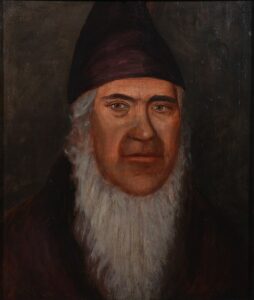
In the 1780s George Rapp, a vinedresser from Iptigen in southwest Germany began gathering followers as a Pietist preacher. [Image at right] Germany, of course, was not yet a nation state; it was made up instead of independently ruled territories. Each ruler determined the state religion, and life was often difficult for those who did not accept their ruler’s faith. Rapp and his growing following met in small private gatherings for Bible study and people increasingly travelled to Iptigen to hear Rapp preach. Rapp rejected the state instituted church and its demands for attendance and participation in rites, such as communion, and later baptism, although Rapp did baptize his children in the Lutheran church. Other Rappite practices, such as refusing to swear oaths to any but God, conscientious objection to military service (this was the period of the Napoleonic Wars), and homeschooling their children to protect them from the corrupting influences of the Lutherans placed the growing community in direct conflict with local civil and religious authorities. By the early nineteenth century Rapp and his followers had wearied of the constant demands to appear before the church council and of the fines, imprisonments, and harassment. Rapp scouted possible locations in the United States for them to establish a new community.

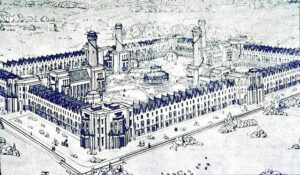
In 1805, Rapp and eight hundred of his followers purchased land in western Pennsylvania, near Pittsburgh. Pennsylvania was a favorable location because of its laws regarding religious tolerance, large German-speaking population, arable land, and access to trade. [Image at right] The Rappites set to work clearing land, erecting log cabins, and planting crops. Over time they added many industries including furniture building, shoe making, sawmill, textile mills for cotton, wool, and later silk, whiskey distilling, and wine and beer making to their farming income. The community signed the Articles of Association in 1805 agreeing that all personal property became the assets of the community, that all labor be donated to the group and that the needs of all members would be provided for from the production of the community. George Rapp was designated as sole leader and prophet of the now established Harmony Society. Despite the unity asserted by this agreement, the great efforts required in establishing their community and the initial poverty experienced by the Harmonists resulted in early conflicts and discontent, but Rapp overcame these by reminding them that the Harmonists were the elect and this was all part of their preparation for the Second Coming. Celibacy proved a practice that helped unify the Harmonists by offering practical benefits and a commitment mechanism. Rapp had a wife, Christine, and two children, Johannes and Rosina. When he preached celibacy, it was as a man who had experienced sexual and romantic love, not a dispassionate ascetic.

The Harmonists became successful farmers and industrialists, transitioning from subsistence living to wealth within a short period of time. The wealth of the community evoked jealousy and animosity from outsiders as did their largely insular habits and German heritage. During times of frontier instability, outsiders resented the Harmonists’ pacifism, although officials generally permitted the community to pay fines in lieu of military service. Tensions with neighbors, ongoing internal conflict, and a desire to be closer to shipping routes and in a warmer climate all convinced Rapp that he should move the community south.

In 1814, Rapp sold the village of Harmony and its land and bought a new property in southern Indiana near Evansville. Here the Harmonists built the village of New Harmony, better known under the tenure of the utopian Robert Owen, who bought it from Rapp in 1825. While establishing the new community brought the Harmonists together in a shared project, many died of a mosquito borne fever. New Harmony also became a successful enterprise under Rapp, but the growth in numbers, wealth, and political influence concerned their neighbors and led to even greater animosity than the Harmonists had experienced in Pennsylvania. In 1825, Rapp resolved to return north, and he bought land not far from Harmony to establish his final community, Economy. While all was not peaceful in Economy, internal acrimony outweighed external conflict.

Economy proved again that the Harmonists could balance preparing for the Second Coming with extraordinary profits. As the community aged, members hired outsiders as day labor without the expectation that they conform to the Rappite practices and faith. These were largely German speaking locals, although at one point the Harmonists employed Chinese laborers, abandoned by the railway, at their cutlery factory. During the Civil War the community took in widows and orphans and a handful of former slaves. Although not active in abolitionist circles, Harmony Society did not support slavery and provided materials and money in lieu of soldiers to the Union army.

Throughout its early history George Rapp’s adopted son, Frederick Reichert (who took the name Rapp) showed considerable acumen as he shepherded the Harmonist business interests. After Frederick’s premature death in 1834, George Rapp appointed Romelius Baker and Jacob Henrici as Trustees to manage the Harmonist business portfolio. Because Rapp lacked competency in English and because of his preoccupation with religious matters, this proved wise. For the remainder of the Harmonist’s history the community had a board of Elders led by Trustees who managed the business and dealt with conflicts in Economy.

After Rapp’s death in 1847, Baker and Henrici continued to lead the community until their own deaths. While they, particularly Baker, preached sermons on Sundays, it was in the role of Elder, not prophet. Successive Trustees, while managing practical affairs well, did not attempt to take on the role of religious leader and community commitment declined in later generations.

Arguably the most controversial leaders of the Harmonists were John and Susie Duss. John had lived among the Harmonists as a child when his widowed mother sought sanctuary during the Civil War. Duss left for a time but returned as a teacher, falling in love with his fellow teacher’s sister. Henrici asked John and Susie to leave once they determined to marry but reversed his decision largely because the Harmonists needed a teacher and music director. Both Dusses eventually served as Trustee although they were never part of the Harmonist faith. Some, including their contemporaries and historian Karl Arndt, viewed the Dusses as carpetbaggers who swept into Harmony in its dying days to steal the Harmonist fortunes. Although there were many lawsuits that upheld the Dusses actions, many questions have remained about their motives. In 1905, as the sole surviving Trustee, Susie Duss dissolved Harmony Society and inherited its wealth.

The Commonwealth of Pennsylvania acquired six acres of the site with seventeen buildings in 1916; the remainder of the land became part of the community of Ambridge. In 1966, Old Economy Village became a designated Historic Landmark District under the administration of the Pennsylvania Historical and Museum Commission. Much of the village has been restored and is open to the public. The archives of the Harmonist Society are housed there.

DOCTRINES/BELIEFS

Rapp was one of many Pietists who sought a more direct relationship with God and a more primitive style of Christianity than the Lutherans who dominated the region at this time. German mystics, such as Jakob Böehme and Phillipp Spener, influenced the development of Rapp’s theological writings. Arguably, the Book of Revelation in the New Testament of the Bible played the strongest role in shaping Rappite beliefs.

In late eighteenth century Germany, the context for the development of Rapp’s ideas, the Book of Revelation acted as a lens for understanding their time. The Napoleonic Wars brought death, destruction of industry and the landscape, disease, and famine. People in southwest Germany believed that the End Times were upon them. In this context, Rapp’s millennialism was hardly unusual. Rapp preached that that the elect must prepare themselves for the Second Coming by perfecting themselves through Christian living. By this, he meant not simply adhering to the Christian faith, but living life according to the teachings of Christ.

Hard work, simple living, and belief in salvation through Christ were the initial practices that illustrated this doctrine. Rapp learned that removing oneself from the corrupting influences of greater society and the Lutheran Church, rejecting civil and church authority, and pacifism, proved more contentious practices. By forming a largely insular communal society, Rapp and his followers committed to their practices and each other.

Rapp incorporated some less common beliefs, or at least found ways to connect them to his community and their practices. For the Rappites, the path to harmony involved the pursuit of spiritual wisdom, an idea Rapp took from the writings of Saint Paul via Jakob Böehme. The personification of this spiritual wisdom was, for the Harmonists, the virgin goddess Sophia. Sophia appears frequently in Harmonist hymns and poetry, including in some that appear romantic or erotic in their relationship to the virgin. Sophia was the Harmonist’s guide along the path to wisdom and harmony in preparation for the Second Coming of Christ.

Another symbol incorporated by the Harmonists, including in their folk art and product trademarks, was the Golden Rose. The Rose is similar to the Catholic symbol used during Lent on Laetare Sunday as a symbol of commitment to the Catholic faith. It also symbolizes the hope of salvation. Martin Luther chose a white rose with a gold ring around it as a symbol of faith and love. For Rapp the rose was a symbol of Jesus and perfection, therefore tied to the Harmonists’ messianic or millennial beliefs.

Sophia was not the only woman to appear in Rapp’s sermons. Again, turning to the Book of Revelation, in chapter 12:1-17 a woman, identified by Rapp as his church, flees Satan to the wilderness, identified by Rapp as the American frontier, where God has prepared her a sanctuary. This woman is described as being clothed with the sun and this Sunwoman became a repeated symbol that Rapp would bring up in times of strife and fear about the future. Like the Sunwoman, the Harmonists would flee Satan into the wilderness and build a new life under God’s protection.

Despite the use of feminine symbolism and the more egalitarian structure of German Pietism, Rapp stuck to a very traditional, patriarchal view of mortal women and their place in his society. Women were not permitted religious leadership roles or much voice in community affairs. Traditional gender roles were reinforced, and the division of the sexes in their daily lives suggests a suspicion of the corrupting influence of allowing men and women to mingle, particularly unsupervised.

Rapp introduced celibacy as a practice soon after the move to America. While there were practical reasons for the change, Rapp did not emphasize these. Rather, he focused on celibacy as a demonstration of commitment to the Harmonist faith and its role in their quest for Christian perfection. Drawing again on Böehme and the German mystics, Rapp pulled the concept of a perfect androgynous or dual-sex God. Böehme explained that God created man, perfect in God’s image. With the creation of Eve, Adam lost his dual nature, and after the Fall, mankind lost his perfection. Rapp taught that mankind would regain this duality and perfection after the return of Christ. As man would be both male and female in one body after the Second Coming, marriage and sexuality would become redundant. To perfect themselves for this imminent new age, the Harmonists committed to celibacy.

RITUALS/PRACTICES

In the early days in Württemberg, the Rappites’ rituals and practices appeared more notable for what they were not rather than what they entailed. The Bible and Luther’s writings were used by the Rappites as guidance in creating a Pietistic religion and ridding themselves, as Luther suggested, of the institutional corruption of the Catholic Church. Rapp preached against the institutionalized Lutheran church and the worldly civil authorities more than he actually set down a body of practice for his followers. Rapp argued that the Lutheran institutions did not go as far as Luther encouraged in a return to the simplicity of the early church.

The Rappites homeschooled their children because reading skills were essential for enabling personal reading and the study of the Bible. The goal was to empower believers to form their own opinions about what they read and ask the questions that mattered to them rather than have a priest determine what they should learn and how they should understand the word of God. This was also a Lutheran practice, however, Rapp believed that homeschooling would also protect the children from worldly influences. Rapp taught that oaths should only be sworn to God and not earthly beings, creating conflict with the demands of local authorities.

Once the Rappites immigrated to the United States, they had a huge advantage over the typical frontier settler in that they had a group to share labor and resources with and a social network for support through hard times. Rapp drew on the Book of Acts and early Christianity to validate his teachings about communalism. The Rappites adopted the practice formally as part of their Articles of Agreement in 1805. By sharing labor and resources, the Rappites quickly established a village with industries to support the community. In return, the community provided its members with food, shelter, clothing, education, worship and healthcare including in old age and infirmity. Many members who left quickly realized that they missed these benefits and that it was incredibly difficult and lonely establishing oneself as an individual. While cash wages and freedom from Rapp’s control continued to appeal to some members, most accepted and enjoyed living communally.

Rapp realized early on that this enormous undertaking required all hands on deck. This included expecting members who had worked white collar and professional jobs in Germany to contribute manual labor. He used his mystical ideas about God to explain that celibacy was the desired state for all members of the elect as after the Second Coming they would return to the dual sexual nature of God and marriage and sex would become irrelevant. Of course, being celibate also meant that the women in the community were more available to contribute their labor as they were not limited by pregnancy and childbirth or caring for babies. As Rapp taught that the Kingdom of God was imminent, there were no concerns about longevity or maintaining population growth.

The Harmonists lived in households with a designated head. Men and women slept on separate floors. Households often included former spouses who continued to live together but as brother and sister rather than husband and wife. Rapp required young people wanting to marry to leave the community, and in only very rare instances were they permitted to return. Work largely followed normative gender roles, which facilitated gender segregation in the workforce. A few women, including Gertrude Rapp and Hildegard Mutschler, acted as workplace leaders. Sexuality became a flashpoint for the Harmonists in the 1830s.

Although, typical of Protestants and Northern Europeans of the time, the Harmonists believed in hard work; they also practiced admirable work/leisure balance. Every day time was set aside, while plain and noticeably out of style by outsider standards, was comfortable, practical, and included textiles manufactured by their own mills. These included cottons, wools and silk. Every house in the Harmonist villages included not only a vegetable garden but flowers for their aesthetic benefits. George Rapp’s granddaughter Gertrude stood out as a musician and artist and as the director of the silk industry. She was known for her skill as a needle worker, flower arranger and maker of wax flowers, pianist, and singer.

The Harmonists included music in both their school curriculum and their worship services. Under John Duss the Harmonist band toured and performed for outside audiences. Duss also received funding from the community for his career on the outside as a band director and producer of operas. Harmonists wrote and arranged many hymns and poems, including several to the goddess Sophia, personification of wisdom. These were used in weekly services and rituals. When a Harmonist died, the community gathered to bid them farewell and they were buried in unmarked graves.

Every Sunday the Harmonists gathered first at the schoolhouse to hear the children perform their lessons and then at an afternoon and evening service with sermons and music. During the week there were also sermons on two evenings. George Rapp would sit on a small dais to one side at the front and deliver his sermons seated. Women sat on Rapp’s left and men on his right, and they entered and departed through separate doors.

Four to seven times yearly the Harmonists would hold feasts in their Feast Hall. Every year there would be feasts for the founding of the Society (February 15), Easter, Christmas, and in August a Thanksgiving or Harvest Home. Later, the anniversary of George Rapp’s death (August 7) was added to the calendar. Another celebration was the Love Feast, which began with confession to Father Rapp followed by a meal and religious service. These did not follow a set schedule and appeared at times of strife as well as other occasions, possibly as Rapp recognized a need to affirm their beliefs and commitment. Meat-based stew with spaetzle was an essential component to the Love Feast meal. These celebrations were closed to outsiders.

ORGANIZATION/LEADERSHIP

The Harmonists were a classic example of patriarchal, authoritarian leadership. George Rapp acted as community leader, preacher and prophet to the Harmonists. His word was law, whether in regard to religion or group practice. Because Rapp never mastered the English language, he was dependent on Frederick Rapp, his adopted son, to manage the business affairs of the community and contact with outsiders. His granddaughter Gertrude was sent to live with the Shakers to master English and afterword helped Father Rapp with his correspondence.

Members of the community, as part of their acceptance into the Harmonists, signed the Articles of Agreement. In doing so they ceded their rights to their property and to payment for their labor and agreed to obey George Rapp. Rapp agreed in return to provide for the spiritual and physical wellbeing of his followers. In repeated lawsuits, the courts upheld the Articles of Agreement as a legal contract and denied the claims of disgruntled former members to their assets or payment for labor given to the Harmonists.

Unlike many religious groups, there was no competition among the Harmonists to replace George Rapp as prophet and spiritual leader after his death in 1947. The Elders of the community led the religious services and gave sermons, but no one claimed prophetic powers or made religious pronouncements. By the time John Duss became Trustee, the religious commitment of the Harmonists had declined considerably, and although he tried to act as religious leader, he was not taken seriously, probably because he had never been a follower of George Rapp.

The Harmonists elected their Board of Elders, with women as well as men having the right to cast a ballot. The Elders appointed the Trustees. These were men only for most of the Harmonists’ history, and until John Duss they exemplified commitment to the Harmonist religion and community. By the 1880s the male membership in the community had declined to the point where women were elected Elders for the first time.

John and Susie Duss were unusual in that they joined the community late, did not convert to the Harmonist faith and, particularly John, faced conflict over their selection as Trustee. Controversy and lawsuits marked John Duss’ tenure as Trustee as former members sued to gain access to the Harmonist wealth. Duss resigned as both member and Trustee and turned the helm over to Susie in the twilight years of the community.

At the end of the community, remaining member Franz Gillman willed Susie Duss his share of the remaining (but still considerable) Harmonist wealth with the understanding that she would continue to care for him in his few remaining years. Susie then became the sole inheritor and controller of the Harmonist assets, which she retained after dissolving the Society as a legal and religious entity in 1905. While Susie Duss represented an unusual use of legal and financial power as Trustee of the Harmonists, a few other women, notably Gertrude Rapp, exercised soft power as “first lady of Harmony,” exerting influence over her grandfather and uncle.

Women could act as foreperson for groups of women laborers, such as housekeepers, silk workers, gardeners, and seamstresses, but only within than gender restricted venue. In her early twenties, Gertrude Rapp led the silk industry at Harmony. She was unique in her role as businesswoman and scientific expert. Outsiders in the industry regarded her as knowledgeable and skilled. However, Gertrude Rapp and Susie Duss were exceptional Harmonist women as labor and leadership within Harmony Society were distinctly divided on a traditional gender role basis that was rarely breached.

ISSUES/CHALLENGES

The Harmony Society existed at the intersection of communal society and new religious movement. This proved advantageous for the Harmonists as their more insular organization acted as an incubator for their divergent religious beliefs and practices. It is much easier to enforce and maintain religious differences if everyone within a community practices them. Likewise, those differences reinforced the community’s belief in their uniqueness and special status and set them apart and in opposition to outsiders. The faith of the community and commitment to its practices encouraged the bond between community members and helped them persevere through hardship.

Many communal societies have struggled with the problem of freeloaders, but for the Harmonists, because their work served as a means to promote the common good and to prepare the community for the millennium, those that committed to the Harmonist beliefs worked willingly. There are no written records of members being expelled for idleness, although some left because they wanted payment for their labor. The Articles of Agreement signed by Harmonists protected the community from lawsuits as the courts viewed it as a legal contract.

The Harmonists adopted celibacy as a practice early on for practical and religious reasons. Interestingly, although celibacy quickly became the normative practice, it was never officially included in the articles of agreement that members signed. The records of the community show the steady decline in births after celibacy was accepted indicating that it was widely accepted. A few members left over this issue, but the majority complied at this time. Not everyone who stayed agreed with celibacy; however, the majority embraced it as a way to demonstrate their commitment to Christian perfection.

Throughout the history of the Harmonists celibacy, shared labor and communal resources, and Rapp’s authoritarian leadership proved the most contentious issues. The upheaval of the move back to Pennsylvania and lingering dissatisfaction with communalism and celibacy provided an opportunity for a con man to move in and attempt to wrest the leadership of the community and its then vast wealth from George Rapp. Count Leon, also known as Proli or the Lion of Judah, took interest in the Harmonists as word of their prosperity and success reached Germany. He contacted Rapp, writing in religious terms, and requested permission to visit. Unfortunately, Rapp acceded, leading to the Great Schism and the turning point in Harmonist fortunes. Leon talked to Rapp’s followers and listened to and encouraged their grievances. He promised them that as leader he would do away with celibacy and communalism while still preparing the Harmonists for the Second Coming. Many members, particularly later generations, were taken in by Leon and voted to replace Rapp as leader. The majority rejected the attempted coup, and, as a result, a third of the members left with Count Leon taking labor, skills, and Harmonist wealth with them. The breakaway community did not live up to the promises made, but the disillusioned were not permitted to return. The Harmonists’ decline began with the Great Schism and the loss of numbers and resources.

One of the conflicts that ignited anger to Count Leon’s benefit was the Hildegard Mutschler affair. Hildegard was a young, pretty, flirtatious woman. She had a failed romance that ended with the young man leaving the community. Hildegard then worked as George Rapp’s assistant in his alchemy laboratory, a position previously held by Frederick Rapp. Frederick Rapp was outraged by both the loss of position and by the idea that his father was engaged in close work unchaperoned with a young woman. It was scandalous! Other members commented on the inappropriateness of the relationship although it is impossible to know whether there was simply the appearance of impropriety or whether something actually occurred. Hildegard later eloped with Conrad Feucht, a Harmonist business leader. Rapp, in contradiction with precedent, welcomed the married couple back with their children a few years later. Other Harmonists resented the favoritism and inconsistency in the application of rules of conduct.

One of the big challenges for a charismatic-led religious group is how to proceed after the leader dies. In his final years, Rapp’s sermons focused on keeping the faith and and the hope for the imminent return of Christ. When George Rapp died in 1847, members struggled to accept that the Second Coming had not arrived in Rapp’s lifetime as he had prophesied. The number of members who had been part of Rapp’s original following had diminished and they were aging. Younger members felt less loyalty to Rapp and his teachings and less commitment to Harmonist practices, including celibacy. This period marked increases in lawsuits and withdrawals as young people left to marry and to work for pay, although many found life on the outside difficult and unfriendly. Several petitioned the Trustees to return; however, they were generally denied. In a few cases, the petitioners were offered a loan or small charitable donation to help them get established. Rapp’s death together with the Great Schism and the practice of celibacy all contributed to the decline of the community.

IMAGES

Image #1: George Rapp. Credit: Wikimedia Commons. Public Domain.
Image #2:  Architectural vision of the New Harmony community. Credit: Wikimedia Commons. Public Domain.

REFERENCES**
**
Unless otherwise noted, profile content is drawn from Cheryl Coulthard, Communal Societies and New Religious Movements (New York: Cambridge University Press, 2024).

SUPPLEMENTARY RESOURCES

Arndt, Karl J.R. 1965. George Rapp’s Harmony Society, 1785-1847. Cranbury, NJ: Associated Universities Press.

Kring, Hilda A. 1973. The Harmonists: A Folk-Cultural Approach. Metuchen, NJ: The Scarecrow Press.

Old Economy Village website. https://www.oldeconomyvillage.org/.

Reibel, Daniel B. 2002. Old Economy Village: Pennsylvania Trail of History Guide. Mechanicsburg, PA: Stackpole Books.

Publication Date:
31 December 2024

Share

Aumism

AUMISM TIMELINE

1923 (June 25):  Gilbert Bourdin was born in Martinique.

1956:  Bourdin left Martinique for France.

1961:  Bourdin traveled through India and was initiated as Swami Hamsananda Sarasvati by Swami Sivananda at Rishikesh in the Himalayas.

1962:  Sarasvati retired as an ascetic hermit to a cave in Vaucluse (Southern France).

1967:  Sarasvati founded the “Association des Chevaliers du Lotus d’Or” (Association of the Knights of the Golden Lotus).

1969:  Sarasvati and his first pupils purchased the land in the municipality of Castellane (Haute-Provence Alps, France) where they established the first monastery and began to build the Mandarom.

1977:  The Lotus Temple was constructed, and Sarasvati visited the Sixteenth Karmapa in the Holy City of Mandarom.

1981-1990:  More prominent temples and statues at the Holy City were constructed. Gradually, the community developed, and Sarasvati realized his messianic role during the rituals of the cosmic battles against evil.

1990:  Sarasvati proclaimed himself the “Cosmoplanetary Messiah” and Avatar of Synthesis His Holiness Hamsah Manarah.

1991:  The Association Cultuelle du Temple Pyramide was created.

1992:  Robert Ferrato (ecological activist) started his campaign against the Holy City of Mandarom Shambhasalem and the Aumist religion, both environmentally and financially.

1994:  The Holy City of Mandarom was searched to verify the civil building permits concerning statues and temples, and the Court of Appeal of Lyon annulled the building permit for the Pyramid Temple.

1995 (January):  The Holy City of Mandarom was raided by the police.

1995 (June 12):  Bourdin/Lord Hamsah Manarah was charged with rape and arrested. The building permit for the Pyramid temple was annulled.

1995 (December):  Aumism was included in the Gest and Guyard’s report on sects to the French National Assembly.

1998 (March 19):  Hamsah Manarah died at the hospital in Grasse of complications from diabetes. His inhumation was allowed not at the Holy City but rather in a little cemetery in front of a few followers on April 6 after several changes of destination.

2001 (September 6):  The temple-statue of the Cosmoplanetary Messiah was destroyed.

2007-2013:  Suits against France over taxation matters were taken to the European Court of Human Rights.

2013-2019:  Lawsuits were filed at the national level to obtain the building permits for the Pyramid Temple.

FOUNDER/GROUP HISTORY

Gilbert Bourdin was born on June 25, 1923 in Martinique to a French and Catholic family. Little is known about his early life. As Zoccatelli wrote (2004:186), “He himself worked to surround his biography with a veil of inaccessibility, for example when he places at the frontispiece of one of his books the phrase: ‘The High Tradition demands that one does not speak of the past of a man of religion’.” In his writings, he described his life growing up as painful and declared during his youth years an attitude of strong atheism (Zoccatelli 2004:185-86; Hamsah Manarah 1993a). He left Martinique in 1956 to study law, medicine, political sciences, and economics in France. During this period, he engaged with several esoteric milieus, joining the Theosophical Society, the Freemasonry of the Grand Lodge of France, and various Rosicrucian and Martinist circles (Introvigne 1999; Duval 2002).
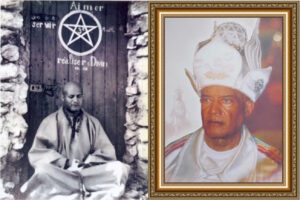
During his travel to India in 1961, he was initiated under the name of Swami Hamsananda Sarasvati by the influential Swami Sivananda (who founded The Divine Life Society) at Rishikesh in the Himalayas. [Image at right] When he returned to France, he spent about one year, around 1962, as an ascetic hermit practicing the Hatha-yoga, meditation, and purification in a Vaucluse cave (Southeastern France). After this period, he started to gather some followers. Sarasvati became quite well-known as a yoga teacher, publishing several books on that topic, also translated into languages other than French (Hamsananda Sarasvati 1976). After having experimented with yoga teachings in several ashrams, in 1967, not far from Avignon, Sarasvati founded the “Association des Chevaliers du Lotus d’Or” (Association of the Knights of the Golden Lotus). The Association was a philanthropic association aimed at human development through sciences, arts, philosophy, and comparative music, with the goal of bringing religions closer together (Journal Officiel de la République Française 1967, 10 Octobre :10000).

In 1969, a plot of land was purchased in the municipality of Castellane in the French Haute-Provence Alps, where, together with his first pupils, Gilbert Bourdin started to build the Holy City of Mandarom Shambhasalem. He created the initiatory order of the Knights of the Golden Lotus which pursues through prayer the mystic change and spiritual realization of men and women (Hamsah Manarah 1995a).

In the following two decades, the founder taught the principles of yoga, practiced meditations, and improved his ashram, while the group of followers increased. Meanwhile, through his followers’ financial and physical support, several temples and statues of different sizes (from less than one meter to around twenty meters) were built, and the Holy City took actual shape. Each of the biggest temples constructed represented one of the world’s great religious traditions; the first to be completed was the Lotus Temple (1977). This was the earthly home of the spiritual master, where he resided until his hospitalization and death in 1998. In 1981, the Statue of the Buddha was complete, and it remains one of the tallest Western statues of seated Buddha. In 1987, the gaze of the Statue of the Cosmic Christ was completed. In 1989, several buildings were finished: the Mosque with four minarets dedicated to Islam, the Temple of Kalki as a column of fire representing Hinduism, and the Jewish Golden Temple built following the symbolism of the golden ratio. The large temple-statue of the Cosmoplanetary Messiah was erected in 1990, thirty-three meters high. It was placed between the Cosmic Christ and the Maha Buddha as the symbolic unification of Eastern and Western Religions (Aumisme 2024a), and his face had the likeness of the spiritual master Hamsananda Sarasvati, later revealed as Lord Hamsah Manarah. The sacred architecture should have culminated with the construction of the Pyramid Temple, which was thought to crystalize the cyclic conception of time of the Golden Age, balancing cosmic forces (Hamsah Manarah 1995a). This project remained ongoing because, after the building permits were obtained in April 1992, they were contested and annulled at different levels of French administrative law. They continued until the last initiatives of enhancement of the landscape specificities (Unpublished material provided during the Author’s field visit in 2023).

During the 1980s, in parallel with the construction of the temples in the Holy City, slowly and through a significant number of rituals, Sarasvati cultivated additional religious and spiritual affiliations. These consisted of numerous initiations in the Hindu, Jainist, Tibetan Buddhist, Indian Sufi, and African traditions, and included one by the Sixteenth Karmapa that he received during his visit to the Mandarom in 1977 (Aumisme 2024a). This period of study of the writings of several spiritual and illuminated masters, as well as sacred books of different religions, marked the maturation of his own religious system and recognition of the prophecies and his past lives. This led to his realizing his messianic role (Zocatelli 2004; Palmer 2013) that focused on his calling to produce a spiritual revolution and establish the Universal Religion of the Unity of the Faces of God (See, Doctrines/Beliefs). From being a guru initiated to different religions, he revealed himself as like the incarnation of God, an “Avatar of synthesis” (Zoccatelli 2005:217-18).

This revelation was announced in May 1990 at a press conference at the Holy City inviting the public to the celebration of that year’s August full moon. It was at that long ceremony that the Aumist spiritual master crowned himself as the Cosmo-Planetary Messiah. This revelation consisted of becoming His Holiness, the Lord Hamsah Manarah. His mission was to save the Earth, help humanity, and take charge of the planet’s future. According to the Aumist conception of time, he might have brought about the Golden Age of Peace, Unity, Truth, and Freedom. Six more ceremonies of the Revelation and of the Sevenfold Crowning of the Avatar of Synthesis followed, with one for each major religion, until the seventh ceremony. The last step of the Revelation, one year later, took place on August 22, 1991 in front of the Aumists and the world press, who were invited to each of these events (Palmer 2011, 2013).

In 1991, the group created a new association, Association Cultuelle du Temple Pyramide (Cult Association of the Pyramid Temple) to gather and manage financial resources to be allocated to the construction of the Pyramid Temple. This temple was and has remained dedicated to the cosmic realization of the materialization of this religion; the sacred architecture would embody and achieve the messianic purposes of Lord Hamsah Manarah (Hamsah Manarah 1993a; Belanger 2012). Notwithstanding the initial building permission, the construction project has been opposed by a local ecologist association, the Association pour la protection des lacs et sites du Verdon (Association for the Protection of the Lakes and Sites of the Verdon). The association, led by an ecologist, engaged in the protection of the Verdon landscape and environment against ecological damage. The Association “claimed that the Mandarom is an offense to the ecological equilibrium of the mountain” (Introvigne 1999:368).

The following decade was meant by the group as a universalistic opening of the Aumist religion to the world. The founder published five books titled Books of the Revelation, which presented the theological, symbolic, and ritual system of Aumism. Revelation, rather than expanding the size of Aumism, coincided with the beginning of a period of strong social control by French institutions (Palmer 2011). Adherents referred this as religious persecution (Jacot 2008; Hamsah Manarah 1991) because Aumism was listed in the French institutional anticult organizations’ accounts (Palmer 2013). In the mid-1990, the movement was confronted with several allegations of financial fraud, rape by their spiritual leader, and infringement of zoning and urban planning laws (See, Issues/Challenges). In 1992, the movement was opposed by the local ecological association, which raised media attention on the impact of the sacred architecture of the Holy City of Mandarom Shambhasalem on the alpine and mountain landscape (Introvigne 1999:368; Palmer 2011:41-42). This was probably a turning point, as can be elicited from the report of Gest and Guyard (1995:18). During the year 1995, Gilbert Bourdin (Mandaja 1995) and some of the Aumisme followers were arrested (See, Issues/Challenges) at the Mandarom and elsewhere in France, but released a couple of weeks later.

In May 1996, the spiritual master issued a press release stating his proposal to withdraw from public teaching, relinquish his title of Messiah, and either destroy or detonate the statues of the Holy City of Mandarom Shambhasalem (Introvigne 1999:369). Indeed, he did not follow up on this announcement, but legal battles were meanwhile opened on several fronts: fiscal tax controls on the two different associations created to manage the religious group (see Organization/Leadership), rape allegations greatly amplified in the press and on television (Palmer 2011:45-46), and infringement of urban laws for temples and statues.

Long ill and aware that he has been diabetic since the 1970s, Gilbert Bourdin was hospitalized in Grasse after a deterioration in his condition in March 1998. He died on March 19 at age seventy-four. The spiritual leader’s death came on the heels of an extremely sensitive period for new religious movements that were questioning not only French institutions but especially European public opinion because of the 1994 mass suicides of some members of the Order of the Solar Temple in Switzerland. Rumors about mass suicide were also advanced against the Aumists (Palmer 2001:36; Palmer 2013:39-40). The French authorities framed his death in terms of the possible problems of public order (typical in managing minorities’ rights in France. See, Dieu 2020). Further, the possibility of watching over their Messiah, as well as celebrating his funeral and interring his body in the Holy City were repeatedly obstructed. Finally, after several prohibitions from prefects and mayors in the neighborhood of Grasse or Castellane, Lord Hamsah Manarah was buried in a small, abandoned cemetery in the municipality of Castellane, under a thick pour of concrete, despite an unfavorable public demonstration by the mayor and a hundred citizens (Introvigne 1999:370-71; Duval 2002:93-96).
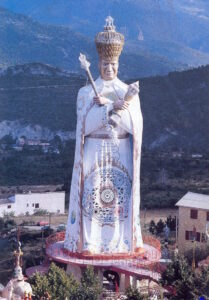
Lawsuits continued after the death of the spiritual master. Although charges of rape were dropped upon his death, the cases concerning urban infringement continued, particularly those concerning the biggest temple-statue of the Cosmoplanetary Messiah at the Holy City of Mandarom Shambhasalem. [Image at right] This construction could not be undertaken without proper permits, leading to a lengthy legal battle. Despite the fact that members of Aumism have always claimed to have obtained the necessary permits, the French authorities challenged their validity. This led on September 6, 2001 to a court order of the destruction of the thirty-three-meter-tall statue of the Cosmoplanetary Messiah. After forcibly entering the Holy City of the Mandarom Shambhasalem, police demolished the temple-statue with explosives. The event was widely publicized, drawing international attention also for the evocative power of the statue’s demolition and for that same year’s events (the destruction of the Bamiyan Buddha in Afghanistan in March 2001 by Taliban and the demolition of the Twin Towers in the U.S. a few days after the detonation of the Cosmoplanetary Messiah in France) (Aumise website 2024b).

In the following decades, the group’s legal actions continued in several sectors: concerns on fiscal regimes as a cult association, contesting the expenses for the demolition of the Cosmoplanetary Messiah, the retired permission to build the Pyramid Temple, etc. Even if a small number (a few hundred), the group has survived not only in France but also in Africa and is still waiting for the reincarnation of their next Hierokarantine (Introvigne 2017; Rech field visit in 2023).

DOCTRINES/BELIEFS
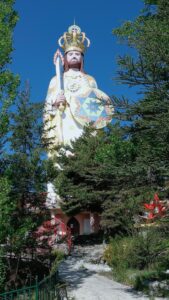
When Aumists present themselves to external visitors (a guided tour of the Holy City of Mandarom is organized throughout the year: [Image at right] Aumisme 2024c), they affirm themselves to be a religion of action, that is, according to scholars, an active philosophy of action (Perocco 2001; Zoccatelli 2004).

Aumism is both an esoteric and occult order and a church-like organization. It originally had a Hindu identity and then transformed into a syncretic universalism that blended Christianity, Buddhism, Hinduism, Jainism, Islam, and Judaism. This was the consequence of the founder’s self-identification (the “revelation” in the Aumists’ words, See Founder/Group History) as the Cosmoplanetary Messiah and Synthesis Avatar (Zoccatelli 2005; Perocco 2001; Belanger 2012). The founder has defined his spiritual itinerary from Hinduism to the universalist and syncretic religion as a moral and spiritual revolution. The entire Aumist doctrine is contained in the twenty-two volumes written by the founder. The volumes cover the different phases of Aumism from the very early stages until the actual phase, which is the transition age after the death of the founder and the waiting period for the Messiah’s reincarnation (Jacot 2008). The religious system is dense, merging oriental philosophies and practices with messianism, esoterism, and apocalyptical millenarism (Perocco 2001). From this perspective, new elements contributing to belief system coherence are the unique dogma of Unity of God’s Faces; the cyclical time conception, which is settled in the scale of evolution of nature represented through a pyramid; and the Column of Light.

Aumist religion is based on the dogma of Unity of God’s Faces. This means that it is always the same God (named the “God of Unity”) who has manifested himself to humankind since the dawn of time, despite the apparent multiplicity of his “Faces.” God is one, while men/women divide it, according to Lord Hamsah Manarah’s teachings. This is materially noticeable in the sacred architecture of their Holy City in France. From this point of view, each religion is a varied and symbolic expression of the same transcendent reality. In the Aumist doctrine, contemporary society would need adaptation, which is offered by this syncretic approach, and the synthesis is represented by the doctrine revealed by the founder in his books and teachings.

This synthesis is also represented in the symbol of Hexamid, which is a six-sided pyramid, each face displaying a color of the rainbow, symbolizing a different religion. At its apex, all religions converge into the unifying OM, the radiant white light of synthesis (Hamsah Manarah 1991; Belanger 2012).

Time is cyclical in Aumisme and composed of four continuous and intertwined cycles: the Silver Age, the Copper Age, the Iron Age, and the Golden Age. There exists a fifth period, the Diamond Age, which transcends them, and which alone is not subject to time. Souls are subject to these cycles, but they are at different levels of evolution. The Aumist belief system divides creation into different planes or “kingdoms of nature”: mineral, vegetable, animal, and human. According to their doctrine, reincarnation allows beings to progress through these planes, evolving from one to the next. So, in the groove of Hinduism, Buddhism, and Jainism, Aumists share the belief in reincarnation (Zoccatelli 2005:219). Their spiritual master, through the revelation of “five truths,” developed a doctrine aimed at the effort to liberate from karma. Aumists do not deny paradises, but they do claim that they are harmful to the spiritual life and to the evolution of the soul (Hamsah Manarah 1992).

In 1985, Hamsah Manarah postulated the creation of the Column of Light, a purported instrument for the reception of disembodied souls. Comprising six arms, each divided into twenty-one levels of consciousness, the Column of Light is conceived as a vast post-mortem educational institution (they commonly call it the “university for the souls,” field visit 2023). It is believed to facilitate the channeling and evolution of souls towards a divine state, integrating the diverse afterlife concepts of various religious traditions. This instrument is further posited to contribute to the crystallization and perpetuity of the Golden Age on Earth (Hamsah Manarah 1993b).

RITUALS/PRACTICES

As Aumism is both a monastic group and a church-like organization, the ritual life is crucial at the Mandarom (which is a monastery) and in the ordinary life of the Aumists. Monks and nuns take vows of chastity and poverty, but the vows are not perpetual: they may cover a period of some years of retirement (Duval 2002:46-47). Originally called Chevaliers du Lotus d’Or (Knights of the Golden Lotus), since the 1990s the initiatory order has taken the name of Chevalier du Vajra Triomphant (Knights of the Triumphant Vajra: see Organization/Leadership). This esoteric path comprises twenty-two levels of initiation and, as reported by Aumists encountered during the author’s field visit (2023), progression depends on commitment to knowledge and the personal mystical and spiritual effort.

According to Duval (2002:83-86), Aumists’ ordinary life is just differentiated by the attention to spreading symbols of protection in their houses and creating an altar that displays the image of Lord Hamsah Manarah, an oil lamp or candle holders, protective objects and supports burning incense. Apart from these, which could be dissimulated or hidden, there are constant in prayers, practicing yoga or other martial arts, and meditation. Those activities, together with vegetarianism and a general approach of renunciation and detachment from worldly and comfortable life, characterize each Aumist (Duval 2002:70-71). Visiting the Holy City of Mandarom (2023), the presence of sacred and religious symbols, citations of several sacred books or mystics’ citations, as well as representations of Lord Hamsah Manarah are widespread. This symbolic system would function at the unconscious level for bystanders and/or visitors.

The Aumists base their religion on the ritual repetition of the OM sound, even though the number of OM’s repetitions is symbolically determined and connected to the individual status and their role in the Aumist religion. It is understood as the repetition of the first of the mantras, which is a condensed sacred formula. This prayer is recited along with the blessings, and the sound of bells or drums, during public worship (Author’s field visit 2023). Its manifold benefits include the fact that it is a primordial sound of divine creation but also helps people regenerate themselves. Through the ritual repetition of this sound, the energy of Unity is released to improve the cosmic evolution and build a new age or a Golden Age (Hamsananda 1990).

According to the dogma of the Unity of Faces of God (See Doctrines/Beliefs), Aumists have seventeen festivities every year. These unite Lord Hamsah Manarah’s anniversaries (e.g. his initiations and revelation) with other major cosmic, spiritual, and religious festivities that belong to Christianism, Buddhism, Hinduism, Jainism, Islam, and Judaism. They also celebrate five sacraments, highly inspired by Christianity (Hamsah Manarah 1995b), and Catholicism in particular (Duval 2002:168-80). These include baptism, confirmation, renewal of vows and promises, marriage, transition (Hamsah Manarah 1995b).

ORGANIZATION/LEADERSHIP

Aumism is an esoteric and initiatory order, but also a church-like and new syncretic religion that was originally inspired by Hinduism and then became a messianic movement and religion (Zoccatelli 2005). Comprising both men and women, it is divided into a monastic order, a priesthood order (with bishops, priests, and priestesses), and all the members. The actual organization dates to the period of the 1990s, which followed the revelation (See Founder/Group History).

From an external organizational point of view, Aumism has always been organized under the French Republic’s 1901 law on association. On the one hand, the Aumism initially was composed of members of the Order of the Knights of the Golden Lotus, and among them, there were members of the monastic order. On the other hand, an exoteric branch was made up of the faithful people who had received the “baptism of OM” and were initiated by the spiritual master. Various regulatory bodies were set up after the dissolution in 1995 of the Association of the Knights of the Golden Lotus: “Association des Chevaliers du Vajra Triomphant” (1995-present) and the “Association Cultuelle du Vajra Triomphant” (1991-1995) were established for different tasks. Gradually, prayer centers or Centrom were also created to welcome and bring together members of the Aumist Church, according to their place of residence. Administratively, there were fourteen regions, with each administered by a “region leader” who may be a priest or a bishop (Duval 2002).

The monastic group is actually composed of about a dozen people (Author’s field visit 2023), who live in the Holy City of Mandarom Shambhasalem, the headquarters of the Aumist religion (Author’s field visit in 2023). Duval (2002), during his ethnography between 1997 and 2000, counted a maximum number of about 400 followers, while Gest and Guyard listed about 2,000 followers (1995:17). Introvigne (2017) reported that members “decreased from 1,300 in 1990 to 300 in 2001. However, this decline proved not to be irreversible. The number of Aumists started increasing again in the twenty-first century, reaching ca. 500 in 2017” (2017:29).

After the spiritual master’s death in 1998, the collegial administrative structure (made up of officials from both the Monacal Order and the Initiatory Order) remained the sole legitimate decision-making authority. Members argued that Lord Hamsah Manarah envisioned a collegial leadership structure to carry on the religion’s teachings after his death. From an organizational point of view, Aumism is represented by the Association du Vajra Triomphant for material and financial purposes, and the Association cultuelle du Vajra Triomphant for everything concerning worship. Since the illness and death of the spiritual master, a collegial leadership was established to manage Aumism, and other committees were charged with specific projects (e.g. the biannual conference).

ISSUES/CHALLENGES

Aumist religion has been confronted with both internal and external disputes. The most visible and long-lasting have been external ones. Palmer (2011), Duval (2002), and Introvigne (1999) illustrated both the impact of negative media attention and the ways in which French anticult sentiment has provoked government interference, conflict with civil society, and public opinion antagonism. During the 1990s, Aumism (better known in the media as the Mandarom) was harshly confronted with judicial cases regarding financial fraud, allegations of sexual misconduct, and urban planning law infringement. The Mandarom community has been considered a sect by the French Anticult organizations. It was included on the 1995 Gest and Guyard’s (1996) list compiled to combat the sectarian drift (Introvigne 1999; Palmer 2001).

The group was repeatedly raided in the 1990s; the first inspection at the Holy City was aimed at verifying the civil planning code concerning statues and temples, in November 1994. One month later, the Court of Appeal of Lyon annulled the building permit for the Pyramid Temple. In January 1995, the tax officials and gendarmes burst into the Holy City of Mandarom, searching for documents and other items, while at the same time, in Paris, the administrative leader’s apartment was inspected. Some months later, the gendarmes came back to arrest Gilbert Bourdin. He was accused of rape by the daughter of a devout Aumist, as she stated in a book written in collaboration with the television journalist Bernard Nicolas (Roncaglia 1995). On the same day (June 12, 1995), about twenty other disciples were arrested elsewhere in France, and the day after, the Conseil d’Etat confirmed the annulation of the building permit for the Pyramid Temple.

Palmer (2013) analyzed the French anticult attitude toward Aumism as the labeling of the group as “a focus of moral panic” (2013:35-36), wondering about the boundaries between the social control of sects and religious persecutions (Palmer 2002). This is the product of a twofold issue. From one side, the French Republic presents a multifaceted form of secularism(s) (the French laicités, cf. Baubérot 2015) that has been established since the approbation of the Separation Law in 1905. According to that law, the French Republic guarantees religious freedom but does not recognize, remunerate, or subsidize any religion (Koussens 2023). As established in a previous research work (Rech 2024), the tension between freedom of conscience and religious regulation is difficult to balance in cases like this. While the French law protects individual religious freedom, it also requires the State to maintain neutrality. However, this neutrality is complicated by the need to regulate certain aspects of religious practice, such as public order (Dieu 2020) and manifestations or the maintenance of historical religious sites.

If the French official judicial jurisprudence is consulted, a remarkable number of suits concern the Association du Vajra Triomphant since 2004. In 2007, Aumism, through its Association Cultuelle du Temple Pyramide, took to the European Court of Human Rights its case against France concerning the taxation of manual donations and its rights to exercise religion.

Apart from the lawsuits, the group has always exercised the right to reply in the media, and, on their website, they have collected a large number of documents that witness the entire set of legal affairs, media materials, and scholars’ works that involved them (Aumisme 2024a). The group has been effectively exposed to a phenomenon of media disrepute, which was referred to as “mediabolization” (Palmer 2011; Duval 2002) that has yielded deviant status (Berzano 1996). This long process of disqualification by French and international public opinion is counterbalanced by tireless action in the legal arena that has extended from the various national courts to the European Court of Human Rights to have its legal status recognized. Introvigne explained, in a 2017 speech, how the group survived through the legal affairs that he named a “tale of resistance” (confirmed in interviews during the Author’s fieldwork in 2023).

Another important challenge was the succession of leadership, which is a decisive issue both internally and externally. From an internal point of view, Aumists are still waiting for a future incarnation. When Palmer conducted her study on the groups especially addressed in the Gest and Guyard’s list (Palmer 2011), Aumism was present in North America, and particularly in Canada. A Canadian association dedicated to the promotion of Aumist prayer and meditation meetings was registered in 1997 but ceased activity in 2004. Among Northern American and Canadian members there has been a potential “schism” over the transition of Lord Hamsah Manarah (Introvigne 2017:24; Duval 2002:96-97).

IMAGES

Image #1: © S. HAMSAH MANARAH Fondateur de l’Aumisme. This image is protected by copyright law. Unauthorized use, reproduction, or distribution of this image is prohibited. For permissions or licensing, please AVT MANDAROM AUMISME via e-mail  aum@aumisme.org.
Image #2: © Aumisme Le Messie Cosmoplanétaire. This image is protected by copyright law. Unauthorized use, reproduction, or distribution of this image is prohibited. For permissions or licensing, please AVT MANDAROM AUMISME via e-mail  aum@aumisme.org.
Image #3: Statue of the Cosmic Christ. Photograph and copyright by Giovanna Rech.

REFERENCES

Aumisme website. 2024a. Accessed from https://aumisme.org on 6 December 2024.

Aumisme. 2024b. Mandarom: Soutien international. Communiqué de Presse. Accessed from https://www.aumisme.org/archives/fr/cp/soutien_int.htm on 9 December 2024.

Aumisme. 2024c. Visite de la Cité Sainte de Mandarom Shambhasalem. Accessed from https://aumisme.org/n4-visite-de-la-cite-sainte-de-mandarom-shambhasalem/ on 4 December 2024.

Baubérot, Jean. 2015. Les 7 laïcités françaises. Paris: Maison des Sciences de l’Homme.

Belanger, Odile. 2012. L’Aumisme, étude religiologique. Montréal: Université du Québec, Mémoire de maîtrise.

Berzano, Luigi. 1996. “La déviance supposée du ‘phénomène sectaire’: l’exemple de la religion aumiste.” Pp. 315-20 in Pour en finir avec les sectes. Le débat sur le rapport de la commission parlementaire, edited by Massimo Introvigne and J. Gordon Melton. Parigi: Dervy.

Dieu, Frédéric. 2020. “L’ordre public et les religions : ordre public, ordre laïque? ” Revue du droit des religions 9:13-40.

Duval, Maurice. 2002. Un ethnologue au Mandarom : enquête a l’intérieur d’une “secte.” Paris : Presses Universitaires de France.

Gest, Alain and Jacques Guyard. 1995. Rapport fait au nom de la commission d’enquête sur les sectes, Assemblée Nationale, Rapport n° 2468, déposé le 22 décembre 1995, Dixième législature (1993-1997). Accessed from https://www.assemblee-nationale.fr/11/rap-enq/r2468.asp on 5 December 2024.

Manarah, Hamsah. 1995a. Périple d’un yogi et initié d’occident. La Baume (Castellane): Le Mandarom.

Hamsah Manarah. 1995b. Le livre des sacrements de l’Aumisme. La Baume (Castellane): Le Mandarom.

Hamsah Manarah. 1993a. La révolution du monde des vivants et des morts. La justice divine/ La Baume (Castellane): Editions Le Mandarom.

Hamsah Manarah. 1993b. Une loi pour détruire le mal. La sélection dans le jardin des âmes. La Baume (Castellane): Editions Le Mandarom.

Hamsah Manarah. 1992. La loi d’évolution des âmes. De l’esclavage à la vraie libération. La Baume (Castellane): Editions Le Mandarom.

Hamsah Manarah. 1991. L’Aumisme, la doctrine de l’Âge d’Or. La Baume (Castellane): Le Mandarom.

Hamsah Manarah (S.M. Hamsananda). 1991. Les combats du Messie attendu pour sauver la terre et la création. La Baume (Castellane): Éditions du Mandarom.

Hamsananda, S.M. 1990. La doctrine de l’AUMISME, fondement de l’Âge d’Ori. La Baume (Castellane): Editions Le Mandarom.

Introvigne, Massimo. 2017. Communicating the Incommunicable: How Aumism Survived, Communication during the European Association for the Study of Religion Annual Conference, Leuven September 19, 2017. Accessed from https://www.cesnur.org/2017/aumisme_leuven.pdf on  9 December 2024.

Introvigne, Massimo. 1999. “Holy mountains and anti-cult ecology: the campaign against the Aumist religion in France.” Social Justice Research 12:365–75.

Jacot, Jean-Marc. 2008. “AUMISM: The Birth of a New Religion. A Short History of the First 47 Years. 1961-2008.” Paper presented to the 2008 International Conference of CESNUR Twenty Years and More: Research into Minority Religions, New Religious Movements and ‘the New Spirituality, London 16-20,”April 2008. Accessed from  https://www.cesnur.org/2008/london_jacot.pdf on 5 December 2024.

Koussens, David. 2023. Secularism(s) in Contemporary France. Boundaries of Religious Freedom: Regulating Religion in Diverse Societies. Cham:Springer.

Mandaja. 1995. Mandarom: les persécutions du Messie. Nîmes: Lacour.

Palmer, Susan J. 2013. “Mandarom and the Limitations on Liberté in the Laïcité.” Pp. 29-49 in Spiritual and Visionary Communities. Out to Save the World, edited by Timothy Miller. London: Routledge.

Palmer, Susan J. 2011. “The Holy City of Mandarom: A Case of  ‘Médiabolization’.” Pp. 33-57 in The New Heretics of France: Minority Religions, la Republique, and the Government-Sponsored ‘War on Sects’.” Oxford: Oxford University Press.

Palmer, Susan J. 2002. “France’s Anti-Sect Wars,” Nova Religio: The Journal of Alternative and Emergent Religions 6:174–82.

Palmer, Susan J. 2001. “Ambushing the Apocalypse: Sects, Suicide and Stigma in the Media.” Pp. 113-36 in Chercheurs De Dieux Dans l’espace Public – Frontier Religions in Public Space, edited by P. Côté. Ottawa: LesPresses de l’Université d’Ottawa.

Perocco, Fabio. 2001. “Il New Age tra dislocazione sociale e ricomposizione del legame sociale. Il caso dell’Aumismo.” La Critica sociologica 137:82-99.

Rech, Giovanna. 2024. “The (In)visibility of Places of Worship in Two New Religions: A Comparative Analysis of Heritagization in Italy and France.” Pp. 241-60 in Religion Between Governance and Freedoms. Boundaries of Religious Freedom: Regulating Religion in Diverse Societies, edited by Olga Breskaya, Roger Finke, and Giuseppe Giordan. New York: Springer.

Rolland, Patrice. 2007. “La loi de 1905 à l’épreuve des sectes, Études théologiques et religieuses”  1:91-101.

Roncaglia, Florence. 1995. Mandarom. Une victime témoigne. Boulogne-Billancourt: TF1 Editions.

Sarasvati, Hamsananda. 1976. Naturopathie et yoga : sante, guérison, bonheur. Paris: Albin Michel.

Zoccatelli, PierLuigi. 2005. “Notes on the Aumist Religion.” Pp. 215-24 in Controversial New Religions, edited by J.R. Lewis and J. A. Petersen. Oxford, Oxford University Press.

Zoccatelli, PierLuigi. 2004. “L’Aumisme: religion de l’Unité des Visages de Dieu ou nouveau syncrétisme.” Pp 183-212 in La naissance des nouvelles religions, edited by J.F. Mayer and R. Kranenborg. Genève: Georg Editeur.

Publication Date:
30 December 2024

Share

Giovanna Rech

Giovanna Rech is a sociologist of religions and culture at the Department of Philosophy, Sociology, Education and Applied Psychology at the University of Padova (Italy). She holds a PhD in Social Sciences and Philosophy of Knowledge (University of Paris 4-Sorbonne, France) and a PhD in Methodology and Epistemology of Social Science (University of Trento, Italy). Since 2006, she has been involved as a researcher in several national and international projects in the domain of cultural studies applied to religious beliefs and social phenomena like cultural tourism. Her current studies, conducted with a qualitative approach, deal with freedom from/of religion, religious and cultural sustainability, and the roles of cultural mediation of built heritage in European religious minorities. She published a monograph on the enhancement of cultural heritage of Trentino Region in Italian and several essays and articles in English and French on tourist uses of religious and natural sites in Europe.

Share

Fourierist Communities

FOURIERIST COMMUNITIES TIMELINE

1772 (April 7):  Charles Fourier was born in Besançon, France.

1789:  The French Revolution began. The chaos of the revolution greatly influenced Charles Fourier, and shaped his ideas on individual affinities, social order, and labor that defined his utopian vision.

1808:  Fourier published his first book: Théorie des quatre mouvements et des destinées générales (The Social Destiny of Man; or, Theory of the Four Movements) which outlined his ideas on humanity and his utopian vision.

1830:  Victor Considerant, Fourier’s French discipline, began publishing articles on Fourier. Considerant became the international leader of Fourierism and French romantic socialism, a precursor to Marxist socialism.

1832:  Albert Brisbane traveled to France from the U.S. to become Fourier’s student. He became Fourier’s most outspoken disciple in the United States and introduced Fourier’s writings to American audiences, leading to the founding of a series of Fourier-inspired communities, or phalanxes, across the United States.

1837 (October 10):  Charles Fourier died in Paris, France.

1841:  The first Fourierist communities were founded in the United States beginning with Marlboro Association in Ohio and Brook Farm in Massachusetts, though Brook Farm only explicitly adopted Fourierist organizational principles three years into its founding, in 1844. More than two dozen Fourierist communities were founded across the United States throughout the 1840s.

1856:  The North American Phalanx dissolved, marking the end of the 1840s Fourierist communitarian movement in the United States.

FOUNDER/GROUP HISTORY

Charles Fourier was born in 1772, in France, to a family of merchants. Upon reaching adulthood, Fourier reluctantly entered commerce at the behest of his father, who threatened to withhold his inheritance if Fourier chose a different career path. While Fourier was apprenticed to a cloth merchant in Lyon, the French Revolution began, bringing instability and widespread violence, especially in Lyon, which came to be known as a center of counterrevolutionary sympathizers (Beecher 1986:42-43). Fourier was imprisoned numerous times, drafted into the revolutionary army, and barely escaped with his life, but the experience altered his perspective on both government rule and the laboring classes. (Beecher and Bienvenu 1971:3-7). Fourier saw gross failures in the revolutionary cause and its slogan of “liberty, equality, fraternity,” which Fourier saw as contradictory and misguided. The liberty sought by the revolutionaries did not actually ensure equality, as the economic cruelty of capitalism and the social inequalities imposed through unjust institutions like marriage continued to reinforce legal and class hierarchies (Bowles 1960:350). The laborers Fourier worked with lived seemingly tedious and meaningless lives, completing unfulfilling, repetitive tasks to survive. Each social and political group seemed to work in competition or with contempt for the other, and no comradery or fraternity was found between distrusting people. Disillusioned with the government and economic system of his time, Fourier began to imagine a better world where individuals were fulfilled by their work and had their personal needs met.

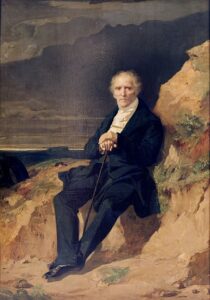
Fourier [Image at right] continued to work as a clerk for merchants in Lyon and Marseille in the years following the French Revolution. But Fourier became more and more preoccupied by his vision of a better world. He first attempted to provide solutions to the ills he witnessed within his own society. Fourier was interested in architecture and urban planning, as well as finding a solution to the downfalls of the free market. (Beecher 1986:59). He drafted numerous plans for reform and sent them to various city government officials, who showed little interest, prompting him to focus on developing his utopian visions.

Fourier was influenced by an eclectic array of scientists (Newton), philosophers (Rousseau), and poets (Horace) to develop his theory of the “destinies” of man. He looked to develop a scientific explanation of society and its individuals, which would then provide a formula for creating what he called a harmonious society (Beecher 1986:54-55). The first aspect of his scientific theory was the “theory of passionate attraction,” which said that the material world and inner world were intertwined, and individuals held natural passions, or affinities that were derived from a divine order and which drew them toward certain types of labor or interests (Beecher 1986:66, 224). Fourier began publishing in local Lyon journals and published his first book, The Theory of Four Movements, in 1808. In this book Fourier discusses his theory of the passions describes the social harmony that will exist in the future when his calculations for aligning individuals with their passions are followed (Beecher 1986:118). The book also contains rambling epilogues and introductions throughout, and touches on a wide range of physical, social, and philosophical ideas and predictions for the future (Beecher 1986:120). The book failed to attract widespread attention.

Fourier dedicated his later years to writing his vision for a utopian society, which would exist through the formation of numerous small communities. He gained French and American disciples who promoted his vision, though Fourier’s irascible personality often led to bitter arguments with even his most devoted followers. Fourier took a mocking and sarcastic tone towards most other people in his writings, whether those were the revolutionary government or philosophers, who he saw simpleminded people compared to him. Fourier never married, nor had children, though he claimed to have a perfect understanding of ideal romantic and familial relationships, which were described in his writings alongside his vision for economic and social relations.

Fourier developed his ideas in the midst of another French utopian visionary, Henri Saint-Simon, who also promoted a vision of economic cooperation and security, though enacted through the state instead of through small communities. Fourier found fault with his approach, and even attempted to directly draw disciples away from the Saint-Simonians to join his cause instead (Beecher 1986:416-19). Fourier eventually became critical of even his own disciples for failing to adequately express his ideas, and eventually isolated most of his followers. Fourier died in France in 1837, having inspired a small group of followers to advocate for his vision of a more socially fulfilling and economically secure society. However, he did not live to see his vision adopted internationally and enacted through a series of communitarian experiments across the United States throughout the 1840s.

While Fourier’s ideas were formed through his experiences in Revolutionary-era France, they were enacted in Antebellum-era United States, a country experiencing an economic recession and fierce social and political divisions. Fourier’s writings offered a vision for a more socially unified and economically secure future that Americans found attractive in the 1840s.

DOCTRINES/BELIEFS

Fourier was greatly impacted by the French Revolution and the wastefulness and cruelties of industrialized capitalism. He began laying out his utopian visions in writing first in The Theory of the Four Movements, published in 1808, then in Traité de l’association domestique-agricole (Treaties on the Domestic Agricultural Association) in 1822.

In these texts, Fourier explained society as made up of individuals with different natural talents and proclivities, which should be harnessed for the betterment of the community. The perfect matching of personality traits with their respective type of labor would lead to social harmony. This emphasis on individual difference was a direct reaction against French Revolutionaries, who, according to Fourier, discouraged individual differentiation through talent, instead enforcing uniformity as a means to achieving equality. In Fourier’s ideal society, communities recognize the importance of balancing natural talents with the needs of a functioning society, ideally creating a self-sustaining and mutually beneficial society in which every person could follow his or her desired vocation without being forced into conformity.

In Fourier’s vision, society would be divided into multiple small communities, called phalanxes, [Image at right]  which would produce material goods and provide fulfilling labor and social relationships for every resident. There would be a hierarchy of classes in Fourier’s communities, as the goal of a harmonious society was not forced equality in material possessions, but instead the meeting of personal needs (materially, socially, spiritually, etc.) (Beecher 1986:248-49). Fourier described, down to minute detail, the architecture of these communities, the number of people who would inhabit them (1,620 per phalanx, to provide the ideal number of each “passion,” or personality type), and the roles that each person would play in society to ensure it provided meaning and comfort for all members. Fourier described the ideal structure of labor, romantic relationships, and a system of communal child rearing and education (Beecher 1986:262).

According to Fourier, the incentives and power structures imposed upon individuals by institutions limited personal development and expression. Instead of acknowledging and harnessing the natural talents inherent in individuals, governments and their laws restricted expression by categorizing people using superficial differences, including gender. To Fourier, women could hold a variety of talents and dispositions, just as men could, and should thus not be restricted to certain roles in society solely due to their gender. This uncommon view led Fourier’s writings to be hailed by twentieth-century scholars as feminist, and even being named the founder of the word “feminist,” though some scholars disagree on the term’s origins (Moses 1985:10; Moon 1978:45, n. 1; Riasanovsky 1969:208; Goldstein 1982:92; Offen 1988:45-51). Over the course of his lifetime (and continuing after his death) Fourier’s writings would attract praise by some of the most well-known women’s rights advocates of nineteenth-century France, including Jeanne-Désirée Véret and Flora Tristan. In many ways, the women who were attracted to Fourier’s ideas in France were combatting similar social and legal restrictions as those women in the United States who would later join Fourierist communities. Under the Napoleonic Civil Code of 1804, divorce was essentially illegal, the father held legal custody of children, and husbands controlled all family property. Fourier found these restrictions on women’s rights unjust and counterproductive to creating a utopian society [Hart 2021:8]. As he summarized: “As a general proposition: Social progress and changes of period are brought about by virtue of the progress of women towards liberty, and social retrogression occurs as a result of a diminution in the liberty of women” (Beecher and Bienvenu 1971:195).

Fourier’s writings remained purely visionary during his lifetime. A reclusive and finicky personality, Fourier never started a community himself using the blueprint for society he created through his writings. Fourier’s antisocial tendences and increasingly repetitive and outlandish writings during the course of his life led to political satirists to mock him in French publications. Despite his limited influence during his lifetime, Fourier did inspire lifelong devotees and disciples of his vision, most notably Victor Considerant and Albert Brisbane, each of whom disseminated Fourier’s writings and oversaw the founding of planned communities based on Fourier’s vision.

It was only after Fourier’s death that his ideas found broader appeal among French and International audiences. In 1840, Fourier’s American disciple, Brisbane, published Social Destiny of Man, his distillation of Fourier’s writings for American audiences. This text highlighted Fourier’s organizational plan for the development of communities, including the division of labor into groups based on the natural propensities of community members. Brisbane excluded significant portions of Fourier’s utopian vision, particularly his ideas on sexual exploration. Fourier disapproved of marriage and monogamy, arguing that it created unequal relationships between men and women and was an inefficient approach to love and sex. In his ideal society, sex would be a group affair, with communal orgies occurring for the good of communal health. The secretiveness of sex would be taken away, and monogamy would be shamed, a reversal of the social shame that was heaped upon those participating in any type of relationship but monogamous marriages during Fourier’s time (Beecher 1986:317).

Albert Brisbane understood Americans’ discomfort with sexual experimentation and nontraditional relationships, and removed those parts of Fourier’s writings from his English translations of Fourier’s texts (Goodwillie and Hart forthcoming: 3-4). Brisbane’s selective translations of Fourier launched a wave of over two dozen Fourierist communities across the eastern and midwestern United States throughout the 1840s. American audiences infused progressive ideals into Fourier’s vision, developing American-style Fourierism, also known as Associationism (Guarneri 1982:583).

The American Association movement emphasized the protection of the laborer from the unpredictability of market capitalism, and the sharing of profits among laborers. Associations were typically organized as joint-stock companies, in which members would purchase stock upon joining, thus receiving voting rights and labor compensation. The associations were typically founded in semi-rural areas, where members could farm and produce goods for sale in nearby towns or cities. Many of these communities grew to approximately 200 members at their peak, and scholars have claimed that as many as 100,000 people were involved in the Fourierist communitarian movement of the mid-nineteenth century, though exact numbers are difficult to verify (Noyes 1870:22; Guarneri 1996:487–88). The vast majority of the associations were shuttered after only four years of existence, making the Fourierist communal wave a brief period.

Associations differed in their daily routines, rituals, and social makeup depending on their geographic region, but they shared some characteristics: all of them grouped labor into categories based on Fourier’s vision, and assigned daily tasks within these labor groups. They also rejected any particular religious requirement for joining the communities, thus promoting religious diversity that expressed itself in subtly different ways across communities, from allowing various Christian denominations to flourish within communities (i.e. in Trumbull Phalanx) to banning on-site religious services at the community altogether (i.e. in the early years of Brook Farm). Nontraditional spiritual and health practices were also experimented with in some Associations, including spiritualism, mesmerism, cold water cures, and vegetarianism (Hart 2021:213-16).

The infrastructure of Associations were designed based on Fourier’s vision, and when financially possible, included a large shared building (phalanstère), where community members were housed together and communal meals were eaten. This shared housing model was central to Fourier’s vision, as it eliminated the inefficiencies found in traditional American households, which duplicated domestic tasks. American followers of Fourier saw the practice of living “in association” as a superior and advanced version of family-based households, which they referred to as the “isolated household.”

By the mid-1840s, Associationist leaders in the U.S., including Albert Brisbane (who resided at the North American Phalanx for a short period), Charles Anderson Dana and John Sullivan Dwight (who resided at Brook Farm), began promoting the idea of a “model phalanx” which would finally demonstrate the full potential of Fourier’s ideas, instead of the small, financially flailing communities that had been developed across the country. Associationists across the East Coast came to have a dominant voice in the Associationist movement, publishing journals on Fourierism and attracting popular attention, funding, and members. Perhaps the most well-known Association was Brook Farm, which was founded by Transcendentalists near Boston, Massachusetts, and attracted support and membership from intellectuals, poets, and reformers including Nathaniel Hawthorne, Elizabeth Peabody, and Margaret Fuller.

Associations along the East Coast were founded in more established towns or cities, and thus the Associationists’ experiences there differed immensely from those founding communities in frontier areas of Ohio, Iowa, or Wisconsin, who often needed to clear land, construct buildings from the ground up, and travel long distances for supplies. These differences in experiences, and in available funders and financial backing, led to bitter divides between the Eastern and Midwestern branches of Associationism. Calls for the development of a model phalanx competed with calls for increased financial backing from the numerous new Fourierist communities that were founded during 1842 and 1843. The inability of most Fourierist communities to achieve financial stability after purchasing land and supplies needed to build a new community led to the closure of nearly all of the Fourierist communities by 1848.

Fourier’s communal socialism, also called French romantic socialism, was later seen by scholars as a precursor to the socialism of Karl Marx (Beecher, 2000). However, Fourier’s approach to socialism differed significantly from that of Marx. Fourier’s analysis of work was optimistic as he believed humans could be reconciled with their work and made to enjoy it. Marx argued, in contrast, that there would always be painful but necessary work to be completed in society, and the best hope for humanity would be to develop technology that would increase efficiency and create more leisure time outside of work (Beecher 1986:295). Fourierist communities did not propose the “centralization of all instruments of production in the hands of the State,” as Karl Marx later proposed in his Communist Manifesto, but instead favored more equitable distribution of profits and services to the benefit of the laborer (Marx and Engels 1848).

The Association movement inspired some members to engage in other social and religious reform movements following the demise of the Fourierist communities, including the women’s rights movement, the abolition movement, the labor movement, the free love movement, and spiritualism. While some Fourierists became engaged in these movements even while living in their communities, after the dissolution of their communities they turned more directly toward activism within these movements, some of which (like the free love movement) had not yet gained traction with the public in the early 1840s. Some of these Fourierists also became involved in formal politics, even taking part in organizing the new Republican Party in the years leading up to the Civil War. Thus, the beliefs and practices of Fourierists had long-term impacts on the social and political evolution of the United States (Hart 2021:205-15).

RITUALS/PRACTICES

Fourier grew up in the predominantly Catholic country of France, but did not identify with that religion. He did, however, tie his scientific understanding of the world into a divine order, arguing that individuals’ passions, or natural propensities, were innate and God-given. The subsequent leader of the Fourierist movement in France, Victor Considerant, read Fourier’s vision as a Christian message, arguing that Fourier’s message of communal harmony represented Christ’s vision for humanity, which the church had later corrupted (Beecher 2000:66).

Among American Associationists, a form of Christian socialism was developed, which incorporated rituals and celebrations commemorating Fourier’s life and significant writings. Fourier himself was held up as a sort of saint of Christian socialism within the Associationist movement, a saint ushering in a new world of ethical social and economic reform. Celebrating the birthday of Charles Fourier or the anniversary of an Association’s founding sometimes took on religious undertones. The Wisconsin Phalanx (also called Ceresco) offers a clear example. As Warren Chase, a co-founder of the community, reported to the New York Tribune in 1846, the annual celebration of Ceresco’s founding included a variety of religious “exercises,” from reading biblical passages to praying for fellow communitarians. Brook Farm member John Dwight selected hymns and wrote toasts to be performed at Fourier-centered celebrations, where the words of Fourier were read aloud to followers of his socialist message. While traveling throughout the country to seek financial investments for Brook Farm in 1846, Brook Farm member John Orvis introduced Fourierism to interested parties by speaking at length of Association as the fulfillment of “the Christian idea” (Hart 2021:166). Following the dissolution of Brook Farm, some of its former members helped develop the “Religious Union of Associationists” in 1847, a national Fourierist church which held weekly services celebrating Christian socialist ideals. This “Church of Humanity” continued to hold services and kept former Fourierists connected until 1853, long after the dissolution of most American Associations (Guarneri 1991:278-83).

ORGANIZATION/LEADERSHIP

Charles Fourier inspired a small following based in France, but the internationalization of his vision was primarily due to the proselytizing of Albert Brisbane and Victor Considerant. Victor
Considerant [Image at right] was exposed to Fourier’s views as a teenager in France and became the leader of the Fourierist movement in France. Considerant promoted Fourier’s visions and even helped start Fourier’s journal, La Phalange (Beecher 1986: 45). Considerant eventually became a political leader in France, but fell out of favor of Napoleon Bonaparte and was forced to leave France in 1848. In 1855, he founded an ill-fated Association loosely based on Fourier’s vision in Dallas, Texas, which dissolved after two years of existence.
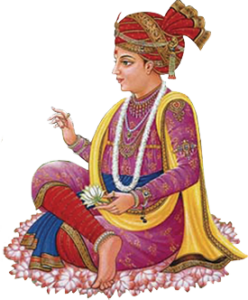
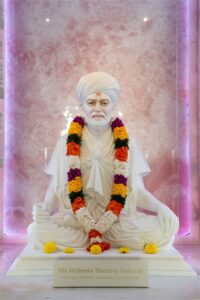
Albert Brisbane was the most outspoken advocate of Fourierism in the United States. He organized Fourierist societies and encouraged the founding of a model phalanx, which never materialized.

American Associations developed a leadership structure within their communities, which included a voting process based on share ownership in the join-stock companies that managed each Association. Associations kept meeting minutes and records of votes on various issues in communal life, including on labor organization, financial decisions (purchases, wages, etc.), admittance of new members, and elections to leadership committees. Both women and men were hypothetically able to buy shares and vote in the American associations, though the extent to which women participated in governance varied from community to community. In 1846, local Fourierist organizations formed the American Union of Associationists to facilitate national discussions and gatherings among Associationists. This group dissolved as the Association movement fall apart in the late 1840s, but during its existence it facilitated the publication of numerous pamphlets and books that helped promote Associationism nationally.

Print culture proved critical to the dissemination of Fourierist ideas in both Europe and the United States, and in recruiting new members to the burgeoning Fourierist communities. A few journals served as the primary propagators for Fourierism: The Fourierist journal, the Phalanx, later reorganized as The Harbinger, and Brisbane’s short-lived serial called The Future. Other journals and newspapers were not explicitly Fourierist by design, but promoted Fourierism through positive articles and coverage of Fourierist communities. These include: The Dial, a journal created by Transcendentalists in an effort to disseminate new insights on literature and theology, though it primarily remained popular within the social circle of New England Transcendentalists. The journal was published for four years from 1840 to 1844 and was edited first by Margaret Fuller, followed by Ralph Waldo Emerson. This journal introduced readers to the emerging Brook Farm community in 1842. Horace Greeley, an advocate of progressive social reform movements including Fourierism, was editor of the New York Tribune from 1841-1848. During that period, he published numerous first-hand accounts from associations, advertisements and promotions for newly founded associations, and articles promoting Fourier’s ideas and the Association movement generally. Together, these publications helped to make Associationism a national movement.

ISSUES/CHALLENGES

Fourier himself never saw the creation of the American phalanxes, but he undoubtably would have thought they fell short of his vision: Fourier’s scientific equations required exact numbers of members to ensure correct proportions of the different “passions” needed for harmonious communities. His vision was too exact, too mathematical, for human accomplishment. Achieving 1,620 members was crucial to the success of a community, though it was a requirement that each of the Fourierist communities in the United States failed to achieve (Beecher 1986:241-42). Fourier’s detailed communal blueprints were never perfectly produced in the American Fourierist communities of the 1840s.

While each Association faced unique challenges, the rapid closure of the Fourierist communities can be attributed to some overarching causes. By the late 1840s, the U.S. was emerging from its economic recession, and enterprising Americans continued to move west, to pursue new financial opportunities, like the California Gold Rush. The financial benefits of sharing a communal property and labor were less appealing in more prosperous times, and the unprofitability of the Fourierist experiments had become evident. Many associations fell into debt after the founders took loans to acquire property, and they were unable to make the association profitable fast enough to repay the loan. While each association experienced unique circumstances that led to its dissolution, in general overborrowing, financial mismanagement, admittance of financially unstable members, and the extraction of initial investment by departing members plagued many associations and contributed to their closures (McKanan 2007). While the American Fourierist movement influenced future reform efforts in the United States, the communitarian period of this movement was brief.

IMAGES

Image #1: Charles Fourier. Portrait by Jean Gigoux – Françoise Foliot, CC BY-SA 4.0, https://commons.wikimedia.org/w/index.php?curid=86237241.
Image #2: Perspective view of Charles Fourier’s Phalanstère. The rural areas and the gardens are not represented. First half of the 19th century. Author: Victor Considérant. Public Domain.
Image #3: Victor Considerant. Between 1848 and 1849. Source: Lithographie publiée par Goupil Vibert & Cie (Gallica). Author: A. Collette. Permission: “Droits : domaine public” (Public Domain)

REFERENCES

Beecher, Jonathan. 1986. Charles Fourier: The Visionary and His World. Berkeley: University of California Press.

Beecher, Jonathan. 1994. “Fourierism and Christianity,” Nineteenth-Century French Studies 22:391-403.

Beecher, Jonathan. 2000. Victor Considerant and the Rise and Fall of French Romantic Socialism. Berkeley: University of California Press.

Bowles, Robert C. 1960. “The Reaction of Charles Fourier to the French Revolution” French Historical Studies 1:348-56.

Fourier, Charles. 1971. The Utopian Vision of Charles Fourier: Selected Texts on Work, Love, and Passionate Attraction. Translated, edited and with an introduction by Jonathan Beecher and Richard Bienvenu. Boston: Beacon Press.

Moon, Joan. 1978. “Feminism and Socialism: The Utopian Synthesis of Flora Tristan.” Pp. 19-50 in Socialist Women: European Socialist Feminism In The Nineteenth And Early Twentieth Centuries, edited by Marilyn J. Boxer and Jean H. Quatert. New York: Elsevier.

Moses, Claire Goldberg. 1985. French Feminism in the 19th Century. New York: SUNY Press.

Riasanovsky, Nicholas V. 1969. The Teaching of Charles Fourier. Berkeley: University of California Press.

Goldstein, Leslie F. 1982. “Early Feminist Themes in French Utopian Socialism: The St.-Simonians and Fourier.” Journal of the History of Ideas 43:91-108.

Goodwillie, Christian and Amy Hart, eds. Ephemeral Edens: An Anthology of Fourierist Communal Experiments in the United States. Expected 2025: Under preliminary contract with Syracuse University Press.

Guarneri, Carl. 1996. “Reconstructing the Antebellum Communitarian Movement: Oneida and Fourierism.” Journal of the Early Republic 16:463-88.

Guarneri, Carl. 1991. The Utopian Alternative: Fourierism in Nineteenth-Century America. Ithaca: Cornell University Press.

Guarneri, Carl. 1982. “Importing Fourierism to America.” Journal of the History of Ideas 43:581-94.

Hart, Amy. 2021. Fourierist Communities of Reform: The Social Networks of Nineteenth-Century Female Reformers. New York: Palgrave Macmillan.

Marx, Karl and Friedrich Engels. 1848. The Communist Manifesto.

Mckanan, Dan. 2007. “Making Sense of Failure: From Death to Resurrection in Nineteenth-Century American Communitarianism.” Utopian Studies 18:159-92.

Noyes, John Humphrey. 1870. History of American Socialisms. Mount Tom Printing Press.

Offen, Karen. 1988. “On the French Origin of the Words Feminism and Feminist.” Feminist Issues 8:45–51.

Publication Date:
12 November 2024

Share

Amy Hart

Amy Hart is the author of Fourierist Communities of Reform: The Social Networks of Nineteenth-Century Female Reformers (New York: Palgrave Macmillan, 2021), which was awarded the 2022 Timothy Miller Outstanding Book Award for contributing to the understanding of communal societies. She has written numerous articles on Fourierist communities, as well as on other nineteenth-century religious movements and communal experiments. She holds a Ph.D. in History from the University of California, Santa Cruz, and has lectured in the History Department and the Women’s and Gender Studies Department at California Polytechnic State University, San Luis Obispo. She has also served as a State Historian at Hearst Castle in San Simeon, California, and is currently Program Manager for the Office of Public Scholarship and Engagement at the University of California, Davis.

Share

Divine Order of the Royal Arms of the Great Eleven

DIVINE ORDER TIMELINE

1881 (August 2):  Matilda May Otis was born in Storm Lake, Iowa.

1896:  Otis married Alfred Weiland. The couple had one daughter, Ruth.

1898:  Ruth Wieland was born in Union, South Dakota.

1919:  Ruth married Edgar J. Richenbaugh in Los Angeles, the first of several husbands.

1918:  May Otis married her second husband.

1922:  Otis and her daughter Ruth began proclaiming themselves as the two witnesses referred to in the Book of Revelation and gathering followers.

1922-1925:  May and Ruth reported receiving messages from the Archangel Gabriel that later became the content of a book, The Great Sixth Seal.

1924 (January):  May Otis married her step-brother, Ward Blackburn.

1924 (June):  Ruth Wieland Rickenbaugh married Samuel Rizzio.

1924 (October):  May Otis Blackburn and Ruth Wieland Rickenbaugh Rizzio reported being visited by the angels Gabriel and Michael.

1929:  Leaders of the Divine Order were indicted for grand theft.

1930 (March 2):  Blackburn was convicted of eight counts of grand theft.

1931 (March):  Upon review, the appeals court and then the state supreme court overturned the trial court convictions. The prosecution declined to pursue a second trial.

1936:  May Blackburn published The Origin of God containing  elements of her past proclamations.

1951 (June 17):  May Blackburn died in Los Angeles.

1978:  Ruth Wieland Rickenbaugh Rizzio died.

FOUNDER/GROUP HISTORY

May Otis was born in 1881 in Storm Lake, Iowa. There is little known about her early life. In 1896 she married Alfred Weiland, and the couple had one daughter, Ruth. By 1910, May and Ruth appear to have separated from Wiland and had moved to Portland, Oregon. Otis worked in real estate and later as a film director and producer with her daughter in Los Angeles.

Beginning around 1922 May and Ruth began claiming that they were the two witnesses referred to in the biblical Book of Revelation and began gathering followers. May and Ruth were successful at gathering around 100 followers, organizing first in Los Angeles and subsequently on a farm outside the city. Clifford Dabney, nephew of oil magnate Joseph Dabney, made a substantial financial gift to the group along with a large farm that became the organizational center of the group. However, the group became involved in a litigious relationship with Dabney that led to civil and criminal cases and, ultimately, to the demise of the Divine Order.

DOCTRINES/BELIEFS

The biblical passage on which May and Ruth based their divine claims was drawn from the Book of Revelation (11:3): “And I will grant my two witnesses power to prophesy for one thousand two hundred and sixty days.” May and Ruth self-identified as those two witnesses.

They reported that two angels, Archangel Gabriel and Archangel Michael (archangels are believed to have been granted the power to transmit God’s will to humans) were living with them and had provided them with information that subsequently became The Great Sixth Seal.

On October 6, 1924, May told a journalist that she had been selected as a queen by Archangel Michael (“Angel Gabriel Girls Quizzed.”):

… the Angel Gabriel used to come into the room where May and I were … and he dictated a while on the “Seventh Seal, and the “Seventh Trumpet and now we were to gain eternal life and a mine full of nuggets and jewels near Bakersfield…

In addition, Archangel Michael showed May and Ruth a secret place where they could recover a treasure trove of valuable metals and gems after the publication of The Great Sixth Seal. The publication of this book was indeed to be an event of cosmic significance as  the Seventh Seal (the final seal of the Seven Seals of God described in Revelation) would be broken and apocalyptic events would occur.

After May and Ruth were chosen as queens, they in turn would choose nine queens who in turn would be given a matching set of “kings” by Archangel Gabriel. These would constitute the “Great Eleven” who would govern the world as humans gained eternal life. Based on her apocalyptic pronouncements, May subsequently created The Divine Order of the Royal Arms of the Great Eleven. The eleven queens would rule the world from mansions on Olive Hill, in Hollywood, California.

ORGANIZATION/LEADERSHIP

The Divine Order, led by May and Ruth, occupied several locations in Los Angeles before moving to a rural location outside the city. At one point May had planned to build a complex of marble temples on Olive Hill, in East Hollywood. However, the group acquired a plot of land and moved to a 164-acre ranch in the Santa Susana Mountains. They constructed a series of cabins along with a temple. Perhaps the most striking structure at the site was the temple’s “massive gilded wood throne weighing 800 pounds, sitting upon four hand-carved paws and adorned with a lion’s head. The temple was sealed off, waiting for Christ’s return (Rasmussen 1999).

The group supported itself by getting jobs at a nearby tomato packing plant. All wages generated by member employment was deposited in the a common purse.

ISSUES/CHALLENGES

The Divine Order’s history actually was rather belief, beginning with May and Ruth’s claims in 1922 to be the two witnesses referred to in the Book of Revelation and essentially ending with May’s criminal conviction in 1930.

Prior to the group’s involvement in civil and criminal legal proceedings there were a series of mysterious, disquieting events that in themselves never had legal implications. There was an unsolved disappearance of Samuel Rizzio, who was believed to have been murdered but who was never found. Sixteen year-old Willa Rhoades died under suspicious circumstances; her remains were preserved on ice for over a year in an what apparently an anticipated resurrection. Her body was then buried under her parent’s home along with the remains of seven dogs. Thirty year-old Frances Turner, who suffered from what was termed a “blood malady” was placed in a heated, crudely constructed brick oven for two days to cure her condition. She died within a few days. Rather, it was financial issues that resulted in civil and criminal litigation.

The case that began the series of events that eventually led to the demise of The Divine Order was a civil suit. Clifford Dabney, nephew of oil magnate Joseph Dabney, had made financial and property donations to the Divine Order, at least partly on the basis of a hidden treasure that could be recovered after publication of The Great Sixth Seal. When book publication was not forthcoming, Dabney filed a civil suit against May and the Divine Order for defrauding him of $40,000. The civil suit subsequently triggered an investigation by the District Attorney that led to criminal charges for defrauding Divine Order members of $200,000 over a seven-year period between 1922 and 1929. On March 2, 1930, May Blackburn and several other group leaders were convicted in a jury trial, in which both May and Ruth offered testimony, of eight counts of grand theft. Each count carried a potential sentence of between one and ten years. With the defendants still in custody, the convictions were appealed, however, and a year later the state appellate court ruled that testimony at trial concerning the deaths and disappearances in which the Divine Order was involved was irrelevant to the offenses for which they were convicted and therefore had been inadmissible. At the end of 1931 the Supreme Court of California upheld the appellate court ruling (California Supreme Court 1931):

We have set forth but briefly disclosures of the record before us, and in our investigation we have been unable to see what relevancy the gruesome story of the preservation of the body of Willa Rhoads, in the promise of resurrection, could have borne to the issue of whether or not the defendant applied the moneys which she received from the complaining witness to the purposes for which they were procured.

The same lack of relevancy exists in the admission of evidence directed to the alleged attempt of the defendant to administer poison to one Sammy Rizzio. We feel, as did the District Court of Appeal, that the evidence as to both of the events above adverted to, must have prejudiced the defendant in the minds of the jury to the extent that the testimony offered in her defense could not have received the deliberate consideration that the law accords to all persons charged with crime.

All other matters of importance have been properly disposed of in the decision of said District Court of Appeal.

The judgment and order are reversed.

In its ruling the Supreme Court also stipulated that ““This is a free country, where there is freedom of religious worship, and it is not actionable to the court if the defendant made certain representations as to being divine” (Eddy 2015). Following the Supreme Court ruling, the defendants were released from custody. The prosecution declined to retry the case, ending legal proceedings.

May Blackburn and the other defendants were freed and there was insufficient evidence to charge her with any additional crimes. However, her organization was in decline as a consequence of the turmoil and negative publicity surrounding her investigation and trial. Blackburn published “The Origin of God”] in 1936, a book that contains elements of her former proclamations. The small group thereafter simply disappeared from public view. May Blackburn died in Los Angeles in 1951.

REFERENCES

“Angel Gabriel Girls Quizzed.” 1925. Los Angeles Times, February 7. Accessed from  https://homesteadmuseum.blog/2020/10/07/take-it-on-faith-a-press-photo-of-members-of-the-divine-order-of-the-royal-arms-of-the-great-eleven-los-angeles-7-october-1929/ on 3 November 2024.

California Supreme Court. 1931. People v. Blackburn, November 30. Accessed from https://casetext.com/case/people-v-blackburn-7 on 3 November 2024.

Eddy, Cheryl. 2015. “Angels Made Them Do It: A Brief History of The Blackburn Cult.”  Gizmodo, June 15. Accessed from https://gizmodo.com/angels-made-them-do-it-a-brief-history-of-the-blackbur-1711445327 on 3 November 2024.

“The Blackburn Cult.” n.d. Los Angeles Times. Accessed from  https://www.laalmanac.com/religion/re720.php on 25 October 2024.

 Rasmussen, Cecilia. 1999. “Divine Order’s Tale Smacks of Cult Fiction.” Los Angeles Times, May 23. Accessed from https://www.latimes.com/archives/la-xpm-1999-may-23-me-40217-story.html on 3 November 2024

Spitzzeri, Paul R. 2020. “Take It On Faith: A Press Photo of Members of the Divine Order of the Royal Arms of the Great Eleven, Los Angeles Times, October 7, 1929.”

Publication Date:
6 November 2024

Share

Jesus Fellowship Church

JESUS FELLOWSHIP CHURCH TIMELINE

1926 (December 25):  Noel Stanton was born in Bedfordshire, England.

1957:  Stanton became pastor of a small Baptist church in Bugbrooke, Northamptonshire, which later became the Jesus Fellowship Church.

1968 (Summer):  Stanton experienced a spiritual breakthrough moment while holding a Saturday evening prayer service.

1974:  The first community house was established.

1979:  Creation Community Fellowship was founded and became an important component of the movement.

1979:  Jesus Fellowship had purchased enough properties to support 350 individuals.

1982:  The Jesus Fellowship Church became a member of the Evangelical Alliance. Four years later the church was asked to resign membership.

1987:  Jesus Fellowship Church launched The Jesus Army as the evangelizing wing of the church.

1987:  The Jesus Army began an annual public London Jesus Day event.

1992:  The Jesus Fellowship participated in the founding of the Multiply Christian Network to establish links with other churches.

1999:  Jesus Fellowship Church was accepted back  into membership in the Evangelical Alliance.

2001:  The Jesus Army Charitable Trust was registered.

2009:  Stanton appointed Mick Haines as his successor.

2009 (May 20):  Noel Stanton died.

2009:  Following Stanton’s death, Jesus Fellowship began receiving reports of sex abuse withing the church.

2013:  Jesus Fellowship invited responses from members and former members about their personal experiences in the church.

2015:  Local law enforcement launched Operation Lifeboat, investigating abuse allegations against Jesus Fellowship leaders.

2017 (July):  The five apostolic leaders stepped down as an investigation of their handling of the abuse allegations commenced.

2019 (May):  The church announced that it would “cease to exist” and on May 26 voted to revoke the organization’s constitution.

2020 (December): The Jesus Fellowship Community Trust closed.

2021 (October):  Companies House initiated a name change  from Jesus Centres Trust to Joining Communities Together Limited ( JCT).

2023 (December 31):  Applications to the Jesus Fellowship Redress Scheme closed.

FOUNDER/GROUP HISTORY

At its founding and through its history the Jesus Fellowship was influenced by several other movements (Hunt 1998:22-23). An early influence was Graham Pulkingham’s Church of the Redeemer in Houston, Texas, which created a strong charismatic community. Jesus Fellowship also resonated with the U.S. Jesus People movement of the early 1970s in the effort to separate themselves from conventional society and build community around what the Jesus Fellowship called “Kingdom values and to evangelize others (Hunt 2008). Jesus Fellowship resembled the Salvation Army as it likewise drew membership from marginal populations (homelessness, problems with substance abuse, and former prison inmates), and adopted a service orientation.

Noel Stanton, the founder of Jesus Fellowship Church (JFC), was born in Bedfordshire, England in 1926 into a farm family. When he was eighteen he was conscripted into the Royal Navy and assigned duty in Australia. While in Australia he met an Christian evangelist, Frank Jenner, and within a year had become a Christian convert. Following the war, Stanton returned to England and attended All Nations Bible College. In 1957, he became pastor of a small Baptist church in Bugbrooke, Northamptonshire, which later became the Jesus Fellowship Church.

Over much of the next decade Stanton led the small church, but the revival that he hoped for did not take place. As a result, by 1967 he had become uncertain about his pastoral future (Cooper and  Farrant 1998:30):

By 1967 he seriously wondered about the way forward. The
years had flown by. Could he rely on the devotion of his flock?
Should the next crusade go ahead? He felt desperate, and
called a special church meeting. ‘We are reaching a cross
roads,’ he said, ‘and need to reassess things in the light of
scriptural truth. Is the old style mission really the way? Should
not growth spring from the vitality of the local church? We do
a lot, but our heart is weak.’

During the summer of 1968 Stanton began holding  Saturday evening prayer services. At that moment a breakthrough came. As Stanton experienced the moment (Cooper and  Farrant 1998:33-34):

The experience was…so intense that I felt I was just not going to live anymore! I became filled with the intensity of God. This went on for hours and hours and I moved into speaking in tongues and praising the Lord. It was a tremendous experience of life and fullness from which I didn’t come down for a long time–and this was the changing point in my life.

This experience became the basis for group expansion as Stanton began attracting young adults who were “baptized in the spirit.” Initially, new recruits were professional-managerial individuals, but by the early 1970s movement membership had broadened to include individuals affiliated with biker groups, the drug subculture, and the counterculture (Kay 2007:152).

The movement grew from several hundred in the early 1980s to over 3,000 by 2007. This evangelizing soon produced two dozen congregations across the UK (Barker 2020:103; Kay 2007:157). But gradually the numbers started to decline. In 2012 there were aboutx 2,500 members, and, by 2019, the Fellowship had about 1,000 members (Lynch 2019b).

DOCTRINES/BELIEFS

The Jesus Fellowship Church had Baptist roots and a conventional Christian theology in many respects (Greenholm 2014; We Believe n.d.):

The Jesus Fellowship upholds the historic creeds of the Christian faith: the Apostles’ Creed, the Nicene Creed and the Athanasian Creed. Further:

[the church professes] the historic Christian faith, being reformed, evangelical and charismatic. It practises believer’s baptism and the New Testament reality of Christ’s Church; believing in Almighty God: Father, Son and Holy Spirit; in the full divinity, atoning death and bodily resurrection of the Lord Jesus Christ; in the Bible as God’s word, fully inspired by the Holy Spirit.
This Church desires to witness to the Lordship of Jesus Christ over and in His Church; and, by holy character, righteous society and evangelical testimony to declare that Jesus Christ, Son of God, the only Saviour, is the way, the truth and the life, and through Him alone can we find and enter the kingdom of God.
This church proclaims free grace, justification by faith in Christ and the sealing and sanctifying baptism in the Holy Spirit.

The concept of covenant was central to the Kingdom. The covenant consisted of a pledge, growing out of a born again experience to commit to the Kingdom family. It involved a pledge to seven specific commitments (Hunt 2008:40):

1) uphold the pure biblical faith, 2) be loyal to the brotherhood of the church, 3) consecrate their whole being in service to God, 4) love each other in social equality, simplicity and righteousness, 5) accept suffering for Christ’s sake and face opposition without retaliation, 6) accept wisdom and help from other members of the church with mutual correction, confession of faults, forgiveness and reconciliation, and 7) unite with each other in full bond of unity in Christ with an intention that this should be the life-long pledge.

There were also proscriptions, such as avoidance of secular music and media, traditions religious holidays, recreational pursuits, and involvement of women in leadership (Haines and Stanton 1991).

RITUALS/PRACTICES

The early Jesus Fellowship was distinctive in its adoption of its Pentecostal-style religious services and public evangelism. Glossolalia and other expressive worship forms were regarded as evidence of the presence of the Holy Spirit.

The communal structure at the core of Jesus Fellowship meant constant engagement with other members in ritualized activities. For example, on Saturday evenings there was house worship, on Tuesday evening is the community covenant meal (agape), on Wednesday evening a meeting of “servant groups (Hunt 1998:35).

ORGANIZATION/LEADERSHIP

As it developed, the movement was organized around several components, membership, leadership, communal households, movement owned businesses and properties, and outreach.

Jesus Fellowship accommodated members at several levels of involvement and commitment, which were referred to as “styles of covenant membership.” All of these styles involved baptism by immersion and inclusion in the church family. These levels of commitment ranged from irregular attendance to attendance at group meetings and meals to sharing in community daily life while retaining separate residence and personal lifestyle to communal living, worship and property sharing (Barker 2020:101).  About one quarter of the community made the commitment to celibacy. (Campbell and Bird 1989:7). New members, especially if they opted for a communal commitment, were usually assigned a “shepherd” who was responsible for their spiritual development. Members typically adopted new first names that reflected their Christian qualities (Hunt 1998:30). New members were treated as associate members for a two-year probationary period before formally assuming full membership. In the event that members disaffiliated, they could request a return of their donations (Campbell and Bird 1989:11). Across the movement traditional gender roles and boundaries were maintained, and housing accommodations were organized by gender.

Overall movement leadership was vested in a small group of senior leaders who met regularly to oversee movement functioning and decision making. This group was exclusively male; members held other jobs within the movement as did all members; the group did not reside in a single location; and members were particularly likely to have pledged to celibate lives. Financial leadership was organized through the Trust Fund, which processed property and funds from new members, oversawx the common purse resources, and administered the Jesus Centers (Campbell and Bird 1989:11).

At the core of Jesus Fellowship was communal life is the New Creation Christian Community, which established dozens of communal residences across England. What began experimentally in 1974 ultimately grew to several hundred communal homes, with each led by a small number of elders. The concept of “new creation” was central to establishing the Kingdom. The key building block of the Kingdom was the new spiritual family that transcended biological family. Members referred to one another in kinship terms, such as brother and sisters, and ministered to one another (Hunt 1998:29). Marriage was covenantal, with primacy given to a relationship with Jesus and then with one another. All members, including leaders, had jobs either within or outside the movement.

As the movement grew, it acquired several properties in the area for communal living, including a nearby farm. It also built up a number of businesses, including wholesale foods, building supplies, and a vehicle repair firm (Barker 2020:100); MacDonald-Smith 1995; Kay 2007:155). Profits from the businesses helped fund the various Jesus Fellowship projects. Businesses and community houses were owned by a Trust Fund. Some of the members worked outside the community, giving their earnings to the community; others were employed in one or other of the businesses, working on the farm or renovating the movement’s properties, where everyone received the same wages. Wages of either type were then donated to “the common purse.”

There were two primary mechanisms for movement outreach. The Jesus Centers began operating in 2002. They offered information and advice on a variety of matters, skill training, personal hygiene facilities, parenting support, and worship meetings. Jesus Fellowship was instrumental in the founding of the Multiply Christian Network in 1992, which established links with around 250 other churches.

ORGANIZATION/LEADERSHIP

As it developed, the movement was organized around several components, membership, leadership, communal households, movement owned businesses and properties, and outreach.

Jesus Fellowship accommodated members at several levels of involvement and commitment, which were referred to as “styles of covenant membership.” All of these styles involved baptism by immersion and inclusion in the church family. These levels of commitment ranged from irregular attendance to attendance at group meetings and meals to sharing in community daily life while retaining separate residence and personal lifestyle to communal living, worship and property sharing (Barker 2020:101).  About one quarter of the community made the commitment to celibacy.[ Campbell and Bird 1989:7). New members, especially if they opted for a communal commitment, were usually assigned a “shepherd” who was responsible for their spiritual development. Members typically adopted new first names that reflected their Christian qualities (Hunt 1998:30). New members were treated as associate members for a two-year probationary period before formally assuming full membership. In the event that members disaffiliated, they could request a return of their donations (Campbell and Bird 1989:11). Across the movement traditional gender roles and boundaries were maintained, and housing accommodations were organized by gender.

Overall movement leadership was vested in a small group of senior leaders who met regularly to oversee movement functioning a decision making. This group was exclusively male; members held other jobs within the movement as did all members; the group did not reside in a single location; and members were particularly likely to have pledged to celibate lives. Financial leadership is organized through the Trust Fund, which processes property and funds from new members, oversees the common purse resources, and administers the Jesus Centers (Campbell and Bird 1989:11).

At the core of Jesus Fellowship was communal life is the New Creation Christian Community, which established dozens of communal residences across England. What began experimentally in 1974 ultimately grew to several hundred communal homes, with each led by a small number of elders. The concept of “new creation” is central to establishing the Kingdom. The key building block of the Kingdom is the new spiritual family that transcended biological family. Members referred to one another in kinship terms, such as brother and sisters, and minister to one another (Hunt 1998:29). Marriage was covenantal, with primacy given to a relationship with Jesus and then with one another. All members, including leaders, had jobs either within or outside the movement.

As the movement grew, it acquired several properties in the area for communal living, including a nearby farm. It also built up a number of businesses, including wholesale foods, building supplies, and a vehicle repair firm (Barker 2020:100); MacDonald-Smith 1995; Kay 2007:155). Profits from the businesses helped fund the various Jesus Fellowship projects. Businesses and community houses were owned by a Trust Fund. Some of the members worked outside the community, giving their earnings to the community; others were employed in one or other of the businesses, working on the farm or renovating the movement’s properties, where everyone received the same wages. Wages of either type were then donated to “the common purse.”

There were two primary mechanisms for movement outreach. The Jesus Centers began operating in 2002. They offered information and advice on a variety of matters, skill training, personal hygiene facilities, parenting support, and worship meetings. Jesus Fellowship was instrumental in the founding of the Multiply Christian Network in 1992, which established links with around 250 other churches.

ISSUES/CHALLENGES

The Jesus Fellowship Church faced controversy and opposition almost from its inception as a result of the group’s exuberant, pentecostal-style religious gatherings; its increasing separation from conventional society; its endtime doctrines, and its tight-knit communal organization. The “shepherding” of new members was deemed “brainwashing,” tight knit, communal organization was labeled “cultic;” the creation of “Kingdom families” was regarded as an attack on “natural families.” The groups separation from conventional society and distancing from other Christian groups led to its expulsion from the Baptist Union of Great Britain and from the Evangelical Alliance in 1986.

By far the greatest challenge to Jesus Fellowship, and the one that ultimately led to its demise, was the discovery of sexual abuse within its leadership ranks, which had been taking place since the 1970s, following Stanton’s death in 2009. There had been rumors of sex abuse, including some involving Stanton, as well as several other disquieting incidents. However, it was in 2013 that a major scandal began to unfold (Barker 2020:110).

In 2013 the Jesus Fellowship leaders invited people to make disclosures about their experiences of the Church, and many came forward with disclosures related to pastoral abuse and bullying as well as financial, physical and sexual abuse. This information was shared with local law enforcement which launched an investigation, Operation Lifeboat, in 2015 that led to a number of criminal prosecutions and convictions. Stanton, who had pledged a life of celibacy, was one of those charged with sexual abuse. In 2017, the five Jesus Fellowship apostolic leaders stepped down as an investigation of their handling of the abuse allegations was being launched.

The final report on abusive conduct indicated that there were hundreds of members who experienced abuse, with as many as one in six children having suffered abuse (Ironmonger and Heath 2024). The number of perpetrators also numbered in the hundreds, and a majority of the cases of abuse involved church leaders. The sheer number of perpetrators and survivors suggested a widespread pattern of abuse across time and church locations (Ironmonger 2020). Amid the rapid decline in membership and shrinking financial resources, national leaders concluded that national organization was no longer viable

Both the results for Jesus Fellowship and its response were extraordinary. Church membership plummeted to around 200. The church began reporting abuse information to local law enforcement, and the church began a process of disestablishment. In May 2019 the church announced its organizational dissolution, the resignations of members of the National Leadership Team, and the revocation of the church’s constitution. After December 2020, the Jesus Fellowship Community Trust had the limited function of completing administrative responsibilities.

Jesus Fellowship also offered a public apology for its “faults and failures” (Desborough n.d.)

The NLT  [National Leadership Team] and the members of the JFC recognise that, over a sustained period of time, there have been faults and failures in the Church that have had a profound impact on many people’s lives.
We are deeply sorry for, and appalled by the abuse that has taken place within Jesus Fellowship Church and the New Creation Christian Community (NCCC) and offer our heartfelt sympathy and unreserved apology to all those affected. Children and vulnerable people were entitled to expect full protection from harm. We acknowledge the pain many of those people continue to feel. As things have become clearer to us, we are grieved and deeply troubled.

A Jesus Fellowship Redress Scheme was developed to offer monetary compensation to those filing claims under the Redress Scheme. Millions of dollars in compensation have been paid to claimants. An independent, online Jesus Fellowship Survivors Association, which has grown to several hundred, was also established as a site where those reporting abuse could follow news and exchange views (Jesus Fellowship Survivors Association 2024).

One significant element of the closing of Jesus Fellowship was the release of local congregations. They became independent organizations.  Small congregations and some communal groups have continued with a total population of several hundred (Ironmonger 2020). While this approach created the possibility for a continued presence of the original Jesus Fellowship initiative, the catastrophic loss of membership after 2019 and of a national support structure have left the future of the movement uncertain.

REFERENCES

Barker, Eileen. 2020. “Denominationalization or Death? Comparing Processes of Change within the Jesus Fellowship Church and the Children of God aka The Family International. Pp. 99-117 in The Demise of Religion: How Religions End, Die, or Dissipate, edited by Michael Strausberg, Stuart Wright, and Carole Cusack. London: Bloomsbury Academic.

Cooper, Simon and Mike Farrant. 1998. Fire in Our Hearts: The story of the Jesus Fellowship/Jesus Army. Northampton, England: Multiply Publishing.

Desborough, Martin. n.d. Jesus Fellowship Closure. Accessed from https://jesus.org.uk/about-jfct/jesus-fellowship-closure/ on 10 October 2024.

Grenholm, Micael. 2014. “The Mission and Vision of the Jesus Army.” Charismactivism, June 5. Accessed from https://charismactivism.com/2014/06/05/the-mission-and-vision-of-the-jesus-army/ on 15 September 2024.

Hunt, Steven. 2008. “The Radical Kingdom of the Jesus Fellowship.” PentecoStudies 7:1–33.

Ironmonger, Jon. 2020. “Jesus Army abuse ‘covered-up by church leaders’, report claims.” BBC News, August 4. Accessed from https://www.bbc.com/news/uk-england-northamptonshire-53450901 on 15 January 2026.

Ironmonger, Jon. 2019. “Jesus Army sex scandal: The dark secrets of life in a commune.” BBC News, July 19. Accessed from https://www.bbc.com/news/uk-48447066 on 10 October 2022.

Ironmonger, Jon and Martin Heath. 2024. “One in six children sexually abused in Jesus Army cult.” BBC News, September 13. Accessed from https://www.bbc.com/news/articles/c0qejd0njpeo on 20 October 2024.

Jesus Fellowship Survivors Association website. 2024. Accessed from https://jesusfellowshipsurvivors.org/ on 10 October 2024.

Macdonald-Smith, Fiona. 1995. “The Jesus Army Wants You.” The Independent, April 28. Accessed from https://www.independent.co.uk/life-style/the-jesus-army-wants-you-1617501.html on 10/15/2024.

We Believe. n.d. Accessed from http://www.jesus.org.uk/sites/default/files/media/documents/books/ja/we_believe.pdf on 15 October 2024.

Publication Date:
27 October 2024

Share

Angela Burt

Angela Burt (PhD) teaches religion and sociology at Australian Catholic University. She is the author of Hare Krishna in the Twenty-First Century (2023) published by Cambridge University Press and Leading the Hare Krishna Movement: The Crisis of Succession in the International Society for Krishna Consciousness (2024) published by Routledge. As Project Manager for the ISKCON Oral History Project, she has documented the history of ISKCON in her interviews with ISKCON’s earliest members since 2003. Angela is a Co-Director of The Intersection of Hinduism and Contemporary Society Research Group at the Oxford Centre for Hindu Studies and a Co-Organizer for the Vaishnava Advanced Studies (VAST) online academic conference.

Share

Bochasanwasi Akshar Purushottam Swaminarayan Sanstha (BAPS)]

BAPS TIMELINE

1781 (April 13):  Swaminarayan was born as Ghanshyam in Chhapaiya, Uttar Pradesh, India.

1786 (March 31):  Ghanshyam began studying Sanskrit at the age of five.

1792:  Ghanshyam left home to begin a seven-year pilgrimage across India and came to be known as Neelkanth Varni.

1794 (October 24):  Neelkanth mastered ashtanga yoga.

1799 (August):  Neelkanth arrived at the hermitage of Ramanand Swami.

1800 (October):  Ramanand Swami initiated Neelkanth into the sampradaya and named him Sahajanand Swami.

1801 (November):  Ramanand Swami appointed Sahajanand Swami as the leader of the Sampradaya.

1801 (December):  Ramanand Swami passed away.

1801 (December 31):  Sahajanand Swami instructed his followers to chant the “Swaminarayan” mantra, marking the beginning of the Swaminarayan Sampradaya.

1826:  Swaminarayan established two dioceses, Ahmedabad and Vartal and appointed acharyas (the heads of a sampradaya) as administrators to manage the mandirs (temples) in their regions.

1830 (Feburary 28):  Sir John Malcolm, governor of the Bombay Presidency, met with Swaminarayan.

1830 (June 1):  Swaminarayan passed away.

1830 (June 2):  Gunatitanand Swami took over the spiritual leadership of the Sampradaya.

1907:  Shastri Yagnapurushdas (1865-1951) split from Vartal and Ahmedabad due to theological differences and established the Bochasanwasi Shri Akshar Purushottam Swaminarayan Sanstha (BAPS).

1947:  BAPS became a registered and certified trust.

1950:  Pramukh Swami Maharaj became president of BAPS.

2016 (August 13):  Administrative and spiritual head of BAPS, Pramukh Swami Maharaj passed away.

2016 (August 13):  Mahant Swami became the successor to Pramukh Swami Maharaj as administrative and spiritual head of BAPS.

FOUNDER/GROUP HISTORY

Swaminarayan is the founder of the Swaminarayan Sampradaya, a Hindu bhakti (devotional) community (Brahmbhatt 2014:99) (Image at right). He was born on April 3, 1781 in Chhapaiya, in Uttar Pradesh in India and was named Ghanshyam Pande (I. Patel 2022:1582). His parents were Hariprasad Pande and Premvati, and they belonged to the Brahmin caste of Sarvariya (Williams 2018:14). Ghanshyam studied Hindu texts under the guidance of his father, and after the death of his parents, he left home at the age of eleven to set off on a pilgrimage throughout India (I. Patel 2022:1582). He renounced the world by taking up the practice of ascetic wandering students (brahmachari) (Williams 2018:14), learned the eight-fold yoga system, and performed austerities (I. Patel 2022:1582). He was seeking a religious order that aligned with his theological perspective, and at this time he adopted the name Nilkanth Varni (Mamtora 2016:831).

In August 1799, he arrived at the hermitage of Ramanand Swami (1739-1801). In October 1800, Ramanand Swami initiated Nilkanth Varni into the Sampradaya (monastic order) and named him Sahajanand Swami (Mamtora 2016:831) and Narayan Muni (I. Patel 2022:1582). In November 1801, Ramanand Swami appointed Sahajanand Swami as the leader of the Sampradaya; Ramanand Swami passed away one month later. Thirteen days after the passing of Ramanand Swami, Sahajanand Swami instructed his followers to chant the “Swaminarayan” mantra, and this is considered to be the beginning of the Swaminarayan Sampradaya. Sahajanand Swami came to be known as Swaminarayan due to the prominence of this mantra.

Over the next twenty-nine years, Swaminarayan initiated an estimated 2,000 (Raymond Brady Williams 2018:23) to 3,000 (Brahmbhatt 2014:100) sadhus (holy men) who spread his teachings throughout Gujarat (I. Patel 2022:1582). British sources estimated that by the 1820s, Swaminarayan had at least 100,000 followers, while some in the community suggest that the following had grown to 1,800,000. He allowed women to practice ascetic life, and they lived in separate spaces in the temples (Williams 2018:. 22–23).

The development of Swaminarayan’s movement took place within the context of great social change in Gujarat. By 1820, Gujarat had come under the control of the British. In the first two decades of the nineteenth century, the Rajput and Kathi chiefs had conducted many raids, resulting in a breakdown of law and order. There was a lack of peace and security because of friction between various chieftains and rulers. Civic order broke down due to drought, famine, epidemic, an earthquake, and poverty in Gujarat, and due to scarcity, armed bands engaged in killing and looting. It was within this context that colonial rule over parts of Gujarat was justified, as well as religious and social reforms that were supported by Swaminarayan. The desire to restore civil order was a shared goal for British and Swaminarayan leaders (Williams 2018:6–9). Sir John Malcolm, an official of the British East India Company who had became governor of the Bombay Presidency, met with Swaminarayan on Feburary 28, 1830 (Williams:2018:4). By that time, Swaminarayan was known as a religious reformer who raught that sati and female infanticide were not a legitimate part of orthodox Hinduism (Williams 2018:12).

Swaminarayan’s followers point out that his preaching and teachings had an influence on the people of Gujarat in leading morally upright and peaceful lives while the region was in the throes of civil unrest (Williams 2018:13), and Swaminarayan leaders worked with British leaders to discuss how to deal with civic and religious issues (Williams 2018:22). Swaminarayan spread a message of social and religious reform, and a major element of reform was the strict discipline required of his ascetic disciples. The ascetics took part in works for social welfare to restore order and security in the region. They engaged in manual work including digging and repairing wells, building and repairing roads, and building temples and homes. They opened kitchens to feed people during times of famine and engaged in relief efforts in areas affected by diaster. The ascetics were also trained as teachers and preachers to spread the teachings of Swaminarayan in the villages, and this led to the rapid growth of the movement (Williams 2018:26).

After meeting with Swaminarayan, Malcolm met with the leaders of the Jarijah caste of Rajputs and tried to persuade them to give up the practice of female infanticide. He believed that recovering from political instability and achieving social and moral reform would be accomplished through the leadership of enlightened leaders. At that time, Swaminarayan was one of the most influential Indian leaders in Gujarat, and for this reason, Malcolm arranged to meet with him (Williams 2018:13). They both abhorred the practices of infanticide and the immolation of widows, and Swaminarayan preached that infanticide is forbidden because it is sinful. He raised money to pay for the marriage expenses of daughters if they would be spared. Infanticide was finally banned by the government in 1870. Swaminarayan also preached against widow suicide, and he made provision for women who wanted to lead a life of devotion to live an ascetic life, so that they could have a position in society as widows. Malcolm and other British officials encouraged and supported Swaminarayan in his reform efforts which were the focus of his movement in his final years. His movement helped to bind the territory together after a period of turmoil, and his establishment of holy places and temples as places of pilgrimage has become a significant part of Gujarati cultural identity (Williams 2018:31–33).

Swaminarayan passed away on June 1, 1830 (I. Patel 2022:1582). The next day,  Gunatitanand Swami took over the spiritual leadership of the Sampradaya and became Swaminarayan’s successor (Raymond Brady Williams 2018:61, 66; BAPS 2024b; Sadhu Vivekjivandas 2024). As is so often the case in religious movements, the succession put in place after the founder’s death had ramifications for how the Sampradaya would continue in the future (See, Organization/Leadership).

DOCTRINES/BELIEFS

At the core of Swaminarayan’s doctrine are five entities that informed his teachings on devotion, practice, and liberation: jiva (the souls of ordinary beings); ishvara (higher order beings with cosmic functions); maya (an instrument of Parabrahman in the formation of the material world); Brahman (the supreme God); and Parabrahman (the supreme God). In a departure from earlier thinkers, Swaminarayan discusses two Brahmans in his teachings, Aksarabrahman and Parabrahman (Patel 2022:1583).  Akṣarabrahman is the abode of Parabrahman. In its human manifestation, Akṣara helps spiritual practitioners realize their true form to be an atman and become like Brahman. Parabrahman, also called Puruṣottama and Paramatma, is the supreme God and is superior to Akṣarabrahman (Sadhu Bhadreshdas 2016; Swami Paramtattvadas 2017). The supreme person is Purushottam and akshar is the abode of Purushottam and has an impersonal form. It is the cosmic principle and mediates the activities of the supreme person (Williams 2018:86, 91)

In formulating his doctrines, Swaminarayan considered eight texts as authoritative: the Vedas; Vedantasutras; Bhagavatapuraṇa; Bhagavadgita, Vīṣṇusahasranama, and Viduraniti from the Mahabharata; Vasudev Mahatmya from the Skandapurana; and Yajnavalkyasmrti (I. Patel 2022:1582). Two texts are particularly important for his followers. First, the Vachanamrut, which is a collection of Swaminarayan’s sermons, and second, the Shikshapatri, a book of instructions on devotional and moral conduct (Mamtora 2016:831), consisting of 212 Sanskrit verses attributed to Swaminarayan (Brahmbhatt 2014:101).

An important teaching within the Swaminarayan movement is that the highest manifestation of God takes a human form in God’s eternal abode, and in line with Vaishnava understanding, God descends in a human form to earth to help humankind (Williams 2018:78–79). These manifestations are called avatars, which means one who descends, and Swaminarayan instructed his followers to worship only avatars in human form, with worship being directed primarily to Krishna and Rama (Williams 2018:80).

It is widely believed by the followers of Swaminarayan that he is an incarnation of Krishna (Williams 2018:82) and others believe he is a manifestation of Purushottam (Williams 2018:85). However, in Swaminarayan’s lifetime, opinion on this was split, with some followers resisting this idea (Williams 2018:83). Followers worship Sahajanand as Swaminarayan, a manifestation of God (Raymond Brady Williams 2018:77), and aim to realize that the God who manifests on earth in the human form of Swaminarayan is the topmost supreme being and the cause of all avatars (Raymond Brady Williams 2018:88). Swaminarayan’s purpose in appearing on earth is said to be of for the redemption of souls and for establishing moral and social order, as well as fulfilling his devotees’ desire to have intimate and direct contact with God (Williams, 2018:98). Followers aim to see the divine form of God and in so doing, overcome attachment to the world from the cycle of rebirth (samsara) by Swaminarayan’s grace. The belief that contact with the manifestation of akshar on earth is necessary for reaching Purushottam is a defining aspect of BAPS theology (Williams 2018 99–100).

The major split in the movement came about due to differences in the teaching about the personal form of akshar. Swami Yagnapurushdas, also known as Shastriji Maharaj (Image at right), identified the personal form of akshar with Swami Gunatitanand (1785–1867) who was a close companion and disciple of Swaminarayan. Swami Yagnapurushdas argued that Purushottam is always accompanied by his perfect devotee and that God continues to manifest himself to his devotees in human form through his perfect devotee. The majority of the sadhus in Vadtal rejected this teaching as heresy and refused to worship what was, in their opinion, a human being. Swami Yagnapurushdas broke away from Vadtal and formed the Bochasanwansi Shri Akshar Purushottam Swaminarayan Sanstha (BAPS). Followers of Ahmedabad and Vadtal dioceses teach that the name Swaminarayan represents one entity, Purushottam. BAPS members hold that the name represents two entities; “Swami” stands for akshar represented by Gunatitanand and his successors, and “Narayan” stands for Purushottam, or Sahajanand. BAPS members align themselves with both by chanting the Swaminarayan mantra (Williams 2018:92–93)

As a result of this different interpretation of akshar, BAPS subscribes to the conception of an unbroken line of perfect devotees who appeared as manifestations of akshar. These manifestations are the leaders and spiritual gurus of BAPS (the guru parampara, or line of teachers) and this lineage can be traced back to Gunatitanand, and ultimately to Swaminarayan. The current representative is Swami Keshavjivandas, more popularly known as Mahant Swami (Image at right). He is the spiritual guru for all members, in addition to being the administrative head of BAPS. As well as being a channel for divine grace, the guru is believed to be absolutely divine (Williams 2018:93–95).
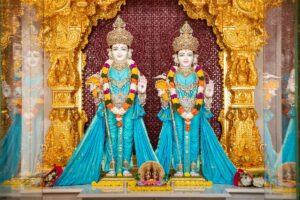
RITUALS/PRACTICES

According to Swaminarayan, one who practices the higher form of devotion worships Purushottam, and realizes the self is like akshar, who is the abode of Purushottam Narayana. Such a devotee is called an ekantik bhakta, who has perfected ekantik dharma, which is the constant practice of bhakti (devotion) towards God through jnana (knowledge), vairagya (detachment from anything other than God) and dharma (right behaviour in service to God) (Patel 2022:1583).

To cultivate ekantik dharma, Swaminarayan encouraged his followers to engage in temple worship, participation in festivals, rituals, didactic addresses, following devotional behavior, and thinking about model devotees of God. He emphasised the execution of seva (service) as a form of bhakti, stating that “a devotee should not wish for anything except the service of God” (Gadhada 1-43 cited in Brahmbhatt, 2014:107). Seva also extends to serving the guru (Gadhada 11-25 cited in Brahmbhatt 2014:108) and devotees of God, and is also broadened to include wider society and humanity (Brahmbhatt 2014:108). Seva is executed through activities and financial support, and in Swaminarayan’s lifetime it included engaging in social projects such as digging wells, running welfare centers and literacy programs for women, and preaching against female infanticide and sati (Patel 2022:1583).

Some of Swaminarayan’s followers were sadhus (holy men who engage in devotional and ascetic practice) who took vows that the laity also took, that is, to refrain from: stealing; intoxication; eating meat; adultery; and impurities of body and mind. The sadhus took five additional vows: celibacy; detachment from the body; humility; to not covet wealth; and detachment from food. These vows remain as important pillars of practice within BAPS today. Swaminarayan also instructed his followers to avoid interacting with the opposite gender at the temple and during religious events, which resulted in separate congregational activities for males and females, a practice that also persists to this day (Patel 2022:1584).

Members of the Ahmedabad and Vadtal dioceses believe that Swaminarayan is present in images installed by the acharya, and in the sacred scriptures authored by him. BAPS believes that Swaminarayan is present in the form of the guru and in images and sacred scriptures. Mahant Swami performs morning worship before a small image of Swaminarayan called the thakorji. This ritual is observed by devotees who are personally present and those who observe the rituals via the Internet (Williams 2018: 100).

Images in the central shrines of Swaminarayan temples are statues of the human form of God, and daily rituals in the temples act out the events of the daily life of God in human form and encourage meditation on God. Most temples also house shrines to gods in nonhuman form, including Hanuman and Ganapati, but they are in subsidiary shrines at the entrance to the temple. In line with the prominent position of Swaminarayan over Krishna, ritual worship is focussed on him and Krishna takes a subordinate position (Williams 2018:103). As such, the image of Swaminarayan is in the central position in the main shrine of all BAPS temples and the images of Krishna and Radha are in a side shrine. In BAPS temples, the image of Gunatitanand, a manifestation of God’s ideal devotee, sits to the left of Swaminarayan (Williams 2018:105) (Image 4 at right).

Members of BAPS and its charitable organizations engage in seva (service to society) by carrying out social service activities in the following areas: medical; educational; disaster relief; welfare; environmental; community; and rural development services (BAPS Charities n.d.). The Akshar Purushottam Public Charitable Trust was established in India in the 1950s, and subsequently, BAPS Charities, an international nonprofit organization was formed, and is engaged in over 160 humanitarian activities (Brahmbhatt 2014:99). Anand (2004:53) proposes that BAPS “focuses on philanthropy that arises from a religious motivation for the greater good of the society” and Brahmbhatt (2014:118) argues that while the social service of the organization’s members is religiously motivated and seen as an act of devotion, the service is not tied to a religious or proselytizing mission.

ORGANIZATION/LEADERSHIP

Swaminarayan institutionalized the Swaminarayan Sampradaya by constructing six mandirs (temples) in Gujarat (Mamtora 2016:831). Within the mandirs he installed images of deities and their ideal devotees, in accordance with his view that God should be worshipped alongside God’s ideal devotee (Patel 2022:1582). He installed his image at the Sri Laksminarayan mandir in Vartal, Gujarat (Mamtora 2016:831). Swaminarayan established two dioceses (Ahmedabad and Vartal) and appointed acharyas as administrators to manage the mandirs in their regions in 1826 (Mamtora 2016, 831). He appointed his two nephews to the role of administrators, which later established a hereditary line of succession. He identified Gunatitanand Swami as his eternal, ideal devotee as someone from whom his followers could take spiritual guidance, and in doing so, he established a line of gurus (parampara) (I. Patel 2022:1582).

After Swaminarayan’s death, new branches of the Swaminarayan Sampradaya were established. In 1907 Shastri Yagnapurushdas (1865-1951) split from Vartal and Ahmedabad due to theological differences about the nature of akshar that were discussed in the section on doctrines and beliefs. The breakaway group established the Bochasanwasi Shri Akshar Purushottam Swaminarayan Sanstha (BAPS) (Mamtora 2016:831).

BAPS had its first sustained migration outside of Gujarat and India, as Indians, and specifically Gujaratis migrated to East Africa as labor opportunities opened up due to British colonization (Williams 2001). During the policy of Africanisation in East Africa in the 1960s and 1970s, many Gujaratis left, with some members of the Swaminarayan movement going to Gujarat. The majority migrated to the United Kingdom, and they began to build temples there from 1970. A new temple was opened in Neasden in London in 1995, and it is the most important of BAPS’ overseas temples (Dwyer 2004:193). (Image 5 at right).

BAPS became a registered and certified trust in 1947 (Sadhu Amrutvijaydas 2007). The trust was managed by an administrative committee led by a president, and from 1950 the president was Pramukh Swami Maharaj (Williams 2001). Brahmbhatt (2014) notes that there was a distinction between administrative and spiritual leadership, with Pramukh Swami Maharaj taking the role of administrative president under two different spiritual leaders, before he became both the spiritual and administrative leader. On  August 13, 2016, Pramukh Swami Maharaj passed away (Marketwired 2016). His Holiness Mahant Swami was named as his successor and spiritual head of BAPS (Eastern Eye 2016).

A rationalized system of organization and hierarchical management (Kim 2008) has developed within BAPS in the United States, Britain, and other areas to manage the activities of 55,000 volunteers worldwide (BAPS 2024b). Rather than one overall structure in BAPS administrative organization, several trusts have been established to support activities, including social service activities globally (Brahmbhatt 2014:104). BAPS Charities is a global charity established in 2000 to oversee humanitarian activities and is registered in the United States, Canada, the United Kingdom, South Africa, Kenya, Tanzania, Uganda, and New Zealand. Working in five key areas, BAPS Charities, oversees selfless service to society through health awareness, educational services, humanitarian relief, environmental protection and preservation, and community empowerment (BAPS Charities n.d.).

There are now an estimated 30,000 members of BAPS in the United Kingdom, 40,000 members in the United States, and one million members worldwide (Kim 2009). BAPS has mandirs globally, in India, Europe, North America, Asia Pacific, the Middle East, and Africa. Its International Headquarters are located in Ahmedabad, Gujarat. The global network consists of more than 1300 mandirs and 5025 centers (BAPS 2024a).

ISSUES/CHALLENGES

A number of schisms have occurred within the Swaminarayan movement. The most significant schism came about due to theological differences discussed in the doctrines and beliefs section and resulted in the founding of the Bochasanwasi Shri Akshar Purushottam Sanstha (BAPS), which broke away from the original movement. This involved a major doctrinal split and institutional division within the movement (Raymond Brady Williams 2018, 60). The Swaminarayan Gadi was founded when Muktajeevandas Swami left the Ahmedabad temple in the 1940s. He rejected the householder acharyas as the legitimate successors of Swaminarayan and established his own institution. He claimed that the authentic lineage is from Gopalanand Swami, who was a prominent sadhu during Swaminarayan’s time (Williams 2018:57–58).

As a result, there are three major divisions of the Swaminarayan movement: the original Ahmedabad and Vadtal dioceses led by the acharyas of Ahmedabad and Vadtal; BAPS; and the Swaminarayan Gadi (Williams 2018:60). The two largest and most important are the original Ahmedabad and Vadtal dioceses, which follow the acharyas of Vadtal and Ahmedabad, and BAPS, which gives allegiance to Mahant Swami as the current akshar and spiritual guru in succession from Gunatitanand Swami (Williams 2018:73).

Aside from this major schism, several other schisms have beset the Swaminarayan movement within all three major divisions. Regarding BAPS specifically, the Yogi Divine Society separated from BAPS in 1966 over a dispute about leadership and initiation of women. Dadubhai Patel claimed authorization from his guru, Yogiji Maharaj, to invite young women to accept initiation as BAPS ascetics and to raise funds for a women’s ashram in India. Trustees in India expelled Dadubhai and his brother, Babubhai, from BAPS shortly thereafter. Dadubhai subsequently established a mission at Vidyanagar, where some of the young women from East Africa resided as ascetics. A few sadhus then established a center at Sokhda near Baroda. They accept Yogiji Maharaj as their guru, but they rejected the authority of his BAPS successor, Pramukh Swami (Williams 2018:72). BAPS still does but not permit the initiation of female ascetics; however, some elderly respected women live according to strict ascetic vows. On the other hand, female ascetics (samkhya yoginis) form part of the Ahmedabad and Vadtal dioceses and they receive initiation from the wives of the acharyas (Williams 2018:126–27).

A number of controversies have plagued the organization in the last few years. In the middle of political turmoil and intercommunal religious conflict, a terror attack on the Akshardham Swaminarayan complex in Gandhinagar, Gujarat took place on September 24, 2002. Two Muslim men entered the complex, carrying assault rifles and grenades, killing thirty-three people and injuring more than seventy7. The Indian government brought in the anti-terrorist Black Cat commandos and the siege ended early the next morning when the commandos killed the two men. The deceased included the two assailants, three commandos, four Swaminarayan volunteers, and one sadhu on the staff at the complex (Williams 2004:131).

A dispute arose in the construction of a BAPS temple at Chino Hills in California in 2003. It initially faced intense opposition from the local community whose residents claimed that traditional architectural elements of the temple would disrupt the city’s natural beauty. Some residents argued that the existence of the temple would usher in unwelcome changes in the city’s religious, cultural, and demographic makeup. The dispute ran for twelve years, but eventually, local community members who were initially opposed to the construction of the temple offered overwhelming support (A. Patel 2018).

In 2021, the New York Times reported allegations that forced labor was being used to build the Akshardham Mahamandir in Robinsville, New Jersey. Federal law enforcement agents entered the construction site of a BAPS temple in New Jersey after workers filed a lawsuit against the organization, accusing it of luring them from India, confining them to the temple grounds, forbidding them to talk to visitors, confiscating their passports and paying them the equivalent of about $1 an hour to perform hard labor. The workers entered the country on religious workers visas and the majority of them were said to be from Dalit backgrounds (Correal 2021). A spokesman for the temple said the workers came to the United States as volunteers, not as employees because volunteerism is a core part of their religious tradition, and he advised that temple officials were cooperating with the investigation. The temple opened in 2023, and a federal criminal investigation and a wage claim lawsuit has been ongoing (Bailey 2023).

In 2023, the BAPS temple in Sydney was vandalised, along with other Hindu temples prior to an official visit by Indian Prime Minister, Narendra Modi. “Declare Modi terrorist” was spraypainted on the temple in September 2024, motivated by campaign by activists who want to form a break-away state (Khalistan) for Sikhs in India (The Sydney Morning Herald 2023).

The Swaminarayan movement has undergone significant changes since its founding in the early nineteenth century due to a number of issues and challenges. The most significant of these changes has been the division of the movement into three major divisions due to theological differences and issues around succession and leadership. Of these three divisions, BAPS has become the most prolific. It has become one of the fastest-growing religious groups in Gujarat, and in India, and is the most prominent Hindu organization in Britain and North America (Williams 2018:60).

IMAGES

Image #1: Swaminarayan. Credit: https://commons.wikimedia.org/wiki.
File: Swaminarayan,_founder_of_the_Swaminarayan_Sampradaya.png.
Copyright held by BAPS Swaminarayan Sanstha (web: www.baps.org, email: info@baps.org);, CC BY-SA 4.0 <https://creativecommons.org/licenses/by-sa/4.0>, via Wikimedia Commons.
Image #2: Shastriji Maharaj. Credit: https://commons.wikimedia.org/wiki/File:BAPS_Abudhabi_15.jpg
BAPS Swaminarayan Sanstha, CC BY-SA 4.0 <https://creativecommons.org/licenses/by-sa/4.0>, via Wikimedia Commons.
Image #3: Mahant Swami. Credit: https://commons.wikimedia.org/wiki/File:Mahant_Swami_Maharaj.jpg
Copyright held by BAPS Swaminarayan Sanstha (web: www.baps.org, email: info@baps.org), CC BY-SA 4.0 <https://creativecommons.org/licenses/by-sa/4.0>, via Wikimedia Commons.x
Image#4: Swaminarayan and Gunatitanand Swami (collectively known as Akshar-Purushottam Maharaj).
Credit: https://commons.wikimedia.org/wiki/File:BAPS_Abudhabi_17.jpg
BAPS Swaminarayan Sanstha, CC BY-SA 4.0 <https://creativecommons.org/licenses/by-sa/4.0>, via Wikimedia Commons.
Image #5: BAPS Shri Swaminarayan Mandir, London. Credit: https://commons.wikimedia.org/wiki/ File: BAPS_Shri_Swaminarayan_Mandir,_London_-_geograph.org.uk_-_4743308.jpg
Shri Swaminarayan Mandir, London by Robin Webster, CC BY-SA 2.0 <https://creativecommons.org/licenses/by-sa/2.0>, via Wikimedia Commons.

REFERENCES

Anand, Priya. 2004. “Hindu Diaspora and Religious Philanthropy in the United States.” In Toronto: Center on Philanthropy and Civil Society, New York. Accessed from https://cdn.ymaws.com/www.istr.org/resource/resmgr/working_papers_toronto/anand.priya.pdf on 25 September 2024.

Bailey, Sarah Pulliam. 2023. “A $96 Million Hindu Temple Opens Amid Accusations of Forced Labor.” New York Times, October 21. Accessed from https://www.nytimes.com/2023/10/21/nyregion/nj-hindu-temple.html on 25 September 2024.

BAPS. 2024a. “BAPS Global Network.” BAPS.Org, 2024. Accessed from https://www.baps.org/Global-Network.aspx on 25 September 2024.

BAPS. 2024b. “History and Milestones.” BAPS, 2024. Accessed from https://www.baps.org/About-BAPS/WhoWeAre/HistoryandMilestones.aspx on 25 September 2024.

BAPS Charities. n.d. “About Us.” BAPS Charities. Accessed from https://www.bapscharities.org/about-us/ on 18 August 2024.

Brahmbhatt, Arun. 2014. “BAPS Swaminarayan Community: Hinduism.” Pp. 180-99 in Global Religious Movements Across Borders. Cambridge, UK: Cambridge University Press.

Correal, Annie. 2021. “Hindu Sect Is Accused of Using Forced Labor to Build N.J. Temple.” New York Times, May 11. Accessed from https://www.nytimes.com/2021/05/11/nyregion/nj-hindu-temple-india-baps.html on 25 September 2024.

Dwyer, Rachel. 2004. “The Swaminarayan Movement.” Pp. 180-99 in South Asians in the Diaspora, Histories and Religious Traditions, edited by Knut A Jacobsen and Pratap Kumar. Numen Book Series 101. Leiden: Brill.

Eastern Eye. 2016. “Mahant Swami Takes Charge.” Eastern Eye, August 19.

Kim, Hanna H. 2009. “Public Engagement and Personal Desires: BAPS Swaminarayan Temples and Their Contribution to the Discourses on Religion.” International Journal of Hindu Studies 13:357–90.

Mamtora, Bhakti P. 2016. “Swaminarayan and the Establishment of the Swaminarayan Sampraday (1801).” In Great Events in Religion: An Encyclopedia of Pivotal Events in Religious History (Three Volumes), edited by Florin Curta and Andrew Holt. New York, NY: Bloomsbury Publishing USA. Accessed from http://ebookcentral.proquest.com/lib/usyd/detail.action?docID=4743710 on 25 September 2024.

Marketwired. 2016. “Across America Devotees Grieve for Hindu Guru His Holiness Pramukh Swami Maharaj.” Marketwired. Accessed from https://search.proquest.com/docview/1813880488?pq-origsite=primo.

Patel, Aarti. 2018. “Secular Conflict: Challenges in the Construction of the Chino Hills BAPS Swaminarayan Temple.” Nidan: International Journal for Indian Studies 3:55–72.

Patel, Iva. 2022. “Swaminarayan.” Pp. 1581–85 in Hinduism and Tribal Religions, edited by Jeffery D. Long, Rita D. Sherma, Pankaj Jain, and Madhu Khanna. Dordrecht: Springer Netherlands.

Sadhu Amrutvijaydas. 2007. 100 Years of BAPS: Foundation, Formation, Fruition. Ahmedabad, India: Swaminarayan Aksharpith.

Sadhu Bhadreshdas. 2016. “Swaminarayan’s Brahmajnana as Aksharabrahma-Parabrahma Darsanam.” In Swaminarayan Hinduism: Tradition, Adaptation and Identity, edited by Raymond B. Williams and Yogi Trivedi. New Delhi: Oxford University Press.

Sadhu Vivekjivandas. 2024. “Gunatitanand Swami: A Brief Introduction (Part 1).” BAPS. Accessed from https://www.baps.org/EnlighteningEssays/2018/Gunatitanand-Swami–A-Brief-Introduction-(Part-1)-12812.aspx on 25 September 2024.

Swami Paramtattvadas. 2017. An Introduction to Swaminarayan Hindu Theology. Introduction to Religion. Cambridge: Cambridge University Press.

The Sydney Morning Herald. 2023. “Police Release Images After Hindu Temple Vandalised.” The Sydney Morning Herald, May 13. Accessed from https://www.smh.com.au/national/nsw/police-release-images-after-hindu-temple-vandalised-20230513-p5d84t.html on 25 September 2024.

Williams, Raymond B. 2018. “An Introduction to Swaminarayan Hinduism.” Pp. 75-106 in An Introduction to Swaminarayan Hinduism. Third Edition. Introduction to Religion. New York, NY: Cambridge University Press.

Williams, Raymond B. 2004. “Terror Invades Paradise.” Pp. 131–37 in Williams on South Asian Religions and Immigration, edited by John R. Hinnells. New York: Routledge.

Williams, Raymond B. 2001. An Introduction to Swaminarayan Hinduism. New York: Cambridge University Press.

Publication Date:
30 September 2024


Share