AUMISM TIMELINE
1923 (June 25): Gilbert Bourdin was born in Martinique.
1956: Bourdin left Martinique for France.
1961: Bourdin traveled through India and was initiated as Swami Hamsananda Sarasvati by Swami Sivananda at Rishikesh in the Himalayas.
1962: Sarasvati retired as an ascetic hermit to a cave in Vaucluse (Southern France).
1967: Sarasvati founded the “Association des Chevaliers du Lotus d’Or” (Association of the Knights of the Golden Lotus).
1969: Sarasvati and his first pupils purchased the land in the municipality of Castellane (Haute-Provence Alps, France) where they established the first monastery and began to build the Mandarom.
1977: The Lotus Temple was constructed, and Sarasvati visited the Sixteenth Karmapa in the Holy City of Mandarom.
1981-1990: More prominent temples and statues at the Holy City were constructed. Gradually, the community developed, and Sarasvati realized his messianic role during the rituals of the cosmic battles against evil.
1990: Sarasvati proclaimed himself the “Cosmoplanetary Messiah” and Avatar of Synthesis His Holiness Hamsah Manarah.
1991: The Association Cultuelle du Temple Pyramide was created.
1992: Robert Ferrato (ecological activist) started his campaign against the Holy City of Mandarom Shambhasalem and the Aumist religion, both environmentally and financially.
1994: The Holy City of Mandarom was searched to verify the civil building permits concerning statues and temples, and the Court of Appeal of Lyon annulled the building permit for the Pyramid Temple.
1995 (January): The Holy City of Mandarom was raided by the police.
1995 (June 12): Bourdin/Lord Hamsah Manarah was charged with rape and arrested. The building permit for the Pyramid temple was annulled.
1995 (December): Aumism was included in the Gest and Guyard’s report on sects to the French National Assembly.
1998 (March 19): Hamsah Manarah died at the hospital in Grasse of complications from diabetes. His inhumation was allowed not at the Holy City but rather in a little cemetery in front of a few followers on April 6 after several changes of destination.
2001 (September 6): The temple-statue of the Cosmoplanetary Messiah was destroyed.
2007-2013: Suits against France over taxation matters were taken to the European Court of Human Rights.
2013-2019: Lawsuits were filed at the national level to obtain the building permits for the Pyramid Temple.
FOUNDER/GROUP HISTORY
Gilbert Bourdin was born on June 25, 1923 in Martinique to a French and Catholic family. Little is known about his early life. As Zoccatelli wrote (2004:186), “He himself worked to surround his biography with a veil of inaccessibility, for example when he places at the frontispiece of one of his books the phrase: ‘The High Tradition demands that one does not speak of the past of a man of religion’.” In his writings, he described his life growing up as painful and declared during his youth years an attitude of strong atheism (Zoccatelli 2004:185-86; Hamsah Manarah 1993a). He left Martinique in 1956 to study law, medicine, political sciences, and economics in France. During this period, he engaged with several esoteric milieus, joining the Theosophical Society, the Freemasonry of the Grand Lodge of France, and various Rosicrucian and Martinist circles (Introvigne 1999; Duval 2002).
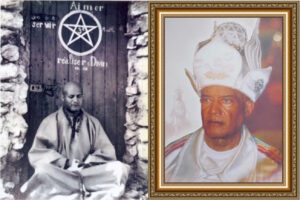
During his travel to India in 1961, he was initiated under the name of Swami Hamsananda Sarasvati by the influential Swami Sivananda (who founded The Divine Life Society) at Rishikesh in the Himalayas. [Image at right] When he returned to France, he spent about one year, around 1962, as an ascetic hermit practicing the Hatha-yoga, meditation, and purification in a Vaucluse cave (Southeastern France). After this period, he started to gather some followers. Sarasvati became quite well-known as a yoga teacher, publishing several books on that topic, also translated into languages other than French (Hamsananda Sarasvati 1976). After having experimented with yoga teachings in several ashrams, in 1967, not far from Avignon, Sarasvati founded the “Association des Chevaliers du Lotus d’Or” (Association of the Knights of the Golden Lotus). The Association was a philanthropic association aimed at human development through sciences, arts, philosophy, and comparative music, with the goal of bringing religions closer together (Journal Officiel de la République Française 1967, 10 Octobre :10000).
In 1969, a plot of land was purchased in the municipality of Castellane in the French Haute-Provence Alps, where, together with his first pupils, Gilbert Bourdin started to build the Holy City of Mandarom Shambhasalem. He created the initiatory order of the Knights of the Golden Lotus which pursues through prayer the mystic change and spiritual realization of men and women (Hamsah Manarah 1995a).
In the following two decades, the founder taught the principles of yoga, practiced meditations, and improved his ashram, while the group of followers increased. Meanwhile, through his followers’ financial and physical support, several temples and statues of different sizes (from less than one meter to around twenty meters) were built, and the Holy City took actual shape. Each of the biggest temples constructed represented one of the world’s great religious traditions; the first to be completed was the Lotus Temple (1977). This was the earthly home of the spiritual master, where he resided until his hospitalization and death in 1998. In 1981, the Statue of the Buddha was complete, and it remains one of the tallest Western statues of seated Buddha. In 1987, the gaze of the Statue of the Cosmic Christ was completed. In 1989, several buildings were finished: the Mosque with four minarets dedicated to Islam, the Temple of Kalki as a column of fire representing Hinduism, and the Jewish Golden Temple built following the symbolism of the golden ratio. The large temple-statue of the Cosmoplanetary Messiah was erected in 1990, thirty-three meters high. It was placed between the Cosmic Christ and the Maha Buddha as the symbolic unification of Eastern and Western Religions (Aumisme 2024a), and his face had the likeness of the spiritual master Hamsananda Sarasvati, later revealed as Lord Hamsah Manarah. The sacred architecture should have culminated with the construction of the Pyramid Temple, which was thought to crystalize the cyclic conception of time of the Golden Age, balancing cosmic forces (Hamsah Manarah 1995a). This project remained ongoing because, after the building permits were obtained in April 1992, they were contested and annulled at different levels of French administrative law. They continued until the last initiatives of enhancement of the landscape specificities (Unpublished material provided during the Author’s field visit in 2023).
During the 1980s, in parallel with the construction of the temples in the Holy City, slowly and through a significant number of rituals, Sarasvati cultivated additional religious and spiritual affiliations. These consisted of numerous initiations in the Hindu, Jainist, Tibetan Buddhist, Indian Sufi, and African traditions, and included one by the Sixteenth Karmapa that he received during his visit to the Mandarom in 1977 (Aumisme 2024a). This period of study of the writings of several spiritual and illuminated masters, as well as sacred books of different religions, marked the maturation of his own religious system and recognition of the prophecies and his past lives. This led to his realizing his messianic role (Zocatelli 2004; Palmer 2013) that focused on his calling to produce a spiritual revolution and establish the Universal Religion of the Unity of the Faces of God (See, Doctrines/Beliefs). From being a guru initiated to different religions, he revealed himself as like the incarnation of God, an “Avatar of synthesis” (Zoccatelli 2005:217-18).
This revelation was announced in May 1990 at a press conference at the Holy City inviting the public to the celebration of that year’s August full moon. It was at that long ceremony that the Aumist spiritual master crowned himself as the Cosmo-Planetary Messiah. This revelation consisted of becoming His Holiness, the Lord Hamsah Manarah. His mission was to save the Earth, help humanity, and take charge of the planet’s future. According to the Aumist conception of time, he might have brought about the Golden Age of Peace, Unity, Truth, and Freedom. Six more ceremonies of the Revelation and of the Sevenfold Crowning of the Avatar of Synthesis followed, with one for each major religion, until the seventh ceremony. The last step of the Revelation, one year later, took place on August 22, 1991 in front of the Aumists and the world press, who were invited to each of these events (Palmer 2011, 2013).
In 1991, the group created a new association, Association Cultuelle du Temple Pyramide (Cult Association of the Pyramid Temple) to gather and manage financial resources to be allocated to the construction of the Pyramid Temple. This temple was and has remained dedicated to the cosmic realization of the materialization of this religion; the sacred architecture would embody and achieve the messianic purposes of Lord Hamsah Manarah (Hamsah Manarah 1993a; Belanger 2012). Notwithstanding the initial building permission, the construction project has been opposed by a local ecologist association, the Association pour la protection des lacs et sites du Verdon (Association for the Protection of the Lakes and Sites of the Verdon). The association, led by an ecologist, engaged in the protection of the Verdon landscape and environment against ecological damage. The Association “claimed that the Mandarom is an offense to the ecological equilibrium of the mountain” (Introvigne 1999:368).
The following decade was meant by the group as a universalistic opening of the Aumist religion to the world. The founder published five books titled Books of the Revelation, which presented the theological, symbolic, and ritual system of Aumism. Revelation, rather than expanding the size of Aumism, coincided with the beginning of a period of strong social control by French institutions (Palmer 2011). Adherents referred this as religious persecution (Jacot 2008; Hamsah Manarah 1991) because Aumism was listed in the French institutional anticult organizations’ accounts (Palmer 2013). In the mid-1990, the movement was confronted with several allegations of financial fraud, rape by their spiritual leader, and infringement of zoning and urban planning laws (See, Issues/Challenges). In 1992, the movement was opposed by the local ecological association, which raised media attention on the impact of the sacred architecture of the Holy City of Mandarom Shambhasalem on the alpine and mountain landscape (Introvigne 1999:368; Palmer 2011:41-42). This was probably a turning point, as can be elicited from the report of Gest and Guyard (1995:18). During the year 1995, Gilbert Bourdin (Mandaja 1995) and some of the Aumisme followers were arrested (See, Issues/Challenges) at the Mandarom and elsewhere in France, but released a couple of weeks later.
In May 1996, the spiritual master issued a press release stating his proposal to withdraw from public teaching, relinquish his title of Messiah, and either destroy or detonate the statues of the Holy City of Mandarom Shambhasalem (Introvigne 1999:369). Indeed, he did not follow up on this announcement, but legal battles were meanwhile opened on several fronts: fiscal tax controls on the two different associations created to manage the religious group (see Organization/Leadership), rape allegations greatly amplified in the press and on television (Palmer 2011:45-46), and infringement of urban laws for temples and statues.
Long ill and aware that he has been diabetic since the 1970s, Gilbert Bourdin was hospitalized in Grasse after a deterioration in his condition in March 1998. He died on March 19 at age seventy-four. The spiritual leader’s death came on the heels of an extremely sensitive period for new religious movements that were questioning not only French institutions but especially European public opinion because of the 1994 mass suicides of some members of the Order of the Solar Temple in Switzerland. Rumors about mass suicide were also advanced against the Aumists (Palmer 2001:36; Palmer 2013:39-40). The French authorities framed his death in terms of the possible problems of public order (typical in managing minorities’ rights in France. See, Dieu 2020). Further, the possibility of watching over their Messiah, as well as celebrating his funeral and interring his body in the Holy City were repeatedly obstructed. Finally, after several prohibitions from prefects and mayors in the neighborhood of Grasse or Castellane, Lord Hamsah Manarah was buried in a small, abandoned cemetery in the municipality of Castellane, under a thick pour of concrete, despite an unfavorable public demonstration by the mayor and a hundred citizens (Introvigne 1999:370-71; Duval 2002:93-96).
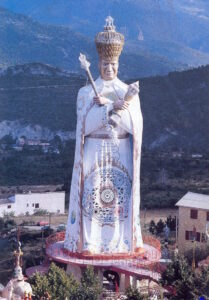
Lawsuits continued after the death of the spiritual master. Although charges of rape were dropped upon his death, the cases concerning urban infringement continued, particularly those concerning the biggest temple-statue of the Cosmoplanetary Messiah at the Holy City of Mandarom Shambhasalem. [Image at right] This construction could not be undertaken without proper permits, leading to a lengthy legal battle. Despite the fact that members of Aumism have always claimed to have obtained the necessary permits, the French authorities challenged their validity. This led on September 6, 2001 to a court order of the destruction of the thirty-three-meter-tall statue of the Cosmoplanetary Messiah. After forcibly entering the Holy City of the Mandarom Shambhasalem, police demolished the temple-statue with explosives. The event was widely publicized, drawing international attention also for the evocative power of the statue’s demolition and for that same year’s events (the destruction of the Bamiyan Buddha in Afghanistan in March 2001 by Taliban and the demolition of the Twin Towers in the U.S. a few days after the detonation of the Cosmoplanetary Messiah in France) (Aumise website 2024b).
In the following decades, the group’s legal actions continued in several sectors: concerns on fiscal regimes as a cult association, contesting the expenses for the demolition of the Cosmoplanetary Messiah, the retired permission to build the Pyramid Temple, etc. Even if a small number (a few hundred), the group has survived not only in France but also in Africa and is still waiting for the reincarnation of their next Hierokarantine (Introvigne 2017; Rech field visit in 2023).
DOCTRINES/BELIEFS
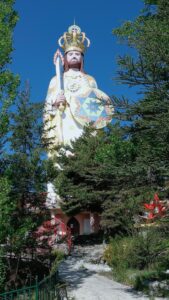
When Aumists present themselves to external visitors (a guided tour of the Holy City of Mandarom is organized throughout the year: [Image at right] Aumisme 2024c), they affirm themselves to be a religion of action, that is, according to scholars, an active philosophy of action (Perocco 2001; Zoccatelli 2004).
Aumism is both an esoteric and occult order and a church-like organization. It originally had a Hindu identity and then transformed into a syncretic universalism that blended Christianity, Buddhism, Hinduism, Jainism, Islam, and Judaism. This was the consequence of the founder’s self-identification (the “revelation” in the Aumists’ words, See Founder/Group History) as the Cosmoplanetary Messiah and Synthesis Avatar (Zoccatelli 2005; Perocco 2001; Belanger 2012). The founder has defined his spiritual itinerary from Hinduism to the universalist and syncretic religion as a moral and spiritual revolution. The entire Aumist doctrine is contained in the twenty-two volumes written by the founder. The volumes cover the different phases of Aumism from the very early stages until the actual phase, which is the transition age after the death of the founder and the waiting period for the Messiah’s reincarnation (Jacot 2008). The religious system is dense, merging oriental philosophies and practices with messianism, esoterism, and apocalyptical millenarism (Perocco 2001). From this perspective, new elements contributing to belief system coherence are the unique dogma of Unity of God’s Faces; the cyclical time conception, which is settled in the scale of evolution of nature represented through a pyramid; and the Column of Light.
Aumist religion is based on the dogma of Unity of God’s Faces. This means that it is always the same God (named the “God of Unity”) who has manifested himself to humankind since the dawn of time, despite the apparent multiplicity of his “Faces.” God is one, while men/women divide it, according to Lord Hamsah Manarah’s teachings. This is materially noticeable in the sacred architecture of their Holy City in France. From this point of view, each religion is a varied and symbolic expression of the same transcendent reality. In the Aumist doctrine, contemporary society would need adaptation, which is offered by this syncretic approach, and the synthesis is represented by the doctrine revealed by the founder in his books and teachings.
This synthesis is also represented in the symbol of Hexamid, which is a six-sided pyramid, each face displaying a color of the rainbow, symbolizing a different religion. At its apex, all religions converge into the unifying OM, the radiant white light of synthesis (Hamsah Manarah 1991; Belanger 2012).
Time is cyclical in Aumisme and composed of four continuous and intertwined cycles: the Silver Age, the Copper Age, the Iron Age, and the Golden Age. There exists a fifth period, the Diamond Age, which transcends them, and which alone is not subject to time. Souls are subject to these cycles, but they are at different levels of evolution. The Aumist belief system divides creation into different planes or “kingdoms of nature”: mineral, vegetable, animal, and human. According to their doctrine, reincarnation allows beings to progress through these planes, evolving from one to the next. So, in the groove of Hinduism, Buddhism, and Jainism, Aumists share the belief in reincarnation (Zoccatelli 2005:219). Their spiritual master, through the revelation of “five truths,” developed a doctrine aimed at the effort to liberate from karma. Aumists do not deny paradises, but they do claim that they are harmful to the spiritual life and to the evolution of the soul (Hamsah Manarah 1992).
In 1985, Hamsah Manarah postulated the creation of the Column of Light, a purported instrument for the reception of disembodied souls. Comprising six arms, each divided into twenty-one levels of consciousness, the Column of Light is conceived as a vast post-mortem educational institution (they commonly call it the “university for the souls,” field visit 2023). It is believed to facilitate the channeling and evolution of souls towards a divine state, integrating the diverse afterlife concepts of various religious traditions. This instrument is further posited to contribute to the crystallization and perpetuity of the Golden Age on Earth (Hamsah Manarah 1993b).
RITUALS/PRACTICES
As Aumism is both a monastic group and a church-like organization, the ritual life is crucial at the Mandarom (which is a monastery) and in the ordinary life of the Aumists. Monks and nuns take vows of chastity and poverty, but the vows are not perpetual: they may cover a period of some years of retirement (Duval 2002:46-47). Originally called Chevaliers du Lotus d’Or (Knights of the Golden Lotus), since the 1990s the initiatory order has taken the name of Chevalier du Vajra Triomphant (Knights of the Triumphant Vajra: see Organization/Leadership). This esoteric path comprises twenty-two levels of initiation and, as reported by Aumists encountered during the author’s field visit (2023), progression depends on commitment to knowledge and the personal mystical and spiritual effort.
According to Duval (2002:83-86), Aumists’ ordinary life is just differentiated by the attention to spreading symbols of protection in their houses and creating an altar that displays the image of Lord Hamsah Manarah, an oil lamp or candle holders, protective objects and supports burning incense. Apart from these, which could be dissimulated or hidden, there are constant in prayers, practicing yoga or other martial arts, and meditation. Those activities, together with vegetarianism and a general approach of renunciation and detachment from worldly and comfortable life, characterize each Aumist (Duval 2002:70-71). Visiting the Holy City of Mandarom (2023), the presence of sacred and religious symbols, citations of several sacred books or mystics’ citations, as well as representations of Lord Hamsah Manarah are widespread. This symbolic system would function at the unconscious level for bystanders and/or visitors.
The Aumists base their religion on the ritual repetition of the OM sound, even though the number of OM’s repetitions is symbolically determined and connected to the individual status and their role in the Aumist religion. It is understood as the repetition of the first of the mantras, which is a condensed sacred formula. This prayer is recited along with the blessings, and the sound of bells or drums, during public worship (Author’s field visit 2023). Its manifold benefits include the fact that it is a primordial sound of divine creation but also helps people regenerate themselves. Through the ritual repetition of this sound, the energy of Unity is released to improve the cosmic evolution and build a new age or a Golden Age (Hamsananda 1990).
According to the dogma of the Unity of Faces of God (See Doctrines/Beliefs), Aumists have seventeen festivities every year. These unite Lord Hamsah Manarah’s anniversaries (e.g. his initiations and revelation) with other major cosmic, spiritual, and religious festivities that belong to Christianism, Buddhism, Hinduism, Jainism, Islam, and Judaism. They also celebrate five sacraments, highly inspired by Christianity (Hamsah Manarah 1995b), and Catholicism in particular (Duval 2002:168-80). These include baptism, confirmation, renewal of vows and promises, marriage, transition (Hamsah Manarah 1995b).
ORGANIZATION/LEADERSHIP
Aumism is an esoteric and initiatory order, but also a church-like and new syncretic religion that was originally inspired by Hinduism and then became a messianic movement and religion (Zoccatelli 2005). Comprising both men and women, it is divided into a monastic order, a priesthood order (with bishops, priests, and priestesses), and all the members. The actual organization dates to the period of the 1990s, which followed the revelation (See Founder/Group History).
From an external organizational point of view, Aumism has always been organized under the French Republic’s 1901 law on association. On the one hand, the Aumism initially was composed of members of the Order of the Knights of the Golden Lotus, and among them, there were members of the monastic order. On the other hand, an exoteric branch was made up of the faithful people who had received the “baptism of OM” and were initiated by the spiritual master. Various regulatory bodies were set up after the dissolution in 1995 of the Association of the Knights of the Golden Lotus: “Association des Chevaliers du Vajra Triomphant” (1995-present) and the “Association Cultuelle du Vajra Triomphant” (1991-1995) were established for different tasks. Gradually, prayer centers or Centrom were also created to welcome and bring together members of the Aumist Church, according to their place of residence. Administratively, there were fourteen regions, with each administered by a “region leader” who may be a priest or a bishop (Duval 2002).
The monastic group is actually composed of about a dozen people (Author’s field visit 2023), who live in the Holy City of Mandarom Shambhasalem, the headquarters of the Aumist religion (Author’s field visit in 2023). Duval (2002), during his ethnography between 1997 and 2000, counted a maximum number of about 400 followers, while Gest and Guyard listed about 2,000 followers (1995:17). Introvigne (2017) reported that members “decreased from 1,300 in 1990 to 300 in 2001. However, this decline proved not to be irreversible. The number of Aumists started increasing again in the twenty-first century, reaching ca. 500 in 2017” (2017:29).
After the spiritual master’s death in 1998, the collegial administrative structure (made up of officials from both the Monacal Order and the Initiatory Order) remained the sole legitimate decision-making authority. Members argued that Lord Hamsah Manarah envisioned a collegial leadership structure to carry on the religion’s teachings after his death. From an organizational point of view, Aumism is represented by the Association du Vajra Triomphant for material and financial purposes, and the Association cultuelle du Vajra Triomphant for everything concerning worship. Since the illness and death of the spiritual master, a collegial leadership was established to manage Aumism, and other committees were charged with specific projects (e.g. the biannual conference).
ISSUES/CHALLENGES
Aumist religion has been confronted with both internal and external disputes. The most visible and long-lasting have been external ones. Palmer (2011), Duval (2002), and Introvigne (1999) illustrated both the impact of negative media attention and the ways in which French anticult sentiment has provoked government interference, conflict with civil society, and public opinion antagonism. During the 1990s, Aumism (better known in the media as the Mandarom) was harshly confronted with judicial cases regarding financial fraud, allegations of sexual misconduct, and urban planning law infringement. The Mandarom community has been considered a sect by the French Anticult organizations. It was included on the 1995 Gest and Guyard’s (1996) list compiled to combat the sectarian drift (Introvigne 1999; Palmer 2001).
The group was repeatedly raided in the 1990s; the first inspection at the Holy City was aimed at verifying the civil planning code concerning statues and temples, in November 1994. One month later, the Court of Appeal of Lyon annulled the building permit for the Pyramid Temple. In January 1995, the tax officials and gendarmes burst into the Holy City of Mandarom, searching for documents and other items, while at the same time, in Paris, the administrative leader’s apartment was inspected. Some months later, the gendarmes came back to arrest Gilbert Bourdin. He was accused of rape by the daughter of a devout Aumist, as she stated in a book written in collaboration with the television journalist Bernard Nicolas (Roncaglia 1995). On the same day (June 12, 1995), about twenty other disciples were arrested elsewhere in France, and the day after, the Conseil d’Etat confirmed the annulation of the building permit for the Pyramid Temple.
Palmer (2013) analyzed the French anticult attitude toward Aumism as the labeling of the group as “a focus of moral panic” (2013:35-36), wondering about the boundaries between the social control of sects and religious persecutions (Palmer 2002). This is the product of a twofold issue. From one side, the French Republic presents a multifaceted form of secularism(s) (the French laicités, cf. Baubérot 2015) that has been established since the approbation of the Separation Law in 1905. According to that law, the French Republic guarantees religious freedom but does not recognize, remunerate, or subsidize any religion (Koussens 2023). As established in a previous research work (Rech 2024), the tension between freedom of conscience and religious regulation is difficult to balance in cases like this. While the French law protects individual religious freedom, it also requires the State to maintain neutrality. However, this neutrality is complicated by the need to regulate certain aspects of religious practice, such as public order (Dieu 2020) and manifestations or the maintenance of historical religious sites.
If the French official judicial jurisprudence is consulted, a remarkable number of suits concern the Association du Vajra Triomphant since 2004. In 2007, Aumism, through its Association Cultuelle du Temple Pyramide, took to the European Court of Human Rights its case against France concerning the taxation of manual donations and its rights to exercise religion.
Apart from the lawsuits, the group has always exercised the right to reply in the media, and, on their website, they have collected a large number of documents that witness the entire set of legal affairs, media materials, and scholars’ works that involved them (Aumisme 2024a). The group has been effectively exposed to a phenomenon of media disrepute, which was referred to as “mediabolization” (Palmer 2011; Duval 2002) that has yielded deviant status (Berzano 1996). This long process of disqualification by French and international public opinion is counterbalanced by tireless action in the legal arena that has extended from the various national courts to the European Court of Human Rights to have its legal status recognized. Introvigne explained, in a 2017 speech, how the group survived through the legal affairs that he named a “tale of resistance” (confirmed in interviews during the Author’s fieldwork in 2023).
Another important challenge was the succession of leadership, which is a decisive issue both internally and externally. From an internal point of view, Aumists are still waiting for a future incarnation. When Palmer conducted her study on the groups especially addressed in the Gest and Guyard’s list (Palmer 2011), Aumism was present in North America, and particularly in Canada. A Canadian association dedicated to the promotion of Aumist prayer and meditation meetings was registered in 1997 but ceased activity in 2004. Among Northern American and Canadian members there has been a potential “schism” over the transition of Lord Hamsah Manarah (Introvigne 2017:24; Duval 2002:96-97).
IMAGES
Image #1: © S. HAMSAH MANARAH Fondateur de l’Aumisme. This image is protected by copyright law. Unauthorized use, reproduction, or distribution of this image is prohibited. For permissions or licensing, please AVT MANDAROM AUMISME via e-mail aum@aumisme.org.
Image #2: © Aumisme Le Messie Cosmoplanétaire. This image is protected by copyright law. Unauthorized use, reproduction, or distribution of this image is prohibited. For permissions or licensing, please AVT MANDAROM AUMISME via e-mail aum@aumisme.org.
Image #3: Statue of the Cosmic Christ. Photograph and copyright by Giovanna Rech.
REFERENCES
Aumisme website. 2024a. Accessed from https://aumisme.org on 6 December 2024.
Aumisme. 2024b. Mandarom: Soutien international. Communiqué de Presse. Accessed from https://www.aumisme.org/archives/fr/cp/soutien_int.htm on 9 December 2024.
Aumisme. 2024c. Visite de la Cité Sainte de Mandarom Shambhasalem. Accessed from https://aumisme.org/n4-visite-de-la-cite-sainte-de-mandarom-shambhasalem/ on 4 December 2024.
Baubérot, Jean. 2015. Les 7 laïcités françaises. Paris: Maison des Sciences de l’Homme.
Belanger, Odile. 2012. L’Aumisme, étude religiologique. Montréal: Université du Québec, Mémoire de maîtrise.
Berzano, Luigi. 1996. “La déviance supposée du ‘phénomène sectaire’: l’exemple de la religion aumiste.” Pp. 315-20 in Pour en finir avec les sectes. Le débat sur le rapport de la commission parlementaire, edited by Massimo Introvigne and J. Gordon Melton. Parigi: Dervy.
Dieu, Frédéric. 2020. “L’ordre public et les religions : ordre public, ordre laïque? ” Revue du droit des religions 9:13-40.
Duval, Maurice. 2002. Un ethnologue au Mandarom : enquête a l’intérieur d’une “secte.” Paris : Presses Universitaires de France.
Gest, Alain and Jacques Guyard. 1995. Rapport fait au nom de la commission d’enquête sur les sectes, Assemblée Nationale, Rapport n° 2468, déposé le 22 décembre 1995, Dixième législature (1993-1997). Accessed from https://www.assemblee-nationale.fr/11/rap-enq/r2468.asp on 5 December 2024.
Manarah, Hamsah. 1995a. Périple d’un yogi et initié d’occident. La Baume (Castellane): Le Mandarom.
Hamsah Manarah. 1995b. Le livre des sacrements de l’Aumisme. La Baume (Castellane): Le Mandarom.
Hamsah Manarah. 1993a. La révolution du monde des vivants et des morts. La justice divine/ La Baume (Castellane): Editions Le Mandarom.
Hamsah Manarah. 1993b. Une loi pour détruire le mal. La sélection dans le jardin des âmes. La Baume (Castellane): Editions Le Mandarom.
Hamsah Manarah. 1992. La loi d’évolution des âmes. De l’esclavage à la vraie libération. La Baume (Castellane): Editions Le Mandarom.
Hamsah Manarah. 1991. L’Aumisme, la doctrine de l’Âge d’Or. La Baume (Castellane): Le Mandarom.
Hamsah Manarah (S.M. Hamsananda). 1991. Les combats du Messie attendu pour sauver la terre et la création. La Baume (Castellane): Éditions du Mandarom.
Hamsananda, S.M. 1990. La doctrine de l’AUMISME, fondement de l’Âge d’Ori. La Baume (Castellane): Editions Le Mandarom.
Introvigne, Massimo. 2017. Communicating the Incommunicable: How Aumism Survived, Communication during the European Association for the Study of Religion Annual Conference, Leuven September 19, 2017. Accessed from https://www.cesnur.org/2017/aumisme_leuven.pdf on 9 December 2024.
Introvigne, Massimo. 1999. “Holy mountains and anti-cult ecology: the campaign against the Aumist religion in France.” Social Justice Research 12:365–75.
Jacot, Jean-Marc. 2008. “AUMISM: The Birth of a New Religion. A Short History of the First 47 Years. 1961-2008.” Paper presented to the 2008 International Conference of CESNUR Twenty Years and More: Research into Minority Religions, New Religious Movements and ‘the New Spirituality, London 16-20,”April 2008. Accessed from https://www.cesnur.org/2008/london_jacot.pdf on 5 December 2024.
Koussens, David. 2023. Secularism(s) in Contemporary France. Boundaries of Religious Freedom: Regulating Religion in Diverse Societies. Cham:Springer.
Mandaja. 1995. Mandarom: les persécutions du Messie. Nîmes: Lacour.
Palmer, Susan J. 2013. “Mandarom and the Limitations on Liberté in the Laïcité.” Pp. 29-49 in Spiritual and Visionary Communities. Out to Save the World, edited by Timothy Miller. London: Routledge.
Palmer, Susan J. 2011. “The Holy City of Mandarom: A Case of ‘Médiabolization’.” Pp. 33-57 in The New Heretics of France: Minority Religions, la Republique, and the Government-Sponsored ‘War on Sects’.” Oxford: Oxford University Press.
Palmer, Susan J. 2002. “France’s Anti-Sect Wars,” Nova Religio: The Journal of Alternative and Emergent Religions 6:174–82.
Palmer, Susan J. 2001. “Ambushing the Apocalypse: Sects, Suicide and Stigma in the Media.” Pp. 113-36 in Chercheurs De Dieux Dans l’espace Public – Frontier Religions in Public Space, edited by P. Côté. Ottawa: LesPresses de l’Université d’Ottawa.
Perocco, Fabio. 2001. “Il New Age tra dislocazione sociale e ricomposizione del legame sociale. Il caso dell’Aumismo.” La Critica sociologica 137:82-99.
Rech, Giovanna. 2024. “The (In)visibility of Places of Worship in Two New Religions: A Comparative Analysis of Heritagization in Italy and France.” Pp. 241-60 in Religion Between Governance and Freedoms. Boundaries of Religious Freedom: Regulating Religion in Diverse Societies, edited by Olga Breskaya, Roger Finke, and Giuseppe Giordan. New York: Springer.
Rolland, Patrice. 2007. “La loi de 1905 à l’épreuve des sectes, Études théologiques et religieuses” 1:91-101.
Roncaglia, Florence. 1995. Mandarom. Une victime témoigne. Boulogne-Billancourt: TF1 Editions.
Sarasvati, Hamsananda. 1976. Naturopathie et yoga : sante, guérison, bonheur. Paris: Albin Michel.
Zoccatelli, PierLuigi. 2005. “Notes on the Aumist Religion.” Pp. 215-24 in Controversial New Religions, edited by J.R. Lewis and J. A. Petersen. Oxford, Oxford University Press.
Zoccatelli, PierLuigi. 2004. “L’Aumisme: religion de l’Unité des Visages de Dieu ou nouveau syncrétisme.” Pp 183-212 in La naissance des nouvelles religions, edited by J.F. Mayer and R. Kranenborg. Genève: Georg Editeur.
Publication Date:
30 December 2024
