TIMELINE FOR HARMONY SOCIETY
1757: Johann Georg Rapp born in Iptigen, Germany, second of five children.
1771: Rapp began preaching to other school children.
1785: Rapp stopped attending established church; instead he led small religious gatherings.
1785: Rapp was called before the Church Council twice under a 1706 law against Separatists. In response, Rapp presented his first confession of faith.
1787: Rapp and Johannes Hörnle were called before Church Council several times, but the Council was told by the consistory to focus on reconciliation not punishment.
1787: The Iptigen Investigation of Rapp and Hörnle took place over rejection of baptism, and church school.
1791: The consistory issued a statement advising Rapp’s Separatists that if they did not comply they would be expelled.
1791: Rapp and followers were imprisoned for refusing to comply with the order.
1792: Rapp was fined for homeschooling.
1798: Rapp’s Separatists presented a declaration of faith to Württemberg Legislature.
1799: Rapp was fined for distilling brandy and breaking Sabbath.1802: The Maulbronn administration reported that Rapp’s followers now numbered in the thousands.
1803: In the Maulbronn investigation, Rapp claimed to be bishop of a large congregation outside the established church. He was not punished but was given a stern warning.
1803: Rapp scouted possible relocation sites in United States.
1803: The Württemberg government issued an order prescribing punishment and suspension of rights for Separatists, who were deemed a threat to civic order.
1803-1804: During Rapp’s absence Separatist’s meetings continued. Members were arrested and harassed.
1804: Friedrich Reichert (Rapp) petitioned the Elector of Württemberg to allocate funds to the Separatists’ funds so that they could leave the country.
1804: Rapp and his followers decided to immigrate to United States as soon as possible.
1804: The ship Aurora arrived in Baltimore with 300 Separatists under leadership of Rapp disciple Dr. David Gloss.
1804: Rapp petitioned President Thomas Jefferson for a law providing financial aid to encourage German immigration from Württemberg.
1804: The Harmony Society purchased undeveloped land in Butler County, Pennsylvania.
1805: The Articles of Association of the Harmony Society were signed, making the group a legal entity and establishing a communal religious society under the leadership of Rapp.
1805-1810: The Town of Harmony was constructed, including farms, industries, a church and a school. Harmony became a popular site for visitors from Europe. The town population numbered 800.
1806: There was a crisis of faith in Rapp precipitated by the hardship of frontier life, but belief in an impending Second Coming and the need to prepare overcame doubts.
1807: Celibacy was adopted by Harmonists in preparation for rebirth.
1807: Lawsuits began as some followers became discontented with celibacy and communalism.
1814: Harmonists resisted the draft; they paid fines in lieu of service.
1814: The Harmonists sold Harmony and established the village of New Harmony in southern Indiana.
1814: Many Harmonists died in an epidemic.
1815: Rapp successfully petitioned the Territory of Indiana to allow religious conscientious objectors to pay fines in lieu of service.
1817: 200 new members immigrated to New Harmony from Württemberg.
1818: Fifty new members immigrated to New Harmony from Württemberg.
1819: Tensions with neighbors increased concomitant with the growth of New Harmony and with Harmonist wealth and political influence.
1825: Rapp announced in sermon that millennium actually began thirty years previously.
1825: New Harmony was sold to Robert Owen, and the Harmonists returned to western Pennsylvania to build the village of Economy.
1825: Rapp described Harmonists as parallel to the woman in the wilderness in Revelations. Economy was viewed as the divine economy described in Revelations.
1827: New Articles of Agreement/a Constitution for Harmony Society was signed by 615 members. Dissent increased regarding communalism, celibacy, and sole leadership under Rapp.
1827: Forty-two members withdrew from Harmony Society. Many formed The Society of the United Germans (Teutonia Society). Teutonia published a statement criticizing Rapp and Harmonists.
1829: Rapp received letter from Count Leon showing understanding of Rappite theology and calling on the Harmonists to join him in preparing for the Second Coming.
1832: The Great Schism took place. Count Leon visited Economy and organized a revolt against Rapp. Count Leon was elected leader of Harmonists by rebels but was rejected by the majority of members.
1832: Count Leon left with one third of the Harmonist membership to found the New Philadelphia congregation, which came at great cost to the Harmony Society.
1834: Count Leon and his followers migrated to Louisiana, but Leon died on the journey.
1834: Frederick Rapp died.
1834: The remaining Harmonists unanimously gave George Rapp temporal as well as religious control of the community. Rapp appointed R.L. Baker and Jacob Henrici as Trustees to run the community businesses.
1835: Rapp closed membership of Harmony Society, except to those who had been born into and came of age in the Society. Outsiders were hired as needed for labor but were not permitted to join.
1847: George Rapp died. No one replaced him as religious leader and prophet, although Trustees gave sermons at services. 288 remaining members re-committed to the Articles of Agreement.
1868: R.L. Baker died. Jonathan Lenz was appointed Trustee in his place.
1887-1890: New members were admitted who did not adhere to the Harmonist religion, including John and Susie Duss.
1892: Henrici died. John Duss was made sole Trustee.
1905: Susie Duss replaced John Duss as sole Trustee and wound down the business affairs of the Harmonists and dissolved the community.
1916: Old Economy Village was acquired by the Commonwealth of Pennsylvania but undeveloped or restored.
1921: The Harmonist Historical and Memorial Association, a local citizen’s group, began caring for site.
1938: The Pennsylvania Historical Commission took over operation of the site and took possession of Society collection, including furniture, other artifacts and archives.
1961-1965: The site closed for restoration.
1966: Old Economy Village was designated a National Historic Landmark District and opened to the public.
FOUNDER/GROUP HISTORY
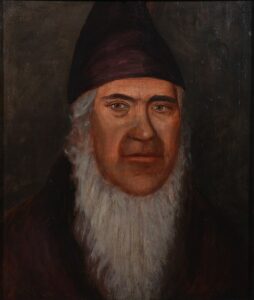
In the 1780s George Rapp, a vinedresser from Iptigen in southwest Germany began gathering followers as a Pietist preacher. [Image at right] Germany, of course, was not yet a nation state; it was made up instead of independently ruled territories. Each ruler determined the state religion, and life was often difficult for those who did not accept their ruler’s faith. Rapp and his growing following met in small private gatherings for Bible study and people increasingly travelled to Iptigen to hear Rapp preach. Rapp rejected the state instituted church and its demands for attendance and participation in rites, such as communion, and later baptism, although Rapp did baptize his children in the Lutheran church. Other Rappite practices, such as refusing to swear oaths to any but God, conscientious objection to military service (this was the period of the Napoleonic Wars), and homeschooling their children to protect them from the corrupting influences of the Lutherans placed the growing community in direct conflict with local civil and religious authorities. By the early nineteenth century Rapp and his followers had wearied of the constant demands to appear before the church council and of the fines, imprisonments, and harassment. Rapp scouted possible locations in the United States for them to establish a new community.
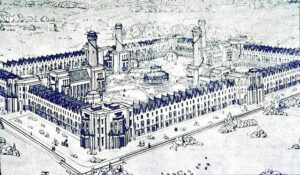
In 1805, Rapp and eight hundred of his followers purchased land in western Pennsylvania, near Pittsburgh. Pennsylvania was a favorable location because of its laws regarding religious tolerance, large German-speaking population, arable land, and access to trade. [Image at right] The Rappites set to work clearing land, erecting log cabins, and planting crops. Over time they added many industries including furniture building, shoe making, sawmill, textile mills for cotton, wool, and later silk, whiskey distilling, and wine and beer making to their farming income. The community signed the Articles of Association in 1805 agreeing that all personal property became the assets of the community, that all labor be donated to the group and that the needs of all members would be provided for from the production of the community. George Rapp was designated as sole leader and prophet of the now established Harmony Society. Despite the unity asserted by this agreement, the great efforts required in establishing their community and the initial poverty experienced by the Harmonists resulted in early conflicts and discontent, but Rapp overcame these by reminding them that the Harmonists were the elect and this was all part of their preparation for the Second Coming. Celibacy proved a practice that helped unify the Harmonists by offering practical benefits and a commitment mechanism. Rapp had a wife, Christine, and two children, Johannes and Rosina. When he preached celibacy, it was as a man who had experienced sexual and romantic love, not a dispassionate ascetic.
The Harmonists became successful farmers and industrialists, transitioning from subsistence living to wealth within a short period of time. The wealth of the community evoked jealousy and animosity from outsiders as did their largely insular habits and German heritage. During times of frontier instability, outsiders resented the Harmonists’ pacifism, although officials generally permitted the community to pay fines in lieu of military service. Tensions with neighbors, ongoing internal conflict, and a desire to be closer to shipping routes and in a warmer climate all convinced Rapp that he should move the community south.
In 1814, Rapp sold the village of Harmony and its land and bought a new property in southern Indiana near Evansville. Here the Harmonists built the village of New Harmony, better known under the tenure of the utopian Robert Owen, who bought it from Rapp in 1825. While establishing the new community brought the Harmonists together in a shared project, many died of a mosquito borne fever. New Harmony also became a successful enterprise under Rapp, but the growth in numbers, wealth, and political influence concerned their neighbors and led to even greater animosity than the Harmonists had experienced in Pennsylvania. In 1825, Rapp resolved to return north, and he bought land not far from Harmony to establish his final community, Economy. While all was not peaceful in Economy, internal acrimony outweighed external conflict.
Economy proved again that the Harmonists could balance preparing for the Second Coming with extraordinary profits. As the community aged, members hired outsiders as day labor without the expectation that they conform to the Rappite practices and faith. These were largely German speaking locals, although at one point the Harmonists employed Chinese laborers, abandoned by the railway, at their cutlery factory. During the Civil War the community took in widows and orphans and a handful of former slaves. Although not active in abolitionist circles, Harmony Society did not support slavery and provided materials and money in lieu of soldiers to the Union army.
Throughout its early history George Rapp’s adopted son, Frederick Reichert (who took the name Rapp) showed considerable acumen as he shepherded the Harmonist business interests. After Frederick’s premature death in 1834, George Rapp appointed Romelius Baker and Jacob Henrici as Trustees to manage the Harmonist business portfolio. Because Rapp lacked competency in English and because of his preoccupation with religious matters, this proved wise. For the remainder of the Harmonist’s history the community had a board of Elders led by Trustees who managed the business and dealt with conflicts in Economy.
After Rapp’s death in 1847, Baker and Henrici continued to lead the community until their own deaths. While they, particularly Baker, preached sermons on Sundays, it was in the role of Elder, not prophet. Successive Trustees, while managing practical affairs well, did not attempt to take on the role of religious leader and community commitment declined in later generations.
Arguably the most controversial leaders of the Harmonists were John and Susie Duss. John had lived among the Harmonists as a child when his widowed mother sought sanctuary during the Civil War. Duss left for a time but returned as a teacher, falling in love with his fellow teacher’s sister. Henrici asked John and Susie to leave once they determined to marry but reversed his decision largely because the Harmonists needed a teacher and music director. Both Dusses eventually served as Trustee although they were never part of the Harmonist faith. Some, including their contemporaries and historian Karl Arndt, viewed the Dusses as carpetbaggers who swept into Harmony in its dying days to steal the Harmonist fortunes. Although there were many lawsuits that upheld the Dusses actions, many questions have remained about their motives. In 1905, as the sole surviving Trustee, Susie Duss dissolved Harmony Society and inherited its wealth.
The Commonwealth of Pennsylvania acquired six acres of the site with seventeen buildings in 1916; the remainder of the land became part of the community of Ambridge. In 1966, Old Economy Village became a designated Historic Landmark District under the administration of the Pennsylvania Historical and Museum Commission. Much of the village has been restored and is open to the public. The archives of the Harmonist Society are housed there.
DOCTRINES/BELIEFS
Rapp was one of many Pietists who sought a more direct relationship with God and a more primitive style of Christianity than the Lutherans who dominated the region at this time. German mystics, such as Jakob Böehme and Phillipp Spener, influenced the development of Rapp’s theological writings. Arguably, the Book of Revelation in the New Testament of the Bible played the strongest role in shaping Rappite beliefs.
In late eighteenth century Germany, the context for the development of Rapp’s ideas, the Book of Revelation acted as a lens for understanding their time. The Napoleonic Wars brought death, destruction of industry and the landscape, disease, and famine. People in southwest Germany believed that the End Times were upon them. In this context, Rapp’s millennialism was hardly unusual. Rapp preached that that the elect must prepare themselves for the Second Coming by perfecting themselves through Christian living. By this, he meant not simply adhering to the Christian faith, but living life according to the teachings of Christ.
Hard work, simple living, and belief in salvation through Christ were the initial practices that illustrated this doctrine. Rapp learned that removing oneself from the corrupting influences of greater society and the Lutheran Church, rejecting civil and church authority, and pacifism, proved more contentious practices. By forming a largely insular communal society, Rapp and his followers committed to their practices and each other.
Rapp incorporated some less common beliefs, or at least found ways to connect them to his community and their practices. For the Rappites, the path to harmony involved the pursuit of spiritual wisdom, an idea Rapp took from the writings of Saint Paul via Jakob Böehme. The personification of this spiritual wisdom was, for the Harmonists, the virgin goddess Sophia. Sophia appears frequently in Harmonist hymns and poetry, including in some that appear romantic or erotic in their relationship to the virgin. Sophia was the Harmonist’s guide along the path to wisdom and harmony in preparation for the Second Coming of Christ.
Another symbol incorporated by the Harmonists, including in their folk art and product trademarks, was the Golden Rose. The Rose is similar to the Catholic symbol used during Lent on Laetare Sunday as a symbol of commitment to the Catholic faith. It also symbolizes the hope of salvation. Martin Luther chose a white rose with a gold ring around it as a symbol of faith and love. For Rapp the rose was a symbol of Jesus and perfection, therefore tied to the Harmonists’ messianic or millennial beliefs.
Sophia was not the only woman to appear in Rapp’s sermons. Again, turning to the Book of Revelation, in chapter 12:1-17 a woman, identified by Rapp as his church, flees Satan to the wilderness, identified by Rapp as the American frontier, where God has prepared her a sanctuary. This woman is described as being clothed with the sun and this Sunwoman became a repeated symbol that Rapp would bring up in times of strife and fear about the future. Like the Sunwoman, the Harmonists would flee Satan into the wilderness and build a new life under God’s protection.
Despite the use of feminine symbolism and the more egalitarian structure of German Pietism, Rapp stuck to a very traditional, patriarchal view of mortal women and their place in his society. Women were not permitted religious leadership roles or much voice in community affairs. Traditional gender roles were reinforced, and the division of the sexes in their daily lives suggests a suspicion of the corrupting influence of allowing men and women to mingle, particularly unsupervised.
Rapp introduced celibacy as a practice soon after the move to America. While there were practical reasons for the change, Rapp did not emphasize these. Rather, he focused on celibacy as a demonstration of commitment to the Harmonist faith and its role in their quest for Christian perfection. Drawing again on Böehme and the German mystics, Rapp pulled the concept of a perfect androgynous or dual-sex God. Böehme explained that God created man, perfect in God’s image. With the creation of Eve, Adam lost his dual nature, and after the Fall, mankind lost his perfection. Rapp taught that mankind would regain this duality and perfection after the return of Christ. As man would be both male and female in one body after the Second Coming, marriage and sexuality would become redundant. To perfect themselves for this imminent new age, the Harmonists committed to celibacy.
RITUALS/PRACTICES
In the early days in Württemberg, the Rappites’ rituals and practices appeared more notable for what they were not rather than what they entailed. The Bible and Luther’s writings were used by the Rappites as guidance in creating a Pietistic religion and ridding themselves, as Luther suggested, of the institutional corruption of the Catholic Church. Rapp preached against the institutionalized Lutheran church and the worldly civil authorities more than he actually set down a body of practice for his followers. Rapp argued that the Lutheran institutions did not go as far as Luther encouraged in a return to the simplicity of the early church.
The Rappites homeschooled their children because reading skills were essential for enabling personal reading and the study of the Bible. The goal was to empower believers to form their own opinions about what they read and ask the questions that mattered to them rather than have a priest determine what they should learn and how they should understand the word of God. This was also a Lutheran practice, however, Rapp believed that homeschooling would also protect the children from worldly influences. Rapp taught that oaths should only be sworn to God and not earthly beings, creating conflict with the demands of local authorities.
Once the Rappites immigrated to the United States, they had a huge advantage over the typical frontier settler in that they had a group to share labor and resources with and a social network for support through hard times. Rapp drew on the Book of Acts and early Christianity to validate his teachings about communalism. The Rappites adopted the practice formally as part of their Articles of Agreement in 1805. By sharing labor and resources, the Rappites quickly established a village with industries to support the community. In return, the community provided its members with food, shelter, clothing, education, worship and healthcare including in old age and infirmity. Many members who left quickly realized that they missed these benefits and that it was incredibly difficult and lonely establishing oneself as an individual. While cash wages and freedom from Rapp’s control continued to appeal to some members, most accepted and enjoyed living communally.
Rapp realized early on that this enormous undertaking required all hands on deck. This included expecting members who had worked white collar and professional jobs in Germany to contribute manual labor. He used his mystical ideas about God to explain that celibacy was the desired state for all members of the elect as after the Second Coming they would return to the dual sexual nature of God and marriage and sex would become irrelevant. Of course, being celibate also meant that the women in the community were more available to contribute their labor as they were not limited by pregnancy and childbirth or caring for babies. As Rapp taught that the Kingdom of God was imminent, there were no concerns about longevity or maintaining population growth.
The Harmonists lived in households with a designated head. Men and women slept on separate floors. Households often included former spouses who continued to live together but as brother and sister rather than husband and wife. Rapp required young people wanting to marry to leave the community, and in only very rare instances were they permitted to return. Work largely followed normative gender roles, which facilitated gender segregation in the workforce. A few women, including Gertrude Rapp and Hildegard Mutschler, acted as workplace leaders. Sexuality became a flashpoint for the Harmonists in the 1830s.
Although, typical of Protestants and Northern Europeans of the time, the Harmonists believed in hard work; they also practiced admirable work/leisure balance. Every day time was set aside, while plain and noticeably out of style by outsider standards, was comfortable, practical, and included textiles manufactured by their own mills. These included cottons, wools and silk. Every house in the Harmonist villages included not only a vegetable garden but flowers for their aesthetic benefits. George Rapp’s granddaughter Gertrude stood out as a musician and artist and as the director of the silk industry. She was known for her skill as a needle worker, flower arranger and maker of wax flowers, pianist, and singer.
The Harmonists included music in both their school curriculum and their worship services. Under John Duss the Harmonist band toured and performed for outside audiences. Duss also received funding from the community for his career on the outside as a band director and producer of operas. Harmonists wrote and arranged many hymns and poems, including several to the goddess Sophia, personification of wisdom. These were used in weekly services and rituals. When a Harmonist died, the community gathered to bid them farewell and they were buried in unmarked graves.
Every Sunday the Harmonists gathered first at the schoolhouse to hear the children perform their lessons and then at an afternoon and evening service with sermons and music. During the week there were also sermons on two evenings. George Rapp would sit on a small dais to one side at the front and deliver his sermons seated. Women sat on Rapp’s left and men on his right, and they entered and departed through separate doors.
Four to seven times yearly the Harmonists would hold feasts in their Feast Hall. Every year there would be feasts for the founding of the Society (February 15), Easter, Christmas, and in August a Thanksgiving or Harvest Home. Later, the anniversary of George Rapp’s death (August 7) was added to the calendar. Another celebration was the Love Feast, which began with confession to Father Rapp followed by a meal and religious service. These did not follow a set schedule and appeared at times of strife as well as other occasions, possibly as Rapp recognized a need to affirm their beliefs and commitment. Meat-based stew with spaetzle was an essential component to the Love Feast meal. These celebrations were closed to outsiders.
ORGANIZATION/LEADERSHIP
The Harmonists were a classic example of patriarchal, authoritarian leadership. George Rapp acted as community leader, preacher and prophet to the Harmonists. His word was law, whether in regard to religion or group practice. Because Rapp never mastered the English language, he was dependent on Frederick Rapp, his adopted son, to manage the business affairs of the community and contact with outsiders. His granddaughter Gertrude was sent to live with the Shakers to master English and afterword helped Father Rapp with his correspondence.
Members of the community, as part of their acceptance into the Harmonists, signed the Articles of Agreement. In doing so they ceded their rights to their property and to payment for their labor and agreed to obey George Rapp. Rapp agreed in return to provide for the spiritual and physical wellbeing of his followers. In repeated lawsuits, the courts upheld the Articles of Agreement as a legal contract and denied the claims of disgruntled former members to their assets or payment for labor given to the Harmonists.
Unlike many religious groups, there was no competition among the Harmonists to replace George Rapp as prophet and spiritual leader after his death in 1947. The Elders of the community led the religious services and gave sermons, but no one claimed prophetic powers or made religious pronouncements. By the time John Duss became Trustee, the religious commitment of the Harmonists had declined considerably, and although he tried to act as religious leader, he was not taken seriously, probably because he had never been a follower of George Rapp.
The Harmonists elected their Board of Elders, with women as well as men having the right to cast a ballot. The Elders appointed the Trustees. These were men only for most of the Harmonists’ history, and until John Duss they exemplified commitment to the Harmonist religion and community. By the 1880s the male membership in the community had declined to the point where women were elected Elders for the first time.
John and Susie Duss were unusual in that they joined the community late, did not convert to the Harmonist faith and, particularly John, faced conflict over their selection as Trustee. Controversy and lawsuits marked John Duss’ tenure as Trustee as former members sued to gain access to the Harmonist wealth. Duss resigned as both member and Trustee and turned the helm over to Susie in the twilight years of the community.
At the end of the community, remaining member Franz Gillman willed Susie Duss his share of the remaining (but still considerable) Harmonist wealth with the understanding that she would continue to care for him in his few remaining years. Susie then became the sole inheritor and controller of the Harmonist assets, which she retained after dissolving the Society as a legal and religious entity in 1905. While Susie Duss represented an unusual use of legal and financial power as Trustee of the Harmonists, a few other women, notably Gertrude Rapp, exercised soft power as “first lady of Harmony,” exerting influence over her grandfather and uncle.
Women could act as foreperson for groups of women laborers, such as housekeepers, silk workers, gardeners, and seamstresses, but only within than gender restricted venue. In her early twenties, Gertrude Rapp led the silk industry at Harmony. She was unique in her role as businesswoman and scientific expert. Outsiders in the industry regarded her as knowledgeable and skilled. However, Gertrude Rapp and Susie Duss were exceptional Harmonist women as labor and leadership within Harmony Society were distinctly divided on a traditional gender role basis that was rarely breached.
ISSUES/CHALLENGES
The Harmony Society existed at the intersection of communal society and new religious movement. This proved advantageous for the Harmonists as their more insular organization acted as an incubator for their divergent religious beliefs and practices. It is much easier to enforce and maintain religious differences if everyone within a community practices them. Likewise, those differences reinforced the community’s belief in their uniqueness and special status and set them apart and in opposition to outsiders. The faith of the community and commitment to its practices encouraged the bond between community members and helped them persevere through hardship.
Many communal societies have struggled with the problem of freeloaders, but for the Harmonists, because their work served as a means to promote the common good and to prepare the community for the millennium, those that committed to the Harmonist beliefs worked willingly. There are no written records of members being expelled for idleness, although some left because they wanted payment for their labor. The Articles of Agreement signed by Harmonists protected the community from lawsuits as the courts viewed it as a legal contract.
The Harmonists adopted celibacy as a practice early on for practical and religious reasons. Interestingly, although celibacy quickly became the normative practice, it was never officially included in the articles of agreement that members signed. The records of the community show the steady decline in births after celibacy was accepted indicating that it was widely accepted. A few members left over this issue, but the majority complied at this time. Not everyone who stayed agreed with celibacy; however, the majority embraced it as a way to demonstrate their commitment to Christian perfection.
Throughout the history of the Harmonists celibacy, shared labor and communal resources, and Rapp’s authoritarian leadership proved the most contentious issues. The upheaval of the move back to Pennsylvania and lingering dissatisfaction with communalism and celibacy provided an opportunity for a con man to move in and attempt to wrest the leadership of the community and its then vast wealth from George Rapp. Count Leon, also known as Proli or the Lion of Judah, took interest in the Harmonists as word of their prosperity and success reached Germany. He contacted Rapp, writing in religious terms, and requested permission to visit. Unfortunately, Rapp acceded, leading to the Great Schism and the turning point in Harmonist fortunes. Leon talked to Rapp’s followers and listened to and encouraged their grievances. He promised them that as leader he would do away with celibacy and communalism while still preparing the Harmonists for the Second Coming. Many members, particularly later generations, were taken in by Leon and voted to replace Rapp as leader. The majority rejected the attempted coup, and, as a result, a third of the members left with Count Leon taking labor, skills, and Harmonist wealth with them. The breakaway community did not live up to the promises made, but the disillusioned were not permitted to return. The Harmonists’ decline began with the Great Schism and the loss of numbers and resources.
One of the conflicts that ignited anger to Count Leon’s benefit was the Hildegard Mutschler affair. Hildegard was a young, pretty, flirtatious woman. She had a failed romance that ended with the young man leaving the community. Hildegard then worked as George Rapp’s assistant in his alchemy laboratory, a position previously held by Frederick Rapp. Frederick Rapp was outraged by both the loss of position and by the idea that his father was engaged in close work unchaperoned with a young woman. It was scandalous! Other members commented on the inappropriateness of the relationship although it is impossible to know whether there was simply the appearance of impropriety or whether something actually occurred. Hildegard later eloped with Conrad Feucht, a Harmonist business leader. Rapp, in contradiction with precedent, welcomed the married couple back with their children a few years later. Other Harmonists resented the favoritism and inconsistency in the application of rules of conduct.
One of the big challenges for a charismatic-led religious group is how to proceed after the leader dies. In his final years, Rapp’s sermons focused on keeping the faith and and the hope for the imminent return of Christ. When George Rapp died in 1847, members struggled to accept that the Second Coming had not arrived in Rapp’s lifetime as he had prophesied. The number of members who had been part of Rapp’s original following had diminished and they were aging. Younger members felt less loyalty to Rapp and his teachings and less commitment to Harmonist practices, including celibacy. This period marked increases in lawsuits and withdrawals as young people left to marry and to work for pay, although many found life on the outside difficult and unfriendly. Several petitioned the Trustees to return; however, they were generally denied. In a few cases, the petitioners were offered a loan or small charitable donation to help them get established. Rapp’s death together with the Great Schism and the practice of celibacy all contributed to the decline of the community.
IMAGES
Image #1: George Rapp. Credit: Wikimedia Commons. Public Domain.
Image #2: Architectural vision of the New Harmony community. Credit: Wikimedia Commons. Public Domain.
REFERENCES**
** Unless otherwise noted, profile content is drawn from Cheryl Coulthard, Communal Societies and New Religious Movements (New York: Cambridge University Press, 2024).
SUPPLEMENTARY RESOURCES
Arndt, Karl J.R. 1965. George Rapp’s Harmony Society, 1785-1847. Cranbury, NJ: Associated Universities Press.
Kring, Hilda A. 1973. The Harmonists: A Folk-Cultural Approach. Metuchen, NJ: The Scarecrow Press.
Old Economy Village website. https://www.oldeconomyvillage.org/.
Reibel, Daniel B. 2002. Old Economy Village: Pennsylvania Trail of History Guide. Mechanicsburg, PA: Stackpole Books.
Publication Date:
31 December 2024
