Karaikkal Ammaiyar

KARAIKKAL AMMAIYAR TIMELINE

ca. 500 C.E.:  Karaikkal Ammaiyar lived in what is now known as the state of Tamilnadu in south India. She was a great devotee of the Hindu god Shiva, and the author of four poetic works of devotion in the Tamil language to him.

11th–12th centuries C.E:  Her life was described in authoritative traditional biographies in the Tamil language.

11th century on:  She was depicted in metal festival sculptures originally designed for temple worship.

Present:  She is publicly celebrated in several annual temple festivals in Tamilnadu, south India, as well as other locations where there is a significant population of Hindu Tamils devoted to Shiva.

HISTORY/CONTEXT

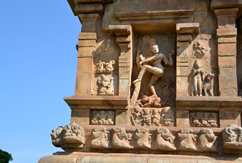
Karaikkal Ammaiyar is revered as a Tamil Shiva-bhakti saint by Tamil people in south India and elsewhere who are Shaivas (theyworship Shiva as their family deity and/or chosen deity). [See photo at right by the author; credits appear below.] The name by which she is known (Karaikkal Ammaiyar) means in the Tamil language “revered mother of Karaikkal.” Her biographers and her devotees regard the contemporary town named Karaikal in Tamil Nadu in south India as her home village. Karaikal is located nearly 300 kilometers south down the east coast of India from Chennai, and a major festival to Karaikkal Ammaiyar is held there every June–July.
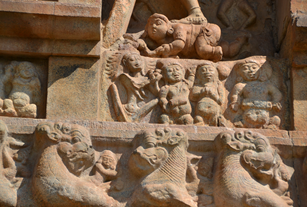
In the Tamil south Indian tradition, Karaikkal Ammaiyar (Kāraikkāl Ammaiyār) is remembered as a female poet-saint who lived more than one thousand years ago in what is now the state of Tamilnadu, India. There, she composed 143 verses expressing her praise of and devotion (bhakti) to the Hindu deity Shiva (Śiva): The 101-verse poem entitled Arputat Tiruvantati (Arputat Tiruvantāti; Sacred Linked Verses of Wonder); the twenty-verse poem entitled Tiru Irattai Manimalai (Tiru Iraṭṭai Maṇimālai; Sacred Garland of Double Gems); and two hymns set to music in eleven verses entitled Tiruvalankattut Tiruppatikam 1 and 2 (Tiruvālaṅkāṭṭut Tiruppatikam 1 and 2; Sacred Hymns on [the place called] Tiruvalankatu). She is one of only three female named saints in the authoritative Tamil Shiva-bhakti devotional tradition (Śiva-bhakti; devotional participation dedicated to the god Shiva), and the only woman among those saints to have authored devotional works. [See photo at right; credits appear below.]
There are important questions of historicity concerning Karaikkal Ammaiyar that should be considered.

Was Karaikkal Ammaiyar a real person? Tradition considers her to have been an historical personage who authored four poetic compositions. By the eleventh and twelfth centuries C.E., traditional biographers described her as a female person who had a special connection to Shiva. While these biographers’ lifetimes are centuries later than Karaikkal Ammaiyar’s, her biographers are much closer in time to her than we are at present. Unless there is a compelling reason to doubt or contradict an aspect of traditional memory, we may take what tradition says as a working assumption.

When did Karaikkal Ammaiyar live? Scholars agree that Karaikkal Ammaiyar lived around 550 C.E. (Nilakanta Sastri 1955:35; Kārāvelāne 1982 [1956]:19; Filliozat 1982 [1956]:8, 13; Zvelebil 1973:186; Cutler 1987: 118; Dehejia 1988:135). All of the scholars point to two pieces of evidence: 1) Traditional memory places her as historically the earliest of the sixty-three named Tamil Shiva- bhakti saints; and 2) Cuntarar (Sundarar), one of the three most famous male poet-saints in the Tamil Shiva-bhakti group dating to 700 C.E., wrote a poem listing the names of all of the sixty-three saints in which his reference to one saint as “pey” (pēy; ghoul) is understood by tradition to refer to Karaikkal Ammaiyar; thus, she lived prior to 700 C.E.

However, none of these scholars provide a more detailed rationale for the dating of Karaikkal Ammaiyar to 550 C.E.; while this date is open to revision, it is plausible for several significant reasons (Pechilis 2012; 2013). Tradition views Karaikkal Ammaiyar as developing new poetic forms, and her use of them is less orderly and assured in terms of syntax and structure than later prominent poets who also used those forms, including Cuntarar, which suggests that she initiated new forms of poetry and that later poets perfected those forms. In addition, she is concerned with themes found in other Tamil literature of her time, especially the Cankam (Ca ṅ kam; academy) classical poetry (ca. 200 B.C.E. to 500 C.E.) and the narrative poems (or “epics”) Cilappatikaram (Cilappatikāram, ca. 300–400 C.E.) and Manimekalai (Maimēkalai, ca. sixth century). Such themes include the heroic ideal, the existence of pey (ghouls), Shiva’s dance, and the spiritual significance of the cremation ground. In addition, Karaikkal Ammaiyar’s poetry demonstrates familiarity with descriptions of Shiva from classical Sanskrit mythological stories, known as a genre as purana (purāṇa), which were redacted during the Gupta dynasty era (ca. 320–550 C.E.). Lastly, the kind of bhakti (devotional) poetry that Karaikkal Ammiyar produced is very different in terms of voice, structure, choice of themes and representation of bhakti compared to the compositions of the three most famous male saints (Appar, Campantar and Cuntarar, ca. 700 C.E.); it is doubtful, given their predominance and authority as spokesmen of bhakti, that Karaikkal Ammaiyar would follow, rather than precede, them.

Karaikkal Ammaiyar lived in the early period of what Alexis Sanderson (2009) has called “the Śaiva Age” in India, during which Shaivism (the worship of the god Shiva) was predominant across India, from about the fifth to the thirteenth centuries C.E. She is not the first woman to compose Tamil poetry, nor the first poet to describe Shiva in some detail; for example, at least ten poetesses contributed to the classical Tamil poetic anthology, the Purananuru (Puranānūru ; The Four Hundred [Poems] About the Exterior; dated to the first to third centuries C.E.), and several of the poems in the collection describe aspects of Shiva known from Sanskrit mythology, including his third eye, his blue-black neck, and his destruction of the demonic triple cities (e.g. v. 55; see Hart and Heifetz 1999, xv:41). However, tradition credits Karaikkal Ammaiyar with being the first Tamil poet to have an exclusive devotional focus on Shiva. Some scholars contend that Karaikkal Ammaiyar’s aim was to replace worship of the Tamil goddess Korravai with worship of the god Shiva as depicted in Sanskrit mythology (Mahalakshmi 2000, 2011; repeated in Craddock 2010), but this perspective has some serious chronological issues, as well as a lack of thematic representation in the poetry of Karaikkal Ammaiyar (Pechilis 2012:74–75). A more fruitful avenue is to view her work as an intertextual dialogue with preceding literature such as the classical Tamil Cankam poetry and Sanskrit mythology, with contemporaneous Tamil literature such as the “epics” Cilappatikaram and Manimekalai, and with contemporaneous traditions of practice such as Shaiva Tantra.

Two authoritative biographies from within Tamil Shiva-bhakti tradition were written about her within 600 years of her lifetime, celebrating Karaikkal Ammaiyar as an exemplar of devotion and as an author of devotional poetry. The much longer and more authoritative biography was written in the twelfth century by a court minister named Cekkilar (Cēkkilār), which contains biographical stories of all sixty-three named saints in the Tamil Shiva-bhakti tradition, including Karaikkal Ammaiyar. At this time, Karaikkal Ammaiyar’s compositions were canonized in the Tamil Shiva-bhakti tradition by being included in the eleventh volume of the canon of devotional literature to Shiva; this canon is called the “Sacred Collection” (Tirumurai). Cekkilar’s biographies of the saints constitute the twelfth and final volume of this canon.

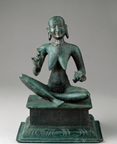
Cekkilar’s biography of Karaikkal Ammaiyar was enormously influential in the Shiva-bhakti community’s imagining of her. For example, the biography has had a major influence on the festival images of Karaikkal Ammaiyar made of metal created from the eleventh century on, such as the image now at the Nelson-Atkins Museum and the thirteenth-century image now at the Metropolitan Museum of Art. [See image at right from the MET Museum; credits appear below.] Historical images of this saint can be found in large Hindu temples dedicated to Shiva in Tamil south India today, as well as in Hindu temples in countries where Tamils reside, such as Sri Lanka, South Africa, Fiji, and Western nations. Such images continue to be made today for both temple and personal worship collections. In addition, Cekkilar’s biography of Karaikkal Ammaiyar provides the narrative for annual festivals that publicly celebrate her devotion, including: 1) The festival to celebrate her achievement of spiritual liberation (mukti) at the Vadaranyeswarar Temple in Tiruvalankatu (also spelled Tiruvalangadu, about sixty km west of Chennai) every February–March; 2) The festival of the sixty-three saints (aruppattumūvar tiruvilā), held at the prestigious Kapaleeshvara (Kapālīśvara) Temple in Mylapore, Chennai every February–March; and 3) The mango festival (maṅgani tiruvi lā) to celebrate her life story at the temple town of Karaikal (about twenty km. north of Nagapattinam) every June–July. Today, Cekkilar’s biographical stories of the saints are widely known among Tamil speakers, especially those who identify as Shaiva. Indeed, the story of Karaikkal Ammaiyar is much more widely known than her own poetry. Her two hymns are known to some professional temple singers (ōtuvār) of Shiva-bhakti devotional hymns, but they are not part of the common performance repertoire.
BIOGRAPHY 

Cekkilar’s twelfth-century biographical volume of the saints, called the Periya Puranam (Periya Purāṇam; Great Traditional Story), has been enormously influential, and it predominates in guiding the Tamil public’s imagination of the sixty-three named saints’ identities today, as any number of books, articles and websites demonstrate. In the case of Karaikkal Ammaiyar, the biographical story is much more widely known than her own poetry. (For a detailed English translation of Karaikkal Ammaiyar’s biographical story, see Pechilis 2012:199-205. For a general English translation of the Periya Puranam see McGlashan 2006.) Yet there is a compelling reason to doubt an aspect of Cekkilar’s traditional memory, because the themes that he prioritizes in his biography, such as Karaikkal Ammaiyar’s identity as a wife, are not ones that are found in her own poetry and hymns. That is, Karaikkal Ammaiyar’s self-representation in her poetry in certain ways significantly differs from Cekkilar’s representation of her in his biography.

It is thus necessary to start with Karaikkal Ammaiyar’s own poetry in order to discover the ways in which she represents herself in her compositions. The first thing to note is that there is a sharp bifurcation in her compositions. Her two poems, the 101-verse Arputat Tiruvantati (Sacred Linked Verses of Wonder; hereafter “Wonder”) and the twenty-verse TiruIrattai Manimalai (Sacred Garland of Double Gems; hereafter “Garland”), are similar in voice, theme and imagery in their reflections on devotion to Shiva. Her two hymns on Tiruvalankatu (Tiruvalankattut Tiruppatikam 1 and 2; hereafter “Decade-1” and “Decade-2”) are, however, quite distinct because of their sole concentration on Shiva as the Lord of Dance who performs at a cremation ground (Pechilis 2012:40-42). This difference will be explored in the sections below on Beliefs and Practices in this profile.

In the “Wonder” and the “Garland,” Karaikkal Ammaiyar devotes many verses to descriptive praise of Shiva as heroic. Shiva’s heroic deeds, known from Sanskrit mythology, are represented, especially those that portray Shiva as a protector of humankind (Pechilis 2012:53), such as his burning the demons of the triple cities and his swallowing of the poison, as in the following two examples:

The gaze of his third eye,
which can appear as
long flames of fire,
soft cool moonlight
or the harsh rays of the sun,
immediately burned to ashes
the three fortresses
of his formidable foes. (“Wonder” v. 84; Pechilis 2012:30)

In times of yore
the lord who bears the cobra
drank the poison from the awesome ocean
churned by the celestials,
which darkened his neck
like a shadow across the silvery moon
that crowns his red, snake-bearing matted locks. (“Wonder” v. 55; Pechilis 2012:28)

In contrast to the intense specificity with which the poet describes the body of god, she does not tell us of any particular characteristics or context of her own body: She does not identify her gender, her caste, or her socio-economic class, but instead emphasizes her humanity, as in the first verse of the “Wonder,” her longest poem:

Birth in this body
enabled me to express
my overflowing love
through speech,
and I reached your sacred henna-red feet.

And now I ask,
oh, lord of the gods
whose neck shimmers black,
when will the afflictions
that birth in this world also enables ever end? (“Wonder” v. 1; Pechilis 2012:26)

By not providing details about herself, the poet may have sought to present a universal voice in her poetry through which the devotional subjectivity she describes is accessible to all of humankind and not limited to people who match her own identity characteristics. Her voice is thus that of humanity as engaged in contemplation of the divine. A complicating factor is that three of her works, the “Wonder” and the two hymns on Tiruvalankatu, conclude with a signature verse in which the author refers to herself as Karaikkālpey (pēy), which translates to “the ghoul from the place named Karaikkal.” In all of her works, the poet describes ghouls (pey can be singular or plural) as frightening, capricious beings who attend Shiva’s dance at the cremation ground. Issues in understanding the poet’s adoption of pey as an identity marker are discussed in the section of this profile on Practices. But the devotional subjectivity Karaikkal Ammaiyar describes in the “Wonder” and the “Garland” is clearly that of a human being who desires to know Shiva.

As her biographer, Cekkilar includes personal identifying information about Karaikkal Ammaiyar that the poetess herself leaves unspoken. According to him, she was born into a wealthy merchant family headed by her father Tanatattan in the town of Karaikkal (Tamils today understand “merchant” to suggest the Chettiar caste), and she was named Punitavati (Punitavati; “Pure One”). Beloved and beautiful, she exhibited devotion to Shiva from her youth; when she came of age her family arranged her marriage to Paramatattan, the son of a successful merchant named Nitipati. One day, Punitavati gave a Shaiva mendicant one of two mangoes that her husband had been saving, because the mendicant was hungry and she had not yet finished cooking lunch. Later, when her husband Paramatattan demanded even the second mango as his luncheon dessert, she appealed to Shiva to provide another. The husband tasted the difference between the first and second mango, and demanded to know the latter’s origin. When she explained, Paramatattan did not believe her and demanded yet another mango; Shiva provided it to her husband’s amazement, but it disappeared as Punitavati tried to hand it to her husband. Convinced that his wife was a capricious goddess, Paramatattan left her permanently under the guise of sailing on a trading journey. After some time, her relatives discovered his location and brought Punitavati to him. To their astonishment, Paramatattan, his new wife, and their daughter (whom he had named Punitavati) prostrated themselves before the original Punitavati, for in the ensuing years Paramatattan had come to reconsider his former wife to be a benevolent goddess. His former wife Punitavati then appealed to Shiva to release her from her beautiful body that she had maintained only for the sake of her husband, and grant her the body of a pey, which the text describes as a “body of bones” (vv. 50, 57; Pechilis 2012:203–04); upon this transformation she sang the “Wonder,” followed by the “Garland.” In this embodiment, she traveled to Shiva’s abode at Mount Kailash in the Himalayas, where she walked up the mountain on her hands. Shiva and his wife Parvati witnessed the unusual sight, and the Lord called out “Mother!” (ammai) to the pey, and she responded by addressing him as “Father” (appā). When the Lord graciously asked her what she desired, she answered: “May those who desire you with undying joyful love not be reborn; if I am born again, may I never forget you; may I sit at your feet, happily singing while you, virtue itself, dance” (vv. 59-60; Pechilis 2012, 204). Shiva directed her to the town of Alankatu (Tiruvalankatu) and promised she would witness his dance there. As she witnessed the beauty of his dance at Alankatu, she composed her two hymns (“Decade-1” and “Decade-2”).

Cekkilar’s brilliant biography does many things. It provides a social context for the saint, enumerating conventional details of identification (caste, class, marital status) that arguably make the poet-saint more accessible to readers. It provides a rationale for calling her Karaikkal Ammaiyar, understood as a reference to her hometown and to Shiva’s address to her on Mount Kailash. It provides us with a glimpse of the circumscribing social expectations for women, especially through its emphasis on propriety, while at the same time it asserts that a woman can become a religious exemplar of supreme devotion to Shiva (Pechilis 2014; 2012: 82–105). It provides a chronology and event contexts in which to locate her compositions. It provides an interpretation of her embodiment as a pey: It is her own wish, expressed to Shiva in response to her husband’s actions, to renounce her youthful body and become a “body of bones.” While the biography creatively deploys images and themes from Karaikkal Ammaiyar’s own poetry, it remains quite distinct from her poetry. Most glaringly, the biography represents the poet as becoming alienated from other people: Her husband leaves her, her transformation to a pey is a miraculous occurrence, people are frightened by her appearance as a pey, she travels by herself to Mount Kailash, and she alone witnesses Shiva’s dance at Tiruvalankatu. Cekkilar promotes the singularity of Karaikkal Ammaiyar; in contrast, in her own poetry she asserts her common humanity and instead promotes the singularity of Shiva.

DOCTRINES/BELIEFS

Karaikkal Ammaiyar’s poetry describes a devotional subjectivity that is fully engaged with Shiva. Hers is an exploratory attempt to experience affectively the mystical connection between the divine and the human (Pechilis 2013, 2016c), and as such, in her compositions she reflects on both the nature of the divine and the nature of the human self, often raising questions rather than providing answers. One way of interpreting her corpus is to note five major themes in her compositions.

1) Being a servant. In several of her “Wonder” and “Garland” verses, the poet identifies herself as a “servant” (āḷ) to Shiva, or refers to “servants” in the plural, or speaks of performing service to Shiva. If Karaikkal Ammaiyar was indeed the first Shiva-bhakti poet, as tradition claims and scholarship to date supports, then she was the first to establish what became a signature identity, that of servant, in Tamil devotional poetry.

I aspired to only one thing;
I settled on it and left the rest

I kept in my heart only that lord
whose crest bears the Ganga
whose matted locks
are adorned with the sun and moon
whose palm holds the flames—

and I have become his servant. (“Wonder” v. 11; Pechilis 2012, 26)

2) The Heroic Lord. The hierarchy inscribed in the devotional subjectivity of “servant” is reflected in the intensely visual verses that describe Shiva as a heroic lord, such as the poems already provided earlier in this profile. These verses, found in her “Wonder” and “Garland” poems, draw on the heroic deeds of Shiva known from Sanskrit mythology. Karaikkal Ammaiyar especially favors the image of Shiva as the Swallower of Poison as well as the form of Shiva as the Bearer of Ganga. As the former, Shiva swallowed the poison that unexpectedly emerged as the gods and demons churned the ocean of milk in primordial times in order to create the elixir of immortality; his neck bears a blue-black stain from this event. As the Bearer of Ganga, Shiva allowed the celestial Ganga (Ganges) River to come to earth to reward his devotee, but her power was such that she would destroy the earth if she fell on it unobstructed; Shiva compelled the river to pass through his convoluted matted locks, and a gentle stream became the Ganga River on earth. Memorializing this event, Shiva wears a tiny icon of the goddess Ganga in his matted locks. Both of these images feature Shiva as a protector deity whose body is marked with a symbol of these heroic deeds. Karaikkal Ammaiyar also frequently praises Shiva as the Destroyer of the Triple Cities, referring to when he lethally pierced the demonic cities with a single flaming arrow. Her hymns on Tiruvalankatu (“Decade-1” and “Decade-2”) exclusively praise the Shiva as the Dancer, which is discussed under the theme of The Other Side below.

3) Questions. Karaikkal Ammaiyar asks many demanding questions of Shiva, seemingly undermining the hierarchy of lord and subject that the servant identity and praise of the heroic lord would suggest. In “Wonder” and “Garland,” she asks about the god’s many forms and what they mean. She also asks why she is still suffering from life’s afflictions and why Shiva has not favored her with his grace. These questioning verses, found throughout her two poems, describe the oscillation of her devotional subjectivity—her relationship with Shiva is not settled but is instead a fluid and changing one, with the devotee sometimes feeling assurance and sometimes feeling anxious and puzzled. This oscillation was to become a hallmark of bhakti poetry.

4) The Other Side. In this category are verses in the “Wonder” and the “Garland” that speak of Shiva as frightening to some, who are usually described as “others.” The poetess at times asks Shiva to remove fright-inducing emblems, such as replacing the cobra that he wears across his chest with a gold necklace, so that he more conventionally represents benevolence to onlookers. Other verses in this category describe those who are hostile to the worship of Shiva; perhaps these are the same people who would be frightened by his emblems. Yet the poet also insists that a prominent and powerful form of Shiva is as a dancer in the cremation ground at midnight; this image, while mentioned in the “Wonder” and the “Garland,” is the sole image of the Lord in her two hymns on Tiruvalankatu.

In this miserable burning ground
young ghouls (pey) scavenge the desolate theatre,
disappointedly find nothing to eat
and settle for sleep;

while at twilight,
flawlessly in time to the rhythm
of heavenly drums
effortlessly bearing fire in his palm
the beautiful one dances. (“Decade-2” v. 7; Pechilis 2012:34)

In her sustained focus on Shiva as the Dancer in all but one of the twenty-two verses of her hymns on Tiruvalankatu, Karaikkal Ammaiyar distinctively contributed to the early development of the image of Shiva asDancer as itself being worthy of devotion, contemplation and elaboration, and thus to its circulation as a recognized image of his power. In particular, her poetry played a role in expanding the meaning of Shiva’s dance from the mythological stories of a victory dance into a universal cosmic dance. Moreover, through her emphasis on devotional subjectivity, the poetess created a connection between the majestic Lord of the Dance and the here-and-now of the human lifespan (Pechilis 2013, 2016b). The bronze Nataraja (Naarāja) image of Shiva as the Dancer was definitively developed in Tamil south India in the tenth century (Kaimal 1999), and today it is one of the most famous and prized images from the classical art of India. [See image at right from the MET Museum; credits appear below.]

5) Assurances. Many of Karaikkal Ammaiyar’s verses indicate that she considers herself and all other servants of Shiva to have received his grace as salvation from their sorrows, including the sorrow of rebirth (the cycle of sasāra) based on their own actions (the law of karma). Such verses are interspersed throughout the “Wonder” and the “Garland,” creating the sense of oscillation between assurance and anxiety characteristic of bhakti poetry. However, the final verses, known as a signature verse, found at the conclusion of the “Wonder” as well as her two hymns on Tiruvalankatu, offer a concluding reassurance that devotion to Shiva results in spiritual salvation.

RITUALS/PRACTICES

Karaikkal Ammaiyar’s devotional priority was to keep Shiva always in mind. Her poetry does not describe the performance of rituals to Shiva, but instead urges humankind to focus on contemplating his form, nature, essence and power. Her compositions provide hearers or readers with the means to such contemplation, and her signature verses, found at the end of the “Wonder” and her two hymns on Tiruvalankatu, urge hearers or readers to recite her own verses in order to reach Shiva and experience bliss and salvation.

Her two hymns on Tiruvalankatu, however, provide a distinctive dimension to experiencing Shiva: They read as an eyewitness account of Shiva’s dance in the cremation ground. The scene is portrayed as forbidding, with the Lord dancing at midnight in the glow of a funeral pyre that barely illuminates the desolate theatre encircled by thickets of dried and inhospitable plants. Birds of prey and scavenger animals wander at will, screeching and howling their presence. Pey (ghouls), who are known from Sanskrit mythology to be a motley crew of misshapen beings who serve as Shiva’s dedicated attendants, appear here and there, consumed with their own frightful activities.

Whirling,
their eyes and mouths ablaze,
the ghouls perform the tunankai dance in a circle;
their dance is fear-inducing,
in which they eat the flesh of burned corpses.

Dancing in this cremation ground
with leg lifted and anklets ringing
revolving body erect
emitting flames that scatter the foxes
our father resides at Tiru Alankatu. (“Decade-1” v. 7; Pechilis 2012, 191)

And yet the observer, “Karaikkal pey” as she self-identifies in each of the two signature verses to the Tiruvalankatu hymns, remains there in that eerie place. Was she herself a pey? Those who believe so point to the first verse of “Decade-1,” which is a third-person description of a female pey , limning her form as hollowed and bony. This verse could have inspired her biographer Cekkilar, who depicted Karaikkal Ammaiyar as undergoing a bodily transformation into a “bag of bones,” as well as icon makers who created metal images of her with such characteristics to be carried in religious festival processions. While this predominant interpretation is plausible, there is a problem with it insofar as Karaikkal Ammaiyar’s hymns depict the pey as instinctual beings that do not have refined language, which is the antithesis of the devotional subjectivity Karaikkal Ammaiyar describes in the “Wonder” and the “Garland.” This would suggest that she joins the pey at the cremation ground to witness Shiva’s dance, but she does not become a pey herself. It is plausible that in journeying to and remaining at the socially shunned cremation ground at night Karaikkal Ammaiyar chose to appropriate and transform for her own devotional path then-current Tantric practices, which involved going to the cremation ground to become like Shiva (Pechilis 2016a). In Karaikkal Ammaiyar’s hymns, she encounters Shiva himself there, instead of becoming like Shiva. Her hymns suggest that a devotional subjectivity leads to a transformation of consciousness that enables the devotee to appreciate all aspects of the divine, including his awesome power over life and death. Taken as a whole, Karaikkal Ammaiyar’s compositions affirm that visceral knowledge of the finitude of the human lifespan compels one to live life as fully as possible in expressed dedication and service to Shiva.

ISSUES/CHALLENGES

One of the major challenges in studying Karaikkal Ammaiyar is to discern her perspective from her own poetry, separate and apart from the hegemony of her biographer Cekkilar’s description of her life. Such a study, to date infrequently undertaken, reveals that the poet had very distinctive humanistic priorities in her creation of a devotional subjectivity. A second challenge is to more completely understand the early medieval historical context of Karaikkal Ammaiyar, including political history (Ali 2004) as well as literary and religious history. A third challenge is to understand in scholarly and historical detail Karaikkal Ammaiyar’s influence and legacy in subsequent developments in Tamil Shiva-bhakti . A fourth challenge is to integrate Karaikkal Ammaiyar’s voice into global knowledge of both women’s history and feminist history (Pechilis 2014).

IMAGES

Image #1: Shiva as Nataraja on the western corner of the southern wall of the temple at Gangaikondacholapuram, India eleventh century. Karaikkal Ammaiyar is to the viewer’s left on the frieze below the Nataraja, seated with three of Shiva’s bhutaganas. She is depicted playing cymbals to Shiva’s dance. Photo taken by and © the author.
Image 2: Detail of Image 1. Photo taken by and © the author.
Image #3: Karaikkal Ammaiyar. India Chola Dynasty bronze ca. late thirteenth century, approx. nine inches height. MET Museum collection, www.metmuseum.org.
Image #4: Shiva Nataraja. India Chola Dynasty bronze ca. eleventh century, approx. twenty-seven inches height. MET Museum collection, www.metmuseum.org.

REFERENCES

Ali, Daud. 2004. Courtly Culture and Political Life in Early Medieval India. Cambridge: Cambridge University Press.

Craddock, Elaine. 2010. Śiva’s Demon Devotee: Kāraikkāl Ammaiyār. Albany: State University of New York Press.

Cutler, Norman. 1987. Songs of Experience: The Poetics of Tamil Devotion. Bloomington: Indiana University Press.

Dehejia, V. 1988. Slaves of the Lord: The Path of the Tamil Saints. New Delhi: Munshiram Manoharlal.

Filliozat, Jean. 1982 [1956]. “Introduction.” Pp. 1-14 in Chants dévotionnels tamouls de Kāraikkālammaiyār, ed. and trans. Kārāvelāne. Pondichéry: Institut Français d’Indologie.

Hart, George L., and Hank Heifetz. 1999. The Four Hundred Songs of War and Wisdom: The Puranānūru. New York: Columbia University Press.

Kaimal, Padma. 1999. “Shiva Nataraja: Shifting Meanings of an Icon.” The Art Bulletin 81:390–419.

Kārāvelāne. 1982a [1956]. “Avant-Propos.” Pp. 17-19 in Chants dévotionnels tamouls de Kāraikkālammaiyār, ed. and trans. Kārāvelāne. Pondichéry: Institut Français d’Indologie.

Mahalakshmi, R. 2011. The Making of the Goddess: Korravai-Durgā in the Tamil Traditions. New Delhi: Penguin.

Mahalakshmi, R. 2000. “Outside the Norm, Within the Tradition: Kāraikkāl Ammaiyār and the Tradition of Tamil Bhakti.” Studies in History 16, no. 1: 19–40.

McGlashan, Alastair. 2006. The History of the Holy Servants of the Lord Siva: A Translation of the Periya Purāṇam of Cēkkilār. Oxford: Trafford Publishing.

Nilakanta Sastri, K. A. 1955. A History of South India: From Prehistoric Times to the Fall of Vijayanagar. Madras: Oxford University Press.

Pechilis, Karen. 2016a. “Bhakti and Tantra Intertwined: The Exploration of the Tamil Poetess Kāraikkāl Ammaiyār.” International Journal of Dharma Studies 4, no. 2 (February 2016). Accessed from http://internationaljournaldharmastudies.springeropen.com/articles/10.1186/s40613-016-0024-x on 10 April 2016.

Pechilis, Karen. 2016b. “The Siva Nataraja Image: Poetic Origins.” Kalakshetra Journal 4:1-16.

Pechilis, Karen. 2016c. “To Body or Not to Body: Repulsion, Wonder and the Tamil Saint Kāraikkāl Ammaiyār.” In Re-Figuring the Body: Embodiment in South Asian Religions, edited by Barbara A. Holdrege and Karen Pechilis, in press. Albany: State University of New York Press.

Pechilis, Karen. 2014. “Devotional Subjectivity and the Fiction of Femaleness: Feminist Hermeneutics and the Articulation of Difference.”  Journal of Feminist Studies in Religion 30:99–114.

Pechilis, Karen. “ Śiva as the Lord of Dance: What the Poetess Saw.” Journal of Hindu Studies 6:131–53.

Pechilis, Karen. 2012. Interpreting Devotion: The Poetry and Legacy of a Female Bhakti Saint of India. London: Routledge.

Sanderson, Alexis. 2009. “The Śaiva Age: The Rise and Dominance of Śaivism during the Medieval Period.” Pp. 41-350 in  Genesis and Development of Tantrism, edite by Shingoo Einoo. Institute of Oriental Culture Special Series 23. Tokyo: Institute of Oriental Culture, University of Tokyo. Accessed from http://www.alexissanderson.com/uploads/6/2/7/6/6276908/sanderson_2009_the_saiva_age.pdf on 10 April 2016.

Zvelebil, Kamil. 1973. The Smile of Murugan: On Tamil Literature of South India. Leiden: E. J. Brill.

Post Date:
13 April 2016

Share

New Latter Rain Movement

NEW ORDER OF THE LATTER RAIN


NEW ORDER OF THE LATTER RAIN TIMELINE

1947 (Spring):  George Hawtin, a Pentecostal Assemblies of Canada pastor, founder of the college, and its principal, resigned under pressure from Bethel Bible College Saskatoon. Faculty member Percy G. Hunt resigned in sympathy.

1947 (October 21):  Hawtin and Hunt joined Herrick Holt, in a new work, Sharon Orphanage and Schools.

1947 (Late Fall):  Hawtin and Hunt, with several others, attended a Vancouver, British Columbia, revival led by healing evangelist William Branham.

1947-1948 (Winter):  Hawtin and others promoted a regime of long fasts and prayer meetings modeled on Branham’s revivals and the book, Atomic Power with God through Fasting and Prayer, by Franklin Hall.

1948 (February 11):  A young woman student reported a prophecy of a door opening into a gift of ministry in the body of Christ. Revival broke out on campus, drawing outsiders.

1948 (Easter):  Special services described as The Feast of Pentacost drew large numbers of people to the campus.

1948 (July 7-18):  What is considered the first Camp Meeting was held on campus, drawing worshipers in the thousands from all over Western Canada and places in the U.S. The teachings of this revival became known as The Latter Rain and spread widely.

1949:  General Council of the Assemblies of God USA condemned Latter Rain teachings. At least one key official resigned in protest, and the issue almost split the denomination.

1949 (Late):  Leadership of the movement began to slip from the hands of the Sharon group as other centers developed.

1952:  As an organized movement, the Latter Rain began to fade.

1967:  Characteristic Latter Rain positions became major elements of the Charismatic Renewal movement.

Present Day:  Latter Rain theology is central to numerous movements, such as the Vineyard Churches, The Kansas City Prophets, and the Toronto and Lakeland revivals, as well as hundreds of independent neo-Pentecostal churches.

FOUNDER/GROUP HISTORY

Several authors have placed the beginnings of the Latter Rain movement of the late 1940s (sometimes called the New Order of the Latter Rain to distinguish it from at least two earlier uses of the term “Latter Rain”) in a context of a Pentecostal renewal already well underway. Many Pentecostals felt that, after the Azusa Street period, Pentecostalism had become “dry” or had “cooled off” because it had lost its focus on the emotional, supernatural, and ecstatic manifestations of the Holy Spirit (Riss 1987:Chapters 1 and 2).

Several movements in the early war years had begun to examine this loss of supernatural emphasis and had spawned a generation of “Healing Revival” preachers, among them William Branham, who started his ministry somewhat later (1946). This made him contemporary with several better known revivalists, such as Billy Graham and Oral Roberts. But Branham was somewhat further outside of the mainstream, with his heavy concentration on casting out demons, supernatural healing, laying on of hands, end time predictions, and his contention that the doctrine of the Holy Trinity was wrong (Riss 1987:1-2, Chapters 1 and 2).

Meanwhile, a minister of the Pentecostal Assemblies of Canada (PAOC) known for his “unrestrained zeal,” George Hawtin, became involved in a dispute with the Saskatchewan District of the PAOC. Several years earlier, Hawtin had founded Bethel Bible College, then in Saskatoon. He had sold the college property to the district in order for the college to become an official institution of the district. He was soon in trouble with the district administration for, among other things, making decisions without informing or asking permission of the district. There were also questions about the college’s academic standards. In the late spring of 1947, Hawtin’s resignation was sought and given. Faculty member Percy G. Hunt resigned in sympathy (Riss 1987:53-55; Holdcroft 1980:2).
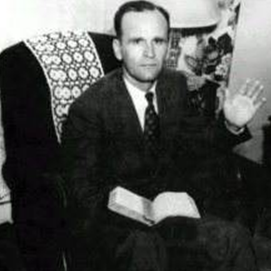
That fall, Hawtin and Hunt joined Herrick Holt, pastor of the Four Square Gospel church of North Battleford, Saskatchewan, in a new venture, Sharon Orphanage and Schools, founding that organization’s Bible college and becoming the nucleus of its first faculty. A substantial number of students from Bethel transferred to the new school (Holdcroft 1980:3).

At about the same time, Hawtin and others from Sharon journeyed to Vancouver, British Columbia, to attend a revival led by William Branham. They were deeply impressed by the supernatural and ecstatic elements of the revival, aspects of Pentecostalism they felt had been lost over the years. They also became aware of a book, Atomic Power With God through Fasting and Prayer, by Franklin Hall, which proposed that one could reach a level of direct communication with God by fasting for long periods (as much as 40 days) and engaging in extended periods of intense prayer (Riss 1987:56-60).

On the group’s return to North Battleford, they promoted the practices proposed by Hall and encouraged prayer for an “outpouring of the Holy Spirit” similar to what they had seen in the Branham revivals Riss 1987:60-63).

Students took up the challenge. On February 11, 1948, following a regime of fasting and prayer, one of them, a young woman, reported a prophecy involving an open door which was “an invitation for students to pass through into gifts and ministry in the Body of Christ.” Revival broke out on campus, classes were cancelled. Outsiders heard about what was happening and joined in (Holdcroft 1980:3).

Revival continued, including supernatural “signs and wonders.” Leaders, following Branham’s example, began “calling out” individual students, laying hands on them in order to impart “blessing in the spirit” (something Pentecostals had always believed involved “tarrying,” waiting prayerfully for the Lord) and then giving prophecies for each individual (Holdcroft 1980:3).

At Easter of that year (1948), the school held special services described as The Feast of Pentecost. The event drew large numbers of people to campus and led to the organization of what is considered the first Camp Meeting, held July 7-18, 1948. For this event, the attendance was in the thousands (Riss 1987:66-68).

By this time, the revival was becoming somewhat structured, and it was the teachings of this revival that, collectively, came to be called the Latter Rain, a term that had been in use periodically, at least since the late nineteenth century, to identify a particularly enthusiastic and emotional element in the developing Holiness and Pentecostal movements (Holdcroft 1980:1, 4-7).

These teachings, which were largely proclaimed as direct prophecy, generally followed the lines of phenomenon observed at
Azusa Street and in the meetings of William Branham. They included such things as speaking in tongues, being “slain in the spirit,” being baptized in the spirit, supernatural healing, singing in tongues (“heavenly choirs”), laying on of hands, and an imminence of end times, among others (Riss 1987:72-74).
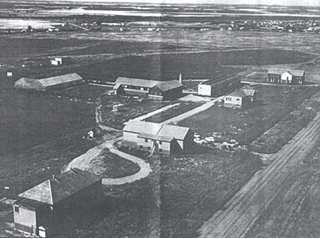
These teachings spread very widely very quickly, splitting or absorbing a number of established Pentecostal churches and becoming a movement within a few months. While Latter Rain teachings valued relational networks and condemned denominationalism (contending that no church or organization had any right to give direction to any other church), the Sharon group early on formed a team of “Presbyters” who visited Latter Rain churches and essentially managed the movement through directive prophecy (Riss 1987:67-74; Holdcroft 1980:4, Apologetic Index n.d.:4).

By mid-1949, the movement had become a major concern for more orthodox Pentecostals. The General Council of The Assemblies of God USA meeting that year formally condemned Latter Rain teachings as unbiblical and heretical (Riss 1987:103-19).

In the meantime, several other centers formed. The first one was the Elim Bible Institute in New York, which had already been involved in attempts to revive a more emotional and supernaturally focused Pentecostalism and which already had the resources to compete with the Sharon group. The second center to rise to a position of influence was the Bethesda Missionary Temple in Detroit, Michigan; another soon followed in Texas. Leadership and control of the movement were quickly sliding out of the hands of the Sharon group and beginning to fragment (Riss 1987:103-10).

By 1952, the Latter Rain as a recognized movement was clearly beginning to fade, although a number of strong congregations continue into the present day. Also, a number of Latter Rain teachings became major parts of the Charismatic Renewal movement that blossomed starting about 1967 (Riss 1987:140-43).

Much Latter Rain teaching is central in numerous contemporary movements, such as the Vineyard Churches, The Kansas City Prophets, and the Toronto and Lakeland Revivals, as well as hundreds of independent neo-Pentecostal churches (Sanchez 2008:4-6; Houdmann 2002:2)

Of particular contemporary interest are two teachings of the movement that can be traced back to William Branham, teachings that are still widely held, despite not being prominent in the early life of the movement. The first is a powerful sense of a restoration of the attributes of the early church in preparation for the end times, including the “Five-fold gifts of the Spirit”: prophets, apostles, elders, preachers, and teachers (as outlined in Paul’s letter to the Ephesians). Prophets and apostles, it is understood, hold authority directly from God (Holdcroft 1980:6-7).

The second is also an end-times prophecy, that the most devoted members will become “The Manifest Sons of God,” forming an undefeatable and immortal army that is able to overcome all obstacles to bring all people into geographically organized single churches in preparation for the reign of the Lord. This prophecy is the basis for the Joel’s Army (or Overcomers), a phenomenon that has become prominent in recent years. Evangelist Todd Bentley, who led much of the Lakeland Revival, is a prominent proponent (Warnock 1951:83; Sanchez 2002:5-6).

While there is no longer an active movement headquartered in North Battleford, the revival grounds themselves, now beautifully landscaped and with extensive facilities, still operate, though largely as a conference center. At least two religious meetings, including “The Feast of Pentecost” and a summer camp, are held each year, and there is also a global missions project housed there (Holdcroft 1987:7).

DOCTRINES/BELIEFS

The doctrines and beliefs of the Latter Rain religious revival movement are somewhat difficult to define since collectively they constitute something of a moving target, and have never been officially codified.

The movement was a protest against the more formalized Pentecostalism of the time, particularly what was considered by many to be a “dry” denominational church, lacking in emotional and spiritual life (Holdcroft 1980:2). Further, it was a movement that tended largely to privilege the mystical and subjective (prophecies, experiences, intuition, and directives straight from God) over exegeses of the written word. These prophecies and directives changed from time to time. Also, when the movement used the Bible, it did so in a highly stylized, symbolic and typological interpretation (that is, looking to the Hebrew Scriptures to interpret the New Testament) (Holdcroft 1980:2-7; Houdmann 2002:1).

Notwithstanding the above, it is possible to identify a number of teachings or beliefs, though leaders of the movement would resist the institutional implications of calling them doctrines.

First and foremost, of course, is the acceptance of the concept of The Latter Rain as found in the Hebrew Scriptures in the books of Deuteronomy (11:14), Joel (2:23) and Zechariah (10:1). These passages describe an early rain to start a crop and a latter rain to bring it to maturity for harvest. Latter Rain adherents see their revival as a sure sign that end times are imminent (Theopedia n.d.:1).

The Latter Rain movement saw the term “Latter Rain” as symbolizing a time of restoration of a victorious, universal church, including all of the apostolic gifts, in the end times, in contrast to the rather dour, pessimistic, Calvinistic dispensationalism widely held in the Pentecostalism of that period. Where the healing revivalists of the time emphasized healing and early Pentecostals emphasized tongues, Latter Rain emphasized prophecy (Riss 1987:116).

The apostolic gifts to be restored included speaking in tongues, healing, spirit blessing, prophecy, and the five-fold ministry, including prophets, apostles, evangelists, preachers and teachers. The roles of prophets and apostles, lost to the church in the Middle Ages, would now be restored to provide leadership of the victorious church, preparing the world for the return of Jesus Christ. Put another way, the Latter Rain will complete God’s work on earth, with the church united and victorious over the world, and will usher in the Kingdom of God. The movement also believed that spiritual gifts (including healing) could be received by the laying on of hands from one believer to another, in contrast to the traditional Pentecostal emphasis on “tarrying” (prayerful waiting for God’s presence) (Theopedia n.d.:1; Houdmann 2002:1-2).

Most other teachings followed from these basic beliefs, but the interpretation of these beliefs was carried out within the context of an intense, active search for a subjective, emotional, and interactive relationship with God. This meant that the prioritization and emphasis given the various elements of these beliefs tended to be shifting and circumstance-specific. Part of this circumstantial context was the belief that Christians could be demonized and require deliverance. Another part was the belief that intense, emotional praise and worship could usher God into the believers’ presence (Houdmann 2002:1-2). A somewhat unrelated belief was that women should have full and equal ministry (Houdmann 2002:2).

There are debates over whether the Latter Rain movement should be considered premillennial, postmillennial or just amillenial. Most Latter Rain believers seem to have accepted an end-times scenario in which denominational lines will be destroyed and the church will be unified by “overcomers” equipped with supernatural powers, thus preparing the world for the return of Jesus Christ and the beginning of the Kingdom of God. The role and timing of the Tribulation and the Rapture do not appear to have been settled. These issues are considered important by a number of groups, notably dispensationalist fundamentalists (Warnock 1951:83).

There was also the belief, inherited from William Branham and expanded by latter Rain teachers, notably George Warnock in his book The Feast of Tabernacles, that certain very devout members would become “The Manifest Sons of God”. Those who reached this level would have Godlike powers that included speaking any language and “teleporting” from place to place, forming an army that is able to overcome all obstacles to bring all people into geographically-organized single churches in preparation for the reign of the Lord. This prophecy is the basis for the Joel’s Army (or Overcomers) concept (Warnock 1951:83; Sanchez 2008:5).
Defenders of Latter Rain teachings see them as “a major step in the long unfolding of Biblical truth. They place themselves on a par with the Reformers, the Puritans, the Wesleyans, and the nineteenth century evangelical revival. New Order doctrine, they believe, is the final rung in the ladder whereby God’s people climb upward as they ‘go on unto perfection’” (Holdcroft 1980:8).

RITUALS/PRACTICES

Worship services conducted by Latter Rain churches were either revival services or events modeled after them. Most were exuberant, since members came seeking an emotional and personal spiritual experience. The service could also be described, using a much later term, as interactive, since worshipers took a very active part in the service (Holdcroft 1980:10).

Since Latter Rain teaching held that intense praise and worship would usher God into the worshipers’ presence (sometimes described as the restoration of the Tabernacle of David), the early part of these services usually consisted of music, including singing in tongues, dancing and waving raised hands, and individual shouts of praise (Liichow 1997:3; Houdmann 2002:2).

Once an intense atmosphere had been established, there might be a sermon on an end times or prophecy theme, followed by an extended time of healing, casting out demons, testimony, and spirit blessing. This would again include individuals falling down “slain in the spirit,” speaking and singing in tongues, interpretation of tongues, and weeping. Healing and exorcisms were performed by the leader praying and “laying on of hands.” Early on, Latter Rain congregations developed the practice of “calling out” individuals by name, blessing them with a laying on of hands, and providing a prophecy for them (Holdcroft 1980:4-5).

The times of service tended to be flexible, again following the revival practice. If testimony and seeking continued, so did the service in most cases. Services tended to be long and to occur several times a week (conventionally Sunday morning and evening and Wednesday evening, but other times were often scheduled).

LEADERSHIP/ORGANIZATION

Initially the leadership of the Latter Rain consisted of just three men: George Hawtin, Percy Hunt, and Herrick Holt. Over time, as the movement expanded, so did the leadership group, and eventually leadership passed out of the hands of the Sharon group (Holdcroft 1980:1-4).

There does not appear to be any record of who within the early Sharon group, other than Hawtin, were among those who went to Vancouver for the William Branham meetings, save that there were “several” people. Given the timing, a fair guess is that all three were involved (Riss 1987:56-57).

But once the revival began at the school, others became involved rather quickly. With the formal beginning of the Bible school,

the three founders were soon joined by George Hawtin’s brother and brother-in-law, Ernest Hawtin and Milford Kilpatric. As the
revival gained momentum, they were also joined by George Warnock. Warnock had once been personal secretary to W. J. Ern
Baxter, who had become an associate of Branham’s ministries. Baxter himself later joined the group on a part-time basis. Warnockwrote a book called The Feast of Tabernacles, which has been held to be a major publication of the group, and expanded on Branham’s concept of “The Manifest Sons of God” (Riss 1987:53-62).

In terms of church polity, the movement established a position that strongly supported local church autonomy and opposed any form of denominationalism. One observer noted that “conflict and hostility emerged in relationships with the New Order because of their vindictive militant denunciations of existing denominations and church policies.” An oft-reported remark of one of the leaders was that “no church exercises or has any right to exercise authority of jurisdiction over another church, its pastors or members.” Yet in spite of this rhetoric and positioning, leaders of the movement did in fact exercise control, both within and without the group (Holdcroft 1980:6-7; Apologetics Index n.d.:2).

The belief that apostles and prophets were being restored to the church in this era gave rise to identifying movement leaders with these positions, and allowing them to contend that their directive prophecies came directly from God, and that, therefore, these prophecies were beyond question or challenge. Control within the group was reportedly tight, being described by at least one former member as “dictatorial” (Holdcroft 1980:5-7).

The Sharon group also formed teams of travelling “Presbyters” that included these apostles and prophets, who visited Latter Rain churches and institutions, controlling them through prophecies that were considered to have precedence over any other decision-making authority. The Sharon group has been described as rejecting any teaching that did not originate with its leaders (Holdcroft 1980:6-7).

ISSUES/CHALLENGES

The movement that came to be known as The New Order of The Latter Rain was born in controversy. One author has stated flatly that it “was an organizational schism before it was a spiritual cause.” The same author, L. Thomas Holdcroft, describes the schism as “the unrestrained zeal (of the founder and leaders of Bethel Bible Institute) pitted against the necessary conservatism and restraints of responsible denominational leaders” (Specifically the Saskatchewan District of the Pentecostal Assemblies of Canada) Holdcroft 1980:2).

This “unrestrained zeal” continued after the key players moved to North Battlefield and, over time, provided fuel for a number of other controversies. The group’s somewhat unorthodox beliefs provided sparks. Its success in drawing large numbers of members from other churches, nearly splitting the Pentecostal Assemblies denomination, fanned the flames (Holdcroft 1980:3-4).

The earliest controversies grew from the vituperative comments made, and sometimes published, by the founders regarding the leaders of other churches and denominations. Later theological controversies fall primarily into two groups, largely identifiable by the source of the criticism, though there is substantial overlap (Holdcroft 1980:6).

The first of these originated very early on and came largely from Pentecostal sources. Pentecostals rejected the use of personal prophecy, the transmission of spiritual gifts (such as healing, prophecy and tongues) by the laying on of hands from one believer to another. The also rejected what was considered by Pentecostals to be distortion of Scripture, the belief in the Manifest Sons of God predictions, and the restoration of the positions of apostle and prophet, calling all of these contrary to the historic teachings of Pentecostalism. This list of objections formed the basis for the 1949 official rejection of the Latter Rain movement by The Assemblies of God and several other Pentecostal organizations (Riss 1987:119).

Later, a fairly large number of generally fundamentalist groups published, first in books and journal articles and later on websites, objections to the eschatological teachings of the Latter Rain, to the Manifest Sons teaching, to the restorationist teaching that identified specific living apostles and prophets, to what they considered “untested” prophecy, and to what they also considered misuse, or failure to use, Scripture. One of the more succinct statements of this position is from Holdcroft: “No group can remain sound in faith and practice if it gives authority to experiences for their own sake, rather than on the ground of the standards of the Word of God” (Holdcroft 1980:10).

Another, much broader criticism comes from sources outside of these two communities and applies to Pentecostals generally and perhaps to groups within the Holiness tradition as well, but has been aimed specifically at Latter Rain teachings. That is the contention that the emotionalism, supernaturalism, tongues, healing, and other teachings concerning spiritual gifts, constitute a modern neo-Montanism, a revival of a third century Christian heresy. This is an issue that goes well beyond the scope of the present article. (“A Study of Denominations,” n.d.:1-4).

Contemporary criticism revolves not around the Latter Rain movement itself, but around the various present-day manifestations
of teachings and practices that originated with, or were developed out of, Latter Rain teachings. Some of these include the Army of Joel and similar groups based on the Manifest Sons of God teaching (which actually came originally from William Branham), the Shepherding movement, restorationism and dominionism (Sanchez 2008:1-6).
REFERENCES

Apologetics Index, Apologetics Research Resources on Religious Cults and Sects. n.d. Accessed from www.apologeticsindex.org/108.html on 29 November 2013.

Holdcroft, L.Thomas. n.d. Strange Fires, The New Order Of The Latter Rain . Accessed from www.spiritwatch.org/firelatter2.htm on 5 August 2013 .

Houdmann, S. Michael. n.d. Got Questions.org . Accessed from www.gotquestions.org/latter-rain-movement.html 5 August 2013.

Liichow, Rev. Robert S. n.d. Restoration “The Latter Rain Movement .” Accessed from www.newdiscernment.org/restorat.htm on 5 August 2013.

Riss, Richard M . 1987. Latter Rain; The Latter Rain Movement of 1948 and the Mid-Twentieth Century Evanngelical Awakening . Honeycomb Visual Productions, Ltd., Mississiauga, Ontario, Canada.

Sanchez, Casey. 2008. Todd Bentley’s Militant Joel’s Army Gains Followers in Florida .

Southern Poverty Law Center Intelligence Report , Fall. Accessed from www.splcenter.org/get-informed/intelligence-report/browse-all-issues/2008/fall/arming for armageddon on 26 November 2013.

A Study of Denominations, Montanism. n.d. Accessed from www.astudyofdenominations.com/history/montanism/ on 26 November 2013.

Warnock, George H. 1951. The Feast of Tabernacles. Bill Britton: Springfield, MO.

Author:
John C. Peterson

Post Date:
10 January 2014


Share

Integral Yoga International (IYI)

INTEGRAL YOGA INTERNATIONAL TIMELINE

1914 Sri Swami Satchidananda was born in Tamil Nadu, South India.

1947-1964 Satchidananda met and studied under Sri Swami Sivanandaji for seventeen years.

1966 Satchidananda traveled to New York City.

1966 (October) The first Integral Yoga Institution was established in New York City.

1969 Satchinananda addressed the crowd at the Woodstock Music Festival.

1972 Yogaville-West was established in Seigler Springs, California.

1973 Yogaville-East was established in Pomfret Center, Connecticut and became IYI headquarters.

1976 Satchidananda became a U.S. citizen.

1979 (September) IYI was gifted 600 acres in Buckingham County, Virginia which became Satchidananda Ashram-Yogaville (SAYVA).

1979-1986 Light of Truth Universal Shrine (LOTUS) was constructed in Buckingham, Virginia at SAYVA.

1986 (July) A dedication ceremony was held for LOTUS, and SAYVA became the IYI headquarters.

2002 Satchidananda died in his home region of Tamil Nadu, South India.

FOUNDER/GROUP HISTORY

Sri Swami Satchidananda was born as Ramaswamy Grounder in Tamil Nadu, South India on December 22, 1914. He was one of two sons born to Kalyanasundaram Gounder and his wife, Srimati Velammai, a prosperous Hindu couple (Perringer n.d.). His early
adult life was quite secular in nature. He graduated from an agricultural school and worked in the automotive industry before becoming a manager in the National Electric Works. In the hagiographic account of his life, however, Swami Satchidananda is described as having been intensely spiritual from childhood: “Even as a young child, he spoke truths and displayed insights far beyond his years. His devotion to God was strong, and he looked at people of all castes and faiths with an equal eye, always recognizing the same light within every being” (Perringer n.d.) While working as the manager of a Hindu temple, Grounder met and married his wife, and the couple gave birth to two children. However, five years later his wife died suddenly. Following his wife’s death, Grounder renounced the world and began his spiritual career at age twenty eight.
In order to become disciplined in yoga, Grounder secluded himself for several years before traveling around India to study under various gurus. After studying under several spiritual figures, including Sri Ramakrishna, and Ramana Maharshi. Grounder met Sri Swami Sivananda in the foothills of the Himalayas in 1947; the Swami initiated him into the Holy Order of Sannyas and gave him his spiritual name, Swami Satchidananda (divine bliss). Satchidanada studied with Sivananda for seventeen years. Due to his mastery of all branches of yoga, Satchidananda was given the title “Yogiraj,” master of yoga. Sivanandaji sent Satchidananda to Ceylon (present day Sri Lanka) to spread Sivanandaji’s teachings. He lectured across India and established yoga centers in Sri Lanka, Hong Kong, Japan, Malaysia, Singapore, and the Philippines (Meadows and Hadden 2002:646).

Satchidananda met filmmaker Conrad Rooks and artist Peter Max in India while the two were filming the now cult classic film Chappaqu in 1965. Satchidananda made a cameo appearance in the film, and Rooks and Max invited Satchidananda to New York City the following year. Although initially planned as a two day visit, Satchidananda attracted hundreds of followers resulting in an extended stay in New York City.

The first Integral Yoga Institute was founded in New York City on October 7, 1996. Six years later in 1972, Yogaville-West was established in Seigler Springs, California to provide a community for those who practiced Integral Yoga. Following closely behind Yogaville-West, Yogaville-East was founded in 1973 in Pomfret Center, Connecticut. Yogaville-East served as IYI headquarters for ten years.

In 1978 vocalist Carole King (Karuna King) gave Satchidanada a large tract of land in Connecticut. Satchidanada sold the land the
following year to purchase a 650 acre tract in Buckingham County, Virginia to IYI. It was in Buckingham County that construction began on the Light of Truth Universal Shrine (LOTUS) at the new Satchidananda Ashram-Yogaville (SAYVA). LOTUS is described as a temple for all world religions where one can find the Spirit that unites everything. LOTUS held a dedication ceremony on July 20, 1986, after which SAYVA became the new headquarters for IYI.

Satchidananda continued to travel the world giving lectures to promote religious harmony. He left his body (Mahasamadhi) on August 19, 2002 as a result of an aneurysm while visiting his home region of Tamil Nadu, South India.

BELIEFS/DOCTRINES

Yoga is conventionally divided into six paths or traditions, with over fifteen million practitioners in the United States, but numerous other schools have developed out of these six traditions (Cook 1999-2000). Hatha Yoga, which first opened a center in San Francisco in 1955, is the most popular branch of Yoga, using physical postures (Asanas), regulated breathing (Pranayama) and meditation (Dharana). Karma Yoga emphasizes selflessness and service to eliminate attachment to the material results of the practitioner’s actions. Bhakti Yoga uses repetitive sounds or words (mantras) in order to surrender the self, identify with a higher self and experience the divine in all of creation. Raja Yoga uses deep meditation to create stillness and focused control over the mind that allows the emergence of the practitioner’s higher self. Jnama Yoga emphasizes the development of the intellect and study of yogic scriptures combined with deep meditation that promotes an unfolding of the “surface mind” and understanding of the Ultimate.

Kim (2006) describes Integral Yoga as rooted in Hatha Yoga, but Integral Yoga presents itself as a synthesis of the hatha, karma, bhaki, raja, and jnana traditions (Meadows and Hadden 2002:646). Satchidananda understands Integral Yoga as a scientific method for integrating both the various branches of Yoga and the mental, physical and spiritual aspects of the individual. Integral Yoga is therefore more than religion. In Satchidananda’s view, “Integral Yoga is the basis of all religions, not a religion itself” (Ma 1980:24). Put another way, “Yoga is not a religion, but embodies the essence of ethical perfection that is the foundation of all religions” (Ma 1980:23). Satchidananda acknowledges that “We do teach religion, but not as it is usually taught. That is, we teach the basic principles which are common to every religion” (Ma 1980 24). He is often quoted as stating that “Truth Is One, Paths Are Many.”

However Integral Yoga is categorized, Satchidanada teaches that most individuals operate only with their “surface minds” and therefore never realize their full spiritual potential. The objective of Integral Yoga is to facilitate individuals’ quest for self knowledge (Sadhana). What impedes individual progress toward Sadhana is imperfect or selfish actions. Practitioners are taught to understand that they are completely responsible for their actions and to engage in selfless service. As Satchidananda has put it, “Wherever you are, whatever you are doing, do it for the benefit of others (Ma 1980:19). When practitioners complete the quest for self knowledge, they recognize that all living things are connected in One Spirit. Because One Spirit is broadly conceived, Integral Yoga can be practiced within a multitude of religious and spiritual frameworks based on the belief that the One Spirit unites all faiths. The belief that all living beings are part of One Spirit led Satchidanada to disavow inequality. As he has put it, “No person is an untouchable. Differences come, not with the work one does nor the caste into which one is born, but with the state of mind. Essentially we are all one and the same. All are God’s children.” (Perringer n.d.)

The term integral yoga can legitimately be applied to any spiritual path based upon the synthesis of multiple yoga traditions. There are two main schools of thought and practice of integral yoga, one established under Sri Aurobindo and the other established under Sri Satchidananda. Followers of Satchidananda have trademarked the name Integral Yoga in the United States.

RITUALS/PRACTICES

The degree of involvement in Integral Yoga varies among practitioners. Some individuals choose to only take weekly classes at the closest center, institute, or ashram while others choose to live within the Yogaville communities. The headquarters for Integral Yoga, SAYVA , offers courses, retreats, special seminars, and internships. A typical retreat package offers various choices of accommodations within onsite dormitories, private rooms, or camping. Also included are three buffet style vegetarian meals as practitioners of Integral Yoga practice non-violence toward all beings. Additionally, daily yoga, meditation, and scripture classes are offered. At SAYVA, weekly spiritual meetings (satsangs) are held every Saturday evening. Satsang includes chanting (Kirtan), a DVD featuring Satchidananda, a spiritual presentation by a guest lecturer or senior member, and prayers for world peace. Every year SAYVA offers silent retreats; a ten day retreat in June, a five day retreat during New Year’s, and four-day retreats in both Spring and Fall.

Consistent with its integrative perspective, Integral Yoga practitioners celebrate a variety of Christian, Jewish and Hindu holidays: Christian (Easter, Thanksgiving, Christmas ), Jewish (Rosh Hoshana, Yom Kippur, Hanukkah) Hindu (the Navarati celebration of the Divine Mother, the Mahasivaratri celebration in honor of Lord Shiva, and the Deepavali celebration of the Festival of Lights). Some mainstream culture holidays, such as Mother’s Day, Father’s Day, and New Year’s are celebrated. Integral Yoga practitioners have created their own holy days that honor Satchidananda ( Guru Poornima – a n annual sacred occasion honoring Satchidananda and marking the anniversary of the LOTUS dedication ceremony) and Mahasamadhi (commemorating Satchidananda’s exit from his physical body).

ORGANIZATION/LEADERSHIP

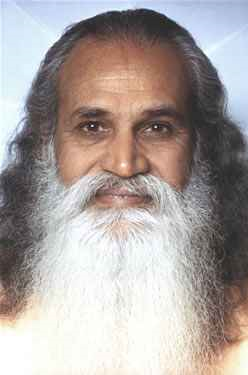
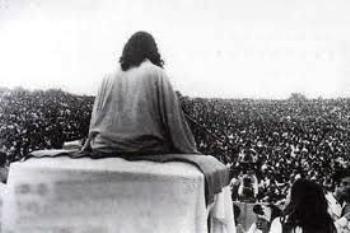
When Satchidanada arrived in the United States in 1966 he was drawn to youthful members of the counterculture (Kempton 1967). He argued that established institutions had failed American youth: “Where do you go if your institutions don’t offer you anything?…To a tepee in Vermont, that’s where….They are all searching for the necklace that’s around their necks” (Katz 1992:377). His popular fame increased after he addressed the audience at the Woodstock Music Festival in 1969, teaching them tochant “Hari Om.” His message to the assembled was to find peace within: “I still don’t understand how they are going to fight and then find peace. Therefore, let us not fight for peace, but let us find peace within ourselves first” (Satchidanda 1969). He touted Integral Yoga as a means to abandon drug use, stating that “The problem with drugs is that while they elevate you, they immediately drop you back down again” while Integral Yoga offered a “natural high (Katz 1992:377). Satchidanada subsequently attracted many wealthy and prestigious followers.


Satchidananda was regarded by his followers as “God realized” and as a person who retained human form only as a way of supporting the spiritual development of others. He initiated many sannyasi in the West and gave new yoga names and individual mantras to his many initiates. He became a celebrity, appearing on talk shows and consulting with corporations, conducting interfaith dialogues, speaking on college campuses, and lecturing on nutrition and holistic health. Satchindanada has received numerous awards for his work, including the U Thant Peace Award from the United Nations Meditation Group, the Martin Buber Award for Outstanding Service to Humanity, the Judith Hollister Interfaith Award, the B’nai Brith Anti-Defamation Leage Humanitarian Award, and the Albert Schweitzer Humanitiarian Award. The fiftieth anniversary of his ministerial ordination was commemorated in 1999 during an interfaith service prior to the commencement of the 54th General Assembly of the United Nations. Numerous famous personages from Bill Clinton to Dean Ornish to Richard Gere to Allen Ginsberg praised his work.

Integral Yoga has established three yogavilles in the United States, Yogaville-East, Yogaville-West, and Satchidananda Ashram-Yogaville (SAYA), the headquarters of IYI . Integral Yoga also has four Integral Yoga Institutes within the United States, with one in Canada and one in India. Institutes offer coursework for those interested in becoming certified Integral Yoga teachers. Additionally, Institutes offer classes to the larger surrounding communities and Integral Yoga practitioners. Integral Yoga maintains 37 centers in 28 different countries. These centers are similar to Institutes but are smaller, localized, and do not offer courses for teacher certification. Integral Yoga does not maintain a formal membership list, but only a few hundred people are certified to teach Integral Yoga.

Like many Ashrams, Yogavilles are normally located in rural areas. They serve as monastic-like communities of Integral Yoga yogis and teachers. At any given time the population of a Yogaville will consist of guests, associate members and full-time members. At the Yogaville ashram the renunciate swamis are provided food and housing while householders are expected to provide basic necessities for themselves. Practitioners come for retreats.

The Satchidananda Ashram-Yogaville welcomes about 2,000 visitors every year, while another 150 individuals consider the community their home. Some of the workshops offered at SAYA are classes that teach the concepts of each branch of yoga of which Integral Yoga is composed. These include Hatha Yoga, which focuses on postures, breathing pattern, and diet; Raja Yoga, which revolves around controlling the mind through meditation; Bhakti Yoga, which is practiced through constant love of and devotion to God; Karma Yoga, which is the path of selfless service; Jnana Yoga, which concentrates on the existence of everything that is natural and/or unchangeable; and Japa yoga, in which the focus is on chanting. Other workshops and classes include yoga for athletes, stress management yoga, prenatal and labor yoga, laughing yoga, inner tantric yoga, as well as yoga for those with scoliosis. For those at SAYA the diet is vegetarian, celibacy is required for singles and monastics, and alcohol, drugs and tobacco are prohibited.

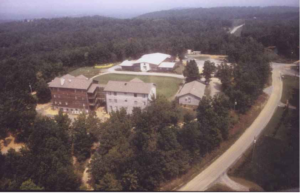
SAYA is also home to the Light of Truth Universal Shrine (LOTUS), which opened in 1986. The shrine houses alters dedicated to ten major religions, as well as two additional alters, one dedicated to other known religions and the other dedicated to those still unknown. The outside of the shrine contains fountains and gardens, many with spiritual symbolism. The interior of the shrine consists of two floors; the bottom floor houses cases that display artifacts of the religions represented in the alters, which are located on the top floor of the shrine.

ISSUES/CHALLENGES

Integral Yoga was caught up to a very limited extent in the mental manipulation and divided family controversies that affected many religious movements beginning in the 1970s. It has been the claims of sexual manipulation and abuse levied against Satchidananda that have received the greatest public visibility and most significantly affected the movement. During the early 1990s several female members who had served on Satchidanada’s staff charged him with sexual improprieties of various kinds (McGehee 1991). Following the initial allegations, several additional women made similar charges. Satchidananda has consistently denied the charges but refused interviews with journalists or responses to those making the allegations. With respect to his accusers, he has stated that “They are free to feel this way….If they don’t feel comfortable with me, they can go learn from someone else.” With respect to his unwillingness to provide a public response to the accusations, he has stated that “There is no need. If the public wants to believe that, they can believe it” (Chopra 1999). Many followers have vigorously defended Satchidananda and dismissed the charges as fabricated, but opponents claim that the movement lost numerous practitioners, teachers, and center affiliations in the wake of the controversy (Zuckerman 1991). Satchidananda’s mahasamadhi in 2002 ended the personal confrontation but does not appear to have impacted his overall influence.

REFERENCES

Chopra, Sonia. 1999. Satchidananda’s Yoga Ashram Caught Up In A New Controversy, Past Sexual Charges Begin Resurfing.” Rediff On The Net. 14 June. Accessed at http://www.rediff.com/news/1999/jun/14us on 28 October 2011.

Cook, Jennifer. 1999-2000. “Not All Yoga Is Created Equal.” Yoga Journal. Winter 1999-2000. Accessed at http://www.yogajournal.com/basics/165 on 23 October 2011.

Kempton, Sally. 1967. “What’s New in America?” Village Voice. 9 November, p. 1.

Ma, Swami Saravananda. 1980. “The Integral Yoga School in Historical Perspective.” Ph.D. dissertation. Storrs: University of Connecticut.

Meadows, Sarah and Jeffrey K. Hadden. 2002. “Integral Yoga International.” Pp. 646-47 in Religions of the World, Volume 2, edited by J. Gordon Melton and Martin. Santa Barbara, CA: ABC-CLIO.

McGehee, Overton. 1991. “Ex-followers Say Swami Demanded Sexual Favors.” Richmond Times-Dispatch, Aug 2, p. B-1.

Pettinger, Richard. n.d. “ Biography Swami Satchidananda.” Biography Online. Accessed at http://www.biographyonline.net/spiritual/satchidananda/index.html on 25 October 2011.

Satchinanada, Sri S. 1969. “ Woodstock.” Accessed at http://www.swamisatchidananda.org/docs2/woodstock.htm on 15 November 2011,

Zuckerman, Joy. 1991. “An Open Letter.” Accessed at http://groups.yahoo.com/group/Sri_Chinmoy_Information/message/2448 on 28 October 2011.

SUPPLEMENTARY RESOURCES

Bordow, Sita. 1984. The Master’s Touch. Yogaville, VA: Integral Yoga Publications.

Bordow, Sita. 1986. Sri Swami Satchidananda: Apostle of Peace. Yogaville, VA: Integral Yoga Publications.

Mandelkorn, Philip, Ed. 1978. To Know Yourself: The Essential Teachings of Swami Satchidananda. Garden City, NY: Anchor Books.

Satchidananda, Sri. 1978. [translation and commentary]The Yoga Sutras of Patanjali. Yogaville, VA: Integral Yoga Publications.

Weinca, Sita. 1972. Swami Satchidananda. NY: Bantam Books.

Post Date:
22 November 2011


Share

Hillsong

 HILLSONG TIMELINE

1954:  Brian Houston was born in Auckland, New Zealand.

1974:  Houston graduated from Bible College in Auckland.

1977:  Houston’s father, Frank, founded the Christian Life Centre in Sydney, Australia. Brian married Bobbie Houston in New Zealand.

1978:  Brian and Bobbie Houston moved to Sydney.

1983:  Brian and Bobbie Houston planted a separate church, the Hills Christian Life Centre, from Frank Houston’s original church.

1986:  The first Christian Life Centre Conference was held.

1992:  Christian Life Centre’s first international plants were established in London and Kiev.

1997:  The First Colour (women’s) Conference was held. Brian became the new National President of the Assemblies of God (AOG) in Australia.

1999:  Frank Houston was removed from the church and stripped of ministerial credentials after confessing to sexually abusing an underage boy thirty years earlier in New Zealand. Brian referred the matter to the National Executive of the AOG and became Senior Pastor in his father’s place. Brian rebranded the family of churches as Hillsong.

2002:  Hillsong started holding services in its purpose-built conference venue (Hillsong Convention Centre) in Sydney’s Baulkham Hills.

2013:  Zion, an album of Hillsong United (the band of Hillsong Church), debuted in the U.S. secular billboard at number five.

2014:  The “Royal Commission – Institutional Responses to Child Sexual Abuse” asked Hillsong to appear as it examined the way the church handled the complaint of sexual abuse made against Frank Houston.

2015:  Hillsong is due to release its first feature-film (Hillsong – Let Hope Rise) in September. The film charts the rapid rise of Hillsong United.

2020:  Hillsong New York Pastor Carl Lentz was fired after admitting to infidelity in his marriage.

2022:  Global Senior Pastor Brian Houston resigned for breaching the Hillsong code of conduct. Phil and Lucinda Dooley, previously senior pastors for South Africa, were appointed interim Global Senior Pastors.

2022:  In the wake of a series of scandals, individual churches in the U.S.  began withdrawing from the Hillsong network. The head pastors in Atlanta and Phoenix withdrew from Hillsong, making a total of nine withdrawals.

2023:  Phil and Lucinda Dooley were made permanent Global Senior Pastors

2025:  The San Francisco Hillsong congregation withdrew from Hillsong, making the total of eleven withdrawals from the sixteen congregations that had been operating in the U.S.

FOUNDER/GROUP HISTORY

Brian Houston, one of the founders and now Senior Pastor of the Hillsong family of churches, was born in Auckland, New Zealand in 1954. Frank and Hazel, his parents, were Salvation Army officers and Brian Houston explains that his parents left the Salvation Army to join a Pentecostal congregation “with nothing, really, at that time. We grew up in what would be a Housing Commission house” (Houston 2005). Houston’s father, Frank, “got filled with the Holy Spirit” and went on to become a Pentecostal minister in New Zealand. Houston himself went to Bible College in Auckland, graduating in 1974.

Houston met his future wife, Bobbie, on a beach during a summer Christian Conference, and they married in 1977. They moved to Sydney in 1978 to join Frank Houston, who had founded the Christian Life Centre there the year before. Brian, together with Bobbie, planted the Hills Christian Life Centre in 1983 from Frank’s original church. The church started out of the Houston’s Sunday night outreach program and was not an immediate success. Houston explained: “the very first Sunday we had 70 people turn up. The second week, there were 60, the third week, 53, and by the fourth week, 45. I’ve often joked that we worked it out at the time- we had only four and a half weeks left until there were no more people. It was about that time that we had our first ever commitment to Christ. We outgrew the school hall after twelve months. The crowds were so big that we were using road-case as the platform, and what should have been the stage as a balcony so that we could fit more people in” (Houston 2014).
The first Christian Life Centre conference was held in 1986, and, by 1989, the popularity of the church had grown to the point that it was relocated to a warehouse in Baulkham Hills. The church again relocated in 1990, this time to the Hills Centre, an entertainment complex, the design and space of which was to set the tone for future church buildings. The church held its first women’s conference, the Colour Conference, in 1997, led by Bobbie Houston.

In 1999, Frank Houston was stripped of his ministerial credentials after he confessed to sexually abusing a child thirty years earlier in New Zealand (Morton and Box 2014). Brian oversaw his father’s removal from the church, and he and Bobbie took over leadership of the original Sydney Christian Life Centre. The Houstons rebranded this family of churches simply as “Hillsong,” in recognition both of the Hills district where the church had experienced such tremendous growth, and the music that played such an important part in worship and services. Having continued to grow in number, Hillsong built a large conference venue, the Hillsong Convention Centre, in Baulkham Hills. Then Australian Prime Minister, John Howard, opened the centre in 2002.
Where the Christian Life Centre held its first meetings in the homes of its forty-five members, Hillsong greatly expanded in the country before the scandals of the 2020s and had a congregation of around 20,000 in Sydney alone and 10,000 people in other Australian cities in 2013 (O’Malley 2013).

Starting in 1992, international churches were planted in London, Kiev, South Africa, Sweden, Denmark, Spain, the United States, Germany, France, Portugal, Russia, the Netherlands, Brazil, Argentina, Mexico, Japan and many other countries. In 2012. Hillsong was described as “Australia’s most powerful brand” (Hicks 2012).

The megachurch reached its peak before the 2022 scandals, when it had a global congregation of 150,000 people.  According to Potter and Riches (2025), “During the scandals, at least 30,000 people left the Australian congregation; some returned, while others are expected to be replaced by new converts.”

DOCTRINES/RITUALS

Hillsong is a Pentecostal church that believes the Bible is God’s Word and is “accurate, authoritative and applicable to our everyday lives” (“Hillsong: What We Believe” 2015). The Church believes in the use of spiritual gifts and baptism, including divine healing. To receive forgiveness and “new birth” individuals must repent, and submit to the will of Jesus.

Brian Houston argues that there are four levels of Christianity. The first is enjoyment, the exciting moment of discovery and perhaps the first experience of Spirit. The second is “servanthood,” and “Christians who rise to this tier are those who have added to their enjoyment by committing to serve in God’s House.” The third level of Christianity, according to Houston, is “giving.” Not giving time as above, but money. The fourth level is “sharing the load,” doing “whatever it takes” to promote the vision and work of the church. In this, Houston argues, the clergy is not separate from the laity, and the “work of the ministry” becomes the responsibility of every believer (Houston 2013:102-5).

Brian Houston is well known for his “How to Maximise Your Life” series of books, which includes How to Live a Blessed Life; How to Build Great Relationships; How to Flourish in Life; How to Make Wise Choices; and How to Live in Health and Wholeness (Houston 2013) . These five books were published together as How to Maximise Your Life after the earlier publication of the work, You Need More Money: Discover God’s Amazing Financial Plan (1999) was lambasted by the press for its title. In the book, Houston argued that “God actually gets pleasure when we prosper” financially, because “money answers everything” (Houston 1999:2, 20). To Houston, faith can lead to prosperity and an individual’s faith is tangible and reflected in their health and wealth. He describes this attitude to wealth, which is often labelled as embodying the “prosperity gospel,”as “prosperity for a purpose” or “prosperity on purpose” (Houston 2008: 123). This has become one of the central tenets of Houston’s preaching and Hillsong’s message (Houston quoted in Marriner 2009).
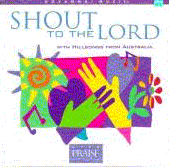
Houston and other Hillsong Church leaders also embrace the concepts of individualism and aspiration. There is a focus on the power of positive thinking and the ability of the church to help individuals transform their lives. Houston explains: “ I’m sure not so blind that I can’t see that people suffer and struggle. I just believe that we should have and can have answers that do something about it. I am an absolute believer in the potential of people” (Houston 2005). Bobbie Houston in her 2008 book, I’ll Have What She’s Having, builds on this idea by arguing that people need to “ rise up ! Time to get over the negatives” and achieve all they can. She believes that “ ultimate compliment” is for someone to see your lifestyle, attitude, and sense of purpose, and then want those same things (Bobbie Houston 2008:26). This belief in the potential of people, along with the emphasis placed on prosperity and the repeated use of aspiration language, indicates the way Hillsong emerged out of the neo-liberal ideas that came to define Australia’s economy and society around the time that Hillsong Church was established.

Worship music has been particularly critical in the success of Hillsong Church internationally and is seen as a chance to praise theLord and build a close, personal relationship with him (Houston 2013). Ben Fielding, one of Hillsong’s music/creative leaders says that “music reflects the creativity and beauty of God; its ultimate purpose is to bring enjoyment and cause us to draw near to our Creator” (Fielding 2012). Hillsong released its first tape of worship music, Spirit and Truth, in 1988, though the church had had a music pastor (Geoff Bullock) since 1985. Darlene Zschech replaced Bullock in 1994, and remained the church’s worship pastor until 2007. Zschech is probably the best-known Hillsong worship leader and was instrumental in increasing the popularity of Hillsong’s music, with 35,000,000 Christians around the world sing one of her most popular songs, Shout to the Lord, at church each week (Houston 2005).

Hillsong’s music became most strongly associated with the band “Hillsong United,” which started as the church’s youth band and began recording original music in 1998. The band was led by Joel Houston, the son of Brian and Bobbie. Another important Hillsong band was Young & Free, a collective of younger artists that released music between 2012-2021. In 2022, four of the ten most popular worship songs sung in churches were from Hillsong bands (“The Goodness of God,” “What a Beautiful Name,” “Who You Say I Am,” and “King Of Kings”) (McGinnis 2022).

After the scandals, the newly appointed Global Senior Pastors, Phil and Lucinda Dooley, directed Hillsong to stop creating and publishing music. Some musicians left the church while some key worship leaders, like Joel Houston, remained silent (Potter and Riches 2025; Thornton 2025:4).

At the same time, churches around the world started discussing whether they should continue to play Hillsong music because of the megachurch’s downfall (McGinnis 2022). However, Thornton has argued that although “Hillsong’s prominence in the genre [Contemporary Congregational Song] has waned…the CCS genre has been indelibly impacted by Hillsong, [and] it will continue to evolve and renew” (Thornton 2025:13).

Hillsong’s music has continued to be most strongly associated with the band “Hillsong United,” which started as the church’s youth band and began recording original music in 1998. The band is currently led by Joel Houston, the son of Brian and Bobbie. Hillsong also releases albums recorded at its London and Sydney services (Riches and Wagner 2012:24).

ORGANIZATION/LEADERSHIP

Hillsong was a member of the Australian Christian Churches (formerly the AOG in Australia) until 2018, when it became its own denomination. The Assemblies of God in Australia is a movement of 1,100 churches with over 250,000 adherents around the country. Hillsong, like the AOG/Australian Christian Churches, embraces apostolic leadership, or “leadership by God appointed apostolic ministries” (Cartledge 2000). Brian Houston argued that Hillsong represented a “network that connects hundreds and thousands of pastors…committed to the apostolic anointing of leaders” (Houston, “The Church I Now See,” 2014).

Brian and Bobbie Houston were “Global Senior Pastors” of Hillsong until January 2022, when Brian was forced to resign for breaching the Hillsong code of conduct. Since then, Phil and Lucinda Dooley, previously the senior pastors for South Africa, have been appointed to the position.

Hillsong believes that men and women play different roles in life and in the running of churches. Men tend to be the ultimate decision makers and leaders, yet Bobbie Houston used to describe herself as being an “equal partner” in her marriage and argued that she and Brian pastor and lead the church together (Bobbie Houston 2008). Similarly, Brian Houston argued that: “Bobbie works alongside me. We’re very much a team …I certainly don’t adhere to the mentality that a woman must submit or that she should be pushed down,” but also acknowledged that “I’ve got a conservative, biblical idea that a man should take a role of leadership in his life” (Houston 2005). This conflict in understandings of gender roles and power dynamics is part of what sociologist Bernice Martin described as “the Pentecostal gender paradox” (Martin 2001).

Until 2022, when the scandals broke and after two years of borders closures in Australia due to the Covid-19 pandemic, Hillsong International Leadership College formed a significant part of the church’s vision and income stream. According to Hillsong Church Australia’s 2013 Annual Report, the total revenue generated by the College is $8,155,639 (Hillsong 2013 Annual Report:18). Students can study Pastoral Leadership, Worship Music, TV & Media, Dance, Production, or can undertake a Bachelor of Theology, offered in conjunction with Alphacrucis College. Attendees spend part of their time at College doing “Fieldwork,” where students “get the opportunity to serve in church life” (“What Makes Hillsong College Different?” 2014). Hillsong College also runs shorter evening courses on a variety of topics including money, relationships, and parenting (“Evening College Life Courses” 2015).

ISSUES/CHALLENGES

Hillsong has been the subject of much negative publicity. One former member wrote a book People in Glass Houses exploring her experiences in the church and detailing what she felt were the major flaws of the organisation (Levin 2007). Before this and since, there have also been repeated criticisms of the church, usually centred on the church’s finances, its size, and its theology. Brian Houston says that “if anybody is an expert in media opposition, it’s me,” joking that he essentially has a PhD in public relations (Pulliam Bailey 2013).

Houston openly acknowledges that his book, You Need More Money, was poorly received. He noted: “ If you said to me ‘what are the three silliest things you’ve done’, that would probably be No. 1. The heart of the book was never just being greedy and selfish …I put a bullseye on my head” Marriner 2009). In a 2005 interview explaining this public attitude towards Hillsong, Houston said, “Hillsong church today has facilities valued somewhere near $100 million. In our last accounting period, the total income was fifty million dollars. I think that the idea of a church being big and successful and effective threatens some people” (Houston 2005). Tanya Riches, who grew up attending Hillsong and has a PhD in religious studies, believes that the Australian media “doesn’t get Hillsong” and sees it as “money hungry, a sham, flamboyant, corrupt” (Riches 2014). One journalist described Hillsong’s marriage of faith and finance as “Praise the Lord and pass the chequebook” (Beaurup 2005).

Hillsong, like other Pentecostal churches in Australia, faces particular challenges when it comes to retaining members over the long term. Pentecostal churches in Australia have experienced growth rates that outpace other Christian denominations, and the number of Australians identifying as Pentecostal has steadily increased relative to the size of the Australian population over the last thirty years. However, these figures do not show the high number of “visitors” to Pentecostal churches, who do not remain in the church over the long term. From 1991-2001, AOG churches retained less than sixty percent of members while retention rates for other Protestant denominations in the same period were over eighty percent (NCLS 2015).

Hillsong is one of only twenty-one megachurches in Australia (Hughes 2013:7). Being a megachurch is perhaps one of the reasons retention rates at Hillsong are so low. That is, people are looking for a more personal connection with a pastor and the congregation than is possible when you are one of thousands worshiping at a service. More than this, as a megachurch, Hillsong has become a large institution that caters for more than religious needs. It embraces modernity and makes faith convenient through the live online streaming of church services, the provision of food and drink outlets in church foyers, the ability to make donations using EFTPOS facilities, and the increasing use of social media platforms to release information and content. Hillsong has since been criticised by various social commentators for producing a form of religion that is “light” on theology and very broad. Some argue that the church is more focused on giving attendants an enjoyable worship experience, than on Bible teaching (Pulliam Bailey 2013; Marr 2007). However, some argue that being a megachurch has helped Hillsong’s popularity because people today are comfortable in large institutions associated with market success (Connell 2005:317).
Cristina Rocha (2021, 2024) has argued that Hillsong subscribes to a Cool Christianity aesthetic style. This kind of Pentecostalism has its distant origins in the late-1960s’ Jesus People but consolidated in the twenty-first century as a way to reach the unchurched at a time of dwindling church participation. In order to make Christianity relevant to new generations, particularly the middle-class youth, “Cool” churches ap­propriate elements of secular youth and popular cultures, be it dress style, body decoration, trendy graphic design, social media aesthetics, pop music, celebrity culture, and the methods of the entertainment industry. Such style becomes a brand that communicates success, and generates pride, excitement, and pleasure. This plays an important role in how Hillsong is able to connect with its congregation. By becoming a brand, Hillsong engages with the congregation emotionally while the congregation adopts the Hillsong brand as part of their identity formation (Rocha 2024:31-34).

A first serious challenge that has faced Hillsong emanated from its founding by Frank Houston (Wyatt 2022); he established the Christian Life Centre, which was affiliated with the Assemblies of God (AOG), in Sydney in 1977. Brian Houston and his wife joined Brian’s father in church leadership in 1978. In 1983, Brian Huston and his wife planted their own church, Hills Christian Life Centre.

It was sixteen years later that Frank Houston was removed from church leadership for sexually abusing an underage boy in the late 1960s in New Zealand (Zhou 2018). For his part, Fank Huston’s letter of resignation made no mention of the charges against him. Brian Houston, who at the time was president of the AOG in Australia, reported the incident to AOG leaders, replaced his father as leader, and renamed the church Hillsong. However, Brian Houston did not report the allegations against his father, which would have led to a criminal investigation, to law enforcement. Subsequent investigation led to six additional child sexual abuse allegations that were deemed “credible.” In 2021, Brian Houston faced charges of failing to report the abuses committed by his father (Hunter, Smith, and Chung 2021). In early 2022, Houston resigned his chairmanship of the Hillsong board to address his legal problems. However, three months later he was forced to resign from the church he founded due to internal church investigations that led to allegations that he had inappropriate relationships with female church members. The Houstons were replaced by Phil and Lucinda Dooley, the lead pastors of the church in South Africa, first as interim “Global Senior Pastors,” and then as permanent in 2023 (Cohen, McDonald, Hunjan, and Christodoulou 2022).

The church faced other sexual abuse issues as well (Wyatt 2022). In 2020, Carl Lentz, the celebrity pastor of Hillsong New York City, was fired by Brian Houston after it was revealed the he had an affair with a female member of the congregation. Further, Reed Bogard, pastor of the Hillsong Dallas church, resigned in 2021 amid allegations that he had raped a young female church colleague while serving at Hillsong New York City. Hillsong then “paused” the Dallas church.

Meanwhile, American streaming service Discovery+ released Hillsong: A Megachurch Exposed, a negative documentary series focusing on Hillsong’s scandals. This series came after an equally critical BBC series on Hillsong in 2021. In October 2022, the same creators of the Discovery + documentary series started streaming a podcast series, Hillsong: A Megachurch Shattered. In addition, in late 2020, social media accounts were created to offer counternarratives to Hillsong’s tight control on information. For in­stance, Hillsong ACCountability6 (on Facebook and YouTube), The Hillsong Kerfuffle and Religion.Shouldnt.Hurt (on Instagram), and the blog Hillsong Church Watch frequently post news media reports on the abuse, and their critical views on church videos and the Houstons’ own social media postings (Rocha 2024:193).

In the wake of this series of scandals and negative media, Hillsong churches in the U.S.  began withdrawing from the Hillsong network. In March 2022 the head pastor of Hillsong Atlanta withdrew from Hillsong to establish his own church and that same month the head pastor of Hillsong Phoenix withdrew and cited lack of confidence in church leadership. By the middle of the following month nine Hillsong churches in the U.S. had separated from the network. By 2025, with the withdrawal of the  San Francisco Hillsong  congregation , eleven of the sixteen congregations that had been operating in the U.S. had withdrawn (Blair 2025)

It is clear the Hillsong network has lost some of its major components, particularly in the U.S. and Australia.  Two significant factors weigh in favor of reforms that will lead to a return of stability: the attractiveness of the church message and organization to young adults and the vibrant music productions that capture the imagination of participants.

It is important to note that Hillsong is still strong and growing in other countries. For instance, from its Latin American headquarters in Argentina it has expanded to Brazil, Colombia, Mexico and Uruguay in the past few years. In Brazil, Hillsong established a second campus (branch) in in São Paulo in 2022, the year Brian Houston resigned, while it purchased its own church building in 2025 in the same city.

Cristina Rocha (2024) has suggested that this growth in Latin America and countries in the Global South is due to the fact that Hillsong offers middle-class youth an alternative geography of belonging and the possibility of a cosmopolitan life, where pastors speak are young, cool, speak English, and some are celebrities in their own right. Furthermore, congregants had a close relationship with their local Hillsong pastors, not Brian Houston or the American celebrity pastor Carl Lentz. Subsequently, the scandals have not affected the way the church is run and people relate to the church in these countries.

REFERENCES

Bearup, Greg. 2005. “Praise the Lord and Pass the Chequebook.” Sydney Morning Herald, February 18. Accessed from: http://www.smh.com.au/news/National/Praise-the-Lord-and-pass-the-chequebook/2005/02/18/1108609391134.html on 23 May 2013.

Cartledge, David. 2000.  The Apostolic Revolution: The Restoration of Apostles and Prophets in the Assemblies of God in Australia. Sydney: Paraclete Institute.

Cohen, Hagar; McDonald, Alex; Hunjan, Raveen, and Christodoulou, Mario. 2022. “Former Hillsong pastors say they were threatened by Brian Houston to hand over their church and assets.” ABC News, April 6. Accessed from https://www.abc.net.au/news/2022-04-06/hillsong-property-empire-financial-control-over-churches/100969258 on 9 July 2022.

Connell, John. 2005. “Hillsong: A Megachurch in the Sydney Suburbs.” Australian Geographer 36:315-32.

Fielding, Ben. 2012. “Part Two: Can music bring you closer to God? Ben Fielding says ‘Yes.’” Bible Society” Culture. 8 July 2012. Accessed from: http://www.biblesociety.org.au/news/part-two-can-music-bring-you-closer-to-god-ben-fielding-says-yes#sthash.unQyRaLi.dpuf on 5 August 2015.

Hicks, Robin. 2012. “Hillsong – Australia’s Most Powerful Brand.” mUmBRELLA, July 26. Accessed from: http://mumbrella.com.au/hillsong-australias-most-powerful-brand-104506 on 1 August 2012.

Hillsong College. 2015. “Evening College Life Courses.” Hillsong International Leadership College Website. Accessed from: http://hillsong.com/college/evening-college-life-courses/ on 7 August 2015.

Hillsong College. 2014. “What Makes Hillsong College Different?” Hillsong Collected Blog , August 1. Accessed from: http://hillsong.com/collected/blog/2014/08/what-makes-hillsong-college-different/#.VcRWI_mqpBc on 5 August 2015.

Hillsong Church. 2015. “What We Believe: Statement of Beliefs.” Hillsong Church Website. Accessed from http://hillsong.com/what-we-believe/ on 5 August 2015.

Hillsong Church. 2013. “Hillsong 2013 Annual Report.” Hillsong Church Website. Accessed from: http://hillsong.com/policies/2013-annual-report-australia/ on 7 August 2015.

Houston, Bobbie. 2008. I ‘ll Have What She’s Having: The Ultimate Compliment for Any Woman Daring to Change her World. Nashville: Thomas Nelson.

Houston, Brian. 2014. “Brian & Bobbie.” Hillsong Church Website. Accessed from http://staging.hillsong.com/brian-bobbie on 24 December 2014.

Houston, Brian. 2014. “The Church I Now See.” Hillsong Church Website. Accessed from http://hillsong.com/vision/ on 24 December 2014.

Houston, Brian. 2013. How to Maximise Your Life. Castle Hill, NSW: Hillsong Music Australia.

Houston, Brian. 2008. For This I Was Born: Aligning Your Vision to God’s Cause. Nashville: Thomas Nelson.

Houston, Brian. 2005. “The Life of Brian.” Australian Story (Australian Broadcasting Corporation), August 1. Accessed from ww.abc.net.au/austory/content/2005/s1427560.html on 30 March 2012.

Houston, Brian. 1999. You Need More Money: Discover God’s Amazing Financial Plan for Your Life. Castle Hill: Brian Houston Ministries.

Hughes, Philip. 2013. “Australian Megachurches.” Pointers: Bulletin of the Christian Research Association 23: 7-9.

Hunter, Fergus, Alexandra Smith, and Laura Chung. 2021. “Hillsong pastor Brian Houston charged for allegedly concealing child sexual abuse by his father.” The Sydney Morning Herald, August 5. Accessed from “Hillsong pastor Brian Houston charged for allegedly concealing child sexual abuse by his father” on 10 July 2022.

Levin, Tanya. 2007. People in Glass Houses, An Insider’s Story of a Life in and out of Hillsong. Melbourne, VIC: Black Inc.

Marr, David. 2007. “Hillsong – The Church With No Answers.” Sydney Morning Herald. 4 August 2007. Accessed from http://www.smh.com.au/articles/2007/08/03/1185648145760.html?page=fullpage on 23 May 2012.

Marriner, Cosima. 2009. “Next Stop, Secular Europe, Says Hillsong Founder.” Sydney Morning Herald. 25 May 2009. Accessed from: http://www.smh.com.au/national/next-stop-secular-europe-says-hillsong-founder-20090524-bjj1.html on 28 March 2012.

Martin, Bernice. 2001. “The Pentecostal Gender Paradox: A Cautionary Tale for the Sociology of Religion.” Pp. 52-66 in The Blackwell Companion to the Sociology of Religion, edited by Richard K. Fenn. Malden, MA: Blackwell Publishing.

McGinnis, Kelsey. 2022. “Should We Keep Singing Hillsong?” Christianity Today, May 2. Accessed from https://www.christianitytoday.com/ct/2022/may-web-only/hillsong-church-music-sing-worship-scandal-documentary.html on 30 July 2026.

Morton, Rick and Dan Box. 2014. “Senior Counsel Calls for Hillsong Founder to be Referred to Police.” The Australian, December 20. Accessed from: http://www.theaustralian.com.au/national-affairs/in-depth/senior-counsel-calls-for-hillsong-founder-to-be-referred-to-police/story-fngburq5-1227162370779 on 23 December 2014.

NCLS (National Church Life Survey). 2015. “Protestant Churches Inflow and Outflow.” Research: Who Goes to Church, Church Size and Growth. Accessed from: http://www.ncls.org.au/default.aspx?sitemapid=5911 on 22 March 2015.

O’Malley, Nick. 2013. “The Rise and Rise of Hillsong.” Sydney Morning Herald, September 8. Accessed from http://www.smh.com.au/national/the-rise-and-rise-of-hillsong-20130907-2tbzx.html on 21 February 2014.

Potter, Mark and Riches, Tanya. 2025. “Mediated Alternative Religious Identities in Sydney’s West.” AASR conference presentation.

Pulliam Bailey, Sarah. 2013. “Australia’s Hillsong Church Has Astonishingly Powerful Global Influence.” Huffington Post, May 11. Accessed from: http://www.huffingtonpost.com/2013/11/05/australia-hillsong-church-influence_n_4214660.html on 24 December 2014.

Riches, Tanya. 2014. “Why the Media Doesn’t Get Hillsong: Reflections of an Australian Pentecostal.” Australian Broadcasting Corporation. January 8 . Accessed from http://www.abc.net.au/religion/articles/2014/01/07/3921786.htm on 23 December 2014.

Riches, Tanya and Tom Wagner. 2012. “The Evolution of Hillsong Music: From Australian Pentecostal Congregation into Global Brand.” Australian Journal of Communication 39:17-36.

Rocha, Cristina. 2024. Cool Christianity: Hillsong and the Fashioning of Cosmopolitan Identities. Oxford and NY: Oxford University Press.

Rocha, Cristina. 2021. “Cool Christianity: The Fashion-Celebrity-Megachurch Industrial Complex.” Material Religion 17:580– 602.

Thornton, Daniel. 2025. “Hillsong’s Swansong? On the Decline of Hillsong Within the Contemporary Congregational Song Genre.” Religions. Accessed from https://www.mdpi.com/2077-1444/16/4/427 on 30 July 2026.

Wyatt, Tim. 2022. “How to fix a problem like Hillsong.” Premier Christianity, May 18. Accessed from https://www.premierchristianity.com/news-analysis/how-to-fix-a-problem-like-hillsong/13110.article on 9 July 2022.

Zhou, Naaman. 2018. “Sexual abuse victim pursues Hillsong’s Brian Houston over crimes of his father.” Guardian Australia, November 19. Accessed from https://www.theguardian.com/world/2018/nov/19/sex-abuse-victim-pursues-hillsongs-brian-houston-over-crimes-of-his-father

Post Date:
9 August 2015
Update:
11 July 2022 [WRSP]
12 March 2025 [WRSP]
30 July 2026 [Cristina Rocha]


Share

Fadia Ibrahim

FADIA IBRAHIM TIMELINE

1962:  Fadia Ibrahim was born.

1990:  Ibrahim immigrated from Beirut, Lebanon to Canada.

2009 :  The Virgin Mary first visited Fadia Ibrahim during Mass, by inscribing the letter M on her leg in blood.

2010:  In response to now numerous messages from Mary to Ibrahim, a Catholic group in Detroit, Michigan delivered a statue of the Virgin to her.

2010 (March):  Ibrahim began to notice the statue weeping tears of oil.

2010 (May/June):  Mary told Ibrahim to place the statue outside her home.

2010 (October):  The City of Windsor Ontario received the first complaint about the presence of the statue.

2010 (early November):  Media in the U.S. reported on the statute, leading to an increase in visitors.

2010 (November 5):  After opposition to the display of the statue outside of Ibrahim home, the statue was moved to St. Charbel Maronite Catholic Church.

FOUNDER/GROUP HISTORY

There is little known about Fadia Ibrahim’s life before her experiences with the Virgin Mary. It is known that she was born in 1962 in Lebanon and migrated to Canada around 1990 (Yonke 2010). She resided in East Windsor in Ontario at the time her messages from the Virgin Mary began (Willick 2010). Ibrahim attended the St. Ignatius of Antioch Church, an Orthodox Christian church.
Ibrahim’s first encountered with the Virgin Mary occurred during a Catholic Mass. A bloody M appeared on Ibrahim’s leg, placed there, Ibrahim reports, by the Virgin Mary (Wilhem 2010). Mary continued to visit Ibrahim through messages and additional markings on her body. Ibrahim describes Mary in the following way: “She’s pretty. She keeps smiling. She covers her head. … She’s 49, 50 years [old]. … She’s like, I don’t know how to say, she’s different. She’s different” (Yonke 2010). Once word of her messages from Mary began to spread, a family of Chaldean Catholics from Detroit presented a boxed four-foot statue of the Virgin Mary to Ibrahim (Yonke 2010). It is believed that the statue originally came from the Los Angeles area (Morgan 2010).

After receiving the statue, Ibrahim stored it inside her home. It was on Canada Day (July 1), she reports, that her daughter discovered that it was dispensing oil. It was a request from Mary that led her to then build an enclosed pedestal on her front lawn to display the statue. Visitors began to appear immediately, and some brought flowers. According to Ibrahim, Mary was pleased. She states that the statue was smiling and secreting oil. Shortly after the statue was placed outside the home, Ibrahim began to report oil secreting from her own hands. Ibrahim stated the oil came from the statue and was of the Virgin Mary (Yonke 2010). Daily attendance at the statue rose to as many as 1,000 visitors per day (Willick 2010).

Following persistent complaints from neighbors about the noise and traffic generated by visitors, municipal officials ordered Ibrahim to remove the statue from her lawn by November 19, 2010. Ibrahim reports also receiving a message from Mary requesting that her statue be moved. According to Ibrahim, “She told me she wanted people to go back to the church,” said Ibrahim. “My house is not a church.” Ibrahim later commented that the statue was happy in its new location (Kristy 2010). Ibrahim initially offered the statue to her own church, St. Ignatius of Antioch Orthodox Church, but the pastor declined her offer. Father Chaaya at St. Charbel Maronite Catholic Church, which serves primarily Catholics of Lebanese origin, did agree to accept the statue at St. Charbel’s, although he was not convinced at the time that the tears were real. Within a short time, however, he changed his mind: “Then, during recitation of the rosary on the evening of Nov. 13, the Maronite priest said he and about 50 worshippers clearly saw tears dripping from the statue’s eyes. “It’s true. I saw it,” Father Chaaya said. “Now I know” (Yonke 2010). Nonetheless, the transfer of the statue from an independent to a church-controlled site proved definitive. As Laycock (2014:192) noted, “Once it was inside the church, the statue received far less attention. There have been no reports of Ibrahim receiving messages or the statue secreting tears.”

DOCTRINES/BELIEFS

Many visitors to the statue at Ibrahim’s residence believed that the tears from the statue were a sign from God and an indication of the world reaching dark times. Visitors felt that Mary wept out of heartbreak as the world destroyed itself through injustices such as crime and war. Pam Martin, a visitor of the statue, believed the statue indicated such a message: “I watch the news and I can’t help but be saddened by what I see…[Mary’s] weeping for us because we’re killing this world” (Jette 2010). Ironically perhaps, Windsor was known as “sin city” to Americans (Wilhelm 2010). Thus, at least some locals believed that the statue brought much needed attention, prayer, and hope to the area. In this way, the statue was appreciated as a miracle. “I think it’s a miracle from God,” Ms. Ibrahim told The Blade. “She wants people to pray, go back to the church. She like people to believe on her Son, and she want people to help each other as before” (Willick 2010; Yonke 2010).

In addition to believing the statue itself is a miracle and a message, visitors believed that the oil from the statue possessed healing powers. When Ibrahim started to report oil miraculously appearing on her hand, visitors began to seek out her personal blessing. There are reports of visitors receiving healing and answers to the prayers from worshiping the statue and being blessed by Ibrahim (Wilhelm 2010).

RITUALS/PRACTICES

Large groups of believers, predominantly of the Catholic faith, visited the site to be in communion with the miracle statue of the Virgin Mary. Although in place for a very short time, the statue in Windsor became a pilgrimage site for believers in Marian apparitions. Visitors reported being overcome with emotion upon simply looking at the statue. Worshipers also repeated prayers, such as the Hail Mary, and held religious items such as rosaries and Bibles while worshiping. Even after the statue had been placed in the St. Charbel Maronite Catholic Church, believers attested to the statue’s secreting of tears: “I swear to God, honestly — we’re in church right now — by the fourth decat you could see it, it was just so clear,” Ms. Rizk said. “The tear formed on the top of the eye and dripped down and stopped at the bottom of the eye. It was a statue one second and then it became a miracle, right in front of my eyes” (Yonke 2010).

The most important ritual believers engaged in was collecting the Virgin’s oily tears. They believed the oil to be sacred whether through direct contact with the statue itself, with the hand of Ibrahim, or with the hands of those who did touch the statue. Ibrahim only allowed a handful of visitors actually touch the statue. These lucky few would place their hands on the heads of other visitors and bless them. Visitors brought with them ziploc bags, cotton balls, and makeup remover to collect the Virgin’s tears of oil and bring them home (Wilhelm 2010). Sometimes Ibrahim would use her hands to make a cross with the on the forehead of visitors. One woman described the experience as overwhelming: “When she touched me, I just felt overwhelmed and everything seemed to come out,” said Rosanne Paquette. “I felt this warmth, and it was unbelievable.” Another woman testified that her teenage granddaughter was cured of leukemia after Ibrahim anointed her with the oil: “She just put the oil on her, prayed for her…. The doctor said her blood, everything was normal” (Willick 2010).
ISSUES/CHALLENGES

Fadia Ibrahim and her statue of the Virgin Mary encountered opposition from two sources: neighborhood residents and municipal officials and officials of the Roman Catholic Church.

Once Ibrahim had moved the statue of Mary from inside her house to the front lawn, the statue quickly came under fire. Neighbors disliked the large increased traffic and noise in the neighborhood, which only increased when the U.S. began to report about it (Caldwell 2010). Neighbors quickly complained to the city and organized a petition against the statue that was delivered to municipal officials. Due to the lack of a building permit and to building code violations, the city gave Ibrahim until November 19 to remove the statue. Ibrahim quickly objected to the city’s notice and collected hundreds of donations and signatures for a petition to save the statue before finally acceding to the city’s demands. Ironically, a city solicitor at the time, George Wilkki, spoke to the media telling them there was an easy solution to the city’s issues with the statue. Ibrahim simply needed to apply for a minor variance and a building permit. Then, the statue could remain at its location in her front yard (Wilhelm 2010).
At the same time, Catholic Church officials had begun to investigate the validity of Ibrahim’s statue and its miraculous tears of oil. Church officials dissuaded people from visiting the shrine but never officially denounced the statue. Father John Ayoub of the Diocese of the Windsor Orthodox Church, St. Ignatius of Anitoch Church was more measured in his response (Laycock 2014: 192). He stated that he did not find the statue to be a miracle of God. However, he continued to accept Ibrahim as a member of his parish and allowed others to believe in her message if they so desired. Ibrahim, on the other hand, reportedly felt disappointed by the lack of support from the Catholic and Orthodox churches.

On November 5, fourteen days before the city’s deadline for Ibrahim to move the statue, visitors who arrived at Ibrahim’s home found that the statue had been removed. The expressed sadness and curiosity. The only explanation for the removal of the statues was contained in two notes left outside the home. The note on the outside of the statues casing simply asked visitors to leave the family and home alone. The other note, located on the front door of the home read, “The statue has been relocated and this structure will be taken down shortly. Please stay off this private property. Visit your church, please.” Members of the Ibrahim initially denied knowledge of the statue’s location when visitors made further inquiry (Vijay 2010).

Ibrahim did subsequently offer an explanation. She stated that she had received a message from Mary asking her to take the statue of the weeping Virgin to the church. Ibrahim insisted that Mary did not want believers coming to Ibrahim’s house to pray, thereby treating it as Mary’s home. Mary, Ibrahim asserted, had only wanted her to attract public attention and then direct believers back to the church. Ibrahim denied any relation between the city’s demand for her to move the statue, or the strain the statue had created on her neighborhood and family, and her decision to give the statue to the church Her final statement was that Mary had given “a message…to pray you have to pray in church” (Vijay 2010).

REFERENCES

Caldwell, Simon. 2010. “‘Weeping’ Virgin Transferred to Canadian Church.” The Catholic Herald. Accessed from http://www.catholicherald.co.uk/news/2010/11/12/%E2%80%98weeping%E2%80%99-virgin-transferred-to-canadian-church/ on 4 November 2014.

CBC News. 2010. “Front-yard Virgin Mary to Come Down.” Accessed from http://www.cbc.ca/news/canada/windsor/front-yard-virgin-mary-to-come-down-1.939349 on 4 November 2014.

Jette, Martha. 2010a. “Miracles: Do They Still Happen Today?” (Part 1 of 2). Accessed from http://www.examiner.com/article/miracles-do-they-still-happen-today-part-1-of-2 on 16 November 2014.

Jette, Martha. 2010b. “Is Madonna ‘Weeping for the World?’” (Part 2 of 2). Accessed from http://www.examiner.com/article/is-madonna-weeping-for-the-world-part-2-of-2 on 16 November 2014.

Kristy, Dylan. 2010. “Visitors Welcome at New Home of ‘Weeping’ Madonna.” The Windsor Star , November 8. Accessed from http://www2.canada.com/windsorstar/news/story.html?id=5c83fa0e-e79b-4671-85a5-6892beb84368 on 24 November 2014.

Laycock, Joseph. 2014. The Seer of Bayside: Veronica Lueken and the Struggle to Define Catholicism. New York: Oxford University Press.

Laycock, Joseph. 2011. “Controversial Mary Statue Weeps because ‘We’re Killing This World.’” Religion Dispatches. Accessed on Nov 16, 2014 from http://religiondispatches.org/controversial-mary-statue-weeps-because-were-killing-this-world/ .

Lewis, Charles. 2010. “Weeping Madonna: Separating miracles from wishful thinking.” National Post , November 5. Accessed from http://life.nationalpost.com/2010/11/05/weeping-madonna-separating-miracles-from-wishful-thinking/ on 4 November 2014.

Morgan, Dale. 2010. “Canada: Hundreds of Superstitious Virgin Mary Worshipers Flock to Windsor Home to See Virgin Mary Statue.” Accessed from https://groups.google.com/forum/#!search/Fadia$20Ibrahim$20Canada$3A$20Hundreds$20of$20superstitious$20Virgin$20Mary$20Worshipers$20flock$20to$20…/bible-prophecy-news/BEPkyKdPj4E/ywF8T3qvcQcJ on 4 November 2014.

Paterson, Andrea. 2010. “A World Without Miracles.” Accessed from http://lifeasahuman.com/2010/mind-spirit/spirituality-and-religion/a-world-without-miracles/ on 4 November 2014.

The Canadian Press. 2010. “Homeowners Must Remove Structure Housing Virgin Mary.” Accessed from http://www.ctvnews.ca/homeowners-must-remove-structure-housing-virgin-mary-1.569727 on 4 November 2014.

Vijay. 2010. “Windsor’s Mysterious ‘Weeping’ Madonna Has a New Home.” Accessed from http://www.churchnewssite.com/portal/?p=35173 on 4 November 2014.

Wilhelm, Trevor. 2010. “Hundreds F lock to Windsor to S ee W eeping Virgin Mary S tatue.” Postmedia News. Accessed from http://www.jesusmariasite.org/Signs/Signs_.asp?editid1=5 on 16 Nov ember 2014 .

Willick, Frances. 2010. “Crowds Flock to See Mary’s ‘Tears’.” The Windsor Star , November 2. Accessed from http://www2.canada.com/windsorstar/news/story.html?id=0c689192-80db-447f-a128-b6c1f370f8d1 on 23 November 2014.

“Windsor Ontario’s W eeping Madonna.” Accessed from http://www.visionsofjesuschrist.com/weeping556.html on 16 November 2014.

Yonke, David. 2010. “Faithful Flock to See the Statue of Mary Reported to Weep at Night.” Toledo Blade , November 21. Accessed from
http://www.toledoblade.com/local/2010/11/21/Faithful-flock-to-see-statue-of-Mary-reported-to-weep-at-night.html on 21 November 2010.

Post Date:
8 December 2014

FADIA IBRAHIM VIDEO CONNECTIONS

Share

God Light Association

GOD LIGHT ASSOCIATION TIMELINE

1945:  Takahashi returned from Burma after the Pacific War to a defeated Japan and moved from Nagano to Tokyo.

1960s:  Takahashi initiated the Saturday Association (Doyō Kai ), informal meetings based on his spiritual experiences held on Saturday evenings in his home in the Minato Ward of Tokyo.

1968 (November):  Takahashi experiences a full awakening of his spiritual self. He changed the name of the group to Divine Principle Association (Shinri no Kai ), but the increasing number of participants made it difficult for Takahashi to continue holding the meetings in his home.

1969 (April 8):  The group moved into the Yaoki Building in Asakusa district of downtown Tokyo and changed its name to the Great Universe God Light Association (Dai Uchū Shinkō-Kai ).

1970:  Takahashi changed the religion’s name yet again, opting for an English name for the group, God Light Association or GLA (pronounced G-L-A), to reflect the aspirations that the religion to spread beyond Japan.

1971:  Takahashi visited a temple of Zuihōkai, (one of several offshoots of the new religion Reiy ū kai) in Higashi Osaka. Zuihōkai merged with GLA and the new entity was called “GLA Kansai.” Zuihōkai’s leader abandoned his religion for GLA and then turned over its temple to GLA which became the Osaka headquarters of the group.

1971:  Several books by Takahashi Shinji were published: Discovery of the Heart, Science Collection (Kokoro no hakken: kagaku-hen), Discovery of the Heart, Divine Principle Collection (Kokoro no hakken: shinri-hen), and Discourse on the Heart Sutra: Identifying the Inherent Wisdom (Gensetsu hannya shingyō : naizai sareta eichi no kyūmei ), all published by Sampoh Publishing Co., GLA’s publishing house.

1973 (28 March):  GLA received recognition under the Japanese law as a Religious Juridical Person (shūkyōhōji).

1973:  Takahashi published The Way of Hungry Ghosts (Gaki-dō). Origin of the Heart (Kokoro no genten), Discovery of the Heart: Actual Proof Collection (Kokoro no hakken: genshō-hen), Human Beings/Shakyamuni Buddha: The Greatest Enlightenment (Ningen shaka idai naru satori) also were published.

1974:  Sampoh published Takahashi Shinji’s Guide for the Heart (Kokoro no shishin) and Gaining Insight (Shingan wo hiraku).

1976 (March):  At the GLA workshop in Shirohama, Wakayama Prefecture, Takahashi, Shinji acknowledged his eldest daughter Keiko to have been the guiding spirit throughout his life and designated her his spiritual heir.

1976 (June 25):  Takahashi Shinji died at age forty eight of kidney and liver disease, although members were quick to claim his actual death resulted from “death from overwork” (karōshi ). Two decades previously, he had also prophesied that he would die at age forty eight and announced this to his wife-to-be when he proposed to her.

1976 (July 10):  At the Gratitude and Pledge Ceremony in Tokyo, Takahashi Keiko made a pledge to carry on her father’s work and build a utopia on earth.

1977:  The nineteen year-old Takahashi Keiko, a student of philosophy at Nihon University, succeeded her father as the spiritual leader of GLA.

1977:  GLA Kansai, refused to recognize Keiko as the spiritual heir of GLA, split from the group, and named one of Takahashi Shinji’s former disciples, Kishida Mamoro, its spiritual leader.

1980:  Takahashi Keiko introduced the foundation of her original teachings through the concept of Three Theories: Foundation Theory, (Kiban-ron), Theory of Individual Mission (Jigo-ron), and Theory of Resonant Collaboration (Kyōdō-ron).

1993-2000: Takahashi Keiko developed many spiritual techniques to help members become bodhisattva such as the soul compass (bonnōmap), the personality map (jinsei chizu), and the perception-response-reality (juhatsushiki).

1999: Path of Prayer, now GLA’s sacred text, was published.

2001-present: Takahashi Keiko introduced numerous new techniques and projects: Genesis Project, Reestablishing the Bond with the Big Cross, Overcoming the Bonnō, and Excavating the Bodaishin (the inherent Buddha-mind found in all sentient beings).

FOUNDER/GROUP HISTORY

Takahashi Shinji (1927-1976), born Takahashi Haruo, was born in the city of Saku, Nagano Prefecture, Japan, on September 21, 1927. Since around the age of 10, Takahashi began to have out-of-body experiences that left him with a sense that he possessed an alternate self or astral body (mo hitori no watashi ) as distinct from his physical body. In his attempt to understand more deeply this sense of an alternate or spiritual self, Takahashi began to frequent the Hakusa Shrine, a small Shinto sanctuary near his home, in order to meditate. Although the Takahashi family was officially registered with a Sōtō Zen Buddhist temple, their affiliation remained but a formal association. In spite of these early spiritual experiences, Takahashi Shinji’s pursuits remained primarily scientific. He attended a military high school and was drafted as an aerial navigator. After World War II, which he spent in Burma, he studied electrical engineering in the College of Science and Technology at Nihon University in Tokyo; he did not graduate.

Takashashi later founded the Koden Industry Co., Ltd., a medium-sized enterprise that manufactured electronic parts. By the late 1960s, Takahashi claimed to be in communication with spirits and ultimately to have achieved an enlightened state through the guidance of these same spirits who eventually revealed themselves to him as Christ and Moses. Takahashi then launched his career as a religious leader writing about his experiences and drawing many to him through his books, dynamic lectures, and charismatic personality.
Takashashi became renowned for his exorcisms of turbulent and malevolent spirits with whom he spoke gently and sent on their way. He called his teachings Divine Principle (shinri ) and True Law (shōhō ) and taught in a way that he believed had once existed during the lifetimes of Moses, Jesus Christ, and the Buddha, all of whom performed miraculous deeds or actual proof (genshō ). Aside from wondrous healings, fundamentally Takahashi taught the Buddhist Eightfold Path (hasshōdō) to his followers combined with a form of Naikan or self-reflective meditation. In traditional Naikan, the practitioner spends a week in an isolated and structured meditation (from 6:30 a.m. to 9 p.m.) that focuses on just three questions in relation to their mother, then father: What did I receive? What did I give back? and What trouble did I cause? As the meditator will inevitably find him/herself in a debtor’s position, Naikan is a sure method of fostering gratitude. Takahashi found the practice invaluable, but the week-long stretch was too long for most people and even dangerous for novices. Thus, he created an abbreviated form of Naikan still based on the cultivation of gratitude.

As a religious innovator, Takahashi also did not believe that religions should seek to be revenue producing. Therefore, throughout his life Takahashi remained employed as the corporate manager of Koden Industry from which he earned his livelihood and supported his wife and two daughters, and sometimes even GLA.

At age forty, when Takahashi Shinji came to realize that the home of his alternate self was a spiritual realm that existed beyond the world of the senses, he initiated the “Saturday Association” (Doyō-Kai ). This took place in his home in the Minato ward of Tokyo where people interested in spiritual development could learn directly from his experiences. This informal gathering gained momentum and developed into the Divine Principle Association (Shinri no Kai) by November, 1968. To accommodate the growing numbers of followers, in 1969 the group moved into the third floor of a building in the Asakusa district of downtown Tokyo and changed their name to the Great Universe God Light Association (Dai Uchū Shinkō-Kai). In 1970, Takahashi changed the association’s name once again to reflect the universality of his message and its globalizing intention by opting for an English name, God Light Association. However, members usually refer to their religion by the acronym GLA, pronounced G-L-A. In 1971, when the second-generation leader of the new religion Zuihōkai, Nakatani Yoshio, encountered Takahashi Shinji in Osaka, he was so convinced of Takahashi’s spiritual authority that he decided to abandon Zuihōkai, to become Takahashi’s disciple, and to follow GLA. He then gave the Zuihōkai temple in Higashi Osaka to GLA to become the religion’s center in Kansai. Since March, 1973, GLA has been designated a legally recognized religion (shūkyōhōjin) protected under Japanese law.

In 1976, Shinji died of kidney and liver failure, although GLA members are quick to affirm that he actually died of “death by overwork” (karōshi ). As the leader of a growing religious organization, a prolific author of books on spiritual topics, the manager of the electronics company he founded, a spiritual guide and exorcist to members of GLA, Takahashi had neglected himself and slept only three to four hours a night. At the time of his death, the membership of GLA numbered some 8,700 persons with particularly strong followings in Tokyo (Kantō) and Osaka (Kansai). Prior to his death, Takahashi had predicted the year of his passing and had therefore been in search of his successor during the last year of his life.

Although he considered the Archangel Michael to be his legitimate successor, he did not know who among his GLA followers possessed this particular identity. However, during a workshop in Shirohama, Wakayama Prefecture (an incident referred to as the “Shirohama Legend”), Takahashi is said to have realized that his eldest daughter Keiko’s soul had been guiding his own soul throughout his life and prior to his birth, and that she had been the Archangel Michael in a past life. They both came to realize this in Shirohama where a soul-to-soul transmission from father to daughter occurred.

After Takahashi’s death, Keiko, then aged nineteen, publicly assumed her identity as the Archangel Michael during a transitional era in GLA known as the Michael Movement. At that time, Keiko often appeared on stage in a long white robe as the archangel and claimed to have been sent by God. Her self-presentation as a spiritual leader and the heir of GLA, which was conducted in the manner of a pop-star promotion, alienated many members at this time and was the source of numerous defections. However, at this time the famous science-fiction writer Hirai Kazumasa joined GLA and wrote the twenty volume Great Magic War (Genma Taisen) in which Keiko served as the model character.

As often happens in religions after the death of their founder, acute tension gives way to an actual crisis as contention arises over the true spiritual heir of the religion. GLA presents a prime example of this phenomenon. Although Takahashi had named his daughter Keiko as his heir in Wakayama, some male disciples who had been close to Takahashi Shinji (Hota Wase, Haba Taketsugu, and Kishida Mamoro) felt that Takahashi had selected Keiko as his heir in a state of diminished health and therefore poor judgment. They considered themselves the legitimate spiritual heirs of GLA. Chino Yūko, who later founded Chino Shōhō/Pana Wave Laboratory, apparently had many visions after Takahashi’s death that convinced her that she was Takahashi’s spiritual successor. Chino’s mother, who was a GLA member in Osaka, approached GLA officials about this prospect but was ridiculed for the suggestion. Chino then went on to found her own organization. Thus, Keiko’s authority and authenticity had been contested on several fronts. GLA consequently experienced a rupture over the successorship of the religion. Kishida Mamoro eventually became the head of GLA Kansai, the only former GLA affiliate that has remained separate from Takahashi Keiko, and continued to focus exclusively on the teachings of Takahashi Shinji. GLA Kansai also continued the practice of past-life glossolalia that Takahashi had commenced in which members spoke in tongues that were believed to be actual ancient languages, mostly of Egypt, Israel, India, and Greece. When Takahashi was alive he would carry on conversations in these past-life tongues with his members.

Tokyo GLA, headed by Takahashi Keiko, faltered during the Michael years and only began to pick up as Keiko found her own style and established her own authority, phasing out some of the practices associated with the former GLA, such as past-life glossolalia. GLA has since grown and changed under Keiko’s leadership and now constitutes a highly organized religious body of some 23,000 members (still one of Japan’s smaller new religions) divided into five age and/or occupational cohorts for whom customized annual seminars and events are regular occurrences. GLA keeps eight major regional centers; they are located in Hokkaido, Tohoku, Okinawa, Hokuriku, Chukyo, Kinki (Osaka, Kyoto, Shiga), Chugoku-Shikoku, and Kyushu. There are sixty-five other centers throughout Japan. The main headquarters (sōgō-honbu ) remains in Asakusa in Tokyo. It now has an active international division that coordinates translations of Takahashi Keiko’s books and fosters limited overseas activity. GLA also owns a retreat center in Yatsugatake, Yamanashi Prefecture, which serves as a summer youth camp for members.

Takahashi Keiko has remained prolific throughout her tenure as GLA’s spiritual leader. Among her titles published by Sampoh Publishing are: The Margins of Life: For Noble Minds Now and Forever (Seimei no yohaku ni: per nobilem mentem et nunc et semper) (1982), Book of Revelation: For the Sake of Eternal Life (Shinsōseiki, mokushi-hen: eien no seimei ni itaru tame ni ) (1992), True Genesis, Book of Heaven: The Whole Truth is Here (Shinsōseiki, tenjo-hen: subete no shinjitsu, ima koko ni ) (1993), Discovery: Approaching the Actuality of the World (Disukabarii: sekai no jissō he no sekkin) (1996), The Path of Prayer (Inori no michi) (1999), The Grand Challenge (Gurando charenji ) (2000), True Genesis, Book of Hell: Now, The Truth Revealed About Souls (Shinsōseiki, jikoku-hen: ima akaraka sareta tamashi no shinjitsu) (2002), Silent Calling: The Shock of the 21st Century (Sairentokōringu: 21 seiki shōdō ) (2002), What you Most Want to know about Life: Toward the Era of the Big Cross (Jinsei de ichiban shiritakatta koto: biggu kurosu no jidai he) (2003), The New Human Force: The Declaration – “I Will Change Myself” (Atarashii chikara: watashi ha kawarimasu sengen) (2003).
DOCTRINES/BELIEFS

Takahashi Shinji’s beliefs and doctrines began with a formidable critique of contemporary Japanese society as one of rampant materialism. He did not limit his critique to “things” but in sermons often critiqued Japan’s obsession with “study” (benkyō). Knowledge and learning were not the object of his critique, but rather the pursuit of knowledge in order to achieve entrance to one of the country’s elite universities that guaranteed a lucrative career upon graduation. For Takahashi, this obsession with education had wrongly placed the emphasis on the acquisition of knowledge as a product among many others in a system infused with greed. As for the religious options available in such a society, namely, Buddhism and Christianity, he considered them to have become formalized and academic, the product of countless scholarly ruminations. As a result, both religions had lost their substance and sustenance, a fact that Takahashi aimed to restore through his True Law (shōhō).

Above all, Takahashi Shinji claimed that each person possessed within themselves eternal life as a reincarnating soul. He saw his mission as one in which to help people make contact with this hidden dimension within their hearts/minds. He taught that after death a person’s soul would enter the world that corresponded most closely with their character as they had lived on earth measured by the amount of light the soul produced; the greater the light the greater the harmony with God. In ascending order, these worlds were: Hell, Astral, Spirit, God, Bodhisattva, and Tathagata. As methods for developing the soul to be harmonious with the laws of nature, he taught the Noble Eightfold Path (hasshōdō) that the Buddha had taught and a form of abbreviated Naikan meditation for both self-reflection and to receive God’s light into the soul.

Takahashi believed that what he called Divine Principle (shinri) or the laws of nature, were ordained by God. These were exactly the same in the times of Jesus Christ, the Buddha, and Moses, the three religious figures on whom Takahashi most focused.

In the sutra that he wrote, Heart Sutra (Shingyō), the universe in which we live is controlled by a Great Divine Spirit (Dai Uchū or Dai Shinrei ) that harmonizes all things. This consciousness is God and the universe is the body of God. Within the universe our planet is but a cell in a larger body, but is considered a great temple of the Spirit that functions as a training ground for souls. All calibers and levels of the spirit reside on earth and move through endless cycles of transmigration through past, present, and future. This transmigration exists so that the souls can perfect themselves. He taught that we live in the material or phenomenal world. When we die we return to the real world. He believed in the soul’s growth through samsara or the trials the soul meets during the course of its life, it rises progressively towards harmony through the development of compassion and love. The ultimate goal of all of this movement is to build a utopia or Buddhaland in accordance with the Great Divine Spirit. Enlightenment then is the harmonization of our microcosm with the macrocosm.

In contrast to her father’s brief seven-year mission, Takahashi Keiko has led GLA now for nearly four decades. During this time she has built on her father’s Buddhistic foundation and further developed the Christian notion of an individual soul with its unique mission. Takahashi Keiko teaches that every soul has a mission at its core that represents its deepest wish or aspiration to fulfill. This desire for fulfillment is what drives the soul to keep transmigrating over many lifetimes. Takahashi Keiko has developed numerous psychological and therapeutic techniques such as the “perception–response–reality” (juhatsushiki ) (ju-hatsu-shiki ), a model of how a person relates to the world which is based on the Buddhist doctrine of “cause–environmental conditions–result” (in-en-kahō ) in which the in is the direct cause of an event, the en is the indirect or environmental condition and kahō is the reality that results. The “perception” (ju) represents the way in which people absorb information through their personal filters. The “response” (hatsu) is the act or expression in the external world based on the person’s partial perceptions. The “reality” (shikii) is a Buddhist term that expresses the reality that follows from the perception and response. People generally have no awareness of their own juhatsushiki , for it is not created anew in each instance but is rather the product of an accumulation of past experiences in both this life and previous lives. The result of strong patterns long reinforced have since solidified into orientations and automatic unconscious responses. Hence, for Takahashi Keiko, because the soul is eternal, it is not a “blank slate” at birth but is already colored in some way. It is important for each person to discover the “color” of his or her own soul. This is the initial work that Keiko sets out to have her members accomplish.

All human actions are the result of the interplay between the inner and outer worlds through the medium of each person’s unique juhatsushiki. Because certain juhatsushiki patterns are consistent they have given rise to four basic personality types or “false selves”: the Over-Confident, the Resentful-Victim, the Self-Deprecating, the Self-Satisfied. Keiko has long used slogans such as: “I will change myself” or “Change myself, and change the world.” Most of the activities she has designed, such as the Shikan Sheets and the Wisdom Sheets, both techniques for written reflections, seek the answer to every problem in relation to that self.

RITUALS/PRACTICES

In the current GLA under Takahashi Keiko, members attend seminars in their local area, study groups, and engage individually in activities such as copying prayers from GLA’s sacred text, Inori no Michi/Path of Prayer. Before meetings or encounters, members fill out Shikan Sheets or Wisdom Sheets as ways to reflect on the spiritual state in which they enter a situation and what outcome they hope to shape.

There are five special days during the year when members congregate in large numbers:

New Year’s Assembly (Shinnen no tsudoi) – held on January 1, is the day when members affirm their souls’ aspirations.

Fellowship Assembly (Zenyu no tsudoi) – held in April, celebrates the founding of GLA.

Prayer Assembly (Inori no tsudoi) – held on June 25, commemorates the death of GLA founder, Takahashi Shinji.

Birthday Assembly (Gotanjō no tsudoi) commemorates Takahashi Keiko’s birthday on October 24.

Thanksgiving Assembly (Kansha no tsudoi) – held in December, is the day to reflect on the year past and to recall with gratitude what one has received.

ORGANIZATION/LEADERSHIP

Takahashi Keiko is the current spiritual leader of GLA. Being born in 1956, just a few years after the American Occupation of Japan (1945-1952), when the country was inundated with Western, particularly American, culture has influenced Keiko profoundly. Through her this Western influence has stamped GLA. A graduate of Nihon University in philosophy, most of Keiko’s cultural heroes (with the exception of Mahatma Gandhi and Albert Schweitzer) are secular: Florence Nightingale, Henri Dunant, Rachel Carson, Helen Keller, Copernicus, Heinrich Schliemann, Thomas Edison, Oswald Spengler, Arnold Toynbee, and Andrew Carnegie. In her publications, she has introduced numerous English words in katakana, not easily accessible to older members, but they have given to GLA a modern and international flair.

Takahashi Keiko now presides over an organization divided into five cohorts with events customized according to the age and gender of the members:

University of the Full Heart/Mind (Hosshin Daigaku) is for people sixty years-old and above. These seminars are held at comfortable hotels in various parts of the country.

Frontier College (Furonchia Kareji ) is for men from ages thirty to fifty nine and also working women of those ages.

Youth Academy (Seinen Juku) is for young adults from middle school to age thirty five. This group gathers four times a year.

Mindful Caregiver’s School (Kokoro no Kango Gakkō) is for women ages thirty to fifty nine, or mothers, daughters and wives, all whom identify as caregivers.

Kakehashi Seminar is for boys and girls from third grade to juniors in high school.

Additionally, Keiko launched the Total Human Life Lectures (TL Ningen Kōza) in 1992. These have focused on seven professional areas (business, medicine, education, science, law, art, and drama) with various study groups. As of 2005, some 350,000 members had participated in the series, with multiple repeaters.

Takahashi Keiko is constantly generating new projects or giving old concepts a new life with a novel twist. The official reason is to provide followers with techniques that they find valuable for resolving personal and professional conflicts and that render their lives more meaningful.

ISSUES/CHALLENGES

Takahashi Shinji had a huge impact on the generation of new religions that arose in the seventies in Japan. Part of his appeal was the frequent use of scientific language and technological metaphors for articulating complex spiritual phenomena. One of his favorite metaphors for the reincarnating soul was “the soul as a videotape” that a person could make contact with and replay. But above all, Takahashi insisted on the experiential dimension of the spiritual world. Miracles were not something that had happened only in the remote past but were anticipated as the signs of a genuine spiritual life in the present. Takahashi’s access to these realms made him both an awesome leader and a beloved teacher. Ōkawa Ryūhō, for instance, founder and spiritual leader of Happy Science, published the Collection of Takahashi Shinji’s Sayings (Takahashi Shinji reigenshū) after Takahashi’s death, claiming to be channeling the spirit of the recently deceased master. Ōkawa initially derived much of his doctrine from GLA. Chino Yūko, founder and spiritual leader of Chino Shōhō/Pana Wave Laboratory, thought herself a reasonable candidate as Takahashi’s successor and derived much of her cosmology and True Law (shōhō) directly from his teachings.

Takahashi Shinji taught his shōhō within a dynamic and open forum that included past-life glossolalia, exorcisms, healings, and lectures. Furthermore, he subsidized GLA by using profits of Koden Co. in his role as corporate manager to fund missionary activities and never sought to be a full-time religious professional.

The GLA under Takahashi Keiko has operated under a different premise. This GLA has sought to create a religion that is self-sustaining and economically productive in order to maintain a staff of professionals, an international office, and a full-time religious leader. Hence, GLA has adopted a corporate model, and adherents are literally card-carrying members. As the religion eschews any overt religious symbolism, GLA buildings look like office high rises though a chapel will be located in some room within the building with photo-portraits of Takahashi Shinji (black-and-white) and Takahashi Keiko (in technicolor).
Joining GLA is easy to do, but becoming a member merely lets one through the door. Once inside, the novice cannot easily be passive without obtrusively drawing attention. There is considerable pressure to become more actively involved, which requires a continuing, and not small, investment of both time and money. Initially, just to learn the fundamentals requires a two-part training course each of which costs 15,000 yen (approximately $150). Seminars then cost from 45,000 to 56,000 yen ($450-560). To attend the professional seminars, engage in mentoring, and demonstrate the proper attitude by volunteering at one of the many GLA offices or events, will require more emotional, financial, and social investment. In this sense, the GLA quickly becomes for a member a total care system.

The GLA has progressively adapted itself to accommodate a secular sensibility chiefly through therapeutic appeals: personality typing, workshops, techniques to connect the interior life to the workplace or home environment. These can produce powerful motivations and perseverance in the face of difficulties. However, this constant micromanagement of a person’s life will not appeal to people who seek more variety and open-endedness in their lives. For GLA leaves no space for a life outside of the institution. An old friendship will no longer be pursued unless the friend is introduced to GLA and represents a potential member.

Whereas Shinji was never more than an arm’s length away, Takahashi Keiko is an onstage presence before several thousand observers. She has the aura of any celebrity along with the full apparatus of bodyguards and a bureaucracy that makes any direct contact implausible. In this sense, she has become untouchable while her teachings are increasingly experienced in video or DVD format to be viewed in the many GLA centers across Japan when one is not actually at one of the mass meetings over which she presides.

But perhaps the greatest risk that the group faces is in its fundamental approach to problem solving. To seek the reason for any conflict within oneself and in this way to discover one’s true self suggests an adaptation to the status quo rather than a more flexible and socially engaged dialogue. Withdrawal and finding the self always responsible rather than seeking changes where they might be most needed, in institutions or the society at large, ultimately represents a highly conservative response. In effect, this softly authoritarian organization makes GLA a hard sell in the West where it easily can appear cult-like in spite of its cultivation of a strongly secular appearance and seemingly pragmatic techniques and methods.

REFERENCES*

* This profile is based on the author’s PhD thesis. See Whelan, Christal. 2007. Religious Responses to Globalization in Japan: The Case of The God Light Association. Ph.D. dissertation, Department of Anthropology, Boston University, Boston, Massachusetts.

ADDITIONAL RESOURCES

Numata Ken’ya. 1991. “Shinshūkyō no kyōjin: Takahashi Shinji no sugao.” Gekkan Asahi 3:13:50-55.

Ōmura Eishō and Nishiyama Shigeru. 1988. Gendaijin no shūkyō. Tokyo: Yuhikaku.

Ozawa-de Silva, Chikako. 2006. Psychotherapy and Religion in Japan: The Japanese Introspection Practice of Naikan. New York: Routledge.

Whelan, Christal. 2011. “Metaphorical and Metonymical Science: Constructing Authority in a Japanese New Religion.” Pp. 165-83 in Religion and The Authority of Science, edited by James R. Lewis and Olav Hammer. Leiden: Brill Publications.

Whelan, Christal. 2007. “Religious Responses to Globalization in Japan: The Case of The God Light Association.” Ph.D. dissertation, Department of Anthropology, Boston University, Boston, Massachusetts.

Whelan, Christal. 2006. “Shifting Paradigms and Mediating Media: Redefining a New Religion as “Rational” in Contemporary Society.” Nova Religio 10:3:54-72.

Wieczorek, Iris. 2002. Neue religiöse Bewegungen in Japan. Hamburg: Institut für Asienkunde.

Winter, Franz. 2012. Hermes und Buddha: Die Neureligiöse Bewegung Kōfuku No Kagaku in Japan. Berlin: LIT Verlag.

Yamaori Tetsuo. “Reikon tenshō no higi – GLA Kyōdan no baai.” Pp. 126-48 in Rei to nikutai. Tokyo: Tokyo Daigaku Shuppan-kai.

Post Date:
15 May 2015


Share

Hikari No Wa (ひかりの 輪)

HIKARI NO WA TIMELINE

1962 (December 17):  Jōyū Fumihiro born in Kurume, Fukuoka prefecture, Japan.

1978:  Jōyū Fumihiro entered Waseda University.

1987:  Jōyū Fumihiro left his job at the National Space Development Agency and joined Aum Shinrikyō.

1993:  Jōyū sent to Russia as co-representative of Aum Shinrikyō’s Russian branch.

1995 (March 20):  A sarin attack in a Tokyo subway killed thirteen people and injured thousands.

1995 (March 22 onwards):  Police investigations of Aum were conducted, and leaders, including Asahara, were arrested.

1995 (October):  Aum’s status as religious organization was revoked.

1995 (October):  Jōyū Fumihiro was arrested on charges of perjury and forgery; he was sentenced to three years in prison.

1996 (April 24):  Asahara’s trial started.

1999 (December):  Jōyū Fumihiro was released from prison and returned to Aum Shinriky ō.

1999:  Two new laws, the Victims Compensation Law (Higaisha kyūsaihō) and the Organizational Control Law (dantai kiseihō) were introduced to place Aum Shinriky ō under strict surveillance.

2000 (February):  Aum Shinrikyō changed its name to Aleph.

2002 (January):  Jōyū Fumihiro became Aleph’s representative.

2004:  Asahara was sentenced to death for murder and conspiracy to murder.

2004:  A minority group led by Jōyū Fumihiro started to form inside Aleph.

2007 (March):  Jōyū Fumihiro left Aleph.

2007 (May):  Jōyū Fumihiro and his supporters founded Hikari no Wa.

2010:  Hikari no Wa started the offline meetings (off kai).

2011: (November):  The Supreme Court rejected Endō Seiichi’s appeal against his death sentence bringing to an end the numerous Aum-related trials that had been going on since 1995. 189 people were tried and thirteen were sentenced to death.

2011 (December 17):  The Hikari no Wa Outsider Audit Committee (Hikari no Wa gaibu kansa iinkai) was established.

2011 (December 31):  Aum member Hirata Makoto surrendered after being on the run for sixteen years.

2012 (June 3):  Naoko Kikuchi was arrested after seventeen years on the run.

2012 (June 15):  Police arrested the last Aum fugitive, Katsuya Takahashi.

2014 (January 16):  Hirata Makoto’s trial opened.

FOUNDER/GROUP HISTORY

Jōyū Fumihiro was born on December 17, 1962 in the city of Kurume in Fukuoka Prefecture on the southern island of Kyushu. His father was a bank employee and his mother a former teacher. His family later moved to Tokyo, and, after his parents separated, he stayed with his mother. Jōyū attended the private Waseda High School and then the prestigious Waseda University in Tokyo, where he graduated from its Faculty of Science and Technology. In 1987, he received a Masters degree from the Waseda University Graduate School of Science and Engineering. In April, 1987, he started working for the National Space Development Agency as a scientist.

Jōyū first joined the group Aum Shinsen no Kai (later Aum Shinrikyō) during the summer of 1986 at the age of twenty-three (Reader 2000). According to his autobiographical account (Jōyū 2012) he was attracted to the group because of his interest in paranormal phenomena, supernatural powers, and yoga practice. He was an avid reader of magazines on “supernatural phenomena” that gained some popularity in Japan from the 1970s onwards, and he became interested in yoga and Zen Buddhism during high school.

According to his account, he read an article on Aum’s founder, Asahara Shōkō, in a magazine devoted to topics related to the “spiritual world” (seishin sekai). He decided to visit his training centre in Shibuya (Tokyo) and, subsequently, to start practicing yoga. Aum’s doctrine at the time focused on the acquisition of supernatural powers, such as the ability to levitate or acquire clairvoyance, through yoga and breath and mind concentration exercises.

Shortly after joining the group, he was encouraged to attend a seminar. At Aum training centres two types of seminars were offered, one focusing on the teaching of “liberation” (gedatsu) and the other on supernatural powers. Despite his interest in the latter, he decided, following other members’ recommendation, to join the seminar on “liberation”. A guest teacher from India attended the seminar and Jōyū was asked to act as an interpreter, because of his ability to speak English. This, he believes, meant that he received special treatment from Asahara from the very beginning (Jōyū 2012:35). Later, Jōyū started practicing yoga and attending intensive seminars and moved to Setagaya ward in Tokyo to be closer to the training centre.

In May, 1987, he decided to became a renunciant (shukkesha) and live a communal life with other Aum members and, as a result, he quit his job at the National Space Development Agency. In July, 1987, he engaged in very strict ascetic training practices for three months during which, according to his own account, he underwent several mystical experiences (Jōyū 2012:38-39). After the training, he received the sacred name of Maitreya and became one of Asahara’s most prominent disciples. Aum Shinrikyō was based in a rigid hierarchical structure, including ten ranks for shukkesha and, below them, ordinary lay members (Reader 2000:86). At the top of the hierarchy was Asahara himself who was referred to as the “ultimately liberated one” (saishū gedatsusha) (Reader 2000:10), as “ guru” and “honourable teacher” (sonshi). The second rank included only five members with the title of “sacred grand teacher: (seitaishi): Ishii Hisako, Tomoko (Asahara’s wife), Achari (Asahara’s third daughter), Murai Hideo and Jōyū.

In the fall of 1987 Jōyū was sent to the United States to open a new branch of Aum in New York, and then, i n the fall of 1993, Asahara sent Jōyū to Russia as Aum’s representative there. Jōyū did not return to Japan until after the sarin gas attack in March, 1995, when he became Aum’s spokesperson. In October, 1995, Jōyū was arrested on charge of perjury and forgery in relation to acontroversial land deal in 1990 at Namino in the southern Japanese island of Kyushu. He was released from prison in December, 1999. On January 18, 2000, Jōyū Fumihiro and Muraoka Tatsuko announced that an organisation called “Aleph” would replace Aum and would be represented by Jōyū and Muraoka. They also announced changes in the doctrine and asserted that they were to retain practices of yoga and meditation but would discontinue teachings considered “dangerous” (Jōyū n.d.).

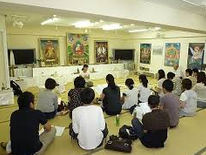
In 2004, a minority group led by Jōyū started developing inside Aleph. The group was called “daihyōha” (literally, group of the representative, daihyō , representative/delegate, the name used by members to refer to Jōyū). The other faction called itself “seitōha” (legitimate group, Jōyū 2012: 209). For a while the two factions shared the same facilities but organised different seminars and other activities. In March, 2007, Jōyū and around 200 members left Aleph and set up a new religious organisation called Hikari no Wa (literally, “Circle of Light,” officially “The Circle of Rainbow Light”).

The name Hikari no Wa was chosen, according to the group’s website, for a variety of reasons:

• In the group’s narratives, the decision to finally leave Aleph and to found a new group is linked to the interpretation of a series of “signs” (mostly connected to vision of rainbows) experienced by members in sacred and natural places around Japan. In particular, Jōyū is reported to have seen a circle of rainbow light around the sun (a sun halo) after having had a revelatory experience about the new group;
• The wheel symbolized the idea of equality between all beings (which is one of the main teachings of Hikari no Wa);
• ‘Wa’ also stands for “Japanese spirit,” expressing Hikari no Wa’s new interest in Japanese cultural and religious traditions;
• The wheel as sacred symbol is common to many religions around the world, indicating that Hikari no Wa sees itself as equal, rather than superior, to other traditions.
• The light doesn’t simply mean physical light, but also the light of wisdom, spiritual light (“Message” n.d.).

The symbol represents a rainbow around the sun, and the Dharma wheel symbolizes Buddha and his teachings. The background represents the blue sky with radiating light from the middle of the Dharma Wheel.

DOCTRINES/BELIEFS

Hikari no Wa’s website and printed material present the group not as a religion, but as “a place of learning for a new spiritual wisdom” (atarashii seishintekina chie no manabi no ba de aru), a “centre for learning religion,” and a “spirituality academy.” According to a textbook distributed to participants at Hikari no Wa’s summer seminar in August, 2010 (Hikari no Wa 2010), religion in the twentieth century has been characterized by several problems, including blind beliefs, fanaticism, and conflict with society and among religious groups. Hikari no Wa proposes a “reformation of religion for the 21st century” (21seki no tame no shūkyō no kakushin) that will be accomplished through a threefold path: rejection of blind beliefs (mōshin wo koeru) (Hikari no Wa 2010:37); overcoming of dualism and the struggle between good and evil (zenaku nigenron to tōsō wo koeru) (Hikari no Wa 2010:39); and, finally, the overcoming the barrier between the religious community and society (kyōdan to shakai no kabe wo koeru) (Hikari no Wa 2010:41; Baffelli 2012:37). More recently, the group has started presenting itself as a “religious philosophy” ( shūkyō tetsugaku , Hikari no Wa 2013). Hikari no Wa claims that their doctrine introduces a new idea of faith and god and that it is not necessary to believe in any particular faith or god in order to be saved.

Members, it is claimed, do not believe in a transcendental being or in an absolute leader. Instead, the focus is on cultivating the “sacred consciousness” (shinseina ishiki) in each individual and in particular the “love of a million people and things,” compassion and benevolence. God itself is seen as a symbol of the individual “sacred consciousness.” Special people, such as Buddha, Jesus and Mohammed, are external symbols of the deity. Symbols may differ, but the sacred consciousness is unique and remains constant . The idea of a “guru” or absolute leader, therefore, is rejected and peace and equality among religions is advocated. By cultivating the “sacred” in every individual the group stresses the idea that all beings are equal and that members are not considered spiritually superior to non-members (“Basic Principles” n.d.).

According to the 2010 textbook, the group will henceforth incorporate several “sacred symbols” and practices from different religious traditions. Although the new organisation will have, at least at the beginning, a stronger “Buddhist flavour,” it aims to include teaching and practices from other Japanese religious traditions, including Shintō. In particular, the group emphasises that their references to Buddhism will not be limited to the historical Buddha Shakyamuni, but will include more aspects related to the Japanese Buddhist tradition and its connection to Shinto and a vaguely defined “natural religion.” During the last seven years, Hikari no Wa’s teachings have progressively changed towards including more elements from Japanese Buddhism (in particular references to Shōtoku Taishi, the sixth/seventh century semi-legendary regent who is portrayed as having played a major role in promoting Buddhism in Japan) and reducing references to Tibetan Buddhism. Ichnographically, the images of Buddhas and Bodhisattvas (mainly relating to the esoteric tradition) have been gradually replaced with images of natural landscapes and Japanese sacred sites (both Buddhist temples and Shinto shrines). At the same time, Hikari no Wa has rejected some of the central tenets of Aum’s doctrines and practices, such as extreme asceticism, the idea that one can acquire supernatural powers through yoga practice, beliefs in the end of the world and prophecies, and beliefs that were influential in Aum’s use of violence.(On Aum Shinriky ō’s teachings and doctrinal justifications of violence see Reader 2000 and Reader 2013).

RITUALS/PRACTICES

Hikari no Wa has also been introducing new practices in an attempt to distance itself from Aum Shinrikyō, while retaining aspectsof Aum’s teaching and practices that still appeal to members. Hikari no Wa’s activities and practices can be divided into three groups. First of all, there are training activities performed at the dōjō. Different training methods are used, such as yoga, qigong, healing techniques, Buddhist meditation, and Esoteric Buddhism practices. A variety of objects and techniques are used during meditation (such as music and sounds, incense, Buddhist images, Buddhist statues, ritual paraphernalia, “holy” water from sacred places (gojinzui, seizui), astrology). Members are free to choose any of these practices, but they are discouraged from engaging in extreme asceticism. Counseling sections with Jōyū and other representatives are also offered at the centres.

Furthermore, Jōyū’s preaching lectures (seppōkai) are held approximately every month, and intensive seminars are held three times a year (in May, August and at the end of the year). In 2012, a well-known Japanese therapeutic practice of self-reflection called introspection (naikan) has been introduced. Some members took part in the rigorous version of naikan which is practised over a week. However, in Hikari no Wa it is usually performed as a one-day practice during which members are isolated in a small room that is divided into enclosed sections, and they are guided (by a non-member expert) through different stages of their life. Members are invited to reflect on what they have received from others, what they have given, and what troubles they have caused to their family and others. The aim is to learn how to deal with the painful past and reinterpret it as a learning process through which negative experiences can be turned into positive ones for the future.

Initially the chanting of sutras during rituals and ceremonies was based on the same Sanskrit sutras used by Aum. They have gradually been replaced by a new original sutra in Japanese, the sanbutsu shingyō , written by Jōyū, who use d the popular Heart Sutra as a model. The sutra is now considered the main text for Hikari no Wa’s practices and it reads as follows:

Banbutsu onkei, banbutsu kansha 万物恩恵、万物感謝

Banbutsu hotoke, banbutsu sonchō 万物仏、万物尊重

Banbutsu ittai, Banbutsu aisu 万物一体、万物愛す

That, following the explanation given in Hikari no Wa’s text and website, could be translated as:

See all things as blessed, be thankful to all things.

See all things as Buddha, be thankful to all things.

See all things as one, love all things (“Texts and Lectures” n.d.).

CDs, DVDs, self-published texts, Buddhist ritual paraphernalia and healings goods are also available for sale at the centres and online.

Other activities are organized outside the group facilities and include Jōyū’s talk shows and meeting at public centres (some of those meetings are organized via Internet and called off kai, offline meetings). The group also organizes regular pilgrimages to sacred places around Japan.

Generally, the image the group is trying to construct is centred on its desire to separate itself from Aum. Hikari no Wa promotes itself as being very open, it does not require formal membership, and all activities and ceremonies are explained in detail on the website and on social networking services. Furthermore a counselling service has been set up to actively encourage Aleph’s members to leave that group (and potentially, but not necessarily, join Hikari no Wa).

New practices are introduced regularly, while previous practices are discontinued or modified. In the process of distancing itself from Aum, several practices needed to be reconsidered or abandoned, but, at the same time, Hikari no Wa is attempting to find a new and original identity.

ORGANIZATION/LEADERSHIP

In 2012, Hikari no Wa declared that the group had twenty seven “staff” members permanently living in the group’s facilities (Jōyū
2012:250). The number has now decreased. As of January, 2014, the group is claiming that only eight people are in charge of the centres, and so Hikari no Wa only has about ten full time staff. The use of the word renunciant (shukke) to indicate members living communal lives (and which was previously also used by Aum) has been discontinued in favour of the more neutral term full-time staff (senjū sutaffu). The group has also established a public relations department (jōhōbu) that deals with issues related to requests from media, relationships with local communities and contacts with scholars. Finally, full-time staff are also in charge of the consultation service aimed at persuading Aleph’s members to leave the group.
The estimated number of members too has been decreased from 180 (Jōyū 2012:250) to 150 members (“For Beginners” n.d.). There is a formal membership system, but most of activities and meetings are open to non-members. Usually a significant number of those participating in pilgrimages and other activities (especially Jōyū’s talks at the centres) are non-members. Participants to off-kai, that is offline meetings organized at public halls in order to allow people interested in Jōyū who contacted him via the Internet to meet him and ask him and other Hikari no Wa’s members questions, are predominantly non-members.

Hikari no Wa’s headquarters is located in Tokyo and currently seven centres called classrooms (kyōshitsu) have been established around the country (Nagoya, Osaka, Fukuoka, Nagano, Chiba, Yokohama and Sendai). In addition, study sessions are regularly held in Sapporo and Okayama. Most of the centres are very small, just consisting of a few rooms in rented apartments. Usually one or two full-staff members are in charge of the centres and their activities. In each dōjō, preaching meetings (seppōkai) are held regularly (more or less monthly) by Jōyū, in addition to study sessions about Mahayana Buddhism, yoga, qigong practices, and counselling services. Each branch offers a “free trial” to visitors. One can meet local representatives (members in charge of the branches) and try out various Hikari no Wa practices, including yoga and qigong . There is also an online classroom, called Net Dojō (Netto Dōjō) to allow online learning and it includes videos of lectures and other learning material (“Net-Dojo” n.d.). A Net shop has been opened that sells CDs and DVDs produced by the group and items for Buddhist rituals (“Hikari no Wa Net Shop” n.d.).

Jōyū Fumihiro is indicated as the representative (daihyō) of the group, and the website clearly states that although he is a guide and a teacher for the members, he is not considered an absolute leader and that he is seen as an imperfect human being (Overview n.d.). This idea of a leadership as based on experience and guidance and not necessarily on charisma has been stressed by Jōyū from the very beginning of the new group. The main aim is to assert that the new leader should not be seen as the new Asahara and that the leader-members relationship that was highly problematic in Aum is not going to be replicated in Hikari no Wa. Despite this intent, however, Jōyū’s leadership had to be legitimized by his previous role in Aum. It was his high status of seitaishi achieved in Aum that allowed him to become the guide for the new group. Furthermore, Jōyū acquired a form of celebrity status after the sarin gas attack in Tokyo, when he became Aum’s spokesperson and the Japanese mass media started reporting about his ability to reply sharply and promptly when questioned about Aum’s crimes. This raised his public profile, and his status has been recently replicated online, where his accounts on social networking sites (especially Mixi and Twitter) received the attention of several users who were intrigued by his personality. The found a way where they could approach him (anonymously) via the Internet and ask him disparate questions about his personal life and Aum’s activities (on Hikari no Wa’s use of Internet and social networking see Baffelli 2010, 2012). As a consequence, although Jōyū may not be seen anymore as an absolute leader by Hikari no Wa’s members and sympathizers, it is thanks to his previous status that Hikari no Wa is receiving some attention from the public and the media. At the moment, it would be difficult for the group to survive without his leadership.

ISSUES/CHALLENGES

Despite Hikari no Wa’s efforts to detach itself from Asahara and Aum, the Public Security Intelligence Agency (Kōan Chōsachō, thereafter PSIA) decided that group will remain under strict surveillance and that the new laws introduced in 1999 to control Aleph, namely the Victims Compensation Law (Higaisha kyūsaihō) and the Organizational Control Law (dantai kiseihō), will be apply to Hikari no Wa as well. The surveillance was extended for another three years in 2012, and the last report of the PSIA (2014) still shows a mistrust of Hikari no Wa, claiming that the members are still devoted to Asahara. In response to the suspicions expressed by the PSIA and the Anti-Aum movements and victims’ organizations, Hikari no Wa has created a section on its website stating its differences with Aleph and outlining the problems related to Aleph’s leadership and teachings(“Aleph” n.d.). Furthermore, in late 2011 Hikari no Wa established a committee of “external observers” (gaibu kansa iinkai) that includes, among others, one individual who has previously been involved in anti-Aum movements and victims’ organizations. The aim of the committee is to observe and report on Hikari no Wa’s activities in a neutral and objective way (PSIA reports are considered by Hikari no Wa biased and false).

Recently the group has been attracting some media attention and interviews with Jōyū have been published in various magazines, allowing the group to achieve some more visibility in the printed media. However, Hikari no Wa and its leader are still regarded suspiciously by the PSIA and the society at large, and their biggest challenge still remains that of persuading the public that they are no longer dangerous and that they have cut their ties with Aum’s violent past.

REFERENCES

“Aleph.” n.d. Accessed from http://alephmondaitaisaku.blog.fc2.com/ on 7 March 2014.

Baffelli, Erica. 2012. “Hikari no Wa: A New Religion Recovering from Disaster.” Japanese Journal of Religious Studies 39:29–49.

Baffelli, Erica. 2010. “Charismatic Blogger? Authority and New Religions on the Web 2.0.” Pp. 118-35 in Japanese Religions on the Internet: Innovation, Representation, and Authority, edited by Erica Baffelli, Ian Reader and Birgit Staemmler. New York: Routledge.

Baffelli, Erica and Ian Reader. 2012. “Impact and Ramifications: The Aftermath of the Aum Affair in the Japanese Religious Context.” Japanese Journal of Religious Studies 39:1–28.

Baffelli, Erica and Birgit Staemmler. 2011. “Aum Shinrikyō, Aleph, Hikari no Wa.” Pp. 276-93 in Establishing the Revolutionary: An Introduction to New Religious in Japan, edited by Ulrich Dehn and Birgit Staemmler. Münster-Hamburg-Berlin-Wien-London-Zürich: LIT.

“Basic principles.” n.d. Accessed from http://www.joyus.jp/hikarinowa/overview/05/0006.html on 7 March 2014.

“Hikari no Wa Net Shop.” n.d. Accessed from http://hikarinowa.shop-pro.jp/ on 7 March 2014.

Jōyū, Fumihiro . n .d. “Hikari no wa” no kihontekina seikaku. Accessed from
http:// ww.joyus.jp/hikarinowa/overview/05/0006.html on 15 November 2012.

Jōyū, Fumihiro. 2012. Aum jiken 17nenme no kokuhaku. Tokyo: Fusosha.

Jōyū Fumihiro. n.d. “Outlook on the Aum-related Incidents.” Published on the English version of Aleph’s public relations’ website. Accessed from http://english.aleph.to/pr/01.html on 7 March 2014.

Jōyū, Fumihiro, and Ōta Toshihiro. 2012. “Aum Shinrikyō o chōkoku: sono miryoku to kansei o megutte.” At purasu 13:4-34.

Maekawa, Michiko. 2001. “When Prophecy Fails: The Response of Aum Members to the Crisis.” Pp. 179-210 in Religion and Social Crisis in Japan: Understanding Japanese Society through the Aum Affair, edited by Robert J. Kisala and Mark R. Mullins. New York: Palgrave.

“Message.” n.d. Accessed from http://www.joyu.jp/message/ on 7 March 2014.

Munakata Makiko, 2010. Nijūsai kara nijūnenkan: “Aum no seishun” to iu makyō wo koete. Tokyo: Sangokan.

“Net-Dojo.” n.d. Accessed from http://net-dojo.hikarinowa.net/home.html on 7 March 2014.

“For Beginners.” n.d. Accessed from http://www.joyu.jp/hikarinowa/overview/00_1/0030.html on 7 March 2014.

“Overview.” n.d. Accessed from http://www.joyu.jp/hikarinowa/overview/ on 7 March 2014.

Public Security Intelligence Agency. 2014. Annual Report 2013. Accessed from http://www.moj.go.jp/content/000117998.pdf on 2 October 2013.

Public Security Intelligence Agency. 2012. Annual Report 2011. Accessed from http://www.moj.go.jp/content/000096470.pdf on 8 October 2013.

Public Security Intelligence Agency. 2011. Annual Report 2010 . Accessed from http://www.moj.go.jp/content/000072886.pdf on 15 November 2012.

Reader, Ian. 2013. “ Aum Shinrikyō. Accessed from http://www.has.vcu.edu/wrs/profiles/AumShinrikyo.htm on 10 March 2014.

Reader, Ian. 2000. Religious Violence in Contemporary Japan: The Case of Aum Shinrikyō . Richmond and Honolulu: Curzon Press and University of Hawai‘i Press.

“Texts and Lectures.” n.d. Accessed from http://www.joyu.jp/lecturetext/012010/0041_1.html on 7 March 2014.

ADDITIONAL RESOURCES: Hikari no Wa texts

(Booklets produced by the group and distributed during intensive seminars in December/January, May, August or during pilgrimages):

2008, Bukkyō kōgi , satori no d ōtei.

2009a Gendaijin no tameno ichigen no hōsoku. (End of the Year Seminar).

2009b Naikan, yuishiki, engi no essensu. (Golden Week Seminar).

2009c Daijōbukkyō, rokubutsu no oshie. (February Pilgrimage Seminar).

2010a Chūdo no oshie , hikutsu to ikari no ch ōestsu , Nijūisseki no atarashii shinkō no arikata. (End of the Year Seminar).

2010b Sanbutsu no ichigenhōsoku, bodaishin to rokuharamitsu: Nijūisseki no shūkyō no kakushin . (Summer Seminar).

2010c Ichigen no hōsoku to sono satori no d ōtei , kong ō bōsatsu no naisei sh ugyō.

2011a Sanbutsushingyō no oshie, kansha to sonchō to ai no jiseen. (End of the Year Seminar).

2011b Wa no shisō to tadashii shūkyō no shinkō no arikata . (Summer Seminar).

2011c Hikari no Wa to Nihon to “wa no shisō (Golden Week Seminar).

2012a Hōsoku no taitoku, shisaku no sh ugyō. Sanbutsu no hōsoku no shisaku to meisō. (End of the Year Seminar)

2012b Sanbutsu shingyō no oshie to gendai no shomondai . (Summer Seminar).

2012c Sanbutsu shingyō no shūchū no sh ugyō. Dokyō meisō no shōsetsu (Golden Week Seminar)

2013a Wa no hō to mezame no oshie. Butsumo no meisō, nikyoku no chōwa. (End of the Year Seminar).

2013b Gendai wo ikiru chie, wa no shisō to saishinkagaku. (Summer Seminar).

2013c Gense kōfuku to satori no hō. Satori no shūchū sh ugyō. (Golden Week Seminar).


Post Date:
10 March 2014


Share

Fundamentalist Latter-Day Saints (2002-2012)

FLDS TIMELINE (2002-2012)

2002 (September 8):  FLDS leader Rulon Jeffs died at age 92.

2002:  Rulon Jeffs’ son, Warren Jeffs, became FLDS president and prophet at age 47.

2003:  Property for the Yearning For Zion Ranch (YFZ) was purchased.

2005:  The foundation for the YFZ temple was dedicated.

2005 (June):  Warren Jeffs was arrested on sexual misconduct charges.

2011:  Warren Jeffs was sentenced to life in prison plus 20 years.

FLDS HISTORY (2002-present)

When Rulon Jeffs died in 2002, his son, Warren, assumed the office of President and Prophet of the FLDS. Warren Jeffs was thesecond son of Rulon’s fourth (and favorite) wife, Marilyn Steed. Rulon Jeffs left behind twenty-two wives, many of whom Warren married. Warren Jeffs’ leadership marked a significant shift in key FLDS practices and policies. Jeffs sought to solidify his power and authority in the new policy changes. He called for greater centralization of political and economic power in the person of the prophet. Though the FLDS had already moved to the “one man doctrine” of First Ward governance, Jeffs expanded this doctrine to a new level. Jeffs centralized finances and ordered business owners in the community to surrender ownership. He excommunicated long-term community leaders Dan and Louis Barlow and twenty other FLDS men who challenged the new rules and practices. Their property was seized and their wives and children reassigned to men loyal to Jeffs (Evans 2011).  Jeffs also enunciated a “seed bearer” principle that only duly appointed seed bearers would be allowed sexual relationships with wives in the group, although there is no evidence it was actually implemented (Sims 2015; Personal communication). This culminated in a mass exodus of 700 members led by Winston Blackmore to another FLDS community in Bountiful in Canada (B.C.). Jeffs also ousted several hundred teenage boys (Lost Boys”) for violations of community rules. These self-aggrandizing actions created new divisions and conflicts within the FLDS. Critics charged Jeffs with blatant disregard for church law and its officers. It was in this contentious context that Jeffs set about to establish a new FLDS community in Texas.

The property for the Yearning for Zion (YFZ) Ranch near Eldorado was purchased in 2003 by FLDS member David Allred. He claimed the 1,700 acre property was to be developed as a corporate hunting retreat. But construction crews quickly began building log homes to house the new residents and set about working on the new temple. The new construction and the arrival of hundreds of FLDS members in their traditional dress raised deep suspicions and rumors in the neighboring towns, exacerbated by the aggressive claims-making of anti-FLDS apostates and anticult activists (Wright 2011).

The Yearning for Zion (YFZ) Ranch was envisioned as a new “center place” where true believers could seek more perfect lives. Critics suggest that Jeffs’ intent was to separate his most loyal followers from rest of the fundamentalists in Colorado City and Hildale. Indeed, Jeffs claimed that the Lord had rejected Colorado City as a place where the spirit of God could dwell and that he was led by God to build a new city of Zion and a new temple. Only the most righteous or elect could reside in the new YFZ community. The temple foundation was dedicated in January, 2005. The population of the ranch was estimated to be about 500 at that time.

One of the policy shifts under Jeffs reign was the return to the practice of underage (plural) marriage. In the years leading up to the Warren Jeffs presidency, the age of marriage for women in the FLDS had risen. Martha Bradley (1993) reports that by the late 1980s, the average age of marriage for FLDS women had reached 18 as these women were expressing more interest in waiting to marry and obtaining higher education or professional training outside the community (see also Hammon and Jankoviak, 2011:69). Underage marriages were becoming less common. But Jeffs reversed this trend, promoting underage marriages.

In June, 2005, Jeffs was charged with sexual assault of a minor and with conspiracy to commit sexual misconduct with a minor for allegedly arranging a marriage between a fourteen year-old girl and her nineteen year-old first cousin. Jeffs became a fugitive to avoid arrest. Photos were later released showing Jeffs celebrating his marriage to an underage girl who was only twelve. In late 2005, Jeffs was put on the FBI’s most wanted list. Jeffs was captured in Nevada in August, 2006. He stood trial in St. George, Utah in 2007 and was found guilty on two counts of being an accomplice to rape. He was sentenced to ten years in prison. But the Utah Supreme Court later overturned the ruling and ordered a new trial due to faulty instructions given to jurors. Jeffs was still in custody when the state of Texas launched a raid on the YFZ property the following year.

On April 3, 2008, Texas state police and the Department of Family and Protective Services (DFPS) raided the YFZ Ranch. Officials alleged that they had evidence of the “widespread pattern and practice” of child sexual abuse. The massive raid was triggered by phone calls to the Newbridge Family Shelter hotline in San Angelo. The caller claimed to be a sixteen year-old girl, Sarah Jessop, who resided at the YFZ Ranch and who said she was raped and beaten by her forty-nine year old spiritual husband. But the raid failed to locate Sarah, and authorities later learned that the calls were a hoax. The caller turned out to be Rozita Swinton, a mentally disturbed thirty-three year-old woman from Colorado Springs. Ms. Swinton, who had previously been arrested for making false charges to police, initially made calls to an anti-FLDS apostate and activist, Flora Jessop, who contacted Texas authorities and forwarded the calls to child protection officials. In an unprecedented action, DFPS officials seized 439 FLDS children at the YFZ Ranch asserting that all the children were at risk of abuse even though the raid and the allegations were predicated on hoax phone calls (Wright and Richardson 2011). The District court granted the DFPS requests for emergency custody, but the Texas Appeals Court later reversed the District court after determining that the state did not have evidence for mass custodial detention and had overreached. The appellate court’s decision was upheld by the Texas Supreme Court (Schreinert and Richardson 2011). Eleven FLDS men, including Jeffs, were charged with sexual assault of a minor.

According to a DFPS report issued December 22, 2008, all but 15 of the 439 cases (96 percent) were “non-suited” (i.e., parents had taken appropriate action to protect children from abuse). All but one of the FLDS children taken into state custody was returned to their parents. However, evidence garnered from the YFZ raid implicated Jeffs in underage marriage practices and led to convictions in Texas on two charges of sexual assault of a child, and he was sentenced to life in prison plus 20 years. Nine of the FLDS men were charged and convicted of sexual assault of a minor, one was convicted of performing an unlawful marriage ceremony, and the other pleaded guilty to bigamy.

The conviction of Jeffs has left the FLDS community in some disarray. Some of the families whose children were seized by the state of Texas did not return. Other FLDS members have left as Jeffs has continued to press his authority from prison. Warren Jeffs’ brother, Lyle Jeffs, was running the daily operations of the church as of 2012.

ISSUES/CHALLENGES

The leadership of Warren Jeffs represented a power grab and reversal of a trend away from underage marriage. In Jeffs’ trial in Texas, former FLDS member Ezra Draper testified that “FLDS men began taking brides younger and younger after Jeffs took over” (Weber, 2011). Draper also testified that “Jeffs ruled FLDS with a far heavier and crueler hand than his father,” whom he succeeded (Weber 2011). It is important to remember that the FLDS community is almost 100 years-old. The origins of the FLDS date back to the statement of Lorin Wooley in 1912 regarding the disagreement with the LDS church over the decision to abandon Celestial Marriage. The community of Short Creek (now Colorado City/Hildale) was founded the next year. As age of consent laws have been raised over the years in the U.S., the FLDS has been reluctant to make these accommodations to modernity, preferring to live as if they were still residing in the frontier society of the 19 th century. But research suggests that they were making these accommodations, albeit slowly and reluctantly, until Jeffs took over.

While plural marriage or “Celestial marriage” is controversial in its own right, irrespective of the age of consent issue, the broader abuse and forced marriage claims by opponents and critics have to be examined carefully and in context. Some of these claims have been discredited or shown to be wildly exaggerated (Wright 2011, Wright and Fagen 2011). There is substantial research to suggest that FLDS women are not simply pawns of a predatory patriarchal system. Cultural anthropologist Janet Bennion, who has studied the FLDS perhaps more extensively than anyone, contends that these women reveal a unique strength and independence, carving out lives of “female autonomy” and “widespread sharing” (2008:ix). She found that FLDS women had created an innovative matrifocal network that provides shared childcare while pursuing an education or career outside the community. This finding comports with the observations of other scholars and with the results of other studies of the FLDS (Altman and Ginat 1996; Bennion 2004, 2008, 2011a, 2011b; Bradley 1993; Campbell 2008, 2009; Daynes 2001; Driggs 2011; Fagen and Wright, forthcoming). The focus on Warren Jeff’s brief reign and abuse of power distorts the evolved roles of women in the FLDS overall. But it also points to the vulnerability of the FLDS or “First Ward” governance advocating the “one-man doctrine” which concentrates power in the hands of a single individual. As Hammon and Jankowiak (2011:55) observe, the split in the FLDS in 1984 produced two separate wards, and the Second Warders have placed more emphasis on individual choice, personal responsibility, merit, and reliance on a Priesthood Council rather than unwavering allegiance to the prophet characteristic of the First Ward.

As Warren Jeffs continues to insist on ruling the FLDS from prison, it remains to be seen how this will play out among members over time: whether there will arise competing prophets to challenge Jeffs’ authority, whether new factions will emerge, or if out of practical necessity those who administer the day-to-day operations of the church become de facto leaders who develop their own authority. Jeffs has imposed even stricter and more rigid requirements on members since his incarceration, dissolving marriages, declaring a moratorium on sex, and attempting to purge the doubters (Dobner 2012; Hollenhorst 2011). He has also issued a series of revelations declaring God’s judgment on the nation for imprisoning him, warning of earthquakes, volcanoes, fires, storms, and floods. But it seems highly unlikely that Jeffs will ever be released from prison, given his life sentence plus twenty years. This permanent sequestration may empower some FLDS members to accept future changes in leadership.
REFERENCES

Altman, Irwin and Joseph Ginat. 1996. Polygamous Families in Contemporary Society. New York: Cambridge University Press.

Bennion, Janet. 2011a. “History, Culture, and Variability of Mormon Schismatic Groups.” Pp. 101-24 in Modern Polygamy in the United States , edited by Cardell K. Jacobson and Lara Burton. New York: Oxford University Press.

Bennion, Janet. 2011b. “The Many Faces of Polygamy: An Analysis of the Variability in Modern Mormon Fundamentalism in the Intermountain West.” Pp. 163-84 in Modern Polygamy in the United States , edited by Cardell K. Jacobson and Lara Burton. New York: Oxford University Press.

Bennion, Janet. 2008. Evaluating the Effects of Polygamy on Women and Children in Four North American Mormon Fundamentalist Groups. Lewiston, NY: The Edwin Mellen Press.

Bennion, Janet. 2004. Desert Patriarchy. Tuscon, AZ: University of Arizona Press.

Bradley, Martha Sontag. 1993. Kidnapped from That Land: The Government Raids on the Short Creek Polygamists. Salt Lake City: University of Utah Press.

Campbell, Angela. 2009. “Bountiful Voices.” Osgoode Hall Law Journal 47: 183-234.

Campbell, Angela. 2008. “Wives’ Tales: Reflecting on Research in Bountiful.” Canadian Journal of Law and Society 23(1-2):121-41.

Daynes, Katherine M. 2011. “Differing Polygamous Patterns: Nineteenth-Century LDS and Twenty-First Century Marriage Systems.” Pp.125-50 in Modern Polygamy in the United States, edited by Cardell K. Jacobson and Lara Burton,. New York: Oxford University Press.

Dobner, Jennifer. 2012. “Imprisoned Warren Jeffs Imposes Change on Polygamous Sect.” Deseret News, January 15. Accessed from www.deseretnews.com on 13 March 2012.

Driggs, Ken. 2011. “Twenty Years of Observations about the Fundamentalist Polygamists.” Pp. 77-100 in Modern Polygamy in the United States, edited by Cardell K. Jacobson and Lara Burton. New York: Oxford University Press.

Evans, Martha Bradley. 2011. “The Past as Prologue: A Comparison of the Short Creek and Eldorado Polygamy Raids.” Pp. 25-50 in Saints under Siege: The Texas State Raid on the Fundamentalist Latter Day Saints, edited by Stuart A. Wright and James T. Richardson. New York: New York University Press.

Fagen, Jennifer Lara and Stuart A. Wright. Forthcoming. “Gender, Sexuality and Women’s Empowerment in Mormon Fundamentalist Communities.” In Sexuality and New Religious Movements, edited by Henrik Bogdan and James R. Lewis. Syracuse: Syracuse University Press.

Hammon, Heber B. and William Jankoviak. 2011. “One Vision: The Making, Unmaking, and Remaking of a Fundamentalist Polygamous Community.” Pp.41-75 in Modern Polygamy in the United States, edited by Cardell K. Jacobson and Lara Burton. New York: Oxford University Press.

Holenhorst, John. 2011. “Purge of Nonbelievers Under Way in FLDS Town.” Deseret News, December 5. Accessed from www.deseretnews.com on 13 March 2012.

Schreinert, Tamatha L. and James T. Richardson. 2011. “Pyrrhic Victory? An Analysis of the Appeal Court Opinions Concerning the FLDS Children.” Pp.242-64 in Saints under Siege: The Texas State Raid on the Fundamentalist Latter Day Saints , edited by Stuart A. Wright and James T. Richardson. New York: New York University Press.

Sims, Alexandra (2015): “Polygamist sect ‘demands husbands watch while seed bearers impregnate their wives’.” The Independent, October 2. Accessed from https://www.independent.co.uk/news/world/americas/polygamist-sect-limits-sex-to-seed-bearers-according-to-leader-s-estranged-wife-charlene-jeffs-a6675151.html on 15 March 2026.

Weber, Paul J. 2011. “Warren Jeffs ruled with heavy hand, Texas jurors hear in sentencing phase,” Deseret News, August 9. Accessed from www.deseretnews.com on 15 October 2012.

Wright, Stuart A. 2011. “Deconstructing Official Rationales for the Texas State Raid on the FLDS.” Pp.124-49 in Saints under Siege: The Texas State Raid on the Fundamentalist Latter Day Saints , edited by Stuart A. Wright and James T. Richardson. New York: New York University Press.

Wright, Stuart A. and Jennifer Lara Fagen. 2011. “ Texas Redux: A Comparative Analysis of the FLDS and Branch Davidian Raids.” Pp.150-77 in Saints under Siege: The Texas State Raid on the Fundamentalist Latter Day Saints , edited by Stuart A. Wright and James T. Richardson . New York: New York University Press.

Wright, Stuart A. and James T. Richardson, eds. Saints under Siege: The Texas State Raid on the Fundamentalist Latter Day Saints. New York: New York University Press.

Post Date:
31 October 2012

FUNDAMENTALIST CHURCH OF JESUS CHRIST OF LATTER-DAY SAINTS VIDEO CONNECTIONS


Share

Fundamentalist Latter-Day Saints (1843-2002)

FUNDAMENTALIST LATTER-DAY SAINTS TIMELINE

1843:  Joseph Smith announced his revelation on plural marriage.

1862:  The U.S. Congress passed the Morrill Anti-Bigamy Act.

1882:  The U.S. Congress passed the Edmunds Anti-Polygamy Act.

1886 (September 26-27):  Fundamentalists claimed that John Taylor received a revelation about the continuation of plural marriage while on the underground.

1887:  The U.S. Congress passed the Edmunds-Tucker Act.

1890 (October 6):  Wilfred Woodruff announced a Manifesto forbidding plural marriage.

1904-1907:  Hearings were held in the U.S. Senate on the seating of Reed Smoot as Senator from Utah.

190 (April 6: ) A second Manifesto was issued by Joseph F. Smith that threatened excommunication for LDS members who engaged in plural marriage.

1910:  LDS Church began a policy of excommunication for new plural marriages.

1929-1933:  Lorin C. Woolley created the “Priesthood Council.”

1935 (September 18):  Lorin C. Woolley died, and Joseph Leslie Broadbent became head of the Priesthood Council.

1935:  Broadbent died, and John Y. Barlow became head of the Priesthood Council.

1935:  Truth magazine began publication.

1941:  Leroy S. Johnson and Marion Hammon were ordained to the Priesthood Council by John Y. Barlow

1942:  The United Effort Plan Trust was established.

1944 (March 7-8):  The Boyden polygamy raid was conducted.

1949 (December 29):  John Y. Barlow died, leading to a succession crisis in the Priesthood Council.

1952:  The Priesthood Council split when Joseph W. Musser announced that Rulon Allred would become a new member. Result was two factions: the FLDS (Leroy S. Johnson) and the Apostolic United Brethren (Rulon Allred).

1953 (August 16):  In the case of In re Black the U.S. Supreme Court held that polygamous parents have no rights as parents.

1953 (July 26):  The raid on the polygamist community at Short Creek was conducted.

1954 (January 12):  With Joseph Musser’s death, Rulon Allred became the head of the Priesthood Council.

1985:  Colorado City was incorporated.

1986:  Fundamentalist Church of Jesus Christ of Latter-day Saints organized.

1986 (September 26):  J. Marion Hammon dedicated Centennial Park (new intentional community formed by the Second Warders).

1986 (November 25):  Leroy S. Johnson died, and Rulon T. Jeffs became the FLDS leader.

2002 (September 8):  Rulon Jeffs died.

FOUNDER/GROUP HISTORY

Mormon fundamentalism originated in the teachings of the Latter-day Saint Prophet, Joseph Smith, who introduced the doctrineof a plurality of wives to a select group of his followers in the 1840s. By the time of his death in 1844, according to scholar George D. Smith’s analysis, at least 196 men and 717 women had entered the practice privately (Smith 2008:573-639). His vision for the “new and everlasting covenant of marriage” became part of LDS scripture on July 12, 1843 with the 132 nd section of the Doctrine and Covenants. He positioned the uniquely Mormon interpretation of the significance of marriage, in the restoration of the model of Abraham, Isaac and Jacob. According to the revelation, “Celestial marriage” was marriage for time and eternity. Men with priesthood authority had the power to seal men and women for eternity. Essential for the highest level of salvation in what Smith described as the “Celestial” kingdom, Smith interpreted plural marriage “as a uniquely exalted form of ‘celestial marriage’—the ‘further order’ of the patriarchal order of marriage mentioned in Doctrine of Covenants” (Bradley 1993:2)
The next three presidents of the LDS church were also polygamists. Brigham Young, John Taylor and Wilford Woodruff led a church that had at its center the doctrine of plural marriage. As prophet and president of the Church of Jesus Christ of Latter-day Saints, Brigham Young expanded the practice of plurality, married at least fifty-five women himself, and had fifty-seven children (Johnson 1987). Like Young, President John Taylor and Wilford Woodruff continued to tie the Mormon concept of salvation and the afterlife to the doctrine of plural marriage. With the 1890 Manifesto, the church began a multi-year process of ending the official practice of plural marriage among the Latter-day Saints.

Despite LDS claims to priesthood authority or the revelatory origins of the doctrine, the federal government fought the church and its practice of plural marriage through the second half of the nineteenth century. After the public announcement of the practice by Apostle Orson Pratt from the pulpit in front of an Utah audience of thousands of Latter-day Saints, the Congress passed a series of bills designed to limit the practice, punish those who continued to violate the law, and ultimately to damage the church corporation itself. These included the Morrill Anti-Bigamy Act of 1862, the Poland Act of 1874, the Edmunds Act of 1882, and, finally, the Edmunds-Tucker Act of 1887. During the 1880s and the federal pursuit of polygamists, men and women went on the “underground” to avoid arrest, hiding in Arizona, Nevada, Idaho and throughout Utah. Church president John Taylor went into hiding in January, 1885 and died two years later on the underground (Bradley 1993:5).

In important ways, the story of the FLDS begins with the 1890 Manifesto. President Wilford Woodruff introduced the Manifesto at the October semiannual conference of the Church. Eventually included in the Doctrine and Covenants, it was initially essentially a press release. It denied that the LDS church advocated continuing in the practice of plural marriage, stating that “We are not teaching polygamy or plural marriage, nor permitting any person to enter into its practice….” It went on to assert:

Inasmuch as laws have been enacted by Congress forbidding plural marriages, which laws have been pronounced constitutional by the court of last resort, I hereby declare my intention to submit to those laws, and to use my influence with the members of the Church over which I preside to have them do likewise….I now publicly declare that my advice to the Latter-day Saints is to refrain from contracting any marriage forbidden by the law of the land (Doctrine and Covenants).

The impact of the Manifesto was neither absolute nor swift in causing plural marriages to cease. In fact, for the next two decades at least 250 new marriages were performed in secret in the Salt Lake Valley, the Canadian or Mexican colonies or in other areas throughout the church (Hardy 1992:167-335, Appendix II).

During the U.S. Senate hearings over the confirmation of Utah Senator Reed Smoot between 1904-1907, plural marriage surfaced again as a national issue. Smoot was not himself a polygamist, but the issue was whether he would be loyal to the laws of the United States or those of his church. In response to this new pressure, President Joseph F. Smith in April conference, 1904 announced the “Second Manifesto” that added the threat of excommunication to those who failed to follow the prohibition against plural marriages. The document decried allegations that new marriages had occurred “with the sanction, consent or knowledge of the Church” (Allen and Leonard 1976:443).
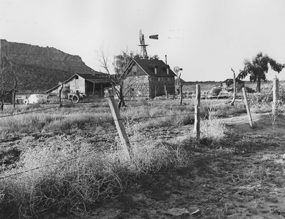
President Smith framed the discussion with reference to the church’s patriotism and particularly the importance of the guarantee of freedom of religion. “What our people did in disregard of the law and the decisions of the Supreme Court affecting plural marriages,” he said, “was in the spirit of maintaining religious rights under constitutional guarantees, and not in any spirit of defiance or disloyalty to the government.” Importantly, “the Church abandoned the controversy and announced its intention to be obedient to the laws of the land” (Clark 1965-75:4:151).

Regardless of the Second Manifesto, considerable ambiguity still existed in the church over the issue of plural marriage. Marriages continued to be performed without the official sanction of the Church president and sometimes by General Authorities of the church. A significant tightening of the policy and punishment for disobedience of the prohibition occurred during the 1910s under presidents Joseph F. Smith and Heber Grant. Church President Grant spoke publicly about priesthood authority, and clarified the official LDS position, asserting that the “keys” rested only in the prophet and in the Church (Bradley 1933:13).

Although Short Creek, Arizona became publicly identifiable in 1953 with the Arizona raid on its polygamous community, settlers first came to the area in the 1910’s. Nestled in the stark desert landscape at the base of the Vermillion Cliffs, beginning in the late 1920s, Short Creek became the home to polygamists seeking refuge from persecution from the world outside. When John Y. Barlow became senior member of the Priesthood Council and fundamentalist leader, he encouraged his followers to gather at Short Creek. Practicing the principle of the gathering, like mid-nineteenth century Latter-day Saints, true believers formed communities apart from the mainstream where they could continue in their practice of a plurality of wives. It is estimated that forty families settled in the isolated landscape of the Arizona strip country.

In 1935, the LDS church excommunicated Short Creek polygamists, Price W. Johnson, Edner Allred, and Carling Spencer. While Barlow was absent from his leadership role and visiting with fundamentalists throughout the region, Joseph Jessop, and later his son, Fred Jessop, guided social life in Short Creek and helped with economic growth and development. The Barlows, Jessops and Johnsons became closely connected through religious and community ties through the 1940s and 1950s.

In 1944, in the first mass arrest of polygamists, federal and state officials arrested fifty men and women in both Utah and Arizona. The Boyden Raid executed charges of conspiracy, Mann Act and Lindberg Act violations. Eventually, fifteen men served in the Utah State penitentiary before signing a loyalty oath that allowed some of them to return to their families before their terms had transpired (Bradley 1993:79).

On July 26, 1953, the government of Arizona raided the polygamous community of Short Creek. As more than 100 vehicles of the state rolled over the rocky roadbeds leading into town, Governor Howard Pyle justified the raid over the radio, announcing his fight against “insurrection within [ Arizona’s] own borders,” with the intent “to protect the lives and future of 263 children . . . . the product and the victims of the foulest conspiracy . . . . a community dedicated to the production of white slaves. . . . degrading slavery.” He elaborated further on this theme:
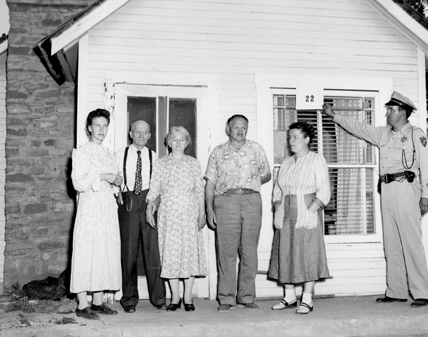
Here is a community—many of the women, sadly right along with the men—unalterably dedicated to the wicked theory that every maturing girl child should be forced into the bondage of multiple wifehood with men of all ages for the sole purpose of producing more children to be reared to become mere chattels of this totally lawless enterprise.

As the highest authority in Arizona, on whom is laid the constitutional injunction to ‘take care that the laws be faithfully executed,’ I have taken the ultimate responsibility for setting into motion the actions that will end this insurrection (Pyle 1953).

More than one hundred Arizona state officials brought with them the warrants for thirty-six men and eighty-six women. Thirty-nine of the warrants were for individuals who lived on the Utah side of town. The charges included: rape, statutory rape, carnal knowledge, polygamous living, cohabitation, bigamy, adultery, and misappropriation of school funds (Bradley 1993:131). The raid sought to “rescue 263 children from virtual bondage under the communal United Effort Plan,” according to Attorney General Paul LaPrade. “The principle objective is to rescue these children from a life-time of immoral practices without their ever having had an opportunity to learn of or observe the outside world and its concepts of decent living” (LaPrade 1953).

Over the next three days the state set up a magistrate’s court in the schoolhouse at the center of town. The men would be transported for a preliminary hearing in Kingman on August 31, 1953. The state also held juvenile court where Judges Lorna Lockwood and Jesse Faulkner took custody of each child and made them wards of the court. Judges, deputy sheriffs and court photographers visited the homes of polygamous families in Short Creek gathering evidence to support the accusations. On the third day after the raid, the state gave mothers the chance to travel with their children (153 in total) to foster homes in Mesa, Phoenix and other locations nearby where they stayed for the next two years while their cases played out in the court and they appeared before state agencies. Two years after the raid all of the women had returned to Short Creek with the exception of one who had been a minor at the time of the raid, but who returned once she was legally old enough to do so.

Utah took a different tack in attempting to dismantle plural families. Judge David F. Anderson, of Utah’s Sixth District Juvenile Court in St. George, Utah devised a legal tactic that attacked the alleged neglect of the children of polygamous children. Although Anderson filed twenty different petitions alleging that eighty children had been neglected, he chose to make Vera and Leonard Black a test case of the legitimacy of this approach. The polygamous couple had eight children together by 1953. Anderson depended on Section 55-10-6, Utah Code Annotated, 1953 for the definition of neglect: “A child who lacks proper parental care by reason of the fault or habits of the parent, guardian or custodian….A child whose parent, guardian or custodian neglects or refuses to provide proper or necessary subsistence, education, medical or surgical care or other care necessary for his health, morals or well-being. A child who is found in a disreputable place or who associates with vagrant, vicious, or immoral persons.”

The case, In Re Black , moved through the courts for almost two years, eventually in 1955 ending up on appeal at the Utah Supreme Court. In 1955, the Court upheld the decision of the lower court against the mother, concluding that polygamists have no right to the custody of their children. The majority opinion stated: “the practice of polygamy, unlawful cohabitation and adultery are sufficiently reprehensible, without the innocent lives of children being seared by their evil influence. There can be no compromise with evil” (Driggs 1991:3) After staying in foster care for three years, Vera gained custody of her children, but only after she signed an oath denying she believed in plural marriage (Bradley 1993:178).

Estimates of the number of individuals practicing plural marriage in the late twentieth century, ranged from thirty to fifty thousand. Before he died, polygamist Ogden Kraut estimated that “there are probably at least 30,000 people who consider themselves Fundamentalist Mormons, espousing at least the belief in the doctrine of plural marriage” (Kraut 1989). Historian Richard Van Wagoner also estimated 30,000 fundamentalists in 1986 (Van Wagoner 1992). In 2009, Melton offered the same estimate (Melton 2009:650). Since its inception among the Mormons in the 1840s, the practice of a plurality of wives has proceeded beneath the surface in a private, subterranean world protected by religious ritual and belief, behavior and life practice, and sometimes, as in the case of Short Creek, Arizona, by the protection provided by the natural world.

DOCTRINES/BELIEFS

The FLDS believe in the core doctrines of the nineteenth century Church of Jesus Christ of Latter-day Saints, including the Principle (the doctrine of plural marriage), consecration and stewardship (a type of communal organization), the plurality of Gods (the potential for every righteous man to become a God in the afterlife), and the right of a prophet to receive revelations from God. Many describe the LDS Church as God’s church and some participate in LDS temple rituals, serve LDS missions or pay tithes in LDS wards before they are excommunicated for their polygamous beliefs or life style.

Although outsiders commonly describe Mormon fundamentalists as polygamists, the FLDS themselves use a variety of terms to describe their unique practice of a plurality of wives: “the Principle,” “Celestial Marriage,” the “New and Everlasting Covenant,” “plural marriage,” or the “Priesthood work” (Quinn 1993:240-41).

The principal point of division between the FLDS and the Church of Jesus Christ of Latter-day Saints is over priesthood authority. The fundamentalists believe that the LDS Church moved off course with the 1890 Manifesto and eventually lost priesthood authority to perform Celestial marriages. The FLDS believe that a plurality of wives is a core doctrine of the Church of Jesus Christ of Latter-day Saints, essential to salvation and a sign of individual righteousness. Moreover, the FLDS recognize priesthood authority in their own leadership, authority they trace to 1886 through the narrative of Lorin C. Woolley. Woolley claimed that in 1886 President John Taylor was living in Centerville, Utah on the underground hiding from federal officials. He reported being was visited by the Prophet Joseph Smith and pledging that he would “suffer my right hand to be cut off” before he would sign a document ordering the desertion of plural marriage (Musser 1934). According to Joseph Musser’s 1912 account, Taylor allegedly instructed Woolley and the other men present: George Q. Cannon, L. John Nuttall, John W. Woolley, Samuel Bateman, Daniel R. Bateman, Charles H. Wilkins, Charles Birrell, and George Earl to continue the practice of plural marriages. If the LDS Church abandoned the practice, or the “Principle,” a smaller group of five men—Cannon, Wilkins, Bateman, John W. Woolley, and Lorin C. Woolley would carry priesthood authority forward to perform plural marriages and could ordain others to do the same (Bradley 1993: 19). By 1929, Woolley was the only one of these men still alive. He transferred the same priesthood power to a select group in the “Council of Friends or the Priesthood Council.” These men became the leaders of the movement that would eventually be known as Mormon fundamentalism, former Latter-day Saints who continued in the practice of a plurality of wives.

For the FLDS, the marriage relationship was the nucleus of a family kingdom. The primary aim of marriage, however, was not love, but a celestial social order. Plural marriage was part of a deferential and hierarchical society strictly ordered along patriarchal lines. The child was subordinate to the mother; the mother bowed to her husband’s authority; he, in turn, looked to the prophet for direction; while the prophet was answerable to and spoke for Jesus Christ. As God was at the head of the world, the husband was the earthly head of the family. The appropriate behavior directed toward one’s superior consisted of deference and obedience. The appropriate behavior directed toward one’s subordinates consisted of instruction, benevolence, and the meting out of either rewards or punishments (Bradley 1993:101).

Men and women married to “Multiply and replenish the earth.” Sexuality had religious significance and was tied to procreation. Musser taught that “every normal woman yearns for wifehood and motherhood. She yearns to wear the crown of glory. The most precious and yearned for jewels are children to call her mother” (Musser 1948:134).

Joseph Musser articulated the meaning of the difference between men and women for Truth magazine in 1948: “Thy desire shall be to thy husband, and he shall rule over thee. In placing man at the head, he bearing the Priesthood, a law, an eternal law, was announced.” The roles of men and women were scripturally defined and existed to create social order. “Man, with divine endowments, was born to lead, and woman to follow, though often times the female is endowed with rare talents of leadership. But women, by right, look to the male members for leadership and protection.” According to Musser, women should “respect and revere themselves, as holy vessels, destined to sustain and magnify the eternal and sacred relationship of wife and mother.” Women’s role was related to that of men, as the “ornament and glory of man; to share with him a never fading crown, and an eternally increasing dominion” (Musser 1948:134).

RITUALS/PRACTICES

The scriptures used by the FLDS are the same as those of the LDS church: the Book of Mormon, the Bible, the Pearl of Great Price and the Doctrine and Covenants. Beliefs such as the plurality of Gods, the Word of Wisdom, the nature of heaven and the afterlife are virtually the same. Both churches are founded on the structure of male, priesthood authority.

Although many of the religious rituals practiced by the FLDS resemble those practiced by the Latter-day Saints, the tradition of holding Sunday School in private homes where the sacrament is served, rather than in the meetinghouse, is one significant difference. The Johnson meetinghouse at the center of the community in Colorado City is the size of two LDS stake centers and is the backdrop for group worship services, community dances, and community business meetings. The central meeting space holds an audience of between 1,500 and 2,500. Also, the FLDS hold worship meetings throughout the week as was true in the nineteenth century LDS church. Like the LDS, fundamentalists wear sacred priesthood undergarments and choose modest clothing over modern popular styles.
Priesthood leaders, and ultimately the group’s prophet, arrange marriages among the FLDS in a practice called placement marriage. One plural wife commented that “we were raised believing that the Priesthood [Council] would choose our mate and that we were not to allow ourselves to fall in love with anybody,” and another FLDS youth said “In our group we don’t date” (Quinn 1992:257). The church president and leader of the Priesthood Council prays for God’s instruction about marriage partnerships. For the FLDS, arranged marriages create social stability and a sense of familial structure that has eternal significance.

The FLDS family is strictly patriarchal, although in the day-to-day life of a family women play key economic and social roles. Many have a high degree of functional autonomy. There are multiple styles of housing for families in FLDS communities. Some families prefer to have all of the wives and their children in the same household and other have multiple households for different mothers and their children. Colorado City/Hildale and Centennial Park are distinguished by the number of large-scale family homes. Local architect, Edmund Barlow, in 2003 suggested that as homes became larger in terms of square footage, they had to accommodate housing codes for apartment units. Large families with multi-families under a single roof built Sunday School rooms for family worship in their homes.

Joseph Smith revealed the principle of consecration and stewardship to the nineteenth century church. In Utah, the “United Order” functioned as an intentional community and the expression of religious ideals. Under the United Order, members consecrated property and received a stewardship that obligated them to use resources for the good of the group as well as the individual. Under Barlow’s leadership, the Priesthood Council in 1936 formed the United Trust. Besides land, the trust owned a sawmill and equipment used for agriculture “for the purpose of building up the Kingdom of God” (Driggs 2011:88). Six years later, the community dissolved the trust and returned the property. The second attempt at a communal organization of property was the United Effort Plan, which was a property holding or business trust rather than religious organization. At one point, the property in the UEP was valued at more than $100 million and “subject to the disposal of the UEP board or the Priesthood Council (Hammon and Jankowiak 2011:52).

ORGANIZATION/LEADERSHIP

The pinnacle of FLDS leadership and organization is the Priesthood Council, which they believe holds authority to perform plural marriages and which is considered higher in authority than the LDS church itself. Members of the group, also called the Council of Friends, are apostles of Jesus Christ or high priest apostles (Hammon and Jankowiak 2011:44). The president of the high priesthood, the senior member of the group, leads the council. According to the fundamentalists, John W. Woolley led the Priesthood Council until his death in 1928. At that time, Lorin Woolley called new members to the council, ordaining four new men as apostles: J. Leslie Broadbent, John Y. Barlow, Joseph W. Musser, and Charles F. Zitting (Hammon and Jankowiak 2011:45). Typically, the senior apostle or president of the council receives a revelation about who will be called to the council, or the Brethren. During these same years, the LDS church distanced itself from the practice of a plurality of wives. The movement eventually known as Mormon fundamentalism organized around those individuals who believed plural marriage was essential to their salvation and questioned both the authority and the course that the LDS church had taken.

ISSUES/CHALLENGES

Between the 1930s and the present, educational training has varied. In 1991, the community developed an elaborate plan for “Barlow University,” with a physical plan for a horseshoe loop of educational buildings like that at the University of Utah. Under the leadership of Warren Jeffs in the first decade after 2000, parents took their children out of public schools and home schooled them. For decades before that, children attended schools funded with tax dollars including an elementary school, middle school and high school. Many members of the community attended Southern Utah State College at Cedar City to receive their teaching credentials, and according to D. Michael Quinn’s estimate in 1993, 85 percent of the young men and women in the group attended college, including Mohave County Community College that was located in town (Quinn 1993:267). In 1960, Short Creek changed its name to Colorado City/Hildale and built a community school—the Colorado City Academy. Until its closure in 1980, the Academy offered an education grounded in religious instruction as an alternative to public education.

In 1981, the community of the FLDS divided into two groups over priesthood leadership (priesthood council vs. one man doctrine), different interpretations of private/collective property (entitlements), and social practices (varying degrees of scriptural and social orthodoxy). Known from that time forward as “First Warders” or “Second Warders,” the split created competing and sometimes hostile sects. After 1984, Leroy Johnson led the FLDS under the “one man doctrine” and dismantled the Priesthood Council until the second coming of Christ (Driggs 2011:91). When Rulon T. Jeffs succeeded Johnson as prophet of the First Ward in 1986, the newly organized Fundamentalist Church of Jesus Christ of Latter-day Saints, excommunicated the members of the Second Ward.

REFERENCES

Allen, James B. and Glen A. Leonard. 1976. The Story of the Latter-day Saints. Salt Lake City: Deseret Book Company and the Historical Department of the Church of Jesus Christ of Latter-day Saints.

Bradley, Martha Sontag. 1993. The Government Raids on the Short Creek Polygamists. Salt Lake City: University of Utah Press.

Clark, James R., ed. 1965-1975. Messages of the First Presidency. Vol. 4. Salt Lake City: Bookcraft.

Hardy, B. Carmon. 1992. Solemn Covenant: The Mormon Polygamous Passage. Urbana, IL: University of Illinois Press.

Johnson, Jeffrey Ogden. 1987. “Determining and Defining ‘Wife’ — The Brigham Young Households.” Dialogue: A Journal of Mormon Thought 20:57-70.

Kraut, Ogden. 1989. “The Fundamentalist Mormon: A History and Doctrinal Review.” Paper presented at the Sunstone Theological Symposium. Salt Lake City, Utah.

LaPrade, Paul, quoted in Arizona Daily Star. July 27, 1953.

Melton, J. Gordon. 2009. “Fundamentalist Church of Jesus Christ of Latter-Day Saints.” Pp. 649-50 in Melton’s Encyclopedia of American Religion, 8 th Edition. Detroit, MI: Gale, Cengage Learning.

Musser, Joseph White. 1948. “The Inalienable Rights of Women.” Truth , 14 October, p. 134.

Musser, Joseph White. 1934. The New and Everlasting Covenant of Marriage an Interpretation of Celestial Marriage, Plural Marriage. Salt Lake City: Truth Publishing Company.

“Official Declaration 1.” 1890. Doctrine and Covenants. Salt Lake City, UT, October 6. Accessed from http://www.lds.org/scriptures/dc-testament/od/1?lang=eng on 15 October 2012.

Pyle, Howard W. 1993. Radio Address. July 26, 1953. KTAR Radio. Phoenix, Arizona.

Quinn, D. Michael. 1993. “Plural Marriage and Fundamentalism.” Pp. 240-93 in Fundamentalisms and Society: Reclaiming the Sciences, the Family, and Education , edited by Martin E. Marty and R. Scott Appleby. Chicago : University of Chicago Press.

Smith, George D. 2008. Nauvoo Polygamy: “But We Called It Celestial Marriage.” Salt Lake City, UT: Signature Books.

Van Wagoner, Richard. 1992. Mormon Polygamy: A History. Salt Lake City, UT: Signature Books.

SUPPLEMENTARY RESOURCES

Allred, B. Harvey. 1933. A Leaf in Review. 2d ed. Caldwell, ID: Caxton Printers.

Allred, Rulon C. 1981. Treasures of Knowledge: Selected Discourses and Excerpts from Talks. 2 vols. Hamilton, MN: Bitterroot Publishing.

Allred, Vance L. 1984. “Mormon Polygamy and the Manifesto of 1890: A Study of Hegemony and Social Conflict.” Senior Thesis. Missoula, MT: University of Montana.

Altman, Irwin and Joseph Ginat. 1996. Polygamous Families in Contemporary Society. New York: Cambridge University Press.

Anderson, J. Max. 1979. The Polygamy Story: Fiction and Fact. Salt Lake City: Publishers Press.

Baird, Mark J. and Rhea A. Kunz Baird, eds. [ca. 2003] Reminiscences of John W. and Lorin C. Woolley. 5 vols. 2nd edition. Salt Lake City: Lynn L. Bishop.

Barlow, John Y. 2005. “A Selection of the Sermons of John Y. Barlow, 1940-49.” ebooks@thoughtfactory. B17.

Batchelor, Mary, Marianne Watson, and Anne Wilde. 2000. Voices in Harmony: Contemporary Women Celebrate Plural Marriage. Salt Lake City: Principle Voices.

Bennion, Janet. 1998. Women of Principle: Female Networking in Contemporary Mormon Polygyny. New York: Oxford University Press.

Bistline, Benjamin. 1998. The Polygamists: A History of Colorado City. Colorado City, Arizona: Ben Bistline and Associates.

Bradley, Martha. 2004. “Cultural Configurations of Mormon Fundamentalist Polygamous Communities.” Nova Religio 8:5- 38.

Bradley, Martha Sontag. 2012. Plural Wife: The Autobiography of Mabel Finlayson Allred. Logan, UT: Utah State University Press.

Daynes, Kathryn M. 2001. More Wives Than One: Transformation of the Mormon Marriage System, 1840-1910. Urbana, IL: University of Illinois Press.

Driggs, Ken. 2005. “Imprisonment, Defiance, and Division: A History of Mormon Fundamentalism in the 1940s and 1950s.” Dialogue: A Journal of Mormon Thought 38:65-95.

Driggs, Ken. 2001. “This Will Someday Be the Head and Not the Tail of the Church.’” Journal of Church and State 43:49-80.

Driggs, Ken. 1992. “’Who Shall Raise the Children?’ Vera Black and the Rights of Polygamous Utah Parents.” Utah Historical Quarterly 60:27-46.

Driggs, Ken. 1991a. “Twentieth-Century Polygamy and Fundamentalist Mormons and Southern Utah.” Dialogue: A Journal of Mormon Thought 24:44-58.

Driggs, Ken. 1991b. “ Utah Supreme Court Decides Polygamist Adoption Case.” Sunstone 15: 67-8. Accessed from http://www.childbrides.org/politics_sunstone_UT_Supreme_Court_decides_polyg_adoption_case.html on 15 October 2012.

Driggs, Ken. 1990a. “After the Manifesto: Modern Polygamy and Fundamentalist Mormons.” Journal of Church and State 32:367-89.

Driggs, Ken. 1990b. “Fundamentalist Attitudes toward the Church as Reflected in the Sermons of the Late Leroy S. Johnson.” Dialogue: A Journal of Mormon Thought 23: 38-60.

Hales, Brian C. 2006. Modern Polygamy and Mormon Fundamentalism: The Generations after the Manifesto. Salt Lake City: Greg Kofford Books.

Hales, Brian C., and J. Max Anderson. 1991. The Priesthood of Modern Polygamy: A LDS Perspective. Portland, OR: Northwest Publishers.

Jacobson, Cardell. 2011. Mormon Polygamy in the United States: Historical, Cultural, and Legal Issues. New York: Oxford University Press.

Johnson, Leroy S. The L. S. Johnson Sermons, 1983-1984. 7 vols. Hildale, Utah: Twin Cities Courier.

Kunz, Rhea Allred. 1978. Voices of Women Approbating Celestial or Plural Marriage. Draper, UT: Review and Preview Publishers.

Kunz, Rhea Allred, ed. 1984. A Second Leaf in Review. n.p.

Marty, Martin, and R. Scott Appleby, eds. 1991-1995. The Fundamentalism Project. Chicago: University of Chicago Press.

Musser, Joseph White. 1953-57. Star of Truth. 4 vols. n.p.

Quinn, D. Michael. 1998. “Plural Marriage and Mormon Fundamentalism.” Dialogue: A Journal of Mormon Thought 311-68.

Quinn, D. Michael. 1983. J. Reuben Clark: The Church Years. Provo, UT: Brigham Young University Press.

Solomon, Dorothy Allred. 2003a. Daughter of the Saints: Growing Up in Polygamy. New York: W. W. Norton.

Solomon, Dorothy Allred. 2003b. Predators, Prey, and Other Kinfold: Growing Up in Polygamy. New York: W. W. Norton.

Solomon, Dorothy Allred. 1984. In My Father’s House. New York: Franklin Watts.

Watson, Marianne T. 2003. “Short Creek: ‘A Refuge for the Saints.’” Dialogue: A Journal of Mormon Thought 36:71-87.

Wright, Stuart A. and James T. Richardson. 2011. Saints under Siege: The Texas State Raid on the Fundamentalist Latter Day Saints. New York : New York University Press.

Post Date:
31 October 2012

FUNDAMENTALIST CHURCH OF JESUS CHRIST OF LATTER-DAY SAINTS VIDEO CONNECTIONS


Share

Father Divine

FATHER DIVINE PEACE MISSION TIMELINE

1879:  George Baker was born to a poor black family in Rockville, Maryland.

Circa 1900:  Baker settled in Baltimore, and worked as a gardener and a preacher.

1906:  Baker visited the Azusa Street Revival in Los Angeles where he reportedly spoke in tongues.

1907:  Baker met and began working with Samuel Morris. Baker took the name “the Messenger.”

1908:  John Hickerson joined the two men and the group began preaching together.

1912:  The group broke up and the Messenger traveled to Georgia to preach.

1913:  The Messenger began to call himself God when preaching to his large audience. A few local pastors had him arrested and taken to court, where he was declared insane. He was asked not to return to Georgia.

1914:  The Messenger and the movement moved to New York City and began to live communally among his followers.

Circa 1915:  The Messenger reportedly married Peninah.

1915-1919:  During this period, the Messenger changed his name to Major Jealous Devine, shortened to M.J. Devine. This evolved into Father Divine.

1929:  Widespread desperation due to the Great Depression gave Father Divine and the Movement an influx of followers.

1930:  Hundreds of people visited the house each Sunday and began irritating the surrounding community.

1931:  On Sunday November 15, the police broke into 72 Macon St. and arrested Father Divine and eighty of his devotees.

1932:  Father Divine was convicted by the court and sentenced to prison. He was released soon after, following the death of the presiding judge.

1937:  Former follower Verinda Brown sued Father Divine for money donated to the movement.

1940:  Father Divine incorporated several Peace Mission Movement centers to avoid future lawsuits.

1940:  The Peace Mission Movement gathered 250,000 signatures on an anti-lynching petition.

1940:  Father Divine announced the passing of Peninah.

1942:  Father Divine moved the headquarters out of New York to Philadelphia.

1946 (August):  Father Divine at age sixty six announced his marriage to a twenty-one-year old white female, Edna Rose Ritchings, who was known in the movement as Sweet Angel. She later took the name Mother Divine.

1953:  Father Divine and his wife moved to Woodmont, a large estate outside of Philadelphia that has remained the headquarters of the Peace Mission Movement.

1965:  Father Divine passed away.

1968:  Tommy Garcia, reported to be the adopted son of Father Divine, ran away from Woodmont.

1971:  Jim Jones arrived at the Woodmont estate and claimed to be the incarnation of Father Divine.

1992:  The Movement’s newspaper, the New Day, ceased publication.

2012:  Two major hotels operated by the Movement were sold.

2012:  Construction of a building that would hold archives of the movement began.

2017 (March 4):  Mother Divine died at Woodmont at age ninety-two.

FOUNDER/GROUP HISTORY

There are a number of conflicting biographical accounts of the man who became known as Father Divine. The most common and probable account is that he was born as George Baker in 1879 to parents Nancy and George Baker Sr., two ex-slaves living in Rockville, Maryland. Father Divine himself spoke little of his childhood or background. He was almost certainly born between 1860 and 1880, with 1878 the most frequently reported year. Baker lived in an impoverished town called Monkey Run, where he attended a segregated public school and Jerusalem Methodist Church. He remained in Monkey Run until his mother’s death in 1897. He then simply left his family behind, with his destination unknown.

Prior to 1900, there is little consensus about Baker’s whereabouts or activities. There are unverified accounts that he was jailed forriding in the white section of a trolley, and refusing to attend segregated schools (Schaefer and Zellner 2008). By 1900, Baker was living in Baltimore, Maryland, where he worked as a gardener and assistant preacher in a local Baptist storefront church. He attended the Azusa Street Revival in 1906 and experienced a major spiritual awakening as he spoke in tongues. For the first time he began to recognize his inner divinity and think of himself in god-like terms (Watts 1995:25). In 1907, Baker met a man named Samuel Morris, a preacher to whom Baker was drawn and who called himself Father Jehovia. Baker found the philosophy that Morris taught, that God is within each individual, to be compelling. According to some reports, Morris referred to himself as God. The two men began working together, and Baker began to refer to himself as “the Messenger,” while sharing the godship with Father Jehovia.
In 1908, John Hickerson began working with Baker and Morris. Hickerson was another African American preacher in the area, who had taken the name St. John the Vine. The trio worked together until 1912 when the partnership broke up, likely due to the difficulty of sharing their divinity. The Messenger relocated to the South and settled in Valdosta, Georgia where his congregation was predominantly black women. In 1913, he had a disagreement with preachers in Savannah that led to his spending sixty days on a chain gang. Once he was released from the camp, however, he continued to preach and began to gain a group of followers. Despite his moderate success, he faced harassment from local preachers that resulted in his arrest. He was declared insane, largely, it appears, due to his claim that he himself was God. Some sources report that the Messenger was briefly committed to an asylum (Miller 1995), though others report that he was simply advised to leave Georgia and never return (Schaefer and Zellner 2008). Whatever the sequence of events, The Messenger left Georgia with about a dozen followers, and traveled north to New York City in 1919. One of those followers was Peninah, the woman who he would later marry. There is very little known about Peninah’s (also Penninah, Peninnah, Penniah) life prior to her joining The Messinger.

The Messenger and his followers stayed in Manhattan briefly, and then settled in Brooklyn in 1914 where they lived communally in a small house for several years. The Messenger took on responsibility for finding jobs for his followers, and they, in turn, returned their earnings to him. With those funds The Messenger paid for the rent, food, and living expenses. During this time, the group was growing slowly. Peninah, managed the house and prepared food for the group. At this time, or perhaps earlier as some sources suggest, The Messenger married Peninah despite his ban on marriage for his disciples. He stated that the marriage was spiritual and not sexual, as celibacy was required by the group’s moral code. It is not clear whether a marriage license was obtained. While living in New York, The Messenger decided to change his name once again. This time he assumed the name Major Jealous Devine, which was later abbreviated M.J. Devine. Subsequently, the name M.J. Devine evolved into Father Divine (2008).

In 1919, Father Divine and his group of approximately two-dozen moved to Sayville, Long Island, a predominantly white community. It was around this time that he declared that he was the Second Coming of the Christ (Baer and Singer 2002). The small group constituted the first African American presence in Sayville. They settled in a house at 72 Macon Street, whose ownership was listed in the name of Mrs Peninnah Divine, where they would remain for about ten years. Father Divine continued with his employment office and found jobs for his followers and other locals, while spending his time in various domestic pursuits, such as gardening. The neighborhood benefited from his services and seemed friendly, as the followers were quiet and followed strict moral codes. The community treated Father Divine with respect.

Throughout the 1920s, membership of the Peace Mission Movement increased steadily and began attracting white converts, with Father Divine providing both economic and spiritual security for his followers. Eventually, the movement obtained multiple hotels and other businesses. His followers refurbished the buildings and then worked for no wages, blacks and whites together, relying on Father Divine’s leadership. The beginning of the Great Depression and the increasing hardships that poor blacks faced provided an opportunity for Father Divine to advocate for his egalitarian heaven on Earth (Miller 1995). The Peace Mission Movement expanded to 150 “heavenly extensions;” Peace Mission gatherings were held in Canada, Australia, and several European countries. Membership in New York and Long Island peaked at 10,000 around this time. The Peace Mission drew members from the poor black community impacted by the Great Depression, white members who were attracted by the New Thought doctrines, and blacks who had participated in the Universal Negro Improvement Association before founder Marcus Garvey’s deportation in 1927. Watts (1995:85) estimates overall movement membership in the early 1930s as between 20,000 and 30,000.

The movement grew locally as groups from Harlem and Newark traveled to Saysville to attend the elaborate banquets prepared atthe house. The meals were free to all who wanted to hear God speak, and each Sunday more people would visit. By 1930, hundreds of people were arriving by bus and automobile, which began to irritate the surrounding community. It was during the early 1930s that the group adopted the name “the International Peace Mission movement.” In 1934, Father Divine, who himself had created a type of communal socialism, forged a short-lived alliance with the Communist Party in the U.S. for a time after being impressed with its commitment to civil rights.
While the Peace Mission was growing and expanding, it did attract local opposition. The banquets, sermons, and hallelujahs at its meetings became louder as the movement grew, and the neighborhood began to appeal to the police. Initially, parking tickets were given to discourage attendance. The district attorney subsequently hired a female agent to work undercover at the house. She attempted to prove that Father Divine had sexual relations with females in the house, but was unable to find any evidence. Her ploy to seduce Father Divine also failed, as the official report she filed stated that he simply ignored her (Schaefer and Zellner 2008). A series of town meetings were convened, and a group of respected citizens from the community were chosen to visit Father Divine at the house to state their grievances. Father Divine simply argued politely that he and his group were a benefit to the community, and that they had done nothing illegal. A few days later, the police broke into the house and arrested Father Divine and eighty of his disciples.

Father Divine was indicted and brought to trial, with Lewis J. Smith as the presiding judge. The records make it clear that Smith, a white man, was hostile toward Father Divine. In fact, the judge canceled Father Divine’s bail, ensuring that he would remain in jail throughout the trial (Miller 1995). Father Divine was prosecuted for obstructing traffic and being a public nuisance, and the judge also claimed that Father Divine was a disruptive figure in the community and lacked ministerial credentials. He was sentenced to one year in jail and a fine of five hundred dollars. However, three days later the judge suddenly died from a heart attack. Father Divine is reported to have commented that “I hated to do it,” which only added to his legendary stature (West 2003). Father Divine appealed his case, and the appellate court overturned his conviction and sentence. Father Divine then reassumed his mission with enhanced popularity and status.

The movement became more politically active following the 1935 Harlem Riot, and i n January, 1936, the movement organized a convention with a political platform that incorporated the Doctrine of Father Divine. Divine then led a Peace Mission Movement in New York City under the “Righteous Government Platform” with the goal of gaining justice for blacks. The most important, immediate goal was to abolish lynching. In addition, the platform aimed to stop segregation, and increase government responsibility in this area. Later, in 1940, the Movement gathered 250,000 signatures on an anti-lynching petition. The movement’s political messages on race relations were both controversial and ahead of their time. Delegates also opposed school segregation and many of Franklin Roosevelt’s social programs, which they interpreted as “handouts.” Other planks called for the nationalization and government control of the major banks and industries in the U.S.

Peninah became ill in the late 1930s but appeared to have recovered before dying in the early 1940s (the date is uncertain). Apparently, only a few of Father Divine’s inner circle knew of Peninah’s death, and she  was quietly buried in an unmarked grave  Father Divine never discussed her death, but in August 1946 he suddenly announced his marriage to a twenty-one year-old white follower, Edna Rose Ritchings, who was called Sweet Angel and had been one of his secretaries. Father Divine announced that Ritchings’ and Peninah’s spirits had joined together and thereby the two women had become one. Ritchings subsequently was known as Mother Divine within the movement. Father Divine once again emphasized that this marital union was spiritual and not sexual. This interracial marriage sparked public anger, shock among his followers, and some defections. However, she was accepted and revered within the movement. Father Divine and asserted that she was the incarnation of Peninah (Schaefer and Zellner 2008). The couple moved the headquarters to their current location, the Woodmont Estate, which is located outside of Philadelphia, Pennsylvania in 1953. Mother Divine significantly aided Father Divine in managing the movement during her younger years, and as his health declined she took on many more duties.

Father Divine died in 1965 and was interred in a mausoleum on the Woodmont property. After his death, Mother Divine assumed leadership of the movement but moved away from the more political beliefs and actions that had been Father Divine’s primary focus (Miller 1995). Following Father Divine’s death, the membership in the Peace Mission Movement decreased. However, the group showed little interest in recruitment, preferring to preserve its elite status. The few hundred members scattered around the U.S. and Europe have continued to abide by the strict moral code that Father Divine instituted. A small number of members remain at Woodmont, aiding Mother Divine in giving tours of the property and performing day-to-day managerial duties (Schaefer and Zellner 2008). Mother Divine has generally been accepted as the incarnation of Father Divine, and has been treated as such, though his immortal spirit continues to be honored (Weisbrot 1995).
While Peace Mission membership has continued to dwindle and properties have been sold off since Father Divine’s death, there have been recent efforts to restore some of the movement’s famous landmarks. The Divine Lorraine hotel was recently purchased and is now being refurbished. It had been sitting unoccupied on Broad Street in Philadelphia for years, but work is underway to remove the graffiti and to restructure the interior of the building. The firm that purchased the property has stated that it hopes to operate a hotel in on the premises, a tribute to the movement and the lively culture it brought to the city (Bloomwuist 2014).

Mother Divine died on March 4, 2017 at Woodmont at age ninety-two (Grimes 2017). There subsequently has been legal contestation of the estate and property ownership.

DOCTRINES/BELIEFS

The Peace Mission Movement has roots in Christianity, with a strong emphasis on the New Thought stand of that tradition. Members were taught that they possessed an inner divinity and that Christ was present in every part of every individual’s body. Father Divine was heavily influenced by writings of Robert Collier that advocate for a universal potential in humans, and that success can be realized through the use of their inner divinity. Father Divine focused on the self-image of members. A righteous individual is one with God and this requires positive thinking and an affirmative self-image. Father Divine stated, “The positive is a reality! We dispel the negative and the undesirable…” (Erikson 1977). This positive way of thinking brings the follower closer with God, and closer to the truth. Father Divine purchased copies of New Thought works and gave them to his disciples (Watts 1995). Many white followers were attracted to his movement by the New Thought teachings. Required reading for members included both the Bible and the Divine newspapers, until their publication was discontinued in 1992.
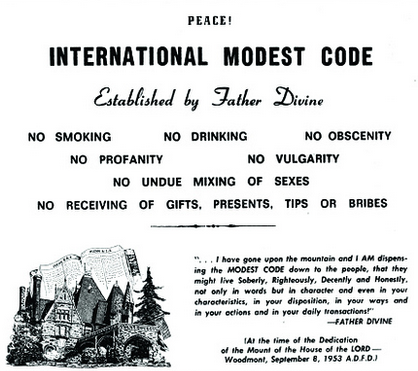
While Father Divine was influenced by Christian theology, and New Thought in particular, he departed from Christian doctrine in a number of ways. For example, early in the Movement, Father Divine rejected the notion of an afterlife in Christian eschatology and advocated for creating an egalitarian heaven on Earth. In this regard, Father Divine was reverential toward America, which he referred to as the “Kingdom of God,” and expected his followers to identify themselves as Americans. He regarded the nation’s founding documents (the Declaration of Independence, the Bill of Rights, and the Constitution) to be divinely inspired. The basic principles in these documents resonated with the primary tenet of the Peace Mission Movement, equality and brotherhood among all people. Everyone should be granted the same dignity and respect irrespective of their race or social background. He defined English as “the universal language,” and children were taught only in English (Watts 1995). Father Divine downplayed Africa and the black heritage, despite the fact that some of his followers took pride in this heritage.

Creating the egalitarian heaven on earth that Father Divine envisioned required a rejection of some important aspects of human nature. A disavowal of these things, Father Divine taught, created a purity of the body and soul and allowed God to enter a follower’s consciousness. Once this presence was recognized, the follower would act and think differently, with a new personality. There would be a spiritual awakening that would result in an “immortal soul” reborn from the old soul (Erikson 1977). With this consciousness, earthly success was possible and would be experienced.

The centerpiece of Father Divine’s moral code was the International Modest Code. The code specifically banned smoking, drinking,obscenity, vulgarity, profanity, undue mixing of the sexes, and receiving gifts, presents or bribes. The restrictions on men and women were stringent. Women were not to wear slacks or short skirts and men short-sleeves. Those who stayed at the hotels owned by the Movement, such as the Divine Lorraine, were asked to abide by the code, which was said to prompt “modest, independence, honesty, and righteousness” (Primiano 2013). A plaque was posted in each room containing the rules and regulations. Guests were separated by gender. Although times have changed, the rules for modest dress remained important up until the closing of the Divine Lorraine in 1999. Women were asked to avoid wearing pants, short skirts, bare midriffs, halters, and low cut necklines, and hair curlers. Men could not wear hats, sleeveless shirts, or untucked shirts. A plaque was posted in each room stating the rules and regulations (Primiano 2013). More significantly both for members and the future of the movement, men and women were required to remain celibate. This mandate was gradually extended from Father Divine’s inner circle to all serious followers. Father Divine taught that humans born as a product of sexual intercourse were “born wrong” and that learning how not to be born was the key to learning how not to die (Black n.d.). In stipulating this code of conduct, Father Divine taught that there was no small crime, and that all crimes stem from the same evil impulses (Weisbrot 1995).
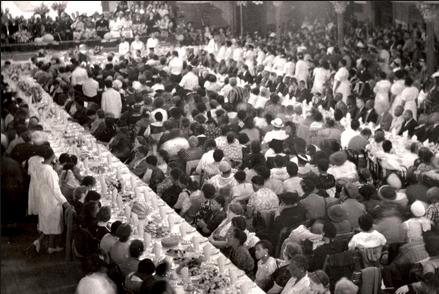
Father Divine was a proponent of capitalism, and the movement owned and operated a network of businesses. At the same time, he was a strong advocate for self-reliance, which led him to oppose a variety of common economic practices. He strongly distrusted the banking system and encouraged his followers not to deposit their money in banks. Followers were to use cash in making personal purchases, never credit. They were forbidden to take out insurance policies, as doing so demonstrated mistrust in God, and life insurance was to be canceled. They were not to take out any loans and were to pay off any existing debts. In addition, individuals were not allowed to receive welfare, as Father Divine largely advocated for self-help, and for his followers to trust deeply in him. Similarly, business owners within the movement accepted only cash, did not accept tips, and, consistent with the group’s moral code, did not sell alcohol or tobacco (Watts 1995).

Father Divine’s spiritual status continued to rise through his life. He began as the Messenger, and around 1920 began to refer to himself as the second coming of Christ. At various times he alluded to himself as God, but it was in 1951 that he clearly made this declaration. He stated that “I have personified myself, Almighty God!” (Erikson 1977). He later defined God as “God is not only personified and materialized. He is repersonified and rematerialized. He rematerialized and He rematerialates. He rematerialates and He is rematerializatable. He repersonificates and He repersonifitizes” (Watts 1995). He described this process in the following way: “Condescendingly I came as an existing Spirit unembodied, until condescendingly inputting MYSELF in a Bodily form in the likeness of men I came, that I might speak to them in their own language, coming to a country that is supposed to be the Country of the Free, where mankind is privileged to serve GOD according to the dictates of his own conscience” (Watts 1995: 177-78 ). He seemed to believe, and led his followers to believe, that he was immortal and would not die physical or spiritually. However, after the first generation of followers had passed, the movement altered some of its views on death and the afterlife. Nonetheless, they continued to consider Father Divine to be immortal and to still live in spirit. They have expressed this belief by leaving a place at the table for him at the communion and wedding anniversary banquet (Weisbrot 1995).

RITUALS/PRACTICES

The Peace Mission holds regular church services on Sundays that involve singing of hymns and songs, reading from scripture, playing recordings of sermons by Father Divine, words from Mother Divine, and sermons from other countries or from visitors. The services do not include donations or offertory (International Peace Mission Movement n.d.).

A central ritual in the Peace Mission Movement is the large, elaborate Communion Banquets that Father Divine began holding during the Great Depression to provide free meals to his followers. There were, and still are, multiple courses served by waiters. Father Divine blessed each dish before it was served. The large gatherings and various courses called for a lengthy dinner that incorporated joyful songs by the different choruses in attendance. At the end of the dinner celebration, Father Divine would stand and give his sermon. The audience would respond with exuberant shouting, jumping, and crying. These banquets, given weekly, were a sign of Father Divine’s charity as well as his wealth. To his followers, the banquets signified his support and his kindness, and they drew many people to him. These banquets are still hosted by the small groups that remain active (Schaefer and Zellner 2008).
In addition to the large Communion Banquets, the marriage between Father Divine and Mother Divine is celebrated each year on April 29 as an “international, interracial, universal holiday.” The anniversary symbolizes for followers the “Marriage of Christ to his Church” and the “fusion between heaven and Earth.” Members gather at the Woodmont estate to share the largest and most exciting banquet of the year ( Schaefer and Zellner 2008).

ORGANIZATION/LEADERSHIP

In the earlier years of the movement, committed members of the Peace Mission either lived communally or with other followers. The other main group lived at home but attended church services and events. Father Divine believed that having the members live in integrated spaces among each other enhanced their closeness with him, and encouraged the equality that he preached. In the original communal houses that Father Divine owned and ran, he provided employment services for the community. Members would turn their wages over to him in exchange for food, housing, and other support. Since Father Divine’s death, membership has dwindled. However, a few groups in the U.S. and overseas remain active, including the group located on the Woodmont estate with Mother Divine (Schaefer and Zellner 2008).

Following the moral code that Father Divine instituted involved a strong commitment to the movement and a strict behavioral code on a number of matters. The movement discouraged marriage, along with “excessive” mingling of the sexes. In the “Heavens” and other living spaces the movement maintained, men and women were kept separate.

When families arrived at the communal houses, family members (husbands and wives, brothers and sisters) were separated and had limited contact. Children were assigned to substitute parents (West 2003; International Peace Mission Movement n.d.). Prior friendships also were abandoned, and contact with outsiders was minimized. Father Divine sought a spiritual family consisting of all his disciples with himself as the head and parent. Although Father Divine rejected marriage and required celibacy of members, he himself was married twice. He professed that both relationships were spiritual and not sexual. Indeed, Mother Divine was regarded within the movement as the “Spotless Virgin.”There were also financial constraints as well. Members were instructed to avoid banks and insurance policies, and loans; use only cash and avoid credit and debt; or to accept welfare.

Racial integration was actively promoted within the movement, and integration at all movement events was mandatory. Black followers were to change their names, as the old names symbolized mortality, as well as being the names of their ancestor’s slave masters (Watts 1995). Likewise, Father Divine promoted gender equality, and women assumed a variety of traditionally male jobs.

Under Father Divine’s leadership, the Peace Mission was politically active and publically advocated for equality and desegregation,as well as anti-lynching laws and further government involvement during the Great Depression. Father Divine led movements and events in New York with his followers. Although Father Divine and the movement participated in meetings and parades with the Communist Party USA, the movement would not be active in the Civil Rights Movement that occurred years later. During the Red Scare, Father Divine took a more anti-communist stance. Later, Mother Divine did not continue his political activity, and the movement became much less politically involved.
The Peace Mission established three auxiliary groups: the Rosebuds, the LilyBuds, and the Crusaders. The Rosebuds is a group for young girls and women, the LilyBuds is for middle to older aged women, and the Crusaders is for boys and men of all ages. Each group has a characteristic uniform and creed, with brightly colored clothes to distinguish them from the rest of the disciples. These orders operate as different choirs, leading and performing various hymns at services and events. Under Father Divine, about half of all disciples were members of one of the auxiliary groups (Weisbrot 1995). The movement also supported two publications: The Spoken Word (1934–1937) and the New Day (1936–1989). Both were available to members and the general public. These publications contained articles on issues of the day as well as world and local events.
Before his death in 1965, Father Divine was the unchallenged leader of the Peace Mission. Other heavenly extensions had their own directors, but the divinity of Father Divine made him as the spiritual guide for the movement. The movement owned a number of businesses, including hotels, restaurants, and clothing shops. Members rather than Father Divine usually held the deeds on property, and members were able to live in movement owned properties inexpensively. Father Divine did not receive a personal salary. However, since members returned their salaries to Father Divine, was able to live well and to host the lavish banquets for which the movement became famous. After Father Divine’s death, Mother Divine and her staff were supported by the Peace Mission and its businesses.

ISSUES/CHALLENGES

The Peace Mission faced a variety of challenges throughout its history. For example, early in the movement’s history Father Divine faced arrest in Georgia as local ministers organized in opposition to his teachings and as local residents opposed the ever growing size of the audience attending his Sunday services. In another incident, public uneasiness with the movement increased when the young daughter of two members died after refusing medical attention in favor of faith in Father Divine (Watts 1995). A financial dispute occurred when a Peace Mission couple, Thomas and Verinda Brown, sought return of money they had given the movement after they decided, in violation of Peace Mission rules, that they wanted to live together. The case resulted in a law suit in which the Browns were victorious, but Father Divine moved the Peace Mission from New York to Philadelphia, outside of the court’s jurisdiction, in order to avoid paying the required settlement. While he was successful in this regard, the move also separated him from his primary recruitment base. Black Nationalists were critical of the Peace Mission as they regarded his mandate of celibacy as racial suicide if widely adopted.

Given that the Peace Mission advocated celibacy, lived communally, divided married couples who joined the movement while Father Divine was married twice in what he deemed “spiritual marriages,” it is not surprising that the sexual practices of the PeaceMission were of considerable interest. Father Divines marriage to Mother Divine, fifty years his junior and white, was scandalous during that period. One sexual abuse scandal that occurred with the movement involved an illicit sexual relationship between an adult Peace Mission member, John Hunt, who took seventeen year-old Delight Dewett across state lines for “immoral purposes” after she came to believe that she was to be the Virgin Mary and mother of the next redeemer. Although Father Divine castigated Hunt and supported his criminal conviction, public suspicion of the movement and negative publicity increased.
The most sensational dispute involving Father Divine directly was with Peace Mission member, Faithful Mary (Black n.d.; Watts 1995). After what began as a financial dispute, Faithful Mary formed a sectarian offshoot movement, the Universal Light Movement, which attracted a number of Peace Mission members. Faithful Mary subsequently authored a book, “God”: He’s Just a Natural Man (1937) accusing Father Divine of financial corruption and slave-like working conditions. The most inflammatory accusations, however, were that there was ongoing sexual activity between disciples, sexual orgies, and homosexuality in Peace Mission communal living quarters. She directly accused Father Divine of personally having sexual relationships with his younger female followers, including her. She wrote that “He regularly seduced other, young female disciples, getting them to come to his quarters late at night, individually or in small groups. When they were either partially or fully naked, he would masturbate them to orgasm, all while telling them that they were not sinning but giving themselves to God.” Despite the acrimonious relationship with Father Divine, Faithful Mary subsequently returned to the Peace Mission after her schismatic movement collapsed. Nonetheless, Black (n.d.) notes that “Although the Peace Mission was at its apex, the public revelations about its sordid sexual underpinnings led credence to the suspicion that the movement was a Black-led White sex slavery cult which lured people in, took all their money, and brainwashed its gullible followers. The scandal took their [sic] toll.”

Finally, the Peace Mission became involved in a controversy with Jim Jones, founder of the Peoples Temple. Jim Jones was deeply influenced by Father Divine (Hall 1987). He visited Father Divine in Philadelphia multiple times during the 1950s, and Divine was welcoming and warm to Jones. Both Jones and Divine had roots in Pentecostalism, advocated for racial equality and promoted an integrated church. Jones found appeal in Father Divine’s claim of his own divinity, the idea of being the “Father” within the movement, the message of the inner divinity of all humans, the promised land theme that would allow an escape from poverty and repression. Early in Jim Jones career, he modeled activities after Father Divine’s Peace Mission. He instituted a church adoption fund, which, like Father Divine’s endeavors, was funded through church dinners and businesses; opened a free social service and meals center in the Peoples Temple basement that gave away thousands of meals each month, as well as encouraging integration; and established a free grocery store, gave away clothing, and provided other social services. At the same time, Father Divine and Jim Jones took separate paths on other matters. Jones advocated socialism as the answer to most of America’s problems, while Father Divine championed Black capitalism (Chidester 1988).

Jones’ interest and admiration for Father Divine culminated in his 1971 trip to Philadelphia, as part of the summer bus tours that sought out converts across the country. Jones attempted to target the Peace Mission followers still in Philadelphia after the death of Father Divine. Jones claimed to be a reincarnation of Father Divine. He hoped to bring converts back to California. However, he was met with an angry Mother Divine, who stated publicly “We have entertained Pastor Jones and the People’s Temple. We were entertaining angels of the other fellow! We no longer extend to them any hospitality whatsoever…They are not welcome!” (Hall 1987).

The Peace Mission peaked during the 1930s amid the poverty and unemployment of the Great Depression and the movement’s advocacy for equality for African Americans. Ultimately, the movement faced an almost certain demise due to Father Divine’s policies of not recruiting new members and the requirement of celibacy. Membership in the movement continued to dwindle after Father Divine’s death. Only a few hundred members remained, and, fewer than two dozen lived with Mother Divine at Woodmont (Blaustein 2014). The small group of aging followers “…spent their days preparing for the Holy Communion banquet,”….“They grow their own food. They bake their own bread. They polish the silver. Each day is filled with actions to prepare for the sacred meal” (Blaustein 2014).

With Mother Divine’s passing and the even smaller number of core followers at Woodmont, the future of the movement remains uncertain. In the wake of Mother Divine’s death, a struggle for control of the estate and remaining property ensued. Tommy Garcia, born to one of Father Divine’s followers and  raised as Father Divine’s adopted son, has laid claim to the movement’s property and money. Garcia left Woodmont when he was fifteen years-old. His claims have been rejected by the movement, and no final legal determination has been made (Pirro 2017; Blookquist 2009).

REFERENCES

Baer, Hans A. and Merril Singer. 2002. African American Religion. Knoxville, TN: Uniersity of Tennessee Press.

Black, E. n.d. “Jonestown and Woodmont: Jim Jones, Mother Divine and the Fulfillment of Father Divine’s Intention of a Vanishing Divine City.” Accessed from http://jonestown.sdsu.edu/?page_id=40227 on 15 July 2014.

Blaustein, Jonathan. 2014. “Philadelphia, City of Father Divine.” New York Times, December 29. Accessed from  http://lens.blogs.nytimes.com/2014/12/29/philadelphia-city-of-father-divine/?_r=0# on 3 March 2015.

Bloomquist, Sarah. 2014. “Redevelopment Underway at the Divine Lorraine Hotel.” ABC 6 Action News. Accessed from http://6abc.com/realestate/redevelopment-underway-at-the-divine-lorraine-hotel/96154/ on 10 June 2014.

Bloomquist, Sarah. 2009. “Father Divine and the International Peace Movement.” 6abc.com, October 16. Accessed from https://6abc.com/news/father-divine-and-the-international-peace-movement/1789153/ on 20 March 2019.

Chidester, David. 1988. Salvation and Suicide: An Interpretation of Jim Jones, the Peoples Temple, and Jonestown. Bloomington: Indiana University Press.

Erickson, Keith V. 1977. “Black Messiah: The Father Divine Peace Mission Movement.” Quarterly Journal of Speech 63:428-38.

Faithful Mary. 1937. “God”: He’s Just a Natural Man.” Philadelphia: Universal Light.

Grimes, William. 2017. “Mother Divine, Who Took Over Her Husband’s Cult, Dies at 91.” New York Time, March 14. Accessed from https://www.nytimes.com/2017/03/14/us/mother-divine-dead-peace-mission-leader.html on 20 March 2019.

Hall, John R. 1987. Gone From the Promised Land: Jonestown in American Cultural History. Piscataway, NJ: Transaction.

Pirro, J.F. 2017. “The Adopted Son of a Peace Mission Leader Returns to Gladwyne.” Mainline Today, August. Accessed from http://www.mainlinetoday.com/Main-Line-Today/August-2017/The-Adopted-Son-of-a-Peace-Mission-Leader-Returns-to-Gladwyne/ on 20 March 2019.

Primiano, Leonard N. 2013. “Father Divine: Still Looking Over Philadelphia” Essayworks. Accessed from http://www.newsworks.org/index.php/local/speak-easy/51031-father-divine-still-looking-over-philadelphia on 10 June 2014.

Satter, Beryl. 2012. “Father Divine’s Peace Mission Movement.” Pp. 386-87 in The Oxford Encyclopedia of American Social History , edited by Lynn Dumenil, Lynn. New York: Oxford University Press.

Schaefer, Richard T. and William W. Zellner. 2008. “The Father Divine Movement.” Pp. 239-78 in Extraordinary Groups: An Examination of Unconventional Lifestyles. New York: Worth Publishers.

Watts, Jill. 1995. God, Harlem U.S.A.: The Father Divine Story. Berkley: University of California Press.

West, Sandra L. 2003. “Father Divine.”  Encyclopedia of the Harlem Renaissance. Accessed from http://www.fofweb.com/History/MainPrintPage.asp?iPin=EHR0116&DataType=AFHC&WinType=Free on 10 June 2014.

Weisbrot, Robert. 1995. “Father Divine’s Peace Mission Movement.” Pp. 285-90 in America’s Alternative Religions, edited by Timothy Miller. Albany: State University of New York Press.

Weisbrot, Robert. 1983. Father Divine: The Utopian Evangelist of the Depression Era Who Became an American Legend. Urbana: University of Illinois Press.

Publication Date:
18 July 2014

FATHER DIVINE PEACE MISSION VIDEO CONNECTIONS


Share