Ramtha School of Enlightenment

Ramtha’s School of Enlightenment

Founder: JZ Knight

Date of Birth: 1946

Birth Place: New Mexico , USA

Year Founded: 1988

Sacred or Revered Texts: The White Book

Size of Group: As of October, 2000, JZ Knight has around 3000 devotees. 1

History

JZ Knight, founder of Ramtha’s School of Enlightenment, was born in Roswell, New Mexico where she experienced psychic and paranormal phenomenon from an early age. An elderly Yacqui Indian woman held JZ in her arms when she was a mere infant and declared that she was destined to “see what no one else sees.” Then, when JZ was older, she and some friends saw “blinding red flashes of light” while at a sleepover. The light abruptly stopped, and the girls apparently forgot the bizarre incident. Years later, JZ recalled the strange flashing lights. She was intrigued by their cause and why she had forgotten about them. JZ believed UFO’s or some higher power may have been responsible, beginning her interest in the paranormal. 2

Despite a turbulent childhood caused by an alcoholic father, she graduated high school and went on to a small business college. Financial difficulties forced her to quit school, but she managed to get a decent job with a cable company. In 1973, she started her own communications company. Her coworkers quickly found that JZ had an uncanny ability to determine when (and to whom) to sell. In fact, some of them believed she could predict the future. 3

Whatever psychic influence JZ had might have been inherited from her mother, who claimed she could foresee the future in her dreams. JZ’s mother knew about a family member’s death or even whether JZ made the school majorette team before the event occurred. 4

JZ’s psychic experiences continued, helping her to realize that she was indeed special. One psychic saw a great force within JZ, a force nearly as powerful as Jesus Christ. This force would help bring peace to the world. Later, an event occurred that can only be described as a miracle. A friend had forced JZ to see an evangelical healer due to her faltering health. JZ, who had become disillusioned with the hypocritical church long ago, openly denounced the minister’s healing powers. In that instant, a flash of blue light knocked the minister down. The congregation was stunned. JZ was cured of her ills. She believed she had seen the hand of God. 5

One of the most important events in her life occurred when she accompanied her friend to a psychic reading one afternoon. The psychic took a strong interest in JZ. She predicted that JZ would move to a place with “great mountains” and “tall pines.” This was where she would meet The One. This entity, the psychic foresaw, would give JZ “great influence” and destiny. Sure enough, JZ received a job offer in the mountain country of Tacoma, Washington. She took the job with the psychic’s powerful words echoing in the back of her mind. 6

The next few years were uneventful in terms of paranormal phenomenon, but JZ and her second husband Jeremy dabbled in psychic communication and mysticism. Jeremy , in particular, became interested in the properties of pyramids, which were believed to harness psychic energy. One day in February, 1977, while JZ and Jeremy were playing with some pyramids in their home, The One appeared before her. 7

Standing in her kitchen a mere ten feet from JZ was an enormous figure, dressed in flowing robes and surrounded by purple light. He proclaimed, “I am Ramtha, the Enlightened One. I have come to help you over the ditch.” He went on to say to a bewildered JZ: “It is the ditch of limitation and fear I will help you over. For you will, indeed, beloved woman become a light unto the world.” Ramtha then warned JZ that she was in danger and she must leave the house immediately, at which point he disappeared. JZ heeded this warning, moving her family into a new home. Days later, the house was ransacked by thugs. The trusting relationship between JZ and Ramtha was thus cemented. 8

The Beginning of RSE

With the help of experts in the field of psychic communication and channeling, JZ was able to turn her body over to Ramtha so that he could spread his teachings. Ramtha first spoke to the public in 1978, when he made an impact with his vast knowledge and insight. The local media soon picked up on this story helping Ramtha’s (and JZ’s) popularity to spread. The fact that Ramtha emerged in the heart of the New Age movement considerably helped his cause; people were lining up to hear him speak. JZ became a full time channel and began charging money for admittance (an idea brought to her by Ramtha himself). Even Actresses Shirley McLean and Joan Hackett became disciples of Ramtha (The Enlightened One predicted McLean would win the “highest award” for her role in Terms of Endearment). Knight’s popularity among the stars lead to her appearance on the Merv Griffin Show in 1985. 9

The RSE Today

JZ’s school has earned her millions of dollars and lots of adoration. She is among the leading New Age channelers with 3000 followers. Disciples come to her ranch in Yelm, Washington to learn the Great Work (see Beliefs and Practices). Ramtha offers courses for beginners and advanced students which are designed to let the disciples harness their divine powers. Aside from lectures by Ramtha, the students participate in “field work” which is designed to focus their concentration and energy (C&E). Field work usually involves searching a vast field for index cards while blindfolded. JZ also built a massive maze known as the Tank in her ranch which she uses for various lessons. Although the lessons seem strange to the students and outsiders, each one has a specific purpose that progresses them on the path to enlightenment. 10

Ramtha’s School tends to attract an older audience than most New Age Movements. The average age for a beginning student is mid-thirties, with some starting as young as age 6, however. According to a study of the advanced students, the typical students “are in midlife, have high levels of education and occupational prestige, and are now choosing to orient themselves in a new direction.” 11

The RSE has become more commercial in the late 1990’s. Students must purchase and watch an introductory video before attending classes. The sale of Ramtha books, video’s, and audio cassettes has become a profitable business. 12

JZ’s success, however, is not without a price. Critics claim that JZ is a fraud, and that she uses mind control techniques. Lawsuits have hurt her in recent years, including a case brought by her ex-husband who says she used Ramtha’s influence to coerce him out of a fair divorce settlement (see controversies).

Beliefs

Ramtha’s teachings are encompassed in a work known as the White Book, and these ideas are based on ancient Gnosticism of the Mediterranean. The core principles of Ramtha’s School are 1) a supreme deity is a part of every man, and 2) the key to reaching the God within us is through Gnosis or knowledge. 13 Ramtha himself does not wished to be revered as a God, but rather as an equal. He says in one of his channeling sessions, “I am but a teacher, servant, brother unto you.” 14

Who Is Ramtha?

Ramtha is a 35,000 year old warrior from the ancient city of Lemuria. The Lemurians were oppressed by highly advanced citizens of Atlantis because they believed the Lemurians were “soulless.” At age 14, Ramtha led a small army against the Atlantians and defeated them. More people joined his army, and he soon became a great warrior. He was stabbed severely during one battle, but miraculously he did not die. His enemies began to believe he was immortal. Ramtha “learned the mysteries of the unknown god and became enlightened” during the seven years he was recovering from his wound. He rose through higher levels of consciousness and eventually transformed into a being of light. He ascended as a God, but vowed to return. 15

Indeed, 35,000 years later, Ramtha returned to meet JZ Knight. Ramtha chose to channel through JZ rather than present himself in human form for several reasons. First, he did not want to be worshipped as a deity, but rather an equal. He felt that if he presented himself, he would be idolized by his students. Second, his human form limited him to a male entity. Channeling himself through a woman presented the dual male/female nature of God. Third, for reasons of his own, he believed JZ Knight was especially suited to the task at hand. 16

Ramtha’s Worldview

Ramtha’s goal with beginner students is to break them away from the traditional Western worldview. This worldview limits the individual and suppresses his power as a divine being. Ramtha aims to make the student not only believe in his divine power, but to manifest it. 17 Ramtha’s Creation myth and the philosophies stemming from it are complex and abstract, but they are essential to understanding his teachings.

The universe started as a Void of nothingness. This Void “turned in upon itself” creating consciousness and energy. Consciousness and Energy fused together causing the Void to become aware of itself. This awareness was represented in the Void as single- dimensional entity called Point Zero. Other dots of awareness formed, and the high energy reactions between the various dots created time and space. As these dot entities interacted, seven energy levels developed. The entities of awareness left Point Zero to “explore” other levels of the Void in order to “make known the unknown.” As the entities progressed from Point Zero (the highest level) to level 1, energy and time slowed. At the lower levels, the entities took on form and substance. When the entities reached the first level, they “coagulated” into human form. It was at this level that life as we know it began. 18

This theory of Creation is difficult to grasp. The main point, however, is that consciousness exists on multiple levels, with human form being the lowest. The higher the level, the greater the level of consciousness. The entities (Gods) used consciousness to create objects at their whim. In other words, they manifested their dreams to create all the objects in the world. The Gods came down to the lowest levels to experience life in its material form, but they still had their divine powers. The early humans could easily move between levels and manifest their dreams or desires. Over time, however, this ability was lost. Ramtha’s School of Enlightenment allows students to regain these powers, and carry on the task of Gods: to make known the unknown. 19

Humans often move to other consciousness levels without realizing it. The most common occurrence is moving up to the second level while dreaming. Near-death experiences, psychic visions and other phenomenon can be attributed to moving to another plane of consciousness. 20

When humans lost the power of the Gods, they fell into the “ditch of limitation,” the same ditch that Ramtha mentioned during his first encounter with JZ. Ramtha holds the Church partly responsible for this limitation when it “took God outside of Man, [and] put him far, far away.” The Church “unenlightened” man by claiming that God is far superior to humans. Ramtha’s teachings indicate that the Church “created” God to keep men in line. He even goes so far as to say Hell and the devil were “created through religious dogma for the purpose of intimidating the masses into a controllable organization.” 21

The Great Work

The Great Work of Ramtha’s teaching is literally manifesting dreams and desires. In essence, the Great Work requires reaching maximum potential of the mind. The key to manifestations lies in the cerebrum, which, according to Ramtha, has the power to make dreams a reality. In the past, humans would hold a dream or desire in their mind, and it would manifest. Today, humans play a passive role to manifestations. They absorb the world around them in their mind, and this then becomes reality. In a sense, they are trapped in the present reality. Ramtha desires to teach students the power to manifest any desire and make known the unknown. 22

Issues and Challenges

Any new religion has its share of controversy, and the RSE is no exception. The public generally perceives New Age Religions, groups in a negative light, usually without any evidence. Ramtha’s messages are certainly not mainstream, and the way in which JZ presents them is also subject to controversy. Some critics claim JZ is a fraud whose only goal is to make money. Others say that she uses brainwashing techniques to keep her students from leaving. There are a number of opinions on the matter and no clear answers.

Is JZ a Channeler?

JZ has undergone a lot of scrutiny as one of the most prominent American channelers. Her overall performance as Ramtha is seamless. While she is channeling, her posture, walk, voice and the color of her eyes changes. Actress Linda Evans, a student of Ramtha’s, argued that if JZ is a fraud then “she is the greatest actress in the world.” 23 A skeptical psychologist became uncertain of JZ’s legitimacy when JZ put her hand on his head revealing such power that he “could hardly take it.” 24 Even if Ramtha was not real, he said, there was definitely a power within her that science could not explain. Later, a team of scientists did tests on JZ during channeling episodes over the course of a year. The results of the test categorically ruled out fraud or multiple personality disorders. 25 “We know something’s going on here,” said one of the researchers, “we just can’t say, at this point, specifically what it is.” 26 Her students swear that JZ and Ramtha have entirely different personas leading them to believe that Ramtha is indeed channeling through JZ.

Other evidence points to the contrary. One of JZ’s business managers saw her “practicing” the Ramtha personality. Her husband Jeff Knight also noticed her slip in and out of the trance to take cigarette breaks (JZ, unlike Ramtha, was a smoker). 27 And then there is the common sense argument, according to the Skeptics Dictionary Website: “…it doesn’t take a rocket scientist to figure out that the likelihood of a 35,000 year old Cro-Magnon ghost suddenly appearing in a Tacoma kitchen to a homemaker to reveal profundities about centers and voids, self-love and guilt-free living, or love and peace, is close to zero.” 28 It takes a great leap of faith to believe that JZ is a channeler, although scientific evidence may not be enough to discredit Ramtha.

Criticism of the RSE

Publicity surrounding Ramtha’s School has been negative for the most part in recent years. A 20/20 segment portrayed JZ as a fraud who was exploiting peoples’ beliefs in Ramtha for money. The show also claimed that Ramtha was teaching people that they are above morality due to their divine status. These beliefs, they surmised, could only lead to amoral behavior. The 20/20 exposure led to more attacks from the press on JZ and the School. 29

J. Gordon Melton, a leading scholar on new religious movements, thoroughly investigated the RSE and found that these criticisms were unfounded. Melton attributes most of the bad press to sensationalist journalism that critiques unconventional beliefs for a good story. Furthermore, anti-cult and counter-cult sentiments are popular with Americans, which intensifies the controversy. 30 . Melton’s book gave important facts rather than insinuations and smear campaigns

Anti-cultists respond that Melton’s book is biased because (1) Melton was hired to testify for JZ in a court case against her in 1992, (2) JZ provided funding for the book and (3) Melton established close ties with JZ and the school during the research thus damaging his credibility as an objective researcher. Melton also neglected to mention several incidents where people were injured during blindfolded field activities. 31 Although this omission does not make JZ a dangerous cult leader, it makes one wonder what else Melton left out of his book.

Criticism from the public caused JZ to withdraw from the public in the early 1990’s. During this period she devoted her time to her school and to Ramtha. Under Ramtha’s guidance, she reappeared to the public in the late 1990’s. As Ramtha’s school continues to succeed, it is receiving “signs of a certain legitimacy among the religious community.” 32 Today, JZ has an unprecedented number of students, and her books and tapes are selling well.

Scandals

Several scandals have marred JZ’s reputation among the religious community. The first involves a student of Ramtha’s who was hired to run stress management programs for the Federal Aviation Administration in 1984. This student, Gregory May, a psychologist from California, used techniques that were “far beyond routine.” Some of the training activities involved tying employees together for long periods of time, forcing women to shower together, sleep deprivation and verbal abuse. Several employees brought charges against the FAA for trauma occasioned by May. 33 These unorthodox techniques cannot be directly linked to Ramtha’s teachings. Nevertheless, the media was quick to point out the connection between bizarre training techniques and (what they perceived to be) a destructive cult.

Another scandal occurred because of JZ’s fondness for horses. Overstepping her boundaries as a religious leader, she advised some of her students to invest in Arabian horses. These students followed her advice as if advised by Ramtha himself. Many of them lost money in this venture and bitterly left the school. Later, JZ compensated them for their losses, but the damage had been done. She had given the critics ammunition to use against her. 34

In addition to these scandals, JZ had a turbulent personal life. She was married five times, and at least once she was caught in an affair with a young student. She divorced her fifth husband, Jeffrey Knight, in 1989. Jeffrey claimed that JZ used Ramtha’s influence to coerce him out of a fair divorce settlement. He took the case to court, embroiling JZ in an intense legal battle. 35 Meanwhile, JZ faced serious financial burdens from bill collectors and taxes. She kept these problems from the public, but eventually the media picked up on them.

Conclusion

Although Ramtha’s School of Enlightenment is surrounded by controversy, there is no clear evidence that JZ is a fraud or that the school is a danger to anyone. Sociologists and psychologists do not believe that students are “brainwashed” to follow this movement, nor are they held against their will. Ramtha’s students are searching for answers to life’s most important questions, and the School is helping them resolve these issues. Until undisputable evidence arises that JZ is harming people, the media and anti-cultists should be careful with their criticisms.

Bibliography

Brown, Michael. “The Channeling Zone.” Cambridge MA: Harvard University Press. 1977.

Carrol, Robert Todd. “Ramtha aka J.Z. Knight.” The Skeptics Dictionary. http://skepdic.com/channel.html

Diamond, Steve. “Into the Mystic: Ramtha Meets the Scholars.” The New Times. Accessed at http://www.newtimes.org/issue/9705/97-05-jz.html

McDonald, Sally. “J.Z. Knight Channeling New Support.” Seattle Times May 9, 1998. Accessed at http://archives.seattletimes.nwsource.com

McDonald, Sally. “Christianity vs. New Age.” Seattle Times May 9, 1998. Accessed at http://archives.seattletimes.nwsource.com

Melton, J. Gordon. Finding Enlightenment. Hillsboro, OR: Beyond Words Publishing, Inc. 1998.

Neill, Michael. “Sure, blame the caveman: channeler J.Z. Knight’s troubles put 35,000 year old Ramtha on trial”. People Weekly Oct. 12, 1992 p. 123.

“Ramtha’s School of Enlightenment – The American Gnostic School.” http://www.ramtha.com

“The Guru and the FAA.” Newsweek , March 6 1995 p. 32.

References

  • “Ramtha’s School of Enlightenment, The School of Ancient Wisdom: FAQ’s.” http://www.ramtha.com/html/aboutus/faqs/students/how-many.stm
  • Melton, J. Gordon. Finding Enlightenment. p. 3-4
  • Ibid. 9
  • Ibid. 4
  • Ibid. 9-12
  • Ibid. 7-9
  • Ibid. 14-15
  • Ibid. 14-15
  • Ibid. 46-52
  • Ibid. 108-109
  • Ibid. 126-127
  • “Ramtha’s School of Enlightenment, The School of Ancient Wisdom:RSE Store.” http://ramtha.com/html/rse-store/product-details/v1.42.stm
  • “Ramtha’s School of Enlightenment, The School of Ancient Wisdom:About US.” http://ramtha.com/html/aboutus/faqs/school/gnostic-beliefs.stm
  • Melton, J. Gordon. Finding Enlightenment. p. 58
  • “Ramtha’s School of Enlightenment, The School of Ancient Wisdom:About US.” http://ramtha.com/html/aboutus/faqs/teacher/who.stm
  • “Ramtha’s School of Enlightenment, The School of Ancient Wisdom:About US.” http://ramtha.com/html/aboutus/faqs/teacher/why-jz.stm
  • Melton, J. Gordon. Finding Enlightenment. p. 58
  • Ibid. 78-80.
  • Ibid. 81-84
  • Ibid. 85
  • Ibid. 59- 61.
  • Ibid. 85
  • Ibid. 146
  • Brown, Michael. The Channeling Zone. p. 12
  • “Ramtha’s School of Enlightenment, The School of Ancient Wisdom:About US.” http://ramtha.com/html/aboutus/faqs/jz/proof.stm
  • Diamond, Steve. “Into the Mystic: Ramtha Meets the Scholars.” http://www.newtimes.org/issue/9705/97-05-jz.html
  • Szimhart, Joe. “Book Review/Essay on Melton’s Study.” http://www.kelebekler.com/cesnur/txt/ram2.htm
  • Carrol, Robert Todd. “Ramtha aka J.Z. Knight.”
  • Melton, J. Gordon. Finding Enlightenment. 137-139
  • Ibid. 144-145
  • Szimhart, Joe. “Book Review/Essay on Melton’s Study.” http://www.kelebekler.com/cesnur/txt/ram2.htm
  • McDonald, Sally. “J.Z. Knight Channeling New Support.”
  • “The Guru and the FAA.” Newsweek March6, 1995.
  • Melton, J. Gordon. Finding Enlightenment. p. 147-148
  • “Sure, blame the caveman.” People Weekly October 12, 1992

Created by Joseph M. Khattab
For Soc 257: New Religious Movements
Fall term, 2000
University of Virginia
Last modified: 07/23/01


Share

Karaikkal Ammaiyar

KARAIKKAL AMMAIYAR TIMELINE

ca. 500 C.E.:  Karaikkal Ammaiyar lived in what is now known as the state of Tamilnadu in south India. She was a great devotee of the Hindu god Shiva, and the author of four poetic works of devotion in the Tamil language to him.

11th–12th centuries C.E:  Her life was described in authoritative traditional biographies in the Tamil language.

11th century on:  She was depicted in metal festival sculptures originally designed for temple worship.

Present:  She is publicly celebrated in several annual temple festivals in Tamilnadu, south India, as well as other locations where there is a significant population of Hindu Tamils devoted to Shiva.

HISTORY/CONTEXT

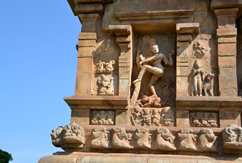
Karaikkal Ammaiyar is revered as a Tamil Shiva-bhakti saint by Tamil people in south India and elsewhere who are Shaivas (theyworship Shiva as their family deity and/or chosen deity). [See photo at right by the author; credits appear below.] The name by which she is known (Karaikkal Ammaiyar) means in the Tamil language “revered mother of Karaikkal.” Her biographers and her devotees regard the contemporary town named Karaikal in Tamil Nadu in south India as her home village. Karaikal is located nearly 300 kilometers south down the east coast of India from Chennai, and a major festival to Karaikkal Ammaiyar is held there every June–July.

In the Tamil south Indian tradition, Karaikkal Ammaiyar (Kāraikkāl Ammaiyār) is remembered as a female poet-saint who lived more than one thousand years ago in what is now the state of Tamilnadu, India. There, she composed 143 verses expressing her praise of and devotion (bhakti) to the Hindu deity Shiva (Śiva): The 101-verse poem entitled Arputat Tiruvantati (Arputat Tiruvantāti; Sacred Linked Verses of Wonder); the twenty-verse poem entitled Tiru Irattai Manimalai (Tiru Iraṭṭai Maṇimālai; Sacred Garland of Double Gems); and two hymns set to music in eleven verses entitled Tiruvalankattut Tiruppatikam 1 and 2 (Tiruvālaṅkāṭṭut Tiruppatikam 1 and 2; Sacred Hymns on [the place called] Tiruvalankatu). She is one of only three female named saints in the authoritative Tamil Shiva-bhakti devotional tradition (Śiva-bhakti; devotional participation dedicated to the god Shiva), and the only woman among those saints to have authored devotional works. [See photo at right; credits appear below.]

There are important questions of historicity concerning Karaikkal Ammaiyar that should be considered.

Was Karaikkal Ammaiyar a real person? Tradition considers her to have been an historical personage who authored four poetic compositions. By the eleventh and twelfth centuries C.E., traditional biographers described her as a female person who had a special connection to Shiva. While these biographers’ lifetimes are centuries later than Karaikkal Ammaiyar’s, her biographers are much closer in time to her than we are at present. Unless there is a compelling reason to doubt or contradict an aspect of traditional memory, we may take what tradition says as a working assumption.

When did Karaikkal Ammaiyar live? Scholars agree that Karaikkal Ammaiyar lived around 550 C.E. (Nilakanta Sastri 1955:35; Kārāvelāne 1982 [1956]:19; Filliozat 1982 [1956]:8, 13; Zvelebil 1973:186; Cutler 1987: 118; Dehejia 1988:135). All of the scholars point to two pieces of evidence: 1) Traditional memory places her as historically the earliest of the sixty-three named Tamil Shiva- bhakti saints; and 2) Cuntarar (Sundarar), one of the three most famous male poet-saints in the Tamil Shiva-bhakti group dating to 700 C.E., wrote a poem listing the names of all of the sixty-three saints in which his reference to one saint as “pey” (pēy; ghoul) is understood by tradition to refer to Karaikkal Ammaiyar; thus, she lived prior to 700 C.E.

However, none of these scholars provide a more detailed rationale for the dating of Karaikkal Ammaiyar to 550 C.E.; while this date is open to revision, it is plausible for several significant reasons (Pechilis 2012; 2013). Tradition views Karaikkal Ammaiyar as developing new poetic forms, and her use of them is less orderly and assured in terms of syntax and structure than later prominent poets who also used those forms, including Cuntarar, which suggests that she initiated new forms of poetry and that later poets perfected those forms. In addition, she is concerned with themes found in other Tamil literature of her time, especially the Cankam (Ca ṅ kam; academy) classical poetry (ca. 200 B.C.E. to 500 C.E.) and the narrative poems (or “epics”) Cilappatikaram (Cilappatikāram, ca. 300–400 C.E.) and Manimekalai (Maimēkalai, ca. sixth century). Such themes include the heroic ideal, the existence of pey (ghouls), Shiva’s dance, and the spiritual significance of the cremation ground. In addition, Karaikkal Ammaiyar’s poetry demonstrates familiarity with descriptions of Shiva from classical Sanskrit mythological stories, known as a genre as purana (purāṇa), which were redacted during the Gupta dynasty era (ca. 320–550 C.E.). Lastly, the kind of bhakti (devotional) poetry that Karaikkal Ammiyar produced is very different in terms of voice, structure, choice of themes and representation of bhakti compared to the compositions of the three most famous male saints (Appar, Campantar and Cuntarar, ca. 700 C.E.); it is doubtful, given their predominance and authority as spokesmen of bhakti, that Karaikkal Ammaiyar would follow, rather than precede, them.

Karaikkal Ammaiyar lived in the early period of what Alexis Sanderson (2009) has called “the Śaiva Age” in India, during which Shaivism (the worship of the god Shiva) was predominant across India, from about the fifth to the thirteenth centuries C.E. She is not the first woman to compose Tamil poetry, nor the first poet to describe Shiva in some detail; for example, at least ten poetesses contributed to the classical Tamil poetic anthology, the Purananuru (Puranānūru ; The Four Hundred [Poems] About the Exterior; dated to the first to third centuries C.E.), and several of the poems in the collection describe aspects of Shiva known from Sanskrit mythology, including his third eye, his blue-black neck, and his destruction of the demonic triple cities (e.g. v. 55; see Hart and Heifetz 1999, xv:41). However, tradition credits Karaikkal Ammaiyar with being the first Tamil poet to have an exclusive devotional focus on Shiva. Some scholars contend that Karaikkal Ammaiyar’s aim was to replace worship of the Tamil goddess Korravai with worship of the god Shiva as depicted in Sanskrit mythology (Mahalakshmi 2000, 2011; repeated in Craddock 2010), but this perspective has some serious chronological issues, as well as a lack of thematic representation in the poetry of Karaikkal Ammaiyar (Pechilis 2012:74–75). A more fruitful avenue is to view her work as an intertextual dialogue with preceding literature such as the classical Tamil Cankam poetry and Sanskrit mythology, with contemporaneous Tamil literature such as the “epics” Cilappatikaram and Manimekalai, and with contemporaneous traditions of practice such as Shaiva Tantra.

Two authoritative biographies from within Tamil Shiva-bhakti tradition were written about her within 600 years of her lifetime, celebrating Karaikkal Ammaiyar as an exemplar of devotion and as an author of devotional poetry. The much longer and more authoritative biography was written in the twelfth century by a court minister named Cekkilar (Cēkkilār), which contains biographical stories of all sixty-three named saints in the Tamil Shiva-bhakti tradition, including Karaikkal Ammaiyar. At this time, Karaikkal Ammaiyar’s compositions were canonized in the Tamil Shiva-bhakti tradition by being included in the eleventh volume of the canon of devotional literature to Shiva; this canon is called the “Sacred Collection” (Tirumurai). Cekkilar’s biographies of the saints constitute the twelfth and final volume of this canon.

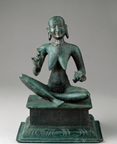
Cekkilar’s biography of Karaikkal Ammaiyar was enormously influential in the Shiva-bhakti community’s imagining of her. For example, the biography has had a major influence on the festival images of Karaikkal Ammaiyar made of metal created from the eleventh century on, such as the image now at the Nelson-Atkins Museum and the thirteenth-century image now at the Metropolitan Museum of Art. [See image at right from the MET Museum; credits appear below.] Historical images of this saint can be found in large Hindu temples dedicated to Shiva in Tamil south India today, as well as in Hindu temples in countries where Tamils reside, such as Sri Lanka, South Africa, Fiji, and Western nations. Such images continue to be made today for both temple and personal worship collections. In addition, Cekkilar’s biography of Karaikkal Ammaiyar provides the narrative for annual festivals that publicly celebrate her devotion, including: 1) The festival to celebrate her achievement of spiritual liberation (mukti) at the Vadaranyeswarar Temple in Tiruvalankatu (also spelled Tiruvalangadu, about sixty km west of Chennai) every February–March; 2) The festival of the sixty-three saints (aruppattumūvar tiruvilā), held at the prestigious Kapaleeshvara (Kapālīśvara) Temple in Mylapore, Chennai every February–March; and 3) The mango festival (maṅgani tiruvi lā) to celebrate her life story at the temple town of Karaikal (about twenty km. north of Nagapattinam) every June–July. Today, Cekkilar’s biographical stories of the saints are widely known among Tamil speakers, especially those who identify as Shaiva. Indeed, the story of Karaikkal Ammaiyar is much more widely known than her own poetry. Her two hymns are known to some professional temple singers (ōtuvār) of Shiva-bhakti devotional hymns, but they are not part of the common performance repertoire.

BIOGRAPHY 

Cekkilar’s twelfth-century biographical volume of the saints, called the Periya Puranam (Periya Purāṇam; Great Traditional Story), has been enormously influential, and it predominates in guiding the Tamil public’s imagination of the sixty-three named saints’ identities today, as any number of books, articles and websites demonstrate. In the case of Karaikkal Ammaiyar, the biographical story is much more widely known than her own poetry. (For a detailed English translation of Karaikkal Ammaiyar’s biographical story, see Pechilis 2012:199-205. For a general English translation of the Periya Puranam see McGlashan 2006.) Yet there is a compelling reason to doubt an aspect of Cekkilar’s traditional memory, because the themes that he prioritizes in his biography, such as Karaikkal Ammaiyar’s identity as a wife, are not ones that are found in her own poetry and hymns. That is, Karaikkal Ammaiyar’s self-representation in her poetry in certain ways significantly differs from Cekkilar’s representation of her in his biography.

It is thus necessary to start with Karaikkal Ammaiyar’s own poetry in order to discover the ways in which she represents herself in her compositions. The first thing to note is that there is a sharp bifurcation in her compositions. Her two poems, the 101-verse Arputat Tiruvantati (Sacred Linked Verses of Wonder; hereafter “Wonder”) and the twenty-verse TiruIrattai Manimalai (Sacred Garland of Double Gems; hereafter “Garland”), are similar in voice, theme and imagery in their reflections on devotion to Shiva. Her two hymns on Tiruvalankatu (Tiruvalankattut Tiruppatikam 1 and 2; hereafter “Decade-1” and “Decade-2”) are, however, quite distinct because of their sole concentration on Shiva as the Lord of Dance who performs at a cremation ground (Pechilis 2012:40-42). This difference will be explored in the sections below on Beliefs and Practices in this profile.

In the “Wonder” and the “Garland,” Karaikkal Ammaiyar devotes many verses to descriptive praise of Shiva as heroic. Shiva’s heroic deeds, known from Sanskrit mythology, are represented, especially those that portray Shiva as a protector of humankind (Pechilis 2012:53), such as his burning the demons of the triple cities and his swallowing of the poison, as in the following two examples:

The gaze of his third eye,
which can appear as
long flames of fire,
soft cool moonlight
or the harsh rays of the sun,
immediately burned to ashes
the three fortresses
of his formidable foes. (“Wonder” v. 84; Pechilis 2012:30)

In times of yore
the lord who bears the cobra
drank the poison from the awesome ocean
churned by the celestials,
which darkened his neck
like a shadow across the silvery moon
that crowns his red, snake-bearing matted locks. (“Wonder” v. 55; Pechilis 2012:28)

In contrast to the intense specificity with which the poet describes the body of god, she does not tell us of any particular characteristics or context of her own body: She does not identify her gender, her caste, or her socio-economic class, but instead emphasizes her humanity, as in the first verse of the “Wonder,” her longest poem:

Birth in this body
enabled me to express
my overflowing love
through speech,
and I reached your sacred henna-red feet.

And now I ask,
oh, lord of the gods
whose neck shimmers black,
when will the afflictions
that birth in this world also enables ever end? (“Wonder” v. 1; Pechilis 2012:26)

By not providing details about herself, the poet may have sought to present a universal voice in her poetry through which the devotional subjectivity she describes is accessible to all of humankind and not limited to people who match her own identity characteristics. Her voice is thus that of humanity as engaged in contemplation of the divine. A complicating factor is that three of her works, the “Wonder” and the two hymns on Tiruvalankatu, conclude with a signature verse in which the author refers to herself as Karaikkālpey (pēy), which translates to “the ghoul from the place named Karaikkal.” In all of her works, the poet describes ghouls (pey can be singular or plural) as frightening, capricious beings who attend Shiva’s dance at the cremation ground. Issues in understanding the poet’s adoption of pey as an identity marker are discussed in the section of this profile on Practices. But the devotional subjectivity Karaikkal Ammaiyar describes in the “Wonder” and the “Garland” is clearly that of a human being who desires to know Shiva.

As her biographer, Cekkilar includes personal identifying information about Karaikkal Ammaiyar that the poetess herself leaves unspoken. According to him, she was born into a wealthy merchant family headed by her father Tanatattan in the town of Karaikkal (Tamils today understand “merchant” to suggest the Chettiar caste), and she was named Punitavati (Punitavati; “Pure One”). Beloved and beautiful, she exhibited devotion to Shiva from her youth; when she came of age her family arranged her marriage to Paramatattan, the son of a successful merchant named Nitipati. One day, Punitavati gave a Shaiva mendicant one of two mangoes that her husband had been saving, because the mendicant was hungry and she had not yet finished cooking lunch. Later, when her husband Paramatattan demanded even the second mango as his luncheon dessert, she appealed to Shiva to provide another. The husband tasted the difference between the first and second mango, and demanded to know the latter’s origin. When she explained, Paramatattan did not believe her and demanded yet another mango; Shiva provided it to her husband’s amazement, but it disappeared as Punitavati tried to hand it to her husband. Convinced that his wife was a capricious goddess, Paramatattan left her permanently under the guise of sailing on a trading journey. After some time, her relatives discovered his location and brought Punitavati to him. To their astonishment, Paramatattan, his new wife, and their daughter (whom he had named Punitavati) prostrated themselves before the original Punitavati, for in the ensuing years Paramatattan had come to reconsider his former wife to be a benevolent goddess. His former wife Punitavati then appealed to Shiva to release her from her beautiful body that she had maintained only for the sake of her husband, and grant her the body of a pey, which the text describes as a “body of bones” (vv. 50, 57; Pechilis 2012:203–04); upon this transformation she sang the “Wonder,” followed by the “Garland.” In this embodiment, she traveled to Shiva’s abode at Mount Kailash in the Himalayas, where she walked up the mountain on her hands. Shiva and his wife Parvati witnessed the unusual sight, and the Lord called out “Mother!” (ammai) to the pey, and she responded by addressing him as “Father” (appā). When the Lord graciously asked her what she desired, she answered: “May those who desire you with undying joyful love not be reborn; if I am born again, may I never forget you; may I sit at your feet, happily singing while you, virtue itself, dance” (vv. 59-60; Pechilis 2012, 204). Shiva directed her to the town of Alankatu (Tiruvalankatu) and promised she would witness his dance there. As she witnessed the beauty of his dance at Alankatu, she composed her two hymns (“Decade-1” and “Decade-2”).

Cekkilar’s brilliant biography does many things. It provides a social context for the saint, enumerating conventional details of identification (caste, class, marital status) that arguably make the poet-saint more accessible to readers. It provides a rationale for calling her Karaikkal Ammaiyar, understood as a reference to her hometown and to Shiva’s address to her on Mount Kailash. It provides us with a glimpse of the circumscribing social expectations for women, especially through its emphasis on propriety, while at the same time it asserts that a woman can become a religious exemplar of supreme devotion to Shiva (Pechilis 2014; 2012: 82–105). It provides a chronology and event contexts in which to locate her compositions. It provides an interpretation of her embodiment as a pey: It is her own wish, expressed to Shiva in response to her husband’s actions, to renounce her youthful body and become a “body of bones.” While the biography creatively deploys images and themes from Karaikkal Ammaiyar’s own poetry, it remains quite distinct from her poetry. Most glaringly, the biography represents the poet as becoming alienated from other people: Her husband leaves her, her transformation to a pey is a miraculous occurrence, people are frightened by her appearance as a pey, she travels by herself to Mount Kailash, and she alone witnesses Shiva’s dance at Tiruvalankatu. Cekkilar promotes the singularity of Karaikkal Ammaiyar; in contrast, in her own poetry she asserts her common humanity and instead promotes the singularity of Shiva.

DOCTRINES/BELIEFS

Karaikkal Ammaiyar’s poetry describes a devotional subjectivity that is fully engaged with Shiva. Hers is an exploratory attempt to experience affectively the mystical connection between the divine and the human (Pechilis 2013, 2016c), and as such, in her compositions she reflects on both the nature of the divine and the nature of the human self, often raising questions rather than providing answers. One way of interpreting her corpus is to note five major themes in her compositions.

1) Being a servant. In several of her “Wonder” and “Garland” verses, the poet identifies herself as a “servant” (āḷ) to Shiva, or refers to “servants” in the plural, or speaks of performing service to Shiva. If Karaikkal Ammaiyar was indeed the first Shiva-bhakti poet, as tradition claims and scholarship to date supports, then she was the first to establish what became a signature identity, that of servant, in Tamil devotional poetry.

I aspired to only one thing;
I settled on it and left the rest

I kept in my heart only that lord
whose crest bears the Ganga
whose matted locks
are adorned with the sun and moon
whose palm holds the flames—

and I have become his servant. (“Wonder” v. 11; Pechilis 2012, 26)

2) The Heroic Lord. The hierarchy inscribed in the devotional subjectivity of “servant” is reflected in the intensely visual verses that describe Shiva as a heroic lord, such as the poems already provided earlier in this profile. These verses, found in her “Wonder” and “Garland” poems, draw on the heroic deeds of Shiva known from Sanskrit mythology. Karaikkal Ammaiyar especially favors the image of Shiva as the Swallower of Poison as well as the form of Shiva as the Bearer of Ganga. As the former, Shiva swallowed the poison that unexpectedly emerged as the gods and demons churned the ocean of milk in primordial times in order to create the elixir of immortality; his neck bears a blue-black stain from this event. As the Bearer of Ganga, Shiva allowed the celestial Ganga (Ganges) River to come to earth to reward his devotee, but her power was such that she would destroy the earth if she fell on it unobstructed; Shiva compelled the river to pass through his convoluted matted locks, and a gentle stream became the Ganga River on earth. Memorializing this event, Shiva wears a tiny icon of the goddess Ganga in his matted locks. Both of these images feature Shiva as a protector deity whose body is marked with a symbol of these heroic deeds. Karaikkal Ammaiyar also frequently praises Shiva as the Destroyer of the Triple Cities, referring to when he lethally pierced the demonic cities with a single flaming arrow. Her hymns on Tiruvalankatu (“Decade-1” and “Decade-2”) exclusively praise the Shiva as the Dancer, which is discussed under the theme of The Other Side below.

3) Questions. Karaikkal Ammaiyar asks many demanding questions of Shiva, seemingly undermining the hierarchy of lord and subject that the servant identity and praise of the heroic lord would suggest. In “Wonder” and “Garland,” she asks about the god’s many forms and what they mean. She also asks why she is still suffering from life’s afflictions and why Shiva has not favored her with his grace. These questioning verses, found throughout her two poems, describe the oscillation of her devotional subjectivity—her relationship with Shiva is not settled but is instead a fluid and changing one, with the devotee sometimes feeling assurance and sometimes feeling anxious and puzzled. This oscillation was to become a hallmark of bhakti poetry.

4) The Other Side. In this category are verses in the “Wonder” and the “Garland” that speak of Shiva as frightening to some, who are usually described as “others.” The poetess at times asks Shiva to remove fright-inducing emblems, such as replacing the cobra that he wears across his chest with a gold necklace, so that he more conventionally represents benevolence to onlookers. Other verses in this category describe those who are hostile to the worship of Shiva; perhaps these are the same people who would be frightened by his emblems. Yet the poet also insists that a prominent and powerful form of Shiva is as a dancer in the cremation ground at midnight; this image, while mentioned in the “Wonder” and the “Garland,” is the sole image of the Lord in her two hymns on Tiruvalankatu.

In this miserable burning ground
young ghouls (pey) scavenge the desolate theatre,
disappointedly find nothing to eat
and settle for sleep;

while at twilight,
flawlessly in time to the rhythm
of heavenly drums
effortlessly bearing fire in his palm
the beautiful one dances. (“Decade-2” v. 7; Pechilis 2012:34)

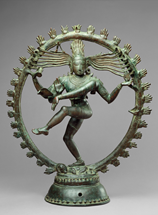
In her sustained focus on Shiva as the Dancer in all but one of the twenty-two verses of her hymns on Tiruvalankatu, Karaikkal Ammaiyar distinctively contributed to the early development of the image of Shiva asDancer as itself being worthy of devotion, contemplation and elaboration, and thus to its circulation as a recognized image of his power. In particular, her poetry played a role in expanding the meaning of Shiva’s dance from the mythological stories of a victory dance into a universal cosmic dance. Moreover, through her emphasis on devotional subjectivity, the poetess created a connection between the majestic Lord of the Dance and the here-and-now of the human lifespan (Pechilis 2013, 2016b). The bronze Nataraja (Naarāja) image of Shiva as the Dancer was definitively developed in Tamil south India in the tenth century (Kaimal 1999), and today it is one of the most famous and prized images from the classical art of India. [See image at right from the MET Museum; credits appear below.]

5) Assurances. Many of Karaikkal Ammaiyar’s verses indicate that she considers herself and all other servants of Shiva to have received his grace as salvation from their sorrows, including the sorrow of rebirth (the cycle of sasāra) based on their own actions (the law of karma). Such verses are interspersed throughout the “Wonder” and the “Garland,” creating the sense of oscillation between assurance and anxiety characteristic of bhakti poetry. However, the final verses, known as a signature verse, found at the conclusion of the “Wonder” as well as her two hymns on Tiruvalankatu, offer a concluding reassurance that devotion to Shiva results in spiritual salvation.

RITUALS/PRACTICES

Karaikkal Ammaiyar’s devotional priority was to keep Shiva always in mind. Her poetry does not describe the performance of rituals to Shiva, but instead urges humankind to focus on contemplating his form, nature, essence and power. Her compositions provide hearers or readers with the means to such contemplation, and her signature verses, found at the end of the “Wonder” and her two hymns on Tiruvalankatu, urge hearers or readers to recite her own verses in order to reach Shiva and experience bliss and salvation.

Her two hymns on Tiruvalankatu, however, provide a distinctive dimension to experiencing Shiva: They read as an eyewitness account of Shiva’s dance in the cremation ground. The scene is portrayed as forbidding, with the Lord dancing at midnight in the glow of a funeral pyre that barely illuminates the desolate theatre encircled by thickets of dried and inhospitable plants. Birds of prey and scavenger animals wander at will, screeching and howling their presence. Pey (ghouls), who are known from Sanskrit mythology to be a motley crew of misshapen beings who serve as Shiva’s dedicated attendants, appear here and there, consumed with their own frightful activities.

Whirling,
their eyes and mouths ablaze,
the ghouls perform the tunankai dance in a circle;
their dance is fear-inducing,
in which they eat the flesh of burned corpses.

Dancing in this cremation ground
with leg lifted and anklets ringing
revolving body erect
emitting flames that scatter the foxes
our father resides at Tiru Alankatu. (“Decade-1” v. 7; Pechilis 2012, 191)

And yet the observer, “Karaikkal pey” as she self-identifies in each of the two signature verses to the Tiruvalankatu hymns, remains there in that eerie place. Was she herself a pey? Those who believe so point to the first verse of “Decade-1,” which is a third-person description of a female pey , limning her form as hollowed and bony. This verse could have inspired her biographer Cekkilar, who depicted Karaikkal Ammaiyar as undergoing a bodily transformation into a “bag of bones,” as well as icon makers who created metal images of her with such characteristics to be carried in religious festival processions. While this predominant interpretation is plausible, there is a problem with it insofar as Karaikkal Ammaiyar’s hymns depict the pey as instinctual beings that do not have refined language, which is the antithesis of the devotional subjectivity Karaikkal Ammaiyar describes in the “Wonder” and the “Garland.” This would suggest that she joins the pey at the cremation ground to witness Shiva’s dance, but she does not become a pey herself. It is plausible that in journeying to and remaining at the socially shunned cremation ground at night Karaikkal Ammaiyar chose to appropriate and transform for her own devotional path then-current Tantric practices, which involved going to the cremation ground to become like Shiva (Pechilis 2016a). In Karaikkal Ammaiyar’s hymns, she encounters Shiva himself there, instead of becoming like Shiva. Her hymns suggest that a devotional subjectivity leads to a transformation of consciousness that enables the devotee to appreciate all aspects of the divine, including his awesome power over life and death. Taken as a whole, Karaikkal Ammaiyar’s compositions affirm that visceral knowledge of the finitude of the human lifespan compels one to live life as fully as possible in expressed dedication and service to Shiva.

ISSUES/CHALLENGES

One of the major challenges in studying Karaikkal Ammaiyar is to discern her perspective from her own poetry, separate and apart from the hegemony of her biographer Cekkilar’s description of her life. Such a study, to date infrequently undertaken, reveals that the poet had very distinctive humanistic priorities in her creation of a devotional subjectivity. A second challenge is to more completely understand the early medieval historical context of Karaikkal Ammaiyar, including political history (Ali 2004) as well as literary and religious history. A third challenge is to understand in scholarly and historical detail Karaikkal Ammaiyar’s influence and legacy in subsequent developments in Tamil Shiva-bhakti . A fourth challenge is to integrate Karaikkal Ammaiyar’s voice into global knowledge of both women’s history and feminist history (Pechilis 2014).

IMAGES

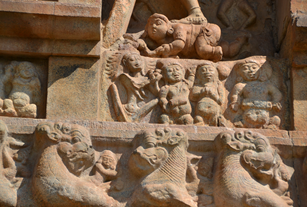
Image #1: Shiva as Nataraja on the western corner of the southern wall of the temple at Gangaikondacholapuram, India eleventh century. Karaikkal Ammaiyar is to the viewer’s left on the frieze below the Nataraja, seated with three of Shiva’s bhutaganas. She is depicted playing cymbals to Shiva’s dance. Photo taken by and © the author.
Image 2: Detail of Image 1. Photo taken by and © the author.
Image #3: Karaikkal Ammaiyar. India Chola Dynasty bronze ca. late thirteenth century, approx. nine inches height. MET Museum collection, www.metmuseum.org.
Image #4: Shiva Nataraja. India Chola Dynasty bronze ca. eleventh century, approx. twenty-seven inches height. MET Museum collection, www.metmuseum.org.

REFERENCES

Ali, Daud. 2004. Courtly Culture and Political Life in Early Medieval India. Cambridge: Cambridge University Press.

Craddock, Elaine. 2010. Śiva’s Demon Devotee: Kāraikkāl Ammaiyār. Albany: State University of New York Press.

Cutler, Norman. 1987. Songs of Experience: The Poetics of Tamil Devotion. Bloomington: Indiana University Press.

Dehejia, V. 1988. Slaves of the Lord: The Path of the Tamil Saints. New Delhi: Munshiram Manoharlal.

Filliozat, Jean. 1982 [1956]. “Introduction.” Pp. 1-14 in Chants dévotionnels tamouls de Kāraikkālammaiyār, ed. and trans. Kārāvelāne. Pondichéry: Institut Français d’Indologie.

Hart, George L., and Hank Heifetz. 1999. The Four Hundred Songs of War and Wisdom: The Puranānūru. New York: Columbia University Press.

Kaimal, Padma. 1999. “Shiva Nataraja: Shifting Meanings of an Icon.” The Art Bulletin 81:390–419.

Kārāvelāne. 1982a [1956]. “Avant-Propos.” Pp. 17-19 in Chants dévotionnels tamouls de Kāraikkālammaiyār, ed. and trans. Kārāvelāne. Pondichéry: Institut Français d’Indologie.

Mahalakshmi, R. 2011. The Making of the Goddess: Korravai-Durgā in the Tamil Traditions. New Delhi: Penguin.

Mahalakshmi, R. 2000. “Outside the Norm, Within the Tradition: Kāraikkāl Ammaiyār and the Tradition of Tamil Bhakti.” Studies in History 16, no. 1: 19–40.

McGlashan, Alastair. 2006. The History of the Holy Servants of the Lord Siva: A Translation of the Periya Purāṇam of Cēkkilār. Oxford: Trafford Publishing.

Nilakanta Sastri, K. A. 1955. A History of South India: From Prehistoric Times to the Fall of Vijayanagar. Madras: Oxford University Press.

Pechilis, Karen. 2016a. “Bhakti and Tantra Intertwined: The Exploration of the Tamil Poetess Kāraikkāl Ammaiyār.” International Journal of Dharma Studies 4, no. 2 (February 2016). Accessed from http://internationaljournaldharmastudies.springeropen.com/articles/10.1186/s40613-016-0024-x on 10 April 2016.

Pechilis, Karen. 2016b. “The Siva Nataraja Image: Poetic Origins.” Kalakshetra Journal 4:1-16.

Pechilis, Karen. 2016c. “To Body or Not to Body: Repulsion, Wonder and the Tamil Saint Kāraikkāl Ammaiyār.” In Re-Figuring the Body: Embodiment in South Asian Religions, edited by Barbara A. Holdrege and Karen Pechilis, in press. Albany: State University of New York Press.

Pechilis, Karen. 2014. “Devotional Subjectivity and the Fiction of Femaleness: Feminist Hermeneutics and the Articulation of Difference.”  Journal of Feminist Studies in Religion 30:99–114.

Pechilis, Karen. “ Śiva as the Lord of Dance: What the Poetess Saw.” Journal of Hindu Studies 6:131–53.

Pechilis, Karen. 2012. Interpreting Devotion: The Poetry and Legacy of a Female Bhakti Saint of India. London: Routledge.

Sanderson, Alexis. 2009. “The Śaiva Age: The Rise and Dominance of Śaivism during the Medieval Period.” Pp. 41-350 in  Genesis and Development of Tantrism, edite by Shingoo Einoo. Institute of Oriental Culture Special Series 23. Tokyo: Institute of Oriental Culture, University of Tokyo. Accessed from http://www.alexissanderson.com/uploads/6/2/7/6/6276908/sanderson_2009_the_saiva_age.pdf on 10 April 2016.

Zvelebil, Kamil. 1973. The Smile of Murugan: On Tamil Literature of South India. Leiden: E. J. Brill.

Post Date:
13 April 2016

Share

New Latter Rain Movement

NEW ORDER OF THE LATTER RAIN


NEW ORDER OF THE LATTER RAIN TIMELINE

1947 (Spring):  George Hawtin, a Pentecostal Assemblies of Canada pastor, founder of the college, and its principal, resigned under pressure from Bethel Bible College Saskatoon. Faculty member Percy G. Hunt resigned in sympathy.

1947 (October 21):  Hawtin and Hunt joined Herrick Holt, in a new work, Sharon Orphanage and Schools.

1947 (Late Fall):  Hawtin and Hunt, with several others, attended a Vancouver, British Columbia, revival led by healing evangelist William Branham.

1947-1948 (Winter):  Hawtin and others promoted a regime of long fasts and prayer meetings modeled on Branham’s revivals and the book, Atomic Power with God through Fasting and Prayer, by Franklin Hall.

1948 (February 11):  A young woman student reported a prophecy of a door opening into a gift of ministry in the body of Christ. Revival broke out on campus, drawing outsiders.

1948 (Easter):  Special services described as The Feast of Pentacost drew large numbers of people to the campus.

1948 (July 7-18):  What is considered the first Camp Meeting was held on campus, drawing worshipers in the thousands from all over Western Canada and places in the U.S. The teachings of this revival became known as The Latter Rain and spread widely.

1949:  General Council of the Assemblies of God USA condemned Latter Rain teachings. At least one key official resigned in protest, and the issue almost split the denomination.

1949 (Late):  Leadership of the movement began to slip from the hands of the Sharon group as other centers developed.

1952:  As an organized movement, the Latter Rain began to fade.

1967:  Characteristic Latter Rain positions became major elements of the Charismatic Renewal movement.

Present Day:  Latter Rain theology is central to numerous movements, such as the Vineyard Churches, The Kansas City Prophets, and the Toronto and Lakeland revivals, as well as hundreds of independent neo-Pentecostal churches.

FOUNDER/GROUP HISTORY

Several authors have placed the beginnings of the Latter Rain movement of the late 1940s (sometimes called the New Order of the Latter Rain to distinguish it from at least two earlier uses of the term “Latter Rain”) in a context of a Pentecostal renewal already well underway. Many Pentecostals felt that, after the Azusa Street period, Pentecostalism had become “dry” or had “cooled off” because it had lost its focus on the emotional, supernatural, and ecstatic manifestations of the Holy Spirit (Riss 1987:Chapters 1 and 2).

Several movements in the early war years had begun to examine this loss of supernatural emphasis and had spawned a generation of “Healing Revival” preachers, among them William Branham, who started his ministry somewhat later (1946). This made him contemporary with several better known revivalists, such as Billy Graham and Oral Roberts. But Branham was somewhat further outside of the mainstream, with his heavy concentration on casting out demons, supernatural healing, laying on of hands, end time predictions, and his contention that the doctrine of the Holy Trinity was wrong (Riss 1987:1-2, Chapters 1 and 2).

Meanwhile, a minister of the Pentecostal Assemblies of Canada (PAOC) known for his “unrestrained zeal,” George Hawtin, became involved in a dispute with the Saskatchewan District of the PAOC. Several years earlier, Hawtin had founded Bethel Bible College, then in Saskatoon. He had sold the college property to the district in order for the college to become an official institution of the district. He was soon in trouble with the district administration for, among other things, making decisions without informing or asking permission of the district. There were also questions about the college’s academic standards. In the late spring of 1947, Hawtin’s resignation was sought and given. Faculty member Percy G. Hunt resigned in sympathy (Riss 1987:53-55; Holdcroft 1980:2).

That fall, Hawtin and Hunt joined Herrick Holt, pastor of the Four Square Gospel church of North Battleford, Saskatchewan, in a new venture, Sharon Orphanage and Schools, founding that organization’s Bible college and becoming the nucleus of its first faculty. A substantial number of students from Bethel transferred to the new school (Holdcroft 1980:3).

At about the same time, Hawtin and others from Sharon journeyed to Vancouver, British Columbia, to attend a revival led by William Branham. They were deeply impressed by the supernatural and ecstatic elements of the revival, aspects of Pentecostalism they felt had been lost over the years. They also became aware of a book, Atomic Power With God through Fasting and Prayer, by Franklin Hall, which proposed that one could reach a level of direct communication with God by fasting for long periods (as much as 40 days) and engaging in extended periods of intense prayer (Riss 1987:56-60).

On the group’s return to North Battleford, they promoted the practices proposed by Hall and encouraged prayer for an “outpouring of the Holy Spirit” similar to what they had seen in the Branham revivals Riss 1987:60-63).

Students took up the challenge. On February 11, 1948, following a regime of fasting and prayer, one of them, a young woman, reported a prophecy involving an open door which was “an invitation for students to pass through into gifts and ministry in the Body of Christ.” Revival broke out on campus, classes were cancelled. Outsiders heard about what was happening and joined in (Holdcroft 1980:3).

Revival continued, including supernatural “signs and wonders.” Leaders, following Branham’s example, began “calling out” individual students, laying hands on them in order to impart “blessing in the spirit” (something Pentecostals had always believed involved “tarrying,” waiting prayerfully for the Lord) and then giving prophecies for each individual (Holdcroft 1980:3).

At Easter of that year (1948), the school held special services described as The Feast of Pentecost. The event drew large numbers of people to campus and led to the organization of what is considered the first Camp Meeting, held July 7-18, 1948. For this event, the attendance was in the thousands (Riss 1987:66-68).

By this time, the revival was becoming somewhat structured, and it was the teachings of this revival that, collectively, came to be called the Latter Rain, a term that had been in use periodically, at least since the late nineteenth century, to identify a particularly enthusiastic and emotional element in the developing Holiness and Pentecostal movements (Holdcroft 1980:1, 4-7).

These teachings, which were largely proclaimed as direct prophecy, generally followed the lines of phenomenon observed at
Azusa Street and in the meetings of William Branham. They included such things as speaking in tongues, being “slain in the spirit,” being baptized in the spirit, supernatural healing, singing in tongues (“heavenly choirs”), laying on of hands, and an imminence of end times, among others (Riss 1987:72-74).

These teachings spread very widely very quickly, splitting or absorbing a number of established Pentecostal churches and becoming a movement within a few months. While Latter Rain teachings valued relational networks and condemned denominationalism (contending that no church or organization had any right to give direction to any other church), the Sharon group early on formed a team of “Presbyters” who visited Latter Rain churches and essentially managed the movement through directive prophecy (Riss 1987:67-74; Holdcroft 1980:4, Apologetic Index n.d.:4).

By mid-1949, the movement had become a major concern for more orthodox Pentecostals. The General Council of The Assemblies of God USA meeting that year formally condemned Latter Rain teachings as unbiblical and heretical (Riss 1987:103-19).

In the meantime, several other centers formed. The first one was the Elim Bible Institute in New York, which had already been involved in attempts to revive a more emotional and supernaturally focused Pentecostalism and which already had the resources to compete with the Sharon group. The second center to rise to a position of influence was the Bethesda Missionary Temple in Detroit, Michigan; another soon followed in Texas. Leadership and control of the movement were quickly sliding out of the hands of the Sharon group and beginning to fragment (Riss 1987:103-10).

By 1952, the Latter Rain as a recognized movement was clearly beginning to fade, although a number of strong congregations continue into the present day. Also, a number of Latter Rain teachings became major parts of the Charismatic Renewal movement that blossomed starting about 1967 (Riss 1987:140-43).

Much Latter Rain teaching is central in numerous contemporary movements, such as the Vineyard Churches, The Kansas City Prophets, and the Toronto and Lakeland Revivals, as well as hundreds of independent neo-Pentecostal churches (Sanchez 2008:4-6; Houdmann 2002:2)

Of particular contemporary interest are two teachings of the movement that can be traced back to William Branham, teachings that are still widely held, despite not being prominent in the early life of the movement. The first is a powerful sense of a restoration of the attributes of the early church in preparation for the end times, including the “Five-fold gifts of the Spirit”: prophets, apostles, elders, preachers, and teachers (as outlined in Paul’s letter to the Ephesians). Prophets and apostles, it is understood, hold authority directly from God (Holdcroft 1980:6-7).

The second is also an end-times prophecy, that the most devoted members will become “The Manifest Sons of God,” forming an undefeatable and immortal army that is able to overcome all obstacles to bring all people into geographically organized single churches in preparation for the reign of the Lord. This prophecy is the basis for the Joel’s Army (or Overcomers), a phenomenon that has become prominent in recent years. Evangelist Todd Bentley, who led much of the Lakeland Revival, is a prominent proponent (Warnock 1951:83; Sanchez 2002:5-6).

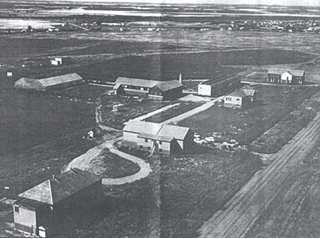
While there is no longer an active movement headquartered in North Battleford, the revival grounds themselves, now beautifully landscaped and with extensive facilities, still operate, though largely as a conference center. At least two religious meetings, including “The Feast of Pentecost” and a summer camp, are held each year, and there is also a global missions project housed there (Holdcroft 1987:7).

DOCTRINES/BELIEFS

The doctrines and beliefs of the Latter Rain religious revival movement are somewhat difficult to define since collectively they constitute something of a moving target, and have never been officially codified.

The movement was a protest against the more formalized Pentecostalism of the time, particularly what was considered by many to be a “dry” denominational church, lacking in emotional and spiritual life (Holdcroft 1980:2). Further, it was a movement that tended largely to privilege the mystical and subjective (prophecies, experiences, intuition, and directives straight from God) over exegeses of the written word. These prophecies and directives changed from time to time. Also, when the movement used the Bible, it did so in a highly stylized, symbolic and typological interpretation (that is, looking to the Hebrew Scriptures to interpret the New Testament) (Holdcroft 1980:2-7; Houdmann 2002:1).

Notwithstanding the above, it is possible to identify a number of teachings or beliefs, though leaders of the movement would resist the institutional implications of calling them doctrines.

First and foremost, of course, is the acceptance of the concept of The Latter Rain as found in the Hebrew Scriptures in the books of Deuteronomy (11:14), Joel (2:23) and Zechariah (10:1). These passages describe an early rain to start a crop and a latter rain to bring it to maturity for harvest. Latter Rain adherents see their revival as a sure sign that end times are imminent (Theopedia n.d.:1).

The Latter Rain movement saw the term “Latter Rain” as symbolizing a time of restoration of a victorious, universal church, including all of the apostolic gifts, in the end times, in contrast to the rather dour, pessimistic, Calvinistic dispensationalism widely held in the Pentecostalism of that period. Where the healing revivalists of the time emphasized healing and early Pentecostals emphasized tongues, Latter Rain emphasized prophecy (Riss 1987:116).

The apostolic gifts to be restored included speaking in tongues, healing, spirit blessing, prophecy, and the five-fold ministry, including prophets, apostles, evangelists, preachers and teachers. The roles of prophets and apostles, lost to the church in the Middle Ages, would now be restored to provide leadership of the victorious church, preparing the world for the return of Jesus Christ. Put another way, the Latter Rain will complete God’s work on earth, with the church united and victorious over the world, and will usher in the Kingdom of God. The movement also believed that spiritual gifts (including healing) could be received by the laying on of hands from one believer to another, in contrast to the traditional Pentecostal emphasis on “tarrying” (prayerful waiting for God’s presence) (Theopedia n.d.:1; Houdmann 2002:1-2).

Most other teachings followed from these basic beliefs, but the interpretation of these beliefs was carried out within the context of an intense, active search for a subjective, emotional, and interactive relationship with God. This meant that the prioritization and emphasis given the various elements of these beliefs tended to be shifting and circumstance-specific. Part of this circumstantial context was the belief that Christians could be demonized and require deliverance. Another part was the belief that intense, emotional praise and worship could usher God into the believers’ presence (Houdmann 2002:1-2). A somewhat unrelated belief was that women should have full and equal ministry (Houdmann 2002:2).

There are debates over whether the Latter Rain movement should be considered premillennial, postmillennial or just amillenial. Most Latter Rain believers seem to have accepted an end-times scenario in which denominational lines will be destroyed and the church will be unified by “overcomers” equipped with supernatural powers, thus preparing the world for the return of Jesus Christ and the beginning of the Kingdom of God. The role and timing of the Tribulation and the Rapture do not appear to have been settled. These issues are considered important by a number of groups, notably dispensationalist fundamentalists (Warnock 1951:83).

There was also the belief, inherited from William Branham and expanded by latter Rain teachers, notably George Warnock in his book The Feast of Tabernacles, that certain very devout members would become “The Manifest Sons of God”. Those who reached this level would have Godlike powers that included speaking any language and “teleporting” from place to place, forming an army that is able to overcome all obstacles to bring all people into geographically-organized single churches in preparation for the reign of the Lord. This prophecy is the basis for the Joel’s Army (or Overcomers) concept (Warnock 1951:83; Sanchez 2008:5).

Defenders of Latter Rain teachings see them as “a major step in the long unfolding of Biblical truth. They place themselves on a par with the Reformers, the Puritans, the Wesleyans, and the nineteenth century evangelical revival. New Order doctrine, they believe, is the final rung in the ladder whereby God’s people climb upward as they ‘go on unto perfection’” (Holdcroft 1980:8).

RITUALS/PRACTICES

Worship services conducted by Latter Rain churches were either revival services or events modeled after them. Most were exuberant, since members came seeking an emotional and personal spiritual experience. The service could also be described, using a much later term, as interactive, since worshipers took a very active part in the service (Holdcroft 1980:10).

Since Latter Rain teaching held that intense praise and worship would usher God into the worshipers’ presence (sometimes described as the restoration of the Tabernacle of David), the early part of these services usually consisted of music, including singing in tongues, dancing and waving raised hands, and individual shouts of praise (Liichow 1997:3; Houdmann 2002:2).

Once an intense atmosphere had been established, there might be a sermon on an end times or prophecy theme, followed by an extended time of healing, casting out demons, testimony, and spirit blessing. This would again include individuals falling down “slain in the spirit,” speaking and singing in tongues, interpretation of tongues, and weeping. Healing and exorcisms were performed by the leader praying and “laying on of hands.” Early on, Latter Rain congregations developed the practice of “calling out” individuals by name, blessing them with a laying on of hands, and providing a prophecy for them (Holdcroft 1980:4-5).

The times of service tended to be flexible, again following the revival practice. If testimony and seeking continued, so did the service in most cases. Services tended to be long and to occur several times a week (conventionally Sunday morning and evening and Wednesday evening, but other times were often scheduled).

LEADERSHIP/ORGANIZATION

Initially the leadership of the Latter Rain consisted of just three men: George Hawtin, Percy Hunt, and Herrick Holt. Over time, as the movement expanded, so did the leadership group, and eventually leadership passed out of the hands of the Sharon group (Holdcroft 1980:1-4).

There does not appear to be any record of who within the early Sharon group, other than Hawtin, were among those who went to Vancouver for the William Branham meetings, save that there were “several” people. Given the timing, a fair guess is that all three were involved (Riss 1987:56-57).

But once the revival began at the school, others became involved rather quickly. With the formal beginning of the Bible school,

the three founders were soon joined by George Hawtin’s brother and brother-in-law, Ernest Hawtin and Milford Kilpatric. As the
revival gained momentum, they were also joined by George Warnock. Warnock had once been personal secretary to W. J. Ern
Baxter, who had become an associate of Branham’s ministries. Baxter himself later joined the group on a part-time basis. Warnockwrote a book called The Feast of Tabernacles, which has been held to be a major publication of the group, and expanded on Branham’s concept of “The Manifest Sons of God” (Riss 1987:53-62).

In terms of church polity, the movement established a position that strongly supported local church autonomy and opposed any form of denominationalism. One observer noted that “conflict and hostility emerged in relationships with the New Order because of their vindictive militant denunciations of existing denominations and church policies.” An oft-reported remark of one of the leaders was that “no church exercises or has any right to exercise authority of jurisdiction over another church, its pastors or members.” Yet in spite of this rhetoric and positioning, leaders of the movement did in fact exercise control, both within and without the group (Holdcroft 1980:6-7; Apologetics Index n.d.:2).

The belief that apostles and prophets were being restored to the church in this era gave rise to identifying movement leaders with these positions, and allowing them to contend that their directive prophecies came directly from God, and that, therefore, these prophecies were beyond question or challenge. Control within the group was reportedly tight, being described by at least one former member as “dictatorial” (Holdcroft 1980:5-7).

The Sharon group also formed teams of travelling “Presbyters” that included these apostles and prophets, who visited Latter Rain churches and institutions, controlling them through prophecies that were considered to have precedence over any other decision-making authority. The Sharon group has been described as rejecting any teaching that did not originate with its leaders (Holdcroft 1980:6-7).

ISSUES/CHALLENGES

The movement that came to be known as The New Order of The Latter Rain was born in controversy. One author has stated flatly that it “was an organizational schism before it was a spiritual cause.” The same author, L. Thomas Holdcroft, describes the schism as “the unrestrained zeal (of the founder and leaders of Bethel Bible Institute) pitted against the necessary conservatism and restraints of responsible denominational leaders” (Specifically the Saskatchewan District of the Pentecostal Assemblies of Canada) Holdcroft 1980:2).

This “unrestrained zeal” continued after the key players moved to North Battlefield and, over time, provided fuel for a number of other controversies. The group’s somewhat unorthodox beliefs provided sparks. Its success in drawing large numbers of members from other churches, nearly splitting the Pentecostal Assemblies denomination, fanned the flames (Holdcroft 1980:3-4).

The earliest controversies grew from the vituperative comments made, and sometimes published, by the founders regarding the leaders of other churches and denominations. Later theological controversies fall primarily into two groups, largely identifiable by the source of the criticism, though there is substantial overlap (Holdcroft 1980:6).

The first of these originated very early on and came largely from Pentecostal sources. Pentecostals rejected the use of personal prophecy, the transmission of spiritual gifts (such as healing, prophecy and tongues) by the laying on of hands from one believer to another. The also rejected what was considered by Pentecostals to be distortion of Scripture, the belief in the Manifest Sons of God predictions, and the restoration of the positions of apostle and prophet, calling all of these contrary to the historic teachings of Pentecostalism. This list of objections formed the basis for the 1949 official rejection of the Latter Rain movement by The Assemblies of God and several other Pentecostal organizations (Riss 1987:119).

Later, a fairly large number of generally fundamentalist groups published, first in books and journal articles and later on websites, objections to the eschatological teachings of the Latter Rain, to the Manifest Sons teaching, to the restorationist teaching that identified specific living apostles and prophets, to what they considered “untested” prophecy, and to what they also considered misuse, or failure to use, Scripture. One of the more succinct statements of this position is from Holdcroft: “No group can remain sound in faith and practice if it gives authority to experiences for their own sake, rather than on the ground of the standards of the Word of God” (Holdcroft 1980:10).

Another, much broader criticism comes from sources outside of these two communities and applies to Pentecostals generally and perhaps to groups within the Holiness tradition as well, but has been aimed specifically at Latter Rain teachings. That is the contention that the emotionalism, supernaturalism, tongues, healing, and other teachings concerning spiritual gifts, constitute a modern neo-Montanism, a revival of a third century Christian heresy. This is an issue that goes well beyond the scope of the present article. (“A Study of Denominations,” n.d.:1-4).

Contemporary criticism revolves not around the Latter Rain movement itself, but around the various present-day manifestations
of teachings and practices that originated with, or were developed out of, Latter Rain teachings. Some of these include the Army of Joel and similar groups based on the Manifest Sons of God teaching (which actually came originally from William Branham), the Shepherding movement, restorationism and dominionism (Sanchez 2008:1-6).

REFERENCES

Apologetics Index, Apologetics Research Resources on Religious Cults and Sects. n.d. Accessed from www.apologeticsindex.org/108.html on 29 November 2013.

Holdcroft, L.Thomas. n.d. Strange Fires, The New Order Of The Latter Rain . Accessed from www.spiritwatch.org/firelatter2.htm on 5 August 2013 .

Houdmann, S. Michael. n.d. Got Questions.org . Accessed from www.gotquestions.org/latter-rain-movement.html 5 August 2013.

Liichow, Rev. Robert S. n.d. Restoration “The Latter Rain Movement .” Accessed from www.newdiscernment.org/restorat.htm on 5 August 2013.

Riss, Richard M . 1987. Latter Rain; The Latter Rain Movement of 1948 and the Mid-Twentieth Century Evanngelical Awakening . Honeycomb Visual Productions, Ltd., Mississiauga, Ontario, Canada.

Sanchez, Casey. 2008. Todd Bentley’s Militant Joel’s Army Gains Followers in Florida .

Southern Poverty Law Center Intelligence Report , Fall. Accessed from www.splcenter.org/get-informed/intelligence-report/browse-all-issues/2008/fall/arming for armageddon on 26 November 2013.

A Study of Denominations, Montanism. n.d. Accessed from www.astudyofdenominations.com/history/montanism/ on 26 November 2013.

Warnock, George H. 1951. The Feast of Tabernacles. Bill Britton: Springfield, MO.

Author:
John C. Peterson

Post Date:
10 January 2014


Share

Lois Roden

LOIS RODEN TIMELINE

1916 (August 1):  Lois Irene Scott was born in Stone County, Montana.

1937 (February 12):  Lois and Ben Roden married.

1940:  Lois and Ben Roden became members of the Seventh-day Adventist Church in Kilgore, Texas.

1945:  The Rodens visited the Davidians’ Mount Carmel Center, near Waco, Texas, and were disfellowshipped by their local Seventh-day Adventist Church.

1955:  Ben Roden announced Branch Davidian teachings .

1962:  The Rodens moved to Mount Carmel and established the Branch Davidian community there.

1977:  Lois had a vision that the Holy Spirit is feminine. She became co-prophet of the Branch Davidians with her husband until his death.

1978:  Ben Roden died and Lois assumed full leadership of the Branch Davidians.

1980:  Lois published a new journal, SHEkinah, to promote her views.

1983:  Lois lost authority to David Koresh who won majority support among the Branch Davidians.

1986 (November 10):  Lois Roden died; she was buried in Israel.

BIOGRAPHY

Lois Irene Scott [Image at right] was born in Stone County, Montana, August 1, 1916. She married Benjamin L. Roden on February 12, 1937. They  had six children (George, Benjamin, Jr., John, Jane, Sammy and Rebecca) (Newport 2006 :117). The Rodens joined a Seventh-day Adventist church at Kilgore, Texas in 1940. They were fully committed to the teachings of the Seventh-day Adventist prophet Ellen Harmon White (1826-1915) concerning the imminent Endtime events and return of Christ as well as the need to observe the seventh-day sabbath (Saturday).

In 1945, Lois and Ben Roden made contact with the Davidian Seventh-day Adventists (Newport 2006 :118), led by their prophet, Victor Houteff (1885-1955). The Davidians were living in community on property named Mount Carmel in Waco, Texas. Disfellowshipped by their Seventh-day Adventist church in Kilgore, Ben and Lois Roden adopted Davidian views. After Victor Houteff died, Ben showed up at Mount Carmel and announced that he was the new Elijah. Citing Isaiah 11:1, he also made the claim that God had revealed to him the new name of Christ: “The Branch” (Zechariah 6:12). This marked the appearance in 1955 of a third distinctive group in this line of millennial Adventists, the “ Branch Davidians.” The Davidians rejected Ben’s leadership at first, initially accepting the leadership of Florence Houteff, Victor’s wife (Pitts 2009).

Ben’s [Image at right] hope was to establish a physical Davidian millennial kingdom in Israel. Both Ben and Lois spent much time in Israel during the next several years trying to achieve this goal. They created a pilot settlement at Amirim, which Lois directed. But the group as a whole never moved there (Doyle with Wessinger and Wittmer 2012:199). Whereas Ben was quiet, Lois was characterized as “exceptionally dynamic and [the leader of] the group for a number of years” (Newport 2006:115, 136).

Victor Houteff’s widow, Florence, announced the great eschatological moment for April 22, 1959 and Davidians gathered at the new Mount Carmel property located east of Waco, which she had purchased after selling the original Mount Carmel property. The prediction failed. Florence Houteff’s failure offered an opening to Ben Roden and Lois Roden to assert leadership of the Davidians; most of the small remnant of Davidians remaining at Mount Carmel accepted the prophetic leadership of Ben Roden in 1962. The Rodens spent time securing control of the Mount Carmel property and the full allegiance of members.

As Ben’s health was declining in 1977, Lois Roden’s most significant personal religious experience occurred. During the night she had a vision of a silver shimmering feminine figure (Lasovich 1981), which she identified as “the Holy Spirit of God” (Bonokoski 1981). Her vision convinced the Branch Davidians that she was the next prophet of the group.

TEACHINGS/DOCTRINES  

Lois Roden’s most enduring legacy among the Branch Davidians was her teaching that the Holy Spirit is feminine. In 1980, she published a mimeographed three-part study entitled By His Spirit (Roden 1980). The group secured an offset press, and in December 1980 she launched SHEkinah, [Image at right] a regularly published journal for disseminating her teaching (Roden and Doyle 1980–1983). She, along with Clive Doyle as co-editor and printer, searched newspapers, popular magazines and academic publications for articles that explored the ideas of the feminine character of God and the ordination of women. Some mainline Protestant denominations had begun ordaining women in the 1950s, and many more denominations began ordaining women as ministers in the 1970s. Meanwhile, feminist scholars studying the early Christian churches found evidence for belief in the feminine character of God and the existence of female clergy among early Christian churches.

Adventists, Davidians and Branch Davidians did not find women’s leadership to be novel, but Lois Roden’s belief in the Holy Spirit as female was revolutionary. She appropriated these proto-feminist emphases during her leadership of the Branch Davidians. She based her understanding of the Trinity on scripture, noting that the text of Genesis 1:26-27 (King James Version) reads, “Let us make man in our image, after our likeness…. So God created man in his own image, in the image of God created he him; male and female created he them.” She explained her reasoning as follows:

Because Adam and Eve were both made in the images of the Godhead I saw that Eve was not made in the image of the Father or the Son, but in the image of a feminine person of the Godhead. So it had two persons who said, “Let us make man in our image, male and female.” That was the key that I got, to know that the woman was a symbol on earth of the Holy Spirit in heaven (Bryan 1980).

She cited word studies to support her argument: the Hebrew word for spirit, ruach, is feminine, and one word for God, elohim, is plural. Moreover, she drew a logical analogy from a human family (father, mother, son) to support her view of the feminine presence in the Trinity. Roden’s views were criticized, but she held to her interpretation. She convinced the Branch Davidians that the Holy Spirit is feminine, a view that surviving faithful Branch Davidians still hold. For outsiders, this was Lois Roden’s most well-known claim. She said that her teaching was not motivated by feminism, but rather by her vision of the Holy Spirit and her understanding of scripture (Lasovich 1981).

Lois Roden’s other major idea was her defense of the authority of women in positions of religious leadership in the Christian tradition. The movement for women’s rights during the 1960s and 1970s (the Second Wave feminist movement) was a fundamental revolution in American life. Recognizing leadership by women in churches was controversial: conservative denominations resisted the change while mainline churches began to embrace it. Roden took a mediating position on the issue, arguing, “The male shouldn’t dominate, and the female shouldn’t dominate.… The Church should play a more active role in bringing about the equality of the sexes” (Halliburton 1980). This argument was not just theoretical. Lois Roden’s son, George Roden (1938–1998), contested her leadership of the Branch Davidians throughout his mother’s tenure. She needed the argument to justify her leadership of the group.

For Lois Roden these two ideas, the feminine nature of the Holy Spirit and women’s religious authority, were closely related. Her vision in 1977 opened her thought to embrace the feminine side of God. She saw women’s leadership roles in religious organizations as a corollary to understanding the Holy Spirit as female (Halliburton 1980).

RITUALS/PRACTICES 

Ben Roden implemented observance of the annual Jewish festivals of Pentecost and Tabernacles as well as Passover, giving them eschatological interpretations (Newport 2006:148-50). The Branch Davidians regarded these as especially holy seasons of the year that reminded them of their beliefs about the coming Judgment, which would witness the destruction of many and the salvation of others. Under Lois Roden’s leadership Passover continued to serve an important theological function among the Branch Davidians (Doyle with Wessinger and Wittmer 2012:88–91). Passover was also the occasion for many Branch Davidians living elsewhere to travel to Texas to join the Mount Carmel group for worship and Bible studies (Haldeman 2007:29, 93-94).

The central ritual was what the Branch Davidians called “the Daily.” According to Newport (2006), the Daily was the name given to their gatherings at 9:00 A.M. and 3:00 P.M. for Bible study and teaching by the Branch Davidian prophet. Lois added to the Daily the taking of unleavened crackers and grape juice as “Emblems” representing the body and blood of Christ (Wessinger 2013).

Whereas most churches center on a weekly gathering for worship, the Branch Davidians were devoted to searching for truth from the Bible; therefore regular gatherings for teaching remained the center of their religious life. Since the deaths of eighty-two Branch Davidians in the conflict with federal agents at Mount Carmel in 1993, a scattered remnant of Branch Davidians who have taken regular jobs in society have had to modify their practice. They are not able to gather as a community for daily study. The Branch Davidians remaining in Waco gather on Saturday for Bible study.

LEADERSHIP

Seventh-day Adventists had a well established tradition of accepting biblical interpretation by modern prophets. Beginning with Martin Luther (1483–1546), Adventists accepted a succession of Christian leaders, including John Knox (1513-1572), John Wesley (1703–1791), Alexander Campbell (1788–1866), William Miller (1782-1849) and Ellen White , who were recognized as prophets because they shed new light on understanding the faith. The Branch Davidians also included more recent prophets, Victor Houteff, Ben Roden, and now Lois Roden.

Prophets in the Davidian-Branch Davidian lineage typically did not reject teachings of their predecessors, but rather built on them and added “new truths” to understanding scriptural prophecies. Houteff likened their task to unrolling a scroll, revealing new insights about the faith (Houteff 1930:114). Hence their key role was to serve as teachers who illuminated the meaning of scriptural texts. The prophets were regarded as possessing “the Spirit of Prophecy,” and Branch Davidians were eager to hear new teachings (Pitts 2014).

Also significant was the precedent of a woman prophet set by Ellen White, who was recognized as the most influential voice in Seventh-day Adventism. Lois Roden (1979a) often referred to “Sister White,” and the Branch Davidians had no problem following the leadership of “Sister Roden.” While accepting the practices of previous leaders, Lois Roden was also deeply influenced by changing gender roles in American culture, and she added two new progressive teachings of her own, making strong arguments for the feminine character of God and for women’s religious leadership.

Lois Roden inherited both the leadership style as well as the teachings and practices of the Branch Davidians, which she modified to meet the needs of her day. Victor Houteff [Image at right] established the style of leadership practiced among the Davidians/Branch Davidians. He set forth the organization of the General Association of the Davidian Seventh-day Adventists in a constitution he called The Leviticus (Houteff 1943). In it he was named the president; the other executive officers ( vice president, treasurer and secretary ) were family members and one close associate who held office only as long as they were approved by the president. Following Houteff’s lead, Ben Roden also composed a Leviticus for the General Association of the Branch Davidian Seventh-day Adventists.

During the years of Ben’s leadership of the Branch Davidians, Lois was a very active leader in her own right. Women such as Bonnie Haldeman (David Koresh’s mother) wrote with respect and affection for the work of “Sister Roden” (Haldeman 2007). Many other Branch Davidians attest to her initiative and spiritual leadership in religious matters during Ben’s leadership. Lois exercised the leadership in establishing a Branch Davidian community in Israel. Her loyalty to her husband’s teachings is notable. He was of Jewish extraction and sought not only to establish the new kingdom in Israel, but also to be buried there. She honored that wish, having his body exhumed and reburied in Israel.

Lois Roden developed her vision of the feminine character of the Holy Spirit as her most important teaching. Immediately after her vision she began to offer studies and publish them in “Christ and the Holy Spirit” (Roden 1978). Significantly the Branch Davidians accepted this view as a teaching from God and therefore recognized Lois Roden as a legitimate prophet who could teach along with her husband Ben as co-prophet. She also took practical legal steps to consolidate her leadership by having members sign a circular letter written in legal language, granting her full legal and financial control of the Branch Davidian Seventh-day Adventist Association assets (Roden 1979b). Ben Roden died October 22, 1978, and Lois led the group from 1978 to 1983.

In accepting Lois Roden’s prophetic leadership, the Branch Davidians recognized a position of authority far beyond the level exercised by ministers in most denominations. They accepted her opinions as the voice of God. She worked tirelessly to promote her own “present truth” or new teachings. She travelled across the United States, to Canada, Israel and elsewhere delivering her message. She demonstrated leadership by serious devotion to her tasks, and she spent her time and resources imparting her teachings. Her deep commitment to Branch Davidian teaching was apparent.

Lois Roden had labored with her husband Ben Roden among the Branch Davidians for more than twenty years and then displayed enormous energy during her short-lived period of prophetic leadership. She published a new journal, SHEkinah, co-edited and printed by Clive Doyle (Roden and Doyle 1980–1983), and produced numerous audiotapes to disseminate her views. She traveled constantly, teaching her view of the Branch Davidian message and giving numerous interviews to newspaper reporters who were interested in presenting her unique views to the public.

Lois Roden inherited structures created by the previous generation of believers, including a base at Mount Carmel, a following of about forty Branch Davidians, and financial resources to travel and publish (Doyle with Wessinger and Wittmer 2012:40). She had the assistance of devoted followers, including her secretary Catherine Matteson, and Clive Doyle. She struggled with her son George Roden and eventually with newcomer Vernon Howell (later known as David Koresh, 1959-1993 ), who arrived at Mount Carmel in 1981, to maintain her leadership. She fended off her son’s attempt to replace her (Roden and Roden 1985–1986). But according to Catherine Matteson (2004), by 1983 most of the Branch Davidians believed that Lois Roden had lost the “Spirit of Prophecy” and consequently that authority was transferred to David Koresh. Lois Roden died in 1986. Her remains were transported to Israel where she was buried beside her husband.

ISSUES/CHALLENGES

Through her will and courage Lois Roden prevailed as Branch Davidian leader for a while, but she had to confront serious challenges to her leadership from male competitors. First, her son George [Image at right] was a rival throughout her years of prophetic leadership. He offered both gender and theological arguments to support his claim to succeed his father as prophet; failing that, he resorted to force. He was mentally unstable and violent, carrying a gun on the Mount Carmel grounds and into the church and threatening people (Doyle with Wessinger and Wittmer 2012:53–54). Because of fear of George Roden’s violence, the majority of the Branch Davidians, along with their new leader Vernon Howell/David Koresh, left to live in a camp they constructed in the woods near Palestine, Texas (Doyle with Wessinger and Wittmer 2012:60–61). In 1988, they were able to return to Mount Carmel under Koresh’s leadership.

The other person vying for prophetic leadership of the Branch Davidians was Vernon Howell/David Koresh. He came to Mount Carmel in 1981 and, by accounts, worked hard to be accepted by the community. Lois Roden befriended him, and his stature in the community rose rapidly. She cultivated him, served as an example of leadership, and communicated her eschatological message (Newport 2006:166–67). In the end, however, Koresh challenged her leadership, and the majority of Branch Davidians sided with him. Lois Roden lost power to Koresh in 1983. According to the Branch Davidians, “the Spirit of Prophecy” abandoned her and she thereby lost the spiritual basis for her authority (Pitts 2014).

After David Koresh [Image at right] led the majority of the Branch Davidians away from Mount Carmel in 1984, Lois Roden was left to live there while her son George took control of the property. She died on November 10, 1986 at age seventy, and her body was transported to Israel for burial. George Roden lost control of the Mount Carmel property to Koresh’s Branch Davidians in 1988 while George was imprisoned for threatening a judge. He subsequently killed a man and spent the rest of his years in a state mental hospital.

Ten years after Lois Roden lost her leadership to David Koresh, the Branch Davidian movement faced its ultimate crisis. In conflicts with federal law enforcement agents in 1993, the Branch Davidians’ home ultimately burned to the ground in a fire that killed seventy-six members, including children, almost destroying the Branch Davidians as a religious movement. However, a small remnant remains.

Lois Roden exercised a powerful influence in shaping the work of Ben Roden, the prophet who preceded her, and also David Koresh, the prophet who succeeded her. Moreover, she led the Branch Davidians to embrace new views during her own tenure as their prophet. She was both a product of her own time and a creative and resourceful American religious leader who made important contributions to the Branch Davidian tradition.

IMAGES

Image #1: Photograph of Lois Roden.

Image #2: Photograph of Benjamin Roden, husband of Lois Roden.

Image #3: Photograph of the front page of SHEkinah, the periodical through which Lois Roden published her spiritual discoveries.

Image #4: Photograph of Victor Houteff.

Image #5: Photograph of George Roden, Lois Roden’s son.

Image #6: Photograph of Vernon Howell/David Koresh, who succeeded Lois Roden as leader of the Branch Davidians.

REFERENCES

Bonokoski, Mark. 1981. “Our Mother Who Art in Heaven.” SHEkinah, December.

Bryan, Paul. 1980. “An Interview with Lois Roden.” The Paul Bryan Talk Show. WFAA, Dallas, Texas. November 4. Reprinted in SHEkinah, December 1980.

Bull, Malcolm, and Keith Lockhart. 2007. Seeking a Sanctuary: Seventh-Day Adventism and the American Dream. Second Edition. Bloomington: Indiana University Press.

Doyle, Clive, with Catherine Wessinger and Matthew D. Witmer. 2012. A Journey to Waco: Autobiography of a Branch Davidian . Lanham, MD: Rowman and Littlefield.

Haldeman, Bonnie. 2007. Memories of the Branch Davidians: The Autobiography of David Koresh’s Mother, edited by Catherine Wessinger. Waco, Texas: Baylor University Press.

Halliburton, Rita. 1980. “Centexan: Holy Spirit Female.” Waco Tribune Herald, April 26, B-5. Reprinted in SHEkinah, December 1980.

Houteff, Victor T. 1943. The Leviticus of Davidian Seventh-day Adventists. Mt. Carmel Center: V. T. Houteff.

Houteff, Victor T. 1930, 1932. The Shepherd’s Rod. Mt. Carmel Center: V. T. Houteff.

Lasovich, Mary. 1981. “Her Crusade to Tell the World the Holy Spirit Is Feminine.” Kingston Ontario Whig Standard, February 28. Reprinted in SHEkinah , April 1981.

Matteson, Catherine. 2004. “Interview #2 by Catherine Wessinger.” Texas Collection. Baylor University, Waco, Texas.

McGee, Dan. n.d. “Davidians and Branch Davidians” (typescript). Texas Collection. Baylor University, Waco, Texas.

Newport, Kenneth G. C. 2006. The Branch Davidians of Waco: The History and Beliefs of an Apocalyptic Sect. Oxford: Oxford University Press.

Numbers, Ronald L. and Jonathan M. Butler, eds. 1987. The Disappointed: Millerism and Millenarianism in the Nineteenth Century . Bloomington: Indiana University Press.

Pitts, William L., Jr . 2014. “ SHEkinah : Lois Roden’s Quest for Gender Equality.” Nova Religio 17:37–60.

Pitts, William L., Jr . 2009. “Women Leaders in the Davidian and Branch Davidian Traditions.” Nova Religio 12:50–71.

Pitts, William L., Jr. 1995. “Davidians and Branch Davidians.” Pp. 20-42 in Armageddon in Waco, edited by Stuart A. Wright. Chicago: University of Chicago Press.

Roden, George, and Lois Roden. 1985-1986. “Legal Documents.” Texas Collection. Baylor University, Waco, Texas.

Roden, Lois. 1980. By His Spirit. Bellmead, TX: Living Waters Branch.

Roden, Lois. 1979a. “Eden to Eden.” Taped teaching. Texas Collection. Baylor University, Waco, Texas.

Roden, Lois. 1979b. “Numbering the People.” Texas Collection. Baylor University, Waco, Texas.

Roden, Lois. 1978. “Christ and the Holy Spirit: Two Turtle Doves.” Bellmead, TX: Living Waters Branch.

Roden, Lois, and Clive Doyle, editors. 1980-1983. SHEkinah. Copies of all issues are housed in the Texas Collection. Baylor University, Waco, Texas.

Saether, George William. 1977. “Oral Memoirs.” Institute for Oral History. Baylor University, Waco, Texas.

Seventh-day Adventists Believe: A Biblical Exposition of 27 Fundamental Doctrines. 1988. Washington, D.C.: Ministerial Association General Conference of Seventh-day Adventists.

Wessinger, Catherine. 2013. “Branch Davidians (1981-2006).” World Religions and Spirituality Project. Accessed from http://wrldrels.org/profiles/BranchDavidians.htm on 10 July 2016.

White, Ellen. 1888. The Great Controversy. Battle Creek, Michigan: James White.

Post Date:
11 July 2016

Share

Koinonia Farm

KOINONIA FARM TIMELINE

1912:  Co-founder Clarence Jordan was born in Talbotton, Georgia.

1942:  Clarence and Florence Jordan and Martin and Mabel England bought Koinonia Farm. The Englands soon returned to Burma, leaving the Jordans to work the farm.

1956:  Area farmers, merchants, and stores began boycotting Koinonia Farm.

1956:  Dorothy Day visited Clarence Jordan at Koinonia Farm.

1956:  Clarence Jordan was asked to recommend two black students to attend the University of Georgia, which resulted in a backlash against Koinonia Farm.

1965:  Millard and Linda Fuller visited Koinonia Farm.

1969:  Millard Fuller and Clarence Jordan developed a plan to provide homes for low-income residents near Koinonia Farm. This became Koinonia Partnership Housing, and Koinonia Farm was sometimes referred to as Koinonia Partners.

1969:  Clarence Jordan died of a heart attack in his writing shack at Koinonia Farm.

1976:  Millard Fuller founded Habitat for Humanity based on the plans he and Clarence Jordan developed in the late 1960s.

1993:  Koinonia Farm became Koinonia Partners, Inc., and modeled itself on a corporate non-profit structure. Members no longer shared a common purse.

2005:  Koinonia Farm was designed a Georgia Historic Site.

2005:  Koinonia Partners moved back to an intentional community model and returned to using the name Koinonia Farm.

2008:  Koinonia Farm received the Community of Christ International Peace Award.

2012:  The first Clarence Jordan Symposium was held in Americus, GA, to celebrate the one hundredth anniversary of Clarence Jordan’s birth and the seventieth anniversary of the founding of Koinonia Farm. Jimmy Carter and many others participated.

FOUNDER/GROUP HISTORY

Koinonia Farm was founded in 1942 by two Baptist couples, Clarence and Florence Jordan and Martin and Mabel England. The purpose of Koinonia Farm was to live out Christianity as they found it in the New Testament. Clarence Jordan called Koinonia Farm “a demonstration plot for the kingdom of God.” (Coble 1999) Soon after the founding of Koinonia Farm, the Englands returned to missionary work abroad. Although many people came and went, and a few families lived at Koinonia Farm for many years, the Jordans were the one consistent family from 1942 until 1969, when Clarence Jordan died (K’Meyer 1997).

Clarence Jordan was a Southern Baptist minister who became a pacifist during his time in college at the University of Georgia. He studied agriculture with the hope of providing help to the poor farmers in rural Georgia. Jordan went on to seminary at Southern Baptist Theological Seminary in Louisville, KY, for a Master of Divinity degree and a doctorate. He studied Koine Greek for his Ph.D., and he was interested in living out his Christian faith as he saw it presented in the Gospels and the Book of Acts in the New Testament. Having grown up in rural Georgia, he also worked to fight the heavy hand of racism that he
saw in the South (Lee 1971).

The Jordans purchased Koinonia Farm, located near Americus, Georgia, in order to live out their faith in a rural setting. Clarence Jordan called the farm a demonstration plot for the kingdom of God. Jordan had studiedagriculture as an undergraduate, and he spent some of his time training local farmers to use better farming techniques. The local white community was antagonistic toward members of Koinonia Farm because black and white farm workers were treated equally. This included offering all workers the same wages and providing all workers a free noonday meal. (Coble 2002)

In the late 1950s, as racial tensions increased across the southern United States, white residents of Americus became violent toward Koinonia Farm members and workers. Their farm stand was blown up, there were regular shots fired into their buildings, and their children were beaten and persecuted in school. In response to boycotting by local merchants, Koinonia Farm began growing pecans and peanuts and selling them by mail order (Lee 1971).

During this time, a group of less than thirty similarly-minded people lived at Koinonia Farm. In addition, Koinonia Farm hired outside workers to process the nuts and work on the farm and in the mail order business. Because the farm was becoming more well-known as a place of radical Christianity, racial reconciliation and pacifism, many people visited Koinonia Farm including Dorothy Day, co-founder of the Catholic Worker Movement (Coble 1999).

In 1965, Millard and Faith Fuller visited Koinonia Farm, and eventually moved there a time in the late 1960s. During this time,many people who were part of the hippie movement visited Koinonia Farm, but few people were committed to living there. Jordan and Millard Fuller developed a plan to help the poor in their community own simple, safe homes. In 1969, while working on a sermon in his little writing shack, Jordan had a heart attack and died. After Jordan’s death, Millard Fuller built on their ideas and started Habitat for Humanity, which still has its headquarters in Americus, GA, near Koinonia Farm (Fuller and Scott 1980).

There were a number of directors of Koinonia Farm in the twentieth century, most notably David Castle. The most recent director, Bren Dubay, brought her Catholic spirituality into the Baptist South, and it has been a very good fit for Koinonia Farm.

DOCTRINES/BELIEFS

The founders of Koinonia Farm were Baptists, and they were all members of local churches and part of the local community. The Jordans participated in the Rehobeth Baptist Church, and Jordan preached there some Sunday evenings. The core religious beliefs of the Jordans were typical of Southern Baptists. They believed in a Trinitarian God, the centrality of Jesus Christ’s death for salvation, and the importance of the Bible in determining doctrine and behavior. They practiced believer’s baptism.

However, Jordan held, practiced, and taught three beliefs that were controversial among Southern Baptists. First, Jordan was apacifist. He stated that he could not reconcile Jesus’ call to love our enemies with violence and war. This included personal violence as well as military violence, and that was very unusual for a Baptist during World War II. Secondly, Jordan believed in racial equality, which was also unusual during this time among Southern Baptists. Eventually the Jordans were disfellowshipped by the Rehobeth Baptist Church in the 1950s because the Jordans were working on racial reconciliation. Thirdly, Jordan read the Book of Acts and came to believe that Christians should live in communities that shared their goods and money in common. His practice of communal living was sometimes linked by his neighbors to communism, and this created more stress with the surrounding farming communities (Coble 2002).

The Bible was central to Jordan as a grounding for his beliefs. In particular, he was interested in the Gospels and the Book of Acts in the New Testament. The word “koinonia” is the Greek word found in the New Testament that means community, fellowship and connection (Lee 1971).

Jordan was asked to speak at many churches and campus student groups, and out of those talks came his Cotton Patch versionsof the New Testament (Jordan 1969, 1970). Considered to be a very loose paraphrase, these Cotton Patch versions placed Jesus in the twentieth century in rural Georgia. Jesus was born to Mary and Joe Davidson, he was baptized by John the Baptizer who wore blue jeans and leather jacket, and he was crucified in Atlanta. Jordan applied the teachings of Jesus to the racial conflict in the South. For example, the Good Samaritan was not a Samaritan, but a Black man. (Jordan 1969, 1970) After Jordan’s death, his Cotton Patch versions were used as the basis for a musical titled Cotton Patch Gospel , with music by Harry Chapin. The actor Tom Key played the central role. The musical was somewhat controversial because Jesus was lynched instead of crucified. ( Cotton Patch Gospel 1988).

In the twenty-first century, most of the members of Koinonia Farm self-identify as Christians, and they come from a wide variety of Christian denominations. Their beliefs are more varied than the founders, but they still center on pacifism, racial reconciliation, and living in community. They are interested in social justice issues and environmental sustainability.

RITUALS/PRACTICES

The Baptist founders of Koinonia Farm practiced the kind of Christianity that downplayed rituals. Baptism and the Lord’s Supper are considered to be ordinances, not sacraments, in Baptist doctrine.

However, Koinonia Farm members developed a few rituals that revolved around farm life. They began by offering the noon meal to people who lived there and workers who came in for the day. This noon meal grew into an important community time, and it became even more established when a simple cinderblock dining hall was built. This meal is still offered to workers and guests.

An annual ritual that developed around farming is the regular influx of volunteers during various harvest seasons. A large number of volunteers come annually to help Koinonia Farm send out all the catalog orders in the month before Christmas.

In the twenty-first century, director Bren Dubay has brought a Catholic sense of the rhythm of the day into the practices at Koinonia Farm. This includes ringing a bell to signal a time of prayer and having services in the chapel.

ORGANIZATION/LEADERSHIP

While Koinonia Farm was founded by the Jordans and the Englands, Clarence Jordan became the leader when the Englandsreturned to Burma. Many utopian groups begin with a statement of commitment and fairly strict ideals, but Koinonia Farm had not begun that way. When Koinonia Farm developed more structure in the 1950s, the adults (both women and men) took turns being the official leaders, although Clarence Jordan remained the unofficial leader.

During this time, people who were interested in becoming members of Koinonia Farm signed a statement of commitment and combined their finances. They lived in separate homes but ate many meals together and worked together on the farm. The process involved a person first becoming a “novice” (Lee 1971) for about three months and then a “provisional member” (Lee 1971) for another three to nine months until the person became a full member. The commitment to full membership included having a common bank account and promising to care for one another, but it did not require a lifetime commitment, and many people came and went.

After Jordan’s death in 1969, various people took turns as the director of Koinonia Farm. For about ten years in the late twentieth century, Koinonia Farm became Koinonia Partners and had the organization of a non-profit. Although they had a common meal at midday, there was no common bank account and they appeared to be moving away from an intentional communal model. Through the leadership of David Castle and then Director Bren Dubay, Koinonia Farm returned to its interest in being an intentional community in the early twenty-first century. They now offer the option of short and medium term internships. They also offer the possibility of becoming a long term member of the community. People who are interested in becoming members go through a process that has some parallels with the novitiate process in religious orders.

ISSUES/CHALLENGES

There have been internal challenges at Koinonia Farm, but by far, the greatest challenges have been the violence, boycotting, and other tensions during the Civil Rights Era. The Koinonia Farm roadside farm stand was bombed, the locals would not buy Koinonia Farm eggs or other products, and people from the community would drive by shooting at the farm. Amazingly, no one was killed in this period of violence. Koinonia Farm members were brought to court on false charges, including the charge of being Communists, and their children were bullied in school because of their connection with Koinonia Farm (K’Meyer 1997).

In the 1950s, there were some internal tensions between Koinonia members which centered around Clarence and Florence Jordan. Clarence Jordan was often gone on speaking engagements, and Florence was viewed by other members as being too individualistic and not communally minded. Through meetings and discussions, the members resolved this problem (Coble 2002).

In the 1990s, there was a brief scandal of embezzlement that resulted in the hiring of a new director, David Castle.

REFERENCES

Barnette, Henlee H. 1992. Clarence Jordan: Turning Dreams Into Deeds. Macon, GA: Smyth & Helwys Publishing.

Coble, Ann Louise. 2002. Cotton Patch for the Kingdom: Clarence Jordan’s Demonstration Plot at Koinonia Farm . Scottdale, PA: Herald Press.

Coble, Ann Louise. 1999. “A Demonstration Plot for the Kingdom of God”: Koinonia Farm as Clarence Jordan’s Incarnated Interpretation of the New Testament. Ph.D. Dissertation. Saint Louis University, St. Louis, MO.

Cotton Patch Gospel. 1988. Film.

Fuller, Millard, and Diane Scott. 1980. Love in the Mortar Joints: The Story of Habitat for Humanity. Chicago: Association Press.

Jordan, Clarence. 1972. The Substance of Faith and Other Cotton Patch Sermons by Clarence Jordan, edited by Dallas Lee. New York: Association Press.

Jordan, Clarence. 1970. The Cotton Patch Version of Hebrews and the General Epistles. Clinton, NJ: New Win Publishing, Inc.

Jordan, Clarence. 1970. The Cotton Patch Version of Matthew and John. Clinton, NJ: New Win Publishing, Inc.

Jordan, Clarence. 1970. The Cotton Patch Version of Paul’s Epistles. Clinton, NJ: New Win Publishing, Inc.

Jordan, Clarence. 1969. The Cotton Patch Version of Luke and Acts: Jesus’ Doings and the Happenings. Clinton, NJ: New Win Publishing, Inc.

Jordan, Clarence. 1952. Sermon on the Mount. Valley Forge, PA: Judson Press.

Jordan, Clarence , with Bill Lane Doulos. 1976. Cotton Patch Parables of Liberation. Scottdale, PA: Herald Press.

K’Meyer, Tracy Elaine. 1997. Interracialism and Christian Community in the Postwar South: The Story of Koinonia Farm. Charlottesville, VA: University Press of Virginia.

Lee, Dallas. 1971. The Cotton Patch Evidence: The Story of Clarence Jordan and the Koinonia Farm Experiment (1942-1970). New York: Harper and Row Publishers.

Snider, P. Joel. 1985. The “Cotton Patch” Gospel: The Proclamation of Clarence Jordan. Boston: University Press of America, Inc..

Trousdale, Ann M. 2015. Cotton Patch Rebel: The Story of Clarence Jordan, illustrated by Tracy Newton. Eugene, OR: Resource Publications.

Weiner, Kay, ed. 1992. Koinonia Remembered: The First Fifty Years. Americus, GA: Koinonia Partners.

Post Date:
18 January 2016


Share

Lady of All Nations (1945-2025)


THE LADY OF ALL NATIONS TIMELINE

1945 (March 25):  Thirty-nine year old Ida Peerdeman experienced an apparition of a woman in her home in Amsterdam, and identified her as the Virgin Mary. This was to be the first vision in a series in three phases continuing up until 1959.

1950 (November 1):  Pope Pius XII solemnly declared the dogma of the Assumption of Mary.

1950 (November 16):  Ida understood that she was to call Mary the “Lady of All Nations.” This was the beginning of the second phase of apparitions.

1951 (February 11):  A new prayer was revealed to Ida by the Lady.

1951 (4 March):  Ida saw a new image of the Lady, which she was to have distributed.

1951 (May 31) :  Ida received the new dogma: Mary, the Lady, wished to be defined by the pope as “Co-Redemptrix, Mediatrix and Advocate.”

1954 (May 31):  The beginning of the third phase of apparitions.

1956 (May 7):  Bishop Huibers of Haarlem confirmed the prohibition on public devotion to the apparitions, and announced that the diocesan investigation into the apparitions concluded that they could not be established as having a supernatural origin.

1957 (March 13):  The Holy Office at the Vatican confirmed the Bishop’s position.

1959 (May 31):  The formal period of the series of apparitions experienced by Ida Peerdeman ended.

1966 (February 19):  The first major conference in Paris on the Amsterdam apparitions was held.

1973 (29 January):  The second diocesan commission under Bishop Zwartkruis reached no new conclusions about the supernatural status of the apparitions, yet it did recommend that public devotion could be allowed.

1973 (June 12):  The start of phenomena including a bleeding and weeping statue and apparitions in Akita, Japan, based upon a statue of the Lady of All Nations.

1974 (May):  The Sacred Congregation for the Doctrine of the Faith advised the diocese to keep to the disciplinary measure of 1956, and thus public devotion remained prohibited.

1979 (December):  The Lady of All Peoples Foundation bought a property for Ida in Diepenbrockstraat, Amsterdam, the present site of the chapel.

1984 (April 22):  Bishop Ito of Niigata, Japan, recognised the supernatural character of the Akita phenomena.

1993:  Vox Populi Mariae Mediatrici was founded to promote the cause for the dogma.

1995:  A congregation of young nuns, the Family of Mary Co-Redemptrix, was founded. They became the custodians of the chapel.

1996 (May 31):  Public devotion was finally approved by Bishop Bomers. There was no statement about the authenticity of the apparition themselves.

1996 (June 17):  Ida Peerdeman, aged 90, died in Amsterdam.

1997 (May 31):  The first annual International Day of Prayer in honour of the Lady of All Nations was held in Amsterdam.

2002 (May 31):  Bishop Punt declared that the apparitions were considered to be of supernatural origin (constat de supernaturalite).

2004 (June 30):  President Gloria Arroyo, at her inauguration, placed the Philippines under the protection of the Lady of All Nations.

2005:  The Congregation for the Doctrine of the Faith, asked that the words in the Amsterdam prayer “who once was Mary” be replaced by “the Blessed Virgin Mary” to avoid misunderstanding.

 2020  (December 30):  The new bishop of Haarlem-Amsterdam, Joannes Hendriks, issued a statement indicating that  the Congregation of the Doctrine of the Faith at the Vatican did not wish the apparitions of Ida Peerdeman to be promoted.

 2024 (July 11):  The retitled Dicastery for the Doctrine of the Faith reaffirmed the negative judgement on the apparitions by the diocese in 1956 and the Vatican in 1974. This reversed the decision by Bishop Punt in 2002 to recognise the apparitions.

2025 (November 4):  The doctrinal note Mater Populi Fidelis by the Dicastery for the Doctrine of the Faith ended speculation on the dogma recommended by Ida (Mary as Co-Redemptrix, Mediatrix, and Advocate) by stating that the first two of these titles were misleading and best avoided.  This formalised statements that had expressed reservation about the concept of Mary as Co-Redemptrix by Popes Benedict XVI and Francis. It confirmed that Leo XIV would follow them in this view.

2025:  The movement Vox Populi Mariae Mediatrici  has remained committed to continuing the campaign for the dogma.

FOUNDER/GROUP HISTORY

Ida Peerdeman (born in Alkmaar on August 13, 1905 as Isje Johanna Peerdeman, the youngest of five children) was a remarkable woman who launched a global movement of campaign for the dogma of Mary as Co-Redemptrix, Mediatrix and Advocate. [Image at right] While the classic popular understanding of visions is that the visionary is a passive medium for the communication of divine revelation, nevertheless official Catholic teaching concurs with anthropological models in attributing the content of visions to the creative and interpretive faculties of the seer herself, even where they are considered to have originated in a divine initiative (for Catholic theology on the subject, see the summary by the future Pope Benedict XVI in Bertone and Ratzinger, the Message of Fatima, 2000, and Karl Rahner, Visions and Prophecies, 1963). While the Marian titles in the proposed dogma and aspects of the prayer and image go back much further in tradition than Ida’s lifetime, no one else has stated them in this combination which has had so much impact. Thus it can be claimed that Ida Peerdeman is an important contributor to the development of twentieth century Catholic Marian devotion.

She stands in a widespread European Catholic tradition of the wise woman/seer/mystic, suffering for the sins of society. The women of this type (usually older women and frequently [but not always] unmarried like Ida) are often regarded with some ambivalence by the all-male Church priestly hierarchy, but in their locality, they elicit interest, respect and devotion. They have visions and dreams; they claim to see souls in purgatory; they make prophecies about historical developments. In the 1930s, several German Catholic women seers foresaw the downfall of Hitler, and suffered the displeasure of the Gestapo in doing so. Some of Ida’s contemporaries, like Therese Neumann of Konnersreuth, Bavaria (1898-1962), Léonie van den Dijck of Onkerzele, Belgium (1875-1949), and Grete Ganseforth of Heede, Lower Saxony (1926-1996) were stigmatics. Ida did not display the visible signs of stigmata in terms of wounds or the flow of blood but she did claim to suffer the agonies of the Cross. She was highly sensitive; the short biography by Fr Sigl on the Lady of All Nations Foundation website indicates that Ida sometimes believed herself to be under demonic attack. The visions of 1945 were not the first supernatural experiences in her life; Ida claimed to have had an apparition of Mary on the same day as the miracle of Fátima (October 13, 1917), when she was only twelve.

The Amsterdam image in which Mary is depicted as standing in front of the Cross, with Christ’s loincloth as a girdle and suffering with him the sins of humanity, illustrates in a powerfully symbolic form the role of women as sufferers in the drama of redemption. Many women in Catholic Europe in the nineteenth and twentieth centuries saw themselves in this way, especially mystics and visionaries (the scholarly literature on this phenomenon includes Richard Burton, Holy Tears, Holy Blood, 2004). Mary as co-sufferer with Christ aptly represents these women experiencing the pains of the Passion on a psychological level in their “hearts.”

Ida’s first apparition of Mary in the series occurred at her home in Amsterdam on March 25, 1945, with her three sisters and her spiritual director, a Dominican named Fr Frehe, in attendance. The date was close to the six hundredth anniversary of the “Eucharistic Miracle of Amsterdam” (March 13, 1345), still honoured by Catholics in the city. Ida thought that the figure in her vision was the Virgin Mary and asked her whether this was true. The woman affirmed this and answered, “They will call me ‘The Lady’, ‘Mother’” (the apparitions and messages are recounted in detail in The Messages of the Lady of All Nations, published by The Lady of All Nations Foundation, Amsterdam). The Lady gave the first prophecy of several that supporters claim to have been fulfilled: the revelation of the date of the liberation of the Netherlands (May 5, 1945).

The dates March 25, 1945 – August 15, 1950 comprise the first phase of apparitions, twenty three in all. Ida’s visionary messages during this period included themes such as the importance of the Cross and humanity’s rejection of it; the lack of love, truth and righteousness in the world; future disasters; exhortations to the Vatican to lead the world in dark times; the need for the Church to modernise and train priests for this task; calls to certain nations (especially England, Italy and Germany) to proclaim the Christian truth; concern about communism and the Soviet Union (following the tradition of the messages of Fátima in Portugal).

The second phase of apparitions, twenty six altogether, occurred between November 16, 1950 and April 4, 1954. On November 16, 1950, the title of the woman was revealed to Ida as “The Lady of All Nations” (De Vrouwe van alle Volkeren). This followed on from the concern in previous messages for the nations of the world. During 1951, the other central concepts of the apparitions took shape, the widespread publication of which Ida stated that the Lady required. Firstly, there was a prayer, in these words: “Lord Jesus Christ, Son of the Father, send now your Spirit over the Earth; Let the Holy Spirit live in the hearts of all nations, that they may be preserved from degeneration, disaster and war. May the Lady of All Nations, who once was Mary, be our advocate; Amen.” The idea of the Holy Spirit renewing the nations of the world and bringing peace was as important to Ida in her messages as the presence of the Lady.

Secondly, there was to be a new image of Mary, the Lady. In it, she stands in front of the Cross upon the globe of the Earth withrays emanating from her hands. [Image at right] This resonates strongly with traditional Marian motifs, particularly those associated with the Immaculate Conception. The globe is surrounded by black and white sheep, symbolising the peoples of the world. The image was soon afterwards given form in a commissioned painting by the German Heinrich Repke; this still hangs in Amsterdam and many copies have been made, including small prints on cards bearing the prayer.

Thirdly, Ida announced a new Marian dogma that the Lady asked the Church to define. This would be the fifth and last Marian dogma (following the first four: Mother of God/Theotokos; Ever Virgin; Immaculate Conception; Assumption), but the Lady foresaw that this would be contested in the Church. It would define Mary as Co-Redemptrix, Mediatrix, and Advocate. This related to Mary suffering with the Son at the Cross.

Between May 31, 1954 and May 31, 1959, the third phase of the apparitions settled into a pattern with an annual apparition on May 31, which became the day associated with The Lady of All Nations (later that year this date was designated as the feast of the Queenship of Mary by Pius XII, but since 1969, it has been allocated to the feast of the Visitation of Mary to Elizabeth). There were just seven apparitions in this phase; in addition to those on May 31 each year, there was another on Ash Wednesday, February 19, 1959, predicting the death of Pope Pius XII (he died in October). In this third phase, there was an emphasis on the Eucharist, reflecting Ida’s powerful experiences during the Mass. May 31, 1959 saw the end of the formal period of the apparitions. Nevertheless, up until the 1980s, Ida recorded occasional further experiences and messages.

In the wake of public interest, the Bishop of Haarlem, Johannes Huibers, initiated a diocesan commission in the 1950s and prohibited public devotion. In 1956, he disclosed the findings of the investigation as non constat de supernaturalite, i.e. that the evidence did not necessitate a supernatural explanation for the apparitions. The Holy Office of the Vatican confirmed their support for this decision in 1957. A second commission in the 1970s came to the same conclusion, again with the support of the Sacred Congregation for the Doctrine of the Faith (which replaced the Holy Office in 1965). However, this decision did leave open the possibility of future approval.

Despite the diocese’s reluctance to support or approve Ida’s apparitions, she steadily gained followers. While Peter Jan Margry (in the edited collection Moved by Mary, 2009) describes how the devotion was weak in the 1950s and relied on a small group to survive, he also shows how the international network of the Lady of All Nations took root, starting with a member of the wealthy Dutch Brenninckmeijer family helping to fund the movement and providing premises. On February 19, 1966, Marian author Raoul Auclair set up a conference in Paris on the Amsterdam apparitions, which encouraged the global promulgation of the prayer revealed by Ida in 1951. This led to the support of several bishops for the prayer, giving their imprimatur, i.e. permission for the prayer to be used in Catholic dioceses. The devotion to the Lady of All Nations spread on an international scale. In Akita, Japan, a nun, Sister Agnes Sasagawa, began to report experiences which focused on a wooden statue of the Lady of All Nations. This statue was said to have bled from July 6, 1973 until September 29, and then wept for six years from 1975 to 1981. Sister Agnes received messages, and her experiences were authenticated by the local bishop in 1984. This is an indication of the strong support for the Lady of All Nations movement in East Asia, where devotion is especially strong in the Philippines, the country with the most derivative shrines. The extent of the global popularity of the movement of the Lady of All Nations is demonstrated by the fact that, on June 30, 2004 Gloria Arroyo, at her inauguration as president, placed the Philippines under the protection of the Lady of All Nations.

In December 1979, The Lady of All Nations Foundation bought a property in Diepenbrockstraat, Amsterdam; there Ida was housed and a chapel was built that became the focal centre of the apparition cultus. The 1990s saw renewed growth in the movement. The Vox Populi Mariae Mediatrici, a global movement dedicated to the promotion of the dogma, was founded in 1993. Its most prominent spokesman has been Deacon Professor Mark Miravalle of the Franciscan University at Steubenville, Ohio, a prolific writer on Mariology and other Christian topics. The Vox Populi has petitioned the Vatican with millions of signatures, which include those of many cardinals and bishops. Then a congregation of young nuns from Austria was founded in 1995 with the title Family of Mary Co-Redemptrix, under the leadership of supporter Fr Paul Maria Sigl. They based themselves in Ida Peerdeman’s house in Diepenbrockstraat as custodians of the shrine. On May 31, 1997, the first annual International Day of Prayer in honour of the Lady of All Nations was held in Amsterdam (and subsequently, in other locations and throughout the year). These are large gatherings which attract several thousand attendees.

On May 31, 1996, as Ida was dying, public devotion was finally approved by Bishop Hendrik Bomers, encouraged by the suffragan bishop Jozef Punt (apparently despite the reservations of the Dutch Bishops’ Conference). The decision meant that the cultus of the Lady of All Nations was now official. Six years later, on May 31, 2002, Bishop Punt, on the strength of a personal investigation of the original documents and consulting a new commission, declared that the apparitions were considered to be of supernatural origin (constat de supernaturalite). However, he also restated the Church caveats on apparitions, i.e. that (1) the visionary’s subjective faculties play their part in the phenomenon, so that the supernatural origin of the apparition messages and images cannot be confirmed in every detail, and (2) Catholics are not constrained to believe in apparitions even when they are approved by the Church.

DOCTRINES/BELIEFS

Ida has brought together familiar ideas in the Catholic Marian tradition during a time in which a very large sub-community of Catholics has become ever more receptive to them. This includes those who wish to re-invigorate Marian devotion because it seems to have declined since the Second Vatican Council (Vatican II). Apparitions have reinforced the importance of Mary at a time when Mariology seems to have been circumscribed within a greater emphasis on Christocentricity in the Church’s doctrine and liturgy. The impact of this change of direction has been felt more at a local rather than universal level: the papacy has not wavered in its promotion of devotion to Mary as Mother of God, but parish devotions such as processions, the rosary, and attendance at small Marian chapels have declined, in Europe and North America, at least.

The proposed fifth Marian dogma includes three components: Co-Redemptrix, Mediatrix, and Advocate.

Co-Redemptrix. The classic formulation of this doctrine was articulated by Edward Schillebeeck in Mary, Mother of the Redemption (1964). Redemption is achieved objectively by Christ’s incarnation and death on the Cross. The believer co-operates in her or his redemption on the subjective level by her or his faith and participation in the sacramental life of the Church. Whilst Mary is also a believer, receiving through grace like others the fruits of redemption, she is unlike other believers in that her co-operation was necessary for the incarnation to take place: she is the Mother of God who bore Christ, having assented to this at the Annunciation. Therefore, she is a participant not only subjectively in her own redemption, but also objectively in the redemption of everyone else.

In 1993, Mark Miravalle wrote Mary: Co-Redemptrix, Mediatrix, Advocate promoting the dogmatic definition initiated in Ida’s visions. There Miravalle accepts that the title “Co-Redemptrix” is not found in that explicit form until the fourteenth century. However, he also argues that much earlier texts, including the New Testament and the writings of the second century apologists Justin Martyr and Irenaeus, implied belief in this title through their description of Mary’s actions and their significance. For example, Mary is the one who replies “let it be according to your word” to the message of the archangel announcing Christ’s birth, and Mary is the “new Eve” who, together with Christ as the new Adam, undoes the knot of sin with which Adam and Eve have bound humanity. Mary also suffers with Christ at the cross: Hilda Graef’s compendium, Mary: A History of Doctrine and Belief (latest edition published in 2009), traces the explicit idea of Mary as a co-sufferer with Christ on behalf of humanity back to Byzantine theologians such as John the Geometer (d. c 990).

Mediatrix. This term can be understood on two levels. Firstly, at the more general level, any Christian can be referred to as a mediator or mediatrix if they act as agents in the coming to faith of others, for example through praying for them, showing them the truth of the gospel through instruction, or in practical ways that provide a Christian example. Karl Rahner, in his Mary, the Mother of the Lord (1974) shows that, while Mary is a supreme example of the Christian faith, the first to believe, what can be said of her can be attributed to all members of the Church. In this sense, Mary is a mediatrix like all Christians, i.e. an agent in the redemption of others, but not the source of that redemption.

However, secondly and in a unique category, Mary has been called the “Mediatrix of All Graces.” The Amsterdam proposal refers to this sense of “mediatrix” rather than the general one. This title places her in a different category to other believers and relates to the idea of Mary as the only person apart from Christ to participate actively in objective redemption. All graces from God (Father, Son and Holy Spirit) come to the believer through her. Graef traces this teaching back to the seventh century (Sophronius, Patriarch of Jerusalem), but it is most explicitly stated by Bernard of Clairvaux (1090-1153). He saw Mary as the neck of the Body of Christ, through whom graces flowed from Christ as Head to the rest of the body. In his terms, she was the “Mediatrix with the Mediator.”

After the definition of the doctrine of the Immaculate Conception by Pius IX in 1854, other Marian teachings were considered as possible candidates for successive definitions, including the Assumption, eventually defined in 1950 by Pius XII. A campaign to define Mary as “Mediatrix of All Graces” began in 1896, encouraged by the references to Mary’s mediation in the writings of Leo XIII. Its history is recounted in Gloria Falcão Dodd’s The Virgin Mary, Mediatrix of All Grace (2012) . A Belgian Jesuit, René-Marie de la Bloise, proposed the idea and Belgian bishops, led by Cardinal Mercier, took the movement forward as it grew in the early twentieth century. The movement waned after the First World War, but it would be fair to suggest that Ida’s request for a new Marian dogma is the natural successor to the original movement with its basis in a neighbouring country.

Advocate. Stephen Shoemaker’s book, Mary in Early Christian Faith and Devotion, shows that belief in Mary as an intercessor was established by the fourth century. In medieval Europe, Mary’s power to intercede on behalf of individuals, sometimes against the due process of divine justice against sinners, was celebrated in popular stories of miracles and many murals in churches. The idea of Mary’s intercession is central to the most well-known Marian prayers still important in devotion today, the Ave Maria and Salve Regina. The idea that Mary is an advocate for human beings before God is ancient, common and uncontroversial in the Catholic tradition.

The Vatican II constitution on the Church, Lumen Gentium (chapter 8 on Mary), refers to Mary as “Mediatrix” and “Advocate” but not “Co-Redemptrix.” It is also careful to put the first two titles in the context of the scriptural statement that Christ is the one mediator between God and humanity. The term “Co-Redemptrix,” although it has a long history in the Catholic tradition, could be considered to be more likely than the others to compromise this principle. Since Vatican II, the Catholic Church has been concerned to develop ecumenical ties, firstly with the Orthodox, then with other episcopal churches such as the Lutherans and Anglicans, then all Christian denominations, and finally other religions. Any dogmatic definition that appeared to exalt Mary would have been considered unwise. No pope since Pius XII, not even that most Marian of popes, John Paul II, has been persuaded to do add to the list of Marian dogmas. The movement for the dogmatic definition of Mary as Co-Redemptrix, Mediatrix and Advocate is therefore swimming against the tide, but it is nevertheless a very large movement including senior clergy that has articulated its ideas clearly on theological and historical grounds, particularly through the organisation Vox Populi Mariae Mediatrici. Therefore, if any further dogmatic definition of Mariology is possible, it would be this one.

It should be noted that Ida Peerdeman was never an opponent of Vatican II. On the contrary, she claimed to have foreseen it and some of her early messages call for a reforming of the Church to make it fitter for the task of leading the nations back to the Cross in a time of extreme danger for the world. Later on, she became nervous about the possibility of internal challenges to the centrality of the Eucharist, clerical celibacy, and some of the fundamentals of Church teaching. Nevertheless, she did not regard the Council has having reversed important Catholic doctrine, and her movement has not been anti-conciliar. The Lady of All Nations Foundation sees her as a promoter of the principles of Vatican II, anticipating them in her messages.

Like many other Marian visionaries of the twentieth century, Ida foresaw calamities for the human race; she spoke of “degeneration, disaster and war.” However, as in other cases, this was underpinned by a confidence in a future time of peace, the reign of Christ, which needed to be hastened by prayer, devotion and righteous lives. Hence Mary in her apparition was called “the Lady of All Nations;” she would be the one to lead the nations to peace. The reference to nations and to papal actions on their behalf echoes the visions of Lúcia dos Santos of Fátima, who saw devotion to the Immaculate Heart of Mary and a papal consecration of Russia to it as the means by which a future time of peace would arrive. A little nearer in time and geography, Mariette Beco of Banneux in Belgium was led by her vision of Mary to a spring which was “reserved for all nations… to heal the sick.”

RITUALS/PRACTICES

The groups that support the Amsterdam apparitions and the call for a new dogma participate in the life of the Roman Catholic Church. There are no rituals specific to this movement. There are regular days of prayer, sometimes international in their scope. Ida Peerdeman’s most pressing concern, especially in the third phase of the apparitions, was the Eucharist.

ORGANIZATION/LEADERSHIP

Ida lived in Amsterdam, in the diocese of Haarlem; in 2008, this diocese was renamed Haarlem-Amsterdam. Therefore, successive bishops of Haarlem were responsible for the discernment of the apparitions and, as the timeline above indicates, this has evolved from lack of certainty and support to wholehearted acceptance (although devotees claim that even bishops before Huibers came to respect Ida and her claims despite their reservations in making this public). The bishop of the diocese does have the responsibility and power to make decisions about apparitions drawing on the counsel of a commission of theologians and psychologists appointed by him. While he is well advised to consult the national episcopal conference and the Congregation for the Doctrine of the Faith in the Vatican, and usually does so, they in turn should respect his decision (the one case where this system broke down was in Medjugorje, Bosnia-Hercegovina, where, because of the bishop’s opposition against the sheer weight of support, the power of decision was transferred to the national episcopate and thence to the Vatican).

Bishop Punt, the bishop who finally authenticated the apparitions of Ida Peerdeman, has a key role in the movement as the leader of the diocese in which it began and in which its primary shrine is located. [Image at right] As he has come to believe that these apparitions in his diocese are genuine supernatural charismata, then he has an obligation to support, encourage and guide the movement which follows them.

The Vox Populi Mariae Mediatrici arguing for the definition of the “fifth dogma” is international in scope and its president is Mark Miravalle of the Franciscan University, Steubenville, Ohio. Its office is based in Santa Barbara, California. It has a website and many publications, both in books and audio-visual material.

ISSUES/CHALLENGES

Ida’s movement cannot be seen in isolation from other Marian apparitions of the modern period. For many devotees, these form all of a piece, reassuring believers through many examples that Mary has come to be present with them in times of crisis; despite the warning prophecies, prayer and faithfulness would be rewarded. However, some interested parties are liable to setting up rivalries between apparition cases; many websites will extol one or more while denigrating others. One apparition is compared to others in order to cast doubt about it. Like other famous cases, for example, San Sebastián de Garabandal in Spain (1961-1965); San Damiano, Italy (1964-1981); Medjugorje in Bosnia-Hercegovina, Bosnia-Hercegovina (1981-present), Amsterdam’s apparitions have the potential to cause controversy and division.

Unlike these other controversial examples, Amsterdam has gained the formal approval of the local diocese. Therefore, one challenge to Amsterdam’s visionary movement has been to suggest that the local bishop, Jozef Punt, is a maverick and that other Dutch bishops and the Vatican disapprove of him. For example, it has been claimed that Punt was influenced by Bishop Hnilica (who died in 2006), a Slovak supporter of apparitions with a questionable role and status in the Catholic Church. Opponents also point out the fact that the Vatican itself has changed the words of the original prayer, disliking the words “who once was Mary” and replacing them with “the Blessed Virgin Mary.” Surely, they suggest, if the words are unsuitable, they cannot be attributed to Mary herself? Another objection is to ask why, if the apparitions are genuine, the papacy has not responded to the call for the new dogma.

Yet of course, devotees and opponents of apparitions alike misunderstand the official Church model for visionary phenomena which are “private revelations” even where they have public impact. Even where they are accepted as being of divine origin, the content of the messages and revelations is always qualified by the fact they are received through the subjective faculties of the visionary, and therefore it is the spirit of the phenomenon rather than the detail that is being authenticated, as well as the extent to which the messages refer the devotee back to the scriptural origin and central truths of Christian teaching. Unlike the latter, apparition messages never become binding; while they may be, in Catholic understanding, the visionary’s articulation of a profound encounter with a supernatural being, the perception and memory of that encounter are also considered to be affected by the subjectivity of the seer.

The movement of devotion to the Lady of All Nations has suffered from an association with the heretical “Community of the Lady of All Nations” or “Army of Mary,” led by Marie-Paule Giguère in Quebec, who claimed to be an incarnation of the Virgin Mary. The Lady of All Nations Foundation and Bishop Punt strenuously deny any support for this group. There are also misleading websites such as www.ladyofallnations.org, often quoted by people researching the movement, but not an official mouthpiece of it. This website has in the past associated Ida’s messages with a future war between Christianity and Islam, projecting back the Islamophobic hysteria of the early twenty-first century onto Ida’s visions in the mid-twentieth.

Thr0ugh its history the Amsterdam apparitions have taken their place alongside others authenticated by the diocesan bishops in the nineteenth and twentieth centuries, such as Lourdes and Fátima (these are the most famous, although there are several more across the world). The messages that Ida Peerdeman of Amsterdam attributes to the Virgin Mary have an equal right to those of the visionaries at Lourdes or Fátima to be considered carefully by Catholics before being adopted or ignored. The movement supporting the papal definition of a dogma of Mary as Co-Redemptrix, Mediatrix and Advocate is one of the largest visionary campaigns in the Catholic world today, rivalling that calling for the authentication of the visions of Medjugorje (many Catholics belong to both). On the outcome of this request to the pope the future direction of Catholic Mariology has rested. Would the Church acknowledge the development of Marian tradition over centuries by declaration and definition, clarifying and strengthening its doctrinal boundaries, or would the belief prevail, held since Vatican II, that pastoral and ecumenical concerns override this and that the age of solemn pronouncement in the face of a secularising world has passed?

Recent events have offered some insight into this issue. In 2020, the new bishop of Haarlem-Amsterdam, Joannes Hendriks, issued a statement indicating that  the Congregation of the Doctrine of the Faith at the Vatican did not wish the apparitions of Ida Peerdeman to be promoted. Four years later, the retitled Dicastery for the Doctrine of the Faith reaffirmed the negative judgement on the apparitions by the diocese in 1956 and the Vatican in 1974, reversing  the decision by Bishop Punt in 2002 to recognise the apparitions. In 2025, the doctrinal note Mater Populi Fidelis by the Dicastery for the Doctrine of the Faith ended speculation on the dogma recommended by Ida (Mary as Co-Redemptrix, Mediatrix, and Advocate) by stating that the first two of these titles were misleading and best avoided. This formalised statements that had expressed reservation about the concept of Mary as Co-Redemptrix by Popes Benedict XVI and Francis; it confirmed that Leo XIV would follow them in this view. However, the movement Vox Populi Mariae Mediatrici remains committed to continuing the campaign for the dogma.

IMAGES

Image #1: Photograph of visionary Ida Peerdeman.
Image #2: Photograph of a painting depicting Our Lady of all Nations.
Image #3: Photograph of the Our Lady of All Nations shrine in Haarlem-Amsterdam.

REFERENCES

Bertone, Tarcisio and Ratzinger, Joseph. 2000. The Message of Fatima. Vatican City: Congregation for the Doctrine of the Faith. Accessed from http://www.vatican.va/roman_curia/congregations/cfaith/documents/rc_con_cfaith_doc_20000626_message-fatima_en.html on 10 August 2016.

Boss, Sarah J., ed. 2007. Mary: The Complete Resource. London and New York: Continuum.

Burton, Richard E. 2004. Holy Tears, Holy Blood: Women, Catholicism, and the Culture of Suffering in France, 1840–1970. Ithaca and London: Cornell University Press.

Dodd, Gloria Falcao. 2012. The Virgin Mary, Mediatrix of All Grace. Bedford, MA: Academy of the Immaculate.

Graef, Hilda and Thompson, Thomas A. 2009. Mary: A History of Doctrine and Devotion, new edition. Notre Dame, IN: Ave Maria.

Laurentin, René and Sbalchiero, Patrick, eds. 2007. Dictionnaire des ‘Apparitions’ de la Vierge Marie: Inventaire des Origines à nos Jours, Methodologie, Bilan Interdisciplinaire, Prospective. Paris: Fayard.

Margry, Peter J. 2009. “Paradoxes of Marian Apparitional Contestation: Networks, Ideology, Gender, and the Lady of All Nations.” Pp. 183-99 in Moved by Mary: The Power of Pilgrimage in the Modern World, edited by Anna-Karina Hermkens, Willy Jansen, annd Catrien Notermans. Farnham: Ashgate.

Maunder, Chris. 2016. Our Lady of the Nations: Apparitions of Mary in 20th-Century Catholic Europe. Oxford and New York: Oxford University Press.

Miravalle, Mark, ed. 1995. Mary Coredemptrix Mediatrix Advocate, Theological Foundations: Towards a Papal Definition? Santa Barbara: Queenship Publishing.

Miravalle, Mark. 1993. Mary: Coredemptrix, Mediatrix, Advocate. Santa Barbara: Queenship Publishing. 

Rahner, Karl. 1974. Mary, Mother of the Lord. Wheathampstead: Anthony Clarke.

Rahner. Karl. 1963. Visions and Prophecies (Questiones Disputatae 8–10). New York: Herder and Herder.

Schillebeeckx, Edward. 1964. Mary, Mother of the Redemption. London: Sheed and Ward.

Shoemaker, Stephen J. 2016. Mary in Early Christian Faith and Devotion. New Haven and London: Yale University Press.

The Lady of All Nations/Family of Mary and The Lady of All Nations Foundation websites have much material in common: Accessed from http://www.de-vrouwe.info and http://www.devrouwevanallevolkeren.nl respectively (add /en for English language), both accessed on 10 August 2016.

The Lady of All Nations Foundation. 1999. The Messages of the Lady of All Nations. Amsterdam.

Vox Populi Mariae Mediatrici website. Accessed from http://www.fifthmariandogma.com on 10 August 2016.

Post Date:
22 August 2016

Share

National Shrine Grotto of Lourdes

NATIONAL SHRINE GROTTO OF LOURDES


NATIONAL SHRINE GROTTO OF LOURDES TIMELINE

1805:  St. Mary’s on the Hill, a Catholic church, was built at the site of the current shrine.

1808:  Mt. St. Mary’s College (now Mt. St. Mary’s University and Mt. St. Mary’s Seminary) was founded. Rev. John DuBois discovered a natural grotto on the mountain, the site of the present-day Emmitsburg shrine.

1858:  St. Bernadette reported a series of apparitions in Lourdes, France.

1875:  The replica grotto was built by Reverend John Waterson, then-president of Mt. St. Mary’s College.

1891:  Monsignor James Dunn provided money for the Our Lady statue in the niche above the Grotto.

1906:  The Corpus Christi Chapel was built where the “Old Grotto,” discovered by Rev. DuBois, once stood.

1913:  St. Mary’s on the Hill was destroyed by fire.

1964:  Pangborn Memorial Campanile, the bell tower topped by the golden statue of Our Lady, was built on the site of St. Mary’s on the Hill.

1965:  Cardinal Shehan of Baltimore declared the Grotto a Public Oratory, and appointed Msgr. Hugh J. Phillips chaplain of the Grotto.

1976:  The Glass Chapel was built at the site.

2007:  Bishop Jacques Perrier, bishop of Tarbes and Lourdes, presented the Emmitsburg Grotto with the gift of a stone from the Lourdes Grotto. It was built into the stone wall of the Emmitsburg replica.

2013:  The Richard and Mary Lee Miller Family Visitors Center and St. Bernadette’s Gift Shoppe opened.

FOUNDER/GROUP HISTORY

Many local Catholics believe that the Emmitsburg area was special even before the Grotto was built there. It was the site of a seventeenth century Marian apparition reported by a Native American man who had converted to Catholicism, and the site of a series of contemporary Marian apparitions reported by Gianna Talone Sullivan. Catholic settlers named landmarks in the area “Mary’s Mountain” and “St. Joseph’s Valley.” Elizabeth Ann Seton lived and worked in Emmitsburg, and her shrine is located at the basilica in town. Mt. St. Mary’s University and Seminary, called the “Cradle of Bishops” for the number of U.S. bishops who are alumni, was founded in Emmitsburg in 1808.

The site of the Grotto itself, on a mountain above Mt. St. Mary’s, has long been a site for devotion. It was home to a church, St. Mary’s on the Hill, founded in 1805 and built by Rev. John DuBois. Fr. DuBois discovered a natural spring and grotto on the mountain, some fifty years prior to the Lourdes apparitions. St. Elizabeth Ann Seton (the first U.S.-born Catholic saint) reportedly walked and prayed on the mountain as well. Since the founding of Mt. St. Mary’s College in 1808, seminarians have hiked up the hillside to pray, using trails carved through the woods, past crosses affixed to trees (Lombardi n.d.). Fr. Simon Gabriel Bruté, of Mt. St. Mary’s, was a leader in these projects.

Rev. John Waterson is credited with building the replica grotto in 1875, and additional statues and buildings have been added since that time. Currently, visitors pass by St. Anthony’s Cemetery and Mt. St. Mary’s Cemetery on their way up the mountainside toward the Grotto. Once inside the gates, there is a parking lot at the foot of a bell tower with a huge golden statue of Our Lady, the Pangborn Campanile, which rings “Immaculate Mary” and other songs at intervals throughout the day. This golden statue, visible for miles around, is a landmark for cars driving on Maryland Rt. 15 as well as for planes flying to nearby Camp David. Over the hillside to the right, a log cabin belonging to a nineteenth century caretaker sits overlooking Frederick County. The Chapel of St. Mary on the Hill, a modern-looking chapel with large windows dating to 1976, sits across the parking lot. Popularly called “The Glass Chapel,” Mass is held at this chapel weekly. There is a new visitor’s center housing St. Bernadette’s Gift Shoppe as well. Some of the beams in the visitor’s center were taken from trees that fell at the shrine during Hurricane Sandy in 2012; miraculously, no statues or buildings at the shrine were damaged.

A large gate and mosaics of Our Lady of Guadalupe and of Jesus mark the entrance to the holy site. Two paved paths wind their way through the trees: one featuring small alcoves depicting the Stations of the Cross, the other the Mysteries of the Rosary. Both paths lead to a wide pool with a statue of Our Lady in the middle. This statue, put in place in 1958 at the 100-year anniversary ofthe Lourdes apparitions, is a replica of the Our Lady statue in Lourdes. To the side are faucets where visitors collect blessed water. Just beyond the pool is a tiny stone chapel, the Corpus Cristi Chapel, and then the grotto replica itself, featuring statues of St. Bernadette and Our Lady, benches, and an altar with devotional candles and slips of paper for prayer intentions. A sign informs pilgrims of the special indulgences granted to anyone visiting the Grotto.

Finally, a short, steep path beyond the Grotto leads to the “Calvary Scene” in large metal statues. Surrounding the parking lot and throughout the walking paths, Catholic saints and other important figures are remembered with statues in alcove shrines. These shrines are dedicated to a number of figures, including Blessed John Paul II, St. Theresa of the Child Jesus, Padre Pio, St. Jude, St. Faustina, and St. Elizabeth Ann Seton. There are also shrines to Our Lady, under various titles: Our Lady of Grace, Our Lady of Fatima, the Pieta, and the Virgin of the Poor (Banneux, Belgium).

This is a Catholic pilgrimage site, one fairly well-known in the mid-East region, and reports between 200,000 and 400,000 visitors every year. These numbers are estimates; currently, visitors are only counted informally when Grotto staff tally the number of cars in the parking lot. Summer weekends may draw 3,000 visitors, but significant numbers of visitors come year round. Some visitors even arrive during snow storms; the staff field complaints from would-be visitors when the Grotto closes during inclement weather. Visitors are racially and ethnically diverse: Hispanic, white non-Hispanic, and Asian (particularly Vietnamese) visitors are common, as are older adults, younger people, and families with children. Visitors come from around the United States, and not all are Catholic or even Christian.

DOCTRINES/BELIEFS

The Grotto is a Catholic pilgrimage site and is on the grounds of Mt. St. Mary’s, a Catholic university. Beliefs espoused at the site align with official Church teachings.

The variety of statues attests to the broad range of devotions accommodated at the shrine. It is international in scope; statues of Our Lady of Lavang, Padre Pio, St. Faustina, Our Lady of Guadalupe, and Our Lady of Medjugorje reflect the diversity of visitors to the Grotto.

Local Catholics speak of the guiding presence of Our Lady in general, and the importance of the campanile topped with its golden Our Lady in particular. For years, floodlights had lit the campanile in the evenings until Grotto staff decided to save money by turning off the lights. Soon after, a government agent contacted Mt. St. Mary’s University requesting that the lights be turned back on: pilots flying into nearby Camp David needed the illuminated campanile to guide them.

RITUALS/PRACTICES

Visitors’ practices are common among devout Catholics: praying the Rosary, organizing Stations of the Cross and Rosary walks, praying, and attending Mass at the Glass Chapel. Sometimes people simply stroll around the site, and families bring picnic lunches to eat at the wooden picnic benches near the parking lot.

Common practices center around prayer, especially prayer for healing. Pilgrims purchase candles to leave at the Grotto cave, and it is common to see dozens of candles lit behind the altar. Slips of paper for prayer requests are also available; these are collected every week so that the priest performing Mass at the Glass Chapel can pray over them. Pilgrims pray for healings (emotional and physical) and for family members to return to the Church; often people return to the shrine to thank Our Lady for taking their prayers to Jesus. A few visitors have reported that they received an apparition of Our Lady or saw deceased family members at the site, though the Grotto neither keeps official records of these reports nor attempts to authenticate them.

In one unique story, a woman brought a bag of rare coins to the Grotto, worth about $40,000. She buried her bag of coins under some leaves near a statue, believing they would be safe there. A staff member discovered the bag, at first thinking that someone had made a large donation to the shrine. The owner of the rare coins, however, returned to retrieve them a few days later, explaining that she had not wanted to leave them at her house while she was away (Stern 2009).

The practice of collecting water from the site or even bathing in the pool, common in Lourdes, is also common in Emmitsburg. Pilgrims bring water bottles to collect spring water from the Emmitsburg site, and it is not uncommon for pilgrims to haul five-gallon water coolers with a hand truck. St. Bernadette’s Gift Shoppe sells empty bottles of various sizes for pilgrims who have forgotten their own; some of these bottles are shaped as St. Bernadette kneeling before Our Lady of Lourdes. It seems that pilgrims treat the water from the Emmitsburg site just as pilgrims treat Lourdes water, and some have attested to blessings associated with this water.

The Emmitsburg Grotto further commemorates the 1858 apparitions to St. Bernadette with special services, such as an Anointing of the Sick on February 11, the date of St. Bernadette’s first apparition. The Emmitsburg Grotto also displays a rock from the Lourdes apparition site prominently, in the rock face of its own Grotto. The gift shop, named for the Lourdes visionary, features an entire wall of shelves with items from Lourdes, including Lourdes water and products made with Lourdes water; statues, magnets, candles, and prayer cards of St. Bernadette and Our Lady of Lourdes; and books and films about the Lourdes apparitions.

Churches in the region organize pilgrimages to the Grotto. In 2014, two pilgrimages organized by a Vietnamese church will draw between 3,000 and 5,000 people. Some pilgrimage groups include a priest so that they can celebrate Mass during their trip on the grounds of the Grotto.

Pilgrims also donate money for benches in memory of loved ones or dedicate trees in their honor. Plaques indicate that windows (in the Corpus Christi Chapel), statues, benches, and trees have been dedicated by or to people all over the eastern seaboard, from Florida to New York.

The Grotto is currently overseeing Mt. St. Mary’s Cemetery and selling space in new columbaria.

ORGANIZATION/LEADERSHIP

Rev. John DuBois, a priest who came to the Emmitsburg area in the early 19 th century, is considered a leader in the founding of the Grotto. He is credited with erecting a cross at the current site of the “Calvary Scene,” though he did not found a shrine per se; indeed, it was not for another 50 years that St. Bernadette reported her visions of Our Lady. Fr. Simon Gabriel Bruté, along with other seminarians at Mt. St. Mary’s, cleared walking trails up the mountainside and attached crosses to trees so that visitors could hike to the area and pray (Lombardi n.d.).

Rev. John Waterson built the replica of the Lourdes grotto in Emmitsburg in 1875 (Mount Saint Mary’s University n.d.).

Msgr. Hugh J. Phillips, chaplain of the Grotto, is credited with many improvements to the site (Kelly 2004). He was pressured to expand the shrine and make it more accessible to visitors, reportedly by Amleto Cardinal Cicognani, former Apostolic delegate to the U.S., who visited the Grotto frequently. It was Cardinal Cicognani who arranged with Pope Paul VI in the 1950s for indulgences to be granted to pilgrims at the Emmitsburg Grotto.

Currently, leadership of the Grotto site falls into the hands of a board of directors, seminarians from Mt. St. Mary’s, and the Student Grotto Team, comprising students from Mt. St. Mary’s who lead Grotto tours and assist pilgrims.

ISSUES/CHALLENGES

The Grotto has faced some struggles developing and maintaining the site. In its early years, the Grotto was rugged; the site was inaccessible except for the hardiest individuals who could hike up the mountainside. Over the years (and especially in the past few decades) the site has been developed into an easily accessible place. Presently, safety is a primary concern for Grotto staff: walkways must be kept clear of ice and debris, and pavers must be kept level. The parking lot outside the visitors center has closed so that the area could be opened for pedestrians; it was too dangerous with visitors (including school children on field trips) walking across the parking lot while cars were parking. Visitors now park past St. Anthony’s Cemetery and walk the short distance to the visitor’s center. A donor has enabled the Grotto to buy golf carts to run a shuttle service for visitors who cannot walk the distance, or who need assistance accessing other areas of the site. All of these improvements require fundraising, so financial support has been a major hurdle over time. Since the time of Msgr. Phillips, there has been a tremendous amount of development at the site, and the Grotto relies on donations for improvements as well as upkeep.

An additional concern for Grotto Director Lori Stewart is to make visitors aware that the Grotto is affiliated with Mt. St. Mary’s University and its extraordinary history. Some visitors are unaware of this connection, and some students are unaware that the Grotto is so close to their campus or unwilling to hike the steep hillside to visit.

Finally, the Grotto is seeking a chaplain who will split time between the Grotto and the Mt. St. Mary’s campus. Currently, pilgrimage groups must bring a priest with them if they wish to celebrate Mass at the shrine during their visit. The Grotto would like to be able to organize retreats and pilgrimages rather than simply host groups that have organized their own retreats. Priests are more likely to be assigned to parishes rather than a site like the Grotto, however, so finding a chaplain has been a struggle.

REFERENCES

Lombardi, Fr. Jack. (n.d.) The National Shrine of Our Lady of Lourdes. Accessed Mar 17, 2014 from www.emmitsburg.net/grotto/index.htm.

Kelly, Jacques. 2004. “Monsignor Hugh J. Phillips, 97, Mount Saint Mary’s College President.” The Baltimore Sun , July 13. Accessed from http://articles.baltimoresun.com/2004-07-13/news/0407130046_1_monsignor-mount-st-mary-college. on 3 April 2014.

Mt. St. Mary’s University. n.d. National Shrine Grotto of Lourdes. Accessed from http://www.msmary.edu/grotto/ on 17 March 2014.

Stern, Nicholas C. 2009. “Woman Leaves $40,000 in Valuable Coins at Grotto for Safekeeping.” The Frederick News Post, November 19. Accessed from http://www.fredericknewspost.com/archive/woman-leaves-in-valuable-coins-at-grotto-for-safekeeping/article_3a26af60-a0ec-5498-bbd3-40e64a15d2d2.html on 10 April 2014.

Author:
Jill Krebs

Post Date:
30 March 2014


Share

Necedah Shrine

NECEDAH SHRINE
(QUEEN OF THE HOLY ROSARY, MEDIATRIX OF PEACE SHRINE)


NECEDAH SHRINE TIMELINE

1909 (July 31):  Mary Ann Van Hoof (née Anna Maria Bieber) was born in Philadelphia, Pennsylvania.

1934:  Mary Ann married Godfred “Fred” Van Hoof. They had seven children.

1949 (November 12):  Van Hoof had a vision of a tall female figure entering her bedroom and standing by her bed.

1950 (February 9):  Wisconsin senator Joseph McCarthy announced that communists had infiltrated the State Department.

1950 (April 7):  On Good Friday, Van Hoof saw a crucifix in her room begin to glow. She heard the voice of Mary, who commissioned her to go the parish priest with a request that everyone be directed to recite the rosary each evening at eight o’clock. Mary announced that she would appear again “where and when the flowers bloom, trees and grass are green.”

1950 (May 28):  Van Hoof experienced her first vision of Mary. The site of the apparition, a group of four ash trees, became known as “The Sacred Spot.” Mary promised to return the next two days (May 29 and 30) and on June 4 (Trinity Sunday), June 16 (The Feast of the Sacred Heart), August 15 (The Feast of the Assumption), and October 7 (The Feast of the Rosary).

1950 (June 4):  Twenty-eight people arrived at the Van Hoof farm to witness Van Hoof’s apparition.

1950 (June 15):  A team of priests visited Van Hoof’s home. They expressed skepticism of her claims.

1950 (June 16):  1,500 people arrived to witness an apparition. Some announced that the apparition had cured them of disease. Father Lengowski, the parish priest, had guards placed at the home to keep out strangers. The Chancery of the La Crosse Diocese urged restraint and said that no pronouncement would be made on the apparitions until a thorough investigation had been completed.

1950 (June):  Henry Swan, president of the Necedah Chamber of Commerce, organized pilgrims into a group called “The Necedah Committee” to promote the apparitions.

1950 (August 9):  John Patrick Treacy, Bishop of La Crosse, Wisconsin, issued of a statement discouraging Catholics from attending the apparition on August 15.

1950 (August 15):  100,000 people gathered to see the apparition. Reporters arrived from Newsweek, Time, Life, and The New York Times. 

1950 (October 4):  Father Lengowski was transferred to Wuerzburg, Wisconsin, seventy-five miles away from Necedah. His support for Van Hoof was likely a factor in his transfer.

1950 (October 7):  30,000 pilgrims arrived for Mary’s final announced appearance. Cardinal Samuel Stritch of Chicago had prohibited Chicago Catholics from attending, resulting in cancelled charter buses and a significantly smaller crowd.

1950 (November):  Van Hoof reported symptoms of stigmata. This was interpreted as penance for those who did not heed Mary’s message from the apparitions.

1951:  The stigmata-like symptoms continued through Lent and Advent of 1951. Beginning in Advent, Van Hoof also announced that she could no longer eat food and was subsisting on a liquid diet.

1951 (May 28):  Bishop Treacy sent Van Hoof a letter ordering her to take down the statues affiliated with her shrine and to cease disseminating literature about her visions. Van Hoof refused.

1952 (April):  Bishop Treacy asked Van Hoof to report to Marquette University Medical University for a ten-day medical exam. The exam coincided with Holy Week (April 7-12). The results of these tests convinced Church authorities that Van Hoof’s experiences were not supernatural.

1954 (August 22):  Van Hoof reported that Mary desired her two closest followers, Henry Swan and Clara Hermans, to write an account of their movement.

1955:  Swan compiled accounts of Van Hoof’s apparitions and her sufferings during Lent and Advent.

1955 (June):  Bishop Treacy officially condemned the apparition at Necedah.

1959:  Swan edited four volumes of material entitled My Work with Necedah published by Van Hoof’s followers through the corporation “For My God and My Country.”

1960 (July 19):  Godfred Van Hoof died of leukemia.

1964:  Bishop Treacy died and was succeeded by Frederick W. Freking.

1969 (September):  Frederick W. Freking ordered a new investigation of the shrine.

1970:  Bishop Freking reiterated Treacy’s condemnation of Van Hoof and her movement.

1975:  Bishop Freking placed Van Hoof and six of her followers under an interdict. Van Hoof’s followers were denied sacraments in their parish.

1977:  An order of nuns was created known as The Sisters of the Seven Dolors of the Sorrowful Mother. They created the Seven Dolors of Our Sorrowful Mother Infants Home to serve unwed mothers and care for unwanted babies.

1978:  Van Hoof married Ray Hirt.

1979 (May):  An announcement was made that that the Necedah shrine had been consecrated by Edward Stehlik, an archbishop of the North American Old Catholic Church, Ultrajectine.

1981 (January):  Stehlik quit the American National Catholic Church, returned to the Roman Catholic Church as a layman, and denounced the Necedah apparition as a hoax. Francis diBenedetto, a bishop of the Old Catholic Church, succeeded him as clerical leader of the shrine.

1982:  Queen of the Holy Rosary School was founded near the shrine.

1983:  diBenedetto also returned to the Roman Catholic Church and denounced the Necedah apparition as a hoax. Many shrine members defected with the loss of these bishops.

1984 (March 18):  Mary Ann Van Hoof died. Several hundred followers remained in Necedah and continued to promote the shrine.

FOUNDER/GROUP HISTORY

Mary Ann Van Hoof [Image at right] was born Anna Maria Bieber in Philadelphia, Pennsylvania. She was one of seven children, and four of hersiblings were still living in 1950 when her career as a seer began. (Zimdars-Swartz 1989:40). Mary Ann was baptized Catholic but was not raised in the Church. Her childhood was an unhappy one and she was repeatedly beaten by her father. Several of her later messages from Mary appear to allude to this abuse. Regarding one message, Van Hoof stated, “She [Mary] said I was an unhappy child, always abused, misunderstood” (Queen of the Holy Rosary Mediatrix of Peace Shrine 2014:20).

The family moved to Kenosha, Wisconsin, where Anna Maria received an eighth-grade education. Her mother, Elizabeth, was a Hungarian immigrant and a Spiritualist. Elizabeth joined the Kenosha Assembly of Spiritualists and served as its vice president from 1945-1948. Although Anna Maria was never in the group’s membership rolls, she reportedly participated in Spiritualist gatherings (Zimdars-Swartz 1989:41).

According to a Church investigation reported on by Father Claude H. Heithaus, Van Hoof moved to Philadelphia at the age of eighteen and worked as a waitress. She fell in love with a Philadelphia man with whom she had a child. As Van Hoof explained to Church investigators, she had received a marriage license from someone the couple believed to be a justice of the peace. However, they learned the man had not been a justice of the peace, and the couple separated. Van Hoof moved back to her family in Kenosha. These events are never discussed in Van Hoof’s own writings (Zimdars-Swartz 1989:40).

In 1934, Van Hoof answered an ad for a housekeeper placed by Godfred “Fred” Van Hoof in The Wisconsin Farmer and Agriculturalist. Fred hired her and four months later they were married. The Van Hoofs eventually had seven children. Van Hoof’s mother, Elizabeth, moved in with the Van Hoofs. When they lost their Wisconsin farm, the Van Hoofs moved with Elizabeth to the southwest where they worked as sharecroppers before they finally purchased as 142-acre farm in Necedah, Wisconsin (Zimdars-Swartz 1989:41). Fred was a devout Catholic, and he drew Van Hoof back into his faith. Van Hoof’s interpretations of her visions initially vacillated between those of her Spiritualist mother and her Catholic husband (Zimdars-Swartz 1989:52-53). In 1949, as Van Hoof lay awake in bed worrying about her health and the future of their farm, a tall female figure entered her room and stood by the bed. Van Hoof was initially terrified, thinking the apparition might be a ghost. It was her husband who first suggested that the apparition might be Mary and that Mary had come to bring an important message to the world (Garvey 2003:213).

On Good Friday, 1950, Van Hoof saw a crucifix in her room begin to glow. She also heard a voice, which she attributed to Mary. Mary commissioned her to go the parish priest with a request that everyone be directed to recite the rosary each evening at eight o’clock. Father Sigismund R. Lengowski of St. Francis of Assisi Church was initially supportive of Van Hoof’s request. Mary also announced that she would appear again “where and when the flowers bloom, trees and grass are green” (Zimdars-Swartz 1991:264-65).

On May 28, 1950, Van Hoof experienced her first full vision of Mary, who appeared near a group of four ash trees on her farm. This area became known as “The Sacred Spot.” Mary promised to return the next two days and to make appearances on the dates of June 4 (Trinity Sunday), June 16 (The Feast of the Sacred Heart), August 15 (The Feast of the Assumption), and October 7 (The Feast of the Rosary) (Zimdars-Swartz 1989:36-37).

Twenty-eight people arrived on June 4 to witness Van Hoof’s encounter with Mary. This drew the attention of Church authorities and on June 15 a team of priests, one of whom was the editor of the diocesan newspaper, visited Van Hoof’s home. They asked to see if her crucifix would glow in the dark. It did not (Garvey 2003:217). Their skepticism left Van Hoof feeling defensive toward Church authorities.

At Mary’s second appearance on June 16, 1,500 people arrived at the Van Hoof farm. Six pilgrims gathered on the cellar door trying to peer into the house, causing it to collapse. Father Lengowski placed guards to keep out strangers after a woman burst into the home announcing that the apparition had cured her asthma (Garvey 2003: 217-218). The Chancery of the Diocese of La Crosse, Wisconsin urged restraint and said that no pronouncement would be made on the apparitions until a thorough investigation had been completed (Kselman 1986:414; Kselman 2020).

Following the June 16 apparition, Henry Swan, president of the Necedah Chamber of Commerce, began to organize the pilgrims. [Image at right] He created an organization called “The Necedah Committee” and began preparing literature and buying radio time to promote the shrine. Benefactors built toilets and kneeling rails around The Sacred Spot as well as a statue of Our Lady of Fatima. A hand-carved cross from Italy was erected on a bluff overlooking Necedah. John Horning, a businessman from Milwaukee, purchased sixty acres north of the Van Hoof farm to provide parking (Zimdars-Swartz 1989:49). Before the next apparition, the Necedah Committee distributed 176,000 pieces of literature. Swan prepared an additional 173,000 pieces of literature for distribution on August 15 (Kselman 1986:415).

On August 9, 1950, John Patrick Treacy, Bishop of La Crosse, issued of a statement discouraging Catholics from attending the apparition on August 15 (Zimdars-Swartz 2012:36). Despite this, over 100,000 people arrived in Necedah to see the apparition on August 15 along with reporters from Newsweek, Time, Life, and The New York Times (Garvey 2003:219) .

As the final apparition drew close, Church authorities moved to stifle the shrine’s growing momentum. On October 4, Father Lengowski, who had been supportive of the apparition, was transferred to Wuerzburg, Wisconsin, seventy-five miles away from Necedah (Zimdars-Swartz 1989:79). Samuel Stritch, Cardinal of Chicago, prohibited Chicago Catholics from attending the apparition. Charter buses hired to take pilgrims from Chicago were cancelled as a result of this pronouncement (Maloney 1989:23). Despite this, 30,000 people still arrived for the final apparition on October 7 (Garvey 2003:220).

This was not the end of Van Hoof’s career as a seer. In November 1950 she began experiencing stigmata. Friends reported seeing her convulse and then collapse to the floor in a cruciform pose. Van Hoof had always been sickly and Mary explained that she was a “victim soul.” The stigmata was said to be a penance to be suffered on behalf of those who had not heeded the apparitions. Van Hoof’s afflictions continued throughout Lent and Advent of 1951. During Advent she claimed to have acquired the saintly phenomenon of inedia in which she could survive without food. All solid food reportedly made her vomit and she subsisted entirely on liquids (Zimdars-Swartz 1989:44).

Around this time several hundred pilgrims relocated to Necedah (a town of less than one thousand) and began creating a community around the shrine on the Van Hoof’s farm. Locals came to refer to the area where the pilgrims settled as “the shrine belt” (Garvey 2003:230). In May 1951, Bishop Treacy sent Van Hoof a letter ordering her to take down the statues affiliated with her shrine and to cease disseminating literature about her visions. According to Fidelity magazine, Van Hoof replied to this order , “I am a free American citizen. This is my own property, and I’ll do as I wish” (Maloney 1989:24).

In 1952, Bishop Treacy asked Van Hoof to report to Marquette University Medical University for a ten-day medical exam. Van Hoof agreed, possibly thinking the tests would prove to Church authorities that her claims were genuine. The exam coincided with Holy Week (April 7-12). Van Hoof’s head, arms, and hands were bandaged and sharp objects taken away. Under these conditions, her stigmata ceased. To test her claims of inedia, blood samples were taken and her salt levels were tested. Upon arriving at the hospital, her salt levels were normal suggesting that she was eating solid food. When she maintained a liquid diet during her hospital stay, she lost weight and her salt levels declined (Zimdars-Swartz 1989:44). A panel of three psychiatrists concluded that she suffered from “hysteria and repressed sexual anxiety.” Adding insult to injury, Father Claude H. Heithaus, a member of the bishop’s investigating committee, discussed the results of the study with the press and described the convulsions associated with Van Hoof’s stigmata as a “disgusting performance” (Garvey 2003:229). Some of Van Hoof’s followers objected to the study’s findings and argued that supernatural phenomena cannot be studied using normal medical tests (Zimdars-Swartz 1989:44).

In 1954, Van Hoof communicated Mary’s desire that her two closest followers, Henry Swan and Clara Hermans, write an account of the history of their movement. The following year, Swan compiled accounts of Van Hoof’s apparitions and her sufferings during Lent and Advent of 1951. In 1959, Swan edited four volumes of material entitled My Work with Necedah (Zimdars-Swartz 1989:39). The shrine formed the corporation “For My God and My Country, Inc.” to publish these materials. It may have been these publications that motivated Bishop Treacy to officially condemn the apparition at Necedah in 1955. He issued a statement prohibiting all public and private worship associated with the apparition (Zimdars-Swartz 1989:37).

Van Hoof’s followers continued despite this censure and in 1969 bishop Treacy’s successor, Frederick W. Freking, ordered a new investigation into the shrine. The following year he re-affirmed Treacy’s findings and ordered Van Hoof and her followers to close down the shrine. When this second condemnation went unheeded, bishop Freking placed Van Hoof and six officers of For My God and My Country, Inc. under an interdict. Father James Barney, the new pastor of Saint Francis of Assisi Church, denied communion to anyone who would not renounce Van Hoof. During one mass, Father Barney reportedly asked “the loyal and obedient” Catholics to approach the altar and for the rest (meaning Van Hoof’s supporters) to leave (Garvey 2003:232-33).

Van Hoof and her followers refused to yield but also desired the approval of Church authorities. In May 1979, Van Hoof’s followers announced that the Necedah shrine had been consecrated by Edward Stehlik, an archbishop of the North American Old Catholic Church, Ultrajectine. However, in 1981, Stehlik quit the Old Catholic Church, returned to the Roman Catholic Church as a layman, and denounced the Necedah apparition as a hoax. He was succeeded by Francis diBenedetto, a bishop of the Old Catholic Church, who became the new Church authority for the shrine. Then in 1983, diBenedetto also returned to the Roman Catholic Church and denounced the Necedah apparition. These events were demoralizing to Van Hoof’s followers and by some accounts as many as two-thirds of the community left (Garvey 2003:234).

Van Hoof died in 1984, but several hundred followers remained in Necedah and continued to promote the shrine. Today the shrine is officially known as “Queen of the Holy Rosary Mediatrix Between God and Man, Shrine” and is aligned with the North American Old Catholic Church, Ultrajectine tradition (DeSlippe 2016:274).

DOCTRINES/RITUALS

From 1950 until her death, Van Hoof received numerous messages from Mary as well as a variety of saints, popes, and other holy figures. Much of the content of these messages resembles that of previous Marian apparitions. Catholics are called to repent and renew their faith and warned of a coming chastisement. Van Hoof’s messages also urge the Church to consecrate Russia to Mary’s heart, a trope that began with the apparition at Fatima. As time went on, the prophecies became more innovative. Van Hoof’s messages contain apocalyptic and conspiracy-driven elements that reflect the Cold War era in which the apparition occurred. The messages also contain themes of Catholic nationalism and ecumenism, as well as a few elements that seem more reminiscent of Spiritualism than Catholic tradition.

In the 1950s many American Catholics took pride in their staunch opposition to communism. Van Hoof’s messages described Wisconsin senator Joseph McCarthy as a kind of saint, and then as a martyr. McCarthy’s claim in 1950 that communists had infiltrated the State Department seems to have set a conspiratorial tone for the messages. Van Hoof warned of poisons deployed in food, water, and air that weakened the minds of Americans and made them more susceptible to evil influences. Many of Van Hoof’s visions describe people dying from radiation poisoning and other horrific scenes of nuclear war. Mary would often relay tactical details to Van Hoof including Soviet invasion plans and the location of Soviet submarines. In one message, Van Hoof reported that “baby subs” were sailing up the St. Lawrence Seaway (Zimdars-Swartz 1991:261).

Henry Swan, an early promoter of Van Hoof, seems to have introduced Van Hoof to a number of conspiracy theories that began to inform her messages. In time, Van Hoof outlined “Satan’s Chain of Command.” This was a super conspiracy in which a group a “grand masters” oversaw the “Learned Elders of Zion,” whom Swan described as “Yids.” The Elders of Zion in turn controlled Communism and Freemasonry, which they used toward their goal of creating a one world government.

Even though this conspiracy theory was clearly derivative of the anti-Semitic hoax The Protocols of the Elders of Zion (1903), Swan denied that his views were anti-Semitic. He stated that most Jews were unaware of the Elders of Zion and that some were “good, patriotic Americans.” Nevertheless, a racialist paranoia runs throughout some of the messages. Swan made a distinction between “true Jews,” whose blood was unsullied, and “Yids,” whose bloodlines and become “mongrelized.” At least one prophecy alluded to a scenario in which white Christians would have to battle the black and yellow races, which the forces of evil would incite against them (Zimdars-Swartz 1991: 261-262).

Just as The Soviet Union was seen as the agent of Satan, Van Hoof’s visions presented America as a nation chosen by God. In one message, Mary related how she had appeared to George Washington and told him that the new nation would withstand five great sieges: the American Revolution, the Civil War, World Wars I and II, and finally a fifth siege that would be the most terrible of all (Zimdars-Swartz 1991:262). The story of Mary appearing to George Washington located the United States within a “theology of history,” culminating in an apocalyptic battle (Zimdars-Swartz 1989:53). By insinuating Catholic tradition into an American foundational myth, it also worked to establish Catholicism as truly American rather than an immigrant religion. Today, the Necedah shrine features the “For My God and My Country Shrine” with a statue of Jesus flanked by George Washington and Abraham Lincoln. [Image at right]

Van Hoof’s messages also emphasized that America was a multi-religious society and that Catholics and Protestants “must work together” to fulfill the nation’s destiny (Kselman 1986:422; Kselman 2020). This call for ecumenism may have reflected religious tensions in Necedah. A new wave of Catholic immigrants had settled in the late 1940s and Protestant residents had complained of efforts to make Necedah a “Catholic town” (Frakes 1950:1020).

Finally, some elements of Van Hoof’s visions deviate from the elements commonly found in Marian apparitions. Van Hoof reported that she could see beings she called “celestials” and that some of these beings were the spirits of her departed friends and family members. Celestials are still described in shrine literature. Some of her messages also suggest a “hollow earth” theory in which the faithful will be transported to a paradise inside the Earth where they will wait out the apocalypse (Marlene 1989:26). The shrine’s newsletter features a column called “Diamond Star Researcher;” this discusses a wide milieu of stigmatized ideas and conspiracy theories, including speculation about planet X, coming pole-shifts, and secret military technology.

RITUALS/PRACTICES

A journalist describing one the apparitions gives some insight into the ritual surrounding these events. Van Hoof emerged from her home accompanied by her mother, her husband, her daughter Joanne, and a few other supporters. She faced the crowd and raised a large crucifix in blessing, before turning to face the statue of Mary that stood on her yard. After a few moments, she faced the crowd again and spoke for about twenty minutes. The journalist surmised that she was listening to Mary and then immediately repeating her words back to the crowd, or at least that this was the impression she sought to give. After she spoke, she collapsed weeping and her family escorted her back into the home (Zimdars-Swartz 2012:37).

Today the Necedah Shrine survives as a small but dedicated community with a shrine complex surrounding the old Van Hoof farm. On October 7, 1950, Van Hoof announced that Mary requested a large heart-shaped shrine to be built at the Sacred Spot. Thisstructure, known as the House of Prayer, has been under construction for decades and currently consists of little more than a concrete foundation. However, the shrine grounds also feature shrines and grottos depicting various saints that appeared to Van Hoof as well as scenes from the life of Jesus. There is a lecture hall as well as meeting hall and workroom. There is a replica of the original Van Hoof home, [Image at right] which burned down on February 9, 1959. An information center is open from 10:00 A.M. to 4:00 P.M. Guided tours, literature, and scapulars are offered visitors. The shrine also hosts an elaborate annual Christmas pageant that is free and open to the public.

The shrine hosts “Anniversary Day Vigils” that commemorate Mary’s appearances to Van Hoof in 1950. These are held on November 12, April 7, May 28, May 29, June 4, June 16, August 15, October 7. The shrine also holds so-called monthly vigils that honor the feast days of saints who were important to Van Hoof or other important days. Monthly vigils actually occur about once a week. Vigils typically consist of a candle light procession and a fifteen-decade rosary, as well as prayers and hymns. The shrine also coordinates a constant vigil of prayer in which various community members pledge to pray at a certain hour. The shrine’s goal is to have someone praying at all hours of day with the intention of saving America from destruction by evil forces.

Modesty is valued at the Necedah shrine, and in one message Van Hoof encouraged her female followers to wear blue wrap-around skirts. The information center keeps a supply of wrap-around skirts for visitors who are dressed immodestly (For My God and My Country, Inc 2011).

ORGANIZATION/LEADERSHIP

In addition to the worship centers, [Image at right] the shrine also runs a private K-12 school, Queen of the Holy Rosary Shrine, and the Seven Sorrows of Our Sorrowful Mother Infants Home orphanage. The shrine relies heavily on volunteers to run services and continue construction of the Hall of Prayer. Little is known about the organization’s leadership; however, Theodore Bodoh is listed as the head of Seven Sorrows of Our Sorrowful Mother Infants Home orphanage in databases of non-profits.

ISSUES/CHALLENGES

As with many contentious Marian apparitions, Van Hoof’s followers have had a complex relationship with the Catholic Church, in which they have challenged Church authorities while simultaneously desiring their approval. Tensions between Van Hoof and diocesan authorities began almost immediately and continued to mount as her movement gained momentum. Although the 1950 apparitions drew tens of thousands in, condemnation by Church authorities nearly eliminated the movement.

In the 1960s, Van Hoof criticized Vatican II and the vernacular mass. She also warned that the Catholic Church had become compromised by traitors, heretics, and communist agents (Thavis 2015:78). These claims appealed to traditionalist Catholics who opposed the reforms of Vatican II. In this, the movement’s history resembles that of other apparitions rejected by the Church such as the Baysiders.

However, being placed an interdict in 1975 appears to have demoralized Van Hoof’s followers, driving them to seek Old Catholic bishops. When the Old Catholic bishops defected, many shrine members defected, suggesting that Van Hoof’s followers still greatly desired Church authority.

Although the shrine continues to receive letters of support from around the country, it is unclear how long it will continue to exist. With the decline of communism as an oppositional threat, the shrine has increasingly focused on the pro-life movement.

IMAGES

Image #1: Photograph of Mary Ann Van Hoof.
Image #2: Photograph of the entrance to the Necedah Shrine.
Image #3: Photograph of the “For My God and My Country Shrine” which features a statue of Jesus flanked by George Washington and Abraham Lincoln.
Image #4: Photograph of a replica of Van Hoof’s original home.
Image #5: Photograph of pilgrims praying at the Shrine.

REFERENCES

DeSlippe, Philip. 2016 “Necedah Apparitions” Pp. 273-74 in Miracles: An Encyclopedia of People, Places and Supernatural Events from Antiquity to the Present, edited by Patrick J. Hayes. 2011. Santa Barbara: ABC-CLIO.

For My God and My Country, Inc. 2011. “Queen of the Holy Rosary Mediatrix Between God and Man Shrine.” Accessed from http://www.queenoftheholyrosaryshrine.com/default.aspx on 9 September 2016.

Frakes, Margaret. 1950. “Setting for a Miracle.” The Christian Century, August 30: 1019-21.

Garvey, Mark. 2003. Waiting for Mary: America in Search of a Miracle. Cincinnati, OH: Emmis Books.

Jones, Meg. 2008. “Honoring a Vision.” Milwaukee Wisconsin Journal Sentinel , May 29). Accessed from http://archive.jsonline.com/news/religion/29568074.html on 9 September 2016).

Kselman A, 2020. “Marian Piety and the Cold War in the United States.” Pp. 211-30 in Cold War Mary. Ideologies Politics and Marian Devotional Culture, edited by Peter Jan Margry. Leuven: Leuven University Press.

Kselman, Thomas A., and Steven Avella. 1986. “Marian Piety and the Cold War in the United States.”The Catholic Historical Review 72:403-24.

Laycock, Joseph. 2015. The Seer of Bayside: Veronica Lueken and the Struggle to Define Catholicism. New York: Oxford University Press.

Maloney, Marlene. 1989. “Necedah Revisited: Anatomy of a Phony Apparition” Fidelity Magazine 8:18–34.

Thavis, John. 2015. The Vatican Prophecies: Investigating Supernatural Signs, Apparitions, and Miracles in the Modern Age. New York: Viking.

Queen of the Holy Rosary Mediatrix of Peace Shrine. 2014. Shrine Newsletter, Vol. 1. (Summer): Necedah, WI: Queen of the Holy Rosary Mediatrix of Peace Shrine.

Zimdars-Swartz, Sandra. 2012. “Bodies in Motion: Pilgrims, Seers and Religious Experience at Marian Apparition Sites.” Journeys 13 (2):28-46.

Zimdars-Swartz, Sandra. 1991.  Encountering Mary: from La Salette to Medjugorje. Princeton, NJ: Princeton University Press.

Zimdars-Swartz, Sandra L. 1989. “Religious Experience and Public Cult: The Case of Mary Ann Van Hoof.” Journal of Religion and Health 28:36-57.

Publication Date:
28 September 2016


Share

OCSMG

THE ORTHODOX CHURCH OF THE SOVEREIGN MOTHER OF GOD (OCSMG)


OCSMG TIMELINE

1946:  Veniamin Iakovlevich Bereslavsky, the future Blessed Father John, was born in Moscow.

1966:  Bereslavsky graduated from the Ippolitov-Ivanov Academy of Music.

1970:  Bereslavsky graduated from the Maurice Thorez Foreign Languages Institute and became a spiritual seeker.

1971:  According to hostile sources, Bereslavsky was diagnosed as a paranoid schizophrenic and was placed in a psychiatric hospital.

1970s:  Bereslavsky became the leader of a small group of spiritual seekers who made pilgrimages to Russia’s holy sites.

1980:  Bereslavsky was baptized in the Russian Orthodox Church and served as a reader.

1982:  Bereslavsky began writing a series of underground self-published (samizdat) religious works, entitled Penitential Fire.

1984 (November):  While venerating the Smolensk Icon of the Mother of God in the Orthodox cathedral in Smolensk. He received a second revelation in December, and the revelations became more frequent.

1985:  Bereslavsky and two of his friends traveled to a secret monastery in the Caucasus where they were ordained by the synod of the underground True Orthodox Church, led by Metropolitan Gennadii (Grigorii Iakovlevich Sekach, ca. 1897-1987). Bereslavsky took the name John (Ioann) in honor of John the Baptist or John the Divine.

1989:  Under new Soviet laws that allowed for new social organizations, Bereslavsky registered the Mother-of-God Center (Bogorodichnyi tsentr) as a trade union and placed advertisements in Moscow newspapers.

1990:  The legislatures of the USSR and the Russian Soviet Federated Socialist Republic (RSFSR) passed laws granting wide religious freedom. In December, John Bereslavsky was consecrated bishop by Bishop Ioann (Vasilii Nikolaevich Bodnarchuk) of Zhitomir.

1991 (April):  The Mother-of-God Center was registered with the RSFSR Ministry of Justice as a philanthropic, educational, and publishing organization; it began publishing Bishop John’s works and the revelations that he has received.

1991 (June):  The Russian Autocephalous Orthodox Church held its First All-Russian Council in Moscow and officially changed its name to the Church of the Transfiguring Mother of God.

1992:  Over the course of the year, the Church of the Transfiguring Mother of God held its Third, Fourth, and Fifth All-Russian Councils in Moscow. In May, the church joined the International Council of Community Churches, a liberal Protestant denomination whose member churches are primarily in North America.

1993:  The church held its Sixth, Seventh, and Eighth All-Russian Councils. In the wake of many public attacks on the “Mother-of-God Center, the publishing arm of the church was renamed “New Holy Rus’.”

1994:  The church held its Ninth, Tenth, and Eleventh All-Russian Councils in Moscow. The Moscow prosecutor’s office began investigating the church for allegedly causing psychological harm to its members.

1995:  The church held its Twelfth and Thirteenth All-Russian Councils. The Twelfth Council was held concurrently with the World Council of Orthodox and Catholic Marian Churches that included Marian visionaries from several different nations.

1996:  The church held its Fourteenth All-Russian Council in Moscow. The Russian Ministry of Justice officially registered the church as a centralized religious organization (i.e., a denomination that has affiliated parishes), and the Moscow prosecutor determined that there was no evidence that the church had harmed its members.

1997:  The church adopted its present name, the Orthodox Church of the Sovereign Mother of God (OCSMG), in honor of the miracle-working “Sovereign” icon of the Virgin Mary. It also held its Fifteenth and Sixteenth All-Russian Councils in Moscow. The Russian parliament passed a more restrictive Law on Freedom of Conscience and Religious Associations, designed to limit legal registration for new denominations, such as the OCSMG.

2001:  The church held its Twenty-first All-Russian Council in Moscow. After the September 11 attacks on the World Trade Center and the Pentagon, Archbishop John published a revelation from Mary calling on Americans and Russians to pray the rosary 150 times per day to avoid another act of terrorism.

2004:  The church held its Twenty-fourth All-Russian Council in Moscow. During a liturgy led by Archbishop John in Moscow, four icons began miraculously producing consecrated oil or chrism. When John traveled to America, one of his photographs likewise spontaneously produced chrism.

2005:  The Moscow Center for Russian Spirituality of the OCSMG was attacked, ostensibly by young members of a Russian Orthodox Brotherhood. Archbishop John traveled to Mount Nightingale in Turkey where he received new revelations from Mary about her “theogamic” marriage to Christ.

2006:  The church held its Twenty-fifth All-Russian Council in Kyiv, Ukraine. Archbishop John visited Cathar sites in France and Spain and adopted the titles “Blessed John of the Holy Grail” and “King of Cathars.”

2006 (December):  In Lipetsk, the Federal Security Service closed an OCSMG exhibit and arrested church members for allegedly causing psychological harm to high school students who visited the exhibit.

2009:  Archbishop John resigned as presiding bishop of the OCSMG and moved to Spain. He adopted the name Juan de San Grial and founded the Association for the Study of Cathar Culture.

2010:  Juan de San Grial convened an annual International Cathar Congress in Spain.

2013:  The Intergalactic Cathar Congress was held in Spain.

FOUNDER/GROUP HISTORY

Veniamin Iakovlevich Bereslavsky was born to the family of a mining engineer in Moscow in 1946 immediately after World War II. His older brother Leonid (b. 1940) developed a successful career in the electronics industry and later created a system of early childhood education (Bereslavsky n.d.). Like many of their compatriots, the two boys grew up in a communal apartment shared by several families. A talented pianist, Veniamin graduated from the prestigious Ippolitov-Ivanov Academy in 1966 and earned an undergraduate degree from the Maurice Thorez Foreign Language Institute in 1970 (Leshchinskii 2005). After graduation, Bereslavsky had unusual difficulty in finding steady employment; according to hostile sources, he was diagnosed as a paranoid schizophrenic in February 1971 and was twice hospitalized for this condition (Pechernikova et al. 1994). In 1973, he married, and his first daughter was born a year later. In the mid-1970s, he began to explore Orthodox Christianity, despite the Soviet regime’s strong anti-religious stance. By 1979, he led a small group of friends who visited churches and made pilgrimages together, and a year later, about the time his second daughter was born, he was baptized into the Russian Orthodox Church (Filatov 2002:423). For a time he volunteered as a reader in a distant diocese, and he even considered becoming a priest. By his own account, he rejected this career path when he learned that he would be required to inform on his parishioners to the secret police (Ioann [Veniamin Iakovlevich Bereslavskii] 1997b). Instead, he sought out the spiritual guidance of two Orthodox ascetic women, Maria Orlovskaya and Evfrosinia Nikiforovna Nikiforova (1916-1993, shown here), who became his spiritual director. Under their influence, Bereslavsky started writing a series of spiritual books entitled Penitential Fire in 1982, which he circulated secretly (Clay 2013:94-97; Leshchinskii 2005).

In November, 1984, while venerating the wonder-working Smolensk icon of the Mother of God in the Smolensk Dormition Cathedral, Bereslavsky received a revelation from the Virgin Mary, who warned him of an imminent divine judgment and urged her followers to live a devout, pious, and ascetic Orthodox life. She strongly condemned hypocrisy in the church, and she responded to the questions that Bereslavsky and his companions posed to her. Bereslavsky received the next revelation in December after he had returned to Moscow. These revelations became increasingly frequent, and they have continued (Ioann [Veniamin Iakovlevich Bereslavskii] 1997:35; Petr [ Sergei Iur’evich Bol’shakov] 1991; “Revelations of the Holy Virgin Hodigitria in Smolensk,1984” 1999 ). A few months later, in October 1985, Bereslavsky and two of his companions traveled to a secret monastery in the Caucasus, the headquarters of one of the branches of the underground True Orthodox Church that had broken away from the officially recognized Moscow Patriarchate in the 1920s. Bereslavsky convinced the secret synod of this underground church to tonsure him and ordain him to the priesthood. The octogenarian leader of the church, Metropolitan Gennadii ( Grigorii Iakovlevich Sekach, ca. 1897-1987 ), acceded to Bereslavsky’s request, and the new priest-monk returned to Moscow as Father John, a name he adopted in honor of John the Baptist (Ioann [Veniamin Iakovlevich Bereslavskii] 1997:42) or John the Divine (Leshchinskii 2005:58).

As the USSR began to relax its restrictions on religion and allow greater freedom of speech in the late 1980s, Father John and his companions became increasingly open about their faith and sought out others who were interested in the True Orthodox Church. In 1989, he registered his Mother-of-God Center [ Bogorodichnyi tsentr ] as a trade union, one of the many public associations that proliferated under the more liberal rule of Mikhail Gorbachev, General Secretary of the Communist Party from 1985 to 1991 (Antic 1991; Krotov 1991:3). New laws adopted in 1990 granted Soviet citizens unprecedented religious freedoms, and many took full advantage of their new liberty to explore traditional and alternative spiritual paths. In this freer atmosphere, Father John moved to develop the institutions of his fledgling church. In December, 1990, he convinced a Ukrainian nationalist bishop who had broken away from the Moscow Patriarchate to consecrate him as the presiding hierarch of a new organization, the Russian Autocephalous Orthodox Church. In April 1991, the newly consecrated Bishop John expanded the scope of the Mother-of-God Center by registering it with the Russian Ministry of Justice as a philanthropic, educational, and publishing organization; the Center began distributing thousands of cheap pamphlets and books containing the Virgin’s revelations and John’s strongly anti-Communist works. In June, Bishop John convened the church’s first all-Russian council in Moscow which resolved to adopt a new name: the Church of the Transfiguring Mother of God (Leshchinskii 2005:59).

In August, 1991, a group of hardline Communists conspired to overthrow Gorbachev and halt his reform. Although the abortive coup failed, it led to the dissolution of the USSR and the independence of its fifteen constituent republics, including the Russian Federation by the end of the year. John credited Mary’s miraculous intervention with defeating the “red dragon” of Communism and saving Russian democracy (Ioann [Veniamin Iakovlevich Bereslavskii] 1991:20-24). In subsequent church councils, John was promoted to archbishop, and his message (that the Virgin Mary had placed Russia under her special protection and was working through her followers to transform the world) attracted thousands of followers. Initially this message warned of an imminent apocalypse. To defeat the devil and to save Holy Russia, the Virgin called for a million Russians to sign her “White Charter,” make a covenant with Christ and Mary, and become “knights of the Immaculate” or “myrrh-bearing women.” With enough signatures, the Antichrist would be defeated and the world transfigured. Dressed in bright blue cassocks, the priests of the church stood on street corners and at busy metro stations where they sold books, gathered signatures, and won converts (Weber 1992). Followers were expected to observe a strict monastic asceticism, including a rigorous schedule of extended prayer, prostrations, and fasts. According to hostile sources, the church also instituted a controversial secret “rite of renunciation of the mother,” in which adepts rejected their natural mothers in favor of the Virgin Mary (“Belaia Gramota” 1991; Witte and Bourdeaux 1999:176; Lunkin and Filatov 2008). Some members of the True Orthodox Church rejected John’s message and claim that he was excommunicated in 1992 by members of the very synod that had ordained and tonsured him in 1985 (Feodosii [Gumennikov] et al. 1992; Feodosii [Gumennikov] et al. 2003). For their part, John and his followers deny these charges (Baklanova 1999).

In the early 1990s, Archbishop John sought to internationalize his movement. He traveled to Canada in 1991 to meet with representatives of the International Council of Community Churches (ICCC), a liberal North American Protestant denomination founded in 1950 that had recently admitted a group of Old Catholics into its communion. One of the congregations of the Church of the Transfiguring Mother of God formally joined the ICCC in 1992. Through its participation in the ICCC, the church could claim membership in the World Council of Churches. John also actively sought to make common cause with other Marian visionaries around the globe. In his sermons, brochures, and books, John argued that the Age of Mary had begun; through her many apparitions, the Mother of God was revealing a new Third Testament. He fully embraced Roman Catholic apparitions, including those at the Rue du Bac (1830), Lourdes (1858), Fatima (1917), and Medjugorje (1981-present). He also adopted Catholic doctrines such as the Immaculate Conception (which the Orthodox Church explicitly rejects) and Catholic practices, including the recitation of the rosary. In Moscow in 1995, he convened a World Council of Orthodox and Catholic Marian Churches, with seers from the USA, Canada, Japan, Mexico, Singapore, France, and Germany. This effort to unite the Marian movement appears to have failed; the seers represented at the council were predominantly marginal figures who had broken away from the Roman Catholic Church ( Arsenau 1998; Clay 2001; Leshchinskii 2005:130-31) .

The rapid growth of the new movement, its sharp criticism of the Moscow Patriarchate, and its ascetic practices provoked opposition. In 1994, at the instigation of concerned relatives of church members, Moscow prosecutors began an investigation into charges that the church had harmed the physical and psychological health of its adherents; two years later, they dropped the case for lack of evidence ( Baklanova 1999:19) . Nevertheless, the church was often attacked in the press and by Orthodox heresiologists as a “destructive cult.” In response to this pressure, the church relaxed its strict ascetic practices and moderated its apocalyptic message. Mary’s messages did not point to the final judgment, but rather to the transfiguration of the world and the inception of a new age (Burdo and Filatov 2004:143-144).

John reached beyond traditional Christianity to welcome mystics from many different traditions. He met with the Korean ZenBuddhist master Seo Kyung-bo (1914-1996) when the latter visited St. Petersburg in 1994. In November 1997, John spoke and prayed at the Reverend Sun Myung Moon’s “Blessing ‘97”—a mass wedding ceremony of 28,000 couples held at the Robert F. Kennedy Stadium in Washington, D.C. In 2005, John traveled to Cyprus to consult with the Naqshbandi Sufi Sheykh Nizam al-Haqqani (b. 1922) (Ioann [Veniamin Iakovlevich Bereslavskii] 2014).

In 1997, as the Russian legislature debated and passed the Law on Freedom of Conscience and on Religious Organizations, which was specifically designed to discourage new and foreign religious movements, the church increasingly emphasized its connection to Russia, the Romanov dynasty, and the underground True Orthodox Church. The church adopted a new catechism (Ioann [Veniamin Iakovlevich Bereslavskii] 1997a) and a new name: the Orthodox Church of the Sovereign Mother of God, a reference to the miraculous discovery eighty years earlier of the wonder-working icon of the Mother of God “Sovereign.” With the new name, the church appropriated an important national religious symbol; the icon, which portrayed the Virgin Mary holding an orb and scepter, had been found in 1917 in a parish church by a peasant woman whose search had been directed by Mary herself. Moreover, the discovery took place on the very day that Emperor Nicholas II abdicated from his throne; pious Orthodox believers interpreted the appearance of the icon as a sign that the Mother of God had become the spiritual ruler of Russia after Nicholas’s abdication ( Kazakevich 2004; Shchennikov et al. 2010 ) .

The church also claimed a direct link to the Romanov dynasty. Archbishop John began receiving revelations not only from Marybut also from “Patriarch” Serafim (Mikhail Alekseevich Pozdeev) (d. 1971) a semi-legendary figure who supposedly had presided over the underground True Orthodox Church during most of the Soviet period. Significantly, John identifies Serafim with Grand Duke Mikhail Romanov (1878-1918), the brother of the last Russian emperor, who allegedly escaped execution, took monastic vows, and was consecrated by Patriarch Tikhon (d. 1925). In several books published in the early 2000s, Archbishop John retold the history of the underground church using Serafim’s miraculous revelations as his primary source (Alekseev and Nechaeva 2000; Ioann [Veniamin Iakovlevich Bereslavskii] 2003a, 2003b, 2004). The church organized pilgrimages to the famous Solovetsky monastery in the White Sea, which the Soviet authorities had turned into a prison camp in 1923. The church also organized exhibits across the Russian Federation that illustrated the suffering of Christian martyrs in the Soviet Gulag.

By 2002, the church had successfully registered 30 religious associations (including one monastery and the church headquarters) with the Ministry of Justice; this network stretched from Moscow to Ulan-Ude near Lake Baikal (Federal’naia sluzhba gosudarstvennoi statistiki 2002). Registration gave these associations juridical personhood so that they could rent buildings, print and distribute religious publications, and produce films. The vast majority of church parishes, however, were refused registration by the local authorities, and as the decade wore on, the church faced increasing persecution and pressure from both society and the state. In 2005, a group of thugs, who claimed to be part of an Orthodox brotherhood, ransacked the OCSMG Center for Russian Spirituality (Falikov 2005). In December, 2006, in the provincial city of Lipetsk, federal agents arrested several church members who had organized an exhibit, entitled “Solovki—The Second Golgotha.” A local teacher, who was a member of President Vladimir Putin’s United Russia Party, had accused the church members of causing psychological harm to her students who had visited the exhibit. The case dragged on for several months and was widely reported on state-run television (Pervyi kanal 2007). The lurid charges were never proven, and a local court ultimately exacted only a small fine ( Afanasii [Kalinkin] 2006; Popov 2007) . Nevertheless, the state began gradually revoking many of the registrations that had been granted to the church’s local congregations ( SOVA Informatsionno-analiticheskii tsentr 2006) . By 2012, only 18 OCSMG parishes had maintained their registration (Federal’naia sluzhba gosudarstvennoi statistiki 2012).

Under this pressure, Archbishop John began spending more time abroad, traveling to various countries, including Turkey and Spain. In 2009, he resigned from his administrative role as the head of the church’s council of bishops and moved with a small band of followers to Spain. Calling himself Blessed Father John of the Holy Grail, he announced a new revelation from the ascended Cathar perfects, the adepts of a dualistic medieval movement that flourished in southern France but was violently suppressed in the thirteenth and fourteenth centuries. The Cathar Immortals are the guardians of the Holy Grail and, through their connection to the Bulgarian Bogomils (another medieval dualist religious movement), are intimately linked to the earliest history of Christianity in Russia. In his latest revelations, Father John has emphasized the spiritual significance of the ruins of the Cathar castles; he fully embraces their dualism and condemns the God of the Old Testament as the “Chastiser,” a vengeful god who is different from the Father revealed by Jesus Christ (Blessed John of the Holy Grail 2010). From his new base in Spain, John has continued to use media effectively by publishing books, creating multiple web sites, designing Facebook event pages, and even producing feature length documentaries (Dorokhov 2010).

DOCTRINES/BELIEFS

The OCSMG affirms the charismatic authority of its prophet and spiritual leader John (Bereslavsky). Because John is in constant
contact with heavenly beings, including the Virgin Mary, the martyrs of the Orthodox Church, and the Cathar perfects, he is continually receiving new revelations that alter or abrogate older ones. John has consistently criticized ecclesiastical institutions for abandoning the original source of their spiritual vitality and developing rigid rules and structures. In the history of the Russian Orthodox Church, John claims to have revived the meek spirit of St. Nil of Sora (ca. 1433-1508), who argued that monastics should not own property but should spend their lives in constant prayer, over against that of his contemporary rival, St. Joseph of Volokolamsk (ca. 1440-1515), who believed in a strong autocracy, strict punishment of heretics, and a wealthy and powerful church. Much to John’s chagrin, Joseph was victorious in the church council of 1505; since that time, legalism, pharisaism, and hypocrisy have infected Russian Orthodoxy. Charismatic authority derived from direct contact with the divine is the cure for the sickness of “Josephism” (Popov and Ioann 1997).

The church’s doctrine is quite complex; over the past three decades, John has published hundreds of books (many filled with new revelations) that define and redefine the soteriology, Christology, ecclesiology, eschatology, and Mariology of his church. Although a full history of the doctrinal development of the church cannot be given here, that history can be broadly divided into three periods. In the first period, from 1984 to 1997, John portrayed his church as part of a global Marian revival. The Virgin Mary was instituting a new age by revealing her own Third Testament to her followers around the world through her many apparitions. Her messages emphasized an imminent judgment and urged her followers to practice a devout and ascetic piety. During this period, the church adopted many Catholic mariological doctrines (such as the dogma of the Immaculate Conception) and practices (such as praying the rosary). The church looked forward to the union of all humanity under the Virgin Mary’s aegis.

In the second period, from 1997 to 2006, as the Russian state imposed restrictions on new religious movements, John increasingly emphasized the Russian and monarchist roots of his church and the redemptive power of the suffering of the True Orthodox martyrs during the Soviet period. Suffering and dying in Soviet prison camps, these martyrs participated, along with Christ and Mary, in the redemption of the world. In the latest phase, which began around 2006, John has abandoned traditional Christianity in its Orthodox, Catholic, and Protestant forms. He has received new revelations from the Cathar perfects (Blazhennyi Ioann 2006; Blessed John of the Holy Grail 2007). He has fully embraced dualism and now has rejected the God of the Old Testament and the Ten Commandments as Yaldabaoth, the Demiurge (Blazhennyi Ioann 2012). Jehovah and Elohim are simply names for the god of this world who resorted to chastisement and fear rather than love. The true God of love was unknown before Jesus, who revealed him to the world. In these latest revelations, John has learned that the Apostle Peter was “the first enemy of Christ” and “the initiator of the anathemas against the true disciples of Christ.” The Cathars, by contrast, created the church of love; they were the keepers of the Holy Grail, and when their enemies tried to burn them, the immortal Cathars simply ascended to heaven, like the Prophet Elijah. The Holy Grail and the Cathar castles mystically inhabit the ruins of Montsegur, the last Cathar fortress to fall to the crusading Catholic Simon de Montfort in 1244 (“The Second Conversion” n.d.; Tainy katarov n.d.). John’s current mission has become to renew and restore the Cathar faith in Western Europe and throughout the world. To this end, he has been conducting lectures, convening congresses, posting videos, and leading seminars on the Cathars. Ultimately, the current, corrupt eighty-fourth civilization will soon come to an end; as a “Hyperborean White Navigator,” John will help shepherd a renewed and purified humanity, the Seraphites, into the eighty-fift civilization. John is “enabling a spiritual army of knights to emerge who will help humanity to awaken and become truly healthy, happy and free” (Cathar Association 2013; John of the Holy Grail 2011).

RITUALS/PRACTICES

Over the past thirty years, John has introduced many changes to the rituals of the church in response to his many revelations. Mary’s first revelations urged her followers to fast and pray, and the early years of John’s movement were marked by strict ascetic practices that included celibacy, extended periods of meditation, limited sleep, and a sparse diet. In the mid-1990s, as it came under increasing scrutiny by the anti-cult movement and Orthodox heresiologists, the church relaxed its ascetic rule (Lunkin 2004: 136-58).

In the early 1990s, the church created its own syncretic liturgies by introducing marches, instrumental music, congregational singing, monarchist hymns (including “God Save the Czar”), “Paracletic” (inspired) original musical prayers, and Catholic devotions into the Liturgy of St. John Chrysostom, the traditional Orthodox service ( Krotov 1991; Egortsev 2004; John of the Holy Grail [Veniamin Iakovlevich Bereslavskii] 2011: 43). The church retained some of the traditional parts of the liturgy, such as the Great Litany, the Small Entrance (the solemn procession of the clergy carrying the Gospel to the altar), the Great Entrance (the procession of the clergy carrying the Eucharistic elements to the altar), and the communion of the faithful. Like the Russian Orthodox Church, the OCSMG celebrates the Eucharist with bread and wine (Baklanova 1999: 75-86). The OCSMG has also made significant changes to the Orthodox ritual by conducting much of the service in Russian (rather than in Old Church Slavonic), by replacing the reading of the Gospel by commentary on the passage of the day, and by introducing inspired “plastic prayers” — prayers that include hand and body gestures “which transfer the vibrations of the spiritual heart” (Cataro 2010). Part of the revised OCSMG liturgy also includes a ritual exorcism in which the participants symbolically cast out specific evils (such as war or the killing of animals) as they chant, “We forbid!” In her revelations to John, Mary has directed this liturgical reform and praised him for it; in her words, John ministers “living liturgies” and has “raised the liturgy of John Chrysostom to a new level” (John of the Holy Grail [Veniamin Iakovlevich Bereslavskii] 2011: 48-49). The OCSMG seeks to avoid cold ritual formality and places great value on emotional warmth and spontaneity in worship (Baklanova 1999: 83).

The OCSMG also observes the other six Orthodox sacraments, although it has introduced some changes in these rituals. Baptism, for example, can be performed by sprinkling (as in the Catholic Church) or by complete immersion (as in the Orthodox) (Aleksandr [A. Z. Dolaberidze] 2003). The church celebrates the Feast of the Resurrection of Christ (Pascha or Easter) and the twelve traditional Orthodox feast days according to the same Julian calendar also used by the Russian Orthodox Church. In addition, the OCSMG has added celebrations for the veneration of Mary. In early March, the church remembers Mary as the Eternal Spring of Future Humanity. In August, the OCSMG observes the Week of the Woman Clothed with the Sun, in which Mary is identified with the apocalyptic woman of Revelation 12. The second week of September commemorates Mary’s names and hypostases; the following week honors her as the New Eve. In December, around the time of Russia’s Constitution Day, the church honors Mary for a week as the Mother of New Holy Russia. The OCSMG credits the Mother of God for defeating the coup-plotters who tried to overthrow Mikhail Gorbachev in August 1991, and celebrates her triumph annually on 21 August. The church also commemorates 3 October, the anniversary of President Boris Yeltsin’s 1993 victory over his opposition in the Russian parliament, as the Victory of the Mother of God over the Red Dragon (Baklanova 1999: 75-86).

In the latest period, John has introduced spontaneous liturgical dances, such as the “Dance of the Holy Grail.” Likewise, in January 2006 at the ruins of Montsegur, John performed the Cathar ritual of the consolamentum on an American pilgrim (San Salvador Castle 2006). John has also published several books of prayers for private devotions.

ORGANIZATION/LEADERSHIP

Although he now lives abroad in Spain and has relinquished formal control of his church, John Bereslavsky, or Blessed John of the Holy Grail, remains the spiritual leader and prophet of the OCSMG, which also has an administrative structure. The church’s headquarters are located in Moscow. According to its charter, the OCSMG is led by a council of bishops, whose current president is Bishop Feodosii (Iurii Sergeevich Feoktistov), John’s longtime friend and companion. Three other bishops serve on the council: Martin (Aleksandr Petrovich Kolistratov), Mikhail (Gennadii Nikolaevich Morgun), and Mikhail (Vadim Evgenievich Kazartsev). The day-to-day operations of the church are overseen by the church’s spiritual board, which is subordinate to the council of bishops. Currently chaired by Bishop Mikhail (Kazartsev) of Tver, the board has nine members, including bishops, priests, and nuns. Archpriest Ilia (Mikhail Nikolaevich Popov), who met and became devoted to John in the 1980s, serves as the Executive Secretary of the OCSMG Spiritual Directorate (Popov 2013). In the early 2000s, Ilia was also the rector of the OCSMG Spiritual Academy of St. Simeon the New Theologian, which trained OCSMG leaders, but the academy closed for lack of funds.

In Spain, John has founded the Association for the Study of Cathar Culture that organizes conferences, lectures, concerts, lectures, and pilgrimages to Cathar sites. The Association vigorously supports and disseminates John’s interpretation of Cathar history. John is considered to be a Cathar prophet who is bringing the message of the Immortals and the possibility of deification to his followers.

ISSUES/CHALLENGES

In Russia, the church faces fierce opposition from nationalist and conservative Orthodox critics who often attack it as a “totalitarian cult.” Many OCSMG communities have lost their legal registration in the Russian Federation. Although by 2002, the OCSMG had 30 registered religious organizations in Russia, ten years later that number had dropped to 19. In 1999, the church was locked out of its Moscow headquarters on the eve of a major council; it ultimately had to move to a new location in the city. Moreover, some of the church’s enemies have resorted to violence. In 2005, five thugs, who claimed to be part of an Orthodox brotherhood, attacked the church’s Center for Russian Spirituality in Moscow late at night and caused extensive damage (Falikov 2005). A year later, someone fired fifteen shots at the church’s monastic community in Glazovo village near Moscow; church officials estimated the damage at 300,000 rubles (about $9000) (Portal Credo.ru 2006). Today the church finds it difficult to rent large venues, such as the Moscow Dinamo stadium, as it did until 2004.

Since Father John’s move to Spain in 2009, the church has been actively seeking converts in Western Europe. It publishes books in Spanish and English as well as Russian and has a vigorous presence on the Internet. Developing and maintaining a transnational community presents a major challenge to John and his close followers. The church’s annual reports of the denomination to the Russian Ministry of Justice suggest that it has suffered a decline in funds since John’s departure; the 2009 budget of 2.4 million rubles decreased to 841,000 rubles by 2011 ( Tsentralizovannaia religioznaia organizatsiia Pravoslavnaia Tserkov’ Bozhiei Materi Derzhavnaia 2010, 2011, 2012) . The eventual death of Father John, who is now in his late sixties, will probably create a crisis for his church, which has depended upon him for its revelations from the divine. The church has no other prophets, nor is there a clear successor to John.

The church also faces the trying task of making sense of the widely varying prophecies that John has received over three decades. The messages of the Cathar Immortals differ radically from the Virgin Mary’s first revelations. Although some of John’s followers have made attempts to develop a coherent theology, new revelations have always been more important than any abstract principle. If those revelations cease, however, the church leaders may face difficult theological questions as they seek to reconcile the different strands of their prophet’s revelations.

In his new home in Spain, Father John faces critiques from the Catholic Church, which will no doubt intensify in proportion to his perceived success.

REFERENCES

Afanasii (Kalinkin). 2006. “Episkop Bogorodichnogo Tsentra o sobytiiakh v g. Lipetske [A Bishop of the Mother-of-God Center on the Events in Lipetsk].” RSNews.net. Accessed from http://rsnews.net/index.phtml?show=article&id=6054&lang=RUS on 5 February 2014.

Aleksandr (A. Z. Dolaberidze). 2003. Osnovy veroucheniia i sootvetstvuiushchei k nemu praktiki, istoriia vozniknoveniia religioznogo ob”edineniia Pravoslavnaia Tserkov’ Bozhiei Materi Derzhavnaia [The Fundamentals of Doctrine and Accompanying Practice, the History of the Rise of the Religious Organization “The Orthodox Church of the Mother of God ‘Sovereign’”]. Accessed from http://user.transit.ru/~maria/doc/osnov_ver.rtf on 22 August 2014.

Alekseev, Veniamin Vasil’evich, and Marina Iur’evna Nechaeva, 2000. Voskresshie Romanovy?: kistorii samozvanchestva v Rossii XX veka. [Ressurected Romanovs? Toward the History of Pretendership in Russia of the Twentieth Century.] Ekaterinburg: Institut istorii i arkheologii UrO RAN.

Antic, Oxana. 1991. “Rare Information about the Catacomb Church.” Radio Free Europe/Radio Liberty Daily Report , no. 11, 16 January.

Arsenau, Albert. 1998. “Letter to Bishop Philip Wilson of Wollongong, Australia,” November 11. Accessed from http://asylcity.com/1971-2000.htm on 10 March 2014.

Baklanova, G. Iu. 1999. Pravoslavnaia tserkov’ Bozhiei Materi “Derzhavnaia”[The Orthodox Church of the Sovereign Mother of God]. Moscow: Agent.

Belaia gramota [The White Charter] . 1991. [Moscow]: IPTK “Logos” Vos.

Bereslavsky, Leonid Yakovlevich. n.d. “Professor Bereslavsky’s London Centre for Early Intellectual Development.”Accessed from http://www.bereslavsky.ru/en/ on 10 March 2014.

Blazhennyi Ioann (Veniamin Iakovlevich Bereslavskii). 2006. Katary: Tserkov’ liubvi: Graal protiv Rima. Kanny – Barselona, ianvar-fevral 2006 g. [The Cathars: The Church of Love: The Grail against Rome. Cannes-Barcelona January-February 2006] . Moscow: Mir Sofii.

Blazhennyi Ioann (Veniamin Iakovlevich Bereslavskii). 2012. Oblichenie Ialdavaofa [ Unmasking Yaldabaoth ] . Moscow: Mir Sofii.

Blessed John of the Holy Grail (Veniamin Iakovlevich Bereslavskii). 2010. The Immortals: The Revelation of the Immortals, the Highest Rank of the Church of Love, to Blessed John. 2 nd ed., revised and expanded. USA: No Publisher.

Burdo [Bourdeaux], M. and Sergei Filatov, eds. 2004. Sovremennaia religioznaia zhizn’ Rossii: Opyt sistematicheskogo opisaniia [Contemporary Religious Life of Russia: An Essay of Systematic Description]. vol. 1. Moscow: Logos.

Cataro, Caballero. 2010. “The Great Prophet of God Civilization—John of the Holy Grail.” Accessed from http://johnbereslavsky.blogspot.com/ on 20 August 2014.

The Cathar Association. 2013. Accessed from https://www.facebook.com/pages/The-Cathar-Association/136152339900160 on 12 March 2014.

Clay, J. Eugene. 2013. “The Orthodox Church of the Sovereign Mother of God/ The New Cathar Church.” Pp. 93-109 in Revisionism and Diversification in New Religious Movements, edited by Eileen Barker. Burlington, VT: Ashgate.

Clay, J. Eugene. 2000. “The Church of the Transfiguring Mother of God and Its Role in Russian Nationalist Discourse, 1984–99.” Nova Religio 3:320-49.

Dorokhov, Aleksandr. 2010. Otets neizrechennoi liubvi [Father of Inexpressible Love]. Video file. Accessed http://video.mail.ru/mail/a.v.sukhanov/_myvideo/22.html on 12 March 2014.

Egortsev, Aleksandr. 2004. Religioznye sekty: Svoboda ot sovesti [Religious Sects: Freedom from Conscience]. V ideo file. Accessed from http://www.youtube.com/watch?v=F8bpjqMgUWY on 12 March 12 2014. Also available from http://yarcenter.ru/content/view/15492/179/ .

Falikov, Boris. 2005. “Kirpichi prileteli [The Bricks Flew].” Kul’tura, no. 9 (3 March), 14.

Federal’naia sluzhba gosudarstvennoi statistiki. 20 02. Rossiia v tsifrakh 2002 [ Russia in Figures 2002 ]. Moscow, 2002.

Federal’naia sluzhba gosudarstvennoi statistiki. 20 12. Rossiiskii statisticheskii ezhegodnik 2012 [Russian Statistical Yearbook . 2012] Accessed from http://www.gks.ru/bgd/regl/b12_13/IssWWW.exe/Stg/d1/02-13.htm on 12 March 2014.

Feodosii (Gumennikov), skhimitropolit, and Epifanii, mitropolit. 1992. “Okruzhnoe poslanie ierarkhii Tikhonovskoi katakombnoi istinnoi pravoslavnoi tserkvi ot 21 maia/ 3 iiunia 1992 g. [Circular Letter of 21 May/3 June 1992 of the Hierarchs of the Tikhonite True Orthodox Church.” Russkii vestnik, no. 25, 1-7 July. Accessed from http://katacomb.narod.ru/ on 12 March 2014.

Feodosii (Gumennikov), skhimitropolit, Vasilii, arkhiepiskop, Adrian, arkhiepiskop, Ioann, arkhiepiskop, and Vladimir, episkop. 2003. “Okruzhnoe poslanie ierarkhii Serafimo-Gennadievskoi vetvi katakombnoi istinnoi pravoslavnoi tserkvi ot 14/27 iiunia 2003 goda [Circular Epistle of 14/27 June, 2003 of the Hierarchs of the Serafim-Gennadii Branch of the Catacomb True Orthodox Church].” Accessed from http://katacomb.narod.ru on 12 March 2014.

Filatov, Sergei. 2002. “Novye religioznye dvizheniia—ugroza ili norma zhizni? [New Religious Movements—Threat or a Norm of Life?].” Pp. 401-49 in Religiia i obshchestvo: Ocherki religioznoi zhizni sovremennoi Rossii.

Ioann (Veniamin Iakovlevich Bereslavskii). 2014. “Deiatel’nost’ [Activity].” Accessed from http://ioan.theosis.ru/work.htm on March 12, 2014.

Ioann (Veniamin Iakovlevich Bereslavskii). 2004. Pobeditel’ Gulaga [The Victor of the Gulag]. Moscow: Mir Sofii.

Ioann (Veniamin Iakovlevich Bereslavskii). 2003a. Solovetskii sad [The Garden of Solovetsky] . Moscow: Sofiia press.

Ioann (Veniamin Iakovlevich Bereslavskii). 2003b. Solovki—vtoraia Golgofa [Solovki: The Second Golgotha]. Moscow: Pravoslavnaia Tserkov’ Bozhiei Materi Derzhavnaia.

Ioann (Veniamin Iakovlevich Bereslavskii). 1991. Ispoved’ ranennogo serdtsa. [ Confession of a Wounded Heart ]. Moscow: Bogorodichnyi tsentr.

Ioann (Veniamin Iakovlevich Bereslavskii). 1997a. Derzhavnyi katekhizis: osnovy very sviatogo pravoslaviia [Sovereign Catechism: The Bases of Faith of Holy Orthodoxy]. Moscow: Pravoslavnaia tserkov’ Bozhiei Materi Derzhavnaia.

Ioann (Veniamin Iakovlevich Bereslavskii). 1997b. IPTs vremen gonenii (1917-1996 gg.) [The True Orthodox Church during the Time of Persecution, 1917-1996]. Moscow: Novaia Sviataia Rus’.

John of the Holy Grail (Veniamin Iakovlevich Bereslavskii). 2011. The Rose of the Seraphites: The Revelation of Supreme Wisdom to John of the Holy Grail. No Publisher.

Kazakevich, A.N., ed. 2004. “ ‘ …V podvale khrama poiavilas’ ikona Bogomateri’, Dokumenty Tsentral’nogo istoricheskogo arkhiva Moskvy o Derzhavnoi ikone Bozhiei Materi [‘In the Basement of the Church There appeared an Icon of the Mother of God.’ Documents of the Central Historical Archive of Moscow about the Sovereign Icon of the Mother of God.]” Otechestvennye arkhivy: nauchno-prakticheskii zhurnal, no. 1, 102-08.

Krotov, Iakov. 1991. Bogorodichnyi tsentr [The Mother-of-God Center]. Moscow: Irina.

Leshchinskii, Anatolii. 2005. Osobennosti Bogorodichnogo dvizheniia v Rossii (iz opyta sotial’nogo filosofskogo analiza) [Peculiarities of the Mother-of-God Movement in Russia (an Essay in Social-Philosophical Analysis)]. Moscow: ROIR.

Lunkin, Roman. 2004 “ Pravoslavnaia tserkov’ Bozhiei Materi Derzhavnoi (PBMD) (Bogorodichnyi tsentr, Pravoslavnaia tserkov’ bogorodichnoi vetvi) [The Orthodox Church of the Sovereign Mother of God (OCSMG) (The Mother-of-God Center, the Orthodox Church of the Mother-of-God Branch).” Pp. 136-59 in Sovremennaia religioznaia zhizn’ Rossii (Contemporary Religious Life of Russia) , ed. M. Burdo (Michael Bourdeaux) and Sergei Filatov. 2 vols. Moscow: Logos, 2004. Volume 1.

Pechernikova, T.P., Kondrat’ev, F.V., Orseniuk, T.M., Safunov, F.S., Kopeiko, G.I., Vasil’evskii, G.V. 1994. “Zakliuchenie i nstituta sudebnoi psikhiatrii o deiatel’nosti organizatsii ‘Fond Novoi Sviatoi Rusi’ (Bogorodichnyi tsentr) [The Conclusion of the Institute of Forensic Psychiatry on the Activity of the Organization ‘New Holy Rus” (the Mother-of-God Center)].” Accessed from http://www.sektoved.ru/enciclopedia.php?art_id=22 on 12 March 2014.

Pervyi kanal. 2007. “Po statistike, seichas v Rossii deistvuiut bolee 80 krupnykh totalitarnykh sekt [According to Statistics, More than 80 Large Totalitarian Sects Are Now Active in Russia].” 30 May. Accessed from http://www.1tv.ru/news/print/84787 on 11 March 2014. Video file accessed from http://video.yandex.ru/users/apologet/view/70 on 12 March 2014.

Petr (Sergei Iur’evich Bol’shakov), ed. 1991. Otkrovenie Bozhiei Materi v Rossii (1984-1991) Odigitriia-putevoditel’nitsa [The Revelation of the Mother of God in Russia (1984-1991). The One Who Points the Way]. Moscow: Bogorodichnyi tsentr.

Popov, Mikhail. 2007. “Strannye manevry vokrug protsessa [Strange Maneuvers around the Trial].” Accessed from http://user.transit.ru/~maria/books/lipeck.htm on 12 March 2014.

Popov, Mikhail Nikolaevich. 2013. “Father Iliya Popov, Dr.” Accessed from http://user.transit.ru/~maria/prilia-en.htm on 21 August 2014.

Popov, Il’ia Alekseevich and Ioann (Veniamin Iakovlevich Bereslavskii). 1997. Iosif Volotskii: 500 let inkvizitsii v Rossii [Joseph Volotskii: 500 Years of Inquisition in Russia]. Moscow: Novaia Sviataia Rus’.

Portal Credo.ru. 2006. “Pravoslavnaia Tserkov’ Bozhiei Materi Derzhavnaia zaiavliaet, chto v Moskovskoi oblasti obstreliana Trinikol’skaia obitel’ [The Orthodox Church of the Mother of God ‘Sovereign’ Declares that the Hermitage of the Three Nicholases Was Fired upon].” Accessed from http://www.portal-credo.ru/site/print.php?act=news&id=44758 on 22 August 2014.

“The Revelations of the Holy Virgin Hodigitria in Smolensk, 1984.” 1999. Accessed from http://user.transit.ru/~maria/news-eng.htm on 12 March 2014 .

San Salvador Castle. 2006. “Consolamentum. Cathar prophet blessed John of the Holy Grail at Montsegur.” Accessed from http://vimeo.com/18089239 on 20 August 2014.

“ The Second Conversion” n.d. Accessed from http://www.youtub=e.com/watch?v=HWOP8wHsHB0 on 12 March 2014.

Shchennikov, L.A., Gurii (Fedorov), E.P.I. 2010. “Derzhavnaia ikona Bozhiei Materi [The Sovereign Icon of the Mother of God].” Pravoslavnaia entsiklopediia, 14, 436-37. Moscow: Tserkovno-nauchnyii tsentr ‘Pravoslavnaia entsiklopediia’.

SOVA Informatsionno-analiticheskii tsentr. 2006. “V Lipetske zaderzhany chleny organizatsii ‘Bogorodichnyi tsentr’ [In Lipetsk, Members of the Mother-of-God Center Were Arrested].” Accessed from http://www.sova-center.ru/religion/news/harassment/discrimination/2006/12/d9758/ on 12 March 2014.

Tainy katarov. n.d. Video file. Accessed from http://video.mail.ru/mail/a.v.sukhanov/_myvideo/8.html o n 29 November 2012.

Tsentralizovannaia religioznaia organizatsiia Pravoslavnaia Tserkov’ Bozhiei Materi Derzhavnaia. 2010. “Otchet o deiatel’nosti religioznoi organizatsii za 2009 g.”. Accessed from http://unro.minjust.ru/Reports/3838701.pdf on 8 August 2012.

Tsentralizovannaia religioznaia organizatsiia Pravoslavnaia Tserkov’ Bozhiei Materi Derzhavnaia. 2011. “Otchet o deiatel’nosti religioznoi organizatsii za 2010 g.” Accessed from http://unro.minjust.ru/Reports/3229601.pdf on 8 August 2012.

Tsentralizovannaia religioznaia organizatsiia Pravoslavnaia Tserkov’ Bozhiei Materi Derzhavnaia. 2012. “Otchet o deiatel’nosti religioznoi organizatsii za 2011 g.” Acessed from http://unro.minjust.ru/Reports/8677401.pdf on 8 August 2012.

Weber, Tracy. 1992. “New Religions Spring up in Post-Communist Russia.” Seattle Times, August 27.

Witte, Jr., John and Michael Bourdeaux. 1999. Proselytism and Orthodoxy in Russia: The New War for Souls. Maryknoll, NY: Orbis Books.

Author:
J. Eugene Clay

Post Date:
September 3, 2014


Share
Kateri Tekakwitha and Saint Kateri’s Shrine

Kateri Tekakwitha and Saint Kateri’s Shrine

KATERI’S SHRINE TIMELINE

1656:  Catherine Tegahkouïta [hereafter Kateri Tekakwitha ] was born in a Mohawk village near present day Auriesville, New York.

1667 or 1668:  St. Francis Xavier Mission was founded by Pierre Raffeix, S. J., in the seigneurie of La Prairie de la Madeleine, or Kentake, on the Eastern bank of the St Lawrence, South of Montreal.

1673:  Led by Jesuits, about forty Christian Mohawks reached the mission coming from Kaghnuwage, on the Mohawk River in the colony of New York.

1676:  Kateri reached the mission that was then moved to Sault Saint Louis. The village was named Coghnawaga (or Caughnawaga).

1680:  Kateri Tekakwitha died.

1680:  The French King granted the Sault Saint Louis seigneurie to the Jesuits for the settlement of the Christianized Iroquois; the Jesuits owned it until 1762 when France lost possession of North America.

1684:  Kateri’s body was removed from the cemetery and brought into the church of Côte Sainte-Catherine.

1716:  The mission, which had moved several times, permanently settled at its present site.

1720:  When the church was built, Kateri’s remains were placed there in a sealed glass box.

1831:  Under the supervision of Fr. Joseph Marcoux and Fr. Félix Martin, S.J., the mission was renovated to include a new sacristy, a new tower and steeple.

1845 (May 19):  Construction began for the current church.

1943:  Kateri was declared Venerable.

1972:  Kateri’s relics were relocated into a tomb in the right transept of the church.

1980:  In 1980, Catherine Tegahkouïta was formally renamed Kateri Tekakwitha. She is also known as Lily of the Mohawks.

1980:  Kateri was beatified by Pope John Paul II in Rome.

1983:  The church was declared Kateri’s Canadian shrine.

2012 (October 21):  Kateri was canonized by Pope Benedict XVI in Rome.

HISTORY

Kateri Tekakwitha was born in 1656 at Gandaougué, a Mohawk village, near present day Auriesville in New York State. Her father was Iroquois, her mother was Algonquin and had been baptized by the French. When Kateri was four, smallpox killed her mother, father and brother; marked her face forever; and damaged her eyesight. Thereafter, she had to continuously bend forward to

protect herself from all light, and even to wear a blanket over her head. She was adopted by her uncle, and she helped her family with daily chores but liked to remain solitary. When she came of age to be married, she refused all proposals, much to the surprise of her people for whom celibacy and virginity had no value.

At some point, Father Lamberville, S.J., visited her village where he met her. He later said how surprised he had been to encounter such a young person who had so much knowledge of Christianity. Kateri soon asked to be baptized and spent the whole winter studying with other Natives. More rapidly than was the Jesuits’ custom, she was baptized as Catherine on Easter Day in 1676, at the age of twenty.

She later fled with her brother-in-law and a friend to reach the mission on the St. Lawrence. The positive transformations she could see among the neophytes convinced her to dedicate her whole life to Christ. She would work and spend the rest of the day in prayer. She constantly inflicted macerations upon her body. At the end of the week, she reviewed all the sins and imperfections she had committed in order to erase them in the sacrament of penance. She was allowed to take Holy Communion for the first time on Christmas day, whereas neophytes normally had to wait several years for this privilege. Kateri besought her confessor to let her marry Jesus, that is, to become a nun. On the day of Annunciation she pronounced her vows after the Eucharist.

Soon after, her asceticism aggravating her physical frailty, she fell sick. She declined rapidly on Good Tuesday 1680, and the next day at three in the afternoon she entered a gentle agony and passed away at the age of twenty-four. Her confessor reported that her face underwent a transfiguration and that the smallpox scars disappeared altogether (See C hauchetière 1696 and Cholenec 1717 for biographical details of Kateri’s life).

In 1684, Kateri’s body was removed from the cemetery and brought into the church of Côte Sainte-Catherine. Some of her relics subsequently were taken to Mission St. Regis in Akwesasne in 1755 where most were lost. The Tekakwitha Conference holds one of the few remaining relics.

From the day Father Lamberville noted her extraordinary qualities and recommended her to Father Cholenec at the mission until 2011, many worked for the official recognition of her holiness. Her cause was introduced 204 years after her death; it took 127 years to succeed.

On December 6, 1884, the American bishops meeting for their Third Plenary Council in Baltimore sent letters of petition on behalf of the See of Albany to introduce her cause and that of the martyred Jesuits, Isaac Jogues and René Goupil. In 1885, twenty-seven Indian tribes from Canada and the United States followed suit and sent letters of petition. The process was somewhat unusual since the only diocese that can ask for the introduction of a cause is the one where the person died, which in this case was the See of Montreal. Father Molinari, S.J., was her Postulator General in Rome.

The first stage of her canonization was reached in 1943 when she was pronounced Venerable (Positio 1938). Thanks to the new evangelization policy of John-Paul II, who decided to grant saints to all the social and ethnic groups deprived of them, she was beatified in 1980. A first class miracle was expected before the canonization could proceed. In 2006, one finally occurred near Seattle thanks to specific prayers to Blessed Kateri and contact of the terminally ill child with her relic.

The College of Doctors who report to the Congregation for the Cause of Saints found that “in the current state of scientific knowledge” there was no medical explanation for the cure. The theologians concluded that the boy had been healed through miraculous intercession. On December 19, 2011, the Holy Father authorized the promulgation of the decree recognizing the miracle attributed to the intercession of Kateri Tekakwitha. On October 21, 2012, her canonization was celebrated in Rome by Pope Benedict XVI in front of thousands of North American Native Catholics. Since 2012, more visitors have been coming to the shrine which is regarded as a pilgrimage center.
DOCTRINES/RITUALS

The doctrines and ceremonies at the shrine follow the Roman Catholic canon, with some marks of inculturation. For example, the Our Father is prayed in Mohawk. Because the church itself is ancient, it has not been altered to accommodate more Native cultural elements as can be seen in more recent churches.

Mass is celebrated on Tuesdays, Wednesdays and on Sundays; it is followed by Anointing with Saint Kateri’s oil. Eucharistic Adoration and Benediction are performed the last Sunday of each month. Daily silent prayer at the tomb of St. Kateri is held in the afternoon. Anointing with Saint Kateri’s relic is performed every Tuesday and Wednesday, as well as on Sundays.

On April 14, St. Kateri Feast Day, the celebration includes a procession with the diocese bishop to Saint Kateri’s tomb immediately after mass and veneration of the relic of Saint Kateri Tekakwitha. Eucharistic adoration and benediction follow in the afternoon.

For the second anniversary of Kateri’s canonization, the shrine organized a candle-light procession with the Statue of Saint Kateri Tekakwitha around the Church on October 20, 2014. The procession was followed by the testimonies of a person healed by the intercessory prayers to Saint Kateri. The ceremony concluded with the Our Father in the Mohawk language. The exact anniversary, October 21, began with the Eucharistic celebration; Ron Boyer narrated “The life of Saint Kateri Tekakwitha.” Eucharistic Adoration and Benediction followed. In the afternoon, the Anointing with Saint Kateri’s relic and Blessed oil was offered, and the day closed on Our Father prayed in Mohawk.

The Prayer to Saint Kateri Tekakwitha is as follows (with permission of the Ordinary of Saint-Jean-Longueuil. August, 2012):

Saint Kateri Tekakwitha, our elder sister in the Lord, discreetly, you watch over us;

May your love for Jesus and Mary inspire in us words and deeds of friendship, of forgiveness and of reconciliation.

Pray that God will give us the courage, the boldness and the strength to build a world of justice and peace among ourselves and among all nations.

Help us, as you did, to encounter the Creator God present in the very depths of nature, and so become witnesses of Life.

With you, we praise the Father, the Son and the Spirit. Amen.

Holy founders of the Church in North America. Pray for us.

The Prayer of Thanksgiving for Kateri Tekakwitha is as follows (with permission of the Ordinary of Saint-Jean-Longueuil. August, 2012):

God our Father, Whom Kateri Tekakwitha liked to call the Great Spirit,

We thank you for having given us this young woman as a model of Christian life.

Despite her frailness and her community’s resistance, she bore witness to the presence of Christ.

With her companions, she drew close to the elderly and to the sick.

Every day, she saw in nature a reflection of your own glory and beauty.

Grant that by her intercession we may always be close to you, more sensitive to the needs of those around us, and more respectful of creation. With her, we shall strive to discover what pleases you and endeavour to accomplish it until that day you call us back to you.  Amen!

ORGANIZATION

The mission complex includes the west wing; the rectory; the security vault; the museum and the sacristy; and the small grounds where a cemetery must have been. All of the buildings were constructed with grey Montreal stone. The old bell donated by King William IV of England stands on the left lawn on the street side. The Kateri Center, located in a nearby house, publishes the quarterly Kateri and administers all the activitites at the sanctuary.
The church looks like old French Breton country churches. The inside is a graceful combination of simplicity, with its white walls, and of neo-baroque statues and paintings typical of churches in Quebec.

Kateri is represented in a statue on the main altar by Médard Bourgault (1941) and on the right side of the church in a 1981 statue by Leo Arbour, placed behind her tomb. She is also portrayed in a stained glass window above it. Another statue, painted red, adorns a niche in the outside walls above the date of construction, 1845. Her rectangular white Carrara marble tomb bears the inscription: “Kaiatanoron Kateri Tekakwitha, 1656-1680”. Kaiatanoron means “blessed, precious and dear.”
In the passage way to the museum, left of the altar, one finds an intriguing sculpture that evokes the specialty of Mohawk men as sky scraper construction workers and binds the sanctuary to the recent history of North America: it is a replica of the Twin Towers made by Donald Angus with the molten steel he extracted from the ruins of 9/11 when he helped the firemen recover bodies. He had been part of the Mohawk team that had built the towers and he wanted the victims to be remembered in this sanctuary (personal research information). Among various artifacts, the museum displays the earliest known oil painting (1690) of Kateri by Father Claude Chauchetiere S. J., her spiritual director.

The mission is located on the Mohawk or Kanien’kehá:ka reservation of Kahnawake (8,000 people) that lies on 48 km 2 on the Eastern bank of the Saint Lawrence Seaway, South West of Montreal, at the level of the Lachine rapids. The St. Lawrence Seaway passes right behind the sanctuary.

The mission complex belongs to the Diocese of Saint-Jean-Longueuil. It was run by Jesuit fathers for a large part of its history. In 1783, following the suppression of their Society (1773), they stopped operating it and were replaced by Oblates of Mary Immaculate. The Jesuits returned in 1903, and the Sisters of St-Ann came to help in 1915. In 2003, though they were intimately bonded to Kateri’s cause, the Jesuits stopped operating the shrine because they were unable to staff it adequately. Father Alvaro Salazar from Guatemala was appointed parish priest. In 2013, he was replaced by Fr. Vincent Esprit, F.M.I. (Fils de Marie Immaculée). The priests are helped by Deacon Ron Boyer (Ojibway), who also acted as Vice Postulator of Kateri’s cause between 2007 and 2011.

Since Kateri Tekekawitha is a bi-national saint, she is remembered also in two shrines within the United States: Fonda, New York, where she was baptized, and also at the Shrine of Our Lady of Martyrs in Auriesville, New York.

ISSUES/CHALLENGES

St. Francis Xavier Mission can be seen as a tiny Catholic island in a sea of traditionalist and Protestant Mohawks. In the early decades of conquest, being the allies of the British, the Iroquois were mostly evangelized by Protestant missionaries, and when New France became part of the British Empire, many Catholic Mohawks joined various Protestant denominations. This trend is also visible in their speaking English even though the reservation is located within French speaking Quebec. When in conflict with the Quebec authorities and police forces, they make a point of not speaking French as a sign of resistance (as occurred during the Oka Crisis that in 1990 involved Kahnawake and the Mercier Bridge that straddles part of it). Even if everything in the shrine is bilingual, it is connected historically to the French period of colonization and may have suffered from this.

Furthermore, in Kahnawake, as in other Indigenous lands, many people practice only their traditional tribal ceremonies. The Long Houses where Iroquois rituals are performed are numerous on the reservation. Thus, the number of regular worshipers at St. Francis church had decreased over the years (in fact with the same ratio as within the Catholic churches in the whole of Quebec). Now, with the crowning of Kateri’s cause, the number of visitors and of worshippers is increasing. This improvement in the life of the mission is attested in the better health of the finances as well.

Apart from Kahnawake and Akwesasne, the nearby Mohawk reservation, and from some indigenous parishes across Canada, before the 1990s, Kateri was far less known in Canada than in the U.S. In the U.S., a very active organization (the Tekakwitha Conference, directed since 1998 by a Mohawk sister from Akwesasne, Sister Kateri Mitchell, S.S.A.) has promoted her cause and networked American Native Catholics for decades.

REFERENCES

Chauchetière , Claude. 1887. Vie de la Bienheureuse Catherine Tegakouïta dite à présent la saincte Iroquoise (1696). Manhattan: Cramoisy Press of John Gilmary Shea.

Cholenec, Pierre. 1717. La vie de Catherine Tegakouïta Première Vierge Iroquoise . Manuscrit conservé par les Hospitalières de Saint Augustin à Québec. Lettre publiée dans Lettres édifiantes et curieuses écrites des missions étrangères. Paris.

Positio. 1938. Romae : Typis Polyglottis Vaticanis. 1940: Universitatis Gregorianae. Shortened English version: 1940 : The Positio of the Historical Section of the Sacred Congregation of Rites on the Introduction of the Cause for Beatification and Canonization and on the Virtues of the Servant of God, Katharine Tekakwitha, the Lily of the Mohawks. Being the Original Document First Published at the Vatican Polyglot Press Now Done Into English and Presented for the Edification of the Faithful. New York: Fordham University Press.

Rigal-Cellard. Bernadette. 2010. “Native American Religion: Roman Catholicism.” Pp. 2041-44 in Religions of the World: A Comprehensive Encyclopedia of Beliefs and Practices. 6 vols., edited by J. Gordon Melton and Martin Baumann. Santa Barbara, CA: ABC-Clio.

SUPPLEMENTARY RESOURCES 

Greer, Allan. 2005. Mohawk Saint: Catherine Tekakwitha and the Jesuits. New York: Oxford University Press.

Greer, Allan and Jodi Bilinkoff, eds. 2003. Colonial Saints: Discovering the Holy in the Americas. New York: Routledge.

Holmes, Paula Elizabeth. 2000.  Symbol Tales: Paths Towards the Creation of a Saint. PhD dissertation. Hamilton, Ontario: Université MacMaster.

Post Date:
2 December 2014

Share