United Nuwaubian Nation of Moors

UNITED NUWAUBIAN NATION OF MOORS TIMELINE

1945 (June 26):  Dwight D. York was born in Baltimore, Maryland.

1965:  At age nineteen, York had joined a youth gang in New York City and was arrested on charges of statutory rape, possessions of a dangerous weapon and resisting a police officer. He served two years of his three-year sentence in prison at the Elmira Reception Center, where he converted to Islam.

1967:  On his release from prison, York began to attend the State Street Mosque where he met his spiritual mentor, Sheikh Daoud Faisal (1891-1980), founder of the Islamic Mission of America.

1967:  York dubbed himself Isa Abdullah and formed a spiritual circle with his friends called Ansar Pure Sufi.

1968:  York changed his title to Imam Isa and renamed his group the Nubian Islaamic Hebrews.

1973:  After returning from a pilgrimage to the Sudan, York announced that he was the great grandson of the famous Sudanese Mahdi, Muhammad Ahmad ibn al-Sayyid (1845-1885) who had led an uprising against the British. York changed his name to al-Imaam Isa Abdullah Muhammad al Mahdi.

1973-1992:  York founded and presided over the Ansaaru Allah Community (AAC), one of the longest-lasting African American communes in American history. It was located on Bushwick Avenue in Brooklyn, New York.

1990:  Dwight York’s son, Jacob, left the group.

1992:  York suddenly renounced Islam, claiming he had been the target of an assassination by an Islamist terrorist, York disbanded the AAC and founded a new Black Hebrew group called the Holy Tabernacle Ministries. Islamic Mosques were transformed into Jewish “Tabernacles.”

1993:  Amid mounting pressure from law enforcement, York his followers relocated to Putnam County in the state of Georgia. There they purchased 475 acres of farmland. York’s group was now known as the United Nuwaubian Nation of Moors (UNNM), and his disciples, formerly known as the Ansaaru Allah (“helpers of Allah”) were known in Georgia as the “Nuwaubians.”The Nuwaubians proceeded to construct an ancient Egyptian-style village and theme park they dubbed “Tama Re.”

1994:  Tama Re’s two famous pyramids were constructed.

1997 (January):  Howard Sills took office as Sheriff of Putnam County.

1997 (April):  The Nuwaubians received a zoning violation notice from County Inspector J.D. Adams.

1998 (March):  After discovering an unlicensed nightclub at Tama Re, Sills and Adams took the Nuwaubians to court.

1998 (April):  A magistrate judge ruled that a Nuwaubian administrator, Victo Grieg, was guilty of fire code and zoning violations, fining him a large sum.

1998:  The FBI began cooperating with the Putnam County Sheriff’s Office in building a case against the Nuwaubians.

1999 (May):  A Superior Court judge issued an injunction on the zoning dispute, prompting Sills to padlock the nightclub.

1999 (June 26):  The Nuwaubians held protests against the ruling began during their annual Savior’s Day festival.

1999 (June):  York was cited for contempt of court for failing to appear at a court date regarding the zoning issue. Another Superior Court Judge ordered more buildings at Tama Re to be padlocked.

1999 (June 26):  Protests against the ruling began during the Nuwaubians’ annual celebration.

2000: Nuwaubians put forth several candidates for local offices in Putnam County, including County Sheriff. Sheriff Sills was nonetheless re-elected.

2001 (circa):  National news began to take notice of the ongoing legal conflicts and demonstrations in Putnam. County.

2001:  Jacob York visited Tama Re after becoming concerned about his father; he subsequently formed an opposition group as well as cooperating with the FBI investigation of Tama Re.

2002 (May 8):  Federal, state, and local law enforcement raided Tama Re and arrested York in a local shopping mall.

2003 (May):  York had prophesied that on this date a Mothership would descend on one of the pyramids at Tama Re and transport 144,000 of his followers to the planet Risq prior to the destruction of the world.

2003:  York pled guilty to seventy-seven state charges of child molestation in Georgia.

2004:  York was convicted on ten federal counts and was sentenced to 135 years in a federal supermax prison. The federal government seized the Tama Re property.

2005 (June):  The Tama Re property was sold, and the entire compound was demolished.

2024 (August):  The Brooklyn complex, under the ownership of a splinter group, was listed for sale.

2024 (December):  Ummkhayr “Uma” York, the daughter of Dwight York, filed a lawsuit against the splinter group for the right to rents collected at the Brooklyn center, alleging that her father’s signature on the deed transfer was forged.

2026 (February 13):  York filed a petition requesting compassionate release due to a potentially fatal medical condition that could not be adequately treated within the prison system. The appeal was immediately contested.

FOUNDER/GROUP HISTORY

Dwight D. York, known towards the end of his charismatic career as “Dr. Malachi Z. York” was born on June 26, 1945. The FBI reports his birthplace as Baltimore, Maryland, but other sources claim alternative locations in New York and New Jersey. York himself claims to have been born in Sudan, thereby supporting his charismatic persona as the Mahdi. Dwight York grew up in New York City, where as a teenager he associated with street gangs, and in 1965, at age nineteen he was sentenced to two years in prison for a list of crimes including rape, weapons possession, and assault.

While in prison, York encountered various Black Muslim missionaries in prison who encouraged him to convert to Islam. Upon his release in 1967, York began to attend a mosque on State Street where he met his spiritual mentor, Sheikh Daoud Faisal, the founder of the Islamic Mission of America. York assumed the name Isa Abdullah and founded his first spiritual group, Ansar Pure Sufi, whose syncretic symbol was a combination of the Islamic Crescent, the Jewish Star of David, and the Egyptian Ankh.

In 1968, York renamed his group the Nubian Islaamic Hebrews. The new dress code was a long white robe and a fez. In 1973, after returning from a pilgrimage to the Sudan, York announced that he was the great grandson of the famous Sudanese Mahdi, Muhammad Ahmad ibn al-Sayyid (1845-85) who had led an uprising against the British. Claiming that he and his ancestor shared the same birth date (100 years apart), York changed his name to al-Imaam Isa Abdullah Muhammad al Mahdi, York then proceeded to found one of the largest and longest-lasting African American utopian communes in American history, the Ansaaru Allah Community (AAC).

Street missionaries known as Propagators set up tables across New York City where they sold African crafts, incense and oils and York’s booklets or “scrolls” featuring Black Nationalist philosophy (Blackosophy), ideas from Western esotericism, Western esoteric themes, ufology and racialist myths. The AAC expanded rapidly along Brooklyn’s Bushwick Avenue, establishing a mosque, communal residences, a school. Businesses and organizations affiliated with the group included restaurants, a security organization, and a laundromat.

The AAC set up a chain of Black Nationalist esoteric bookstores known as Tents of Kedar, across the Eastern United States, Canada, Trinidad and Tobago, Jamaica, and the United Kingdom. These bookstores functioned as teaching and social centers for York’s disciples. After 1992, these bookstores were renamed “All Eyes on Egipt.”

These developments produced a mixed response. On the one hand, the group was publicly commended by Mayor Ed Koch for purging the streets of crime and drugs. However, in 1985, the FBI and the ATF launched an investigation of the AAC for arson, welfare fraud, illegal weapons and harboring criminals. These investigations notwithstanding, street missionaries from the commune known as Propagators began proselytizing across Manhattan and Brooklyn, selling goods such as York’s scrolls and African crafts and encouraging youth to join the group. While male followers were tasked with raising funds for the commune, women in the group were required to wear face veils and worked jobs onsite, such as in the organization’s publishing office. York also began to engage in polygamy around this time, “marrying” numerous women who lived in the compound and fathering children with them.

Between the mid-1970s and mid-1980s, York had begun sending delegations to set up bookstores in inner cities across the Eastern United States, such as Washington, D.C., Baltimore, Philadelphia, Atlanta, and eventually abroad, in Canada, Trinidad and Tobago, Jamaica, and the United Kingdom. The communities, known as the Original Tents of Kedar, were intended to raise funds through the sale of York’s writings and drive recruitment. Each of these communities generally followed the same communal living model as the original compound in Bushwick, and worship services, information sessions, and classes were held in the bookstore and mosque onsite.

In 1992, York suddenly renounced Islam after claiming to be the victim of an attempted assassination attempt by Islamist terrorist El Sayyid Nossair. York removed the group’s Islamic influences, renaming the organization Holy Tabernacle Ministries and renaming the mosques at the communities Tabernacles.
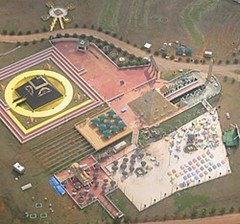
In the late 1980s, the federal government launched an investigation into the AAC in response to the cash-only, untaxed nature of the group’s interstate business ventures, as well as reports of weapons stockpiling. In what appeared to be a strategic move, in 1993 York’s movement left New York and relocated to Georgia, where over $1,000,000 was spent to purchase a headquarters building in Athens and a 473-acre farm in rural Putnam County. [Image at right]

On the Putnam County property, the Nuwaubians constructed an Egyptian theme park called “Tama-Re.” The construction included two large pyramids, a Scarab Beetle sculpture, a Sphinx, a museum of Black History, and a large statue of a Black Jesus wearing an Indian headdress crucified on an Ankh (the ancient Egyptian cross-shaped hieroglyph with a loop at the top). Beyond the theme park, the community included the communal living quarters in trailers, a recording studio, a shop, and various other structures.  The separatist inclination of the community was indicated by the posting of [two] armed guards at the community’s gate and a claim to be a “Sovereign Nation.”
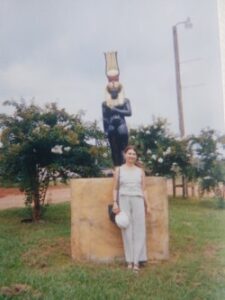
Taking inspiration from African American – Native American groups such as the Washitaw Nation, the Nuwaubian movement again rebranded as the the Yamassee Native American Moors of the Creek Nation, and York changed his title to Chief Black Eagle. The objective of establishing the community at Tama Re was to create a black utopia, an “Egipt (sic) in the West” that would become a center of pilgrimage for African Americans. And, indeed, several thousand migrants did arrive at the community from across the U.S., the West Indies, and Great Britain. Several thousand visitors flocked to the annuals Savior’s Day festivals held at Tama Re, arriving from across the U.S., the West Indies, Canada, and Great Britain. [Image at right]

2003 proved to be a pivotal year for the movement. During the 1990s York had prophesied that in May 2003 a Mothership would descend on one of the pyramids at Tama Re to carry 144,000 of his followers to the planet Risq prior to the world’s destruction. In that same year a sequence of events began that resulted in York’s criminal conviction and the destruction of Tama Re. [See, Issues/Challenges]

DOCTRINES/BELIEFS
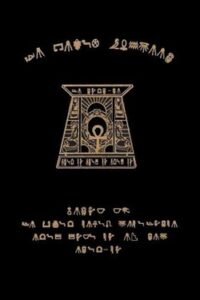
As its history of frequent name changes and shifting religious identities would suggest, Dwight York’s spiritual movement was notably eclectic and syncretic in its belief system(s). A prolific author, York penned hundreds of books and pamphlets (scrolls) with the assistance of his team of veiled women secretaries. The Holy Tablets (1996) is the primary holy book for York’s disciples, and his magnum opus of almost 2,000 pages. [Image at right]

Although York’s early teachings are influenced by the Black Muslims groups he first encountered in prison and on the streets of New York (for example the myth of Yakub derives from the Nation of Islam and the Five Percenters), his later writings indicate that he took inspiration from the Black Hebrew Israelites, and Noble Drew Ali’s Moorish Temple of America, as well as the Moorish Temple’s subsequent “sovereign citizen”-type splinter group, the Washitaw Nation. The sovereign citizen ideology became evident when Tama Re presented itself as an autonomous zone that issued its own passports to citizens for a fee. A highly secretive men’s masonic lodge was the main organizing unit at Tama Re.

The eclectic sources of the Nuwaubian belief system are reflected in the architecture and iconography of Tama Re itself, which represents the broad-ranging influences of the movement: “two large pyramids, a Scarab Beetle, a Sphinx, a museum of Black History, and a large statue of a black Jesus wearing an Indian headdress crucified on an Ankh” (Palmer 2006). From the early 1990s, York expressed a strong interest in ufology, and the beautiful Black angelic Annunaki (extraterrestrials) are featured in his eschatology and in the murals of the All Eyes on Egipt bookstores.
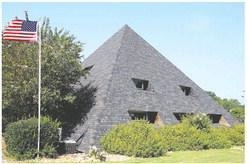
In his 1992-1993 scroll, The Man from Planet Rizq, York unveiled his new charismatic persona; an alien named Yanuuhn who had come to prepare humanity for a Rapture-like ascension to the planet of the Eloheem/Annunaki. [Image at right] This event was predicted for May 2003, when a UFO (the Mothership) would appear. It would hover above the larger of the two pyramids at Tama Re to transport 144,000 Nuwaubians deemed worthy by the Eloheem, the extraterrestrial ancestors of Black humanity, to be groomed for 1,000 years before eventually returning to Earth to save the planet. [Image at right]

RITUALS/PRACTICES

The major ritual at Tama Re was El Maguraj (pilgrimage). York explains in his scroll, El Maguraj, that it is based on the ancient rites of Amun Ra at Karnak, and that the pyramids function as antennae (electrical capacitors) that balance the earth’s magnetic fields (Knight 2022:237).

Many other rituals were performed at Tama Re, but most were performed in secret. In 1992, York founded his own all-male clandestine order inside the UNNM, Lodge 19 of the Ancient Mystical Order of Melchizedek. Its books, lessons, and rituals were privy only to the initiates. York claims he first learned about Freemasonry from a 33rd degree Mason, W.M. Charles Tinsley. Michael Scheiderer points out that “in almost every picture of York he is wearing some sort of Masonic regalia” (Schreiderer n.d.). (After York’s arrest in 2002, he founded a women’s masonic order that would meet at the All Eyes on Egipt bookstores.

Other ritual activities at Tama Re (such as a man praying at the scarab beetle altar, and a Nuwaubian saluting the sun from the Black Pyramid) have been captured in the vivid photographs of Nick Oza (Nick Oza website). The major festival at Tama Re was Savior’s Day, the annual celebration of York’s birthday. The 1997 and 1998 Savior’s Day celebrations, held on June 26, each drew between 4,000 and 5,000 followers of York as well as other visitors.

ORGANIZATION/LEADERSHIP

While Dr. Malachi Z. York was the undisputed spiritual leader of his movement, during the Ansaaru Allah phase (1973-1990), his first (and only legal) wife, Dorothy (Duhbayda) York, served as the head administrator. She left in 1990 after a severe altercation with her husband because he had seized the trust fund intended for the Ansaar children’s college education to be used for another purpose (Palmer 2010:84-85).

During the Tama Re phase (1993-2002) the administrative leadership was composed of three men known as the “Triad.” One of the Triad, Victor Grieg, was responsible for building and zoning matters at Tama Re. Many of York’s “wives” (estimated at over fifty) held leadership positions in publishing and finance. Habiba Washington was only eighteen when she became head of finance at Tama Re, until her banking strategies to save money were questioned, leading to RICO charges against York.

After 2002, when York was arrested and received a 135-year prison sentence, his movement fractured into warring schisms. Various splinter groups continue to operate the “All Eyes on Egipt (sic.)” bookstores that were selling York’s scrolls in various U.S. cities. The Holy Trinity Seed Ministries of Nuwaup is currently the owner of the original Brooklyn building. However, Ummkhayr “Uma” York claims that her father’s signature on the deed signing over the property to Holy Trinity Seed Ministries is a forgery, and is currently involved in a legal battle over who rightfully should rightfully receive the rents paid by tenants of the building.

ISSUES/CHALLENGES                              

 The Nuwaubians enjoyed support from a variety of civil rights activists and religious leaders, mostly prior to York’s expanding legal problems. In September 1999, the Nuwaubians invited several distinguished black activists and legislators to visit Tama Re and speak up on their behalf as they understood opposition to their presence as racially based. Civil rights leaders, Jesse Jackson, the renowned civil rights activist, politician, and Baptist minister. and Al Sharpton of the National Action Network visited Tama Re to voice their support for York. Another supporter was Tyrone Blooks, Atlanta state Representative and President of the Georgia Association of Black Elected Officials, who noted he had already visited the Nuwaubians at least three times, but had heard nothing of the allegations against York. Brooks, a veteran legislator, had often sought to intervene in racially sensitive cases. Brooks met privately with Barnes in June 1999 to discuss his fears that York and the Nuwaubians being targeted for “Waco-like racial violence.” Barnes took Brooks’ warnings seriously enough to summon Sherriff Sills to a meeting at the Capitol a few days later, where Brooks, Barnes’ Chief of Staff Bobby Kahn and then-GBI Director Buddy Nix discussed the potential for racial violence (Osinski 2002). Later, Brooks testified as a character witness for York at a federal court hearing in May, where York was denied bail. Brooks also publicly stated his support for the Nuwaubians in opinion articles in both The Atlanta Journal-Constitution and the Macon Telegraph (Osinski 2002). On April 27, 2001, Jesse Jackson, the leader of the Rainbow/PUSH Coalition, made a speech at Tama Re, calling it “an American Dream” and pledging solidarity with the Nuwaubians in their ongoing zoning and building disputes.

Tension between law enforcement and the Ansaaru Allah Community preceded the move to Georgia. In 1979, the Nuwaubians were caught up in the unsolved murder of local daycare owner Horace Green who was lobbying against what he described as the AAC’s “takeover” of the Bushwick Avenue neighborhood. Subsequently there was an arson investigation into the outbreak of five fires near Bushwick Avenue that facilitated the AAC’s expansion into the area.

After the Nuwaubians moved to Putnam County, York and the Nuwaubians initially received rhetorical support from African American activists. However, tension with the community continued to escalate. One initial source of tension was Savior’s Day (York’s birthday on June 26) celebrations as they raised concern about the small, rural community being overwhelmed by the Nuwaubians’ presence. Savior’s Day festivals in 1997 and 1998 each drew 4,000-5,000 celebrants.

Legal confrontations began in April 1997 when Tama Re’s security guards declined entry to a building inspector who arrived to examine buildings on site for zoning purposes. When the building inspector and recently elected Sheriff Howard Sills did gain entrance in June, they were served with papers declaring that they would be fined $5,000,000 if they entered the property. At that time a citation was issued for building without a proper permit. Sills’ apprehension about where this conflict was headed was apparent in his reaction (Palmer 2006):

I became aware of what a volatile situation I had been dragged into when…I heard them say, ‘We are not subject to your laws,’” Sills said. “Here we were, facing the guards who were wearing guns and saying, ‘No, you can’t come on our land, we are a sovereign nation.’ What was I supposed to do? They had guns and my job was to disarm them.” York was, Sills said, “begging for a Waco. He asked for it!

In 1998, the Nuwaubians requested that the Tama-Re property be rezoned from agricultural to commercial to allow their theme park activities. Sheriff Sills subsequently discovered that a storage facility had been converted into a public dance hall without necessary permits, which resulted in a substantial fine for fire code and zoning violations. In 1999, Superior Court judges ordered buildings at Tamara Re padlocked, and York was cited for contempt of court when he did not appear in court. The decision to padlock the buildings coincided with Savior’s Day, and so residents of Tama Re joined forces with the thousands of visiting Nuwaubians and tourists to engage in protests across Putnam County. Civil rights leaders, Jesse Jackson and Al Sharpton, visited the site to voice their support, and the residents of Tama Re began to perform synchronized defense drills to prepare for a confrontation with law enforcement. One hundred state troopers and Georgia Bureau of Investigation agents were secretly dispatched to the Eatonton armory in case of trouble (Palmer 2006).

The visible escalation of conflict between the Nuwaubians and law enforcement began with the election of county sheriff, Howard Sills. In 1997, newly elected Sheriff Stills assumed office and already was suspicious of the Nuwaubians. As he stated to a local reporter (Tocher 2023):

Right before I took office, I decided I need to know something about this, so I met with the FBI and learned a great deal about York’s operations in New York,” Sills said in an interview last month while parked in the former Tama-Re’s driveway. “I learned that he was a Black Panther, that he’d gone into the Nation of Islam, that he created his own Muslim sect, and they were financed primarily by organized bank robberies and just all kinds of things. He was also suspected of murder in Brooklyn … so I knew I had a problem when I first took office.

By the end of 1998, Sills began to suspect that members of the group were involved in child sexual molestation, which heightened his determination to pursue formal investigation. As he put in the interview, “That’s when it all started.” Sills then made inquiries with counterparts in Antelope Oregon about their experience with Rajneeshpuram in the 1980s to inform his own plans. When new local elections were impending in 2001, the Nuwaubians nominated several candidates for local office, including the office of sheriff. Prior to the election nearly 200 Nuwaubians were purged from the voter roles for failure to establish legal residence, and Sheriff Sills was resoundingly re-elected (Palmer 2006).

Sheriff Sills’ investigation was bolstered by contact with Dwight York’s disaffected son, Jacob, who had begun assisting members in separating from Tama Re. He also connected them with Sheriff Sills who, in turn, connected Jacob York and former members with the FBI.

On May 8, 2002, federal and local law enforcement officers conducted a military-style raid on the Tama Re community, with over 300 heavily armed agents involved. The officers arrived with armored vehicles and helicopters and employed dynamic entry tactics and dispensed tear gas. The officers met with no resistance; they arrested sixty-five men and women and placed about sixty children in the care of social workers. A few legally registered weapons were recovered, but no illegal weapons caches were discovered. No immediate signs of child abuse were observed. York was not present during the raid. He was subsequently arrested while shopping at a local mall.

In the wake of the raid, criminal indictments against York were filed. More than 208 state counts alleged that York had molested dozens of children of both sexes. A corresponding federal indictment was even more serious. In that indictment York was charged with violating the Mann Act for transporting children across state lines for illegal sex. The transporting charges involved the community’s move from Brooklyn to Georgia and trips taking children to visit Disneyworld. Most significantly, federal charges were brought under the RICO Act (Racketeer Influenced and Corrupt Organizations Act), which originated with an effort to prosecute organized crime groups and allows for more severe sentences than are available for individual component acts.

The specifics of the charges brought against York were contained in the U.S. Department of Justice press release (2004; See also, Gabriel 2003:152). It asserted that York molested and sexually abused “countless minor aged children” within his organization, fourteen of whom testified for the prosecution at trial. The prosecution asserted that York moved, or caused to be moved, children from Sullivan County, New York, to Putnam County, Georgia, and from Georgia to Orange County, Florida, for the purpose of continuing the sexual molestation of children in his organization. The organized character of the abuse was contained in the assertion that York also used adult female members of his group, whom he had also previously molested when they were children, to bring younger children to him for unlawful sexual purposes.

The trial process itself was extremely convoluted. York had initially accepted a plea bargain in 2003 that would have resulted in a fifteen-year prison sentence. However, the presiding judge deemed the sentence “too lenient,” and the trial was moved to 2004. A change in trial venue also was ordered. The dynamics of the trial itself were equally challenging as there were several recantations and recantations of recantations by witnesses.

The prosecution’s case relied heavily on fourteen witnesses. However, half of those witnesses changed their testimony during the trial, asserting that their testimony had been coerced by prosecutors (Palmer 2010:110). The key witness against York was Abigail “Habiba” Washington, who had borne two children to York in her early teens. She had served as one of the main administrators at Tama Re until she quarreled with York and then defected. She initially testified against York but then recanted her testimony, claiming that she had been threatened and intimidated. A few months later she testified under oath that she was rescinding her recantation, stating that she felt sorry for York and thought he deserved “a second chance” (WRLV 2004).

A key component of the defense’s case, therefore, was that witnesses were being coerced. The defense also presented an expert witness, a gynecologist who reported that there was no forensic or medical evidence to corroborate the testimonies of violent acts of rape and molestation. With respect to the conspiracy charges, the defense noted that no other party in the alleged conspiracy was put on trial. York’s “main wife,” Kathy Johnson, agreed to a guilty plea and was sentenced to two years in prison, and three other “wives” were initially charged, but were never prosecuted.
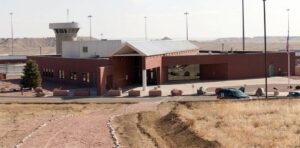
In 2004, York was convicted on ten federal counts, including RICO, conspiracy, structuring cash transactions, and transporting a minor across state lines for illicit sexual conduct. At the conclusion of the trial, York received an extraordinarily harsh sentence of 135 years in the nation’s highest security federal prison, United States Penitentiary Administrative Maximum Facility (ADX) in Florence, Colorado. [Image at right] He is held in solitary confinement for twenty-three hours per day. The federal government then seized the Tama Re property, which was sold in 2005 and later demolished.

York’s attorney, Adrian Patrick, led an appeal to the United States Court of Appeals for the Eleventh Circuit Court in Atlanta, arguing that state and federal charges had been “improperly combined” and that charges under the Mann Act were opportunistic, and that RICO charges (that the Nuwaubians were an “organized crime syndicate) was not supported by the facts at trial and prevented cross-examination of unindicted co-conspirators (Palmer 2016:127). After review, the court upheld York’s convictions in 2005.

The battle has continued. In 2026, York’s attorney filed a petition for compassionate release on the basis that he suffers from complications created by hereditary angioedema, which creates potentially fatal throat constriction. Putnam County Sheriff Howard Sills, who had been pursuing York since before his election as sheriff, immediately objected to the proposed release (Harris 2026):

This man here is a serial rapist, a child molester that committed the most heinous of crimes in our society, short of torturous murder, and did it generationally,” Sills told WMAZ. “You don’t get, in my opinion, much worse than that.

The movement, has continued to operate under the name United Sabaeans Worldwide and operates numerous bookstores, previously called the Tents of Kedar, where York’s scrolls are sold. Loyal disciples publicly advocate for York’s release. A candlelight vigil was held in Washington, D.C. in January 2017 to petition that then-President Barack Obama pardon York before leaving office. The original compound in Brooklyn has continued to be occupied by the group, though an attempted sale of the property in late 2024 triggered a legal battle between the splinter group that owns the property and York’s daughter Uma York.
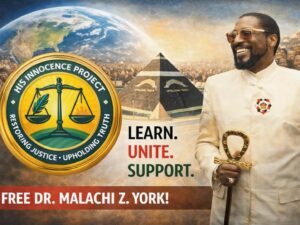
The future of the Nuwaubians remains to be determined. York is elderly and in fragile health, his compassionate care petition has been challenged, and he remains convicted of both financial and sexual crimes. Tama Re has been demolished. Movement organization and leadership continue to be contested. Nonetheless, his remaining followers continue to pursue legal vindication on his behalf through the “His Innocence Project” (n.d.), and several splinter groups remain active.  [Image at right]

IMAGES
Image #1: Tama Re. Credit: Photographer, Kenneth C. Budd. Creative Commons 2.0 Generic License.
Image #2: The author, Susan Palmer, at Tama Re. Credit and Copyright: Susan Palmer.
Image #3: Larger of the two pyramids at Tama Re.
Image #4: Cover of The Holy Tablets, published in 1996.
Image #5: Cover of The Man from Planet Rizq,published in 1992-1993.
Image #6: Project Innocence logo.

REFERENCES**
**
Unless otherwise noted, the material in this profile is drawn from Susan J. Palmer, The Nuwaubian Nation: Black Spirituality and State Control. Farnham, U.K: Ashgate, 2010.

AEOE Bookstore (“Books by Dr. Malachi Z. York”). Accessed from https://aeoebookstore.net/archives/7188 on 20 May 2026.

Afrika Bambaataa. 1990. “Tama Re” (Part 1). New York: Tommy Boy Records. Accessed from https://soundcloud.com/afrika-bambaataa/tama-re-part-1 on 20 May 2026.

“The Bizarre UFO Pyramid Cult That Fell Hard.” YouTube, 17:12. Posted by Maye Muses, March 7, 2025. Accessd from https://www.youtube.com/results?search_query=Tama+Re+Cult on 20 May 2026.

Brooklyn Eagle Staff. 2024. “Talented legal dispute over selling of HQ of controversial Nuwaubian Nation sect.” Brooklyn Daily Eagle, December 10,

“The Cult That Was in Georgia.” YouTube videos. Accessed from https://aeoebookstore.net/archives/7188 on 20 May 2026.

“Cult Leader York Arrested in Georgia.” Accessed from https://www.washingtontimes.com/news/2002/jun/2/20020602-030741-8461r/ on 20 May 2026.

DrMalachiKYork. 2011. “Tama-Re: Egypt of the West.” YouTube. Accessed from https://www.youtube.com/watch?v=HaUNv_YBeYY on 20 May 2026.

Elbein, Asher. 2016. “We Just Walked into America’s Creepiest Egyptian-UFO Cult.” Atlas Obscura. Accessed from  https://www.atlasobscura.com/articles/tama-re-egyptian-ufo-cult on 20 May 2026.

Elbein, Asher. 2016. “The Road to Tama-Re: A Disappearance, a Con Man, and the Lingering Ruins of His Improvised Religion.” Oxford American, Fall. Accessed from https://oxfordamerican.org/magazine/issue-94-fall-2016/the-road-to-tama-re on 20 May 2026.

Ellwood, Robert S. 1979. Alternative Altars: Unconventional and Eastern Spirituality in America. Chicago: University of Chicago Press.

Harris, Chris. 2026. “Imprisoned Leader of Egyptian-Themed UFO-Obsessed Cult Seeks Compassionate Release.” US Magazine, April 7. Accessed from https://www.usmagazine.com/crime-news/news/jailed-leader-of-egyptian-themed-ufo-cult-seeks-early-release/ on 17 April 2026.

Finley, Steven C. 2022. In and Out of This World. Durham and London: Duke University Press.

Gabriel, Theodore. 2003. “The United Nuwaubian Nation of Moors.” Pp. 149-61 in UFO Religions, edited by Christopher Partridge. New York: Routledge.

Gardell, Mattias. 1996. In the Name of Elijah Muhammad: Louis Farrakhan and the Nation of Islam. Durham, NC: Duke University Press.

“Georgia’s Egyptian-Themed Cult: The United Nuwaubian Nation of Moors.” 2024. YouTube Video. Accessed from https://video.search.yahoo.com/yhs/search?fr=yhs-fc-5178&hsimp=yhs-5178&hspart=fc&param1=7&param2=eJwtjstqwzAURH9FywRk%2BerlyNGqrtMPKF31cheuozrCT%2FzApV9fXMJsBuYMnCbe0dN7KQGshAw5DehJA2jkdEzIqUZPeZ4jpzihJ6WFdE4oACEdcmrCiJ62BTltFXrqx9%2FYdVVqBbDTHof7uC9sWJkEAZ7tcciMZz%2BZObNqmrqwh682rqnVF6Ezdmofa99x1sU2sCbU7Xhm9WMe%2B5BK4wQcYUv1Xc3xeTm0lvhU3ZYw%2F%2FeiLMyrNJCANS6R8k0mhdU2kVZZfbPlTb8c7lt9wApUloBKwH0ofTX5FUDoi%2Fr8AyUjUZg%3D&p=%E2%80%9CGeorgia%E2%80%99s+Egyptian-Themed+Cult%3A+The+United+Nuwaubian+Nation+of+Moors%E2%80%9D+you+tube&type=fc_A69BE08F2A5_s69_g_e_d_n3003_c999#id=1&vid=c37ac18567923db5cd0cc7c5a26e2a36&action=click on 20 May 2026.

Gardell, Mattias. 1996. In the Name of Elijah Muhammad: Louis Farrakhan and the Nation of Islam. Durham: Duke University Press.

Gomez, Michael. 2005. Black Crescent: The Experiences and Legacy of African Muslims in the Americas. Cambridge: Cambridge University Press.

“Gov. Raid on Nuwaubian Nation.” 2011. YouTube. Accessed from https://www.youtube.com/watch?v=zL-sKtPDtTI&t=131s on 20 May 2026.

Heimlich, Adam. 2000. “Black Egypt: A Visit to Tama-Re.” New York Press, November 8.

His Innocence Project website. n.d. Accessed from https://www.hisinnocenceproject.org/ on 25 April 2026

Humphrey, Jay. 2024. “Open House Visits to the Nuwaubian Compound Tama-Re.” YouTube. Accessed from https://www.youtube.com/watch?v=RNdWocxkM8Q on 20 May 2026.

Illeife. 2011. “Open House Visits to the Nuwaubian Compound Tama-Re.” YouTube. Accessed from  https://www.youtube.com/watch?v=zL-sKtPDtTI on 20 May 2026.

Introvigne, Massimo. 1995. “The Secular Anti-Cult and the Religious Counter-Cult Movement: Strange Bedfellows or Future Enemies?” Accessed from https://www.academia.edu/30311768/The_Secular_Anti_Cult_and_the_Religious_Counter_Cult_Movement_Strange_Bedfellows_or_Future_Enemies on 20 May 2026.

Knapp, Francky. 2023. “We Just Walked into America’s Creepiest Egyptian-UFO Cult.” Messy Nessy: Cabinet of Curiosities, February 17. Accessed from https://www.messynessychic.com/2023/02/17/we-just-walked-into-americas-creepiest-egyptian-ufo-cult on 20 May 2026.

Knight, Michael Muhammad. 2022. Metaphysical Africa: Truth and Blackness in the Ansaru Allah Community. University Park, Pennsylvania: Pennsylvania State University Press.

Knight, Peter. 2000. Conspiracy Culture: From Kennedy to the X-Files. New York: Routledge.

Lasseter, Tom. 1999. “Tensions Simmer Around a Black Sect in Georgia,” The New York Times. June 29. Accessed from https://www.nytimes.com/1999/06/29/us/tensions-simmer-around-a-black-sect-in-georgia.html on 20 May 2026.

Lieb, Michael. 1998. Children of Ezekiel: Aliens, UFOs, the Crisis of Race, and the Advent of End Time. Durham, North Carolina: Duke University Press.

“Middle Georgia’s Cult Legacy: The Nuwaubian Nation.” WGXA News, May 5, 2021. Accessed from https://wgxa.tv/news/local/middlegeorgias-cult-legacy-the-nuwaubian-nation on 17 April 2026. Well that’s interesting yeah OK

McCain, Robert Stacy. 2002. “Nuwaubian Nightmare.” The Washington Times, June 2. Accessed from https://www.washingtontimes.com/news/2002/jun/2/20020602-030741-8461r/ on 20 May 2026,

Moser, Bob. Fall 2002. “United Nuwaubian Nation of Moors Meets Its Match in Georgia.” Southern Poverty Law Center Intelligence Report. Accessed from https://www.splcenter.org/resources/reports/united-nuwaubian-nation-moors-meets-its-match-georgia on 20 May 2026.

“The Mothership Connection: Dwight York and Nuwaubianism.” 2011. Illogical Contraption Blogspot, 3.

Muhammad, Elijah. 2008. The Mother Plane: Elijah Muhammad’s Analysis of Ezekiel’s Wheel. Chicago: Secretarius MEMPS Publications.

Muhammad, Elijah. 1973. “Battle in the Sky.” Muhammad Speaks, May 25.

The Mystery Clouds, Are They UFOs? n.d. Scroll #91. Eatonton, Georgia: Holy Tabernacle Ministries.

Nation of Moors. n.d. “Welcome to the United Nation of Moors Government.” Accessed from https://unnm.net/ on 20 May 2026.

“Nuwaubian Nation.” n.d. CultFacts.com. Southern Poverty Law Center. Accessed from           https://www.cultfacts.com/cults/nuwaubian-nation on 20 May 2026.

“Nuwaubian Nation of Moors.” 2026. Extremist Files, Southern Poverty Law Center. Accessed from            https://www.splcenter.org/resources/extremist-files/nuwaubian-nation-moor on 20 May 2026.

Nuwaubian Nation of Moors. 2002. “Timeline of Nuwaubian Events.” Macon Telegraph, May 9. Accessed from   https://culteducation.com/group/1083-nuwaubians/15489-timeline-of-nuwaubian-events.html on 20 May 2026.

Humphrey, Jay. n.d. “Open House visits to the Nuwaubian compound Tama-Re.” Accessed from https://www.youtube.com/watch?v=RNdWocxkM8Q) on 20 May 2026.

Osinski, Bill. 2009. Ungodly: A True Story of Unprecedented Evil. New York: St. Martin’s Press.

Osinski, Bill. 2002. “Legislator intervened in Nuwaubian case.” Atlanta Journal-Constitution, August 31. Accessed from https://r.search.yahoo.com/_ylt=AwrEo6gcz9xpKu4RvxUXFwx.;_ylu=Y29sbwNiZjEEcG9zAzkEdnRpZAMEc2VjA3Ny/RV=2/RE=1776107421/RO=10/RU=https%3a%2f%2fwww.religionnewsblog.com%2f698%2flegislator-intervened-in-nuwaubian-case/RK=2/RS=9PlNjhSnnbisE4YfeHwthWQ6XKo-

Oza, Nick. n.d. Nick Oza website. Accessed from www.nickoza.com on 20 May 2026.

Oza, Nick. n.d. “Photographic Documentation of Tama Re.” https://www.nickoza.com.

Palmer, Susan J. 2021. “The United Nuwaubian Nation.” Pp. 343-53 in Handbook of UFO Religions, edited by Benjamin E. Zeller. Leiden: Brill.

Palmer, Susan J. 2010. The Nuwaubian Nation: Black Spirituality and State Control. Farnham, U.K: Ashgate.

Palmer, Susan J. 2006. “Cult Fighting in Middle Georgia.” Religion in the News. Accessed from https://www3.trincoll.edu/csrpl/RINVol9No1/Cult%20Fighting%20in%20Middle%20Georgia.htm on 20 May 2026.

Philips, Bilal. 1988. The Ansar Cult in America. Riyadh, Saudi Arabia: Tawheed Publications.

Scheiderer, Michael. 2004. “Nuwaubian Nation of Moors.” Cult Education Institute. Accessed from https://culteducation.com/group/1289-nuwaubian-nation-of-moors.html on 20 May 2026.

Scheiderer, Michael R. n.d. The Craft and the Crescent: Freemasonry and the Black Muslim Movement in America. Accessed from http://mastermason.com/Millennium382/Papers/TheCraftandtheCrescent.pdf on 20 May 2026.

Shan Yan’s Tale. 2020. “Nuwaubian Nation Documentary Footage.” YouTube. Accessed from https://www.youtube.com/watch?v=iDe85eeTZKE on 20 May 2026.

Speir, Joseph. 2021. “Middle Georgia’s Cult Legacy: the Nuwaubian Nation.” WXGA News, May 5. Accessed from  https://wgxa.tv/news/local/middle-georgias-cult-legacy-the-nuwaubian-nation on 20 May 2026.

“Tama-Re: Egipt of The West” You Tube. Accessed from https://www.youtube.com/watch?v=HaUNv_YBeYY on 20 May 2026.

“The Mothership Connection: Dwight York and Nuwaubianism.” 2011. Illogical Contraption (Blogspot), March 3.

“Timeline of Nuwaubian Events.” 2002. CultEducation.com. Accessed from  https://culteducation.com/group/1083-nuwaubians/15489-timeline-of-nuwaubian-events.html on 20 May 2026.

Tocher, Ian. 2023. “N Is for Nuwaubian (Part III).” The Eatonton Messenger, August 17. Accessed from https://gahistoricnewspapers.galileo.usg.edu/lccn/sn88054152/2023-08-17/ed-1/seq-25/ocr/ on 20 April 2026.

Tocher, Ian. 2023 (September 14). “Putnam A to Z: P Is for Pyramid.” MSGR News, September 14. Accessed from  https://www.msgrnews.com/news/putnam-z-p-pyramid on 20 May 2026.

Towler, Eric, ed. 1995. New Religions and the New Europe. Oxford, UK: Aarhus University Press.

United Nuwaubian Nation of Moors. n.d. “Archives.” Accessed from https://aeoebookstore.net/archives/7188 on 20 May 2026.

von Däniken, Erich. 1968. Chariot of the Gods: Unsolved Mysteries of the Past (Originally published as Erinnerungen an die Zukunft. Düsseldorf, Econ-Verlag.

U.S. Department of Justice, Criminal Division. 2004. “Press Release.” Accessed from
https://www.justice.gov/archive/criminal/ceos/pressreleases/downloads/MDGA%20York%20convict%20PR_012304.pdf
on 25 April 2026.

“Welcome to the United Nation of Moors Government.” n.d. UNNM Official Website. Accessed from https://unnm.net/ on 20 May 2026.

WTLV. 2004. “Witness in Nuwaubian Trial Tries To Recant Her Testimony.” WFMY NEWS2, August 14. Accessed from https://www.wfmynews2.com/article/news/local/witness-in-nuwaubian-trial-tries-to-recant-her-testimony/83-402308776 on 24 April 2026.

York, Dwight (As Sayyid Isa Imam Mahdi). 1989. Ansaar’s Guide to the Scriptures for Better Living: Bringing Up the Children. Brooklyn, NY: The Original Tents of Kedar.

York, Malachi Z. 1996. Extraterrestrials Among Us. Eatonton, GA: United Nuwaubian Nation of Moors.

York, Malachi Z. 1996. The Holy Tablets. Holy Tabernacle Ministries.

York, Malachi Z. 1990. The Paleman. (no location or publisher).

York, Malachi Z. n.d. The Man from Planet Rizq. Eatonton, GA: United Nuwaubian Nation of Moors.

York, Malachi Z. n.d. The Mystery Clouds, Are They UFOs? (Scroll 91). Eatonton, GA: Holy Tabernacle Ministries.

Publication Date:
26 May 2026

Share

María Vardé

María Vardé  graduated in Anthropological Sciences at the University of Buenos Aires and is currently a researcher and Ph.D. candidate at the Instituto de Ciencias Antropológicas, Facultad de Filosofía y Letras, Universidad de Buenos Aires (Institute of Anthropological Sciences, Faculty of Philosophy and Humanities, University of Buenos Aires). She has written and lectured on archeology,  new religious movements, and freedom of religion or belief.

Share

Ashram Shambhala

ASHRAM SHAMBHALA TIMELINE

1967 (August 4):  Konstantin Rudnev was born in Novosibirsk, Russia.

1982:  Rudnev showed an early interest in yoga.

1987:  Rudnev was drafted into the army and discharged due to mental illness.

1989:  Rudnev’s school began as a small yoga group in Novosibirsk.

1991:  Rudnev founded the Siberian Association of Yogis and the “Olyrna” Association.

1992:  Rudnev organized a correspondence school operating throughout the former USSR. Groups were formed in various regions, which began conducting classes independently.

1993:  Rudnev founded an ashram for the permanent residence of his followers.

1998:  Rudnev’s activities expanded to the international level: seminars were held in various countries, and autonomous groups emerged around the world.

1999:  Russian law enforcement agencies began monitoring Rudnev and his group. Rudnev dissolved the associations but continued to teach yoga within a non-corporate network of followers.

2000:  The number of followers in Russia was estimated at 20,000, and worldwide at over 100,000. The name “Ashram Shambhala” appeared in the media.

2008:  Police raided Rudnev’s home, but no charges were filed.

2010:  Following a second raid, Rudnev was arrested. The activities of “Ashram Shambhala” ceased. However, some individual groups continued to exist independently.

2013 (February 7):  The Novosibirsk Court of Public Order sentenced Rudnev to eleven years in prison for leading an “extremist cult,” sexual assault, and drug possession.

2021:  After serving his full sentence, Rudnev was released and moved to Montenegro with his wife.

2024:  Facing harassment by Montenegrin law enforcement as a “cult leader,” Rudnev moved to Argentina.

2025 (March 21):  A young Russian woman, E., who gave birth at a hospital in Bariloche, Argentina, was linked by medical staff and police to Rudnev, who was accused of organizing her illegal immigration into the country. Two friends who had helped E. at the hospital were detained along with three other women.

2025 (March 28):  Fifteen men and women were arrested at the Bariloche airport and other locations, including Rudnev and his wife, on charges of participating in a “cult” involved in illegal immigration.

2026 (April 1):  After all other defendants were released, Rudnev’s pretrial detention was extended for another year.

FOUNDER/GROUP HISTORY

Konstantin Rudnev was born in Novosibirsk on August 4, 1967. Conflicting values shaped his childhood. Although, according to his brother, the family was raised “in the spirit of communism,” they were never ardent patriots. The central figure in the upbringing of Rudnev and his brother was not their parents, but their grandmother, a native Muscovite who had survived Stalin’s repressions and was exiled to Novosibirsk after World War II [Image at right]. She was deeply religious, and Konstantin valued her wisdom and presence far more than he did his parents. Her home became the family’s gathering place, and under her influence, he and his brother first glimpsed a life beyond the narrow ideological confines of the Soviet state.

In his youth, Konstantin struggled with social interactions. His brother recalls that he found it difficult to interact with his peers and was often teased. These social frictions became the primary driving power behind his personal development. Konstantin began to view his inability to cope with these social challenges as a sign of imperfection. He became obsessed with the idea of changing his life to avoid such “incidents.”

His brother reports that during the Soviet era, non-ideological information was scarce and available mainly in two magazines: Fizkultura i Sport (Physical Culture and Sport) and Nauka i Religiya (Science and Religion). When Konstantin was about fifteen years old, his brother showed him an article about yoga in one of these magazines. This marked the beginning of an intensive practice at home, which continued until Konstantin was drafted into military service.

Reportedly, the brothers also met a man described as “very advanced” in esoteric terms. This encounter triggered what his brother calls an “opening of consciousness,” a state in which Konstantin began to perceive truths hidden from the ordinary mind. During the Gorbachev era of perestroika (1985–1991), when individual initiatives were finally permitted, the brothers explored various spiritual paths. They spent time with Christian groups, including Adventists and Baptists. [Image at right]

Konstantin grew up in an ordinary Soviet family, attended School No. 187, and after graduating, followed the expected path, compulsory military service. The Russian army of that time was characterized by systematic hazing, a practice so deeply entrenched that it shaped the entire public attitude toward conscription. Hazing included psychological humiliation, physical beatings, and, in the worst cases, fatalities. Young recruits were regularly subjected to violence by senior soldiers, who acted with virtual impunity. There were rumors of conscripts who ended up in the hospital, became disabled, or were driven to suicide. In many regions, parents viewed military service not as a civic duty but as a real threat to life, one that had to be avoided if you had the means or connections. One of the most common ways to avoid service was to feign mental illness. According to his family, Rudnev made this choice deliberately after witnessing cruelty in the barracks, including an incident in which a young recruit was beaten and raped, after which he attempted suicide by cutting his wrists. By feigning symptoms that would lead to hospitalization in a psychiatric clinic, he ensured that he would not be sent back to the army. The family maintains that this episode (later used by prosecutors to imply a hidden mental illness) was, in fact, a calculated act of self-preservation, a reaction to conditions that many Russians of his generation understood all too well.

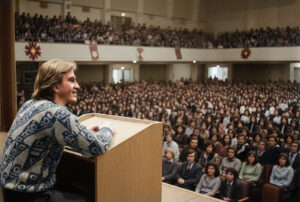
After being discharged from both the hospital and the army in 1987, Konstantin seized the opportunity to organize a yoga group (the name “Ashram Shambhala” did not appear until the turn of the century). Although it all began with hatha yoga and asanas, he quickly realized that physical exercises were merely a gateway to the world of spiritual knowledge. He was influenced by the works of Carlos Castaneda (1925–1998) and “astral karate,”  which was taught in the final years of the Soviet era by the controversial teacher Valery Averyanov. [Image at right]

His brother notes that Konstantin’s rejection of a “normal” life was a conscious choice. After being assigned to a foundry, which Konstantin described as a “biblical hell” due to the unbearable heat, he realized that it was impossible to teach while engaged in manual labor. He devoted himself to professional teaching, even though the Soviet authorities viewed his lack of a regular job as “parasitism.”

Konstantin was cynical about government institutions. He claimed that the state sought to turn people into “fools and cowards” so that they would be easier to control. He regarded the Soviet obsession with communism as a “dream” that had led to senseless destruction and suffering. He often cited Pavel Korchagin, the protagonist of Nikolai Ostrovsky’s (1904–1936) classic 1930s Soviet novel How the Steel Was Tempered, as an example of a man who “died for lies” (a hero useful to governments but tragic for humanity). Later, Rudnev extended this criticism to Putin’s regime.

Opposition to the government, combined with the growing popularity of his groups, led to friction with the Orthodox Church, which, in those years, felt it was losing spiritual influence, even as it remained firmly on the regime’s side. The Church and the active Russian anti-cult movement also expressed concern over the growing number of Rudnev’s followers.

During a 2008 police raid on Rudnev’s home, no incriminating evidence was found, but during a second raid in 2010, police claimed to have found drugs and arrested the spiritual teacher. The trial that followed at the Novosibirsk Court of Public Order, as well as Rudnev’s detention and subsequent troubles in Montenegro and Argentina, are covered below in the “Issues / Challenges” section.

DOCTRINES/BELIEFS

What Rudnev proposes in his texts (which we have examined through manuscript English versions provided by his wife) is not a system of doctrines but a metaphysical concept. It combines elements of cosmology, anthropology, and a critique of civilization. Rudnev’s worldview, as presented in the sources, constitutes a complex system in which Siberian shamanism is combined with Eastern ideas, including Tantric teachings and the concept of karma. It asserts that the physical world is a temporary realm where souls undergo severe trials to gain wisdom and ultimately return to divine unity. Our world is not our true home, but a training ground where souls grow through trials, mistakes, and experience.

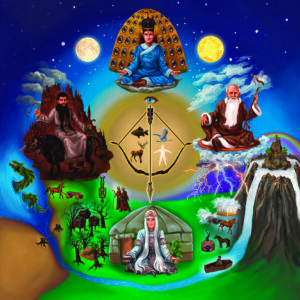
Four divine powers govern the universe, each associated with one of the dimensions of time: eternity, the future, the present, and the past. Tengri-khan, the eternal source, maintains cosmic balance; Ulgen-khan shapes the future and its possibilities; Umai sustains the material present; and Erlik-khan rules the past and the realm of the dead. [Image at right]

A human is not a single entity, but a combination of five souls, each responsible for its own mode of perception or life power. Aiy connects a person to eternity; Bosi perceives the future; Tes—the past; Sur travels between worlds; and Kut fills the body with vital energy. Without them, a person is “nothing more than a piece of meat.”

Rudnev is often ridiculed in the media for the more esoteric elements of his worldview, particularly his reflections on extraterrestrial life. In his words, extraterrestrial civilizations are neither invaders nor saviors but distant, intelligent beings that once gave rise to consciousness on Earth and continue to observe humanity’s development from afar. Humanity is part of a long evolutionary arc shaped not only by biological processes but also by indirect contact with a more advanced civilization beyond our planet.

Earth is becoming, in Rudnev’s words, a “metaphor,” a kind of cosmic experiment, not in a sinister sense, but similar to how scientists construct artificial ant colonies to study the behavior, adaptation, and social patterns of ants. Just as researchers observe how an anthill organizes itself, reacts to stimuli, or evolves under new conditions, these hypothetical civilizations observe humanity’s behavioral patterns, occasionally leaving signs or impulses (such as pyramids, myths, and symbolic structures) that serve as catalysts for cultural or spiritual development. The idea is that humans are gently guided, nudged toward growth in ways that remain largely invisible.

This cosmology is accompanied by a grim diagnosis of humanity’s state. According to Rudnev, modern society has lulled people into a deep sleep, a state in which they confuse social conditioning with identity. Rudnev describes modern civilization as a seriously flawed system that produces mindless followers through the media, propaganda, and education. From childhood, individuals are shaped by what the movement calls the “Devil’s Template,” a set of harmful stereotypes and expectations that push them into a life they never consciously chose. The roles they play, whether as workers, spouses, or citizens, are masks rather than true expressions of themselves. Modernity is not merely imperfect; it functions as a mechanism of oblivion, a vast system designed to sever people from their divine essence and keep them subjugated to social norms.

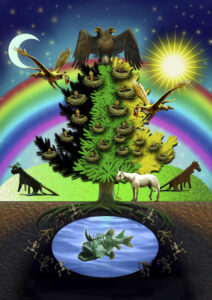
This critique of society underlies the movement’s understanding of suffering, which it reinterprets as a tool for learning. Rudnev’s teachings insist that suffering is a key catalyst for awakening. Illness, aging, and deprivation are viewed as vaccines against evil, shocks that shatter complacency and propel the soul toward growth. Evil gives rise to suffering, and this power compels people to evolve. Suffering is not a sign that something is wrong, but rather a signal that something important is trying to happen. The path to awakening involves seeking one’s inner World Tree, a symbolic connection between one’s ancestors’ roots and the divine heights. [Image at right]

However, this is not a glorification of pain nor a call to endure, or impose, unnecessary hardships. In Rudnev’s concept, suffering is “educational” only to the extent that it is transformed into awareness, humility, and responsibility. Thus, in Rudnev’s system, progress is measured not by mystical experiences but by the ability to extend compassion. In the movement’s moral concept, a person is truly happy only when they wish to bring happiness to someone else.

Death is not an end, but a transformation. Life on Earth is likened to a business trip or a visit to the gym: a temporary experience in which the soul gains an understanding unavailable in heaven. After death, the soul remains near the earthly world for forty to forty-nine days, letting go of attachments before ascending to higher levels. The Akashic Records, a concept of Theosophical origin, serve as a cosmic archive storing records of all events and intentions. Judgment is not divine punishment, but a moment of deep empathy in which the soul experiences its life from the perspective of everyone it has influenced. Reincarnation becomes a long journey through the cosmos, in which souls are cyclically reborn as plants, animals, and humans until they accumulate enough experience to return to the Absolute.

All of this is embodied in the symbolic figure of the Warrior of Light, the ideal human being in Rudnev’s moral landscape. These persons resist the uniformity of the social group, awaken from the spell of modern life, and dedicate themselves to service, mindfulness, and mastery of subtle energies.

RITUALS/PRACTICES

Most descriptions of rituals and group practices at Ashram Shambhala pertain to the pre-2010 community of Rudnev’s followers. Gatherings in Russia became impossible after the police repression of the movement and the leader’s incarceration. After his release from jail, Rudnev lived in Montenegro and Argentina, where he did not operate any spiritual group. Rituals continued during Rudnev’s detention, however, within the independent groups that used his teachings. Operating outside his control, they often added new elements from different origins.

The practices that support human transformation in Rudnev’s teachings are diverse. Some are described as “ancient spiritual technologies.” “The Guida Method” uses hypnosis and posthypnotic suggestions to identify traumas, unlock hidden abilities, and interact with the subconscious or even with the deceased. “Sampo,” described as a form of astral karate, teaches practitioners to protect their energy from negative influences and harmful thoughts. The “Field of Love Ritual” uses parental energy to create a protective shield around children, while “Orphism” uses music and art as tools for intention and spiritual resonance. [Image at right]

Pre-2010 group classes and seminars typically followed a fixed rhythm of lectures, practical sessions, and periods of rest, including walks, shared meals, and visits to cultural sites. Instruction was delivered in blocks of approximately one to one and a half hours, beginning with a theoretical exposition and followed by practical work. These practical components consisted of movement practices such as yoga and spontaneous dance; trance-inducing, non-pharmacological techniques, including rhythmic group movement and controlled breathing; and guided meditations in which participants visualized natural landscapes, cosmic spaces, temples, or deities while remaining seated, lying down, or moving gently. Rudnev also taught through poetry, music, and songs used in spiritual practices, trance work, and prayer. Altered states of consciousness were not pursued as ends in themselves and, when they occurred, were attributed to the effects of breathwork and trance practices rather than to any external substances (our interviewees consistently emphasized that narcotics, hallucinogens, alcohol, and smoking were categorically prohibited).

Critics and prosecutors in the Russian trials focused on Rudnev’s Tantric teachings on sexuality, describing them as fostering immorality and sexual abuse. Rudnev describes Tantra as a comprehensive discipline of daily life, a teaching on how to breathe, sleep, feel, and eat, where sexuality is just one of the spheres in which energy must be consciously managed and directed toward the path to the divine.

In contrast to sensationalized portrayals in Russian media that depicted the group as engaging in sexual rituals or orgiastic practices, relatives of Rudnev and other interviewees insist that teachings on sexuality were delivered only in the form of lectures and that any practical application was expected to occur privately, at home, and within established couples. Exercises conducted in pairs during seminars were performed while fully clothed and involved visualizing energy, synchronized breathing, and yoga postures without physical contact. Such paired or group exercises were considered beneficial within the group’s doctrine of “egregores,” understood as collective energy fields strengthened by coordinated intention and practice.

Rudnev teaches that sexuality could become a path of enlightenment, but only when practiced with awareness, restraint, and energetic discipline. Consistent with certain strands of the Tantric tradition, the same manuscript stresses the value of intercourse without ejaculation, “in which partners do not seek orgasm but raise energy upward along the central Sushumna energy channel.” Ejaculation, it states, represents a dissipation of vital force: “a person wastes their vital power, which could have been directed toward creative activity and self‑improvement.”

Tantric teachings and practices used by the group before 2010 are described in a novelized form in a privately circulated book titled The Dawn of Inliranga (n.d., available also in English). Although presented as fiction, the volume offers a stylized account of the ritual repertoire that informed the group’s early activities. The book outlines a philosophical understanding of Tantra rooted in the idea that human relationships, including intimate relations, can serve as vehicles for spiritual realization when approached with intention, harmony, and self‑discipline.  Practices such as controlled breathing, visualization of subtle energies, and meditative concentration are presented as foundational methods for awakening latent capacities and integrating bodily experience with spiritual aspiration.

A distinctive feature of the text is its focus on the idealized figure of the “Onome.” “Onome is a creature of the opposite sex who exists in the subtle world and is the embodiment of the human ideal. To meet your true love in the physical world, you should first establish contact with your Onome from the subtle world” (The Dawn of Inliranga, 5). The search for and cultivation of the inner Onome is depicted as a central practice through which practitioners learn to regulate emotions, clarify intentions, and orient their relationships toward spiritual growth.

The Dawn of Inliranga serves as a literary codification of the group’s pre-2010 Tantric orientation, blending philosophical exposition with dramatized accounts of practice. It emphasizes the interplay between inner transformation and outer conduct, suggesting that authentic relationships arise from the refinement of one’s internal energetic and emotional landscape. Tantra, including techniques for controlling and directing sexual energy, is presented as a holistic path of self-knowledge, relational harmony, and spiritual awakening.

ORGANIZATION/LEADERSHIP

Rudnev’s school began in 1989 as a small yoga group in Novosibirsk with about six members. As the group grew rapidly, Rudnev founded two officially registered public associations in 1991 to organize his followers: the Siberian Association of Yogis and the “Olyrna” Association. [Image at right]

Three years later, a correspondence school was established, operating throughout the former USSR and covering topics such as yoga, shamanism, Orphism, and tantra. Subsequently, large-scale seminars were organized, attracting participants from across the former USSR, and numerous groups formed in various regions, where participants began to conduct classes independently based on Rudnev’s teachings and books.

In 1993, Rudnev founded an ashram in Novosibirsk as a permanent residential
community for his followers. [Image at right] In 1998, in-person seminars of Ashram Shambhala began to be held outside the former USSR. The first countries were Greece, Belgium, and the Netherlands, followed later by Mexico and Brazil.
In 1999, Rudnev dissolved the public associations when the police began monitoring him, but continued to teach yoga. At that time, the media began using the name “Ashram Shambhala ” to refer to his “movement.” Rudnev did not coin this name, but his followers used “Ashram Shambhala” both to refer to the physical community of those living near their teacher and to denote an ideal ashram encompassing all who followed the same teachings. Eventually, Rudnev accepted this name, while insisting that he had never “founded” “Ashram Shambhala” as an organization.

It was more of a network of local groups united by Rudnev’s teachings, lectures, and books. Over time, groups emerged in different countries and cities around the world. According to estimates from 2000, there were about 20,000 followers in Russia alone, and more than 100,000 worldwide. [Image at right]

When Rudnev was arrested in 2010, some independent groups in Russia and abroad continued to draw on his teachings, while others used the name “Ashram Shambhala.” Some of these groups faced their own legal challenges. However, they operated autonomously and without any guidance from Rudnev. During his imprisonment, all correspondence with him was subject to strict prison control: phone calls were allowed for fifteen minutes once a month, and letters were censored, making it impossible for him to issue instructions, coordinate activities, or exercise any form of leadership over the independent groups.

After his release from prison in 2021, he moved to Montenegro. Later, in Argentina, Rudnev insisted that he was not interested in reorganizing a movement or an organization. However, he continued to teach yoga, only to a small circle of friends and relatives, and to hold talks. Individual groups continued to operate autonomously without Rudnev’s involvement.

ISSUES/CHALLENGES

Rudnev had been under surveillance by law enforcement agencies in Russia since 1999, long before any official charges were brought against him. In 2008, investigators searched his home but found nothing incriminating. He was detained for two days and then released. This was followed by an intensified surveillance campaign: from 2008 to 2010, the authorities conducted a two-year investigation to uncover incriminating evidence. During this period, thousands of witnesses were questioned, and fifty volumes of case files were compiled.

However, despite these exhaustive efforts, nothing criminal was found. Some parents whose adult children had left home attributed their departure to Rudnev’s alleged “brainwashing.” These parents claimed that his teachings had “pushed” their children to seek independence. However, the adult children themselves testified that their decisions were driven by longstanding family restrictions and a desire to start an independent life, decisions that, they insisted, were their own.

The 2010 raid that led to Rudnev’s arrest was carried out with the use of power normally employed in counterterrorism operations. This is typical of raids against “cults,” as research by scholars such as Stuart Wright and Susan Palmer has shown (Wright and Palmer 2015). They serve no meaningful law enforcement purpose but constitute a kind of baroque spectacle staged for the media and reinforcing anti-cult rhetoric. The followers we spoke with recall how they were awakened at five in the morning when dozens of masked OMON officers armed with automatic rifles stormed into the house, forced everyone to lie on the floor, and herded them into a single room, pointing their automatic rifles at them. Rudnev was taken to another room, while he believes officers planted drugs that later became the basis for one of the most serious charges against him. From there, he was transferred to a pretrial detention center.

According to documents provided to us by the lawyers representing Rudnev and his wife, during the trial, ninety percent of the witnesses admitted that their impressions of Rudnev were based not on personal experience, but on television programs and hostile websites. The prosecution’s case was based on the claim that in 1989, Rudnev founded a “cult” called “Ashram Shambhala,” where he “brainwashed” followers, forcing them into financial and sexual submission. [Image at right]

The charges of sexual crimes are perhaps the most disturbing aspect of this case. These charges were based almost entirely on the testimony of a single woman, A.V., who claimed that Rudnev had taken advantage of her psychological vulnerability. Apart from her words, there is no other evidence that A.V. had sexual relations with Rudnev or even knew him.

During a raid in September 2010, the police claimed to have found five grams of a narcotic substance in Rudnev’s home. Medical tests of his blood, urine, and hair revealed no traces of drug use. There was no evidence that any of Rudnev’s associates used drugs. No drug paraphernalia (no scales, no packaging materials) was found in the house. Nevertheless, eight of Rudnev’s eleven years in prison were handed down on charges of drug trafficking.

The financial aspect of the charges played a significant role in shaping the court’s opinion of Rudnev. Prosecutors argued that he had enriched himself by exploiting his followers, citing his ownership of dachas and luxury cars as evidence of illicit profits. Defense attorneys presented documents showing that Rudnev had inherited $400,000 from his grandfather, who lived in Germany, and argued that this fully explained his financial independence.

Rudnev’s collections of teachings were labeled “extremist” and accused of promoting “cult” doctrines. Rudnev’s lawyers argued that even an expert analysis by the FSB’s Institute of Criminalistics found no calls for extremism, terrorism, or the severing of family ties. Nevertheless, the court chose to believe the “experts” from the Russian anti-cult movement.

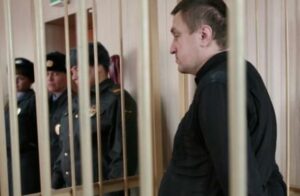
On February 7, 2013, Rudnev was sentenced to eleven years in prison for drug trafficking, leading an antisocial “cult” organization, and exploiting A.V.’s “helpless state” for sexual purposes. He served his entire sentence under harsh conditions and was released in 2021. [Image at right]

He left Russia almost immediately and moved to Montenegro, where he applied for asylum. Still, after two-and -one half years, the local media began publishing exposés, likely inspired by Russian anti-cult activists, claiming that he was attempting to reorganize his “cult.”

The Montenegrin police raided the hotel where he was staying, questioned him and others, and briefly detained him. No
charges were filed, but he decided to move to Bariloche, Argentina, where there was a significant Russian community. [Image at right]
The events that ultimately led to his arrest there began with E., a young Russian woman who arrived in Argentina while pregnant. Thousands of Russian women fly to Argentina every year to give birth to children who will thus become Argentine citizens. In a personal interview with Vardé, E. explained that she had come to Bariloche to escape a toxic and abusive relationship, hoping to recover emotionally and physically before giving birth. Nadezhda Belyakova, a close friend of the family, accompanied her at the request of E.’s mother, who wanted to ensure a safe environment for her daughter and future grandson, far from her abusive, alcoholic partner and the war between Russia and Ukraine. In turn, Belyakova turned to Svetlana Komkova, a Russian and Portuguese language teacher, for help with translation during their doctor’s visits.

When E. began visiting the Dr. Ramón Carrillo Regional Hospital in Bariloche, the medical staff suspected something was wrong. They interpreted her dependence on Nadezhda and Svetlana, as well as her limited communication skills, as “submissiveness” and a sign that others were preventing her from speaking freely. One of the nurses decided that E. “looked too young” to be twenty-two, as stated in her passport, and concluded that she must be a minor and possibly a surrogate mother. (and Komkova told Vardé that hospital staff repeatedly insisted that the child must be registered under the father’s surname and made it clear that, in the absence of the father’s documents, the hospital would not discharge the newborn. This statement contradicted Argentine law, but was later confirmed by the nurse herself during the court proceedings).

Fearing that the child would not be discharged and would not be placed in their care, the women brought a copy of Rudnev’s passport to the hospital, which they had found in their rented apartment. The man who had rented the apartment to them had been helping Rudnev and his wife with the paperwork to regularize their immigration status and had kept the passport, along with other documents, in the house.

After the child was born, the hospital called the police, and E. was detained and placed in appalling conditions, where she was pressured to claim she was a victim. Investigators put forward a theory that she was the primary victim of an alleged human trafficking network linked to Rudnev.

Argentina’s anti-trafficking law (Law No. 26,842) is known for its broad scope: it covers everything from forced labor and sexual exploitation to document fraud. Prosecutors with an anti-cult bias have repeatedly used it in cases involving “cults,” whether real or imagined (Introvigne 2023; Palmer 2023; Vardé 2024a, 2024b; Introvigne and Vardé 2025).

Apart from the passport incident, E. asserts that she never met Rudnev in person and was not part of any spiritual school or “cult.” However, when Rudnev’s name surfaced from the passport and appeared in the file that the hospital sent to the authorities, it was linked to his past as a “cult leader” in Russia, and this sparked speculation that he was reorganizing a “cult” in Argentina.  [Image at right]

In the initial phase of the case, the defendants included one Mexican woman and five Russian women, with no mention of Rudnev, and the case was heard by Judge Dr. Gustavo Villanueva of the Federal Guarantees Court in the San Carlos de Bariloche Judicial District. After reviewing the testimony of E. and the other women, the judge promptly dismissed the charges. Following this decision, rather than narrowing, the investigation expanded by order of a new judge, Dr. Gustavo J. Zapata of the General Roca District Court. A few days later, on March 28, 2025, the police conducted a large-scale operation at Bariloche Airport and other locations, detaining another fifteen people, mostly women, this time including Rudnev and his wife. One woman was charged with drug possession, but forensic analysis showed that the pills were ordinary medication (Gendarmeria Nacional Argentina 2025).

Headlines across Argentina proclaimed the discovery of a “Russian cult” led by an international “fugitive.” The articles were direct copies of Russian and Montenegrin reports, featuring the same outdated photographs and the same accusations. Prosecutors claimed they had caught the dangerous leader of the “cult.” Most of the arrested women claimed they did not know Rudnev; they simply happened to be Russian and were boarding the same flight from Bariloche to Brazil. Others knew Rudnev, but insisted they were not members of any “cult” or spiritual organization.

A week after their arrest, all the women were released, but their passports, cell phones, and money were confiscated, and they were required to report to the court office once a week. After the initial detentions, only one person remained in custody: Rudnev. He went through two lawyers, frustrated that he had not been told exactly what he was accused of. Prosecutors insisted they needed more time to investigate and translate documents from Russian (while offering a plea deal under which Rudnev would admit to “attempted human trafficking,” and the remaining charges would be dropped).

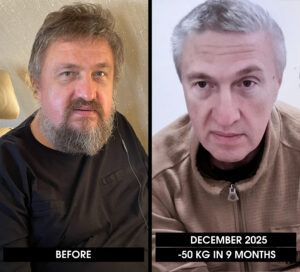
On April 1, 2026, Rudnev’s pretrial detention was extended for another year. Later in the month, he was granted house arrest after his lawyers petitioned for his release on humanitarian grounds, emphasizing that he has lost more than fifty kilograms since his initial detention and suffers from serious health problems. [Image at right]  They also have insisted that the case is based on information supplied by Russia rather than on any crimes he may have committed in Argentina. At the time of this writing, an appeal by the prosecutors seeking Rudnev’s detention again is pending. The case has also been referred to the UN Working Group on Arbitrary Detention in Geneva.
IMAGES
Image #1: Konstantin Rudnev as a child with his grandmother.
Image #2: Rudnev at age 22.
Image #3: Rudnev during an early lecture.
Image #4: A “Shamanic map of the world” with Tengri, Ulgen, Umai, and Erlik.
Image #5: The World Tree.
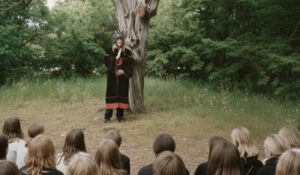
Image #6: Rudnev with followers in the woods.
Image #7: Rudnev lecturing in 1991.
Image #8: Rudnev with participants in one of his early seminars, 1992.
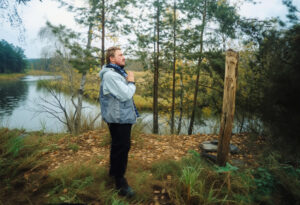
Image #9: Rudnev praying near Novosibirsk at age 37.
Image #10: Rudnev during the Novosibirsk trial.
Image #11: Rudnev in jail.
Image #12: Rudnev in Montenegro with his wife, 2023.
Image #13: Rudnev in Argentina before being arrested, 2025.
Image #14: Image supplied by the lawyers to document Rudnev’s weight loss in jail.

REFERENCES**
** There are very few reliable written sources about “Ashram Shambhala.” Apart from reports in the Russian media and on anti-cult websites, a book by a French anti-cultist has been published (Bourdy 2018). It draws on Russian sources and Rudnev’s 2013 trial, but focuses primarily on independent international groups that adopted some of Rudnev’s ideas while he was in prison. As for the updated versions of Rudnev’s teachings, we relied on manuscripts provided by his wife, Tamara Saburova. Although we read Russian media, we found it largely biased and unreliable. This profile is primarily based on manuscripts and court transcripts provided by Tamara, as well as interviews with Tamara herself, Rudnev’s brother, one of his lawyers, and nine women involved in the pending Argentine case (E., Svetlana Komkova, Nadezhda Belyakova, Alexandra K., Marina G., Vera Z., Valentina E., Ksenia T., Paula S.H.), conducted in February and March 2026 either in Argentina or via Zoom. For this reason, references to written sources in this profile are limited.

Bourdy, Alban. 2018. Un Bisounours au pays des se(x)ctes. Paris: Book on Demand.

Gendarmería Nacional Argentina. 2025. Informe pericial químico No. 135491 (Qualitative and quantitative analysis of narcotic substances). Group of Criminalistics and Forensic Studies, Squadron 34 Bariloche Cabo Primero Marciano Verón. Prosecutorial Case File No. 50,063/2025. Restricted document.

Introvigne, Massimo. 2023. “The Great Cult Scare in Argentina and the Buenos Aires Yoga School.” The Journal of CESNUR 7(3): 3–32. DOI: 10.26338/tjoc.2023.7.3.1

Introvigne, Massimo, and María Vardé. 2025. “The Jesus Christians: History, Theology, Controversies.” The Journal of CESNUR 9(3): 3–68. DOI: 10.26338/tjoc.2025.9.3.1.

Palmer, Susan J. 2023. “From Cults to Cobayes: New Religions as ‘Guinea Pigs’ for Testing New Laws. The Case of the Buenos Aires Yoga School.” The Journal of CESNUR 7(4): 3–24. DOI: 10.26338/tjoc.2023.7.4.1.

The Dawn of Inliranga. n.d. Privately published.

Vardé, María. 2024a. “La criminalización de las creencias: ideología antisectas en las políticas de trata de personas en Argentina.” Diversa (Red de Estudios de la Diversidad Religiosa en Argentina), September 2. Accessed April 15, 2026. https://bit.ly/3G8BlXT.

Vardé, María. 2024b. “Anti-Cult Categories in Anti-Trafficking Policies in Argentina and Their Implications for ‘Victims’: A Case Study.” The Journal of CESNUR 9(5): 21–44. DOI: 10.26338/tjoc.2025.9.5.2

Wright, Stuart A., and Susan Palmer. 2015. Storming Zion: Government Raids on Religious Communities. New York: Oxford University Press

Publication Date:
29 April 2026


Share

Christ Church

CHRIST CHURCH TIMELINE

1953:  Douglas James Wilson was born.

1977:  Wilson served as pastor of the Community Evangelical Fellowship.

1981:   Logos, a K-12 school was founded.

1988:  The Confederation of Reformed Evangelicals (CRE), which later became Communion of Reformed Evangelical Churches (CREC), was established.

1988:  Canon Press was established.

1993:  Wilson continued his theological development with the introduction of paedobaptism and Presbyterian church governance.

1994:  New Saint Andrews College was founded.

1999:  Wilson renamed Community Evangelical Fellowship as Christ Church.

2003: Wilson came to national attention when he organized a conference at the University of Idaho at Moscow about revolutions throughout U.S. history.

2004:  CRE changed its name to the Confederation of Reformed Evangelical Churches.

2011:  Confederation of Reformed Evangelical Churches changed its name to Communion of Reformed Evangelical Churches (CREC)

2024 (April):  Wilson was interviewed by podcast hosts Tucker Carlson and Charlie Kirk.

2025:  Christ Church planted a church in Washington, D.C.

2025:  Wilson was invited to speak at the Pentagon by Secretary of Defense Pete Hegseth.

2026:  Hegseth promoted U.S. military engagement in Iran based on Christian Nationalist principles.

FOUNDER/GROUP HISTORY

Douglas Wilson was born in 1953 and spent most of his childhood years in Annapolis, Maryland. His father served in the military. After retiring from the military, his father started a Christian bookstore on the nearby Washington State University campus in Pullman and subsequently moved to the Moscow, Idaho area. (Smentana 2019; Simmons 2019).

His pastoral career began in 1977 when he led leading services at Community Evangelical Fellowship. [Image at right] Simultaneous with his pastoral duties, Wilson began building what became a denomination. In that year The Confederation of Reformed Evangelicals (CRE), which later became Communion of Reformed Evangelical Churches (CREC), was established. He incorporated Logos, a K-12 school, that he had founded in 1981 into the organizational set. In 1988, Canon Press was established. Six years later, in  1994, New Saint Andrews College was founded. This set of organizations indicates the emphasis on education, on preparing coming generations to pursue movement goals. Christ Church, the flagship church of the denomination, adopted its current name in 1999.

Wilson’s theological positions became steadily more conservative, and his determination to publicly promote his ideas began to draw public attention. This first occurred in 2003 he chose to make a presentation at the University of Iowa through the church student organization. There was pushback on that presentation as, in addition to student protest, the presidents of both the University of Idaho and the University of Washington at Pullman both issued highly critical statements about the presentation. Controversy escalated and Wilson and Christ Church first came to national attention during the COVID-19 epidemic. Their public opposition to government mandated masking generated considerable public visibility. Wilson and Christ Church achieved a national presence in the mid-2020s. Wilson was interviewed by two popular conservative podcast hosts, Tucker Carlson and Charlie Kirk in 2024. In 2025, Wilson established a church-plant congregation in Washington, D.C. Secretary of Defense Pete Hegseth attended the congregation on some occasions and subsequently invited Wilson to speak at the Pentagon. Hegseth then presented his own version of Christian Nationalist ideology to promote military engagement with Iran and to disregard established rules of military engagement in 2026 (The New Republic and Greg Sargent. 2026). [See, Issues/Challenges]

DOCTRINES/RITUALS

At the outset of his pastoral career preached a conservative Baptist theology, but he revised his theological position as he sensed a shift in the surrounding culture in the late 1980s. As the theology evolved, Christ Church began presenting itself as a Conservative, Reformed, & Evangelical church: “We affirm the Apostles Creed, the Nicene Creed, the Definition of Chalcedon, and the Westminster Confession of Faith.” The church has announced its mission in the following way” (Christ Church website 2026):

We seek to honor the living God by renewing covenant with him on the Lord’s Day, living faithfully under the Lordship of Christ as Christian men and women in our families and communities, preaching the gospel to unbelievers, and applying the word of God to every area of life.

But it is another set of intertwined doctrinal commitments that give this movement a character that is distinct from larger evangelicalism.  And it is this framework that shapes what they mean by “applying the Word of God to every area of life” and makes it hang together as a comprehensive worldview. These are called Unity of Scripture, Presuppositionalism, Sphere Sovereignty, and Postmillennialism (Ingersoll 2015).

Unlike most modern Christians, those who are part of Christ Church and its larger network, reject the idea that there is discontinuity between the Old Testament and the New Testament. With the Unity of Scripture they assert that the Bible is one continuing revelation from Genesis through the Book of Revelation, with God in the form of the Trinity present throughout. Thus, Jesus is present at creation and the character of God is the same and it is revealed in what we read in both testaments. The character of Jesus, as it is revealed in texts such as the Sermon on the Mount, are part of the character of God. But so is God as described commanding Israelites to kill all Canaanites (Deuteronomy 20). God is understood as a god who loves His people but hates His enemies. This helps explain why, on first read, many of the positions held by Wilson and his followers appear to be in contradiction with the character of Jesus: they have a completely different understanding of Jesus.

Key to understanding this theological system in an epistemological position built on the work of Corenelius van Til by mid-twentieth theologian Rousas John Rushdoony called presuppositionalism. “By What Standard?” Rushdoony’s first book (1959) has remained the fundamental explication of this employment of presuppositionalism. Essentially, their view is that there are only two sources of knowledge: Revelation given by God in the Bible, and the sinful claim for the autonomy of human reason -dating initially to the fall in the Garden of Eden. Put differently, there are only two ways of being in the world. One way is in obedience to God, the other (which includes all other religions, philosophies etc.) is rebellion. There can be no neutral space between the two. They are fundamentally, inevitably, and inescapably in conflict; there can be no pluralism, diversity, or secularity. God’s Word applies to every area of life and culture.

The interpretive framework through which they identify how to apply “the Word of God to every area of life” is called Sphere Sovereignty. A version of this teaching was promoted by Reformation theologian Abraham Kuyper. But the version employed here is a variation on that developed by Rushdoony in the mid-20th century. According to Rushdoony God delegated authority to human beings in three distinct spheres of human life: family, the church, and the civil government. Together, these comprise Biblical Law to which all human beings, Christian or not, are held accountable.  This constitutes a comprehensive application of God’s law to all of life and it is what they mean by their motto “All of Christ for all of life.”

Each sphere of authority in this framework is given certain responsibilities and limited from engaging in the responsibilities given to another spheres. The Family is to “raise up children in the nurture and admonition of the Lord,” the Church is to “preach the gospel,” and the and the Civil Government is to “punish evil doers.” This is how they can claim that they believe in a separation of church and state in a way which is confusing to outsiders. It’s also how they conclude that public education, for example, is unbiblical. Education is a function of the family, not the state. Economic endeavors, too, are within the authority of families to support their mission. The state has no authority to oversee or regulate except where crimes are delineated in the Bible.

Finally, Christians in this network embrace post millennialism. They claim that Adam and Eve were created to exercise dominion over the earth, that their purpose was thwarted by sin in the Garden of Eden, but the prophecies foretold in the Book of Revelation have already occurred and humans were restored to their original purpose with the resurrection.

They hold that it is the job of Christians to build the Kingdom of God on earth, an effort that will culminate in the return of Christ to rule over the Kingdom of God. This building of the Kingdom of God is what they mean by the exercise of Dominion: they seek to make all nations Christian Nations ruled by Biblical Law.

The various commitments that flow from this system include young earth creationism (the doctrine that Earth was created supernaturally between 6,000 and 10,000 years ago), covenantalism (The doctrine that God has been working throughout history to gather His people to Himself through the covenants of redemption, work and grace), postmillennialism (The doctrine that Christ’s second coming will take place after a messianic age), dominionism (the doctrine that the nation should be governed by Christians under biblical law), biblically based education (education should be based on Christian principles and not dictated by the state), biblical inerrancy, biblical courtship (courtship during which each partner seeks a spiritually aligned, lifetime marriage), paedobaptism (baptizing babies and young children) and paedocommunion (giving the Eucharist to young children), and a strong sense of religious mission that emphasizes church planting. Each of these theological principles is connected to specific individual and collective commitments (Communion of Reformed Evangelical Churches 2026). While individual congregations are independent, Wilson also advocates “household voting,” through which the male family head determines how family members should vote.

Key elements of a typical Sunday service include: a call to worship, confession of sin, biblical readings and a sermon that connects biblical teaching to modern life circumstances, communion, and a benediction.

LEADERSHIP/ORGANIZATION

Wilson renamed his first church, Community Evangelical Fellowship, that he had pastored since 1977 as Christ Church in 1999 (Gribben 2021:50). [Image at right] Consistent with his larger mission, he cofounded the organization that later became the Communion of Reformed Evangelical Churches (CREC) in 1988. Wilson clearly has been and remains the central creative source of the Christ Church’s and Communion’s development, but the leadership style is one in which the ministers and elders govern together as a group in each church. CREC began with three local churches: Community Evangelical Fellowship in Moscow, Idaho; Eastside Evangelical Fellowship (Trinity Church) in Bellevue, Washington; and Wenatchee Evangelical Fellowship in Wenatchee, Washington. The initial triumvirate of churches had a membership of over 3,000, with Christ Church having about 2,000 members (Simmons 2025). As the Communion expanded, churches were organized into presbyteries, usually of up to twenty churches.

CREC defines its objectives in the following way (CREC website 2024):

The CREC seeks to uphold traditional Reformed distinctives, resisting fundamentalist and modernist trends that dilute doctrinal purity and ecclesiastical structures. Throughout the 20th century, fundamentalism and modernism influenced American Protestantism, leading to a departure from historic creeds, confessions, and church polity.

Despite these trends, confessionalists within denominations like the Christian Reformed Church and the Orthodox Presbyterian Church remained committed to their doctrinal heritage. The CREC emerged in the late 20th century seeking to recover a Reformed Catholic vision, emphasizing the importance of creeds, confessions, and liturgies.

The Communion expanded rapidly, particularly after 2020. Brito reports that (Brito 2025):

Numerical expansion accelerated post-2020, with 104 churches and roughly 10,000 members at the onset of the COVID-19 pandemic, rising to 125 churches by the 2023 council and surpassing 160 churches and parishes by late 2025. Membership grew 150% over this period, predominantly from 2023 onward, driven by church plants and conversions amid cultural shifts favoring robust confessional communities.

Beyond the impressive growth to over 150 churches, there also was a significant global spread of churches (Simmons 2025). Overall membership in the Communion has been estimated at 25,000 (Communion of Reformed Evangelical Churches 2026). One of the most significant church plants occurred in 2025 with the establishment of an affiliate congregation in Washington, D.C. During its transition to a freestanding congregation, Christ Church supplied rotating pastors. The new congregation received considerable visibility as a result of Secretary Pete Hegseths attendance at church services.

Under Wilson’s leadership the movement developed a number of organizational components beyond church congregations that modeled its movement principles. These include Logos School, New Saint Andrews College, Canon Press, Greyfriars Hall, and The Bakwé Mission.

Logos School was founded in 1981 by Doug Wilson as a K-12 school offering a classical Christian education. The school received accreditation from The Association of Classical Christian Schools, which Wilson also founded. ACCS has grown to include hundreds of similar schools around the nation. One of the books featured on the ACCS website is Battle for the American Mind: Uprooting a Century of Miseducation, [Image at right] which conveys the struggle in which the movement envisions itself and why education is one of its top priorities (Hegseth and Goodwin 2022):

Battle for the American Mind is the untold story of the Progressive plan to neutralize the basis of our Republic – by removing the one ingredient that had sustained Western Civilization for thousands of years. Pete Hegseth and David Goodwin explain why, no matter what political skirmishes conservatives win, progressives are winning the war—and control the “supply lines” of future citizens.  Reversing this reality will require parents to radically reorient their children’s education; even most homeschooling and Christian schooling are infused with progressive assumptions. We need to recover a lost philosophy of education – grounded in virtue and excellence – that can arm future generations to fight for freedom. It’s called classical Christian education.

Founded in 1994, New Saint Andrews College is the movement organization designed offer a broad classical religious education (without academic majors) at the college level to train the kind of future leaders who will guide the nation in the prophetic direction the movement deems necessary. The emphasis is on disciplines that will illuminate Western history from antiquity through the present from Christian perspective. As the college website states, “New Saint Andrews College exists to graduate leaders who shape culture living faithfully under the Lordship of Jesus Christ.” And specifically, the college offers (New Saint Andrews website n.d.):

[the] highest quality undergraduate and graduate education in liberal arts and culture from a distinctively Christian and Reformed perspective, to equip them for lives of faithful service to the Triune God and His Kingdom, and to encourage the use of their gifts for the growth of Christian culture. 

The education that New Saint Andrews provides is not an end in itself, the goal is activist opposition to contemporary culture and participation in what it regards as a sacred restoration campaign. In the NSA blog, Lennox Kalifungwa writes about NSA degrees as “Degrees in Apostasy” (Kalifungwa 2025):

New Saint Andrews is not where the faith of students quietly withers but where it is honed to flourish. It is a forge for cheerful troublemakers, righteous disturbers of the ‘peace’, steel-spined reformers, and joyful saboteurs of chaos. Here, students take up the tools to fight evil and plant good. Here, they learn to love and serve Christ, finding their place as leaders in the advancement of His kingdom on earth as it is in heaven.

Integration with the larger movement is maintained as the college president is an elder in Christ Church.

Canon Press was founded as a ministry of Christ Church by Doug Wilson in 1988. It was later sold as a private company in 2012. Wilson’s son is one of the co-owners. The press describes itself as “Outfitters of the Reformation” and asserts that “We aim to change the world through simple, Christ-centered, faithful living (Canon Press website 2026).

Greyfriars Hall is a three-year ministerial training program for men. The program is coordinated by Elders of Christ Church; the small faculty includes Doug Wilson and the president of New Saint Andrews College.

The Bakwé Mission is Christ Church’s “foreign mission ministry to the Bakwé people of southwest Côte d’Ivoire.” The primary goals of the mission are scripture translation and literacy education. The mission website connects the mission to the larger movement objectives (Bakwé Mission website 2026):

Christ Church believes that God has commissioned the Church to make disciples of all nations through the faithful preaching of the Word and the administering of the sacraments. Thus the primary method of mission remains the preaching of the gospel, with its goal, the planting of the church. 

ISSUES/CHALLENGES

Christ Church and the larger movement it has precipitated, have faced and have continued to face significant challenges, but the movement openly welcomes then as part of the necessary path to the end they seek. These challenges include tension with the local community, controversies surrounding Doug Wilson personally, protests around COVID-19 masking regulations, and, most recently, involvement in the divisive debate over U.S. military action in Iran.

Moscow is considerably more politically liberal than most of Iowa, and, as Wilson began his ministry, he became steadily more conservative and more determined to move the city in a more conservative direction. As he put it, “Basically this is a blue dot in a very, very red state and the blue dotters are pleased,” Wilson told Religion News Service in an interview. “Our mission is ‘All of Christ for all of life’ and if you drill that down, then for all of Moscow.” As the Christ Church website states, “Under the grace of God, this means that our desire is to make Moscow a Christian town” (Christ Church website 2026). Church members have privately purchased a number of buildings and businesses (restaurants, coffee shops, a brewery) and created a highly visible local presence, but it does not have sufficient size and impact to alter the community’s fundamental character. Further, in a library board election candidates supporting the church’s values lost decisively, and church supported candidates also lost mayoral and city council races.

Doug Wilson has been and continues to be a polarizing figure. In part his confrontational style is deliberate as he seeks to assert and willingly debate his religious agenda. For example, Wilson has made a point of taking his message to students at the University of Idaho through its church-affiliated student organization, Collegiate Reform Fellowship (CRF). Wilson has chosen that forum for a number of events. As he explains that strategy (CREC website 2026):

Churches are responsible for preaching the word, evangelizing everybody in the town —evangelizing everybody who wants to listen — and that would include the college students,” Wilson said. “So, if we’re a church in Moscow, we want to do outreach to college students, so that is what CRF is for.

For example, his presentation “The Lost Virtue Sexism” intentionally and predictably produced the kind of student pushback one would expect on a college campus.

Version 1.0.0

The books written by the Pastor have also sparked controversies in the community. Southern Slavery: As It Was, a book co-written by Wilkins and Wilson (1996), claimed in a part that “Slavery as it existed in the South […] was a relationship based upon mutual affection and confidence.”  [Image at right] Wilson went on to state that “There has never been a multiracial society which has existed with such mutual intimacy and harmony in the history of the world. […] Slave life was to them [slaves] a life of plenty, of simple pleasures, of food, clothes, and good medical care.” Wilson defended his statements by responding “I am not interested in defending slavery. I don’t believe we should practice slavery. What I said is that a Christian man in the South could be a slave owner. He needed to follow the rules in the New Testament. Christian slave owners were compelled to teach their slaves to read [and] teach them Christian values” (Arora2022). Wilson’s defense notwithstanding, his comments produced intense controversy within the Christian community (Wells 2025).

A more significant and defining conflict emerged in September 2020 during the COVID-19 pandemic as the church organized two anti-mask protests at Moscow’s City Hall after the city mandated mask wearing in public spaces and large gatherings. Several of the 150 protesters were arrested during the protest where protesters sang psalms and hymns. However, in 2023 a federal judge ruled that “the City indisputably erred in interpreting its own Code,” and the arrests were illegitimate since the municipal ordinances exempted religious and protest activities (Kumar 2021; Brown 2023). However, beyond the legal outcomes, the events were no longer a local story; they created national media coverage for the church and markedly increased public interest and support from likeminded individuals.

A pivotal moment in movement history took place in 2025 when Christ Church created a church plant in Washington, D.C. and Wilson connected with a national audience through Secretary of Defense and presidential cabinet member Pete Hegseth. [ Hegseth stated that he moved to Tennessee specifically to enroll his children in one of the schools modeled on the Christian education advocated by Wilson and a member of Wilson’s Association of Classical Christian Schools. He became a member of the new CREC church pastored by Brooks Potteiger, and invited his pastor to lead a prayer service at the Pentagon (Jenkins 2025). In February 2026, Wilson himself preached at the Pentagon at the monthly Christian worship services instituted by Hegseth. Hegseth advanced Wilson’s stature as he praised him as a mentor (Kaylor 2026):

Thank you for your leadership, for your mentorship, for the things you’ve started, the truth you’ve told, your willingness to be bold,” Hegseth said to Wilson. “It’s the type of thing that we’re trying to exercise here too with the monthly worship service, is to pause and recognize who is at the wheel, who is sovereign in all of these things. The scale and scope of which we can’t possibly imagine sometimes and outcomes we cannot foresee, but there is no plan B, only God’s plan of plan A. 

Hegseth later joined Wilson on stage to praise the preacher and defend the holding of monthly Christian worship services. Hegseth also evangelistically urged those under his command to repent and follow Jesus (Kaylor 2026):

We are all fallen, we are all sinful, we are all in need of the grace of God, and all in need of redemption. And I certainly stand chief among them,” Hegseth added. “Ultimately, in that pursuit, when we humbly come before God and work with others in that, he creates amazing opportunities, to include this service here in this place where many different things were worshiped for a very long time. And here we get a chance to worship Jesus Christ openly and in public.

At a recent National Prayer Breakfast, Hegseth promoted Christian Nationalism (Kaylor 2026):

America was founded as a Christian nation. It remains a Christian nation in our DNA, if we can keep it. And as public officials, we have a sacred duty 250 years on to glorify him,” Hegseth said as he pointed upward. “That’s precisely why we instituted a monthly prayer service at the Pentagon, an act of what we see it as, spiritual readiness.

In an extension of his Christian Nationalism ideology, Hegseth applied it to the 2026 military operation against Iran, following up on a prayer offered by a chaplain during the military incursion in Venezwela. His words were uncompromising (Kaylor 2026):

I thrust them through so that they were not able to rise….They fell under my feet, for you equipped me with strength for the battle. You made those who rise against me sink under me. You made my enemies turn their backs to me, and those who hated me, I destroyed. They cried for help, but there was none to save. They cried to the Lord, but he did not answer them. I beat them fine as dust before the wind. I cast them out like the mire of the streets.

Hegseth’s linking the Iran military action to a divine mandate clearly is intended to increase to motivation among those in military service as well as to invest the action with divine purpose. It has also, of course, produced the same heightened patriotic, religious fervor among Iranians (Matthiesen 2026).

Beyond the historical rise and influence of Christ Church and CREC, their impact cannot be measured simply in isolation. They are, in turn, part of a larger set of restorationist movements, both Protestant and Catholic. Ingersoll (2026) states that:

One of the movement’s most potent forms is a segment of the Pentecostal/Charismatic movement called the New Apostolic Reformation, which is guided by the strategic vision of Seven Mountains dominionism. Another important form of Christian nationalism is Catholic integralism, which advocates a union of government and Catholic religious authority.

Although the members of this set of movements have often been at odds, as Ingersol notes they share one important common perspective (Ingersoll 2026):

What brings them together now is the rejection of several fundamental American values articulated in our founding documents. Advocates of Christian nationalism do not believe in democracy, pluralism, egalitarianism, or the separation of church and state, and they desire a return to a naturalized gender hierarchy. They reject the notion that the legitimacy of the state is grounded in the “consent of the governed.” Government, in their view, should be headed by leaders who carry the mandate of heaven—quite literally.

For his part, Wilson draws a clear line in the sand (Ingersoll 2026):

Wilson claims that there are just two possible ways for us to know what we know: either God’s revelation in the Bible is true, making it our primary source of real knowledge about the world, or we must trust autonomous human reason to sort things out for ourselves—a sinful misuse of the faculty, in his account. Those two sources are understood as ultimately incompatible and mutually exclusive; there is no neutrality.

In the end, for the movement, the only correct and acceptable ordering of society is the one ordained by God. Wilson and his followers understand that the struggle may continue for several generations, first Moscow, then Idaho, then the nation, and finally the globe. They profess to have no doubts about the final outcome as they follow the true, biblically mandated path.

IMAGES

Image #1: Douglas Wilson. Public Domain.
Image #2: Christ Church in the Nu_Art_Theatre_NRHP_01001304_Latah_County,_ID. Credit: Creative Commons Attribution-Share Alike 4.0 International license. Author: Jon Roanhaus.
Image #3: Battle for the American Mind book cover.
Image #4: Southern Slavery as it Was book cover.
Image #5;  Credit:  Christ Church local church plant in Washington D.C. at the Capitol Lounge. Credit: Creative Commons Attribution 4.0 International license.

REFERENCES

Arora, Piyush. 2022. “What is Christ Church? As Idaho murders’ investigation continues, Moscow faces another battle for its SOUL.”MEAA, November 25. Accessed from https://meaww.com/what-is-christ-church-as-idaho-murder-probe-continues-moscow-is-facing-another-battle-for-its-soul on 28 March 2026.

Brito, Rev. Dr. Uriesou T. 2025. “New numbers and updates for the CREC, 2025 & Athanasius Presbytery Meeting in Odenville, Alabama.” The Perspectivalist. Accessed from https://www.uribrito.com/p/new-numbers-and-updates-for-the-crec on 28 March 2026.      

Brown, Jon. 2023). “Moscow, Idaho, church deacon wins motion over COVID-protest arrest at outdoor hymn sing: ‘I feel vindicated'”. Fox News, February 7. Accessed from https://www.foxnews.com/us/moscow-idaho-church-deacon-wins-lawsuit-covid-protest-arrest-outdoor-hymn-sing-i-feel-vindicated on 28 March 2026.

Christ Church website. 2026. Accessed from https://christkirk.com/our-church/our-mission/ on 28 March 2026.

Christ Church Washington website. 2026. Accessed from https://christkirkdc.com/ on 27 March 2026.

“Communion of Reformed Evangelical Churches.” 2026. Grokipedia. Accessed from https://grokipedia.com/page/Communion_of_Reformed_Evangelical_Churches on 28 March 2026.

Communion of Reformed Evangelical churches website. 2024. Accessed from https://crechurches.org/story/ on 28 March 2026.

Gribben, Crawford. 2021 50 Survival and Resistance in Evangelical America. New York: Oxford University Press.

Hegseth, Pete and David Goodwin. 2022. Battle for the American Mind: Uprooting a Century of Miseducation. Peterborough, Ontario, Canada: Broadview Press.

Ingersoll, Julie. 2026. “What Pete Hegseth’s Spiritual Mentor Wants for America.” The Bulwark, March 18. Accessed from https://www.thebulwark.com/p/douglas-wilson-pete-hegseth-moscow-idaho-theocracy-dominionism-christian-reconstruction-theonomy on 28 March 2026.

Ingersoll, Julie 2015. Building God’s Kingdom inside the world of Christian Reconstruction. New York: Oxford University Press.

Kalifungwa, Lennox. 2025. “Degrees in Apostasy: How Some Christian Colleges Learned to Fear the Mob and Betray Christ.” NSA Blog, June 11. Accessed from https://nsa.edu/blog/Degrees-in-Apostasy on 28 March 2026.

Kaylor, Brian. 2026. “At Pentagon Worship Service, Hegseth Casts Iran Conflict as Violent Holy War Against God’s Enemies.” Word & Way, March 25. Accessed from https://publicwitness.wordandway.org/p/at-pentagon-worship-service-hegseth on 28 March 2026.

Kaylor, Brian. 2026. “Doug Wilson Preaches at Pentagon, Compares Services to Day of Pentecost.” Word & Way, February 17. Accessed from https://publicwitness.wordandway.org/p/doug-wilson-preaches-at-pentagon on 28 March 2026.

Kumar, Anugrah. 2021. “Charges Dropped Against Deacon Charged for Singing Hymns Outdoors.” Christian Post, January 17. Accessed from https://www.christianpost.com/news/charges-dropped-against-deacon-arrested-for-singing-hymns-outdoors.html on 28 March 2026.

Matthiesen Toby. 2026. “God on their side: how the US, Israel and Iran are all using religion to garner support.” The Conversation, March 26. Accessed from https://theconversation.com/god-on-their-side-how-the-us-israel-and-iran-are-all-using-religion-to-garner-support-279337 on .27 March 2026.

New St. Andrews College website. n.d. Accessed from https://nsa.edu/ on 27 March 2026.

Simmons, Tracy. 2025. “Church at 50: How Doug Wilson Pushed Christian Nationalism to the Center. Word & Way, December 11. Accessed from https://wordandway.org/2025/12/11/christ-church-at-50-how-doug-wilson-pushed-christian-nationalism-to-the-center/ on 27 March 2026.

Simmons, Tracy. 2019. “Douglas Wilson’s ‘spiritual takeover’ plan roils Idaho college town.” Religion News Service, November 5. Accessed from https://religionnews.com/2019/11/05/douglas-wilsons-spiritual-takeover-plan-roils-idaho-college-town/ on 27 March 2026.

Smietana, Bob. 2019. “Douglas Wilson’s ‘spiritual takeover’ plan roils Idaho college town.” Religion News Service, November 5. Accessed from https://religionnews.com/2019/11/05/douglas-wilsons-spiritual-takeover-plan-roils-idaho-college-town/ on 28 March 2026.

The New Republic and Greg Sargent. 2026. “Hegseth Just Revealed the Real Roots of His Sadism and Rage. The New Republic, March 30. Accessed from https://newrepublic.substack.com/p/pete-hegseth-just-revealed-the-real?utm_source=post-email-title&publication_id=1520659&post_id=192605037&utm_campaign=email-post-title&isFreemail=true&r=6fcgp&triedRedirect=true&utm_medium=email on 5 April 2026.

Wells, Nathan. 2025. “Doug Wilson Says ‘The Christians Who Owned Slaves in the South Were on Firm Scriptural Ground’.” dougwilsonsays.com, November 1. Accessed from https://dougwilsonsays.com/blog/southern-christian-slaveholders-firm-ground/#user-content-fn-6 on 28 March 2026.

Wilkins, Steve and Douglas Wilson. 1996. “Southern Slavery As It Was.” Moscow, ID: Canon Press.

Publication Date:
7 April 2026


Share

Maradonian Church

MARADONIAN CHURCH TIMELINE

1960 (October 30): Diego Armando Maradona was born.

1976 (October 20). Maradona made his debut as a professional footballer.

1986 (June 29). Maradona won the FIFA World Cup with Argentina.

1998 (October 29-30): The initial inspiration for the creation of an institutionalised Maradona devotion took place.

2001 (October 29-30):   The Maradonian Church was founded.

2001 (November 10):   There was a tribute match on the occasion of the end of Maradona’s football career.

2002 (June 22):  The first Maradonian Easter celebration was held.

2008 (June 16):  An official Facebook group was established.

2017 (October 28):  An Instagram channel was launched.

2020 (November 25):  Diego Armando Maradona died.

FOUNDER/GROUP HISTORY

Diego Armando Maradona was born on October 30, 1960, in Lanús, Buenos Aires Province, Argentina to don Diego Maradona, known as ‘Chitoro’, and Dalma Salvadora Franco, “doña Tota.” His birth followed those of four daughters and preceded two brothers and one sister. His family was of modest means as his father was employed a factory worker. Maradona showed great footballing ability as youth and was regarded as a young star by the early 1970s. He made his professional debut in 1976 with Argentinos Juniors. His career was meteoric, and by the early 1980s he was achieving national stardom. He won the World Cup with his national team in 1986. Through his career he moved to teams in Spain (Barcelona, Seville) and Italy, in Naples (in 1984), where he became a local hero and icon. In Argentina, where he is regarded as a national sporting hero, he played for Argentinos Juniors, Boca Juniors, and Newell’s Old Boys. In 2000, he won the award for the best Argentine sportsman of the twentieth century, presented by the CPD (Círculo de Periodistas Deportivos de Buenos Aires), and in 2010 the award for the best Argentine footballer in history. He and Pelé were selected as joint winners of the FIFA Player of the Twentieth Century award.

He was a footballer of boundless talent and great success, with a charismatic personality and a temperamental character. He never denied his working-class origins, he had a conflictual relationship with the powers that be in world football and politics, a reason why he is so popular with the working classes and in the Global South, as well as with the media. He faced family and health issues within a typical rise-and-fall biography. Nine days after his death, on November 25, 2020, Napoli’s home stadium was renamed Stadio “Diego Armando Maradona.”

The Maradonian Church that emerged around Diego Maradona can be best described as an invented, fictional, mock or parody religion (Alberts 2008; Cusack 2013, 2018). These are structured institutions and belief systems, for which it is possible to trace a recognisable date of origin, and which are designed to imitate the content and configuration of traditional religions, either to criticise them and develop politically concrete provocations, or simply to bring together people with similar unconventional beliefs, ideas and sentiments. In some cases, the imitation of a pre-existing traditional belief system is less obvious. However, although the ironic, hilarious and light-hearted side is often present, as is the parody of characters, movements, rituals, and beliefs, members may well regard their commitment to their faith and their thoughts as serious and sincere. Celebrations, liturgical services, prayers and sacraments take various forms, and the way the communities are organised can be informal or follow a more formal structure. Often, this is of significance only to the members themselves, but sometimes they may seek broader official recognition.

Thus, the Maradonian Church is explicitly and deliberately constructed with an identifiable founding date, a set of beliefs, a guiding narrative, and rituals and practices that imitate the Christian religion. There is a subtle balance between playful elements and references to profound existential meanings; indeed, the story at its foundation resembles a sort of Acts of the Apostles. Some features common to religious phenomena have not been developed, such as a reference to an afterlife, to primordial realities or to the origin of the world. The church is non-exclusive and therefore potentially compatible with other forms of religious affiliation.

The inspiration for the Maradonian Church arose spontaneously and unexpectedly on the evening of October 29-30, 1998, the date of Diego Armando Maradona’s birthday. In Rosario, Argentina, a group of friends exchanged playful Christmas greetings in jest, among them Hernán Amez, Héctor Campomar and Alejandro Verón. In the subsequent years of 1999 and 2000, that date became an occasion for those old friends to get together informally, involving other acquaintances, and raising a toast to their football idol. What had started as an improvised gesture gradually began to become a ritualised tradition, eventually attracting an increasing number of Maradona’s fans.

At the beginning of October 2001, Hernán Amez and Alejandro Verón decided to organise something bigger for that year, also in anticipation of Maradona’s imminent end-of-career match. On October 30, 2001, this form of worship, linked to football passion and its founding principles, was given its first institutional form. One hundred and twenty euphoric devotees, in an atmosphere with inebriated fervour and emotional transport, gathered at the Central Club Córdoba restaurant in Rosario and founded what would become a stable creed, organised within an institution of devotion.

On November 10, 2001, at the Bombonera stadium in Buenos Aires, during the tribute match marking the last act of Maradona’s football career, the group appeared in the stands and was visible worldwide. On June 22, 2002, the first Maradonian Easter was celebrated, an occasion which has since been observed every year on the anniversary of the match between Argentina and England in the 1986 World Cup in Mexico. That match, which ended 2-1 in favour of the South American team, is famous and commemorated for its important symbolic significance, as well as its sporting importance. Maradona scored two famous goals, the ‘hand of God’ goal and the goal described as the most beautiful of the century, giving his national team a victory that was also seen as patriotic, political, and redemptive.

Maradona’s death on November 25, 2020 gave further impetus to the group’s vitality, motivating, among other things, collective action to demand that those believed responsible for his death be identified and brought to justice.

DOCTRINES/BELIEFS


The Maradonian Church has developed prayers, reworkings of famous Christian prayers and hymns, borrowing from their style and value structure. Despite their parodic nature, they explicitly or implicitly convey principles, assumptions, and meanings that resonate with Maradona’s supporters and which, although they originated on the football pitch, end up transcending the strictly sporting sphere, exceeding even the stated intention of sporting passion. For example:


Our Father (and it is truly ours)


Our Diego, who art on earth,

hallowed be thy left foot,

Thy magic be done,
May we remember your goals,

on earth as it is in heaven.

Give us joy today,

and forgive those journalists
as we forgive
the Neapolitan mafia.
Do not let us stain the ball
and deliver us from Havelange…
Diego.


Hail D10s


Hail the ball.
You are full of magic,
Diego is with you.
Blessed are you among all others
and blessed is Diego who does not let you be tarnished.

Holy ball, mother of goals

pray for us players

now and at the hour of our meeting…

Diego.


I believe


I believe in Diego.
Almighty footballer,
Creator of magic and passion.
I believe in Pelusa, our D10s (God), our Lord.
Who was conceived by the work and grace of Tota and Don Diego.

He was born in Villa Fiorito,
He suffered under Havelange’s rule,
He was crucified, died and mistreated.
Suspended from the pitches.
They cut off his legs.
But he came back and revived his magic.
He will remain in our hearts,
forever and in eternity.
I believe in the spirit of football,
the holy Maradonian Church,
The goal against the English,
The magical left foot,
The eternal cunning dribble,
And in an eternal Diego.
Diego


From the prayers, it is possible to implicitly derive the core values and beliefs of the Maradonian Church, primarily the ways in which the sacred is represented, the nature of the divine, and its superhuman and transcendent character, naturally in relation to the venerated figure of Maradona. This aspect of the creed symbolically fuels an experience, composed of deep feelings and emotions, which define the relationship with the Maradonian divinity and the development of practices, relationships (among adherents or with the rest of humanity) and forms of action defined as morally appropriate.


The meanings and emotional and sacred experience institutionalised in the creed of the church celebrate Maradonian qualities, primarily footballing, but sometimes allegorically transposed to broader existential spheres, characterised by a perception of superiority and extraordinary sporting power. Similar to the concept of the “numinous” (Otto 1950), this power fascinates, arouses admiration, and generates pleasure in those who feel indirectly part of such excellence, but at the same time demanding respect and proving, in certain ways, deeply intimidating. The connection with Maradona, and the sense of trust and gratification that makes up this ideal support, is fuelled by this bewildering power and attractive charm, to which adherents aspire to belong.


The supernatural dimension of talent and genius is, moreover, always central to the narrative of Maradona. It is no coincidence that the tetragram D10s has accompanied the sporting exploits of the player since the beginning of his career, precisely because of his supposed exceptionality. Maradona’s footballing exploits, his extraordinarily effective actions on the pitch, but also his leadership and motivational skills, are the source of a representation of portentous, supernatural power: a magic capable of generating amazement and passion, especially among his fans. Broader social meanings are likewise grafted onto this greatness.

The Maradonian Church also outlines a moral order linked to belonging to its community of faith. A formulation of this can be found in its decalogue:

1.The ball must not be dishonoured, as D10S said in his book.
2. Love football above all else.
3. Declare your unconditional love for Diego and good football.
4.Defend the Argentine jersey, respecting the people.
5. Spread the miracles of Diego throughout the universe.
6. Honour the temples where he preached and their sacred mantles.
7. Do not proclaim Diego in the name of a single club.
8. Preach the principles of the Maradonian Church.
9. Take Diego as your middle name and give it to your son.
10. Do not act like a turtle.

As noted, in its practices, rituals, shared symbols, prayers and many beliefs, the Maradonian Church imitates many characteristic elements of Christianity. In this context, Maradona takes on Christological traits, manifest in linguistic expressions, in iconic representations, and evoked values. Although there is a clear element of arbitrariness, characterised by exaggeration and playful provocation, the fictional and ludic dimension do not prevent the feelings and beliefs involved from being perceived as sincere and truthful, and from being experienced as a source of solemn and genuine inspiration, albeit with varying degrees of intensity and participation.

We are therefore always suspended between playfulness and solemnity, irony and artifice on the one hand, and symbolic and emotional authenticity on the other. The humorous and creative component does not therefore exclude the claim to sincerity or the desire, especially among those most deeply involved, to affirm the truthfulness of their sacred experience. Maradonian faith is in fact experienced as an effective belief, and the revelation of Maradona’s sacredness is not considered less valid simply because it lacks ancient roots or because it offers no explicit indications of what will happen after death. This is especially true for adherence to the founding meanings and values of this devotion, which unites anyone who feels a strong identity bond with the former footballer.

On the football pitch, first and foremost, Maradona is always described as unpredictable, prodigious, brilliant, capable of winning almost single-handedly, overcoming ordinary barriers. He therefore symbolises an allegorical supremacy over the finite and mortal human condition.  He acts in a superhuman way, creating a syntax of the impossible (Alabarces 2021), almost contradicting human limitations. In doing so, he feeds the psychological impulse that drives people to seek in religion the overcoming of humanity’s boundaries and constraints.

By showing what can be achieved beyond limits, through excess, immoderation, and the overcoming of boundaries (in football as much as in his very existence) Maradona brought about victories, gave joy, fascinated all those drawn to him. He was, in this sense, experienced as a divine gift (Archetti 1997, 2001). This fullness of power, this expression of supremacy perceived as incredible and almost otherworldly, arouses in his fans a feeling of awe, but also of dependence, obligation, and gratitude, for having symbolically benefited from their connection with the Argentine champion and for having somehow been part of his uniqueness. This gives rise to a strong love for the idol, who offers himself as a point of identification and a communal symbol, nurturing pride and self-esteem. The embodiment of the superhuman gesture instils confidence, strength, and courage in everyday actions. It is no coincidence that the narrative surrounding him is constantly marked by themes of redemption and salvation.

The symbolic model and the horizon of meanings, representations, and devotional images within which the institution of the Maradonian Church takes shape is Christian. Similar to what happens in Christianity, the symbolic structure of the church is based, in a predominantly allegorical register, on the deification of man and, in parallel, on a sort of worldliness of God, which the church intends to institutionalise within a system of beliefs and joyful practices, without this rendering them superficial. All this primarily in the context of football, while retaining the possibility of expanding into other symbolic spaces (Bifulco 2023).

The underlying idea is that of a divinity incarnated in man to give meaning to earthly and immanent time, conferring on history (football history, but not exclusively so) a density of values (Galimberti 2000). Like the Christian Church, the Maradonian Church is based on the prophetic charisma embodied by Maradona and on his appearance on the public scene at a specific moment in history. Maradona is a charismatic leader who marks a rupture with established tradition, made up of entrenched footballing or social powers, charting a new course for many followers.

The verifiable event of the concrete manifestation of the divine, which in the symbolic framework metaphorically takes on the appearance of the footballer Maradona, thus takes on the character of a salvific, redemptive and liberating event. Maradona presents himself as an announcement of redemption, capable of opening up an experience of rebirth and regeneration, a form of concrete salvation that offers trust, relief, and hope, taking on the human desires of those who find in him a source of satisfaction, pride, and self-esteem.

The Maradonian Church also incorporates a finalisation of pain, interpreted as passion and sacrifice inscribed in historical time, thereby recovering a Christological dimension (Bifulco 2023). Against this backdrop emerges the idea that he suffered on behalf of humanity, against many personal and collective antagonists, purifying the corruption of the sporting world through the beauty of his game. His sacrifice, even self-destructive, is narrated as having been made for the happiness of his fans.

His representation constantly oscillates between joy and pain. He gave happiness and hope, yet his life was marked by tragic events, experienced with participation and compassion by his fans (Archetti 2001). He thus became a symbol of the ability to fight and win against powerful enemies: the wealthy North, FIFA, England, referees, North America, but also unscrupulous journalists and the criminality that exploited him (Alabarces 2021).

It is no coincidence that, in the Maradonian imagination, he triumphs at the helm of teams considered modest, in underprivileged contexts, fuelling pride and confidence. He led a peripheral and relatively modest nation to compete with the global football powers. Similarly, in Italy, he led a team from the south, in a city marked by socio-economic difficulties, to compete at the highest levels. He also presented himself as the voice of the less heard against the power of sports technocrats, FIFA executives, and world leaders. In this representation, he appears capable of overcoming particularly difficult trials, including the biographical falls and rebirths of his own life. He thus becomes a builder and dispenser of dreams, trust, and popular joy, especially for Argentinians and Neapolitans.

His childhood, spent in the poverty of the outlying suburbs, further consolidated an archetype of social emancipation that became central to his representation and the devotion he inspired. He became a popular symbol who flaunted his humble origins: the poverty of Villa Fiorito was not removed from his mythologisation, but remained a fundamental element of the narrative.

The goals against England in 1986, scored shortly after the Falklands War, a deep collective wound for Argentinians that cut across even the dictatorship, fit into this imagery of social redemption and symbolic revenge. In that match, Maradona scored two goals that encapsulated the Argentine style: brilliant, creative, rebellious, and plebeian, as opposed to the English style, which was orderly, powerful, and overbearing. The second goal was the result of individual flair; the first, scored with his hand, combined genius and cunning, symbolically subverting the established order of power. It was seen as a revenge experienced as plebeian, as well as simply patriotic exaltation (Alabarces 2021).

These are prescriptions addressed to followers, formulated in the impersonal register typical of norms and doctrines that codify the Maradonian creed, guiding its sharing, dissemination, and transmission. Firstly, institutionalised worship prescribes the form of the bond with the Maradonian deity (Bifulco, 2023). At an inner level, attention and respect must be directed towards the deity, and particular care must be taken in all matters relating to it. It is this component of the bond that drives, for example, the feeling and expression of love for Maradona, now facilitated by digital media and the possibility of expressing it explicitly in this public space.

The bond of obligation towards the Maradonian divinity is also characterised by a declared function that assigns a common task to the members of the Church: to keep alive the magic, joy, and passion with which Maradona played, to remember his actions on the pitch as true theophanies. Another commitment of the devotees is to reproduce, spread, and evoke on a daily basis the emotions aroused by Maradona’s football genius.

The imitation of his goals in rituals, the constant remembrance of his exploits, the comparison with the exemplary Maradonian model for every exceptional play by a contemporary footballer or every number 10 on a football shirt, the constant manifestation of his figure on T-shirts, social media profiles, tattoos, and so forth all represent, within a typical archaic-religious mentality (Eliade 1968), forms of “imitatio dei” (the repetition and commemoration of a hierophany, of the re-enactment of the archetype and the irruption of mythical time into profane time, all embodied in Maradona’s football skills) mythologised and defined as supernatural.

If there is a sacred time, there is also a sacred space delimited by the Maradonian Church. At a more general level, the space of community belonging is based on a passion for football and, consequently, on devotion to its God, Maradona. His Argentine nationality is also claimed, since Argentina represents the spatial seat of the community, a true sacred centre of the world (Eliade, 1968) and of Maradonian cosmology.

RITUALS/PRACTICES

The Maradonian Church proposes various institutionalised ritual practices and has codified a liturgical calendar of activities and solemn moments rich in effervescence that mark the life of the movement, enliven its culture, and within which a playful dimension and genuine emotions coexist. The parodic imitation of the Christian model does not eliminate the social meaning of these activities and practices, namely the public recognition of belonging, the definition of social bonds, and the consolidation of collective identity.

Maradonian Christmas is celebrated on the evening of October 29-30, Maradona’s birthday, with a countdown starting ten seconds before midnight and a toast. Christmas follows, in an ironic but engaging way, the structure of the Christian holiday, focusing on the birth of “D10s.” There is a Christmas tree decorated with coloured lights, libations, gifts, and prizes. Some disciples walk in procession wearing white robes and carrying relics, scarves, votive images, replica World Cups, a bleeding ball set in a crown of thorns and a rosary of thirty-four beads, corresponding to the number of goals Maradona scored for the Argentine national team. The liturgy includes the collective recitation of Maradonian prayers, stories from Maradona’s life, and videos of his football exploits.

Maradona’s Easter, celebrated on June 22, commemorates the match against England in the 1986 World Cup and the two goals scored by Maradona, remembered as miraculous feats, or divine manifestations announcing an otherworldly and supernatural presence in the human world. Easter reworks the theme of resurrection and rebirth, intertwined with Maradona’s biography of rise and fall. It welcomes the Maradonian baptism, a ritual of particular significance within the Church, as it consecrates the institutional entry of new members into the community of the faithful, codified by formulas, symbolic gestures, and the sounds of ritual bells. The central part of the ritual is the new member’s imitation of Maradona’s handball goal against England in the World Cup in Mexico. The officiants chant the holy Maradonian trinity ‘Nel nombre de la Tota, Don Diego y el fruto de su amor” (In the name of Tota, Don Diego and the fruit of their love), and all the faithful respond with the chorus “Diego,” while the baptisand kneels before the Maradonian altar and the ten commandments are read to him. The new member is accepted as a disciple into the community, having sworn on Maradona’s autobiography “Yo soy el Diego” (Maradona 2000), and seals this union by drinking a glass of wine, eating a slice of pizza, and proclaiming loyalty to Maradona as the best player in football history.

As is typical of various baptismal rites, in which regeneration and purification take on a central symbolic role, the clash with evil entities (England, in particular, on account of the ten-week undeclared war between Argentina and England over the Falkland Islands) takes on meanings of redemption and individual as well as collective rebirth.

This is one of two rites of passage of particular importance within the Church. The other is the Maradonian wedding, celebrated by swearing on Maradona’s autobiography and on a football encircled with a crown of thorns, proclaiming fidelity to Maradona and the principles of his Church. There is an exchanging rings and declaring love before an image of him that culminates in the symbolic imitation of one of his free kicks with a shot over a wall. All this is accompanied by Maradonian ritual formulas and prayers. Maradona becomes, to all intents and purposes, the emblematic keeper of the union between the spouses, who symbolically sanction their relationship within the movement culture, the Church and its ideals.

These forms of ritual recall, in many ways, the ideal of access to the sacred through repetition and participation in the exemplary model of the divine archetype (the imitation of a goal, for example), as a manifestation of the ideal of perfection and the original myth (Eliade 1949, 1968; Bifulco 2023).

Maradonian culture feeds on an evident collective dimension, where common stories and symbols are associated with devotion, shared practices, and actions. Through these elements, an imagined community takes shape that transcends territorial barriers and becomes cohesive by virtue of a shared symbolic and experiential horizon. The persistent oscillation between irony and seriousness does not diminish its symbolic power; on the contrary, it represents one of its defining features, allowing adherents to move between a playful dimension and convinced adherence, between critical distancing and emotional participation.

ORGANIZATION/LEADERSHIP

The leaders of the Maradonian Church are Hernán Amez and Alejandro Verón. The organisation of ritual practices is very streamlined and can take place in different locations, in the presence of officiants and disciples/members. In fact, a small portable altar accompanies the officiants during worship. It is a very small chapel (presumably just under a metre high) surmounted by a ball on the small bell tower, with an image of Maradona’s smiling face at its base.

The city of Rosario takes on a significance analogous to that of Vatican City in Catholicism, with its headquarters located in the La Tablada neighbourhood. This is despite the fact that worship groups are scattered throughout the world; there is another renowned Maradonian Church in Mexico.

The group has grown steadily, offering various ways of joining and participating, some more idealistic, some more concrete. One may participate constantly or sporadically in the practices held in Rosario, the Maradonian “cathedral,” certifying an affiliation that, although not formally recognised by any established authority, can be considered accredited, at least in the eyes of its members. There also exists a lighter and more vague form of participation, consisting of simply in sharing certain beliefs and engaging (or just following) the group’s content on social media.

The official Facebook group was established on June 16, 2008 and had more than 193,000 members at the beginning of 2026. The Instagram channel was launched on October 28, 2017 and had 6,400 followers at the beginning of 2026.

The institutionalisation of Maradonian worship includes rituals, celebrations, moments of symbolic communion, as well as short liturgical texts and the dissemination of content, principles, and values (Bifulco 2023). Adherence to and acceptance of the founding meanings operates across several levels of assiduity, presence, conviction, fervour, and physical or sometimes online participation. Part of the devotional experience involves spreading and sharing messages, including through social media, and in some cases extends to organised activism.

Rituals such as baptism are sealed with certificates attesting to the entry and completion of the sacraments by members within the faith community. Although mainly valid internally, these documents are included within the organisational dimension of the Church.

ISSUES/CHALLENGES

The Maradonian Church aims to foster the shared and collective worship of, and love for the Argentine footballer. It seeks to welcome all those who live this spirit, to consolidate the bond of belonging around common symbols and emotions, to publicly express love for Maradona and to pass it on to new generations, thus ensuring that this belief can persist over time.

The church is primarily rooted in football passion, while expressing deeper existential concepts, and therefore does not compete with traditional faiths. Specifically, many members of the Maradonian Church are also Christians.

A very important moment for the group was Maradona’s death, which amplified his sanctification and the impetus of devotion around a collective mourning, deeply felt in Argentina and in Naples alike, as well as elsewhere. Vigils, public grief, and various forms of pilgrimage to symbolic places were a shared moment of community participation. At the same time, death allowed the myth to free itself from its earthly condition, increasing the forms of narration, commemoration, and rituality in terms of content, meaning, and emotions involved.

Nevertheless, Maradona’s death, beyond the ideal of immortality borrowed from Christianity, was conceived as a wound and an injustice suffered not only by the former footballer himself but also by his community. For this reason, representatives of the Maradonian Church made their voices heard and, acting with the forms of protest typical of a social movement, from demonstrations to the dissemination of messages and demands in the media, called for  those responsible to be recognised, tried,  and convicted,  identifying them  above all as those who were responsible for his health.

Overall, the Maradonian Church organises, in a more systematic way, beliefs, emotions, and representations already present in a widespread sentiment, giving them a more defined and coherent configuration and building around Maradona an ordering principle of meanings and identity references, even beyond the sporting sphere (Bifulco 2023).

In fact, sporting, religious, political, popular, and aesthetic aspects are intertwined within the church. Certainly, key elements of a complete religious system are missing (such as a cosmogony on the origin of the world or a specific doctrine on the afterlife), yet the most devoted fans recognise Maradona as a dispenser of ultimate meanings of particular relevance.

REFERENCES

Alabarces, Pablo. 2021. “Maradona: mito popular, símbolo peronista, voz plebeya.” Papeles del CEIC 249:1-11.

Alberts, Thomas (2008). “Virtually real: Fake religions and problems of authenticity in religion.” Culture and Religion: An Interdisciplinary Journal. 9:125-39.

Archetti, Eduardo P. 1997. “‘And give joy to my heart’: Ideology and emotions in the Argentinian cult of Maradona.” Pp. 31-51 in Entering the field: New perspectives on world football, edited by Gary Armstrong and Richard Giulianotti, Oxford: Berg.

Archetti, Eduardo P. 2001. “The spectacle of a heroic life: The case of Diego Maradona.” Pp. 151-63 in Sport stars: The cultural politics of sporting celebrity, edited by David L. Andrews and Steven J. Jackson, London & New York: Routledge.

Bifulco, Luca. 2023. “Deifying Diego.” Pp. 218-30 in Diego Maradona: A socio-cultural study, edited by Pablo Brescia and Mariano Paz, London & New York: Routledge.

Cusack, Carole M. 2018. “Mock religions.” Pp. 1-5 in Encyclopedia of Latin American religions, edited by Henri Gooren. New York: Springer.

Cusack, Carole M. 2013. “Play, narrative and the creation of religion: Extending the theoretical base of ‘invented religions’.” Culture and Religion: An Interdisciplinary Journal 14:362-77.

Eliade, Mircea. 1968. The sacred and the profane: The nature of religion. Boston: Houghton Mifflin.

Eliade, Mircea. 1949. Le mythe de l’éternel retour: Archétypes et répétition. Paris: Gallimard.

Galimberti, Umberto. 2000. Orme del sacro: Il cristianesimo e la desacralizzazione del sacro. Milano: Feltrinelli.

Maradona, Diego A. 2000. Yo Soy el Diego. Buenos Aires: Editorial Planeta Argentina.

Otto, Rudolf. 1950. The Idea of the Holy. Oxford: Oxford University Press.

Publication Date:
24 March 2026


Share

Luca Bifulco

Luca Bifulco is associate professor at the University of Naples Federico II – Department of Social Sciences – where he teaches Sociology of Cultural Processes and Sociology of Sport.
He is editor in chief of “Eracle. Journal of Sport and Social Sciences”. He won the 54th and 58th editions of the CONI award for sports literature – technical section.
He has been a visiting researcher at the Universidad Autónoma de Madrid.
He is a member of: the Academic Football Lab (AFLab); CLACSO – Latin American Council of Social Sciences; the Funes atelier at the University of Naples Federico II; and DICUS Lab (Digital Cultures and Sports Research Laboratory – University of Salerno).
His research focuses on the analysis of sporting phenomena, critical sociology and conflict sociology. Specifically, his main areas of research are: the commercialisation of sport, consumer culture and socio-political implications; sports celebrity, the commodification and spectacularization of sport; the sports hero and community; the fan-spectator-consumer and passion as a form of community belonging and consumption; critical theory of sport; the athlete, the body and processes of digitalisation; sport and security policy.
He has authored several monographs, many academic articles published in national and international journals, and numerous essays in Italian and international edited volumes. He has also contributed several entries to the Encyclopedia of Sport Management (Elgar Publishing, 2021 and 2024, second edition).

Share

Evangelical Baptist Church of Korea (EBCK)

THE EVANGELICAL BAPTIST CHURCH OF KOREA (EBCK) TIMELINE:

1923:  Kwon Shin-chan was born.

1941:  Yoo Byung-eun was born.

1951:  Kwon graduated from Presbyterian General Theological Seminary.

1951:  Kwon was ordained and became pastor of Daegu Chilsung Presbyterian Church.

1961 (April):  Yoo was baptized by American missionary Dick York.

1961 (November):  Kwon received “enlightenment” and was baptized by York.

1962:  Kwon and Yoo joined York’s Daegu Bible School.

1962 (November):  Kwon was dismissed from church positions for teaching heresy.

1962 (December):  Yoo was expelled from York’s Bible school for disobeying a rule.

1966:  Kwon became head of Evangelism department of Evangelical Broadcasting Station (later Far East Broadcasting); Yoo became Broadcasting Deputy Director.

1966:  Yoo married Kwon’s daughter

1970:  Their growing Bible study group was named the Korean Layman’s Evangelical Fellowship (KLEF).

1974:  Kwan, Yoo and several others were dismissed from positions at the broadcasting company for preaching heresy.

1974:  Yoo acquired Samwoo Trading.

1979:  Yoo established Semo Co., Ltd.

1981:  KLEF changed its name to Evangelical Baptist Church of Korea (EBCK).

1982:  Yoo opposed this change and stepped out of active involvement.

1987:  Yoo and EBCK came under public scrutiny following mass suicide in Odaeyang splinter group.

1991:  An investigation was conducted into Yoo’s business dealings.

1992:  Yoo was tried and convicted of fraud; he served four years in jail.

1996:  Kwon died.

1997:  Yoo retired from all business positions.

1997:  Yoo concentrated on photography career.

2014:  Yoo and EBCK came under spotlight again following Sewol ferry disaster.

2014:  Yoo was found dead from unknown causes.

2014:  Yoo family members were convicted of embezzling funds from their companies.

2015:  EBCK secured an Order from Korean Press Arbitration Commission for Korean news outlets to print corrections to a great many statements that were determined to be false.

FOUNDER/GROUP HISTORY

The founders of what became the Evangelical Baptist Church of Korea (EBCK) were a former Presbyterian minister named Kwon Shin-chan (1923-1996) and his son-in-law, Yoo Byung-eun (1941-2014).  Kwon was born in Yeongdeck, North Gyeongsang Province, Korea. Yoo was born in Kyoto, Japan but his family resettled in Daegu, Korea shortly after the end of World War II (Baek 2014; KLEF 2014, Misconceptions).  In 1991, a Korean Broadcasting System report cited Ministry of Culture information that the EBCK had a total of 107 churches in South Korea with a membership totaling 67,000. It additionally claimed some fifty overseas churches (KBS 1991). WRSP. Its activities apparently have continued to center around the Evangelical Layman’s Church which, in addition to Korea, has active branches in almost all of the Americas as well as several European and Asian countries (ELC 2026).

Kwon graduated from the Presbyterian Theological Seminary in Seoul in 1951. On November 30 he was ordained a minister and was appointed pastor of the Daegu Chilsung Presbyterian Church (Yejang Unified Side) (Baek 2014; KLEF 2014, Misconceptions).

In 1961, the lives of both Kwon and Yoo changed when they came into contact with an American missionary named Dick York. He was part of a joint Western missionary initiative that came to different parts of Korea between 1952 and 1964 (Kim and Bang 2019, 7-8; Seo 2014) to spread their particular fundamentalist brand of Christianity.  On November 18, 1961, Kwon had a born-again “enlightenment” experience (Kwon 2015, part 5). In early 1962 Kwon and Yoo, who later became his son-in-law, were accepted into York’s Bible-study group in Daegu. An initial group of eleven Korean students studied with York. These students had to meet certain criteria before being accepted as students. They were required to have been “born again” of the Holy Spirit and received adult water baptism by full immersion.

The students lived in a large house together with York and his family. Kwon was accepted as an “audition” student only, presumably participating part-time because of his pastorship and marital status. The group engaged in individual prayer and meditation from dawn, studied under instruction from York and visiting preachers in the morning and did evangelical work in the afternoon, working in groups of two. On Saturdays they conducted a public Bible study meeting in front of Daegu Railway Station. Students had to provide their own upkeep without begging, borrowing, or accepting assistance. They were required to rely solely on God to meet their everyday food and other needs, presumably through scavenging.

In November 1962 Kwon was dismissed from his church duties for preaching “heretical” ideas. In December Yoo was discovered to have disobeyed the non-assistance rule for having accepted hospitality from a foreign missionary couple. (Good News Mission LA 2022, “Formative years”) Kwon and Yoo teamed up and in 1963 informally started a laymen’s-style house church, preaching many of the Biblical interpretations they had learned from York (KLEF 2014, Misconceptions).

In February 1966, they became acquainted with Western missionaries from the Team Missionary Church, which had started the non-denominational Evangelical Broadcasting Station (later Far East Broadcasting Station, which has continued operation). Broadcasts were aimed at Communist countries, but South Koreans also tuned in. Kwon was appointed head of the Evangelism department and Yoo became Deputy Director of Broadcasting. Beginning in 1969, Yoo organized an annual summer retreat that was held at various locations in and around Seoul.  Starting with just 150 attendees at the first retreat, attendance grew to the many thousands (Lee 2015 “Looking back”). Kwon’s sermon entitled “Morning of Grace,” in which he asserted the need for spontaneous “internal enlightenment” by the Holy Spirit to be saved, aroused considerable interest, but also controversy (Baek 2014).

As a result of the broadcasts the fame of Kwon and Yoo spread. They now had study groups in Incheon, Anyang, and Seoul and in 1970 decided to adopt a formal name for their group. They chose the Korean Layman’s Evangelical Fellowship (KLEF) (Song 1991).

In 1974, an investigation was launched into the KLEF by a conglomerate of the Kiseong Yesung General Assembly, the Mokpo Christian Council, the Mapo District Christian Church Association, the Korean Council of Jesus (KCCC), the Korean Council of Christian Churches (KNCC), and the Korean Christian Revival Association. Their “salvation” teachings and practices were criticized.  Following a considerable amount of pressure, in September Woo In-cheol, head of the Far East Broadcasting Station, made a public announcement that “salvation” teachings departed from mainstream Christian doctrine to an unacceptable degree and would no longer be tolerated on its platform. Kwon, Yoo and several others were banned from further association with the station (Baek 2014).

At this point, Yoo took over Samwoo Trading, a failing small embroidery business owned and run by a group member, with the stated intention of providing employment opportunities for group members. He enlarged the business and made it more profitable. Some members objected to group funds being put into this business. This resulted in two small breakaway groups, the Korean Jesuit Baptist Church and the Korean Jesuit Baptist Central Church (Song 1991).  In 1979, he established the Semo Co., Ltd. as a holding company for an enlarging number of businesses and became company Chairman (Seo 2014), This company gradually acquired interests in shipbuilding, health foods, and auto parts manufacturing, among others, allegedly persuading members to contribute to these acquisitions (Baek 2014).

In 1981, an inaugural meeting consisting of 248 representatives from around the nation was convened at the Layman’s Fellowship headquarters in Yongsan, Seoul, and the name of the group was officially changed to the Evangelical Baptist Church of Korea. Critics said this was to deflect from the disrepute in which the KLEF was now held in Christian circles, while the group defended the change as reflecting the need for an official body to comply with government regulations now that it had expanded its numbers (Song 1991; Seo 2014; KLEF 2021, 3). Yoo, however, was critical of the new name and philosophy, and he and Kwon fell into disagreement over the issue. According to statements later issued by the EBCK, Yoo and others are said to have asked, “Why do we need another church? There are already so many” (KLEF 2021, 3).

In 1987, the group and Yoo, still managing his business corporation, came under the national spotlight as a result of a very unfortunate occurrence.  A former member named Park Soon-ja had split from the EBCK and formed her own group called Odaeyang. Following complaints over money issues, she was investigated by the Public Prosecutor for “swindling” an estimated US$ 8,200,000 from 220 members who had invested in her trading company. Park’s group emphasized doomsday imminence, and on August 29 the bodies of 32 Odaeyang members, including Park and her three children, were found in a room gruesomely bound and strangled. This was later determied to be an isolated doomsday murder-suicide pact, but news reports were rife with EBCK connections, particularly with Yoo as its former financial manager. It was alleged that Park had continued business relations with the EBCK. One allegation was that some of her members’ money had been funnelled to Yoo’s Semo group. (Facts and Details, Odaeyang) It was later found that the transaction that had sparked this claim had occurred before Park had left the EBCK and was between her and an EBCK member other than Yoo. Nonetheless, the incident produced continuing negative media coverage (Jung 2025).

Yet, in 1991 investigators began examining transactions between the EBCK and Yoo’s Semo holding company. This led to Yoo’s prosecution in 1992 for “habitual fraud under the mask of religion.” He was found guilty of having swindled the equivalent of US $100,000 from thirty-four EBCK members, for which he served a sentence of four years in prison. The EBCK to this day maintains Yoo’s innocence of all embezzlement charges (Maritime Executive 2017).

Yoo’s Semo company went bankrupt in the midst of, and perhaps as a result of, all this controversy and many EBCK members who had invested in the company, particularly in a proposed construction of a living complex for the elderly, lost their money (Seo 2014).

Despite such a massive setback, by 1995 retreat attendances had become so large that a 115-acre rural property named Geumsang located in Anseong about eighty kilometers south of Seoul was purchased to accommodate their needs. They also ran run an organic vegetable and fish farm on the property (Seo 2014; Lee 2015).

In 1996, Kwon died. In 1997, Yoo officially divested himself of all business ties and commenced a reclusive existence at Geumsang.  Ever the entrepreneur, he reportedly “obsessively” turned his attention to photography, allegedly taking millions of photos of the view from one particular window. Under the name of Ahae, he secured exhibition space for his photographs at the Louvre and a few other prestigious institutions. Yoo was later accused of having secured these showings through sizable donations, a charge vigorously denied by all (Seo 2014).

Yoo’s life came to an untimely end in 2014 following the tragic sinking of the Sewol Ferry in July which took the lives of 304 people, a large number of whom were high school students on a school trip who had gotten trapped below deck. This tragedy made world headlines. Yoo’s family was found to have business interests in the company that owned the ferry boat (Maritime Executive 2017). The rumor mill churned once again, raking up all the previous controversies. Numerous claims and suppositions concerning the reasons for the sinking grabbed headlines, most of which were later shown to be invented, exaggerated or twisted (Seo 2014; Chosun 2015). Government response was demanded by an angry public, and an arrest warrant was issued for Yoo. All main EBCK properties were searched amidst hundreds of protesting members. (NBC 2014; Cho 2014) Yoo could not be located and what later proved to have been a prank call to the police said he had escaped or was attempting to escape overseas with the help of members. This, however, set off a nationwide manhunt and a bounty for information leading to his capture was offered.  A badly decomposed, unidentified body which had been discovered in a plum orchard a month earlier was eventually re-examined and forensically confirmed to be the remains of Yoo. The decomposition was too advanced to ascertain the exact time and cause of death.  Next to his body, however, were allegedly found three empty bottles of alcohol and an empty container of squalene, one of the health products Yoo had promoted during his business days (Facts and Details, Salvation Sect; Kim 2014), suggesting suicide through self-neglect. In August, members of the Yoo family and their associates were indicted for their alleged mismanagement of the company that owned the Sewol ferry, Chonghaejin Marine (Choi 2014). It was later found that though members of the Yoo family owned shares in a company that owned some forty shares in this company, they’d had no influence over the running of the company or the Sewol ferry (EBCK 2023, Sewol facts), nor were key parties involved in the incident found to be members of the EBCK (Seo 2014).

Following decades of being dragged through the court of public opinion as an evil “cult,” the EBCK retreated from public activity, and it has become difficult to ascertain its current status in Korea. Its activities apparently center on its international branches, which since 2025 now operate under the name, Layman’s Evangelical Fellowship (LEF 2026). International retreats continued to be held on the Anseong property until 2020 when they stopped because of Covid and as of 2026 had not resumed, according to the LEF’s 2026 website.

The EBCK’s history has been inexorably tied to that of Yoo, whose legacy seems to be one of both opportunistic entrepreneurialism and victimization through scapegoating. Investigations were never able to tie negligence or corruption on the part of the Yoo family to the Sewol sinking, but in the course of scrutinizing Yoo family companies four members of the Yoo family were convicted of embezzling funds from some of their companies for personal use and were jailed. Several other company executives were also prosecuted for assisting the embezzlement. In addition, one of Yoo’s sons was convicted for participating with his father in the earlier embezzling funds from the EBCK. (Facts and details)

BELIEFS/DOCTRINES

The EBCK is classified as a “Salvation sect.”  Though it is often referred to, by both itself as well as outsiders, as the Salvation sect, there are several Christian denominations in Korea that were highly influenced by the teachings of the American missionary Dick York and his compatriots, and are classified as Salvation sects. Their belief systems usually reflect York et al’s unique fundamentalist soteriology, combined with more generalized indigenous responses (Namu-Wiki 2026). Pentecostal-like revivalism has been a hallmark of Korean Protestantism ever since the Great Revival of 1907 that began in Pyongyang. These early revival meetings displayed shamanist-like behavior that called upon the Holy Spirit rather than mountain and other traditional animistic and ancestral spirits. Korean Christians became noted for their exceptional fervor, attending dawn prayer meetings daily, donating fifty percent of their incomes, and participating in non-stop, days-long prayer meetings. This remarkable fervor has often been tied to the trauma of the Japanese invasion of Korea that commenced with a forced Protectorate Treaty in 1905. The fervent behaviour that the Great Revival inspired set a typology for Korean Christianity that lingers today (Yu 56-62). Yet there is also a wider history of religious extremism in Korea, both against and by heterodox groups. Korea’s treatment of Catholics during the nineteenth century was long and brutal, with martyrs numbering in the thousands (Beutner 2025), and several small religious groups have unquestionably been guilty of violence (Facts and details: Contemptible religions). This may have something to do with the greater tension that is likely to develop in highly conformist societies like the traditional Korean Confucian one and the propensity for greater extremity in breaking free from it.

Dick York started the Shield of Faith Mission in Eugene, Oregon in 1953 and remained involved until his death in 2023. The Shield of Faith Mission website’s Statement of Faith differs little from that of conventional Christian denominations, other than its mention of full-immersion, adult baptism and commitment to carrying out the Great Commission. (SFMI “About”)  It is only in York’s Testimony that differences become apparent and they are highly instructive to our understanding of the EBCK and other of Korea’s Salvation sects. Most controversially, York taught that one has not received salvation and is therefore not a true Christian until one has been “born again.” He differentiated this “born again” from the Pentecostal/charismatic version. He stated that it encompassed an overwhelming experience of personal encounter with Jesus that, similarly to what happened to Jesus’ disciples at Pentecost, kindled the desire to fully embrace the Great Commission to evangelize the world. This experience for York was so life-altering that he could recall the exact date and time that he had this experience (York 2019). One of the later criticisms of Korean salvation groups was that members had to remember and recite their “spiritual” birthdates.

York et al’s theological influences are claimed to stem from the great preacher D.L. Moody among others (Good News LA 2022, “Formative years”), who believed in the value of lay preaching, taught the need for “second blessing” or spiritual rebirth, and was strongly influenced by Keswick-style revivalism (McGeown undated). York also taught that the Sabbath should be celebrated on Saturday rather than Sunday. Other Adventist influences are indicated in Salvation theology, such as belief in the centrality of Scripture, that salvation comes through faith or grace rather than works, and the belief that the world is in the end-time days and true Christians must therefore make one last mighty effort to bring the world to Christ in time.

Despite the word “Baptist” being in its name, the EBCK has never been associated with the Korean Baptist Convention or any of the other Baptist denominational organizations.  This part of its name evidently derives solely from its belief in and practice of full-immersion, adult baptism, one of the initial dissenting features of the Baptist denomination. The “Evangelical” part of its name no doubt reflects York’s teaching that true salvation entails full Christly discipleship through a lifelong commitment to the study and evangelizing of God’s Word. Bible study is central to Salvation groups and its interpretations are highly literalist and fundamentalist.

There are two other large Salvation groups that also descend from York et al. One is the Good News Mission of Park Ock-soo, which started in 1972.  Park was also in York’s original Bible study group with Kwon and Yoo. Similar to the EBCK, after several years of building up a base, Park staged Bible study retreats. Its first was held in 1986 with an attendance of 700. According to its 2018 website, the GNM had 178 churches in Korea and 838 overseas. Kim and Bang describe GNM teachings as typically Salvationist: one-time repentance and forgiveness of sins through the justification of the Cross; experience of “internal enlightenment” (Kaedareum); and rejection of traditional rituals and officialdom. (Kim and Bang 2019:5-14)

The other group is the Life Word Mission, which was started in 1982 by a former member of the EBCK, Lee Yo-han, who goes by the name of John Lee. His group was initially called the Korean Baptist Church. Its January 2026 website claimed 1401 churches in 83 countries (Life Word Mission website 2026).

In effect, Salvation groups assert that churches that do not practice spiritual followed by full-immersion adult baptism and are not following the Great Commission as a community are not saved and are therefore not real Christians. The EBCK has repeatedly denied the accusation that its doctrine of one-time repentance means one is saved regardless of post-repentance sin. It means that once one is fully in the love of Christ he or she will not commit major sins. (KLEF 2014, Misconceptions)

RITUALS/PRACTICES

The EBCK has prided itself on its lack of conventional Christian worship and organizational formats. It specifically positioned itself as a layman’s church in which there are no pastors, elders, or deacons. Everyone is encouraged to speak during its study and worship meetings as they are so moved by the Holy Spirit and to take responsibility for meeting the church’s financial needs. Giving public testimony to their “enlightenment” experiences was also common. There is little reliable information concerning exact practices today but early morning group prayer is still practiced, though is not compulsory (KLEF 2014, “Misconceptions”). Through its Word Forum online bookstore, many treatises written by Yoo and a few by Kwon are still available (Word Forum website).

The Good News Mission has two worship services on a Sunday and another on a Wednesday evening, according to Kim and Bang’s information, the Life Word Mission also worships on a Sunday (See, website). The LEF may also now have moved away from Saturday worship to more conventional timings.

ORGANIZATION/LEADERSHIP

The EBCK from its earliest days rejected clergy and centralized leadership. Neither Kwon nor Yoo ever held pastorships in the group as such, though Kwon’s sermons were evidently valued for their inspirational and explanatory content, and Yoo was held in high esteem for both his administrative and financial contributions and the quality of his sermons and writings. Yoo was frequently referred to as a “cult leader,” but the EBCK denies this.

Most concerning has been the many businesses Yoo developed during his administrative involvement. Korean religious groups have a history of developing businesses to financially support their work, and so the EBCK was not unusual in that respect. Yoo’s financial conduct was greatly criticized by detractors, who also painted his motivations as self-interested, whereas the EBCK defends it as having been sincere and above board. (The Chosun Daily 2015)

ISSUES/CHALLENGES

EBCK history is riddled with controversy, and this attached primarily to Yoo as its original financial manager. Its theology is within the bounds of historical acceptance, even if on the margins in several instances. Its troubles stem from a few factors: the greater activity and contribution demands that York’s “enlightenment” approach encouraged, combined with Korea’s history of high religious commitment; plus Yoo’s apparent financial opportunism.

As some components of the EBCK belief system were publicly rejected by the mainstream Korean churches, the Odaeyang incident brought the EBCK into deeper disrepute due to its former relationship with its founder. Further, former members or families of members had been making similar allegations of coerced donations against it. Three separate investigations, 1987, 1989, and 1991, were conducted, and all found no financial or institutional ties between the EBCK and Odaeyang. But in the public eye the accusation prevailed. The Sewol ferry sinking was the final nail in the coffin for Yoo.

In 2015, the EBCK secured an order from the Korean Press Arbitration Commission that required all media outlets that had indiscriminately reported falsities to print corrections. The EBCK additionally made the following statement:

We sincerely request of the press to serve the public’s right to know with objective and balanced reporting, guarding against biased arguments from its interviewees, all the while fulfilling its duty and responsibility to create no victims from such reporting.

We ask the press to reflect upon its manner of reporting on the Sewol ferry accident. Without waiting for the truth to be revealed through the completion of the investigative and judicial process, the reporting largely focused on releasing exclusive and sensational news reports, which led to misleading the public and essentially conducting a trial in the court of public opinion. We also ask the press to avoid compromising the democratic principles of a constitutional state and to prudently take strict precautions against those forces that aim to take advantage of this period of heartbreak for this nation in order to advance their own position and authority (Korea Herald June, 2015).

EBCK thus took the public position that it was the victim of media frenzy and inadequate due process. The situation may be more complex. Yoo’s children and brother did probably have a financial interest in the Chonghaejin Marine Company that owned the Sewol Ferry at the time of its sinking, and according to one report, had succeeded in signing over its company portfolio to the EBCK to avoid threatened government seizures to compensate damages for the accident and rescue operations (The Chosun Daily 2015). Yet, the legally substantiated charges against the Yoo family members ultimately involved only personal tax evasion (Choi 2014),

The Sewol’s Captain and the Chonghaejin CEO were sent to prison for operating the ship in an unsafe condition, even though ongoing investigations have yet to reliably determine the exact cause of the sinking and also found that the ferry had in fact not been overloaded, nor was it guilty of many of the other accusations of neglect that were circulated (Maritime Executive 2017). Further, many of the victims’ families focus blame for the deaths of their loved ones on what they regard as numerous failures of the South Korean Coast Guard and government, and they have sought compensation on that basis (Jeong 2014).

EBCK achieved considerable popularity during its growth period and has survived some significant challenges that threatened its very existence. Moving forward, there are ongoing shifts in the Korean cultural environment, particularly among the upcoming generations, that suggest the church will need to continue innovating its path forward (XXX).

REFERENCES

Baek Sang-hyun. “Dissecting the pseudo-‘Yoo Byung-eun Salvation Sect’ (1): The history, genealogy, and doctrine of the Salvation Sect (translated).” Kookmin Ilbo, May 7, 2014. Accessed at https://kmib.co.kr/article/view.asp?arcid=0008298057/ on 22 October 2025.

Beutner, Dawn. “The martyrs of Korea and their children.” The Catholic World Report, September 20, 2025. Accessed at https://catholicworldreport.com/2025/09/20/the-martyrs-of-korea-and-their-children/ on 28 February 28 2026.

Cho, Joohee. “Cops raid church searching for owner of doomed ferry.” ABC News, June 12, 2014. Accessed at https://abcnews.com/International/cops-raid-church-searching-owner-doomed-ferry/story?id=24090338 on 15 October 2025.

Choi, He-suk. “Prosecution indicts Sewol’s owner’s son.” The Korea Herald, August 12, 2014. Accessed at https://koreaherald.com/article/3636608 on 21 December 2025.

Chosun. “Counter-statement: On ‘Evangelical Baptist Church’ article.” Chosun.com, April 1, 2015. Accessed at https://www.chosun.com/site/html_dir/2015/04/01/2015040102017.html on 21 October 2025.

EBCK. “Sewol facts.” Evangelical Baptist Church of Korea, 2026. Accessed at https://sewolfacts.com/sewol-key-misconceptions/ on 21 December 2026.

Evangelical Layman’s Church (ELC). “About us,” 2026. Accessed at https://elconline.org/pages/our-history on 17 February 17 2026.

Facts and Details. “Cults in South Korea.” Undated. Accessed at https://factsanddetails.com/south_korea/religion_2/entry-7220.htm on 21 October 2025.

Good News Mission, Los Angeles. “4. Formative years of the Good News Mission (2).” April 22, 2022. Accessed at https://goodnewsla.org/post/4-formative-years-of-the-good-news-mission-2/ on 26 October 2025.

Grisafi, John G. “A Marginal Religion and COVID-19 in South Korea: Shincheonji, Public Discourse, and the Shaping of Religion.” Nova Religio: The Journal of Alternative and Emergent Religions 25, no. 1 (2021): 40–63. https://www.jstor.org/stable/48767926.

Holdhus, Knut. “Asia Today editorial: Avoid detention of clergy!” Unification News, Europe, November 29, 2025. Accessed at https://unificationnews.eu/asia-today-editorial-avoid-detention-of-clergy/ on 3 February 2026.

Holdhus, Knut. “Gingrich: Kishida joining Communist campaign.” Unification News, Europe, February 2, 2024. Accessed at https://unificationnews.eu/gingrich-kishida-joining-communist-campaign/ on 3 February 2026.

Introvigne, Massimo. “CAP-LC brings Christian Gospel Mission case to UN.” Bitter Winter, January 30, 2026. Accessed at https://bitterwinter.org/cap-lc-brings-the-christian-gospel-mission-to-the-un/ on 3 February 2026.

Introvigne, Massimo. “Killing the Competition: Opposition to Shincheonji before and after the COVID-19 Crisis.” Nova Religio: The Journal of Alternative and Emergent Religions 25, no. 1 (2021): 14–39. https://www.jstor.org/stable/48767925.

Introvigne, Massimo. “South Korea: A law to dissolve churches at will.” Bitter Winter, February 23, 2026. Accessed at https://bitterwinter.com/south-korea-a-law-to-dissolve-churches-at-will, on 23 February 2026.

Introvigne, Massimo. “The Flourishing of New Religions in Korea.” Nova Religio: The Journal of Alternative and Emergent Religions 25, no. 1 (2021): 5–13. https://www.jstor.org/stable/48767924.

Jung, Min-kyung. 2025. “Korea’s own Jonestown Massacre lesson on dangers of cults.” Korea Herald, April 16. Accessed from https://www.koreaherald.com/article/3137227 on 15 March 2026.

Jeong, Hunny. “Three-pronged effort to investigate Sewol.” The Korea Herald, August 12, 2014. Accessed at https://koreaherald.com/article/3636589 on 18 December 2025.

Kim, David W. and Bang, Won-il. “Guwonpa, WMSCOG,and Shincheonji: Three Dynamic Grassroots Groups in Contemporary Korean Christian NRM History.” Religions 10, 212 (2019): 1-18, doi:10.3390/rel10030212.

Kim, Yon-se. “Autopsy on Sewol owner’s body inconclusive.” The Korea Herald, July 25, 2014. Accessed at https://koreaherald.com/article/3823466/ on 21 December 2025.

Korea Herald. “Corrections and official statement by EBC.” The Korea Herald, June 3, 2015. Accessed at https://koreaherald.com/article/527232 on 18 December 2025.

Korean Layman’s Evangelical Fellowship (KLEF). “Former Chairman Yoo founded the Evangelical Baptist Church?” KLEF, November 12, 2021 (translated). Accessed at https://klef.co.kr/311 on 26 October 2025.

Korean Layman’s Evangelical Fellowship (KLEF). “Misconceptions and truths about Salvationism.” KLEF, May 24, 2014 (translated). Accessed at https://klef.co.kr/19 on 26 October 2025.

KBS News. “What is Christian Gospel Baptist Church?” Korean Broadcasting System, July 25, 1991, transcript of television report, translated. Accessed at https://news.kbs.co.kr/news/pc/view/view.do?ncd=3706404 on 10 October 2025.

Kwon, Shin-chan. From “Autobiography, Part 5.” KLEF, 2015 (translated). Accessed at https://klef.co.kr/174 on 26 October 2025.

Latson, Jennifer. “Why that ‘Dingo’s got my baby’ line isn’t funny.” TIME, 30 October 2014. Accessed at https://time.com/3537456/dingo-got-my-baby/ on 17 February 2025.

Lee, Yong-hwa. “Looking back on the Bible study meeting of the Christian Gospel Baptist Church, 1969-present.” KLEF, 2015 (translated). Accessed at https://klef.co.kr/196 on 26 October 2025.

Life Word Mission. Website, 2026. Accessed at https://v3.jbch.org/eng/ on 25 February 2026.

Liu, Mengyao. “China, you’re never too old or too young to fight ‘cults and illegal religions.’” Bitter Winter, 23 February 2026). Accessed at https://bitterwinter.com/china-youre-never- too-old-or-too-young-to-fight-cults-and-illegal-religions/ on 25 February 2026.

McGeown, Martyn. “The life and theology of D. L. Moody (with particular emphasis on his British campaigns).” Covenant Protestant Reformed Church, undated. Accessed at https://ccrp.co.uk/articles/moody/ on 21 December 21 2025.

Maritime Executive. “Religious sect defends legacy of Sewol shipping magnate.” The Maritime Executive, September 6, 2017. Accessed at https://maritime-executive.com/article/religious-sect-defends-legacy-of-sewol-shipping-magnate on 22 October 2025.

Namu-Wiki. “Salvation Sect (translated).” (Last updated January 26, 2026) Accessed at https://en.namu.wiki/w/구원파on 15 February 2026.

NBC. “Billionaire’s ‘cult’ compound stormed in South Korea ferry case.” National Broadcasting Company, June 11, 2014. Accessed at www.nbcnews.com/storyline/south-korea-ferry-disaster/billionaires-cult-compound-stormed-in-south-korea-ferry-case-n128206 on 15 October 2025.

Seo, Ji-eun. “Sects, money and tragedy have history in Korea.” Korea JoongAng Daily, May 25, 2014. Accessed at https://koreajoongangdaily.joins.com/2014/05/25/socialaffairs/Sects-money-and-tragedy-have-history-in-korea/2989692.html on 22 October 2025.

Shield of Faith Mission International. “About SFMI.” Accessed at https://www.sfmiusa.org/about/ on 21 December 2025.

Song. “Salvation reality: Inducing property donation with eschatology (translated).” Yonhap News Agency, July 24, 1991. Accessed at https://www.yna.co.kr/view/AKR19910724000300004/ on 2 November 2025.

The Chosun Daily. “Ferry owner signed property over to cult.” The Chosun Daily, March 24, 2015. Accessed at https://www.chosun.com/english/national_en/2014/05/22/TPIOIDKBUYN23M3SU33HZDONJI/ on 22 October 2025.

The Word Forum. Website (translated). Accessed at https://www.twfbook.com/collections/books on 21 December 2025.

Yoo, Cheong-mo. “Investigators again raid Shincheonji over alleged collusion with politics.” Yonghap News Agency, March 11, 2026. Accessed at https://en.yna.co.kr/view/AEN20260311003600315?section=national/national/ on 11 March 2026.

York, Dick. “Salvation testimony of missionary Dick York, 2009.” Accessed at https://www.youtube.com/watch?v=683fYtSXa-g on 21 December 2025.

Publication Date:
2 May 2025


Share

Yoido Full Gospel Church (YFGC)

YOIDO FULL GOSPEL CHURCH (YFGC) TIMELINE

1936:  David Yonggi Cho was born in Korea amid the Japanese colonial period.

1950–1953:  The Korean War wreaked havoc on the peninsula, and the resulting conditions of material deprivation and spiritual hunger later shaped YFGC’s message of holistic salvation.

1958 (May 18):  Cho, along with his future mother-in-law, Choi Ja-Sil, opened a tent church in Daejo-dong, a slum area of Seoul. Only five members attended the first meeting.

1961:  Growing to over 500 members, the congregation relocated to the Seodaemun area and established the Full Gospel Central Revival Centre (later renamed Full Gospel Central Church).

1968:  Membership reached 8,000. Cho developed the cell group system relying on predominantly female lay leaders, and this became a hallmark of YFGC’s organizational structure.

1973 (September):  The church relocated by consecrating a new building with a main sanctuary seating 6,800 worshippers on Yeouido Island, marking the beginning of the “Yoido Period.”

1976:  Cho founded Church Growth International (CGI) to spread YFGC’s principles to church leaders globally. CGI’s training programs were eventually attended by participants from 181 countries.

1979: Church membership surpasse 100,000, and this milestone attracted significant international attention from scholars, church growth specialists, and missiologists.

1980:  Membership doubled to over 200,000 within a single year.

1985:  YFGC claims 500,000 members and status as the largest single congregation in the world. The main sanctuary was renovated for a maximum seating of 10,000.

1988:  YFGC established the Elim Welfare Center and began blood donation campaigns while expanding its social service programs.

1999: The church founded “Good People” (Goodpeople International), an NGO organizing charitable activities and disaster relief both domestically and internationally.

2008 (May):  Completing fifty years of ministry, Cho retired as senior pastor. Reverend Younghoon Lee became Cho’s successor. The mother church and regional chapels boasted a combined membership totaling 780,000 (approximately 1.5 perccent of South Korea’s population).

2010 (January):  Twenty regional chapels became independent local congregations in a restructuring process called “slimming the megachurch.” The mother church’s membership reduced to 449,000.

2011:  Inappropriate conduct allegations against Cho became public knowledge and contributed to a climate of crisis, impacting the congregation.

2014 (February):  Cho was fined 5,000,000,000 won after being convicted of embezzling roughly 12,000,000,000 won ($11,600,000) in church funds. His three-year prison sentence was later suspended due in light of his age and declining health.

2021: YFGC’s membership fell to approximately 560,000 (a twenty-eight percent decrease from the movement’s peak in 2008). The church went public with a commitment of $84,000,000 to assist people affected by the COVID-19 pandemic, which was seen as a renewed emphasis on social responsibility implemented by Reverend Lee.

FOUNDER/GROUP HISTORY

Yoido Full Gospel Church (YFGC 여의도 순복음 교회 / 汝矣島純福音敎會), located in Seoul, South Korea, has gained recognition as one of the most significant expressions of global [Image 1 at right] Pentecostalism and is also of great interest as a remarkable case study in church growth and religious adaptation. Founded in 1958 by Reverend David Yonggi Cho (조용기 / 趙鏞基 Jo Yonggi 1936–2021) with only five members in a makeshift tent (a style of church known in Korean as Cheonmak Gyohoi 천막 교회 / 天幕敎會) in a rundown suburban area, the church went on to defy outside expectations and experience extraordinary expansion to become the world’s largest single congregation, reaching 780,000 members by 2008. After an organizational restructuring in 2010 which granted autonomy to its twenty regional chapels, the mother church maintained a membership in excess of 490,000 as of 2013, while continuing to serve as a flagship institution for Pentecostal Christianity in Asia and also outside of Asia to lesser extent (Lee 2014:66).

YFGC’s emergence cannot be properly understood outside its twentieth-century Korean historical context. The church’s founding occurred a mere thirteen years after Korea’s liberation from Japanese colonial rule and only five years after the devastating Korean War itself, when Korean society remained deeply scarred from traumatic experiences while still facing severe material deprivation (Lee 2014:69–70).

The Japanese colonial period (1910–1945) had subjected Koreans to systematic exploitation. Many young Korean men were forcibly conscripted into military service all while their young female counterparts were forced into “Military Sexual Slavery” to Japanese soldiers throughout Asia. Japanese authorities severely persecuted Korean churches and other religions while forcing the populace into Shinto shrine worship. They also imprisoned, tortured, and martyred many clergy and laity (Lee 2014:69; Kim 1993:42–46).

Following liberation in 1945, Korea was drawn into the catastrophic Korean War (1950–1953), which left massive casualties and created widespread devastation. The war resulted in approximately 2,000,000 million refugees fleeing from North Korea to the South, and many who fled were Christians escaping Communist persecution. This context of suffering created both challenges and opportunities for religious movements as they offered hope, material, and spiritual assistance. Cho’s message of holistic salvation resonated powerfully with those who were suffering various forms of deprivation (Lee 2014:69–70; Kennedy 1980:72).

The church’s development occurred at a critical period in Korea’s modernization wherein YFGC emerged from the devastation of Japanese colonial rule (1910–1945) and the Korean War (1950–1953) to become a major religious institution during South Korea’s rapid industrialization and democratization. YFGC’s growth trajectory has attracted considerable scholarly attention for being both a religious phenomenon and a case study in the relationship between Pentecostal Christianity and socioeconomic development in the East Asian context. Yet, the church has also faced significant challenges in recent decades such as leadership scandals, membership decline, and criticism of its theology and practices. This has drawn significant concerns about the sustainability of megachurch models and their institutional succession.

The origins of Yoido Full Gospel Church trace back to the ministry of David Yonggi Cho, who co-founded the congregation immediately following his graduation from Full Gospel Theological Seminary (순복음 신학교 / 純福音神學校). On May 18, 1958, Cho and his future mother-in-law, Choi Ja-Sil (최자실 / 崔子實 1915–1989) established a tent church in Daejo-dong, a slum area of Seoul, which conducted its first meeting with only five attendees. Only twenty-three at the time, Cho was an inexperienced minister with limited resources. His fledgling congregation faced numerous hardships, such as the neighborhood’s resistance to his activities and severe financial constraints. Born during the Japanese colonial period, Cho’s path to ministry was likewise unconventional due to his having suffered through a life-threatening bout of tuberculosis as a teenager. During his illness, he encountered Christianity through a high school student who visited him. He credited his recovery as a miraculous healing following his conversion. This formative experience of divine healing profoundly shaped his subsequent theology and approach to his ministry (Lee 2014:66–67; Kennedy 1980:45–52).

The eventual breakthrough for the struggling congregation came in the form of purported miraculous healings which the members saw as divine intervention. One pivotal case unfolded when a handicapped boy gained the ability to walk after Cho and church members prayed for him. This event and other reported miracles and healings generated rapid growth and significant interest from the surrounding community. By 1961, the tent church had expanded exponentially as it came to exceed five hundred members. This influx necessitated relocation in order to accommodate the growing congregation (Lee 2014:67).

In October of 1961, the congregation relocated to the Seodaemun area which is closer to central Seoul. There they established the Full Gospel Central Revival Centre (later renamed Full Gospel Central Church in May of 1962). The pattern of miraculous healings and spiritual experiences continued as did the congregation’s sustained growth. Within a decade, membership had expanded to over 8,000 (Lee 2014:67).

During this period, Cho developed organizational innovations that would become the hallmarks of YFGC’s unique approach. Inspired by Jethro’s advice to Moses on the delegation of leadership responsibilities, Cho created an extensive network of cell groups primarily led by trained lay leaders. Cho selected numerous women to serve as cell leaders, and allowing women to have this type of substantial leadership role was uncommon in Korean society at that time. The cell system proved highly valuable in managing rapid growth while enabling individual members to maintain a sense of pastoral connection (Lee 2014:67; Grayson 2001:69).

Church leadership opted to relocate to the Yoido area as early as 1968; however, the actual move first involved overcoming various challenges. [Image 2 at right] Financial difficulties exacerbated by the international oil crisis was one key hurdle. Despite these obstacles, the church consecrated a new building in September of 1973 that was equipped with a main sanctuary that had a seating capacity of 6,800. The location on Yeouido, an island in the Han River that had been intentionally developed to serve as Seoul’s new financial and political center, was seen as symbolizing YFGC’s emerging prominence (Lee 2014:67–68).

The Yoido period witnessed growth so explosive that it attracted international attention. Membership surpassed 100,000 in 1979 and doubled to over 200,000 by 1980. During the mid-1980s, the main sanctuary underwent renovations to increase the seating capacity to 10,000. Numerous auxiliary buildings and overflow spaces were also constructed. By 1985, the church claimed 500,000 members, solidifying YFGC as the largest single congregation in the world. YFGC established twenty regional chapels in suburban areas which connected to the main church via satellite broadcasting. When Reverend Cho retired in May of 2008, the combined membership of all sites totaled 780,000. Impressively, this can also be thought in terms of membership reaching approximately 1.5 percent of South Korea’s entire population at that time (Lee 2014:68).

The transition from founding pastor David Yonggi Cho to his successor, Reverend Younghoon Lee (이영훈 / 李永勳 1954–, Lee Yeong-hun), in 2008 marked a critical juncture in the institutional development of YFGC. In January of 2010, the twenty regional chapels transitioned into independent local congregations. This strategy of “slimming the megachurch” was praised by Korean churches as a positive shift that transitioned YFGC out of a self-centered mega-congregation model and into a church-multiplication model focused on community service (Lee 2014:68; Miller 2015).

However, the period following Cho’s retirement was also marred by various controversies. In February of 2014, Cho was convicted of embezzling an approximate 12,000,000,000 won ($11,600,000 USD) in church funds and fined 5,000,000,000 won. He avoided prison time as his three-year sentence ended up being suspended due to his considerable age and declining health. The prosecution argued that Cho had used his position to illegally profit from church stock transactions and had pressured church leaders to purchase stock in his son’s company, Goodpeople Inc., at inflated prices (Asian News 2014; Christianity Today 2014; Christian Post 2014).

In 2011, a woman who had worked closely with Cho alleged he had engaged her in an inappropriate relationship spanning decades; however, Cho denied those claims. While these allegations failed to result in criminal charges, they further contributed to a climate of crisis within the congregation (Christianity Today 2013; Hankyoreh 2013; Vice 2015).

Such controversies contributed to a significant decline in membership. By 2021, YFGC’s membership had fallen to approximately 560,000. This was a decrease of roughly twenty-eight percent from its 2008 peak. Church attendance at worship services showed even steeper declines. For example, some estimates suggest that actual weekly attendance had fallen below 200,000 by the late 2010s. The church acknowledged these challenges publicly and attributed those trends to downturn over controversies, generational shifts in Korean religiosity, and increased competition from other churches (UCA News 2015; Church Watch Central 2015; Christian Post 2015).

BELIEFS/PRACTICES

Prior to examining YFGC’s beliefs and practices, it is beneficial to contextualize the movement in terms of its uniquely Korean character and its specific place within Korean Christian movements. To this end, it can be observed that YFGC’s success reflects a complex interaction between Pentecostal Christianity and traditional Korean religiosity. Of particular note are YFGC’s shamanic and Confucian elements, both of which are quite apparent. Scholars have identified numerous points of resonance between Pentecostal emphases and Korean religious sensibilities. These include the belief in direct spirit to human interaction, the expectation of tangible blessings in the here and now, emphasis on experiential encounters with the divine, the significance of intensive prayer and devotion, and the acceptance of supernatural intervention in daily affairs (Grayson 2001, 66–71; Kim 1992, 285–286). Parallels between shamanic practice and YFGC’s spirituality also include the use of repetitive prayer as means of spiritual breakthrough, the emphasis on emotional expression and physical manifestation of spiritual experience, and the function of cell leaders as spiritual intermediaries (Kim 1992, 285–286; Grayson 2001, 68–69).

Moreover, although YFGC is correctly regarded as Pentecostal in nature, it emerged within the broader development of Korean Protestant Christianity, which began through American missionary efforts that trace back to the 1880s. The first major revival movement in Korean Protestantism occurred in Pyongyang in 1907. That revival established patterns of fervent prayer, experiential spirituality, and evangelistic zeal that have come to characterize Korean Christianity and provide foundations for later Pentecostalism. The Pyongyang Revival featured extended periods of unified prayer, the public confession of sins, emotional expressions of repentance, and reports of healings and spiritual experiences. Participants of that time period thought of those experiences as a sort of baptism via the Holy Spirit (Kim 1993, 36–42).

With those background influences acknowledged, examination of YFGC’s theological framework shows that the movement’s religious ideology centers on Cho’s notions of the “Fivefold Gospel” (오중복음 / 五重福音, ojung bogeun) and the “Threefold Blessing” (삼중축복 / 三重祝福, samjung chukbok). These two key components represent adaptations of classical Pentecostal theology specifically tailored to the Korean pastoral context. While classical Pentecostalism traditionally emphasized the “Fourfold Gospel,” Cho added a fifth element, the Gospel of Blessings. This innovation created a distinctively practical theology that responded to the material and social needs of his congregation (Lee 2014:72–73).

The Fivefold Gospel consists of: (1) regeneration through salvation in Jesus Christ (중생 / 重生, jungsaeng); (2) fullness with the Holy Spirit (성령충만 / 聖靈充滿, seongryeong chungman); (3) divine healing of physical ailments (신유 / 神癒, shinyu); (4) blessings encompassing material and social well-being (축복 / 祝福, chukbok); and (5) the Second Coming of Christ (재림 / 再臨, jaerim). The Gospel of Blessings is based on biblical passages such as 3 John 1:2 and Deuteronomy 28, and it represents the most distinctive and controversial aspect of Cho’s theology. Essentially, it posits that Christian faith produces positive outcomes not only spiritually but in one’s everyday life as well in a manner that will be evident to oneself and others (Lee 2014:72–73).

The Threefold Blessing, based primarily on 3 John 1:2, emphasizes that believers should expect God’s blessing to encompass their souls (spiritual well-being), bodies (physical health), and circumstances (material prosperity and social success). Critics have characterized these emphases as being indicative of prosperity theology. They argue that such teachings distort biblical lessons, encourage both materialism and self-centered faith, and fail to adequately address suffering and sacrifice. International observers, including evangelical leaders like John Piper, have voiced concern that these theological assertions promote expectations of “health, wealth, and prosperity” that are not explicitly promised in the Bible (Christian Today Australia 2014; Grayson 2001:70; Kim 1995:178–80).

Defenders argue that Cho’s critics fail to understand the holistic nature conveyed by his understanding of biblical salvation. Likewise misunderstood is the pastoral context that shaped such teachings. Cho emphasizes God’s desire to bless believers in all aspects of life, and this can be seen as a recovery of biblical themes neglected by otherworldly spiritualities. Cho insisted that his teaching simply reflected biblical promises, and he focused on prayer, faith, and obedience while avoiding mechanical formulas for obtaining wealth, a typical cornerstone of actual prosperity theology (Lee 2014:72–73; Chan 2004:99).

RITUALS/PRACTICES

YFGC’s worship services epitomize how classical Pentecostal emphases can be adapted to Korean cultural contexts. Services feature enthusiastic praise and worship accompanied by contemporary music led by large choirs and orchestras. Expository preaching focuses on the practical application of biblical texts, and the services make room for frequent opportunities for prayer and spiritual response. The church holds multiple services throughout the week, and Sunday services in particular are repeated seven times (Lee 2014:70; Miller 2015).

Prayer is central to YFGC’s model spiritual life. Each service includes extended periods of congregational prayer, a time when members pray aloud simultaneously. In Korean, this practice is known as “tongseong gido (통성기도 / 通聲祈禱).” Rooted in the Pyongyang Revival of 1907, this technique has become characteristic of Korean Protestant worship. Regular prayer meetings occur on Wednesday evenings and Friday nights. The church’s strong use of all-night prayer vigils (철야기도 / 徹夜祈禱, cheolya kido), healing services, and fasting prayer is indicative of both Pentecostal spirituality and Korean shamanistic traditions, as both rely heavily upon intensive devotional practice (Lee 2014: 70; Kim 1993:39–41; Grayson 2001:68–69).

The church operates Osanri Choi Ja-sil Memorial Fasting Prayer Mountain (오산리 최자실기념금식기도원 / 梧山里崔子實紀念禁食祈禱院), [Image 3 at right] a retreat center located in mountains roughly forty kilometers outside of Seoul where members practice intensive prayer and fasting for extended periods. This retreat facility serves as a space for spiritual renewal, healing prayer, and intense spiritual seeking. Prayer Mountain has become a pilgrimage site for both Korean Christians and international visitors. It has even been taken as a model frequently replicated by other Korean churches (Kim 1993:44–45).

ORGANIZATION/LEADERSHIP

YFGC operates under a pastoral leadership model with the senior pastor serving as both the primary spiritual authority and the administrative head. The senior pastor enjoys considerable authority and has a high degree of influence over theological direction, ministry priorities, financial decisions, and personnel matters. The church employs a large pastoral staff that is organized into specialized departments. As of 2013, the church employed over 500 pastors and thousands of lay individuals who work as staff members (Lee 2014:68).

The concentration of authority that Cho held during his five decades of leadership created vulnerabilities that became apparent during the succession crisis and financial scandals. The lack of robust institutional checks on his pastoral authority, combined with Korean cultural deference to senior religious leaders, created conditions enabling financial improprieties in general and also the specific type of embezzling that led to Cho’s conviction. Reform efforts following the scandals focused on increasing financial transparency, strengthening oversight mechanisms, and clarifying governance structures (Christian Post 2015; Korea Times 2021).

The cell group system (구역 / 區域, guyeok) developed by Cho is often said to be one of YFGC’s most influential organizational innovations. Based on the principle that effective pastoral care and evangelism are best achieved within small-group contexts, the system organizes members into neighborhood-based groups that usually consist of five to fifteen families who meet weekly in members’ homes. Cell leaders (권사 / 勸士 gwonsa when referring to women, and 집사 / 執事 jibsa when referring to men) receive training in biblical teaching, pastoral care, and group facilitation. This enables them to provide ongoing spiritual guidance and support to lay devotees (Lee 2014:67).

The cell groups serve multiple functions. They provide intimate fellowship, facilitate biblical study and spiritual growth, enable pastoral care via trained lay leaders (predominantly women), create contexts for evangelistic outreach, and mobilize lay participation in YFGC’s ministry. The empowerment of women as cell leaders, in particular, proved significant in the Korean cultural context as the Confucian tradition had previously limited women’s access to public religious leadership. However, this empowerment was limited to the cell level. Ordained pastoral ministry and senior leadership positions still carried forward as predominantly male domains (Lee 2014:67, 77–78; Grayson 2001:69).

YFGC has established numerous educational institutions such as Hansei University and Bethesda Christian University in Anaheim, California. It also has seven theological seminaries in various locations around the world. These institutions serve to perpetuate YFGC’s theological distinctives and extend its influence through education of leaders from a variety of denominations and nations (Lee 2014:78–79).

In 1976, Cho founded Church Growth International (CGI) to share YFGC’s experiences and principles with church leaders globally. CGI offers teaching and training programs on subjects including church growth, cell group systems, and Pentecostal spirituality to participants from 181 countries. Cho authored numerous books on prayer, the Holy Spirit, cell group ministry, and church growth that have been translated into dozens of languages and promulgated globally (Lee 2014:78–79).

Beyond its core religious functions, YFGC operates extensive social service programs. Established in 1988, the Elim Welfare Center provides residential care for elderly persons lacking familial support and educational programs for underprivileged teenagers. The church founded the NGO “Good People” (Goodpeople International) in 1999 to coordinate charitable activities and disaster relief. In 2021, in the wake of the COVID-19 pandemic, YFGC announced an $84,000,000 commitment to assist people harmed by the pandemic (Lee 2014:77–78; Korea Times 2021).

ISSUES/CHALLENGES

YFGC’s remarkable growth attracted international attention beginning in the 1970s. In fact, it became a prominent case study in church growth literature and Pentecostal studies. The church’s success challenged assumptions about limitations on church size and attested to the viability of Pentecostal Christianity in the Korean context and the East Asian cultural context more broadly (Martin 2002; Yong 2005:50–53). Thousands of church leaders from around the world have visited YFGC to observe its methods, and many have implemented adaptations of its cell group system. YFGC’s emphasis on prayer and church growth strategies are also commonly emulated by outside visitors who have observed the implementation of their system (Lee 2014:78–79; Yong 2005:50–53).

However, questions regarding the sustainability of megachurch models have persisted, and from the 2010s onward, YFGC’s international influence has been complicated by the controversies surrounding Cho. Financial scandals and membership decline have prompted reconsideration of YFGC as a model. Some observers have implied that the church’s declining membership and financial scandals reveal inherent weak points in megachurch structures and related issues like excessive concentration of power, inadequate accountability, and difficulties in institutional succession (Miller 2015; UCA News 2015).

YFGC’s elements of supposed prosperity theology have generated sustained criticism from both Korean and international theological circles. The financial scandals of the 2010s became extra cannon fodder for the church’s critics who argued that excessive emphasis on material blessings distort the gospel’s message, encourage self-centered spirituality, fail to adequately address suffering and sacrificial discipleship, and accommodate rather than challenge materialistic values. Hence, the financial scandals were frequently cited as an apparent confirmation of critics’ warnings about the dangerous potential inherent in prosperity theology (Anderson 2004:143–50; Lee 2014:72–73; Christian Today Australia 2014).

Korean theological critics can be found in both progressive and conservative traditions; however, their concerns with YFGC’s theology differ from one another. As for progressive theologians associated with Minjung theology, they argue that prosperity gospel diverts attention from structural injustice and accommodates oppressive social systems. Conservative Reformed theologians, on the other hand, maintain that prosperity teaching undermines the proper understanding of divine sovereignty, grace, and the sufficiency of Christ (Kim 1995:178–80).

YFGC’s growth occurred in conjunction with South Korea’s remarkable economic development and social transformation that saw South Korea transition from war-devastated poverty to status as an advanced developed nation. Some analysts suggest YFGC’s prosperity message particularly appealed to Koreans experiencing rapid urbanization and industrialization as it provided a religious legitimation for material aspirations and offered hope for advancement within the changing social structures of that time period (Kim 1995:95–103; Lee 2014:75–76).

Korean church growth began slowing significantly in the late twentieth century as Protestant Christianity showed decline in its percentage of national population from the late 1980s onward. This deceleration coincided with Korea’s achievement of developed-nation status, rising education levels, and increasing secularization common among the younger generation. Younger Koreans show markedly different religious patterns than previous generations, and they also exhibited significantly higher rates of religious non-affiliation and declining participation in institutional religion overall (Lee 2014:79–80; Miller 2015; UCA News 2015).

Yoido Full Gospel Church’s trajectory from a tent church to a global megachurch to an institution facing significant challenges encapsulates many dynamics of contemporary Christianity in Asia and globally. The church’s remarkable growth demonstrated Pentecostal Christianity’s capacity for adaptation to non-Western cultural contexts and its appeal to populations affected by rapid social change. YFGC’s various innovations such as cell group ministry, the mobilization of lay leadership, and the integration of intensive prayer with practical ministry influenced churches worldwide and contributed to shifting Christianity’s demographic center toward the Global South.

However, YFGC’s recent history also exposed significant vulnerabilities in megachurch models. The weaknesses uncovered include the excessive concentration of authority enabling financial impropriety, difficulties in institutional succession, and the plethora of challenges related to maintaining spiritual vitality as after the death or retirement of key charismatic figures. The controversies surrounding Cho and the church’s subsequent struggles demonstrate the fragility of institutions highly dependent on charismatic founding leaders and raise crucial questions about accountability, governance, and sustainability in religious organizations.

The theological debates surrounding YFGC’s alleged reliance on prosperity gospel teachings remain unresolved and likely will continue, and this reflects broader tensions within global Christianity in connection to proper relationships between spiritual and material concerns, faith and prosperity, divine sovereignty and human agency. YFGC’s future remains uncertain as the church faces the challenge of navigating generational transitions, maintaining relevance in a dramatically changed Korean society, and restoring their credibility which was tarnished by the scandals which came to light in the 2010s.

IMAGES

Image #1: Reverend David Yonggi Cho. Credit: Photo by Lidiya. J. Creative Commons.
Image #2: The cross outside of Yoido Full Gospel Church. Credit: Photo by Jhcbs1019. Creative Commons.
Image #3: Osanri Choi Ja-sil Memorial Fasting Prayer Mountain. Credit: Photo by Chpl5891. Creative Commons.

REFERENCES

Anderson, Allan H. 2013. An Introduction to Pentecostalism: Global Charismatic Christianity. Second Edition. Cambridge: Cambridge University Press.

Anderson, Allan H. 2004. “The Contextual Pentecostal Theology of David Yonggi Cho.” Pp. 143-50 in David Yonggi Cho: A Close Look at His Theology and Ministry, edited by Wonsuk Ma et al. Baguio City: APTS Press.

Asian News. 2014. “Scandals and Corruption, Yoido Mega-Church Pastor Sentenced.” Asia News, September 22. Accessed from https://www.asianews.it/news-en/Scandals-and-corruption,-Yoido-mega-church-pastor-sentenced-30377.html on 5 February 2026.

Baker, David. 2013. “David Yonggi Cho: Money, Sex, Power and the Perils of Church Leadership.” Christian Today, March 4.

Chan, Simon. 2004. “The Pneumatology of David Yonggi Cho.” Pp. 99-118 in David Yonggi Cho: A Close Look at His Theology and Ministry, edited by Wonsuk Ma et al. Baguio City: APTS Press.

Cho, David Yonggi. 1981. Successful Home Cell Groups. Plainfield, NJ: Logos International.

Cho, David Yonggi. 1979. The Fourth Dimension. Plainfield, NJ: Logos International.

Christian Post. 2014. “Pastor Cho Yong-Gi of One of the World’s Largest Churches Sentenced to Three Years in Prison for Embezzlement.” Christian Post, February 20.

Church Watch Central. 2015. “Yoido Full Gospel Church in Decline.” Church Watch Central, September 17.

Croft, Belinda. 2014. “John Piper’s Five Points to Pastors Following Yonggi Cho Church Embezzlement Scandal.” Christian Today Australia, February 6.

Grayson, James Huntley. 2001. “Cultural Encounter: Korean Protestantism and Other Religious Traditions.” International Bulletin of Missionary Research 25:66–71.

Hankyoreh. 2013. “Signs of Vulnerability for Korean Megachurch.” UCA News.

Hazzan, Dave. 2016. “Why the World’s Largest Church Still Worships Its Embezzling Former Leader.” Vice, May 29.

Hong, Young-gi. 2000. “The Backgrounds and Characteristics of the Charismatic Mega-Churches in Korea.” Asian Journal of Pentecostal Studies 3:99–118.

Kennedy, Nell L. 1980. Dream Your Way to Success: The Story of Dr. Yonggi Cho and Korea. Plainfield, NJ: Logos International.

Kim, Byeong-Seo. 1995. Korean Society and Christianity. Seoul: Han Wool.

Kim, Sung Joon. 1993. A History of Korean Church. Seoul: Christian Literature Society.

Kim, Yung Han. 1992. Korean Christian Cultural Theology. Seoul: Daehwa Publishing.

Lee, Younghoon. 2014. “Church Growth: Reflections on Yoido Full Gospel Church.” Pp. 66-81 in Pentecostal Mission and Global Christianity, edited by Wonsuk Ma, Veli-Matti Kärkkäinen & J. Kwabena Asamoah-Gyadu. Oxford: Regnum Books International.

Martin, David. 2002. Pentecostalism: The World Their Parish. Oxford: Blackwell.

Miller, Donald E. 2015. “Slimming the Megachurch in Seoul and Los Angeles.” USC Center for Religion and Civic Culture. Accessed from  https://dornsife.usc.edu/crcc/slimming-the-megachurch-in-seoul-and-los-angeles/ on 5 February 2026.

Moon, Ruth. 2014. “Founder of World’s Largest Megachurch Convicted.” Christianity Today, February 20.

Park, Ji-won. 2021. “Yoido Full Gospel Church Vows $84 Million for People Hurt by Pandemic.” Korea Times, November 30.

UCA News Reporter. 2015. “Signs of Vulnerability for Korean Megachurch.” UCA News, March 17. Accessed from https://www.ucanews.com/news/signs-of-vulnerability-for-korean-megachurch/74269 on 5 February 2026.

Wonsuk, Ma and Robert P. Menzies, eds. 1997. Pentecostalism in Context: Essays in Honor of William W. Menzies. Sheffield: Sheffield Academic Press.

Wonsuk Ma, William W. Menzies, and Hyeon-sung Bae, eds. 2004. David Yonggi Cho: A Close Look at His Theology and Ministry. Baguio City: APTS Press.

Yong, Amos. 2005. The Spirit Poured Out on All Flesh: Pentecostal Christianity and the Possibility of Global Theology. Grand Rapids, MI: Baker Academic.

Zaimov, Stoyan. 2015. “Yoido Full Gospel, World’s Largest Megachurch, Admits Stagnation, Slowdown Following Controversies.” Christian Post, May 3.

SUPPLEMENTARY RESOURCES

Anderson, Allan H. 2013. An Introduction to Pentecostalism: Global Charismatic Christianity. Second Edition. Cambridge: Cambridge University Press.

Cho, David Yonggi. 1979. The Fourth Dimension. Plainfield, NJ: Logos International.

Cho, David Yonggi. 1981. Successful Home Cell Groups. Plainfield, NJ: Logos International.

Hong, Young-gi. 2000. “The Backgrounds and Characteristics of the Charismatic Mega-Churches in Korea.” Asian Journal of Pentecostal Studies 3:99–118.

Wonsuk, Ma and Robert P. Menzies, eds. 1997. Pentecostalism in Context: Essays in Honor of William W. Menzies. Sheffield: Sheffield Academic Press.

Wonsuk, Ma, William W. Menzies, and Hyeon-sung Bae, eds. 2004. David Yonggi Cho: A Close Look at His Theology and Ministry. Baguio City: APTS Press.

Publication Date:
10 February 2026


REFERENCES


Anderson, Allan H. 2004. “The Contextual Pentecostal Theology of David Yonggi Cho.” In David Yonggi Cho: A Close Look at His Theology and Ministry, edited by Wonsuk Ma et al., 143–150. Baguio City: APTS Press.

Asian News. 2014. “Scandals and Corruption, Yoido Mega-Church Pastor Sentenced.” September 22. https://www.asianews.it/news-en/Scandals-and-corruption,-Yoido-mega-church-pastor-sentenced-30377.html

Chan, Simon. 2004. “The Pneumatology of David Yonggi Cho.” In David Yonggi Cho: A Close Look at His Theology and Ministry, edited by Wonsuk Ma et al., 99–118. Baguio City: APTS Press.

Christian Post. 2014. “Pastor Cho Yong-Gi of One of the World’s Largest Churches Sentenced to Three Years in Prison for Embezzlement.” February 20.

Christian Post. 2015. “Yoido Full Gospel, World’s Largest Megachurch, Admits Stagnation, Slowdown Following Controversies.”

Christian Today. 2013. “David Yonggi Cho: Money, Sex, Power and the Perils of Church Leadership.”

Christian Today Australia. 2014. “John Piper’s Five Points to Pastors Following Yonggi Cho Church Embezzlement Scandal.”

Christianity Today. 2014. “Founder of World’s Largest Megachurch Convicted.” February 20.

Church Watch Central. 2015. “Yoido Full Gospel Church in Decline.” September 17.

Grayson, James Huntley. 2001. “Cultural Encounter: Korean Protestantism and Other Religious Traditions.” International Bulletin of Missionary Research 25(2): 66–71.

Hankyoreh. 2013. “Signs of Vulnerability for Korean Megachurch.”

Kennedy, Nell L. 1980. Dream Your Way to Success: The Story of Dr. Yonggi Cho and Korea. Plainfield, NJ: Logos International.

Kim, Byeong-Seo. 1995. Korean Society and Christianity. Seoul: Han Wool.

Kim, Sung Joon. 1993. A History of Korean Church. Seoul: Christian Literature Society.

Kim, Yung Han. 1992. Korean Christian Cultural Theology. Seoul: Daehwa Publishing.

Korea Times. 2021. “Yoido Full Gospel Church Vows $84 Million for People Hurt by Pandemic.” November 30.

Lee, Younghoon. 2014. “Church Growth: Reflections on Yoido Full Gospel Church.” In Pentecostal Mission and Global Christianity, 66–81. Oxford: Regnum Books International.

Martin, David. 2002. Pentecostalism: The World Their Parish. Oxford: Blackwell.

Miller, Donald E. 2015. “Slimming the Megachurch in Seoul and Los Angeles.” USC Center for Religion and Civic Culture. https://dornsife.usc.edu/crcc/slimming-the-megachurch-in-seoul-and-los-angeles/

UCA News. 2015. “Signs of Vulnerability for Korean Megachurch.” March 17. https://www.ucanews.com/news/signs-of-vulnerability-for-korean-megachurch/74269

Vice. 2015. “Why the World’s Largest Church Still Worships Its Embezzling Former Leader.”

Yong, Amos. 2005. The Spirit Poured Out on All Flesh: Pentecostal Christianity and the Possibility of Global Theology. Grand Rapids, MI: Baker Academic.

Supplementary Resources

Anderson, Allan H. 2013. An Introduction to Pentecostalism: Global Charismatic Christianity. 2nd ed. Cambridge: Cambridge University Press.

Cho, David Yonggi. 1979. The Fourth Dimension. Plainfield, NJ: Logos International.

Cho, David Yonggi. 1981. Successful Home Cell Groups. Plainfield, NJ: Logos International.

Hong, Young-gi. 2000. “The Backgrounds and Characteristics of the Charismatic Mega-Churches in Korea.” Asian Journal of Pentecostal Studies 3(1): 99–118.

Ma, Wonsuk, and Robert P. Menzies, eds. 1997. Pentecostalism in Context: Essays in Honor of William W. Menzies. Sheffield: Sheffield Academic Press.

Ma, Wonsuk, William W. Menzies, and Hyeon-sung Bae, eds. 2004. David Yonggi Cho: A Close Look at His Theology and Ministry. Baguio City: APTS Press.

Publication Date:

Share

Jason Greenberger

Jason Greenberger, a Ph.D. graduate from the Daesoon Studies Department of Daejin University and an MDiv graduate of University of the West’s Buddhist Chaplaincy program, currently serves as the Associate Director of the Institute for the Study of American Religion and as the managing editor of Journal of Daesoon Thought and the Religions of East Asia published by the Daesoon Academy of Sciences. Jason has presented his research on East Asian New Religious Movements at the Association for the Sociology of Religion, Center for the Study of New Religions, and Parliament of the World’s Religions. Professionally, Jason has been the translator of award-winning books on Buddhism, notably Living Now Book Award’s 2015 gold medal-winning Meditation and Wisdom by Venerable Hsin Ting and the 2018 bronze recipient of the Evergreen Medal for Spiritual Leadership, Pick It Up! Chan Stories to Inspire by Venerable Master Hsing Yun. More recently, Jason has translated exhibits for the Museum of Daesoon Jinrihoe and The Temple Complexes of Daesoon Jinrihoe: A Guidebook for Visitors (2018). Jason also edited and partially retranslated Weixin Shengjiao’s Gui Gu Zi Heart Dharma in Taiwan: Feng Shui Lectures on Yang Residences (2016).

Share

Diana Tumminia

Diana Tumminia retired from California State University Sacramento in 2011, where she taught Social Psychology, Sociology, Social Theory, and Women’s Studies. She won the Outstanding Teaching Award in Social Science for 2000/2001. She wrote When Prophecy Never Fails (2005), and she co-authored A Study of the Movement of Spiritual Inner Awareness: Religious Innovation and Cultural Change (2013) with James R. Lewis. She edited Alien Worlds: Social and Religious Dimensions of Extraterrestrial Contact (2007) and co-edited How Prophecy Lives (2011) with William H. Swatos. In 2022, she published “Winning Our Freedom: Life Story of FGM Crusader Jane Frances Kuka” in This Bridge Called Woman (FEMRITE Uganda). Her doctoral degree is from UCLA where she studied Social Psychology and EPOS (Ethnomethodology, Phenomenology, and Observational Sociology). She now practices her artistic side with Women’s Wisdom Art.

Share