BRANCH DAVIDIANS WRSP ARCHIVE PROJECT

Profiles:
Davidians and Branch Davidians (1929-1981)
Branch Davidians (1981-2006)
The Branch Davidians (1981-2006): An Extended Profile
Florence Houteff
Lois Roden

Articles:
Kenneth Newport, “‘A Baptism by Fire’: The Branch Davidians and Apocalyptic Self-Destruction.”  Posted with the permission of Nova Religio: The Journal of Alternative and Emergent Religions.
Catherine Wessinger, The Siege of the Branch Davidians at Mount Carmel Center according to the FBI.”Paper presented at CESNUR (Center for Studies on New Religions) conference meeting at Baylor University on June 5, 2014.
Catherine Wessinger, “Listening to the Branch Davidians: Learning from the Survivors”
Paper presented at the Reflecting on an American Tragedy Symposium sponsored by the Baylor Institute for the Study of Religion, April 18, 2013.
Catherine Wessinger, “Deaths in the Fire at the Branch Davidians’ Mount Carmel: Who Bears Responsibility?” Posted with the permission of Nova Religio: The Journal of Alternative and Emergent Religions
Stuart Wright, “Revisiting the Mass Suicide Debate.” Posted with the permission of Nova Religio: The Journal of Alternative and Emergent Religions

Interviews:
Catherine Wessinger, https://www.youtube.com/@catherinewessinger7779,
“Deadly Encounter At Mount Carmel: The Branch Davidian – Federal Agency Confrontation, February 28 – April 19, 1993″ Interview with Stuart Wright

Reports:
The Danforth Report.
Jean Rosenfeld, The Use of the Military at Waco, Texas: The Danforth Report in Context.”
Nova Religio (2001, Volume 5, 171-183).
Alan A. Stone, Report and Recommendations Concerning the Handling of Incidents Such as the Branch Davidian Standoff in Waco Texas (November 10, 1993).

ATF/FBI-Branch Davidians Negotiation Transcripts:

This set of 263 negotiation transcripts relating to the conflict of federal agents with Branch Davidians at Mount Carmel Center outside Waco, Texas, from February 28 to April 19, 1993, were downloaded from the FBI online archive named “FBI Vault” in the section titled “WACO/Branch Davidian Compound,” https://vault.fbi.gov/waco-branch-davidian-compound.

Unfortunately, virtually every negotiation transcript in the FBI Vault online archive were very poor photocopies of the original transcripts. Pages were photocopied crooked, there were smudge marks in the page backgrounds, and pages were missing. Will Morgan of Morgan Research Group LLC used Adobe Acrobat to straighten each page and remove smudge marks. He also was able to located misplaced pages in other pdfs and return them to the correct pdfs. No content was changed in the transcripts’ text. It should be noted that the transcribers often spelled names phonetically and therefore a number of names are misspelled in the transcripts; accurate name spellings should be located in the published scholarly books, articles, and journal articles. The cleaned-up negotiation transcripts are uploaded in this collection of ATF/FBI-Branch Davidians Negotiation Transcripts on this webpage in the World Religions and Spirituality Project.

The conflict at the Branch Davidians’ Mount Carmel Center property began on February 28, 1993, when about 70 Bureau of Alcohol, Tobacco, and Firearms (ATF) agents attempted to carry out a no-knock, “dynamic entry” assault on the residence. They had an arrest warrant for David Koresh (1959-1993) and a search warrant for the premises of the large residence with two floors, three towers, and an attached gymnasium building in the back. The ATF agents suspected that Branch Davidian men were converting semi-automatic weapons to automatic weapons without paying the fee to obtain the federal license to own an automatic weapon, but they had no evidence that such conversions were being done. The first gunshots were fired when an ATF agent shot the Branch Davidians’ Malamute dog and her puppies inside a fence along the front of the building. Immediately gunfire was returned by the Branch Davidians and a gun battle ensued. Four ATF agents and six Branch Davidians died that day.

Because there were deaths of federal agents, FBI agents took over the siege on March 1, 1993. From February 28 through March 5, 1993, twenty-one children were sent out by their parents. From March 2 to March 23, 1993, fourteen adults came out periodically. Adults stopped coming out when FBI agents started using loudspeakers to blast high-decibel sounds toward the residence.

Many other events occurred during the siege. Bright spotlights were shown through the nights around the residence. The building’s electricity was turned off. Combat Engineering Vehicles were used to move and crush the Branch Davidians’ vehicles. One time a man came out to pick something up from FBI agents in a CEV and an agent threw a flash-bang grenade at him. A CEV struck the side of the building where a man was sleeping with his head next to the outer wall.

On April 19, 1993, at 6:00 a.m. Central Daylight Savings Time, FBI agents launched a tank and CS gas assault. The CEVs dismantled large parts of the building as CS gas was sprayed into the building and grenade launchers fire ferret rounds into the building that also release CS tear gas. At 11:48 a.m. a CEV drove into the building and sprayed CS into an enclosed room with an open doorway where the mothers and young children were sheltered. The first flames of the fire appeared at 12:07 a.m. Twenty-two children (including two trauma-born infants), seven teenagers, and forty-seven adults died. Nine people escaped the fire.

These transcripts do not include the 911 call to the McLennan County Sheriff’s Department made by Branch Davidian Wayne Martin, an attorney, from his office on the first floor, southeast corner of the residence.

In the transcripts here, negotiations begin with ATF agent James (Jim) Cavanaugh speaking with David Koresh (who was wounded in his wrist and abdomen and lying in the hallway of the second floor of the residence), his right-hand man Steve Schneider (1949-1993), and occasionally Floracita (Cita) Sonobe (1958-1993), who was bringing children out, two at a time, driving them down the long Mount Carmel driveway and handing them over to agents waiting at the “T” where Double EE Ranch Road intersects with Farm Road 2491. Initially while negotiating, Cavanaugh was located in a house known as the “undercover house” located across Double EE Ranch Road from the Mount Carmel Center property. On March 1, 1993, the negotiation base was moved to the Texas State Technical College (TSTC) campus, about twelve miles from Mount Carmel, in a building at the TSTC Waco Airport. (This airport was formerly the James Connally Air Force Base.)

By March 1, 1993, FBI negotiation coordinator Gary Noesner and other FBI negotiators were able to take over negotiations with Koresh and Schneider from ATF agent Cavanaugh, however, for a while Koresh insisted that Cavanaugh resume negotiating while more children were sent out. By the time that Cavanaugh was able to stop being involved in negotiations, the negotiations with the Branch Davidians were carried out by FBI agents in addition to Austin police negotiators supervised by the FBI negotiation coordinator and an FBI Team Leader. The transcripts frequently only give a negotiator’s first name, but sometimes the conversations will indicate if the negotiator is an FBI agent or not.

On the three webpages of the FBI Vault “WACO/Branch Davidian Compound,” there are 247 numbered negotiation transcripts, and there are separate folders for numbered transcripts marked “x.” There are sixteen of these “x” transcripts: Tape 001x through Tape 019 [with transcripts for tape 017 and 018 missing]. These transcripts appear to be randomly dated, but quite a few of them are dated March 17 and March 18, as if these transcripts were left out of the other chronologically dated transcripts. Perhaps they were omitted when the collection of 247 tapes and transcripts were compiled and then were added with their various dates indicated. On this WRSP archival webpage, we have kept the “x” transcripts separate from the consecutively dated transcripts for Tape 001-Tape 247.

Transcript for Tape 003x is dated February 28, 1993;
Transcript for Tape 007x is dated March 1, 1993;
Transcripts for Tape 001x and Tape 002x are dated March 9, 1993;
Transcripts for Tape 004x, 005x, 006x, 008x, 009x, 010x, 011x, 013x, 014x are dated March 17, 1993;
Transcripts for Tape 015x, 016x, 019x are March 18, 1993.

These “x” negotiation transcripts should not be overlooked by researchers because they contain important discussions.

It is unknown why the header for each transcript is: U.S. Department of the Treasury, Bureau of Alcohol, Tobacco & Firearms. This header suggests that the transcriptions of the negotiation audiotapes were made in the Department of the Treasury of which the Bureau of Alcohol, Tobacco, and Firearms was a part in 1993. For the majority of the siege, the negotiators were FBI negotiators and Austin police negotiators being supervised by FBI negotiators. The Federal Bureau of Investigation was in 1993 and still is part of the U.S. Justice Department.
Therefore, the suggested citation for specific negotiation transcripts hosted in WRSP is the following:
ATF/FBI-Branch Davidians Negotiation Transcript for Tape #6, February 28, 1993, available at World Religions and Spirituality Project, URL.

The ATF/FBI-Branch Davidians Negotiation Transcripts are of interest because they record the negotiations with the Branch Davidians; the voices of many of the Branch Davidians, also called the Students of the Seven Seals, and their views are recorded, not only David Koresh and Steve Schneider; and when Koresh was permitted by negotiators, he spent a great deal of time explaining his teachings about the Seven Seals in relation to other biblical prophecies. The negotiation transcripts are an important source for David Koresh’s theology.

ATF/FBI-Branch Davidians Negotiation Transcripts

Tape-001-003-February-28-1993
Tape-004-005-March-1-1993
Tape-006-February-28-1993
Tape-007-March-1.-1993-1|
Tape-008-March-1-1993-1
Tape-009-March-1-1993
Tape-010a-March-1-1993
Tape-010b-March-1-1993
Tape-011a-March-2-1993


[Additional Individual Transcripts Forthcoming]

ATF/FBI-Branch Davidians Negotiation Transcripts for Miscellaneous Tapes Marked “X” 

Tape-001x-March-9-1993
Tape-002x-March-9-1993
Tape-003x-February-28-1993
Tape-004x-March-17-1993
Tape-005x-March-17-1993
Tape-006x-March-17-1993
Tape-007x-March-1-1993
Tape-008x-March-17-1993
Tape-009x-March-17-199

WACMUR FBI Major Event logs
Part 1
Part 2
Part 3

Bibliography
Bibliography for the Waco Branch Davidians

Archives
A Guide to the Lee Hancock Collection at Texas State University. Compiled by Lee Hancock
Assault on the Branch Davidian Community: A Photographic Retrospective. Compiled by Catherine Wessinger
Matthew Wittmer, “Traces of Mount Carmel: Documentation and Access.”
Posted with the permission of Nova Religio: The Journal of Alternative and Emergent Religions
The Kirk D. Lyons Collection at Baylor University
Compiled by Kirk D. Lyons
The Lee Hancock Collection: Federal and State Materials on the Branch Davidian Case
Author: Catherine Wessinger
Published in Nova Religio (2009). Posted with permission of Nova Religio.
Shekinah Journal Issues
Compiled by Catherine Wessinger


Share

Arthur Jipson

Arthur “Art” Jipson, Ph.D., is an Associate Professor of Sociology in the Department of Sociology, Anthropology, and Social Work at the University of Dayton, where he has taught since 2001. An internationally recognized scholar of extremism, white supremacy, white nationalism, conspiracy theories, and online radicalization, his research examines how extremist movements evolve, organize, and recruit in both digital and offline spaces. His work explores the intersection of political violence, digital culture, religion, and social movements, with a particular focus on contemporary far-right extremism and strategies for preventing radicalization through resilient, inclusive communities.

Dr. Jipson was a researcher with the University of Dayton’s PREVENTS-OH initiative, a Department of Homeland Security-funded multidisciplinary project focused on preventing targeted violence and terrorism through research, education, and community engagement. His scholarship has informed educators, journalists, policymakers, and community organizations seeking to better understand the rapidly changing landscape of domestic extremism.

Committed to making academic research accessible to broader audiences, Dr. Jipson is a frequent public scholar whose work has appeared in The Conversation. His articles on white nationalism, extremist violence, Christian nationalism, conspiracy theories, QAnon, Active Clubs, and political radicalization have reached more than one million readers through republication by the Associated Press, Yahoo News, the Ohio Capital Journal, and numerous national and international media outlets. He has also published in OtherWords with Paul Becker, examining how President Trump’s blanket pardons of nearly 1,600 January 6 defendants, without standard Justice Department screening, increased tangible risks to public safety. His writing has also appeared in Inside Higher Ed, where he has examined the evolving realities of higher education and teaching amid social disruption.

His scholarly publications have appeared in Research in Political Sociology, The American Sociologist, American Journal of Criminal Justice, Journal of Criminal Justice Education, The Justice Professional, Journal of the Institute of Justice & International Studies, International Review of Law, Computers & Technology, and Popular Music and Society, among other journals. He co-edited a special issue of Sociological Focus devoted to white racial extremism, online extremism, white nationalism, and hate crime, and has also edited a special issue of Popular Music and Society examining hate music and extremist subcultures.

In addition to his research on extremism, Dr. Jipson has published on popular music, youth culture, memorialization, visual sociology, and innovative teaching. His courses examine criminology, social movements, sociology of popular music, hate crime, social deviance, and the sociology of extremism, encouraging students to connect sociological research with pressing contemporary social issues. Outside the classroom, he has hosted Your Tuesday Afternoon Alternative on WUDR Flyer Radio for more than 20 years, championing independent, local, and alternative music while exploring the connections between music, culture, and society.

Dr. Jipson earned his Ph.D. in Sociology from Bowling Green State University and his bachelor’s degree from the University of Minnesota. He can be reached at ajipson1@udayton.edu


Share

NXIVM

NXIVM TIMELINE

1960 (August 26):  Keith Allen Raniere was born in Brooklyn, New York to James Raniere (1932-2020), an advertising executive, and Vera Oschypko (1931-1978), a dance teacher. His parents divorced when he is a child.

1982:   Raniere graduated from Rensselaer Polytechnic Institute, then worked for Amway.

1990:   Raniere founded Consumer’s Buyline, a multi-level marketing operation that was forced to close due to legal problems.

1991:  Toni Natalie first met Keith Raniere.

1998:   Raniere and Nancy Salzman launched Executive Success Programs (ESP).

1999:  Natalie left Raniere.

2002 (January):  Executive Success Programs (ESP) became NXIVM.

2002:  The Bronfman sisters, the Seagram liquor heiresses, joined NXIVM.

2003:  Raniere filed for patent rights on his Rational Inquiry Method.

2003:  An article appeared in Forbes Magazine depicting Raniere as a “cult leader.”

2005:  Sarah Edmondson joined NXIVM.

2006:  JNESS was founded.

2007:   Raniere’s first son, Gaelyn, was born to Kristin Keeffe.

2009:  Barbara Bouchey left NXIVM.

2009 (May 6):   The Dalai Lama, Tenzin Gyatso, appeared at a NXIVM event. It was reported that he had received a $1,000,000 donation from Clare and Sara Bronfman for this appearance, which papal authorities vigorously denied.

2010:  SOP was founded.

2011:  Catherine Oxenberg and daughter, India, joined NXIVM.

2013:  Jness, which was introduced as a women’s empowerment group, was created.

2015:  Ranier began drawing his female consorts from Jness amid increasing defections.

2015:  DOS (Dominus Obsequious Sororium) was founded.

2016:  The first Rainbow Cultural Garden was established in Miami, Florida.

2017:    Raniere’s second son, Kemar, was born to Mariana Fernandez.

2017:  The New York Times published an expose article on DOS.

2018 (March 25):  Keith Raniere was arrested in Mexico and returned to the United States.

2018 (June 12):  NXIVM was shut down.

2019:    Sarah Edmondson (with Kristine Gasbarre) published Scarred: The True Story of How I Escaped NXIVM, the Cult that Bound My Life; Toni Natalie (with Chet Hardin) published The Program: Inside the Mind of Keith Raniere and the Rise and Fall of NXIVM.

2020:  Two series examining NXIVM were aired: Cecilia Peck (Director) Seduced: Inside the NXIVM Cult and Jehane Noujaim and Karim Amer (Directors) The Vow.

2020 (October 27):  Following convictions at trial in June 2019, Judge Nicholas Garaufis issued prison sentences: Raniere to 120 years, Clare Bronfman to six years and nine months, Allison Mack to three years, and Nancy Salzman to three years and six months.

2021:  Sarah Berman publishes Don’t Call it a Cult: The Shocking Story of Keith Raniere and the Women of NXIVM.

2021:  Sarah Edmondson and Anthony (Nippy) Ames launched the podcast A Little Bit Culty, which won an audience, partly due to their involvement with NXIVM.

2022 (December 9):  The United States Court of Appeals for the Second Circuit upheld Raniere’s conviction and sentence.

2025:  NXIVM’s campus, which had forfeited following Raniere’s conviction, was sold for $700,000.

2026 (October):  The U.S. Supreme Court declined to hear Raniere’s appeal of his 2020 sentence, leaving in place the 2022 decision by the United States Court of Appeals for the Second Circuit.

FOUNDER/GROUP HISTORY

Keith Allen Raniere was born on August 26, 1960 in Brooklyn to James Raniere (1932-2020), who worked in advertising, and Vera Oschypko (1931-1978), a dancing teacher. [Image at right] When he was about six years-old, the family moved to Suffern, an affluent suburb in Rockland County, New York. His parents separated around two years later. Raniere enrolled at Rensselaer Polytechnic Institute in 1977 and met his girlfriend Karen Unterreiner (b. 1959) at the college orientation (Edmondson and Ames 2022). Their relationship continued, non-exclusively, for more than forty years until Raniere’s arrest in 2018. After graduation, Unterreiner qualified as an actuary and became a crucial part of Raniere’s business ventures and later of NXIVM itself.

Raniere began to develop sales techniques with the health and beauty product, multi-level marketing firm AMWAY (Bloch, Goldhar, Elash and Pizer 2018; Bromley 1998). In 1990, Raniere founded Consumers Buyline, a purchasing service that was declared a multi-level marketing scheme and shut down in 1996 (Cusack 2022:37). Raniere’s next venture was National Health Network, a business selling vitamins and supplements, which he partnered with Toni Natalie. In 1998, he launched Executive Success Programs (ESP) with Nancy Salzman. Executive Success Programs (ESP) became NXIVM in 2002. The name NXVIM appears to be derived from the ancient Roman legal concept denoting a debtor who pledged both property and personal security as collateral and was subject to legal actions extending to forced labor and debt slavery (Silver 2012).

The first decade of ESP/NXIVM was very successful; new centers were opened and various famous people, especially from the world of film and television, were attracted and joined (Freedman 2003; Massingale 2023). These included the co-founder of Black Entertainment Television (Sheila Johnson), former U.S. Surgeon General (Antonia Novello), acting chief executive officer of Enron (Stephen Cooper), the daughter of Mexico’s president (Ana Cristina Fox), and three members of the Seagram family (Edgar and his daughters Clare and Sarah). Canadian actress Sarah Edmondson, who became a key informant for these years, was invited to join by Mark Vicente, a South African filmmaker and Raniere himself. Vicente co-directed the 2004 New Age hit film What the Bleep Do We Know!? that promoted quantum mysticism philosophy (which posits a spiritual connection between quantum physics and consciousness). Both Vicente and his wife became involved in NXIVM at Raniere’s invitation with the objective of making a film about the group. The financial success of NXIVM is more difficult to assess as, despite the lucrative profits to be made from executive training programs, NXIVM benefited greatly from the more than $100,000,000 contributed to various movement related projects by the Bronfman sisters (Andrews 2010).

There were numerous reasons that individuals were attracted to NXIVM or participated as a result of positive experiences. For example, India Oxenberg acknowledged that she was an active seeker):

At fifty, I was a veteran of the self-help, self-improvement, self-realization genre. In an effort to overcome a tenacious, life-threatening eating disorder that I’d struggled with from age sixteen up until my midthirties, I tried every kooky idea out there that promised to heal my body, enlighten my mind, and, hopefully, save my life.

She also was looking for career success (Berman 2020; Licea 2020):

I felt like I was missing a lot of skills…And I felt like I was missing the confidence that I needed to even just pursue something like that.
I was looking for structure and direction, and what they were saying was they were going to give me a practical MBA so I could go out in the world and be successful.

Sarah Edmonson sought mental clarity: “I left my five-day, my initial training as if a veil had been lifted,” she said. “And I could see things more clearly in my life” (ABC News 2017).

Mark Vicente later reflected on another attraction, the idealism he observed in NXIVM members during this period (Miller 2020):

“They believe in being better, in the world being better,” said Vicente. “And because they don’t understand how abusive these things are, and they don’t understand that these people are lying, they believe what they’re saying at face value. They think, “Oh, they’re going to help me make the world a better place.”

Vicente’s involvement in NXIVM and his personal friendship were to become significant for NXIVM and Raniere because, although the film that was planned with Raniere never was completed, Vicente accumulated a wealth of film footage. Those materials were that were used in the production of the 2020 Netflix series directed by Jehane Noujaim and Karim Amir, The Vow (Willmore 2020).

During this time key female personnel for NXIVM were recruited by Raniere as partners in his business endeavors: his 1990s girlfriend Toni Natalie; his 2000s girlfriend Barbara Bouchey (b. 1959); and his non-exclusive sexual partners Pamela Cafritz (1959-2016), Kristin Keeffe, Barbara Jeske (1950-2014), and Nancy Salzman (b. 1954) (Parlato 2017).

It is important to note that for a majority of participants in NXIVM during this time Raniere’s sexual life was not an issue. There were partitioned levels of organization (Shea 2019). For the thousands of limited commitment participants who simply took courses, NXIVM simply folded into the fabric of their larger life commitments. They participated in trainings, socialized with other members, sought career success, and celebrated annual Vanguard week (Parlato 2022). For these participants, Raniere was living the life of a renunciate with his housemates (Unterreiner, Cafritz and Keeffe). For the small group of inner circle members, by contrast, there was awareness that Vanguard was sexually active as he had sexual relationships with numerous adult participants, as well as his housemates, had “official girlfriends,” and was rumored to have a history of sexual relations with underage girls.

There was some migration of participants into the inner circle. The memoir by former member Sarah Edmondson (2019) has narrated the impact of moving from the outside to the inner circle through becoming part of DOS. She reported that initially the transition made her feel successful and happy. This process involved having a best friend in the group (Lauren Salzman) who officiated at her wedding to “Nippy” Ames in 2013, playing late-night volleyball with Raniere, and being excited by the presence of Tenzin Gyatso, the Fourteenth Dalai Lama, at a NXIVM media event [There was a report that the Dalai Lama was offered a large honorarium for his appearance, which was vigorously denied by Vatican officials (Whitaker 2018)] on May 6, 2009 (Berman 2021:161-63). There also was the reward of moving upward through the membership ranks (Shea 2019):

During that time, she didn’t just belong; she thrived, forming a close circle of Nxivm friends and rising through the ranks to eventually earn the title of senior proctor. She met her future husband, actor Anthony Ames, during an early visit to Nxivm’s Albany headquarters. In 2009, she opened the group’s only Canadian branch with Vicente. It occupied 5,000 square feet in a downtown Vancouver office building and resembled a spa, with hardwood floors, soft lighting and orchids. 

Subsequently, however, she left the group after negative experiences resulting from her participation in Raniere’s inner circle group, DOS.

While NXIVM had thrived in the years following its inception in 2002, as 2010 approached the movement’s fortunes began to shift rapidly amid significant defections. Hutchinson, who had been one of his sexual partners already had died by suicide in 2002. When Bouchey, who was a financial planner, left Raniere in 2009, it was clear that there were significant financial problems in the organization as a result of questionable investments and practices (CBC Radio 2019; Correspondent 2019; Cusack 2022:39). Then, with Susan Dones (who ran a NXIVM center in Tacoma) and seven other women defectors, known collectively as the “NXIVM Nine,” Bouchey was sued by Raniere and subsequently harassed for several years (Berman 2021:91-92). Raniere’s position was also weakened after the departure or death of some of his closest women friends. Keeffe left in 2014, taking with her Raniere’s firstborn son Gaelyn, as she was anxious about Raniere as a parent, and Jeske died of cancer the same year. In 2016, Cafritz also died of cancer.

Raniere then sought to rebuild his power base by creating men’s and women’s “empowerment” groups, the Society of Protectors (SOP), which was to build commitment, honor and leadership for the upcoming generation, and a comparable women’s group, Jness. He turned to newer Jness members, most notably Smallville actress Allison Mack (b. 1982), to found an inner sorority, DOS, (Dominus Obsequious Sororium) (Berman 2021:216-17). However, as it turned out, this combination actually increased the power of men while reducing the power of women and increased Raniere’s control over both (Moynihan 2021). [See, Rituals/Practices]

The year 2017 was a decisive one for NXVIM as the wall of separation between insiders and ordinary members collapsed. Mark Vicente’s wife, Australian actress and singer Bonnie Piesse, left in January 2017. Filmmaker Mark Vicente himself left in May. However it was in June that investigative journalist and whistleblower Frank Parlato, who had initially been hired by NXVIM as a publicist, published a tell-all article about DOS after suspecting serious financial irregularities by Raniere (Nicholas 2018). After Parleto’s public revelation of Raniere’s inner circle sexual practices and a steady stream of follow-up posts, scores of everyday NXIVM members exited the group (Nicholas 2018). As one female participant commented (VanBaale 2025):

[earlier information] didn’t have any of the context of the later stories about DOS [a “secret sisterhood” within NXIVM], the branding, and the legal case [against it], so I found out about the criminal aspects through the 2017 New York Times article, just like everyone else. It took me a day or two to put it all together that these classes my acquaintances were into were [part of NXIVM].

Sarah Edmonson (ABC News 2017) stated that when she learned that the brand in fact consisted on Raniere’s initials her response was that: “I lost it when I figured that out,” Edmondson said. “I am not cattle. I’m not owned by Keith.” She went on to comment (Sun 2018):

“I’ve heard of women, many women, signing lifelong vows to only have sex with Keith,” says Edmondson, who criticizes Raniere’s practice of sleeping with his Nxivm lieutenants and students as “a conflict of interest…“They’re there to learn. You have the person teaching them having sex with them as part of their growth?” she says. “If that’s what he wants to do, that should be on their fucking website.”

These revelations were followed by a series of high-profile arrests, and on June 12, 2018 NXIVM was closed permanently. Five of Raniere’s female lieutenants were charged with various offences: Nancy Salzman, her daughter Lauren Salzman, Allison Mack, Clare Bronfman, and Kathy Russell. Raniere was charged with “racketeering, racketeering conspiracy, sex trafficking, attempted sex trafficking, sex trafficking conspiracy, forced labor conspiracy, and wire fraud conspiracy” (Palmer 2021:107).

DOCTRINES/BELIEFS

Raniere formed the predecessor to NXIVM, Executive Success Programs, in the Albany, N.Y., suburb of Colonie in 1998 with Nancy Salzman, a former psychiatric nurse. He was in the process of developing a foundational narrative that emphasized self-interest as the necessary path to individual ethical behavior. Any alternative course meant that people assumed responsibilities they did not want and made personal decisions in which they did not believe. He asserted that one should not be influenced by the desires and needs of others who diverted one from one’s own purpose and goals (“parasites”). Individual “limiting beliefs,” fears, and anxieties prevent individuals from reaching their full potential. Rather, the truly ethical path, he reasoned, was simply to understand one’s own goals and pursue them. That is the pro-survival path. He was influenced in this core principle by the work of Ayn Rand (Younkins 2012) in Atlas Shrugged (1943) and The Fountainhead (1953).

Rand was not the only influence on Raniere. His overall ideology was a bricolage that included influences from L. Ron Hubbard’s Church of Scientology (Kent 2020). The ESP workshop, the “Five-Day” training, closely resembles Scientology’s Bridge to Total Freedom, and the “scale of parasites” is similar to Scientology’s “tone scale.” Participants who rejected ESP teachings or left were termed “suppressives,” the term Hubbard used to label leavetakers and opponents. Toni Natalie recalled Raniere reading Hubbard’s early book, Dianetics: The Modern Science of Mental Health (1950), and Heidi Hutchinson’s sister, Gina, took Scientology courses in Los Angeles in 1989 and sent materials to her sister when Raniere requested them (Edmondson 2019:41-45).

The essence of Raniere’s philosophy is contained in his “Twelve-point Mission Statement” (Raniere n.d.):

Success is an internal state of clear, honest knowledge of what I am, my value in the world, and my responsibility for the way I react to all things. There are no ultimate victims; therefore, I will not choose to be a victim. I am committed to be successful. I understand each of us must raise ourselves—and thereby raise all others—as all others raise us. This is interdependence. Success in my own right is my earned success. True success cannot be stolen, copied or received by happenstance. I will not masquerade as successful by these methods or any other. I will earn my success. Tribute is a form of payment and honor. It is giving credit where credit is due. I will use tribute to uphold others beyond my petty likes and dislikes. As a result, I will define my self and my true contribution to humankind.

Successful people do not steal and they have no desire or need to steal, I will not steal anything. I will always earn what I need and desire. Copying without permission or tribute is not the highest form of. flattery; it is theft. Theft is also taking or receiving something without fully earning it; it is always at the expense, no matter how small, of others. Inner honesty and integrity are the highest human values and the foundation of the human psychology, All other values arise from them. I will never trade my integrity or inner honesty for any other value. It is never worth it. The methods and information I learn in ESP are for my use only. I will not speak of them or in any way give others knowledge of them outside ESP. Part of the condition of being accepted into ESP is to keep all its information confidential. If I violate this, I am breaking a promise and breaching my contract, but more importantly, I am compromising my inner honesty and integrity.

True success is never at the expense of others. As a successful individual, I will never envy another’s success, I will rejoice because I realize the success of others raises me up just a little bit more because I am also part of the human team. The actualization of human potential by anyone is a tribute to all team humankind. If others are successful, I will protect their success against those who envy them. I pledge to purge myself of all parasite and envy-based habits, and replace them with the habits of effort and interdependence. I will unreservedly accept the success I have earned. I will accept no moré and no less; this is accepting with integrity, I will give unreservedly to those who have earned it; this is giving with integrity. I will accept with integrity as easily as I give with integrity. To not accept what I am worth, or what I have earned, is to devalue myself and thereby all others. People control the money, wealth and resources of the world. It is essential for the survival of humankind for these things to be controlled by successful, ethical people. I pledge to ethically control as much of the money, wealth and resources of the world as possible within my success plan. I will always support the ethical control of these things.

A world of successful people will be a better world indeed; a world devoid of hunger, theft, dishonesty, envy and insecurity. People will no longer try to destroy each other, steal from each other, down each other or rejoice at another’s demise. Success, ethics and integrity are co-inspirational. I pledge.to share and enroll people in ESP and its mission for myself, and to help make the world a better place to live.

RITUALS/PRACTICES

In the early days, rituals included recitation of the Twelve-point Mission statement (Martin 2003; Raniere n.d.). NXIVM continued to incorporate the key elements of that statement: pursuing ethically based self interest, purging oneself of “parasites,” pledging not to reveal methods and information learned in classes, the importance of recruiting new members for NXIVM, and ethically controlling as much wealth as possible to support ethical causes.

The focus of classes was to use the “Rational Inquiry” method, which is defined as a scientific method that teaches individuals how to create and implement the emotional and intellectual capacity for thought and action that will allow them to reach their full potential. Success is understood as full individual understanding of who one is and assumption of complete responsibility for one’s thought, action, and reaction. Therefore, there are no victims, only responsible actors.

The hierarchical element of NXIVM was reflected in a number of ritualistic practices. There was a NXIVM handshake, wearing of sashes or scarves that signified degree of contribution to the NXIVM mission (yellow sashes for beginning levels (with stripes that indicated rank) to the highest level orange sashes), and bowing to superiors. Classes ended with students expressing gratitude to Keith Raniere (as “Vanguard”) and Nancy Salzman (as “Prefect”). Their images were ubiquitously displayed as a sign of respect. Another sign of respect was the annual celebration of Vanguard’s birthday during V-Week.

Various NXIVM classes (Intensives) were offered (weekend, five-day, sixteen-day) and were organized into “modules.” In each case the modules involved very long hours and considerable expense. One of the key elements of these classes was re-examination of childhood beliefs from a now adult perspective, which Rational Inquiry uniquely permitted. Children were understood to be inherently incapable of the kind of reasoned, integrated, ethically based thought and actions that adults could potentially achieve and that Rational Inquiry enabled. Personal and professional development went hand in hand. Once individuals achieved success in NXIVM’s terms, they became capable of productive and ethical professional performance. There was also a collective dimension to Rational Inquiry. Human survival and progress depend on knowledge, and the potential for both was understood to be enhanced to the extent that society is populated by individuals who are fully self-knowledgeable and ethical. If NXIVM’s Rational Inquiry principles were to be widely adopted, human society would be dramatically advanced and transformed.

Practices within NXIVM followed the division between outer and inner circles. The outer circle paid for ESP courses, wore their colored sashes to mark progression through the levels of study, and bowed to Raniere’s photograph in training rooms (Hardin 2006). These members were assured of his genius and were encouraged to commit money and time to NXIVM events such as V-Week. Those who lived in the Clifton Park area were drawn more closely into Raniere’s orbit, playing volleyball and going for long walks with him in the early hours of the morning, activities that raised the level of specialness felt by members. This closeness to the spiritual leader was mainly focused on the Albany community, but Raniere also visited NVIVM centers in the United States, Canada, and Mexico, and many from those groups were drawn into the Albany network (Anon 2019). The business of offering corporate training was relatively lucrative, and the majority of those who were aware of Raniere regarded him as an inspired business leader and skilled, savvy trainer.

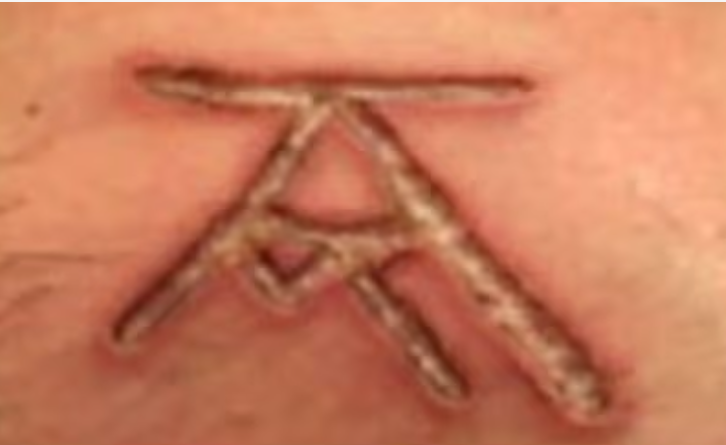
Certainly the most controversial ritual, which took place in Raniere’s inner circle DOS membership, was branding, [Image at right] which involved cauterizing in the pelvic area with the initials of Raniere and Salzman. Salzman and Mack orchestrated the ritual (Bekiempis 2021). Part of the ritual was a pledge: “Master, please brand me, it would be an honor, an honor I want to wear for the rest of my life” (Parlato 2020). It was presented as a kind of sorority symbol of solidarity. However, as Palmer noted, they did not realize “that the branding ceremony would require being held down, naked, and screaming for twenty minutes of searing pain under a cauterizing pen” (Palmer 2021:55). Nor did they realize that the brand itself consisted of Raniere’s and Salzman’s initials. It appears that there was a general perception that the brand represented an ancient representation of the “four elements” (water, earth, wind, fire). [Image at right] When the nature of the branding ritual was revealed publicly, it broke down the barrier between ordinary members and Raniere’s inner circle, unleashed a torrent of media coverage, and led to a substantial wave of defections. (When the brand is rotated ninety degrees, Raniere’s initials become more evident)

ORGANIZATION/LEADERSHIP

Corporate training programs like NXIVM that offered members the promise of achieving their full potential in exclusive personal-development workshops and seminars were quite lucrative financially, and for most of those involved in the workshops and seminars, Raniere presented as an inspired business leader and skilled, savvy trainer. Raniere (Vanguard) was the undisputed leader of NXVIM, although he did not hold any formal position as an employee or an owner. Nancy Salzman (Prefect) served as his second in command.

One way that he maintained his leadership dominance was hagiographic claims that, at least for much of NXIVM’s history, went unchallenged. He claimed that he was unable to drive because “his intellectual energy sets off radar detectors” and that “his energy is drained if those around him disappoint or defect” (Odato and Gish 2012). He claimed that in his childhood, he was an “East coast judo champion by age eleven; he learned high school math in a day at age twelve; he taught himself three years of college mathematics by age thirteen.” (Berman 2021:26). And, he claimed to be “a self-taught, concert-level pianist.” (Raine 2020:65). His loftiest claim was that his adopted name, Vanguard, identified him as the first fully enlightened human being.

While Vanguard was the public face of NXIVM, the members of his inner circle were responsible for much of the movement’s stability and operation. [Image at right] Karen Unterreiner and Kathy Russell were important to the accounting and financial side of NXIVM and raised substantial amounts of money to support the movement (Edmondson and Ames 2022). Raniere’s female, principally Allison Mack and Lauren Salzman, both of whom were in sexual relationships with Raniere were key in orchestrating the sexually oriented components of the movement as they developed (Parlato 2021).

The most controversial inner circle group was DOS (Dominus Obsequious Sororium), which had an entirely female membership and was headed by Lauren Salzman and Allison Mack. There were eight original DOS members: Lauren Salzman, Allison Mack, Nicki Clyne, Daniela Padilla, and Rosa Laura Junco (Berman 2019). DOS reflected the moral commitment, binding, and loyalty themes that are embedded in the name NXIVM and the Twelve Position Statement. DOS extended that logic. Future members were selected by DOS and required to produce “collateral” (typically sensitive memories, intimate photographs, embarrassing messages, passports, etc,) prior to initiation.

DOS was organized hierarchically and consisted of descending levels of “masters” and “slaves,” with masters being responsible for the personal development of slaves. New slaves would present their masters with personal and professional goals and then become accountable to their masters for this development. Assignments given to slaves by masters typically consisted of uncompensated labor such as purchasing groceries, cleaning premises, and organizing activities. In some cases slaves were given the assignment of having exclusive sexual intimacy with Raniere as part of their personal development (Cobb 2020). Whatever the assignment, the guiding principle of DOS was total loyalty.

Lauren Salzman, who was a cooperating witness in the Raniere trial and had already pleaded guilty to sex trafficking and racketeering, offered material from the “DOS rulebook” documenting the degree of loyalty expected from participants (Berman 2021):

Your sole highest desire must be to further your Master from whom all good things come and are related….It doesn’t matter what the command is, it matters that you obey. It doesn’t matter that you understand the command, it matters that you obey.

NXIVM attempted to internationalize the movement; the most significant success was achieved in Mexico. Carlos Emiliano Salinas Occelli, son of former President Carlos Salinas de Gortari, was extensively involved in expanding NVIXM’s operations in Mexico and in recruiting prominent business associates and wealthy families. He organized the movement’s Mexico’s inaugural event in 2007. He subsequently provided financial support to the movement’s development in Mexico and assumed a leadership role. By virtue of his success on the movement’s behalf, a significant minority of Raniere’s inner circle consisted of Mexican nationals. Occelli initially supported Raniere when allegations of improprieties arose, attributing them to dissident former members. He later distanced himself when Raniere faced criminal charges. He himself was not charged in U.S. criminal proceedings but was listed as an unindicted co-conspirator (Montes de Oca 2018).

Raniere also initiated an early childhood, multicultural education program, Rainbow Cultural Garden (Iannelli 2018). He developed the concept in 2006, referring to it as “a revolutionary child development program promoting children’s cultural, linguistic, emotional, physical, and problem-solving potential.” At the heart of the school’s curriculum was the concept of five caregivers teaching each young child five different languages simultaneously at an annual cost of $120,000. In 2015, Raquel Perera, who was the wife of renowned Latin Grammy winner Alejandro Sanz, became the owner of Rainbow Garden’s LLC parent company. The chain ultimately grew to eleven locations (Albany, New York City, Los Angeles, London, Madrid, Guatemala City, Mexico City (and three other Mexican cities), and Miami). At one point, Sara Bronfman was listed as the chain’s CEO. When a media report surfaced on Rainbow Garden, the State of Florida ordered the shutdown of the Miami location on the grounds that it was not currently licensed to operate either as a school or an early education center. That investigation precipitated inquiries in other locations. Perera then sold the school to Patricia Pietra in 2018. While multiple reports circulated that Rainbow Garden represented an attempt to sexualize young children, no legal charges were brought and the federal government stipulated that it was not seeking to connect prosecution of Raniere for sexual offenses to the school or its leadership.

ISSUES/CHALLENGES

NXIVM enjoyed a brief period of success from the late 1990s through 2017, just over a decade and a half. The movement experienced considerable growth in its program participation, expanded its presence nationally and internationally, attracted a number of celebrity figures and wealthy donors, and added new programs. However, the development of a secret inner circle, particularly DOS, derailed the movement’s momentum. It was only about three years between the formation of DOS and the shuttering of the movement.

The beginning of the end of NXIVM occurred at the beginning of 2018 when an arrest warrant for Raniere was issued by the Eastern District of New York federal court. Raniere fled the country but was apprehended in Mexico at the end of March along with several members of his inner circle. The criminal charges against Raniere could have been pursued in a variety of ways. There were, for example, a number of reports of sexual assault on girls under the age of consent (in New York the age of consent was seventeen) that could have been pursued as rape (Herbert 2018; Correspondent 2019). However, the case against Raniere and his associates involved activity that crossed both state and national borders, which allowed the federal government to take the lead in prosecution under the RICO (Racketeering Influenced and Corrupt Organizations) Act. The case was prepared by the Organized Crime and Gangs Section of the U.S. Attorney’s Office, Eastern District of New York. This strategy avoided individual state trials on rape charges where consent issues and statute of limitations, for example, would complicate prosecution. Similarly, forced labor charges could prevail on the basis of threats to expose women through use of “collateral” they had provided. Further, creating a single prosecution process allowed prosecutors to negotiate reduced charges in return for information implicating other inner circle members. This prosecution structure insured that NXIVM leadership would face federal charges of sex trafficking, forced labor, and racketeering that carried extremely heavy penalties.

Prosecution focused on the top tier of NXIVM, and so some individuals were simply listed as unindicted co-conspirators. Those who chose to actively cooperate with prosecutors were given alternatives to prison sentences or reduced sentences. Clare Bronfman pleaded guilty to harboring a fugitive and fraudulent use of identification, which drew a prison sentence of eighty- one months. Nancy Salzman pleaded guilty to racketeering conspiracy and was sentenced to forty-one months in prison. Her daughter, Lauren, who provided testimony that implicated other insiders (including her mother), pleaded guilty to racketeering and racketeering conspiracy and was sentenced to five years probation (Luperon 2021). Allison Mack pleaded guilty to racketeering charges and received a three-year prison sentence.

Only Raniere chose to plead not guilty, insisting that sexual relationships were consensual and his unconventional lifestyle was not on trial (McLaughlin and Einbinder 2021). He was tried and found guilty on all counts. In addition to his 120-year prison sentence, he was ordered to pay over $3,000,000 in restitution for removal of branding scars and for physical and mental health costs. His operation headquarters was forfeited and subsequently sold by the government. Raniere was ultimately incarcerated in the United States Penitentiary, Tucson, which serves as the only federal maximum security prison designated for sex offenders. Since his incarceration, Raniere has continued to receive support from a small group of members who have protested outside the prison facility (Whiting 2020). He also appealed his sentence. In 2025, a three-judge panel for Second Circuit Court of Appeals rejected the appeal for a new a new trial, stating that a “mountain of evidence” supported his conviction (Russell 2025). In 2026, the U.S. Supreme Court declined to hear Raniere’s appeal of his 2020 sentence, leaving in place the 2022 decision by the United States Court of Appeals for the Second Circuit.

In addition, media coverage on NXIVM before and during the trial, and particularly on the branding ritual, was pervasive, even though that ritual was not part of the legal charges. Raniere and others who were placed on trial were convicted in the media beginning before the courts acted. Further, victims who were not part of the formal legal proceedings (although included in the sentencing hearings), were given a much more prominent voice in media accounts. There was a succession of widely viewed documentaries. Seduced: Inside the NXIVM Cult, a four-episode series on Starz premiered on October 18, 2020. It focused particularly on the experiences of Catherine and India Oxenberg. The series also featured appearances by three well-know “cult” experts: Janja Lalich, Steve Hassan and Rick Alan Ross.  A second documentary, The Vow, premiered on HBO in October 2020, with a second season in October 2022. The first season featured a number of former NXIVM insiders, with particular focus on two couples, Mark Vicente and Bonnie Piesse and Sarah Edmondson; the second season focused on the Raniere trial. Other documentaries include two by A&E in 2018 and 2019, a two-hour special on Investigation Discovery in 2019, an episode on E! True Hollywood Story in 2019, and an episode on CNBC in 2021. Taken together, this media coverage and the trial coverage constituted a major media moment in American society and a lasting legacy for NXIVM.

NVIXM was created after Keith Raniere had worked in several multilevel marketing ventures that were not successful. He also took concepts from the personal growth and development industry that was popular in the 1970s. He drew on that general model in establishing an executive development program that became NXIVM. NXIVM was only partially successful as it never achieved a participation base of 20,000, and, while financially lucrative, depended on contributions from wealthy donors, and particularly the Bronfman sisters, for stability. The formation of the DOS inner circle proved to be NXIVM’s downfall as it remained in place for only about three years. NXIVM as an organization is now defunct, and its inner circle leaders have been convicted on a range of charges. If the organization has a public legacy, it is as a model of dangerous, exploitive organization.

IMAGES

Image #1: Keith Raniere. Credit: Public domain.
Image #2: Photo of a brand administered during a DOS ritual. Credit: Public domain.
Image #3: Rotated brand image to display Keith Raniere’s initials. Credit: Public domain.
Image #4: NXIVM logo. Credit: Public domain.

REFERENCES

ABC News. 2017. “Former NXIVM member says she was invited into a secret sorority, then branded.” ABC News, December 15. Accessed from https://abcnews.com/US/nxivm-member-invited-secret-sorority-branded/story?id=51617201 on 15 June 2026. 

Andrews, Suzanna. 2020. “The Heiresses and the Cult.” Vanity Fair, October 13. Accessed from https://www.vanityfair.com/culture/2010/11/bronfman-201011 on 7 July 2026.

Anon. 2019. “Keith Raniere’s Nxivm sex cult trial: What we learned.” BBC, June 20. Accessed from https://www.bbc.com/news/world-us-canada-48401061 on 7 July 2026.

Bekiempis, Victoria. 2021. “Allison Mack Provided Audio of Keith Raniere Planning NXIVM Branding Ceremony, Prosecutors Say.” Vulture, June 22. Accessed from https://www.vulture.com/2021/06/allison-mack-keith-raniere-tape-nxivm-sentencing.html on 7 July 2026.

Berman, Sarah. 2021. Don’t Call it a Cult: The Shocking Story of Keith Raniere and the Women of NXIVM. Lebanon, NH: Steerforth Press.

Berman, Sarah. 2020. “NXIVM Survivor India Oxenberg on Why She Didn’t Believe She Was Brainwashed.” Vice, October 26. Accessed on 10 November 2020.

Berman, Sarah. 2019. The NXIVM ‘Sex Cult’ Story Keeps Getting More Disturbing. Vice, May 20. Accessed from https://www.vice.com/en/article/the-nxivm-sex-cult-story-keeps-getting-more-disturbing/ on 7 July 2026.

Bloch, Josh, Kathleen Goldhar, Anita Elash, and Dave Pizer. 2018. “The Making of Vanguard.” CBC, 12 September. Accessed from https://newsinteractives.cbc.ca/longform/the-making-of-the-vanguard/ on 7 July 2026.

Bromley, David G. 1998. “Transformative movements and quasi-religious corporations: the case of Amway. Pp. 349–63 in Sacred Companies: Organizational Aspects of Religion and Religious Aspects of Organizations, edited by Nicholas Jay Demerath, Peter Dobkin Hall, Terry Schmitt and Rhys H. Williams. New York: Oxford University Press.

CBC Radio. 2019. “TRANSCRIPT: Uncover: Escaping NXIVM – Season 1, EP 3,” April 4. Accessed from https://www.cbc.ca/radio/uncover/transcripts/transcript-uncover-escaping-nxivm-season-1-ep-3-1.5084740?ref=popsugar.com&=___psv__p_47722460__t_w_ on 25 May 2026.

Cobb, Kayla. 2020. “’The Vow’ Finally Explained How NXIVM’s Sex Cult Worked.” Decider, September 7. Accessed from https://decider.com/2020/09/07/the-vow-hbo-nxivm-sex-cult-explained/ on 24 June 2026.

Correspondent. 2019. “Gina Hutchinson: The Untold Story.” The Frank Report, August 25. Accessed from https://frankreport.com/gina-hutchinson-the-untold-story on 28 June 2026.

Correspondent. 2019. “Barbara Bouchey Breaks Long Silence and Speaks Out About Commodities Losses and Other Raniere-Bronfman Matters.” The Frank Report, October 22. Accessed from https://frankreport.com/barbara-bouchey-breaks-long-silence-and-speaks-out-about-commodities-losses-and-other-raniere-bronfman-matters?ref=popsugar.com&___psv__p_47722460__t_w_ on 25 May 2026.

Cusack, Carole M. 2022. “NXIVM, Religion, and ‘Cults’: Keith Raniere as Charismatic Leader and Transgressive Criminal” Wuhan Journal of Cultic Studies 2:1. Accessed from https://www.academicpublishing.co/volume-2-issue-1.html on 7 July 2026.

Edmondson, Sarah and Anthony Ames. 2022. “Hot Mess Express: Karen Unterreiner on Dating Keith Raniere.” A Little Bit Culty (podcast). Accessed from https://alittlebitculty.com/episode/hot-mess-express-karen-unterreiner-on-dating-keith-raniere on 6 July 2026.

Edmondson, Sarah, with Kristin Gasbarre. 2019. Scarred: The True Story of How I Escaped NXIVM the Cult that Bound My Life. San Francisco, CA: Chronicle Prism.

Freedman, Michael. 2003. “Cult of Personality.” Forbes, October 13. Accessed from https://www.forbes.com/forbes/2003/1013/088.html on 14 May 2026.

Hardin, Chet. 2006. “Stress in the Family.” Metroland: The Coverage Archives, August 10. Accessed from https://thefallofnxivm.com/coverage-publication/metroland/ on 7 July 2026.

Herbert, Geoff. 2018. “NXIVM cult leader Keith Raniere accused of raping 12-year-old girl in Upstate NY.” Syracuse.com, April 13. Accessed from https://www.syracuse.com/state/2018/04/nxivm_keith_raniere_ny_cult_rape.html  on 7 July 2026.

Iannelli, Jerry. 2018. “State Closes Midtown Miami School Tied to NXIVM “Sex Cult” Leader.” Miami New Times, April 27. Accessed from https://www.miaminewtimes.com/news/alejandro-sanzs-wifes-miami-school-closed-by-state-tied-to-nxivm-sex-cult-founder-10295903/ on 27 June 2026.

Licea, Melkorka. 2020. “How India Oxenberg went from an aspiring entrepreneur with dreams of launching a catering business to being lured into a cult.” Business Insider, October 22. Law & Crime.

Luperon, Alberto. 2021. “NXIVM Cult Guru Keith Raniere’s Ex-Top Aide Ducks Prison Time Because of ‘Extraordinary’ Help to Prosecutors, Including Against Her Mother.” Law & Crime, July 28. Accessed from https://lawandcrime.com/crime/nxivm-cult-guru-keith-ranieres-ex-top-aide-ducks-prison-time-because-of-extraordinary-help-to-prosecutors-including-against-her-mother/on 7 July 2026.

Martin, Paul. 2003. “A Critical Analysis of the Executive Success Programs Inc.” Wellspring Retreat & Resource Center, February 12. Accessed from https://www.cs.cmu.edu/~dst/NXIVM/esp10.html#16 on 17 May 2026.

Massingale, Kelley. 2023. The Rise and Fall of NXIVM: A Social Network Analysis. Master of Arts (Criminology), Simon Fraser University.

McLaughlin, Kelly and Einbinder, Nicole. 2021. “How NXIVM, a so-called self-help company, crumbled after former members exposed it as a cult that abused sex slaves.” Business Insider, September 9. Accessed from  https://www.businessinsider.com/what-is-nxivm-keith-raniere-explainer-2019-4 on 7 July 2026.

Montes de Oca, Maurizio. 2018. “The Leader Of A Cult That Branded Women Had Dealings With The Mexican Government.” BuzzFeed, March 30. Accessed from https://www.buzzfeednews.com/article/mauriziomontesdeoca/the-leader-of-a-cult-that-branded-women-with-a-hot on 7 July 2026.

Moynihan, Colin. 2019. “Nxivm Trial: Leader Convicted After Trial Exposed Sex Cult’s Sordid Inner Workings.” The New York Times, June 19. Accessed from https://www.nytimes.com/2019/04/08/nyregion/nxivm-allison-mack.html on 7 July 2026.

Nichols, JB. 2018 “How Frank Parlato Helped Bring Down Keith Raniere And His Alleged Sex Cult NVIXM.” Oxygen Media, April 12. Accessed from https://www.oxygen.com/crime-time/frank-parlato-keith-raniere-sex-cult-NXIVM on 7 July 2026.

Odato, James M. and Jennifer Gish. 2012. “Secrets of NXIVM.” Times Union, February 24. Accessed from https://www.timesunion.com/local/article/Secrets-of-NXIVM-2880885.php on 7 July 2026.

Palmer, Susan J. 2021. “Media Review: NXIVM and #MeToo.” Nova Religio: The Journal of Alternative and Emergent Religions 24:104-12.

Parlato, Frank. 2022. “Unseen Texts: Keith Grovels, Begs for Cami at V-Week.” The Frank Report, March 26. Accessed from https://frankreport.com/2022/03/26/unseen-texts-keith-grovels-begs-for-cami-at-v-week/ on 7 July 2026.

Parlato, Frank. 2021. “Part 3 Lauren Salzman Unredacted Sentencing Memo — She Wanted Children and Raniere Dangled It Before Her. “The Frank Report, 25 July. Accessed from https://frankreport.com/2021/07/25/part-3-lauren-salzman-unredacted-sentencing-memo-she-wanted-children-and-raniere-dangled-it-before-her/ on 7 July 2026.

Parlato, Frank. 2020. “Lauren Salzman – ‘Collateralized’ Slaves Agreed to Vow of Obedience Without Knowing What [or Who] They Had to Obey.” The Frank Report, January 22. Accessed from https://frankreport.com/lauren-salzman-collateralized-slaves-agreed-to-vow-of-obedience-without-knowing-what-or-who-they-had-to-obey on 7 July 2026.

Parlato, Frank. 2017. “Aging Harem: Karen Unterreiner. She also serves who stands and waits.” The Frank Report, June 27. Accessed from https://frankreport.com/2017/06/27/aging-harem-karen-unterreiner-she-also-serves-who-stand-and-wait/ on 7 July 2026.

Raine, Susan. 2020. “Reinventing the Self: NXIVM’s Promises, Secrets, and Lies.” International Journal of Coercion, Abuse, and Manipulation 1:60-81.

Raniere, Keith. n.d. “Twelve Point Mission Statement.” Accessed from https://int.nyt.com/data/documenthelper/852-keith-raniere-s-twelve-point-m/14c1838fee817b774dfc/optimized/full.pdf on 25 May 2026.

Russell, Josh. 2025. “Second Circuit upholds Keith Raniere sex cult abuse conviction.” Courthouse News, October 27. Accessed from https://www.courthousenews.com/second-circuit-upholds-keith-raniere-sex-cult-abuse-conviction/ on 26 June 2026.

Shea, Courtney. 2019. “Ladies Who Cult: Celebrities, executives and wealthy heiresses brought into NXIVM’s promise of expanded consciousness and female empowerment. Then came the sex slavery, brainwashing and blackmail. Inside an alleged cult for successful women.” Chatelaine 92:2. Accessed from https://go.gale.com/ps/i.do?p=AONE&u=googlescholar&id=GALE%7CA573241856&v=2.1&it=r&sid=sitemap&asid=74e8e667 on 7 July 2026.

Silver, Morris. 2012. “The Nexum Contract as a ‘Strange Artifice’.” Revue Internationale des Droits de l´Antiquité 59:217-38.

Sun, Rebecca. 2018. “Ex-Nxivm Member Was Branded at Allison Mack’s Home.” Hollywood Reporter, May 17. Accessed from https://www.hollywoodreporter.com/tv/tv-news/nxivm-member-was-branded-at-allison-macks-home-video-1113006/ on 24 June 2026.

VanBaale, Kali White. 2025. “The NXIVM Cult: An Inside Look at the Classes and Cruelty.” AE TV, August 22. Accessed from https://www.aetv.com/articles/nxivm-cult on 14 May 2026.

Whitaker, Justin. 2018. “Office of His Holiness the Dalai Lama Issues Clarification over Report of Controversial Donation.” Buddhist Door.net, February 5. Accessed from https://www.buddhistdoor.net/news/office-of-his-holiness-the-dalai-lama-issues-clarification-over-report-of-controversial-donation/ on 7 July 2026.

Whiting, Amanda. 2020. “Where NXIVM Stands Two Years After Leader Keith Raniere’s Arrest.” Bustle, August 30. Accessed from https://web.archive.org/web/20200831090843/https:/www.bustle.com/entertainment/nxivm-the-vow-still-active-splinter-groups on 26 June 2026.

Willmore, Alison. 2020. “Before NXIVM and The Vow, Mark Vicente Directed a Truly Bizarre Hit Documentary.” Vulture, October 22. Accessed from: https://www.vulture.com/2020/10/looking- back-at-mark-vicentes-what-the-usd-do-we-k-now.html on 7 July 2026.

Younkins, Edward W. 2012. “Ayn Rand’s Objectivist Virtues as the Foundation for Morality and Success in Business.” The Journal of Ayn Rand Studies 12:237-62.

Publication Date:
8 July 2026


Share

QANON

QANON  TIMELINE

1990s–2000s:  There was an expansion of internet conspiracy culture through  message boards, talk radio, and websites associated with conspiratorial worldviews.

1990s–2000s:  There was a growth of narratives involving “deep state” actors, global elites, and secret cabals.

1990s–2000s:  Conspiracy entrepreneurs such as Alex Jones and older anti-government traditions increased their influence.

2016:  The “Pizzagate” conspiracy emerged after hacked Democratic Party emails were released through WikiLeaks making false claims that spread online alleging that Democratic elites were operating child-trafficking networks from the Comet Ping Pong pizza restaurant in Washington, D.C.

2017 (December):  A gunman entered Comet Ping Pong restaurant while attempting to “investigate” the conspiracy. Scholars later identified Pizzagate as a key precursor to QAnon.

2018 (October):  An anonymous poster using the name “Q Clearance Patriot” began posting on the image board 4chan in a thread titled “Calm Before the Storm.”

2018 (October 28):  The first Q drop was posted. Q claimed to possess high level U.S. government security clearance. Early “Q drops” predicted imminent arrests of political elites, especially Hillary Clinton. Followers began interpreting cryptic messages collectively.

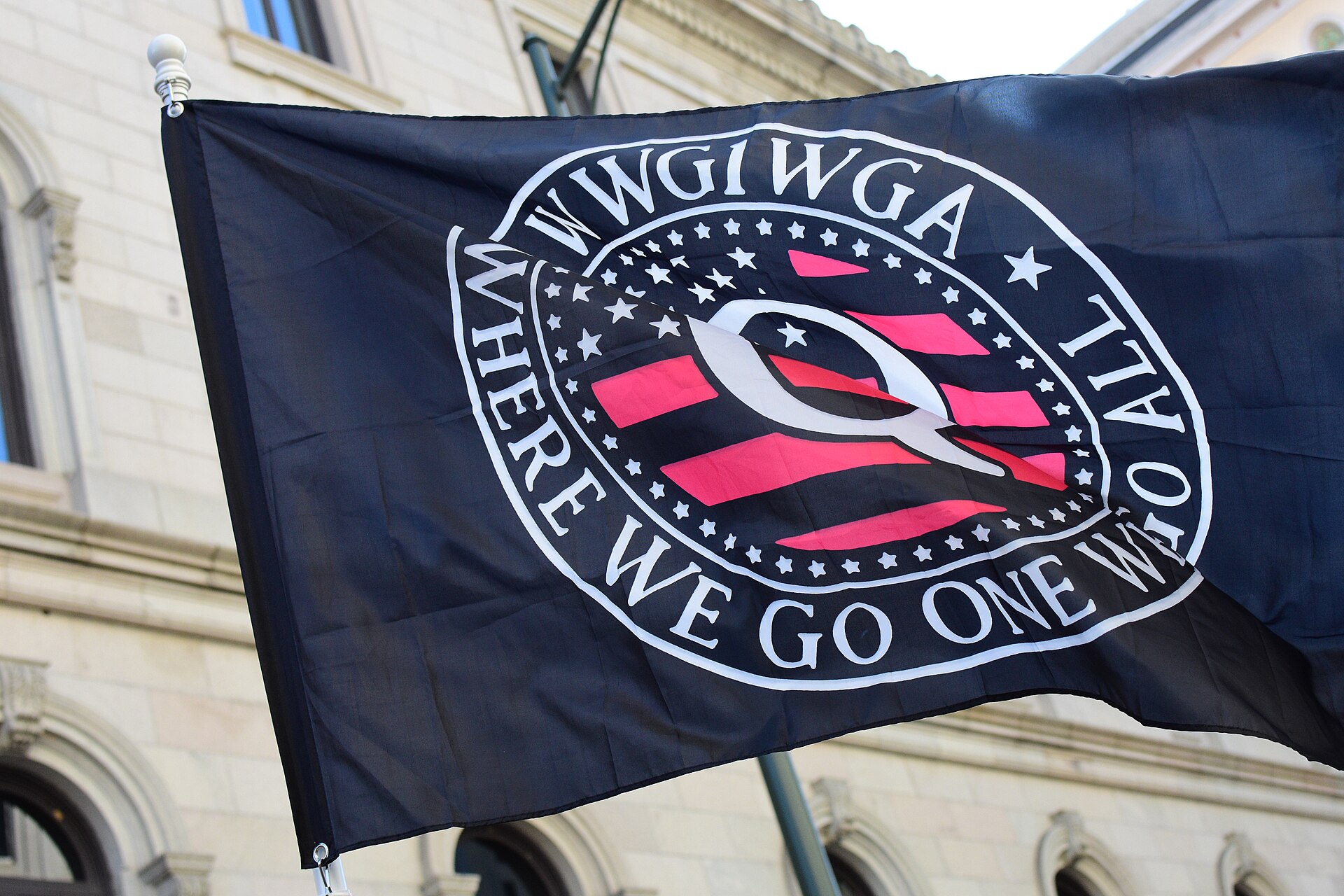
2017–2018:  QAnon communities spread from 4chan to 8chan, Reddit, YouTube, Facebook, and Twitter. Followers began calling themselves “Anons” and “digital soldiers.” The phrase “The Storm” became central to the movement, referring to a coming moment of mass arrests and revelation. “Where We Go One, We Go All” (WWG1WGA) emerged as a movement slogan.

2018:  YouTube influencers and social media personalities popularized QAnon content. QAnon merged with evangelical prophecy culture, anti-vaccine narratives, wellness spirituality, and anti-globalist conspiracies.

2018:  The FBI began monitoring conspiracy theory-driven extremism.

2019 (May 30):  The FBI Phoenix field office intelligence bulletin (May 30, 2019) identifies conspiracy-theory-driven extremism, including QAnon, as a potential domestic terrorism threat, the first such designation.

2019:  QAnon symbols appeared at political rallies for Donald Trump.

2019:  Major social media platforms began removing some QAnon-related accounts.

2019:  Scholars began analyzing QAnon’s participatory and quasi-religious structure.

2020:  The COVID-19 pandemic dramatically accelerated online conspiracy communities. QAnon spread internationally, with documented activity in Europe, Australia, and Brazil.

2020:  “Save the Children” activism became a major recruitment pathway, co-opting a legitimate charity’s brand to spread child-trafficking conspiracy narratives.

2020:  QAnon increasingly merged with anti-lockdown, anti-vaccine, and spiritual “awakening” communities.

2020:  Several congressional candidates openly endorsed QAnon ideas; two won seats in the 2020 election cycle.

2020:  Scholars began describing QAnon as a “digital religion” and “hyper-real religion.”

2021 (January 6):  QAnon followers participated in the attack on the U.S. Capitol. Prominent QAnon imagery, slogans, and symbols appeared throughout the riot. The event became a turning point in public understanding of the movement.

2021:  Q posts ceased after December 2020.

2021:  An HBO documentary Q: Into the Storm examined the origins of the movement and focused on possible involvement by Ron Watkins and Paul Furber.

2021:  Despite failed prophecies, many believers reinterpreted events rather than abandoning the movement.

2022–2024:  QAnon narratives continued circulating through election denialism, anti-LGBTQ rhetoric, anti-globalist activism, and “Great Reset” conspiracies.

2022–2024:  The movement became more decentralized and integrated into broader far-right ecosystems).

2025–2026:  Scholars increasingly analyzed QAnon as a persistent mythic framework rather than a single organized movement. Research continued examining the overlap between QAnon, Christian nationalism, digital extremism, and conspiratorial spirituality.

FOUNDER/GROUP HISTORY

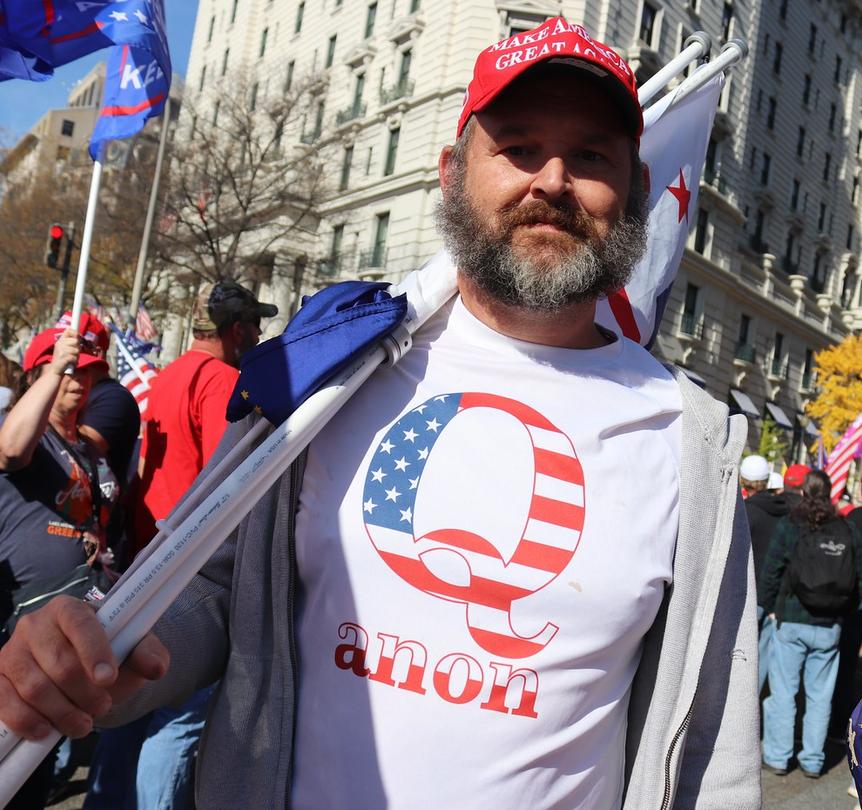
QAnon emerged in October 2017 as an anonymous online conspiracy movement and rapidly developed characteristics that scholars associate with decentralized religious and quasi-religious traditions. [Image at right] At its core, the movement offers followers a cosmic narrative: hidden forces of evil control the world, a heroic struggle is underway, revelation is imminent, and salvation (political and spiritual) awaits the faithful. Therefore, although the movement does not fit the conventional definition of religion, it occupies an important place in contemporary discussions about religion (Argentino 2020; Introvigne 2016), digital culture (Barkun 2013; Starbird et al. 2019), extremism (Amarasingam & Argentino, 2020; U.S. House Select Committee 2022), and the transformation of belief in networked societies (Brubaker 2021; Robertson 2021).

QAnon actually is not an anomaly in America, the nation where the movement originated. Stretching back to the outbreak of witchcraft allegations in Salem, Massachusetts in the 1690s and, more recently, what has been called the “Satanism Scare” in the 1980s, outbreaks of this kind are most likely when there is severe dislocation in some segment of the social order that produces a sense of loss of control such that individuals feel like strangers in their own land. In the case of QAnon, the set of groups that constitute the center of support for the movement include white Christian nationalists, anti-science groups (in this case anti-vaccine groups in particular due to the COVID outbreak), militia and sovereign citizen groups, anti-globalist organizations, and election denial groups. There groups share a deep sense of alienation from the established social order, which they refer to as the “deep state.” The narratives that emerge in such moments are betrayal narratives: Those who were entrusted with the welfare of the citizenry have secretly organized, appropriated power, and collectively use that power to exploit and victimize their fellows. The threat is imminent and of apocalyptic proportions, and so there is an urgent need for restorative action (Bromley and Richardson 2023).

Drawing on these apocalyptic and millennial themes which have deep roots in American religious culture, QAnon has blended conspiracy culture, populist politics, and internet participatory practices into a distinctly spiritual register (LaFrance 2020; MacMillen and Rush 2022). Scholars have described the resulting formation variously as “conspirituality,” digital millenarianism, or a novel form of vernacular religion operating across alternative spiritual spaces (Argentino 2020; Barkun 2013; Conner 2023; Miotto and Droogan 2025; Robertson 2016; Ward and Voas 2011).

Unlike many religious or spiritual movements, QAnon has no universally acknowledged founder. Instead, it emerged through anonymous online participation and collaborative mythmaking. Nevertheless, researchers have identified several important figures in its formation and expansion.

The movement began in October 2017 when an anonymous user called “Q” posted cryptic messages on the image board 4chan. Q claimed access to classified information through a “Q clearance,” a real U.S. Department of Energy security designation associated with nuclear programs. The posts implied that powerful political and cultural elites were secretly involved in satanic child trafficking and corruption, while President Donald Trump was allegedly working behind the scenes to defeat them.

Scholars and journalists have argued that QAnon built directly upon earlier conspiracy traditions. Michael Barkun (2013) described contemporary conspiracy culture as “improvisational millennialism,” in which disparate conspiracies
merged into a single totalizing worldview. QAnon exemplifies this pattern by combining anti-government narratives, anti-elite resentment, apocalyptic Christianity, anti-Semitic tropes, and internet participatory culture.

Researchers have also emphasized the importance of “Pizzagate” as a precursor movement. Pizzagate introduced the idea that Democratic political elites operated hidden child-trafficking networks. QAnon expanded this claim into a comprehensive worldview involving Hollywood celebrities, intelligence agencies, financial elites, and global institutions.

The identity of “Q” remains disputed. Investigations by journalists and documentary filmmakers have pointed toward Paul Furber [Image at right] and Ron Watkins [Image at right] as likely contributors or operators behind at least some Q posts. Britannica has summarized forensic linguistic analyses suggesting that Furber authored early posts while Watkins likely controlled later communications. [Image at right]

However, the movement’s growth depended less on Q personally than on the decentralized interpretive community surrounding the posts. Followers known as “bakers” collectively analyzed and decoded “Q drops,” producing videos, podcasts, memes, livestreams, and social media content. This collaborative interpretive process resembled crowdsourced scriptural exegesis. Authority became diffuse and participatory rather than centralized.

QAnon spread rapidly because it was highly adaptable. Followers could integrate local anxieties, religious traditions, and political concerns into the movement’s framework. In the United States, QAnon overlapped strongly with evangelical Christian nationalism. In wellness and New Age communities, it merged with ideas about spiritual awakening, hidden energies, and cosmic transformation. Scholars coined the term “conspirituality” to describe these hybrids of conspiracy thinking and spiritual discourse (Ward and Voas 2011). Reddit discussions and qualitative research also documented how wellness communities adopted QAnon-related themes during the COVID-19 pandemic.

The movement also benefited from platform algorithms that rewarded emotionally intense content. Researchers studying QAnon social networks found that online communities functioned as echo chambers that reinforced a simplified struggle between absolute good and evil (Priniski, McClay, and Holyoak 2021).

By 2020, QAnon had evolved from a fringe internet phenomenon into a transnational movement with millions of followers. Although many predictions repeatedly failed, including forecasts of mass arrests, military tribunals, and political reversals, followers typically reinterpreted failures rather than abandoning belief. This adaptability resembles patterns found in millennial religious movements after failed prophecies, including what Leon Festinger (1956) famously described in studies of cognitive dissonance.

The January 6, 2021 Capitol attack marked the movement’s greatest moment of visibility and crisis. QAnon symbols, banners, and slogans were highly visible among rioters. After the attack, social media companies intensified moderation efforts, and mainstream visibility declined. Yet the movement persisted through decentralized online communities and ideological diffusion into broader conspiracy ecosystems.

Many scholars have continued to argue that QAnon has functioned less as a coherent organization than as a flexible mythological framework. It has offered followers explanations for social disruption, moral uncertainty, and political distrust while providing a sense of participation in a cosmic struggle.

DOCTRINES/BELIEFS

QAnon’s belief system is difficult to summarize neatly because it has constantly shifted, absorbed new conspiracies, and adapted to current events. Unlike traditional religions with established doctrines or sacred texts, QAnon has functioned as an evolving participatory mythology. Its followers have rarely agreed on every detail, yet a recognizable worldviews has bound the movement together. At its core, QAnon has presented reality as a hidden war between forces of absolute good and absolute evil. This cosmic struggle has given believers a framework for interpreting politics, media, social change, and even personal experience.

Scholars have increasingly argued that QAnon has operated less like a conventional political movement and more like an apocalyptic belief system or “hyper-real religion” rooted in internet culture (Argentino 2020). Like earlier millennial movements, QAnon has promised that hidden truths would soon be revealed, corrupt powers would be destroyed, and believers would be vindicated. The movement has offered followers not only explanations for social uncertainty but also a sense of moral purpose and participation in a larger historical drama.

At the center of QAnon has been an intensely dualistic worldview. Reality is divided into opposing camps of purity and corruption, patriots and traitors, awakened believers and manipulated masses. Followers have continued to believe that a hidden cabal of elites secretly controls major institutions, including governments, intelligence agencies, financial systems, Hollywood, news media, and global organizations. These elites frequently have been portrayed not simply as politically corrupt but as fundamentally evil, often accused of participating in satanic ritual abuse, child trafficking, and moral depravity.

This framework resembles older religious traditions that interpret history as a cosmic battle between sacred and demonic forces. Researchers have noted parallels between QAnon and apocalyptic forms of Christianity in which believers await the destruction of hidden evil powers and the eventual triumph of righteousness (Miotto and Droogan 2025). The movement’s narratives frequently have invoked imagery associated with spiritual warfare, divine judgment, and purification.

The moral certainty offered by this worldview is important to understanding QAnon’s appeal. Complex political, economic, and cultural changes are simplified into a single explanatory framework. Social problems are no longer viewed as the result of competing interests, institutional failures, or historical processes, but instead as the deliberate actions of malevolent actors operating in secret. This has allowed followers to interpret uncertainty and anxiety through a narrative that clearly identifies villains, heroes, and a coming resolution.

QAnon also has framed believers themselves as active participants in this cosmic conflict. Followers are not passive observers but moral actors engaged in a struggle to expose corruption and awaken others to the hidden truth. In this sense, QAnon has transformed political participation into a sacred mission.

One of QAnon’s central prophetic ideas is “The Storm,” a term referring to a coming moment of revelation and reckoning. According to the movement, corrupt elites will eventually be arrested, publicly exposed, or punished in dramatic fashion. Followers have anticipated that this event would involve mass military operations, public tribunals, televised confessions, or the collapse of existing political institutions.

The concept functions similarly to apocalyptic judgment narratives found in many religious traditions. Like the Christian Book of Revelation or millennial prophecies in other movements, “The Storm” represents both destruction and renewal. Evil will supposedly be swept away so that a purified social order can emerge.

Between 2017 and 2021, followers repeatedly predicted specific dates on which “The Storm” would occur. These prophecies consistently failed, yet disappointment rarely led to widespread abandonment of the movement. Instead, believers often reinterpreted failed predictions as evidence of hidden strategic planning, disinformation campaigns, or tests of faith. Scholars of religion have long observed similar patterns in millennial groups whose prophecies do not materialize. Leon Festinger’s classic study When Prophecy Fails argued that failed predictions can sometimes strengthen commitment because believers reinterpret disappointment in ways that preserve the larger worldview. In QAnon communities, delayed prophecy became normalized. Followers encouraged one another to “trust the plan,” a phrase suggesting that unseen forces were still guiding events behind the scenes even when evidence appeared contradictory.

Alongside “The Storm,” QAnon promises an event called “The Great Awakening.” This phrase describes the anticipated moment when ordinary people will realize the truth about hidden corruption and manipulation. The language intentionally echoes the Great Awakenings of American Protestant history while simultaneously drawing from New Age ideas about spiritual consciousness and enlightenment.

Followers often have described themselves as “awake” or “red-pilled,” terms suggesting liberation from illusion and entry into deeper truth. Outsiders, by contrast, have frequently been described as “sleeping,” brainwashed, or trapped within systems of manipulation created by media, education, or political institutions. [Image at right]

The movement therefore has created a strong distinction between insiders and outsiders. Believers have seen themselves as possessing hidden knowledge unavailable to the general public. This dynamic resembles what scholars of religion call esotericism, or the idea that truth is reserved for those who possess special insight or interpretive ability.

The promise of awakening also has given QAnon a conversion narrative. Many followers have described discovering QAnon as a transformative moment in which they suddenly recognized hidden patterns in politics and society. These accounts often resemble religious testimonies or narratives of spiritual rebirth. Individuals describe moving from confusion to certainty, from ignorance to enlightenment, and from passivity to moral action.

QAnon has incorporated and radicalized the idea of the “deep state,” a term referring to putatively hidden networks of power operating beneath visible political institutions. In QAnon narratives, elected officials have often been portrayed as puppets, while intelligence agencies, global financial actors, secret societies, and international organizations have been imagined as the true rulers of society.

The concept of hidden power also is not unique to QAnon. Conspiracy movements have historically relied on narratives in which visible events are controlled by concealed actors. Michael Barkun (2013) argues that conspiracy cultures often reject randomness and complexity in favor of explanations that attribute major events to intentional secret planning.

Within QAnon, the “deep state” has become a catch-all explanation for political defeats, media criticism, public health policies, and institutional authority. Because the conspiracy has been imagined as vast and hidden, contradictory evidence can easily be incorporated into the belief system itself. Skepticism from journalists, academics, scientists, or government officials has been interpreted not as disconfirmation but as proof that these institutions are compromised. This logic has created a self-sealing worldview in which nearly all external criticism has reinforced rather than weakened belief.

QAnon followers have frequently referred to themselves as “digital soldiers.” The phrase has reflected the movement’s understanding of online activity as a form of moral and political combat. Posting content, sharing memes, decoding Q messages, and spreading conspiracy narratives have been framed not as casual internet behavior but as acts of participation in a larger struggle. The identity of “digital soldier” also has given ordinary participants a sense of empowerment and belonging. [Image at right] Individuals who might otherwise feel politically powerless could imagine themselves as part of a hidden resistance movement engaged in world-historical events. This idea has become especially important because QAnon has developed almost entirely online. Unlike traditional religious groups that have relied on churches or formal organizations, QAnon communities have formed through message boards, livestreams, Telegram channels, YouTube videos, podcasts, and social media networks. Participation has been decentralized but highly interactive. Scholars note that QAnon combines internet gaming culture, participatory storytelling, and religious symbolism into a hybrid belief system uniquely suited to digital environments.

Perhaps the most distinctive feature of QAnon belief culture has been its emphasis on “doing your own research.” This means viewing themselves as researchers, investigators, and truth-seekers. The research process involves consuming large amounts of online content, compare screenshots, interpret clues, watch livestreams, and search for hidden connections among political events. The movement has celebrated this collective problem-solving and collaborative interpretation. In this sense, QAnon has transformed internet participation into a ritualized communal activity.

Importantly, research has been presented not simply as information gathering but as a form of revelation. Truth has been understood as hidden beneath official narratives and accessible only through independent investigation. Institutional expertise is treated with suspicion, while intuition, pattern recognition, and collaborative interpretation are elevated as pathways to deeper understanding.

This practice resembles forms of participatory scriptural interpretation found in some religious communities. Q’s cryptic messages, known as “Q drops,” have functioned almost like sacred riddles requiring communal exegesis. Followers collectively have searched for meanings, symbols, numerical coincidences, and prophetic fulfillments. Ambiguity has become a strength rather than a weakness as vague predictions have allowed believers to continually reinterpret unfolding events.

Researchers have argued that this participatory process helped create strong emotional investment in the movement. Followers did not simply consume information; they actively helped construct the narrative itself. This collaborative meaning-making blurred distinctions between audience and authority, believer and interpreter.

The emphasis on “research” also reinforced QAnon’s rejection of mainstream institutions. Journalists, scientists, universities, and government agencies have been portrayed as untrustworthy or corrupted by hidden elites. Independent investigation therefore became both an epistemological practice and a moral obligation. In this way, QAnon offered followers a complete framework for understanding reality: evil forces secretly control society, hidden truths can be uncovered through collective interpretation, believers are engaged in a sacred struggle, and a final revelation is approaching in which justice will ultimately prevail.

There was even something approaching a movement language through which members communicated with one another online. Images, slogans, short videos, coded symbols, and viral graphics circulated constantly across social media platforms. Humor, irony, and sarcasm frequently masked extremist or conspiratorial claims, allowing content to circulate more easily online. This blend of entertainment and ideological messaging reflected broader internet culture, where political communication increasingly occurs through visual and participatory formats. Producing and sharing memes became a form of participation and served to demonstrate loyalty and insider knowledge. Memes also simplified complex conspiracy narratives into emotionally powerful visual forms.

Major elements of the vocabulary include the following: “Q drops” (messages allegedly posted by Q), “Anons” (followers),“ WWG1WGA” (“Where We Go One, We Go All”), “The Storm” (coming purge of elites), “Great Awakening” (mass revelation), “Trust the Plan” (slogan encouraging patience), “Red-pilling” (awakening someone to hidden truth), “Cabal” (hidden ruling elite), and “Deep State” (secret government power structure). [Image at right]

RITUALS/PRACTICES

Although QAnon lacks many features traditionally associated with organized religion (such as churches, clergy, formal rituals, or sacred texts), it nevertheless developed a recognizable culture of devotional practices, collective interpretation, and communal participation. Much of this activity occurred online, leading some scholars to describe QAnon as a form of “digital religion” shaped by internet culture and participatory media (Argentino 2020). Followers engaged in recurring behaviors that created solidarity, reinforced belief, and transformed political conspiracy into an immersive moral and spiritual experience.

What distinguished QAnon from many earlier conspiracy movements was the degree to which participation itself became ritualized. Belief was not merely something followers accepted intellectually; it was enacted through repeated online practices, communal interpretation, emotional performance, and continual anticipation of revelation. YouTube channels, Telegram groups, podcasts, livestreams, Facebook communities, and discussion forums became virtual congregational spaces where believers gathered daily to consume and discuss content. Influencers and livestream hosts often functioned like informal preachers or spiritual interpreters. They translated complex conspiracy narratives into emotionally compelling stories, offered commentary on current events, and reassured audiences during moments of uncertainty or failed prophecy. Followers frequently spent hours each day immersed in QAnon-related media ecosystems. Many described routines involving constant monitoring of news updates, livestream discussions, Telegram feeds, and social media threads. Over time, these digital environments created highly immersive informational worlds in which believers primarily interacted with others who shared the same assumptions and narratives.

One of the central ritual activities within QAnon involved interpreting the cryptic posts known as “Q drops.” These messages, posted anonymously by “Q” on image boards such as 4chan and later 8chan/8kun, were often deliberately vague, fragmented, and filled with rhetorical questions, abbreviations, military language, and symbolic references. Followers treated these posts almost like sacred texts requiring interpretation. Communities collectively analyzed individual phrases, timestamps, punctuation patterns, images, and numerical references in an attempt to uncover hidden meanings. Participants searched for: symbolic patterns, coded messages, numerological connections, hidden confirmations or “proofs,” political predictions, and signs of prophetic fulfillment.

This interpretive activity resembled forms of scriptural exegesis found in religious traditions in which believers collaboratively study sacred writings for deeper revelation. Importantly, the ambiguity of the Q drops increased rather than weakened their power. Because the messages were open-ended, followers could continually reinterpret them to fit unfolding political events. The process also encouraged collective participation. No single follower possessed complete interpretive authority. Instead, thousands of users contributed theories, assembled timelines, compared screenshots, and built elaborate explanatory systems together. This collaborative decoding created strong emotional investment and fostered intense online community bonds. Researchers have argued that the interpretive process itself became more important than the accuracy of predictions as participation gave followers a sense of agency, insider status, and intellectual discovery. In this way, the act of decoding Q drops functioned simultaneously as political participation, entertainment, and ritual devotion.

Particularly during the COVID-19 pandemic, when social isolation increased dramatically, online QAnon communities became even more emotionally significant for many participants. These digital fellowships also reinforced the movement’s sense of urgency. Livestream discussions frequently framed current events as evidence that hidden prophecies were unfolding in real time, encouraging participants to remain continuously engaged.

QAnon culture strongly emphasized evangelism. Followers frequently attempted to “wake up” friends, family members, coworkers, and online audiences by introducing them to conspiracy materials and encouraging them to “do their own research.” This process was commonly described as “red-pilling,” a term borrowed from the film The Matrix in which taking the “red pill” reveals hidden reality. Within QAnon, becoming “red-pilled” meant awakening to truths allegedly concealed by governments, media organizations, and global elites. The evangelistic impulse gave followers a sense of moral obligation. Believers often viewed themselves as rescuing others from deception or manipulation. This dynamic closely resembles missionary activity in many religious traditions, where spreading revelation becomes a sacred duty. At the same time, of course, evangelizing frequently produced conflict within families and communities. Studies and support groups such as “QAnonCasualties” documented the breakdown of relationships as some believers became increasingly immersed in conspiratorial worldviews.

Those who have already joined similarly report a deeply transformative experience involving moral awakening, spiritual renewal, or liberation from deception. Believers frequently portrayed themselves as having escaped manipulation by corrupt institutions and gained access to hidden truth. These narratives often involved strong themes of purification and rebirth. Followers described abandoning old beliefs, severing ties with mainstream media, and adopting new moral frameworks centered on vigilance, truth-seeking, and resistance to corruption. QAnon thus provided not only political explanations but also existential meaning. It offered a sense of purpose, belonging, and moral certainty during periods of social instability and distrust. Researchers have compared these narratives to religious conversion experiences because they frequently include elements such as sudden revelation, emotional transformation, moral realignment, and entry into a new interpretive community.

One of QAnon’s defining social dynamics involved continual anticipation of imminent revelation. Communities repeatedly gathered around predicted moments in which dramatic change was expected to occur, including: mass arrests of political elites, election reversals, military interventions, public disclosures of hidden crimes, or transformative media events. These moments generated intense emotional excitement and communal anticipation. Followers monitored news coverage, interpreted symbolic “signs,” and discussed predictions in real time.

When prophecies failed, the movement rarely collapsed but rather became stronger. Believers often reinterpreted disappointment through new explanations: the plan was still unfolding, hidden victories had occurred secretly, disinformation was necessary, or timelines had changed. The repeated cycle of prediction, disappointment, reinterpretation, and renewed anticipation became a recurring ritual pattern within QAnon culture. This pattern resembles the behavior of earlier millennial movements studied by scholars of religion and social psychology.

Although much of QAnon existed online, followers also participated in offline demonstrations and public events. Q symbols and slogans appeared at political rallies, anti-lockdown protests, election protests, and the January 6, 2021 Capitol attack. Public display of QAnon symbols functioned as a form of testimony and identity performance. Wearing Q-themed clothing, carrying signs, or displaying slogans publicly signaled commitment to the movement and solidarity with other believers. These events also reinforced the perception that followers were participants in a larger historical struggle. Rallies and protests became emotionally charged spaces where political activism merged with apocalyptic expectation and collective identity formation.

ORGANIZATION/LEADERSHIP

QAnon differs significantly from traditional religious movements or political organizations because it has lacked centralized leadership, formal membership, or stable institutional structures. Instead, the movement developed as a decentralized network of online communities, influencers, and participatory media systems. This fluid structure became one of QAnon’s greatest strengths. Because no single organization controlled the movement, it could easily adapt, migrate across platforms, absorb new narratives, and survive repeated prediction failures. At the same time, this lack of formal structure and boundaries makes the movement difficult to define or measure along conventional dimensions.

QAnon has no official membership system, clergy hierarchy, governing institution, or formal doctrinal authority. Individual members participate voluntarily and at varying levels of intensity. Some followers merely consume conspiracy-related content occasionally, while others devote substantial portions of their daily lives to QAnon communities and activism. Individuals can adopt certain QAnon themes without fully identifying with the movement itself, allowing conspiracy narratives to spread into broader political and cultural environments.

With respect to movement leadership, Q itself functioned less as a traditional leader than as a symbolic source of revelation around which interpretive communities formed. While QAnon has lacked centralized leadership, authority still emerged through influence, visibility, and interpretive power. Popular livestream hosts, podcasters, Telegram administrators, YouTube personalities, and social media influencers have gained large followings by explaining Q drops, interpreting political developments, and maintaining audience engagement. Another important role in organizing QAnon is the “baker.” Bakers are individuals who interpret Q drops and transform cryptic messages into coherent narratives. The term derived from the phrase “baking bread,” referring to assembling “crumbs” of information into larger explanations. Bakers thus acted have as interpretive mediators between Q’s vague posts and the broader movement. Through videos, livestreams, charts, timelines, and social media threads, they have synthesized complex conspiracies into emotionally persuasive narratives. Together this set of roles has constituted the interpretive labor that became central to the movement’s structure. Rather than receiving doctrine from a centralized authority, followers participated in a constantly evolving collaborative mythology shaped by countless online contributors.

QAnon’s overall organization consists of a loosely coupled set of movements that share in common intense opposition to the established social order. These include: Christian nationalist, anti-vaccine, militia, sovereign citizen, anti-globalist, New Age, wellness influencer, and election denial movements. Beyond this core set of constituent movements, a variety of other oppositional movements are free to support elements of the QAnon agenda.

The overall QAnon movement network functions through a network of platforms. These include: 4chan, 8chan/8kun, Reddit, YouTube, Facebook, Telegram, Truth Social, TikTok, various podcasts, and numerous livestreaming platforms. Each platform shaped the movement differently. Image boards encouraged collaborative decoding and anonymity, while YouTube and podcasts amplified charismatic personalities. Facebook groups facilitated mass recruitment, and Telegram later became important after mainstream platform bans intensified. This makes QA highly adaptable and increases its reach as individuals entering through one issue, such as alternative health, anti-lockdown activism, or religious prophecy, could gradually adopt broader QAnon worldviews. Scholars have described this process as ideological convergence, where diverse conspiratorial and extremist narratives become interconnected within a shared framework of distrust and apocalyptic expectation.

Although QAnon emerged within American political culture, it rapidly spread internationally. Localized forms of QAnon appeared in Germany, Canada, Australia, Brazil, Japan, France, and the United Kingdom. International variants have adapted core QAnon narratives to local political grievances, cultural anxieties, and national histories. In some countries, QAnon merged with anti-immigrant movements, anti-European Union activism, anti-vaccine protests, or nationalist politics. The movement’s international expansion has demonstrated the flexibility of its underlying mythology. Rather than depending on specific American political figures alone, QAnon provided a broader narrative framework centered on hidden evil, secret power, awakening, and impending revelation. This adaptability helps explain why QAnon has persisted even after failed prophecies, platform bans, and the disappearance of Q’s original posts. More than a single conspiracy theory, QAnon evolved into a decentralized participatory belief system capable of continual reinvention.

ISSUES/CHALLENGES

QAnon represents one of the most significant examples of digitally mediated conspiracy spirituality in the twenty-first century (Argentino 2020). While originating on anonymous internet message boards, the movement developed many characteristics associated with religious and millennial traditions: prophetic revelation, apocalyptic expectation, moral dualism, evangelism, communal interpretation, and narratives of awakening and salvation. Its decentralized structure allowed extraordinary adaptability across political, religious, and cultural contexts. Scholars increasingly interpret QAnon not simply as a conspiracy theory but as a participatory mythic system that provides meaning, identity, and moral certainty during periods of social instability.

The movement’s growth and adaptability notwithstanding, QAnon has faced some significant internal issues. The disappearance of Q left the movement without its symbolic center point, which exposed the sometimes divergent agendas of coalition partners and individual members. These have been evident in the competing interpretations of Q drops, which has limited movement message unity. The movement’s apocalyptic orientation has led to a series of discrediting failed predictions of deep state collapse. Most significantly, because each coalitional partner has its own specific agenda, the movement has always been vulnerable to infighting and withdrawal of support. QAnon messages have also mainstreamed as various MAGA-aligned media outlets and political leaders have repeated and mainstreamed conspiracy narratives, reducing the importance of QA itself.

QAnon has also faced several external challenges. [Image at right] Public credibility of the movement suffered as a result of its implication in denial of the legitimacy of 2020 presidential election results and the participation of its supporters in the January 6, 2021 U.S. Capitol riot. The movement also experienced scrutiny by the FBI as a potential terrorist threat. Major fact-checking organization and mainstream media outlets placed restrictions on material posted by the movement and removed some banned postings. The concern motivating these social control efforts by media and law enforcement organizations, as well as researchers, is that QAnon’s absolutist worldview can contribute to radicalization and political violence (FBI 2019; Amarasingam and Argentino 2020; Jensen and Tinsley 2021).

IMAGES

Image #1: One version of the QAnon flag: Credit: Creative Commons Attribution-Share Alike 3.0 Unported license.
Image #2: Paul Furber at Brainstorm Neotel CIO Roundtable. Credit:  Creative Commons Attribution 2.0 Generic license. This image was originally posted to Flickr by Axel Bührmann at https://flickr.com/photos/9852972@N03/13102567985.
Image #3: Jordan Sather speaking at a pro-QAnon conspiracy theory rally in Washington, D.C., on September 11, 2019. Credit: Jared Holt. Creative Commons Attribution-Share Alike 4.0.
Image #4: “Wake Up” message by QAnon participant at Million MAGA March Gathering Rally at Freedom Plaza at 14th and E Street, NW, Washington DC on Saturday morning, 14 November 2020. Credit:  Creative Commons Attribution-Share Alike 2.0 Generic license. Originally posted to Flickr by gruntzooki at https://flickr.com/photos/37996580417@N01/51084240363
Image #5: Participant at the Million MAGA March Gathering Rally at Freedom Plaza at 14th and E Street, NW, Washington DC on Saturday morning, 14 November 2020. Credit: Creative Commons Attribution-Share Alike 2.0 Generic license. This image was originally posted to Flickr by Elvert Barnes at https://flickr.com/photos/95413346@N00/506.
Image #6: WWG1WGA” (“Where We Go One, We Go All”) banner at a Second Amendment rally in Richmond, Virginia, USA, 2020. Credit:  Creative Commons Attribution 2.0 Generic license.
Image #7: Symbol of opposition to QAnon. Credit: Creative Commons Attribution-Share Alike 4.0 International license. This image was originally posted to Flickr by Axel Bührmann at https://flickr.com/photos/9852972@N03/13102567985. Warsaw Radio Mast.

REFERENCES

Amarasingam, A., & Argentino, M.-A. 2020. “The QAnon conspiracy theory: A security threat in the making? CTC Sentinel 13:37–44. Accessed from https://ctc.westpoint.edu/the-qanon-conspiracy-theory-a-security-threat-in-the-making/ on 1 July 2026.

Argentino, Marc-André. 2020. “In the name of the Father, Son, and Q: Why it’s important to see QAnon as a “hyper-real” religion.” Religion Dispatches, May 28. Accessed from https://religiondispatches.org/in-the-name-of-the-father-son-and-q-why-its-important-to-see-qanon-as-a-hyper-real-religion/  on 1 July 2026.

Argentino, Marc-André. 2020. “The Church of QAnon.” The Conversation,  May 18. Accessed from https://theconversation.com/the-church-of-qanon-will-conspiracy-theories-form-the-basis-of-a-new-religious-movement-137859  on 1 July 2026.

Barkun, Michael. 2013. A Culture of Conspiracy: Apocalyptic Visions in Contemporary America. Berkeley: University of California Press.

Bromley, David G. and James T. Richardson. 2023. “The QAnon conspiracy narrative: Understanding the social construction of danger. Pp. 159-75 in The Social Science of QAnon, edited by Monica K. Miller. New York: Cambridge University Press.

Brubaker, J. 2021. ”QAnon as digital folk religion.” Journal of Religion, Media and Digital Culture. Accessed from https://www.cambridge.org/core/books/social-science-of-qanon/role-of-communication-in-promoting-and-limiting-qanon-support/E6748F58641267732433F543BF98E760 on 1 July 2026.

Conner, Christopher. 2023. “QAnon, Authoritarianism, and Conspiracy within American Alternative Spiritual Spaces.” Frontiers in Sociology 8:1136333. Accessed from https://pmc.ncbi.nlm.nih.gov/articles/PMC10325789/ on 1 July 2026.

Festinger, Leon, Henry Riecken, and Stanley Schachter. 1956. When Prophecy Fails. Minneapolis: University of Minnesota Press.

Federal Bureau of Investigation. 2019. “Anti-government, identity based, and fringe political conspiracy theories very likely motivate some domestic extremists to commit criminal, sometimes violent activity.” FBI Intelligence Bulletin, May 30. Federal Bureau of Investigation, Phoenix Field Office. Accessed from https://info.publicintelligence.net/FBI-ConspiracyTheoryDomesticExtremism.pdf on 1 July 2026.

Introvigne, Massimo. 2016. Satanism: A Social History. Leiden: Brill.

Jensen, M. A. and H. Tinsley. 2021. QAnon-related criminal activity: A look at the evidence. National Consortium for the Study of Terrorism and Responses to Terrorism (START), University of Maryland. Accessed from https://www.start.umd.edu/publication/qanon-inspired-violence-united-states-empirical-assessment-misunderstood-threat on 1 Jully 2026.

LaFrance, Adrienne. 2020. “The Prophecies of Q.” The Atlantic, June. Accessed from https://longreads.com/2020/06/16/the-prophecies-of-q/ on 1 July 2026.

MacMillen, Sarah Louise, and Timothy Rush. 2022. “QAnon — Religious Roots, Religious Responses.” Critical Sociology 48:989–1004. Accessed from https://journals.sagepub.com/doi/full/10.1177/08969205211063565 on 1 July 2026.

Miotto, Nicolò and Julian Droogan. 2025. “‘Stand Against the Wiles of the Devil’: Interpreting QAnon as a Pseudo-Christian Extremist Movement.” Critical Sociology 51:3. Accessed from https://journals.sagepub.com/doi/10.1177/08969205241228744 on 1 July 2026.

Priniski, J. Hunter, Mason McClay, and Keith J. Holyoak. 2021. “Rise of QAnon: A Mental Model of Good and Evil Stews in an Echochamber.” Accessed from https://escholarship.org/uc/item/8tz1527r on 1 July 2026The reference should not be 2021, but instead should be 2015 and 2022 — see below. My apologies for citing an obscure article.

Robertson, David. 2016. UFOs, Conspiracy Theories and the New Age: Millennial Conspiracism. New York: Bloomsbury Academic.

Robertson, David G. 2015. “Conspiracy Theories and the Study of Alternative and Emergent Religions.” Nova Religio: The Journal of Alternative and Emergent Religions 19:5–16. Accessed from https://oro.open.ac.uk/58154/1/__userdata_documents8_dgr228_Downloads_NR1902_01_Robertson.pdf  on 7 July 2026.
Robertson, David G. and A. Amarasingam. 2022. “How conspiracy theorists argue: epistemic capital in the QAnon social media sphere.” Popular Communication 20:193–207. Accessed from  https://doi.org/10.1080/15405702.2022.2050238 https://www.tandfonline.com/doi/full/10.1080/15405702.2022.2050238#abstract on 7 July 2026.

Starbird, K., A. Arif, and T. Wilson. (2019). :Disinformation as collaborative work: Surfacing the participatory nature of strategic information operations.” Proceedings of the ACM on Human-Computer Interaction (CSCW) 3:1–26. Accessed from  https://dl.acm.org/doi/10.1145/3359229 on 1 July 2026.

U.S. House Select Committee to Investigate the January 6th Attack. 2022. Final Report. U.S. Government Publishing Office. Accessed from https://www.govinfo.gov/collection/january-6th-committee-final-report on 1 July 2026.

Ward, Charlotte, and David Voas. 2011. “The Emergence of Conspirituality.” Journal of Contemporary Religion 26:103–21. Accessed from https://www.semanticscholar.org/paper/The-Emergence-of-Conspirituality-Ward-Voas/f12ed3d806d52866f34cf1ea672deb0549ecc522 on 1 July 2026.

Publication Date:
6 July 2026


Share

Marc Lagace

Marc Lodge Andrew Lagace holds a PhD in Religious Studies from McMaster University. He is the author of Hare Krishna in China and lectures on new religious movements at St. Francis Xavier University in Nova Scotia, Canada.

Share

Damian Cyrocki

Damian Cyrocki is a scholar of religion with a specialisation in modern Christianity, apocalyptic and millenarian movements, and Polish religious history. He holds a PhD from St Mary’s University, London, and has published work on new religious movements, including contributions to the Critical Dictionary of Apocalyptic and Millenarian Movements. His research focuses primarily on the Mariavite movement, with particular attention to its theology, historical development, and socio-religious context. He is the author of The Mariavites: Heresy, the Apocalypse, and Poland’s Female Savior, a study of the origins, doctrines, and evolution of the Mariavite movement based on original Polish sources. He is also the co-creator of Religia bez ściemy (“Religion Without the Nonsense”), a Polish-language educational platform that makes the academic study of religion accessible to a broad audience through evidence-based, engaging content on religious history, beliefs, and contemporary issues.

Share

Mariavites

MARIAVITE TIMELINE

1862:  Feliksa Magdalena Maria Franciszka Kozłowska (“Mateczka”) was born.

1887:  Kozłowska organized the Congregation of the Poor Sisters of Saint Clare in Płock.

1893 (August 2):  Kozłowska reported receiving revelations instructing her to establish the Congregation of Mariavite Priests and begin the “Work of Great Mercy.”

1897:  Public opposition to the Mariavite movement intensified after criticism from local Catholic clergy.

1902 (December):  Kozłowska committed her revelations to writing in the text later known as The Beginning of the [Mariavite] Priest Congregation (Początek Zawiązku Zgromadzenia Kapłanów).

1903:  Mariavite representatives traveled to Rome and met Pope Pius X.

1903:  Jan Maria Michał Kowalski became the first Minister General of the Mariavite Congregation.

1904 (September 4): The Roman Inquisition dissolved the Mariavite Congregation and rejected Kozłowska’s revelations.

1906 (April 5):  Pope Pius X issued the encyclical Tribus circiter, criticizing the Mariavite movement.

1906 (December 5):  Kozłowska and Kowalski were formally excommunicated from the Roman Catholic Church.

1909:  The Mariavites joined the Union of Utrecht of the Old Catholic Churches.

1909 (October 5):  Kowalski received episcopal consecration in Utrecht.

1911–1914:  The Temple of Mercy and Charity was constructed in Płock.

1912 (March 11):  Russian authorities officially recognized the Mariavites as a church.

1917:  Mariavites introduced the practice of enrolling believers in the “Book of Life.”

1918:  Kozłowska declared that valid sacrificial worship would cease in the Roman Catholic Church and announced a new stage in salvation history.

1921 (August 23):  Mateczka died.

1922:  Clerical marriages between Mariavite priests and nuns were introduced.

1922:  Communion under both kinds (bread and wine) was introduced for the laity.

1926:  Mariavite representatives visited Eastern Orthodox patriarchates in pursuit of church unity.

1929:  Twelve Mariavite nuns were ordained as priests.

1929:  Antonina Maria Wiłucka-Kowalska was consecrated as a bishop, making her one of the earliest female bishops in modern Christianity.

1930:  Mandatory auricular confession and clerical titles were abolished.

1933:  The rites of the blessing of water and mandatory fasting were abolished.

1935:  An internal conflict divided the movement into the Old Catholic Mariavite Church (OCMC) and the Catholic Mariavite Church (CMC). Kowalski’s supporters (CMC) moved the headquarters of the Church to Felicjanów, while the majority of the Mariavites (OCMC) remained in Płock under the leadership of Bishop Klemens Maria Filip Feldman.

After 1935:  The CMC confirmed all of Kowalski’s reforms and further developed the cult of Mateczka, identifying her as the incarnate Holy Spirit, while also introducing the concept of the “people’s priesthood.”

1936:  Kowalski began serving a prison sentence imposed by Polish authorities.

1942 (May 26):  Kowalski died in the Nazi euthanasia center at Alkoven.

1950:  Józef Maria Wojciechowski became Minister General of the CMC.

1957:  Jan Maria Sitek became Presiding Bishop of the OCMC after the postwar reorganization.

1989:  French bishop André Le Bec entered into intercommunion with the OCMC.

1992:  The French province of the OCMC was established.

2005:  Damiana Maria Szulgowicz became head of the CMC.

2023:  Jarosław Maria Jan Opala became Presiding Bishop of the OCMC.

2023:  Tomasz Dariusz Maria Daniel Mames was consecrated as coadjutor bishop of the French Province.

FOUNDER/GROUP HISTORY

Felicja (Feliksa) Kozłowska (1862–1921), known among her followers as “Mateczka.” [Image at right]  That name is a diminutive of [Imatka (“mother”), a term commonly used in nineteenth-century partitioned Poland for the superiors of female religious congregations and sometimes rendered as “dear Mother” or “beloved Mother.” She was born in the Russian-controlled Kingdom of Poland. Her father died during the January Uprising of 1863, and from an early age she reported experiencing interior revelations and developing an intense devotion to the Eucharist. Because Russian restrictions severely limited monastic life, she joined clandestine religious communities before organizing the Congregation of the Poor Sisters of Saint Clare in Płock in 1887. The sisters adopted an ascetic lifestyle and emphasized perpetual adoration of the Blessed Sacrament.

According to Kozłowska, on August 2, 1893 she received a revelation instructing her to establish the Congregation of Mariavite Priests (“imitators of Mary’s life”), which would promote the “Work of Great Mercy.” The movement sought to renew the Roman Catholic Church through frequent reception of the Eucharist, perpetual adoration of the Blessed Sacrament, devotion to Our Lady of Perpetual Help, and the moral reform of the clergy. Rather than founding a separate denomination, the early Mariavites viewed themselves as a reform movement operating within Catholicism.

The movement expanded rapidly under the leadership of priests such as Kazimierz Maria Jan Przyjemski (1868–1920) and later Jan Maria Michał Kowalski (1871–1942), who was elected Minister General in 1903, attracting clergy from several dioceses. As membership increased, opposition from sections of the Catholic hierarchy also intensified. Mariavite revelations were submitted to Rome in 1903, but in 1904 the Holy Office suppressed the Congregation and rejected Kozłowska’s revelations. Continued promotion of Mariavite devotional practices eventually led to escalating conflict with church authorities, culminating in the formal excommunication of Kozłowska and Kowalski in December 1906.

Following their separation from Rome, the Mariavites gradually developed into an independent church. In 1909 they entered communion with the Union of Utrecht of the Old Catholic Churches, and Kowalski received episcopal consecration in Utrecht. The movement built an extensive institutional network that included new churches, schools, charitable institutions, and its monumental Temple of Mercy and Charity in Płock, completed between 1911 and 1914.

Kozłowska died on August 23, 1921 after a prolonged illness, having continued her austere ascetic life despite declining health and refusing medical treatment, which she regarded as part of her sacrificial vocation. For the Mariavites, however, her death marked not the end but the fulfillment of her divine mission. Before her passing, she assured her followers that she would remain spiritually present among them, a conviction that encouraged subsequent theological reflections on her continuing role in the life of the Church and in relation to the Eucharist.

Leadership of the movement then passed to Archbishop Jan Maria Michał Kowalski, under whom Mariavite theology and ecclesiastical practice entered a period of rapid transformation. [Image at right] Building upon Kozłowska’s legacy and the growing conviction that a new stage in salvation history had begun, Kowalski introduced a series of far-reaching theological and organizational reforms. These included clerical marriage and communion under both kinds. In 1929, the ordination of women to the priesthood and episcopate was adopted, which was among the earliest such developments in modern Christian history. The reforms were closely connected with Mariavite expectations of an approaching spiritual transformation and the establishment of God’s Kingdom on earth.

Kowalski’s increasingly radical theological doctrines provoked both internal and external opposition. His reinterpretation of Scripture, together with his outspoken criticism of the papacy and other aspects of Roman Catholic doctrine, as well as the introduction of controversial reforms concerning clerical marriage and sexuality, led to legal proceedings before the Polish secular courts on charges of blasphemy and offenses against public morality. This placed the very existence of the Mariavite Church at risk. Growing dissatisfaction among the Mariavite hierarchy culminated in 1935, when a group of bishops removed Kowalski from office, leading to a schism within the movement. The majority formed the Old Catholic Mariavite Church (OCMC), while Kowalski and his supporters established the Catholic Mariavite Church (CMC) in Felicjanów. Although both churches claimed continuity with Kozłowska’s original mission, they subsequently followed distinct theological and institutional trajectories.

Mariavitism has survived primarily in two Polish denominations. The OCMC, headquartered in Płock, has approximately twenty thousand adherents in Poland, and some estimates suggest a similar number in France. The CMC, based in Felicjanów, is considerably smaller. Despite their differences, both traditions continue to regard Feliksa Kozłowska as the key founding figure whose revelations initiated the movement’s distinctive vision of religious renewal.

DOCTRINES/RITUALS

From its inception, Mariavitism understood itself not as a new religion but as a movement for the moral and spiritual renewal of Roman Catholicism. Inspired by the revelations of Mateczka, the early Mariavites believed that the contemporary crisis of the Church required an extraordinary act of divine intervention and signaled the beginning of a new stage in salvation history. Their central objective was to advance the “Work of Great Mercy” through the devotional practices described earlier.

The movement combined traditional Catholic sacramental theology with an apocalyptic understanding of history. Mariavites believed that humanity had entered the “last days,” not as the imminent end of the world but as the beginning of a new spiritual era marked by the renewed action of the Holy Spirit and the gradual establishment of God’s Kingdom on earth. Accordingly, passages from the Books of Revelation and Daniel were understood as referring to contemporary religious developments rather than exclusively to distant future events. Believers were therefore called to prepare for this renewed age through lives of exceptional holiness and by having their names inscribed in the symbolic “Book of Life.” Although divine judgment was expected, Mariavites maintained that final condemnation ultimately remained subject to God’s mercy rather than being irrevocably predetermined.

A distinctive feature of Mariavite theology was its interpretation of Kozłowska’s role in salvation history. During her lifetime, she was regarded as the divinely appointed founder and spiritual guide of the movement, entrusted with communicating God’s will through her revelations and inaugurating the “Work of Great Mercy.” After her death in 1921, however, reflection on her theological significance continued to develop, particularly under the leadership of Archbishop Kowalski. Seeking to define more precisely her place within salvation history, the hierarch advanced increasingly elaborate biblical interpretations that elevated Mateczka’s status beyond that of a saintly visionary.

Initially, Mateczka was identified symbolically with the “woman clothed with the sun” described in Revelation 12:1, a figure traditionally associated with the Virgin Mary and the Church. This identification emphasized her unique holiness and her exemplary participation in God’s redemptive plan. By the late 1920s, however, Kowalski proposed a more radical reading of apocalyptic symbolism. He argued that the mysterious “one like a son of man” described in Revelation 1:13 should be understood as a female figure, maintaining that the reference to breasts in the passage supported such a reading. Accordingly, Christians should not expect a future Second Coming of Christ, since Christ remained perpetually present in the Eucharist through the Blessed Sacrament. Instead, the culmination of salvation history would occur through the appearance of Christ’s feminine counterpart, embodied in Mateczka.

Within this theological framework, Mateczka came to be understood as the Second Eve, complementing Christ as the Second Adam. Just as the disobedience of the first Eve had contributed to humanity’s fall, the obedience and holiness of the Second Eve were believed to participate in the restoration of creation and the realization of God’s kingdom on earth. As a result, Kozłowska’s theological status was elevated from that of a visionary and recipient of private revelations to that of a central figure in the divine economy of salvation.

Following the schism of 1935, Kowalski developed an even more controversial theological interpretation by identifying Mateczka with the incarnation (or, perhaps more accurately, the embodiment) of the Holy Spirit. This doctrine rested largely on the observation that the Hebrew and Aramaic term ruach (“spirit”) is grammatically feminine, which Kowalski regarded as evidence for the feminine dimension of the Third Person of the Trinity. The precise meaning of this teaching, however, remains difficult to determine, since the Polish term wcielenie may signify either “incarnation” or a less literal form of embodiment or incorporation. Regardless of its exact interpretation, this teaching represented the culmination of Kowalski’s progressive elevation of Mateczka’s theological status and marked a decisive departure from both Roman Catholic doctrine and the more moderate Mariavite theology of the movement’s early years.

The theological elevation of Mateczka was accompanied by a series of reforms introduced after her death, intended to hasten the establishment of God’s Kingdom on earth. Among the most significant was the introduction of clerical marriage in 1922. From the outset, however, these unions were explicitly distinguished from traditional marriage. They were understood to have different aims, oriented not toward personal fulfillment but toward the exclusive fulfillment of God’s will. For this reason, priests were not permitted to marry secular women, but only nuns.

Kowalski sought to restore what he regarded as the ideal form of original marriage, free from sin and modeled not on pagan or fallen human relationships, but on the mystical union between the La radical submission of individual will, including the renunciation of personal choice in selecting a spouse. For Kowalski, such obedience was a necessary condition for the realization of the Kingdom of God on earth, which he believed could only emerge through the establishment of authentic, sanctified forms of human relationship.mb and the Church (Rev. 21:9) and between Adam and Eve before the Fall. The latter was understood as non-passionate, since the first couple experienced no shame even in their nakedness. Thus, though not in a biological sense, Mariavite unions were described as “virgin marriages.” Because they were to exclude carnal desire, participation in these marriages required a

Closely connected to these unions was another distinctive development within Mariavite ecclesiology: the ordination of women. One of the theological justifications for clerical marriage was that it would enable priests to receive assistance in their pastoral duties, while the marital union itself was understood as one between equals, reflecting the prelapsarian equality of Adam and Eve. If husband and wife were to be fully equal in every respect, however, it became difficult to sustain a theological distinction that would exclude women from ordination and the celebration of the Eucharist. Consequently, the extension of priestly ministry to women emerged as a logical, if not initially anticipated, development within Kowalski’s reformist programme.

The first ordination of women took place on March 28, 1929. [Image at right] On that day, twelve Mariavite nuns were first appointed deaconesses and subsequently ordained as priestesses, while Antonina Maria Wiłucka-Kowalska (1890–1946), together with Klemens Maria Filip Feldman (1885–1971) and Wacław Maria Bartłomiej Przysiecki (1878–1961), was consecrated as bishop. “The first ordination of women took place on March 28, 1929, at the Temple of Mercy and Charity in Płock.” Prior to ordination, the candidates were personally evaluated by Kowalski, who assessed their spiritual readiness; none of those approached rejected the call. The timing and symbolism of the ceremony were carefully chosen: it took place on Maundy Thursday, evoking the institution of the priesthood at the Last Supper, when Christ is believed to have established the Eucharist together with the twelve apostles, corresponding to the number of newly ordained priestesses.

During the ceremony, Kowalski acknowledged that throughout Christian history the priesthood had been reserved to men, but argued that this historical practice did not constitute a theological prohibition against the ordination of women. He maintained that neither Mary nor Mateczka could be considered deprived of priestly dignity. Mary, by giving birth to Christ, was understood to have participated in the mystery of transubstantiation and, therefore, according to the principle qui potest maius, potest et minus, she could also preside liturgically at the Eucharist. Mateczka, in turn, was believed to offer the Body and Blood of Christ through the hands of male priests for the sake of Divine Mercy and the spiritual rebirth of the Church and the whole world. Since her sacrificial role was understood to be mediated through the ordained ministry, Kowalski argued that there was no theological reason why women should not exercise the priesthood directly.

Within this theological vision, the ordination of women also functioned as a form of reparation for the perceived deficiencies of the male priesthood, particularly instances in which Masses were not celebrated with proper intention. Women were not intended to replace male clergy but to complement them within a restored and purified ecclesial order. Initially assigned to assist parish priests in managing churches and chapels, female clergy soon began to assume full pastoral responsibility for entire parishes. Between 1929 and January 17, 1935, 137 women were ordained, reflecting both the rapid institutionalization of the practice and its wide acceptance within the movement.

Over time, however, this rapid expansion generated new structural tensions, as the number of ordained ministers came to exceed the number of available parishes. Within this context, Archpriestess Wiłucka (who, for reasons that remain unclear, was not formally styled as archbishop) together with her husband and supported by Feldman and Przysiecki, proceeded to ordain two additional women bishops, Maria Celestyna Kraszewska (1899–1977) and Maria Dilekta Rasztawicka (1905–1995), on Easter Sunday in 1931. This act effectively consolidated an independent female hierarchy within the Mariavite Church.

The sacramental life of the movement also underwent significant revision. Mariavites promoted frequent Communion and, from 1922, distributed the Eucharist to the laity under both kinds, that is, bread and wine. In 1930, obligatory auricular confession and many traditional distinctions between clergy and laity were abolished. The reform of the sacraments continued with the introduction of infant Communion immediately following baptism, thereby restoring what Kowalski regarded as the practice of the early Church. Subsequent reforms also eliminated obligatory fasting and discontinued the blessing of holy water. Collectively, these changes reflected the conviction that the renewed covenant between God and humanity required new liturgical forms appropriate to the dawning Kingdom of God.

Despite these innovations, Eucharistic devotion remained the defining center of Mariavite spirituality. Perpetual adoration of the Blessed Sacrament, frequent participation in the Eucharist, Marian devotion, ascetic discipline, and the expectation of humanity’s spiritual renewal formed an integrated religious worldview that shaped both individual piety and the collective identity of the movement.

The schism of 1935 marked a turning point in the subsequent development of Mariavite doctrine and practice. The OCMC gradually returned to several earlier forms of religious life, although this process was neither immediate nor complete. For example, while the ordination of women was suspended, women continued to be ordained for a short time in Płock after the division. Likewise, marriages between priests and nuns were abolished, but Mariavite priests were permitted either to remain celibate or to marry secular women.

The CMC, by contrast, not only preserved Kowalski’s reforms but continued to develop them. Alongside the new doctrine concerning Mateczka, one of its most distinctive innovations was the introduction of the “people’s priesthood.” This reform was interpreted in light of Kozłowska’s 1918 revelations, according to which the existing hierarchical priesthood had lost its spiritual authority. Those who remained faithful to God and Archbishop Kowalski were therefore understood to receive a new priestly vocation based on fidelity rather than episcopal ordination.

The introduction of the people’s priesthood was also shaped by practical considerations. Following the schism, Kowalski’s followers feared losing access to churches and, potentially, apostolic succession preserved through bishops recognized by the state. The new model ensured that the sacramental life of the community could continue even under adverse circumstances. Although the CMC retained its hierarchical clergy, the people’s priesthood functions alongside it rather than replacing it. Appointment to this ministry requires only the approval of church superiors, not sacramental ordination.

The liturgy celebrated by the people’s priests is deliberately simple. The Eucharistic celebration consists of an invocation of the Holy Spirit, confession before Christ, the consecration of the Eucharist, an epiclesis, Holy Communion, and thanksgiving. No elaborate liturgical vestments are required beyond, at most, a surplice and stole, nor is a consecrated altar considered necessary; even an outstretched hand may serve as the place of celebration. Kowalski encouraged the faithful to celebrate the Eucharist in their own homes without clerical supervision, arguing that the earliest Christian communities had likewise worshipped in domestic settings before dedicated churches existed. Through these reforms, the CMC sought to restore what it understood as the simplicity and universality of primitive Christianity, while adapting its ecclesiastical structures to the realities created by the schism.

The liturgy of the OCMC  has continued to reflect the traditional Western Catholic liturgical tradition, while having developed independently of the reforms introduced in the Roman Catholic Church after the Second Vatican Council. At the same time it has retained those elements that have characterized Mariavite spirituality since the movement’s inception, especially perpetual adoration of the Blessed Sacrament and devotion to Mateczka as the recipient of the Divine revelations. The CMC likewise preserves Eucharistic devotion as the heart of its religious life, although it continues to uphold the theological and liturgical reforms introduced by Kowalski. Thus, despite their divergent theological trajectories, both Mariavite churches remain united by the centrality of the Eucharist and the conviction that the renewal of humanity begins with perpetual adoration of Christ in the Blessed Sacrament.

LEADERSHIP/ORGANIZATION

The Mariavite movement originated under the spiritual leadership of Feliksa Kozłowska. Although she remained its supreme spiritual authority until her death in 1921, the movement’s day-to-day administration, organization, and expansion depended increasingly on a growing body of clergy, particularly Jan Maria Michał Kowalski, who became Minister General of the congregation in 1903. Together they established a disciplined religious community that united priests, nuns, and lay followers in pursuit of the moral and spiritual renewal of the Roman Catholic Church.

Following the movement’s excommunication in 1906 and its separation from Rome, Mariavitism developed an independent ecclesiastical structure. Admission to the Union of Utrecht in 1909 provided apostolic succession through episcopal consecration and enabled the church to function as an autonomous Old Catholic body. At the same time, the movement expanded its organizational infrastructure by establishing parishes, schools, charitable institutions, and publishing activities while constructing its principal center of worship, the Temple of Mercy and Charity in Płock.

Leadership after Kozłowska’s death became increasingly concentrated in Archbishop Jan Maria Michał Kowalski, whose theological authority shaped nearly every aspect of the church’s development during the 1920s and early 1930s. Under his direction the Mariavites introduced several reforms intended to prepare believers for the anticipated Kingdom of God. Kowalski’s charismatic and highly centralized style of governance generated growing opposition within the movement and ultimately precipitated a major institutional crisis.

The resulting schism around 1935 divided Mariavitism into two separate denominations. Both bodies claimed continuity with the original revelations received by Kozłowska but adopted different approaches to governance and doctrine.

In the case of the CMC, after Kowalski’s martyr-like death in the concentration camp in 1942, leadership of the Catholic Mariavite Church was assumed by Antonina Maria Izabela Wiłucka-Kowalska, who headed the Church until her death in 1946 and was later venerated by many members as a saintly figure. [Image at right] She was followed, after an interim period, by Józef Maria Rafał Wojciechowski (1917–2005), who led the Church for over five decades, providing long-term institutional stability during the communist period and the subsequent political transformation in Poland.

According to the Church’s statute, governance is exercised by the Council of Superiors (Rada Przełożonych), composed of three members: the archbishop as chairperson, the Superior of the [Mariavite] Priestess Congregation (Zgromadzenie Kapłanek), and a secretary elected by the General Chapter. The General Chapter serves as the highest authority of the Church and includes all clergy, three representatives from religious congregations, and one lay delegate from each parish and branch.

The episcopate of the Catholic Mariavite Church may consist of both men and women, elected by the General Chapter and consecrated by at least one bishop of the Church. Since 2021, the episcopate has included Bishop Damiana Maria Beatrycze Szulgowicz, the current head of the Church, and Bishop Hanna Maria Rafaela Woińska, Custodian of the Warsaw diocese. The title of the Church’s supreme leader is “archbishop” in the case of a male bishop and “archpriestess” in the case of a female bishop, although the current leader, Bishop Szulgowicz, has declined to adopt the latter title.

On November 11, 2021, episcopal consecrations of “people’s priests” were held for the first time in the history of the Church. The ceremony took place in Grzmiąca, where three new bishops were consecrated: Iwona Pietrasiak, Patrycja Rosiak, and Paweł Sobczak from the Grzmiąca parish. The consecrating bishops were Bishops Szulgowicz and Woińska. These were the first episcopal consecrations in the Church since 1993.

In the OCMC, the statutory structure of ecclesiastical authority is defined by a clearly articulated system of representative and hierarchical bodies. The highest authority within the Church is the Synod, which serves both as the supreme governing body and the final appellate instance for decisions taken by other ecclesiastical organs. It is composed of bishops, priests, representatives of nuns, and lay delegates from each parish, reflecting a broadly participatory model of governance.

Alongside the Synod operates the General Chapter, an assembly of all bishops and priests, which is responsible for the most important matters concerning the clergy, including the selection of candidates for priestly and episcopal ordination. Executive and administrative authority is vested in the Church Council, elected for a seven-year term by the General Chapter and consisting of seven members, including all bishops. The Church is headed by the Presiding Bishop, elected by the Synod or the General Chapter, who simultaneously serves as chair of the Church Council and represents the Church externally. At the local level, each parish is governed through parish assemblies and councils under the leadership of a parish priest, while both the Church as a whole and individual parishes possess independent legal personality.

The current episcopate of the Old Catholic Mariavite Church is composed of several bishops who jointly oversee both its national and international structures. The Presiding Bishop is Jarosław Maria Jan Opala, who also serves as the Ordinary of the Warsaw–Płock Diocese. He is supported by the Deputy Presiding Bishop, Michał Maria Ludwik Jabłoński, who simultaneously governs the Lublin–Podlasie and Silesian–Łódź dioceses.

The episcopate further includes emeritus bishops, namely Zdzisław Maria Włodzimierz Jaworski and Piotr Maria Bernard Kubicki, who retain honorary status following their retirement from active diocesan governance. Active episcopal ministry within the Warsaw–Płock Diocese is also carried out by Marek Maria Karol Babi.

SONY DSC

On the international level, the Church includes its French and Norman jurisdictions, led respectively by André Le Bec, Ordinary of the French Province, and Roland Fleury, Ordinary of the Norman Diocese, with the assistance of coadjutor bishop Tomasz Maria Daniel Mames. (Image at right]

Despite their relatively small contemporary membership, both Mariavite churches continue to preserve organizational structures that reflect their origins as disciplined reform communities. Their leadership combines episcopal governance with strong sacramental and communal identities, while maintaining a network of parishes concentrated primarily in central Poland and smaller communities abroad. In both denominations, the enduring spiritual authority of Feliksa Kozłowska remains a defining element of institutional identity, even as interpretations of her legacy differ between the two branches.

ISSUES/CHALLENGES

From its earliest years, the Mariavite movement faced intense opposition from ecclesiastical and civil authorities. Although its founders initially sought to reform the Roman Catholic Church from within, the movement’s emphasis on private revelations, criticism of the clergy, and independent organizational structure generated increasing hostility. By the late 1890s local bishops had begun disciplinary proceedings against Mariavite priests, and the conflict culminated in the suppression of the movement by the Holy Office in 1904 and the formal excommunication of Feliksa Kozłowska and Jan Maria Michał Kowalski in 1906. Rather than ending the movement, these actions accelerated its transformation into an independent church.

A central source of controversy concerned the status of Feliksa Kozłowska herself. To her followers she was the divinely chosen recipient of revelations inaugurating the “Work of Great Mercy” and a providential guide for the renewal of Christianity. Critics within the Roman Catholic Church regarded these claims as lacking theological legitimacy and objected to the authority accorded to her revelations. After her death, increasingly exalted interpretations of her role in salvation history, including identification with apocalyptic imagery from the Book of Revelation, further deepened divisions between Mariavites and other Christian communities.

The leadership of Archbishop Jan Maria Michał Kowalski generated an additional set of internal and external challenges. His introduction of clerical marriage, female ordination, and extensive liturgical reforms distinguished the Mariavites from both Roman Catholicism and other Old Catholic churches but also provoked resistance among many members of the movement itself. Critics argued that these innovations departed too radically from established Christian tradition, while supporters viewed them as necessary consequences of the new era inaugurated through Mateczka’s revelations.

These disagreements ultimately produced the defining institutional crisis in Mariavite history. Around 1935 the movement divided into the Old Catholic Mariavite Church and the Catholic Mariavite Church, each claiming fidelity to the original mission but adopting different theological trajectories. The schism fragmented membership, redistributed ecclesiastical property, and created parallel leadership structures that continue to exist. Although relations between the two churches have generally become less confrontational over time, the division remains one of the movement’s most significant historical legacies.

Another recurring challenge has involved public perceptions of Mariavite doctrine. Practices such as the ordination of women, reinterpretations of Marian theology, symbolic understandings of spiritual marriage, and the attribution of exceptional religious significance to Kozłowska have frequently attracted criticism from both Catholic and Protestant observers. Some scholars have interpreted these developments as evidence of innovative theological creativity, while others have regarded them as examples of doctrinal radicalization following separation from Rome.

The movement’s relatively small demographic base has also presented organizational difficulties. Both surviving Mariavite churches remain concentrated primarily in central Poland and have experienced long-term declines in membership due to secularization, demographic change, and limited missionary expansion. Maintaining parish networks, clergy formation, and institutional continuity with comparatively modest resources has therefore become an important practical concern for church leadership.

Despite these challenges, the Mariavites have consistently interpreted opposition and adversity through a theological lens. Persecution by ecclesiastical authorities, internal divisions, and public misunderstanding have often been viewed as confirmation of the movement’s prophetic vocation and participation in the unfolding divine plan. In this respect, conflict has frequently been understood not merely as an obstacle but as an expected consequence of remaining faithful to the mission initiated by Feliksa Kozłowska.

In the contemporary period, the principal issues facing the Mariavite churches are less political than institutional and theological. They continue to balance preservation of their distinctive identity with participation in broader ecumenical dialogue while addressing questions of historical memory, ecclesiastical authority, and the interpretation of the movement’s foundational revelations. Their enduring challenge is to maintain continuity with a unique religious heritage while adapting to the changing religious landscape of twenty-first-century Poland and Europe.

IMAGES

Image #1: Felicja (Feliksa) Kozłowska (1862–1921), known among her followers as “Mateczka.” Credit: Public domain via Wikimedia Commons.
Image #2: Archbishop Jan Maria Michał Kowalski. Credit: Public domain via Wikimedia Commons.
Image #3: Temple of Mercy and Charity (1914) in Płock, Poland, headquarters of the Old Catholic Mariavite Church. Credit:  Creative Commons Attribution 3.0 Unported license.  GNU Free Documentation License, Version 1.2
Image #4: Antonina Maria Wiłucka-Kowalska (1890–1946). Credit: Public domain.
Image #5:  Bishop Tomasz Maria Daniel Mames. Credit:  Creative Commons Attribution 4.0 International license.

REFERENCES

Beatrycze, M. and M. Rafaela, eds. 2012–2013. Mistrzyni Ducha, vol. 1–2. Felicjanów: Wydawnictwo Kościoła Katolickiego Mariawitów.

Beatrycze, M. and M. Rafaela, eds. 2009. Ku Królestwu Bożemu. Felicjanów: Wydawnictwo Kościoła Katolickiego Mariawitów.

Czaczkowska, Ewa K. 2019. Mistyczki. Historie kobiet wybranych. Kraków: Społeczny Instytut Wydawniczy Znak.

Cyrocki, Damian. 2021. “Jan Kowalski.” In James Crossley and Alastair Lockhart (eds.), Critical Dictionary of Apocalyptic and Millenarian Movements.

Cyrocki, Damian. 2021. “Mariavites.” In James Crossley and Alastair Lockhart (eds.), Critical Dictionary of Apocalyptic and Millenarian Movements.

Cyrocki, Damian. 2021. “Mateczka.” In James Crossley and Alastair Lockhart (eds.), Critical Dictionary of Apocalyptic and Millenarian Movements.

Cyrocki, Damian. 2025. The Mariavites: Heresy, The Apocalypse, and Poland’s Female Savior. Sheffield: Equinox Publishing.

Gołębiewski, S. 2002. Maria Franciszka Feliksa Kozłowska 1862–1921: życie i dzieło. Płock: Kościół Starokatolicki Mariawitów.

Gołębiowski, Sławomir. 2014. W poszukiwaniu prawdy… Sądowe procesy arcybiskupa Jana M. Michała Kowalskiego. Felicjanów: Wydawnictwo Kościoła Katolickiego Mariawitów.

Górecki, Artur. 2011. Mariawici i mariawityzm – narodziny i pierwsze lata istnienia. Warszawa: DiG.

Kowalski, Jan Maria Michał, and Edward Warchoł, eds. 2003. Wymiana prywatnych listów między biskupami maryawickimi i rzymskokatolickimi. Sandomierz: Wydawnictwo Diecezjalne.

Kozłowska, Feliksa Maria Franciszka, and Jan Maria Michał Kowalski. 1927. Dzieło Wielkiego Miłosierdzia. Płock: Staro-Katolicki Kościół Mariawitów.

Mames, Tomasz Dariusz Maria Daniel. 2016. Oświata mariawitów w latach 1906–1935. Warszawa: DiG.

Mames, Tomasz Dariusz Maria Daniel. 2009. Mysteria Mysticorum. Kraków: NOMOS.

Mazur, Krzysztof. 1991. Mariawityzm w Polsce. Kraków: NOMOS.

Pasek, Zbigniew. 1991. “Geneza mariawityzmu i przyczyny jego podziału.” Studia Religiologica 24. Kraków: Uniwersytet Jagielloński.

Peterkiewicz, Jerzy. 1975. The Third Adam. London: Oxford University Press.

Podgórski, Ryszard. 1998. Religijność wiernych Starokatolickiego Kościoła Mariawitów. Studium historyczno-socjologiczne. Kraków: NOMOS.

Różyk, W. 2006. “Objawienia Marii Franciszki Kozłowskiej według rękopisu z Archiwum Watykańskiego. Studium teologiczne.” Świdnica: Świdnicka Kuria Biskupia.

Rybak, S. 1992. Mariawityzm. Studium historyczne. Warszawa: Lege.

Seweryniak, H. 2014. Święte Oficjum a Mariawici. Płock: Płocki Instytut Wydawniczy.

Szulgowicz, Damiana M. Beatrycze, and Hanna M. Rafaela Woińska, eds. 2007. Święta Maria Franciszka i jej zgromadzenia zakonne we wspomnieniach i pamiętnikach. Felicjanów: Wydawnictwo Kościoła Katolickiego Mariawitów.

Tempczyk, Katarzyna. 2011. “Nowe Przymierze uczynił Pan z Nami.” Teologia Kościoła Katolickiego Mariawitów. Warszawa: Semper.

Warchoł, Edward. 1997. Starokatolicki Kościół Mariawitów w okresie II Rzeczypospolitej. Sandomierz: Wydawnictwo Diecezjalne.

Warchoł, Edward. 2006. Kontrowersyjna rola arcybiskupa Jana Marii Michała Kowalskiego w Starokatolickim Kościele Mariawitów. Radom: Wydawnictwo Diecezjalne.

Warchoł, Edward. 2011. Historia Starokatolickiego Kościoła Mariawitów historią “Królestwa Bożego na ziemi”. Sandomierz: Wydawnictwo Diecezjalne.

Wojciechowski, J. M. R. 2003. Pisma wybrane. Dzieło Bożego ratunku. Felicjanów: Wydawnictwo Kościoła Katolickiego Mariawitów.

Wojciechowski, R., M. Beatrycze, and M. Rafaela, eds. 1972. Z dziejów Królestwa. Felicjanów: Wydawnictwo Kościoła Katolickiego Mariawitów.

Żaglewski, Stefan Maria Robert. 2014. Świątynia Miłosierdzia i Miłości w Płocku – Święte miejsce Mariawitów. Płock: Kościół Starokatolicki Mariawitów.

Publication Date:
5 July 2026

Share

Luke De Cresce

Luke De Cresce received his B.A. in Foreign Affairs and Middle Eastern and South Asian Languages and Cultures from the University of Virginia. Since receiving his M.A. from New York University, Luke has worked as a multimedia reporter, covering Capitol Hill for Raw America and freelancing for various other publications, including LGBTQ Nation. Luke also works as a research assistant for Professor Susan J. Palmer of Concordia University, and his interest areas include religion in government, urban decay, online political movements, and religious pluralism. 

Share

One Taste

ONETASTE TIMELINE

1967 (August 24):  Nicole Daedone was born in Los Gatos, California.

1968:  Victor Baranco founded Lafayette Morehouse as an intentional community devoted to exploring communication and sensuality, including through clitoral stimulation (which they called Deliberate Orgasm, or DOing), in Lafayette, California.

1970s–1980s:  Ray Vetterlein studied with Victor Baranco at Lafayette Morehouse, became one of the leading teachers, and later created his own practice community.

1992:  Robert J. Testerman founded The Welcomed Consensus as a splinter group from Baranco’s Lafayette Morehouse.

1993:  Daedone began studying Zen Buddhism while in college.

1994:  Daedone earned a B.A. degree in Speech Communication from San Francisco State University.

1994:  After graduating, Daedone and a friend opened the art gallery 111 Minna in San Francisco.

1995–1997:  Daedone was part of a community studying Theosophy and experimenting with LSD.

1997:  Daedone continued training at the San Francisco Zen Center, contemplating the possibility of becoming a Buddhist nun.

1997:  Daedone met Zen practitioner Erwan Davon, who first introduced her to clitoral stroking and later to The Welcomed Consensus.

1999-2001:  Daedone attended The Welcomed Consensus retreats and activities.

2001-2003:  Daedone joined Ray Vetterlein’s community in Brisbane, California.

2002:  Daedone founded the non-profit Fill Up America.

2003:  Daedone started modifying the clitoral stroking practice. The name “Orgasmic Meditation” (OM) was developed collectively by her and members of the Brisbane community.

2003:  Daedone and Rob Kandell founded Insight Institute.

2004:  Daedone and Kandell incorporated Caravan Retreats, doing business as “Insight Institute” and “OneTaste, an Urban Retreat Center” from 2005, and publicly teaching OM.

2006-2008:  Daedone studied with several rabbis, including Rabbi Michael Lerner, and focused on Kabbalah.

2006:  Some fifty individuals who studied with Daedone started living communally in a renovated former warehouse in San Francisco.

2008:  The group living communally moved to a building at 1080 Folsom Street, San Francisco (the “1080”).

2009 (March 15):  The New York Times published a favorable article on OneTaste and OM.

2011:  Daedone delivered a TEDxSF Talk on OneTaste and OM. Over two million people eventually watched it. OneTaste Inc was formed.

2011:  Daedone’s first book, Slow Sex: The Art and Craft of the Female Orgasm, was published.

2014:  Rob Kandell sold his fifty percent stake in OneTaste Inc. back to the company. The communal residence at 1080, run by Caravan Retreats Inc, was closed.

2015:  Daedone started attending Agape International Spiritual Center in Beverly Hills, California.

2017:  An entity controlled by Daedone acquired The Land retreat center in Mendocino County, California.

2017:  By 2017, 35,000 people had participated in in-person OneTaste events, it had over 27,000 customers, 16,000 people had taken day-long or longer classes, and the company had licensees in several U.S. cities, plus London, Paris, Hamburg, and Montreal.

2017 (March):  Daedone sold OneTaste to four senior practitioners and devoted herself to writing. One sold her stake to the remaining three later that year.

2018:  Daedone was baptized at First Corinthians Baptist Church in New York.

2018 (June 18):  Journalist Ellen Huet published a vitriolic article on Bloomberg Businessweek, denouncing OneTaste as a “cult,” possibly hiding a “prostitution ring.” The article prompted an FBI investigation of OneTaste.

2018:  OneTaste began a year-long wind-down of its in-person operations.

2018:  The Institute of OM Foundation was incorporated and obtained 501(c)(3) status to fund studies by public research universities, as well as its own studies. Institute of OM LLC was formed as a commercial venture to offer online training in the OM practice and other online offerings.

2020:  BBC released a ten-part podcast, The Orgasm Cult, accusing again Daedone of operating a “destructive cult.”

2022:  Continuing the campaign against OneTaste as a “cult,” Netflix released the documentary Orgasm Inc.: The Story of OneTaste.

2022:  Her editor, Amy Hertz, introduced Daedone to Gelug lama Glenn Mullin.

2022 (November):  A mobile application on the Apple App Store that provides free OM instructions was launched.

2023 (May):  Daedone published the first volume of The Eros Sutras: The Eros Sutras, Volume 1: Principles.

2023 (May):  Daedone was ordained by Mullin as a non-monastic Vajrayana Tantric practitioner and traveled with him and his practice leader, Drupon Chongwol Na Tso Dorje, to Buddhist sacred sites and monasteries in Nepal, South Korea, and Mongolia.

2023:  The Eros Platform, described as an online erotic philosophy monastery, was launched.

2023 (June 6):  A Grand Jury unsealed an April 2023 indictment of Daedone and her former co-worker, Rachel Cherwitz, on a single count of forced labor conspiracy. Cherwitz was arrested, then released on bail.

2023 (June 13):  Daedone surrendered herself and was released on bail.

2025 (June 9):  At the U.S. District Court for the Eastern District of New York, a jury convicted Daedone and Cherwitz on one count each of conspiracy to force labor.

2026 (March 30): Daedone and Cherwitz were sentenced, respectively, to nine and six-and-one-half years in prison.

FOUNDER / GROUP HISTORY

Nicole Daedone was born on August 24, 1967, in Los Gatos, California. Her parents, Beverly and Joseph Daedone (1930–1995), had moved west from Detroit, where both families had roots in the Italian American community. Her early childhood was shaped by her parents’ divorce when she was five and by the contrasting environments of her mother’s and father’s households. During the week, she lived with her mother, an insurance executive who hosted women’s discussion groups influenced by second‑wave

feminism, and on weekends, she spent time with her father, who supplemented his income by building decks and introduced her to practical skills such as carpentry. Her father, who held an office job at a phone company, later struggled with mental health issues, was charged with child molestation, and spent periods in psychiatric care; he died on February 15, 1995, while awaiting sentencing after pleading no contest to criminal charges. [Image at right]

As a child, Daedone experienced a period of selective mutism following her parents’ divorce, which teachers initially misinterpreted as a learning difficulty. After testing, she was placed in an accelerated program, and she regained confidence, becoming active in school projects and performances. During her adolescence, an uncle who wrote for Rolling Stone lived with the family and introduced her to Beat literature, Eastern philosophy, and alternative approaches to food and consciousness.

Daedone graduated from high school at seventeen and moved with her mother to Philadelphia, where she briefly attended Temple University before relocating again to San Diego. She studied at Mesa College and later moved to San Francisco with her partner, Maria (later Samuel) Gray. She completed a B.A. in Speech Communication at San Francisco State University in 1994 and began a master’s program while working as a graduate teaching associate.

In 1994, after graduating, Daedone co‑founded 111 Minna, an art gallery and performance space in San Francisco’s South of Market district. The venue became a gathering place for artists, writers, and musicians, and Daedone curated exhibitions and salons featuring figures such as Lawrence Ferlinghetti (1919–2021) and Ruth Weiss (1928–2020). Her father’s death in February 1995 led her to withdraw from the gallery and marked a turning point in her personal and spiritual trajectory.

During the mid‑1990s, Daedone became involved in several Bay Area communities exploring spirituality, sexuality, and psychedelic drugs. She spent time with a women‑led group that combined the study of Theosophy with LSD and was exposed to Buddhist and Christian mystical traditions. In 1997, she continued training in Zen Buddhism at the San Francisco Zen Center and prepared for possible ordination. However, she concluded that monastic renunciation did not align with her emerging view that spiritual development should integrate, rather than avoid, embodied experience.

Her subsequent path unfolded within the distinctive cultural landscape of the San Francisco Bay Area, where two overlapping countercultural networks had developed since the 1960s. One centered on sexual experimentation and human potential movements, including Lafayette Morehouse (founded in 1968 by Victor Baranco (1934–2002), its offshoot The Welcomed Consensus (founded in 1992 by Robert J. Testerman (1948–2025), and related splinter groups. The other centered on Eastern spiritualities, including Zen, yoga, and Theosophy. Although some communities in each network maintained strict boundaries (certain sexual‑experimentation groups were emphatically secular, while some Buddhist groups emphasized celibacy), many individuals moved between them, experimenting with both contemplative and erotic techniques. It was within this intersectional milieu that Daedone’s later synthesis emerged.

In 1998, Daedone met Zen practitioner Erwan Davon, who introduced her to clitoral stroking practices and The Welcomed Consensus, where she participated in retreats and training. In 2001, she met Victor Baranco in Hawaii and subsequently joined the Brisbane, California, community led by Ray Vetterlein (1926–2011), another figure in the lineage of groups deriving from Lafayette Morehouse. From 2001 to 2004, she lived in the Brisbane community and undertook daily practice sessions focused on presence, attention, and clitoral stroking. In 2002, she founded Fill Up America, a nonprofit 501(c)(3) (renamed Unconditional Freedom in 2022), which has continued to carry out humanitarian and charitable work.

By 2004, Daedone had accumulated nearly a decade of experience across Zen, Theosophy, women’s contemplative communities, and the sexual‑experimentation lineage descending from Baranco. That year, she and her collaborator, Rob Kandell, began publicly teaching a structured, original alternative to Deliberate Orgasm, which Daedone designed, integrating Eastern philosophies and meditation principles into the clitoral stroking technique. Daedone and some friends in the Brisbane community dubbed it Orgasmic Meditation (OM).

In 2004, Daedone secured a 2,500‑square‑foot space at 1074 Folsom Street in San Francisco, a former warehouse that served as an early center for classes, events, and community gatherings. The organization was initially established in 2003 as the Insight Institute and, in 2004, as Caravan Retreats (doing business as “OneTaste, an Urban Retreat Center”), before OneTaste Inc was incorporated in late 2010. The name was drawn from a Vajrayana Buddhist expression referring to the “one taste” of liberation.

In 2006, approximately thirty-five to fifty individuals who studied with Daedone began living communally down the street from the Folsom Street center (the number of residents fluctuated). This communal residence, informally known as “the Warehouse,” served as a monastic-style environment where residents practiced OM and yoga. The environment was explicitly and deliberately experimental, with opt-in agreements for participants that explained the residence’s experimental nature and purpose. Both

Warehouse residents and OneTaste course participants signed agreements explaining the experimental nature of the environment and the basis for their participation, with a consent system allowing them to give or withdraw consent at any time. In 2008, the communal residence moved to a larger building at 1080 Folsom Street (“1080”), San Francisco, while classes and events continued in an adjacent space on Russ Street. [Image at right]

OneTaste grew rapidly during the late 2000s and early 2010s. A favorable New York Times article in March 2009 (Leigh Brown and Pogash 2009) brought national attention, and Daedone’s 2011 TEDx talk was widely viewed. In 2010, OneTaste Inc. was formed by Daedone and Kandell. It took over the OneTaste name and curriculum, while the original entity, Caravan Retreats, continued to operate the 1080 facility. In 2011, Hachette published Daedone’s Slow Sex: The Art and Craft of the Female Orgasm, which introduced OM to a broader public (Daedone 2011). By 2011, the organization had approximately seventeen paid staff and was running its second coaching program. The communal residence at 1080 Folsom remained open and was operated by Caravan Retreats until its closure in 2014.

During the mid-2010s, OneTaste expanded beyond San Francisco, establishing centers or licensees in several cities. By 2017, the organization reported that 35,000 people had participated in in-person OneTaste events. It had over 27,000 customers, and 16,000 people had taken day-long or longer classes. That same year, a company owned by Daedone acquired a retreat center in Mendocino County known as “The Land,” and she sold her shares in OneTaste Inc to four senior practitioners, shifting her focus to writing, lecturing, supporting independent scientific research into OM, and lobbying efforts to promote the OM practice. Daedone invited Roshi Ed Brown to teach several multi-day Zen meditation retreats at the land between 2017 and 2020. She also explored Christianity, attending the Agape International Spiritual Center in Beverly Hills. In 2018, she was baptized at First Corinthians Baptist Church in New York.

In June 2018, a critical article by journalist Ellen Huet in Bloomberg Businessweek (Huet 2018) prompted significant negative media coverage and eventually led to an FBI investigation. OneTaste began winding down its in-person operations, which concluded in 2020. The Institute of OM, offering online education and later in-person courses, was incorporated in late 2018. In March 2020, Roshi Ed Brown began leading daily Zen practice and Dharma Talks at The Land, which continued until approximately February 2022 for all monastic residents. Between 2020 and 2023, OM and OneTaste were the subject of further negative media productions, including a BBC podcast (BBC 2020) and a Netflix documentary (Netflix 2022). During these years, Daedone also deepened her engagement with Buddhist teachers, including Gelug lama Glenn Mullin, who ordained her in May 2023 as a non‑monastic Vajrayana practitioner. She subsequently traveled with Mullin and his practice leader, Drupon Chongwol Na Tso Dorje, to Buddhist sites in Nepal, South Korea, and Mongolia. While the FBI investigation continued, in 2023, The Institute of OM launched the Eros Platform, described as an online “erotic philosophy monastery” featuring Daedone’s teachings, and a mobile application offering free OM instruction. In 2023, she also began publishing her five-volume series, The Eros Sutras.

This historical trajectory (from Daedone’s early life and education, through her involvement in Bay Area spiritual and human potential networks, to the founding and expansion of OneTaste) provides the background for understanding the institution’s development before the controversies, legal proceedings, and Daedone’s arrest in 2023, which are addressed in the subsection ISSUES/CHALLENGES.

DOCTRINES/BELIEFS

The following two sections draw on Daedone’s published writings and OneTaste/Institute of OM training materials, as well as interviews conducted by the authors with practitioners, experienced coaches, and individuals associated with OneTaste and Orgasmic Meditation. Interview material is used to clarify how participants and teachers understand the development, meaning, and practice of OM, whereas the doctrinal framework is reconstructed primarily from published sources.
The belief system associated with OneTaste and Orgasmic Meditation (OM) is most extensively articulated in Nicole Daedone’s five-volume The Eros Sutras (Daedone 2025a, 2024, 2023c, 2023b, 2023a). These volumes do not function as a conventional creed or doctrinal catechism. Rather, they present a philosophical and spiritual vocabulary through which Daedone interprets embodiment, desire, sexuality, relationship, attention, power, creativity, liberation, and social justice. [Image at right]

Daedone’s use of the term “Sutras” is connected less to a formal claim of continuity with classical Buddhist sutra literature than to the function she assigns to the texts. She presents them as short, contemplative teachings meant to transmit the voice of Eros and the “sovereign Feminine” in a nonlinear, sensory, associative style (Daedone 2023a). In this sense, the Sutras are intended not merely to inform readers, but to evoke recognition or remembrance of a form of knowing that Daedone describes as latent in the body.

The system is organized around the concept of Eros, understood as an impersonal life force that animates embodied experience, evokes beauty, and draws human beings toward connection with themselves, others, and the world (Daedone 2023a, 2023c). Sexual desire is one manifestation of Eros, but the Sutras present Eros as a broader principle encompassing creativity, intimacy, perception, vitality, spiritual development, and justice.

The name OneTaste also expresses an important spiritual principle within this system. Experienced OneTaste coaches interviewed for this profile connected the name to Buddhism, particularly Vajrayana, and its expression “one taste,” which they associated with non-dual awareness and the possibility of encountering diverse experiences without dividing them into what must be grasped and what must be avoided. In the OneTaste context, however, the term is not used to identify the movement as a Buddhist lineage. Rather, it is reinterpreted as a principle of practice: every area of life, including those that are difficult, feared, or socially disavowed, may become a path of consciousness when met with attention, skill, and embodied presence. In The Eros Sutras, this principle appears in the claim that vulnerability can reveal “one taste—the taste of freedom, liberation,” and in the broader teaching that Eros requires neither ascetic transcendence nor hedonic abandon, but a trained capacity to meet experience directly (Daedone 2023a:86).

A foundational premise of The Eros Sutras is that “all is perfect with room to evolve” (Daedone 2023a:3). This is one of the system’s organizing axioms. Reality is not presented as broken or in need of repair, but as a dynamic and interdependent process whose perfection becomes more fully perceptible as human beings learn how to participate in it. In this sense, perfection does not mean stasis, passivity, or the absence of conflict. It means that each situation already belongs to a larger field of life, meaning, and possible evolution.

The task of the practitioner is therefore not to impose order on a defective reality, but to cultivate the perception needed to discern what a particular moment, relationship, or circumstance is asking (Daedone 2023a, 2023c). The Sutras describe this as a movement from judgment, control, and fixing toward approval, attention, and “pitch-perfect response.” Approval, in this context, does not mean agreement with everything that occurs. It refers to a disciplined willingness to look directly at what is present without immediately rejecting, distorting, or attempting to dominate it. Through this form of perception, a situation that might otherwise be experienced as a threat, a lack, or a disorder may become a source of power, learning, and transformation.

Within this framework, the body occupies a central epistemological and spiritual role. The Sutras teach that human beings perceive reality through the body, and that bodily sensation, desire, intuition, and attention are means of knowing (Daedone 2023a, 2023c). The body is not treated as an obstacle to spiritual life, nor as a lower faculty to be overcome by reason or transcendence. Instead, it is presented as the primary site through which consciousness may encounter truth. A healthy relationship with the body is therefore necessary for the development of what the Sutras call the “Erotic mind,” because the body provides the felt information through which the practitioner learns how to respond to life.

Understanding is not reduced to rational analysis, emotional expression, or physical sensation alone. It emerges from the interaction of all three, in relation to the surrounding field (Daedone 2024, 2023a, 2023c). The practitioner learns to perceive not only internal states, but also the atmosphere, relational dynamics, timing, pressure, intensity, and subtle changes in the environment. The development of attention is therefore central to the path: attention must become precise enough to sense what is occurring, spacious enough to include complexity, and powerful enough to remain present when experience becomes intense. This view does not imply that suffering, conflict, or harm are denied. Rather, the Sutras interpret such experiences as part of a larger field of transformation in which what appears painful, blocked, or disordered may become material for greater awareness, intimacy, and creativity.

This principle also underlies the Sutras’ account of circulation and flourishing (Daedone 2023b). The movement of Eros is described through a rhythm of receiving, digesting, emptying, and offering. Rather than consuming experience in search of relief or rejecting it in the name of purity or control, the practitioner is encouraged to develop what the Sutras call a healthy spiritual metabolism, through which blocked or excessive energy is returned to circulation. In this sense, flourishing is not achieved by avoiding difficult experience or by pursuing pleasure as an end in itself, but by learning to remain in contact with the whole field of life until what is contracted can be digested and transformed.

Desire is one of the central categories in this system. In the Sutras, desire is not primarily framed as a moral danger, a psychological deficit, or a merely personal preference. It is described as a kind of sensory capacity that can orient the individual toward connection, self-knowledge, and fuller participation in life (Daedone 2023a, 2023c). This does not mean that every impulse is treated as automatically liberating. The Sutras distinguish between desire as an expression of Eros and desire as filtered through fear, scarcity, compensation, or conditioning. The practitioner is therefore encouraged to learn to feel, discern, and follow desire as a deeper form of guidance rather than as a simple appetite or an external rule-breaking.

A second major concept is “tumescence” (Daedone 2023b). In ordinary usage, tumescence refers to swelling, but Daedone gives the term a much broader meaning. In the Sutras, tumescence refers to a condition of congestion, contraction, or blocked erotic energy. It is said to arise when experiences, sensations, desires, or emotions remain undigested and accumulate in the body and mind. Rather than interpreting suffering primarily as moral failure, the Sutras frame many forms of distress, resentment, shame, control, addiction, and disconnection as expressions of life energy that has not yet been integrated.

Tumescence also names a mode of consciousness. The “tumescent mind” is the aspect of mind that seeks safety through control, prohibition, comparison, resentment, self-protection, and rigid identity (Daedone 2023b, 2023c). It is not presented as inherently evil; its function is often protective. However, when this protective function dominates, it constricts the very vitality, spontaneity, and receptivity through which connection becomes possible. One important expression of tumescence is “climax consciousness,” a purposeful mode of attention that seeks future relief, discharge, or resolution rather than sustained presence in the moment.

The aim of the path is the development of the Erotic mind (Daedone 2023b, 2023c). This is described as the integration of the body’s erotic impulse with the mind’s organizing capacities. In this state, consciousness does not override the body, and the body is not left without discernment. Rather, the practitioner learns to remain present to sensation, intensity, ambiguity, and relational influence without collapsing into either control or impulsivity. The Erotic mind is associated with intuition, creativity, responsiveness, and the capacity to meet life on its own terms.

As discussed in the Rituals/Practices section, Orgasmic Meditation (OM) occupies a central place in this worldview, but its doctrinal significance extends beyond the physical technique itself. In the Sutras, OM is presented as a structured practice through which attention, sensation, desire, receptivity, request, and relational presence are trained, cultivating the perceptual capacities required by Eros (Daedone 2023c). Through repeated practice, participants are said to learn how to remain with sensation without reducing it to performance, fantasy, climax, or psychological narrative. OM is therefore interpreted as a discipline of embodied attention: a way of training the body and mind to perceive more accurately, respond more precisely, and convert tumescence into Eros.

The Sutras also develop a distinctive understanding of polarity. The language of masculine and feminine, man and woman, he and she, appears throughout the texts, but the Sutras state that these terms refer to a spectrum of polarity that is not reducible to biology or conventional gender roles (Daedone 2024, 2023a). The masculine pole is often associated with form, linearity, abstraction, control, and spiritual models that seek transcendence by rising above bodily desire, emotion, and nature. The feminine pole is associated with embodiment, receptivity, relationality, interiority, nonlinearity, and descent into the body, where Eros is encountered as natural intelligence. This emphasis on the feminine is one of the system’s defining features. The Sutras describe Eros as a path of descent in the sense that it is not a movement away from the body, sexuality, vulnerability, and ordinary relational life, but a movement into them.

Liberation is therefore not framed as escape from embodiment or from the profane world (Daedone 2025a, 2023a). It is described as the capacity to include, feel, and transform the full range of human experience, including shame, anger, jealousy, lust, longing, grief, power, fear, and tenderness. The work of Eros is to meet these forces directly and convert them into wisdom, creativity, intimacy, and power.

Daedone does not present the path of Eros as an attack on the masculine, but as an attempt to articulate a complementary feminine spirituality capable of rebalancing what she views as a predominantly masculine religious and cultural order. Moreover, although the Sutras give central importance to the feminine, they do not present Eros as a path limited to women or to heterosexual relationships. The development of Eros is framed as available across sex, gender identity, and sexual orientation; the clitoral focus of OM, discussed below, reflects the practice’s specific ritual form and its emphasis on feminine embodiment, rather than restricting the broader philosophy to women.

The ethical dimension of the system follows from this ontology of perfection and perception. The Sutras refer to “lawless laws,” suggesting that Eros has an order, but not one reducible to external commandments or moralistic rules (Daedone 2023a). Conduct is often described in terms of whether it is evolved or unevolved, integrated or tumescent, life-giving or disconnecting. Ethical action is not understood as the application of a fixed rule to a situation from the outside. It is the result of a trained capacity to sense what a situation requires and to respond in a way that allows life, connection, and evolution to continue unfolding. [Image at right]

Destructive patterns are not treated as signs of inherent evil but as misdirected, blocked, or unintegrated energies that require awareness, responsibility, and transformation (Daedone 2023a, 2023b). This does not eliminate responsibility; rather, it relocates ethical emphasis from punishment and compliance to perception, integration, and effectiveness. A person acting from the Erotic mind is not expected simply to be spontaneous or self-expressive. Rather, such a person is understood to have developed the attention, bodily awareness, and relational sensitivity necessary to perceive the field accurately and act in a way that is responsive to the whole.

Interdependence is another central belief. The Sutras present human beings as always already connected, even when this connection is unconscious, denied, or distorted (Daedone 2024, 2023a). Love, friendship, sexuality, communication, power, leadership, and justice are understood as fields in which Eros may be either blocked by fear, control, withdrawal, comparison, and resentment, or expressed through connection, offering, mutuality, and embodied truth.

Relationship is, therefore, not merely an application of Eros but one of its primary fields of realization. The fourth volume of the Sutras presents relationship as the arena in which the Erotic mind is developed through sustained contact with another person’s difference, desire, limits, and influence (Daedone 2024). Daedone describes a “third” that arises between two people: the living reality of the relationship itself, which asks something beyond the separate preferences of either individual. Growth occurs when participants learn to attend to this relational field rather than retreating into control, comparison, withdrawal, or self-protection.

For this reason, the Sutras treat different forms of relationship (love, friendship, sexuality, community, communication, and even separation) as possible vehicles of Erotic development (Daedone 2024). A relationship may require closeness, distance, change of form, or even breakup; what matters is whether connection, truth, and essence are preserved rather than whether a conventional form remains intact. In this sense, Eros is not identified with romantic possession or permanent fusion, but with the capacity to remain responsive, connected, and truthful across changing relational forms.

The fifth volume extends the system into questions of liberation, purpose, creativity, power, and justice (Daedone 2025a). Here, the account of justice follows from the broader ontology of perfection and evolution. Justice is not primarily framed as the correction of a fundamentally broken reality. Rather, it is understood as the emergence of a more truthful and evolved expression of what reality already contains. This requires an approving way of seeing: the capacity to see persons and situations not as fixed embodiments of evil or damage, but as configurations in which blocked power, projection, fear, and separation may be transformed.

The Sutras contrast “Erotic justice” with forms of activism based mainly on outrage, opposition, or the demand for external correction (Daedone 2025a). Erotic justice begins with ownership: drawing back projections placed onto the “other,” recognizing the feared or rejected other within oneself, and converting opposition into intimacy, creativity, and embodied power. Justice is therefore honored through inner development that becomes externally generative: the individual learns to hold power without domination, to transform complaint into creation, and to contribute a unique offering to the larger ecology of interdependence.

The Sutras explicitly invoke several religious and philosophical traditions (Daedone 2025a, 2024, 2023a). These include Tibetan Buddhism, the language of terma and tertön, Zen, Chögyam Trungpa’s critique of spiritual materialism, depth psychology, Jungian polarity, James Hillman’s notion of soul-making, Kabbalistic language concerning masculine and feminine, and the Gnostic Nag Hammadi text “The Thunder, Perfect Mind.” These references do not make the system a direct continuation of any one of these traditions. Rather, the Sutras incorporate and reinterpret selected concepts from them to articulate what Daedone presents as a distinct path of Eros: embodied, relational, feminine, experiential, and oriented toward transforming blocked life energy into creativity, intimacy, liberation, and justice.

In sum, the beliefs articulated in The Eros Sutras present Eros as a comprehensive spiritual principle rather than a narrowly sexual one (Daedone 2025a, 2024, 2023c, 2023b, 2023a). The system joins embodiment, desire, attention, relationship, and social transformation into a single path. Its central claim is that liberation is not achieved by transcending the body or suppressing desire, but by learning to inhabit embodied experience so fully that what was blocked, feared, or rejected can be converted into connection, power, and love.

RITUALS/PRACTICES

The central practice associated with OneTaste is Orgasmic Meditation (OM). In OneTaste and The Institute of OM materials (Daedone 2023c; Institute of OM 2023), OM is presented as a structured attention-training practice conducted by two trained participants. One participant, known as the stroker, gently strokes the clitoris of the other participant, known as the strokee, for a timed period of fifteen minutes while both place attention on the point of contact and notice what they feel. Within the
movement’s own vocabulary, OM is not described as a sexual encounter, a form of foreplay, or a technique oriented toward climax. It is presented as a partnered meditative practice designed to cultivate attention, bodily awareness, communication, and what the Sutras call the “Orgasm State.” [Image at right]

The roles of stroker and strokee are not defined as a heterosexual couple. In the standard form of OM, the strokee is the participant whose clitoris is stroked, while the stroker may be male or female. The official container manual states that partners without clitorises are always strokers, while partners with clitorises are almost always strokees, although they may also receive training in the stroker role (Institute of OM 2023:22).

Official training materials, particularly The Institute of OM’s The Container & Form of Orgasmic Meditation manual (Institute of OM 2023), distinguish between the “container” and the “form” of OM. The container refers to the non-negotiable parameters that define the practice. These include a fifteen-minute duration, no reciprocation, two moments of explicit “safeporting” (verbal notice before grounding pressure and genital contact), the stroker remaining fully clothed, the strokee undressing only from the waist down, and the absence of “anything extra” such as romantic gestures, sexual additions, changes in the time limit, or modifications to the sequence. The form refers to how participants conduct themselves within that container, including attention, verbal requests and offers, physical positioning, and the technical details of the stroke. The manual emphasizes that the standardized container is what makes OM recognizable as OM, regardless of where or with whom it is practiced (Institute of OM 2023).

OneTaste materials describe this standardization as essential to the practice. The manual states that OM should be well documented and standardized so that “no matter where a practitioner may go or who they OM with, OM is OM” (Institute of OM 2023:4) It also specifies that OM is a practice performed under detailed instructions and compliance guidelines, “not a sex act” (Institute of OM 2023:4). This distinction is central to how practitioners and official materials frame the practice. Although OM involves genital touch, its ritual structure, fixed duration, separation from sexual activity, and emphasis on attention rather than climax are treated as constitutive of the practice. In OneTaste’s own materials, the container is not an accessory to OM, but the feature that defines it: genital stroking outside these parameters is not considered OM and should not be conflated with it.

The setting for OM is called the nest. At minimum, the nest includes a fresh washcloth, pillows, a blanket, gloves, lubricant, a timer, and a cushion for the stroker (Institute of OM 2023). The strokee lies down and removes clothing from the waist down; the stroker remains clothed and sits on the strokee’s right side. The sequence includes grounding pressure on the strokee’s thighs, a brief value-neutral “noticing” of some physical aspect of the genitals, the use of gloves and lubricant, a verbal safeport before genital contact, and the beginning of the fifteen-minute timed stroke (Institute of OM 2023). During OM, both participants may make specific verbal offers or requests concerning the stroke, such as asking for firmer pressure or a slower stroke. After thirteen minutes, the stroker gives a two-minute warning. The practice ends with grounding pressure, a towel stroke, removal of gloves, and the sharing of brief “frames,” in which each participant describes a bodily sensation from the practice in concrete, low-abstraction terms.

The practice is described as “goalless,” but this does not mean that it lacks purpose. Rather, goallessness refers to releasing the practice from a fixed expected outcome, including, but not limited to, a climax. The manual notes that participants may initially understand goallessness as “not climax-centric,” but the broader meaning is not being habituated to any specific experience of orgasm (Institute of OM 2023:6). Climax may occur or may not occur; neither result is treated as success or failure. The emphasis is on sustained attention, sensation, communication, and the capacity to remain present to what occurs. In the language of The Eros Sutras, OM trains attention through resonance: participants learn to meet the stroke, listen, attune, and respond without imposing preference or aversion on the experience.

According to interviews conducted for this profile, practitioners understand the development of OM to have emerged from Nicole Daedone’s experimentation with the early community that lived and practiced in the “warehouse.” Interviewees described OM as having evolved from earlier practices associated with Deliberate Orgasm (DO) but emphasized that Daedone introduced formal and philosophical changes that transformed the activity. In their account, DO was primarily understood as a sexual skill or erotic technique, often embedded in a sexual or dating context. OM, by contrast, was formalized as a contemplative practice with a standardized ritual container, a strict fifteen-minute duration, a defined beginning, middle, and end, and an explicit separation from sexual activity.

Longtime OneTaste coaches interviewed for this profile described this transformation as influenced by Daedone’s Buddhist training, including Zen emphases on present-moment attention and goallessness, as well as her studies of Kabbalah and the encouragement of Ray Vetterlein. In their view, Daedone reframed what had previously been a sexual technique into a practice intended to access and train states of consciousness. Where DO was described as lacking fixed time boundaries, OM became precisely timed. Where DO was described as lacking a ritual structure, OM established one. Where a “DO date” was reportedly framed as a gift from a man to a woman, OM was designed as an experience in which both roles are understood to benefit. This emphasis is also reflected in the official container, which states that there is no reciprocation and that both roles are undertaken for their own enjoyment rather than for compensation or additional benefit.

Practitioners from the original community also emphasized that one of Daedone’s central concerns in shaping OM was the safety and consent of women in the strokee role. Some interviewees stated that this concern was sharpened by unpleasant experiences that some women had reported in relation to Deliberate Orgasm. In their account, the standardized OM container responded to these concerns by setting a fixed time limit, distinguishing OM from sex, requiring clear verbal communication, and giving the strokee explicit authority to stop the practice at any time. At the same time, official materials state that either participant may opt out at any moment, and that both partners are responsible for speaking, listening, and responding during the practice (Institute of OM 2023).

Consent is central to the ritual structure of OM. The official materials present consent as an ongoing process that begins when participants agree to OM and continues throughout the practice (Institute of OM 2023). Either participant may opt out at any time, and the practice stops if consent is withdrawn. Training materials use the language of opting in and opting out, and include the safe words “red,” “yellow,” and “green.” “Red” indicates a need to stop and check in; “yellow” indicates discomfort; and “green” indicates that the practice may continue. The materials place responsibility on both participants to speak, listen, and respond during the practice (Institute of OM 2023:18). The Eros Sutras similarly describe consent in OM as a continuous process, adding that OM can be understood as an environment for practicing presence, communication, and active consent.

Interviews with practitioners suggest that this emphasis on consent begins before students engage in OM itself. Practitioners reported that introductory training includes conversations and exercises designed to help participants identify desire, make requests, say yes or no, and receive another person’s yes or no without taking it personally. Some interviewees described paired exercises in which one participant makes a simple request, such as asking for tea, a walk, or an object, and the other responds yes or no in different emotional tones. Practitioners explained that these exercises are intended not only to help people feel what it is like to consent or refuse, but also to help them experience the frustration of being refused and to respect the other person’s desire and autonomy.

Several female practitioners interviewed for this profile described OM training as expanding their capacity to exercise consent. Some related this to prior socialization in cultural contexts they described as patriarchal, where they felt they had not been encouraged to know, express, or freely defend their own desires. For these practitioners, OM’s preparatory exercises and ritual structure were experienced as empowering because they required explicit request, explicit refusal, and respect for the other person’s answer. This interpretation was not limited to the strokee role: both male and female interviewees described OM as a practice in which desire, consent, refusal, and communication are trained as relational capacities rather than treated as assumptions. In this sense, OM training is not limited to the technical practice of clitoral stroking. It is also presented as training in desire, request, refusal, attention, and communication (Institute of OM 2023). In keeping with the broader philosophy of the Sutras, desire is not understood here as a fleeting urge toward pleasure or climax. It is treated as something that must be noticed, discerned, spoken, and respected. Interviewees stated that this aspect of training helped them become more comfortable identifying what they wanted, making clear requests, and setting boundaries.

Practitioners interviewed for this profile also reported that OM had effects beyond the one-to-one practice itself. Some described feeling more comfortable setting limits and defining expectations. Others reported greater sensitivity to the “energy,” mood, or emotional state of another person, which they understood to improve communication in both intimate relationships and ordinary social interactions. Women practitioners reported gaining a clearer understanding of their sexual desire and pleasure. Both men and women described the practice and its associated philosophy as giving them a more complete understanding of their relationship patterns, including romantic and family relationships.

Men interviewed for this profile often emphasized the stroker role as a discipline of listening and receptivity. They described the practice as requiring sustained attention to the other person’s state, needs, and requests. Some stated that this form of attention extended into other forms of social exchange. In the sphere of intimacy, male practitioners reported improvements in their ability to communicate, express desire and emotion, and navigate anxiety in sexual or romantic relationships. One interviewee described learning to accept crying as an appropriate, even “perfect,” expression when it arose from genuine emotion.

Interviewees consistently described OM not as sex but as a practice of meditation, self-knowledge, and communication. They acknowledged that OM includes physical intimacy, partial nudity, and genital touch, but stated that its formal structure is what places it in the domain of meditation rather than sexual activity. They pointed to the fixed duration, the prohibition on adding sexual or romantic elements, the use of verbal offers and requests, the sharing of frames, and the recommendation to separate OM from dating or sexual activity. In the manual, extra physical contact such as kissing, fondling, or romantic gestures in the nest is contrary to the practice. For sexually active couples, official materials recommend completing the OM, having the strokee put clothes back on, deconstructing the nest, cleaning up the supplies, and changing context before any later sexual activity. This is intended to prevent OM from becoming foreplay or being absorbed into the couple’s sex life.

Some practitioners who practiced OM within a couple reported improvements in communication and an increase in non-sexual intimacy. They attributed these changes to the same formal features that distinguish OM from ordinary sexual interaction: the time limit, the absence of a climax goal, the requirement to make clear requests, the attention to bodily sensation, and the explicit ending of the practice. For these practitioners, OM’s value lay not in replacing sex or romance, but in creating a distinct ritual space in which sensation, attention, desire, and communication could be trained without the usual expectations attached to sexual encounters.

The official materials also distinguish OM from “Demonstrations of Orgasm.” Demonstrations may include some elements associated with OM and may feature a strokee on a demonstration table, but the manual states that they are not OM itself (Institute of OM 2023). They are described instead as an art form located at the intersection of life and orgasm, performed by practitioners with specific training. The manual notes that techniques shown in Demonstrations may not be part of standard OM practice and that Demo Training has been discontinued.

OM is also associated with practice-based communities. The manual notes that there are grassroots OM communities in different parts of the world and states that OneTaste publishes training materials and teaches the trademarked practice but does not manage or preside over these communities (Institute of OM 2023). Practitioners are encouraged to learn the norms of any OM community they enter. The manual also discourages modifying the practice for personal projects, promoting unrelated services through OM communities, or conflating OM with other genital stroking practices. This reflects the broader emphasis on the container: OM is defined not simply by genital contact, but by the standardized ritual structure through which contact, attention, communication, and consent are organized.

Although forms of clitoral stimulation existed in other groups and traditions, the central role of OM at OneTaste created a unique atmosphere. For those living in community, always a minority of those involved in OneTaste, the frequent practice of OM was part of a lifestyle that, for some, included experiments with alternative and non-monogamous sexual arrangements. While several of our interviewees are women and men who are still in touch with OneTaste, we have also carefully read statements, including those from the court case, by people who left the organization and reported negative experiences. The regulations and safeguards did not automatically guarantee that, in the context of sexual experimentation, everything would go as outlined in the manuals. Particularly in a communal setting, some might perceive power and authority as manipulative. What for some was an exciting challenge to conventions and a way to explore liberated sexuality may, in retrospect, be reconstructed by former participants after a period of critical distancing from the group’s effervescence, as submission to authoritarian leaders and even abuse. We will explore these issues further in the section Issues/Challenges.

ORGANIZATION/LEADERSHIP

OneTaste grew from a small group of practitioners living collectively while offering educational courses to the public, evolving into an ecosystem of five overlapping components: a corporate educational entity (the “Company”), an affiliated non-profit serving those with food insecurity and the incarcerated (“Charitable Work”), a network of dedicated practitioners (the “Practice Community”), a small set of intentional residences (the “Residences”), and a much larger orbit of casual participants (the “Broader Community”).

The Company’s earliest legal form was Caravan Retreats, Inc., which operated under various trading names before adopting “One Taste, An Urban Retreat Center” in 2005. In late 2010, a new entity, OneTaste Inc., took over the educational business. Both companies were originally owned equally by Daedone and Kandell. By the early 2010s, OneTaste Inc. had a professionalized internal structure that included a chief executive officer, in-house legal counsel, human resources management, and committees overseeing conduct and training. In 2014, Kandell sold his stakes back to both companies, leaving Daedone as the primary owner. In March 2017, Daedone sold OneTaste to four senior practitioners, one of whom later that year sold her stake to the remaining three.

OneTaste offered a wide range of courses, coaching programs, and certification tracks, eventually covering more than sixty subject areas, taught by trained employees and by more than eigthy-seven guest teachers from other disciplines. Its six- to ten-month coaching programs produced a tiered system of certified and licensed practitioners who could teach independently or through affiliated centers. The Company’s curriculum stressed the value of practice and community.

At its height, OneTaste operated or licensed centers in New York, Los Angeles, and London, with smaller licensees in Austin, Montreal, Burlington, and Paris. OneTaste Inc. managed some affiliates; others were independently owned and licensed to use the curriculum and branding. Pricing resembled that of other personal development programs and was often criticized for being high-cost. Its clientele tended to be older, more educated, and more affluent than the general population; while some critics described the courses as catering to wealthy older men, women (paying for their own programs) greatly outnumbered men in all of OneTaste’s major advanced offerings.

A Practice Community developed around Orgasmic Meditation and community life, with free daily practice sessions for OM, sitting meditation, and journalling held at OneTaste centers.

A small minority also chose to live in residences organized around the OM practice. The largest, the Warehouse and 1080 in San Francisco, were operated by Caravan Retreats. Other practice residences emerged in New York, Boulder, Austin, Las Vegas, Philadelphia, London, Melbourne, and elsewhere; these were run by their residents, even where OneTaste staff also lived in them, and served as practice environments under shared precepts and schedules.

OneTaste used the phrase “community members” liberally, though “membership” encompassed a range of relationships. Most, aside from staff, were more like customer or participant relationships than devotional ones. The residences, though significant to the internal culture, remained organizationally distinct from the corporate entity. The organization described itself as a “laboratory” integrating community life, spiritual practice, and commercial activity, though each domain retained its own administrative procedures.

Recognizing the overlap among Company, Practice Community, and residents, who often intermingled, the Company adopted a code of conduct for its teachers and leaders. The code was adapted from Spirit Rock, a Theravada Buddhist center, and was administered by a three-person committee. The organization emphasized separating staff duties from personal practice.

By the mid-2010s, the Company had developed a substantial administrative apparatus. It employed more than 150 people between 2005 and 2018, maintained structured overtime tracking, and implemented policies governing consent, interpersonal boundaries, and staff responsibilities. From 2016 onward, it funded independent academic neuroscientists by donating to OM Free Inc., a 501(c)(3) that supported a 250-person IRB-approved study led by Dr. Greg Siegle (University of Pittsburgh) and Dr. Nicole Prause (then at Liberos and UCLA). These institutional collaborations formed part of a broader strategy to position OM within the mainline landscape of contemplative and therapeutic practices.

After a temporary cessation of in-person operations in 2018, OneTaste eventually relaunched in-person programs. Several legally distinct entities also emerged or expanded around what internal documents describe as the “Eros lineage.” The Institute of OM Foundation, a 501(c)(3) governed by an independent board, became the principal institutional sponsor of OM research; nine peer-reviewed articles followed by researchers at Thomas Jefferson University, the University of Pittsburgh, UCLA, and MIT, evaluating OM’s effects on brain function, trauma, and interpersonal closeness.

Charitable work runs primarily through Unconditional Freedom, a 501(c)(3) with an independent board in operation since 2002. Initially called Fill Up America, it distributed 650,000 meals in San Francisco between 2002 and 2019. It operates The Prison Monastery, envisioned by Daedone, and its Art of Soulmaking correspondence program for the incarcerated. In 2022, Free Food Harlem was launched as a sit-down restaurant in Harlem offering three-course meals prepared by professional chefs in a dignified setting. Women Over Dinner, co-created by Daedone, Angel Grant, and Reverend Joanne Coleman of Agape International and later led by prisoners’ rights advocate Dr. Topeka K. Sam, convenes women’s gatherings internationally and inside jails. UF also partners with

Exodus Transitional Community, Housing Works, and other re-entry organizations. [Image at right] As of 2026, Free Food Harlem reports over 140,000 meals served and 100,000 lbs. of fresh food re-circulated annually. Prison Monastery programming reaches more than 1,500 U.S. prisons, engaging more than 250,000 incarcerated individuals. 5,000 women worldwide have attended Women Over Dinner gatherings, including two held inside prisons.

Great Work Publishing LLC, trading as Soulmaker Press, publishes works by Daedone and other authors associated with the lineage. The Institute of OM LLC launched the Eros Platform in 2023, an online “monastery” offering courses, live events, and video content, along with a free OM App and Ask Eros, an AI initiative presenting Daedone’s teachings through a digital avatar in community and prison settings. The Land in Mendocino County serves as a base for ecological restoration and retreats, and Organic Erotic, a women-run home design company, extends the lineage’s aesthetic principles into interior design and material culture.

Although organizationally distinct from OneTaste Inc., these initiatives share personnel, leadership, and a common philosophical vocabulary, forming a decentralized network of corporate, nonprofit, residential, digital, and community-based components—the contemporary organizational landscape associated with OneTaste, united by the same underlying spiritual principles.

ISSUES / CHALLENGES

For most of its existence before 2018, OneTaste received mostly favorable media coverage. Mainstream outlets such as The New York Times presented the group as part of a broader cultural moment in which women were reclaiming sexual agency and exploring alternative forms of intimacy. Orgasmic Meditation, although unfamiliar to the general public, was endorsed by several public figures and was often framed within the wider landscape of wellness practices emerging in the early twenty‑first century. The climate shifted markedly in the late 2010s, when the #MeToo movement and high‑profile abuse scandals heightened public sensitivity to questions of power, consent, and exploitation. It was within this changed environment that Bloomberg Businessweek published a critical article by Ellen Huet in June 2018, which became the catalyst for subsequent media scrutiny and a federal investigation.

Huet reported that she had interviewed sixteen sources for her article and ultimately more than 100 individuals connected to OneTaste, although fewer than twenty appeared in her article or in her later book. During subsequent legal proceedings, OneTaste submitted statements from individuals who reported having shared positive experiences with Huet but were not included in her reporting. The defense also noted that one of the central figures in Huet’s article, whose testimony initially appeared central to the government’s case, was removed from the witness list after it emerged that the “journal” she claimed to have kept during her time at OneTaste had in fact been written after entering a licensing agreement with a Netflix film producer. Huet acknowledged in her subsequent book the assistance of Steven Hassan and other activists associated with anti‑cult “brainwashing” theories (Huet 2025:285), which became relevant as the case increasingly turned on questions of psychological influence.

The narratives collected by Huet and later presented by the prosecution described an environment in which members felt subject to strong social pressure and to the authority of Nicole Daedone and her colleague Rachel Cherwitz. Although witnesses consistently stated that they were never physically forced to engage in activities they had explicitly refused, several testified that they believed they had been “brainwashed” into accepting practices or work conditions they would not otherwise have chosen. One government witness summarized this dynamic by answering that she had been both happy and “brainwashed,” adding that “the happiness was real” and that “the happiness is part of the brainwashing” (Trial Tr. May 9, 2025:790–91). Another testified that

the language and the philosophy and the ideas… get into your brain,” and that over time she “began to conform more and more to the ideals of the organization, leaving… my own ideas behind” (Trial Tr. May 19, 2025:2306). Several witnesses described Daedone as a charismatic figure whose perceived insight and authority shaped their decision‑making. One stated that she regarded Daedone as “so advanced and who just knew so much” (Trial Tr. May 12, 2025:1042) while another testified that she came to believe that “ultimately… Nicole knew everything and was right” (Trial Tr. May 12, 2025:1076). [Image at right]

Apart from the “brainwashing” language, these are familiar critical accounts of counter-cultural communes, particularly those experimenting with alternative sexual practices. What appears to some as liberating may be experienced as oppressive by others, and power structures may turn utopia into dystopia. Our interviewees acknowledged problems, though they said OneTaste had consulted experts and attorneys to address them. Staff members accused of abusive behavior were dismissed (in one case, OneTaste says the incident was unacceptable but that it rehired the executive because it believes in rehabilitation) (Bloomberg 2018).

The accusations presented by former participants fell into three broad categories. First, some reported working long hours for compensation they later regarded as inadequate, whether as employees or independent contractors. Second, several described feeling pressured to take part in OM demonstrations, to live a lifestyle characterized by non‑monogamous sexuality, or to enter relationships and even marriages they later viewed as inconsistent with their own preferences. Third, a subset of witnesses alleged that they felt encouraged to engage in sexual activity with individuals they found disagreeable, including men who financially supported OneTaste. These accounts formed the basis for the prosecution’s argument that OneTaste operated a coercive environment in which participants’ autonomy was compromised. The prosecution characterized the organization as one in which “the way to enlightenment was to obey the defendants’ demands,” (Trial Tr. May 6, 2025, Government Opening Statement:33) asserting that participants “worked because they were scared,” (Trial Tr. May 6, 2025, Government Opening Statement:34) and that “there may not have been physical chains… but… the victims who testified did not feel like they could leave OneTaste” (Trial Tr. June 4, 2025, Government Summation:4980). Prosecutors repeatedly framed the case in terms of psychological coercion, arguing that the defendants “indoctrinated the victims in this case to believe that Nicole Daedone was a guru and spiritual leader” (Trial Tr. June 4, 2025, Government Summation:4976) and that “choice wasn’t something they were in a psychological state to even consider” (Trial Tr. June 5, 2025, Government Rebuttal Summation by AUSA Bensing:5222).

The defense countered that the government had selected a small number of dissatisfied former participants from among tens of thousands, and that the government’s witnesses all reported that, at the time they claimed to be having positive experiences, they had entered voluntarily and could leave without obstruction. Defense counsel argued that the government’s theory relied on retroactive reinterpretations of consensual behavior, stating that “these witnesses wanted to take OneTaste courses… OMing changed their lives, and they loved it” (Trial Tr. June 4, 2025, Defense Summation by Celia Cohen:5030). The defense argued the criminal theory was impossibly vague, where evidence of happiness was regarded as an effect of the “brainwashing,” and people’s testimony that they felt they could not leave due to fear of losing social access and their salary was framed as evidence of coercion.

The defense sought to introduce testimony from participants and former participants who did not feel coerced and could offer their impressions of the witnesses, whom they had known and befriended at OneTaste, based on their personal observations. Still, the court limited such evidence, noting the absence of analogous case law and emphasizing the need for specific, rather than general, rebuttal. The defense also sought to introduce expert testimony on the historical and therapeutic dimensions of OM. The court excluded it, finding it would confuse the issues and not assist the jury in determining the facts at issue.

A central point of contention throughout the trial was the role of “coercive persuasion” or “brainwashing.” Anti-cult activist Steven Hassan, a leading proponent of “brainwashing” theories applied to “cults,” counseled two prosecution witnesses and cooperated in different ways with the FBI anti-trafficking unit that conducted the investigation. He was featured in media pre-indictment, labeling OneTaste a “destructive cult.” Witnesses for the prosecution repeatedly used the term “brainwashing” to describe their experiences, and prosecutors framed the case around psychological influence rather than physical compulsion or blackmail. The government emphasized that the charge was conspiracy to commit forced labor, not sex trafficking. It argued that the relevant question was the defendants’ intent rather than whether any particular individual had been physically prevented from leaving. As one prosecutor stated, “It’s not about whether these victims actually suffered serious harm… the question for you is what the Defendants intended” (Trial Tr. June 5, 2025, Government Rebuttal Summation by AUSA Bensing:5222). The defense, by contrast, argued that the government’s reliance on psychological coercion effectively revived discredited theories of “brainwashing” and risked criminalizing non‑mainstream forms of life.

The case attracted attention within the legal community because it applied the federal forced labor statute to a context involving college-educated adults who entered and left voluntarily, and where no underlying crime, such as sexual assault or violence, was charged. Commentators noted that the prosecution’s theory resembled earlier attempts to use “brainwashing” concepts in religious settings. A 2025 National Law Review analysis observed that the case raised questions about the boundaries of the Trafficking Victims Protection Act and its relationship to First Amendment protections for unconventional belief systems (Farina 2025). Other observers noted that the government acknowledged OneTaste was not a religion yet relied on testimony describing Daedone as a spiritual authority whose teachings members could not resist. The exclusion of expert testimony on OM and the court’s refusal to allow First Amendment‑related jury instructions further fueled debate over the case’s implications.

As summarized by the prosecutors, three women testified at trial that they “were coerced into becoming a “handler” for OneTaste’s initial investor, who was also Daedone’s boyfriend, which required them to live with him, perform demeaning sex acts at his direction, and cook for him.” Others “were coerced under threat of termination, demotion, ostracism, and financial and spiritual ruin by Daedone and Cherwitz into performing various sex acts with OneTaste’s potential clients and investors” (U.S. Attorney’s Office, Eastern District of New York 2025).

The “initial investor,” R.J., according to these accounts, practiced BSDM as a submissive who enjoyed being whipped and other sexual BSDM activities by women. The prosecutors spent considerable time describing these activities in detail, aware of their shocking potential during a jury trial and that they will be picked up by media. Stories about other “potential clients and investors” were vaguer and less central to the prosecutors’ narrative. However, neither R.J. nor other alleged beneficiaries of sexual conduct were prosecuted. No testimony described physical force or threats directed at obtaining the consent of the women in these relationships. The prosecution’s theory was that psychological influence rendered what witnesses described as a consent freely given at the time of the relationships legally insufficient. These interactions took place in an environment where short-term and non-monogamous relationships were common, as was sexual experimentation.

The defendants were not charged with sexual crimes. The jury convicted Daedone and Cherwitz of conspiracy to commit forced labor based on the theory that psychological pressure and the structure of the community induced members to work for inadequate compensation. After the trial, prosecutors tried to introduce allegations of sexual misconduct through a “sentencing enhancement” of sexual assault. Once again, the court rejected the request.

After the verdict, the U.S. Attorney stated that the defendants had “preyed on vulnerable victims” (United States Attorney’s Office, Eastern District of New York 2025), while some legal commentators expressed concern about the precedent set by the case (Farina 2025). Media coverage after the trial remained largely critical of OneTaste, although some dissenting voices emerged both before and after the trial, questioning the FBI’s and government’s attitudes and the broader implications for cases involving non‑mainstream spiritual or communal groups. The appeal is pending, and its outcome is widely anticipated. Meanwhile, Daedone has continued to write about her experience in prison, focusing on meditation and contemplative practices as tools for navigating incarceration (Daedone 2025b).

IMAGES
Image #1: Nicole Daedone. Courtesy of Institute of OM LLC.
Image #2: Nicole Daedone teaching an introduction to OM class. OneTaste Archives. Courtesy of Institute of OM LLC.
Image #3: The first volume of The Eros Sutras.
Image #4: Daedone giving a lecture on Eros philosophy. Courtesy of Institute of OM LLC.
Image #5: Attendees at an annual “OMX Conference” in San Francisco, California (2013). OneTaste Archives. Courtesy of Institute of OM LLC.
Image #6: Taconic Correctional Facility Women Over Dinner group photo. Courtesy of Unconditional Freedom.
Image #7: In front: Nicole Daedone (left) and Rachel Cherwitz (right). Courtesy of Institute of OM LLC.

REFERENCES**
**
The authors conducted thirteen interviews between April and May 2026 via video call. Interviewees included current practitioners, former members, coaches, and individuals who were not practitioners but were close to the OneTaste milieu. Because of the public controversy surrounding OneTaste and Orgasmic Meditation, interviewees are cited anonymously. Interview material is used in this profile to clarify how participants, former participants, and individuals close to the movement understand the development, meaning, and practice of OM.

BBC. 2020. “The Orgasm Cult.” Podcast. 10 episodes. Accessed from https://www.bbc.com/audio/brand/p08xzk5h on April 23, 2026.

Daedone, Nicole. 2025a. The Eros Sutras, Volume 5: Liberation & Justice. New York: Great Work Publishing–Soulmaker Press.

Daedone, Nicole. 2025b. Jailbirds in Flight: Everything You’ve Wanted to Know About Enlightenment in Prison but Were Afraid to Ask. New York: Soulmaker Press.

Daedone, Nicole. 2024. The Eros Sutras, Volume 4: Relationship. New York: Great Work Publishing–Soulmaker Press.

Daedone, Nicole. 2023c. The Eros Sutras, Volume 3: Orgasmic Meditation. New York: Great Work Publishing–Soulmaker Press.

Daedone, Nicole. 2023b. The Eros Sutras, Volume 2: Tumescence. New York: Great Work Publishing–Soulmaker Press.

Daedone, Nicole. 2023a. The Eros Sutras, Volume 1: Principles. New York: Great Work Publishing–Soulmaker Press.

Daedone, Nicole. 2011. Slow Sex: The Art and Craft of the Female Orgasm. New York: Grand Central Publishing.

Farina, Tony. 2025. “From Kozminski to Cherwitz: The TVPA’s Transformation from Anti-Trafficking Tool to First Amendment Threat.” The National Law Review, September 4. Accessed 9 May 2026 from https://natlawreview.com/article/kozminski-cherwitz-tvpas-transformation-anti-trafficking-tool-first-amendment.

Huet, Ellen. 2025. Empire of Orgasm: Sex, Power, and the Downfall of a Wellness Cult. New York: Farrar, Straus, and Giroux.

Huet, Ellen. 2018. “The Dark Side of the Orgasmic Meditation Company.” Bloomberg Businessweek, June 18, 1–17.

Institute of OM. 2023. The Container & Form of Orgasmic Meditation. Revision 1.5. Institute of OM Inc.

Leigh Brown, Patricia, and Carol Pogash. 2009. “The Pleasure Principle.” The New York Times, March 13. Accessed from https://www.nytimes.com/2009/03/15/fashion/15commune.html on April 23, 2026.

Netflix. 2022. Orgasm Inc.: The Story of OneTaste. Accessed from https://www.netflix.com/title/81487901 on April 23, 2026.

United States Attorney’s Office, Eastern District of New York. 2025. “Founder of Sexual Wellness Company ‘OneTaste’ and Former Head of Sales Convicted of Forced Labor Conspiracy.” Press release, June 9. Accessed 9 May 2026. https://www.justice.gov/usao-edny/pr/founder-sexual-wellness-company-onetaste-and-former-head-sales-convicted-forced-labor.

United States v. Cherwitz & Daedone, No. 23-CR-00146 (E.D.N.Y. 2025). Trial transcripts [the authors consulted several thousand pages of transcripts; witness names are omitted for privacy reasons].

Publication Date:
23 May 2026

Share

Our Lady of Medjugorje

OUR LADY OF MEDJUGORJE TIMELINE

1981 (June 24):  Ivanka Ivanković (fifteen years-old) and Mirjana Dragićević (sixteen years-old), during a summer holiday walked on Podbrdo hill at around 18:00 hours, saw a flash or luminous silhouette (later described as the preamble to the apparitions), of which Ivanka said: “It is the Gospa” (Our Lady). Later that evening, both again saw the Gospa, together with Milka, Vicka, and Ivan. The story spread through the community.

1981 (June 25):  Six children all saw, on a cloud, an apparition of Mary with black hair and blue eyes, seemingly about twenty years-old, wearing a white dress, a grey mantle and a headscarf, with a crown of stars, and accompanied by two swallows. Some saw a baby in her hands. They heard her words in Croatian.

1981 (June 26):  A crowd of more than 2,000 gathered to see an unusual light; Mary spoke to Ivanka, calling the people to conversion, and the Gospa emphasized her mission: peace, peace, and only peace.

1981 (June 27):  The seers were brought to the police for interviews and to discourage them; a doctor (Ante Vujević) declared them mentally sound. This marked the start of taped interviews during four consecutive days.

1981 (June 28):  More than 10,000 people gathered on the hill of the apparition.

1981 (June 29):  The police brought the children to the hospital of Mostar for a psychiatric investigation by Dr. Mulija Džudža.

1981 (June 30):  Mary announced, in the village of Černo, that she would appear only three more times; the children were interviewed by Father Jozo Zovko.

1981 (July 3):  Father Zovko heard a heavenly voice directing him to protect the child visionaries; the visionaries declared that Mary said she will no longer appear to them. In practice, the apparitions continued.

1981 (August 12):  The authorities closed access to Podbrdo to prevent participation.

1981 (August 17):  Father Zovko, the parish priest, was arrested and jailed for more than a year, accused of counterrevolutionary activity and of setting the clergy against Titoism; his tapes and documents on the visionaries were confiscated.

1982 (January 11):  The first investigation commission was established; the visionaries began having their visions in the parish church, together with the daily Mass, in the “apparition chapel or room” (a former storage room), continuing up to April 1985. Negative conclusions of the commission were sent to Cardinal Ratzinger.

1982 (summer):  Bishop Pavao Žanić informed the Vatican of his doubts regarding the apparitions.

1982 (December 25):  The last daily apparition for Mirjana Dragićević and the tenth secret took place; thereafter there was a yearly apparition on March 18, her birthday.

1983:  The prayer movement gained momentum with the creation of prayer groups. The young girls Jelena and Marijana Vasilj received inner Marian locutions concerning how the prayer movement was to develop.

1984 (February):  The success of René Laurentin’s book, La Vierge, apparaît-elle à Medjugorje? in various languages provided a strong incentive for pilgrimage.

1984:  Franciscan fathers of Medjugorje traveled throughout Europe and the United States to give lectures on the apparitions (which were forbidden by the bishop).

1984 (March–May):  There was a second extension of the initial 1982 commission; seven meetings were held.

1984 (June 2):  Bishop Žanić of Mostar sent a first negative report, mentioning “bizarre declarations by the visionaries,” on Medjugorje to the Congregation for the Doctrine of the Faith: Non constat de supernaturalitate.

1984 (October 12):  The Yugoslav Bishops’ Conference requested that no official pilgrimages to Medjugorje be organized and that no conclusions be anticipated before the Church’s judgment.

1984 (October 30):  Bishop Žanić published a report in which he rejected the visions and described them as hallucination, illusion, or fabrication.

1984 (October):  Bishop Žanić accused priest René Laurentin of profiting from the apparitions through his writings and denounced his book.

1985 (March 25):  Bishop Žanić forbade visionaries to receive apparitions in the parish church; priests were ordered to cease publicizing messages,

1985 (May 7):  The last of Ivanka Ivanković’s daily apparitions occurred; from then on, she received only a yearly apparition.

1985 (May 23):  The Congregation for the Doctrine of the Faith urged Italian bishops not to organize official pilgrimages.

1985:  The Franciscan fathers of Medjugorje wrote to the Pope and his congregations in favor of the Queen of Peace.

1986 (May 2):  The investigation commission voted against supernaturality (verdict: Non constat de supernaturalitate); the report was presented to the Congregation on May 15; the commission was hence dissolved.

1987 (January 9):  At the initiative of the Vatican, a new, third commission of inquiry was appointed by the Yugoslav Bishops’ Conference; sessions ran from April 1989 to September 1990.

1987 (July 25) :  Bishop Žanić forbade the celebration of mass by visiting priests in Medjugorje.

1987 (August 2):  Mirjana began to hear the voice of the Gospa on every second day of the month.

1989 (August 23):  Bishop Žanić revoked the faculties of Father Zovko because of persistent disobedience (there also were allegations of sexual misconduct).

1991 (April 10):  The “Declaration of Zadar” was issued by the Yugoslav Bishops’ Conference, stating that “it cannot be confirmed that the events are of a supernatural nature, but investigation will continue.”

1991 (June 25):  Croatia declared independence of Croatia; this event was seen as an (endorsing) connection to the tenth anniversary of the apparitions of the Gospa.

1994:  Bishop Perić fully suspended Father Jozo Zovko; he was reconfirmed in 1998.

1996 (March 23):  Secretary Tarcisio Bertone of the Congregation for the Doctrine of the Faith declared that the Medjugorje cultus was not allowed; a ban was initiated on parish and diocesan pilgrimages.

1997:  Psycho-physiological research on the visionaries, coordinated by psychologist Andreas Resch, Redemptorist and professor of theology in Rome, found no indication of fraud or deception.

1998 (May 26):  Secretary Tarcisio Bertone of the Congregation declared that privately conducted pilgrimages were allowed, provided they were not interpreted as confirmation of events under investigation by the Church.

1998 (September 12):  Jakov Čolo received his last daily apparition. He lead a prayer program in that month in Haiti, attended by more than 70,000 people.

2004 (February 17):  Bishop Ratko Perić of Mostar-Duvno stated that the number of apparitions exceeded 33,000 for all visionaries combined up to that point.

2009 (December):  Cardinal Christoph Schönborn of Vienna visited Medjugorje and advocated for integration of the phenomenon into regular pastoral life.

2010 (January):  Bishop Perić declared Schönborns visit harmful to his diocese and its pastoral work.

2010:  Pope Benedict XVI (Ratzinger) established an international research commission, presided over by Cardinal Camillo Ruini, to examine the question of supernaturality.

2012:  A total of 42,009 liturgical celebrations took place in Medjugorje, and 1,814,000 communions were distributed; the number of pilgrims was not specified.

2014:  The Ruini Commission report was completed, remaining confidential, while parts become public. The first seven apparitions (June 24 – July 3) were considered more credible and possibly supernatural; later apparitions were described as “repetitive banality” and lacking transcendence; the secrets were not approved; the behavior of one visionary was considered particularly suspect.

2015 (June): Pope Francis visited Herzegovina but declined to visit Medjugorje.

2017 (February 11):  The Pope appointed a papal envoy for Medjugorje, Archbishop Henryk Hoser. The idea was proposed to elevate the parish to the status of a papal sanctuary.

2017:  Pope Francis distinguished  between two phases in the apparitions: the initial seven, which appeared more credible, and the later, seemingly pre-programmed apparitions, which he viewed critically.

2018 (May 31):  Archbishop Henryk Hoser was appointed as apostolic visitor to examine the pastoral situation, stable guidance (not the apparitions themselves), and future possibilities. He took up residence in Medjugorje.

2019 (May 12):  The Vatican announced that Pope Francis would allow official pilgrimages to Medjugorje.

2020 (January 1):  The total number of apparitions reported by visionaries reached approximately 51,000.

2020 (March 18):  Mirjana announced that the Gospa would no longer appear to her monthly.

2024: New supernaturality norms were established: only the Pope (not local bishops) were permitted to recognize supernatural phenomena.

2024 (September 19):  A nihil obstat was granted by the Vatican to the “Medjugorje phenomenon.” This “spiritual event” was now permitted for Catholics, and pilgrimages were encouraged to the Queen of Peace, though not directed toward the alleged visionaries or apparitions themselves. The “spiritual fruits” of Medjugorje were cited as justification for allowing public devotion and organized pilgrimages.

2025:  The cultus leadership calculated that since 1985 there have been about 50,000,000 hosts distributed in the sanctuary of Medjugorje, hence possibly more or less a comparable number of pilgrims, among them 1,143,004 “celebrating priests,” visited the site.

2025:  Since Medjugorje became a pastorally valid pilgrimage site, numbers of new pilgrims have been on the rise. The largest organized pilgrimage groups came from Italy, France, Ireland, Poland, Ukraine, Brazil, Spain, and the United States. 2,020,000 hosts were distributed this year.

2025:  The monthly messages for visionary Marija Pavlović have continued.

FOUNDER/GROUP HISTORY

The cultus surrounding Our Lady of Medjugorje (also known as the “Queen of Peace”) is an international Marian devotional movement originating in the Bosnian-Herzegovinian village of Medjugorje. The village is situated on the lower slopes of the Neretva River Valley, framed by the rugged Dinaric Alps in southern Herzegovina, southwest of Sarajevo. The movement began shortly after Tito’s death in 1980, which marked the beginning of the decline of the Socialist Federal Republic of Yugoslavia. [Image at right]

There, the Virgin Mary has reportedly been appearing since 1981, delivering continuous messages as private revelations to a group of visionaries. Medjugorje subsequently became one of the most popular Catholic pilgrimage sites, developing into a mass devotional phenomenon supported by charismatic, conservative, and partly fundamentalist Catholic groups and organizations worldwide (Kohle 1997:68–69, 98–99). The name “Medjugorje” came to function as a pars pro toto for both the movement and the cultus.

The visionaries, devotees, pilgrims, and priests involved have consistently challenged the authority of the Church, which has not formally recognized the apparitions. Together, they have created a dissident or deviant Catholic devotional movement centered on Medjugorje, one characterized by an idiosyncratic, personalized, and charismatic conception of the sacred. Due to its contested forms and expressions, this movement has developed largely on the margins of the institutional Catholic Church.

Since around 2009, however, perspectives have gradually shifted. The scale and global importance of the Medjugorje movement became so significant that outright rejection appeared no longer tenable. The Church hierarchy began to adopt a more lenient stance, one that could eventually lead to Medjugorje being tolerated, or even acknowledged, by the Vatican as an official Catholic shrine.

The apparitional events began in the summer of 1981. Two girls, aged fifteen and sixteen, claimed to have seen Our Lady (Croatian: Gospa) for the first time on June 24, 1981, initially at the site known as Podbrdo, or Apparition Hill, above the hamlet of Bijakovići. On the same day, and in the days that followed, other young people also reported seeing the Virgin Mary. Together, they formed a relatively stable group of six visionaries, four female and two male, who became entrenched in what would prove to be lifelong roles.

The six Bosnian-Croatian teenagers were Ivanka Ivanković (born on June 21, 1966), Mirjana Dragićević (born on March 18, 1965), Vicka Ivanković (born on September 3, 1964), Ivan Dragićević (born on May 25, 1965), Marija Pavlović (born on April 1, 1965), and Jakov Čolo (born on March 6, 1971). [Image at right] Four of them lived in Bijakovići, while Mirjana (originally from Bijakovići) was residing in Sarajevo, and Ivanka came from nearby Mostar; both were visiting on holiday. Two other local children, Milka and Ivan Pavlović, were present only during the second sighting on the first day and did not become part of the long-term visionary group. The first ten days proved constitutive for the development of the cultus (Bouflet 2007).

The visions immediately sparked significant local and regional interest, drawing crowds of thousands of Catholics and others. On 4 July 1981, a regional Communist Party leader accused alleged “clerico-nationalists” of using Mary as a political tool to manipulate uneducated Bosnian Croats and incite opposition to the state by fabricating an apparition. The regime’s concern about the dangers of popular religious movements intensified, as the visionaries and their followers were initially seen as aligned with the Catholic community, supported by the Diocese of Mostar-Duvno and the Franciscan order, against the anti-religious stance of the state and the Party.

From mid-August 1981 onward, devotees were kept at a distance from Apparition Hill by the authorities, and parish priest Jozo Zovko was arrested. The movement was soon suppressed and pushed out of public space into the parish church. [Image at right] Authorities feared that Marian interventions within a communist context could represent deliberate challenges to state atheism.

The regime also feared the emergence of a new Fátima, an event that might galvanize deeply Catholic Croats in their nationalist and anti-Communist aspirations. At the same time, the Marian policies of Polish Pope John Paul II, aimed at strengthening ties between populations and the Church through popular Marian devotion, were perceived as a threat. Suggestions were even made that Medjugorje represented “a Fátima in a Communist land” (Cviic 1982; Aleksov 2014), although the visionaries themselves made no such connection. Overall, these accusations by Yugoslav authorities proved to lack factual basis (Zimmer 2001:100–05).

Although initially somewhat supportive, the diocese began to question the authenticity of the visions in 1982. On the one hand, charismatic local Franciscan priests successfully mobilized both visionaries and devotees, giving rise to rumors of active involvement in the unusually frequent and scheduled apparitions and messages. On the other hand, inconsistencies were noted in timing, content, and sequences of events reported by the visionaries. Moreover, the messages were often seen as lacking theological depth or containing problematic or overly accommodating statements (Bouflet 1999).

The formal Church hierarchy, both the diocese and the Vatican, increasingly distanced itself from the events and the broader movement that developed from them. This led to disciplinary conflicts between local Franciscans and Church authorities (Orsolić 1997). Some prominent promoters of the Medjugorje phenomenon were eventually excommunicated or exiled, while some early supporters became among its most outspoken critics.

The diocese’s shifting position created serious intra-Church divisions, reflecting broader tensions between secular and regular clergy, and between diocesan authorities and the Franciscan order in Herzegovina, both based in Mostar. According to historian Bouflet, the supernatural dimension was orchestrated by figures such as Zovko and Vlasić, motivated by pastoral ambition, personal prestige, financial inflows, and organized promotion (Bouflet 1999; Sivrić 1989:85–91). This unfolded in a region historically marked by division and conflict (Rousseau 2022).

As a result of ongoing controversies and investigations, the initially rapid expansion of the shrine slowed after 1982. At the same time, religious tolerance in Yugoslavia gradually increased. Influenced in part by Pope John Paul II and religious revival movements in Poland, attitudes toward religion in the Eastern Bloc began to shift. After several years of relative stagnation, Yugoslav authorities relaxed their stance, allowing Medjugorje to be “rediscovered” by international pilgrims and media.

By 1985, a new phase of devotional growth and local economic prosperity had begun. Although prohibitions imposed by Bishop Pavao Žanić remained in place, they were widely ignored, not only by lay devotees but increasingly by clergy as well (Kohle 1997:99). [Image at right] Popular support effectively overshadowed official Church opposition. Even John Paul II reportedly viewed the devotion with sympathy, contributing to the Vatican’s prolonged reluctance to support efforts to suppress the movement (Maunder 2016:161). In 1986, the parish of Medjugorje already registered a total of 291 miraculous healings.

Meanwhile, intra-Church tensions deepened. The Diocese of Mostar and the Yugoslav Bishops’ Conference maintained that the apparitions lacked supernatural authenticity. Medjugorje’s status thus became increasingly ambiguous, regarded as sacred by devotees and Franciscans, yet dismissed by critics as potentially one of the “grand hoaxes” of the twentieth century (Junod 1991:32). Concerns also emerged within the Church that the movement might develop sectarian or even schismatic tendencies, potentially threatening the unity of Catholicism, as John Paul II suggested in 1996 (Franken 2002:68).

Multiple diocesan commissions were established to investigate the phenomenon, all concluding that the apparitions lacked authenticity and supernatural character. While these findings were formally endorsed by the Vatican, the Church’s leadership increasingly recognized the scale and appeal of Medjugorje, particularly in the context of declining Catholic engagement in the West. Despite official prohibitions, bishops increasingly undertook pilgrimages to the site. The perceived spiritual benefits (especially confessions, conversions, pilgrimages, and prayer groups) were for them difficult to ignore.

Under Pope Benedict XVI (Joseph Ratzinger, 2005–2013), the Vatican temporarily adopted a stricter stance. Under Pope Francis (Jorge Bergoglio, 2013-2025), however, a more pastoral approach prevailed, with greater emphasis on the positive “fruits” of the devotion. This culminated in a significant development in 2024, when the Vatican granted a nihil obstat to what it termed the “Medjugorje phenomenon.” This decision primarily concerned pilgrimages to the site, though its wording did not entirely exclude the apparitional dimension. The phenomenon was also described as a “spiritual event,” particularly in relation to pilgrimage practices and rituals, which are now permitted for Catholics.

Official, priest-led pilgrimages to the Queen of Peace are now encouraged, provided they are not focused on the alleged visionaries or the apparitions themselves. The “spiritual fruits” of Medjugorje were cited as justification for permitting public devotion.

Thus, after more than forty years of condemnation, nothing associated with Medjugorje is now considered contrary to the faith, except for the apparitions themselves. Catholics are therefore free to express devotion, and the site may potentially be developed into an official Catholic sanctuary. The Vatican has emphasized, however, that the 2024 decision does not require belief in the Medjugorje phenomenon, but allows it.

DOCTRINES/BELIEFS

Our Lady of Medjugorje herself provided an answer to the visionaries’ initial questions about the reason for her appearance. She explained that, in an increasingly secularizing world, she had found “sincere faith” in Medjugorje. The teenagers she addressed, she noted, were living lives similar to those of others, yet within a world that was gradually abandoning God. According to the apparition, they were chosen as examples. The apparitions were also interpreted as the final ones of the Virgin on earth, which would explain both their frequency and longevity, and serve as a sign that humanity is approaching its end and that conversion is urgent. Since then, however, many other apparitions have been reported elsewhere in the world.

The visionaries are said to have been chosen to spread God’s messages to the world through Mary, acting as her apostles who, in turn, reach out to the wider public. In this process of mass communication, the frequent repetition of certain themes has sometimes been seen as a weakness, raising doubts about authenticity, but also as a practical consequence of the high frequency of the messages. These messages tend to revolve around a number of recurring elements, which, depending on interpretation, can be grouped into five to fourteen key points addressed to both the devout and the less devout, including unbelievers.

The five central themes are penance, fasting, prayer, (personal) conversion, and peace (or reconciliation). These can be expanded with nine additional, frequently mentioned spiritual “obligations:” vigilance, adoration, witnessing, faith, a call to holiness, receiving the Eucharist, reading the Word of God, confession, and praying the rosary. [Image at right ]The concept of peace (also reflected in Gospa’s title “Queen of Peace”) is not meant in a political or secular sense, but refers to inner peace, a peace of the heart that believers are called to achieve. Many of these themes are also found in the broader culture of Marian apparitions, making it difficult to trace their precise origins.

One message states: “I came here to teach you what you have forgotten—to love,” meaning to love God and others, and to see Jesus Christ in every person. According to Mirjana, “prayer and fasting lead us to this.” In this light, the developing shrine is intended as a place of renewed hope, love, and self-sanctification, with the visionaries serving as role models (Šego 2012:21, 31, 33). Within what is sometimes called “Medjugorje theology,” the messages are understood as an invitation to personal conversion and as a means of guiding individuals and parishes back to a Christian way of life (Stelzer 2001:89).

At a later stage, Mary revealed to the visionaries that she had a structured plan for Medjugorje, to be disclosed through ten secrets entrusted to each of them. These secrets concern warning of the (apocalyptic) future of the world and are not explained by the visionaries, who only say: keep faith and trust. By 2012, Ivanka, Jakov, and Mirjana had received ten secrets, while the other three had received nine. The third secret concerns a great sign that will appear on Podbrdo, given by Mary (Sivrić 1989:73–78). The other secrets are said to differ from one another, and their contents remain undisclosed.

There are also other role models within the Medjugorje context. From the outset, the visionaries were asked about possible sources of inspiration for their experiences. At least two of them, Mirjana and Jakov, acknowledged reading books about Lourdes in the early days of the apparitions. Such knowledge, along with later familiarity with other apparitions, may have served as a framework for interpreting their experiences. Even so, Medjugorje cannot simply be considered a copy of Lourdes, as Sivrić suggests (Sivrić 1989:176–79).

For apparitions to be considered plausible and acceptable, they must not deviate too far from established tradition, but rather appear as a continuation of the recognized line of Marian apparitions in the nineteenth and twentieth centuries. Established shrines thus seem to serve also here as key reference points.

Many of the messages appear to be inspired by, or at least consistent with, earlier messages associated with the apparitions of La Salette (1846) and Fátima (1917). A perceived connection with Fátima initially arose because the apparitions took place in communist Yugoslavia, but the idea that Medjugorje was meant to complete Fátima’s anti-atheist and anti-secular mission developed only much later: in 1991. Two years after the fall of the Berlin Wall in 1989, Medjugorje began in hindsight to be interpreted as a continuation of Fátima and even as a decisive force in the collapse of communism, portrayed as the “herald of the dusk of communism.” In fact, among the thousands of Medjugorje messages, Fátima is mentioned only once. Nevertheless, Medjugorje became framed as a response to a “double crisis” on either side of the Iron Curtain (Eastern communism and Western rationalism), calling for a “new evangelization”.

The central controversy surrounding Medjugorje concerns whether it is plausible for Mary to appear so frequently and over such a long period. Critics question whether the visionaries may have fabricated the experiences, either independently or with the support of local Franciscan clergy. Alongside the Vatican, several critics have described the phenomenon as a form of visionary fraud harmful to the faith. Due to perceived inconsistencies and misconduct, a number of persistent Catholic critics have emerged, including the Belgian Mark Waterinckx, the German theologian Manfred Hauke, the Dutch priest Rudo Franken (Franken, Waterinckx & Hauke 2011; Franken 2002), the Medjugorje-born American Franciscan Ivo Sivrić (Sivrić 1989), and the French historian Joachim Bouflet (Bouflet 1999, 2007), among others.

The Ruini report of January 2014 may offer a way toward resolving the Medjugorje question by proposing an intermediate position. The Ruini Commission suggested dividing the messages into two categories: the first consisting of the seven apparitions during the initial ten days, and the second comprising all subsequent messages (Gaeta 2020; Murgia 2023). Its proposed solution was to recognize only the first seven apparitions as authentic, originating from Mary, while considering all later messages inauthentic, possibly the result of human imagination or even demonic influence. The commission further recommended that Medjugorje become an entity directly dependent on the Holy See, transforming the parish into a pontifical sanctuary, removing it from Franciscan control, and limiting the influence of the living visionaries and their ongoing claims of apparitions.

RITUALS/PRACTICES

The extraordinary aspect of the Medjugorje apparitions and messages within apparitional culture is their duration, approximately forty years, and their number, which runs into the tens of thousands. The messages do not show a great degree of variation and often address the central themes such as prayer, fasting, sin and confession, penance, peace, and conversion. Initially, messages were received by all six visionaries, but only three continued to receive them. It is also special that the apparitions were not permanently tied to the place of Medjugorje. When the visionaries traveled on missionary journeys around the world, they also experienced apparitions in those locations. Medjugorje has alo been described as a “great charismatic project” where healing powers are attributed not only to Mary or the visionaries but also to Franciscan friars, who bless and lay hands on devotees. Reported miracles are seen as evidence of divine charismatic gifts (Weißgerber 2018).

In Medjugorje, however, two sets of devotional and ritual practices take place on a daily basis (Claverie 2003). The first consists of semi-public events involving the (visionary) performances of the visionaries and later of the remaining active visionaries in the village: Mirjana, Ivanka, and Jakov. In 1981, at the beginning, all the visionaries collectively heard the Virgin Mary speak on Podbrdo Hill. During these early apparitions, the visionaries showed no visible expressions of ecstasy. Later, when the apparitions took place in the apparition room of the parish church, in the rectory, and subsequently in other environments, the visionaries appeared to enter a state of trance or ecstasy. The Gospa no longer spoke to them collectively, but individually, and without a publicly audible voice. For a long time, these visions occurred daily at 18:40 hours and usually lasted between seven and twenty minutes. Mirjana, for example, claims to see heaven during her apparitions.

Because the fixed group of six visionaries was established on the second day of the apparitions, June 25 is celebrated as the anniversary (rather than June 24). Apart from receiving visions, each visionary prays daily with a specific intention for people: Marija prays especially for the souls in purgatory; Mirjana for unbelievers; Ivan for the young and for priests; Ivanka for families; Jakov for the sick; and Vicka, who also prays for the sick, collaborates with Ivanka on writing about Mary’s life.

The role and position of the visionaries have been very important from the beginning. Pilgrims strongly desire to participate in the semi-public apparitions, to speak with them, to touch them, or to be blessed by them (Hersbach 1987:74; Ory 1987:58–69). These devotees represent a wide variety of Catholics, often practicing their faith in a traditional or fundamentalist manner, though many believers also arrive with an open outlook and participate in the charismatic movement. It is sometimes claimed that groups of Orthodox Christians and Muslims regularly visit the shrine, but there is little evidence to support this (cf. Scaffi 2020:98).

Visiting devotees can obtain a ticket to be present during a daily apparition, which usually takes place as a more or less private séance in order to avoid provoking the Church hierarchy. Marija Pavlović apparitions, for example, have taken place in the large basement of the Magnificat Spiritual Center. [Image at right] There, priests, devotees, children, and the sick gather and pray on their knees with the visionary before a statue of the Gospa.

The central liturgical part of each day is the Evening Prayer Programme (Rosary, Holy Mass, blessings, prayer for healing, and confession), held in and around the double-towered parish church of St. James or, for mass pilgrimages, at the open-air altar behind it, typically from 5–8 p.m. (6–9 p.m. in summer).

The second set of practices and rituals consists of those performed by devotees and pilgrims in connection with Medjugorje’s broader sacred landscape: the two holy mountains, Cross Mountain (Križevac or Šipovac, 446 m) and the lower Apparition Hill (Podbrdo/BrdoUkazanja). Together with the parish church of St. James, they form an imagined sacred triangle at the heart of the Medjugorje pilgrimage and its associated ritual practices [Image at right].

One of Medjugorje’s core qualities (offering personal peace or healing without mediation by clergy or the institutional Church) is typically not achieved by visiting the parish church alone, but by engaging with the entire sacred landscape and its itineraries toward both hilltops (Leutar 2011). They play a central role in devotion and pilgrimage, as they must be climbed via a challenging ascent, physically demanding, especially in the summer heat. Many climb barefoot, which is extremely painful due to the uneven and sharp rocks. This climb is one of the penances requested by the Gospa and willingly undertaken by pilgrims, and forms an important reason for Medjugorje’s popularity (Margry 2019). The summits are considered places where the sacred can be most closely approached in two distinct ways: Apparition Hill, as the site of Mary’s initial appearances (until July 2, 1981), and Cross Mountain, as a place where devotees identify with Christ’s suffering and symbolically imitate Him.
At the site of the apparitions is marked by a statue of the Gospa and is treated as a shrine.  Cross Mountain has a large white cross, erected in 1933 to commemorate the 1900th anniversary of redemption. [Image at right] After the onset of the apparitions, this site also gained devotional significance, especially as supernatural phenomena were reported there. Together, the Marian Apparition Hill and the Christocentric Cross Mountain are central to this movement of renewed evangelization based on prayer and penance (Margry 2021). On its summit pilgrims say prayers and often experience a sense of mercy.  A key ritual there involves placing small handmade crosses of wood or twigs, along with written messages requesting help, healing, or resolution of personal difficulties. Written notes, often accompanied by photographs, are for that reason placed in rock fissures or secured with stones. [Image at right]
The overall setting of Medjugorje differs markedly from other major Roman Catholic shrines in Europe, which are often highly developed, aesthetically refined, and institutionally managed. Medjugorje, by contrast, emerged as a bottom-up shrine and has remained relatively modest. Its architecture is simple and functional, lacking the grandeur of established sanctuaries. Pilgrims perceive this simplicity usually as consistent with the Gospa’s messages and the suffering likewise as something meaningful and supportive (Hersbach 1987:26–27; Margry 2021).

From its early years, Medjugorje became part of a broader informal international network of non-recognized Marian apparition sites. Devotees often visit multiple such shrines, believing them to convey authentic messages from Mary, unfiltered by a Church hierarchy perceived as compromised by modernism. Pilgrimage itineraries towards Medjugorje frequently include contested sites such as Heroldsbach, Marienfried, Eisenbach, Montichiari, Schio, San Damiano, Turzovka etc. (Hersbach 1987:64, 78–79; Kohle 1997:70; Margry 2021).

About thirty kilometers from Medjugorje, the Marian shrine of Tihaljina also became a popular destination, particularly after Jozo Zovko became its parish priest following his release from prison. His reputation attracted many devotees, turning Tihaljina into an additional spiritual refuge and place of prayer. Pilgrims often conflate or jointly venerate the two Madonnas as the Gospa (Gontermann 2021:122–23; Ory 1987:131–47; Scheer 2014).

ORGANIZATION/LEADERSHIP

The local and regional Franciscan fathers in and around Medjugorje have taken the reins of the cultus since the beginning of the apparitions. When the events began, parish priest Jozo Zovko was the first cleric to come into contact with the visionaries. [Image at right] He was later succeeded by other Franciscans who have been formally responsible for all matters concerning the Medjugorje parish. However, the town exhibits nearly all the relevant characteristics of a sanctuary, with the sole exception of formal recognition as such by the Vatican. Consequently, the parish priest and his often more than ten assistants continue to be drawn from the Franciscan friars of the region, among them fathers from the generalate in Mostar and the friary of Saint Anthony in nearby Humac. Many parishes in the region were, and still are, administered by Franciscans.

In an effort to gain greater control over the parishes, and Medjugorje in particular, the bishops of Mostar-Duvno have largely, and not very successfully, attempted to replace them with diocesan priests. The centuries-long monopoly on pastoral care and missionary work in the region has given the Franciscans a strong connection to the local population.

Since 1982, however, as they continued, contrary to the bishop’s position, to proclaim the authenticity of the events in their parish to the wider world, their monopoly has been increasingly contested. The fathers were even accused of constructing or fabricating the alleged divine interventions and thus being instrumental in shaping the cultus. Bishop Pavao Žanić characterized Medjugorje as a “hallucination” or nothing more than a “Franciscan miracle” to support the threatened case of the Franciscans in the region (Maunder 2016:160–62). Various Franciscans have been accused of unruly behavior and abuse, leading to the suspension and excommunication of nine of them by 2006.

During the formative years of the visionary movement, three Franciscans played pivotal roles: Jozo Zovko (*1941), Tomislav Vlašić (*1942), nicknamed ‘the creator of Medjugorje’, and Slavko Barbarić (1946–2000). When Zovko was sent to prison by the communist authorities, Vlašić became appointed assistant pastor in August 1981. Ivan Landeka became Zovko’s successor in 1982. Vlašić developed himself in the meantime into the spiritual director of the visionaries. A charismatic orator, Vlašić proved to be an effective propagandist for the cultus. Due to his “disobedience” in relation to the movement, he was removed from Medjugorje in September 1984 (Sivrić 1989:105–25).

Parish priest Landeka was followed in 1989 successively by the Franciscans: Tomislav Pervan (1989–1992), Ivan Sesar (1992–2001), Branko Radoš (2001–2013), Marinko Šakota (2013–2022), and Zvonimir Pavičić (2022–present). The third key figure, Slavko Barbarić, became central as a spiritual director to the six visionaries, as well as a successful confessor and organizer of pilgrimages. His disobedient behavior also led to his removal from Medjugorje. Zovko, after his release and subsequent appointment to another parish, remained influential in devotional life but was ultimately likewise suspended in August 1989.

In 1989, Bishop Ratko Perić publicly declared that, according to his information, these three fathers had controlled and manipulated the visionaries and their messages. Despite their suspensions, for the visionaries and devotees they remained key figures as early witnesses. This counted all the more because Zovko (on October 21, 1981) and Barbarić were later reportedly declared “saints” by the Gospa herself and were said to have appeared in certain visions. Despite the measures taken by the diocese, their status among devotees remained largely unaffected, and they remained involved in the international mission for Medjugorje.

Within the group of visionaries, Vicka functioned during the first year of the apparitions as the principal spokesperson. But when the visionaries began to differ in the number of apparitions they received and were entrusted with individual secrets (from 1982 onward), they started to act less as a closed collective. Due to marriage, including relocation, partial migration, and intensive international promotion tours from 1989 onward, they began to follow more separate life paths. The war in Bosnia (1992–1995) further enhanced this process of disengagement.

In town, the Mir Medjugorje Information Center serves as the official organization of the Parish of Medjugorje and the Herzegovinian Franciscan Province. Established in 1994, its purpose is to disseminate the messages of Our Lady worldwide and “to the heart of every person.” This is accomplished through various media, including YouTube channels broadcasting the daily prayer program (the Rosary, Holy Mass, Adoration, and Veneration of the Holy Cross) from the Church of St. James in Medjugorje. The radio station Mir (“Peace”) started its missionary broadcasting on November 25, 1997. It has only a regional reach, but can be streamed via Internet (Rado Net website 2026).

The parish has issued regulations and advice for priests, bishops, and other group organizers who arrive with pilgrims in Medjugorje, specifying how and where to register, preferably well in advance, and advising them to contact the Information Office of the shrine. Priests are urged to adhere to canon law, to wear proper liturgical vestments, and, when authorized, to concelebrate Mass and assist with confessions.

The Medjugorje phenomenon is not only locally constituted; it has also been shaped by the missionary activities of the visionaries and their Franciscan spiritual directors. They undertook worldwide propaganda tours to encourage the establishment of Medjugorje prayer groups and to create proselytizing organizations and committees. Informally, an international network of Medjugorje groups emerged, typically publishing newsletters and magazines and organizing local prayer groups and pilgrimages to Medjugorje. This developed into a vast devotional movement, even giving rise to offshoots in the form of related apparitional shrines in various countries. The significance was such that, in June 1997, the Queen of Peace Committee started to register peace centers and prayer groups worldwide and to collect testimonies regarding the spiritual fruits of the apparitions. In this way, they were better able to reinforce the Medjugorje case against the Catholic hierarchy. Foreign Franciscan bulwarks like the Franciscan University of Steubenville in Ohio were important for publicity in the U.S. and for supporting Medjugorje groups and organizations (Maunder 2016:168).

The rise of the internet went parallel with the growth of the Medjugorje movement. The possibility of publishing information beyond the reach of official Church channels or censors was of critical importance for a non-recognized apparitional site in spreading the word and the messages. Examples of such sites, some still in early internet design, include the Medjugorje Web Site (n.d.) and the Medjugorje, Europe website (n.d.).

Certain external “facilitators” have also exerted considerable influence on the development of the movement. Key figures in this regard were the Croatian archbishop Frane Franić in Split, who was from the beginning a zealous supporter of the visionaries and their Franciscan leadership. He himself at some point also received Medjugorje-related revelations. Furthermore, the French Catholic priest René Laurentin, a renowned specialist in Marian apparitions, proved to be a crucial figure. Shortly after 1981, he became deeply, though ambiguously, involved in the development of the cultus. His first book on the apparitions, published in early 1984, Is the Virgin Mary Appearing at Medjugorje?, retained a question mark in its title, yet he already expressed in the text a positive assessment of the visions and, a fortiori, provided what many devotees regarded as authoritative confirmation. Another influential figure was the Slovak titular bishop Pavol Hnilica, who co-founded, with archbishop Franić, the Queen of Peace Committee and the Association/Action MiR for peace and reconciliation and acted as an intermediary with other unrecognized apparitional devotions (such as the Amsterdam Lady of All Nations), whose organizations mutually encouraged and affirmed one another’s missions and devotions (Kohle 1997:73-74, 89-93, 99).

The mass stream of pilgrims wishing to visit the remote town of Medjugorje became increasingly accommodated by specialized travel agencies all over the world, offering fully organized pilgrimage tours by bus or plane. National Medjugorje centers often played an important role.

Independent fundamentalist Catholic publishing houses also played a significant role in promoting Marian apparitional devotions, and in particular Medjugorje’s Gospa. For example, Centrum Vérité in Prague, Éditions du Parvis in Switzerland, Miriam Verlag in Germany, and Marianland and Queenship in the US began, from approximately 1984 onward, to publish book series and newsletters devoted to the Gospa, the visionaries, and the messages (Zimmer 2001; Margry 2019:680–81). The publications they bring to market often suggest that the author is in close proximity to the authentic sources and the involved Medjugorje actors. Such books usually offer a hodgepodge of quotations, allusions, and interpretations in which the private revelations are already presented as an indispensable part of the faith, and in which opponents, such as the Church hierarchy, are labeled as workings of the devil or the Antichrist. In an indoctrinated manner, they claim to possess absolute truth. Such publications often display an evident contradiction between their vilification of opponents and their call for faith, prayer, love, and peace (Zimmer 2001:100–05).

Established scholarly publishers likewise contributed to shaping Medjugorje’s discourse of the supernatural. Oxford University Press, for instance, provided a platform for a Franciscan scholar educated in part at Yale. His PhD dissertation on the mysticism of Medjugorje presented what he regarded as “evidence” for the apparitions, drawing in part on now outdated or insufficient paraclinical, psychological, and electroencephalographic methods (cf. Laurentin and Joyeux 1987). Based on a reductionist analysis, it is argued that the visionaries were healthy and sound and that, hence, the events could not be explained by fraud or pathology, and he described the visions as consistent with “authentic mystical experiences within the Catholic tradition” (cf. Klimek 2015, 2018).

ISSUES/CHALLENGES

The long-term and mass apparitions to the Medjugorje visionaries have created a strongly divisive effect, not only among Catholics and within the institutional Church, but also in the broader debate on the Medjugorje cultus and on apparitional culture at large, as reflected in the literature and scholarly studies (Margry 2009; Rousseau 2022). The entire Medjugorje discourse is permeated by a polarizing conflict between believers and non-believers. In often simplified binary terms, one position holds that Medjugorje is a site of genuine apparitional authenticity: an authenticity of Catholicism, of the visionaries, of the multitude of messages, and of the fruits arising from the movement. The opposing view maintains that it is merely a hoax involving misled youngsters, trapped in a self-created apparitional world, unable to retract their claims while unwilling to relinquish the attention, success, and income derived from them.

For more than forty years, the Diocese of Mostar-Duvno andA the Vatican (including successive popes and the Congregation/Dicastery for the Doctrine of the Faith) maintained a position of non-authenticity, rejecting the claims outright. However, from around the twenty-fifth anniversary of the cultus in 2006 onward, a gradual shift in policy emerged within the Church. As the religio-political strength of the movement grew, the previously rigid stance became increasingly untenable: too many Catholics, including high-ranking church officials, supported what was taking place at the site, and its global impact on Catholicism could no longer be ignored. The movement could not be halted without risking serious damage to the Church (Margry 2009). As one member of the papal commission on Medjugorje reportedly remarked, if the “Medjugorje phenomenon” were entirely false and unfounded, then a large number of laypeople and clergy would have been misled and acted in error. A safe way out, one that would avoid such a scandal, became necessary (Sivrić 1989). The subsequent papal Ruini Report of 2014 marked the first clear indication that the Vatican sought a positive and theologically sustainable resolution to the self-created hornet’s nest of Medjugorje.

This development effectively forced the Church to recalibrate its position and to render credible the idea that what had been condemned for decades could now be reframed as a legitimate “spiritual” destination. A final commission of inquiry, reported in 2024, issued the ecclesiastical judgment of nihil obstat, thereby opening the way for further recognition of the “events” and for the establishment of an official Catholic sanctuary. At the same time, the declaration acknowledged ongoing problems, particularly the thousands of messages allegedly received by the visionaries in later years, including instances in which these messages appeared to contradict elements of Catholic doctrine (Dicastery 2024). This issue is compounded by the fact that the 2024 declaration no longer refers to the 2014 proposal to divide the apparitions into two phases (the initial seven deemed “authentic,” the later ones inauthentic). Moreover, as the document cites numerous later messages in support of its reasoning, it implicitly suggests that these “alleged messages” still also gain a degree of official credibility.

Having learned from the Medjugorje case, the Vatican has nearly at the same time also introduced significantly stricter Norms (2024) for judging the supernatural character of apparitions. Authority has been centralized: it is now the Vatican, rather than the local bishop, that determines authenticity, and it does so under more rigorous criteria. In this way, the Medjugorje case is likely to have lasting implications for Catholic apparitional culture at large, at least at the formal level.

When Medjugorje is formally established as a sanctuary in the near future, it is likely that the visionaries will be sidelined, and possibly even silenced. Theologically and morally, the presence of living visionaries is inherently problematic, as they may continue to produce new messages, potentially containing awkward or erroneous content. This could still make it necessary that only the initial messages from 1981 are recognized, while later ones are effectively disavowed.

The Vatican’s nihil obstat decision does not oblige the faithful to believe in the Medjugorje phenomenon; it merely permits such belief. In its analysis, the Vatican highlighted what it described as numerous spiritual benefits associated with pilgrimages to the site, including vocations to the priesthood and religious life, marital reconciliations, reported healings following prayer, and the emergence of charitable initiatives.

At the pastoral level, questions remain open about how Medjugorje will develop as a sanctuary. A modest increase in visitors has been observed following the nihil obstat, but it is unclear how pilgrims will respond to increasing institutionalization, as for them apparitional authenticity was in particular established by being able to see visionaries and to witness their charisma and visions personally. Part of Medjugorje’s appeal lay precisely in its perceived contrast to established sites such as Fatima, Lourdes, and others: it was seen as more secluded, less regulated, and a more reflective form of lived and charismatic Catholicism. Its relative primitiveness, limited infrastructure, and the physical demands (and even risks) associated with the pilgrimage and its mountain climbs contributed to its spiritual allure and the desire to do penance in pilgrimage. If these elements are normalized or aligned more closely with the Vatican, this may significantly alter pilgrims’ perceptions, experiences, and motives.

Notably, the 2024 commission report makes no reference to earlier negative experiences associated with Medjugorje. It does not mention, for example, that the priest Jozo Zovko, closely associated with the site and the six visionaries, was laicized by the Vatican in 2009 for, among other reasons, the propagation of false doctrine. Nor does it address diocesan accusations concerning the fabrication of miracles or sexual misconduct, at least as far as current knowledge indicates.

This omission relates to a broader issue: the status and accessibility of historical sources concerning Medjugorje. It remains unclear how these materials are preserved, whether they have been selectively curated, and to what extent researchers can access original documents in diocesan, Franciscan, or secular archives. The deeply polarized discourse has, over the years, generated numerous allegations and counter-allegations, making it particularly difficult, especially with regard to the earliest phase of events, to reconstruct what actually occurred and to assess the role of the Franciscans. The critical Franciscan Sivrić (1989) provides substantial grounds for skepticism regarding the narrative as shaped by Franciscan actors.

New research might also shed new light on some unresolved questions, such as whether the apparitions are to be seen as anti-communistic and/or as an expression of Croatian (Catholic) nationalism, as the Yugoslav authorities in 1981 hastily interpreted the events. Also, as some authors have suggested, is Medjugorje to be seen as a Cold War apparition and hence as a follow-up to Fatima? This is, as far as we know now, not the case. Medjugorje can nowadays best be depicted as a rather traditional Catholic Marian apparition site, with a focus on a return to basics, with sincerity of faith and penance experienced in charismatic and physically demanding pilgrimage, leading to personal peace, healing, and a deepened belief.

Contrary to this, the idea regularly mooted in scholarly literature that devotional success has also caused Medjugorje to become a mass tourism destination is mistaken. The suggestion that it has turned into a distorted place where touristic secularity impinges on the sacred is, up until now, incorrect. The vast majority of visitors are deeply religiously motivated and keep tourism (i.e., vacationing and city trips) very much at a distance. Nor are the many shops that have appeared in town an indication of mass tourism; they are a natural economic outgrowth of the scale of the devotion. The objects that are sold are intended to aid pilgrims in their personal devotion and ritual practice within this specific movement. [mage at right] After purchase, the objects immediately become meaningful, as they are sacralized in a personal way during the pilgrim’s stay in Medjugorje and reciprocally affect the owner. They are taken home as religious souvenirs with agency, embodying the sacredness of the site.

IMAGES
Image #1:  Medjugorje road sign, July 2013. Credit and Copyright: Peter Jan Margry.
Image #1: Overview of Medjugorje seen from Podbrdo, July 2013. Credit and Copyright: Peter Jan Margry.
Image #2: The young visionaries, ca. 1982. Photo: public domain.
Image #3: Parish church and the statue of the Gospa, July 2013. Credit and Copyright: Peter Jan Margry.
Image #4: Bishop Pavao Žanić of Mostar, ca. 1970. photo: public domain.
Image #5: Medjugorje is described as the world’s confessional; confessions can be done in various languages, July 2013. Credit and Copyright: Peter Jan Margry.
Image #6: Marija Pavlović during an apparition session, July 2013. Credit and Copyright: Peter Jan Margry.
Image #7: Map of Medjugorje ‘sacred triangle’, July 2013. Credit and Copyright: Peter Jan Margry.
Image #8: Pilgrims on top of Cross Mountain, July 2013. Credit and Copyright: Peter Jan Margry
Image #9: Cross rituality on top of Cross Mountain, July 2013. Credit and Copyright: Peter Jan Margry.
Image #10 Franciscan Jozo Zovko, ca. 1990. Photo: public domain.
Image #11: Religious souvenirs from Medjugorje, July 2013. Credit and Copyright: Peter Jan Margry.

REFERENCES**
**The vast majority of publications on Medjugorje consists of religious books written by devotional or propagandist authors; here below the major scholarly literature is here mentioned and some source books.
**Because of scholarly fraud, the publications of former professor Mart Bax on Medjugorje have been discredited and subsequently retracted from the academic community; hence those are not mentioned below. However Bax’s work has permeated many publications on Medjugorje. Cf. on the Bax-case: Bringa 1997; Jolić 2013; Margry 2019b.

Aleksov, Bojan. 2014. “Marian apparitions in Medjugorje in the Dissolution of Yugoslavia.” Pp. 359–75 in Maria in der Krise. Kultpraxis zwischen Konfession und Politik in Ostmitteleuropa, edited by Agnieszka Gasior. Köln: Böhlau.

Benassi, Vicenzo. 1987. “I fatti di Medjugorje.” Marianum 49:449–77.

Bouflet, Joachim. 2007. Ces dix jours qui ont fait Medj’. Aux sources des apparitions de Medjugorje. Tours: CLD.

Bouflet, Joachim. 1999. Medjugorje ou la fabrication du surnaturel. Paris: Ed. Salvator.

Bringa, Tone E. 1997. “Review of Mart Bax, Medjugorje, Religion, Politics, and Violence in Rural Bosnia (1995).” American Ethnologist 24:241–42.

Cviic, Christopher. 1982. “A Fatima in a Communist Land?” Religion in Communist Lands 10:4-9.

Claverie, Elisabeth. 2003. Les guerres de la Vièrge. Une anthropologie des apparitions. Paris: Gallimard.

Dicastery for the Doctrine of the Faith. 2024.‘The Queen of Peace’. Note About the Spiritual Experience Connected with Medjugorje. Vatican: DDF. Accessed from https://www.vatican.va/roman_curia/congregations/cfaith/documents/rc_ddf_doc_20240919_nota-esperienza-medjugorje_en.html on 20 May 2026.

Franken, Rudo. 2002. A Journey to Medjugorje. Objections to the apparitions. Venlo: Van Spijk.

Franken, Rudo, Mark Waterinckx & Manfred Hauke. 2011. Eine Reise nach Medjugorje. Bedenken hinsichtlich der Erscheinungen. Augsburg: Dominus.

Gaeta, Saverio, ed. 2020. Dossier Medjugorje. Svelata la Relazione finora segreta della Commissione vaticana che ha giudicato credibili le apparizioni mariane. Milano: San Paolo.

Gontermann, Martin. 2021. “Die Marienerscheinngen in Medjugorje. Die Geschichte eines katholischen Wallfahrtsortes (1981-2019.” Die junge Mommsen. Studentische Zeitschrift für Geschichtswissenschaften 3:108-52.

Halemba, Agnieszka. 2008. “From Dzhublyk to Medjugorje: The Virgin Mary as a transnational figure. Transnationalism and the nation state.” Zeitschrift für Ostmitteleuropa-Forschung 57:329-45.

Herrero, Juan A. 1999. “Medjugorje. Ecclesiastical Conflict, Theological Controversy, Ethnic Division. Pp. 137-70 in Research in the Social Scientific Study of Religion 10:137-70.

Hersbach, Gerard. 1987. Meðugorje: Pelgrims en hun pelgrimage. Relict of modernisme? [translation: Meðugorje: Pilgrims and their Pilgrimage. Relict or Modernism?] Amsterdam: MA thesis, University of Amsterdam.

Jolić, Robert. 2013. “Fabrications on Medjugorje: On Mart Bax’ Research.” Studia ethnologica Croatica 25:309- 28.

Junod, Tom. 1991. “A Miracle of Faith. One woman’s quest for deliverance at a latter-day Lourdes.” Life 14:29-33.

Klimek, Daniel. 2018. Medjugorje and the supernatural: Science, mysticism, and extraordinary religious experience. Oxford: Oxford University Press.

Klimek, Daniel. 2015. Visionary Experiences Examined: Recent Scientific Studies of Extraordinary Religious Experiences and their Contribution to Spirituality – The Case of the Medjugorje Seers. Washington, D.C.: Catholic University of America.

Kohle, Hubert. 1997. “Fundamentalistische Marienbewegungen.”Pp. 60-106 in Handbuch der Marienkunde, Volume 2, edited by Wolfgang Beinert and Heinrich Petri. Regensburg: Friedrich Pustet.

Laurentin, René and Patrick Sbalchiero. 2007. Dictionnaire des ‘apparitions’ de la Vierge Marie. Inventaire des orgines a` nos jours. Méthodologie, bilan interdisciplinaires, prospective. Paris: Fayard, 1195–1224.

Laurentin, René and Henri Joyeux. 1987. Scientific and medical studies on the apparitions at Medjugorje. Dublin: Veritas.

Leutar, Ivan. 2011. Wiederentdeckung des Heiligen am Beispiel des Wallfahrtsortes Medjugorje. Saarbrücken: Fromm Verlag.

Margry, Peter Jan. 2021. “Cross Mountain and Apparition Hill: Symbols of the Sacred, (Inter)Nationalism, and Individual Suffering at Mary’s Medjugorje.”’ Nova Religio 24:36-67.

Margry, Peter Jan. 2019a. “The Global Network of Deviant Revelatory Marian Movements.” Pp. 662-683 The Oxford Handbook of Mary, edited by Chris Maunder. Oxford: Oxford University Press.

Margry, Peter Jan. 2019b. “On Scholarly Misconduct and Fraud and What to Learn From It.” Ethnologia Europaea 49:133-44.

Margry, Peter Jan. 2009. “Marian Interventions in the Wars of Ideology. The Elastic Politics of the Roman Catholic Church on Modern Apparitions.” History and Anthropology 20:245-65.

Maunder, Chris. 2016. “Child Visionaries.” Pp. 153-70 in Our Lady of the Nations. Apparitions of Mary in 20th Century Catholic Europe, edited by Chris Maunder. Oxford: Oxford University Press.

Medjugorje website. n.d. Accessed from https://www.medjugorje.ws on 2 May 2026.

Medjugorje, Europe website. n.d. Accessed from https://www.medjugorje.eu/mary.html on 2 May 2026.

Meštrović, Stjepan G. 1991. The Coming Fin de Siècle. An application of Durkheim’s sociology to modernity and postmodernism. London/New York: Routledge.

Murgia, David, ed. 2023. Report on Medjugorje. The Vatican document never published. S.n.: Ed. Il Segno di Giona.

Murgia, David, ed. 2021. Processo a Medjugorje. Soveria Mannelli: Rubettino.

Orsolić, Marko. 1997. “Sieben Jahrhunderte Franziskanische Präsenz in Bosnien und Herzegowina.” Pp. 31-44 in Ausweg aus dem Trauma? Bosnien und Kroatien zwischen Machtpolitik und Glaubenskampf, edited by Andreas Müller and Thomas Bundschuh. Bonn: Missionszentrale der Franziskaner.

Ory, Ad. 1987. Medjugorje tussen Oost en West [Medjugorje between East and West].  Sint Truiden: Ory.

Radio Net website. 2026. Accessed from i.a. https://www.radio.net/s/mirmedugorje on 2 May 2026,

Rousseau, T.K. 2022. The Limits of Pilgrimage Place. London: Routledge.

Scaffi, Alessia. 2020. Italian pilgrims to Medjugorje. A study of Marian devotion. Oslo: Norwegian School of Theology, Religion, and Society.

Scheer, Monique. 2014. “Die Madonnen von Medjugorje. Zum Verhältnis zwischen Bild und Vision bei Marienerscheinungen in der modernen Epoche.” Pp. 69-75 in Maria in der Krise. Kultpraxis zwischen Konfession und Politik in Ostmitteleuropa, edited by Agnieszka Gasior. Köln: Böhlau.

Šego, Krešimir. 2012. A conversation with the visionaries. Medjugorje: Suton.

Skrbiš, Zlatko. 2007. “From Migrants to Pilgrim Tourists. Diasporic Imagining and Visits to Medjugorje.” Journal of Ethnic and Migration Studies 33:313-29.

Skrbiš, Zlatko. 2005. “The apparitions of the Virgin Mary of Medjugorje. The convergence of Croatian nationalism and her apparitions.” Nations and Nationalism 11:443-61.

Sivrić, Ivo. 1989. The Hidden Side of Medjugorje. Volume 1. A Theologian’s Observations. Saint-François-du-Lac: Editions Psilog.

Stamenkovic, Igor, Ivan Dodig and Dajana Vukojević. 2024. “Impact Analysis of Religious Events: Medjugorje as a Pilgrimage Destination.” International Journal of Religious Tourism and Pilgrimage 12:52-66..

Stelzer-Dugandžić, Marija. 2001. Our Lady Speaks as a Mother. Textual Analysis and Theology of the Messages of Medjugorje. Medjugorje: Center ‘Mir’.

Vukonić, Boris. 1992. “Medjugorje’s Religion and Tourism Connection,” Annals of Tourism Research 19:79–91.

Weißgerber, Sebastian. 2018. Medjugorje und die katholisch-charismatische Bewegung. Von der Sakralisierung eines Ortes durch den sozialen Sinn des Rosenkranzes. Open Access LMU. Accessed from https://edoc.ku.de/id/eprint/27547/1/Medjugorje_und_die_katholisch-charismatische_Bewegung.pdf on 20 May 2026.

Zimmer, David. 2001. Marienverehrung zwischen Frömmigkeit und Vereinnahmung: Zur Repräsentation des herzegowinischen Wallfahrtsortes Medjugorje in der Pilgerliteratur des Westschweizer Parvis-Verlag

THE MESSAGES

Despite the titles below, there exists no complete published corpus of all the received messages by the visionaries, as for various reasons (parts of the) messages have been suppressed (cf Sivric 1989: 10-12), while overall they are mediated and edited.

From 1981-present:
https://www.medjugorje.org/messagesall.htm
https://www.medjugorje.org/concordance/framconc.htm

From 1984 – present:
https://medjugorje.hr/en/our-lady-messages-archive
es seit 1981. Bern: thesis Historisches Institut.
Fanzaga, Livio, & Gianni Sgreva (eds). 2024. Medjugorje. Raccolta completa dei messaggi della Regina della Pace. «Vi supplico: convertitevi!.” Camerata Picena: Ed. Shalom.]
Laurentin, René, & Rene LeJeune (eds.) Messages and Teachings of Mary at Medjugorje: Chronological Corpus of the Messages (Milford, Ohio: Riehle Foundation, 1988) https://medjugorje.eu/messages/Medjugorje-Apologia.Com. 2021. The messages of Medjugorje. The complete text, 1981-2020. A chronological corpus of all the messages of Our Lady of Medjugorje from the beginning. Morrisville NC: Lulu.com.

Publication Date:
20 May 2026


Share