CHRIST CHURCH TIMELINE
1953: Douglas James Wilson was born.
1977: Wilson served as pastor of the Community Evangelical Fellowship.
1981: Logos, a K-12 school was founded.
1988: The Confederation of Reformed Evangelicals (CRE), which later became Communion of Reformed Evangelical Churches (CREC), was established.
1988: Canon Press was established.
1993: Wilson continued his theological development with the introduction of paedobaptism and Presbyterian church governance.
1994: New Saint Andrews College was founded.
1999: Wilson renamed Community Evangelical Fellowship as Christ Church.
2003: Wilson came to national attention when he organized a conference at the University of Idaho at Moscow about revolutions throughout U.S. history.
2004: CRE changed its name to the Confederation of Reformed Evangelical Churches.
2011: Confederation of Reformed Evangelical Churches changed its name to Communion of Reformed Evangelical Churches (CREC)
2024 (April): Wilson was interviewed by podcast hosts Tucker Carlson and Charlie Kirk.
2025: Christ Church planted a church in Washington, D.C.
2025: Wilson was invited to speak at the Pentagon by Secretary of Defense Pete Hegseth.
2026: Hegseth promoted U.S. military engagement in Iran based on Christian Nationalist principles.
FOUNDER/GROUP HISTORY
Douglas Wilson was born in 1953 and spent most of his childhood years in Annapolis, Maryland. His father served in the military. After retiring from the military, his father started a Christian bookstore on the nearby Washington State University campus in Pullman and subsequently moved to the Moscow, Idaho area. (Smentana 2019; Simmons 2019).
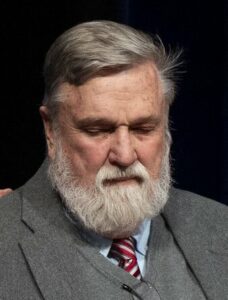
His pastoral career began in 1977 when he led leading services at Community Evangelical Fellowship. [Image at right] Simultaneous with his pastoral duties, Wilson began building what became a denomination. In that year The Confederation of Reformed Evangelicals (CRE), which later became Communion of Reformed Evangelical Churches (CREC), was established. He incorporated Logos, a K-12 school, that he had founded in 1981 into the organizational set. In 1988, Canon Press was established. Six years later, in 1994, New Saint Andrews College was founded. This set of organizations indicates the emphasis on education, on preparing coming generations to pursue movement goals. Christ Church, the flagship church of the denomination, adopted its current name in 1999.
Wilson’s theological positions became steadily more conservative, and his determination to publicly promote his ideas began to draw public attention. This first occurred in 2003 he chose to make a presentation at the University of Iowa through the church student organization. There was pushback on that presentation as, in addition to student protest, the presidents of both the University of Idaho and the University of Washington at Pullman both issued highly critical statements about the presentation. Controversy escalated and Wilson and Christ Church first came to national attention during the COVID-19 epidemic. Their public opposition to government mandated masking generated considerable public visibility. Wilson and Christ Church achieved a national presence in the mid-2020s. Wilson was interviewed by two popular conservative podcast hosts, Tucker Carlson and Charlie Kirk in 2024. In 2025, Wilson established a church-plant congregation in Washington, D.C. Secretary of Defense Pete Hegseth attended the congregation on some occasions and subsequently invited Wilson to speak at the Pentagon. Hegseth then presented his own version of Christian Nationalist ideology to promote military engagement with Iran and to disregard established rules of military engagement in 2026 (The New Republic and Greg Sargent. 2026). [See, Issues/Challenges]
DOCTRINES/RITUALS
At the outset of his pastoral career preached a conservative Baptist theology, but he revised his theological position as he sensed a shift in the surrounding culture in the late 1980s. As the theology evolved, Christ Church began presenting itself as a Conservative, Reformed, & Evangelical church: “We affirm the Apostles Creed, the Nicene Creed, the Definition of Chalcedon, and the Westminster Confession of Faith.” The church has announced its mission in the following way” (Christ Church website 2026):
We seek to honor the living God by renewing covenant with him on the Lord’s Day, living faithfully under the Lordship of Christ as Christian men and women in our families and communities, preaching the gospel to unbelievers, and applying the word of God to every area of life.
But it is another set of intertwined doctrinal commitments that give this movement a character that is distinct from larger evangelicalism. And it is this framework that shapes what they mean by “applying the Word of God to every area of life” and makes it hang together as a comprehensive worldview. These are called Unity of Scripture, Presuppositionalism, Sphere Sovereignty, and Postmillennialism (Ingersoll 2015).
Unlike most modern Christians, those who are part of Christ Church and its larger network, reject the idea that there is discontinuity between the Old Testament and the New Testament. With the Unity of Scripture they assert that the Bible is one continuing revelation from Genesis through the Book of Revelation, with God in the form of the Trinity present throughout. Thus, Jesus is present at creation and the character of God is the same and it is revealed in what we read in both testaments. The character of Jesus, as it is revealed in texts such as the Sermon on the Mount, are part of the character of God. But so is God as described commanding Israelites to kill all Canaanites (Deuteronomy 20). God is understood as a god who loves His people but hates His enemies. This helps explain why, on first read, many of the positions held by Wilson and his followers appear to be in contradiction with the character of Jesus: they have a completely different understanding of Jesus.
Key to understanding this theological system in an epistemological position built on the work of Corenelius van Til by mid-twentieth theologian Rousas John Rushdoony called presuppositionalism. “By What Standard?” Rushdoony’s first book (1959) has remained the fundamental explication of this employment of presuppositionalism. Essentially, their view is that there are only two sources of knowledge: Revelation given by God in the Bible, and the sinful claim for the autonomy of human reason -dating initially to the fall in the Garden of Eden. Put differently, there are only two ways of being in the world. One way is in obedience to God, the other (which includes all other religions, philosophies etc.) is rebellion. There can be no neutral space between the two. They are fundamentally, inevitably, and inescapably in conflict; there can be no pluralism, diversity, or secularity. God’s Word applies to every area of life and culture.
The interpretive framework through which they identify how to apply “the Word of God to every area of life” is called Sphere Sovereignty. A version of this teaching was promoted by Reformation theologian Abraham Kuyper. But the version employed here is a variation on that developed by Rushdoony in the mid-20th century. According to Rushdoony God delegated authority to human beings in three distinct spheres of human life: family, the church, and the civil government. Together, these comprise Biblical Law to which all human beings, Christian or not, are held accountable. This constitutes a comprehensive application of God’s law to all of life and it is what they mean by their motto “All of Christ for all of life.”
Each sphere of authority in this framework is given certain responsibilities and limited from engaging in the responsibilities given to another spheres. The Family is to “raise up children in the nurture and admonition of the Lord,” the Church is to “preach the gospel,” and the and the Civil Government is to “punish evil doers.” This is how they can claim that they believe in a separation of church and state in a way which is confusing to outsiders. It’s also how they conclude that public education, for example, is unbiblical. Education is a function of the family, not the state. Economic endeavors, too, are within the authority of families to support their mission. The state has no authority to oversee or regulate except where crimes are delineated in the Bible.
Finally, Christians in this network embrace post millennialism. They claim that Adam and Eve were created to exercise dominion over the earth, that their purpose was thwarted by sin in the Garden of Eden, but the prophecies foretold in the Book of Revelation have already occurred and humans were restored to their original purpose with the resurrection.
They hold that it is the job of Christians to build the Kingdom of God on earth, an effort that will culminate in the return of Christ to rule over the Kingdom of God. This building of the Kingdom of God is what they mean by the exercise of Dominion: they seek to make all nations Christian Nations ruled by Biblical Law.
The various commitments that flow from this system include young earth creationism (the doctrine that Earth was created supernaturally between 6,000 and 10,000 years ago), covenantalism (The doctrine that God has been working throughout history to gather His people to Himself through the covenants of redemption, work and grace), postmillennialism (The doctrine that Christ’s second coming will take place after a messianic age), dominionism (the doctrine that the nation should be governed by Christians under biblical law), biblically based education (education should be based on Christian principles and not dictated by the state), biblical inerrancy, biblical courtship (courtship during which each partner seeks a spiritually aligned, lifetime marriage), paedobaptism (baptizing babies and young children) and paedocommunion (giving the Eucharist to young children), and a strong sense of religious mission that emphasizes church planting. Each of these theological principles is connected to specific individual and collective commitments (Communion of Reformed Evangelical Churches 2026). While individual congregations are independent, Wilson also advocates “household voting,” through which the male family head determines how family members should vote.
Key elements of a typical Sunday service include: a call to worship, confession of sin, biblical readings and a sermon that connects biblical teaching to modern life circumstances, communion, and a benediction.
LEADERSHIP/ORGANIZATION

Wilson renamed his first church, Community Evangelical Fellowship, that he had pastored since 1977 as Christ Church in 1999 (Gribben 2021:50). [Image at right] Consistent with his larger mission, he cofounded the organization that later became the Communion of Reformed Evangelical Churches (CREC) in 1988. Wilson clearly has been and remains the central creative source of the Christ Church’s and Communion’s development, but the leadership style is one in which the ministers and elders govern together as a group in each church. CREC began with three local churches: Community Evangelical Fellowship in Moscow, Idaho; Eastside Evangelical Fellowship (Trinity Church) in Bellevue, Washington; and Wenatchee Evangelical Fellowship in Wenatchee, Washington. The initial triumvirate of churches had a membership of over 3,000, with Christ Church having about 2,000 members (Simmons 2025). As the Communion expanded, churches were organized into presbyteries, usually of up to twenty churches.
CREC defines its objectives in the following way (CREC website 2024):
The CREC seeks to uphold traditional Reformed distinctives, resisting fundamentalist and modernist trends that dilute doctrinal purity and ecclesiastical structures. Throughout the 20th century, fundamentalism and modernism influenced American Protestantism, leading to a departure from historic creeds, confessions, and church polity.
Despite these trends, confessionalists within denominations like the Christian Reformed Church and the Orthodox Presbyterian Church remained committed to their doctrinal heritage. The CREC emerged in the late 20th century seeking to recover a Reformed Catholic vision, emphasizing the importance of creeds, confessions, and liturgies.
The Communion expanded rapidly, particularly after 2020. Brito reports that (Brito 2025):
Numerical expansion accelerated post-2020, with 104 churches and roughly 10,000 members at the onset of the COVID-19 pandemic, rising to 125 churches by the 2023 council and surpassing 160 churches and parishes by late 2025. Membership grew 150% over this period, predominantly from 2023 onward, driven by church plants and conversions amid cultural shifts favoring robust confessional communities.
Beyond the impressive growth to over 150 churches, there also was a significant global spread of churches (Simmons 2025). Overall membership in the Communion has been estimated at 25,000 (Communion of Reformed Evangelical Churches 2026). One of the most significant church plants occurred in 2025 with the establishment of an affiliate congregation in Washington, D.C. During its transition to a freestanding congregation, Christ Church supplied rotating pastors. The new congregation received considerable visibility as a result of Secretary Pete Hegseths attendance at church services.
Under Wilson’s leadership the movement developed a number of organizational components beyond church congregations that modeled its movement principles. These include Logos School, New Saint Andrews College, Canon Press, Greyfriars Hall, and The Bakwé Mission.
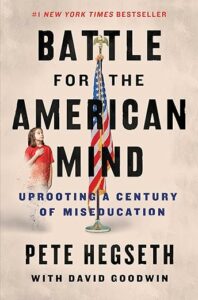
Logos School was founded in 1981 by Doug Wilson as a K-12 school offering a classical Christian education. The school received accreditation from The Association of Classical Christian Schools, which Wilson also founded. ACCS has grown to include hundreds of similar schools around the nation. One of the books featured on the ACCS website is Battle for the American Mind: Uprooting a Century of Miseducation, [Image at right] which conveys the struggle in which the movement envisions itself and why education is one of its top priorities (Hegseth and Goodwin 2022):
Battle for the American Mind is the untold story of the Progressive plan to neutralize the basis of our Republic – by removing the one ingredient that had sustained Western Civilization for thousands of years. Pete Hegseth and David Goodwin explain why, no matter what political skirmishes conservatives win, progressives are winning the war—and control the “supply lines” of future citizens. Reversing this reality will require parents to radically reorient their children’s education; even most homeschooling and Christian schooling are infused with progressive assumptions. We need to recover a lost philosophy of education – grounded in virtue and excellence – that can arm future generations to fight for freedom. It’s called classical Christian education.
Founded in 1994, New Saint Andrews College is the movement organization designed offer a broad classical religious education (without academic majors) at the college level to train the kind of future leaders who will guide the nation in the prophetic direction the movement deems necessary. The emphasis is on disciplines that will illuminate Western history from antiquity through the present from Christian perspective. As the college website states, “New Saint Andrews College exists to graduate leaders who shape culture living faithfully under the Lordship of Jesus Christ.” And specifically, the college offers (New Saint Andrews website n.d.):
[the] highest quality undergraduate and graduate education in liberal arts and culture from a distinctively Christian and Reformed perspective, to equip them for lives of faithful service to the Triune God and His Kingdom, and to encourage the use of their gifts for the growth of Christian culture.
The education that New Saint Andrews provides is not an end in itself, the goal is activist opposition to contemporary culture and participation in what it regards as a sacred restoration campaign. In the NSA blog, Lennox Kalifungwa writes about NSA degrees as “Degrees in Apostasy” (Kalifungwa 2025):
New Saint Andrews is not where the faith of students quietly withers but where it is honed to flourish. It is a forge for cheerful troublemakers, righteous disturbers of the ‘peace’, steel-spined reformers, and joyful saboteurs of chaos. Here, students take up the tools to fight evil and plant good. Here, they learn to love and serve Christ, finding their place as leaders in the advancement of His kingdom on earth as it is in heaven.
Integration with the larger movement is maintained as the college president is an elder in Christ Church.
Canon Press was founded as a ministry of Christ Church by Doug Wilson in 1988. It was later sold as a private company in 2012. Wilson’s son is one of the co-owners. The press describes itself as “Outfitters of the Reformation” and asserts that “We aim to change the world through simple, Christ-centered, faithful living (Canon Press website 2026).
Greyfriars Hall is a three-year ministerial training program for men. The program is coordinated by Elders of Christ Church; the small faculty includes Doug Wilson and the president of New Saint Andrews College.
The Bakwé Mission is Christ Church’s “foreign mission ministry to the Bakwé people of southwest Côte d’Ivoire.” The primary goals of the mission are scripture translation and literacy education. The mission website connects the mission to the larger movement objectives (Bakwé Mission website 2026):
Christ Church believes that God has commissioned the Church to make disciples of all nations through the faithful preaching of the Word and the administering of the sacraments. Thus the primary method of mission remains the preaching of the gospel, with its goal, the planting of the church.
ISSUES/CHALLENGES
Christ Church and the larger movement it has precipitated, have faced and have continued to face significant challenges, but the movement openly welcomes then as part of the necessary path to the end they seek. These challenges include tension with the local community, controversies surrounding Doug Wilson personally, protests around COVID-19 masking regulations, and, most recently, involvement in the divisive debate over U.S. military action in Iran.
Moscow is considerably more politically liberal than most of Iowa, and, as Wilson began his ministry, he became steadily more conservative and more determined to move the city in a more conservative direction. As he put it, “Basically this is a blue dot in a very, very red state and the blue dotters are pleased,” Wilson told Religion News Service in an interview. “Our mission is ‘All of Christ for all of life’ and if you drill that down, then for all of Moscow.” As the Christ Church website states, “Under the grace of God, this means that our desire is to make Moscow a Christian town” (Christ Church website 2026). Church members have privately purchased a number of buildings and businesses (restaurants, coffee shops, a brewery) and created a highly visible local presence, but it does not have sufficient size and impact to alter the community’s fundamental character. Further, in a library board election candidates supporting the church’s values lost decisively, and church supported candidates also lost mayoral and city council races.
Doug Wilson has been and continues to be a polarizing figure. In part his confrontational style is deliberate as he seeks to assert and willingly debate his religious agenda. For example, Wilson has made a point of taking his message to students at the University of Idaho through its church-affiliated student organization, Collegiate Reform Fellowship (CRF). Wilson has chosen that forum for a number of events. As he explains that strategy (CREC website 2026):
Churches are responsible for preaching the word, evangelizing everybody in the town —evangelizing everybody who wants to listen — and that would include the college students,” Wilson said. “So, if we’re a church in Moscow, we want to do outreach to college students, so that is what CRF is for.
For example, his presentation “The Lost Virtue Sexism” intentionally and predictably produced the kind of student pushback one would expect on a college campus.
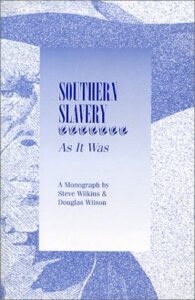
The books written by the Pastor have also sparked controversies in the community. Southern Slavery: As It Was, a book co-written by Wilkins and Wilson (1996), claimed in a part that “Slavery as it existed in the South […] was a relationship based upon mutual affection and confidence.” [Image at right] Wilson went on to state that “There has never been a multiracial society which has existed with such mutual intimacy and harmony in the history of the world. […] Slave life was to them [slaves] a life of plenty, of simple pleasures, of food, clothes, and good medical care.” Wilson defended his statements by responding “I am not interested in defending slavery. I don’t believe we should practice slavery. What I said is that a Christian man in the South could be a slave owner. He needed to follow the rules in the New Testament. Christian slave owners were compelled to teach their slaves to read [and] teach them Christian values” (Arora2022). Wilson’s defense notwithstanding, his comments produced intense controversy within the Christian community (Wells 2025).
A more significant and defining conflict emerged in September 2020 during the COVID-19 pandemic as the church organized two anti-mask protests at Moscow’s City Hall after the city mandated mask wearing in public spaces and large gatherings. Several of the 150 protesters were arrested during the protest where protesters sang psalms and hymns. However, in 2023 a federal judge ruled that “the City indisputably erred in interpreting its own Code,” and the arrests were illegitimate since the municipal ordinances exempted religious and protest activities (Kumar 2021; Brown 2023). However, beyond the legal outcomes, the events were no longer a local story; they created national media coverage for the church and markedly increased public interest and support from likeminded individuals.
A pivotal moment in movement history took place in 2025 when Christ Church created a church plant in Washington, D.C. and Wilson connected with a national audience through Secretary of Defense and presidential cabinet member Pete Hegseth. [ Hegseth stated that he moved to Tennessee specifically to enroll his children in one of the schools modeled on the Christian education advocated by Wilson and a member of Wilson’s Association of Classical Christian Schools. He became a member of the new CREC church pastored by Brooks Potteiger, and invited his pastor to lead a prayer service at the Pentagon (Jenkins 2025). In February 2026, Wilson himself preached at the Pentagon at the monthly Christian worship services instituted by Hegseth. Hegseth advanced Wilson’s stature as he praised him as a mentor (Kaylor 2026):
Thank you for your leadership, for your mentorship, for the things you’ve started, the truth you’ve told, your willingness to be bold,” Hegseth said to Wilson. “It’s the type of thing that we’re trying to exercise here too with the monthly worship service, is to pause and recognize who is at the wheel, who is sovereign in all of these things. The scale and scope of which we can’t possibly imagine sometimes and outcomes we cannot foresee, but there is no plan B, only God’s plan of plan A.
Hegseth later joined Wilson on stage to praise the preacher and defend the holding of monthly Christian worship services. Hegseth also evangelistically urged those under his command to repent and follow Jesus (Kaylor 2026):
We are all fallen, we are all sinful, we are all in need of the grace of God, and all in need of redemption. And I certainly stand chief among them,” Hegseth added. “Ultimately, in that pursuit, when we humbly come before God and work with others in that, he creates amazing opportunities, to include this service here in this place where many different things were worshiped for a very long time. And here we get a chance to worship Jesus Christ openly and in public.
At a recent National Prayer Breakfast, Hegseth promoted Christian Nationalism (Kaylor 2026):
America was founded as a Christian nation. It remains a Christian nation in our DNA, if we can keep it. And as public officials, we have a sacred duty 250 years on to glorify him,” Hegseth said as he pointed upward. “That’s precisely why we instituted a monthly prayer service at the Pentagon, an act of what we see it as, spiritual readiness.
In an extension of his Christian Nationalism ideology, Hegseth applied it to the 2026 military operation against Iran, following up on a prayer offered by a chaplain during the military incursion in Venezwela. His words were uncompromising (Kaylor 2026):
I thrust them through so that they were not able to rise….They fell under my feet, for you equipped me with strength for the battle. You made those who rise against me sink under me. You made my enemies turn their backs to me, and those who hated me, I destroyed. They cried for help, but there was none to save. They cried to the Lord, but he did not answer them. I beat them fine as dust before the wind. I cast them out like the mire of the streets.
Hegseth’s linking the Iran military action to a divine mandate clearly is intended to increase to motivation among those in military service as well as to invest the action with divine purpose. It has also, of course, produced the same heightened patriotic, religious fervor among Iranians (Matthiesen 2026).
Beyond the historical rise and influence of Christ Church and CREC, their impact cannot be measured simply in isolation. They are, in turn, part of a larger set of restorationist movements, both Protestant and Catholic. Ingersoll (2026) states that:
One of the movement’s most potent forms is a segment of the Pentecostal/Charismatic movement called the New Apostolic Reformation, which is guided by the strategic vision of Seven Mountains dominionism. Another important form of Christian nationalism is Catholic integralism, which advocates a union of government and Catholic religious authority.
Although the members of this set of movements have often been at odds, as Ingersol notes they share one important common perspective (Ingersoll 2026):
What brings them together now is the rejection of several fundamental American values articulated in our founding documents. Advocates of Christian nationalism do not believe in democracy, pluralism, egalitarianism, or the separation of church and state, and they desire a return to a naturalized gender hierarchy. They reject the notion that the legitimacy of the state is grounded in the “consent of the governed.” Government, in their view, should be headed by leaders who carry the mandate of heaven—quite literally.
For his part, Wilson draws a clear line in the sand (Ingersoll 2026):
Wilson claims that there are just two possible ways for us to know what we know: either God’s revelation in the Bible is true, making it our primary source of real knowledge about the world, or we must trust autonomous human reason to sort things out for ourselves—a sinful misuse of the faculty, in his account. Those two sources are understood as ultimately incompatible and mutually exclusive; there is no neutrality.
In the end, for the movement, the only correct and acceptable ordering of society is the one ordained by God. Wilson and his followers understand that the struggle may continue for several generations, first Moscow, then Idaho, then the nation, and finally the globe. They profess to have no doubts about the final outcome as they follow the true, biblically mandated path.
IMAGES
Image #1: Douglas Wilson. Public Domain.
Image #2: Christ Church in the Nu_Art_Theatre_NRHP_01001304_Latah_County,_ID. Credit: Creative Commons Attribution-Share Alike 4.0 International license. Author: Jon Roanhaus.
Image #3: Battle for the American Mind book cover.
Image #4: Southern Slavery as it Was book cover.
Image #5; Credit: Christ Church local church plant in Washington D.C. at the Capitol Lounge. Credit: Creative Commons Attribution 4.0 International license.
REFERENCES
Arora, Piyush. 2022. “What is Christ Church? As Idaho murders’ investigation continues, Moscow faces another battle for its SOUL.”MEAA, November 25. Accessed from https://meaww.com/what-is-christ-church-as-idaho-murder-probe-continues-moscow-is-facing-another-battle-for-its-soul on 28 March 2026.
Brito, Rev. Dr. Uriesou T. 2025. “New numbers and updates for the CREC, 2025 & Athanasius Presbytery Meeting in Odenville, Alabama.” The Perspectivalist. Accessed from https://www.uribrito.com/p/new-numbers-and-updates-for-the-crec on 28 March 2026.
Brown, Jon. 2023). “Moscow, Idaho, church deacon wins motion over COVID-protest arrest at outdoor hymn sing: ‘I feel vindicated'”. Fox News, February 7. Accessed from https://www.foxnews.com/us/moscow-idaho-church-deacon-wins-lawsuit-covid-protest-arrest-outdoor-hymn-sing-i-feel-vindicated on 28 March 2026.
Christ Church website. 2026. Accessed from https://christkirk.com/our-church/our-mission/ on 28 March 2026.
Christ Church Washington website. 2026. Accessed from https://christkirkdc.com/ on 27 March 2026.
“Communion of Reformed Evangelical Churches.” 2026. Grokipedia. Accessed from https://grokipedia.com/page/Communion_of_Reformed_Evangelical_Churches on 28 March 2026.
Communion of Reformed Evangelical churches website. 2024. Accessed from https://crechurches.org/story/ on 28 March 2026.
Gribben, Crawford. 2021 50 Survival and Resistance in Evangelical America. New York: Oxford University Press.
Hegseth, Pete and David Goodwin. 2022. Battle for the American Mind: Uprooting a Century of Miseducation. Peterborough, Ontario, Canada: Broadview Press.
Ingersoll, Julie. 2026. “What Pete Hegseth’s Spiritual Mentor Wants for America.” The Bulwark, March 18. Accessed from https://www.thebulwark.com/p/douglas-wilson-pete-hegseth-moscow-idaho-theocracy-dominionism-christian-reconstruction-theonomy on 28 March 2026.
Ingersoll, Julie 2015. Building God’s Kingdom inside the world of Christian Reconstruction. New York: Oxford University Press.
Kalifungwa, Lennox. 2025. “Degrees in Apostasy: How Some Christian Colleges Learned to Fear the Mob and Betray Christ.” NSA Blog, June 11. Accessed from https://nsa.edu/blog/Degrees-in-Apostasy on 28 March 2026.
Kaylor, Brian. 2026. “At Pentagon Worship Service, Hegseth Casts Iran Conflict as Violent Holy War Against God’s Enemies.” Word & Way, March 25. Accessed from https://publicwitness.wordandway.org/p/at-pentagon-worship-service-hegseth on 28 March 2026.
Kaylor, Brian. 2026. “Doug Wilson Preaches at Pentagon, Compares Services to Day of Pentecost.” Word & Way, February 17. Accessed from https://publicwitness.wordandway.org/p/doug-wilson-preaches-at-pentagon on 28 March 2026.
Kumar, Anugrah. 2021. “Charges Dropped Against Deacon Charged for Singing Hymns Outdoors.” Christian Post, January 17. Accessed from https://www.christianpost.com/news/charges-dropped-against-deacon-arrested-for-singing-hymns-outdoors.html on 28 March 2026.
Matthiesen Toby. 2026. “God on their side: how the US, Israel and Iran are all using religion to garner support.” The Conversation, March 26. Accessed from https://theconversation.com/god-on-their-side-how-the-us-israel-and-iran-are-all-using-religion-to-garner-support-279337 on .27 March 2026.
New St. Andrews College website. n.d. Accessed from https://nsa.edu/ on 27 March 2026.
Simmons, Tracy. 2025. “Church at 50: How Doug Wilson Pushed Christian Nationalism to the Center. Word & Way, December 11. Accessed from https://wordandway.org/2025/12/11/christ-church-at-50-how-doug-wilson-pushed-christian-nationalism-to-the-center/ on 27 March 2026.
Simmons, Tracy. 2019. “Douglas Wilson’s ‘spiritual takeover’ plan roils Idaho college town.” Religion News Service, November 5. Accessed from https://religionnews.com/2019/11/05/douglas-wilsons-spiritual-takeover-plan-roils-idaho-college-town/ on 27 March 2026.
Smietana, Bob. 2019. “Douglas Wilson’s ‘spiritual takeover’ plan roils Idaho college town.” Religion News Service, November 5. Accessed from https://religionnews.com/2019/11/05/douglas-wilsons-spiritual-takeover-plan-roils-idaho-college-town/ on 28 March 2026.
The New Republic and Greg Sargent. 2026. “Hegseth Just Revealed the Real Roots of His Sadism and Rage. The New Republic, March 30. Accessed from https://newrepublic.substack.com/p/pete-hegseth-just-revealed-the-real?utm_source=post-email-title&publication_id=1520659&post_id=192605037&utm_campaign=email-post-title&isFreemail=true&r=6fcgp&triedRedirect=true&utm_medium=email on 5 April 2026.
Wells, Nathan. 2025. “Doug Wilson Says ‘The Christians Who Owned Slaves in the South Were on Firm Scriptural Ground’.” dougwilsonsays.com, November 1. Accessed from https://dougwilsonsays.com/blog/southern-christian-slaveholders-firm-ground/#user-content-fn-6 on 28 March 2026.
Wilkins, Steve and Douglas Wilson. 1996. “Southern Slavery As It Was.” Moscow, ID: Canon Press.
Publication Date:
7 April 2026
