Body of Christ

THE BODY OF CHRIST TIMELINE

1933:  The Worldwide Church of God (WCOG) was founded as the Radio Church of God by Herbert W. Armstrong.

1941:  Roland Robidoux was born.

1972 (January):  Herbert Armstrong predicted the imminent Second Coming of Jesus.

1974:  Jacques Robidoux was born.

1975:  Roland Robidoux was ordained pastor in the WCOG in Rhode Island.

1977:  Roland Robidoux and his wife Georgette left the WCOG due to scandals in that church. Along with the co-defector, Reverend Brian Weeks, Roland Robidoux founded a Bible Study Group called The Church of God in Mansfield, Massachusetts.

1992:  Carol Balizet published Born in Zion; she identified Maine as the “New Jerusalem” and exhorted the rejection of modern medicine.

1992:  Michelle Robidoux and Dennis Mingo moved into the Robidoux community.

1995:  The Body of Christ membership reached nineteen adults and their children, along with a high birthrate.

1996 (Summer):  Jacques Robidoux married Karen Daneau, and the couple rented a house in Attleboro Falls, Massachusetts.

1997:  The Robidoux family lived together semi-communally across a group of family homes in Attleboro and Seekonk, Massachusetts.

1997 (Summer):  The work of Carol Balizet was incorporated into the group’s worldview and ritual practice.

1997:  Jacques Robidoux, at the age of twenty-three, was anointed as an “Elder” by his father.

1998:  The group adopted The Body of Christ as its name.

1998 (April):  A son, Samuel, was born to Karen and Jacques Robidoux.

1998 (November):  Dennis Mingo defected from the Body of Christ but continued to visit his children in his home.

1998:  Jacques Robidoux and his sister Michelle announced that followers should burn all their non-scriptural books, and they also banned traditional Christian hymns. Roughly half of the forty members left the group.

1998:  The group abandoned efforts to recruit new members and became more insular due to its belief that it was chosen by God.

1999 (March):  Michelle Mingo imposed a strict dietary regimen on her sister-in-law, Karen (Daneau) Robidoux, and her baby Samuel, forcing him to forego solid food.

1999 (April 26): Samuel Robidoux died from starvation.

1999 (May): There were additional defections from the group.

1999 (September):  Dennis Mingo discovered his wife Michelle’s diary of a two-week period in March of that year, chronicling the emaciation of Samuel Robidoux and Karen’s emotional trauma.

1999 (November):  The Massachusetts Department of Social Services removed eleven children from the group, and Karen Robidoux lost custody of all her children.

2000-2002:  A financial crisis occurred within the group.

2000 (April):  A grand jury began an investigation into the deaths of Samuel Robidoux and Jeremiah Corneau.

2000 (August):  Juvenile Court Judge Kenneth P. Nassif ruled that the parents were unfit to take care of their children, who were then transferred to state control.

2000 (October):  Jacques Robidoux was charged with first-degree murder for “directing the systematic withholding of nourishment,” Karen Robidoux was charged with second-degree murder, and Michelle Mingo was charged as an accessory to murder.

2002 (April-May):  The Corneaus refused to testify to the grand jury when summoned by Judge Kenneth Nasif. They also waived their Fifth Amendment Rights as a way of rejecting the court’s authority. Judge Nasif held them in contempt of court and sent them back to prison.

2002 (June):  The Corneaus finally testified to the grand jury that their baby was stillborn.

2002 (June):  Jacques Robidoux was sentenced to life in prison.

2003 (February 3):  The jury acquitted Karen Robidoux of second-degree murder, and charged her with assault and battery.

2003-2004:  Michelle Mingo pleaded guilty to two counts of being an accessory to murder but was released because she had spent four years in custody.

2006:  Roland Robidoux died.

2009:  Jacques Robidoux requested a post-conviction hearing on his conviction and sentencing that was unsuccessful.

FOUNDER/GROUP HISTORY

The forerunner of the group that would become The Body of Christ was the Radio Church of God, founded by Herbert W. Armstrong in 1934. The group was renamed the Worldwide Church of God in 1968. Armstrong predicted an imminent Second Coming of Jesus for January 1972, along with a prediction that 1975 would be a year of supreme prophetic significance. The failure of these predictions factored into the development of offshoot churches in the 1970s (Barrett 2013).

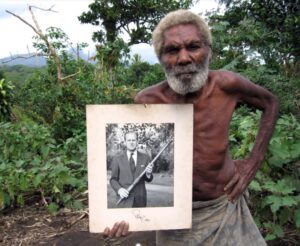
Roland Robidoux, [Image at right] who founded The Body of Christ, was born 1941. He was ordained pastor in the WCOG in Rhode Island in 1975. Just two years later Roland and his wife Georgette left the WCOG due to scandals in that church. Together with fellow defector Brian Weeks, they formed the Church of God in Mansfield, Massachusetts and then the Church of God in Norton, Massachusetts (Chryssides 2012:75). The church subsequently moved to North Attleboro in 1986.

The church was relatively open during the first half of the 1990s and publicly proselytized for new members until 1997 (Pardon 2000). Members lived semi-communally as a group of families, nineteen at the time of its peak in 1995 (Personal communication from Jacques Robidoux to Palmer and Male, October 2020). It was in 1997 that Roland Robidoux unilaterally appointed his son Jacques as leader of the church (Personal communication from Jacques Robidoux to Palmer and Male, September 2020).

In 1998, Jacques Robidoux, [Image at right] reported that he submitted to an “inner voice” seeking abandonment of the outside world and abruptly left his job (Personal communication from Jacques Robidoux to Palmer and Male, September or October 2020). That year the group was renamed The Body of Christ, reflecting a more exclusivist notion of belonging (Personal communication from Jacques Robidoux to Palmer and Male, September or October 2020). The rise of Jacques Robidoux’s control over the group and its overall inward turn led to a focus on dogmatic “spiritual leadings” to override individuals’ interpretation of scripture and to serve as the sole basis for everyday decision-making. As the Body of Christ withdrew from the outside world in 1998, Jacques Robidoux and his sister Michelle jointly led the group to burn all of their non-Biblical books (Palmer and Male 2020:7). In June of that year, ten days after his submission to that “inner voice,” Robidoux insisted that the Body of Christ undergo an ill-supplied trek to Maine, which was considered to be a “New Jerusalem” and a preparation for a larger apocalyptic confrontation (“Former sect member testifies in murder trial” 2002). The church had also begun facing financial problems in 1996 when the masonry business of the Daneau family, which was prominent in Robidoux’s circle, went bankrupt (Palmer and Male 2020:5).

In November 1998, Robidoux’s brother-in-law, Dennis Mingo, left the group, but he continued to visit his children who remained in the group. This defection became a pivotal moment in the decline of the church (Palmer and Male 2020:9). The following year, in September 1999, Mingo discovered his wife Michelle’s diary from that spring which outlined the regimen that she imposed on Jacques’ wife Karen Daneau Robidoux and their infant son Samuel. (Interview with Robert Pardon, 2020) This regimen led to Samuel’s starvation and death that April. After a week of trying to coax Michelle into leaving the group with their children, Dennis became a whistleblower, reporting to the police that Samuel was missing and turning the diary over to them (Thompson 2000). Other core members of the Body of Christ refused to verbally engage with the officials in the judicial system and lost custody of their children. Jacques Robidoux was subsequently charged with first-degree murder in June 2002 (“Sect members face murder charges” 2000; Emery 2002). In the wake of the publicity over Samuel’s death, the group also faced a financial crisis from which it never recovered (Wedge 2002).

During his first year in prison, Jacques Robidoux maintained his innocence, but he appears to have altered his position when his wife filed for divorce in 2003. He began to engage in theological and emotional introspection, which led to his finally accepting responsibility for the death of his son. In 2005, Robidoux filed an appeal, invoking a defense in terms of “brainwashing,” which was denied (Linton 2007; “New trial denied” 2006). In 2009, Robidoux requested a post-conviction hearing on his conviction and sentencing that also was unsuccessful. He engaged in a partially self-directed “deprogramming,” which led him to become active in the religious activities of his prison.

DOCTRINES/BELIEFS

In addition to the Bible, the main text informing the Body of Christ after its inward turn in 1997 was Carol Balizet’s Born in Zion, which depicted the state of Maine to be a millenarian refuge and advocated healing through faith and prayer. This book is a manifesto advocating complete withdrawal from the world. It describes government, banking, science, public education, entertainment, religion, and most notably modern medicine, as institutions controlled by Satan (Personal communication from Jacques Robidoux to Palmer and Male, September-October 2020). The adoption of these ideological presuppositions was aligned with the exhortation to be “led by the spirit,” which was the prevailing practice once Jacques Robidoux assumed power. The “scripturalizing” of these teachings through diary-writing ultimately eclipsed the group’s adherence to any corpus of traditional, mainline Biblical teachings (Pardon 2000).

Robidoux claimed that being part of a “Body of Christ” implied that the leadership was communal in nature and therefore could originate from anyone in the group (Pardon 2000; Personal communication from Jacques Robidoux to Palmer and Male, September 2020). However, authority actually became more hierarchical as pronouncements from the Robidoux men automatically became doctrinal. Robidoux’s pronouncements therefore did not democratize and stabilize the group but rather nurtured erratic, unsafe and dangerous plans and practices that ultimately led to Samuel Robidoux’s death, as his screams and evidence of radical weight loss were interpreted as “Satanic illusions” (Pardon 2000). According to Robert Pardon, the increasingly dangerous feedback loop of dangerous “spiritual leadings” was part of it’s  “devolving” spirit-body dichotomy, in which everyday occurrences were over-determined by their assumptions about Divine will (Pardon 2000).

ORGANIZATION/LEADERSHIP

Ronald Robidoux and Roger Daneau were the leaders of the group in its more settled phase; their families intermarried and formed the main cohort of adherents. The Body of Christ is categorized as a family-based sect, and can be roughly conceptualized as having a patriarchal lineage, although the passing of leadership from Roland Robidoux to Jacques Robidoux was simply a decree and not a formal succession (Palmer and Male 2020:1-3, 30; Pardon 2000).

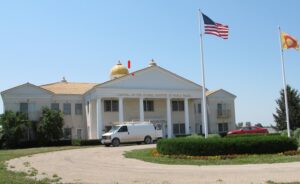
According to Robert Pardon, [Image at right] Roland Robidoux’s leadership prior to the late 1990s featured forms of communal and scriptural accountability that became defunct once he granted his son control. A former adherent said that Pastor Roland used to suggest when making a declaration: “go to the library, check your concordances and Bible dictionaries and see if I’m right” (Pardon 2000). By 1997-1998, the Robidoux men could brook no dissent, as they considered themselves appointed by God to lead their chosen people. Although leadership was theoretically decentralized in terms of the group-wide circulation of “leadings” by any member, such spiritual exclamations were never allowed to go against the ever-increasing restrictions and exclusivity that characterized Jacque Robidoux’s authority (Pardon 2000).

ISSUES/CONTROVERSIES

The Body’s challenges began shortly before the accession of Jacques Robidoux to power, a turning point which vastly increased the possibility of disaster given that nature of “leadings” and the zealousness with which they were followed. The ill-fated trip to Maine in June 1998 was the first major instance of a risky undertaking since the participants believed that they could not bring any provisions with them.

This event played a role in the defection of Dennis Mingo, which was the beginning of the group’s unraveling (Pardon 2000; Palmer and Male September-October 2020). The next controversy, which led to the effective disintegration of the Body of Christ, was the ritual starvation of Samuel Robidoux. In March 1999, Michelle Mingo [Image at right] invoked Mark 7 and the text’s reference to the issue of vanity to lead her sister-in-law Karen to limit her diet to a gallon of almond milk daily and to reverse her ten-month-old son Samuel’s weaning (Personal communication between Robert Pardon and Susan Palmer 2020). Since Karen was pregnant at the time, her ability to breastfeed was limited. When she tried to give Samuel solid food, Jacques Robidoux took him away from his mother. Aside from Karen’s secret spoonfuls of yogurt to Samuel on one occasion, he received nothing but very thin breast milk for nourishment for fifty-two days. He died on April 26 (Palmer and Male 2020:17-20, 38).

As a result of the intervention of Dennis Mingo, police arrived at the Seekonk compound on November 8, 1999. Eleven children were removed from the residence by social workers (Richardson 2000). A large contingent of the group then fled to Baxter State Park in Maine; the group buried both Samuel and the stillborn Jeremiah Corneau (Male February, 2020; Thompson 2000; Wedge 2001, 2002, 2006).

A grand jury investigation into the deaths of the two babies began in April 2000. In court, the members of The Body were reclusive; authorities surmised that this was at the behest of the Robidoux men. They refused to swear on the Bible, which added to the outsider perception of the defendants being an anti-government cult (Male 2020; Lewis 2000). In Juvenile Court hearings and elsewhere, Jacques Robidoux refused to reveal where Samuel and Jeremiah were buried. In August 2000, Judge Kenneth Nassif invoked the Book of Jeremiah to assert that Robidoux was a false prophet (Ellement 2000). In that month Judge Nassif declared the parents of The Body to be unfit, and thirteen children became wards of the state (Fires 2000).

Meanwhile, in the trial of Jacques Robidoux himself, he and his father refused to recognize the legitimacy of the court, declaring himself as a “sovereign citizen” (Noonan 2000; Ellement 2000). He was incriminated by his own emotionally detached handwritten notes, chronicling his son’s ritual starvation (“Prosecutor: Cult Dad watched Baby Starve” 2002). In June 2002, Robidoux was convicted of first-degree murder and sentenced to life in prison (Lavoie2002; “Jury deliberate in sect baby’s death” 2002).

In Karen Robidoux’s trial, her defense was based on a claim that she had been brainwashed by The Body. This defense was supported by psychologists who believed that she had post-traumatic stress disorder that hampered rational decision-making. Although surprising the prosecution and some legal experts, in February 2003 Karen was acquitted of second-degree murder and charged with assault and battery (McKinney 2004; Ellement 2004). Since Karen had already been in state custody for three years, she was released from prison (McKinney 2004; Ellement 2004). Likewise, Michelle Mingo pleaded guilty to accessory to assault and battery, but she was also released after her four years of imprisonment. (Lavoie 2004). Claiming the brainwashing defense, as did his wife, Jacques Robidoux filed an appeal in 2005 that reached the Massachusetts Supreme Court, but the appeal failed (Wedge 2005; Sweet 2007).

As of August 2000, Jeremiah’s mother, Rebecca Corneau, was eight months pregnant; she told the Family Court that she rejected medical assistance (Wedge 2000). Bristol County District Attorney Paul F. Walsh, Jr. asked that she be put in custody for the remainder of the pregnancy, which set off opposition from feminist and civil rights organizations (Wedge 2000; “Jailing of Pregnant Women Could Change How Courts Deal with Religion, Abortion” 2000; “Pregnant sect member’s case is a rights quandary” 2000). Judge Nassif insisted that she be allowed to stay at home, with visits from a nurse. After a stubborn refusal of the nurse and legal counsel, Nassif sent her to a hospital designed for pregnant inmates in state custody (Lehourites 2000; Fires 2000). In mid-October, Corneau gave birth, and the baby was placed in foster care (Farmer and Wedge 2000).

These court cases caught the American public’s attention in the early 2000s, rekindling questions of the legal conflicts between parental responsibility and fundamentalist tenets of faith (Palmer and Male 2020:1). Religion scholars and journalists alike have noted a succession of instances in which U.S. legal authorities have debated state intervention vis-à-vis groups that deny medical care to their children, such as Christian Science and the Faith Assembly (Wedge 2000). In Jacques Robidoux’s case, the court invoked the precedent of Christian Scientists being granted exemption from medical requirements in order to counter Robidoux’s appeal (Holoyda and Newman 2016:59-60).

IMAGES

Image #1: Roland Robidoux.
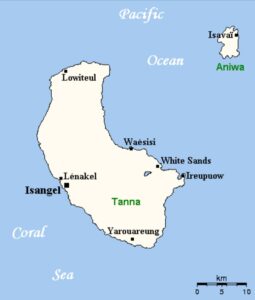
Image #2: Jacques Robidoux.
Image #3: Robert Pardon
Image #4: Michelle Mingo

REFERENCES

Barrett, David V. 2016. “The Worldwide Church of God.” World Religions and Spirituality Project. Accessed from https://wrldrels.org/2016/10/08/worldwide-church-of-god/ on 22 June 2013.

“B” (Retired Seekonk Police Detective). 2020. Interview by Yasmina Male, April.

Belz, Emily. n.d. “When the fog lifts.” World News Group. Accessed from https://wng.org/articles/when-the-fog-lifts-1620590821 on 6 September 2021.

Chryssides, George D. 2011. Historical Dictionary of New Religious Movements. Lanham, Md: Scarecrow Press.

Ellement, John. 2004. “Jury acquits Robidoux of murdering baby.” The Boston Globe, February 4.

Ellement, John. 2000. “Cultist’s infant son officially ruled dead: Judge calls leader a ‘false prophet,’” The Boston Globe, August 17.

Emery, Theo. 2000. “Sect members plead innocent.” Associated Press, November 15.

“Former Sect Member Testifies in Murder Trial.” 2002. WCVB – The Boston Channel, June 6.

Farmer, Tom and Dave Wedge. 2000. “Attleboro cult mother’s newborn taken by DSS,” Boston Phoenix, October 17.

Fires, Jacob H. 2000. “Former Attleboro sect member given custody of his children” The Boston Globe, August 18.

Fires, Jacob H. 2000. “Court action planned against cult member.” The Boston Globe, August 21.

Holoyda, Brian and William Newman. 2016. “Between Belief and Delusion: Cult Members and the Insanity Plea.” Journal of the American Academy of Psychiatry and the Law 44:53-62.

“Jailing of Pregnant Women Could Change How Courts Deal with Religion, Abortion.” 2000. Fox News, September 14.

Lavoie, Denise. 2004. “Sect member pleads guilty in baby’s death.” Associated Press February 10.

Lavoie, Denise. 2002. “Sect member loses bid to represent self in starvation trial.” Associated Press, June 4.

Lavoie, Denise. 2002. “Prosecutor Details Infant’s Demise.” Associated Press, June 6.

Lehourites, Chris. 2000. “Judge turns down move to lock up pregnant sect member.” Associated Press, August 29.

Lewis, Raphael. 2000. “Sect arrests yield few clues in case.” The Boston Globe, June 29.

Linton, David. 2007. “Attleboro cult: Jacques Robidoux appeal set.” The Sun Chronicle in Religion News Blog, September 6.

McKinney, Michael P. 2004. “Witness recalls ‘visions’ guiding sect members.” Providence Journal, January 24.

Mehren, Elizabeth. 2000. “Pregnant sect member’s case is a rights quandary.” Los Angeles Times, September 9.

Noonan, Erica. 2000. “Missing children reveals insular sect in Attleboro,” The Boston Globe.

Palmer, Susan J. and Yasmina Male. 2020. “Missing Children in the Body of Christ.” Unpublished Manuscript.

Pardon, Robert, 2000, The Body of Christ: Descent from Benign Bible Study to Destructive Cult.

Pardon, Robert. 2020. Interview by Susan Palmer, May.

Rego, John. 2020. Interviewed by Yasmina Male, April.

Richardson, Franci. 2000. “DSS takes steps toward cult kids’ custody.” The Boston Herald, March 3.

“Sect members face murder charges.” 2000. CBS News, October 24.

Sweet, Laurel J. 2007. “Court upholds Robidoux murder conviction.” The Boston Herald, December 4.

Thompson, Anne. 2000. “Cult Comes into conflict with the world it spurned.” Los Angeles Times, September 17.

Wedge, Dave., 2005. “Cult-ivating a new defense: Sect leader serving life for starving son claims he was brainwashed.” The Boston Herald, November 22.

Wedge, Dave. 2002. “Cult leader wanted TV deal.” The Boston Herald, March 20.

Wedge, Dave. 2001. “Cult infant starved to death, buried in state park.” The Boston Herald, July 13.

Wedge, Dave. 2000. “SJC to rule on cult mother case: Pregnant pause may bring prison birth.” The Boston Herald, September 8.

Wedge, Dave. 2000. “Attleboro group not the first questioned.” The Boston Herald, September 3.

Wedge, Dave. 2000. “DA: Save that baby: Walsh want cultists to give birth in custody.” The Boston Herald, August 29.

“Prosecutor: Cult Dad Watched Baby Starve.” 2002. The Boston Herald, June 6.

Publication Date:
1 December 2021


Share

Astronism

ASTRONISM TIMELINE

1998:  Brandon Reece Taylor (Cometan) was born in Preston, United Kingdom.

2013:  Cometan began receiving intense revelations. On, the Astronic calendar, this is known as the “Year of The Gift” when Cometan had the idea to create a fictional detective character (Jesse Millete), which eventually expanded and culminated in the creation of Astronism itself.

2014:  Cometan completed his education from Brownedge St. Mary’s Roman Catholic High School in Bamber Bridge. He then studied for two years at Preston’s Cardinal Newman College, graduating with three A levels.

2016:  Cometan commenced work on a Bachelor Degree in Business and Marketing at the University of Central Lancashire. Midnight on the first of July became known as the Dedication of Cometan or the Great Dedication; it was also the beginning of The Year of Expansion, signalling the fourth year since The Founding of Astronism.

2019:  Astronism claimed more than 3,500,000 global adherents (0.04% of the world’s population). Cometan celebrated twenty-first birthday at a large-scale event.

2020:  The Concise Dictionary of Astronism was published by Astral Publishing. Cometan completed his Master’s Degree in Religion with a dissertation on his theory for an Astronic tradition.

2021:  Cometan published The Institutional Dictionary of Astronism.

2021 (June 16):  Cometan published The Institutional Dictionary of Freedom of Religion and Belief and marked the mid-point of his PhD research that promoted the “Cometanic freedom of religion theory.”

2023:  Completion of Cometan’s PhD dissertation under the name of Brandon Reece Taylorian is expected.

FOUNDER/GROUP HISTORY

Brandon Reece Taylor (later Taylorian) [Image at right] was born on July 1, 1998 in Preston, United Kingdom. Following the Year of Ignorance (2014), from the age of seventeen during his Year of Enlightenment (2015), Cometan began to write down his experiences of intense inspirations and revelations known as “the Founding of Astronism” and culminating in his record-keeping book Omnidoxy. In November 2016 (the Year of Expansion), while at the Royal Albert Hall in London with his grandparents, Cometan experienced a series of intense revelations and ideations. In December 2016, Cometan founded The Social Sorcerer Company that would later become the marketing agency for both the Astronist religion and his Spacefaring World franchise.

Beginning in February 2017 (the Year of Consolidation), Cometan began his first long-term relation with Liana Tiratsuyan (Cosma), an Armenian student living in Yerevan who became Cometan’s first follower and historically the second Astronist. This was the year in which Brandon Taylorian adopted the name Cometan for his public persona as a philosopher. In April, as part of the University of Central Lancashire’s Journey to the East programme, Cometan travelled to Beijing, China where he encountered Chinese religion and philosophy, which became noteworthy influences on the development of his Astronic thought. On May 6, he published his first magazine article (in Lancashire and North West) covering Astronism and his Jesse Millette books.

2018 is known as the Year of Prolifics. In November, he organised the first astronomical event (Stargazing at the Tower) at the walled manor house of Hoghton Tower in Preston. In June of 2018 and at the same venue, Cometan celebrated his twenty-first birthday with a lavish party for friends and family.

In 2019, (the Year of Completion), Cometan graduated from UCLan with a first-class honours degree, placement on the Dean’s List and the CMPR Divisional Prize for Best Project award. In August, he travelled to Hong Kong to meet Huang Xiangdong (Heastward), [Image at right] who has become instrumental for the establishment of the religion in the Sinosphere, and Mai Kaijian (colloquially MK), friend and “the second follower.”

From the first of July of 2020 (the Year of Manifestation) and coinciding with the COVID-19 pandemic and lockdowns, the Astronist Institution has been severely challenged and required to cancel many of its plans. As a consequence, Cometan began his video series, “A Conversation with Cometan” (e.g., “A Conversation”). In 2021, Cometan released the global demographics (estimated membership) of Astronists (Cometan 2021a). In a more recent interview (Tripoli 2021), he allows that at present followers number in a few thousand, maybe more. With regard to the Astronist freedom status, with the exceptions for the Vatican City, Northern Cyprus, Jersey, Guernsey, Saint Martin, the Åland Islands, Saint Berthélemy, Montserrat, the Cocos (Keeling) Islands and Somaliland, each of the world’s countries and territories has been classified as either apathetic, censorious or terminal. During 2020, the Grand Astronist Archives was established with more than 138,000 articles.

DOCTRINES/BELIEFS

The principal belief of Astronism is that humanity is not fulfilling its intended purpose. It is only through the physical and spiritual exploration of the cosmos that true existential achievement will be attained. Outer space represents the place where humanity will find answers and become elevated to what is presently still unfathomable.

Astronism is described by Cometan as a naturalistic astronomical religion focusing upon “cosmic contemplations” of space and the stars for its spirituality, faith, destiny, hope, future and existential purpose. The core of Astronism is its cosmic philosophy (cosmontology) that concentrates on the nature, form, structure, past and future destiny of “The Cosmos.” There are three additional Religious Astronist components that concern supernatural belief as well as eschatological, theological and soteriological thought: transhumanism (the belief or theory that the human race can evolve beyond its current physical and mental limitations, especially by means of science and technology), trancensionism (the achievement by humanity of unprecedented intellectual, physical, religious and mental heights through space exploration) and transtellationism (the eschatological school of thought advocating supernaturalism, especially centring on the idea of reunion with The Cosmos upon death). Broadly, Astronism comprises belief in cosmosis (the post-mortem becoming one with the cosmos) and astrosis (corporeal cosmosis or this-life engagement with and knowledge of astronomical mysteries) but extends into sentientism (belief in the existence of an abundance of life and intelligence in the cosmos) and intracosmism (which Cometan explains as the belief that the answers to existential questions are to be found within the cosmos rather than beyond it). Although belief in deity or a deity is left to individual choice, divinity (The Divine) is to be understood as “the ‘uncaused first cause’ that sustains, but crucially, did not create The Universe.” The cosmocentric stress of Astronism, however, is upon the non-theistic study, understanding and exploration of the cosmos as of physical, spiritual, mystical and intellectual importance.

Cometan considers Astronism to be the modern manifestation of the series of astronomical religions that began in the Upper Paleolithic period. [Image at right]  Accordingly, it belongs to the Astronic tradition that today co-exists with the Abrahamic, Dharmic and Taoic [sic.] traditions (Cometan 2020), a classification of religions that compares with York’s ideal types of religion as Abrahamic, Dharmic, Pagan and Secular (York 2019:6-8). However, as a possible fifth Weberian social science construct, namely, the Astral or Galactic (York 2003:204), Astronism may be seen to have similarities to some extent with both Scientology and Raëlianism. While Raël (Claude Vorilhon) claims direct contact with the extraterrestrial Elohim (“those who came from the sky”) and L. Ron Hubbard held that a human’s immortal thetan or spiritual being previously existed extraterrestrially, Cometan affirms the existence of life throughout the universe but does not appear to have been in direct physical contact with conscious entities from beyond the earth. Instead, his revelations and ideations seem to have a greater affinity with the kind of spiritual mediumistic visions of people like Helena Petrovna Blavatsky, Alice Bailey or Edgar Cayce.

In contrast to the sect-like characteristics of Scientology (firm boundaries, possibility of expulsion for heresy), Astronism, though also “deviant” from the perspective of the religio-spirtual beliefs of the host societies in which it finds itself, conforms more to Roy Wallis’ understanding of the cult in his church-sect-denomination-cult typology of religious collectivities (Wallis 1975:90). However, Cometan considers the non-sociological and negative understanding of the cult as that which is to be contrasted with “a genuine NRM” (new religious movement) in its terms of manipulation and control of its followers by the group’s leader. In an interview, he denies to Sam Tripoli that Astronism is a cult, and while acknowledging Scientology’s cult-behaviour in this harmful sense, he sees the movement as closer to being a science as well as “a corporate enterprise straddling the fence between the sacred and the commercial” (Cometan 2020).

RITUALS/PRACTICES

Astronists are encouraged freely to use the example of the July 1 Dedication of Cometan [Image at right] to ignite and augment their own journeys to astrosis and transcension of humanity as well as to its secular employment toward alleviating personal hardships and suffering in this life. Further, adherents study the annual life periods (each single year of Cometan’s life beginning with July 1) that have organised the events of his life, each labelled by an overall dominant theme (e.g., The Year of Prolifics) (Cometan n.d.)

For followers of Astronism, key astronomical events are celebrated. For instance, Cometan in his annual Stellara Statement hails the Winter Solstice of 2020 as both the peak of darkness for the northern hemisphere and the mark of a new beginning. So weather permitting, he asked his followers “please don’t forget to peer up to the stars this evening alone or with loved ones to marvel at The Cosmos, of which we make up such a small and insignificant part” (Cometan 2021b).

ORGANIZATION/LEADERSHIP

While both Scientology and Raëlism are “universally mocked” in wider society (e.g., Palmer 2004:15), the question arises concerning the charismatic leadership in astral and other NRMs. The term “‘charisma” is applied by Max Weber

“to a certain quality of an individual personality by virtue of which he is considered extraordinary and treated as endowed with supernatural, superhuman, or at least specifically exceptional powers or qualities. These are such as are not accessible to the ordinary person, but are regarded as of divine origin or as exemplary, and on the basis of them the individual concerned is treated as a ‘leader’. […] How the quality in question would be ultimately judged from any ethical, aesthetic, or other such point of view is naturally entirely indifferent for purposes of definition. What is alone important is how the individual is actually regarded by those subject to charismatic authority, by his ‘followers’ or ‘disciples’” (Weber 2013:241f).

Cometan clearly possesses both the persuasive charm and energetic dedication to motivate others, but he denies seeking the kind of control exercised by Hubbard or Raël. in which Cometan makes clear that his wish is simply to discuss transcension/existential salvation with others (Tripoli 2021). He says, “This is why I believe in destiny because I can’t honestly say that I think that my comprehension of the astronomical world and my founding of Astronism in this very moment in history are coincidental as that seems utterly implausible. No, instead, I believe that the force driving me forward to recombine astronomy with religion as a testament to the original religion of prehistoric Astrolatry [Astronism’s ‘Emotional Basis’], is the same force that drives all other change in The Cosmos, both minute and monumental” (Cometan 2020). [Image at right]

ISSUES/CHALLENGES

The prominent concern for Cometan is the extension of human rights (the Universal Declaration of Human Rights) into space exploration, spacefaring activity, space tourism and extra-terrestrial settlement, namely, the adoption and implementation of a “Convention on the Rights of the Person in Outer Space” (CRPOS). Cometan’s doctoral studies are focused on hegemonic abuse and the governmental control of citizens’ identities. The proposed dissertation title is “Do Recognitory and Commercial Restrictions Imposed on Religious Organisations Cause Impediments to Freedom of Religion?”

Another issue that has developed from the Astronic endeavour to re-cement Astronism as the (ultimate) culmination of millennia of astronomical religious influence manifested as a singular religion and the re-integration of religion and science relates to Ayres’ (1996:174) concern with

the possibility of the reintroduction of the sacred into sociology as a basis of religious belief and to the need for categories which will help in providing a nuanced description of the place of self.

Following Robbins (1940:3), Cometan relates the absence of an Astronic tradition from current religious scholarship with “the divergence of astronomy from religion after the discoveries of the Age of Enlightenment, particularly the disintegration of astronomy from astrology” (Taylor 2020:27). He argues that astronomically based religion is the oldest of spiritual traditions, but this overlooks that for the earliest of human origins, at least as far as we can discern, the root of religion is pagan in as much for the ancients, Heaven and Earth were perceived at best as equal expanses and hence with as much reverential connection to sacred springs, venerable trees, the elements, mountains and other geographic phenomena as to the sun, moon and moving stars, etc. Our planet’s infinitesimal size vis-à-vis the incomprehensible enormity of the cosmos itself is only a later discovery. Nevertheless, Cometan’s efforts echo the frequent reconnecting of the religious and scientific that is occurring in the twenty-first century, one that Johnston, for example, perceives in questions about the future which increasingly “help to manufacture a highly affective mode of … communication [that] is inevitably tied to religion somewhere within the web of significations provided as answers” (Johnston 2013:184).

The intention behind Cometan’s naturalistic astronomical religion is to resecure a spiritual understanding of the cosmos without simultaneously eschewing empirical investigation but instead precisely to employ technological developments to this end. Nevertheless, as Hillman (1999: 56f) indicates, the practical instrumental approach prevails in the young in contrast to the preference of the elderly “for deliberative reflections, often metaphorical and meditative … beyond the models and attitudes of science.” Inasmuch as “‘Cosmos’ indicates a world formed by aesthetics, … [the] aesthetic imagination is the primary mode of knowing the cosmos, and aesthetic language the most fitting way to formulate the world” (Hillman 1999:184).

Nevertheless, the American psychologist would virtually seem to have someone like Cometan in his thoughts when he refers to the mind as naturally curious, inventive and transgressive.

One further challenging issue to date involves the minimal amount of non-Cometan sources for information on and assessment of Astronism. However, due to the relative novelty of the movement since its founding in 2012 and the youth of its founder, this lacuna is expected eventually to change. Nevertheless, while acknowledging Cometan as a “young prodigy,” Braley Heinley criticises Astronism in that “it does not particularly give a rite of passage into how humanity should live and what people should think and how we should react in certain situations” (Heinley 2021). In his article on “Astronism, and Space Renaissance,” The Civilian Space Protocol’s Adriano Autino recognises the humanistic philosophy of the latter and the non-theistic religiosity of the former (Autino n.d.).

In time, of course, researchers will be able to witness the charismatic development, the kind of “holier than thou” attitude that can appear with a religious leader and/or any possible lack of objective perspective to emerge with the institution’s creator. La Barre wonders if the recognition of a true messiah depends solely on historical hindsight. In the present, he allows that “a new leader’s conviction must rise sometimes to paranoid heights to be heard” (La Barre 1972:614). If this is to be the case with Cometan, it is yet to be seen. When asked by Tripoli how would Astronism help him in his own life today, Cometan answers that through the taking of a more existential perspective, one can come to see the bigger picture. Vis-à-vis the universe, humanity is a part, but it or the self is not the centre. What Cometan explained to Tripoli is that what he is trying to promote for others is simply to look up at the stars and relate that to one’s beliefs and identity.

IMAGES
Image #1: Brandon Reece Taylor (Cometan) on his twenty-first birthday.
Image #2: Cometan and Heastward visiting the Tian Tan Buddha in Hong Kong.
Image #3: Cometan’s Worldview Comparisons.
Image #4: Dedication of Cometan, David Young.
Image #5: The Astronism logo.

REFERENCES

“A Conversation with Cometan & Professor Michael York.” 2021. Accessed from https://www.youtube.com/watch?v=qjxO-YI7KAI on 25 September 2021.

Autino, Adriano. “Astronism, and Space Renaissance.” Accessed from https://spacerenaissance.space/astronism-and-space-renaissance/ on 25 September 2021.

Ayres, Lewis. 1996. “Theology, Social Science and Postmodernity: Some Theological Considerations.” Pp 174-89 in Postmodernity, Sociology and Religion, edited by Kieran Flanagan and Peter Jupp. London: Macmillan.

Cometan. 2021a. Demographics of Astronism Report 2020. Accessed from  https://cometan.medium.com/demographics-of-astronism-report-2020-9f84ae5c4938 on 20 September 2021.

Cometan. 2021b. “Scientology: Cult, Science or a Corporate Enterprise?” Accessed from https://www.researchgate.net/publication/344225458_Scientology_Cult_Science_or_a_Corporate_Enterprise on 25 September 2021.

Cometan. 2020. Astronomy and Religion Journal 1.1:2-4 (2 September).

Cometan. n.d. “Annual Life Period.” Accessed from https://astronism.wikia.org/wiki/Annual_life_period on 20 September 2021.

Heinley, Braley. 2021. “Philosopher of the Stars.” Accessed from https://www.researchgate.net/publication/351372735_Philosopher_of_the_Stars on 23 September 2021.

Hillman, James. 1999. The Force of Character And the Lasting Life. New York: Random House.

Johnston, Lucas F. 2013. Religion and Sustainability: Social Movements and the Politics of the Environment. Sheffield, UK: Equinox.

La Barre, Weston. 1972. The Ghost Dance: The Origins of Religion. New York: Dell/Doubleday.

Palmer, Susan J. 2004. Aliens Adored: Raël’s UFO Religion. New Brunswick: Rutgers University Press.

Robbins, Frank Egleston, ed. 1940. Ptolemy: Tetrabiblos. Cambridge, MA: Harvard University Press.

Taylor, Brandon Reece. 2020. Do the Interactions between Astronomy and Religion, Beginning in Prehistory, Form a Distinct Religious Tradition. Master’s dissertation, University of Central Lancashire. Accessed from https://0df8a29f-d267-4b57-b778-b25567dd2e72.filesusr.com/ugd/86ca95_b35ec085a04e40999dd4fd7b03781d1f.pdf on 25 September 2020.

Tripoli, Sam. 2021. “Astronism, Space and the Future of Humanity with Cometan.” Tin Foil Hat #463. Accessed from https://www.pandora.com/podcast/tin-foil-hat-with-sam-tripoli/463-astronism-space-and-the-future-of-humanity-with-cometan-bonus-episode/PE:6535051 on 25 September 2021.

Wallis, Roy. 1975. “Scientology: Therapeutic cult to religious sect.” Sociology 9:89-100.

Weber, Max. 2013 Economy and Society, edited by Guenther Roth and Claus Wittich. Berkeley: University of California Press.

York, Michael. 2019. Pagan Mysticism: Paganism as a World Religion. Newcastle upon Tyne: Cambridge Scholars Press.

York, Michael. 2003. Pagan Theology: Paganism as a World Religion. New York: New York University Press.

Publication Date:
1 October 2021


Share

The Temple of Universal Rescue (Guangji Si 广济寺)

TEMPLE OF UNIVERSAL RESCUE TIMELINE

12th century:  A temple for the West Liu Village (Xi Liu Cun Si 西刘村寺) was established in what is now Beijing on the site of the later Temple of Universal Rescue.

14th century:  The temple was renamed the Bao’en Hongji (报恩洪济) Temple. By the end of the century, it was destroyed during military conflicts in the area.

1466:  Assisted by imperial patronage, a temple was rebuilt on the site of the Bao’en Hongji temple’s ruins. The emperor named the temple “Spreading Compassion Temple of Universal Rescue.”

1678:  A white marble ordination platform was constructed at the temple.

1912:  Sun Yatsen, president of the Republic of China, the country’s first modern state, spoke at the temple.

1931:  The temple was destroyed in a fire during a ceremony to protect and safeguard the nation.

1935:  The temple was rebuilt in its Ming dynasty style, dating back to the time when it first received imperial patronage.

1953:  After falling into police and military uses, and suffering damage from the Chinese Civil War, the temple was reopened under the auspices of the new Communist government and made the headquarters of the Chinese Buddhist Association (Zhongguo Fojiao Xiehui 中国佛教协会; BAC), a government-sanctioned institution. The temple played a key diplomatic function in hosting delegations of visiting Buddhists from other Asian countries. However, it was not reopened to the public.

1966:  With the onset of the Great Proletarian Cultural Revolution, the temple ceased to fill any official functions and the BAC was shut down. Charged with destroying all remnants of China’s former “feudal” culture, mobs of Red Guards attacked the temple, but it survived mostly unscathed.

1972:  Premier Zhou Enlai ordered the restoration of the temple and rehabilitation of the BAC.

1980:  The BAC reconvened at the temple for the first time since the Cultural Revolution, and the temple resumed its religious and official functions.

1980s (Late):  Following a gradual lessening of restrictions, the temple opened to the general public during regular daytime hours and devotional ritual activities resumed for the first time in the PRC’s history.

1990s (Mid):  Lay Buddhism began to grow and the temple’s outer courtyard, the northernmost of the temple, played host to a vibrant public religious scene, including amateur lay preachers and the sharing and discussion of popular Buddhist literature. The temple monks also established a free, twice-weekly “lecture on the scriptures” (jiangjing ke 讲经课) class to educate laypeople and other interested visitors in Buddhist teachings.

2006:  The Temple of Universal Rescue was named as a key site for the protection of Cultural Relics.

2008:  The temple donated over RMB¥ 900,000 (U.S. $150,000) to reconstruct an elementary school in Gansu province devastated by the Wenchuan earthquake.

2010s (Mid):  The temple authorities took greater control over the public discourses and materials shared in the outer courtyard, which largely ceased to function as a popular religious and civic space.

2018:  Extensive renovation work took place at the temple under the framework of Cultural Relics preservation.

FOUNDER/GROUP HISTORY

Little is known about the original West Liu Village temple that was built on the site in what is now Bejing. The later Temple of Universal Rescue, built in the fifteenth century, was the effort of a group of diligent monks from Shanxi province who had discovered the ruins of the previous temple destroyed nearly one hundred years before and made a vow to rebuild it. Support for this rebuilding came from an imperial palace administrator named Liao Ping (廖屏), who eventually made a successful request to the Ming dynasty emperor Xianzong to give the temple its name.

The temple played an important role in the lineage of the Lü Zong school, one of the eight central schools of Mahayana Buddhism. The Lü Zong school places an emphasis on the following of monastic rules (Vinaya) (Li and Bjork 2020:93). Later on, the temple became an important site for the ordination of new monastics.

The number of resident temple monks has varied throughout history, with periods where monastic residence was completely abandoned following fires or the appropriation of the temple for secular uses. In the post-Cultural Revolution period, between fifteen and twenty-five monastics have generally been in residence in the temple proper, with other senior monastic leaders of the BAC occasionally residing in the northernmost portion of the temple.

DOCTRINES/BELIEFS

The temple’s practitioners follow the teachings of Siddhartha Gautama, a prince in the Sákya kingdom in northeast India who likely lived around the fifth to fourth centuries BCE. According to Buddhist scriptures, Siddhartha gave up his status as a prince and would-be king to live a peripatetic life as a renunciant and teacher. His followers believed that he had achieved final awakening and liberation from the cycle of worldly suffering, making him “the Buddha” or enlightened one. Siddhartha founded the oldest monastic order in the world composed of women and men who aspired to follow his example. Other followers of Buddhism include laypeople (or lay practitioners) who practice the Buddha’s teachings but remain within society not joining the monastic order. Lay practitioners have often served as patrons of monastics, supplying them with food, clothing, and shelter in the hopes of earning enough merit to be reborn as monastics themselves in subsequent lifetimes. In modern times, laypersons have become increasingly concerned with spiritual attainment in their current lifetimes, although their role as supporters of monastics remains important.

Like most Han Chinese temples, the Temple of Universal Rescue belongs to Mahayana Buddhism (in Chinese Dacheng Fojiao 大乘佛教), one of three “vehicles” of Buddhist teachings, which is commonly found in East Asian countries. Mahayana Buddhism is based on the ideal of bodhisattvas, who vow not to achieve final awakening until they have saved all other sentient beings from suffering.

Not all those who come to the Temple of Universal Rescue are following a Buddhist religious path. At many times throughout its history, including the present-day, the temple has also functioned as a site for devotional worship in which worshippers bow and, occasionally, make offerings before images of buddhas and bodhisattvas throughout the temple, treating them as deities with magical powers. Many of these worshippers seek the blessings of good health, long life, material prosperity, and many other worldly concerns. Although orthodox Buddhism is based on the belief that one’s present actions entirely determine future consequences, including one’s future rebirth, it has long been customary in most Buddhist countries for laypersons and worshippers to seek the assistance of monastics in carrying out rituals for their deceased loved ones to ensure the loved ones proceed safely to a favorable rebirth. China is no exception to this, and monks at the Temple of Universal Rescue occasionally hold rituals for the correct deliverance of a person’s “soul” to its future rebirth (chaodu 超度). However, as the Temple of Universal Rescue is the headquarter temple of the Chinese Buddhist Association, the temple monks find it important to maintain orthodoxy, and one sees fewer examples of fee-for-service rituals like the deliverance ritual than at Buddhist temples elsewhere in China.

RITUALS/PRACTICES

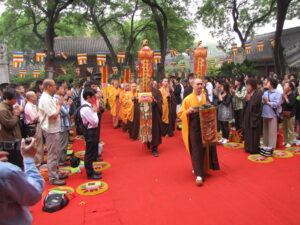
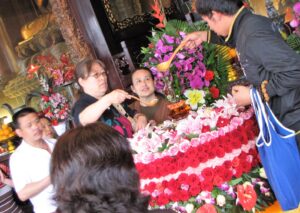
The ordination of new monastics has been an important function of the Temple of Universal Rescue since its ordination platform was constructed in the early Qing dynasty. In addition, recent years have seen biannual lay conversion ceremonies, with several hundred participants at a time.  [Image at right] In addition to these, the temple monks lead laypersons and other visitors at weekly Dharma Assemblies (fahui 法会) in a liturgical ritual known as the Chanting of the Sutras (songjing 诵经; See also, Gildow 2014). Dharma Assemblies take place on the first, eighth, fifteenth, and twenty-third days of the lunar month. At various times throughout the year, special assemblies are held with additional rituals and occasionally a sermon. The most notable of these are the celebration of the Buddha’s birthday (yufo jie 浴佛节); the birthday, conversion day, and enlightenment day of the bodhisattva Guanyin; and the Yulanpen day (often known popularly as the Hungry Ghost Festival) in which those who were reborn as “hungry ghosts” (or, one could say, demons [gui 鬼]) are fed and preached the Dharma as an act of compassion. During the Buddha’s birthday, laypersons line up, often for over an hour, to pour water over a small statue of the baby Buddha as an act of blessing and expression of respect for the great teacher he would become. [Image at right] On the Yulanpen day, the monks lead laypersons in a long nighttime ritual known as the Feeding of the Flaming Mouths (fang yankou 放焰口), so named because it is believed that, as a karmic punishment, ghosts are reborn with tongues of flame in their throat that dissolve all food which enters their mouths before it can nourish their stomachs; during the ritual, the monks, through the power of the Dharma, can circumvent this misfortune, making the ritual the only time the ghosts can receive nourishment. They also hear the preaching of the Dharma which can shorten their time in hell. Laypersons can purchase tablets that temple volunteers adhere to the inside wall of the Yuantong Hall where the ritual takes place. On the tablets are written the names of the sponsors’ deceased loved ones, ensuring that, if reborn as hungry ghosts, the ancestors’ names will be called into the Hall so that they can be fed and preached to.

In addition to these periodic Dharma Assemblies, the temple monks convene morning devotions (zaoke 早课) and evening devotions (wanke 晚课) that begin and end each day. The morning devotions are held at around 4:45 each morning and the evening devotions at 3:45 in the afternoon. A small number of laypeople also participate in the devotions, particularly the evening ones.

Devotees typically complete a ritual circumambulation of the temple along its central axis. Entering from the southernmost gate, they pass through the outer courtyard, proceeding to the Tianwang 天王Hall, where they make offerings to the future Buddha Maitreya (Mile Pusa 弥勒菩萨) and the bodhisattva Skanda (Weituo pusa 韦驮菩萨). They then proceed into the inner courtyard and the temple’s largest Mahavira Hall (Daxiong Baodian 大雄宝殿) where they make offerings to the Buddhas of Three Realms (Sanshi Fo 三世佛) – Kaśyapa Buddha (Shijiaye Fo 是迦叶佛), Shakyamuni Buddha (Shijiamouni Fo 释迦牟尼佛), and the Buddha that presides over the Paradise of Western Bliss, Amitabha (Amituofo 阿弥陀佛). Finally, they proceed to the northernmost courtyard opened to the public, where they make offerings to Guanyin 观音, the bodhisattva of compassion, whose image resides in the Yuantong 圆通Hall.

The opening of the temple gradually led to it becoming an important site for Beijing residents hoping to discover what religion and Buddhism were about. The lack of an admission fee, the temple’s fame as an historically important temple, and the largely unused large open space of the temple’s outer courtyard made it an ideal space for the discussion of Buddhist teachings and their relation to contemporary problems. Beginning from the 1990s, a wide range of free Buddhist-themed literature and later cassette and video recordings became available in mainland China. These multimedia materials ranged in content. The most plentiful were reproductions of popular Buddhist scriptures such as the Sutra of Infinite Life (Wu Liang Shou Jing 无量寿经), which describes the Paradise of Western Bliss, and the Lotus Sutra (Fahua Jing 法华经), which uses a series of parables to educate readers on the bodhisattva path, the possibility of universal salvation for all sentient beings, and the infinite lifetimes of the Buddha. Other popular texts were morality books (shanshu 善书), which feature entertaining stories that teach correct ethical action and the karmic consequence of both good and bad deeds. Some of these morality books were reproductions of popular morality books from China’s past such as the Ledgers of Merit and Demerit (Gongguoge 功过格); others, however, were authored by contemporary monastics or laypersons and related to karmic lessons to modern-day experiences. Basic introductions to Buddhist teachings, particularly those written by Master Jingkong 净空, a popular Australian-based Chinese Buddhist monk, were also very widely read. One could also find thaumaturgical texts that promised healing, long life, and positive karma to those who recited them. Books and audio and video recordings with sermons by famous monastics and laypeople relating Buddhist teachings to everyday life were also common (See also, Fisher 2011).

Because the Temple of Universal Rescue was one of the few active Buddhist temples opened to the public in Beijing in the early post-Mao period, it became an important site for the distribution of these multimedia materials, an act which brought merit to the donor. Those who took interest in the materials sometimes stayed to discuss them with fellow lay practitioners in the temple’s spacious outer courtyard. Among those laypersons, some became self-proclaimed experts from reading and viewing the materials, and they would  of her work;;;; impromptu sermons on their contents. [Image at right] Hearing these lay teachers begin to address an audience with an excited, raised voice, other listeners in the vicinity would wander over, eager to learn whatever they could about a previously unfamiliar religion. Many of these “preachers” only took on the role once or twice; others, however, developed a regular following and even typed and distributed their own interpretations of Buddhist teachings (See also, Fisher 2014). In addition to the preacher circles and discussion groups, groups that sang and chanted sutras in the courtyard started to become common by around the early 2010s.

The phenomenon of the preacher circles and discussion groups may have had antecedents in the temple’s past. Official histories of the temple predictably focus on its structures, cultural treasures, the practices of its monastics, or its famous visitors. However, there are some accounts of monks and at least one layperson preaching to temple visitors during the early twentieth century (Pratt 1928: 36, Xu 2003: 28). Doubtless, then as now, visitors were attracted by the temple’s important history and reputation as the residence of important monastic teachers from whom they hoped to seek guidance on the Dharma. On arriving at the temple, however, they found it was not often possible to gain an audience with these eminent teachers and so fellow laypersons who offered their own interpretations became an attractive alternative. However, it is also likely that the Buddhist public sphere created in the temple courtyard was at its liveliest in the 1990s and 2000s: During the Cultural Revolution, Buddhist scriptures were destroyed and the public teaching and practice of Buddhism was virtually wiped out, particularly in urban areas. Residents of Beijing had been socialized for a generation in an atheist materialist worldview that saw Buddhism and other religions as fundamentally false and harmful. As restrictions on religious practice were eased from the 1980s, however, many people were curious about this missing part of their heritage and eager to gain whatever information they could find in venues like the outer courtyard of the Temple of Universal Rescue. Moreover, in the late twentieth and early twenty-first centuries, many Chinese citizens experienced an acute loss of meaning in their lives, especially the generation that had been young adults during the Cultural Revolution. Many many had been mobilized as Red Guards, a generation, middle-aged by the century’s turn that was well represented in the outer courtyard’s groups. Mobilized by the ideological fervor of the Cultural Revolution and the belief that they were building global socialism, this generation felt abandoned when the post-Mao state shifted gears to a more pragmatic approach to governance by the late 1970s. With its emphasis on universal compassion, egalitarianism, and the importance of everyday ethical actions, Buddhism provided a source of meaning that, for some, filled this lacunae.

During the height of its popularity as a public religious space, the courtyard contained as many as 300 hundred participants and five active preacher circles at any one time. Participants would arrive as early as 9 a.m. and some stayed until the temple closed at 4:30 p.m. or 5 p.m., with the majority present for the first couple of hours after the end of the Chanting of the Sutras. By the early 2010s, however, the phenomenon started to wane, and, by the end of that decade, it became virtually non-existent (See, Issues/Controversies below).

Since the temple’s re-opening, the monks have also taken an active role in reintroducing Buddhism to laypeople, principally through the teaching of the “lecture on the scriptures” class twice each week for two periods of several weeks each year. Unlike the Dharma Assemblies, which fall on various days of the week in the Western calendar, making them difficult to attend for laypersons on a normal weekly work schedule, the scriptures classes take place on Saturday and Sunday mornings, making them accessible to a wider range of participants. The classes are taught by various monks whose teaching methods vary considerably: some simply lecture while others try to involve their audience. The topic for each class or period of classes also varies; different semesters or even different classes might not necessarily build on each other. My ethnographic research suggests that, as with scriptures classes in temples elsewhere in China, the motivation of participants varies. Some are interested in detailed understanding of Buddhist doctrine to assist in their own practice; others believe that merely by listening to the sermons, they will gain merit and spiritual advancement even if they do not completely comprehend the sermons’ content at a cognitive level.

The temple has also been involved in charity outreach work, dating back to the early nineteenth century, during the Qing dynasty, when the temple monks risked danger by gathering up abandoned bodies on battlefield and performing funeral rites for them (Naquin 2000:650). In the early Republican period (in the early twentieth century), encouraged by reformers both within the state and within Buddhist circles, Buddhists began to engage in charity work. The Temple of Universal Rescue housed a school and provided meals for the needy (Xu 2003:27; Humphreys 1948:106). In the contemporary period, the temple provided funds for the restoration of an elementary school destroyed in the 2008 Sichuan earthquake. A donation box for the state-run charitable organization Project Hope (Xiwang Gongcheng 希望工程), which provides schooling in underprivileged parts of the country, stands outside the main Mahavira Hall. However, the present-day temple is less involved in charity work than many other Buddhist temples in China, which run their own charitable foundations.

ORGANIZATION/LEADERSHIP

Leadership of religious sites, including Buddhist ones, in communist China is highly complex (See, for example, Ashiwa and Wank 2006; Huang 2019; Nichols 2020). Not all temples exist as government-authorized religious sites in spite of the presence of religious images, worship practices, or even resident clergy. The Temple of Universal Rescue, as headquarters of the Chinese Buddhist Association, is an officially registered religious site, yet it is also a protected cultural relics site. Even as a religious site, it serves a dual function as a practicing temple in its own right, with its own resident monks, and as the residence of senior monastics within the BAC, as well as headquarters for the offices of the Association. While the daily operation of the temple largely falls to its resident monastics, important decisions about infrastructure or even personnel are made by a number of government and Association bodies.

The temple is led by its abbot (zhuchi 主持). Another important role is filled by the Guest Prefect (zhike 知客) who is responsible for the temple’s relationship to the outside world. Other monastics have specific ritual, administrative, and maintenance duties (See, Welch 1967). As in all Buddhist temples in contemporary China, laypeople also play a significant role in everyday operations. This is in part because there are a relatively small number of monks in relation to the growing number of laypersons and the large number of visitors the temple receives each week, especially during Dharma Assemblies. The temple arranges as many as seventy lay volunteers each week into formal work schedules. Their duties include cooking, cleaning, repair and maintenance, administering the incense urns during Dharma Assemblies, and coordinating and controlling visitors, especially during major ritual events. These volunteer activities are known as “safeguarding the Dharma” (hufa 护法). They are attractive to laypersons as a source of merit as well as an opportunity to create community, particularly for the older, retired volunteers who make up the majority. At various times, the temple has also coordinated younger volunteers, often high school or college-aged students, for major Dharma Assemblies to assist in ritual activities and with crowd control. The activities of these younger volunteers (referred to by the secular term yigong 义工) are part of a recent trend toward civic volunteerism by the generation born after the 1980s. Yigong volunteers, who are not always laypersons, are often motivated more by the desire to try new things and meet new people than the opportunity to earn merit within a Buddhist soteriology.

Additionally, the temple has a small paid staff of temple workers including security guards and maintenance workers.

ISSUES/CHALLENGES

Historically, Buddhist temples in China have struggled between the demands of worldly society and their functions as spaces of religious retreat. The idea of renunciation is more easily accepted in Buddhism’s birthplace of India than in China. Folk Chinese religion is centered around the family, and Buddhism has always been a potentially disruptive force to that family-centered model of religiosity. Buddhism has suffered persecution on many occasions throughout its long history in China, with the Cultural Revolution being only the most recent example. However, Buddhist practitioners have also adapted to Chinese society by performing rituals for ordinary worshippers, accepting the incorporation of buddhas and bodhisattvas into the Chinese pantheon, and accommodating deeply cherished Chinese values such as respect for ancestors through rituals like the Feeding of the Flaming Mouths. The modern Temple of Universal Rescue reflects these tensions being, on the one hand, a space for monastic retreat, at times surprisingly quiet and calm within a busy city and, on the other, a space for popular religious practice. Its important administrative function as the headquarters of the Chinese Buddhist Association reflects the need for Chinese Buddhism to be responsible and responsive to an atheist state that still regards religion with suspicion.

Few monastics in China today would insist that Buddhist temples be kept exclusively as spaces for monastic retreat with no public functions, and many (though not most) are involved in outreach to the laity and the general public. However, there are lines that monastics and other temple administrators wish to be drawn, even if they do not always get their way. In recent years, at the Temple of Universal Rescue, much of this has concerned the activities of the preacher circles and discussion groups in the temple’s outer courtyard.

During the longest period of my ethnographic research at the temple in the early 2000s, the temple monks, their longstanding lay students, and, occasionally, leaders in the Association expressed concern about the activities of the preacher circles and discussion groups, in particular the unregulated distribution of multi-media materials in the courtyard. These leaders of the temple felt, understandably, that they, and not amateur preachers with no religious credentials, had both the right and the responsibility to say what were orthodox Buddhist teachings. For both religious and political reasons, the temple authorities were particularly concerned that the public learn to distinguish “true” Buddhist teachings from folk religious beliefs or, even more crucially, banned teachings like those of the Falun Gong spiritual movement, which had appropriated many Buddhist symbols and concepts. Yet for much of the early 2000s, the temple authorities lacked a regulatory apparatus to fully control the courtyard groups: there was a leadership vacuum at the temple, which was absent an abbot for several years, and a lack of interest from government authorities outside of the temple.

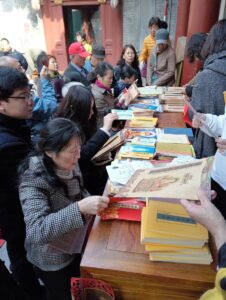
With the appointment of a new abbot, the mid-2000s saw the steady erection of signs in the courtyard warning the public that all distributed religious materials had to be approved first by the temple’s guest office and frowning on unauthorized public preaching. For several years, however, signs such as these were largely ignored, and the activities of the preacher circles and discussion groups went on as before. By the early 2010s, however, the temple worked more actively to take control of the space: it parked a large number of cars there and began to set up stalls to sell Buddhist-themed merchandise. [Image at right] The increased use of the courtyard created more congestion. During one major Dharma Assembly I attended, one of the young yigong volunteers broke up a preacher circle that was blocking the only entrance to the inner courtyard, resulting in a shouting match between the volunteer and the preacher. For the preacher, who had studied Buddhist teachings on his own for many years and freely preached on his knowledge to an interested audience each week, being disrupted by a teenager who likely knew little about Buddhism was extremely humiliating. The volunteer, however, believed he had been given the important responsibility of ensuring people could move smoothly between ritual activities organized by the temple monks, whose rightful authority the preacher was attempting to usurp.

By the mid-2010s, under the presidency of Xi Jinping, the temple leaders received more support from outside authorities to control their own space and became more proactive in forcing the preachers to cease their unscheduled sermons. They confined the distribution of Buddhist-themed literature and multi-media materials to one table in the inner courtyard that was policed by lay volunteers.

In spite of this, the Temple of Universal Rescue remains a vibrant religious site for monastics and laypersons, with an active ritual program, the continuation of the scriptures classes, and the continued availability of a wide range of free Buddhist materials to read and view. [Image at right] While the lay preachers cannot continue to preach, some have taken their followings elsewhere; others remain at the temple to participate in ritual activities. Longtime practitioners still seek out their advice, albeit more discreetly, and direct others to do so as well. Many practitioners, especially elderly ones, continue to gather in the inner and outer courtyard to socialize, discuss Buddhist scriptures, and gain some relief from the heat in the summer months. Overall, the Temple of Universal Rescue is a showpiece to the tenacity of Buddhism’s appeal even in one of the most secular of global cities.

 IMAGES

Image #1: A  lay conversion ceremony at the Temple of Universal Rescue.
Image #2: Celebration of Buddha’s birthday at the Temple of Universal Rescue.
Image #3: An impromptu sermon at the Temple of Universal Rescue.
Image #4: Stalls set up to sell Buddhist-themed merchandise at the Temple of Universal Rescue.
Image #5: Free Buddhist materials to read and view provided by laypeople as an act of merit-making.

REFERENCES

Ashiwa, Yoshiko and David L. Wank. 2006. “The Politics of a Reviving Buddhist Temple: State, Association, and Religion in Southeast China.” Journal of Asian Studies 65:337-60.

Fisher, Gareth. 2014. From Comrades to Bodhisattvas: Moral Dimensions of Lay Buddhist Practice in Contemporary China. Honolulu: University of Hawai`i Press.

Fisher, Gareth. 2011. “Morality Texts and the Re-Growth of Lay Buddhism in China.” Pp. 53-80 in Religion in Contemporary China: Tradition and Innovation, edited by Adam Yuet Chau. New York: Routledge.

Gildow, Douglas M. 2014. “The Chinese Buddhist Ritual Field: Common Public Rituals in PRC Monasteries Today.” Journal of Chinese Buddhist Studies 27:59-127.

Huang Weishan. 2019. “Urban Restructuring and Temple Agency – a Case Study of the Jing’an Temple.” Pp. 251-70 in Buddhism after Mao: Negotiations, Continuities, and Reinventions, edited by Ji Zhe, Gareth Fisher, and André Laliberté. Honolulu: University of Hawai’i Press.

Humphreys, Christmas. 1948. Via Tokyo. New York: Hutchison and Co.

Li Yao 李瑶 and Madelyn Bjork. 2020. “Guangji Temple.” Pp. 92-105 in Religions of Beijing, edited by You Bin and Timothy Knepper. New York: Bloomsbury Academic Press.

Naquin, Susan. 2000. Peking: Temples and City Life, 1400-1900. Berkeley: University of California Press.

Nichols, Brian J. 2020. “Interrogating Religious Tourism at Buddhist Monasteries in China.” Pp. 183-205 in Buddhist Tourism in Asia, edited by Courtney Bruntz and Brooke Schedneck. Honolulu: University of Hawai`i Press.

Pratt, James Bissett. 1928. The Pilgrimage of Buddhism and a Buddhist Pilgrimage. New York: Macmillan Press.

Welch, Holmes. 1967. The Practice of Chinese Buddhism, 1900-1950. Cambridge: Harvard University Press.

Xu Wei 徐威. 2003. Guangji si 广济寺. Beijing: Huawen Chubanshe.

Publication Date:
9/18/2021


Share

Order of the Morning Star

ORDER OF THE MORNING STAR TIMELINE

1910 (January 8):  Madeleine Montalban was born as Madeleine Sylvia Royals in Blackpool, Lancashire,

1930:  Montalban moved to London.

1933: Montalban started writing for London Life.

1953:  Montalban started writing for Prediction.

1956:  The Order of the Morning Star was founded.

1961:  Alfred Douglas became a student of Montalban.

1967:  Michael Howard contacted Madeline Montalban.

1982:  Madeline Montalban died of lung cancer at seventy-two years old.

1982:  The rights to Montalban´s work was conferred to her daughter who gave the rights to continue the work of the Order of the Morning Star to Jo Sheridan and her husband Alfred Douglas.

2004:  Michael Howard’s The Book of Fallen Angels was published.

2012:  Jullia Phillips Madeleine Montalban, The Magus of St. Giles was published.

FOUNDER/GROUP HISTORY

The Order of the Morning Star (OMS) was founded in 1956 by Madeline Montalban and Nicolas Heron who she had met in 1952. The Order was founded around their common interest in esotericism, astrology, and the angel Lucifer. Montalban was the driving force behind OMS and would also be its primary ideolog. When she later parted ways with Heron, there is no indication that he continued any activities connected to OMS.

Madeleine Montalban was born on January 8, 1910 in Blackpool, Lancashire, as Madeleine Sylvia Royals. She would later adopt several noms de plume (Dolores North, Madeline Alvarez,Madeline Montalban, and other names) that she used when publishing articles and pamphlets.

Based on what little is known about her childhood her parents do not seem to have had any interest in esoteric matters. According to Julia Phillips, if there was any form of spirituality present during her childhood it was Christianity (Phillips 2012:22). Montalban would later reinterpret central Biblical themes, often at odds with traditional forms of Christianity, and describe herself as a Pagan, but the Bible was central for her when growing up and would continue to play a central role for her. She would later claim that the Old Testament was a work of magic and the New Testament a work of mysticism (Howard 2016:55; Phillips 2012:26). Madeline moved in her early twenties to London, likely to pursue a career as a journalist. There are conflicting stories regarding Montalban´s move to London and her relationship with the London occult scene in the 1930´s. A rather fantastic story is that her father had sent her to London with a cheque to work for the well-known occult author Aleister Crowley (1875-1947), as her father was uncertain as to what to do with her (Phillips 2012:30). There is, however, no evidence that this story is true, and the likelihood that a person without any interest in the occult would send his daughter to live with Crowley is rather fantastic. Also, there are no mentions of Madeleine in Crowley’s diaries from the period. While the story that she was sent to work as Crowley’s secretary is amusing but mythological, there are some indications that she later got to know Crowley. Still, how close they where or how often they meet is debatable. Her stories regarding Crowley are based on later accounts to her friends and on a radio interview in the 1970´s. While the truth of these stories is open for debate, what is significant is how she would use Crowley as a contrast to present her own form of magical practice. Montalban considered Crowley to have failed to advance very far in his magical pursuits due to his lack of knowledge about astrology and the theatrical and bombastic rituals he put on to impress people. While this does not say much about Crowley´s system of Magick in itself, it does emphasize two aspects of Montalban’s teachings regarding magic. First, the importance of Astrology, which was central to everything she did, and second, her rejection of what she saw as the theatrical form of magic represented by occult orders like The Hermetic Order of the Golden Dawn and its offshoots (Phillips 2012:32).

Living in London Montalban started to work for London Life as their astrology columnist in 1933, writing under different pseudonyms. In 1939, she married a fireman, George Edward North, with whom she had a daughter. The marriage did not last, and he later left her. In 1947, she had become a regular contributor to London Life writing their Astrology column. According to Book of Lumiel, around 1944 she started to develop a deeper interest in Lucifer and started to search for more information about the angel, but none of this is found in her public writings at the time (Phillips 2012:112).

While the extent of her relationship with Crowley is debatable Montalban did become more and more a part of the occult scene in London in the 1940s. She would get to know people like Gerald Gardner (1884-1964), Kenneth (1924-2011) and Steffi Grant (1923-2019) and Michael Houghton, who had established Atlantic Bookshop in 1922. She would later help Gerald Gardner with his novel High Magic´s Aid that was published through Atlantis in 1949, or according to some accounts she basically wrote the whole novel based on Gardner’s notes (Phillips 2012:75-77). The novel was the first where Gardner presented his ideas about Witchcraft, although in a fictional form. While it seems that Montalban and Gardner did work with each other and continued to meet socially sometime in the middle of the 1960s, there was some fallout, but the reason is unclear. As Gardner died in 1964, Montalban´s increasingly negative view of him and Wicca could have begun after Gardner’s death (Phillips 2012:77). Her former student Michael Howard (1948-2015) would later write that “she exhibited a hostility to Gardner and Wicca that bordered on hatred” Howard 2004:10). When Howard, who had made contact with Montalban in 1967, was initiated into Gardnerian Wicca in 1969, it lead to a complete break with Montalban who saw this as “treachery” (Howard 2004:11; Phillips 2012:77). Despite her negative view on Wicca, she later got to know Alex and Maxime Sanders in the late 1960s, and the Sanders also incorporated aspects of her Angelic teachings in their work (Sanders 2008:237).  Still Montalban was always clear that she was not a witch and her form of magic had nothing to do with Witchcraft. Through the later writings of Michael Howard her ideas have become incorporated into what can be defined as “Luciferian Witchcraft” (or “Luciferian Craft”), which was Howards original term (Howard 2004: 12, Gregorius 2013:244).

In 1953, she started working with the magazine Prediciton and would continue writing for them for the rest of her life. Most of her articles focused on astrology and her private beliefs are seldom evident in them.

In 1956, she founded the Order of the Morning Star with her partner Nicolas Heron. The Order was organized so that students could complete a correspondence course rather than the traditional Masonic forms of initiations found in the Golden Dawn, Society of Inner Light, or Ordo Templi Orientis, and there were no group rituals. While the majority of those interested would only do so through written instructions and work for themselves, a small number would later become private students of Montalban (Phillips 2012:97. In 1964, Montalban and Heron split up, but the OMS continued their workings.

Despite being a part of the occult community in London, there is no evidence that she ever entered a magical order or had any teachings from an outside source. There are descriptions, with varying reliability, of her working with other people, like Gardner and Grant, but she does not seem to have had any formal initiations. Instead, her knowledge was based on studying primary texts and, according to Howard, she seems to have started to get revelations from Lucifer in 1946 (Phillips 2012:85; Howard 2016:56).

Montalban died on January 11, 1982, and the rights to her work went to her daughter. After the funeral there was an agreement between her, Jo Sheridan, and Alfred Douglas that Sheridan and Douglas would continue offer the correspondence courses of OMS. Both Sheridan and Douglas had known Montalban in the 1960´s, and Douglas was one of the students living with her when she moved into her new flat on Grape Street in 1966 (Phillips 2012: 37).

Central for the continued interest in Montalban have been the writings of Michael Howard, [Image at right] who was a student of Montalban in the 1960´s. Despite the fact that their relationship ended due to his interest in Wicca, it has been through his efforts in The Cauldron, for which Howard was editor begween its founding in 1976 and his death, that an interest of Montalban has been kept alive. In the 1990s, he started to write articles under the nom de plume “Frater Ashtan” about Luciferianism (Howard 2004:13). While he kept his interest in Luciferianism a secret for almost thirty years, he would later become more open about it. In 2001, The Pillars of Tubal Cain was published, co-written with Nigel Jackson, and The Book of the Fallen Angels was published in 2004. [Image at right The latter gives a presentation of Montalban´s view of Lucifer and the esoteric tradition she created.

DOCTRINES/BELIEFS

Montalban never published her esoteric teachings during her lifetime. While being a prolific writer, her public writings were mainly around astrology. Her only book, on the Tarot, was published after her death in 1983. To understand what was being taught in the OMS we must rely on recollections and interpretations from her students. The person who has written most extensively on Montalban is Michael Howard who was a student of hers in the 1960s. Howard integrates Montalban´s teachings with his own interpretation of Witchcraft and Luciferianism, but according to the current head of the OMS, Alfred Douglas, Howard’s presentation of Montalban is correct (Douglas, private correspondence, August 8, 2021).

Astrology plays a central role in the teachings of OMS, and Montalban argued that without a knowledge about astrology, magical workings were not possible. The organization also teaches that all people have their own special angels, and a central purpose of the workings within the OMS is to develop a relationship to these angels. How to approach and how to work with the angels are determined by an understanding of one’s personal birth chart. Astrology impacts everything within OMS, and like other esoteric orders there is a set of correspondences where different angels are also related to different zodiac signs and planets (Phillips 2012:98.

The most famous teaching of Montalban concerns her theology about Lucifer, or Lumiel as she preferred to label him (Howard 2016:56). Lumiel meant according to Montalban “The Light of God.” While many teachings found in OMS are based on the Bible, Montalban described herself as a Pagan and viewed Lumiel as based on a pre-Christian doctrine, referring to Chaldean religion as the origin (Phillips 2012:99; Howard 2004). Montalban was particularly found of the Chaldeans as she regarded their religious and magical systems to be based on astrology.

While Lumiel is a central figure in OMS teachings, he does not appear as a significant character until the twelfth course when the adept is given a copy of The Book of Lumiel that explains the history of Lumiel. Howard also refers to a manuscript called The Book of the Devil that has a similar narrative but is more focused on the figure Baphomet (Howard 2016:59). The Book of Lumiel is only twenty-one pages. Quoted from Phillips, it begins with a declaration that Montalban began her study on Lucifer in 1944. Based on Phillips and Howard, Lucifer is presented as a force for evolution of humanity, and the despair of Lucifer is connected to the ignorance of humanity. It is because of humanity´s ignorance that Lucifer is trapped, and the liberation of Lucifer is also the liberation of the human soul and its awakening.

The mythology presented in The Book of Lumiel is that the world was created by God, who is seen as ”dual natured, the perfection of male and female” (Howard 2004:27). God divides his power equally between himself and his female self, creating a division between Light and Intellect, and from this creating Lumiel, the first being. Further, out of this division comes the Ben Elohim, the sons, and daughters of God. These becomes the Archangels and are set to rule over the seven planets. The narrative that follows is a mixture of gnostic teachings mixed with Montalbans understanding of evolution, perhaps inspired by Helena Blavatsky. Life on Earth is guided to perfection by the angelic beings and above in Astral form are the “Ray People” that is the goal of humanities evolution. Rather than allowing evolution to take its course, Lumiel seeks to advance it by speeding it up. According to Howard:

According to the teachings of the OMS, Lucifer was frustrated at the slow evolution of the primitive human race, described as ´furless monkeys´, and therefore the angels ´mingled their vibrations´ with the ´daughters of earth´. Unfortunately humanity was not evolved enough to use the power they were given by this process and misused it leading to chaos and anarchy (Howard 2016:59).

This resulted in Lucifer being trapped in matter as a punishment and forced to reincarnate in the flesh throughout the ages to teach mankind the path to enlightenment and be the “Light of the World.” Montalban seems to have been influenced by Frazer, and the theory of the dying and resurrected god as he writes:

Not until mankind knew who and what I was should they know and understand, but my own sufferings, which must be physical, as the sufferings of mankind must be…these same sufferings and sacrifice should redeem mankind. I was a scapegoat, to be driven into the wilderness suffering shame and ignorance life after life, until that error that I had perpetrated had worked itself out by mankind becoming wise, and therefore wholly good, through experience (Motalban quoted in Howard 2004:123).

Even Christ was seen as an avatar of Lucifer in Montalbans teachings. The teachings of Montalban can be seen as a form of neo-Gnosticism where the spirit is trapped in matter and seeks liberation. The Garden of Eden is for example a place in the astral (Howard 2004:31). The image of Lucifer is based on the Bible and Book of Enoch but reinterpreted with Lucifer being a force for good that will in the end return to his former glory. Lucifer is not a Satanic figure, even if the mythology around him is a based on the fall of Lucifer and the rebel angels. The teaching of OMS can be seen as Luciferian but not Satanic. There is no conflict between God and Lucifer, rather Lucifer becomes, through his initial error, a guide for humanity. Howard compares Montalban´s views with those of Gurdjieff, in that she viewed most of humanity as being asleep.

RITUALS/PRACTICES

Montalban was critical to what she saw as the theatrical form of ceremonial magic that she found in organizations like the Hermetic Order of the Golden Dawn. The descriptions that exist of her performing rituals are often simple, using candles, tarot, and astrological timing. [Image at right] The rituals were based on the seven planets and correspondences between them and your own birth chart. The Seven planets and their ruling spirits, zodiac-sign and weekday are (Phillips 2012: 103):

Michael (Sun),               Sunday,                           Leo

Gabriel (Moon),            Monday,                         Cancer

Samael (Mars),             Tuesday,                       Aries and Scorpio

Raphael (Mercury),      Wednesday,                  Gemini and Virgo

Sachiel (Jupiter),          Thursday,                       Sagittarius and Pisces

Anael (Venus),               Friday,                           Taurus and Libra

Cassiel (Saturn),           Saturday,                       Capricorn and Aquarius

The rituals are designed to be performed individually. The teachings of OMS are themselves secret and only open for members, but in their presentation they refer primarily to renaissance magic as a source of inspiration:

The basis of her system was Hermetic magic, as developed during the Italian Renaissance and practiced by Marsilio Ficino, Pico della Mirandola, Cornelius Agrippa and John Dee amongst others. Her sources included the Picatrix and Corpus Hermeticum, The Heptameron of Peter d’Abano, the Key of Solomon, the Sacred Magic of Abramelin, and Agrippa’s Occult Philosophy (OMS n.d.).

The rituals were designed to be performed mainly by the student themselves as part of their own understanding of magic. A central part of this is the use of and construction of talismans under the correct astrological timing. Initially a horoscope was cast for new students that revealed the students Sun and Moon angels. The first course was also called The Occult Secrets of the Moon (Phillips 2012: 96) indicating the focus on the moon.

ORGANIZATION/LEADERSHIP

While a more informal order, OMS is still divided into different degrees based on how advanced the student has become. When Montalban was alive, she took in students that she taught in person who would form an inner circle. Still, there are no clear degrees, and the system is based on a rejection of the type of degree-based orders that where common in the 1950´s (Phillips 2012:96-98).

The initial leadership for OMS was Montalban and Heron. When their relationship ended in 1964, she continued herself. After Montalban´s death in 1982, the copyright to her work was given to her daughter who contacted Jo Sheridan and Alfred Douglas to continue the work with OMS. The OMS has remained active under the leadership of Alfred Douglas.

ISSUES/CHALLENGES

A primary issue regarding the OMS has been its emphasis on Lucifer, which has led to associations with Satanism. Based on the writings of Michael Howard, it seems that there were some challenges within the British Pagan scene to come out as a Luciferian due to the possibility of being associated with Satanism. OMS has emphasized that it regards Lucifer as a positive figure and does not promote Satanism. Instead, OMS sees Lucifer as “the bringer of Light” who opens human consciousness to higher awareness (Douglas, personal communication, August 13, 2021).

As with many esoteric teachers, there have been questions about the biography of Montalban and to what degree her stories about her relationship to other occultists of the time are factual. This is the case, as noted previously, regarding how she got to know Aleister Crowley. Apart from stories told by herself, there are also stories from other sources that are questionable. Gerald Gardner seems to imply Montalban had a close connection to Lord Mountbatten that is difficult to prove, as is Gardner’s claim that she really worked as a psychic adviser and “personal clairvoyant” (Heselton 2000:301). Equally fanciful is the description of a ritual performed by Montalban with Gerald Gardner and Kenneth Grant that is found in Grant´s Nightside of Eden (Grant 1977:122-24; Phillips 2012:83). These types of issues are rather common with most biographies, and further research on OMS and Montalban will probably yield a greater understanding of these stories. Still, according to Julia Phillips, who has written the only biography about Montalban, when conducting interviews with those who knew her, a rather homogenic picture of her emerged, and most stories seem consistent and are verified by multiple sources (Phillips, private correspondence August 13, 2021).

Montalban and the OMS were very early examples of Luciferianism, even if her interpretation is far from most contemporary forms. While she herself rejected Witchcraft, through the writings of Michael Howard she has become a significant source of inspiration for modern Luciferian Witchcraft.

IMAGES
Image #1: Michael Howard.
Image #2: Cover of  The Book of the Fallen Angels.
Image #3: Madeline Montalban from Man, Myth and Magic in the 1970s

REFERENCES

Douglas, Alfred. 2021. Personal correspondence, August 13.

Grant, Kenneth. 1977. Nightside of Eden. London. Skoob Book Publishing.

Gregorius, Fredrik. 2013. “Luciferian Witchcraft: At the Crossroads between Paganism and Satanism.” Pp. 229-49 in The Devil’s Party: Satanism in Modernity, edited by Per Faxneld and Jesper Aa. Petersen. New York: Oxford University Press.

Heselton, Philip. 2003. Gerald Gardner and the Cauldron of Inspiration: An Investigation into the Sources of Gardnerian Witchcraft. Somerset. Capall Bann Publishing

Heselton, Philip. 2000. Wiccan Roots: Gerald Gardner and the Modern Witchcraft Revival. Berks. Capall Bann Publishing.

Howard, Michael. 2016. ”Teachings of the Light: Madeline Montalban and the Order of the Morgning Star.” Pp 55-65 in The Luminous Stone: Lucifer in Western Esotericism, edited by Michael Howard and Daniel A. Schulke. Richmond Vista: Three Hands Press.

Howard, Michael. 2004. The Book of Fallen Angels. Somerset: Capall Bann Publishing.

Hutton, Ronald. 1999. The Triumph of the Moon: A History of Modern Pagan Witchcraft. Oxford: Oxford University Press.

OMS. n.d. ”Madeline Montalban and the Order of the Morning Star.” Accessed from https://www.sheridandouglas.co.uk/oms/ on 15 August 2021.

Phillips, Julia. 2021. Personal correspondence, August 13.

Phillips, Julia. 2012. Madeline Montalban: The Magus of St Giles. London: Neptune Press

Phillips, Julia. 2009. ”Madeline Montalban, Elemental and Fallen Angels.” Pp 77-88 in Both Sides of Heaven: A collection of essays exploring the origins, history, nature and magical practices of Angels, Fallen Angels and Demons, edited by Sorita d´Este. London: Avalonia.

Sanders, Maxine. 2008. Firechild: The Life and Magic of Maxine Sanders. Oxford: Mandrake of Oxford.

Valiente, Doreen. 1989. The Rebirth of Witchcraft. London: Robert Hale. 

Publication Date:
19 August 2021


Share

Prince Philip

PRINCE PHILIP TIMELINE

1966:  Iounhanen villagers presented a pig to British Resident Commissioner Alexander Mair Wilkie during his visit to Tanna.  Wilkie died on August 13 of that year and did not reciprocate.

1971 (March):  Prince Philip briefly visited the New Hebrides, including Malakula island, on the Britannia.

1973-1974:  Freelance journalist Kal Müller filmed island life (kava drinking, dancing, circumcision ceremony) and John Frum rituals and convinced Iounhanen men to revive wearing penis wrappers and to consider establishing a kastom (custom) school for their children to attend.

1974 (February 15-17):  Prince Philip, Queen Elizabeth, and Princess Anne visited the New Hebrides on the royal yacht Britannia. They did not call at Tanna. Jack Naiva of Iounhanen claimed he canoed out to the Britannia in Port Vila harbor and saw the Prince in a white uniform.

1975 (November 10):  The first general election in the colonial New Hebrides took place. The anglophone New Hebrides National Party won seventeen seats.

1977 (November 29):  The second general election, boycotted by the Vanua’aku (National) Pati (Party), took place.  The Vanua’aku Pati declared a People’s Provisional Government in areas it controlled.

1977 (March):  The General Assembly was suspended after the Vanua’aku Pati boycott.

1978 (September 21):  British Resident Commissioner John Stuart Champion visited Iounhanen village and learned of the unreciprocated pig. He obtained a framed photograph of Prince Philip and five clay pipes and returned to Iounhanen to present these gifts.

1978:  Tuk Nauau carved a pig-killing club that British authorities sent to Buckingham Palace.  The Palace returned a second photograph of Prince Philip wielding the club and newly appointed British Resident Commissioner Andrew Stuart visited Iounhanen to present this second photograph.

1979 (November 14):  Third general elections in the New Hebrides. The Vanua’aka Pati won twenty-five out of thirty-nine seats.

1991:  Movement co-founder Tuk Nauau was featured in the 1991 documentary The Fantastic Invasion, filmed with a Prince Philip photograph hanging behind.

2000:  Buckingham Palace sent another photo of Prince Philip to Tanna

2007 (September):  Posen and four other men from Iakel village were featured in the television reality show Meet the Natives. Prince Philip welcomed them off camera to Buckingham Palace and gifts (including another photograph and a walking stick) were exchanged.

2009:  Other Iakel villagers were featured in the American version of Meet the Natives.

2009:  Movement co-founder Jack Naiva died.

2014 (October):  Princess Anne visited Port Vila.

2015:  Iakel villagers wearing penis wrappers and bark skirts, and Iakel village itself, starred in Tanna, a feature film nominated in 2017 for a Best Foreign Language Academy award.

2018 (April):  Prince Charles visited Port Vila. Jimmy Joseph, from Iounhanen, gave him a walking stick.

2021 (April 9):  Prince Philip died.

FOUNDER/GROUP HISTORY

When Prince Philip, Duke of Edinburgh, [Image at right] died on April 9, 2021, obituaries celebrated his long life, his faithful support of his wife Elizabeth, his military career, and his witty if sometimes gruff personality. They also noted that he was a “South Pacific Island God” (see Drury 2021; Morgan 2021; among many others), and was revered as such on Tanna Island in southern Vanuatu. This apotheosis was a journalistic exaggeration, a not untypical misunderstanding of island actuality. The Prince was not a god. Rather, he was an island brother, the son of Kalpwapen a powerful spirit who lives atop Tukusmera, the highest mountain on the island. Young Philip, somehow, had found his way to Europe to marry a queen. But he had returned several times to the islands and clever pundits from a few isolated villages were delighted to reestablish a relationship (or a “road,” in local parlance) with him. The renewed connection was marked with exchanges of gifts including photographs and clay pipes from the Prince, and clubs, walking sticks, and pigs from his island relatives. [See, Doctrines/Beliefs below]

Tanna island is appreciated by anthropologists, linguists, and tourists alike for both its rich cultural and linguistic traditions that have survived, if somewhat transformed, 250 years of culture contact and for remarkable religious and social innovations, the John Frum movement among the best known of these (Lindstrom 1993). The Duke fit usefully into island politics of the 1970s. France and Great Britain, in 1906, established the New Hebrides Condominium colony after neither would agree which power would occupy this island chain. By the 1970s, Southwest Pacific colonies were achieving independence, beginning with Fiji in 1970. By the mid-1970s it was clear that New Hebridean independence, too, was quickly approaching and this sparked much political competition between the two ruling powers, concerned to transfer authority to a friendly independent government, and confrontational dispute and debate among islanders themselves.

The colonial education system was never good, but more islanders had attended British funded schools, and spoke some English, than had matriculated in French schools. The French were particularly concerned to beef up support for francophone and French-leaning political parties that competed in several national elections: a first in 1975 for a new General Assembly; a second, failed election, in 1977; and a third in 1979 for what would become the rechristened Vanuatu’s first Parliament. In these years both the British and French sent operatives around the archipelago to discuss impending independence, explain voting procedures, and firm up political support (Gregory and Gregory 1984:79). The French especially cultivated John Frum movement supporters, headquartered at east Tanna’s Sulphur Bay, with a range of enticements. The British, in counterpoint, established relations with a few isolated villages in the west that, conveniently, had just rediscovered their lost brother, the Duke of Edinburgh. Then British Resident Commission Andrew Stuart denied any ulterior political motive in these dealings (Stuart 2002:497), but doubts justifiably persist.

West island Iounhanen village, and neighboring Iakel, located about five km up the mountainside from the colonial administrative headquarters although isolated by bad trails and tracks, had hosted in the early 1970s freelance photographer Kal Müller. Müller managed to convince villagers to doff their tattered shorts and skirts and resume wearing traditional men’s penis wrappers and women’s bark skirts. Villagers also discussed establishing a kastom (“custom”) school in which their children could learn island traditions (Baylis 2013:36). This exotically much improved an article that Müller published in the National Geographic (1974). It also boosted the villages’ attraction for a small, but growing number of tourists that came to Tanna. Bob Paul, an Australian trader resident on Tanna since 1952, had helped establish a small airline that connected Tanna with the main national airport on Efate Island, and built Tanna’s first tourist bungalows. He arranged for visitors to climb Iasur, the island’s active volcano, drive by a herd of “wild horses,” and tour Sulphur Bay, John Frum movement headquarters. Some tourists also began calling at Iounhanen to take part in traditional dance ceremony and hobnob with real kastom villagers, as signified by those penis wrappers and bark skirts.

Paul’s connections with Iounhanen were good, and he and British island agent Bob Wilson facilitated British Resident Commission John Champion’s visit to that village in September, 1978. People there, Champion wrote, unlike John Frum supporters were “basically well-disposed to the British” (2002:153). Villagers in 1966 had presented Alexander Wilkie, one of Champion’s predecessors, a pig and some kava (Piper methysticum). They now complained that Wilkie (who died soon after this visit) had never reciprocated these gifts. Leading men Jack Naiva and Tuk Nauau requested some return token, preferably from Champion’s London boss, the Prince. Naiva may have observed Philip, dressed in naval whites, on the Britannia during its royal visit to Port Vila in 1974. He claimed he had canoed out into Vila harbor to scrutinize the yacht (Baylis 2013:60). Gender relations on Tanna remain patriarchal and male princes trump female queens, particularly one in an impressive uniform. A return gift would square the exchange and promise enduring international connections after the British departed, which they did when the colony achieved independence in 1980.

The British Residency consulted Kirk Huffman, the Anglo-American curator of the New Hebrides Cultural Centre in Port Vila, who explained the cultural significance of reciprocal exchange and noted men’s continuing fondness for German-produced clay pipes, a popular nineteenth century trade item (Baylis 2013:56). Champion contacted Buckingham Palace which provided a signed photograph of the Duke. He then returned to Iounhanen with photograph and five clay pipes that Naiva and Nauau received “with great dignity and satisfaction, although one old man was heard to mutter that it would have been even better if HRH had come in person” (Champion 2002:154).

Nauau, in turn, gave Champion a pig-killing club that he had carved and asked that this be sent to the Prince and a photograph of Prince-with-club be taken. This was done and Andrew Stuart, who replaced Champion as British Resident Commission at the end of 1978, brought this second photograph down to Iounhanan (Gregory and Gregory 1978:80). The British, from the beginning of it all, were well-aware of the public relations potential of these exchanges and they recruited BBC photographer Jim Biddulph to film the gift exchange. (Biddulph missed the exchange itself but subsequently took the first, now famous, image of Naiva holding the picture of Philip with club (Stuart 2002:498)). [Image at right]

Photographs, books, and other paper material have short lives on Tanna given the island’s tropical climate and passing cyclones, and the Palace over the years continued to send along replacement photographs as earlier ones decayed, including one in 2000 accompanied by a Union Jack flag.

Iounhanen and Iakel in the 1970s were small, isolated, and sparsely populated places made remote by bad roads and mountain slopes. In the 1920s, the Presbyterian mission (the nearest mission station located at Ateni village (Athens)) had converted people; and in the 1940s, people abandoned the mission to join the resurgent John Frum movement. These villages, though, were on the margins of both Christian and John Frum organizations and people enjoyed little recognition or respect from their island neighbors, let alone from the wider world. They could, and did, however, boast their commitment to true island kastom. Naiva’s and Nauau’s brilliant idea, which has much elevated their fame and fortunes, and erased their marginality, was to create a kastom road to Prince Philip.

DOCTRINES/BELIEFS

Most islanders, although largely Christian, maintain a firm belief in the presence of spirits, and they share a rich set of myth motifs with fellow Melanesians and with Polynesian neighbors in the central Pacific. One common motif concerns two brothers, one of whom leaves home while the other stays behind (Poignent 1967:96-97). A chain of myths along the northern coast of Papua New Guinea, for example, recount the stories of separated brothers Kilibob and Manup (Pompanio, Counts, and Harding 1994). The brothers are culture heroes who, with superhuman power, innovated or introduced important elements of culture. One is often credited with establishing local traditions, and the other, who disappeared beyond the horizon, with endowing colonizing Europeans with the technological and other powers they enjoy. Prince Philip, as a long-lost island brother, fits into this widespread Melanesian myth motif.

More particularly, the Duke also served island and colonial politicking in the 1970s as a British counterweight to the French-leaning John Frum movement, and as a well-placed brother who might elevate Iounhanen’s local renown. Tanna, with its oral culture, is an island of competing and overlapping stories. Sacred texts are not codified in print. People are inspired constantly with messages that they receive in dreams, or when slightly intoxicated by kava, infusions of which men drink together every evening (when supplies permit) at village dance/kava-drinking grounds (Lebot, Merlin, and Lindstrom 1992). Since the 1970s, many variant Prince Philip tales have circulated about Tanna and have been spread widely by international journalists delighted to recount the Duke’s delicious, if incorrect, apotheosis.

Resident Commission Champion heard some early stories in 1978, although these no doubt were warped through British ears: The Duke is a son of mountain spirit Kalpwapen; John Frum is his brother; he

had flown across the sea, where he married a white lady, and would one day return in his nambas [penis wrapper] to live on the volcano and rule over them in perpetual bliss—when old men would lose their wrinkles, become young and strong again, and be able to enjoy the favours of innumerable women without restraint (2002:153-154).

Andrew Stuart, his successor, added that “Some said that, in his white naval uniform, he must be the pilot of John Frum’s aeroplane” (2002:497). Other early stories promised Philip several nubile young wives when he came home to Tanna.

These accounts correlate with Western appreciation of the John Frum movement as a “cargo cult” (Lindstrom 1993).  These were social movements, widespread in Melanesia, that erupted after the Pacific War  Prophets instructed followers to improve their behavior and repair their social relationships so as to invite ancestral spirits, or American cargo planes and ships, to return with material wealth, political salvation, better health, and even immortality.

Tuk Nauau is a better source for island stories. Huffman, when photographs were first exchanged in 1978, interviewed Nauau and others to provide background intelligence to the Palace. In Fantastic Invasion Nauau lauds the creation of new roads, new connections as with the Prince, that will ensure peace and prosperity. His stories connect Tanna to the wider world which the Prince represents (Baylis 2013:17). Nauau holds up a cupro-nickel coin, silver joined with copper, or in island eyes black with white. The coin, like the Duke, symbolizes happy relationships that profitably conjoin families together (Baylis 2013:122-23).

The label “cargo cult,” which most anthropologists began to avoid by the 1970s, shaded and simplified diverse post-war Melanesian social movements. Prince Philip’s Tanna following was not a cargo cult despite journalistic unquenchable fondness for the term. A 2017 television series that commemorated James Cook’s Pacific voyages showcased “The Prince Philip Cargo Cult” (Lewis 2018; see also Davies 2021 and many others). Instead, the Prince from afar looks after his island relatives, enhancing their lives on Tanna. Islanders looked forward to an eventual reunion with their roving brother, and not so much to the treasure or cargo that he might bring home. They expected his homecoming which has, with his passing, indeed occurred. Philip’s spirit is back on Tanna.

RITUALS/PRACTICES

Innovative Philip stories did not spark much new ritual in either Iounhanen or Iakel. Instead, followers incorporated recognition of the Prince within the normal round of island ceremony. This includes daily communion with spirits during evening kava consumption, and standard circle dances (nupu) that mark important events (marriages, the circumcision of sons, and annual exchanges of first-fruit yams and taro). Iounhanen and Iakel hosted a large regional pig-killing festival (nekoviar or nakwiari) in the 1970s and they might do so again in some future commemoration of the Duke.

Baylis, who visited Iouhanen for a month in 2005, was disappointed not to discover specific celebratory rites. Naiva explained “We don’t sing songs to Prince Philip. We don’t go into a special house. We don’t have . . . sticks like this”—he made the sign of the cross with his hands—“or dances or anything like that” (2013:235). That sort of ostentatious ritual, Naiva explained, was something that Christians and John Frum followers did and it merely “blocks the road.” Philip’s island brothers instead,

…walk slowly.  We work in the gardens.  We drink kava.  We keep it in our hearts.  And what happens?  Prince Philip sends us photographs and letters.  We have built a road, and because we continue to do it our way, the kastom way, and not the way of the Christians and the John people, one day men from Tanna will meet him” (2013:236).

Naiva stored his two Philip photographs in a structure raised off the ground, out of reach of pigs and floods (Baylis 2013:200), and he curated a small collection of Philip letters and published articles inside his house.

Ongoing journalistic attention and tourist arrivals (before Covid19 disrupted these) recently have encouraged innovation of ceremonial occasions, including the Duke’s June 10 birthday, although Islanders are fitful time-keepers. Iakel supporters, when informed of Prince Harry and Meghan Markle’s wedding, reportedly raised one of their British flags, drank kava, and danced nupu (Lagan 2018). Followers also gathered to kill and share pigs, and drink kava, to mourn Philip’s death when they heard the news. Traditionally, male relatives of a dead kinsman grow their beards out for about a year and then organize a mortuary feast to mark shaving these off. Such celebrations are ad hoc and irregular, sparked largely by passing external attention.

ORGANIZATION/LEADERSHIP

Leadership on Tanna is diffuse and contextual (Lindstrom 2021). Men occupy managerial positions insofar as others are willing to follow. At the village level, numbers of men claim one or the other of two sorts of traditional chiefly titles (ianineteta “spokesman of the canoe” and ierumanu “ruler”) although in practice age, experience, and ability determine who effectively serves as “chief.” Regional organizations (the many Christian denominations active on the island; John Frum; previous groups including “Four Corner” and various Kastom churches; and now the Prince Philip movement) operate similarly. Able, typically older, men (particularly those who receive innovative messages from spirits or the wider world) command followings.

Jack Naiva and Tuk Nauau, along these lines, were two principal innovators of Prince Philip stories. They took advantage of the politically troubled 1970s, an unreciprocated pig, a fortunate encounter with the Britannia during its 1974 royal visit to Port Vila, and a community unhappy with its marginality to evoke a hidden princely connection. Nauau, who suffered from filariasis, died in the 1990s and Naiva in 2009. Movement leadership has passed to a second generation, but even before Naiva died serious conflict had erupted between the Duke’s followers in Iounhanen village and those in Iakel, located a few hundred yards down the road and led by Johnson Kouia, Posen, and others. Such denominational conflict is typical on the island as communities and organizations dispute and split over resources. In this case, the Prince and the global attention he commanded, and a growing tourist business, were the main points of conflict.

ISSUES/CHALLENGES

Philip is dead. What might islanders do next? Much journalistic speculation focused on whether Prince Charles might take his father’s place in the hearts of the Tannese (e.g., Squires 2021). No firm story, however, has yet appeared that Charles will supplant Philip. Philip’s spirit, after all, is now back home on Tanna [Image at right] and he continues to offer roads that lead out into the wider world.

A bigger challenge comes from the movement’s remarkable success. This precipitated a split between Iounhanen and Iakel, which deepened when the latter captured much of the tourist trade. Although Iounhanen, in the 1970s, was first to offer itself to the world as a kastom village tourist attraction (and villagers could hurry to don their penis wrappers and bark skirts when a truck could be heard grinding up the mountain trail), Iakel by the 2000s had captured much of the trade (Connell 2008). Iakel men also starred in both the British (2007) and American (2009) versions of the reality television show Meet the Natives. This carried five villages to the U.K. and the U.S. where they met new friends and encountered exotic Western social conditions (homeless people, for example). The Duke, in the British version (episode three, part five), entertained the five Iakel men in Buckingham Palace, although off camera. They gave Philip several gifts including another walking stick, and apparently asked him “Is the pawpaw ripe yet or not?” If ripe, his return to Tanna was imminent. One wonders about the Duke’s willingness to hobnob with his followers although this did enhance international relations as is his assigned island duty.

In 2015, Iakel villagers in their penis-wrappers and bark skirts starred in an Australian-produced feature film, Tanna (Lindstrom 2015). This film, in 2017, was nominated for an Academy Award Best Foreign Language Film, and it won other awards including one from the African-American Film Critics Association. Its young stars traveled widely to international film festivals. The Prince, too, popped up in the film as village elders commend his arranged marriage with Elizabeth as an essential model for island marriages which are also still mostly arranged by a couple’s parents (Jolly 2019).

Tourist visits to Tanna increased significantly in the 2000s, before Covid-19 closed borders. Vanuatu’s National Statistics Office reported that over 11,000 international visitors came to Tanna in 2018. Most arrived to tour Iasur, the island’s volcano, but increasing numbers also paid to experience and photograph kastom life in Iakel, or in several competing villages hawking island traditionalism. A few, especially wide-eyed journalists, come to follow Prince Philip’s trail. When international tourism resumes, this growing outlandish attention promises to deepen island conflict as Philip’s followers clash over the money and other resources that visitors offer.

Philip has indeed served as the road along which villagers have, like him, left Tanna to travel far. Now that his spirit is back home on the island, his road may one day become overgrown and impassable, replaced by new connections and new global relationships that islanders crave. But, for now, his stories still circulate, and his light which shines on Tanna continues to attract the world to this remote and fascinating island.

Image #1: Prince Philip, Duke of Edinburugh.
Image #2: Jack Naiva with Philip’s photograph (a post-1978 retake).
Image #3: Map of Tanna.

REFERENCES

Baylis, Matthew. 2013. Man Belong Mrs Queen: Adventures with the Philip Worshippers. London: Old Street Publishing.

Champion, John. 2002. John S. Champion CMG, OBE.  Pp. pp.142-54 in Brian J. Bresnihan and Keith Woodward, eds. Tufala Gavman: Reminiscences from the Anglo-French Condominium of the New Hebrides. Suva: Institute of Pacific Studies, University of the South Pacific.

Connell, John. 2008. “The Continuity of Custom? Tourist Perceptions of Authenticity in Yakel Village, Tanna, Vanuatu.” Journal of Tourism and Cultural Change 5:71-86.

Davies, Caroline. 2021. “Prince Philip: The unlikely but willing Pacific deity.” The Guardian, April 10. Accessed from https://www.theguardian.com/uk-news/2021/apr/10/prince-philip-south-sea-island-god-duke-of-edinburgh on 1 August 2021.

Drury, Colin. 2021. “Prince Philip: Tribe Who Worshipped Due as God Will Wail to Mark His Death.” Independent, April 10. Accessed from https://www.independent.co.uk/life-style/royal-family/prince-philip-death-island-tribe-b1829458.html on 1 August 2021.

Gregory, Robert J. and Janet E. Gregory. 1984. “John Frum: An Indigenous Strategy of Reaction to Mission Rule and the Colonial Order.” Pacific Studies 7:68-90.

Jolly, Margaret. 2019. Tanna: Romancing Kastom, Eluding Exoticism? Journal de la Societe des Oceanistes 148:97-112.

Lagan, Bernard. 2018. “Royal wedding: Duke cult islanders celebrate with a feast.” The Times, May  21. Accessed from https://www.thetimes.co.uk/article/duke-cult-islanders-celebrate-with-a-feast-kmxjbkxqb on 1 August 2021.

Lebot, Vincent, Mark Merlin, and Lamont Lindstrom. 1992. Kava: The Pacific Drug. New Haven: Yale University Press.

Lewis, Robert. 2018. The Pacific in the wake of Captain Cook with Sam Neill. (study guide). St Kilda: Australian Teachers of Media.

Lindstrom, Lamont. 2021. Tanna Times: Islanders in the World. Honolulu: University of Hawaii Press.

Lindstrom, Lamont. 2015. Award-winning film Tanna sets Romeo and Juliet in the south Pacific.” The Conversation, November 4. Accessed from http://theconversation.com/award-winning-film- tanna-sets-romeo-and-juliet-in-the-south-pacific-49874 on 1 August 2021.

Lindstrom, Lamont. 1993. Cargo Cult: Strange Stories of Desire from Melanesia and Beyond. Honolulu: University of Hawaii Press.

Morgan, Chloe. 2021. “South Pacific Yaohnanen tribe who worship Prince Philip as a God believe his spirit is ready to return to their island to bring ‘peace and harmony to the world’—and say Prince Charles will ‘keep their faith alive’.” Daily Mail, April 20. Accessed from https://www.dailymail.co.uk/femail/article-9487967/Vanuata-island-tribe-worship-Prince-Philip-God-believe-spirit-ready-return-home.html on 1 August 2021.

Müller, Kal. 1974.  “A Pacific Island Awaits Its Messiah.” National Geographic 145:706-15.

Poignant, Roslyn. 1967. Oceanic Mytholody: The Myths of Polynesia, Micronesia, Melanesia, Australia. London: Paul Halyn.

Pompanio, Alice, David R. Counts, and Thomas G. Harding, eds.1994. Children of Kilibob: Creation, Costom and Culture in Northeast New Guinea.  Pacific Studies (special issue) 17:4.

Squires, Nick. 2021. “Spiritual secession: Vanuatu tribe who worshipped Prince Philip as a god will now deify Charles.” The Telegraph, April 9. Accessed from https://www.telegraph.co.uk/royal-family/2021/04/09/spiritual-succession-islanders-worshipped-prince-philip-god/ on 1 August 2021.

Stuart, Andrew. 2002. “Andrew Stuart CMG CPM.” Pp. 588-506 in Brian J. Bresnihan and Keith Woodward, eds. Tufala Gavman: Reminiscences from the Anglo-French Condominium of the New Hebrides. Suva: Institute of Pacific Studies, University of the South Pacific.

Publication Date:
4 August 2021


Share

Fairfield, Iowa (Transcendental Meditation Enclave)

FAIRFIELD, IOWA ENCLAVE TIMELINE

1970:  UCLA graduate student Robert Keith Wallace, a devotee of Maharishi Mahesh Yogi in California, published a version of his doctoral thesis, showing helpful effects of meditation, in Science magazine.

1971-1972:  Maharishi developed the Science of Creative Intelligence, planning at first to teach it as a supplementary course at universities worldwide. Followers launched the course at Yale and Stanford, among other schools.

1973-1974:  After switching gears to develop its own university, the movement opened Maharishi International University (MIU) in rented space in Goleta, California. Crammed for space, the movement bought the campus of bankrupt Parsons College in Fairfield, Iowa, for $2,500,000. Students and faculty arrived in the summer of 1974. R.K. Wallace headed the school.

1975:  Popular TV host Merv Griffin, a TM practitioner, broadcast two shows interviewing the guru, and initiations grew by nearly 300,000, part of what followers call “the Merv wave.” This represented the movement’s peak and the beginning of Fairfield’s ascension.

1975:  Practitioners set up the Maharishi School of the Age of Enlightenment in Fairfield, an elementary school mainly for children of faculty and staff at MIU.

1976-1979:  Parents of public school students in New Jersey and clergy sued to shut down TM programs launched in the schools, contending they were religious in nature. New initiations plunged. A federal judge, ruling for the parents, stopped the public school TM programs in New Jersey in 1977 and his decision was upheld on appeal in 1979, driving the movement inward toward Fairfield.

1977:  Maharishi introduced the TM-Sidhi program, involving hours of meditation daily and promises of levitation, so-called “Yogic Flying.” The claims of flying and invisibility, which drew ridicule, were based on a classic text of Hindu philosophy.

1979:  After being rebuked in the federal court decision against teaching TM in public schools, the guru issued a call for meditators to come to Fairfield and more than 1,000 heeded it. The movement began work on two giant meditation domes on the MIU campus, one for men and one for women, intended for daily meditation by thousands.

1981:  Practitioners added a high school to the Maharishi School of the Age of Enlightenment in Fairfield, giving students the chance to pursue “consciousness-based” education from preschool to the doctoral level.

1986:  A TM practitioner was elected to the city council in Fairfield, the first time a meditator won such a post in the town. Others followed.

1992:  TM practitioners in the U.S. founded the Natural Law Party, running candidates for state and national offices from Fairfield, including three runs at the U.S. Presidency by leading movement figure John Hagelin through 2000. The presidential campaigns drew headlines across the U.S.

1995:  Maharishi International University in Fairfield changed its name to Maharishi University of Management.

1997:  Fairfield voters turned out in large numbers to defeat TM practitioners running for a school board seat and the mayoralty. Mayoral candidate Democrat Ed Malloy, who served on the city council beginning in 1992, was defeated.

2001:  Making another run, Malloy was elected mayor of Fairfield, Iowa, after serving on the city council until 1998. He defeated an incumbent who had served for twenty-eight years.

2001:  TM practitioners chartered a new city, Maharishi Vedic City, a few miles outside of Fairfield. The small city featured a couple of hotels, including a luxury spa-hotel resembling a French chalet, the headquarters of the headquarters of the Global Country of World Peace, a few residential developments and a city council dominated by developers active in the movement.

2002:  Connie Boyer, a TM practitioner, Republican and lifelong Fairfield resident, was narrowly defeated in a bid for an Iowa state house seat.

2003:  Boyer was appointed to the Fairfield City Council and in the fall won an election to keep the spot, serving until declining to run again in 2007.

2004:  Levi Andelin Butler, a student at MUM, was stabbed to death by a disturbed fellow student on the campus. The event triggered criticism of safety practices and crime-free claims about the campus, as well as consideration of TM’s limits in mental health matters.

2005:  Filmmaker and TM enthusiast David Lynch set up an eponymous foundation to back efforts to teach TM in troubled schools, in veterans programs, prisons and other stressed environments nationwide. Over time, the foundation’s fundraising events included appearances by former Beatle Paul McCartney, comedian Jerry Seinfeld and other TM enthusiasts.

2006:  Meditator Becky Schmitz, a Democrat from Fairfield, was elected to the Iowa State Senate, where she served until 2011.

2008:  Maharishi died in Vlodrop, the Netherlands

2011:  Boyer won election to the Fairfield City Council.

2012:  Schmitz was elected to the Board of Supervisors for Jefferson County, Iowa, whose county seat is  Fairfield.

2019:  Boyer was elected mayor of Fairfield after Malloy declined to run again, and a tie in a runoff was decided by a blind drawing. Boyer’s runoff opponent was also a TM practitioner.

2019:  Maharishi University of Management changed its name back to Maharishi International University, reflecting its mostly international makeup of students.

FOUNDER/GROUP HISTORY

The Transcendental Meditation movement, created by Maharishi Mahesh Yogi in the 1950s in India and expanded in California in the 1960s, opened a university near Santa Barbara in 1973 to provide a “consciousness-based education.” Then, crammed for space, in 1974 the movement acquired a college campus in southeastern Iowa, in Fairfield, after a local mainstay, Parsons College, went bankrupt. The TM movement moved its university to Iowa and launched a program that granted undergraduate through Ph.D. degrees with courses infused with the guru’s teachings. It also opened an elementary and high school in Fairfield with all courses similarly infused with Maharishi’s teachings and, over time, welcomed hundreds of meditators.

The arrival of the meditators transformed Fairfield, turning it from a sleepy farm town whose biggest events were a county fair and performances by the 34th Army Iowa National Guard Band into a place where spiritualists of various stripes visited regularly. [Image at right] Over time, the meditators also brought celebrities from distant Hollywood to town. They introduced vegetarian restaurants and shops of all sorts, including some selling mystical gems. Entrepreneurs among the practitioners developed substantial businesses, employing non-meditators and meditators alike; some businesses thrived while others faded. Across the university and in scattered residential areas, even the architecture was altered over the years by TM-influenced doctrines.

Founded in the mid-1830s, Fairfield grew through the century as the county seat of Jefferson County. Mainly a retailing center for area farmers and home to the first state fair in Iowa, in 1854, the town got a boost in 1875 when Parsons College opened its doors. The sons of a wealthy New York merchant who had died in 1855, Lewis B. Parsons, provided the funds to create a Christian school in Iowa in their father’s name (Jefferson County Online n.d.). Fairfield’s population swelled from about 2,200 in 1870 to nearly 3,100 in 1880, as the college drove growth in the local economy, a pattern that endured over the decades (Population.us 2016). As Fairfield grew, notable buildings rose across the town. Among them: the Jefferson County Courthouse and the Carnegie Library, ornate red-brick buildings completed in 1893. On the campus, one of the most prominent structures, the Barhydt Memorial Chapel, rose in 1909 (Fairfield Convention and Visitors Bureau 2021).

But the college fell on bad times by the 1960s, driven into disrepute as a “second-chance” school for students who had flunked out elsewhere and as a haven for draft-dodgers. Meanwhile, as the school was declining, the TM movement was growing. It stretched its influence across the country in the 1970s, and bought the Parsons campus out of bankruptcy for $2,500,000 in 1974. During the summer of that year, young meditators and faculty flocked into town, surprising residents who feared that they would be invaded by wild-haired counter-culturists. “In an era of ‘hippies’ with torn and patched jeans, scraggly hair and bare feet, the newcomers were neat in dresses and suits; their hair was trim and their feet were shod,” Fairfield historian Susan Fulton Welty wrote. The TM leaders were determined to make a good impression on their new national home (Welty 1968).

The TM movement then gave Fairfield another boost in the late 1970s, stemming from an unlikely source, an unfriendly court decision in New Jersey. The movement had been teaching meditation techniques in public schools, denying as it did so that its practices were religious. Some parents disagreed, seeing the Hindu-based practices as an unconstitutional promotion of religion in schools, and they sued. Even as the movement insisted it was a not a religion and its practices not religious, a federal judge in 1977 sided with the parents, barred the movement from teaching TM in public schools; his decision was upheld on appeal in 1979. In the wake of the decision, the Maharishi issued a call for meditators to flock to Fairfield to embrace a new set of practices he was initiating, driving a surge of newcomers into the town. The population overall in the town jumped from about 8,700 in 1970 to more than 9,400 in 1980 and to just under 10,000 in 1990 (U.S. Census Bureau 2019).

In response to the guru’s 1979 call, meditators who flocked to Fairfield took on innovative practices Maharishi developed. Some engaged in “Yogic Flying,” for instance, hopping on mattresses while reciting silent mantras to themselves. The practice was based on Hindu scripture referring to meditation-induced levitation. The movement also built a pair of giant domes [Image at right] on the MIU campus (capable of handling up to 1,000 people each) in hopes of drawing enough meditators each day to create “the Maharishi Effect,” a belief that practicing TM in sufficient numbers could bring peace. Practitioners sought enough meditators to spread the Maharishi Effect nationwide from its nearly central U.S. location. Men gathered in one dome at MIU, while women gathered in another. While building and operating its sprawling meditation domes, the campus’s officials let the Barhydt chapel fall into disrepair, and they ultimately razed the historic structure in 2001, symbolically destroying the original Christian ties of the school and irking some Fairfield locals who had married in the building or had other deep ties to it.

While they were shut out of public schools nationwide in the late 1970s and 1980s, TM supporters sought to broaden the movement’s influence by moving into politics; several Fairfielders sought public office locally and beyond. In 1986, the first practitioner was elected to a city council seat in Fairfield, and many followed over the years, assuring that the interests of the university and movement were addressed in local government. Practitioners set up their own political party, the Natural Law Party, in 1992 and one top movement official, John Hagelin, made quixotic runs three times for president of the United States, the last time in 2000. Meditators fared better at the local level, with two meditators serving as mayors of Fairfield from 2001 through at least 2021, and one practitioner served in the Iowa State Senate until 2011, later winning a seat on the Board of Supervisors in Jefferson County, based in Fairfield.

Their rise in local politics reflected the acceptance, or at least tolerance, that most Fairfield locals developed for the meditators. In the early years, some locals derided the newcomers as “roos,” short for followers of the guru. But for the most part meditators who made Fairfield their home for over four decades fit in. Some joined local churches (although a few conservative churches still barred them), and they became active in community cultural and arts groups. They worked hand in hand with elected officials who are not meditators. While their practices were not embraced by most of their neighbors, and socializing still tended to be within the group, most of the meditators grew comfortable in the community. The TM practitioners avoided proselytizing among the locals, and the positive effects they had on the economy helped build tolerance.

In the years leading up to and after the guru’s death, in 2008, TM proselytization efforts around the world were led by filmmaker David Lynch, a Maharishi enthusiast who created the David Lynch Foundation for Consciousness-Based Education and World Peace to deliver TM programming in schools (trying again across the country, despite the federal court decision), in prisons and in other areas of high stress across the country. The foundation based itself legally in Fairfield, as well as having offices in Los Angeles and New York. Consistent with the publicity-generating techniques of the movement’s early day in California, the foundation enlisted celebrities to help in fundraising events. Among them were former Beatles Paul McCartney and Ringo Starr, radio shock-jock Howard Stern and comedian Jerry Seinfeld.

Other celebrities who supported TM efforts over the years included Clint Eastwood, Mary Tyler Moore, Gwyneth Paltrow, Laura Dern, Hugh Jackman and Ellen DeGeneres. Hedge fund magnate Ray Dalio brought TM trainers into his Bridgewater Associates firm to teach the technique to employees, and other business leaders who supported TM included designer Donna Karan. Supportive media figures included former CNN journalist Candy Crowley, who cohosted a Lynch foundation gala in 2010 and spoke at the Maharishi university commencement in Fairfield in 2012, and others who brought TM enthusiasts onto their programs, such as former CNN anchor Soledad O’Brien and ABC’s George Stephanopoulos, as well as Merv Griffin in the movement’s early days.

Some of the celebrities accepted invitations to visit Fairfield. Paul McCartney’s son James, for instance, brought his band, Light, to the town in 2009. Oprah visited, meditated and did a program on the meditating community in and around the town in 2012. Rubber-faced comedian Jim Carrey spoke at the TM university commencement there in 2014, one of several prominent Lynch foundation supporters to do so.

As many other rural Iowa towns saw declines in population, Fairfield’s grew. It was estimated at 10,600 in 2021, according to the World Population Review. The entrepreneurial efforts of the meditators helped significantly, as they spawned substantial businesses in telecommunications, food and food-related areas, finance, and environmental areas, employing both TM practitioners and non-meditators alike. Some executives credited TM with giving them the focus they needed to build their businesses, ranging from colorful small shops to sprawling operations. Some executives credited their successes to the focus that meditation helped them bring to bear on business issues. (Weber 2014).

DOCTRINES/BELIEFS

Practitioners espouse a mantra-based meditation, conducted at least twice a day for twenty minutes each time. Based on studies conducted by TM practitioners, they point to many health and psychological benefits from the practice. The movement’s official view is that such meditation is non-religious and can be done by individuals who belong to any religion. Its teachers deliver meditation training to individuals in person, giving each practitioner a mantra that is said to be unique but which may be drawn from lists provided to teachers. There is controversy over whether the mantras are based on the names of gods or on laws of nature.

Beyond that, some TM adherents study or hold with various teachings by the late guru. He drew some of his teachings, based in Hinduism, from those of his personal guru, the late Swami Brachmananda Saraswati Jagadguru. Maharishi also offered innovations in what he called his Science of Creative Intelligence. The teachings, reflected in curriculum provided in the Maharishi pre-K-12 school and university in Fairfield, include references to the Divine, to heaven and to Hindu deities.

A form of astrology, known as Jyotish, and a form of architecture, known as Sthapatya Veda, are part of the system and Fairfield is dotted with homes and other structures built in accord with it. [Image at right] Adherents hold, for instance, that east-facing entrances on buildings foster enlightenment, affluence and fulfillment while south-facing entrances breed fear, destruction and quarreling. Some homes and buildings are adorned with distinctive kalashes, cupola-type crowns that are said to tighten the link between the residents and heaven. Some homes are built around Brahmastans, shrine-like covered areas said to nourish family life.  Sanskrit is among the subjects students at the movement’s schools may study, though all coursework (even computer science and literature) is infused with the guru’s teachings. In addition, based on the late guru’s aversion to cellphones, adherents avoid using wireless computers in the movement schools (though the university relaxed its bars on such machines in many areas).

The Maharishi also expanded on the meditation technique with his TM-Sidhi program, which required hours of meditation daily and included promises of levitation. Believers hopped around on mats in such “Yogic Flying,” a practice based on a classic text of Hindu philosophy, the Yoga Sutras of Patanjali. The practice carried promises of invisibility and the ability to move through walls. Adherents also hold with “the Maharishi Effect,” a belief that groups of meditators can lower the levels of violence in a town, city or even a nation. Various numbers were reported over time, ranging from one-tenth of the adult population in a given area to one-hundredth or one-thousandth. The movement settled on the square root of one percent of a given population and produced studies purporting to prove the effect. Indeed, with prominent scientists trained at such institutions as Harvard in its practitioner ranks, the TM movement has produced studies backing up its claimed effects, though they often appear in movement journals rather than peer-reviewed mainstream academic or medical journals.

In Fairfield, the movement has tried to assemble enough meditators twice daily in its meditation domes to deliver the Maharishi Effect nationwide. For a time, it also brought in young men from India, known as pandits, to meditate for many hours daily in a compound in Maharishi Vedic City, [Image at right] a small city developers associated with the movement built outside of Fairfield .(Weber 2014)

From Fairfield, the movement also influenced the global debate over genetically modified organisms in food and agricultural products. TM leaders, most notably some associated with Maharishi International University, opposed such modifications, with one drawing national attention in 1994 for returning federal grant money tied to biotechnology and instead endorsing a “Vedic approach” to agriculture. As that argument became a key one for the Natural Law Party in various political campaigns, advocates made their case nationally and globally against GMOs. Fairfield became the home to a company that tested various products across the world for GMOs, FoodChain ID (Grohman 2021).

RITUALS/PRACTICES

Meditation sessions of twenty minutes each, conducted twice daily in private or in group sessions are core practices of TM adherents. Some adherents, who have been through the TM-Sidhi program, meditate far longer each day. In Fairfield, meditators gather in great domes on the university campus for group sessions or meditate in their homes or in the movement’s university or pre-K to grade twelve school. Those who have taken up the practice outside of Fairfield typically meditate privately.

When meditation is taught in programs in public schools under the aegis of the Lynch foundation or affiliates, the practice includes a controversial ritual known as the puja. This rite included students appearing before a picture of Maharishi’s late guru and chanting in Sanskrit that critics have said included statements recognizing the power of Hindu deities. In early iterations in the 1970s (deemed religious by a federal judge), the programming included instruction from a textbook in the guru’s Science of Creative Intelligence.

Experts and former practitioners have argued that the ties to Hinduism cannot be separated from TM. Hinduism scholar Cynthia Ann Humes, in “Maharishi Mahesh Yogi: Beyond the TM Technique,” argues: “When is a path to enlightenment, which sponsors rituals to deities and is based on meditation that deploys the names of gods, not a religion?” She adds: “Not only is it Hinduism, but it is a specific incorporated brand of Hinduism” (Forsthoefel and Humes 2005). Scholars Rodney Stark and William Sims Bainbridge wrote that “for a long time, its more religious teachings and practices were revealed only to the inner core of members while ordinary meditators were offered an apparently nonreligious, practical technique.” (Stark and Bainbridge 1985). Bainbridge and Daniel H. Jackson called TM “a solidly organized religious cult movement” that in 1981 was “undoubtedly one of the largest new religions in America.” (Wilson 1981).

ORGANIZATION/LEADERSHIP

The international organizations of the TM movement are based in Vlodrop, in the Netherlands, while most of its U.S. organizations are headquartered in Fairfield. The organization is led globally by Dr. Tony Nader, a physician and neuroscientist who trained at the American University in Beirut and the Massachusetts Institute of Technology and did research at Harvard. The Lebanese-born Nader, whose full name is Tanios Abou Nader, was born in 1955 and assumed leadership of the TM global efforts upon the guru’s death in 2008. A leading figure in the movement’s U.S. operations in Fairfield is John Hagelin, president of Maharishi International University and a Harvard-trained physicist, though much of the proselytization efforts for TM now come from moviemaker David Lynch through his eponymous foundation. Politically, the interests of the university in Fairfield are advanced by local elected officials who are practitioners, most conspicuously the mayoral positions in Fairfield and nearby Maharishi Vedic City.

ISSUES/CHALLENGES

Because so much of the TM movement’s direction and inspiration came from its guru, his death in 2008 left the organization with a vacuum at the top. For followers, the charismatic Maharishi was a source of wisdom and centralized leadership, as well as a major draw for the media when he was in his prime. Adherents still rely on tapes of the guru’s lectures and his writings. Leadership is somewhat fractured now, with such figures as Lynch far more visible in the media than global organization head Tony Nader or a leading U.S. figure, John Hagelin. None of the leaders have proved as inspirational as the late guru and no spiritual successor is apparent.

While Maharishi was responsible for the broad popularization of mantra-based meditation outside of India in the 1960s and beyond, the practice since then has been taught by others who provide various types of meditation. Some groups have taken advantage of the Internet to provide apps that offer meditation techniques that don’t carry the religious baggage critics see in Transcendental Meditation. But the TM movement adheres to its model of prospective meditators meeting in person with teachers. It has far more competitors for meditation techniques than ever before, moreover, as some meditation practices are offered in venues ranging from gyms and yoga programs to churches and synagogues.

The movement also has spawned defectors who criticize it in blogs, such as the TM-Free Blog, and books, such as Transcendental Deception, and in materials easily available online (Siegel 2018).

As organizations such as Lynch’s foundation seek again to teach the meditation technique in public schools, they run into opposition from religious groups and individual who see the programs as espousing a form of Hinduism that violates laws barring the propagation of religion in such schools (one such suit in 2021 was moving forward in federal court in Chicago). Critics, including former practitioners who continued to live in Fairfield, argue that the movement’s denial of its religious nature amounts to deception. Some who have left the town have written scathingly of the culture the movement developed in Fairfield (Shumsky 2018). No matter how much evidence the movement produces showing the positive effects its meditation practices have on students in troubled schools, the religious argument is a daunting hurdle for proponents.

Despite claims that the movement’s practices can aid in mental health, several suicides among practitioners in Fairfield and a 2004 murder of a student on the campus of what is now known as Maharishi International University suggest its benefits are more limited that some enthusiasts have suggested. The guru also embraced health supplements that have drawn skepticism among medical professionals (Wanjek 2007).

While some meditators have built distinctive homes around Fairfield, sporting unique architectural features, they or their heirs could find difficulties in selling them over time, as family needs change. Some of the homes are worth far more than the median prices for houses in the relatively modest-income town. Similarly, the architectural styles that now mark many of the new buildings on the university campus could prove unappealing for other potential occupants, should the university ultimately fade if the movement declines over time.

Also the guru’s teachings and credibility could wane over time. Following Hindu tradition for holy men, Maharishi publicly held out that he was celibate, but several women who dealt with him claimed otherwise, embarrassing the movement. One, former follower Judith Bourque, self-published a book about her sexual liaisons with the guru, Robes of Silk, Feet of Clay. (Bourque 2010). Other women who reported sexual relationships with him were written about by critical journalists or defectors from the movement, who suggested the guru was hypocritical and deceptive, blunting the guru’s appeal.

Finally, the movement’s practitioners are aging. It appealed originally to many twenty-somethings in the 1960s and 1970s, and its leadership and supporters in the early days included many such figures, some of whom moved to Fairfield in response to the guru’s call in 1979. Developing a coterie of younger people to take the helm in the 2000s, as elders cling to their often well-paying organizational roles, as well as to fill the followers’ ranks, is an existential challenge, one other religious organizations have faced with mixed results. For Fairfield, the challenge is likely to be most acute, as many of the children of devotees have not so far risen to leadership roles (Weber 2014).

IMAGES**
***
Copyrights to the images displayed in this profile are held by Joseph Weber and are used with permission.
Image #1: Fairfield town square.
Image #2: One of the Golden Domes in Fairfield.
Image #3: A home in Fairfield owned by a meditator.
Image #4: The Global Country of World Peace headquarters in Vedic City.

REFERENCES

Bourque, Judith. 2010. Robes of Silk, Feet of Clay. Self-published.

Fairfield Convention and Visitors Bureau. 2021. Fairfield: Tune Into Our Vibe. Accessed from https://www.visitfairfieldiowa.com/about/history on 25 July 2021.

Forsthoefel, Thomas A. and Cynthia Ann Humes. 2005. Gurus in America. Albany: State University of New York Press.

Grohman, Gregory. 2021. “Transcending Transgenics: Transcendental Meditation, Natural Law, and the Campaign to Ban Genetically Engineered Food,” Annals of Iowa 80:Issue 1.

Jefferson County Online. n.d. The Rise and Fall of Parsons College. Accessed from http://iagenweb.org/jefferson/ParsonsCollege/Parsons.html on 7/25/2021.

Population.us. 2016. Accessed from https://population.us/ia/fairfield/ on 25 July 2021.

Shumsky, Susan. 2018. “My Experience Living In A Cult For 20 Years – Here’s How I Broke Free.” Huffington Post, October 17. Accessed fromhttps://www.huffingtonpost.co.uk/entry/cult-maharishi-mahesh-yogi_uk_5bc5e04de4b0d38b5871a8c3 on 25 July 2021.

Siegel, Aryeh. 2018. Transcendental Deception. Los Angeles: Janreg Press.

Stark, Rodney and William Sims Bainbridge. 1985. The Future of Religion: Secularization, Revival, and Cult Formation. Berkeley: University of California Press.

U.S. Census Bureau. 2019. Accessed from https://data.census.gov/cedsci/table?q=Fairfield%20Iowa%20population%201974&tid=ACSDT5Y2019.B01003 on 25 July 2021.

Wanjek, Christopher. 2007. “Ayurveda: The Good, the Bad and the Expensive.” Livescience. Accessed from https://www.livescience.com/1367-ayurveda-good-bad-expensive.html on 25 July 2021.

Weber, Joseph. 2014. Transcendental Meditation in America: How a New Age Movement Remade a Small Town in Iowa. Iowa City: University of Iowa Press.

Welty, Susan Fulton. 1968. A Fair Field. Harlo Press.

Wilson, Bryan ed. 1981. The Social Impact of New Religious Movements. New York: Rose of Sharon Press.

Publication Date:
29 July 2021

Share

La Famille

LA FAMILLE TIMELINE

1640:  Augustinus, the posthumous treatise by Bishop Cornelius Jansen, was published in Louvain.

1642:  The first Pontifical condemnation of “Jansenism” was issued.

1713 (September 8):  The Papal bull Unigenitus by Clement XI marked the final condemnation of Jansenism.

1727 (May 1):  Deacon François de Pâris died in Paris.

1731:  Miracles started to be reported at the grave of Deacon François de Pâris in Paris’ Saint-Médard cemetery.

1733:  The “Convulsionaries” movement was driven underground.

1740s:  Crucifixion and other extreme practices involving (mostly female) Convulsionaries started.

1744 (February 23):  Claude Bonjour was born in Pont-d’Ain, in Eastern France.

1751 (January 4):  François Bonjour was born in Pont-d’Ain.

1762 (July 25):  Jean-Pierre Thibout was born in Épinay-sur-Seine, near Paris.

1774:  Claude Bonjour was appointed as parish priest of Fareins, Dombes, France.

1783:  Claude Bonjour resigned as parish priest of Fareins in favor of his brother François.

1787 (October 10):  Étiennette Thomasson was crucified in the parish church of Fareins.

1788:  A criminal prosecution against the Bonjour brothers was initiated.

1789 (January 5):  Marguerite Bernard died in Paris, following extreme austerities.

1790 (June 6):  The Bonjour brothers and several followers were arrested.

1791 (September 10):  Claude Bonjour was released from jail.

1791 (November 19):  François Bonjour was released from jail.

1791 (December 5):  The Bonjour family left Fareins and moved to Paris.

1792 (January 21):  Jean Bonjour, son of François Bonjour and Benoite Françoise Monnier, was born in Paris.

1792 (August 18):  Israël-Elie Bonjour (Lili), son of François Bonjour and Claudine Dauphan, was born in Paris.

1799:  Sister Élisée (Julie Simone Olivier) was accepted as a prophetic voice within the Bonjours group.

1800:  François Bonjour stated that the prophetic messages of Sister Élisée “did not come from the Holy Spirit.”

1805 (January 20):  François Bonjour was arrested in Paris with fifteen relatives and followers.

1805 (May):  François Bonjour and his family were expelled to Switzerland (or agreed to go there to avoid being arrested again).

1812 (January 4):  Israël-Elie Bonjour married Marie Collet.

1814 (March 6):  Claude Bonjour died in Assens, Canton of Vaud, Switzerland.

1817 (date unknown):  Sister Élisée died in the Paris region.

1819 (January 2):  Jean-Pierre Thibout and François Joseph Havet reorganized the followers of the Bonjours in Paris.

1836 (July 12):  Jean-Pierre Thibout died in Paris.

1846 (April 24):  François Bonjour died in Paris.

1863 (April 25):  Paul-Augustin Thibout (Mon Oncle Auguste) was born in Paris.

1866 (September 4):  Israël-Elie Bonjour died in Ribemont, Aisne, France.

1920 (Mars):  Paul-Agustin Thibout died in Villiers-sur-Marne.

1961–1963:  Former members of La Famille organized a kibbutz in Pardailhan, Hérault, through which some French media discovered the existence of La Famille.

2013 (night between June 10 and 11):  La Famille’s villa in Villiers-sur-Marne (Les Cosseux) was burned by an arsonist and severely damaged.

2017 (July 4):  Contacted by ex-members, the French governmental anti-cult mission MIVILUDES published a document critical of La Famille.

2020–2021:  Using materials posted on Facebook by a hostile ex-member, several French media published articles on La Famille.

2021:  Journalist Suzanne Privat published the book La Famille. Itinéraires d’un secret.

FOUNDER/GROUP HISTORY

Jansenism was a theological movement born in the seventeenth century that imported into Catholicism some Protestant elements, including a doctrine of predestination, a puritanic morality, the autonomy of national churches, and the introduction of readings in French rather than in Latin within the Catholic liturgy. It took its name from Dutch Bishop Cornelius Jansen (1585–1638), [Image at right] although the latter did not want to establish any movement, and his book Augustinus was published only after his death, in 1640. It met with an almost immediate Papal condemnation in 1642 as promoting a form of crypto-Protestantism.

What came to be called “Jansenism” was particularly successful in France, where it seduced prominent intellectuals, such as philosopher Blaise Pascal (1623–1662), and a sizable number of bishops and priests. For political as well as religious reasons, it was suppressed in the eighteenth century by both the Catholic Church and the French monarchy. The strongest document was the Papal bull Unigenitus by Clement XI (1649–1721) in 1713, although its cultural influence continued into the nineteenth century and extended to other countries (Chantin 1996).

Jansenism was never a movement of intellectuals only. A popular Jansenism developed around the cult (not authorized by the Catholic Church) of “saints” such as Jansenist Deacon François de Pâris (1690–1727). His grave in the Parisian cemetery of the Saint-Médard parish church witnessed the first phenomena of the “Convulsionaries,” who convulsed, fainted, screamed, prophesied, and claimed to have been healed from various illnesses.

Eventually, the movement of the Convulsionaries spread from Paris to several cities and villages of France, and added to the convulsions extreme practices called secours, where devotees, mostly female, willingly submitted to beating, torture, and even crucifixion to mystically connect with Jesus and early Christian martyrs. [Image at right]. Early scholars of Jansenism regarded Convulsionaries as a deviant group, while later historians have emphasized continuities between the “cultivated” and the “popular” Jansenism (Chantin 1998; Strayer 2008).

The Convulsionaries never became a unified movement. They formed a network, and a devotee moving from one French city to another might be welcomed there by other Convulsionaries. More often, the different small groups criticized and excommunicated each other, particularly after some of the leaders advanced messianic claims forthemselves (Chantin 1998; Maury 2019).

One successful group of Convulsionaries developed from the 1770s around Father François Bonjour (1751–1846: complete dates, when available, are supplied in the Timeline above), later known as “Silas,” the parish priest of Fareins, a village in the French region of the Dombes, some twenty-five miles from Lyon. [Image at right] Father François’ activities, carried out with the cooperation of his elder brother and predecessor as parish priest of Fareins, Father Claude Bonjour (1744–1814), and other priests, belonged to the most extreme wing of the Convulsionaries.

The crucifixion in 1787 of a female devotee, Etiennette Thomasson (who survived, while another female parishioner, Marguerite “Gothon” Bernard, submitted to heavy secours died at the beginning of 1789), led to police intervention, and the Bonjour brothers ended up in jail (Chantin 2014). The confusion of the years of the French Revolution set them free, but Father François decided to leave Fareins in 1791 [Image at right] and move to Paris. The main reason for this was that, claiming it had been commanded to do so by a divine revelation, the priest had taken two lovers, his servant Benoite Françoise Monnier, and Claudine Dauphan (sometimes spelled “Dauphin,” 1761–1834: François Bonjour might have married her secretly on November 23, 1790), the servant of a Convulsionaries leader in Lyon, and both were pregnant (Maury 2019:136–44).

Eventually, Father François explained the events within the framework of a millenarian theology. Benoite would generate a male child, Jean Bonjour (1792–1868), who would serve as the John the Baptist to the new divine incarnation, Claudine’s son Israël-Elie Bonjour (1792–1866), nicknamed Lili, who would open the path to the Millennium. Not all Convulsionaries in Paris accepted the strange “holy family” of Father François, but some did, and the birth of Lili was celebrated with great enthusiasm. A prophetess, “Sister Elisee” (Julie Simone Olivier, d. 1817), joined the group and predicted the imminent advent of the Millennium in no less than 18,000 pages of revelations, although after one year of cooperation she broke with the Bonjours and established her own separate group in 1800 (Maury 2019).

The Bonjours’ followers belonged to the faction of the Convulsionaries who welcomed the French Revolution as a deserved punishment for the Catholic Church and the monarchy that had persecuted them (while other Convulsionaries remained loyal to the King and opposed the Revolution). However, the Revolution did not welcome those who were now called “Bonjouristes,” particularly after Napoleon signed in 1801 his Concordat with the Catholic Church. In January 1805, the Bonjours, including thirteen-year-old Lili, and a group of followers were arrested and later in the same year (in May) exiled to Switzerland (or, as others maintain, negotiated with the government a move to Switzerland as an alternative to being jailed).

In Paris, Jean-Pierre Thibout (1762–1836), the concierge of the building where the Bonjours lived, emerged as the leader of the remaining “Bonjouristes.” He later claimed that Lili, before leaving France, had passed his mantle to Pierre’s son, the then three-year-old Augustin Thibout (1802–1837), known as “St. John the Baptist” among the devotees (for this and subsequent information see La Famille n.d. [1] and Havet 1860).

The years after the Revolution were somewhat confused. The Bonjours were allowed to return to France in 1811, but they seemed to have lost interest in their new religion. Lili, who had behaved as a temperamental messiah as a child, married the daughter of a rich merchant, Marie Collet (1794–1829), who gave him ten children. With the help of his father-in-law, Lili became a successful industrialist. He was also a colonel in the National Guard and was awarded the Legion of Honor in 1832. He died in 1866, and just as his father François, who died in 1846, did not play a significant role in the subsequent development of the Bonjouristes, although some continued to correspond with him and received his blessing.

In fact, Jean-Pierre Thibout built a “Bonjourisme” without the Bonjours, which continued to venerate Lili as a mystical presence independently of the real flesh-and-blood Lili, who was busy elsewhere with his businesses. The group has continued to celebrate the anniversary of the reorganization of the movement on the first Saturday of January 1819 (January 2). This is the date when Thibout was discussing Lili’s mission in a coffee shop in the Parisian suburb of Saint-Maur with his co-religionist François Joseph Havet (1759–1842). At the moment of paying the bill, they put two coins on the table, and a third coin, they reported, appeared miraculously, a sign that God was blessing their projects.

But in fact a group of families has kept the faith in Lili, and would continue to quietly meet and intermarry. “La Famille,” as it came to be called, insisted it had no leader, but in fact the elder sons of the Thibout family, all named Augustin as Lili had once requested, had a certain prominence in the movement and dictated some of the current practices (see below, under Rituals/Practices).

Some 3,000 members (although precise statistics are difficult) remain in the movement, and live today mostly in the same area of Paris (11th, 12th, and 20th arrondissements), often in the same buildings.

DOCTRINES/BELIEFS

La Famille has a basic Christian theology, but teaches that all churches are corrupted and that it has been left in the world by God as a little remnant to usher in the Millennium, a kingdom of God on Earth that will last for 1,000 years.

The contemporary La Famille celebrates the Convulsionaries as saintly ancestors, but does not repeat their practices, just as Roman Catholics venerate saints who practiced extreme austerities but do not imitate them.

La Famille reads about Lili, and expects that he or his spirit will return in some way to usher in the Millennium, but offers no dates for this return.

Critics of La Famille describe its Jansenist connection as “remote,” but its songs are still full of Jansenist reminiscences. The great moments of Jansenism continue to be celebrated, as is the saint Deacon François de Pâris. The Church of Rome is condemned as deviant (since it repudiated Jansenism as its last chance of reform) and corrupted, with accents reminiscent of French nineteenth-century anticlericalism. Non-members are called “Gentiles,” and although their fate in the Millennium remains unclear, they are often criticized in the songs as not part of those chosen by God to follow him and defend the truth in dark times (La Famille n.d. [2])

While the origins of La Famille are in Roman Catholicism and Jansenism (and some texts of eighteenth-century Jansenism are still read in the movement), neighbors often describe them as “Protestant,” as their attitude and conservative morality are more similar to Evangelicals than to Catholics.

On the other hand, despite its puritanism and its Jansenist roots, La Famille maintains a familiar relation with God, who is called “Bon Papa,” and trusts his benevolence and care. In the eyes of devotees, this is the root of the loving and caring attitude of members towards each other, which leads many to remain in La Famille, despite its strictness.

RITUALS/PRACTICES

In 1892, Paul Augustin Thibout (1863–1920), a direct descendant of Jean-Pierre Thibout who was called “My Uncle Auguste” (Mon Oncle Auguste), [Image at right] enacted a series of precepts aimed at preserving La Famille from contacts with the larger society, which he believed to be hopelessly corrupted.

What he exactly prescribed is a matter of controversy between members and opponents. Certainly, he expressed little sympathy for public schools, holidays, and work outside the community. These precepts are now largely disregarded, and children of La Famille (except those of a minority of arch-conservative families, which prefer home-schooling) do attend public schools (often with very good results), join their parents in taking holidays, enjoy modern music. They may achieve significant professional results in careers Uncle Auguste would have not approved of (although they do not become doctors or lawyers, believing only God is the master of health and law).

Women today do not necessarily wear long shirts or keep their hair long, according to other precepts of Uncle Auguste, although some do. What remains of his legacy, however, is that La Famille does not proselytize and no longer accepts new members from outside. Further, devotees do not marry “gentiles,” i.e. non-members. This has led to a situation where all members of La Famille are identified by the same eight last names.

Uncle Auguste also celebrated drinking wine as a bond between male members of the movement, citing biblical precedents, and noisy alcoholic celebrations have remained a distinctive feature of La Famille. And he inaugurated the practice of celebrating the main feasts of the country and of Christianity (and some typical of La Famille, such as the commemoration of the reorganization of the group in 1819) in his property of Les Cousseux, in Villiers-sur-Marne. [Image at right] The property still belongs to La Famille and has been restored after an arsonist (possibly an angry ex-member) set in on fire in 2013. Weddings (most of them purely religious ceremonies, not registered for legal validity) also often take place at Les Cousseux.

Singing is a key part of La Famille’s celebrations, and the hymnals are a main component of its otherwise scarce literature.

ISSUES/CHALLENGES

La Famille had remained largely unknown to both media and scholars, with books on the Bonjourisme wrongly proclaiming it dissolved in the nineteenth century. However, in 1960 a member of the Thibout family, Vincent (1924–1974), who had visited Israel, decided to establish a kibbutz in Pardailhan, Hérault, and he took with him some twenty families from La Famille. Although the experiment, which collapsed in 1963, was disavowed by the Paris community and led to a total separation from La Famille, it attracted the attention of several media sources, which also mentioned the Famille origins of the founders. [Image at right]

After the end of the Pardailhan kibbutz, Vincent Thibout established two businesses that were ruled according to the kibbutz philosophy. After his death, one of his successors was accused of physical violence against other devotees. Critics used this incident to attack La Famille despite the fact that Vincent’s group had a contested relationship with La Famille.

The Pardailhan kibbutz had, nonetheless, been largely forgotten by the twenty-first century. The element that brought La Famille back into controversy was the government-sponsored anti-cult campaigns in France. Former members of La Famille became aware of these campaigns and contacted the governmental anti-cult mission MIVILUDES in the decade beginning in 2010. In 2017, the MIVILUDES published a note acknowledging that it was difficult to apply its “cult” model to La Famille (MIVILUDES 2017). In the French anti-cult model, each “cult” is understood to be led by a “guru” who exploits gullible followers. Although this form of guru leadership was not present in La Famille, MIVILUDES still found “dérives sectaires” (cultic deviances), a concept used to identify “cult-like” problems in many groups denounced by former members and anti-cult groups. Former members also noticed the development of anti-cult campaigns on social networks, and one former member established a critical Facebook group.

Media articles began appearing, and proliferated in 2021 (see e.g. Jacquard 2021; Cala and Pellerin 2021), as reporters liberally drew on material from the Facebook site for articles on the “secret cult in the very heart of Paris.” In the same year, journalist Suzanne Privat published La Famille. Itinéraires d’un secret [Image at right]. She began research for her book after discovering that young members of a religious community (about which she reportedly had been unaware), who physically resembled each other and had a limited number of surnames, were in the same schools in Paris with her two children. Since she was unable to interview current members and relied on hostile ex-member accounts, Privat’s book contributed to La Famille’s contested public image.

What most disturbs French anti-cult opponents and MIVILUDES about La Famille is its “separatism,” a word used in France to criticize a variety of groups. Members of La Famille have survived for centuries by remaining largely insular, with a variety of implications that have drawn the attention of critics. Members do not participate in elections, marriages are not legally registered, their children are educated differently, and there have been some cases of genetic diseases as a result of the groups endogamy.

La Famille is not surprised by the controversiality it has been experiencing as what it regards as persecutions were predicted in its prophecies. However, the current French emphasis on “anti-separatism” may create problems the group has not experienced since the Napoleonic era.

IMAGES
Image #1: Bishop Cornelius Jansen.
Image #2: The “secours” in a 18th-century lithograph.
Image #3: Father François Bonjour, “Silas.”
Image #4: The parish church in Fareins.
Image #5: Paul Augustin Thibout, “Mon Oncle Auguste.”
Image #6: Les Cosseux, in Villiers-sur-Marne, at the time of “Uncle Auguste.”
Image #7: Members of the Pardailhan community, 1961.
Image #8: Cover of Suzanne Privat’s book.

REFERENCES

Cala, Jeanne, and Juliette Pellerin. 2021. “‘La Famille’, une secte au cœur de Paris.” Paris Match,  April 20. Accessed from https://www.parismatch.com/Actu/Societe/La-Famille-une-secte-au-coeur-de-Paris-1734414 on 18 July 2021.

Chantin, Jean-Pierre. 2014. Il était une croix, ou la curieuse et édifiante histoire du crucifiement de la Tiennon en 1787, et ses suites. Villefranche-sur-Saône: Éditions du Poutan.

Chantin, Jean-Pierre. 1998. Les Amis de l’Œuvre de la Vérité. Jansénisme, miracles et fin du monde au XIXe siècle. Lyon: Presses universitaires de Lyon.

Chantin, Jean-Pierre. 1996. Le Jansénisme. Entre hérésie imaginaire et résistance catholique. Paris: Cerf.

Havet, Walstein. 1860. “Mémoire du Grand-Père Walstein.” Manuscript. Posted on the critical page https://www.facebook.com/lafamille.secte/ on Jan,uary 30 2021 [it had appeared in 2020 on another critical page, no longer existing].

Jacquard, Nicolas. 2021. “Dans le secret de «la Famille», une communauté religieuse très discrète en plein Paris.” Le Parisien, June 21. Accessed from https://www.leparisien.fr/faits-divers/dans-le-secret-de-la-famille-une-communaute-religieuse-tres-discrete-en-plein-paris-21-06-2020-8339295.php on 18 July 2021.

La Famille. n.d. [1]. “Recueil sur la Sainte Famille.” Manuscript. Posted on the critical page https://www.facebook.com/lafamille.secte/ on January 30, 2021 [it had appeared in 2020 on another critical page, no longer existing].

La Famille. n.d. [2]. “Cantiques.” Manuscript. Posted on the critical page https://www.facebook.com/lafamille.secte/ on January 30, 2021 [it had appeared in 2020 on another critical page, no longer existing].

Maury, Serge. 2019. Une secte janséniste convulsionnaire sous la Révolution française. Les Fareinistes (1783-1805). Paris: L’Harmattan.

MIVILUDES. 2017. “Note d’information sur la communauté ‘La Famille.’” Paris: MIVILUDES.

Privat, Suzanne. 2021. La Famille. Itinéraires d’un secret. Paris: Les Avrils.

Strayer, Brian E. 2008. Suffering Saints: Jansenists and Convulsionaires in France, 1640–1799. Eastbourne, Sussex: Sussex Academic Press.

Publication Date:
20 July 2021


Share

Teresa Urrea (La Santa de Cabora)

TERESA URREA TIMELINE

1873:  Niña Garcia María Rebecca Chávez (later known as Teresa Urrea) was born to Cayetana Chávez in Sinaloa, Mexico.

1877-1880; 1884-1911:  The Porfiriato, the period of the presidency of Porfirio Díaz in Mexico during which the government suppressed Indigenous and popular rebellions in the name of “orden y progresso” took place.

1889:  Teresa Urrea received the “don,” the gift of healing, and became widely known throughout Northwest Mexico as “La Santa de Cabora” (or “Santa Teresa”) because of her miraculous healings.

1889-1890:  Many visited the Cabora Ranch, where Teresa lived, to be healed, including Yaqui and Mayo Indians from the region. Mexican Spiritists and U.S. Spirtualists also visited to assess her power as a Spiritual medium.

1890:  Spiritualist and Spiritist presses joined to from the Federación Universal de la Prensa Espirita y Espiritualista.

1890-1892:  The Mexican Spiritist periodical, La Illustración Espirita, published stories on Santa Teresa. Some of these stories were published in U.S. Spiritualist periodicals, including The Carrier Dove.

1890 (September):  Mayo Indians worshiped and witnessed their holy santos (living saints). They prophesied along the Río Mayo (in the name of God and Santa Teresa) that a flood would come and destroy Mexicans and then Mayo lands would be their own again. The Mexican government stopped this and deported the santos.

1892 (May):  Mayo Indians attacked the Mexican customs house at Navojoa, Sonora, and proclaimed “¡Viva la Santa de Cabora!” “¡Viva la Libertad!”

1892 (June):  Teresa Urrea and her father were exiled from Sonora because of Teresa’s association with Mayo uprising. The Urreas temporarily settled in Arizona, close to the border with Sonora where Teresa continued to heal.

1892 (September-October):  The Tomochic Uprising in Chihuahua, Mexico was suppressed by the Mexican government. Although she was not present, Santa Teresa’s name was invoked during this uprising.

1896 (February):  “Plan Restaurador de la Constitución Reformista” (Plan to Restore the Reformed Constitution) was drafted in the Urrea home in Arizona.

1896 (June):  Teresa, her father, and extended family moved to El Paso, Texas where they continued to publish the anti-Díaz paper, El Independiente and other materials including ¡Tomóchic!.  In El Paso, Teresa continued to heal many people from both sides of the border.

1896 (August 12):  Rebels attacked the Nogales, Sonora Customs house in the name of “La Santa de Cabora.”

1896 (August 17):  Rebels attacked the Mexican Customs house in Ojinaga, Chihuahua (across the border from Presidio, Texas).

1896 (September):  Rebels attacked the Mexican Customs house in Palomas, Chihuahua (across the border from Columbus, New Mexico).

1897:  Teresa Urrea and family moved to Clifton, Arizona. They continued to publish the anti-Díaz paper, El Independiente and Teresa continued her healings.

1900 (July):  Teresa Urrea left Clifton, Arizona and moved to San Jose, California where she continued healing and gained media attention in papers such as the San Francisco Examiner.

1901 (January):  Teresa embarked on tour of the United States. She stopped first in St. Louis and gave interviews for the local press.

1903 (April):  In Los Angeles, Teresa supported La Unión Federal Mexicana (UFM) and took part in the Pacific Electric Strike.

1906:  Teresa Urrea died in Clifton, Arizona at thirty-three, probably from tuberculosis.

FOUNDER/GROUP HISTORY

Niña Garcia María Rebecca Chávez (later known as Teresa Urrea) was born in 1873 in Ocoroni, Sinaloa, Mexico to Cayetana Chávez, a fourteen year-old Tehueco Indian girl. Her father, Don Tomás Urrea, was the owner of the hacienda that employed Cayetana’s father as a ranch hand. Cayetana herself may have been working as a criada (house servant) for Don Tomás’ uncle, Miguel Urrea, on a nearby ranch. Until she was sixteen Teresa Urrea lived in servant quarters near the Urrea Ranch in Ocoroni, Sinaloa with her mother and aunt, half brothers, sisters, and cousins. There, she lived the life of the Tehueco, a tribe in the Cahita linguistic group, who, along with the Yaquis and Mayos of this region in northwestern Mexcio, had been farming the Fuerte River Valley since before the arrival of the Spaniards in the sixteenth century. After centuries of colonization by the Spanish and then the Mexican state, in the late nineteenth century, these Indigenous peoples mostly worked as house servants and field workers for wealthy hacendados, like Don Tomás Urrea, who came from a family tracing their lineage back to Spain, as Christian Moors, or moriscos. However, after growing up with her Tehueco family, Teresa was welcomed at sixteen into her father’s “legitimate” family at the Rancho de Cabora.

At Cabora, Teresa Urrea received the don, the gift of healing. One evening in 1889, witnesses described how Teresa experienced a sudden attack of violent convulsions. For approximately thirteen days thereafter, she alternated between short bursts of convulsions and longer spells of unconsciousness, interspersed with moments of lucidity during which she talked about seeing visions and expressed her desire to eat dirt. Those who attended Teresa during these thirteen days remembered that she would eat only dirt mixed with her saliva and nothing else. Teresa came out of this violent thirteen-day episode by healing herself with dirt mixed with saliva.  On the last day of her convulsive attacks, she complained of intense pain in her back and chest, and she ordered her attendants to apply to her temples the mixture of dirt with her saliva that was kept by her bed. Her attendants did as she asked, and when they removed the mud and saliva mixture from her temples, she claimed to finally be free of pain.

Over the next three months, Teresa drifted between coherence and a kind of otherworldly daze; she seemed to be in a trance, or a liminal state. She had visions. She began to heal. In one of her visions, Teresa claimed the Virgin Mary told her she had been given the gift of healing (the don) and that she would be a curandera.

Years later, Urrea would describe her don experience to a San Francisco journalist:

For three months and eighteen days I was in a trance. I knew nothing of what I did in that time. They tell me, those who saw, that I could move about but that they had to feed me; that I talked strange things about God and religion, and that the people came to me from all the country and around, and if they were sick and crippled and I put my hands on them they got well…Then when I could remember again, after those three months and eighteen days, I felt a change in me. I could still if I touched people or rubbed them make them well…When I cured people they began to call me Santa Teresa. I didn’t like it at first, but now I am used to it (Dare 1900:7).

It seems that from the moment she received her don Teresa Urrea became known throughout Sonora, Mexico, and even parts of the U.S. Southwest, for her miraculous cures, divinely-sanctioned healing powers, and the multitudes of poor and oppressed that she healed freely at Cabora Ranch. [Image at right] Her adherents (and detractors) called her “La Santa de Cabora,” “La Niña de Cabora,” or simply “Santa Teresa.”

Because she was one of the santas from whom the insurgent Mayos took inspiration in the 1892 attack on the Mexican customs, President Díaz became convinced that nineteen-year-old Urrea incited Indians to rebel against him, and that the Ranch at Cabora was the place that dissidents met to plan these uprisings against his government. Thus, he had her expelled from the region. The government claimed there was no reason for the Mayo uprising, other than “religious fanaticism” that Teresa Urrea inspired at her father’s Rancho de Cabora. On the president’s orders, Teresa and her father were then exiled from Mexico and into the United States. Teresa and her father stayed in Nogales, AT (Arizona Territory) across the border from the twin city Nogales, Sonora.

To the disappointment of the Mexican government, Santa Teresa continued to heal people and inspire resistance from the U.S. side of the border, first in Nogales, Arizona, and then when she moved to El Paso, Texas in 1896. Some reports suggest that hundreds, even thousands, crossed the lightly monitored border into the U.S. to receive healing from Santa Teresa. One journalist, writing for the Los Angeles Times, visited Teresa’s healing practice in El Paso and described the way she healed Mexicanos as well as Americans: she used her hands to massage and apply salves, she administered and prepared herbal remedies with the assistance of several older Mexican women in order to heal 175-200 patients each day.

In addition to healing, Teresa Urrea was also engaged in a political project in El Paso, along with her father Don Tomás, and Spiritist friend Lauro Aguirre. Teresa and Aguirre published an opposition newspaper, El Independiente, which exposed the injustices of the Díaz regime and called for an overthrow of the current Mexican government.  They wanted to replace it with a reformed, more enlightened one with Teresa Urrea at the head, as the “Mexican Joan of Arc.” They also published a revolutionary manifesto that proposed that Teresa Urrea would overthrow the Mexican government: Señorita Teresa Urrea, Juana de Arco Mexicana.

Three attacks on Mexican customs houses launched from the U.S. side of the border into Mexico within three months in 1896, all in the name of “La Santa de Cabora” with the goal of overthrowing the corrupt Mexican government provide evidence of the power and influence of Santa Teresa and the ideology she and her cohort articulated in their publications, First, on August 12, 1896 rebels attacked the Nogales, Sonora Customs House (across the border from Nogales, Arizona), then on August 17 they attacked the Mexican Customs House in Ojinaga, Chihuahua (across the border from Presidio, Texas), and thirdly in early September fifty armed men attacked the Mexican Customs House in Palomas, Chihuahua (across the border from Columbus, New Mexico). Although Teresa Urrea denied involvement, her name was invoked by many of the assailants (sometimes called “Teresistas”), and authorities on both sides of the border suspected that these were coordinated attacks meant to start a revolution. The editorials published in El Independiente, including Señorita Teresa Urrea, Juana de Arco Mexicana, strongly suggest that Teresa was involved, even if she denied allegations.

Because of the unwanted attention these attacks and publications brought to Teresa, she moved with her family almost 200 miles away from the border, eventually landing in Clifton, Arizona. There, for three years, Teresa lived with her family, continued to heal, and became an important figure in the town of Clifton, making friends with the local physician and other influential families who sought her healing. In July 1900 Teresa left Clifton for California, with the support of Clifton friends, and began a healing career far from her family, on her own, in the urban cites and medical marketplaces of San Francisco, Los Angeles, St. Louis and New York City. Santa Teresa Urrea represented a source of cultural and spiritual refuge and possible revitalization for the people she healed in these U.S. cities. In the burgeoning urban centers, she continued to heal those on the margins of power: especially people of Mexican descent. Many of those she healed in these growing cities not only suffered from diseases for which medical science had no cure, but were discriminated against by U.S. public health officials who deemed non-white “others” as vectors of disease.

During the years Teresa Urrea lived in San Francisco, Los Angeles, and New York City (1900-1904) she performed cures in front of audiences, and the analysis of her healing from observers described her as an “exotic” that had special powers emanating from the electric impulses in her hands. [Image at right] However, in U.S. cities, Teresa continued practicing her curanderismo that mixed Indigenous healing ways with espiritismo. She used her hands to heal by applying mud, plasters, sínapismos, and electric vibrations, yet, she continued to identify as an espiritista healer as well, as she advertised herself as a Spiritualist medium in the San Francisco Call classifieds, demonstrating this connection between Mexican espiritistas and U.S. Spiritualists revealed when she was investigated by both at Cabora.

At twenty-eight years old and on her own, Teresa Urrea made plans to travel the world in order to discover the source of her healing power. However, she never made it to any of those places. It seems that, as is the case for so many women, domestic concerns intervened and cut short her dreams. In New York City, she gave birth to her first child, Laura, in February of 1902. Teresa lived in New York City for a year with her translator, a family friend from Clifton named Jon Van Order with whom she had two children. Then, in September of 1902, she received news that her father, Don Tomás, had passed away. The sources are silent on her reasons for abandoning the world tour and returning to California, yet it seems possible that Teresa wanted to raise her family somewhat closer to family and friends. Whatever her reasons, she returned to California, and by December of 1902, she had settled in an East Los Angeles neighborhood near Sonoratown, populated with Mexican people from Sonora. In Los Angeles, Teresa Urrea continued to heal and attract attention of the popular press. She supported La Unión Federal Mexicana (UFM) and took part in the Pacific Electric Strike 1903. However, after her home burned down that same year, she (and her family) moved back to Clifton, Arizona where she lived until she passed away in 1906, at the age of thirty-three, probably from tuberculosis.

DOCTRINES/BELIEFS

The doctrines and beliefs that animated Teresa Urrea, according to her own writings, were Spiritist and liberal ideologies popular among her cohort and others in Mexico over the turn of the century. The Spiritist ideology embraced the concept of social equality as well as a practical and Christian morality centered on charity and love for one’s fellow man. These values are reflected in Teresa Urrea’s own words, published in the radical anti-Díaz newspaper El Independiente in 1896: “Todos somos hermanos é iguales por ser todos hijos del mismo Padre” (We are all brothers and equal because we are sons of the same father) (El Independiente 1896). Like their French counterparts, Mexican espiritistas sought to apply scientific rationale to religious faith.

In her own words, Teresa Urrea expressed what Spiritist meant to her:

If for something I have affinity, and if something I try to practice, it is espiritismo,     because espiritismo is based on the truth, and the truth is much greater than all the religions, and also because espiritismo was studied and practiced by Jesus and is the key to all the MIRACLES of Jesus and the most pure expression of the religion of the spirit…

I suppose, as well, that science and religion should march in perfect harmony and union, being that science should be the expression of truth and religion… I think God more adores the ATHEIST that loves his brothers and works to acquire science and virtue than the Catholic monks that kill and hate men while proclaiming God.

God is goodness, is love, and only for goodness and love can we elevate our soul towards him (El Independiente 1896).

Like many anticlerical liberals in Mexico at this time, Santa Teresa voiced a clear disdain for the hypocrisy of institutional religion and in particular the Catholic Church in Mexico that often aligned with oppressive leaders, yet she combined this cynicism with sincere Christian beliefs (particularly the belief in the centrality and goodness of Jesus) as well as the Spiritist ideals of the pursuit of God and “Truth” through science and the perfection of society.

RITUALS/PRACTICES

Teresa Urrea’s healing practices combined espiritismo and curanderismo. One of the most important aspects of Teresa Urrea’s healing was that her adherents believed she had received the don, the supernatural gift of healing. To receive the don, curanderas undergo a kind of symbolic death and rebirth, accompanied with visions and messages from God, Jesus, the Virgin Mary, or saints and other deities. Some curanderas claim the gift also gives them the power to see into the future and discern people’s illnesses before they present themselves, a belief about healers shared by the local Indigenous groups Yaquis and Mayos. The gift to cure is considered by curanderas a spiritual gift, something Teresa consistently claimed. Yet, Teresa also healed as an espiritista medium, and her own descriptions of her healing reveal the blending of traditional curanderismo and espiritismo healing.

Teresa gave an interview in St. Louis on January 13, 1901, when she was setting out on a tour and possibly a world tour, to demonstrate her healing power and to discover the sources of her power. [Image at right] In this interview, she provided a description of what happened when she healed. First, she explained how she diagnosed her patients: “Sometimes I can tell at a glance what ailment afflicts the patient who comes to me – just as though it were written on his face; sometimes I cannot.” She discussed giving botanical medicines: “Sometimes I give medicines made from herbs to my patients.” The use of herbal medicine is not what Urrea is most known for (surely not what most people wrote about when they described her healing), but it is something consistently mentioned in less sensationalized accounts of her healing and reflects her training as a curandera in Mexico with Maria Sonora.

Teresa went into most detail discussing the intimate moment of healing, the laying on of hands, and what transpires between the curandera and her patient:

In treating a patient, I take his hands in mine – not grasping them tightly, but only clasping the fingers and pressing each of my thumbs against each of his thumbs.  Then, after awhile, I place one of my thumbs on his forehead – just over the eyes (The Republic 1901).

Then, she describes the patient’s point of view, why they come to her, what they should feel:

It is this way: You have headaches. Sometimes your head feels heavy. Your heart does not at all times beat regularly – sometimes it palpitates too rapidly. Your stomach is not as good as it should be.  Do you feel a little electric thrill entering your thumbs? No? Sometimes I cannot communicate the thrill to patients –and then I cannot cure them (The Republic 1901).

Here, Teresa Urrea describes communication between herself and her patient: the clasping of hands and touching of thumbs and the “little electric thrill” that the patient must feel to know that healing power is passing from her to her patient. This electricity is something many described feeling when Urrea clasped their hands in this way.

In this interview, Urrea consistently speaks about her healing as powerful, as a power within her that she conveys to sick bodies through her hands. For example, Teresa describes how she almost always uses her hands to “rub” her patients “gently.” However, she makes a distinction between what she does and what “masseurs” do. She only rubs her patients in order to “communicate the power that I have to them,” not necessarily to give pleasure, as journalists would describe her touch as doing. In this interview, Urrea acknowledges the limitations of her power. In fact, she begins her discussion of healing by admitting that she cannot heal everyone.  She explains the importance of belief in her healing power, that healing is a two-way street, and if some do not believe, “that power I try to send into them returns to me, and they are no better.” However, she says that if her patient does accept that power from her hands, “most of them get well.” Finally, Teresa describes how she often goes into a trance state when she heals, similar to the trance state she was in for over three months when she received in don, and this is when she is when her healing power is strongest:

I frequently go into trances, but none have lasted as long as did the first one. Then people think I am crazy. Not that I am violent: But I do not pay attention to their questions, and I say strange things. These spells do not give warning to their approach. I do not know when I am to have them except by my queer answers to their questions. In these spells my power for healing is greater than at other times (The Republic 1901).

News of Urrea’s cures spread, inspiring ever more visitors to come to Cabora to be cured or witness the amazing powers of the curandera Santa Teresa. Santa Teresa’s style of healing involved touch, herbs, faith, and the use of earth, water, and her saliva. For example, one man was carried by his friends to Teresa because he could not walk. He suffered a wound in a mining accident (the mines in this area were significant employers of Indigenous peoples and peasant mesitzos) that he believed was incurable. This man came to Santa Teresa as a last hope. Her cure? She drank water, spat it out on the dirt, mixed the water and dirt into a poultice, and applied it to the man’s wound. Witnesses claim he was “instantly cured.” A woman was brought to Teresa who had hemorrhage in one lung. Witnesses describe how Teresa said to her: “I am going to cure you with blood from my own heart” (La Ilustración Espirita:159). Then she took saliva, in which appeared a drop of blood, and mixed it with earth, and applied it to the middle of the sufferer’s back, with the result that the hemorrhage was at once controlled, and the woman cured.

ORGANIZATION/LEADERSHIP

During her lifetime, Teresa Urrea influenced, healed, and inspired many people, but no organization ever developed around her. However, she did have numerous supporters.  In addition to the Indigenous and mestizo peasants who came to Cabora to be healed by Santa Teresa, there was another group in Mexico drawn to her: espiritistas. Mexican espiritistas (Spiritists) followed the French metaphysical religion of Spiritism, which taught that gifted mediums could heal while in a trance state, and Mexican espiritistas believed Teresa Urrea was one of these gifted healing mediums. Espirista mediums, like Teresa Urrea, they believed, prophesied, cured, and offered advice that guided their “brothers and sisters” to higher, more evolved and “scientific” ways while in trance states. Like their French counterparts, Mexican Spiritists sought to apply scientific rationale to religious faith. While most prominent in cosmopolitan Mexico City, there were groups of espiritistas in other areas, such as the Sinaloan and Sonoran groups that came to be associated with Teresa Urrea. In 1890, Mexican espiritistas from Mazatlán, Sinaloa, declared Teresa Urrea a medium. Subsequently, espiritistas from Baroyeca, Sonora, traveled to Rancho de Cabora to observe her healing. Among several miraculous healings they observed, the Sonoran espiritistas witnessed Urrea heal a deaf man in front of 100, simply by applying her saliva to his ears. These espiritistas came to believe that she not a curandera or a miracle-working santa, but a powerful healing medium.

Not unlike the skeptical journalists who described Teresa’s healing, the Espiritistas explained that Teresa Urrea’s Indigenous, impoverished, and (they believed) ignorant followers had been misled by Catholic priests into believing in miracles, saints, and superstitions. Espiritistas believed that her powers could be scientifically explained through magnetism and spirit channeling. She was not a religious mystic, they insisted, but a champion of the “Nueva Ciencia” (New Science). When Teresa healed by “laying on hands,” espiritistas did not interpret this as a miraculous, supernatural sign of God or the Virgin Mary working through her, but rather as proof of the vital magnetic fluid moving through her. Mexican Spiritists were not alone in interpreting Teresa Urrea’s healing powers in this way. American Spiritualists, who maintained contact with Latin American Spiritists through shared editorials in publications (such as La Ilustracíon Espirita and The Carrier Dove (San Francisco)) also became interested in the healing powers of Teresa Urrea.

There was a political dimension to the connection between Mexican Spiritists and Teresa Urrea. The Spiritist movement in Mexico typically reinforced elite, Porfirian ideas about modernization and progress, yet there was a minority of Spiritists, including Lauro Aguirre and eventually Teresa Urrea, who held more radical views about social equality and transcendence (Schrader 2009). One of the observers at Cabora described the promise of Teresa Urrea as an espiritista regenerating agent for Mexico, as one who could return the nation to the ideals articulated in the 1857 Constitution that had been betrayed by the government of Porfirio Díaz:

Espiritismo, we repeat, is called to bring about universal regeneration and with the help of God we will see an age not very far in the distance, the true brotherhood of man without distinction between races, nationalities; the true government of the people in order to benefit the people, without the intervention of despots or tyrants…(La Ilustracíon Espirita 1892: 29).

In her own words, Teresa Urrea expressed what Spiritist meant to her:

If for something I have affinity, and if something I try to practice, it is espiritismo, because espiritismo is based on the truth, and the truth is much greater than all the religions, and also because espiritismo was studied and practiced by Jesus and is the key to all the MIRACLES of Jesus and the most pure expression of the religion of the spirit…

I suppose, as well, that science and religion should march in perfect harmony and union, being that science should be the expression of truth and religion… I think God more adores the ATHEIST that loves his brothers and works to acquire science and virtue than the Catholic monks that kill and hate men while proclaiming God.

God is goodness, is love, and only for goodness and love can we elevate our soul towards him (El Independiente 1896).

 Two influential espiritistas supporting Urrea’s spiritual status were General Refugio González and Lauro Aguirre. González fought for Mexican Independence when he was young, for liberalism during the civil wars and Reforma, against the United States invasion (1846), and then in the French Occupation, became one of the founding leaders of Mexican Spiritism. General González was often referred to as the “Mexican Kardec.” He founded the first official espiritista circle in Mexico in 1868, translated Kardec’s books into Spanish in 1872, and helped to establish the main journal of the espiritismo movement in Mexico, La Ilustracíon Espirita. As Teresa Urrea would do, González spoke out forcefully against the Catholic Church in La Ilustracíon Espirita, his own books (written as spiritist transmissions, like Kardec’s), and in well-known Mexican liberal newspapers such as El Monitor Republicano and El Universal. González believed in Teresa Urrea as a powerful healing medium and he defended her often in the pages of La Illustracion Espirita as well as other publications.

Lauro Aguirre, a practicing Spiritist and close friend of the Urrea family, claimed that Teresa was a medium of the highest order, never seen before in Mexico, perhaps even one that Allan Kardec had prophesied in his Book of the Mediums. Aguirre and his fellow Espiritistas believed that Teresa healed in a trance and that she could channel spirits of the dead and help them elevate Mexico to a higher plane of scientific and spiritual evolution. While the Spiritist movement in Mexico typically reinforced elite, Porfirian ideas about modernization and progress, there was a minority of Spiritists, including Lauro Aguirre and eventually Teresa Urrea, who held more radical views about social equality and transcendence (Schrader 2009).

One of the observers at Cabora described the promise of Teresa Urrea as an espiritista regenerating agent for Mexico, as one who could return the nation to the ideals articulated in the 1857 Constitution that had been betrayed by the government of Porfirio Díaz:

Espiritismo, we repeat, is called to bring about universal regeneration and with the help of God we will see an age not very far in the distance, the true brotherhood of man without distinction between races, nationalities; the true government of the people in order to benefit the people, without the intervention of despots or tyrants…(La Ilustracíon Espirita 1892: 29).

ISSUES/CHALLENGES

Teresa Urrea was a complex figure who confounded even her supporters while drawing strong opposition from Mexican authorities. Her healing practice crossed both religious/spiritual boundaries and political/religious boundaries.

In her healing practice Urrea combined seemingly contradictory ideas as she embraced Spiritism, with its scientific orientation, but also her religious status as a folk saint. She practiced Indigenous healing ways as well as some elements of folk Catholicism, but strongly rejected the institutionalized Church. She also defied proscribed gender roles. While her healing practice in some ways conformed to the traditional gender roles for women as nurturers and caregivers, she defied the rigid gender expectations that demanded women be kept sequestered in domestic spaces. Instead, openly, in the public space of Cabora, she healed those who came to her.

Urrea drew the most intense opposition from government officials who were concerned that she was not only healing the Indigenous Yaqui and Mayo from the region, but also inciting them to resist government attempts to dispossess them of their lands for foreign investment. The government of Porfirio Díaz was committed to a national project encompassed in his idea of orden y progresso, a mantra as well as an official program whose ultimate aim was to unify and modernize Mexico by courting foreign investment in enterprises such as railroad production and mining. This development especially affected the north of the country and created an increasingly larger and discontented agrarian class, including the Yaquis, Mayos, and other Mexicans. Teresa Urrea, as the Mexican Joan of Arc, threatened Díaz’s orden y progresso. She specifically addressed (and healed) those excluded from the economic benefits of modernization or targeted by his government, like the Mayos who were disposed from their homeland and the Yaquis, who the government deported from Sonora to work on henequen plantations in the Yucatan, or killed for not submitting to the government’s wishes.

Teresa Urrea and her family were exiled as a result of her political activities and her symbolic representation of opposition to the Mexican government. She never returned to Mexico but rather moved to various locations in the United States and continued both her healing practice and political opposition. She died in Clifton, Arizona at age thirty-three, but her influence as a healer and supporter of revolution lived on.

IMAGES

Image #1: Teresa Urrea healing and blessing babies in El Paso, Texas, 1896.
Image #2: Teresa Urrea healing by grasping hands and transmitting healing energy through her thumbs. San Francisco Examiner, September 9, 1900.
Image #3: Teresa Urrea, ó La Porfetisa De Cabora, sitting with a world globe.

REFERENCES

Unless otherwise noted, the material in this profile is drawn from Jennifer Koshatka Seman, Borderlands Curanderos: The Worlds of Santa Teresa Urrea and Don Pedrito Jaramillo. Austin: University of Texas Press, 2021.

SUPPLEMENTARY RESOURCES

Bayne, Brandon.  2006. “From Saint to Seeker: Teresa Urrea’s Search for a Place of Her Own.”  Church History 75: 594-97.

Butler, Matthew, ed. 2007. Faith and Impiety in Revolutionary Mexico. New York: Palgrave/MacMillan.

Dare, Helen. 1900. “Santa Teresa, Celebrated Mexican Healer, Whose Powers Awe Warlike Yaquis in Sonora, Comes to Restore San Jose Boy to Health.” The San Francisco Examiner, July 27, 7.

Domecq de Rodriguez, Brianda. 1982. “Teresa Urrea: La Santa de Cabora.” Pp. 214-51 in Memoria del VII Simposio de Historia y Anthropología, Universidad de Sonora, Departamento de Historia y Antropología: Hermosillo, Sonora, México.

Domecq de Rodriguez, Brianda. 1990. La insólita historia de la Santa de Cabora. Mexico City: Plantea.

Espinosa, Gastón and Mario T. García, eds. 2008. Mexican American Religions: Spirituality, Activism, and Culture. Durham and London: Duke University Press.

Gill, Mario. 1957. “Teresa Urrea, la Santa de Cabora.” Historia Mexicana 6:626-44.

Griffith, James S. 2003. Folk Saints of the Borderlands: Victims, Bandits, and Healers. Tucson: Rio Nuevo Publishers.

Guidotti-Hernández, Nicole M. 2011. Unspeakable Violence: Remapping U.S. and Mexican       National Imaginaries. Durham and London: Duke University Press.

Hale, Charles. 1990. The Transformation of Liberalism in Late Nineteenth Century Mexico. Princeton: Princeton University Press.

Hendrickson, Brett. 2015. Border Medicine: A Transcultural History of Mexican American Curanderismo. New York: New York University Press.

Holden, William Curry. 1978. Teresita. Owning Mills, Maryland: Stemmer House Publishers.

Hu-Dehart, Evelyn. 1984. Yaqui Resistance and Survival: The Struggle for Land and Autonomy 1821-   1910. Madison: The University of Wisconsin Press.

Irwin, Robert McKee. 2007. Bandits, Captives, Heroines, and Saints: Cultural Icons of Mexico’s Northwest Borderlands. Minneapolis: University of Minnesota Press.

Lamadrid, Enrique. 1999. “El Corrido de Tomóchic: Honor, Grace, Gender, and Power in the First Ballad of the Mexican Revolution.”  Journal of the Southwest 1:441-60.

León, Luis. 2004. La Llorona’s Children: Religion, Life, and Death in the U.S-Mexico Borderlands. Berkeley and Los Angeles: University of California Press.

Macklin, Barbara June and Crumrine, N. Ross. 1973. “Three North Mexican Folk Saint Movements.”  Comparative Studies in Society and History 15:89-105.

Mallén, Francisco. 1896. Letter from Mexican Consul in El Paso to the Secretario de Relaciones Exteriores in Mexico City, June 18, 1896, 20-2. Maria Teresa Urrea File, 11-19-11, SRE.

Martin, Desirée A. 2014. Borderlands Saints: Secular Sanctity in Chicano/a and Mexican Culture. New Brunswick: Rutgers University Press.

McGarry, Molly. 2008. Ghosts of Futures Past: Spiritualism and the Cultural Politics of Nineteenth-Century America. Berkley: University of California Press.

Nava, Alex. 2005. “Teresa Urrea: Mexican Mystic, Healer, and Apocalyptic Revolutionary.” Journal of the American Academy of Religion 73:497-519.

Newell, Gillian E. 2005. “ Teresa Urrea, Santa de Cabora and Early Chicana? The Politics of Representation, Identity, and Social Memory.” Pp. 90-106 in The Making of Saints: Contesting Sacred Ground, edited by James Hopgood. Tuscaloosa:  University of Alabama Press.

O’Connor, Mary I. 1989. Descendants of Totoliquoqui: Ethnicity and Economics in the Mayo   Valley.  Berkeley: University of California Press.

Perales, Marian. 1998. “Teresa Urrea: Curandera and Folk Saint.” Pp; 97-119 in Latina Legacies: Identity, Biography, and Community, edited by Vikki Ruiz and Virginia Sánchez Korrol.  New York: Oxford University Press.

Putnam, Frank Bishop. 1963. “Teresa Urrea, ‘the Saint of Cabora’.” Southern California Quarterly 45:245-64.

Rodriguez, Gloria L., and Richard Rodriguez. 1972. “Teresa Urrea: Her Life as It Affected the Mexican-U.S. Frontier.” El Grito 5:48-68.

Romo, David Dorado. 2005. Ringside Seat to a Revolution: An Underground Cultural History   of El Paso and Juárez: 1893-1923. El Paso: Cinco Puntos Press.

Ruiz, Vicki L. 1998. From Out of the Shadows: Mexican Women in Twentieth Century America. Oxford: Oxford University Press.

Schraeder, Lia Theresa. 2009. “The Spirit of the Times: The Mexican Spiritist Movement from Reform to Revolution.” PhD Dissertation, University of California-Davis.

Spicer, Edward H. 1962. Cycles of Conquest: The Impact of Spain, Mexico, and the United States on the Indians of the Southwest, 1533-1960. Tucson: University of Arizona Press.

Torres, Eliseo. 2005. Curandero: A Life in Mexico Folk Healing. 62-74. Albuquerque: University of New Mexico Press.

Treviño-Hernández, Alberto. 2005. Curanderos: They Heal the Sick with Prayers and Herbs. Tucson: Hats Off Books.

Trotter II, Robert T. and Juan Antonio Chavira. 1981. Curanderismo: Mexican American Folk Healing. Athens: University of Georgia Press.

Urrea, Luis Alberto. 2011. The Queen of America. New York: Little, Brown and Company.

Urrea, Luis Alberto. 2005. The Hummingbird’s Daughter. New York: Little, Brown.

Vanderwood, Paul J. 1998. The Power of God Against the Guns of Government: Religious Upheaval in Mexico at the Turn of the Nineteenth Century. Stanford: Stanford University Press.

Newspapers

La Ilustracíon Espirita. 1892.

El Independiente. El Paso, Texas, 1896.

San Francisco Examiner. September 9, 1900.

The Republic. Sunday, Jan. 13, 1901.


Share

Reclaiming Witchcraft

RECLAIMING WITCHCRAFT TIMELINE

1951 (June 7):  Starhawk was born Miriam Simos.

1976:  Starhawk was initiated into the Feri Tradition by Victor and Cora Anderson. Soon after, she began forming new covens: Compost, Raving, and Honeysuckle.

1979 (October 31):  The first Annual Spiral Dance, a Samhain ritual, was held at Fort Mason, in conjunction with a book release party for Starhawk’s The Spiral Dance.

1980:  Starhawk and Diane Baker led the first Reclaiming class, “The Elements of Magic.” Reclaiming Witches named their organization the Reclaiming Collective. The first Reclaiming Newsletter was printed.

1981/1982:  Reclaiming Witches participated in a blockade around Diablo Canyon Nuclear Power Plant.

1982:  Starhawk published Dreaming the Dark, a version of her master’s thesis submitted to Antioch University.

1985:  The Reclaiming Collective held a weeklong summer intensive that later blossomed into extensive Witchcamps.

1994:  Reclaiming Collective incorporated as a 501(c)(3) in California.

1997:  The Reclaiming Collective reorganized itself as a Wheel rather than a singular working collective.

1997:  The organization wrote its first “Reclaiming Principles of Unity.” Reclaiming Newsletter was retitled Reclaiming Quarterly.

2005:  After several years at Herbst Pavillion of Fort Mason, the Spiral Dance was held at Kezar Pavilion, which was the location for the following ten years.

2011:  Reclaiming Quarterly transitioned to digital publication only.

2012:  At the annual Dandelion Gathering, Reclaiming revised its Principles of Unity, emphasizing a non-gender-binary polytheistic theology. The event led to a public disaffiliation by priestess M. Macha NightMare.

2016:  The Spiral Dance was held at Yerba Buena Center for the Arts in San Francisco.

2019:  The fortieth Anniversary Spiral Dance was held at the Craneway Pavillion in Richmond, California.

2020:  The Spiral Dance was conducted online because of COVID-19.

FOUNDER/GROUP HISTORY

The Reclaiming Witchcraft Tradition was founded by Starhawk (b. Miriam Simos 1951) and Diane Baker, with assistance from others including Kevyn Lutton and Lauren Gale (Reclaiming Collective 1980; Craig [1998?]; Salomonsen 2002:44).  [Image at right] Starhawk had received prior training from Victor and Cora Anderson in their shamanic Pagan Witchcraft tradition, “the Feri Tradition” (sometimes spelled “Faery Tradition”). From 1976 to 1979, Starhawk founded three covens: Compost, Raving, and Honeysuckle. The first, Compost, was mixed-gender, and the next two, Raving and Honeysuckle, were for women only (Salomonsen 2002:37–39). Baker had been practicing contemporary Pagan Witchcraft (aka “Craft”) in California, and she was preparing to relocate to New York, where she did not know any Witches (Salomonsen 2002:37). Baker and Starhawk’s initial vision was to develop a “school” of Witchcraft, and its curriculum would be Starhawk’s forthcoming book, The Spiral Dance (Salomonsen 2002:37). Beginning to implement this vision, in 1980, Starhawk and Baker developed the first Reclaiming class, “The Elements of Magic,” and taught it as a six-week series to a group of women in Northern California (NightMare 2000; Salomonsen 2002:39). Receiving requests for more, they ran a second “Elements” series and developed other classes, “The Iron Pentacle” and “The Rites of Passage.” These courses became the foundation for the Reclaiming Witchcraft tradition, and they have continued to be observed  and taught by leaders around the world.

Starhawk’s The Spiral Dance was released in late October 1979, and a Samhain ritual was planned in conjunction with the book’s release. [Image at right] This Samhain ritual, titled “The Spiral Dance,” became an annual event hosted by Bay Area Reclaiming Witches and has been observed each year since (remotely during COVID-19).  The event has grown from one taking place in a Fort Mason (former military outpost now used as a venue for arts and cultural celebrations) room rental with a capacity of 400 (NightMare, personal communication) to one whose attendance exceeds a thousand (Craig [1998?]; Bay Area Reclaiming [2009?]). Starhawk’s publication is often discussed in association with Margot Adler’s Drawing Down the Moon and Zsuzsanna “Z” Budapest’s Holy Book of Women’s Mysteries. These three books about Paganism, written respectively by three priestesses in North America, were all published in the same year.

In the early phases of Reclaiming, Starhawk taught that Witchcraft was a form of Goddess religion that especially benefitted women (Starhawk 1999; Feraro 2017). Over the decades, Reclaiming Witchcraft has shifted to become an inclusive Witchcraft tradition. Starhawk and Diane’s initial classes were for women, but men joined the Reclaiming Collective soon after in the early 1980s (Salomonsen 2002:41). By 1990, the Reclaiming Collective counted nineteen members (Salomonsen 2002:41). From 1980 to 1997, the Reclaiming Collective counted up to fifty-two members (Salomonsen 2002:42). By the late 1990s, there were “perhaps thousands of Reclaiming Witches in the U.S. and also many abroad” (Salomonsen 2002:43).

DOCTRINES/BELIEFS

From its beginning, the Reclaiming Witchcraft Tradition has centered around the integration of magic and leftist politics. In the merging of ritual practice with social action, the Reclaiming Tradition resembles Quakerism, and the influence from Quakerism is often recognized (NightMare 2000; Salomonsen 2002:108; Adler 2006:123). Social action, magic, and personal healing are the pillars of Reclaiming practice (Starhawk, NightMare, and The Reclaiming Collective 1999:14).

The Reclaiming Witchcraft Tradition is anti-authoritarian and non-hierarchical. As for the definition of magic, Starhawk has often cited Dion Fortune’s – “the art of changing consciousness at will” (C.f. Starhawk n.d; Starhawk, NightMare, and The Reclaiming Collective 1999:14). Reclaiming Witchcraft is eclectic. Reclaiming Witches’ beliefs and terms for divinity are fluid. The tradition historically celebrated Goddess as an immanent divine life force permeating all beings, the ecosystem, and the known universe. The Reclaiming Collective now incorporates greater pluralism and non-binary language, working to destabilize and disrupt gendered language and gender norms for ritual practice in new ways. The only required belief is agreement with the Principles of Unity (NightMare 2000; Reclaiming Collective n.d.):

The values of the Reclaiming tradition stem from our understanding that the earth is alive and all of life is sacred and interconnected. We see the Goddess as immanent in the earth’s cycles of birth, growth, death, decay and regeneration. Our practice arises from a deep, spiritual commitment to the earth, to healing and to the linking of magic with political action.
Each of us embodies the divine. Our ultimate spiritual authority is within, and we need no other person to interpret the sacred to us. We foster the questioning attitude, and honor intellectual, spiritual and creative freedom.
We are an evolving, dynamic tradition and proudly call ourselves Witches. Our diverse practices and experiences of the divine weave a tapestry of many different threads. We include those who honor Mysterious Ones, Goddesses, and Gods of myriad expressions, genders, and states of being, remembering that mystery goes beyond form. Our community rituals are participatory and ecstatic, celebrating the cycles of the seasons and our lives, and raising energy for personal, collective and earth healing.
We know that everyone can do the life-changing, world-renewing work of magic, the art of changing consciousness at will. We strive to teach and practice in ways that foster personal and collective empowerment, to model shared power and to open leadership roles to all. We make decisions by consensus, and balance individual autonomy with social responsibility.
Our tradition honors the wild, and calls for service to the earth and the community. We work in diverse ways, including nonviolent direct action, for all forms of justice: environmental, social, political, racial, gender and economic. We are an anti-racist tradition that strives to uplift and center BIPOC voices (Black, Indigenous, People of Color). Our feminism includes a radical analysis of power, seeing all systems of oppression as interrelated, rooted in structures of domination and control.
We welcome all genders, all gender histories, all races, all ages and sexual orientations and all those differences of life situation, background, and ability that increase our diversity. We strive to make our public rituals and events accessible and safe. We try to balance the need to be justly compensated for our labor with our commitment to make our work available to people of all economic levels.
All living beings are worthy of respect. All are supported by the sacred elements of air, fire, water and earth. We work to create and sustain communities and cultures that embody our values, that can help to heal the wounds of the earth and her peoples, and that can sustain us and nurture future generations.

RITUALS/PRACTICES

Reclaiming Witches celebrate many of the same lunar and solar events associated with traditional Wicca, specifically the full moons (Esbats) and the eight Sabbats (two solstices, two equinoxes, and four cross-quarter days). Reclaiming Witches also perform initiations within covens, as do most Wiccan groups. The Elements of Magic and other classes started by Starhawk and Diane Baker have continued to be the foundation of the public Reclaiming tradition, with many more teachers around the world applying the curriculum with their own innovations. Also unique to Reclaiming-style Witchcraft are Witchcamps, some that are even family-oriented (e.g. Northern California’s Redwood Magic and Witchlets in the Woods). Witchcamps arose out of a successful summer intensive from 1985. Witchcamps are represented within Reclaiming’s main authority, “the Wheel,” through a spokescouncil.

Reclaiming Witches utilize the magic circle for rituals, a paradigmatic ritual structure found in British Traditional Witchcraft and other forms of Wicca (as well as in other Western esoteric traditions). For Reclaiming Witches, the circle represents a magical application of the principles of grassroots organizing, a unique spin on the magic circle used in other esoteric groups. Salomonsen writes: “People sit, stand, lie down or hold hands, always in a circle. There are no chairs, tables or pulpit, only an open floor with altars set up around the walls. By choosing this structure also for teaching, the women hoped to increase the changes that people would form covens when the classes ended” (Salomonsen 2002:40). The Reclaiming application of the magic circle illustrates the merging of magic, spirituality, and politics that defines the tradition.

Reclaiming leaders take pride in social action and demonstration including acts of civil disobedience. A particularly memorable event for Reclaiming’s founders was their participation in a 1982 blockade around the Diablo Canyon Nuclear Power Plant, which they and others believed was a devastating ecological hazard, given its proximity to major fault lines in California (Starhawk 1997:xxix; NightMare 2000; Adler 2006:124). Starhawk reports: “The blockade became a crucial experience in my understanding not only of the theory but also of the actual practice of political/spiritual work based on the principle of power-from-within” (Starhawk 1997:xxx).

Starhawk’s books often act as the spine of the Reclaiming Witchcraft Tradition. The Spiral Dance, as previously noted, was the original curriculum that inspired Reclaiming. Dreaming the Dark was an adaptation of Starhawk’s master’s thesis for Antioch University. The book presents the political worldview that informs Reclaiming magic, ritual, and theology. The Fifth Sacred Thing is a utopian novel that showcases Starhawk’s belief in the power of ritual for leading social and environmental change. A Pagan Book of Living and Dying was developed to fill a void of funerary and grieving rites and green burial guidance for Pagans. Twelve Wild Swans, acting as a workbook in Reclaiming magic, demonstrates how Reclaiming Witches use mythology and folklore from different world cultures.

Starhawk has described Reclaiming ritual style as ecstatic, improvisational, ensemble-based, inspired, and organic (“EIEIO”). and also experimental, eclectic, and evolving (Starhawk n.d.). Vestiges from the Feri Tradition include the rituals and classes, Iron Pentacle and Pentacle of Pearl; the concept of the Three Selves (the Younger Self (unconscious mind), the Talking Self (conscious expression) and Deep Self (the divine within)); and aspecting (the name for transpossession in some Witchcraft/Pagan groups). There is no one pantheon of deities associated with the Reclaiming Witchcraft Tradition. Reclaiming Witches work with goddesses and gods from many world cultures.

Bay Area Reclaiming has hosted its Annual Spiral Dance for more than forty consecutive years. During the COVID-19 pandemic, the Spiral Dance was moved to an online platform, which enabled the planning group to encourage international participation. (There were some failures in technology and inclusion (Maxina Ventura, personal commmunication).

ORGANIZATION/LEADERSHIP

The Reclaiming Tradition includes any Reclaiming-identifying Witch who agrees to the Principles of Unity (NightMare 2000). The Reclaiming Collective is the more formal organization that developed from Bay Area Reclaiming practice. The Reclaiming Collective is incorporated as a 501(c)3 in California and keeps updated bylaws. Reclaiming Witches make decisions by consensus as much as possible (C.f. Reclaiming Collective 1997; Salomonsen 2002:108, 301). Responding to the tradition’s growth, the organization restructured in 1997 into a “Work-Cells-and-Wheel” structure. [Image at right] The Reclaiming Collective’s Board of Directors are called “the Wheel.” The Leadership Team, “the Triad,” consists of three Wheel members selected by the Wheel at the most recent meeting. The Wheel meets quarterly, and members who have urgent business between meetings are pointed to the Triad (Reclaiming Collective 2018:Section 15).

Local Reclaiming chapters (“communities”) are established within most major metropolitan regions in the U.S. and Canada (e.g., Bay Area Reclaiming, Philly Reclaiming, Portland Reclaiming, Tejas Web, Chicago Reclaiming, British Columbia Witchcamps/Vancouver Reclaiming, Toronto Reclaiming, and Montreal Reclaiming) and also in Australia, Brazil, Venezuela, Costa Rica, Spain, Germany, the Netherlands, and England. Reclaiming Witches use the term “cells” from grassroots organizing for magical, ecumenical, and political working groups. Examples include the spokescouncils of the Wheel (e.g., SF Teachers cell, Samhain (aka Spiral Dance cell), and Special Projects cell).

Reclaiming published a newsletter for many years. Initially Reclaiming Newsletter, the periodical was retitled Reclaiming Quarterly in 1997. In the mid-2000s, Reclaiming Quarterly publication tapered off, no longer living up to its name of “Quarterly.” Production of issues became spotty, and then non-existent after 2014. In an attempt to revive Reclaiming publications, one issue of Reclaiming Cauldron was published in 2020.

ISSUES/CHALLENGES

In comparison with some other Pagan traditions, the Reclaiming Tradition has been characterized by rapid evolution when it comes to issues of gender identity. Especially popular with Millennial Pagans and Gen Z Pagans (as compared with British Traditional Witchcraft), the Reclaiming Witchcraft Tradition has maneuvered cultural shifts regarding gender rather well. (Some other groups by contrast have struggled around transgender inclusion and have been the subject of controversy among Pagans (Mueller 2017).)

Reclaiming Witchcraft was founded upon principles of radical feminism. Starhawk’s first book The Spiral Dance, a bestseller that received multiple anniversary editions, emphasized Witchcraft as a feminine religion of Goddess worship. According to the organization’s very first newsletter, “We [Reclaiming Witches] use the word ‘Witch’ as an affirmation of women’s power to shape reality” (Reclaiming Collective 1980:2). The same newsletter advertised separate six-week class series for women (The Rite-of-Passage) and for men (Magic for Men), showing that men have been offered space in Reclaiming from the beginning (Reclaiming Collective 1980:3). Yet, the Reclaiming Tradition today emphasizes inclusion of all genders among its practitioners and its deities.

The organization has gone through periods of preferring feminine, gendered terms and others of using more pluralistic and/or more non-binary terms. For instance, Starhawk and others have preferred “thealogy” over “theology” (C.f. Starhawk 1999:13–18) and have used “priestess” as a gender-neutral term (Starhawk and Valentine 2000:xxiv). Witchcraft as Goddess religion has been a present theme throughout Starhawk’s writing. Yet, gendered terminology within Reclaiming’s theology was approached directly and reformed in 2012. At that year’s Dandelion Gathering, the Reclaiming Collective consensed upon new wording for its “Principles of Unity,” delivering a more non-binary creed. The group replaced its statement of belief in “Goddess and God” supported by the practice of using “female and male images of divinity” to one “affirm[ing] a plurality of goddesses and gods ‘of myriad expressions […and] genders’ without a definitive binary to separate them” (Mueller 2017:260). The events of the Dandelion Gathering led to a very public disaffiliation from long-time Reclaiming priestess M. Macha NightMare (aka Aline O’Brien) (NightMare 2012). Macha cited lacking civility and candor as her reasons for withdrawing from Reclaiming.

Furthermore, some tensions have arisen around the meshing of Reclaiming’s grassroots-organizing-based values onto traditional Wiccan systems, which are implicitly hierarchical on account of its initiatory degree system (Salomonsen 2002:42). In traditional Wicca, initiands (those undergoing an initiation rite) are ignorant of the inner workings of the ritual they are about to undergo. The secrecy (or mystery, according to practitioners) contributes to the esoteric nature of the tradition, but the secrecy also institutes an exaggerated power differential between initiating members and initiands, which is perceived by some as counter-intuitive to Reclaiming’s radical social values (Salomonsen 2002:42).

Though many rituals and esoteric practices (Esbats, Sabbats, and an initiatory degree system) are shared in common with traditional Wicca, the Reclaiming Collective formally uses the label “Witchcraft.” Though Reclaiming Witchcraft had been differentiated from Wicca well before the recent conflict (NightMare 1998), the distinction of Reclaiming as Witchcraft rather than Wicca relates with a recent controversy within the Pagan community. Around 2013, the buzzword, “Wiccanate privilege,” was newly in use among Pagans as an internal critique of Wicca’s hegemony within contemporary Paganism. Awareness of Wiccanate privilege led to more groups articulating their own locations as Wiccan or as non-Wiccanate. Wicca-derived groups might be labeled as “Wiccanate,” although the controversial nature of Wiccanate privilege led to few if any groups embracing the label “Wiccanate” for themselves. The origins of various Pagan/Witchcraft groups are often contested, as is the chain of influence between leaders like Victor and Cora Anderson and Gerald Gardner (C.f. Adler 2006:76).

The location for the Annual Spiral Dance has been embroiled with some controversy, affecting the Bay Area Reclaiming community. Complaints about the Kezar Pavillion (location for 2005–2015) included that it lacked a natural, earthy aesthetic (or, to some, any aesthetic), was not accessible for people using wheelchairs, and was not accessible via public transportation. Looking for a venue that would be wheelchair accessible and a more economically sustainable rental, organizers considered the Armory in San Francisco as a new site for the Spiral Dance. In 2013, it became known to community members that Spiral Dance organizers were considering the Armory in San Francisco as a new site for the Spiral Dance.  Some members felt that Reclaiming’s consideration of the Armory as a possible venue was aligned with Reclaiming’s support for all sexual orientations. Others ranged from being vehemently opposed to the idea of Reclaiming’s implied support for BDSM to arguing that the Armory was not suitable for families with children.

IMAGES

Image #1: Starhawk (Miriam Simos).
Image #2: 1979 Spiral Dance Flyer. Courtesy of Diane Fenster.
Image #3:  The Work-Cells-and-Wheel organization.

REFERENCES

Adler, Margot. 2006. Drawing Down the Moon: Witches, Druids, Goddess-Worshippers and Other Pagans in America. Revised and updated with expanded Appendix III. New York: Penguin Books.

Bay Area Reclaiming. [2009?]. “The Dance’s History.” Reclaiming Spiral Dance. Accessed from https://www.reclaimingspiraldance.org/history on 1 July 2021.

Craig, Georgie. [1998?]. “The Beginning of the Spiral Dance: It Was 20 Years Ago…” Reclaiming Quarterly.  Accessed from http://www.reclaimingquarterly.org/web/spiraldance/spiral4.html on 1 July 2021.

Feraro, Shai. 2017. “The Politics of the Goddess: Radical/Cultural Feminist Influences of Starhawk’s Feminist Witchcraft.” Pp. 229–48 in Female Leaders in New Religious Movements, edited by Inga Bårdsen Tøllefsen and Christian Giudice. Cham, Switzerland: Palgrave Macmillan.

Mueller, Michelle. 2017. “The Chalice and the Rainbow: Conflicts Between Women’s Spirituality and Transgender Rights in US Wicca in the 2010s.” Pp. 249–78 in Female Leaders in New Religious Movements, edited by Inga Bårdsen Tøllefsen and Christian Giudice.– Palgrave Studies in New Religions and Alternative Spiritualities. Cham, Switzerland: Palgrave Macmillan.

NightMare, M. Macha. 2012. “A Co-Founder Withdraws from Reclaiming Tradition.” Broomstick Chronicles, August 6. Accessed from https://besom.blogspot.com/2012/08/a-co-founder-withdraws-from-reclaiming.html on 1 July 2021.

NightMare, M. Macha. 2000. “Reclaiming Tradition Witchcraft.” Reclaiming. Accessed from https://reclaimingcollective.wordpress.com/reclaiming-tradition-witchcraft/ on 1 July 2021.

NightMare, M. Macha. 1998. “The ‘W’ Word: Why We Call Ourselves Witches.” Reclaiming Quarterly 71:16–17, 49–50.

Reclaiming Collective. 2018. “Bylaws.” Revised 2018.

Reclaiming Collective. 2014. “Archives and Back Issues.” Reclaiming Quarterly. Accessed from http://reclaimingquarterly.org/backissues.html on 1 July 2021.

Reclaiming Collective. 1997. “About – 1997 Restructuring.” Reclaiming. Accessed from https://reclaimingcollective.wordpress.com/about-1997-restructuring/ on 1 July 2021.

Reclaiming Collective. 1980. Reclaiming Newsletter 1, Winter.

Reclaiming Collective. n.d. “Principles of Unity.” Accessed from https://reclaimingcollective.wordpress.com/principles-of-unity/ on 1 July 2021.

Salomonsen, Jone. 2002. Enchanted Feminism: Ritual, Gender and Divinity Among the Reclaiming Witches of San Francisco. New York: Routledge.

Starhawk. 1999. The Spiral Dance: A Rebirth of the Ancient Religion of the Great Goddess. Twentieth Anniversary Edition. San Francisco: Harper Collins.

Starhawk. 1997. Dreaming the Dark: Magic, Sex, and Politics. Fifteenth anniversary edition. Boston: Beacon Press.

Starhawk. n.d. “A Working Definition of Reclaiming.” Reclaiming. Accessed from https://reclaimingcollective.wordpress.com/about-working-definition/ on 1 July 2021.

Starhawk, M. Macha NightMare, and The Reclaiming Collective. 1999. Pagan Book of Living and Dying: Practical Rituals, Prayers, Blessings, and Meditations on Crossing Over. San Francisco: HarperSanFrancisco.

Starhawk, and Hilary Valentine. 2000. The Twelve Wild Swans: A Journey to the Realm of Magic, Healing, and Action. San Francisco: HarperSanFrancisco.

Publication Date:
3 July 2021

Share

SAINT JULIAN OF NORWICH

SAINT JULIAN OF NORWICH TIMELINE

1342/1343:  Julian of Norwich was born.

1343 and 1362 (and periodically recurring throughout the fourteenth century):  Severe flooding occurred in Norwich.

1348–1349, 1361, 1369, 1375, 1383, 1387:  Plague struck Norwich.

1373 (May 8 or May 15): Julian experienced a series of visions during a near fatal illness.

1378–1417:  The Western (Papal) Schism took place. The Papacy was disputed with bishops in Avignon and Rome each claiming papal authority.

1381:  The Peasants’ Revolt took place across England.

1382:  John Wycliffe produced the first English translation of the Latin Vulgate Bible.

1382:  Lollard movement was begun by earliest followers of John Wycliffe.

1384:  John Wycliffe died.

Circa 1393:  The possible date that Julian entered her anchor-hold at Norwich.

1415:  The English defeated the French in the Battle of Agincourt.

1413–1416:  Margery Kempe visited Julian of Norwich.

After 1416:  Julian of Norwich died in Norwich, England.

HISTORY/BIOGRAPHY

Saint Julian, a late fourteenth to early fifteenth century woman from Norwich, England,  [Image at right] is known and remembered through her own recounting of a series of sixteen visions that she received while suffering a near fatal illness. According to Julian’s account, the visions came to her in May of 1373 at the age of thirty. Already a very devout woman , she relates that in her desire to become closer to Christ, she had previously asked for three specific gifts from God: “the first was memory of his passion; the second was bodily sickness in youth at thirty years of age; the third was to have from God’s gift three wounds;”  specifically the wounds of “true contrition,” “compassion,” and a “wish-filled yearning for God”(Revelations chapter 2, John-Julian 2009:67, 69). Julian’s hope in asking for these rather strange gifts, complete even with wounds, was “so that after the showing I would have a more true consciousness of the Passion of Christ . . . [and] so that I would be purged by the mercy of God and afterward live more to the honor of God because of that sickness. . . ” (Revelations chapter 2, John-Julian 2009:67, 69). Remarkably, she was indeed afflicted  by a severe illness at thirty years of age, [Image at right] during which she seems to have passed in and out of consciousness for several days. On the fourth night, when she was not expected to survive to daybreak, a priest was called in and last rites were administered. With a crucifix held before her face, death began its creep over her, until she was aware of nothing but her own tortured and labored breathing; and then, finally, a cessation of all pain and a feeling of wholeness (Revelations chapter 3, John-Julian 2009:71). As Julian puts it, she “marveled at this sudden change,” but “the feeling of comfort was of no full ease to me, for it seemed to me I would rather have been delivered from this world” (Revelations chapter 3, John-Julian 2009:73). Yet, no such deliverance from the world was to be. Instead, as her body lingered between death and life, the visions commenced and with them, God began to gift her with those very “wounds” she had earlier requested; that is, to reveal to her God’s own true contrition, compassion and yearning, and to teach her that God truly is love (all love) and that such love can never be divorced from humanity.

Entitled Showings or Revelations, these visions given to Julian were recorded in both a short and a long version. It is generally believed that she completed the former shortly after recovering from her illness; and that the latter, which is much longer, was written down after many years of prayer and reflection, since it includes not only the visions but also Julian’s own interpretations regarding the meaning of those visions (Spearing 1998:xii–xiii). By meditating on the memory of her experience over the course of years, Julian engaged in an ongoing relationship with God through which greater and greater knowledge of God’s love was continuously revealed to her. Thus, for her, even the long text  was “an unfinished text” because there was always more that God might choose to reveal through the process of her own remembering (Yuen 2003:198). Unfortunately, no original manuscripts have survived to the present day, but copies of both the long and short versions do exist (John-Julian 2009:17). [Image 3 at right] The long version consists of 86 short chapters and is notable for being the first book written in English by a woman. It is also significant that after lying in obscurity for nearly six hundred years, the work has grown increasingly popular since the latter part of the twentieth century. Julian’s visions, which reflect on the nature of God and God’s relationship to humanity, on the meaning of sin and redemption, on prayer, and ultimately on communion of the soul with God, seem to offer fresh possibilities for those seeking a deeper level of relationship with God as well as with their fellow human beings.

Very little is known about this medieval woman, apart from her writings, which continue to inspire people today. Due to a difference between two major manuscripts, there is some discrepancy regarding the exact date on which the visions came to Julian, yet it is clear that the illness and thus the visions began on either the eighth or the thirteenth of May 1373 (John-Julian 2009:35–38) when Julian was thirty years old (Revelations chapter 3, John-Julian 2009:69). For this reason, a birthdate of 1342/1343 is generally assumed. Ascribing a date of death is more difficult. The oldest surviving manuscript is a copy of the Short Version, which dates to the mid-fifteenth century. It includes an introductory note from which it can be ascertained that she lived at least until 1413 since the note reads: “this is a vision shown, through God’s goodness, to a devout woman, and her name is Julian, and she is a recluse at Norwich, and is still alive in the year of our Lord 1413.” (Revelations chapter 1, Spearing, 1998:3). In addition, a will that bequeathed funds to “Julian recluse at Norwich,” in 1416 supports the likelihood that she lived at least until that time. Some have assigned a death date into the 1420s based on later wills; one in 1429, for instance, leaves a gift to “the anchorite in the churchyard of St. Julian’s, Conesford in Norwich” (John-Julian, 2009:31). Testimonials such as these have led to some confusion since it is known that another Julian, known as Dame Julian Lampett, was an anchorite at Carrow Priory (also in Norwich) between 1426 and 1481 (John-Julian 2009:31-32). Another important piece of historical evidence that suggests Saint Julian lived until sometime around 1415 comes from the Book of Margery Kempe (c. 1440), in which that well known visionary writes about her own visit to Dame Julian, the anchoress at Norwich (excerpts in John-Julian, 2009:33–34 and Spearing, 1998:192–93). The date of this visit between the two women is not absolutely certain; it may have taken place in 1413 (John-Julian 2009:33) or as late as 1415 (Spearing 1998:xi).

One fact that is certain is that at some point in her life, Julian became an anchorite attached to St. Julian’s Church in Norwich, England. Yet, as with the date of her physical death, the date on which she was ritually entombed in the anchor-hold is also unknown. Instead, questions abound regarding much about this woman, including the very name, Julian, by which she is known to history, as well as about her religious vocation, her familial ties and social status, and her education.

Just how Saint Julian attained the name “Julian” has been a matter of much discussion in recent years. Although it had become commonplace to assume that she took this name upon entering the anchor-hold at St. Julian’s Church in Norwich (for instance, Spearing 1998:xi and Milton 2002:9), this notion is now being questioned, with some scholars even implying that it is more likely that the church took its name from her. In his extensive translation and commentary on the Revelations, Father John-Julian asserts that “there is no evidence of any kind that any English anchorite ever took a new ‘name-in-religion,’ to say nothing of taking the name of the patron saint of the church to which his or her cell was attached or affiliated. Historical records show that it was certainly not a ‘common practice’. . .” (John-Julian 2009:21–22). Likewise, following a systematic study of anchoresses of the Norwich diocese up to 1540 (including those enclosed at St. Julian’s Church as well as St. Edward’s Church in Norwich), E. A. Jones states that “There is, in fact, nowhere in any of the extant rites for the enclosure of an anchorite where a changing of name is stated or implied.” While such an assumption is generally based on a practice common to religious orders, anchorites were not considered a part of any order, a fact that weakens the comparison considerably (Jones 2007:1, 3). Furthermore, Jones notes that the name, Julian, “was not exclusively, or even principally, a male name in the Middle Ages” (Jones 2007:9). Citing two different studies as well as poll tax records from the fourteenth century, he found that Julian was never listed among male names but was quite common for women, an equivalent to the modern name, Gillian (Jones 2007:9). Thus, he argues that it is quite possible that Julian, may have actually been Saint Julian’s given name, and that she retained that name upon entering the anchor-hold at Norwich.

Alongside questions about Julian’s given first name, there are further uncertainties regarding her heritage and background. Just who was this woman? Where did she come from and how did she end up as an anchorite attached to St. Julian’s Church in Norwich? There has been some speculation that she was a Beguine, that is, a laywoman informally connected to other women who devoted themselves to prayer and the care of others, who took simple, rather than solemn, religious vows (Milton 2002:11). However, perhaps because Carrow Abbey, a convent with which Julian would have been familiar, is located within walking distance of St. Julian’s Church, a much more popular theory is that she may have been a Benedictine nun. Indeed, a striking portion of stained glass window, [Image at right] depicting her as such, was commissioned in 1964 for Norwich Cathedral, and in their extensive 1978 study and translation of Julian’s work, Edmund Colledge and James Walsh concluded that it was “clear that she had entered a religious order when still young” (Colledge and Walsh 1978:20).

Even so, there are several factors that point away from the possibility that Saint Julian was actually a nun. First, in her writings, Julian never speaks about life in a convent. Of course, this in itself, is merely an argument from silence. It must also be noted that while she speaks a great deal about her visions and her feelings surrounding them, she gives very few, if any, hints about her own personal life. More important, however, are small details that she does include while describing her experience. First, her mother and others were present during her illness. This would have been highly unlikely had she been a Benedictine nun residing at the convent. Second, Julian relates that it was her “curate,” who came to administer last rites and who placed the crucifix before her face. Since the word “curate” refers specifically to a secular or parish priest, it seems strange that Julian would have used it here had he been the priest associated with her convent (John-Julian 2009:26 and footnote #6, 70; Revelations chapter 2, Spearing 1998:5). In addition, in both chapters 4 and 8, Julian uses the Latin phrase, Benedicite Domino incorrectly, instead saying Benedicite Domine. Had she been a nun for whom this was a common and traditional greeting this would be an unlikely mistake (John-Julian 2009:26 and Revelations chapter 4, 75 and chapter 8, 89).

Unconvinced that Saint Julian of Norwich was a nun, in spite of the fact that Carrow Abbey is conveniently close to St. Julian’s Church, Father John-Julian has recently argued persuasively that she may have actually been a laywoman; specifically, Lady Julian Erpingham Phelip, a member of a prominent aristocratic family in fourteenth-century Norwich who was twice widowed and had three children from her second marriage. There is much to support this theory. Historical records of Norwich indicate that Julian Erpingham, elder sister of the Norfolk knight, Sir Thomas Erpingham, first married Roger Hauteyn who was killed, apparently in a duel with Sir John Coleby, in 1373. This Julian then remarried, this time to Sir John Phelip I of Suffolk and subsequently gave birth to three children, the last in 1389. According to Father John-Julian’s hypothesis, the timeline of Lady Julian Erpingham’s life coincides with that of Saint Julian. For instance, it may not be merely coincidental that Saint Julian became ill and experienced her visions in 1373, the very same year that Julian Erpingham faced the shocking and traumatic death of her first husband, Roger Hauteyn. Furthermore, with the death of her second husband in 1389, it is possible that she recorded the Long Version of her visions and then entered the anchor-hold in the years following. The fact that she had three children would not have disallowed that possibility since records show that her daughter, Rose, was married in 1389. As for the care of her younger sons, it is well established that in medieval England children of the upper classes were almost always fostered out to other families of high social standing in order to ensure a proper upbringing. Given the circumstances of Lady Julian Erpingham’s life, Father John-Julian points out that in 1389, she would have “‘faced four choices: a third marriage, the position of a secular “vowess” (under vows of chastity but living in the world), entering a convent, or being enclosed as an anchorite” (John-Julian 2009:24). Arguably, anchorite status may have been “the most attractive alternative” (John-Julian 2009:24). Furthermore, there was the very practical matter of support. Prior to enclosing an anchorite, a bishop needed to be assured that the person being enclosed had the necessary means of support for the remainder of her/his physical life. Such support could come from various places, however, the most common source was through the anchorite’s own holdings and family. Through her birth family, as well as through connections made via her second husband, Sir John Phelip, Lady Julian Erpingham Phelip clearly had the wealth needed to assure the bishop that she could be adequately taken care of and would not become a drain on Church resources (John-Julian 2009:24–5 and footnote #30, 415).

Finally, among the other uncertainties surrounding the question of “Who was Saint Julian?” is the matter of her education. Since she is the first woman to have ever recorded a book in English, a book that in the eyes of many is a theological masterpiece, one might be inclined to believe that she must have been highly educated. Yet, in the world of the fourteenth century, English was but the common spoken language. It was not a language associated with higher learning and certainly not with Roman Catholic Church writings. In England during this time, John Wycliffe, an Oxford academic, had advocated translating the Bible into English and was eventually deemed a “heretic” so dangerous that many years after his death in 1384, his body was exhumed, burned, and the ashes thrown into the river Swift (Gonzalez 2010:411–15). Given this context, it seems likely that had Julian been able to write in Latin rather than in English, she would have done so. Thus, many scholars take her at her word when, in chapter 2 of her work, she relates that “These revelations were shown to a simple creature that had learned no letter” (Revelations chapter 2, John-Julian 2009:67). Still, it is quite possible that these words merely exhibit Julian’s humility or modesty about her work. Such would certainly not be out of the realm of possibility for a woman writing in a man’s world. Thus, scholarly opinion regarding Julian’s level of education runs across the spectrum, from highly educated to little or no education. Perhaps she knew English, Latin, French, and maybe even Hebrew, or she may have known no language other than English. Perhaps she could read some of these languages, including English, but could not write them, a level of learning that would not have been uncommon for a woman of high social status in the fourteenth century (for a summary of various views, see John-Julian 2009:27–29). Perhaps Grace Jantzen, the well-known feminist philosopher and theologian, comes closest to accuracy in asserting that Julian’s reference to herself as “unlettered” “should be taken within the context of her time to indicate the lack of formal education such as would have been available to men in monastic and cathedral schools and universities” but which would not have been accessible to her as a woman in the fourteenth century (quoted, John-Julian 2009:28). Still, such a lack of formal education would not preclude the possibility that she could have achieved a high level of academic proficiency through informal personal study. In all of this, it is evident that Julian’s actual level of education, and the manner in which she achieved it, will most likely never be known with certainty. Still, the purpose for which she recorded her visions is abundantly clear: she wished to come closer to her God and in the process to help other ordinary people do the same. It is indeed possible that she knew other languages and could have written a theological treatise in Latin. It was by writing in English that she could best share her experiences with common people. As she herself put it:

I am not good because of this showing, but only if I love God better; and in so much as you love God better, it is more to you than to me. I do not say this to those who are wise, for they know it well, but I say it to you who are simple, for your benefit and comfort, for we are all one in love (Revelations chapter 9, John-Julian 2009:93).

Indeed, over the years, Julian’s message of love has resonated with those for whom she specifically wrote; that is, common people. In the latter half of the twentieth century, the Church of England and the Episcopal Church in the United States designated May 8 as the date on which to commemorate her (John-Julian, 2009:35–36). Furthermore, although never formally beatified or canonized in the Roman Catholic Church, she is often referred to as “Saint” Julian, “Mother” Julian, or “Blessed” Julian due to popular veneration, and the Catholic Church commemorates her as “blessed” on May 13 (“Blessed Julian of Norwich” 2021; “Saint Julian of Norwich” 2021).  There is hope among many that Julian’s status in the Roman Catholic Church could change as her popularity continues to grow. In 1997, the Jesuit Giandomenico Mucci listed Julian of Norwich among those on the waiting list for the title of “Doctor of the Church” (Magister 2011); and in 2010 Pope Benedict XVI dedicated a General Audience to Julian in which he emphasized her central message that God is love (Benedict 2010).

DEVOTEES

From our modern vantage point, it is difficult to imagine the attraction of the anchoritic lifestyle, and even more so, how an anchorite such as Julian would have had much influence on the wider community, or could possibly have gathered followers. After all, becoming an anchorite meant being ritually entombed, that is, literally living out the rest of one’s physical life in a cell and thus, cut off from the rest of the world. Yet, contrary to what might seem likely, studies have shown that there were a number of persons living the anchoritic life in England during the medieval period, and in Julian’s time, Norwich actually had more of these persons than any other English town (Spearing 1998:xi). Both men and women were drawn to this life, but for women in particular, it may have offered a measure of autonomy that could not otherwise have been achieved, even though such autonomy came at the cost of severe solitary confinement. In Julian’s case, her ritual tomb, or cell, is thought to have had three windows; the first, a very small “squint window,” situated such that it provided a very narrow view into the church, allowing her to gaze upon the altar and the sacrament. The second window would have opened into a room where one (possibly two) servants dedicated to her care would have done their work. It is from this window that food would have been provided to Julian, and also through this window that laundry, as well as anything needing disposal, such as bodily waste, would have been passed. It is the third window that would have provided Julian’s only contact with the outside world and, therefore, this third window from which she was likely to have had the most influence (John-Julian 2009:39).

As to the community, anchorites, including Julian, provided several benefits. While the bulk of their time was dedicated to prayer, often patterned after the Benedictine Rule (which prescribed seven periods of prayer spaced throughout every twenty-four hour period), time was also allotted for counsel (Milton 2002:10). This would take place only at that third window through which the anchorite could listen and talk, but which was usually curtained so that no one could see her face nor could she see theirs (John-Julian 2009:39). Evidence shows that many anchorites were highly regarded as counselors; that in fact, they acted as forerunners to persons in the counseling professions today, such as “psychiatrists, social workers and pastoral counselors” (Milton 2002:10). In some cases, they may have acted in other arenas as well, for instance, in fund raising for the poor, assistance in banking, and even in providing medical aid when necessary (Mayr-Harting 1975:337–52) As for Julian, it seems she was highly regarded in her own day since gifts were left to her in several wills, including by some persons of high social standing. It is reasonable to presume that these gifts were granted in gratitude for services rendered. In addition, it is certain that Julian did offer counseling services since a report of such was recorded by Margery Kempe (1373–1438) who wrote that she “was commanded by our Lord to go to an anchoress in the same city [Norwich, where she took advice from the friar William Southfield] who was called Dame Julian” (Spearing 1998:192). In this book about her travels and spiritual experiences, Margery also recorded several excerpts from the “holy conversation” that she had with the anchoress who “was expert in such things and could give good advice” (Spearing 1998:192).

Following her death, Julian and her work fell into obscurity. Since she had written in English it is quite possible that the work was suppressed lest it raise suspicions of heresy. During this time, Lollardy, a popular movement advocating many of the teachings of John Wycliffe (particularly the notion that the Bible should be made available to common people in their own language) was deemed a dangerous heresy, and its followers were severely persecuted by Roman Catholic Church authorities. In 1397, the situation grew even more dire as Church authorities succeeded in convincing Parliament to implement procedures that would authorize Church leaders to imprison and interrogate those suspected of heresy. Those deemed guilty would then be handed over to the secular arm of government for execution. The first decree in this set of procedures was issued in 1401 by King Henry IV and was called “On the Burning of the Heretics” which targeted Lollards in particular, referring to them as “diverse false and perverse people of a new sect” (Deane 2011:230). This Act enabled the arrest of heretics who could then be executed by secular authorities.  This political environment quite likely played a major role in the fact that Julian’s text was not widely circulated in the years immediately following her death. Nonetheless, it is clear that certain communities must have treasured and preserved it since the two surviving copies of the Long Version both date to the seventeenth century (John-Julian 2009:17).

Finally, this treasure which languished in obscurity for so long, is being rediscovered. Since the latter part of the twentieth century, a plethora of academic as well as popular books, articles, and devotions about Julian and her visions have been produced. Rowan Williams (b. 1950), the 104th Archbishop of Canterbury, referred to Julian’s book as a work that “may well be the most important work of Christian reflection in the English language” (Back cover comment—Watson and Jenkins 2006 and quoted, John-Julian 2009:3). Likewise, the highly esteemed modern mystic, Thomas Merton (1915–1968), considered her one of the greatest English theologians; “without doubt one of the most wonderful of all Christian voices” (John-Julian 2009:3). That her voice has carried over the centuries and continues to speak to the hearts of many is evident by the growing number of persons who now seek to pattern their own lives after her way of being. In 1985, Father John-Julian, OJN, founded the Wisconsin-based Order of Julian of Norwich, with “the intention of providing contemplative monastic life and witness as a leaven of spiritual renewal in the Episcopal Church” (The Order of Julian of Norwich 2021). Another community “inspired by the Revelations of Divine Love,” is Friends of Julian of Norwich, which is active both in Norwich as well as around the world via its online outreach and work of growing in “the love of God alongside fellow pilgrims” (Friends of Julian of Norwich 2021). In addition to these communities , the Church of St. Julian and Shrine in Norwich has become a popular tourist destination. [Image at right] Although destroyed by bombing in World War II, the church was rebuilt in 1953 and includes a reconstruction of the area that was thought to have once been Julian’s cell (Church of St. Julian and Shrine, Norwich 2021).

While many are drawn to visit Julian’s cell each year, it has become clear that her influence has reached well beyond the confines of those walls. Her central message, that God is love and that there is hope, even when all evidence appears to the contrary, continues to provide strength to many. Perhaps nowhere is this conveyed more clearly than in T. S. Eliot’s famous poem, “Little Gidding,” which he wrote in 1942 while serving as a nighttime fire watcher during the bombings of London. With the world literally on fire, Eliot recalls to his own mind the voice of Julian: “Sin is Behovely” and yet, “all shall be  well and / All manner of thing shall be well” (stanza three, second verse of “Little Gidding,” Abrams 1993:2168–9). [Image at right] Julian’s use of the word, “behovely,” (behovabil) has been translated in various ways, sometimes as inevitable (footnote #3, Abrams 1993:2168); or as befitting (Spearing 1998:79). In Julian’s thinking, it seems to indicate a thing simply unavoidable and somehow necessary; thus, sin and the pain it causes is understood as inevitable, even necessary or befitting; yet it is ultimately transformed and utilized for the good in the overarching economy of God (John-Julian 2009:408–9). In “Little Gidding” Eliot draws on the same message of hope and confidence to which Julian had clung in the fourteenth century as she endured deaths of loved ones, multiple plagues, a church in disarray, violence and warfare (John-Julian 2009:381–86 and 49–52). Taking up Julian’s words into his own, he conveys, in the twentieth century, that same transformative power of God’s presence and love, even as the village of Little Gidding burned. Like Julian, he witnessed terrible, and heart wrenching tragedy. Yet, somehow he also knew that not only in the good times but somehow, even during the worst of times, “All shall be well.”

While beautiful, poetry such as Eliot’s, as well as various works and words of theologians, are not the only venues where Julian’s life and work flourishes today. A quick internet search reveals numerous informational and devotional sites and even an abundance of gift items available for purchase: mugs, tote bags, aprons, cards, t-shirts, all bearing a message of God’s love passed down by this fourteenth-century anchorite (Julian of Norwich Gifts 2021). After several hundred years in obscurity, it appears she is finally being recognized and appreciated for who she was: a theologian, a mystic, and most importantly, a true lover of God. Today, the Church of England and the Episcopal Church in the United States commemorate Dame Julian on May 8 (John-Julian 2009:35–6), while the Roman Catholic Church designates May 13 as her feast day. The difference in dates on which Julian is venerated results from a discrepancy in manuscripts regarding the actual day on which her visions began (John-Julian 2009:35–38).

DOCTRINES/BELIEFS

The bedrock of Saint Julian’s revelations is that God is love (complete and total love) and that everything that exists has its very being in the love of God. This concept, that God is love and that nothing that exists, exists outside of God’s love, was shown to Julian early on in her visions in the form of a hazelnut, perhaps one of her most well-known images. As she relates, God showed to her a little round thing, “the size of a hazelnut , in the palm of my hand” (Revelations chapter 5, John-Julian 2009:77). [Image at right] Upon asking what this could possibly be, the answer came that, “It is all that is made” (Revelations chapter 5, John-Julian 2009:77). But upon questioning how such a small thing could possibly be “all that is made,” Julian was answered: “It continueth and always shall, because God loveth it; and in this way everything hath its being by the love of God” (Revelations chapter 5, John-Julian 2009:77). Thus, in this little hazelnut resting in the palm of her hand, Julian saw that everything, “all that is made,” has its foundation in God for “God made it,” “God loves it,” and “God keeps it” (Revelations chapter 5, John-Julian 2009:77). Nothing that exists, no matter how large or how small, exists outside of the love of God who created it, loves it and protects it. All of Julian’s subsequent visions and reflections on those visions, build on this foundational point, that God is love and that all things exist within God’s love. As the visions reveal God’s deep and endless love for humanity, they also lead her to plumb the depths of such topics as the nature of God and of humanity, the reality of sin and the hope of redemption, and finally of prayer and ultimate unity with God.

Throughout Julian’s various revelations, the figure that is most prominent is that of Christ in the midst of his passion. This is perhaps not surprising since as she lay in delirium, a priest performing last rites was also holding a crucifix before her eyes. Nonetheless, it can hardly be forgotten that to take part in the passion of her Lord and to share in his wounds was the exact request she had previously made of God. From her graphic descriptions of the Savior’s bleeding head and battered body it is clear that her request to know his passion more deeply was granted. Still, the revelations that she receives are not limited to the suffering endured by Jesus on the cross. Rather, the showings always reveal much more than that for which she asked. Through them, she would come to know not only the passion of her Savior but rather the fullness of the Godhead, the Trinity, in all of its various reflections. As she says, “Whenever Jesus appears, the blessed Trinity is understood” (Revelations chapter 4, John-Julian 2009:75),

for the Trinity is God, God is the Trinity; the Trinity is our Maker, the Trinity is our Keeper, the Trinity is our everlasting Lover, the Trinity is our endless Joy and Bliss, through our Lord Jesus Christ and in our Lord Jesus Christ (Revelations chapter 4, John-Julian 2009:73).

Thus, as Julian looks upon the figure of Christ, she understands not just a god-man dying on a cross but rather the fullness of God; a non-hierarchical union in which each Person of the Trinity is distinct as to function but equal within the godhead.

While this basic understanding regarding the Trinity does not differ from orthodox Church teaching, the language Julian uses to describe that distinct but unified whole is far less common. As she seeks to present that which was revealed to her, she uses gendered language in order to describe the three aspects of God: “the aspect of the Fatherhood, the aspect of the Motherhood, and the aspect of the Lordhood, in one God” (Revelations chapter 58, John-Julian 2009:279). While over the centuries Christians have become accustomed to the use of masculine language when speaking of the First Person of the Trinity (the Creator) as Father, and the Second Person (the Redeemer) as Son, there has been far less use of feminine language when referring to these two Persons of the Trinity. In her own discussion of the functions of each Person of the godhead, Julian follows the tradition by most frequently referring to the First Person as Father; however, she departs radically from that tradition in regard to the Second Person whom she describes as a “Mother” and whom she often refers to as “Mother Jesus” (for instance, Revelations chapters 60 and 61, John-Julian 2009:289, 293). For Julian, “all the sweet natural function of dear worthy motherhood is attached to the Second Person” (Revelations chapter 59, John-Julian 2009:285) for it was this Person of the godhead who “clothed Himself and enclosed Himself  most willingly in our poor flesh, in order that He Himself could do the service and duty of motherhood in everything” (Revelations chapter 60, John-Julian 2009:287). [Image at right] Indeed, in the incarnate Christ, Julian sees the One who “carries us within Himself in love, and labors until full term so that He could suffer the sharpest throes and the hardest birth pains that ever were or ever shall be” (Revelations chapter 60, John-Julian 2009:287). It is this one, “our true Mother Jesus, He—all love—[who finally in his dying] gives us birth to joy and to endless life” (Revelations chapter 60, John-Julian 2009:287). Yet, as Julian sees the love of “Mother Jesus” poured out in the blood of his passion she comes to understand that even after He could die no more, “He would not cease working” (Revelations chapter 60, John-Julian 2009:289). Instead, he remains and functions always as our true Mother who surpasses all others. As Julian gazes on the crucified Christ, she comes to understand the great depth of the nurture and love of God, for as it is revealed to her any “mother can give her child suck from her milk, but our precious Mother Jesus can feed us with Himself; and He does it most graciously and most tenderly with the Blessed Sacrament, which is the precious food of true life” (Revelations chapter 60, John-Julian 2009:289). Furthermore, recognizing that a child needs tenderness and hope as surely as food, she sees that any “mother can lay the child tenderly on her breast, but our tender Mother Jesus can more intimately lead us into His blessed Breast by His sweet open Side, and show therein part of the Godhead and part of the joys of heaven, with spiritual certainty of eternal bliss” (Revelations chapter 60, John-Julian 2009:289).

Thus, for Julian it is clear that it is Mother Jesus, the incarnate Second Person of the Trinity, through and by whom human beings are reborn, nurtured, and united once again to their God. It is critical to remember, however, the point she makes clear throughout her work that, “whenever Jesus appears [in her visions], the blessed Trinity is understood” (Revelations chapter 4, John-Julian 2009:75). As she writes:

I understood three ways of looking at motherhood in God: the first is the creating of our human nature; the second is His taking of our human nature (and there commences the motherhood of grace); the third is motherhood in action (and in that is a great spreading outward . . .) and all is one love (Revelations chapter 59, John-Julian 2009:285).

Although the function of motherhood is attached to the Second Person of the Trinity, motherhood itself permeates the essence of God and is essential to Julian’s understanding not only of Christ, but of the fullness of God, that is, the Trinity.

For Julian, it is not only motherhood that is of the essence of the godhead but also human nature itself. Significantly, it is not simply that the Second Person assumed human flesh at the time of Jesus’ birth on earth. Rather, it is that Christ (the Second Person) was “already ‘spiritually human’ in heaven,” (footnote #3, John-Julian 2009:274) where “human nature was first assigned to Him” (Revelations chapter 57, John-Julian 2009:275). Human nature, in other words, was already and always within the essence of the godhead. As Father John Julian describes it, for Julian, “The Son was human before all others. He was the ‘pioneer’ of humanity, and our humanity is an imitation of His” (footnote #3, John-Julian 2009:274).

This point, that humanity itself is of the essence of God, radically affects Julian’s understanding of the relationship between God and human beings. For her, it is not enough that God knits God’s own self to our spiritual essence. As it is revealed to Julian, God also knits God’s self to our very flesh, thereby in Christ uniting our spiritual and fleshly natures within ourselves, while at the same time uniting us to the godhead; “for the Trinity is encompassed in Christ” in whom our “higher part” [spirit] is based and rooted and in whom our “lower part” [flesh] has been taken up (Revelations chapter 57, John-Julian 2009:275). In this way, Christ “by full accord of all the Trinity . . . knit us and one-ed us to Himself” (Revelations chapter 58, John-Julian 2009:277). Thus, Julian comes to understand that “[God] makes no distinction in love between the blessed soul of Christ and the least souls that shall be saved” for “God dwells in our soul” and “our soul dwells in God” (Revelations chapter 54, John-Julian 2009:263). Indeed, Julian notes that she

saw no distinction between God and our essence. . . . God is God, and our essence is a creation of God. . . . We are enclosed in the Father, we are enclosed in the Son, and we are enclosed in the Holy Spirit; and the Father is enclosed in us, and the Son is enclosed in us, and the Holy Spirit is enclosed in us: all Power, all Wisdom, all Goodness, one God, one Lord (Revelations chapter 54, John-Julian 2009:263).

 Julian wrestles greatly with this lack of distinction, this notion of one-ness between God and humanity. While the hazelnut in her palm had revealed that “everything hath its being by the love of God” (Revelations chapter 5, John-Julian 2009:77), and while her visions had repeatedly shown her that the essence of God is love, the same could not easily be said for humanity. How could it be possible that everything exists in love when there is clearly so much sadness and wickedness in the world? And how could there be no distinction between the essence of God and the essence of humanity when human beings are so obviously sinful? Thus, the reality of human sin and God’s response to sin troubled her deeply. Specifically, she was greatly puzzled by the fact that her visions never revealed any anger or wrathful punishment being meted out on humanity by God. Would not, and should not, a god of love be filled with righteous indignation in the face of sin? And would not, should not, such a god seek to punish sinners?

In response to such questions, Julian relates that she was given an illustration, a vision involving a parable of a Lord and his servant. The story is one on which she must have reflected a great deal in the years following her illness, for the retelling of it, along with her subsequent interpretation, make up the lengthiest chapter in the Long Version of her revelations.

In her account of this vision, Julian relates that she saw two figures, a lord who “looks upon his servant most lovingly and sweetly” and a servant who stands “reverently, ready to do his Lord’s will” (Revelations chapter 51, John-Julian 2009:227). As the parable unfolds, the servant, at the humble bidding of his lord, eagerly rushes off to fulfill the master’s request. However, in his great haste to comply and thus show his master how much he loves him, the servant suddenly missteps, falling into a deep pit and badly injuring himself. Julian notes that as she looked upon the servant wallowing in his great misfortune, she saw him enduring many pains and much woe, the greatest of which was that he could not turn his head in order to look upon the face of his loving lord who constantly watched him “most tenderly . . . most humbly and gently with great compassion and pity” (Revelations chapter 51, John-Julian 2009:229). Gazing upon this startling scene, Julian claims that she watched “deliberately” in order to determine whether there was any failure on the part of the servant; yet all she could see was that he was “good inwardly” and that it was “only his good will and his great desire [to please his master, that] were the cause of his falling” (Revelations chapter 51, John-Julian 2009:229). Furthermore, she watched to see whether “the lord would allot him any blame, and truly there was none seen” (Revelations chapter 51, John-Julian 2009:229). Instead, this compassionate, gracious lord continued to look upon his servant with love declaring

Behold, behold, my beloved servant. What harm and distress he has received in my service for my love, yea, and because of his good will! Is it not reasonable that I reward him for his fright and his dread, his injury and his wounds, and all his woe? And not only this but does it not fall to me to give him a gift that is to him better and more honorable than his own health would have been?” (Revelations chapter 51, John-Julian 2009:231).

Julian must have been truly puzzled by this parable for she writes that she remained in ignorance regarding its full meaning until nearly twenty years later when she “received inner teaching,” an epiphany, so to speak, instructing her to reflect on it further, taking heed to its many details even those that might seem uninteresting (Revelations chapter 51, John-Julian 2009:233). In following this directive, Julian saw much that had previously escaped her notice and an allegorical interpretation of the parable began to take shape. In the Lord, she saw one who was brilliantly and beautifully clothed such that he seemed to have “enclosed within Himself all heavens and all joy and bliss” (Revelations chapter 51, John-Julian 2009:237). And yet, this glorious looking lord sat not on a noble throne but, rather, on a bare earthen floor in the midst of the desert. Reflecting on the strangeness of the scene, the realization came to Julian that this lord was God the Father and that “His sitting on the bare earth and desert” was to symbolize that “He made Man’s soul to be His own Throne and His dwelling place;” a place that although dusty and barren, He nonetheless chose, out of His great love, to sit and await the time when humanity would be returned to its noble state through the rescue of His own dear Son (Revelations chapter 51, John-Julian 2009:237).

As she observed the lord in detail, so Julian began to notice more about the servant as well. The servant, she noted, appeared outwardly as a peasant worker, clothed in a torn and tattered smock, stained with the sweat of his own body and dirt from the earth. Yet in this humble workman, she also detected a deep wisdom and a “foundation of love that he had for the Lord that was equal to the love that the lord had for him;” and the understanding came to her that this workman symbolized both the first human being, Adam (and thus all of humanity), and the Son of God, the Second Person of the Trinity, who would come to rescue humankind from the ditch of despair (Revelations chapter 51, John-Julian 2009:239). In all of this detail, the deep meaning of the parable is gradually revealed to Julian: the servant’s falling into the ditch symbolizes that “When Adam fell, God’s Son fell—because of the true union that was made in heaven [between the Second Person of the Trinity and humanity]” (Revelations chapter 51, John-Julian 2009:243). Thus, as the man (and all humanity) lies wallowing, beaten, and bruised, in the deep ditch of sin, death, and despair, so also Christ lies with him, never leaving him alone, always sharing in his suffering, his battering, his shame, and his disgrace. But the Son would not leave Adam forever in the pit. As this deep meaning unfolds, Julian comprehends that the servant, the Son of God, “would do the greatest work and hardest toil that is—he would be a gardener; digging and ditching, and straining and sweating, and turning over the earth . . . he would continue his labor . . . and he would never return” until he had retrieved that great treasure for which his lord had initially sent him out—the treasure of eternal bliss and unity with which his dear Father would repay and reward his much loved servant for his good will and devoted service (Revelations chapter 51, John-Julian 2009:241).

Embedded in this parable are key points regarding Julians’ theology of sin and redemption. It is significant that the lord’s gaze never strays from the servant and that the gaze is always filled with compassion, pity, and love and never with anger, wrath, or blame. For her, sin in and of itself, “has no manner of essence, nor any portion of being” (Revelations chapter 27, John-Julian 2009:149). It occurs as an unfortunate “falling away from love,” that is, a falling away from God that happens because of the lower (fleshly) nature of humanity (Revelations chapter 37, John-Julian 2009:179). And yet, because of the higher part of human nature (spirit) through which they are bound to Christ, humans also possess a “divine will that never consented to sin nor ever shall” (Revelations chapter 37, John-Julian 2009:179). Thus, in the servant (humanity), God sees only that which is reflected through Christ: good will, devotion, and love, not bad will, evil desire, or intent.

Nevertheless, God’s loving response to sin did not, for Julian, easily answer the question of why sin was allowed to exist in the first place. “I often wondered why, by the great foreseeing wisdom of God, the beginning of sin was not prevented, for then, it seemed to me, all would have been well” (Revelations chapter 27, John-Julian 2009:147). Initially, Julian’s repeated pondering of this question is answered by Jesus only with the response that, “Sin is inevitable, but all shall be well, and all shall be well, and all manner of thing shall be well” (Revelations chapter 27, John-Julian 2009:147). Eventually she saw “a marvelous, high secret hidden in God,” a secret that would be made more fully known in heaven (chapter 27, John-Julian 2009:149). This secret, which God began to reveal to Julian, uncovered for her even more clearly how truly everything is created in and exists in God’s love. As she began to understand it, nothing in God’s creation would be wasted. Instead, God in great love, would eventually transform all things, even the worst of human sin, into honor and glory. Not only would God transform sin to honor, but because of his great compassion and love (as shown in the parable of the lord and the servant), God would reach far beyond mere redemption. Not only will sinners be redeemed, they will also be rewarded for the pain and sorrow suffered as a result of sin. Just as the lord in the parable chose not only to restore his devoted servant but also to reward him greatly with eternal bliss and joy forever, so God will not only redeem the sinner but also reward him “in heaven [with] manifold joys exceeding what he would have had if he had not fallen” (Revelations chapter 38, John-Julian 2009:183). Therefore, in Julian’s understanding, “sin is the harshest scourge” and yet, through the love of God, all pain and shame that is caused by sin will finally be “transformed to honor and more joy” since “our falling does not prevent Him from loving us” (Revelations chapter 39, John-Julian 2009:183 and 185).

Thus, ultimately, Julian’s foundational understanding of God as ALL love leads her to a different understanding of sin, and of the relationship between God and humanity, than that which was common in her day and throughout much of Christian history. For Julian, sin is not so much evil intent as it is human error. Thus, God’s response to sin is not wrath and punishment but, rather, compassion and love. In this view, God can never be angry or wrathful because anger and wrath do not logically flow from love. Rather, God’s love causes even sin to become a means of growth and movement toward God. In, with, and under God’s great love even the worst of sin is transformed into love and compassion in the process of making all things well.

For Julian, then, the whole life of the Christian is a process of moving toward God, a process through which the soul finally attains one-ness with God in eternity. Until the time of that eternal bliss, God continues his transformative work, providing the gift of prayer as an ongoing means of connection between humans and God, for “Prayer ones the soul to God” (original language). This is necessary, “for though the soul is ever like God in nature and essence (restored by grace), it is often unlike God in its external state by sin on man’s part” (Revelations chapter 43, John-Julian 2009:201). Thus, prayer is a gift which Julian comes to understand exists, as does everything else in creation, only through God’s love, for as the Lord reveals to her, “I am the ground of thy praying” (Revelations chapter 41, John-Julian 2009:191). And in that revelation, Julian recognizes that contrary to what is often believed, prayer is neither initiated nor answered by human action but rather only through “God’s own characteristic goodness” for, as the showing continued, the Lord explained: “First, it is my will that thou have something, and next I make thee to want it, and afterward I cause thee to pray for it” (Revelations chapter 41, John-Julian 2009:191).

Julian notes that two major obstacles nonetheless often arise in human prayer. The first is that, because of our own perceived unworthiness, we are not always certain that God hears us; and the second is that we may “feel absolutely nothing,” remaining as “barren and dry after our prayers as we were before” (Revelations chapter 41, John-Julian 2009:191). As to the first, the parable of the Lord and the Servant once again establishes the great value that God sees in fallen humanity. It is a worth so high that his loving gaze is never averted, neither will he leave the servant ignored and alone in the vile pit. As to the second obstacle, the showing reveals to Julian that the Lord rejoices and delights in our prayer even if we feel absolutely nothing. God, not one’s own feelings (however solid or fickle they may be), is always the ground of prayer. Furthermore, it is revealed to her that God “watches for [prayer] and He wishes to enjoy it, because with His grace it makes us [as] like Himself in character as we are in nature” (Revelations chapter 41, John-Julian 2009:193). Prayer  then, is not a means whereby humans curry favor with God and can then expect to be either answered or ignored. Rather, prayer is transformative, a powerful grace given by God through which we are made more like God. [Image at right] While sin sometimes moves us away from God, prayer is a process through which we are restored to God; and not only we ourselves but eventually others as well, and even all of creation. In prayer, God makes us “partners in His good will and deed, and therefore He moves us to pray for that which it pleases Him to do,” according to Julian. “I saw and sensed that His marvelous and fulsome goodness completes all our abilities” (Revelations chapter 43, John-Julian 2009:201, 203).

 As in Julian’s understanding of sin and redemption, her revelations regarding prayer rest on the firm and often repeated assurance that God is all love, and that everything that exists exists within God’s love. For her, God is love that has always been and ever shall be. In humanity’s relationship with the blessed Trinity, there was no beginning and there will be no end.

Before we were made, God loved us. When we were created, we loved God. And so our souls are made by God, and at the same moment, knit to God. . . . We are held and protected in this endless love of God from the very beginning. And we shall continue to be joined with God in this knot of love for all eternity (chapter 53, Milton 2002:79).

ISSUES/CHALLENGES

Although Julian refers to herself as a “simple creature” who recorded her visions for the benefit of other ordinary people, her Revelations cannot be said to be simple (Revelations chapter 2, John-Julian 2009:67). While her message that God is love could not be missed by even the most superficial reading, her graphic manner of writing is sometimes startling to the modern ear, and her unwavering stance that God will indeed make all things well has raised questions regarding her own loyalty to the Roman Catholic Church. More specifically, it concerns whether she was an advocate for universal salvation, the belief that ultimately there will be no eternal damnation. Instead, every person, even all of creation, will one day be fully reconciled to God.

The first issue touches upon the graphic nature of Julian’s work. The introduction to Elizabeth Spearing ’s translation notes that the fourteenth century was a time when devotional practices were becoming “more Christocentric and more affective than that of earlier Christianity” (Spearing 1998:xiv, italics in original). [Image at right] Among many devout persons there was a growing desire to share in the life and experiences of Jesus, particularly in his Passion, yet for those “desired feelings to be continually renewed, Christ’s torments had to be evoked in ever-intensifying detail, to an extent that modern readers of Julian and other devotional writers may find repellent and even nauseating” (Spearing 1998:xiv). Given this context, it is not surprising that the first gift that Julian requested from God was to share in the memory of His passion. It is equally unsurprising that when she recounts the visions given to her in response to this request, she does so in meticulous detail, graphically recalling the sight of Christ’s crucified head weighted down with its crown of thorns:

The great drops of blood fell down from under the garland like pellets, seeming as if they had come out of the veins; and as they emerged they were brown-red (for the blood was very thick) and in the spreading out they were bright red; and when the blood came to the brows, there the drops vanished; and nevertheless the bleeding continued. . . (Revelations chapter 7, John-Julian 2009:85 and 87).

As the vision moves from the head to the whole of Christ’s suffering body she continues:

I saw the body plenteously bleeding (as could be expected from the scourging) in this way: the fair skin was split very deeply into the tender flesh by the harsh beating all over the dear body; so plenteously did the hot blood run out that one could see neither skin nor wound, but, as it were, all blood. . . . And this blood looked so plenteous that it seemed to me, if it had been as plenteous in nature and in matter during that time, it would have made the bed all bloody and have overflowed around the outside (Revelations chapter 12, John-Julian 2009:105).

“Why this seeming obsession with blood?” we might ask. Couldn’t we just skip over those passages and still catch the drift of Julian’s experience? Perhaps. But maybe not. In an article in which he explores and compares brutality against the male body in theological discourse and cinematic texts, Kent Brintnall, a scholar of religion and gender, asserts that “representations of violence have an ethical import because they can focus our attention and generate our sympathy in particular ways.” The bloody, gory, wounded human figure can serve “as a mechanism for generating ethical critique, moral judgment and possible social transformation” (Brintnall 2004:74, 71). In regard to Julian’s text, Brintnall notes that she explicitly links compassion and brutality, and suggests an underlying assumption on her part that “meditating on the suffering of Jesus would increase compassion . . . and that “the means to this end is contemplation of the spectacle of a wounded body” (Brintnall 2004:70). Indeed, the text does seem to support this line of thinking. As Julian lingers between life and death, she recalls her earlier desire for that second wound, compassion, and she remembers that she had prayed “that his pains were my pains with compassion” (Revelations chapter 3, John-Julian 2009:73).

Given the possibility that graphic images of Christ’s crucifixion might generate a drive toward greater compassion, modern readers might wish to use caution regarding the temptation to skip over the gory details painted so vividly by Julian. Certainly, Brintnall’s work raises important questions for future study:

If violent spectacle is capable of making an ethical demand and directing our moral attention, then what is lost when we avert our gaze from images of brutality? What is the cost when Jesus becomes a great moral teacher instead of a victim of public torture? (Brintnall 2004:72).

 Apart from her explicit, yet gripping writing style, Julian’s theology of God as all Love has created another controversy, resulting in disagreement regarding her alignment (or lack thereof) with religious authorities, particularly on the question of salvation. Will some people be eternally saved while others be eternally damned, as the Roman Church taught? Or will, ultimately, all be saved. The issue presents a conflict for Julian who writes:

one point of our faith is that many creatures shall be damned (as were the angels who fell out of heaven because of pride—who are now demons), and many on earth who die outside of the faith of Holy Church (that is to say, those who are heathen men and also men who have received Christianity but live unchristian lives and so die without love) all these shall be damned to hell without end as Holy Church teaches me to believe (Revelations chapter 32, John-Julian 2009:163).

But then she continues:

Given all this, it seemed to me that it was impossible that all manner of thing would be well as our Lord showed at this time; and in regard to this, I had no other answer in any showing of our Lord God except this: “What is impossible for thee is not impossible for me. I shall preserve my word in all things, and I shall make everything well.” Thus I was taught by the grace of God that I should steadfastly keep myself in the Faith as I had interpreted it before, and also that I should firmly believe that everything shall be well as our Lord showed. . . (Revelations chapter 32, John-Julian 2009:163).

Clearly, Julian was not willing to speak directly against church teaching on this matter, but she freely admits that she does not understand how all could be made well if some are destined for eternal damnation. From what she had seen in her vision of the lord and the servant it was clear that God would never leave his beloved child in the ditch to struggle alone. Ultimately, she declares that “it is necessary for us to leave off involving ourselves” with how God would solve this problem for “the more we busy ourselves to know His secrets in this or any other thing, the farther we shall be from the knowledge of them” (Revelations chapter 33, John-Julian 2009:167).

Julian’s ability to live with the tension on this matter may well have forestalled accusations of heresy in her day, but it has not prevented disagreements in the modern period as to whether or not she leaned for or against universal salvation. Father John-Julian notes that Julian uses the phrase “all mankind that shall be saved” thirty-four times in her book and argues that this is a “clear indication that she is NOT a universalist, but believes there are people who will not be in heaven” (footnote #2, John-Julian 2009:92). On the other hand, after examining works of other theologians, both ancient and modern, on this topic of universal salvation, Richard Harries suggests that Julian could not affirm universalism because she accepted the teaching of the Church, but nonetheless “everything in her writing points in that direction” (Harries 2020:7). He then lists eight key convictions apparent in her work that “point in an inexorable way to the salvation of all,” and goes on to say, “You cannot help feeling that when she stresses that the existence of hell is taught by the Church, it is as a safeguard against the possible accusation that [her] theology is implicitly universal, which it is” (Harries 2020:8). In the end, the most that can be said is that Julian chose to live in the unknown on this issue, trusting only in the certainty that God had planted within her the knowledge that somehow, someway, someday all would be made well. Perhaps she “trembled on the edge of universalism” but she did not choose to go over the edge in either direction. She determined to leave that decision to God (Harries 2020:7).

SIGNIFICANCE TO THE STUDY OF WOMEN IN RELIGIONS

There is much that makes the work of Julian of Norwich highly significant to the study of women in religions. First and foremost is simply the fact that she stands as an undeniable example of a woman not only able to claim revelations from God but also one capable of influencing others during a time when women were not considered credible bearers of theology. Furthermore, through the reemergence of her work in the twentieth century, she continues to stand as a powerful and sorely needed example of encouragement for women. As theologian Wendy Farley has noted, several “churches and seminaries continue to accept it as natural that the feminine body of Christ, figuratively and literally, has had its tongue cut out” (Farley 2015:7). And while it is true that women have made great strides within many Christian circles, there continue to be denominations that “do not ordain women” and have not accepted women as legitimate “interpreters of Christian thought” (Farley 2015:6). Julian serves as a beacon of hope that this systematic silencing of women in the Church will one day come to an end.

It is highly significant to the study of women in Christianity that Julian’s theology applies feminine imagery, particularly the symbol of the mother to God, and not only to the Second Person of the Godhead but rather to the whole of the Trinity. For Julian, the Mother aspect is of the essence of God and it is always active. In her work examining Julian’s use of the mother symbol, theologian Patricia Donohue-White describes the three “inter-related stages of divine mother-work” in Julian’s writings:

First, there is the Trinitarian work of creating—what I call Trinitarian “womb-work”—that culminates in incarnation. Secondly, there is the work of redeeming  that begins with incarnation and climaxes in the hard labor of Jesus’ birthing/dying on the cross.  [Image at right] The third and final stage consists in the work of sanctifying that comprises the long process of nurturing, raising and educating a child and is completed eschatologically with the mother leading the child back to the place of origin, that is, back to the Trinitarian womb (Donohue-White 2005:27).

For Julian then, motherhood is present first and foremost in God. It is “archetypically divine” and thus, although she also frequently uses Father imagery for God, her use of these gendered images is balanced. “As truly as God is our Father, so truly is God our Mother” (Revelations chapter 59, John-Julian 2009:283). This is critical, for in recognizing both Mother and Father aspects of the godhead, Julian emphasizes that God cannot properly be understood as specifically male; not even, and perhaps not even especially, in the incarnate Christ who is our “Mother.”

Even so, because Julian’s use of feminine imagery does not include women in roles other than that of mother, the question has sometimes been raised as to whether she was merely conforming to the conventions of her day, wherein the role of mother was acceptable but other roles for women were not. Can her work be understood as truly subversive? Or, does she merely seem to resist negative stereotypes even as she conforms to the stereotypes of her own day? The late Catherine Innes-Parker, a highly revered scholar and professor of medieval literature, wrestled with this question by examining Julian’s development as an author as she progresses from her Short Text to her final version, the Long Text. She concluded that Julian re-envisions her own self, as well as the conventional view of God, by adopting “strategies of subversion through conformity.” That is to say, “she creates metaphorical possibilities for reinterpreting the gendered stereotypes of her day, without rejecting them entirely” (Innes-Parker 1997:17 and 11).

The manner in which Julian negotiates this delicate terrain between subversion and conformity can be seen particularly in her descriptions of Jesus as mother, which

involves not so much the active reconstruction of the images of female humanity, but the reconstruction of a male icon, the ultimate male model in whose image all humankind is created, into a female figure, the mother of us all in whom we find, male and female alike, the “ground of our being” (Innes-Parker 1997:18).

Thus, although Julian utilizes themes and images commonplace in her day, “her re-working of those themes and images shows that her hidden agenda may have been more subversive than her outward conformity suggests” (Innes-Parker 1997:22). Indeed,

[b]y applying the images of motherhood to the incarnate Christ, Julian makes the feminine normative for the Word made Flesh, and thus for all flesh. By fundamentally redefining, in terms, who God is, Julian thus also redefines what it means to be created in the image of God. The human ideal, therefore, becomes feminine (Innes-Parker 1997:22).

Yet, not only feminine. Through Julian’s visions one senses that the potential exists for the human ideal to span the entire range of human possibility for “Julian transforms a ‘woman’s theology’ into a universal human theology.” It is a theology not defined by difference, sexual or otherwise; but rather, a theology defined by love, both in this world and the next (Innes-Parker 1997:22). As such, these revelations given to a self-proclaimed “simple creature that had learned no letter” are a critically important resource not only for women but for the whole Christian Church. Indeed, they are vital for all people who seek a relationship with a god whose love is deep and abiding; a god whose steadfast love is capable of carrying them not only through the good times but also through the chaos and turbulence of loss, tragedy, terror, and injustice (Revelations chapter 2, John-Julian 2009:67).

Saint Julian trusted in such a God and indeed clung to that God of love through personal illness, floods, plagues, warfare, and papal schisms, trusting that neither death, nor life, nor angels, nor rulers, nor things present, nor things to come could separate her from the love of God in Christ Jesus (Romans 8:38–39). Through it all she remained convinced that, ultimately, God would somehow make all things well. It was neither a trite saying nor a naive wish. For her, it was a sure and certain hope that had been revealed to her by God, and which she sought to pass on to others. Whatever one’s circumstances, personal or communal, “all shall be well, and all shall be well, and all manner of thing shall be well” (Revelations chapter 27, John-Julian 2009:147).

IMAGES 

Image #1: Statue of Julian of Norwich on Norwich Cathedral, England, by David Holgate, 2014. Wikimedia.
Image #2: Icon produced by artist Geoffrey P. Moran on display in the Nave of St. Aidan’s Church, Machias in Machias, Maine. https://staidansmachias.org/about/our-icons/icons/
Image #3: Title page of Senenus de Cressy’s 1670 edition of the Long Text of Julian’s Revelations of Divine Love, written by unknown hand c. 1675 and copied from a manuscript.
Image #4: Bauchon Chapel Window, 1964. Designed by Maria Forsyth. Made by Dennis King of G King & Son.  Given in memory of Harriet Mabel Campbell (1874-1953). http://www.norwich-heritage.co.uk/cathedrals/Anglican_Cathedral/bauchon_window_general.html
Image #5: St. Julian’s Church, with Julian’s cell in lower right, https://www.britainexpress.com/counties/norfolk/norwich/st-julian.htm
Image #6: Contemporary depiction of Saint Julian of Norwich with cat holding her book showing the statement, “All shall be well.”
Image #7: Brother Robert Lentz, OFM, “Dame Julian’s Hazelnut. For sale at Trinity Stories. https://www.trinitystores.com/artwork/dame-julians-hazelnut. Accessed June 18, 2021.
Image #8: Icon of Julian of Norwich painted by Christinel Paslaru. Commissioned by Father Christopher Wood, rector of St Julian’s Anglican Church. https://anglicanfocus.org.au/2020/05/01/julian-of-norwich-all-shall-be-well/.
Image #9: Emily Bowyer. 2012. A photograph from inside the reconstructed cell at St. Julian’s Church, Norwich, England, showing the altar in the new chapel. https://www.researchgate.net/figure/A-photograph-from-inside-the-reconstructed-cell-St-Julians-Church-Norwich-showing-the_fig1_303523791.
Image #10: Stained glass window in the Norwich Cathedral depicting Julian of Norwich in prayer.
Image #11: Farid de la Ossa Arrieta, God, the Mother, 2002. https://www.paulvasile.com/blog/2015/10/28/mothering-christ.

REFERENCES

 Abrams, M. H., ed. 1993. The Norton Anthology of English Literature. Sixth Edition, Volume 2. New York: W. W. Norton & Company.

Benedict XVI. 2010. “General Audience of 1st December 2010: Julian of Norwich.” Accessed from http://www.vatican.va/content/benedict-xvi/en/audiences/2010/documents/hf_ben-xvi_aud_20101201.html on 25 June 2021.

“Blessed Julian of Norwich.” 2021. CatholicSaints Info. Accessed from http://catholicsaints.info/blessed-julian-of-norwich/ on 12 May 2021.

Brintnall, Kent L. 2004. “Tarantino’s Incarnational Theology: Reservoir Dogs, Crucifixions and Spectacular Violence.” Crosscurrents 54:66–75.

Ross, David. 2021. “Church of St Julian and Shrine, Norwich.” Britain Express. Accessed from https://www.britainexpress.com/counties/norfolk/norwich/st-julian.htm Accessed on 18 June 2021.

Colledge, Edmund, and James Walsh, 1978. Julian of Norwich Showings. New York: Paulist Press.

Deane, Jennifer Kolpacoff. 2011. A History of Medieval Heresy and Inquisition. New York: Rowman and Littlefield.

Donohue-White, Patricia. 2005. “Reading Divine Maternity in Julian of Norwich.” Spiritus 5:19–36.

Farley, Wendy. 2015. The Thirst of God: Contemplating God’s Love with Three Women Mystics. Louisville, KY: John Knox Press.

Friends of Julian of Norwich. 2021. Accessed from https://julianofnorwich.org/pages/friends-of-julian on 18 June 2021.

Gonzalez, Justo L. 2010. The Story of Christianity: The Early Church to the Dawn of the Reformation, Volume 1. New York: Harper Collins.

Harries, Richard. 2020. “Universal Salvation.” Theology 123:1, 3–15.

Innes-Parker, Catherine. 1997. “Subversion and Conformity in Julian’s Revelation: Authority, Vision and the Motherhood of God.” Mystics Quarterly 23:7–35.

John-Julian, Fr., OJN. 2009. The Complete Julian of Norwich. Brewster, MA: Paraclete Press.

Jones, E. A. 2007. “A Mystic By Any Other Name: Julian(?) of Norwich.” Mystics Quarterly 33:1–17.

Julian of Norwich Gifts. 2021. Zazzle. Accessed from https://www.zazzle.com/julian+of+norwich+gifts?rf=238996923472674938&tc=CjwKCAiA-_L9BRBQEiwA -bm5fkGqy69kX_mbs57f9hE1Ot9GbqEOt-9ykE3rGhNKM4rgbUQpjJII7RoCBCMQAvD_BwE&utm_source=google&utm_medium=cpc&utm_campaign=&utm_term=&gclsrc=aw.ds&gclid=CjwKCAiA-_L9BRBQEiwA-bm5fkGqy69kX_mbs57f9hE1Ot9GbqEOt-9ykE3rGhNKM4rgbUQpjJII7RoCBCMQAvD_BwE on 18 June 2021.

Mayr-Harting, Henry. 1975. “Functions of a Twelfth-Century Recluse.” History 60:337–52.

Milton, Ralph, 2002. The Essence of Julian: A Paraphrase of Julian of Norwich’s Revelations of Divine Love. Kelowna, British Columbia, Canada: Northstone.

“Saint Julian of Norwich.” 2021. New World Encyclopedia. Accessed from https://www.newworldencyclopedia.org/entry/Saint_Julian_of_Norwich on 18 June 2021.

The Order of Julian of Norwich. 2021. Accessed from https://www.orderofjulian.org on 18 June 2021. 

Spearing, Elizabeth, trans., and A. C. Spearing, Introduction and Notes. 1998. Julian of Norwich: Revelations of Divine Love (Short Text and Long Text). London: Penguin Books.

Magister, Sandro. 2011. “Vatican Diary / A New Doctor of the Church. And Seventeen More on Hold.” chiesa.expressonline, August 21. Accessed from http://chiesa.espresso.repubblica.it/articolo/1349083bdc4.html on 25 June 2021. 

Watson, Nicholas, and Jacqueline Jenkins, eds. 2006. The Writings of Julian of Norwich: A Vision Showed to a Devout Woman and A Revelation of Love. University Park, PA: Pennsylvania State University Press.

Yuen, Wai Man. 2003. Religious Experience and Interpretation: Memory as the Path to the Knowledge of God in Julian of Norwich’s Showings. New York: Peter Lang.

SUPPLEMENTARY RESOURCES

Adams, Marilyn McCord. 2004. “Courtesy, Human and Divine.” Sewanee Theological Review 47:145–63.

Baker, Denise Nowakowski. 2004. The Showings of Julian of Norwich. New York: W. W. Norton.

Baker, Denise Nowakowski. 1993. “Julian of Norwich and Anchoritic Literature.” Mystics Quarterly 19:148-60.

Brockett, Lorna, R.S.C.J. “Traditions of Spiritual Guidance: The Relevance of Julian for Today.” The Way 28:272–79.

Denny, Christopher. 2011. “‘All Will Be Well:’ Julian of Norwich’s Counter-Apocalyptic Revelations.” Horizons 38:193–210.

Heffernan, Carol F. 2013. “Intimate with God: Julian of Norwich.” Magistra 19:40–57.

Holt, Bradley. 2013. “Prayer and the Theologian of the Cross: Julian of Norwich and Martin Luther.” Dialog: A Journal of Theology 52:321–31.

Jantzen, Grace. 2000. Julian of Norwich: Mystic and Theologian. Majwah, NJ: Paulist Press.

Kieckhefer, Richard. 1984. Unquiet Souls: Fourteenth-Century Saints and Their Religious Milieu. Chicago: University of Chicago Press.

Koenig, Elisabeth K. J. 1993. “Julian of Norwich, Mary Magdalene, and the Drama of Prayer.” Horizons 20:23–43.

Skinner, John, trans. and ed. 1998. The Book of Margery Kempe. New York: Doubleday.

Tolkien, J. R. R., ed. 1963. The English Text of the Ancrene Riwle: Ancrene Wisse (Original Series 249). London: Early English Text Society.

Walker, Oonagh. 2012. “A Dialogue across Time: Julian of Norwich and Ignatius Loyola.” The Way 51:121–34.

Walsh, James, trans. 1961. The Revelations of Divine Love of Julian of Norwich. London: Burns and Oates.

Walsh, Maureen L. 2012. “Re-imagining Redemption: Universal Salvation in the Theology of Julian of Norwich.” Horizons 39:189–207.

Williman, Daniel, ed. 1982. The Black Death: The Impact of the Fourteenth-century Plague. Binghamton, NY: Center for Medieval and Early Renaissance Studies.

Publication Date:
28 June 2021
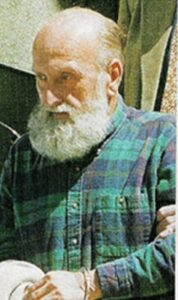
 

Share