Cassadaga Spiritual Camp
CASSADAGA SPIRITUAL CAMP TIMELINE
1848 (January 6): George P. Colby was born.
1875: George Colby relocated to Florida.
1893: The National Spiritualist Association (now the National Spiritualist Association of Churches) was established.
1893 (January): George Colby announced in January 1893 that the National Spiritual and Liberal Association would soon meet at DeLeon Springs in Volusia County, Florida.
1894: The Cassadaga Spiritualist Camp Meeting Association (CSCMA) incorporated.
1895: George Colby deeded thirty-five acres of land to the CSCMA to make a Spiritualist Camp.
1895 (February 8): The Association opened for its first season and one hundred people attended the three-day event held at Colby’s home.
1922: The original Cassadaga hotel was constructed on the Association grounds.
1926: The original Cassadaga Hotel burned down. Reconstruction began the following year and was completed in 1928.
1933: The community trustees sold the Cassadaga Hotel to a non-member purchaser.
1933 (July 27): George Colby died in Deland, Florida.
1991: Cassadaga Spiritual Camp was placed on the National Register of Historic Places.
2019: The 125th anniversary of the founding of Cassadaga took place.
FOUNDER/GROUP HISTORY
Cassadaga, Lily Dale, and Camp Chesterfield are three of the most significant remaining spiritual camps in the U.S. (Compton 2019). While there remain a number  of other active camps in the U.S., such as Camp Etna in rural Maine (Yechivi 2019), most have shuttered or operate seasonally (Leonard 2020). Cassadaga (a Seneca Indian tribal phrase meaning “rocks beneath the water”), which was established in 1894, is the oldest spiritual camp in the South. The name for the camp was taken from Lake Cassadaga where Lily Dale is located. It is often referred to as the “Psychic Capital of the World.” 2019 marked the 125th anniversary [Image at right] of the founding of Cassadaga. Despite the camp’s prominence, there are only a few comprehensive historical sources on Cassadaga (United States Department of the Interior 1991; Schaleman n.d.; Leonard 2020, 2017).
George P. Colby, [Image at right] the principal founder of Cassadaga, was born on January 6, 1848 (the same year that the Fox Sisters made spirit contact in Hydesville, New York, which started the Modern Spiritualist movement and eventual religion) to Baptists James Colby and Elminia (Lewis) Colby in Pike, New York (Colby 2020; Mimna 2017; Leonard 2020). When Colby was eight years-old, the family moved to Minnesota. Colby was baptized when he was twelve. As a young teenager, Colby apparently began to develop his psychic abilities. He soon became known in  the area for healing and clairvoyant powers. He had left the Baptist church by 1867 and had begun traveling and making a living through displays of his abilities during private readings and seances as well as public appearances. He frequently visited Lily Dale in New York, as well as other Spiritualist associations and camps. As an adult, Colby remained unmarried, but he did adopt several boys and supported their education. He enjoyed a measure of prosperity during his life, [Image at right] but also experienced prolonged illness and poverty toward the end of his life.
Colby reported that early in his development as a medium he received a message from his uncle’s spirit that he would one day establish a Spiritualist camp in the South. Seneca instructed Colby to visit T. D. Giddings in Wisconsin, and the pair then traveled together to Florida to establish a spiritualist center, with the location to be determined by a “Congress of Spirits.” Colby also had begun to suffer from ill health and was advised by a doctor to seek out a warmer climate in order to convalesce (Awtry 2014:44; Karcher and Hutchison 1980:67).
Colby and his traveling party arrived at Blue Springs in Volusia County on November 1 (Karcher and Hutchinson 1980:67-68). They report that during the evening Seneca appeared to the party with a vision of the future community.
Most of the party had never before that night experienced the manifestation of a spirit entity but George Colby, in his convincing way, explained the phenomena and gained the confidence of his companions. That night, Colby had a dream about Spiritualism—how it would someday be organized as a religion. In his dream, he saw a small community in Central Florida which consisted entirely of Spiritualists—a place where people would come from all over the country to learn about and experience Spiritualism.
Well prior to locating the actual Cassadaga camp site, in 1875 Colby had already begun homesteading land in Volusia County, which he pursued for twenty years. In 1880, Colby filed a homestead claim and was granted a 145-acre tract in 1884. After a charter was granted to the Cassadaga Spiritualist Camp Meeting Association in 1894, he deeded the thirty-five acres of land to the association in 1895. The association later was able to acquire additional acreage increasing its area to fifty-seven acres (Leonard 2020).
On February 8, 1895, the Association inaugural took place with 100 people in attendance for a three-day event that was held in Colby’s home. Once the Association was established, Colby became one of the resident mediums. As time went on, however, his health continued to decline, as did his financial fortunes. He died impoverished on July 27, 1933.
DOCTRINES/BELIEFS
Cassadaga subscribes to central tenets of Spiritualism (Cassadaga website n.d. “Who We Are”):
We believe in Infinite Intelligence.
We believe that the phenomena of nature, both physical and spiritual, are the expression of Infinite Intelligence.
We affirm that a correct understanding of such expression and living in accordance therewith constitute true religion.
We affirm that the existence and personal identity of the individual continue after the change called death.
We affirm that communication with the so-called dead is a fact, scientifically proven by the phenomena of Spiritualism
We believe that the highest morality is contained in the Golden Rule: “Whatsoever ye would that others should do unto you, do ye also unto them.”
We affirm the moral responsibility of the individual, and that he makes his own happiness or unhappiness as he obeys or disobeys Nature’s physical and spiritual laws.
We affirm that the doorway to reformation is never closed against any human soul, here or hereafter.
We affirm that the Precepts of Prophecy and Healing contained in the Bible are Divine attributes proven through Mediumship.
Spiritualism bases its claim to be scientific on the assertion that life is continuous; that is, everyone is a unique, eternal entity. Validation is found through mediums who receive and share information from the unseen spiritual realm. At the same time, Spiritualism is also a religion. It teaches that there is a God, who is the infinite intelligence and force that created the Natural Laws which govern the universe.
Cassadaga is careful not to assert exclusive validity for its beliefs and practices, noting that “Spiritual Healing does not deny that physicians and surgeons are necessary. We believe Spiritual Healing complements traditional as well as alternative medical practitioners and we cooperate with them at all times.” Further, Cassadaga acknowledges that self-healing may be an important part of the process. The medium channels “God’s healing energies” to the individual, even when the individual is not physically present in some cases (Cassadaga website n.d. “Who We Are”).
RITUALS/ACTIVITIES
The central rituals at Cassadaga are conducted by mediums and healers. A medium is understood to be “one who is capable of receiving communication from people who were once living on the earth and have passed into the spirit world. This communication from entities may be spontaneous or opened and comes in the form of seeing, hearing, smelling and sensing.” A healer is one who acts as a channel to convey God’s healing energies to others, whether for physical, emotional, mental or spiritual healing. This occurs through the laying on of hands.” (Cassadaga website n.d. “Mediums and Healers). Cassadaga underscores the authenticity of mediums and healers through its assertion that each must have a minimum of four years’ certification process (Cassadaga website “List of Mediums” n.d.). In addition to the spiritual power generated by individual mediums and healers, Cassadaga itself is understood to be a spiritual vortex created by the cumulation of psychic and spiritual activities within the community.

Several dozen mediums and healers are listed on the Cassadaga Camp website. [Image at right] Each provides a profile of their personal history, certification, services provided. In general, these profiles trace their medium and healing skills to a lifelong history of spiritual and psychic proclivities, transformative experiences, and professional training (See, Fernandez 2015). All mediums offering services within the camp are required to have certification, with the exception of the privately owned Cassadaga Hotel which provides its own mediums and healers.
The authenticity and power of healings and seances is buttressed by testimonials from clients. Williamson (2008), for example, reports
Once, he was in the temple’s seance room with seven people when money started falling from the air. Another time, a spirit holding a lighted candle followed him and five other people from the room.
“We have had the room get very cold and then real hot. We have also heard voices in the walls and people moving around,” he said. “It would take a long time to tell all the wonderful things that happen in that special room.”
“I have seen hands form of ectoplasm on the table next to mine and have had them touch me,” said Cassadaga medium Victor Vogenitz, 54, a veteran of hundreds of seances.
There are community services as well. On Sunday mornings there are services: an instructional services Spiritualism, a healing service, and a church service (hymns, a guided meditation healing, a lecture)
ORGANIZATION/LEADERSHIP
Cassadaga Spiritual Camp’s current legal status is an “unincorporated town;” it is located near DeLand, Florida (Basu 2020). The current camp was preceded by an attempt to establish a community organized by the National Spiritual and Liberal Association in nearby DeLeon Springs in January 1893. Dr. William Rowley is credited with founding the De Leon Springs site and naming it the National Spiritual and Liberal Association (NSALA). George P. Colby became its first President. Once the Camp had outgrown its property, Abbie Pettengill, Marion and Thomas Skidmore, and Emma Huff, all of the “City of Light” in New York (now the Lily Dale Assembly), were in full agreement with most of the membership to find it a new home. The Cassadaga community so much resembled the northern camp that the group of thirteen are credited with having incorporated the Southern Cassadaga Spiritualist Camp Meeting Association (SCSCMA) as a sister Camp to their northern camp (Leonard 2020).
In her book, Cassadaga: Where Spirits Meet (2014:55), Marilyn Awtry identified George Colby as the founder of the actual geographic location of the camp, Cassadaga, and identified the following thirteen individuals as being the founders of the “Southern Cassadaga Spiritualist Camp Meeting Association:”
Thomas Skidmore (Lily Dale, New York); Marion Skidmore (Lily Dale, New York); Abby L. Pettengill (Cleveland, Ohio and Lily Dale, New York); Emma J. Huff (Lake Helen, Florida and Lily Dale, New York); Frank Bond (Deland, Florida); Harvey W. Richardson (East Aurora, New York); Adailla C. Jewett (Cleveland, Ohio); Jerry Robinson (Lookout Mountain, Tennessee); Mariette Cuscaden (Tampa, Florida); Soledad B. Sofford (Tarpon Springs, Florida); George W.Liston (Forest City, Florida); George Webster (Lake Helen, Florida); and Maria H. Webster (Lake Helen, Florida).
Although the first gathering at De Leon attracted 1,000 participants, the project ultimately failed when founder George Rowley could not raise sufficient funds to purchase the proposed camp property. At that point George Colby offered his property as an alternative. After the camp was established, Colby went on to become a resident medium. The board of directors almost immediately amended its charter to require that the association would own all real estate within the camp boundaries. Residents were offered ninety-nine year leases on lots, but ownership would remain with the Association.
The original vision of Cassadaga was as a center and national winter resort for Spiritualists. There were seances and speeches along with outdoor activities. The camp attracted around 100 people seasonally but had only a few dozen permanent residents. Still, the community ranked as the second largest nationally after the Lily Dale Community in New York. The community expanded rapidly between the late 1890s and the late 1920s. Nearly three dozen houses were constructed by 1915. The community added major non-residential buildings, such as a post office in 1910, Colby Memorial Temple in 1923, and the reconstructed Cassadaga Hotel in 1927.  Throughout the camp’s history, of course the Spiritualist church [Image at right] has, symbolically at least, been the center of the community as the Cassadaga Spiritualist Camp is a religiously-based association (Leonard 2020).
ISSUES/CHALLENGES
Cassadaga Spiritual Camp has encountered three major issues during its history that have affected its survival and development: maintaining financial viability, controlling the emergence of unconnected businesses around the borders of the camp, and dealing with scandal and the skepticism about Spiritualism generally in the broader community.
Dating back to the early formation of Cassadaga, there have been financial problems. Indeed, the camp was initially established primarily as a result of George Colby’s initiatives and willingness to deed thirty-five acres of his land to create the new camp. While the  camp did draw a number of resident mediums who attracted Spiritualist visitors, interest in Spiritualism gradually waned. A further blow to the community was the destruction of the Cassadaga Hotel by fire in late 1926. [Image at right] Although the hotel had been rebuilt by 1928, the fallout from the stock market crash in 1929 and the 1930s depression left the community with a serious financial burden. It was at this point that the community decided that it could no longer support the Cassadaga Hotel, which had been important in generating visitation. Despite vigorous debate, “the members of the Association who considered the hotel a burden prevailed. In 1933, due to its inability to pay either its taxes or the debt owed to the bondholders, the Association sold the Cassadaga Hotel” [to a private party] (Schaleman n.d.). Although the community survived the depression years, “By the beginning of World War II development in Cassadaga had come to an end” (Schaleman n.d.).
A related problem for the community has been loss of control over its boundaries. Unlike most Spiritualist camps, which tend to be in gated, fenced communities with clearly marked borders, Cassadaga Spiritualist Camp properties are intermingled with non-  association buildings, homes, and businesses. [Image at right] The buildings and enterprises that are associated directly and officially with the camp are clearly marked, but the intermingling compromises a clear community identity for non-residents (Leonard 2020).
The sale and loss of control over the Cassadaga Hotel was particularly significant in this regard. The hotel hired its own mediums and also permitted some New Age practitioners to operate in the hotel (Basu 2020). As Blaogh (2013) described this two-culture issue:
The New Agers use tarot cards and stick to the Cassadaga Hotel. A stone’s throw away is the religious organization maintains the traditional belief system that Colby established in the 1800s. That’s not to say the Cassadaga Hotel and its hired psychics don’t stay true to Spiritualism as religion, but they’re a bit more relaxed about it. Its like Episcopalians and Catholics.
In response to this tension, Cassadaga-certified mediums emphasize that they are “SCSCMA Certified” (Leonard 2020).
The community identity problem has been compounded by the growth of population and businesses just outside the border of Cassadaga’s fifty-seven acre camp. As the camp acknowledged on its website (Cassadaga website n.d. “Who We Are”):
Over the years, metaphysical stores and businesses have sprung up in Cassadaga around the perimeter of the 57-acre Camp. Although many of these businesses are owned by like-minded people, they are separate businesses and unaffiliated with the Camp.
Finally, there was the problem of scandal. Along with the growth and popularity of Spiritualism, a cottage industry of skeptics emerged whose mission was advanced by scandals within the ranks of Spiritualism’s mediums. In probably the most noteworthy case, a confrontation in Boston, Massachusetts in 1896 followed the mediums to Cassadaga. According to Guthrie (1998) the incident
involved two popular practitioners at the Camp–the materializing medium O. L. Concannon and his wife, Edella, a platform test medium. While the details surrounding the episode remain sketchy, according to one eyewitness, when Mr. Concannon performed a seance in Boston a member of the audience called him a phony.
Although the accuser produced no evidence of fraud, the episode tested the relationship with residents around the camp. However, external resident-camp relationships had generally been cordial, and the local press sought to distinguish between imposters and authentic Spiritualists. In one editorial published in the Volusia County Record, for example, a county resident wrote (Guthrie 1998):
We have as much respect for a person who is sincere in his spiritualistic ideas as have for those happy in the enjoyment of any other religious belief. Because fraud and impostors have crept into the teachings of Spiritualism it affords no argument to denounce all those who are enjoying the comforts and promises they sincerely find in its doctrine.
Another wrote that “There are too many sincere and earnest believers in the faith,” it said, “to have [Cassadaga’s] plans upset by the exposure of frauds such as Concannon” (Guthrie 1998). For its part the Cassadaga community responded by immediately strengthening its certification standards.
Cassadaga, Lily Dale, and Camp Chesterfield continue to be the three most significant remaining spiritual camps in the U.S. (Compton 2019). There has been a long-term decline in broad public interest in Spiritualism, although there are a number of churches in the Spiritualism tradition. Most camps shuttered or operated seasonally after the “Golden Age of Spiritualism” (circa 1880s-1920s) (Leonard 2020). Those that have survived have tended to experience a resurgence of interest after major wars (e,g., the U.S. Civil War, World War I, World War II, and even the Vietnam War) when there was heightened interest in contact with the dead. It seems likely that the original concept of a retreat for Spiritualists will no longer prove viable; instead, the longer-term future of even the most resilient camps will rest on some combination of practitioner loyalty and tourism interest.
IMAGES
Image #1: Logo celebrating the 125th anniversary of the founding of Cassadaga.
Image #2: George P. Colby.
Image #3: Photograph of a medium at Cassadaga.
Image #4: The interior of the Spiritualist Church in Cassadaga.
Image #5: The original Cassadaga Hotel.
Image #6: The entrance to the Cassadaga community.
REFERENCES
Awtry, M. J. (2014) Cassadaga: Where Spirits Meet. Sanford, FL: Shen-Men Publishing.
Balogh, Christopher 2013. “Inside Cassadaga, the Psychic Capital of the World.” Vice, January 29. Accessed from https://www.vice.com/en/article/nn4g87/inside-cassadaga on 20 November 2020.
Basu, Moni. 2020. “In Search of Spirits in Cassadaga: A writer unlocks the truths of this mystical community, its energy healers and the supernatural.” Flamingo Magazine. Accessed from https://www.flamingomag.com/2020/10/30/in-search-of-spirits-in-cassadaga/ on 20 November 2020.
Cassadaga website. n.d. “List of Mediums.” Accessed from https://www.cassadaga.org/mediums.html on 5 December 2020.
Cassadaga website. n.d. “Mediums and Healers.” Accessed from https://www.cassadaga.org/mediums–healers.htmls on 5 December 2020.
Cassadaga website. n.d. “Who We Are.” Accessed from https://www.cassadaga.org/who-we-are.html on 5 December 2020.
“Colby, George P. (1848-1933) .” Encyclopedia of Occultism and Parapsychology. . Encyclopedia.com. (October 16, 2020). https://www.encyclopedia.com/science/encyclopedias-almanacs-transcripts-and-maps/colby-george-p-1848-1933
Compton, Natalie. 2019. “Interested in traveling to a spiritualist community? Here’s what you need to know.” Washington Post, October 29, 2019. Accessed from https://www.washingtonpost.com/travel/2019/10/29/interested-traveling-spiritualist-community-heres-what-you-need-know/ on 20 November 2020.
Fernandez, Alexia 2015. “Woman Certified As Medium At Cassadaga Spiritualist Camp.” Statewide, April 3. Accessed from https://www.wuft.org/news/2015/04/03/medium/ on 5 December 2020.
Guthrie, John. 1998. “Sweet Spirit of Harmony: Establishing a Spiritualist Community at Cassadaga, Florida, 1893-1933.” Florida Historical Quarterly 77:1-38.
Karcher, K. and Hutchison, J. (1980) This Way to Cassadaga. Sanford, FL: John Hutchison Productions (Seminole Printing).
Leonard, Todd J. 2020 “A Contemporary Study of Cassadaga Spiritualist Camp: Its Historical and Spiritual Legacy.” Association for the Scientific Study of Religion 2020 Proceedings: 60-78.
Leonard, Todd J. 2017. “Camp Meetings and Spiritualism: A Report on the Status and Condition of Functioning Spiritualist Camps around America.” Association for the Scientific Study of Religion 2017 Proceedings:11-30
Mimna, Robin. 2017. “The True Spirit of Cassadaga.” Florida History, February 27. Accessed from https://medium.com/florida-history/the-mystery-and-spirit-of-cassadaga-8a0058b024b1 on 20 November 2020.
Schaleman, Harry. n.d. Casadaga: Just a Medium Place. Florida Virtual Library. Accessed from https://journals.flvc.org/flgeog/article/view/78709/76105 on 20 November 2020.
United States Department of the Interior, National Park Service. 1991. National Register of Historic Places Registration Form: Southern Cassadaga Spiritualist Camp Historic District. Accessed from https://npgallery.nps.gov/GetAsset/2fc1fca3-b02b-475e-90c1-e321209a1423 on 20 November 2020.
Williamson, Ronald. 2008. “Since 1923 in Cassadaga, the Seance Room has been where they call upon and talk to the dead.” Florida History Network. Accessed from http://www.floridahistorynetwork.com/in-cassadaga-the-seance-room-is-where-they-talk-to-the-dead.html on 5 December 2020
Williamson, Ronald. 2008. Volusia County’s West Side: Steamboats & Sandhills. Charleston, SC: The History Press.
Publication Date:
20 January 2021


 Chakravarti, and at eighteen, she went to live with her husband, whom she later called Bholanāth, one of Śiva’s names. Although she went through with marriage and is described as being the exemplary housewife, the couple actually never consummated their marriage and had no children. She therefore distanced herself from the traditional forms of marriage, [Image at right] going against the ideal of pativrata, the perfect Hindu woman vowed to her husband.


 participation in retreats such as the Samyam Saptah (concentrated meditation for seven days). It was so while Ānandamayī Mā was alive, and it is still the case today.


 “Enneagram of Personality” (see, for example, Beesing, et. al. 1984 and Palmer 1988). In 1982, his book Between Metaphysics and Protoanalysis: A Theory for Analyzing the Human Psyche and Interviews with Oscar Ichazo was published. [Image at right] Ichazo, who had published very little of his own work (1976, 1982a and 1982b), preferring to keep his teachings to members of his own esoteric school, did not take kindly to what he regarded as the plagiarizing and distorting of his ideas. This gave rise to the so-called “Enneagram Wars” (Goldberg 1993; See also Effross, 2003). Arica filed a lawsuit against Helen Palmer and Harper & Row after the publication of Palmer’s The Enneagram: Understanding Yourself and the Others in Your Life (1988). However, the court ruled against Arica in 1991, upheld in an appeal in 1992, maintaining that Palmer’s use of copyrighted Arica materials constituted “fair use.” The Arica School had a much smaller public presence for the next three decades with the formation of Oscar Ichazo Company in Hawaii and a shift in the teaching and practice toward individual home trainings. The nature of this work is largely unavailable to non-members of Arica. and members must sign non-disclosure agreements. The Arica website indicates that the new work is focused on the transcendental dimension leading to ultimate enlightenment or “theosis.” Indeed, after a period in the 1980s and 1990s, when the Arica work seemed to focus largely on what Ichazo described earlier as “symbol yoga” (similar to Vajrayana Buddhism with an emphasis on imagining oneself as a kind of Buddha or deity), recent years have brought the use of more Greek terminology. For example, in place of a Buddha, we are introduced to the “Divine Metatelos” as a name for a particular higher level of mind, and students are encouraged to participate in the One and the Good, suggesting a more western, Platonic character to the Arica School.
 things manifest themselves according to this pattern (See Ouspensky 1949:286-94). And so, Arica theory presents itself as a kind of nine-pointed cylinder [Image at right] that could be sliced up into individual enneagrams that build upon one other in hierarchical sequence (Ichazo 1982c). For example, while pure consciousness is the primary reality and precedes its material manifestation, in the human being it manifests as nine constituents: materiality or elements, systems, mentations, senses consciousness, mental perceptions, domains, feelings or discriminative mind, willing intention, and access base. The nine constituents are akin to the Buddhist notion of the Five Aggregates that constitute the illusory “self.” Fundamental to an understanding of the ego is awareness of the nine physiological systems: sexual, skeletal, digestive, protective, circulatory, expression, coordination, central nervous system, unity system. These systems in turn give rise to energy centers, like chakras, that manifest in the psyche as the instincts, functions and drives that constitute what Ichazo calls the “hypergnostic systems”: the sexual pole, the function of space, the conservation instinct, the function of time, the relations instinct, function of expression, the function of coordination, the adaptation instinct, the spiritual pole.


 Lords, Conquering Lion of Juda, Emperor Haile Selassie I; and they show deep love for Ethiopia as well as a strong claim to Redemption through Repatriation to Africa. Symbolically, they consider Africa as Zion (a Holy land where God resides), [Image at right] which stands in opposition to Western spaces, values and institutions called Babylon (a place of exile and depravation). More than any other community, Rastafari have a specific claim to Shashemene: land was granted by Haile Selassie I, their God and King, the central figure of their cosmology and worldview. As a result, they feel therefore particularly concerned and entitled to it.


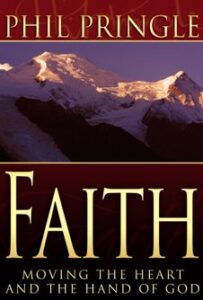
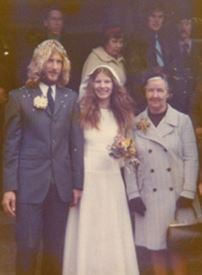 visited the church, which was located in Sydenham, a suburb outside of Christchurch, and led by a pastor named Dennis Barton. At the end of the service, the pastor invited all of the congregants to receive Jesus Christ. Both Phil and Chris walked to the front and were born again. Three weeks later, at the request of the church, the couple got married (Barclay 1987). [Image at right]
 ity Church.” In 1984, Phil founded the Oxford Falls Grammar School as well as Christian City Church (now C3) College. In 2008, at the “Here We Go” global conference held in Hawaii, the church officially changed its name to “C3 Church.”
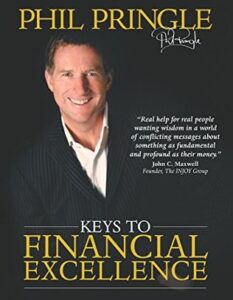
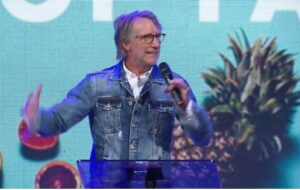 diverse as Christian faith, leadership, personal finances, and church planting. He regularly travels around the world to speak at conferences, [Image at right] preaching a combination of neo-Pentecostal and prosperity theology, which is highly tailored to appeal to contemporary late modern (and secular) sensibilities.
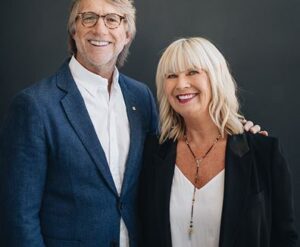
 of heterosexual couples, and same-sex sexual relations as sinful. However, C3 Church also clearly belongs to the “Pentecostal” family, stressing as Phil and Chris do, [Image at right] baptism in the Holy Spirit, glossolalia (speaking in tongues), the existence of spiritual warfare, and the promise of divine healing.
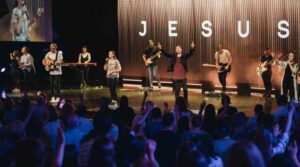
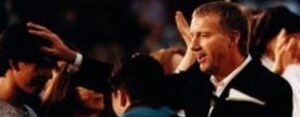
 amphitheatres; and rather than traditional vestments, a dressed-down hipster dress code is tacitly normalized. Indeed, C3 churches tend to resemble other common sites of leisure in modern societies, such as the mall, the sports arena, or the movie theatre (Maddox 2012:153). [Image at right]
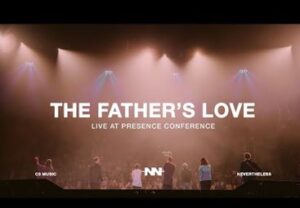 Asia (with seventy-five), Southern Africa (with twenty-six), West Africa (with nine), and Pacific (with fifty-five) (C3 Global 2020c). Within specific regions, Church Oversees are tasked with providing structure and support to local pastors. And each C3 Church is headed by Senior Pastors, who are sometimes supported by Junior Pastors.
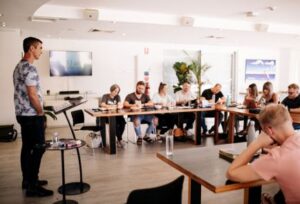 courses in biblical studies and theology, music, film, and media, both in person and online. [Image at right]
 ex-C3 members have setup a Christian watchdog website, “C3 Church Watch,” meant to bring attention to what they see as the church’s unbiblical teachings and dissuade others from joining the C3 movement. [Image at right]
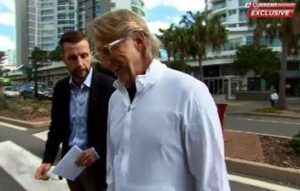 church. Showcasing negative testimonies from ex C3-members, along with footage of C3 events and an impromptu interview with Phil Pringle, [Image at right] the program took a critical stance on the church’s theology, funding practices, approach to mental illness, and views of same-sex relations (Passi 2019).


 as the establishment in 1954 of a marble image (a murti consecrated in Hindu fashion) above the saint’s tomb in the Samadhi Mandir. [Image at right] Similar consecrated images are found in some Hindu temples, and smaller murtis and devotional posters or framed prints may be found in people’s homes and businesses alongside virtually any other sacred figure. The generally Hindu character of Sai Baba worship reflects the predominantly Hindu demographic of his devotees, including hagiographers, past and present. Exact numbers are impossible to ascertain, but one study of Shirdi as a site of religious tourism shows that visitors are mostly Hindus (ninety-two percent), with Muslims, Christians, Parsis, and Sikhs all together in a distinct minority (Ghosal and Maity 2011:271).
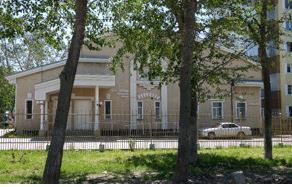 safely evangelize to their neighbors, publish and circulate literature used by Witnesses worldwide, rent and buy property for Kingdom Halls, [Image at right] and hold larger gatherings of Witnesses across the country. As of 2017, the organization counted roughly 175,000 active members. Nearly double that number attended meetings or Bible studies (Baran 2020:2).
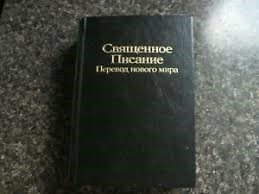 Old and New Testaments as the “Hebrew-Aramaic Scriptures” and the “Christian Greek Scriptures.” This Bible is translated into other languages from the English-language version, including a Russian translation in 2007 (2008 Yearbook 2008:237). [Image at right] The English version is regularly updated and the most recent edition appeared in 2013 (Watch Tower Bible and Tract Society 2013).
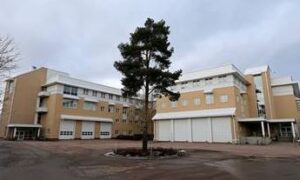
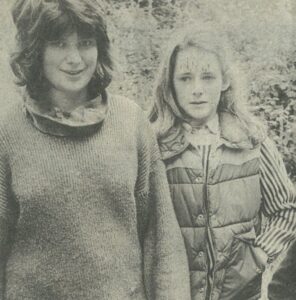 (‘Kathy’) O’Mahony and her two daughters, Helen and Claire. [Image at right] Two years before that, in 1983, Helen and Claire had made a similar claim.
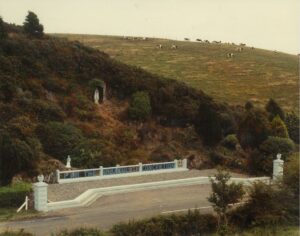
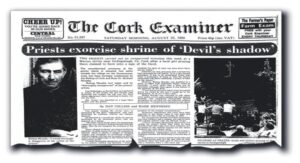
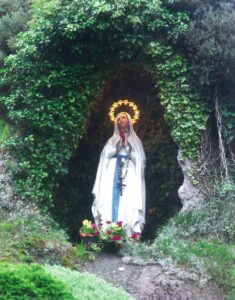
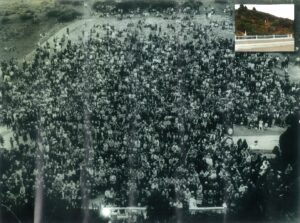 1985:15). The following day The Cork Examiner carried a front-page story reporting that “hundreds” were now praying at the Ballinspittle grotto. [Image at right]
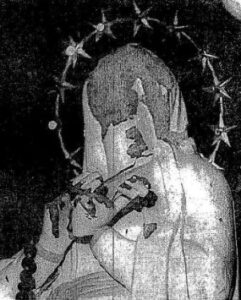 accused the gathering of idolatry. Repairs to the statue were made rapidly, and it was repositioned at the grotto. [Image at right]
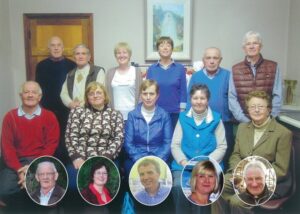 people interpreted the actual apparitions as being a message in and of themselves. As the grotto committee [Image at right] put it in their 2015 booklet: ‘Many believe that it was a call and invitation to prayer and most especially to pray the Rosary for peace and harmony in the world’ (2015: 52). Hence, in a chapter headed “The Message of Ballinspittle Grotto” the committee explained its own raison d’être as being to “spread devotion to Our blessed lady” (2015: 53). But closer to the time of the 1985 apparitions other meanings were being offered up. For example, as Ryan and Kirakowski noted, on August 23 the Cork Examiner published a letter from a woman who claimed to have seen the Ballinspittle statue moving and who interpreted it as being Our Lady calling ”her children from sin to save their immortal souls” and as a warning against “The rejection of the Blessed Virgin by the atheist mods…”. Then, on August 26, Time Magazine quoted the Ballinspittle post mistress, Marie Collins, as having explained the apparitions as being “a sign to prepare us for the end of the world” (Ryan and Kirakowski 1985:23, 30). It should be noted, however, that warnings of an impending global catastrophe had been issued by a couple of youthful visionaries at the Mount Melleray grotto over a week before, on August 16, 1985 (Allen 2014:123-24).