Dhammakāya


DHAMMAKĀYA MOVEMENT TIMELINE

1610:  Wat Paknam Phasi Charoen (Wat Paknam) was founded by royal edict in what is now a district of metro Bangkok.

1600s-1800s:  Much popular Buddhism in northern and northeastern Thailand (and adjacent areas) was versions from which the modern Dhammakāya movement developed, including the distinctive meditation method.

1916:  Phra Mongkol Thepmuni (1884-1959) “rediscovered” the vijjā dhammakāya meditation system, the foundation of the modern Dhammakāya movement.

1916:  Phra Mongkol Thepmuni was appointed abbot of Wat Paknam and set about building it into a major Buddhist center in Thailand.

1959:  Phra Mongkol Thepmuni died.

1970:   Khun Yay Ubasika Chandra Khonnokyoong (1909-2000), a prominent Mae chi of Wat Paknam, founded a Wat Paknam meditation center in Pathum Thani. 

1979:  The meditation center officially became a temple, Wat Phra Dhammakāya.  Phra Dhammachayo became its first abbot. His assistant abbot was Phra Dattacheevo.

1991:  Wat Luang Pho Sot Thammakayaram was founded.

1999:  Phra Dhammachayo of Wat Phra Dhammakāya stepped down as abbot over corruption charges. Phra Dattacheevo became acting abbot.

2006:   Phra Dhammachayo was reinstated, but stepped down in 2011, probably for health reasons. Phra Dattacheevo again became acting abbot.

2016-2017:  Thailand’s military government tried several times to arrest Phra Dhammachayo on new corruption charges, but he disappeared. Phra Dattacheevo was also charged and forced out as abbot.

2017:  Dhammakāya movement’s influence in the Thai saṅgha was severely curtailed when their candidate for Saṅgharaja (already acting head) was rejected, and many Dhammakāya monks were purged.

FOUNDER/GROUP HISTORY

The term “Dhammakāya movement” is somewhat ambiguous. While in one sense, it refers to a particular version of Buddhism, most commonly characterized by its distinctive meditation method, there are three major currents. Wat Phra Dhammakāya is probably the most widely recognized, even among most Thai. However, the movement’s founder, Phra Monkol Thepmuni, was Abbot of Wat Paknam Bhasi Charoen, which came first, and remains a separate current. Mae Chi Chandra Khonnokyoong, a meditation master who trained for many years at Wat Paknam, began the second current when she founded a meditation center in 1970 that would later become Wat Phra Dhammakāya. One of her star students, Phra Dhammachayo, became the first abbot and built it into the most prominent current temple. The third main current is Wat Luang Pho Sot Thammakayaram, which is from the same tradition. Thus, there are several “founders” of various temples, but all the temples recognize Phra Monkol Thepmuni as the master who started the modern movement.

Phra Mongkol Thepmuni (his monastic name at the time of his death) [Image at right] was born in Suphanburi province in central Thailand in 1885. His family engaged in rice farming, and some biographical accounts stress his humble origins. Actually, the family was moderately prosperous by the standards of rural Thailand since they owned rice barges to engage in trading, and employed some workers. His father died when he was fourteen, and he ran the family business until twenty-two, when he was ordained (Dhammakaya Foundation 2010a; Cholvijarn 2019; Magness n.d.; Newell 2008).

As a monk, Phra Monkol Thepmuni was very determined to deeply understand Buddhism, and frustrated by the inability of most rural monks to teach much depth. He therefore embarked on extensive efforts toward mastering both meditation and Pāli scholarship. The meditation required residence in a number of temples scattered around Thailand to learn from recognized masters. Pāli scholarship necessarily included some time in the scholastic center in Bangkok. His background thus includes fairly extensive knowledge of the range of Buddhist thinking and practice in Thailand at the time. As the culmination of these efforts, Phra Mongkol Thepmuni “rediscovered” vijjā dhammakāya meditation in 1916 during an intensive session, and he started teaching the method.

He was also appointed Abbot of Wat Paknam [Image at right] in 1916, although this was only indirectly related to his particular meditation achievement. Wat Paknam was a Royal temple which had existed for several centuries, but it had declined in size to only a few resident monks. Phra Monkol Thepmuni was already gaining some reputation for being outspoken and somewhat unorthodox for his non-official elements of esoteric Theravāda, but also for being very energetic and capable. Either characteristic is sometimes cited as the reason for assigning him to Wat Paknam. That is, either because the temple was obscure and he would be out of the way or because the temple needed to be revived and he would do the task well. Whatever the reason, he was quite successful at building it, and it became the base for spreading the vijjā dhammakāya meditation method, which he believed was an excellent way to make meditation more accessible to the larger population.

Phra Monkol Thepmuni also taught the dhamma, which was somewhat unusual. Most monks focused on either developing meditation skills or preaching the dhamma, but rarely both. Wat Paknam became a center for both meditation and dhamma learning. By the time of his death in 1959, it had become one of the leading temples in Thailand, with hundreds of monks in residence, a number of branch temples and meditation centers, a Pāli study institute, and one of the largest communities of mae chi (essentially nuns), who played a major role in helping propagate Wat Paknam’s teachings and meditation (Seeger 2006).

Khun Yay Maharatana Upasika Chandra Khonnokyoong (1909–2000), [Image at right] founder of the second current, was born into a rural family in Nakhon Pathom province in a district roughly fifty kilometers east of Bangkok. Perhaps similarly to Phra Monkol Thepmuni’s case, her family was more or less middle class by the standards of rural Thailand. Not surprisingly, however, she was illiterate as it was rare for rural women receive much education at the time. She started learning meditation in the late 1920s, moved to Bangkok near Wat Paknam in the mid-1930s, and began practicing at the Wat while working as a maid in a relative’s home. In 1937, she formally became a mae chi at the Wat. Eventually her meditation skills were sufficiently advanced that she was assigned to teach, and she built up a loyal following, notably including many university students (Cholvijarn 2019; Dhammakaya Foundation 2010b; Newell 2008).

Wat Phra Dhammakāya stresses Mae chi Chandra’s humble background, noting with pride that it proves her great achievements came from mastery of vijjā dhammakāya, rather than scholastic accomplishment. Her central role in founding and helping build Wat Phra Dhammakāya into a huge worldwide movement makes Mae chi Chandra “perhaps the most influential nun in Thai Buddhist history” (Scott 2010:503).

Mae chi Chandra founded a meditation center in Pathum Thani (just north of Bangkok) for Wat Paknam in 1970, which later became Wat Phra Dhammakāya. [Image at right] Two of her leading students, who had been among her following at Wat Paknam, were instrumental in building the temple. Chaiyabun Suddhipol, born in 1944 in Singburi, central Thailand, studied marketing at Kasetsart University, and ordained upon graduating in 1969. He helped found the meditation center, and as Phra Dhammachayo became its first abbot. Phadet Phongsawat was also a student at Kasetsart studying agriculture, ordained in 1971, and as Phra Dattacheevo became assistant abbot. These two ran Wat Phra Dhammakāya more or less continuously from its founding. Phra Dhammachayo has largely been the charismatic strategic leader, and Phra Dattacheevo proved to be a very efficient administrator (Dhammakaya Foundation 2010b; Mackenzie 2007; Newell 2008; Scott 2009).

Satha-Anand notes that Wat Phra Dhammakāya followers “seem to represent a segment of the emerging middle class that is keen on achieving both worldly pleasure and peace of mind in religious form“ (1990:407). Phra Dhammachayo was quite skillful at further adapting the temple toward these prominent middle-class views. “His modern view of Buddhist life extended to religious practice, in that he has always focused on the practical benefits of meditation within contemporary life – helping to improve grades, facilitating harmony within families, overcoming addiction, and securing desirable employment” (Scott 2009:77).

More mundane details also appealed to the growing middle class. Phra Monkol Thepmuni had started some of this innovation, for example, by cleaning up Wat Paknam and refurbishing some of the buildings. He also had a temple kitchen built so monks could spend more time building meditation skills rather than on alms rounds. Wat Phra Dhammakaya furthered this trend. “The traditional Thai temples do not meet the expectations of Wat Phra Dhammakaya members in areas such as cleanliness of the temple and its grounds and education of the monks. Wat Phra Dhammakaya offers a modern, efficiently administered system, with dynamic leaders” (Mackenzie 2007:191). Phra Dattacheevo was instrumental in making sure temple administration could deliver this middle-class ethos (Dhammakaya Foundation 2010a; Mackenzie 2007; Newell 2008; Scott 2009).

In 1991, Phra Thepyan Mongkhon (1929‒2018) [Image at right] became the first abbot of the new Wat Luang Pho Sot Thammakayaram, the third current. He was born into a Thai-Chinese trading family in Buriran, northeast Thailand, and was well educated (BBA and MPA) with a successful career before ordaining at Wat Paknam at age fifty-seven. The temple was established from a successful meditation center he had helped start for Wat Paknam in central Thailand nearly a decade earlier. There are conflicting accounts about whether he and some of the Wat Paknam monks had fallen out with Wat Phra Dhammakāya over exactly what the correct teaching of vijjā dhammakāya should be. Later, Phra Thepyan Mongkhon clearly did criticize Wat Phra Dhammakāya for deviating from proper meditation teaching, as well as for excessive commercialization, and somewhat distanced his temple from it (Cholvijarn 2019; Mackenzie 2007; Newell 2008).

Most informed observers view Thailand’s modern Dhammakāya movement as a revival of traditional popular currents of Theravāda that have been present for centuries, especially in northern and northeastern Thailand and adjacent areas. (Some forms are often called yogāvacara, e.g., Crosby 2000.) The “orthodox” modern version of Thai Theravāda was largely constructed through reforms carried out in the nineteenth and early twentieth centuries. These reforms aimed to eliminate “superstition” and to “rationalize” Buddhism as part of the broader effort to modernize and strengthen the Thai State under pressure from Western colonialism (Keyes 1971; Tambiah 1976).

The Thammayut order was the main instrument for the State project to return to the Buddha’s original teachings and purify Buddhism of superstition, mythology, and other “non-Buddhist” elements. One of two official orders in Thai Theravāda today, it was founded by King Mongkut [Image at right] during his time as a monk (1824-1851) before ascending the throne. Crosby (2014) notes that the French pursued similar policies in Cambodia to strengthen the colonial state. Largely, however, other versions of Theravāda were absorbed, or simply downplayed, rather than thoroughly suppressed (Cohen 2001; Puntarigvivat 2013). Thus, much popular practice in these versions never really completely disappeared.

Long-term enforcement of State policy has resulted in a somewhat stagnant official Buddhism in modern times. “Monks not sympathetic to state policies are structurally excluded from senior administrative positions within the Sangha, just as monks supportive of the regime in power receive material and career advancement in the Sangha hierarchy” (Puntarigvivat 2013, p. 11). Nowadays, many middle class Thai feel that leadership in the modern saṅgha (community of ordained monks) has lost touch with the modern world (e.g., Taylor 1999; Mackenzie 2007; Puntarigvivat 2013). “The clergy’s dependency on state support has made it weak and out of touch with public sentiments and needs. That’s how it has become socially irrelevant” (Ekachai 2018). Phra Payutto, a leading scholar-monk of the “reform-from-within” current, summarized the problem well:

when the modernists began to be disillusioned and dissatisfied with modernization [they] turned to find meaning and answers from [Buddhist] tradition. However, as the traditionalists have long been far removed from the real world of changing values, they cannot supply the answers or satisfy the need of the modernists (Payutto 2007:56).

Modern urban middle class Buddhist reform is the public re-emergence of diversity in recent decades (summarized, e.g., in Speece 2013, 2019). “This religious diversity [is] taking place in parallel with the growth of lay Buddhism. The lay Buddhists [are] playing greater roles in religion and we eventually see the emergence of new Buddhism with lay people as core leaders instead of monks” (Visalo 2012). The Dhammakāya movement is one manifestation of the trend. It builds on Buddhist traditions long established in Thailand, but the strong orientation toward the lay middle class has fostered considerable adaptation to modern lifestyles.

Rawlinson (2000) proposed a categorization of Buddhist religious experience that is helpful in understanding versions of Thai modern reform Buddhism and that we employ here. He uses two key dimensions. “Hot-cool” distinguishes self-realization vs. other-directed / granted salvation. Structured-unstructured distinguishes order and a well-defined path toward salvation vs. lack of distinction between path and goal. So, for example, salvation in official Theravāda is essentially a matter of self-realization (cool), following a well-defined (structured) path laid out by the Buddha and various masters over the centuries. Vajrayāna gives a prominent role to the masters and to various gods, buddhas, and bodhisattvas (hot) who must provide guidance on how to follow the (structured) path. In Zen, there is no obvious path (unstructured); salvation is attained through (often sudden) self-realization (cool). Pure Land is a faith-based version, with no path (unstructured), where salvation is granted to the devoted by the grace of a Buddha or bodhisattva (hot).

Official institutional Theravāda in Thailand is “cool-structured” in this taxonomy (Speece 2013). Of course, cool-structured variations had been present for centuries, especially among the more scholarly-oriented members of the saṅgha, but the issue took on some urgency during the colonial period in Southeast Asia. “One of the objectives of erecting a national sangha organization with its center in Bangkok was the elimination of regional variants considered dangerous to orthodoxy in the interest of a national standardization and homogenization” (Tambiah 1976:239). Schlamm (2001:26) considers it “a defining feature of these [cool] traditions to separate themselves from the mythology of their surrounding cultures.” Many Theravāda countries engaged in “reassessing their traditional religious identity” and “strengthening the foundation of their monastic institutions” to deal with the pressures of colonialism and modernization (Cantwell and Kawanami 2002:57).

As already noted, however, other versions never really disappeared. They could not disappear, because controlling the administrative hierarchy and official doctrine of the State saṅgha had little impact on various psychologies among the population. In marketing language, Rawlinson’s (2000) four quadrants represent a framework for psychographic segmentation (Speece and Roenjun 2016), and versions of Buddhism in each quadrant have developed to appeal to different psychologies. The Dhammakāya movement is a hot structured form (Speece 2013), and it exhibits many characteristics similar to Vajrayāna. However, the occasional modern criticism that it is Vajrayāna, rather than Theravāda, ignores substantial evidence that Dhammakāya is simply a modern adaptation of traditional Theravāda forms. Certainly, it is not the official State Buddhism, but esoteric / tantric versions of Theravāda have been present in Southeast Asia for centuries (e.g., Cholvijarn 2019; Crosby 2000; Foxeus 2013, 2016; Newell 2008).

Wat Paknam helped bring this version back to the mainstream. It may be more or less accurate that Phra Monkol Thepmuni “rediscovered” vijjā dhammakāya meditation, which supposedly had been lost for centuries. But largely, elements of the method had never been entirely lost, even if official doctrine aimed to submerge “non-rational” forms of meditation. It seems likely that his wide knowledge of practice gained during his determined efforts to better understand Buddhism played a role. The meditation skills and doctrinal knowledge he developed eventually allowed him to recognize how the elements all fit into a coherent whole, vijjā dhammakāya (Choljivarn 2019; Newell 2008). He seems also to have anticipated the need for Thai Buddhism to begin adapting to the modern world, somewhat before the rise of modern lay-oriented middle class reform movements made this so obvious.

Most versions of reform Buddhism in Thailand appeal to the middle class because they adapt to modern middle class needs (e.g., Speece 2013, 2019). Three essential spiritual elements are ethics, meditation, and the possibility of nibbāna achievable in this lifetime, rather than after eons of rebirth. “The religious crisis in the modern nation state in Thailand and Burma centres on the relevance of lay ethics in increasingly diversified social, political and religious contexts” (Schober 1995:317). Meditation among lay practitioners has likewise played a key role in the revival of Buddhism throughout the Theravāda countries of Asia (Swearer 2010). Buddhadāsa, a prominent cool-structured “reform-from-within” monk, is perhaps the most well-known proponent of nibbāna in the here-and-now (Buddhadāsa 2016), but most Thai reform Buddhism agrees that it is achievable this lifetime. Like Buddhadāsa, “Thammakāi emphasizes that Nibbāna is to be sought within the world, not through withdrawal from the world” (Keyes 1992:336).

Finally, a sometimes overlooked aspect is the role of women; most of the modern middle class favors more equality for women (e.g., Buranajaroenkij et al. 2018). “In the past two decades, women have been playing more roles in Thai Buddhism, not only as the supporters of monks but also as an important force in Lay Buddhism. Their roles in the realms of academics and practices have helped Thai Buddhism to be relevant to the way of life of people in modern society” (Visalo 2012). Lay people have become annoyed with the saṅgha hierarchy’s resistance to equal treatment for women.

The clergy see it as a technical problem. Others see it as sheer misogyny. … If the current draft charter cannot protect female monks, then the people can. Disillusioned with monks’ widespread misconduct, people are increasingly seeking spiritual teachers outside the male-dominated clergy. It is now no longer necessary for spiritual teachers to be monastics (Ekachai 2016b).

From his start at Wat Paknam, Phra Monkol Thepmuni began changing traditional temple life and interaction with the lay population in ways that anticipated modern middle class concerns. He clamped down on lax monastic discipline (e.g., Magness n.d.; Scott 2009), which has worried lay people for decades. (“The only way for the clergy to restore public faith is by being true to the Vinaya, the monastic code of conduct. That, and only that”) Bangkok Post 2008). Meditation training for lay people was expanded, as well as dhamma talks, both with participation from advanced mae chi as teachers (Choljivarn 2019; Magness n.d.). Many of these aspects were not really innovations as much as revivals of the traditional Theravāda driven underground. “Expertise in the yogāvacara tradition is not restricted to monks. Lay people, including women, may be practitioners, and may even be teachers to monks” (Crosby 2000:142).

On the role of women, as with many issues, Wat Paknam generally avoids direct challenge to official saṅgha positions. Wat Paknam’s position seems to be roughly that there is no doctrinal issue preventing ordination of women, but that saṅgha administration has the authority to set the rules (Wat Paknam 2016). (This contrasts with the Thai bhikkunī movement, which quite aggressively challenges the patriarchal norms of official Theravāda) (e.g., Tomalin 2006). Meanwhile, the mae chi status has risen, and Wat Paknam mae chi operate fairly extensively, but somewhat under the radar because they do not claim to be bhikkunī. Nowadays, “[mae chi] interaction with the lay people has often come to resemble the relationship between the monks and the laity” (Seeger 2009a:806).

DOCTRINES/BELIEFS

Hot-structured Dhammakāya shares much of the same doctrine as official cool-structured Thai Theravāda. (Rawlinson 2000 notes that adjacent quadrants in his framework may overlap in many elements.) The differences, however, clearly indicate this is not official cool-structured Theravāda. In hot-structured forms, “the cosmos is vast and inhabited by innumerable powerful beings; liberation consists in finding one’s way through the labyrinth with the appropriate passwords” (Rawlinson 2000:100). The teacher in hot-structured traditions can be characterized as “magician / knows the secret” (Rawlinson 2000:103), and “the teaching is never given all at once, but only when necessary and then only in cryptic form” (Rawlinson 2000:106). In Buddhism, such esoteric forms are usually associated with Vajrayāna, which Rawlinson uses as an example for this quadrant.

A nineteen-year veteran Wat Phra Dhammakāya monk, who achieved a very high level in the hierarchy before leaving the movement, offers an inside view. Wat Phra Dhammakāya’s mythology maintains that ‘the universe is the battlefield between the Dhammakāyas of the Light and Darkness’ (Laohavanich 2012:495). The Abbot, Phra Dhammachayo, [Image at right] is rumored to have great psychic and meditative powers, and he leads the forces of light (e.g., Mackenzie 2007). Wat Phra Dhammakāya followers participate, primarily through intense mass meditation, and final victory over the forces of darkness will lead to collective enlightenment (Taylor 2008; Laohavanich 2012).

unlike other Buddhist communities in Thailand where the teachings of the master remain open to the public, Wat Phra Dhammakāya is built upon rings of esoteric teachings .… When the newcomer has gained sufficient faith in the leadership of the wat, s/he will be introduced to a higher level of the teaching of Vijjā Dhammakāya where the conventional knowledge of Buddhism becomes almost insignificant (Laohavanich 2012:487-88).

Cool-structured Theravāda, of course, discounts such mythology, and also maintains that it is a vinaya offense to claim psychic powers to lay people (e.g., Seeger 2009b). However, this cosmic struggle between good and evil is not a Wat Phra Dhammakāya innovation, but can be seen in other esoteric Theravāda contexts. Foxeus (2012:244), for example, describes the “cosmic, Manichean contest between good and evil” in a Burmese version, and also notes similar cosmologies in Sri Lanka. Such mythology has occasionally been present in Theravāda millenarianism, non-official Buddhist nationalism’s frequent response to pressure from colonialism and modernization (e.g., Foxeus 2012, 2016; Mackenzie 2008). Millenarian movements resisting centralization by the Siamese state / saṅgha in modern times sometimes gave rise to holy men who used their advanced powers to protect Buddhism and the Buddhist community (e.g., Cohen 2001; Scott 2009).

Official Theravāda also accuses Wat Phra Dhammakāya of distorted views on nibbāna and anattā (non-Self). The conventional self is conditioned, i.e., it arises from the interaction of the five mental and physical aggregates (khandha), which themselves are conditioned and impermanent. In other words, self has no inherent existence, and realizing nibbāna is about letting go of all attachment to the conditioned and impermanent. The exact nature of nibbāna is incomprehensible to the unenlightened. The Buddha did not want to be drawn into fruitless discussion about such issues, which would distract people from progress on the Path and be a hindrance to enlightenment (e.g., Harvey 2013).

Wat Phra Dhammakāya teaches that nibbāna is attainment of the “True Self,” contradicting cool-structured Theravāda’s non-Self teachings. These Wat Phra Dhammakāya teachings are not entirely their own innovation either, but rather, build on historical forms of esoteric Theravāda. Wat Paknam and Wat Luang Phor Sodh Dhammakayaram both have similar teachings (Cholvijarn 2011, 2019), although they have managed to stay somewhat under the radar in the modern debate. Proponents of Dhammakāya beliefs more or less view non-Self teachings as skillful means; by teaching people to let go of (conventional) self, which is hopelessly entangled with the khandha and defilements, one can discover the pure True-Self.

Differing interpretations of nibbāna and anattā / attā have been key issues in various Buddhist traditions for millennia. In Mahāyāna, the dharmakāya is the eternal purified “body of the Buddha,” and (in some Mahāyāna) the tathāgata-garbha is this inherent Buddha nature still covered with defilements in the unenlightened (Williams 2008:106). Williams (2008:125 ff) characterizes Wat Phra Dhammakāya’s True-Self as a version of tathāgata-garbha thought in Mahāyāna. He notes, however, that most Thai proponents do not consider it Mahāyāna, but rather, “back-to-the-original” interpretations of the Buddha’s teachings. Cholvijarn (2019) sees parallel development of the concept in esoteric Theravāda, not direct borrowing. Some version of ideas about “bodies of the Buddha” have been present in Theravāda all along (e.g. Reynolds 1977). Certainly, historical textual material from Southeast Asian Yogāvacara traditions contain extensive reference to the Pāli Canon (e.g., Cousins 1997; Crosby 2000), but do not show much Mahāyāna influence.

Until recently, when Wat Phra Dhammakāya began to alienate many middle class and some factions of the elite by involvement in politics, these doctrinal disputes were not very prominent. Historically, orthopraxy has usually been far more important throughout Buddhism than strict orthodoxy. It is difficult to formally censure a monk who develops a reputation for advanced meditation skills and acquires strong moral authority by adhering scrupulously to the vinaya. Jackson (2003), for example, discusses how Buddhadāsa (cool-structured “reform-from-within”) was able to use this to introduce substantial doctrinal innovation. Zehner (1990) speculates that Phra Dhammachayo (and by extension, Phra Monkol Thepmuni earlier) could probably sidestep questions about doctrinal issues by presenting himself as a meditation master using the scriptures to guide practice.

Indeed, even if not predominant, versions of the dhammakāya doctrine have been widespread for quite a while among saṅgha, even at the top levels. For example, the Saṅgharāja (head of the official saṅgha hierarchy) argued in 1939 that nibbāna is True-Self. At that time, Buddhadāsa led the debate arguing the non-Self view (Williams 2008:125 ff; cf. Cholvijarn 2011, 2019). The controversy was not particularly acrimonious, and subsided for some time, but resurfaced once Wat Phra Dhammakāya became prominent. Phra Payutto has led continued vigorous defense of the orthodox non-Self doctrine (e.g., Cholvijarn 2011; Seeger 2009b).

RITUALS/PRACTICES

In esoteric traditions, there is no need to get into details of such complex doctrinal issues until followers are sufficiently advanced to follow them. It is certainly acceptable to focus on personal practice, which what most middle-class followers want. Most do not worry very much about doctrinal theory. In a sense, the middle class wants to recover traditional values, but do not regard simply returning to the past as a viable solution for the modern world. All three Dhammakāya currents understand this to some extent, but Wat Phra Dhammakāya has been the most skillful at addressing masses of people.

Their teaching would increasingly emphasize a lay piety and ethics framed in terms relevant to middle-class lifestyles. Claiming to be carrying out the vision passed on by Luang Phau Sot, they nevertheless purified that vision in accordance to the emerging middle-class religious values of their day … Thus, claiming to be heirs of the master, they subtly adapted his teaching and his vision to a new purpose and a new audience. (Zehner 1990:408).

The Temple at once embraces modern technology and aesthetics while simultaneously cultivating what it considers to be traditional values. In fact, it is this effective blending of the traditional with the modern, as seen in the Temple’s meditation practice … and merit-making … that has attracted thousands upon thousands of middle-class, college-educated urbanites to the Temple’s teachings and practices” (Scott 2009:54-55).

The main vehicle for spreading the teachings is vijjā dhammakāya meditation. [Image at right] It is controversial to some, possibly reflecting tension between its experiential (largely samatha) approach and the more intellectual approach (largely vipassanā) of “cool-structured” official Theravāda (Crosby 2014:155 ff; Scott 2009:80 ff). Cholvijarn (2019), however, maintains that vijjā dhammakāya includes aspects of both samatha and vipassanā. It is based on three methods of concentration (a visualization object, recollection of the Buddha, and mindfulness of breathing), and the “Principle of the Center,” i.e., bringing the focus of these concentrations to the center of the body (Rajyanvisith 2011:26). None of these elements are unique to vijjā dhammakāya, although unifying them into a single system is rare (Newell 2008; Scott 2009).

Details of the method(s) are better addressed by the masters who teach it (e.g., Dhammakaya Foundation 2020; Rajyanvisith 2011). Here we simply note that vijjā dhammakāya is a “relatively simple” visualization technique, which is “easily taught to large groups of people” (Swearer 1991:660). Wat Phra Dhammakāya, because of its mass orientation, has probably taken this further, and other temples in the movement sometimes accuse it of over-simplifying (Cholvijarn 2019; Newell 2008; Scott 2009). It should also be noted that many monks who do not necessarily follow Dhammakāya traditions nevertheless find it useful to learn vijjā dhammakāya (usually from the Wat Paknam or Wat Luang Phor Sodh Dhammakayaram currents), although not exclusively.

Merit-making is also a fundamental element in much Buddhist practice, prominent in both traditional and modern forms of Thai Theravāda. Generosity and giving are one major source of merit, and can bring good karmic results, because they reduce attachment. Strictly speaking, only giving without expectation of return benefits would bring positive karma; if one expects to gain benefits, it may be an expression of greed rather than generosity (e.g., Harvey 2013). There has always been some ambiguity in Thai popular Buddhism about whether merit-making has eventual enlightenment as a goal, or simply fortuitous rebirth, a problem which modern consumerism has exacerbated (Kitiarsa 2007).

Wat Phra Dhammakāya has organized merit-making on a mass commercial scale, with such things as shuttle busses for an easy commute, on site sales of devotional objects, direct selling techniques, and easy credit-card donation payments. “These new religious groups include Dhammakaya which teaches one can buy merit points and reserve a space in heaven by donating to the temple” (Ekachai 2016a). “Merit-making has become a well-packaged and ready-made good which can be easily acquired and ‘consumed’” (Fuengfusakul 1993:168).

Despite such criticisms, Wat Phra Dhammakāya was able to sidestep much serious official opposition for a long time. “Thammakaay has taken pains to present itself as a dynamic, ‘cutting-edge’, reformist movement which respects and accepts the existing order and rules of the game” (Fuengfusakul 1993:176). “The authorities have shown themselves willing to tolerate Thammakaay’s commercial innovations and activities as long as it does not challenge the Sangha Order and the law” (Fuengfusakul 1993:178). This did not change until the past few years when the advantage in Thailand’s color-coded political divide tilted strongly against the side Wat Phra Dhammakāya supported.

ORGANIZATION/LEADERSHIP

Wat Phra Dhammakāya has been quite skilled at marketing itself (Scott 2009), which facilitated becoming more of a mass movement than other versions of reform Buddhism or even other currents of the Dhammakāya movement. Equally important, however, has been its political skill within the traditional official saṅgha hierarchy. Hot-structured Dhammakāya as a movement does not really have any formal leadership, and, indeed, the three main currents are fairly autonomous. But they all recognize and work within the official saṅgha hierarchy, and thus, share most of same organizational structure as official cool-structured Thai Theravāda. In practice, though, Wat Phra Dhammakāya has been most aggressive at building its position and, correspondingly, has been very careful to present itself as subordinate to the official Theravāda saṅgha. (There has rarely been much question about this for the other two main temples, which have usually kept a somewhat lower profile.)

The official saṅgha hierarchy is more-or-less a top-down feudalistic structure. (Ekachai’s 2013 headline says this explicitly: “Sangha feudal hierarchy has to go for good”.) The top position (Saṅgharāja) is based almost entirely on seniority, although with some concession to alternating between the two official orders of monks. Wat Prah Dhammakāya and Wat Paknam (which are Mahanikaya) have many very senior monks (e.g., McCargo 2012), partly because they stress lifetime ordination more strongly than many other temples. A Wat Paknam monk was appointed acting Saṅgharāja upon the death of the serving head in 2013, but was never confirmed permanently. He was a Wat Prah Dhammakāya ally, and after the 2014 coup, the government declined to forward his nomination to the King for approval. After several years of political maneuvering, a technical change in the law gave the King the choice, rather than just approval power. A new Saṅgharāja was appointed in 2017, bypassing both strict seniority and much meaningful participation by the saṅgha hierarchy that would have benefitted Dhammakāya monks (Kulabkaew 2019; Malikhao 2017).

Within Wat Prah Dhammakāya itself, Phra Dhammachayo was the undisputed head until recently. This top down administrative structure is how most temples are run, so the formal structure is not unusual, but the substance of it was. Laohavanich (2012) describes Phra Dhammachayo’s authority as quite cult-like, and any opposition or criticism could result in expulsion from the temple. (Expelled monks usually moved to one of the other Dhammakāya movement temples.) His formal authority declined somewhat when he stepped down in 2011 (not entirely clear why, possibly for health reasons), but Phra Dattacheevo always worked closely with him anyway. In 2016-2017, the government aggressively pursued new corruption charges, attempted to arrest him, and Phra Dhammachayo disappeared to avoid prosecution. He is rumored to have left the country. The government somewhat halfheartedly continues to look for him (Bangkok Post 2019), but seems fairly content to leave it at simply a top management purge of Wat Prah Dhammakāya.

ISSUES/CHALLENGES

The Dhammakāya movement as a whole is likely to remain strong, but the fortunes of Wat Phra Dhammakāya specifically have declined somewhat in the past few years. Wat Phra Dhammakāya aligned with the pro-Thaksin reds in Thailand’s color-coded political wars of the past two decades (McCargo 2012; Prateepchaikul 2015b; Malikhao 2017). When Thaksin’s factions held power, this alignment gained the temple some advantage, including favorable resolution of serious corruption charges, which were dropped in 2006 (e.g., Prateepchaikul 2015a; Malikhao 2017). The alignment cost some middle class support, and the current factions which came to power in the 2014 coup are again pursuing corruption charges against its leaders (e.g., Malikhao 2017; but also against other corrupt clergy, e.g., Ekachai 2018).

The earlier corruption scandal concerned embezzlement charges over Phra Dhammachayo’s insistence that roughly Baht 900,000,000 (≈ US$ 30,000,000) in donations, mostly land, had been to him personally, rather than to the temple. The Saṅgharaja at the time actually recommended that he be defrocked, although partly because the issue became entangled with the true-Self / nibbāna doctrinal debate. Dhammakāya allies in the Supreme Saṅgha Council prevented his defrocking, and political allies got the charges dropped in 2006 on the grounds that he had recently returned the land to the temple (Prateepchaikul 2015a; Scott 2009; Swearer 2010). The current scandal regards charges of using donations to launder nearly 1,000,000,000 of the Baht 12,000,000,000 (≈ US$ 400,000,000) embezzled from Klongchan Credit Union (Bangkok Post 2019; Kulabkaew 2019; Prateepchaikul 2015a).

Most of the middle class has been happy to see efforts to purify the saṅgha, including Wat Phra Dhammakāya, of corruption, but is less enthusiastic about “purifying” Theravāda of unorthodox views. They are somewhat at odds with both factions described in Kulabkaew (2019), which simplifies things into a struggle between religious conservatives who believe more lay (and government) control can uphold orthodox Theravāda, vs. the saṅgha hierarchy, allied with Wat Phra Dhammakāya (and, for a while, Thaksin’s political parties) to protect their own positions. Many are glad Wat Phra Dhammakāya’s influence has been curbed, but the issue is accountability, not doctrine, and they do not want to see it banned.

The real problem is not the temple and its beliefs, but rather, the weakened condition of Buddhism in Thailand. Several articles by Sanitsuda Ekachai, the Bangkok Post columnist, articulate these middle-class views well.

“let me be clear. I don’t like Dhammakaya. I don’t like it cashing in on people’s superstitions and faith. I don’t like how it spins Buddhist teachings, how it quantifies merit in monetary terms, how it caters to the rich, how it buys influence in the clergy and officialdom, how the temple is entangled in a web of corruption such as the Klongchan Credit Union scandal which led to Phra Dhammajayo’s legal charges, and how the ex-abbot is using his supporters to protect himself which may cause violence” (Ekachai 2017).

Nevertheless,

[Wat Phra Dhammakāya’s] promise of heaven in return for donations is rooted in traditional belief. Its rise to prominence stems from theclergy’s failure to speak to the middle class and respond to their needs. Meanwhile, its successful infiltration of the council derives from the elders’ and the system’s own weaknesses (Ekachai 2015).

By kowtowing to elders, Dhammakaya connections and influence have dominated the clergy’s top echelon. For criticising the Sangha Council, Santi Asoke was banished (Ekachai 2016a).

Santi Asoke (Heikkilä-Horn 2016), of course, is another version of modern middle class Buddhist reform in Thailand, cool-unstructured in Rawlinson’s (2000) framework (Speece 2013, 2019). (Thai know that Ekachai’s term “banished” means that their monks were expelled from the official saṅgha and cannot legally call themselves Theravāda. They were not “banned” as sometimes appears in Western accounts, but are free to practice as long as they do not represent themselves as Theravāda.)

No, Dhammayaka is not dangerous. It is just one of new religious groups that has emerged with new needs in our modern consumerist society. What is dangerous to Thai Buddhism is the corruption-ridden clergy autocracy (Ekachai 2018).

The Dhammakāya movement does not seem to be seriously damaged by current political trends. Wat Phra Dhammakāya is somewhat chastened, but that may be to its long-term advantage. Early on, Ekachai already recognized its strong appeal:

Urban Thai society is ruled by consumer culture, and the [Wat Phra] Dhammakaya movement by integrating capitalism into its structure has become popular with contemporary urban Thais who equate efficiency, orderliness, cleanliness, elegance, grandeur, spectacle, competition, and material success with goodness (Ekachai 1998).

The things that attract a major segment of the middle class remain. Much of what they condemned was never as strong in the other Dhammakāya temples. It has been tamed in Wat Phra Dhammakāya, and the charismatic leadership that promoted such excesses is not likely to regain power. Long term, the Dhammakāya movement is likely to remain prominent in Thailand’s growing Buddhist diversity.

IMAGES

Image #1: Phra Mongkol Thepmuni.
Image #2: Wat Paknam.
Image #3: Khun Yay Maharatana Upasika Chandra Khonnokyoong.
Image #4: Wat Phra Dhammakāya.
Image #5: Phra Thepyan Mongkhon.
Image #6: King Mongkut.
Image #7: Wat Phra Phra Dhammachayo.
Image #8: Vijjā dhammakāya meditation.

REFERENCES

Buddhadāsa, Bhikkhu. 2016. Nibbāna For Everyone (translated by Santikaro). Norwalk, WI: Liberation Park.

Buranajaroenkij, D., P. Doneys, K. Kusakabe, and D. L. Doane. 2018. “Expansion of Women’s Political Participation through Social Movements: The Case of the Red and Yellow Shirts in Thailand.” Journal of Asian and African Studies 53:34-48.

Cantwell, Cathy, and Hiroko Kawanami. 2002. Buddhism. Pp. 47-81 in Religions in the Modern World: Traditions and Transformations, edited by Linda Woodhead, Paul Fletcher, Hiroko Kawanami, and David Smith. London: Routledge.

Cholvijarn, Potprecha. 2011. Nibbāna as True Reality beyond the Debate: Some Contemporary Thai Discussions. Rajburi, Thailand: Wat Luang Phor Sodh Dhammakayaram.

Cholvijarn, Potprecha. 2019. The Origins and Development of Sammā Arahaṃ Meditation: From Phra Mongkhon Thepmuni (Sot Candasaro) to Phra Thep Yan Mongkhon (Sermchai Jayamaṅgalo). PhD dissertation, University of Bristol, U.K.

Cohen, Paul T. 2001. “Buddhism Unshackled: The Yuan ‘Holy Man’ Tradition and the Nation-State in the Tai World.” Journal of Southeast Asian Studies 32:227-47.

Cousins, L. S. 1997. Aspects of esoteric southern Buddhism. Pp. 185-207 in Indian Insights: Buddhism, Brahmanism and Bhakti, edited by Peter Connolly and Sue Hamilton). London: Luzac Oriental.

Crosby, Kate. 2000. “Tantric Theravāda: A Bibliographic Essay on the Writings of François Bizot and others on the Yogāvacara Tradition. Contemporary Buddhism 1:141-98.

Crosby, Kate. 2014. Theravada Buddhism: Continuity, Diversity, and Identity. Oxford, U.K: Wiley.

Dhammakaya Foundation. 2020. “Teachings.” Accessed from https://en.dhammakaya.net/teachings/#meditation on 10 August 2020.

Dhammakaya Foundation. 2010a. The Life and Times of Luang Phaw Wat Paknam (Fourth Edition). Pathum Thani, Thailand: Dhammakaya Foundation. Accessed from https://en.calameo.com/read/00280806695da2cf703d4 on 10 August 2020.

Dhammakaya Foundation. 2010b. Second to None: The Biography of Khun Yay Maharatana Upasika Chandra Khon-nok-yoong, Second revised edition. Dhammakaya Foundation, Bangkok. Accessed from https://web.archive.org/web/20160819002003/http://en.dhammakayapost.org/download/book/04-Second-to-None.pdf on 10 August 2020.

“DSI to renew efforts to collar fugitive rogue monk.” 2019. Bangkok Post, July 29. Accessed from https://www.bangkokpost.com/thailand/general/1720959/dsi-to-renew-efforts-to-collar-fugitive-rogue-monk on 10 August 2020.

Ekachai, Sanitsuda. 2018. “Buddha’s Path Must Guide Reform of Clergy.” Bangkok Post, June 7. Accessed from https://www.bangkokpost.com/opinion/opinion/1480325/buddhas-path-must-guide-reform-of-clergy on 10 August 2020.

Ekachai, Sanitsuda. 2017. “Making Thai Buddhism relevant again.” Bangkok Post, March 1. Accessed from https://www.bangkokpost.com/opinion/opinion/1206865/making-thai-buddhism-relevant-again on 10 August 2020.

Ekachi, Sanitsuda. 2016a. “Clergy must drop its dependence on state.” Bangkok Post, February 24. Accessed from https://www.bangkokpost.com/opinion/opinion/874388/clergy-must-drop-its-dependence-on-state on 10 August 2020.

Ekachai, Sanitsuda. 2016b. “Grim future for bhikkhuni under CDC draft.” Bangkok Post, April 20. Accessed from https://www.bangkokpost.com/opinion/opinion/939937/grim-future-for-bhikkhuni-under-cdc-draft on 10 August 2020.

Ekachai, Sanitsuda. 2015. “Dhammakaya is only a symptom.” Bangkok Post, February 25. Accessed from https://www.bangkokpost.com/opinion/opinion/483196/dhammakaya-is-only-a-symptom on 10 August 2020.

Ekachai, Sanitsuda. 2013. “Sangha feudal hierarchy has to go for good.” Bangkok Post, October 30. Accessed from https://www.bangkokpost.com/opinion/opinion/377066/sangha-feudal-hierarchy-has-to-go-for-good on 10 August 2020.

Ekachai, Sanitsuda. 1998. “Phra Dhammakaya Temple Controversy: Keeping the Faith.” Bangkok Post, December 21. Accessed from https://culteducation.com/group/1289-general-information/8544-phra-dhammakaya-temple-controversy.html on 10 August 2020.

Foxeus, Niklas. 2016. “’I am the Buddha, the Buddha is me:’ Concentration meditation and esoteric modern Buddhism in Burma/Myanmar.” Numen 63:411-45.

Foxeus, Niklas. 2013. “Esoteric Theravada Buddhism in Burma/Myanmar.” Scripta Instituti Donneriani Aboensis [S.l.]. Digital Religion 25:55-79.

Fuengfusakul, Apinya. 1993. “Empire of crystal and utopian commune: two types of contemporary Theravada reform in Thailand.” Sojourn 8:153-83.

Harvey, Peter. 2013. An Introduction to Buddhism: Teachings, History and Practices, Second Edition. Cambridge, U.K: Cambridge University Press.

Heikkilä-Horn, Marja-Leena. 2016. “Santi Asoke. World Religions and Spirituality Project.” Accessed from https://wrldrels.org/2016/10/08/santi-asoke-2/ on 10 August 2020.

Jackson, Peter A. 2003. Buddhadāsa: Theravada Buddhism and Modernist Reform in Thailand. Chiang Mai, Thailand: Silkworm Books.

Keyes, Charles F. 1992. “Buddhist politics and their revolutionary origins in Thailand.” Pp. pp. 319-50 in Innovation in Religious Traditions, edited by Michael A. Williams, Collett Cox, and Martin S. Jaffee. Berlin: de Gruyter.

Kitiarsa, Pattana. 2007. “Thailand’s prosperity religion and its commodifying tactics.” Pp. 120-43 in Religious Commodifications in Asia: Marketing Gods, edited by Pattana Kitiarsa. London: Taylor & Francis.

Kulabkaew, Katewadee. 2019. The Politics of Thai Buddhism under the NCPO Junta. Trends in Southeast Asia Series, No. 8. Singapore: ISEAS – Yusof Ishak Institute.

Laohavanich, Mano Mettanando. 2012. “Esoteric Teaching of Wat Phra Dhammakāya.” Journal of Buddhist Ethics 19:483- 513.

Mackenzie, Rory. 2007. New Buddhist Movements in Thailand: Towards an Understanding of Wat Phra Dhammakaya and Santi Asoke. New York: Routledge.

Magness, T. n.d. The Life and Teaching of The Ven. Chao Khun Mongkol-Thepmuni. Accessed from https://www.meditation101.org/attachments/view/?attach_id=23963 on 10 August 2020.

Malikhao, Patchanee. 2017. ”Analyzing the ‘Dhammakaya Case’ Online.” Pp. 17-35 in Culture and Communication in Thailan, edited by Patchanee Malikhao). Singapore: Springer.

McCargo, Duncan. 2012. “The changing politics of Thailand’s Buddhist order.” Critical Asian Studies 44:627-42.

Newell, Catherine S. 2008. Monks, Meditation and Missing Links: Continuity, “Orthodoxy” and the Vijjā Dhammakāya in Thai Buddhism. PhD dissertation, SOAS, University of London, London.

Payutto, Ven. Prayudh A. 2007. Vision of the Dhamma: A Collection of Buddhist Writings in English. Nakhon Pathom, Thailand: Wat Nyanavesakavan.

Prateepchaikul, Veera. 2015a. “The Sangha’s Shock Ruling Leaves it Ripe for Reform. Bangkok Post, February 23. Accessed from https://www.bangkokpost.com/opinion/opinion/481065/the-sangha-shock-ruling-leaves-it-ripe-for-reform on 10 August 2020.

Prateepchaikul, Veera. 2015b. “Finally, Dhammakaya’s political alliances made clear.” Bangkok Post, February 27. Accessed from https://www.bangkokpost.com/opinion/opinion/485118/weng-tojirakarn-revelation-of-wat-dhammakaya-links-to-the-red-shirts-and-thaksin-mean-a-clear-explanation-is-due-from-the-attorney-general-says-veera-pradeepchaikul on 10 August 2020.

Puntarigvivat, Tavivat. 2013. Thai Buddhist Social History. Bangkok: World Buddhist University.

Rajyanvisith, Phra. 2011. The Heart Of Dhammakāya Meditation. Wat Luang Phor Sodh Dhammakayaram, Fourth Edition. Accessed from http://www.dhammacenter.org/upload/e-book/57ef93feaf6721a24700b2d7fc565191.pdf on 10 August 2020.

Rawlinson, Andrew. 2000. “A Model of Experiential Comparative Religion.” International Journal of Transpersonal Studies 19:99-108.

Reynolds, Frank E. 1977. “The several bodies of Buddha: Reflections on a neglected aspect of Theravada tradition.” History of Religions 16:374–89.

Satha-Anand, Suwanna. 1990. “Religious Movements in Contemporary Thailand: Buddhist Struggles for Modern Relevance.” Asian Survey 30:395-408.

Schlamm, Leon. 2001. “Ken Wilber’s Spectrum Model: Identifying Alternative Soteriological Perspectives.” Religion 31:19-39.

Schober, Juliane. 1995. “The Theravada Buddhist engagement with modernity in Southeast Asia: Whither the social paradigm of the galactic polity?” Journal of Southeast Asian Studies 26:307-25.

Scott, Rachelle M. 2010. “Buddhism, Miraculous Powers, and Gender: Rethinking the Stories of Theravāda Nuns.” Journal of the International Association of Buddhist Studies 33:489-511.

Scott, Rachelle M. 2009. Nirvana for Sale? Buddhism, Wealth, and the Dhammakāya Temple in Contemporary Thailand. Albany: State University of New York Press

Seeger, Martin. 2009a. “The Changing Roles of Thai Buddhist Women: Obscuring Identities and Increasing Charisma.” Religon Compass 3:806–22.

Seeger, Martin. 2009b. “Phra Payutto and Debates ‘On the Very Idea of the Pali Canon’ in Thai Buddhism.” Buddhist Studies Review 26:1-31.

Seeger, M. 2006. “The bhikkhunī-ordination controversy in Thailand.” Journal of the International Association of Buddhist Studies 29:155-83.

Speece, Mark W. 2019. “Sustainable Development and Buddhist Economics in Thailand.” International Journal of Social Economics 46:704-21.

Speece, Mark W. 2013. “Modern urban reform Buddhism in Thailand.” IAPR 2013 Congress, International Association for the Psychology of Religion. 27-30 August 2013, Lausanne, Switzerland. Accessed from https://papers.ssrn.com/sol3/papers.cfm?abstract_id=2535746) on 10 August 2020.

Speece, Mark and Jitnisa Roenjun. 2016. “Psychographics of Religiosity and the Nature of Just Economic Systems: Examining Buddhist Reform Movements in Thailand.” Pp. pp. 533-54 in Proceedings of the 41st Annual Macromarketing Conference, Dublin, July 13-15 2016.

Swearer, Donald K. 2010. The Buddhist World of Southeast Asia, Second Edition. Albany, NY: State University of New York Press.

Swearer, Donald K. 1991. “Fundamentalistic Movements in Theravada Buddhism. Pp. 628-90 in Fundamentalisms Observed, edited by Martin E. Marty and R. Scott Appleby. Chicago: University of Chicago Press.

Tambiah, Stanley J. 1976. World Conqueror and World Renouncer: A Study of Buddhism and Polity in Thailand against Historical Background. Cambridge, U.K.: Cambridge University Press.

Taylor, James. 2008. Buddhist Modernities, Heresy and Hybridization: Thailand’s Thammakaai. Pp. 37-64 in: Buddhism and Postmodern Imaginings in Thailand: The Religiosity of Urban Space, edited by James Taylor. Farnham, U.K.: Ashgate Publishing.

Taylor, James. 1999. “(Post-) Modernity, Remaking Tradition and the Hybridization of Thai Buddhism.” Anthropological Forum 9:163-87.

“Thailand: Sangha needs to look within.” 2008. Bangkok Post, May 16. Accessed from https://www.buddhistchannel.tv/index.php?id=52,6430,0,0,1,0 on 10 August 2020.

Tomalin, E. 2006. “The Thai bhikkhuni movement and women’s empowerment.” Gender & Development 14:385-97.

Visalo, Phra Paisal. 2012. “Thai Buddhism in the Next Decade: As Thai society moves with the times, so do its religious beliefs and practices.” Bangkok Post, July 2. Accessed from http://www.visalo.org/englishArticles/BkkPost_budNextDecade.htm on 10 August 2020.

Wat Paknam. 2016. Commentaries on Buddhist Doctrines & Precepts Volume 1: Ordination of Female Buddhist Monks (Bhikkhuni). Accessed from https://www.meditation101.org/16012522/9-commentaries-on-buddhist-doctrines-precepts-1 on 10 August 2020.

Williams, Paul. 2008. Mahayana Buddhism: The Doctrinal Foundations, Second Edition. London: Routledge.

Zehner, Edwin. 1990. “Reform Symbolism of a Thai Middle-Class Sect: The Growth and Appeal of the Thammakai Movement.” Journal of Southeast Asian Studies 21:402-26.

Publication Date:
29 September 2020


Share

Lottie Moon


LOTTIE MOON TIMELINE

1840 (December 12):  Charlotte Digges Moon was born to wealthy slaveholders in Albemarle County, Virginia.

1858:  Moon had a conversion experience and joined the First Baptist Church in Charlottesville, Virginia.

1861:  Moon earned the equivalent of a master’s degree from Albemarle Female Institute, Charlottesville, Virginia.

1873:  Moon began her career as a Southern Baptist missionary in Shandong Province, China.

1885:  Moon moved into the Shandong interior alone and established her work as an independent missionary.

1885:  Moon inspired the first Christmas Offering fundraiser for mission work, which drew Southern Baptist women together to support her personal mission.

1888:  The Woman’s Missionary Union, Auxiliary to the Southern Baptist Convention (SBC), formed as an independent organization, separate from the SBC, as a result of the Christmas Offering campaign.

1912 (December 24):  Moon died en route back to the United States in Kobe Harbor, Japan.

1913:  Virginia Snead Hatcher’s article, “Miss Lottie Moon. She Being Dead, Yet Speaketh,” created the myth that Moon starved herself to death.

1918:  The Woman’s Missionary Union, Auxiliary to the Southern Baptist Convention, named their annual fundraiser, “The Lottie Moon Christmas Offering,” and began using her life story to publicize it.

1927:  The Southern Baptist Convention published the first hagiography of Lottie Moon, turning her life story into a fundraising tool.

1980:  The Southern Baptist Convention published the second hagiography of Lottie Moon, firmly establishing a starvation myth as part of her narrative.

2018:  The SBC raised nearly $160,000,000 through the “Lottie Moon Christmas Offering,” with the total since 1888 being more than $4,500,000,000.

BIOGRAPHY

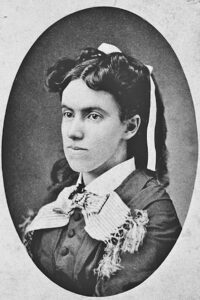
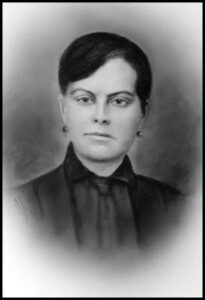
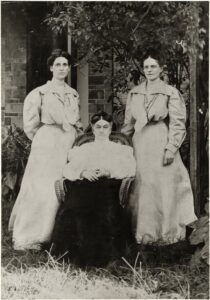
Charlotte Digges Moon was born in 1840 to an elite slaveholding family in Albemarle County, Virginia. The fourth of seven children, Moon grew up in a privileged antebellum household yet one in which the daughters each received educations comparable to their brothers’. Her older sister Orianna, for example, wanted to earn a medical degree as their brother had and was the first Virginia woman to become a trained physician. Lottie Moon, too, attained an elite level of education, earning in 1861 the equivalent of a master’s degree from Albemarle Female Institute, which shared faculty with the University of Virginia. Notably, both Moon and her older sister openly resisted religion and held opinions that were at odds with the views of their society. Orianna Moon took pride in her lack of religion, her belief in women’s rights, and her opposition to slavery. (The following biographical account comes from Sullivan 2011.) Their mother and grandmother were prominent Baptists, but until she was eighteen years old, Lottie Moon remained happily areligious. She mocked her pious classmates and teased her devout friends. But in 1858, she decided to become a Christian. Her conversion came not in a sudden emotional religious experience but rather through a decision to give rational consideration to the topic. Afterward, she was devoted to her beliefs, but her intellect and rebellious personality did not change.

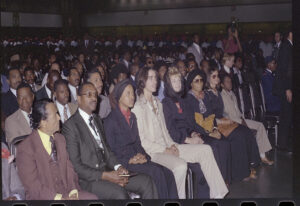
After her graduation from Albemarle Female Institute in 1861, she had hoped to go abroad as a missionary, but the Southern Baptist  Convention (SBC) denomination [Image at right] discouraged single women from applying for such positions. There was no justification for sending single women into the mission field since, according to the social norms of the time, only men could publicly evangelize mixed audiences containing men and women. Such activities were deemed outside of women’s proper sphere in the home. After the Civil War (1861–1865), however, Baptist men began to question the proper conduct and place of southern women in light of the difficult economic conditions in the postwar South. In short, women’s work was needed. In 1871, the Southern Baptist Convention’s Foreign Mission Board (FMB), an all-male body, changed its policy and began allowing single women to receive appointments to missions abroad. The justification for this change was a policy known as “woman’s work for woman,” which argued that single women, unburdened by family responsibilities, could visit Asian women in their homes and teach school. While this policy opened mission work to women like Lottie Moon, who left for China in 1873, it also limited their influence specifically to women and children.

Soon after Lottie Moon arrived in the city of Penglai (then known as Tengchow to the missionaries) in Shandong province in 1873, she began making trips outside the city walls with two female colleagues. The women would travel to a village, wait for a crowd to gather, and then speak to them about Christianity. The missionaries did not separate the villagers by gender before beginning to talk with them. Instead, they simply started speaking or preaching, as they termed it themselves. Moon immediately understood that their behavior blurred the boundaries of what was considered proper in her home country, but she was committed to her Christian responsibility for the souls of all those she met, not simply the souls of women.

In the early 1870s, female missionary societies were just beginning to form in southern states, and Southern Baptist missionaries were few. In her earliest reports to the Foreign Mission Board, Moon appealed for more workers, especially men who were permitted to preach and evangelize in public. Finally, after two years in China and many such appeals, Moon wrote that she had recently been invited to a nearby village to speak to a hall overflowing with potential converts. She described her dilemma: “I hope you won’t think me desperately unfeminine, but I spoke to them all, men, women and children . . .” (Moon 1876).

In late 1885 Moon relocated to the Pingdu district in Shandong province, sensing that rural folk might find her teachings more appealing than had the city dwellers of Penglai, where the main mission station was located. Until the Foreign Mission Board could approve the new station, Moon wrote to the FMB informing it that she had taken up residence in Pingdu. When she heard back from the FMB months later, she discovered it had decided against funding the new station, but it was too late. Moon was already settled and refused to abandon her post. During the next five years, she would make her home there. She used the freedom this isolated village afforded to work autonomously and create a personal mission in a place where she could finally be, as she put it, “responsible to God and not to man” (Moon 1879).

It was in the Pingdu district that Southern Baptists found their greatest number of Chinese converts. Through Moon’s personal evangelism and the efforts of missionaries funded by the Christmas offering, a church and school were formed in the village of Shaling in 1891, and by 1898 there were four churches in the Pingdu district and educational services were added as well. In 1891, Moon returned to the United States for her long-postponed furlough. When she returned to China in 1894, she left the Pingdu district to younger missionaries and devoted herself to evangelism in the Penglai area and, from time-to-time, she organized and oversaw schools. Moon remained on the mission field in Shandong Province, China until she fell ill in 1912. She died aboard a ship in Kobe harbor, Japan while en route back to the United States on December 24, 1912.

TEACHINGS/DOCTRINES 

Although Lottie Moon grew up in a Baptist household, the antebellum period was one of religious flux in Virginia, and she was exposed to other beliefs before deciding to become a Baptist. Her maternal uncle, James Turner Barclay, and his family, for example, converted and became the first Disciples of Christ missionaries and, later, her two youngest sisters became Catholics.

Throughout her missionary career, Moon proved devoted to Southern Baptist doctrine. Evangelism defines the Southern Baptist self-concept and was, indeed, the main justification for creating and maintaining an overarching denominational structure. In fact, the denomination was created when northern Baptists refused to appoint southern slaveholders to the mission field. Southerners broke away and formed their own organization in 1845.

The Baptist beliefs that emerged out of the Protestant revivals of the Second Great Awakening (1790–1840) emphasized the conviction that each Christian can access God through prayer and can read and interpret the Bible for himself/herself with God’s guidance and without the mediation of a priest. Therefore, each individual Christian is responsible for using their gifts in service. Baptists also stressed the need for an emotional conversion experience; the importance of full immersion water baptism; and participation in the Lord’s Supper. Southern Baptists took, and still take, the command to go out into the world to teach the Gospel message as the supreme directive. Lottie Moon took seriously God’s call to preach the Gospel and this led her to bump up against the restrictions that women on the mission field faced.

Moon therefore decided to break with Baptist tradition, which reserved the privilege of preaching to men  alone. [Image at right] While on evangelistic tours outside the United States, she spoke to men whenever the situation presented itself. She rejected the “woman’s work for woman” policy that had been used to justify sending out unmarried women as missionaries. In 1883 she wrote, “Can we wonder at the mortal weariness and disgust, the sense of wasted powers and the conviction that her life is a failure, that comes over a woman when, instead of the ever broadening activities she had planned, she finds herself tied down to the petty work of teaching a few girls?” (Moon 1883:48). Moon now began to argue that the restrictions placed on single women missionaries were impractical and, in many cases, unjust. Her openness brought harsh criticism. To her critics, she replied, “What women have a right to demand is perfect equality” (Moon 1883:54). Two years later Moon made her final break with the “woman’s work for woman” policy by moving 150 miles into the interior of Shandong province to live alone and independently engage in direct evangelism, although she never abandoned the Southern Baptist denomination or her position as a missionary.

While there were theological controversies and disagreements during her lifetime that caused the Southern Baptist Convention to remove some of its prominent intellectuals and to push out supporters of what came to be known as Landmarkism, Moon never wavered. She had studied classical languages and could read the New Testament in Greek. When the issue of higher biblical criticism challenged the Baptist belief that the Bible is written by God and is therefore inerrant, she took no public stand. She never challenged traditional Baptist beliefs, nor did she ever support alternative funding models that would have eliminated the SBC Foreign Mission Board.

Instead, Moon kept faith with her denomination’s primary objective: direct evangelism. When she found that the gendered restrictions placed on her kept her from what she saw as her true and highest calling, she spoke out against these traditions. Her solitary accomplishments in China led her to argue that all Southern Baptist women should abandon their fear and trust that defying male authority was proper (and even necessary) when following the Gospel imperative.

LEADERSHIP/PRACTICES

After the Foreign Mission Board declined to fund her missionary station in 1885, Lottie Moon began a public campaign for financial assistance by publishing articles in the Foreign Mission Journal and state Baptist newspapers. Moon first directed her appeals to the FMB and Southern Baptist men. When she received no response, Moon turned away from the men and appealed, instead, to the Southern Baptist women’s missionary societies. White Southern Baptist women had been trying for years to form an overarching women’s organization for their local missionary societies and had failed due to opposition from male denominational leadership. A women’s organization, even if it functioned solely to raise funds for missions, would exist outside formal control of Baptist men and would thus be “irregular,” according to the men (Religious Herald 1888).

In 1887, Moon published an article in the August issue of the Foreign Mission Journal in which she advocated for a female organization to support missions. To shame the Southern Baptist women into taking action, she compared their efforts with those of their closest denominational rival, the Methodist Episcopal Church, South. Moon wrote: 

The Southern Methodist women manifest an intense enthusiasm for foreign missions. They give freely and cheerfully. Now the painful question arises: What is the matter, that we Baptists give so little? Whose the fault? Is it a fact that our women are lacking in the enthusiasm, the organizing power, and the executive ability that so conspicuously distinguishes our Methodist sisters? It is certain that women can be found willing and glad to come and work for God in China. The lack is not of women who would come but of money to send and sustain them (Moon 1887a).

In the December 1887 issue of the Foreign Mission Journal, Moon spoke out again, but this time she included more detail and even stronger language. She reminded her readers that, until the Methodist women organized, their work in China had reached its nadir: “In like manner, until the women of our Southern Baptist churches are thoroughly aroused, we shall continue to go on in our present ‘hand to mouth’ system. . . . [W]e shall continue to see other denominations no richer and no better educated than ours, outstripping us in the race” (Moon 1887b:224).

Despite continuing opposition from many Baptist men, in 1888 the women, using Moon’s arguments, formed an Executive Committee, which would become the Woman’s Missionary Union. While they claimed to have organized the white Baptist women of the South into a region-wide association, in reality, approximately thirty women had voted to form a committee of nine that now claimed to speak for all Southern Baptist women. To engage local societies across the region, they would need a special project. In July 1888, the FMB secretary wrote to the Executive Committee and suggested that the women take on a fundraising campaign to support one of their own, Lottie Moon. The Executive Committee decided to do as Moon herself had suggested. They would use the Methodist model and lead Southern Baptist women in a fundraising campaign centered around the Christmas holiday, an offering designated to help Moon in Pingdu.

The Christmas Offering campaign captured the imagination of Southern Baptist women as no other fundraising effort previously had. In total, approximately $3,500 was raised in 1888, $1,500 more than the original goal. By July 1889, the Executive Committee of the WMU was earning praise from Southern Baptist men where a year earlier it had heard only criticism. There had been only thirty-five women at the organizational meeting in 1888, but in 1889 latecomers found standing room only. Among the many speakers on the agenda were two who spoke about Lottie Moon. The first was a recently returned missionary who gave the women a firsthand account of the situation Moon faced in Pingdu. Then one of Moon’s schoolmates recounted a letter she had recently received asking once again for help. At that point, a woman rose to remind the delegates of their success with the Christmas Offering and expressed concern that other fields might be neglected if everyone remained so intensely focused on Moon and China.

The women of the Southern Baptist Convention, though, would not be turned away from Moon and her work. Annual Christmas Offerings organized by the WMU continued with Moon and Pingdu as their special object for three more years. Unlike the first Christmas Offering, which was publicized mainly through the women’s missionary societies’ journals, later campaigns increased in scope and spread to the state Baptist newspapers, intensifying as Moon continued to postpone her furlough. She remained in China where the yearly Christmas Offerings she inspired guaranteed that her station would not suffer from lack of funding as the Foreign Mission Board struggled to stabilize its finances. It was not until 1892 that Moon finally agreed to leave China for her furlough.

During the WMU’s first decade, strengthened organization and successful fundraising increased its power and assured its legitimacy. By the end of the nineteenth century, Southern Baptist women had moved firmly into the public realm. And, as a result of her efforts, Lottie Moon was lauded as no other Southern Baptist missionary had ever been. Women regularly paid tribute to her in state Baptist newspapers and journals. But perhaps the most telling measure of Moon’s stature in her denomination came in 1890 when, at the Southern Baptist Convention meeting, a delegate, after hearing the report of her work for the year, remarked that it had often been said of her: “She is the greatest man among our missionaries” (SBC Proceedings 1890).

ISSUES/CHALLENGES

It is not this story, however, that the Woman’s Missionary Union has perpetuated about Lottie Moon . In the materials that the WMU has produced, [Image at right] her vital role in the organization’s formation is downplayed or not mentioned at all. Her use of rights language and her willingness to defy male authority are overlooked. Instead, the WMU re-characterized her life, flattening it into stereotypical images of the southern “lady,” idealized missionary, and martyr. The irony is that Moon’s experience does not fit these stereotypes. Although privileged, she never played the “southern belle” role in her youth. Instead, she studied, pursued a profession, and became an advocate for women’s equality and organization. As a missionary, she again broke the mold, refusing to speak only to women in the mission field or to confine her work to a prescribed area where she was under male control. Instead, Moon ignored policies designed to restrict her activities and became a pioneering evangelist on her own. Her solitary accomplishments in China led her to argue that all Southern Baptist women should abandon their fear and trust that defying male authority was proper (even necessary) when following the Gospel imperative.

In fact, when the Chinese Revolution (1911–1912) brought fighting to the region Moon refused to follow the U.S. Consul’s order to remove to the port city of Yantai (then known to the missionaries as Chefoo) for protection. Instead, the intrepid seventy-one-year-old traveled alone to the city under bombardment to volunteer with the Red Cross. After she returned to her home in late summer 1912, Moon developed a boil on her neck, which caused a serious infection that eventually affected her spinal cord. The illness caused mental deterioration and physical wasting, although she was under the constant care of medical professionals.

Throughout the twentieth century, denominational accounts of Moon’s life remained relatively close to the historical record except when relating the details of her death. While outlandish claims about her accomplishments persist on denominational websites to this day (for example, that she translated the Bible into Chinese and led a campaign against foot binding), the most persistent fiction remains the starvation myth. Its main components are as follows:

Moon sacrificed her life for the Chinese on the mission field and, most symbolically, at her death. Overwhelmed by the Foreign Mission Board’s indebtedness and inability to help with famine relief, Moon stopped eating as a protest and in order to give all of her own money to those suffering. Ultimately, Moon starved herself to death to save Chinese Christians and to bring attention to Southern Baptists’ lack of financial commitment to the FMB.

This rendition was first put into print in an article written by a school friend following Moon’s death, but soon faded (Hatcher 1913). The 1927 hagiography, Lottie Moon, written by Una Roberts Lawrence (1893–1972), a writer for WMU, repeated the starvation story (Lawrence 1927), but the narrative did not become a standard feature in promotional materials until the mid-1960s. When WMU employee Catherine B. Allen published her updated hagiography of Moon in 1980, she admitted that some Southern Baptists hoped for a more fact-based account. In the foreword to the first edition, Allen noted that many had asked her not to perpetuate “that myth about [Moon] starving to death in a famine” while others advised her not to “tamper with that precious story” (Allen 1980:4). In the end, Allen chose to continue the legend. She writes that by the fall of 1912 Moon “had ceased to eat so that her impoverished Chinese might be fed” (Allen 1980:276).

Perhaps the story’s most dramatic use came in 1988. On the centennial of the WMU’s founding [Image at right] and  the first Christmas Offering, posters designed to publicize the event proclaimed, “Lottie Moon Is Starving Again.” The text reads:

Just 76 years ago, foreign missionary Lottie Moon literally starved to death. She refused to see the Chinese people she loved go spiritually or physically hungry. So she gave all she had to give—from her food to her last ounce of strength. . . . This year marks the 100th anniversary of the Lottie Moon Christmas Offering. It’s been six years since we’ve met the offering goal. Lottie Moon is starving again. The 1988 goal is $84 million. If each Southern Baptist gives $10, we will not only reach, but surpass the goal. But if we don’t, what happened to Lottie Moon could happen to foreign missions. How much will you give to keep foreign missions alive? (Lottie Moon Christmas Offering Promotional Files 1988 ).

This narrative of martyrdom has proven to be an amazingly successful fundraising tool, and it continues to have profound significance for Southern Baptists.

Moon’s life ended at age seventy-two on December 24, 1912, on a ship en route to the United States, then in Kobe Harbor, Japan, but her memory has lived on, taking shape in this new narrative, one with such power and flexibility that it changed Moon from a historical figure into a legendary symbol for Southern Baptists. The “Lottie Moon Christmas Offering,” named for her in 1918, brings this story  [Image at right] into Southern Baptist churches across the nation and around the world each December. Annually, the WMU and the Foreign Mission Board, now called the International Mission Board, produce new materials to teach 14,500,000 adherents about the SBC’s commitment to overseas evangelism. For more than a century Moon’s life has provided the centerpiece to this fundraising effort. In a religious tradition dominated by men, Southern Baptist women gained power by creating a gripping account of female piety and sacrifice, one that has brought the denomination more than $4,500,000,000 and ensured the survival of Southern Baptist mission efforts.

Since its inception, the Woman’s Missionary Union, with headquarters in Birmingham, Alabama, has existed as an independent organization, free from the control of the male leadership. To raise money, the WMU needed an appealing narrative but, even more importantly, it needed one that would downplay their struggles with the Southern Baptist leadership. Moon’s role as instigator of the WMU and rebellious pioneer female missionary are, therefore, silenced in favor of Moon as a martyr to the mission cause. According to the narrative, Moon protested Foreign Mission Board policies by starving herself, not by encouraging Southern Baptist women to organize, the new account goes. Thus her memory has served the institutional purposes of the Southern Baptist Convention, which has subsumed her active life to its own need for effective fundraising for missions that does not challenge male denominational leadership. In the end, a tension remains. A factually remembered Moon would be a female activist who preached to mixed male-female audiences in China, argued for women’s equality, and inspired Southern Baptist women to bring the WMU into existence. Yet such activities conflict with the traditional understanding of the female role for Southern Baptist women as submitting to male headship.

Moon, therefore, for Southern Baptists remains a female saint who evinces Christ-like qualities by sacrificing her own life, refusing to take food so that famine sufferers in China might have more and so that she would not increase the Foreign Mission Board debt. That this story of martyrdom is not true has not prevented it from resonating deeply for Southern Baptists for more than a century.

SIGNIFICANCE TO THE STUDY OF WOMEN IN RELIGIONS

Lottie Moon’s struggle to live an independent life as a female missionary had ramifications both in China and in the United States. As she found her personal calling and moved alone into the interior of China, she challenged patriarchal gender roles (in America) and inspired Southern Baptist women back home to form an independent organization in 1888, the Woman’s Missionary Union (WMU), to support mission work financially, specifically women’s missionary work. Moon’s popularity among white Baptist women across the South made her famous in her lifetime. The creation of “The Lottie Moon Story” by the WMU has ensured that her memory, although distorted for fundraising purposes, lives on into the twenty-first century. She is, arguably, the most remembered and regularly celebrated nineteenth-century Southern woman in the Southern Baptist tradition, celebrated around the world each year within the denomination.

IMAGES

Image #1: Lottie Moon, ca. 1860s, from a Woman’s Missionary Union, Auxiliary to the Southern Baptist Convention, pamphlet.
Image #2: Lottie Moon, ca. 1880s. Charcoal drawing. Hunt Library, Woman’s Missionary Union, Auxiliary to the Southern Baptist Convention.
Image #3: Lottie Moon with Ella Jeter (left) and Jessie Pettigrew (right), 1905, Penglai, China. International Mission Board, Southern Baptist Convention.
Image #4: “Lottie Moon Is Starving Again” poster. Woman’s Missionary Union, Auxiliary to the Southern Baptist Convention
Image #5: “Lottie Moon Christmas Offering” promotional material.

REFERENCES

Allen, Catherine B. 1980. The New Lottie Moon. Nashville: Broadman Press.

Hatcher, Virginia Snead. 1913. “Miss Lottie Moon: She Being Dead, Yet Speaketh.” Religious Herald (Va.), March 6.

Lawrence, Una Roberts. 1927. Lottie Moon. Nashville: Sunday School Board of the Southern Baptist Convention.

Lottie Moon Christmas Offering Promotional File. 1988. Hunt Library, Woman’s Missionary Union, Auxiliary to the Southern Baptist Convention, Birmingham, Alabama.

Moon, Lottie. 1887a. “An Earnest Plea for Helpers.” Foreign Mission Journal (August). Pp. 215–16 in Send the Light: Lottie Moon’s Letters and Other Writings, edited by Keith Harper. Macon, GA: Mercer University Press, 2002.

Moon, Lottie. 1887b. “From Miss Lottie Moon.” Foreign Mission Journal (December):222–25.

Moon, Lottie. 1883. “The Woman Question Again.” Woman’s Work in China (November):47–55.

Moon, Lottie. 1879. “Lottie Moon’s Diary.” Western Recorder (KY), November 20.

Moon, Lottie. 1876. Lottie Moon to Dr. Henry Tupper, corresponding secretary of the Southern Baptist Convention Foreign Mission Board, April 14. Lottie Moon Correspondence File, Southern Baptist Historical Library and Archives, Nashville, Tennessee. Religious Herald (VA). 1888. April 26.

Southern Baptist Convention Proceedings. 1890. Southern Baptist Historical Library and Archives, Nashville Tennessee.

Sullivan, Regina D. 2011. Lottie Moon: A Southern Baptist Missionary to China in History and Legend. Baton Rouge: Louisiana State University Press.

ADDITIONAL RESOURCES

Baker, Robert Andrew. 1974. The Southern Baptist Convention and Its People, 1607-1972. Nashville: Broadman Press.

Brumberg, Joan Jacobs. 1982. “Zenanas and Girlless Villages: The Ethnology of American Evangelical Women, 1870-1910.” Journal of American History 69:347–71.

Estep, William R. 1994. Whole Gospel Whole World: The Foreign Mission Board of the Southern Baptist Convention 1845-1995. Nashville: Broadman & Holman.

Eighmy, John Lee, and Samuel Hill. 1987. Churches in Cultural Captivity: A History of the Social Attitudes of Southern Baptists. Knoxville: University of Tennessee Press.

Flowers, Elizabeth. 2011. “The Contested Legacy of Lottie Moon: Southern Baptists, Women, and Partisan Protestantism.” Fídes et Hístoría 43:15–40.

Grimshaw, Patricia. 1983. “‘Christian Woman, Pious Wife, Faithful Mother, Devoted Missionary:’ Conflicts in Roles of American Missionary Women in Nineteenth-Century Hawaii.” Feminist Studies 9:489–521.

Hill, Patricia Ruth. 1985. The World Their Household: The American Woman’s Foreign Mission Movement and Cultural Transformation, 1870-1920. Ann Arbor: University of Michigan Press.

Hunter, Jane. 1984. The Gospel of Gentility: American Women Missionaries in Turn-of-the-Century China. New Haven: Yale University Press.

Hyatt, Irwin Jr. 1976. Our Ordered Lives Confess: Three Nineteenth-Century American Missionaries in East Shantung. Cambridge: Harvard University Press.

Latourette, Kenneth Scott. [1929] 1967. A History of Christian Missions in China. New York: Russell & Russell.

Lerner, Gerda. 1993. The Creation of Feminist Consciousness: From the Middle Ages to Eighteen-seventy. New York: Oxford University Press.

Letsinger, Norman H. 1977 “The Status of Women in the Southern Baptist Convention in Historical Perspective.” Baptist History and Heritage 31:37–51.

Lindley, Susan Hill. 1996. “You have Stept out of Your Place:” A History of Women and Religion in America. Louisville: Westminster John Knox Press.

Lyerly, Cynthia Lynn. 2005. “In Service, Silence, and Strength: Women in Southern Churches.” Pp. 101–23 In Religion and Public Life in the South: In the Evangelical Mode, edited by Charles Reagan Wilson and Mark Silk,. Walnut Creek, CA: AltaMira Press.

Lyerly, C. Lynn. 2004. “Women and Southern Religion.” Pp. 247–81 in Religion in the American South, edited by Beth Schweiger and Donald G. Mathews. Chapel Hill: University of North Carolina Press.

McBeth, Leon. 1977. “The Role of Women in Southern Baptist History.” Baptist History and Heritage 22:3–25.

Morgan, David T. 2003. Southern Baptist Sisters: In Search of Status, 1845-2000. Macon, GA: Mercer University Press.

Robert, Dana L. 2002. “The Influence of American Missionary Women on the World Back Home.” Religion and American Culture 12:59–89.

Scott, Anne Firor. 1992. Natural Allies: Women’s Associations in American History. Chicago: University of Illinois Press.

Spain, Rufus. 1967. At Ease In Zion: A Social History of Southern Baptists. Nashville: Vanderbilt University Press.

Sullivan, Regina D. 2012. “‘Responsible to God and Not to Man:’ Lottie Moon In Southern History.” Historically Speaking 13:21–22.

Sullivan, Regina D. 2010. “Myth, Memory, and the Making of Lottie Moon.” Pp. 11-41 in Entering the Fray: Gender, Politics and Culture in the New South, edited by Jonathan Daniel Wells and Sheila R. Phipps. Columbia: University of Missouri Press.

Welter, Barbara. 1978. “She Hath Done What She Could: Protestant Women’s Missionary Careers in Nineteenth-Century America.” American Quarterly 30:624–38.

Sims, Anastasia. 1997. The Power of Femininity in the New South: Women’s Organizations and Politics in North Carolina, 1880-1930. Columbia: University of South Carolina Press.

Varg, Paul. 1958. Missionaries, Chinese, and Diplomats: The American Protestant Missionary Movement in China, 1890-1952. Princeton: Princeton University Press.

Publication Date:
18 Sepbember 2020

Share

Siddha Yoga


SIDDHA YOGA TIMELINE

1908:  Swami Muktananda (birth name, Krishna), known to his followers simply as Baba, was born in Karnataka State, India.

1923:  At age fifteen, Muktananda, then Krishna, first saw his future Guru Bhagavan Nityananda, and soon after left home in search of a spiritual life.

1947:  Muktananda received Shaktipat (spiritual initiation) from his Guru Bhagawan Nityananda. Over the next decade Muktananda spent his time living and meditating in a small hut in the village of Yeola, Maharashtra.

1956:  Bhagawan Nityananda gave Muktananda a small parcel of land a few kilometres from his own ashram where Muktananda built a small hut with and cultivated a rose garden.

1961 (August 8):  Muktananda’s Guru, Bhagawan Nityananda, died. The death of Bhagawan Nityananda left multiple successors, including Muktananda, to what is now considered a Siddha Yoga lineage.

1970:  Muktananda’s first world tour took place. Toward the end of the 1970’s, Muktananda and a small group of devotees travelled and taught Siddha Yoga in Europe, Australia, Singapore and America.

1974-1976:  Muktananda’s second world tour took place. Muktananda returned to Australia, which had by then established two Ashrams, Europe, and then spent most of his time in America in the newly established Oakland Ashram and creating the organisation, Siddha Yoga Dham Associates (SYDA) and touring the U.S.

1978-1981:  Muktananda’s third and final world tour took place. It included an extended stay and the newly established Santa Monica Ashram and the Nityananda Ashram (later Shree Muktananda Ashram) in South Fallsburg, New York, which served as the organisation’s headquarters, and developed a high profile internationally as a guru.

1981:  During a celebration at the South Fallsburg Ashram in New York, Muktananda named the young Swami Nityananda his successor.

1982 (May):  After the initiation of Swami Chidvilasananda, young Swami Nityananda’s sister, Muktananda named them both as successors to the Siddha Yoga lineage.

1982 (October 2):  Swami Muktananda died and Swami Chidvilasananda (later Gurumayi) and Swami Nityananda became co-gurus of the Siddha Yoga movement.

1982-1985:  Swami Chidvilasananda (now Gurumayi) and Swami Nityananda co-led Siddha Yoga, spreading their message internationally but often travelling separately.

1985:  Swami Nityananda stood down as co-guru amid controversial circumstances. Nityananda soon created his own organisation Shanti Mandir to continue his work as a successor of Muktananda.

1985-2020:  Gurumayi has continued as the sole leader and Guru of Siddha Yoga and has continued to develop the tradition. Many of the Ashram and centres established by Muktananda continue to operate.

FOUNDER/GROUP HISTORY

Born in 1908, and named Krishna, Muktananda [Image at right] did not often talk of his family or childhood, although, it is known that he left home at the age of fifteen to follow the life of an ascetic and may have come from an upper-class to wealthy family. He became a saṃnyāsī as a young man in the Sārasvatī order in the tradition of Daśanāmīs at Siddharudha’s āśram in Hubli (Brooks 2000; Prakashananda 2007). For much of his life, he travelled by foot all over India. Muktananda was an eclectic yogī; he picked up practices, rituals, and bhajans from the different religious personalities that he met during his travels. As a young man, he was keen to learn from the great saints of India. Muktananda learned from Muslim, Christian, and Hindu alike. In his autobiography The Play of Consciousness: Chitshakti Vilas (Muktananda 1974), he describes his time of wandering and the great saints of India that he had met, culminating with his śaktipāta initiation (the awakening of the spiritual energy known in this tradition as kuṇḍalinī awakening by the grace of the guru) by his own guru, Bhagawan Nityananda (1888–1961) of Ganeshpuri. [Image at right]

After years of searching, Muktananda finally settled with his guru in the village of Ganeshpuri not far from Mumbai. However, Muktananda claims to have first met his guru Bhagawan Nityananda briefly as a schoolboy, which was what led him on his spiritual quest to learn from this master. After the death of Bhagawan Nityananda, Muktananda began to create his own āśram from a small three-room dwelling and surrounding lands that Bhagawan Nityananda had given him. From the humble beginnings in the village of Ganeshpuri, eighty km out of Mumbai, Muktananda’s own version of the guru–disciple tradition was born, and Siddha Yoga (“yoga of siddhas”), was taught to the world.

Muktananda dedicated his own āśram to his guru and named it Shree Gurudev Ashram, and later, Gurudev Siddha Peeth. To establish himself within a spiritual lineage, Muktananda declared himself sole successor to his guru; however, among followers of Bhagawan Nityananda, succession was not clearly articulated. In contrast to a sole succession, there was a recognition among devotees of Bhagawan Nityananda of several potential successors, including Janananda Swami, Muktananda, [Image at right] Shaligram Swami, Shankar Teerth Swami, Sadananda Swami, Tulsiamma, and Gopalmama (Kodikal and Kodikal 2005). Janananda Swami was in fact the head of the Bhagawan Nityananda Ashram in Kerala during and after the death of Nityananda, which would have made him the likely successor. However, Muktananda’s autobiography (1974) asserted that he was the successor to what he considered a lineage of the siddhas (god-realized beings), hence the name Siddha Yoga. The succession of a lineage is, however, contentious considering that Bhagawan Nityananda had no guru himself; therefore, the claim to lineage is possibly not a claim to a physical lineage but to a lineage of siddhas. In Siddha Yoga āśrams around the world, there are portraits of various siddhas whom Muktananda considered part of his own lineage.

Throughout the 1960s, the Shree Gurudev Ashram attracted many Indian and a growing number of Western devotees. It was not, however, until 1970 that Swami Muktananda’s Siddha Yoga was introduced to the West as part of his first ventures outside of India (Thursby 1991; White 1974). Numerous Indian gurus at this time had travelled to the West and had gained large followings. Muktananda’s first tour was undertaken with the support of his growing Indian and a handful of Western followers. Swami Rudrananda (Albert Rudolph) and Baba Ramdas (Richard Alpert) were also important to Muktananda’s first world tour. Swami Rudrananda, commonly known as Rudi, was one of the few Westerners to have met Muktananda’s guru, Bhagawan Nityananda. From the late 1950s onward, Rudi began traveling to India collecting antiques to sell in his New York Manhattan store. Rudi became a devotee of Bhagawan Nityananda, and during his time with Nityananda he had met Muktananda.

After the death of Bhagawan Nityananda in 1961, Rudi established himself as a spiritual teacher in New York City and eventually created an āśram in the town of Big Indian in upstate New York, attracting his own followers. The āśram, which he called Big Indian, was the first āśram dedicated to Bhagawan Nityananda in the West. (Shanti Mandir has of 2020, three Ashrams in India and one in Walden New York.)

Rudi continued to travel to India after the death of Bhagawan Nityananda and often visited Muktananda. It was Muktananda that gave Rudi the name Swami Rudrananda. During Muktananda’s first tour, Rudi invited Muktananda to Big Indian, where he introduced Muktananda to his own followers. Muktananda stayed as Rudi’s guest at Big Indian and at Rudi’s New York home. Some of Rudi’s followers became devotees of Muktananda, including Franklin Jones, also known as Adi Da Samraj, who soon after meeting Muktananda established his own reputation as a dynamic and controversial spiritual teacher. It was primarily through the support of Rudrananda and Baba Ramdas that Muktananda was able to travel to the United States.

Baba Ramdas, a former college professor and psychedelic-drug researcher with Timothy Leary and Aldous Huxley, was a friend of Swami Rudrananda. Rudi invited Ramdas to meet Muktananda at Big Indian. During his time at Big Indian, one of Muktananda’s followers asked Ramdas if he could take Muktananda around America. [Image at right] At this time, Ramdas was a leading authority on eastern mysticism, touring widely and lecturing on his experience with his own guru Neem Karoli Baba. During Muktananda’s stay at Big Indian, Ramdas had a vision of his guru Neem Karoli Baba, who told him to “help this man,” meaning Muktananda (Coroneos 2005). Ramdas then toured with Muktananda across America to Melbourne, Australia, and then on to India, introducing Muktananda to the vibrant counterculture of that time. It was to some extent the support of Baba Ramdas [Image at right] and Swami Rudrananda that initially helped to establish Muktananda’s credibility as guru to the West and began the groundswell for his own Siddha Yoga practice.

After Muktananda’s first world tour, new Western devotees began to establish Siddha Yoga centers in their own countries. Like other Indian guru-based movements, such as ISKCON or Bhagwan Shree Rajneesh/Osho, Siddha Yoga would be considered a new religious movement in the terms proposed by Melton (1993), because when it entered the West, it gained converts from the host country. Although guru–disciple traditions were well-known and had been established in India for centuries, during the late 1960s and early 1970s, these groups offered the West an alternative spirituality to the predominant Christian perspective. In his lifetime, Swami Muktananda conducted three tours of the West, passing on the teachings of his guru Bhagawan Nityananda in what he considered a lineage of siddhas, or perfect masters (Brooks 2000; Foster 2002).

Muktananda’s second tour, in 1974, was undertaken with the support of Werner Erhard of Erhard Seminars Training (est). Werner Erhard had firmly established himself in the Human Potential Movement of the 1970s and had thousands of followers in his est program (Graham 2001; Prakashananda 2007). He paid for Muktananda and his small entourage to travel out of India, and like Ramdas and Rudi had done in 1970, introduced Muktananda to his own audience (Brooks 2000). Werner Erhard introduced Muktananda to his est intensive self-empowerment workshops. These workshops seemed to have had some influence on Muktananda who then began to conduct his own two-day intensive programs of introduction to Siddha Yoga; these Intensives became the stalwart of Siddha Yoga śaktipāta initiation for newcomers. By late 1975, Muktananda had established a reasonably large following of his own and was conducting regular weekend intensives and traditional satsaṅg (following) all across America. Although Werner Erhard did not associate with Muktananda after this time (nor did Baba Ramdas), he did visit Muktananda in India just before Muktananda’s death in 1982 (Graham 2001). [Image at right]

For this second tour, in 1974, a small house on Webster Street, San Francisco, was turned into the first āśram outside of India dedicated to Muktananda’s Siddha Yoga practice. The āśram was administered by Ed Oliver who, during Muktananda’s second tour of America, scouted ahead with a small group of devotees, including some of the individuals mentioned above, to various American cities in order to make preparations for Muktananda’s visits (Siddha Path 1982a). In 1975, Muktananda’s tour of America eventually settled in the newly established Oakland āśram, which then became the hub for the development of an organized structure for Siddha Yoga in the West. It is reported that Muktananda, on one of his walks around Oakland, was passing by the old Stanford Hotel and thought it would make a good āśram and base for further developing Siddha Yoga internationally (see “This Place Has Everything” 1982b). Soon, devotees from Australia, inspired by meeting Muktananda, established āśrams in Melbourne and Sydney. This made Australia the second largest satsaṅg outside of India (Brooks 2000:83).

The third tour, in 1978, firmly established Muktananda’s Siddha Yoga internationally and the Shree Muktananda Ashram, an m2 property in South Fallsburg, upstate New York, as the Western administrative base. It is interesting that the main Siddha Yoga āśram in America was established not very far from Rudrananda’s Big Indian Ashram, in which Muktananda had stayed on his first tour.

By the time of Muktananda’s death in his Indian āśram in 1982, Siddha Yoga had grown into an international movement with āśrams and centers around the world and around a quarter of a million followers (Graham 2001:13). For the Siddha Yoga community, the death of their guru was sudden and devastating; to his followers, Muktananda was Siddha Yoga.

Before Muktananda died, he installed two of his devotees to lead the group as co-gurus (Beit-Hallahmi 1993; Thursby 1991). During the gurupūrṇimā celebration in 1981, Muktananda named as his successor Swami Nityananda (1962–); six months later, Nityananda’s sister Swami Chidvilasananda, formerly Malti and now known as Gurumayi (1958–), was named co-successor (Brooks 2000:115). Nityananda and Gurumayi were the children of long-term devotees of Muktananda and had for many years lived and travelled with him. [Image at right] The new gurus of Siddha Yoga travelled extensively in their three years together as co-leaders until the third anniversary of Muktananda’s death, which was held at Gurudev Siddha Peeth in Ganeshpuri, India.


DOCTRINES/BELIEFS 

The charismatic presence of the guru is possibly more fundamental to the practice of Siddha Yoga than are the individual spiritual practices (Thursby 1995:206). The guru–disciple relationship is therefore central to the potential devotee’s spiritual awakening. When an open and receptive person comes into contact with the śakti of a living siddha, a spontaneous spiritual awakening within the individual can take place. In the eastern scriptures, this awakening or initiation is known as śaktipāta. Once this occurs, the individual begins a process leading to total transformation (Siddha-Yoga 1989:1).

Given the guru’s importance, the aspirant may meditate on the guru’s physical form rather than using a mantra. In Siddha Yoga practice, it is believed that the initiation by the guru, or śaktipāta, propels the aspirant’s spiritual practice, and therefore meditation and mantra repetition become second nature. Śaktipāta is also known as “kuṇḍalinī awakening” or the “awakening of the kuṇḍalinī” (Muktananda 1990; White 1974). From the perspective of Siddha Yoga, this awakening is the beginning of the participant’s spiritual life or sādhana, which in the guru–disciple tradition of India is the practice of spiritual disciplines in order to attain god realization (Sharma 2002; Uban 1977). The concept of śaktipāta in Siddha Yoga is largely derived from the philosophical tradition of Kashmir Śaivism (Brooks 2000; Shankarananda 2003). One of the primary texts of this tradition is the Śivasūtra, a revealed text whose authorship is attributed to Śiva, who revealed it to Vasugupta (Chatterji 2004; Singh 1990). Kashmir Śaivism attempts to explain the way to enlightenment or the recognition of the true or supreme self, or Śiva (Shankarananda 2003:53). The Śaiva-Śakta religion is one of the most ancient faiths in the world; prior to Vasugupta, it was an oral tradition (Singh 1990:3).

Shankarananda (2003:57) asserts Śaivism as a life-affirming philosophy that acknowledges that all that the individual sees and experiences is god. Within Siddha Yoga practice, all is god, and the follower’s aspiration is becoming one with god. From the point of view of the Śivasūtra, when a yogī eventually achieves the highest state, he or she becomes Śiva, or god (Singh 1982:186). Once this state is achieved, the guru or satguru (perfect guru) becomes an instrument of knowledge, and the universe is filled with his or her śakti or energy (Singh 1982:197–197). The state of Śiva, or god, is the claimed spiritual attainment of the guru within Muktananda’s Siddha Yoga tradition (Foster:2002; Uban 1977). However, Muktananda’s guru Bhagawan, Nityananda said the following: “it is not right to say ‘I am Brahman [god].’ One should rather say ‘You are the All, the whole world is yourself”’ (Kodikal and Kodikal 2005:168).

Within the tradition of Kashmir Śaivism, the liberation of the individual is not “achieved by mere intellectual gymnastics, it comes by saktipat [sic] (the descent of Divine Sakti) or…Divine grace” (Singh 1990:26). Therefore, the guru is seen as a very important aspect of Siddha Yoga practice, as the grace bestowing power of Śiva or god. The Gurugītā, a 182-verse hymn from the Skandapurāṇa, which dates to the sixth to eighth centuries CE (Chapple 2005:15), provides a template for the relationship between the guru and the follower for devotees of Siddha Yoga, and it is chanted daily in Siddha Yoga āśrams. According to the Gurugītā, “there is nothing higher than the Guru” (The Nectar of Chanting 1990:28). Muktananda also wrote many books on the subject of the guru, using as an example his relationship with his own guru, who emphasized the concept of the guru as god. However, when Bhagawan Nityananda said “The guru is God,” he followed this with “God is the guru” (Kodikal and Kodikal 2005:61) and “The real guru has no sandals on his feet, no rosary in the hands” (Kodikal and Kodikal 2005:161).

The guru in Siddha Yoga practice is considered the embodiment of the self or god and the outward manifestation of the inner self in all. That the guru is god seems like a enormous claim; however, this is tempered by the notion that all individuals are also god, although they may not have recognized this just yet. The aspirant may eventually merge with god or the guru and therefore become the guru. One of the main teachings of Siddha Yoga is that “God dwells in you as you.” Muktananda often said the following: “Honor your Self, Worship your Self, Meditate on your Self, God dwells within you as you” (Graham 2004:71).

RITUALS/PRACTICES

Siddha Yoga is for the most part a guru–disciple tradition. The followers of this tradition are part of a movement that worships a living deity from a tradition of living deities.

Siddha Yoga practice includes meditation, chanting, sevā, Haṭha Yoga, study, contemplation, and dakṣiṇā (ritual donations). “The underlying traditions of Siddha are Vedanta and Kashmir Shaivism, and the practices are of kundalini yoga” (Beit-Hallahmi 1993:284). There are also varying levels of Tantra as discussed by Caldwell (2001) in her article “Heart of the Secret: A Personal and Scholarly Encounter with Shakta Tantrism in Siddha Yoga.” Individual devotees’ approach to each practice may vary (Healy 2010). For example, there are devotees who would not consider Haṭha Yoga important to their practice and then others for whom chanting or sevā is their total practice. Individuals may fit into particular streams of practice that suit their personal disposition and reflect forms of traditional Indian yoga discussed in the Bhagavadgītā, such as karmayoga, jñānayoga, and bhaktiyoga. Karmayogins primarily perform sevā service and spend much of their time in Siddha Yoga working for the organization, jñānayogins are interested in pursuing an intellectual practice of study and contemplation of various Indian religious texts, and bhaktiyogins tend to enjoy the practice of chanting and absorption in the form of the guru. The categories are, however, not exclusive in practice, and most devotees participate in each of these forms of practice to some extent.

Meditation in Siddha Yoga practice tends to be mantra meditation or contemplation on the guru’s physical form. The initial form of mantra meditation introduced to new devotees is the repetition of oṃ nāmaḥ śivāya (an adoration of Lord Śiva with the addition of the primordial oṃ or aum). This can be understood as “I bow to Śiva,” and it can also be understood as “I bow to myself” or “I bow to my inner self,” which is Śiva, according to the interpretation given by the various teachers of Siddha Yoga practice. When Muktananda first traveled in the West, he often gave the mantra guru oṃ; however, in Siddha Yoga programs or satsaṅgs, oṃ nāmaḥ śivāya is usually chanted communally before meditation. The mantra in meditation is repeated with each in and out breath. An additional mantra that devotees use for meditation is soʾham, usually repeated as ham sa. This mantra is taught during intensive weekend workshops or what Siddha Yoga describes as “intensives,” in which śaktipāta initiation takes place. The soʾham mantra is possibly a more natural mantra for following the breath, considering the short phrase. A circular mantra, with ham uttered on breathing in and so on breathing out, it is understood to mean “I am that.” Following the breath in and out, the mantra becomes “I am that I am that I am that I am,” and so on. With the oṃ nāmaḥ śivāya mantra, there is a recognition that the devotee is acknowledging his or her connection with the infinite, his or her own inner self, or god. The object of the soʾham mantra is that it eventually be as natural as the breath itself, and therefore mantra repetition becomes a constant practice. Mantra repetition is also reinforced by the use of a japamālā. As with chanting beads or rosary beads, the japamālā is held in one’s hand, and the beads are passed through one’s fingers; the mantra is repeated on each of the beads. The overall goal of mantra repetition in meditation or daily life is to silence the mind so that an individual may become attuned to their inner self or god.

Sevā or selfless services to the guru was always a major focus of Muktananda’s Siddha Yoga practice and continues to be so under the leadership of Gurumayi and other groups within Muktananda’s lineage. Sevā is considered a spiritual practice; it is through service to the guru that individuals are rewarded with, among other things, types of mystical experience, sensations of love, and serenity (Brookes 2000:144). It is also important to acknowledge that without the volunteer labour of devotees, these types of movements would find it difficult to exist, let alone grow.

A key addition to Gurumayi’s Siddha Yoga practice is the central position of Dakshina, or giving to the organisation, especially that of “Planned Giving.” Planned giving is an arrangement for a financial bequest at the end life to be gifted to the organisation (siddhayoga 2020).

ORGANIZATION/LEADERSHIP

Siddha Yoga has continued under the sole leadership of Gurumayi throughout difficult periods of readjustment during the 1980s following the leadership dispute and the later challenges of the critical exposé on the group in The New Yorker (Harris 1994; Beit-Hallahmi 1993; Brooks 2002; Williamson 2005). Williamson’s study (2005:163) highlighted a decline in Siddha Yoga membership and noted the shutting down of some of the group’s facilities. However, because there is no formal membership in Siddha Yoga (Melton 1993:935), it is difficult to accurately evaluate the group’s member base. There is a shifting culture and new and innovative directions, such as greater use of online technologies. This is apparent on their websites. The online intensives and financial donations through the practice of Dakshina appear to reflect a committed group that is reassessing its present and future priorities. However, Gurumayi, no longer tours extensively to meet her devotees around the world nor does she conduct publicly accessible events. Gurumayi’s teachings are presented by her senior svāmīs or through live and recorded webcasts.

ISSUES/CHALLENGES

From the beginning of the 1980s, a few years before Swami Muktananda’s death, there were already rumours of Muktananda’s sexual relations with young women circulating around the Siddha Yoga community. These rumours were then stated clearly during 1981 in an open letter from Swami Abhayananda (Stan Trout), mailed to every Siddha Yoga Ashram (Rodarmor 1983). In 1983, Rodarmor presented the first published account of the abuses, sexual and other wise alleged against Muktananda and the Siddha Yoga organization. Rodarmor had interviewed some of the women and gained first-hand accounts of Muktanandas abuses. Although both letter and article gave an extensive critique, at the time they caused little disruption to the growth and reputation of Swami Muktananda or Siddha Yoga. Not until the same and further accounts were presented in the New Yorker in 1993 by Liz Harris did it begin to damage Siddha Yoga’s reputation worldwide and its current Leader Gurumayi. Not only did the article outline the systemic sexual abuse of young women by Muktananda, but also the abusive behaviour of Gurumayi and her organisation towards her own brother Swami Nityananda, who was forced out of the co-leadership under mysterious circumstances (Harris 1993). In 2001, Sarah Caldwell’s article, again brought to the forefront the sexual abuses of Muktananda, however, with a shift toward a Shakta Tantrism interpretation. An attempt at a tantric rationalisation was also given by participants in Healy’s study of Siddha yoga (Healy 2010) where ex-Siddha Yoga swami Elizabeth (pseudonym) and others made the point, that within the Tantric tradition, sexual relations can be part of the guru’s practice.

It appears the allegations of abuses around Muktananda are well documented; however, for a believer, or an individual who is invested in the ideas of this spiritual practice there can be a reluctance to “throw out the baby with the bath water.” Muktananda’s Siddha Yoga tradition goes on with many organisations and individuals having clear devotion to him. Those groups who would see themselves in the lineage of Swami Muktananda include but not limited to: Gurumayi’s Siddha Yoga; Swami Nityananda’s Shanti Mandir; Swami Shankarananda’s Shiva Yoga; Master Charles’ Synchronicity; Jivanmukta Swami Ganapati’s Siddha Shiva Yoga; Acharya Kedar’s Supreme Meditation; Mark Griffin’s Hard Light Center of Awakening; Swami Prakashananda; and Sally Kempton.

The third anniversary of Muktananda’s death took place in October 1985 and attracted thousands of Western and Indian devotees; it appeared to be a high point of the movement, which had become a multimillion-dollar corporation (Caldwell 2001:26). However, it was also a turning point for the movement, as divided loyalties became evident among devotees toward the two young gurus. Nityananda on one occasion, in front of many devotees, took Gurumayi’s hand, held it up, and said with some emotion, “No matter what you do, no matter what you think of us, we won’t split,” which appeared to be a reference to the growing division of loyalties among devotees (Harris 1994:102). As George Thursby (1995:206) has noted, it is the guru’s felt presence that is key to Siddha Yoga practice, and the fact that the movement had two gurus seemed to make the Siddha Yoga guru more accessible to the devotees around the world than during the time of Muktananda. However, this duality also created ground for divisions, and rifts were growing.

On November 10, 1985, Nityananda renounced not only his co-leadership of Siddha Yoga but also his vows of a saṃnyāsī monk (for Nityananda’s account of these events, see Kottary 1986). In a letter to devotees, the trustees of the Siddha Yoga announced the following: “You should know that the SYDA foundation recognises Gurumayi Chidvilasananda as the sole spiritual leader of Siddha Yoga” (Chidvilasananda 1986). What actually happened during this period of Siddha Yoga has been the subject of contention for nearly three decades. Melton (1993:935) has referred to this event as Nityananda’s retiring, and Thursby (1991:177) has described it as a leadership dispute. Both may be to some extent correct. Siddha Yoga first suggested to their followers that Muktananda had only intended Nityananda to co-lead the group for three years and then step down. After Nityananda left the movement, it was reported in the Indian press and the Illustrated Weekly of India that he had been forced to stand down as co-leader (Harris 1994; Kottary 1986). At the same time, Siddha Yoga reported that Nityananda had allegedly fallen from his saṃnyāīn vows of celibacy by having affairs with some of the female devotees (Chidvilasananda 1986). These allegations were not denied by Nityananda in a later interview for The New Yorker (Harris 1994).

After his departure from Siddha Yoga, Nityananda reinstated his saṃnyāsī vows in the Dashnam tradition, with the support of the Mahamandaleshwar Swami Brahamanand Giriji Maharaj, and re-established his role as a successor of Muktananda by creating his own organization, Shanti Mandir, in 1987 (Beit-Hallahmi 1993; Foster 2002; Melton 1993). Nityananda was then reportedly harassed by supporters of Gurumayi for what they considered Nityananda’s illegitimate claim to the lineage of Siddha Yoga (for a full account of this period, see Harris 1994). Thursby also noted that Siddha Yoga experienced Nityananda’s re-assertion of his succession to Muktananda as a threat and “in order to protect the right to lawful use of basic terms, practices, and materials utilized in the movement against unexpected challenges…registered them” (Thursby 1991:178). The protection of the name of Siddha Yoga seemed important to Siddha Yoga’s asserted claim to the sole lineage of Muktananda (Brooks 2000; Williamson 2005). Nityananda was all but erased from the history of Siddha Yoga except for a few pages in Siddha Yoga’s Meditation Revolution: A History and Theology of the Siddha Yoga Movement (Brooks 2000:131-34).

Although Muktananda’s Siddha Yoga was, and continues to be under the leadership of Gurumayi, a minor new religious movement, compared with ISKCON and other Hindu-based movements, it is interesting to note that, since its appearance in the West in 1970, it has given birth to offshoots and schisms (Healy 2010). There are many groups in the West that are derived from Muktananda’s Siddha Yoga practice, including Swami Nityananda’s Shanti Mandir, Swami Shankarananda’s Shiva Yoga, Master Charles’ Synchronicity, Jivanmukta Swami Ganapati’s Siddha Shiva Yoga, Acharya Kedar’s Supreme Meditation, Mark Griffin’s Hard Light Center of Awakening, and Sally Kempton. Some of these individuals, with the support of a number of Siddha Yoga devotees (but not the leadership), developed their own movements after moving away from Siddha Yoga. Today, these separate groups continue the lineage of their guru and emphasize the importance of the guru–disciple relationship within Muktananda’s tradition. Swami Nityananda’s Shanti Mandir, in particular, presents a challenge to Siddha Yoga’s sole claim to the Muktananda lineage, particularly because Nityananda was for a short time the co-leader of Siddha Yoga (Brooks 2000; Williamson 2005).

Since Muktananda’s death, the possibility of continuing his lineage of Siddha Yoga practice through various organizations or movements has become evident. Muktananda’s Siddha Yoga practice continues to grow not only through the original organization of Siddha Yoga and the leadership of Gurumayi but also through a variety of organizations that consider their own movements to be in the lineage of their guru, Swami Muktananda.

IMAGES

Image #1: Swami Muktananda.
Image #2: Young Bhagavan Nityananda.
Image #3: Muktananda with his guru Nityananda.
Image #4: Muktananda with Ramdas.
Image #5: Werner Erhard with Swami Muktananda.
Image #6: Chidvilasananda (later Gurumayi) and her brother Nityananda.

REFERENCES

Beit-Hallahmi, Benjami. 1993. The Illustrated Encyclopedia of Active New Religions, Sects, and Cults. New York: Rosen Publishing Group.

Brooks, Douglas. 2000. Meditation Revolution: A History and Theology of the Siddha Yoga Lineage. South Fallsburg, NY: Motilal Banarsidass.

Caldwell, Sarah. 2001. “The Heart of the Secret: A Personal and Scholarly Encounter with Shakta Tantrism in Siddha Yoga.” Nova Religio 5:9–51.

Chapple, Christopher. 2005. “Raja Yoga and the Guru: Gurani Anjali of Yoga Anand Ashram, Amityville, New York.” Pp. 15-35 in Gurus in America, edited by Thomas A. Forsthoefel and Cynthia Ann. Humes. Albany: State University of New York Press.

Chatterji, Jagadish Chandra. 2004. Kashmir Saivism. Delhi: Galav.

Chidvilasananda, Swami. 1986. “A Message from Gurumayi to All the Devotees of Siddha Yoga.” Circular Distributed to Siddha Yoga Ashrams.

Coroneos, John. 2005. Ecstatic States: Featuring Ram Das. Sydney: Love Serve Remember Foundation.

De Michelis, Elizabeth. 2004. A History of Modern Yoga. London: Continuum.

Forsthoefel, Thomas and Cynthia Ann. Humes, eds. 2005. Gurus in America. Albany, NY: State University of New York Press.

Foster, Sarah.2002. Muktanand. Gujarat: Foster.

Graham, Michael. 2001. The Experience of Ultimate Truth. Andhra Pradesh: U-turn Press.

Harris, Lisa. 1994. “O Guru, Guru, Guru.” The New Yorker, November, 92–109.

Healy, John Paul. 2010. Yearning to Belong: Discovering a New Religious Movement. London: Routledge.

Kodikal, Deepa and Kodikal, Raja. 2005. Life of Bhagawan Nityananda. Mumbai: Kohinoor

Mumbai Kottary, Sailesh.1986, “I Was Abducted.” Illustrated Weekly of India, March 16, 7–13.

Melton, J. Gordon. 1993. “Another Look at New Religions.” American Academy of Political and Social Science 527:97–112.

Muktananda, Swami. 1974. The Play of Consciousness: Chitshakti Vilas. South Fallsburg, NY: Siddha Yoga Publications.

Pechilis, Karen. 2004. The Graceful Guru: Hindu Female Gurus in India and the United States. New York: Oxford University Press.

Muktananda, Swami. 1990. “Sensual Excitement.” Pp. 151-71 in Kundalini, Evolution and Enlightenment, edited by John White. New York: Paragon House.

Pitchford, Susan, Christopher Bader and Rodney Stark. 2001. “Doing Field Studies of Religious Movements: An Agenda.” Journal for the Scientific Study of Religion 40:379–92.

Possamai, Adam.2001. “Not the New Age: Perennism and Spiritual Knowledges.” Annual Review of the Sociology of Religion 14:82–96.

Prakashananda, Swami. 2007. Baba Muktananda: A Biography. Mountain View, CA: Sarasvati Productions.

Rodarmor, William. 1983. “The Secret Life of Swami Muktananda,” CoEvolution Quarterly 40:104–11.

Shankarananda, Swami. 2003. Consciousness Is Everything. Australia: Shaktipat Press.

Sharma, Arvind. 2002. Modern Hindu Thought: The Essential Texts. New York: Oxford University Press.

Siddha Yoga Correspondence Course: An Introduction. 1989. New York: Siddha Yoga Dham of America.

Siddha Path. 1982. “Editorial.” Ganeshpuri: Gurudev Siddha Peeth, September, 1–30.

Singh, Jaideva. 1990. The Doctrine of Recognition: A Translation of Pratyabhijñahrdayam, New York: State University of New York Press.

Singh, Jaideva. 1982. Śiva Sūtras: The Yoga of Supreme Identity. Delhi: Motilal Banarsidass.

The Nectar of Chanting. 1990. New York: Siddha Yoga Dham of America.

Thursby, Gene. 1991. “Siddha Yoga: Swami Muktananda and the Seat of Power.” Pp. 165–81 in When Prophets Die: The Postcharismatic Fate of New Religious Movements, edited by Timothy. Miller. Albany, NY: State University of New York Press.

Thursby, Gene.1995. “Hindu Movements since the Mid-century.” Pp. 191-214 in America’s Alternative Religions, edited by Timothy Miller. Albany, NY: State University of New York Press.

Uban, Sujan Singh. 1977.The Gurus of India. New Delhi: East-West Publications

White, Charles. S.J. 1974. “Swami Muktananda and the Enlightenment through Sakti-pat” History of Religions 13:306–22.

Williamson, Lola. 2005. “Perfectibility of Perfection.” Pp. 147-67 in Gurus in America, edited by Thomas A. Forsthoefel and Cynthia Ann Humes. Albany: State University of New York Press.

Publication Date:
7 October 2020


Share
Marceline Jones

Marceline Jones


MARCELINE JONES TIMELINE

1927 (January 8):  Marceline Mae Baldwin was born in Richmond, Indiana.

1945:  Baldwin graduated from Richmond High School.

1948:  Baldwin met James Warren Jones while training as a nurse at Reid Memorial Hospital, Richmond, Indiana.

1949 (June 12):  Marceline Mae Baldwin married James (Jim) Warren Jones.

1953 (June):  The Joneses adopted Agnes, a nine-year-old white girl.

1954:  The Joneses established their first church, Community Unity, in Indianapolis.

1955 (April):  The Joneses founded Wings of Deliverance in Indianapolis.

1956:  Peoples Temple, the renamed Wings of Deliverance (first incorporated 1955), was opened by the Joneses in Indianapolis.

1958 (October 5):  The Joneses adopted two Korean children, Stephanie (b. 1954) and Lew (b. 1956).

1959 (May 11):  Adopted daughter Stephanie Jones died in a car crash.

1959 (June 1):  Marceline gave birth to son Stephan Gandhi Jones.

1959:  The Joneses adopted Suzanne (b. 1953), also from Korea.

1961:  The Joneses adopted James Warren Jones Jr. (b. 1960), becoming the first white couple in Indiana to adopt a black child.

1962–1964: The Jones family resided in Brazil.

1965 (July):  The Jones family, along with 140 members of Peoples Temple interracial congregation, moved to Redwood Valley, California.

1967–1977:  Marceline Jones worked for State of California as a nursing home inspector.

1969:  Temple member Carolyn Layton began relationship with Marceline’s husband Jim Jones.

1972 (January 25):  Temple member Grace Stoen gave birth to John Victor Stoen, purported to be Jim Jones’ son.

1974:  Peoples Temple pioneers began clearing land in the Northwest District of Guyana, South America to develop the Peoples Temple Agricultural Project.

1975 (January 31):  Carolyn Layton gave birth to Jim Jon (Kimo) Prokes, who was fathered by Jim Jones.

1977 (July):  Mass exodus of Peoples Temple members to Guyana began; Marceline Jones remained in San Francisco to manage Temple operations.

1977:  Marceline Jones relocated to Jonestown, and resided apart from her husband.

1978 (October 3):  Marceline Jones held a press conference in the United States with attorney Mark Lane, defending Peoples Temple against charges from Concerned Relatives, an oppositional group.

1978 (October 30–November 13):  Marceline’s parents Charlotte and Walter Baldwin visited Jonestown.

1978 (November 17):  Marceline Jones welcomed Congressman Leo Ryan and his party to Jonestown.

1978 (November 18, morning):  Marceline Jones took reporters with the Ryan delegation on a tour of Jonestown.

1978 (November 18, afternoon):  Marceline Baldwin Jones died in Jonestown, Guyana of cyanide poisoning. Buried in Earlham Cemetery, Richmond, Indiana.

BIOGRAPHY

Marceline Mae Baldwin was born in 1927, the eldest daughter of Walter (1904–1993) and Charlotte Lamb Baldwin (1905–1992), and sister to Eloise (1929–1982) and Sharon (1938–2012). Her early years were steeped in the values of Richmond, Indiana’s civic-minded managerial class, with its emphasis on community and service. Her father served on the city council, representing Republican interests (Guinn 2017:47; Moore 2018a:12).

Exposure to civic service was complemented by the family’s active participation in the local Methodist community. Marceline’s early religious education emphasized a “liberal social creed,” and she embraced the service aspect of this creed, volunteering her time to sing during church services. She also used her musical talents to benefit those outside of her church community, forming an outreach program with her sister Eloise and a youth group friend; the group performed music for the local hospital and nursing homes (Guinn 2017:48). Eloise described her sister as “always helping others” (Lindsey 1978:20). And in reflecting on her daughter’s character, Charlotte Baldwin noted that Marceline “was always for the underdog,” citing as evidence Marceline’s donation of a portion of her first nursing paycheck “to a local widow with 10 children” (Lindsey 1978:20).
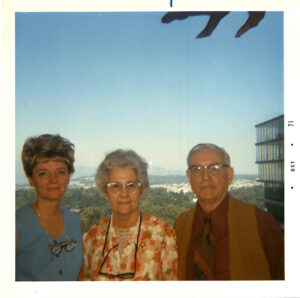
After high school, Marceline trained as a nurse at Reid Memorial Hospital in Richmond, Indiana. [Image at right] Her choice of vocation reflected her social commitment to service, but it also reflected her desire to see more of the world than her small Indiana town. Initially she had planned to relocate to Kentucky with her cousin Avelyn, who also worked at Reid. But she changed her mind when she met James (Jim) Warren Jones (1931–1978), who became her future spouse and with whom she would collaborate to found Peoples Temple (Moore 2012; Guinn 2017:48–49).

Marceline made Jim’s acquaintance when she requested an orderly to help with dressing a corpse for delivery to a funeral home. The orderly who responded to the call was Jim, and he impressed her with his attitude toward his work: serious and compassionate (Jones “Interview” n.d.:5; Jones and Jones 1975).

Marceline and Jim were married on June 12, 1949 in a double ceremony with Marceline’s sister Eloise and her betrothed, Marion Dale Klingman (Double Nuptial Rite 1949:7). Jones was eighteen, and Marceline was three years his senior; unbeknownst to both, they were third cousins (Young 2013). The Baldwin family’s stature [Image at right] in the community warranted a lengthy write-up of the wedding in the local newspaper (Guinn 2017:52; Double Nuptial 1949:7). The guests included the mayor and several members of the city council (Reiterman and Jacobs 1982:36).

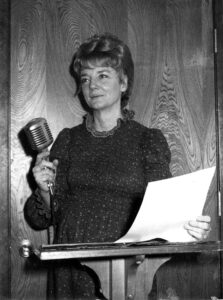
The Jones family developed alongside their ministry. Between 1953 and 1977, they added seven children, six of whom were adopted, to their fold. Their family unit contracted and expanded over the years as Jim and Marceline unofficially took in others (for example, two Indiana women, Esther Mueller and “Goldie”) (Reiterman and Jacobs 1982:47), and Bonnie Thielman (Thielman and Merrill 1979:12), the daughter of a missionary whom the Joneses met while in Brazil.

Marceline’s relationship with Jim fundamentally shifted her views on what it meant to fight for the side of what is good and right. As she tells it, “[t]he most rebellious thing I ever did before I met Jim was to walk in and say I was going to vote a straight Democratic ticket in front of a group of people who knew my father was a dyed in the wool Republican” (Jones “Undated” n.d.:2). The cumulative effect of their relationship convinced Marceline that living by example was essential to doing good in the world, even if the strategies employed, such as public protest, put her at odds with the social rules with which she was raised.

Over the years, her relationship with her husband would be tested publicly and privately. During a family dinner at the Baldwin’s house, Marceline’s mother made a remark against interracial marriage, and Jim stormed from the house, telling Marceline he would never return, leaving her to follow him. On separate occasions, he threatened suicide (Reiterman and Jacobs 1982:37) and ending the marriage (Guinn 2017:53–54) if Marceline did not reject her Methodist belief in a Christian god and relinquish attending practices, such as praying. Later, their relationship would be complicated by his sexual relationships with other women, relationships that were rationalized through the doctrine and hierarchy of Peoples Temple (Maaga 1998:72–73; Abbot and Moore 2018). If Marceline wanted to be with her husband, she would have to take him on his terms, and she did (Guinn 2017:53).

Marceline dedicated herself to a field in which she would work until her death: healthcare. During Jim and Marceline’s engagement, her work as a nurse helped to financially support Jim while he pursued his university degree (Reiterman and Jacobs 1982: 35). Her nursing skills took her to operating rooms (Jones “Undated” n.d.:2) in a Bloomington, Indiana hospital and later, in Indianapolis, Indiana, to a hospital’s children’s ward (Reiterman and Jacobs 1982:36). By 1956, she had assumed lead responsibilities for managing care at a racially integrated nursing home, Peoples Nursing Home. By 1960, a second home, the Anthony Hall Nursing Home, came under her oversight (Reiterman and Jacobs 1982:56; “New Nursing Home” 1960:3).

When Peoples Temple moved west, Marceline worked for a decade with the California Board of Health (Turner 1977:8), part of that being her time as a state health inspector for nursing homes in California (Tipton 2002). The salary she earned as a State of California employee was placed into a legal defense fund for her husband (Turner 1977:8). She also helped the Temple build a profitable collection of sixteen care homes catering to the needs of the elderly, the mentally disabled, and foster children (Moore 2018b).

Marceline’s final months were spent in Guyana, South America, where she coordinated the medical facilities at Jonestown (“Agricultural Mission” 2005; Guinn 2017:386). Her work in nursing overlapped with Temple endeavors and contributed substantially to the Temple’s success (Maaga 1998:77; Moore and Abbott 2018), but Marceline’s career as a medical professional, which spanned two decades of work in challenging settings and a variety of capacities, was significant in its own right.

She also had a direct hand in ministry-building alongside her husband. Indeed, it could be said that it was Marceline’s guiding hand, which directed Jim’s gaze toward the social-justice tenets of Methodism, that set his sights on becoming part of the clergy (Hall 1987:24; Moore 2018a:12; Guinn 2017:56). Within the span of three years, Marceline and Jim founded three congregations: Community Unity (1954), Wings of Deliverance (1955), and finally Peoples Temple (1956) (Hall 2987:43–44). Marceline states (Jones Recollection n.d.) that she encouraged Jim to go the “Oral Roberts” route (i.e., become a traveling faith healer who drew large crowds), but he wouldn’t do that.

Instead, their ministry gained traction locally through a powerful combination: Jim’s faith healings, coupled with a responsiveness to members’ needs and a commitment to the social gospel. In the early 1960s due to concerns about nuclear fallout, a concern likely stoked by an article in Esquire, Jim considered relocating the ministry. One site noted was in Brazil, and Marceline, Jim, and the Jones’ children spent time there on a scouting trip (Reiterman and Jacobs 1982:77–8). While they were away, the Temple remained in Indiana under the pastoral care of others appointed by Jim.

But the trip to Brazil was unsuccessful for a number of reasons, and the Joneses returned to Indianapolis and began rebuilding the congregation, which had diminished in their absence. They also scouted alternative locations for a new home, and the most promising was in Redwood Valley, California. Marceline traveled west to confirm its appropriateness for the congregation’s needs, and she purchased the property where the new Peoples Temple building would later stand (Beam 1978:21). From the site in northern California, the ministry marched down the coast to San Francisco and Los Angeles, and eventually reached Guyana, a country neighboring Venezuela. Marceline remained in charge of San Francisco temple operations in California until October 1977, when she joined the nearly 1,000 Temple members who had relocated to the Temple’s agricultural project in Guyana (Guinn 2017:385).

Family was especially important to Marceline. [Image at right] Surviving son Stephan Jones describes her “not an activist, let alone a revolutionary” but instead as “a wife and mother and daughter” whose work and attention “extended beyond her immediate family” (2005). Despite Marceline’s break with her Methodist upbringing, she always maintained a steady relationship with her parents that included in-person visits and even collaborative work on Peoples Temple care homes (Reiterman and Jacobs 1982:56). Her final contact with her parents was close to her death; she personally escorted her parents from Richmond, Indiana to Guyana in November 1978. Her parents returned to their home only days before the deaths at Jonestown (Beals et al. 1979).

Marceline died of cyanide poisoning in Jonestown on November 18, 1978. Her remains are interred at Earlham Cemetery, Richmond, Indiana.

TEACHINGS/DOCTRINES

Peoples Temple doctrine changed over time; the Christian discourse that influenced Temple doctrine early on was eventually put aside in favor of communalist political theories (Hall 1987:19–28). Temple doctrine, however, found coherence in its apostolic socialist outlook. Apostolic socialism was a term coined by Jones in response to his reading of Acts. Two passages are especially relevant: Acts 2:44-45 and Acts 4:32-35 (Moore 2018a). Both passages speak to the Temple’s larger goal of freeing people from the oppressions experienced by many who live in individualistic, capitalist culture.

Actively fighting against oppressive structures was a foundational aspect of Temple doctrine (Moore 2018c). In contrast to “do-nothing” Christianity (a frequent target of Jim’s sermons), Temple teachings urged members to take action against injustice, a quality that Temple member Thielman recognized in Marceline as “loving action” (Thielman and Merrill 1979:25). The injunction against individualism was extended in the Temple to include a broad focus on self-sacrifice for the common good, especially in the battle against race-, class-, and sex-based discrimination (Chidester 2003:52). Jim was accepted as the “embodiment of Divine Socialism,” which in his calculus meant he was, as a result of word and deed, a physical manifestation of god (Moore 2018ab; Chidester 1991:53). As Maaga (1998:68) notes, “to love God’s justice here on earth was to love Jim Jones; to be loyal to socialist values was to be loyal to Jim Jones. Any betrayal of Jones thus became a betrayal of the community and all it stood for.”

RITUALS/PRACTICES

Peoples Temple rituals and practices, which as a whole aimed at dismantling individualistic, capitalist thinking in members and cultivating loyalty to the group and to Jim as the group’s leader, have been explored in detail by Hall (1987), Chidester (1991), and Moore (2018a, 2012). For the purposes of summary here, we can organize significant rituals and practices under several types of action to which Marceline contributed significantly in her role as Mother of the Temple. (Jim Jones was called Father or Dad, and Marceline was called Mother by Temple members.)

One type of action that encompasses a range of the Temple’s rituals and practices was that involving self-confession, condemnation and/or praise of other members, and atonement for transgressions. Two significant practices were the use of catharsis sessions and Peoples Rallies. Catharsis sessions were self-criticism meetings lasting for several hours; all members with more than a superficial connection to the Temple attended these meetings (Moore 2018a:36). Temple apostates describe the abuse, both physical and emotional (Kilduff and Tracy 1977), that was at times a part of the catharsis sessions. Peoples Rallies continued the catharsis tradition in Jonestown (Beck “Rallies” 2013). Both practices aimed at managing members’ behavior through a combination of public confession, member-on-member reporting, and punishments or praise doled out by Jones, sometimes in coordination with recommendations from others (Moore 2018d; Moore 2018a:32).

Punishments helped members atone for their transgressions against the community. Marceline is credited with the shift away from corporal punishment in Jonestown to the use of peer pressure (Kilduff and Tracy 1977; Stephenson 2005:79–80). Based on Marceline’s input, Jim developed the Learning Crew (Guinn 2017:359). Temple members were assigned to the Learning Crew for minor infractions against community norms, and they were tasked with undesirable but necessary work, such as digging ditches or trimming grass alongside community walkways by hand. While serving out their punishment on the Learning Crew, they were personae non gratae to the rest of the community. In addition, they were beholden to a supervisor from whom they had to ask permission for basic activities like “visiting the bathroom or drinking water” (Moore 2018a:48).

Marceline also impacted the protocol associated with another of Jonestown’s punishments, the “sensory deprivation chamber,” a 6’x4’ cubicle in which a transgressor could be isolated individually for up to a week. She insisted that the vital signs of those placed in the chamber be regularly monitored (Moore 2018a:74). Her authority as a part of the medical community in Jonestown and her status as Mother likely permitted her voice to be heard on these matters.

Another type of action in the Temple was oriented toward affirming the loyalty of members to the group and to Jones as the group’s leader. Included here are large-group practices such as the suicide drills (Moore 2012), “going communal,” composing “Dear Dad” letters, signing Temple forms that affirmed Jim’s authority, and using Temple honorifics for Jim (Father, Dad) and Marceline (Mother, Mom). As a whole, these practices allowed members to affirm that they worked on behalf of the group and acknowledged Jim’s status as the group’s leader.

Marceline contributed content to several primary texts, written for Temple members and/or the general public, that served to affirm Jim’s greatness. Her “Undated Recollections,” “Jim Jones . . . as seen through the eyes of those HE LOVED,” and a letter addressed “to whom it may concern” are three examples of affirmative texts. She also composed private correspondence to her husband that affirmed her belief in him (“The Words of Marceline Jones” 2013). Her production of Temple texts, especially those that documented Temple stories about Jones’ selflessness, commitment, and abilities, was significant not just for what was said, but also for the fact that Mother said it.

Chidester’s (1991:52) discussion of faith healing and its role in the Temple surfaces yet another category of action, which is that concerned with liberating members “from the human limitations of a dehumanizing social environment,” and Marceline made substantial contributions to this category of activity. She was directly involved in helping her husband stage his faith healings. Recollections of Temple members provide some details, such as her handling the “growths” ostensibly removed from congregants’ bodies (Reiterman and Jacobs 1982:49; Harpe 2013) and her removing a freshly applied cast from woman strong-armed into claiming she had a broken bone (Thielman and Merrill 1979:78–79). Initially Jim kept from Marceline the details of how he managed the healings (Reiterman and Jacobs 1982:46), but given her medical training, as well as her status as part of his inner circle (Moore 2018a:36), it seems unlikely that she was not aware that some aspects of these events, if not all aspects, involved subterfuge.

LEADERSHIP

In the Temple’s Indiana days, leadership was a cooperative endeavor between Marceline and Jim. He was the frontman and she shouldered a great deal of the administrative work (Abbot and Moore 2018). For instance, she was in charge of the Temple’s first nursing home, one of many the Temple would establish over its history, thus helping to initiate and maintain a critical line of income to support the Temple’s financial health and social-oriented mission (Moore 2018a:17; Abbott and Moore 2018). Given that her attempts to plan the Temple’s services were ignored by her husband (Guinn 2017:70), this administrative work offered a productive outlet for Marceline’s service-focused energy.

Marceline’s dedication to healthcare, especially the elder care for which the Temple was known, would become a defining feature of her public persona and her leadership in Peoples Temple (Maaga 1998:90). Her husband at times publicly mentioned her work in the context of praising her activism and critiquing a system that used people for profits (see, for example, Q255 1978). Longtime Temple member Laura Johnston Kohl describes Marceline as “a crusader” in her efforts to provide care for the elderly (Kohl 2010:30). Hyacinth Thrash, a senior citizen who was one of Jonestown’s few survivors, credits Marceline with keeping Jonestown’s medical facilities up to a high quality (1995:90).

Within the Temple, Marceline’s status was elevated and formalized the late 1950s when “Sister Jones” became “Mother Jones,” [Image at right] a change that paralleled Jim adopting the title “Father.” This name change was styled after the honorifics used by Father Divine and his wife Edna Rose Ritchings, whose Peace Mission the Joneses had visited and on whose ministry they modeled some of Peoples Temple’s efforts (Moore 2018a:16–17). “Mother” seemed to reflect the view that members had of her, as “a somewhat remote if caring and overarching mother figure” and “the compassionate heart of Peoples Temple” (Cartmell 2010).

She seemed to take this role seriously, and Temple recordings capture moments of care-filled “parenting” that speak to her concern for people’s health and well-being. These moments run the gamut from advising members not to undertake dangerous work during the day because they might make critical errors due to sleep deprivation (Q569 1975) to more substantial lessons, such as the reminding them that tough love and anger do not mean that someone does not care (Q573 n.d.). Sometimes she does make use of anger to push a point, such as when she admonishes Temple members who cannot easily see the honesty in her husband (Q955 1972), chides those who fail to back their words with action, unlike Jim (Q1057-3 1973), scolds a Temple member for making light of assassination attempts on Jim’s life (Q600 1978), and reprimands a member accused of stealing whose arm was previously healed by Jim (Q807 1978). One particular moment captures her appreciation of members’ affection for her and her role. She is being welcomed home to Jonestown with a song dedicated to her, and she quotes a Temple member who said to her, “‘Mom, I really miss you, ‘cause when you shake your finger in somebody’s face (laughs) they know you mean it and we step to.’ And I appreciated the fact that he knew that I did it because I cared. I’m not always right, but I say it like I see it . . .” (Q174 1978).
Her matriarchal role gave her the rhetorical standing to bolster her spouse’s leadership efforts. When speaking to members, for example, [Image at right] Marceline often depicted herself as naively doubting Jim’s certitude, only to be reminded of his truth and power when he succeeds (for example, Q775 1973). Over and over again, she is converted to his perspective as he tackles greater challenges. Her words and reflections would no doubt have had a persuasive effect on her audience: if Mother did not believe, why would she remain? Her support reinforced his charisma.

Her status was in turn bolstered by her spouse’s laudatory references to her character. She exemplified Temple values, and she was, therefore, a role model. The times when Jim critiqued her also called out her status relative to others, for instance when he stated during a sermon that even Mother was not above reproach (Q1021 1972): “I didn’t spare Mother [a criticism], because Mother’s got to be in a position to carry principle.” He comments on her positively in comparison to the wives of “other preachers”— they are flashy, she is not — (Q162 1976); he notes that she is second closest to power, with him being first (Q568 1974); and he often referred to her with terms of endearment that carried status, such as his use of “loyal wife,” “my love,” “wife of xx years,” and “faithful companion” in reference to her (for example, Q1021 1972; Q233 1973; Q589 1978; Q591 1978).

Marceline consistently defended the Temple and Jim against perceived attacks, [Image at right] stating in one 1978 press conference that her spouse is a “man of the highest integrity” and those who have participated in defaming his character (this “man who has always been an advocate of the poor and oppressed”) will find themselves on the receiving end of a lawsuit (Q736 1978). Her support of his more challenging viewpoints, such as his belief in the power of revolutionary suicide, are present in Temple recordings, such as those made during a Jonestown White Night where she states that she will die with her husband if he were to choose that path (Q635 1978). During the same meeting, she also chastises members who do not respond with proper emotion when Jim talks about giving up his own life.

At times she delivered sermons in Jim’s absence, [Image at right] although when she did so, she indicated clearly that any insights she shared with the congregation originated with him; she was merely the conduit (Q436 1978).

The extent of Marceline’s influence and the nature of her responsibilities changed and contracted over time. This was due in part to shifts in Temple demographics and size; what started as a small, community-engaged outfit grew into a large, diverse multi-site operation requiring a complex leadership structure. Furthermore, once the Temple moved to California, it attracted a new demographic: young, educated Caucasians from higher economic classes. Many of the female recruits became part of the Temple’s administrative structure, and a select number of them became members of Jim’s inner circle of advisors. It is too simple to say that the new members usurped Marceline’s leadership responsibilities (she continued to act as a figurehead and had practical responsibilities associated with her role as a Temple officer), but in an absolute sense, she had less individual power when the group’s California ranks swelled, its projects and goals became more complex, and the leadership structure changed. Perhaps as a consequence, she seemed to prefer the company of the members who joined in Indiana (Maaga 1998:78). (See Abbot and Moore 2018 and Abbott 2017 for a comprehensive overview of women’s work and power in the Temple, including the contradictions that women faced.)

There is little to suggest, however, that the Temple membership’s view of Marceline shifted much. In Temple meetings, she was consistently referred to as “Mom” or “Mother.” As late as 1978, Jim invoked this status (“Don’t you give no shit to Mother”) when disciplining members (Q734 1978). And one Temple member, while completing a Temple-administered self-analysis writing activity, observed that should someone succeed Jim as the movement’s leader, that person could be Marceline: “An extremely strong leader is needed to keep together this kind of group. Mother is the prototype of everything next in a woman.” The same member observed that the group might not yet be “ready to follow a woman” (“FF-5 Statements” n.d.). Although Marceline was designated as a successor to Jones in one version of Jones’ will (Q587 1975), her sons were more certain about the necessity of male leadership: if Peoples Temple were to have leadership other than Jim Jones, they would fill the void. In an organization that argued for women’s rights and had female administrative leadership at the highest levels, sexism remained, with Jim Jr. noting that his father “‘talked [gender] equality but for him, it was always his sons’” (Guinn 2017:338).

Despite her loyalty to Peoples Temple and its apostolic socialist principles, Marceline was willing to engage in behavior problematic from a Temple perspective with her children’s interests in mind. She squirreled away money in a bank account for at least one of her children (Reiterman and Jacobs 1982:456). She made interventions on behalf of son Stephan, who wasn’t sure that, by the time that work on Jonestown was ramping up, he wanted to be so much a part of the Temple. Stephan took a job as a valet in San Francisco, and with his mother’s help, made arrangements to live alone in an apartment (Wright 1993:75). He was unable to follow through with these plans because his father, perhaps sensing his son’s increasing distance, pushed for Stephan to relocate to Jonestown. Marceline secured a compromise from Jim that Stephan would go to Jonestown only temporarily. Once in Jonestown, however, he was there permanently (Wright 1993:75). While in Jonestown, Marceline helped the Jonestown basketball team get permission to leave the community to play with other teams; this advocacy ended up saving the lives of three Jones children: Stephan, Tim, and Jim Jr. (“Who Was On the Jonestown Basketball Team and Why Were They in Georgetown on November 18?” 2017; Reiterman and Jacobs 1982:475).

ISSUES AND CHALLENGES

The dreams that Marceline once had for her life (family, service, stability) were sidelined by her spouse’s infidelity. According to Jim, he and Marceline were both virgins when they married, and they were monogamous up until the time, thirteen years after they wed, that Jim engaged in sexual relations with a diplomat’s wife in exchange for a $5,000-dollar donation directed to a Brazilian orphanage (Q1059-2 n.d.). He made reference to this event numerous times in Temple services and meetings. But he also told people about it in more personal settings. Bonnie Thielman relates her shock at hearing the story told casually over an evening meal at the Jones’ house in California: “. . . [the Jones children] went right on eating. They had obviously heard all this before. Even Marceline didn’t blanch” (1979:47).

Jim’s strategic use of extramarital sex continued after Brazil, and he was vocal about it. These actions were justified by claims that specific members needed to be drawn closer to the cause through relations with Jones (Maaga 1998:66; Abbot and Moore 2018), that sex with Jones could lead to personal growth (FF-7 Affidavits n.d.), or, in moments of candor, that Jones just needed it (Wright 1993:72). Sex was often part of an unspoken power-sharing arrangement between Jim and members of the Temple’s leadership structure (Maaga 1998:67; Abbott 2017). At its root, though, his sexual relations with members boiled down to his desire for control (Moore 2012).

The ethics of sharing in the Temple extended to sex, and monogamy was linked with selfishness; Jim was commonly the director behind Temple relationships, arranging marriages and partnerships (Moore 2018a:35), all in the name of furthering Temple principles. During one Planning Commission meeting, he opined on sharing partners: “Perfect sharing. No more jealousy . . . . My wife wants you? You want my wife? And I love you both. Happy, happy. When you love somebody, you don’t want to hold them, you want to free them” (Q568 1974). Jones also used sex to direct people’s loyalty toward him over others, including potential mates. These sexual acts were depicted by Jim as personal sacrifices made for the cause, but they were ultimately about control (Kohl 2013).

Jim’s liaisons became common knowledge in the Temple. The most significant of these was with Carolyn Moore Layton (1945–1978), a Temple member with whom Jones openly conducted a relationship and fathered a child (Moore 2018a:60–61). The affair was justified, in part, by Marceline’s supposed inability to engage in sexual intercourse; Jim also implied that she was mentally unwell (Reiterman and Jacobs 1982:122–23; Moore 1985:88). Although publicly Marceline retained her status as Jim’s wife and the movement’s Mother (one Temple member described Jim and “his dedicated wife Marceline” as “the most perfect souls in principle of any two people I’ve known” (Orsot 2013)), Jim and Carolyn would become, for all intents and purposes, a couple. Jim even brought his son Stephan with him on trips with Carolyn, as though she was, or could become, a part-time mother to his and Marceline’s children (Reiterman and Jacobs 1982:123). Another liaison, that with Temple member Grace Grech Stoen, became a part of the Temple’s identity due to the custody battle over John Victor Stoen, a son supposedly fathered by Jones’ with Grace. (Grace left the Temple in 1976; John Victor died November 18, 1978.)

Marceline was deeply and negatively affected by her spouse’s relationships with Carolyn and others (Thielman 1979:100; Reiterman and Jacobs 1982:401; Maaga 1998:69). Yet in May 1974, Marceline signed a document (Marceline Jones Request 2013) requesting that Carolyn “take over the mothering responsibilities” of the Jones children in the event of Marceline’s death and “fill any void [her] absence might leave,” including the physical presence in the family home. And although the paternity of John Victor would never be definitively confirmed, in a number of ways Marceline supported Jim’s claim to have fathered the boy. The most significant was her acting as a witness on Tim Stoen’s affidavit assigning parentage to Jim Jones (“Tim Stoen Affidavit” 1972). She also reinforced her husband’s claims of paternity in comments made in public Temple settings, such as her statement that the boy’s coloring matched Jim’s more closely than Tim Stoen’s (Q638 1978) and that she supported Jim’s determination to keep John Victor in Jonestown (Hall 1987:218). Jim did not spare Marceline’s feelings on the topic of his affair with Grace. During one Jonestown White Night, he talks about having intercourse with Grace and, due to her desire for him, marrying her. He chooses not to because people would leave the Temple if he divorced Mother (Q636 1978).

By staying in the marriage, Marceline gave her husband permission to continue in his behavior and gave members permission to respect him despite his behavior. Even when confronted directly with graphic evidence of his sexual escapades, as was the case during one Planning Commission meeting, Marceline lamented not the lack of monogamy, but the fact that women of the Temple used her to get to her husband:

It’s a lonely– it’s a lonely situation. Uh, you know, as far as really having any friends, I mean people you can talk to, there’s nobody, really, usually. But you still– I– I was really Pollyannaish, and I needed the camaraderie of another woman or other women, you know, someone I could talk to. And to– the hardest thing for me to face was the fact that most women didn’t give a damn about being a friend to me, but used me to get to him. (Q568 1974)

When cases of infidelity were brought before the congregation for discussion, Marceline was apt to be forceful, urging Temple women to refuse easy relationships with men who would use them (Q602 1978; Q787 1978). At other times, she advocated for women who had been treated poorly, suggesting on one occasion that the person who cheats should move out of the couple’s shared lodgings, not the other way around (Q787 1978). Although Marceline was not the origin of these beliefs (women’s emancipation was always a stated Temple goal), it is fair to say that she took pains to remind women that they had the power to emancipate themselves and they should take it. But she was also complicit in maintaining conditions that allowed for sexual assault on members, such as the daughter of an apostate that Marceline, along with another female Temple member, attempted to bring back into the fold after the young woman had been raped by Jim (Q775 1973).

Although Marceline explored the possibility of divorce, she never pursued it because Jim threatened to separate her from her children if she left him (Reiterman and Jacobs 1982:123–24; Thrash 1995:55). Nor did she find solace in a partnership with someone else (Thielman and Merrill 1979:100; Reiterman and Jacobs 1982:376). In a public statement delivered by Marceline to members of the Temple, she tells listeners that her selfishness regarding Jim, her inability to “make the adjustment to being married to a man who was also married to a Cause,” prompted him to ask her for a divorce. Consequently, she took time to reflect on this and decided that she would, without resentment, agree to “share him with people who need to relate to the Cause on a more personal level” (Wooden 1981:43–44 as cited in Maaga 1998:79). Whether or not Jim really asked Marceline for a divorce is unclear, but what is clear is that she was unable or unwilling to emancipate herself by directly confronting the problem.

We can only speculate as to Marceline’s private religious beliefs, and how she reconciled the Temple’s socialistic, and eventually atheistic, outlook with her Methodist background. As late as 1959, there is evidence of her faith in God. In a scrapbook, underneath a photo of her deceased daughter Stephanie, Marceline had written, “Dear God, help me to bear this terrible burden [the death]” (Thielman 1979:111). She struggled to work through the challenges that her husband posed to her faith. This struggle is briefly captured in a letter she wrote to Bonnie Thielman. In this letter, Marceline consoles Thielman who, at the time, was confronting her own crisis of faith brought on by People Temple doctrine. Marceline writes, “I want you to know that I feel the trauma that you are experiencing . . . . It is painful as you go through it but gloriously rewarding after the transition is made” (Thielman 1979:56–57). Her job, as was the job of all Temple members, was not just to follow the group’s leader, whoever that may be, but “to do everything you could to help that person succeed” as any good socialist would (Q569 1974).

Another challenge Marceline faced was the mental and physical deterioration of her husband. In September 1977, she helped bring an end to a six-day White Night at Jonestown. (A White Night was a type of civil defense exercise in which the entire community stood on alert pending an expected assault). This particular White Night was triggered by Jim’s paranoia regarding the possible legal removal of John Victor Stoen from Jonestown. Working over the radio from San Francisco, Marceline talked Jones down from a suicide threat, rallied his spirits by gathering supportive messages from friends and Temple allies, and contacted Guyanese officials traveling in the United States (Guinn 2017:374–76).

By late 1978, Jim’s health had deteriorated appreciably. Jim had a longstanding history of nervous exhaustion and, by 1978, he was experiencing severe pulmonary issues brought on by a fungal infection (Moore 2018a:75) and complicated by an over-reliance on drugs that taxed his body (Reiterman and Jacobs 2017:426–27). Marceline expressed concerns about this to her parents (Serial 427 1978). Along with son Stephan, she had adopted a wait-and-see attitude; wait long enough, and the situation might resolve itself through a natural succession. Her husband’s health was clearly on a downward trajectory, and his death would usher in a succession process (Reiterman and Jacobs 1982:456).

This approach left Marceline in the role of mediator, which was on display when she attempted to de-escalate some of Jones’ paranoia regarding the planned visit to Jonestown by Congressman Leo Ryan, who was accompanied by reporters, Temple apostates, and family of some Peoples Temple members. Jim wanted to prevent Ryan from visiting. Marceline challenged Jim, stating that they should be proud of their hard work and that she had been the one who kept the community running, not him (Guinn 2017:423).  She also persuaded Jim to cancel a White Night had planned for the evening of November 17, 1978, the day of Congressman Leo Ryan’s arrival (“Guyana Inquest” 1978).

Stephan Jones states that his mother objected to the prospect of mass suicide (Winfrey 1979) and that his mother had to be restrained when the babies were being dosed with poison (Wright 1993). At least one written text, a May 15, 1978 proposal from Marceline to Jim, argues that “asylum could be arranged” for the community’s children (Stephenson 2005:103). [Image at right] Often cited in evidence of her objection to the suicides are Jones’ words as the poisoning started at Jonestown: “Mother, Mother, Mother, Mother, Mother, please. Mother, please, please, please. Don’t– don’t do this. Don’t do this. Lay down your life with your child, but don’t do this” (Q042 1978). But Maaga’s analysis (1998:32) of that statement suggests that it’s not Marceline who Jim is referring to, but to the community’s mothers generally, of which Marceline was one. Additionally, Maaga points out that “it took Marceline Jones . . . and others in positions of responsibility and influence at Jonestown to embrace the idea of suicide for the rank and file members to have been willing to drink the poison,” as Jim himself was too debilitated to pull this off on his own (1998:116). At the same time, Guinn (2017:445), based on interviews with eyewitnesses, depicts Marceline as initially resisting the poisoning, screaming “You can’t do this!” at Jones. Jim Jones Jr. suggests that had her sons been with her, she might have been better able to stand up to her husband. Instead, she felt defeated because she thought they had already died (Guinn 2017:445–46). This may have been the case, but it is also true that two of her children, Lew and Agnes, and many others she loved were present.

It seems likely that, had her children not been held hostage, she may have divorced Jones. What is less clear is if she could have divorced the Temple. No matter what we might wonder about Marceline, we can see that she was dedicated to the cause, often at the expense of her own emotional health and, tragically, her own life. Yet her final words to her parents, delivered as they were leaving Jonestown just a few days before the deaths were: “I have lived, not just existed” (Lindsey 1978). These words suggest at least a modicum of satisfaction with the path she chose.

SIGNIFICANCE TO THE STUDY OF WOMEN IN RELIGIONS

Marceline Jones played a leadership role in the rise and fall of Peoples Temple, an organization that she co-founded with her spouse. [Image at right] She is a case study of a committed female activist whose initial impulse to serve was grounded in the social justice principles of her family’s Methodist faith. She helped create an organization where “women in leadership had the authority to influence the social problems about which they were most concerned” (Maaga 1998:67), even if their authority was ultimately undermined by the organization’s leader (Abbott 2017).

It is important to remember that Jonestown bore the family name of more than Jim Jones. While there is no doubt that Jim is principally referred to in the community’s name, it is also true that without Marceline’s support, Jonestown might never have come into existence, for better or for worse. Like many women “behind the man,” Marceline provided necessary financial and emotional support to her spouse who, through her concessions, was allowed to pursue his potential at the expense of hers. Nevertheless, she was a professional in her own right and, in different ways over twenty-odd years, a key player in the development, maintenance, and destruction of Peoples Temple. In this regard she is in the company of women like Hillary Clinton and Tammy Faye Bakker, women who, in pairing themselves with unscrupulous male partners, end up undermining their own agency and that of other women, too.

Citing a series of interviews conducted by journalist Eileen MacDonald with female activists struggling to reshape society, Maaga (1998:67) draws readers’ attention to the “energy and commitment that women bring to the causes they love” (67). While neither MacDonald nor Maaga seek to glorify these women’s work, beset as it can be by violence, they do draw attention to the risks that women take when they shuck off society’s expectations and take up the mantle of revolutionary labor (Maaga 1998:67–68). Marceline should be included in the ranks of these female revolutionaries without hiding the contradictions she offers to us, a kind and loving Mother who nevertheless participated in the deaths of hundreds of people.

IMAGES

Image #1:  A high school graduation portrait of Marceline Jones, 1945.
Image # 2: Marceline Jones with her parents, Charlotte and Walter Baldwin, 1971. Courtesy Jones Family Memorabilia Collection, 1962-2002; Identification number MS-0516-02-031; Special Collections, San Diego State University.
Image # 3: Marceline Jones on Beach with two of her children, Jimmy Jr. and Stephan, 1967. Courtesy Jones Family Memorabilia Collection, 1962-2002; Identification number MS-0516-02-025; Special Collections, San Diego State University.
Image #4: Marceline Jones with Microphone. Courtesy Jones Family Memorabilia Collection, 1962-2002; Identification number MS-0516-02-052; Special Collections, San Diego State University.
Image #5: Marceline Jones being recognized at a testimonial dinner, September 25, 1976. Standing to her right is California Lt. Governor Mervyn Dymally. Courtesy California Historical Society, Image number MS-3791_1698_22, from the Peoples Temple Publications Department.
Image # 6: Marceline Jones (black kerchief on her head) sits next to her son Stephan Jones at the Spiritual Jubilee held with the Nation of Islam in San Francisco, May 23, 1976. Courtesy California Historical Society, Image number MS-3791_1666_28, from the Peoples Temple Publications Department.
Image #7: Marceline Jones and Congregation, 1972. Courtesy Peoples Temple Collection, 1972-1990; Identification number MS0183-43-9; Special Collections, San Diego State University.
Image #8: Marceline Jones and Mike Prokes at Cuffy Memorial Baby Nursery, Jonestown, probably 1978. Courtesy Jones Family Memorabilia Collection, 1962-2002; Identification number MS-0516-04-025; Special Collections, San Diego State University.
Image #9: Marceline and Jim Jones Behind a Pulpit, probably Benjamin Franklin Junior High School, San Francisco, in the 1970s. Courtesy Jones Family Memorabilia Collection, 1962-2002; Identification number MS-0516-05-125; Special Collections, San Diego State University.

REFERENCES

Abbott, Catherine. 2017. “The Women of Peoples Temple.” The Jonestown Report, November 19. Accessed from  https://jonestown.sdsu.edu/?page_id=70321 on 5 February 2020.

Abbot, Catherine and Rebecca Moore. 2018. “Women’s Roles in Peoples Temple and Jonestown.” World Religions and Spirituality Project. Accessed from https://wrldrels.org/2018/09/27/peoples-temple-and-womens-roles/ on 2 February 2020.

“Agricultural Mission: Jonestown, Guyana 1978.” 2005. Prepared by Michael Belefountaine and Don Beck. Alternative Considerations of Jonestown and Peoples Temple. Accessed from https://jonestown.sdsu.edu/wp-content/uploads/2013/10/3aAgricMissionOrganizer.pdf on 5 February 2020.

Beals, Melba, Nancy Faber, Diana Waggoner, Connie Singer, Davis Bushnell, Karen Jackovich, Richard K. Rein, Clare Crawford-Mason and Dolly Langdon. 1979. “The Legacy of Jonestown: A Year of Nightmares and Unanswered Questions.” People Magazine. Accessed from https://people.com/archive/the-legacy-of-jonestown-a-year-of-nightmares-and-unanswered-questions-vol-12-no-20/ on 16 March 2019.

Beam, Jack. 1978. “History of the Church in California.” Pp. 20–22 in Dear People: Remembering Jonestown, edited by Denice Stephenson. San Francisco and Berkeley: California Historical Society and Heyday Books.

Beck, Don. 2013. “Rallies.” Alternative Considerations of Jonestown and Peoples Temple. Accessed from https://jonestown.sdsu.edu/?page_id=35921 on August 5, 2020.

Beck, Don. 2005. “The Healings of Jim Jones.” The Jonestown Report 7. Accessed from http://jonestown.sdsu.edu/?page_id=32369 on 4 July 2020.

Cartmell, Mike. “A Mother-in-Law’s Blues.” The Jonestown Report 12. Accessed from https://jonestown.sdsu.edu/?page_id=30382 on 12 August 2020.

Chidester, David. 1991. Salvation and Suicide: An Interpretation of Jim Jones, the Peoples Temple, and Jonestown. Bloomington, IN: Indiana University Press.

“Double Nuptial Rite Planned By Sisters.” 1945. Palladium-Item, June 5, p. 7.

“FF-5 Statements.” n.d. Alternative Considerations of Jonestown and Peoples Temple. Accessed from https://jonestown.sdsu.edu/?page_id=99911 on 30 July 2020.

“FF-7 Affidavits of Sexual Encounters with Jim Jones.” n.d. Alternative Considerations of Jonestown and Peoples Temple. Accessed from https://jonestown.sdsu.edu/?page_id=99934 on 30 June 2020.

Guinn, Jeff. 2017. The Road to Jonestown: Jim Jones and Peoples Temple. New York: Simon & Schuster.

“Guyana Inquest.” Alternative Considerations of Jonestown and Peoples Temple. Accessed from https://jonestown.sdsu.edu/?page_id=13675 on 1 July 2020.

Hall, John R. 1987 (reissued 2004). Gone From the Promised Land: Jonestown in American Cultural History. New Brunswick: Transaction Books.

Harpe, Dan. 2013. “My Experience with Jim Jones and Peoples Temple.” Alternative Considerations of Jonestown and Peoples Temple. Accessed from https://jonestown.sdsu.edu/?page_id=30265 on 19 June 2020.

Jones, Marceline. n.d. “Interview with Marceline Jones.” Alternative Considerations of Jonestown and Peoples Temple. Accessed from  https://jonestown.sdsu.edu/wp-content/uploads/2013/10/MarcelinesWords2.pdf on 19 May 2020.

Jones, Marceline. n.d. “Undated Recollection.” Alternative Considerations of Jonestown and Peoples Temple. Accessed from https://jonestown.sdsu.edu/wp-content/uploads/2013/10/02-marceline.pdf on 5 February 2020.

Jones, Marceline and Lynetta Jones. 1975. “A joint statement of Marceline Jones and Lynetta Jones, 1975.” Alternative Considerations of Jonestown and People Temple. Accessed from https://jonestown.sdsu.edu/?page_id=18690 on 5 February 2020.

Jones, Stephan. 2005. “Marceline/Mom.” Alternative Considerations of Jonestown and People Temple. Accessed from https://jonestown.sdsu.edu/?page_id=32388 on 25 February 2020.

Kelley, James E. 2019 “‘I Have to Be All Things to All People’: Jim Jones, Nurture Failure, and Apocalypticism.” Pp. 363–79 in New Trends in Psychobiography, edited by Claude-Hélène Mayer. New York: Springer.

Kilduff, Marshall, and Phil Tracy. 1977. “Inside Peoples Temple.” New West Magazine, 30-38.

Kohl, Laura Johnston. 2010. Jonestown Survivor: An Insider’s Look. Bloomington, IN: iUniverse.

Kohl, Laura Johnston. 2013. “Sex in the City? Make That, The Commune.” Alternative Considerations of Jonestown and People Temple. Accessed from https://jonestown.sdsu.edu/?page_id=32698 on 5 February 2020.

Lindsey, Robert. 26 November 1978. “Jim Jones: From Poverty To Power of Life and Death.” The New York Times. Accessed from https://nyti.ms/1kRZ5k5 on 5 June 2020.

Maaga, Mary McCormick. 1998. Hearing the Voices of Jonestown: Putting a Human Face on an American Tragedy. Syracuse: Syracuse University Press.

“Marceline Jones Request of Carolyn Layton.” 1974. Alternative Considerations of Jonestown and Peoples Temple. Accessed from https://jonestown.sdsu.edu/?page_id=14092 on 5 February 2020.

Moore, Rebecca. 2018a [2009]. Understanding Jonestown and Peoples Temple. Westport, CT: Praeger.

Moore, Rebecca. 2018b. “Before the Tragedy at Jonestown, the People of Peoples Temple Had a Dream.” The Conversation. Accessed from https://theconversation.com/before-the-tragedy-at-jonestown-the-people-of-peoples-temple-had-a-dream-103151 on 30 June 2020.

Moore, Rebecca. 2018c. “What is Apostolic Socialism?” Alternative Considerations of Jonestown and Peoples Temple. Accessed from https://jonestown.sdsu.edu/?page_id=84234 on 4 August 2020.

Moore, Rebecca. 2018d. “What Were the Disciplines and Punishments in Jonestown?” Alternative Considerations of Jonestown and Peoples Temple. Accessed from https://jonestown.sdsu.edu/?page_id=84234 on 2 November 2019

Moore, Rebecca. 2012. “Peoples Temple.” World Religions and Spirituality Project. Accessed from https://wrldrels.org/2016/10/08/peoples-temple/ on 2 January 2020.

Moore, Rebecca. 1985. A Sympathetic History of Jonestown: The Moore Family Involvement in Peoples Temple. Lewiston, NY: Edwin Mellen Press. Also available at https://jonestown.sdsu.edu/wp-content/uploads/2019/07/Sympathetic-History-of-Jonestown.pdf

“New Nursing Home.” 1960. The Indianapolis Recorder, September 17, p. 3.

Orsot, B. Alethia. 1989. “Together We Stood, Divided We Fell.” Pp. 91–114 in The Need for a Second Look at Jonestown, edited by Rebecca Moore and Fielding McGehee III. Lewiston, NY: Edwin Mellen Press. Also available at https://jonestown.sdsu.edu/wp-content/uploads/2018/10/The-Need-for-a-Second-Look-at-Jonestown.pdf

Q573. n.d. Alternative Considerations of Jonestown and Peoples Temple. Accessed from https://jonestown.sdsu.edu/?page_id=28703 on 2 January 2020.

Q1059-2. n.d. Alternative Considerations of Jonestown and Peoples Temple. Accessed from https://jonestown.sdsu.edu/?page_id=28703 on 13 February 2020.

Q042. 1978. “The ‘Death Tape’.” Alternative Considerations of Jonestown and Peoples Temple. Accessed from https://jonestown.sdsu.edu/?page_id=29084 on 20 January 2020.

Q174. 1978. Alternative Considerations of Jonestown and Peoples Temple. Accessed from https://jonestown.sdsu.edu/?page_id=28703 on 22 December 2019.

Q191. 1978. Alternative Considerations of Jonestown and Peoples Temple. Accessed from https://jonestown.sdsu.edu/?page_id=28703 on 22 December 2019.

Q255. 1978. Alternative Considerations of Jonestown and Peoples Temple. Accessed from https://jonestown.sdsu.edu/?page_id=28703 on 22 December 2019.

Q436. 1978. Alternative Considerations of Jonestown and Peoples Temple. Accessed from https://jonestown.sdsu.edu/?page_id=28703 on 22 December 2019.

Q589. 1978. Alternative Considerations of Jonestown and Peoples Temple. Accessed from https://jonestown.sdsu.edu/?page_id=28703 on 2 January 2020.

Q591. 1978. Alternative Considerations of Jonestown and Peoples Temple. Accessed from https://jonestown.sdsu.edu/?page_id=28703 on 31 December 2019.

Q 598. 1978. Alternative Considerations of Jonestown and Peoples Temple. Accessed from https://jonestown.sdsu.edu/?page_id=27483 on 12 April 2019.

Q600. 1978. Alternative Considerations of Jonestown and Peoples Temple. Accessed from https://jonestown.sdsu.edu/?page_id=28703 on 6 December 2019.

Q602. 1978. Alternative Considerations of Jonestown and Peoples Temple. Accessed from https://jonestown.sdsu.edu/?page_id=28703 on 4 December 2019.

Q635. 1978. Alternative Considerations of Jonestown and Peoples Temple. Accessed from https://jonestown.sdsu.edu/?page_id=28703 on 4 December 2019.

Q636. 1978. Alternative Considerations of Jonestown and Peoples Temple. Accessed from https://jonestown.sdsu.edu/?page_id=28703 on 4 July 2020.

Q637. 1978. Alternative Considerations of Jonestown and Peoples Temple. Accessed from https://jonestown.sdsu.edu/?page_id=28703 on 12 April 2019.

Q638. 1978. Prepared by Fielding M. McGehee III, The Jonestown Institute. Accessed from https://jonestown.sdsu.edu/?page_id=28216 on June 30, 2020.

Q734. 1978. Alternative Considerations of Jonestown and Peoples Temple. Accessed from https://jonestown.sdsu.edu/?page_id=28703 on 22 April 2020.

Q736. 1978. Alternative Considerations of Jonestown and Peoples Temple. Accessed from https://jonestown.sdsu.edu/?page_id=28703 on 4 December 2019.

Q787. 1978. Alternative Considerations of Jonestown and Peoples Temple. Accessed from https://jonestown.sdsu.edu/?page_id=28703 on 4 December 2019.

Q807. 1978. Alternative Considerations of Jonestown and Peoples Temple. Accessed from https://jonestown.sdsu.edu/?page_id=28703 on 4 December 2019.

Q162. 1976. Alternative Considerations of Jonestown and Peoples Temple. Accessed from https://jonestown.sdsu.edu/?page_id=28703 on 16 November 2019.

Q569. 1975. Alternative Considerations of Jonestown and Peoples Temple. Accessed from https://jonestown.sdsu.edu/?page_id=28703 on 1 December 2019.

Q587. 1975. Prepared by Fielding M. McGeHee III, The Jonestown Institute. Accessed from http://jonestown.sdsu.edu/?page_id=27472 on 23 May 2020.

Q568. 1974. Alternative Considerations of Jonestown and Peoples Temple. Accessed from https://jonestown.sdsu.edu/?page_id=28703 on 13 December 2019.

Q233. 1973. Alternative Considerations of Jonestown and Peoples Temple. Accessed from https://jonestown.sdsu.edu/?page_id=28703 on 5 February 2020.

Q775. 1973. Alternative Considerations of Jonestown and Peoples Temple. Accessed from https://jonestown.sdsu.edu/?page_id=28703 on 2 January 2020.

Q1057-3. 1973. Alternative Considerations of Jonestown and Peoples Temple. Accessed from https://jonestown.sdsu.edu/?page_id=28703 on 12 February 2020.

Q955. 1972. Alternative Considerations of Jonestown and Peoples Temple. Accessed from https://jonestown.sdsu.edu/?page_id=28703 on 31 May 2019.

Q1021. 1972. Prepared by Fielding M. McGehee III, The Jonestown Institute. Accessed from https://jonestown.sdsu.edu/?page_id=27307 on 5 February 2020.

Reiterman, Tim, with John Jacobs. 1982. Raven: The Untold Story of The Rev. Jim Jones and His People. New York: E.P. Dutton.

“Serial 427.” 1978. Alternative Considerations of Jonestown and Peoples Temple. Accessed from https://jonestown.sdsu.edu/?page_id=86899 on 2 July 2019.

Stephenson, Denice, ed. 2005. Dear People: Remembering Jonestown. San Francisco: California Historical Society and Heyday Books.

“The Words of Marceline Jones.” 2013. Alternative Considerations of Jonestown and Peoples Temple. Accessed from https://jonestown.sdsu.edu/?page_id=13155 on 24 March 2020.

Thielmann, Bonnie, with Dean Merrill. 1979. The Broken God. Elgin, IL: David C. Cook Publishing Company.

Thrash, Catherine (Hyacinth), with Marian K. Towne. 1995. The Onliest One Alive: Surviving Jonestown, Guyana. Self-published manuscript.

“Tim Stoen Affidavit of February 6, 1972.” 1972. Alternative Considerations of Jonestown and Peoples Temple. Accessed from https://jonestown.sdsu.edu/?page_id=13836 on 2 November 2019.

Tipton, Jennifer. “6143532 Marceline Mae Baldwin Jones (1927–1978).” Find A Grave. Accessed from https://www.findagrave.com/memorial/6143532/marceline-jones#source on 22 April 2020.

Turner, Wallace. 1977. “Pastor a Charlatan to Some, a Philosopher to Wife.” P. A8 in The New York Times, September 7, p. A-8. Accessed from https://www.nytimes.com/1977/09/02/archives/pastor-a-charlatan-to-some-a-philosopher-to-wife.html on 22 June 2020.

“Who Was On the Jonestown Basketball Team and Why Were They in Georgetown on November 18?” 2017. Alternative Considerations of Jonestown and Peoples Temple. Accessed from https://jonestown.sdsu.edu/?page_id=68416 on 30 June 30 2020.

Winfrey, Carey. 1979. “Why 900 Died in Guyana.” The New York Times, February 25. Accessed from https://www.nytimes.com/1979/02/25/archives/why-900-died-in-guyana.html on 22 June 2020.

Wooden, Kenneth. 1981. The Children of Jonestown. New York: McGraw-Hill.

Wright, Lawrence. 1993. “Orphans of Jonestown” The New Yorker, 66–89.

Young, Jeremy. 2013. “All in the Family.” Alternative Considerations of Jonestown and Peoples Temple. Accessed from https://jonestown.sdsu.edu/?page_id=30272 on 5 April 2020.

SUPPLEMENTARY SOURCES

Alternative Considerations of Jonestown and Peoples Temple is a comprehensive digital library of primary source literature, first-person accounts, and scholarly analyses. It provides live streaming of 900 audiotapes made by the group during its twenty-five year existence, as well as photographs taken by group members. Transcripts and summaries of approximately 600 are currently available online. Founded in 1998 at the University of North Dakota to coincide with the twentieth anniversary of the deaths in Jonestown, the website moved to San Diego State University in 1999, where it has been housed ever since at http://jonestown.sdsu.edu through the Special Collections at SDSU Library and Information Management. The site memorializes those who died in the tragedy; documents the numerous government investigations into Peoples Temple and Jonestown (including making available more than 10,000 pages from the FBI’s RYMUR investigation); and presents Peoples Temple and its members in their own words through articles, tapes, letters, photographs and other items. The site also conveys ongoing news regarding research and events relating to the group.

Publication Date:
13 September 2020

Share

Beguines


BEGUINES TIMELINE

1211:  James of Vitry left Paris for the town of Oignies, where he met and developed a close spiritual friendship with the devout laywoman Mary of Oignies (1177–1213).

1213:  Mary of Oignies died.

1215:  The Fourth Lateran Council took place.

1216 (July):  James of Vitry requested and received permission from Pope Honorius III for the mulieres religiosae (religious women) in the diocese of Liège, the kingdom of France, and the German Empire to live in common and pursue lives of chastity and prayer.

1216 (Autumn):  James of Vitry completed the Life of Mary of Oignies, which served as a model for communities of religious women in the region.

1233:  Pope Gregory IX issued Gloriam virginalem, which extended papal protection to “continent virgins” in Germany and later in the diocese of Cambrai. The court beguinage of Cambrai was founded shortly thereafter.

1234:  The Saint Elizabeth beguinage in Ghent was founded; the court beguinage of Louvain was founded the same year.

1239:  The Saint Elizabeth beguinage in Valenciennes was founded.

1240:  James of Vitry died.

Ca. 1260:  The Saint Catherine beguinage in Paris was founded.

1274: Second Council of Lyons renewed the Fourth Lateran Council’s prohibition on the creation of new religious orders.

1310:  Marguerite Porete was tried and executed.

1311:  The Council of Vienne, where ecclesiastical officials condemned the beguine status, took place. Pope Clement V subsequently issued two anti-beguine decrees (Cum de quibusdam and Ad nostrum)

1314:  Pope Clement V died.

1317:  The anti-beguine Vienne Decrees, Cum de quibusdam and Ad nostrum, were finalized and promulgated by Pope John XXII.

1320:  Pope John XXII issued Cum de mulieribus, aiming to clarify the intended targets of the Vienne Decrees

1328:  Episcopal investigations into the beguinages of northern France and Low Countries ended with a full exoneration of these institutions.

1370s–1390s:  Localized, sporadic investigations into beguines in German cities led to avoidance of the term “beguine” in some locales. Devout laywomen’s communities nevertheless continued to thrive under different labels and affiliations.

1405:  The Beguines were expelled from the city of Basel.

1545–1563:  The Council of Trent took place.

1566:  Pope Pius V issued Circa pastoralis, demanding that all religious women of whatever affiliation observe strict enclosure.

1566:  The Dutch revolt began, unleashing a wave of iconoclasm that damaged or destroyed beguinages throughout the Netherlands.

1585:  There was a restoration of Spanish, Catholic rule in the southern provinces of the Netherlands, leading to the restoration of the regions’ beguinages.

1794:  The annexation of the Low Countries by the French Republic took place, leading to the confiscation of the beguinages’ possessions.

1831:  The Kingdom of Belgium was established, and there was a subsequent revival of interest in beguinages as symbols of Belgian heritage.

1998:  Thirteen court beguinages were placed on UNESCO’s World Heritage list.

2013:  The last beguine, Marcella Pattyn, died at the age of ninety-two.

FOUNDER/GROUP HISTORY

The Beguines had no identifiable founder or point of origin and never constituted a recognized religious order. In the early thirteenth century, beguine communities appeared, organically and seemingly simultaneously, in different parts of northern Europe, especially the Low Countries, a region encompassing parts of modern-day northern France, Belgium, and the Netherlands (Simons 2001). [Image at right] One of the earliest appearances of the term “beguine,” found in the sermons of the medieval cleric James of Vitry (c. 1160/1170–1240), shows that the term originated as one of many insults hurled at women who, turning away from the worldly path of marriage, dedicated themselves to lives of chastity and prayer. Scholars believe that the term derives from the root “begg,” which means “to murmur,” suggesting that the label was initially used to mock someone of ostentatious, perhaps even annoying, piety (Simons 2014). A beguine, then, was a woman exhibiting a piety that surpassed what was expected of ordinary laypeople. It was an identity that depended in many ways on public recognition as much as self-identification.

Medieval clerics who sought to describe and promote what they regarded as an extraordinary outpouring of spiritual expression among women consciously avoided the term beguine, because of its negative connotations, preferring the unambiguously favorable descriptor mulieres religiosae (religious women). Over time, however, medieval observers, and even the women themselves, embraced “beguine” as a label signifying a choice (conveyed via clothing and observable behavior) to live a life of chastity and service in the world outside of a religious order, whether individually or in groups of likeminded women. By the middle of the thirteenth century, gatherings of devout laywomen, with the help, or pressure, of local secular and ecclesiastical authorities, began to present their communities as formal institutions, leading to the foundation of hundreds of beguine houses or beguinages, many of which survive today as cultural heritage sites (McDonnell 1954; Simons 2001).

There are multiple reasons women gravitated towards a self-directed religious life. While scholars traditionally attributed the appeal of the beguine option to a lack of space in convents or a lack of marriage options, recent scholarship recognizes that these women were animated by the same spiritual currents that inspired men like St. Francis of Assisi (d. 1226). Their desire was to emulate Jesus and his apostles (the vita apostolica, that is, apostolic life) (Böhringer 2014). The context here is key. Over the course of the twelfth and thirteenth centuries, socioeconomic inequities became increasingly visible in the growing cities of medieval Europe. At the same time, monastic-driven efforts to reform existing religious orders and monasticize the laity inspired medieval people to demand better religious instruction, particularly in the form of preaching, and to find ways to translate their spiritual aspirations into action in the world (Grundmann 1995). Urban poverty and inequity prompted medieval men and women to embrace charity and service as spiritual ideals, leading to a “charitable revolution” in the thirteenth century as hundreds of hospitals and leprosariums were established all over medieval Europe to offer care to the poor and the sick (Davis 2019). The earliest documented beguine communities were often affiliated with, or grew out of, such institutions (Simons 2001).

The beguine option was flexible, dynamic, and responsive to changing personal circumstances as well as political and social change (Miller 2014; Deane 2016). Beguines took simple, as opposed to solemn, vows of chastity, which allowed women to leave the beguine life at any time to marry. Beguines also did not observe enclosure, since their spiritual calling was socially-oriented. [Image at right] Finally, beguines did not take vows of poverty, although many embraced poverty as an aspect of their spirituality. Beguine communities did not require residents to give up their personal property, which permitted women to use their resources to support themselves and others (De Moor 2014). Control of property also gave women the freedom to leave the community without significant loss of personal investment.These aspects of the beguine life explain its broad, enduring appeal while sometimes leaving the women open to charges of hypocrisy.

The first recognizable community of mulieres religiosae emerged in the early thirteenth century in the diocese of Liège and centered on a charismastic woman known as Mary of Oignies (1177–1213). Mary gained widespread fame thanks to the cleric James of Vitry, who, upon hearing of Mary’s saintly reputation, reportedly left his studies in Paris to settle in Oignies, where he became a regular canon at the local Augustinian priory of St. Nicholas. In James, Mary gained an influential clerical supporter who would go on to petition the papacy on behalf of the mulieres religiosae in the region. James, for his part, credited Mary with providing him spiritual comfort and inspiration and with helping him to become a better preacher (Coakley 2006). Not long after Mary’s death in 1213, James wrote Mary’s vita, dedicating the work to the Bishop Fulk of Toulouse (c.1155-1231), who had come to Liège after being exiled from his diocese by heretics. The vita portrayed Mary, as well as several other women in the diocese, as models of orthodoxy, sacramental devotion, and obedience to the clergy during a time when heretics and other dissidents were calling into question the piety and authority of the Church hierarchy (Elliott 2004) . Mary’s life, recorded in James’s well-circulated vita and commemorated with a liturgical office, seems to have inspired like-minded women in the dicocese of Liège to gather in communities dedicated to work and prayer (Simons 2014).

While James and some of his contemporaries promoted the mulieres religiosae as models of piety, the women’s lack of official privileges, protections, and enclosure prompted concerns about their reputations and physical safety. In response, clerical supporters worked to secure special papal privileges to allow the women to gather together in intentional communities devoted to work and prayer (McDonnell 1954; Dor 1999). In 1216, James of Vitry reported in a letter to his friends that he had succeeded in obtaining verbal authorization from Pope Honorius III for the mulieres religiosae of the diocese of Liège, as well as in France and the Holy Roman Empire, to live in common and encourage one another in their spiritual aspirations. Official recognition came in May 1233, when Pope Gregory IX issued the bull Gloriam virginalem, which offered protections to women he termed virgines continentes (continent virgins) in Germany. Five days later, the pope extended the same protections to the “virgins” of the diocese of Cambrai (Simons 2001). Significantly, Gloriam virginalem emphasized the women’s promise to observe chastity but did not use the term beguine. Moreover, the bull did not offer a clear definition or recognition of the complexity of what would eventually be known as the beguine status, which attracted widows as much as the never-married and did not entail simply a commitment to chastity. Nevertheless, on the basis of Gloriam viginalem, religious and secular authorities in cities throughout northern France, Belgium, and the Netherlands issued formal approvals for local gatherings of devout laywomen, in many cases providing official recognition for communities that already existed. Significantly, it was around this time that local authorities began referring to “beguines” in charters and other types of legal documents, demonstrating that the term had become an acceptable vernacular label for devout laywomen. Indeed, although it never lost its negative connotations, by the mid-thirteenth century, the term had become fairly routine in official documentation concerning such communities (Simons 2014).

Beguines and other penitential groups came under scrutiny at the Second Council of Lyons (1274) when ecclesiastical officials, addressing a range of issues, renewed the Fourth Lateran Council’s (1215) prohibition on the creation of new religious orders (More 2018). Of course, the beguines had never claimed the status of a religious order, a point that local officials believed exempted their communities from this legislation. Nevertheless, in a report addressed to Pope Gregory IX in preparation for the Second Council of Lyons, the Franciscan friar and theologian Gilbert of Tournai (1200–1284) complained specifically about beguines, noting that such women evaded important canonical distinctions between “religious and lay,” since they lived as neither nuns or wives. Further, Gilbert expressed concern about the beguines’ self-directed spiritual practices, claiming that the women possessed error-ridden translations of the Scriptures, which he claimed they read in common. Clearly, while the beguines’ supporters lauded the women’s reputations for mutual prayer and exhortation, other medieval clerics expressed concern that such activities could lead to heresy and doctrinal error (Miller 2007).

Despite Gilbert’s critique, beguine convents and beguinages were not forced to dissolve after the Second Council of Lyons, even as the Council ordered other unofficial, penitential groups to disband. Still, the beguine option remained controversial. As a conscious choice to live in the world but in a way that (effectively) surpassed or stood out from most laypeople (at least in piety), beguines attracted disapprobation as much as admiration. Some professed religious were offended by the co-optation of “religious” status without the commitment to a rule, while some members of the laity resented the beguines’ rejection of marriage as well as their exemption from certain taxes. Because beguines were allowed to retain their personal property or leave the beguine life to marry, some observers questioned the sincerity of their vocation, suggesting that women took up the beguine life in order to avoid marriage and familial responsibilities or as a cover for illicit sexual behavior. Moreover, since beguines had developed reputations as “religious women,” they were often accused of spiritual pride and hypocrisy. Critics of the beguines, such as William of St. Amour (1200–1272) and Gilbert of Tournai, frequently warned that these women could bring the laity, with whom they had regular contact, into error (Miller 2014).

In 1311, ecclesiastical officials gathered at a church council in Vienne to consider, among several other issues, questions of heresy and the beguines, ultimately issuing two decrees.” The first decree, known as Cum de quibusdam mulieribus (Concerning Certain Women), which targeted the beguine status specifically, claimed that beguines disputed and preached about the Trinity and the divine essence, leading others astray with their heterodox opinions about the articles of the faith and the sacraments. Because of these alleged activities, the decree declared that the beguine status “ought to be perpetually prohibited and completely abolished.” The second decree, Ad nostrum, listed eight “errors” allegedly espoused by beguines and their male counterparts, called beghards, who according to the decree constituted an “abominable sect.” Specifically, Ad nostrum claimed that the beguines were not only tied to beghards (a dubious claim) but were part of an organized heretical group that believed that the human soul could become so perfected that it no longer had any need for moral law. Like Cum de quibusdam, Ad nostrum condemned the beguine status but specifically targeted women and men in German lands (Makowski 2005).

Pope Clement V’s death in 1314 (p. 1305–1314) delayed the circulation of the Vienne decrees, which were finalized and issued in 1317 by Clement’s successor, Pope John XXII (p. 1316–1334). The Vienne decrees immediately sowed confusion and controversy for secular and ecclesiastical authorities, since it was not at all clear how they applied to the women in their jurisdictions (Makowski 2005; Van Engen 2008; Miller 2014). Arguably, the most controversial of the two decrees was Cum de quibusdam, which read as a blanket condemnation of the beguine status before ending with a curious so-called “escape clause” permitting “faithful women” to live “honestly in their dwellings,” without specifying which women should be regarded as “faithful” or how to distinguish these women from the intended targets of the decree.

Some canon lawyers argued that Cum de quibusdam applied to the residents of beguine convents or beguinages and the “escape clause” applied to women who lived chaste lives privately in their own homes (Makowski 2005). This interpretation effectively contradicted earlier efforts to make residency in a beguine convent or beguinage the distinguishing factor between true beguines and the insincere women who claimed the beguine status without submitting themselves to a recognized community. To complicate matters further, medieval European cities hosted a wide variety of charitable and penitential lay communities, some of which seemed “beguine-like” in their commitment to prayer and active service in the world (Böhringer 2014). Franciscan tertiaries, for example, were devout laywomen attached to the Franciscan Order. Although, like beguines, tertiaries did not take solemn, monastic vows, they followed a papally-approved rule, that of the Third Order of St. Francis, hence tertiaries. Because of similarities in their way of life and dress (both groups wore simple habits), however, tertiaries were frequently conflated or confused with beguines. Indeed, many beguines, believing that they could escape condemnation by following a papally-approved rule, responded to the Vienne condemnations by becoming tertiaries (Simons 2001).

In August of 1318, Pope John XXII issued the bull Ratio recta, which attempted to provide some guidelines for ecclesiastical authorities charged with the task of distinguishing the “bad” beguines targeted by the Vienne decrees and the “good” beguines exempted in Cum de quibusdam’s so-called escape clause. Nevertheless, Ratio recta, like Cum de quibusdam, left plenty of room for negative and contradictory interpretations. Specifically, the decree urged local authorities not to harass “honest” beguines; however, the pope insisted that this directive in no way indicated that he approved the beguine estate, nor did it seek to contradict earlier rulings condemning the beguine status. Thus, John XXII continued the papacy’s tradition of issuing non-committal statements that only served to emphasize the beguines’ lack of official approbation, effectively leaving the door open for continued harassment of lay religious women, by whatever name they were called (Makowski 2005; Van Engen 2008).

In the years following the publication of the Vienne decrees, bishops with large populations of beguines hesitated to enforce this legislation out of uncertainty as to whether or not the decrees applied to “their” beguines. Meanwhile, in various cities, local authorities invoked the decrees to confiscate the beguinages’ properties or pressure the women to adopt the Third Rule of St. Francis. Finally, in December of 1320, Pope John XXII attempted to provide further clarification regarding the beguine status, addressing Cum de mulieribus to bishops in Tournai, Cambrai, and Paris. Acknowledging that “honest” beguines might dwell together in beguinages or beguine convents, Cum de mulieribus sought to resolve the impasse between bishops and secular authorities by instructing the bishops to investigate the beguine houses in their respective dioceses either themselves or through their representatives to ensure that the women were not engaging in illicit disputations or discussions of doctrine (Van Engen 2008).

Interpretation and enforcement of the Vienne Decrees ultimately came down to local attitudes (of bishops, secular authorities, and clerics, both secular and religious) towards friars, beguines, and tertiaries. Episcopal investigations dragged on until about 1328, leading ultimately to the exoneration of the women living in beguine convents and beguinages in the Low Countries and northern France. The beguinages of the southern Low Countries had long been a part of the social and urban fabric and local authorities were mostly supportive of their survival (Simons 2001). Throughout the fourteenth and into the fifteenth century, court beguinages in cities like Brussels, Ghent, Mechelen, and Liège continued to house hundreds of women who still, quite unabashedly, were known as “beguines.” Indeed, most of Europe’s beguine communities were able to adjust and adapt to local pressures and circumstances, surviving well into the early modern period.

Nevertheless, in some areas the investigations led to a narrowing of options for devout laywomen as local officials leveraged the crisis to regularize beguine communities, thus making them appear more like traditional monastic houses, and prohibit women outside of a beguine convent or beguinage from living as beguines. Many beguinages revised their house rules in ways that limited the beguines’ freedom of movement and strenghthened clerical oversight. The Grand Beguinage of Paris modified its statutes, which reinforced the supervisory role of the local Dominican prior (Miller 2014).The Grand Beguinages of Brussels and Mechelen began requiring residents to take vows of enclosure (More 2018).

Elsewhere, local officials seized on ambiguities in the Vienne decrees to advance or undermine specific factions or causes. In some German cities, the beguine status served as a convenient flashpoint in heated debates about reform, poverty, and the permissibility of lay mendicancy (Deane 2014). While many beguines responded to the Vienne Decrees by calling themselves tertiaries and tightening their affiliation with local Franciscan friars, political forces sometimes erased the relative advantages of one label over the other. In the late fourteenth century, opponents of Franciscan friars in Basel used anti-beguine legislation to attack local tertiaries, prompting the city’s friars to intervene on the tertiaries’ behalf. The friars’ defense emphasized that the tertiaries followed a papally-approved rule and were thus quite different from the unaffiliated beguine communities. Such efforts left Basel’s remaining beguine communities defenseless and vulnerable, since the friars’ defense rested on identifying these groups as the legitimate targets of the Vienne Decrees. By 1405, the beguines had been driven out of Basel permanently (Bailey 2003).

Throughout the fourteenth and into the fifteenth century, inquisitors intermittently targeted beguines in German cities, accusing devout laywomen of espousing antinomian beliefs, beliefs that the Vienne decree Ad nostrum attributed, without evidence, to all beguines and beghards (McDonnell 1954; Lerner 1972; Kieckhefer 1979). These incidents were driven by local tensions, particularly conflicts between male clerical factions, which frequently centered on men’s pastoral relationships with lay religious women. In some areas, the women simply dropped the name, calling themselves spiritual sisters (geistliche schwestern) or recluses (klausnerinnen) while still living much as they had before (Deane 2014).

Beguine communities came under renewed scrutiny in the fifteenth century as clerical and secular authorities, shaped by the Observant movement’s emphasis on reform and renewal, again sought to impose monastic discipline on all religious women, regardless of affiliation and canonical status (More 2018). Mostly associated with the mendicant orders, the Observant movement was a broad reform movement driven and shaped by a range of groups and institutions. These calls for religious renewal played out differently all over Europe, depending on the local political context. As in the fourteenth century, some beguine communities adopted Augustinian or Franciscan tertiary rules, while continuing to live and work much as they had before. In Paris, however, the royal beguinage endured famine, war, and the political upheavals of the fourteenth and fifteenth centuries, only to dissolve under the pressures of the Observant movement. Citing the fact that only two individuals remained in the royal beguinage, the French king Louis XI (r. 1461–1483) decided to transfer the buildings to a group of Franciscan tertiaries in 1471. By 1485, however, the complex housed a community of Observant Poor Clares (Miller 2014).

In the wake of the Protestant Reformation and the Council of Trent (1545–1563), the Catholic Church again focused on issues of discipline in women’s religious communities, particularly enclosure. As in the past, beguine communities resisted enclosure by invoking their non-canonical status. Nevertheless, in 1566, Pope Pius V (p. 1566–1572) issued the bull Circa pastoralis, which insisted that all religious women’s communities, without exception, observe strict enclosure (More 2018). Yet, the social roles devout women played in cities and towns across Europe, particularly in the areas of teaching, hospital work, and charitable service to the poor, continued to have tremendous value. Women called to this work, then, could no longer identify as “religious,” since, post-Trent, such a status required strict enclosure and thus the abandonment of active service in the world. Emphasizing their lay status, women formed pious lay communities such as the Ursulines and the Dévots (Rapley 1990). Thus, while shedding the name “beguine,” these devout laywomen continued to live lives of prayer and service in the world, much as they had before Trent.

Beguines and beguinages remained a feature of urban life in the Low Countries into the early modern period, even as the Protestant Reformation and the Dutch Revolt of the sixteenth century destroyed many of the court beguinages of the region (Moran 2010). In 1585, with the restoration of Spanish, Catholic rule in the Southern provinces (the north remained independent and Protestant), some beguine communities were restored, but under tighter ecclesiastical control. As in the thirteenth century, local clerics during the Counter-Reformation period promoted beguines as models for the laity and auxiliaries in the church’s Counter-Reformation efforts. Bishops also stepped up their visitation efforts, emphasizing tighter discipline, enclosure, and the adoption of stricter rules. The desire to present beguines as an order-like group in appearance if not in canonical reality also led to the creation of a fictive history, complete with an invented founder of the beguines: St. Begga (Moran 2010; More 2018). [Image at right] Born in the early seventh century, Begga was the daughter of Pepin the Elder. Upon the death of her husband, Begga founded a monastery in Andenne, where she died as abbess in 691. While clearly not at all related to beguine history, Begga’s name and saintly status made her an irresistible fictive foundress for an equally fictive “beguine order” in the sixteenth century (More 2018). The creation of a foundress and “order of beguines” promoted the myth that beguine communities in diverse locales (communities with very different histories) had a common institutional identity.

The court beguinages of the southern Low Countries experienced another major decline with the French Republic’s annexation of the region in 1794, at which point the buildings were secularized and taken over by the state. In 1830, with the establishment of the Kingdom of Belgium, nationalist pride sparked renewed interest in beguinages and their history. Seventeen beguinages survived into the twentieth century, including Saint Catherine’s in Breda, Saint Catherine’s in Mechelen, and Saint Elizabeth’s of Ghent. In 1998, thirteen court beguinages were placed on UNESCO’s World Heritage List. In 2013, the last beguine, Marcella Pattyn, [Image at right] died at the age of ninety-two.

DOCTRINES/BELIEFS

Although sometimes accused of heretical beliefs and doctrinal error, beguines followed Roman Catholic traditions and were particularly known for their sacramental piety (Elliott 2004). Beguines took personal, informal vows of chastity and pursued lives of contemplative prayer and active service in the world. Although women were not allowed to preach, they took it upon themselves to pursue their spiritual callings in other ways, namely care of the poor and the sick, spiritual encouragement or exhortation of their neighbors, and manual labor. Thus, beguines made a public claim with their clothing and behavior to live a life apart (in the sense of living a distinct, even superior religious life) among their fellow Christians (Van Engen 2008).

Clerically authored descriptions of the beguines’ spirituality emphasize their orthodoxy, sacramental piety (particularly their devotion to confession, penance, and communion), and their commitment to chastity and service. Clerics frequently presented the public services of beguines in religious terms, emphasizing prayer, bodily suffering, and obedience to the church hierarchy in their descriptions and defenses of these women (Caciola 2003; Elliott 2004). The beguines’ detractors, particularly in the fourteenth century, however, asserted that beguines held anti-sacerdotal and antinomian views (McDonnell 1954; Lerner 1972). Specifically, the Vienne decree Ad nostrum claimed that beguines, along with their male counterparts, beghards, believed that the soul could attain a state of perfection that obviated any need for the church’s sacraments and moral laws. However, there is no evidence that these ideas or beliefs were typical of beguines, who because of their unofficial status were often used as pawns and scapegoats in local political conflicts and religious controversies (Lerner 1972; Deane 2014; Miller 2014).

RITUALS/PRACTICES 

The beguines in medieval Europe’s beguinages and convents were known for combining active service with contemplative prayer. Although the statutes of beguine convents and houses, particularly in the later centuries of beguine history, emphasized monastic routines, the beguines’ calling was to active service in the world on behalf of others. Some beguinages required their residents to attend mass daily and observe a monastic routine of prayers and vigils (Simons 2001; Moran 2010; Miller 2014). In some communities, beguines performed readings from the psalms or other texts appropriate to particular feast days. Choirs of beguines, sometimes educated and trained in music at the beguinage’s school, sang chant texts (antiphons and responsories) proper to the divine office. Members of the beguinage choir were also known to perform vigils for patrons or deceased beguines. Beguines taught schoolchildren, cared for the sick, buried the dead, exhorted their fellow Christians to go to Mass and receive the sacraments. Indeed, spiritual and material service to others was a defining feature of the beguine life that in part explains its enduring popularity in medieval cities (Simons 2001; Miller 2014; Deane 2016).

ORGANIZATION/LEADERSHIP 

Beguine communities emerged in different forms (small households, convents, or beguinages) relatively simultaneously (Simons 2001). Although beguines across different regions lived similar lives of prayer and service, there was no beguine order and no beguine house or beguinage claimed leadership or even affiliation with other beguine communities. Because beguines needed pastoral care, they developed ties with local pastors, friars, and monks, but few communities developed exclusive relationships with any particular order.

Nevertheless, over time, beguine communities underwent a process of institutionalization, developing features that resembled official monastic houses. Local authorities across northern Europe recognized the spiritual and social benefits of the informal gatherings of devout laywomen emerging in their cities, often providing material support and legal privileges that allowed them to coalesce into permanent institutions. These institutions ranged from small residences attached to hospitals, to small houses of a dozen or more women (often called beguine convents) to larger, walled complexes, called beguinages (or begijnhoven). Architectually, the beguinage was a material manifestation of the complexities of the beguine life, which drew women from diverse socioeconomic backgrounds and motivations, serving as havens for the spiritually inspired, refuges for the unmarried, and retirement communities for the elderly (Ziegler 1987; Simons 2001; Moran 2010; Miller 2014) . The court beguinages [Image at right] tended to center around a courtyard and incorporated individual residences for wealthier beguines and communal dormitories for women of more modest means. Beguinage walls and chapels obviated the need for beguines to mingle with the broader laity, assuaging concerns about the women’s safety and reputations. Nevertheless, beguinages were typically located near city gates or main thoroughfares, reflecting the beguines’ socially oriented service. In some regions, the local beguinage constituted a city within a city and housed hundreds of women. Several even secured independent parochial rights (that is, privileges) due a church parish. As recognizably religious women, beguines needed reliable pastoral care and local religious and secular authorities helped smooth the way by negotiating agreements with clergy and mediating conflicts (especially between friars and secular clerics) over parochial rights (Miller 2014). Beguinages typically had their own priests and chaplains to perform Masses, hear confessions, and preach sermons. Thus, beguinages seemed to satisfy the “religious” and contemplative aspect of the beguine life. Indeed, admission criteria, rules, and walls regularized and monasticized what was originally a spontaneous gathering of devout laywomen. Nevertheless, beguines were not nuns. Beguine communities, unlike convents, permitted their residents the freedom of movement necessary to carry out valued social services, which included caring for the sick, the dying, and the dead. Consequently, beguinages were necessarily quite porous, drawing lay patrons and supporters, as well as clerical visitors. Its residents were likewise drawn out of the enclosure to nurture spiritual friendships with clerical advisors, carry out property negotiations with family members and business associates, and fulfill spiritual and social obligations. Thus, beguinages, like their residents, were both visibly distinct and thoroughly embedded in the urban landscape (Simons 2001; Miller 2014).

Beguine convents and beguinages effectively established beguines as a recognizable (if not official) religious community. Indeed, the existence of beguine houses in northern European cities complicated local understandings of what it meant for a woman to identify (or to be labeled) as a beguine (Miller 2007). Beguinages, with their rules, walls, and carefully controlled admission criteria blurred distinctions between beguines and nuns (More 2018). By the mid-thirteenth century, in many cities and towns, local authorities began to regard the beguine convent or beguinage as the only acceptable contexts for devout laywomen, arguing that those who remained unaffiliated with such houses should not be regarded as beguines at all but rather as insincere or insufficiently devout women who used the beguine life as a cover for immoral behavior (McDonnell 1954).

Individual beguine convents and beguinages were typically led by a magistra (mistress), who had broad powers within the community. The magistra typically kept track of the community’s finances, presided over admittance decisions, advised the beguinage’s religious and secular directors on the regulations governing the residents, and provided the women with religious instruction (Simons 2001; Moran 2010 and 2018; Miller 2014). In the Low Countries, the prior of the local Dominican order was often charged with the task of serving as the beguinage’s spiritual director. In Bruges, for example, the prior of the Dominican order aided the mistress of the beguinage in naming the chaplain. In Ghent, the Dominican prior nominated the mistress of the beguinage as well as the chaplains who served the community. In Lille, parish priests appointed the chaplains serving the beguinage. At various points in beguine history, particularly during times of reform or religious conflict, local authorities sought to increase religious and/or secular oversight of beguine communities (McDonnell 1954; Simons 2001; Galloway 1998; Miller 2014.)

ISSUES/CHALLENGES/SIGNIFICANCE

Much of what we know about beguines was written not by the women themselves but by clerical observers, some of whom expressed hostility towards lay religiosity, particularly among women. Thus, scholars must rely on male-authored, sometimes hostile and misogynistic, sources. Relatedly, one of the biggest challenges for both medieval observers and modern scholars is the slippery nature of the term “beguine,” which could denote both a set of behaviors as well as membership in a recognized beguine community (Miller 2007; Deane 2008).

In the view of some medieval thinkers, particularly clerics, beguines defied gendered expectations about female spirituality by their adoption of an “active” religious life that was, by its nature, publicly performed. Because they were not recognized as a religious order, beguines enjoyed no official status and thus served as easy targets for clerics critical of the proliferation of religious lifestyles in the thirteenth century. Defenders of the beguine life thus sought to mitigate criticism by obscuring the “irregular” aspects of the status, constructing fictive histories and establishing convent-like houses for the women (such as beguinages). Still, the beguine identity remained available to any woman who wished to adopt it, leading to accusations of insincerity and hypocrisy. Moreover, some religious observers believed that beguines, as unaffiliated religious women, were particularly inclined to adopt and spread heterodox ideas.

Concerns about “irregular” beguines seemed to be validated by the life and work of Marguerite Porete (d. 1310). [Image at right] Sometime during the early to mid-1290s, Marguerite (a woman from the diocese of Cambrai) wrote a mystical book known as The Mirror of Simple Souls. Written in the Old French vernacular, the book describes the annihilation of the soul, specifically its descent into a state of nothingness, or union with God without distinction. Clearly popular in its day, The Mirror provoked controversy in the early fourteenth century for several reasons. First, the book was written in French rather than Latin, the preferred language of learning, and was therefore accessible to an increasingly literate laity. Second, the book contained statements such as “a soul annihilated in the love of the creator could, and should, grant to nature all that it desires,” which some took to mean that a soul can become one with God and that when in this state it had no need for the Church, its sacraments, or its code of virtues. While this was probably not the interpretation Marguerite intended with this statement, local ecclesiastical authorities feared that the book’s teachings were too easily misconstrued, particularly by the unlearned and theologically unsophisticated (Field 2012.)

Based on the book itself, it is clear that Marguerite was educated and enjoyed access to resources, such as parchment, writing supplies, and perhaps even a scribe. She also had important clerical supporters, including three men who wrote cautious endorsements of The Mirror. Nevertheless, the Bishop of Cambrai, Guido of Collemezzo (r. 1296–1306), who seems to have had little patience for theologically daring laywomen, declared Marguerite’s book heretical and ordered it to be burned publicly in Valenciennes, a fact that suggests that this was the town where Marguerite lived at the time. According to the records of her trial, the bishop informed Marguerite that she would be handed over to secular authorities should she attempt to disseminate her ideas, whether in oral or written form. Apparently undeterred, Marguerite continued to circulate her book, coming to the attention of another bishop, who sent her to Paris in late 1308 to answer to the Dominican inquisitor of France, William of Paris (d. 1314). In Paris, Marguerite remained under house arrest for eighteen months, refusing to cooperate with the inquisitor. Eventually, William proceeded with the case by putting Marguerite’s book on trial, gathering together nearly the entire faculty of theology to judge the orthodoxy of the book. When the university masters unanimously declared the book heretical, they cleared the way for William to condemn Marguerite to death. On May 31, William declared Marguerite a “relapsed heretic” and handed her over to secular authorities, who carried out her sentence. The very next day on June 1, 1310, Marguerite Porete was burned at the stake at the Place de Grève in Paris (Field 2012; Van Engen 2013).

Another challenge is how beguines have been portrayed in the scholarly literature. Until quite recently, both scholarly and popular histories tended to portray beguines as either vulnerable, relentlessly persecuted victims of an oppressive, patriarchal church, or subversive proto-feminists refusing to conform to social expectations. In both cases, the emphasis is on their marginality. This historiographical tendency to cast religious women as victims or rebels is rooted in an overreliance on prescriptive sources, such as the decrees of church councils. Indeed, among medievalists, beguines feature most prominently in histories of heresy and religious deviance, fields that necessarily privilege condemnatory church decrees and inquisitorial records (Deane 2008 and 2013). Moreover, the image of beguines as marginal figure accords well with modern assumptions about medieval women. That is to say, the prevailing assumption is that women were either wives or nuns. Therefore, beguines must have been women who failed to marry or enter a convent (thus victims) or who subversively refused both (rebels). Histories of the Roman Catholic Church, moreover, frequently associate the increased visibility and participation of women in the church with failure, crisis, or a “decline” for men, thereby casting beguines as part of an uncontrollable and unwelcome wave of religious enthusiasm that is (eventually and inevitably) contained and directed along more socially acceptable channels (Grundmann 1995; Deane 2008).

Yet, on the local level, beguines found a great deal of support from clerics, urban authorities, and the broader public. Beguines were significant, valued members of their communities. Even as they were frequently swept into debates about religious poverty, enclosure, and clerical authority, beguine communities adjusted and adapted to shifting expectations about female spirituality, often changing their names, modifying house rules, or seeking politically powerful affiliations or patrons in order to continue to live lives of prayer and service. Consequently, it can be difficult for scholars to write about these communities, since the term “beguine” floats in and out of the documentary record (Böhringer 2014).

The history of beguines demonstrates that women have, for longer than historians have perhaps assumed, found creative ways to come together in intentional communities [Image at right] and to live lives of service and engagement in the world in spite of patriarchal constraints. The beguine option was practical, flexible, and dynamic, reflecting the socio-spiritual priorities of medieval people. These communities, while attracting sporadic criticism and even persecution, were deeply embedded in medieval society as powerhouses of prayer, nodes in far-flung spiritual networks, and providers of essential services. Devout laywomen were able to navigate cycles of criticism and political change because of their deep connections to their families, local clergy and civic authorities. The history of these communities are recoverable by examining these local contexts, yielding valuable new insights about women’s experiences “on the ground” that deeply enrich and often challenge the broader master narrative of medieval church history. Beguine history, moreover, illustrates the myriad ways that women’s communities, both as symbols and groupings of living women, were at the center of masculine contests for political power.

IMAGES

Image 1: Jeanne Brichard, mistress of the beguinage of Paris (d. 1312). Gazette des beaux-arts, v. 84.
Image 2: Beguine, from Des dodes dantz, printed in Lübeck in 1489.
Image 3: Beguine on her way to church, Johann Friedrich Schannat, Beguine d’Anvers, sur l’origine et le progrès de son Institut. Paris, Girard, 1731.
Image 4: St. Begga, Joseph Geldolph Ryckel, Vita S. Beggae ducissae Brabantiae, (Leuven, 1631).
Image 5: Marcella Pattyn, the last Beguine, d. 2013.
Image 6: Béguinage of St Elisabeth, Kortrijk.
Image 7: Marguerite Porete, d. 1310.
Image 8: Beguines working in beguinage in Ghent, Belgium, c. 1910.

REFERENCES 

Bailey, Michael D. 2003. Battling Demons: Witchcraft, Heresy, and Reform in the Late Middle Ages. University Park, PA: Penn State University Press.

Böhringer, Letha, Jennifer Kolpacoff Deane, and Hildo van Engen, eds. 2014. Labels and Libels: Naming Beguines in Northern Medieval Europe. Turnhout: Brepols.

Caciola, Nancy. 2003. Discerning Spirits: Divine and Demonic Possession in the Middle Ages. Ithaca, NY: Cornell University Press.

Coakley, John W. 2006. Women, Men, and Spiritual Power: Female Saints and Their Male Collaborators. New York: Columbia University Press.

Davis, Adam. 2019. The Medieval Economy of Salvation: Charity, Commerce and the Rise of the Hospital. Ithaca, NY: Cornell University Press.

De Moor, Tine. 2014. “Single, Safe, and Sorry? Explaining the Early Modern Beguine Movement in the Low Countries.” Journal of Family History 39:3-21.

Deane, Jennifer Kolpacoff. 2008. “Beguines Reconsidered: Historiographical Problems and New Directions,” Monastic Matrix, Commentaria 3461. Accessed from  http://monasticmatrix.org/commentaria/article.php?textId=3461 on 4 September 2020.

Deane, Jennifer Kolpacoff. 2016. “Elastic Institutions: Beguine Communities in Early Modern Germany.” Pp. 175-195 in Devout Laywomen in the Early Modern World, edited by Alison Weber. London: Routledge.

Deane, Jennifer Kolpacoff. 2014. “From Case Studies to Comparative Models: Würzburg Beguines and the Vienne Decrees.” Pp. 53-82 in Labels and Libels: Naming Beguines in Northern Medieval Europe, edited by Letha Böhringer, Jennifer Kolpacoff Deane, and Hildo van Engen. Turnhout: Brepols.

Deane, Jennifer Kolpacoff. 2013. “Did Beguines Have a Late-Medieval Crisis? Historical Models and Historiographical Martyrs.” Early Modern Women 8:275-88.

Dor, Juliette, Lesley Johnson, and Jocelyn Wogan-Browne, eds. 1999. New Trends in Feminine Spirituality: The Holy Women of Liège and Their Impact. Turnhout: Brepols.

Elliott, Dyan. 2004. Proving Woman: Female Spirituality and Inquisitional Culture in the Later Middle Ages. Princeton, NJ: Princeton University Press.

Field, Sean L. 2012. The Beguine, the Angel, and the Inquisitor: The Trials of Marguerite Porete and Guiard of Cressonessart. Notre Dame, IN: University of Notre Dame Press.

Galloway, Penelope. 1998. “The Origins, Development and Significance of the Beguine Communities in Douai and Lille, 1200–1500.” Ph.D. Dissertation. University of Oxford.

Grundmann, Herbert. 1995. Religious Movements in the Middle Ages: The Historical Links between Heresy, the Mendicant Orders, and the Women’s Religious Movement in the Twelfth and Thirteenth Century, with the Historical Foundations of German Mysticism. Translated by Steven Rowan. Notre Dame, IN: University of Notre Dame Press.

Kieckhefer, Richard. 1979. Repression of Heresy in Medieval Germany. Philadelphia: University of Pennsylvania Press.

Lerner, Robert. 1972. The Heresy of the Free Spirit. Notre Dame, IN: University of Notre Dame Press.

Makowski, Elizabeth. 2005. “A Pernicious Sort of Woman”: Quasi-Religious Women and Canon Lawyers in the Later Middle Ages. Washington, DC: Catholic University of America Press.

McDonnell, Ernest W. 1954 The Beguines and Beghards in Medieval Culture: With Special Emphasis on the Belgian Scene. New Brunswick, NJ: Rutgers University Press.

Miller, Tanya Stabler. 2014. The Beguines of Medieval Paris: Gender, Patronage, and Spiritual Authority. Philadelphia: University of Pennsylvania Press.

Miller, Tanya Stabler. 2007. “What’s in a Name? Clerical Representations of Parisian Beguines (1200-1328). Journal of Medieval History 33:60-86.

Moran, Sarah Joan. 2018. “Women at Work: Governance and Financial Administration at the Court Beguinages of the Southern Low Countries in the Seventeenth and Eighteenth Centuries.” Journal of Early Modern History 22:67–95.

Moran, Sarah Joan. 2010. “Unconventual Women: Religion, Politics, and Image in the Court Beguinages, 1585-1713.” Ph.D. Dissertation, Brown University.

More, Alison. 2018. Fictive Orders and Feminine Religious Identities, 1200-1600. New York: Oxford University Press.

Rapley, Elizabeth. 1990. The Devotes. Women and Church in Seventeenth-Century France. Montréal: McGill-Queen’s University Press.

Simons, Walter. 2001. Cities of Ladies: Beguine Communities in the Medieval Low Countries, 1200-1565. Philadelphia: University of Pennsylvania Press.

Van Engen, John. 2008. Sisters and Brothers of the Common Life: The Devotio Moderna and the World of the Later Middle Ages. Philadelphia: University of Pennsylvania Press.

Van Engen, John. 2013. “Marguerite (Porete) of Hainaut and the Medieval Low Countries.” Pp. 25-68 in Marguerite Porete et le Miroir des Simples Âmes: Perspectives Historiques, Philosophiques et Littéraires, edited by Sean L. Field, Robert E. Lerner, and Sylvain Piron.  Paris: Vrin.

Ziegler, Joanna E. 1987. “The Curtis Beguinages in the Southern Low Countries and Art Patronage: Interpretation and Historiography.” Bulletin de l’Institut historique belge de Rome 57:31–70.

SUPPLEMENTARY RESOURCES

“Obituary, Marcella Pattyn.” 2013. The Economist,  April 27. Accessed from  https://www.economist.com/obituary/2013/04/27/marcella-pattyn on 4 September 2020.

Flemish Béguinages. UNESCO World Heritage Centre. Accessed from https://whc.unesco.org/en/list/855/ on 10 August 020.

Publication Date:
4 September 2020

Share
Roy Ascott

Roy Ascott


ROY ASCOTT TIMELINE

1934 (October 26):  Roy Ascott was born in Bath, England.

1953-1955:  Ascott’s National Service was spent as Officer in RAF Fighter Control.

1955-1959:  Ascott enrolled in the Fine Art and Art History Program at King’s College at the University of Durham. He was awarded the degree of B.A. Hons Fine Art in 1959.

1956-1961:  Ascott was appointed Studio Demonstrator, a two-year position, by Victor Pasmore at King’s College at the University of Durham.

1960-1964:  Ascott instituted the GroundCourse as Head of Foundation at Ealing School of Art in London.

1963:  Ascott had his first solo show, “Diagram Boxes and Analogue Structures,” at Molton Gallery in London.

1964-1967:  Ascott held the position of Head of the Department of Fine Art, and implemented the GroundCourse, at the Suffolk Ipswich Civic College in England.

1967-1971:  Ascott was the Head of Department of Painting at Wolverhampton Polytechnic in England.

1968-1971:  Ascott was a Visiting Lecturer in Painting at Slade School of Fine Art, University College in London.

1971-1972:  Ascott held the position of President, Chief Executive Officer, at Ontario College of Art in Toronto, Canada.

1973-1974:  Ascott was a Visiting Tutor in Sculpture at Saint Martin’s School of Art in London, and at Central School of Art Design in London.

1974-1975:  Ascott held the position of a Full Professor, Chair of  Department  of Fine Art at Minneapolis College of Art & Design.

1975-1978: Ascott held the position of Vice-President, Dean of the College, at San Francisco Art Institute in California.

1985-1992:  Ascott held the position of Professor for Communications Theory as Head of the Department of Communications Theory at University of Applied Arts in Vienna, Austria.

1994:  The Planetary Collegium was conceived by Ascott at University of Wales College, Newport.

1997:  Ascott instituted the international research conference series “Consciousness Reframed: Art and Consciousness in the Post-Biological Era.”

2002:  Ascott founded Technoetic Arts: A Journal of Speculative Research, Intellect Ltd. Bristol, UK and has been its chief editor since its founding.

2003:  Ascott founded and chaired the Planetary Collegium at Plymouth University with nodes in Switzerland, Italy, Greece, and China. He has continued to hold the position as president.

2003-2007:  Ascott was a Visiting Professor at the Design|Media Arts, School of the Arts, University of California Los Angeles

2007: Ascott was appointed Honorary Professor of Thames Valley University, London, UK.

2009:  The Syncretic Sense Retrospective 1960-2009 of Ascott’s oeuvre was held at Plymouth Arts Centre, Plymouth, UK.

2010:  A retrospective Exhibition of Ascott’s oeuvre was held at International Digital Arts Festival, Incheon, South Korea.

2011:  The retrospective, “The Syncretic Sense,” was held in Hackney, London.

2012:  Ascott was appointed De Tao Master of Technoetic Arts by DeTao Masters Academy in Shanghai, China.

2012-2013:  The retrospective, “Roy Ascott: Syncretic Cybernetics” was held at the 9th Shanghai Biennale, Shanghai, China.

2013:  The retrospective, “Roy Ascott: The Analogues” was held at Plug-in Institute of Contemporary Art, Winnipeg, Canada.

2013-2020:  The Roy Ascott’s Technoetic Arts Studio was established in the DeTao Masters College, in Songjiang, Shanghai. It has run an advanced educational program in Technoetic Arts and houses the DeTao Node of the Planetary Collegium’s doctoral research network.

2014:  The retrospective, “OK | CYBERARTS,” of Ascott’s oeuvre was held at Prix Ars Electronica Exhibition, Linz, Austria.

2014:  Ascott was the recipient of the Prix Ars Electronica Golden Nica Award for Visionary Pioneer of New Media Art.

2016:  Ascott was nominated Honorary Doctor of the Department of Audio and Visual Arts at the Ionian University in Corfu, Greece.

2017:  The retrospective, “Roy Ascott: Form has Behaviour,” was held at Henry Moore Institute, Leeds, UK.

BIOGRAPHY

Roy Ascott was born in 1934 in the city of Bath in England. [Image at right] Contemplating the city, he highlights the hermetic symbolism of the eighteenth century Georgian architecture of the city and Silbury Hill’s ancient dome-like formation, a dominant feature in the landscape that has always informed and captivated his thoughts (Ars Electronica 2014). [Image at right] During his National Service, Ascott was appointed as a Radar Officer in the RAF Fighter Control. He spent time working at the radar room’s plotting table, which allows a bird’s eye view of the situation in hand as well as multiple points of view of objects or targets. This military experience later informed Ascott’s early interactive paintings and his engagement with the motif of the table-top (Ascott 2003a:168). In 1955, Ascott’s education as an artist began under his mentors, the artist and architect Victor Pasmore (1908-1998), the artist Richard Hamilton (1922-2011), and the scholars and artists Lawrence Gowing (1918-1991) and Quentin Bell (1910-1996) at King’s College at the University of Durham. Hamilton opened for Ascott the gateway to the mind of Marcel Duchamp (1887-1968), and Lawrence Gowing introduced Ascott to the innovations in Paul Cezanne’s (1839-1906) later paintings in which nature and objects appear in a state of flux (Ars Electronica 2014; Lambert 2017:45). Simultaneously, Ascott was drawn to Jackson Pollock’s (1912-1956) manner of painting horizontally on the floor or ground (Ascott 1990:242). These early formative aesthetic experiences, coupled with Ascott’s understanding of cybernetics (Lambert 2017), eventually led to his Change Paintings, which transpired out of a “wide range of aesthetic and non-aesthetic sources” (Shanken 2003:7). Ascott was awarded the degree of B.A. Hons Fine Art in 1959 and was hired as Studio Demonstrator, a two-year position, by Pasmore, who also secured for him a position at Ealing College of Art in 1961 (Shanken 2003:10).

Lambert writes that “Ascott is a significant interlocutor between cybernetics and the arts” (Lambert 2017:42).  Ascott discovered cybernetics in its early stage, only a decade after the publication of Norbert Wiener’s (1894-1964) book Cybernetics or Control and Communication in the Animal and the Machine (Wiener 1948; Lambert 2017:48). Initially, Ascott’s understanding of cybernetics was informed by the British pioneers of cybernetics, the performative, behaviorist art of Gordon Pask (1928-1996) his friend and mentor (Lambert 2017:50), and the writings of the scientist Ross Ashby (1903-1972) (Lambert 2017:42). In the 1970s, Ascott became particularly interested in the second-order cybernetics theories of Margaret Mead (1901-1978), Gregory Bateson (1904-1980) and in particular Heinz Von Foerster (1911-2002), who emphasized that we cannot understand the world as a system unless we are in it. Ascott explains that Foerster demands that we become involved in the systems that we observe not as remote scientists or distantly observing artists but as active participants (Ars Electronica 2015). Indeed, Ascott was already applying these participatory principles in his early works.

The series entitled Change Paintings, including related artworks made from 1959, are described by Ascott “as analogues of ideas—structures that are subject to change and human intervention in the way that ideas themselves are” (Ascott 2003b:98). Change Painting with movable glass panels demonstrates an active interaction with the work both by the artist and the viewers who become participants in a process of change. [Image at right] The aesthetic process brings together two different fields of knowledge: the field of extrasensory perception (ESP) and the field of cybernetics. Ascott terms the joining of the two fields as “The Psibernetic Arch” (Ascott 2003c:161) which bridges “cybernetics and parapsychology. The west and east sides of the mind, so to speak; technology and telepathy; provision and prevision; cyb and psi” (Ascott 2003c:161). Ascott envisions art made of a predictive structure, art that imagines other futures, and terms it “the art of futuribles” (Ascott 2003c:165).

Additionally, the Change Paintings series is informed by Ascott’s early influence by the metaphysical philosophy of Henri Bergson (1859-1941) (Shanken 2003:21). In Creative Evolution (Bergson 1911), knowledge is perceived as evolving through the faculties of both the intellect and the intuition within a process termed durée or duration. Durée binds any experience to the past, the present and the future within a continuous though nonlinear process of perpetual shift and becoming. The structure of Change Paintings enables a similar experience of transformation in time by inviting the viewers to participate in it by sliding the paintings’ plexiglass panels horizontally, backwards or forwards. [Image at right] The viewers’ behavior results in various designs and meanings, thus, bringing into play the artwork’s past, present and future possibilities in terms of visual designs and meanings (Shanken 2003:21). Bergson’s philosophy of change was central to Ascott’s comprehension of cybernetics (Lambert 2017:44). In “The Cybernetic Stance: My Process and Purpose,” Ascott (1968:106) cites a passage from Bergson’s Creative Evolution: “The living are relatively stable, and counterfeit immobility so well that we treat each of them as thing rather than as progress, forgetting that the very permanence of their form is only the outline of a movement” (Lambert 2017:44). Evidently, the understanding of flux and motion at the core of all systems of existence typifies Ascott’s artworks as well as cybernetic theoretical and pedagogic concepts.

In Untitled Drawing (1962), “the I Ching hexagrams in upper register, followed by binary notation, scatter-plots, and wave-forms. A “calibrator” in the middle suggests the ability to juxtapose or combine various permutations of these systems of information representation” (Shanken 2003: 31). [Image at right] Ascott writes that in his paintings he operates on the level of trance which allows chance behavior and automatic actions akin to automatic writing to impact the artistic process (Ascott 2003c:166).  He describes his perception of the wooden board that characterizes the surface of his artworks especially from 1959 to the 1970s as “the arena for any kind of force, just as the ouija board seems to elicit information from a deep psychic level of the participants” (Ascott 2003c:166). Ascott states:

So the board, the analogue structure as futurible, offers feedback facilities for dragging up visual configurations from a deep level of consciousness, which in turn generate anticipated future structures and relationships. I would like the board to be read like the palm of the hand—“pictomancy”—a kind of non-figurative, all-at-once tarot. The crystal ball rolled out and transferred on to the flat surface of the board like some kind of cartographical projection of the world, not the world geographically described, but an alternative future structured in terms of pure visual energy. (Ascott 2003c:166).

Sculptural paintings such as Cloud Template (1966) [Image at right] and N-Tropic-Random Map I (1968) are based on both cybernetic and divination principles. Ascott created these works by casting coins on top of a sheet of plywood as in an I Ching divination ritual. He then cut the wood following the patterns created by the coins, which resulted in shapes induced by chance and divinational sensibility. Ascott used the chance technique with reference to dada, surrealism and Cage’s compositions, which were determined by I Ching’s consultations (Shanken 2003:32). Nechvatal (2018:35) describes Cloud Template “as a divinational magical gazing opportunity.” The artwork demonstrates Ascott acting as a shaman gazing, seeing and asserting synchronicities, divinational happenings that somehow seem related (Nechvatal 2018:36). The viewer is invited to participate in the gazing event, and may read or comprehend the piece as a divination spread. By casting the coins on a horizontal plane, Ascott referred to Pollock’s mode of painting on the floor, which induces a shift in perspective. Seeing the artwork from a bird’s-eye view, it becomes a map of a holistic totality where physical and metaphysical elements interact (Shanken 2003:33).

The table is a central motif in Ascott’s theory and body of works. [Image at right] The table is akin to an interactive system which Ascott analogs to a house. “The table enables us to sit around our universe of discourse and to transact with one another in that universe” (Ascott 2003a:168). A table, like a house, is the arena for our behavior. It is a designated area for endless negotiations and modes of behaviors. The table generates a space between us, other people and objects. “The table is then a device for divination, a sounding board for new relationships within the house or the universe, a test-bed for change” (Ascott 2003a:171). Moreover, the table offers a unique view of the world, which Ascott identifies as a horizontal viewpoint. Even when a table as object is not available, it is easily replaced by spreading a cloth on any surface. Among Middle Eastern societies, the standing table is replaced by a horizontal plane covered by a cloth on the floor or on the ground. Ascott emphasizes the function of the table as an altar in religious settings where it is the symbolic and ritualistic connector of Heaven and Earth. He writes:

The esoteric tradition finds its most generative system in the tarot, a universe of discourse that creates new universes of possibilities with each spread. The metaphysical table-top is its whole arena. Its own most generative card, number one of the major arcana, the magician, has at its centre the table. Only a table can support the co-ordinates of the minor arcana system—the sword, wand, pentacle, and cup—since it provides the arena for their free interaction, that is, without containing (limiting or defining) their behaviours. Tarot is the most metaphysically refined of table-top behaviours (Ascott 2003a:171).

In Plastic Transaction (1971) [Image at Right], and Syncretic Divination Table (1978), fork, funnel, knife, platter and other objects taken from the context of the everyday transform into “psychic instruments.” (Ascott 2003a: 172). The table becomes a “dream table” on which we can rehearse behaviors and invent alternatives. The table-top represents a cultural and social stance: “The context of art now is set within concepts of behavior, transaction, process and system. Our worldview is holistic and integrative. Our vision is cybernetic. We are no longer locked into the moment, we resist the partial view” (Ascott 2003a:171-72). Art, thus, become a conduit of change. The table-top is the new context of art as an open cybernetic system on which change and meaning can be generated only through the intervention and the behaviors of all those involved in the system, i.e., the artist, the artwork, and the viewers as participants. In the Ninth Shanghai Biennale (2012-2013), [Image at right] visitors were able to change the images on a table-top through touch whilst the images were also changing via a telematic network, which was broadcasted on the table-top. The telematic table-top demonstrates our agency to trigger and affect change in a hyper-connected digital world. Ascott’s Plastic Transactions Table was also brought to the LPDT3’s metaverse in Second Life in 2012.

Trickett (2019: 371) writes that Ascott’s GroundCourse at Ealing College of Art in London, which he instituted in 1960, and later in 1964 at Suffolk Ipswich Civic College, was primarily based on the notion of systems and processes. Ascott introduced cybernetics to his students, and developed a laboratory environment for experimentation in identity, persona and role playing, aiming to study the notion of the Self (Lambert 2017:42). Students such as Brian Eno [Image at right] initially found the problems posed in these experiments difficult to understand and solve (Trickett 2019: 371). Ascott commented that at that time his approach to art and education was rather radical in Britain (Ascott 2013:13). His pedagogy, which was developed in the early 1960s, combined the roles of the artist, the teacher, and the shaman (Ascott 2003e) and endued them with social and political agency along with an understanding that “we are moving towards a fully cybernated society where processes of retroaction, instant communication and automatic flexibility will inform every aspect of our environment” (Ascott 2003d:126).

Ascott continued developing his cybernetic art pedagogy at Wolverhampton Polytechnic, where he was head of Painting between 1967 and 1971. He disseminated and implemented his pedagogic ideas through his various academic positions, whilst a Visiting Lecturer in Painting at Slade School of Fine Art, University College in London in 1968-1971, and as  President, Chief Executive Office, at Ontario College of Art in Toronto, Canada in 1971-1972.  In 1974, Ascott became head of the Department of Fine Art at the Minneapolis College of Art & Design, and between 1975-1978 Ascott held the position of vice president and academic dean of the College at the San Francisco Art Institute.  In the 1980s Ascott’s telematic art projects based on the medium of computerized telecommunications networks led to positions as founding head of the Department of Communications Theory at the University of Applied Arts in Vienna (1985-1992), and head of the Field of Interactive Arts at Gwent College in Newport, Wales (1991-1994) (Shanken 2003:39-40).

The neologism “telematique” was first coined in 1978 by Simon Nora (1921-2006) and Alain Minc (b.1949) in a report about computerized networked communication (Ascott 1990:241, 247). Telematics generally implies the use of technology for sending, sharing, processing and storing information between geographically remote or separated individuals and organizations. Ascott has been one of the primary theorists of the field of telematics and the first to apply it in the context of art (Jacques 2018:6). According to Ascott, telematics is “computer-mediated communications networking” involving the interaction of human minds with “artificial systems of intelligence and perception” (Ascott 1990:241). Individuals using the networks become an integral part of “a global net” where the world is in perpetual interaction with them as active participants (Ascott 1990:241). Ascott’s theory of telematics is intertwined with his theory of technoetics which, according to Karoussos, reestablishes the primary meaning of technology as téchne + logos = technology. It is of relevance to clarify that in his theories and artworks Ascott “had pro-visioned the vistas that the World Wide Net would deploy” (Karoussos 2018:53). However, the novelty of his work should be understood in its notion of technology as “inextricably linked to consciousness and the noetic practice, rather than in a mere convergence of art and technology as the novel practice of new media art, subject to innovative tools and protocols” (Karoussos 2018:53).

To illustrate telematics Ascott refers to the action painting of Pollock as both predictive and emblematic of telematic culture by generating myriad lines linking, clashing, growing, and expanding in all directions. Pollock’s paintings mirror telematic media with their horizontal surface which frames the surface of the earth and the web of spreading lines that cover it. Jackson’s paintings are a “powerful metaphor of interconnectedness” and “of the network consciousness emerging with the telematic culture” (Ascott 1990:241). The “spiritual or transcendent” provenance of telematic culture can be observed if we are able to perceive the communications networks that overlap the earth as a “subtle body” (Ascott 1990:242). Ascott refers to David V. Tansley (1934-1988), a British spiritual healer, one of radionics’ main exponents, who describes the subtle body as a “web of energy streams” (Tansley 1984:23). Tansley writes the physical body has a double named etheric body, which is its subtle dimension that contains and determines all its biological components and functions. The subtle body transmits the prana, which is the universal life force, in and out of the physical body (Tansley 1984:23). Tansley demonstrates photographic images of the cortex of the cerebellum that show web-like patterns and compares them to Pollock’s paintings. [Image at right] He states that Pollock was able to intuitively grasp and paint an inner reality (Tansley 1984:23). Ascott then refers to Peter Russell (B.1946), a British scientist, futurist, spiritual teacher and pioneer of the human potential movement, who coined the term “Global Brain,” in order to demonstrate the interrelation of communications networks and consciousness as well as the “emergence of planetary consciousness” (Ascott 1990:242). Ascott cites Russell: “We, the billions of minds that make up the huge “global brain,” are being linked together by “fibers” of our telecommunications systems in much the same way as are the billions of cells in each of our brains” (Russell 1998:28). For the purpose of conveying the subtle transactions of communications networks and minds, Ascott coined the term “telematic noosphere” that pertains to the “psychic envelope” of the planet. He refers to the French philosopher, Jesuit priest, paleontologist and geologist Teilhard de Chardin’s (1881-1955) terminology (Ascott 1990:242). Teilhard’s notion of the noosphere etymologically derives from the Greek word “nous” that means “mind.” The noosphere specifically relates to layer of mind, thought and spirit that is embedded in the organic matter, the biosphere of the earth (King 2006:8-9). The development of the noosphere led to “the thinking earth whereby evolution becomes conscious of itself, and “the spirit of the earth” begins to take form (Rockefeller 2006:57). The noosphere and the biosphere are therefore interwoven, co-evolve and steered by a global mind and action. Modern communication technologies have turned Teilhard’s vision into an evolving noosphere, which is embedded in the earth’s biosphere. According to Ascott, beyond a technological exchange of information, telematic art constitutes “the infrastructure for spiritual interchange that could lead to the harmonization and creative development of the whole planet” (Ascott 1990:247).

Ten Wings (1982), La Plissure du Texte (1983) and Aspects of Gaia (1989) were configured on the basis of Ascott’s theory of telematics and technoetics.  Interactive telematic divination process was the form and content of the artwork Ten Wings, involving ten players from around the planet. Ascott stated that “Ten Wings” is “the name attributed to the oldest exposition of the Book of Changes” (Ascott 2003e:183). Each player performed a series of divinations by casting coins and transmitted the numerical outcome via the ARTBOX network (Shanken 2003:64). Ascott utilized their combined outcomes to produce a “Master Question.” The divination process was then repeated, sent back to Ascott, who generated a judgment, commentary and an image, which was shared with all participants and the Ars Electronica Centre. Ten Wings was “the first planetary consultation of I-Ching” (Ascott 2003e:183).

La Plissure du Texte (LPDT) (1983) took place as part of the exhibition Electra, which explored the history of electricity in the arts at Musée d’Art Moderne de la Paris. [Image at right] It utilized the Artists’ Electronic Exchange program (ARTEX) that provided a cheap mail program for artists’ communication purposes (Karoussos 2018:52). Ascott used ARTEX for the creation of a world-wide, distributed narrative of a fairy tale that took place on line twenty-four hours a day for twelve days (from December 11 to 23, 1983) and involved nodes in eleven cities. The narrative was open for improvisation and was initiated by Ascott as the magician in Paris announcing Once upon a time… Each node was ascribed an archetypal fairytale character, e.g., witch, princess, etc. The aesthetics of the piece was determined by the ARTEX program. [Image at right] Due to the different time zones and the flow of free associations that characterizes improvisation, the French artist and media theorist Edmond Couchot (b.1932) compared (LPDT) to the Surrealist game “exquisite corpse” in which one artist would begin a drawing, and several others, would continue it without seeing the contributions of those who proceeded them. The process manifested in Ascott’s (LPDT) could therefore not be the result of one mind. “Such a collaborative process parallels Ascott’s goal of creating a field of consciousness greater than the sum of its parts” (Shanken n.d.).

Moreover, the title La Plissure du Texte refers to the French semiotician and literary critic Roland Barthes’ (1915-1980) essay “Le Plaisir du Text” from 1973. Barthes proposes that a text is perpetually weaved jointly by the author and the reader. However, Ascott’s notion of “Plissure” highlights and implies that pleasure (plaisir) derives from the text being “pleated together” through joint authorship (Shanken n.d.). Almost thirty years later LPDT2  (2010) and LPT3 (2012) were the Second Life incarnation of Ascott’s groundbreaking LPDT, created by Max Moswitzer (b.1968), Selavy Oh (b.2007, Second Life birthdate) and Elif Ayiter (b.1953) in Second Life. [Image at right] LPDT2 was projected into Real Life in Seoul, Korea during the INDAF new media art festival held at Tomorrow City, Songdo Incheon, in 2010. The project was also open to visitors in Second Life during the exhibition. LPDT2 was also shown at the ISEA 2011 exhibition in Istanbul. LPDT3 was shown as part of the exhibition Roy Ascott: Syncretic Cybernetics at the 9th Shanghai Biennale 2012. In LPDT2/3 the human storytellers around the world are replaced by avatars and robotic entities in metaverses. These 3D environments and their habitats such as “letters avatars” and “shaman avatar” [Image at right] are pleating the text which derives via a text generator that harvests Gutenberg Project’s dialogues and iterations from masterworks of classical literature. The pleating recalls musical sampling, and the non-linear connections between words, sentences, and images suggest new stories and meanings (LPDT2/3 n.d.)

Aspects of Gaia: Digital Pathways Across the Whole Earth was made as part of the Ars Electronica Festival of Art and Technology in Linz, Austria in 1989. It was inspired by James Lovelock’s (b.1919) holistic Gaia Hypothesis (1979) that conceives the earth (i.e., Gaia) as a living organism, a self-regulating complex system, maintaining the conditions for planetary life. The project’s theme explored the various aspects of life on earth viewed from “spiritual, scientific, cultural, and mythological perspectives” (Ascott 1990:244). Invitations to participate were emailed and faxed to artists, scientists, shamans, visionaries, Australian aboriginal artists, artist natives of the Americas and more (Ascott 1990:244). On the upper part of the exhibition in the Brucknerhau’s exhibition site, viewers could relate to, add information and interact in real time, with streams of digital images, texts and sounds, which constituted the digital noosphere, denoting the invisible cloak that embraces and harmonizes the earth. Ascott likened the participants to healers who access the meridians of the earth’s nodes, and while interacting creatively with the flow of data they are engaged in a “global acupuncture” (Ascott 1990:244). In contrast to the disembodied characteristics of telematics and cyberspace of the exhibition’s upper level, the exhibition’s lower level offered embodied somatic experience. Each viewer was able to travel on a trolley as s/he lays on it horizontally, passing by LED screens that displayed messages about Gaia. According to Ascott, the viewer travelling through the tunnel is akin to a newborn emerging from the birth canal of Gaia’s womb. He describes the subterranean environment as a telematic, neolithic passageway (Ascott 1990:245), thus denoting the unification of the organic earth, the biosphere, with its telematic layer, the noosphere. In Aspects of Gaia, each viewer becomes a participant of both individual and collective process that engages the body and mind with the whole earth within a matrix of planetary consciousness. [Image at right]

In 1989 Ascott coined the term Telenoia which derives from the Greek roots tele, far off, and nous, mind. “Telenoia is networked consciousness, interactive awareness, mind at large (to use Gregory Bateson’s term)” (Ascott, 2003f:259). Telenoia (1992)] was a twenty-four-hour telecommunications project, which involved a concert that took place through telephone lines. [Image at right] In V2’s space in Rotterdam, several computers were installed that would exchange images, sounds and texts with artists, scientific institutions and organizations all over the world. This project was open for the public which was able to participate from home via modem and fax (V2_1992). Telenoia (1992) generated telematic art as a collective and collaborative process. It presented art as opened-ended and uncertain, critical, spiritual and political (Ascott 2003f).

In 1997, Ascott explored the relationship between psychic space and cyberspace by immersing himself in the Brazilian jungle, spending a week with the Kuikuru Indians and shamans in the Xingu river region of the Mato Grosso. [Image at right] The expedition was part of the Shamanic Web project in which participated a group of Brazilian artists. The expedition later led to Ascott’s initiation into the ayahuasca ritual of the Santo Daime community in Brazilia (Ascott 2003g:358). Ascott’s notes from the project poetically describe the exchange and intersection between shamanic technologies and cyber technologies, each gifting the other with instruments of insight.

The Kuikuru effect
we have smoked with the Page
floating above the Mato Grosso
Urubu was the bird that brought fire to Xingu
we brought him cyberfire
he gave us the traditional dish of mandioca
we ate bijou
we brought him the satellite dish of telecom
the gift was a giff
he will weave his dreams into our net
we are enmeshed in his space
his avatar is dynamic (he is jaguar)
the computador must not be a conquistador
our datastreams are tributaries of the Xingu
 […]
the shaman huffed and puffed
he entered the wormhole
his words came from the sky
click on any star
we spilled ashes on his laptop
[…]                              (Ascott 1997:14)

Ascott describes the ability of the shaman to enter different realities in a state of altered awareness and engage with entities and avatars of other worlds. Moreover, the shaman “sees the world through different eyes, navigates the world with different bodies” (Ascott, 2003g:358). The shaman possesses a “double gaze,” a vision peculiar to an altered state of consciousness that Ascott experienced during ayahuasca rituals. He describes the double gaze as a mode of double consciousness whereby one is being in two places at once, having a physical body in the reality whilst having another body that is free to roam in a visionary reality. It is a condition in which one’s awareness fluctuates between two types of reality (Ascott 2003g:359).

For Ascott, computerized technologies trigger the evolution of new senses in humans and awaken dormant ones. Life in a hyper-connected reality alters linear thinking and the terrestrial tunnel-vision of the world. Ascott coined the term cyberception (Ascott 2003h:319) to describe a new faculty of perception that humans develop as a result of their continuing presence and activity in cyberspace. Cyberception is “the emergent human faculty of technologically augmented cognition and perception” (Ascott 2003i:376). Cyberception which could also be called “psi-perception” (Ascott 2003g: 358) implies that both our bodies and minds are connected to a planetary noosphere and biosphere. We constantly think and interact with other remote minds, probing data, and experiencing events both on earth and even in outer space. In cyberspace the notion of identity via avatars and usernames has become experimental and dynamic. Virtual reality, augmented reality and mixed reality allow the users to be in more than one place at the same time, and add layers to what was once a stable environment. Cyberception involves “transpersonal technology” that enables us to transform our selves, transfer our thoughts, and transcend the limitations of our bodies and minds. (Ascott 2003h: 321). Ascott explains the notion of transpersonal technologies:

The transpersonal technologies of telepresence, global networking, and cyberspace may be stimulating and re-activating parts of the apparatus of a consciousness long forgotten and made obsolete by a mechanistic worldview of cogs and wheels. Cyberception may mean an awakening of our latent psychic powers, our capacity to be out of body or in mind-to-mind symbiosis with others (Ascott 2003h:321).

In his writings Ascott theorizes the spiritual in art, and acknowledges artists such as Wassily Kandinsky (1886- 1944), Piet Mondrian (1872-1944), and kazimir Malevich (1879- 1935) who “believed that art could evoke a spiritual experience” (Ascott 2006:69).  He emphasizes the spiritual sources that informed artists such as the Navajo sand painting that inspired Pollock (Ascott 1990:242), and the influence of Pyotr Ouspensky’s (1878-1947) theory of the fourth dimension on modern artists as detailed in The Fourth Dimension and Non-Euclidean Geometry in Modern Art (Henderson 1983) (Ascott 2003). Continuing the first trajectory of the spiritual in modern art instigated by Kandinsky’s in On the Spiritual in Art (1912),

Ascott “sets in motion a further, second momentum with a distinct trajectory for the spiritual in art in the twenty-first century in a context that fuses in a syncretic manner ancient spiritual and shamanic traditions and knowledge with the tools and data of emerging science and technology” (Moore 2018:119).

“Indeed, Ascott states: We are moving towards the spiritual in art in ways in which Kandinsky could hardly have imagined” (Ascott 1996:171). Ascott’s retrospective at the Ninth Shanghai Biennale displayed his wall-size Blackboards artworks (Ascott 2003b: 103) next to an exhibition of Rudolf Steiner’s (1861-1925) blackboard drawings, thus, generating subtle associative links with the Theosophical and Anthroposophical spiritual movements that informed Kandinsky, Mondrian, and other modern artists (Introvigne 2015; Moore 2017:327-328). [Image at right]

In “Technoetic Pathways toward the Spiritual in Art: A Transdisciplinary Perspective on Connectedness, Coherence and Consciousness” (Ascott 2006), Ascott states that in the twenty-first century the new frontiers, as well as metaphors, of art are in the field of nano-technology, field theory, and mixed reality. The exploration of invisible phenomena can now involve nano-technology. He states “that the nanofield mediates between pure matter and pure consciousness and that its significance as an interface between two levels of reality can hardly be overestimated” (Ascott 2006:65). The nano plane is where technology and consciousness meet, and to the artists a challenge which is both material and metaphysical. Whilst to a materialist, nano technology involves working with the smallest, subatomic structures of matter alone, it’s not that radical “to see that nano is located between the material density of our everyday world and the numinous spaces of subatomic immateriality” (Ascott 2006:65).

Ascott states that research of biophotonics, magnetic fields, and field theory may support previously rejected models of consciousness and human identity held by marginal spiritual tradition, such as Afro-Brazilian Umbanda, African Yoruba, Santo Daime and União do Vegetal in Brazil as well as European native, pagan traditions. “These archaic traditions implicitly locate the human within a field of consciousness, rather than seeing consciousness as an epiphenomenon of the brain, as western materialist orthodoxies would argue” (Ascott 2006:66). Ascott emphasizes the morphogenetic field model of biological processes and their possible spiritual meanings as theorized by Rupert Sheldrake (b. 1942) in A New Science of Life (1981) (Ascott 2006:66). Based on the discoveries of Fritz-Albert Popp (b.1938) in the field of Biophotonics, Ascott parallels the emission of photons that DNA molecules emanate in living organism to the flow “of electrons and photons across the body of the planet through telematic networks” (Ascott 2006:65).

The exploration of the spiritual in art transpires in a syncretic model of a variable reality which is divided into three variable` realities as illustrated in Ascott’s graph [Image at right] Variable Reality 1 is “Vegetal Reality” ascribed to psychoactive plant technology and dedicated to entheogenic and spiritual reality. Variable Reality 2 is “Validated Reality,” which is the reality that we recognize as our ordinary daily experience. It is based on mechanical technology and is reactive and Newtonian. Variable Reality 3 is “Virtual Reality.” It’s a realm encompassing interactive digital technology and is telematic and immersive. These three modes through which reality may be experienced and perceived represent a syncretic matrix of “extreme differences aligned in a manner that likeness is found amongst unlike things, the power of each element enriching the power of all others within the array of their differences” (Ascott 2019:143).

The three variables are engaged with through five concepts and approaches illustrated in a pentagram model as follows: [Image at right] First, the concepts of Cyberspace and Telepresence imply our capacity to communicate with one another in electronic, immaterial, virtual spaces. It allows us to be distributed across remote and extended locations, to be both here and there, and in many places at one and the same time” (Ascott, 2003f:264). Second, the concepts of Psychic Space and Apparitional Presence refer to the shamanic path and the spiritual domain where interaction with apparitional entities occurs (Ascott 2006:66). Third, the concepts of Ecospace and Physical Presence pertain to our direct interrelations with concrete environments, artificial and natural. Fourth, the concept of Moist Media implies our use of biological media “comprising of bits, atoms, neurons and genes in every kind of combination” (Ascott 2003i:363). Fifth, the notion of Noetic Systems pertains to our personal neural networks merging with global networks “to create a new space of consciousness” (Ascott 2003i:379).  The pentagram represents a constellation comprising of dry media (made of digital components) and moist-media (made of biological matter) through which consciousness including the spiritual can be explored and depicted.

These two interrelated models are based on the premise that “cybernetics underlies the technology of art, and syncretism informs its practice. Syncretic thinking breaches boundaries and subverts protocols” (Ascott 2008:1). Syncretic rational allows thinking outside the box, putting the artist outside the norm and at the front of human development. The models are strategies that art and artists can adopt through advanced research and articulated speculation, “combining the attributes of cyberception, moistmedia, quantum reality, the nanofield, and issues in the ecological, social and spiritual domains” (Ascott 2008:2). The role of art and artists in the technoetic arena is not to prove or illustrate science but explore consciousness and the notion of the self through syncretic interrelations with vanguard scientific thought (Ascott 2008:2). [Image at right] Ascott’s theory and practice, thus, involve the teachings of spiritual teachers, healers, psychonauts, shamans, visionary artists, scientists and theorists such as: Terence McKenna (1946-2000), Jeremy Narby (b.1959), Fernando Pessoa (1888-1935), Max Plank, (1858-1947), David Bohm (1917-1992), Fritjof Capra (b.1939) amongst others (Ascott 2002; Ascott 2008).

In 2003, Ascott combined the research centers that he previously established (CAiiA and STAR) then renamed and re-founded the latter as the Planetary Collegium of Plymouth University with nodes in Italy, Greece, Switzerland and more recently in China. The Collegium “seeks to reflect the social, technological and spiritual aspirations of an emerging planetary society, while sustaining a critical awareness of the retrograde forces and fields that inhibit social and cultural development” (Planetary Collegium). From its outset, the Collegium’s educational program has had a distinct structure combining both telematic and in-person modes of communication, following Ascott’s vision of trans-cultural telematic communities which together evolve a unified network of research nodes located at strategic points on the planet, each with a unique cultural ethos. In 2002, Ascott founded Technoetic Arts: A Journal of Speculative Research and has been its chief editor ever since. During 2003-2007 Ascott was a Visiting Professor at the department of Design Media Arts at School of the Arts, in the University of California. He was appointed Honorary Professor of Thames Valley University in London, UK in 2007. Ascott was appointed De Tao Master of Technoetic Arts in Shanghai, China in 2012 and in 2014 established the Ascott Technoetic Arts Studio together with a B.A. program in Technoetic Arts, which is taught jointly with Shanghai Institute of Visual Art (Ascott 2018:145).

Since 2009, Ascott’s body of works were exhibited in major retrospective exhibitions which displayed artworks alongside texts, photos, videos, and diagrams, which were an integral part of Ascott’s work as a teacher. The retrospectives showed how the different strands of Ascott’s work as an artist, theorist and teacher over many years were always intertwined and impacted each other (Jacques 2018:6). In 2014, Ascott was the recipient of the Prix Ars Electronica Golden Nica Award for Visionary Pioneer of New Media Art. [Image at right] Shanken explicates that the term “visionary” ascribed to Ascott implies that his theory and practice are focused on the “visual discourse of art” and on “systematic methods for envisioning the future” (Shanken 2003:1). Visual art should become visionary, Ascott declares, imagining the critics and viewers becoming seers in the process of their interaction with art (Ascott 2003c:165). Jacques writes that the visionary state of double consciousness that Ascott experienced in ayahuasca rituals in Brazil (Ascott 2003g:359) allows entry to the world that can only be suggested through “indirection, shared participation and metaphor.  This is the realm that visionary thinkers, creative artists, and shamans alike aspire to experience and explore” (Jacques 2018:11). Interestingly, as in a cyclic way, Ascott’s visionary work continues to evolve in the Eastern culture that inspired his early works. The studies in Technoetic Arts provided by his studio at the DeTao Masters Academy in Shanghai are set in the philosophical and spiritual context of the Tao. [Image at Right] According to Ascott, the linkage between technoetic processes in design, architecture, art, and the Tao, is immersion. The Tao is an awareness that we are immersed in the flow and that we are the flow. The question of consciousness is central to the understanding of Tao. Consciousness is considered to be a field. Ascott states:

We consider the brain to be an organ of access to that field. We do not think that the brain is muscle and matter that generates consciousness. And from that kind of model, we are very much I think related to tradition and to Taoist thought, which is important to us. That there is a field, that we are the field, we are part of that field of consciousness. We don’t create it, we navigate it, and that has consequences for our practice. (The Tao of Technoetic Arts n.d.).

Throughout his diverse career as a technoetic artist, theorist, and cross-cultural educator, Ascott “has evolved concepts that continue to inform artists’ approaches to networks, communications media and the Internet; whilst also drawing deeply on shamanism and spiritual discourses” (Lambert 2017:42). The outreach of Ascott’s influence is international, and his technoetic theories have been disseminated as well as further developed through the graduates of the Planetary Collegium, his students and colleagues working in diverse practices at various educational and cultural institutions. Ascott is committed to the understanding of consciousness in a telematic digital age. He defines the shaman as “the one who cares for consciousness” (Ascott 2003g:358). Traditionally, the shamans operate in the social sphere of communities serving as intermediaries and messengers that bridge the spirit world with the mundane existence. “As an intermediary who connects the art of diverse cultures and peoples with widely ranging forms of interaction, Ascott can truly be considered a messenger shaman” (Jacques 2018:5).

IMAGES**
** All images are clickable for larger size viewing.
Image #1: Arial view of the Royal Crescent and Circle, the City of Bath, England.
Image #2: Silbury Hill, Somerset, England.
Image #3: Roy Ascott with Change Painting, 1959.
Image #4: Roy Ascott: Change Paintings. Image © Roy Ascott.
Image #5: Roy Ascott: Untitled  Drawing, 1962.
Image #6: Roy Ascott: Cloud Template, 1966.
Image #7: Roy Ascott: Table. Image © Roy Ascott.
Image #8: Roy Ascott: Plastic Transaction, 1971.
Image #8: Roy Ascott: Table, Retrospective of Roy Ascott in China at the 9th Shanghai Biennale.
Image #9: Brian Eno as student in Roy Ascott’s GroundCourse, Ipswich School Of Art, 1968.
Image #10: Neurons in the cerebellar cortex and detail of a painting by Jackson Pollock (Tansley 1984:54).
Image #11: Roy Ascott: La Plissure du Texte, LPDT, 1983.
Image #12: Roy Ascott: La Plissure du Texte, LPDT, Computer printout, 1983.
Image #13:  Roy Ascott: LPDT2/3, Letters Avatars, Image © Max Moswitzer, Selavy Oh, Elif Ayiter, 2010.
Image #14: Roy Ascott: LPDT2/3, Shaman Avatar, Image © Max Moswitzer, Selavy Oh, Elif Ayiter, 2010.
Image #15: Roy Ascott: Aspects of Gaia, 1989.
Image #16: Roy Ascott: Telenoia, 1989. Image documentation © V2.
Image #17: Roy Ascott with the Kuikuru Indians, 1997. Image © Roy Ascott.
Image #18: Roy Ascott’s wall-sized Blackboard next to Rudolf Steiner’s blackboard paintings at the 9th Shanghai Biennale (2012-2013).
Image #19:  Roy Ascott: Variable Reality, Image © Roy Ascott.
Image #20:  Roy Ascott: Syncretic Art, Image © Roy Ascott.
Image #21: Roy Ascott: A Note to the Spiritually Challenged, Image © Roy Ascott.
Image #22:  Roy Ascott: Recipient of the Prix Ars Electronica Golden Nica Award for Visionary Pioneer of New Media Art, 2014.
Image #23: DeTao Masters Academy in Shanghai, 2016. Image © Lila Moore.

REFERENCES

Ars Electronica. 2015. Visionary Pioneers of Media Art – Roy Ascott. Accessed from htps://www.youtube.com/watch?v=8CBEBW4svyU on 29 July 2020.

Ascott, Roy. 2018. “Appendix 2: Ascott’s Professional History.” Cybernetics and Human Knowing. 25:144-48.

Ascott, Roy. 2013. “Forward: Extending Aesthetics Brian. Pp.12-13 in Eno: Visual Music,” Brian Eno and Christopher Scoates. San Francisco: Cronicale  Books.

Ascott, Roy. 2008. “Cybernetic, Technoetic, Synectric: The Prospect of Art.” Leonardo 4:1-2.

Ascott, Roy. 2006. “Technoetic Pathways toward the Spiritual in Art: A Transdisciplinary Perspective on Connectedness, Coherence and Consciousness.” Leonardo 39: 65–69.

Ascott, Roy. 2003. “Navigating Consciousness: Art and transformative technologies.” Accessed from https://www.olats.org/projetpart/artmedia/2002eng/te_rAscott.html on 29 July 2020.

Ascott, Roy. 2003a. “Table (1975).” Pp. 168-73 in Telematic Embrace: Visionary Theories of Art, Technology and Consciousness, edited by Roy Ascott and Edward A. Shanken. Berkeley, CA: University of California Press.

Ascott, Roy. 2003b. “The Construction of Change (1964).” Pp.97-107 in Telematic Embrace: Visionary Theories of Art, Technology and Consciousness, edited by Roy Ascott and Edward A. Shanken. Berkeley, CA: University of California Press.

Ascott, Roy. 2003c.“The Psibernetic Arch (1970).” Pp. 161-67 in Telematic Embrace: Visionary Theories of Art, Technology and Consciousness, edited by Roy Ascott and Edward A. Shanken. Berkeley, CA: University of California Press.

Ascott, Roy. 2003d.“ Behaviourist Art and the Cybernetic Vision (1966–67).” Pp. 109-56 in Telematic Embrace: Visionary Theories of Art, Technology and Consciousness, edited by Roy Ascott and Edward A. Shanken. Berkeley, CA: University of California Press.

Ascott, Roy. 2003e. “Ten Wings (1982).” Pp. 183-84 in Telematic Embrace: Visionary Theories of Art, Technology and Consciousness, edited by Roy Ascott and Edward A. Shanken. Berkeley, CA: University of California Press.

Ascott, Roy. 2003f. “Telenoia (1993).” Pp. 257-75 in Telematic Embrace: Visionary Theories of Art, Technology and Consciousness, edited by Roy Ascott and Edward A. Shanken. Berkeley, CA: University of California Press.

Ascott, Roy. 2003g. “Weaving the Shamanic Web: Art and Technoetics in the Bio-Telematic Domain (1998).” Pp. 356-62 in Telematic Embrace: Visionary Theories of Art, Technology and Consciousness, edited by Roy Ascott and Edward A. Shanken. Berkeley, CA: University of California Press.

Ascott, Roy. 2003h. “The Architecture of Cyberception (1994).” Pp.319-26 in Telematic Embrace: Visionary Theories of Art, Technology and Consciousness, edited by Roy Ascott and Edward A. Shanken. Berkeley, CA: University of California Press.

Ascott, Roy. 2003i. “Technoetic aesthetics: 100 Terms and Definitions for the Post-Biological Era (1996).” Pp. 375-82 in Telematic Embrace: Visionary Theories of Art, Technology and Consciousness, edited by Roy Ascott and Edward A. Shanken. Berkeley, CA: University of California Press.

Ascott, Roy, 1997. “You ask me about the Xingo Indians…” Leonardo Electronic Almanac. 5:14-15.

Ascott, Roy. 1996. “Noetic Aesthetics: Art and Telematic Consciousness.” P.171 in Consciousness Research Abstracts, Proceedings of the Tucson II Conference Journal of Consciousness Studies. Arizona: University of Arizona.

Ascott, Roy. 1990. “Is There Love in the Telematic Embrace?” Art Journal. 49:241-47.

Ascott, Roy. 1968. “The Cybernetic Stance: My Process and Purpose.” Leonardo 1 (2): 105–112.

Bergson, Henry. 1911. Creative Evolution, Translated by Arthur Mitchell. New York: Henry Holt and Company.

Henderson, D. Linda. 1983. The Fourth Dimension and Non-Euclidean Geometry in Modern Art. Princeton, NJ: Princeton University Press.

Introvigne, Massimo. 2015. “The sounding Cosmos Revisited: Ringbom, Kandinsky, the Theosophical Tradition and Religious/Artistic Innovation.” Accessed from https://www.cesnur.org/2015/Ringbom.pdf on 29 July 2020.

Jacques, Claudia. 2018. “Forward: A Tribute to the Messenger Shaman: Roy Ascott.” Cybernetics and Human Knowing. 25:5-15.

Kandinsky, Wassily. 1946. On the Spiritual in Art. NewYork: Solomon R. Guggenheim Foundation. Originally published in 1911 and 1912 by Piper and Company.

Karoussos, Katerina. 2018. “The Topology of Technoetics Via Theoria: Roy Ascott and the Techne of La Plissure du Texte.” Cybernetics and Human Knowing. 25:51-65.

King, Ursula. 2006.  “Feeding the Zest for Life: Spiritual Energy Resources for the Future of Humanity.” Pp. 3-19 in Teilhard and the Future of Humanity, edited by Thierry Meynard. New York: Fordham University Press.

Lambert,Nick. 2017. “The Cybernetic Moment: Roy Ascott and the British Cybernetic Pioneers, 1955–1965.” Interdisciplinary Science Reviews. 42.42-53.

Lovelock, James.  2000 [1979]. Gaia: A New Look at Life on Earth (Third Edition). Oxford: Oxford University Press.

LPDT2. n.d. “LPDT2.” Accessed from https://lpdt2.tumblr.com/ on 29 July 2020.

Nechvatal, Joseph. 2018. “Ecstatic Ascott.” Cybernetics and Human Knowing. 25:31-42.

Moore,Lila. 2018. “The Shaman of Cybernetic Futures: Art, Ritual and Transcendence in Fields of the Networked Mind.” Cybernetics and Human Knowing. 25:119-41.

Planetary Collegium. n.d.  Accessed from https://en.wikipedia.org/wiki/Planetary_Collegium on 29 July 2020.

Rockefeller., C. Steven. 2006. “Teilhard’s Vision and the Earth Charter.” Pp.56-68 in Teilhard and the Future of Humanity, edited by Thierry Meynard. New York: Fordham University Press.

Russell, Peter. 1998. Waking Up in Time. Novato, CA: Origin Press.

Sheldrake, Rupert. 1981. A New Science of Life: The Hypothesis of Formative Causation. London: Blond & Briggs, Los Angeles: J. P. Tarcher.

Shanken, A. Edward. 2003. “From Cybernetics to Telematics: The Art, Pedagogy, and Theory of Roy Ascott.” Pp. 1-96 in Telematic Embrace: Visionary Theories of Art, Technology and Consciousness. edited by Roy Ascott and Edward A. Shanken. Berkeley, CA: University of California Press.

Shanken, A. Edward. n.d. “Telematic Embrace: A Love Story?

Roy Ascott’s Theories of Telematic Art.” Accessed from: http://telematic.walkerart.org/timeline/timeline_shanken.html on 29 July 2020.

“The Tao of Technoetic Arts.” Accessed from https://www.futurelearn.com/courses/taoism-and-western-culture/0/steps/105404 on 29 July 2020.

Tansley, V. David. 1984. The Subtle Body. New York: USA: Thames and Hudson.

Trickett, Terry. 2019. “A Cybernetic Clarion Call to the Arts’ Community,” Pp.368-75 in Proceedings of EVA London 2019 Electronic Visualisation and the Arts, edited by Jonathan P. Weinel, Jonathan Bowen, Graham Diprose and Nick Lambert. London, UK, July 8-11, 2019. Accessed from: https://www.scienceopen.com/document?vid=e3b6c7a7-190d-46e8-84b3-fd4674badc7a on 29 July 2020.

Wiener, Nobert. 1948. Cybernetics or Control and Communication in the Animal and the Machine. New York, Paris: John Wiley & Sons, Hermann et CIE.

SUPPLEMENTARY RESOURCES

The full lists of Ascott’s exhibitions, publications and professional appointments are available in Cybernetics & Human Knowing, Vol 25, No. 2-3, 2018.

Appendix 3: Ascott’s Art. Accessed from http://chkjournal.com/sites/default/files/_13_ap11_149-163.pdf On 29 July 2020

Publication Date:
30 August 2020

Share

Asatru (Iceland)


ASATRU TIMELINE

870-930 CE:  Norse Pagan Vikings settled in Iceland.

930-1262:  Iceland was established as an independent republic or commonwealth, with a national parliament, the Alþingi (the “All-Thing” or “Thing-of all”).

1000:  The Alþingi voted to accept Christianity as the official religion of the country, while allowing Pagan religious practices to continue in private.

1100-1300:  Myths and poems concerning the now-fading Pagan traditions were preserved in literary texts called Eddas and Sagas.

1262-1944:  Iceland comes under Norwegian (then Danish) rule, suffering exploitation as a colonial state. Religious life was dominated first by the Catholic Church, then the Lutheran. Pagan traditions survived in folklore. Icelandic nationalists pushing for independence in the nineteenth century praised Icelandic medieval literature with its tales of Pagan gods and forebears as essential national heritage.

1944 to 2020:  Iceland’s declaration of an independent republic was accepted by its long-time colonial overlord, Denmark, on June 17. The new nation-state followed the Nordic social democratic model to become a prosperous country by the 1970s.

Late 1960s:  A group led by poet Sveinbjörn Beinteinsson began forming Ásatrúarfélagið (the Ásatrú Society or Fellowship) as an organization dedicated to Iceland’s pre-Christian religious and cultural traditions.

1972-1973:  The Ministry of Religious Affairs granted Ásatrúarfélagið recognition as a state-supported religious organization. Sveinbjörn Beinteinsson was elected to lead the Society as its first Allsherjargoði (high priest). 

1972-1992:  Beginning with less than 100 members, Ásatrúarfélagið became an accepted part of Icelandic society.

1993 (December 24):  Sveinbjörn Beinteinsson died. His funeral is broadcast on national television, sparking new growth in membership.

1993-2002:  Jormundur Ingi Hansen served as Allsherjargoði. Membership reached 280 in 2000.

2000:  Ásatrúarfélagið was granted the right to perform Pagan rituals at Þingvellir, the historic site of the Alþingi, over the opposition of the Icelandic National Church.

2002:  Jormundur Ingi Hansen stepped down as Allsherjargoði, with Jónína K. Berg serving as interim Allsherjargoði.

2015:  Plans were finalized for a temple complex in Reykjavík and construction commenced.

2003-2020:  Hilmar Örn Hilmarsson was elected Allsherjargoði. Membership grew from 879 in 2005 to 4,473 in 2019.

FOUNDER/GROUP HISTORY

Myths, legends and poems of Norse Paganism have been better preserved in Old Icelandic (Old Norse) literature and folklore than anywhere else in Europe. The most important Norse Pagan texts are the collection of Old Norse poems on mythological and heroic themes known as the Elder or Poetic Edda. These are an extensive commentary on the Eddic poems by Snorri Sturluson (1179-1241) alternately known as the Prose Edda or the Snorra Edda, and partially historical, partially fictionalized narratives of the early Icelanders known as Sagas.

Iceland, a Pagan majority country in its earliest history, converted to Christianity by parliamentary vote in the year 1000, under heavy political pressure from King Olaf Tryggvason of Norway. Though the worship of Pagan Norse gods like Óðinn (Odin), Þór (Thor) and Freyja fell away, Pagan traditions such as worship of elves, land-spirits and invisible huldufolk (“hidden people”) lived on, coexisting with the newer Christian traditions and ultimately blending with them. The old tales and poems steeped in Norse Paganism were read and recited along with selections from the Bible and legends of Christian saints as forms of entertainment and inspiration during the long, hard winters of colonial domination. The nineteenth century national independence movement brought new attention to the Pagan dimension of Iceland’s cultural heritage. The achievement of full political independence in 1944, followed by growing prosperity and national pride, paved the way for a modern rebirth of Icelandic Paganism.

Ásatrúarfélagið (literally, the “Ása Faith Fellowship;” more simply, the “Ásatrú Society”) began to develop in the late 1960s a group of Icelander led by the poet Sveinbjörn Beinteinsson (1924-1993) [Image at right] as an organization that they hoped would not merely honor the traces of Norse Paganism embedded in Icelandic literature and culture, but to revive and refashion this religion for modern life. The artistic and literary inclinations of the founding group have greatly influenced the character and activities of the Society.

In 1973, after lengthy negotiations and over the objections of the Icelandic National Church, the Evangelical Lutheran Church of Iceland, the Ministry of Religious Affairs granted Ásatrúarfélagið recognition as a state-supported religious organization. At one point in the discussions, a massive thunderstorm plunged Reykjavík into darkness after a spectacular lighting strike, which some humorously interpreted as a pro-Ásatrú message from the thunder-god Thor. Ásatrúarfélagið now became eligible for public funding through a religion tax paid by Icelanders and was granted full legal authority to conduct rituals such as weddings and funerals.

Sveinbjörn was elected Ásatrúfélagið’s first Allsherjargoði (high priest) in 1973 and would remain in this role for two decades. A farmer and poet devoted to traditional Icelandic culture, Sveinbjörn personified the Icelandic past while also being able to reach out to the young, sometimes taking to the stage in the 1980s to chant medieval rímur poetry to punk rock accompaniment. With piercing blue eyes, long white beard, pipe in hand and priestly white and red robes worn on ceremonial occasions, Sveinbjörn was something of a Pagan Santa Claus for Icelanders, making him an effective spokesperson for the new-old religion of Ásatrú in Iceland.

In Sveinbjörn’s time as Allsherjargoði, the Ásatrú Society developed regular structures and procedures with an elected board of governors, regular board meetings, officers with designated ranks and functions, seasonal ritual gatherings known as Blóts, and life-cycle rituals roughly parallel to Christian baptism, confirmation, marriage and funeral rites.

Sveinbjörn Beinteinsson died on December 24, 1993. His funeral, broadcast on national Icelandic television, contained Christian as well as Pagan elements, with a Christian minister, a close friend of Sveinbjörn, reading from the Bible, and Sveinbjörn’s friend and successor as Allsherjargoði, Jormundur Ingi Hansen (1940- ), [Image at right] reading from the Eddic poem Voluspá (“The Speech of the Seeress”), and a church choir singing traditional Icelandic songs. The funeral service was performed in the church adjoining the graveyard where Sveinbjörn was laid to rest. In contrast to the usual Icelandic Christian custom that has the dead buried with the Book of Psalms, Sveinbjörn was laid into the ground with a drinking horn used at Blót rituals, two Þór (Thor) hammer pendants, and the Eddic poem Hávamál (“The Teachings of the High One”, i.e., Óðinn [Odin]), as well as a book of Icelandic poems and a favorite pipe.

Sveinbjörn’s mixed-faith funeral expressed a relaxed, ecumenical and non-dogmatic attitude about religious identity that may have helped allay any suspicion that Ásatrúarfélagið was a dangerous “cult.” Membership grew markedly after the highly publicized funeral and has continued on an upward trajectory to the present time (2020).

Jormundur Ingi Hansen was a gifted orator with a flair for the theatrical and a deep knowledge of Icelandic Pagan traditions. More international in outlook than Sveinbjörn, Jormundur pursued communications with emerging Pagan movements in other countries and took part in meetings of the World Congress of Ethnic Religions (WCER), founded by the late Jonas Trinkūnas (1940-2014), leader of the Lithuanian Romuva Pagan revival movement. As some groups in the WCER were suspected of extreme right-wing or racist ideological orientations, Ásatrúarfélagið members worried that Jormundur’s relationships with such Pagan groups might damage the reputation of the Society. Some also questioned the propriety of a business scheme of Jormundur to sell Icelandic horses in Eastern Europe. These controversies ultimately to Jormundur stepping down as Ásatrú High Priest.

The year 2000 was Iceland’s 1000th year anniversary of the vote to adopt Christianity at Þingvellir, the site of the ancient Icelandic parliament. “Christian Millennium” festivities were planned to take place in June at Þingvellir, organized by the national government in cooperation with the Evangelical Lutheran Church. However, the Ásatrú Society had its own plans for summer solstice rituals at Þingvellir at roughly the same time as the Millennium celebrations. This Christian versus Pagan conflict became a public controversy eventually resolved by granting both parties the right to perform their respective ceremonies. The inability of the church to expel the Pagans or to halt their un-Christian religious activities on the most hallowed ground in Iceland was a public relations coup for Ásatrúarfélagið, suggesting that the Society‘s claim to embody Icelandic national heritage was no less valid than that of the Church.

Despite continued membership growth, discontent with Jormundur continued to build, and in 2002, the executive board of the Society prevailed upon Jormundur to step down. Deputy Allsherjargoði Jónína K. Berg agreed to serve as interim High Priest for one year. In 2003, a new Allsherjargoði was elected: musician and composer Hilmar Örn Hilmarsson (1958-), who had been involved in Ásatrú from the age of sixteen.

The Ásatrú Society has begun building a hof (temple) in a wooded hill area in Reykjavík known as Öskjuhlíð, [Image at right] not far from Reykjavík’s famous, dome-shaped revolving restaurant, Perlan (the Pearl). City authorities donated the land for the temple to Ásatrúarfélagið in 2008, leaving the Society responsible for the temple construction itself. Under a dome-shaped roof, the temple will providing office space, guest lodgings, a library and research facilities, and a concert hall in addition to its main hall providing a comfortable, weather-sheltered space with a fire altar for ritual gatherings year-round.

The world financial crisis of 2008-2009 cut off construction, but work recommenced in 2015. New financial difficulties occasioned by the Covid-19 pandemic of 2019-2020 may again delay construction, but there is no talk of abandoning the project. When the temple is completed, it is likely to enhance the status of Ásatrúarfélagið as the leading Norse Pagan organization in the world.

DOCTRINES/BELIEFS

“Ásatrú” literally translates as “belief in (or trust or troth in) the Æsir,” but Ásatrú belief is considerably more variable than that formulation would suggest. Ásatrúarfélagið members do not regard the picture of the world given in Norse mythology as a literal description of the universe, but as a symbolic expression of the existence of a higher realm of being beyond our ordinary, everyday experience, and of the interrelatedness of that higher world or worlds with our own. The mythological picture of the World-Tree Yggdrasil connecting many worlds within its branches and roots is highly suggestive in this regard. The multiplicity of divine beings are an acknowledgement of complexity and diversity in nature, in society, and inside of each person.

Some Ásatrú followers may regard Norse gods like Odin, Thor, Freyr and Freyja as actual, super-powerful beings, as a Christian might conceive of Jesus or a Hindu might look on Krishna or Kali. For others, however, the gods’ value is mainly cultural, as a platform for Iceland’s pre-Christian, Pagan worldview. For yet others, the gods’ meaning is primarily symbolic, as timeless expressions of inner and outer realities, forces of nature as well as facets of the psyche and structures of society.

Freyr, for example, is a god of fertility in nature who also represents peace and kingship. [Image at right] His twin sister Freyja is associated with beauty and pleasure as well as war and death. Odin, the “All-Father” of many names and attributes, is a restless seeker of knowledge perpetually wandering across the worlds. He has two helper ravens named “mind” and “memory,” and gives to mankind the gift of poetry, that is to say, culture, while also ruling over the dead in Valhalla. Thor might seem no more than a god of strength and force, but his hammer mjölnir not only protects the earth from malevolent beings but is also used to sanctify marriages, bring rain, and raise the dead. These and other Norse deities provide the  Ásatrú adherent with multiple meanings and purposes: seeking divine guidance according to the gods’ special areas of authority, connecting to Norse-Icelandic identity as bound up with the myths and poems of the Pagan gods, exploring one’s inner nature as reflected in the personalities and powers of the gods, and/or honoring the power and majesty of  nature on daily display in the harsh and beautiful Icelandic landscape.

Ásatrú belief may seem maddeningly vague and variable, but this is a matter of both necessity and design. No ancient text gives any definite set of doctrines for the modern Norse Pagan to follow, only hints and fragments of beliefs and perspectives encoded in the mythological literature. There is no modern work that has gained acceptance as an authoritative interpretation. There is indeed little appetite among Icelandic Pagans for a central authority to impose an official doctrine. This preference for open-ended religious thought and rejection of any overbearing religious authority are common features of much modern-day Paganism, and may be well-suited to the “liquid modernity” of the early twenty-first century, when rapidity of communication and diversity of information and perspective come with a few clicks on the computer keyboard.

The myth of Ragnarök, a catastrophic battle of gods and demons, that is, forces of life and death, that lays waste to the entire earth is described in the Eddic poem Völuspá (the Speech of the Völva, that is, the seeress) and elsewhere.  Odin, Thor and Freyr die in combat against demonic foes. This seems to presage the end of the world altogether, but after the earth is destroyed by fire and sinks into the ocean, it rises again, renewed. Ásatrúarfélagið members tend to see the myth of Ragnarök less as a literal prophecy of future events than as a symbolic warning of the danger of destruction that human beings may bring upon themselves and the earth through ignorance and malevolence. The death of Odin and the gods in Ragnarök is viewed as a poignant meditation on the inevitability of death, and the need to live with honor and integrity until that day arrives.

In terms of its social or political outlook, Ásatrúarfélagið may be characterized as somewhat left-wing and “green.” It has opposed racialized interpretations of Norse myth and heritage, embraced racial and gender equality, and strongly denounced neo-Nazism. The Society has lent its support to protests against opening the Icelandic natural environment to potentially harmful industrial development such as hydroelectric dams and aluminium mining.

RITUALS/PRACTICES

As an old-new religion designed to preserve beliefs and traditions of the past by adapting them to the present, Ásatrú ritual is not a slavish recreation of Pagan religious practices derived from Eddas, Sagas or other sources, but a fairly free-spirited reworking of such traditions that allows for new additions, alterations and interpretations as needed. The test for what to continue from the past and what to keep from new experiments is one that is wholly pragmatic and experiential: whatever religious activity seems to work well, to provide meaning, joy and inspiration to those involved, is kept and continued, and whatever is felt to be lifeless or meaningless or out of keeping with either ancient understandings or contemporary sensibilities is put aside. This is a dance that moves both forward and back, oscillating between the ancient and the now, between conservative and innovative impulses, often utilizing the artistic inclinations of Society members, as noted above.

Icelandic Ásatrú rituals are presided over either by the Allsherjargoði or other goðar (priests, the singular form being goði), who have regional jurisdictions, goðorð, organized according to Old Icelandic traditions, similar to Christian parishes. The presiding goði consecrates the gathering and guides the proceedings. Ásatrú rituals typically center on the recitation of Eddic poems or other selections from Old Norse-Icelandic literature, supplemented by speeches or poems created by the participants or officiants. This mixture of old and new texts maintains but also modernizes the traditional Icelandic dedication to poetic expression and verbal eloquence. Ritual actions likewise range from the recreation of religious behaviors noted in the Eddas and Sagas to newly invented behaviors or gestures. The continual turning back to the older texts demonstrates how deeply rooted in Icelandic literary culture Ásatrúarfélagið is.

A text often used in many rituals, including weddings and funerals, is an invocation from the Eddic poem Sigrdrífumál:

Hail to the Day, hail to the sons of Day
Hail to the Night and her Daughters
Look upon us with kindly eyes
And grant to us all victory.

Hail to the Gods, hail to the Goddesses
Hail to the bountiful Earth
Grant us speech and wisdom and healing hands
As long as we shall live.
(Sigrdrífumál  v. 3-4,  Poetic Edda, Jormundur Ingi Hansen translation,
revised by Michael Strmiska.)

The primary public or collective rituals, in which the entire Ásatrúarfélagið membership is invited, though not compelled, to participate, are the seasonal blóts, [Image at right] sacred feasts observed at intervals roughly corresponding to the summer and winter solstices and the spring and autumn equinoxes. In olden times, the blót included animal sacrifice; the contemporary version usually centers on a drinking and toasting ceremony. The ceremony is known as the sumbel; participants form a circle around a sacred fire and take turns speaking and drinking, taking mead or other liquor or a non-alcoholic beverage from a drinking horn or other vessel passed around the circle, with the bearer of the horn the one who speaks.

The horn is typically passed around the circle three times, giving each participant the opportunity to speak and to share in the common liquid offering. On the first passing of the horn, the participants offer tribute to the higher levels of spiritual existence: to the Norse gods, to other supernatural beings, or whatever else is felt most sacred and significant. This often involves reading or reciting passages from Eddic poems or other ancient texts, though more spontaneous or personal utterances, such as self-composed poems or proclamations, are also welcome. The second time around, the dead and the ancestors are honored, which could range from commemorating family members to offering verbal tribute to respected figures in the larger society such as artists, poets, or politicians. The third passing of the horn is for the community of the living and the world of here and now. Each person is free to speak of whoever or whatever in their current life they wish to honor, congratulate, thank or express sympathy or concern for, even political or social matters of the day. The relationship of sumbel to blót is that the blot is the general occasion of gathering together for religious celebration and contemplation, and the sumbel is the focal point, the apex of the blót.

This basic pattern can be adapted according to the needs or wishes of the individuals involved, but the trajectory from the highest, most sacred realm in the first round of toasting to the more mundane and immediate world of today in the final round is a well-respected pattern. Mead, a traditional drink of the ancient Germanic and Scandinavian peoples, is the beverage of choice, brewed from honey and herbs. The drinking-horn from which the ritual beverage is drunk is fashioned, in accordance with ancient tradition, from the horn of a stag or some similarly large and impressive animal.  Food may also be consumed, with a preference for traditional foods such as hearty dark bread or smoked lamb meat. Participants may wear medieval-styled clothing such as cloaks or tunics embroidered with traditional designs, such as runes, along with metal rings, pendants or other jewelry inspired by Viking designs. Tattoos utilizing traditional designs have become popular in recent times. The gathering around a fire, the invoking of ancient gods, the reciting from ancient texts, the eating and drinking of traditional food and drink, and the adornment of the body with items of vintage medieval style combine to create a sense of connection with the Icelandic past and Norse Pagan spirituality.

Private or personal rituals performed for individuals, families and children range from the “name-giving” blessing of infants to a coming-of-age ritual like a Pagan Bar Mitzvah to weddings to funerals. Ásatrúarfélagið has its own cemetery on the outskirts of Reykjavík where Sveinbjörn and other members have been laid to rest. These private rituals vary widely to suit the individual tastes and needs of the participants. They typically involve recitation from Eddic or other sacred Icelandic texts, the invocation of Pagan gods, and varying display or use of traditional items. These include the brandishing of a Thor’s hammer amulet to bless a marriage or a baby, or a couple taking wedding vows jointly clasping a heavy copper ring. These smaller-scale personal ceremonies can be just as successful as their larger-scale public counterparts in evoking the archaic but accessible atmosphere so appealing in modern Paganism.

ORGANIZATION/LEADERSHIP

The founders of Ásatrúarfélagið viewed Paganism as a foundational element of Icelandic culture. All of the Society’s High Priests have been people of artistic temperament and interests, from the poet Sveinbjörn Beinteinsson, to the erudite and eloquent Jormundur Hansen, to the artist and photographer Jónína K. Berg, to the composer and keyboardist Hilmar Örn Hilmarsson. The Ásatrú Society has welcomed collaborations with artists, musicians, and others to give compelling artistic expression to Ásatrú myths, beliefs and traditions. Notable examples include a theatrical dramatization of the Eddic poem Skírnismál directed by folklore professor Terry Gunnell in the early 1990s and the 2002 debut of a Hilmar Örn Hilmarsson composition  accompanying the mythological poem Hrafnagaldur Óðins (“Odin’s Raven-Magic”), with a symphonic orchestra led by Hilmarsson, who played a massive “Viking marimba” made of Icelandic stone,  accompanied by the superstar rock band Sigur Rós. Such artistic engagements with Pagan myths and traditions have no doubt added to the appeal of Ásatrú in Iceland.

Ásatrúarfélagið’s literary-artistic-cultural focus distinguishes Icelandic Ásatrú from versions of modern Norse Paganism that have developed in other parts of the world. In the U.S., for example, Ásatrú has often been presented as a “warrior religion” harking back to the days of the Vikings, with particular appeal to members and admirers of the American military. This difference in interest and emphasis has lent some American forms of Norse Paganism a hyper-masculine, militaristic character that is generally lacking in Icelandic Ásatrú, except as fodder for jokes.

Ásatrúarfélagið [Image at right] has several overlapping governing structures, ranging from the Logrétta (Adminstrative Council, more literally the “Law-Court”), to the Framkvaemdastjórn (Executive Board), to the Allsherjarðing (the General Assembly, more literally  the “thing” (parliament) “of all people.”)  The overall administrative structure of Ásatrúarfélagið has proven stable and workable.

The Allsherjargoði is the overall leader of Ásatrú. This position has gradually evolved into a lifetime appointment, with recall or impeachment possible through majority vote at the General Assembly. The Allsherjargoði is the main spokesman for the association, responsible for public relations and representing the group on ceremonial occasions. His most important ceremonial role is in consecrating the National Parliament each year, with an equivalent Christian blessing administered by an official of the state church. The Allsherjargoði likewise consecrates all Ásatrú meetings that he attends and takes the lead role in all Ásatrú rituals and activities. The Allsherjargoði is legally empowered to perform weddings, funerals, and other such life-cycle rites, as well as to sanctify contracts of all sorts, for which he is entitled to charge small fees. As noted above, there are also local goðar (priests and priestesses) responsible for particular Pagan parishes, who are empowered to perform the same rites and collect the same fees. Neither the Allsherjargoði nor the goðar receive a salary.

The Executive Board handles the Ásatrú Society’s everyday operations and finances. The Board consists of the Lögmaður (the “Lawspeaker,” more literally the “law-man” or “lawyer”), a Secretary, a Treasurer and one Member-at-Large without specific duties. The Lawspeaker’s role is to preserve official documents and promote fealty to the laws of the organization, appoint board members to specific positions, and preside over board meetings. The Executive Board meets at least four times per year, with responsibility for organizing blót-feasts and the General Assembly.

The Administrative Council is composed of the Allsherjargoði, the other goðar, and the Executive Board, and meets thrice annually in addition to the annual General Assembly meeting on the last Saturday in October. Council meetings are open to the general membership of the Ásatrúarfélagið but only council officials are empowered to vote. Administrative Council meetings review and may overrule Executive Board decisions, address disputes between members, and allow for open discussion of the overall state of the Society.

Administrative Council decisions are subject to further discussion and vote at the Allsherjarðing (the General Assembly, more literally the “thing of all people”). This is in many ways the most powerful governing structure, as well as the most democratic and inclusive one, open to all Society members in good standing twelve years and older. Changes in the association’s laws and procedures can only be made, and major initiatives and expenditures undertaken, with a two-third majority approval of the Allsherjarðing. The General Assembly also elects the members of the Executive Board.

ISSUES AND CHALLENGES

From the vantagepoint of 2020, Ásatrúarfélagið can boast of five decades of successful operation as a small but growing religion in Iceland. It has found acceptance in Icelandic society, remained free of any major scandals, seen its membership triple in the last ten years from 1.402 in 2010 to 4,473 in 2019, and embarked on the construction of an impressive house of worship. Continued membership growth may place strains on the organization of the Society or lead to schisms between different groups with differing views of how Norse Paganism should be interpreted or practiced, but there is no sign of any significant discord at the current time.

The single greatest challenge Ásatrúarfélagið faces is in maintaining a form of Norse Pagan religion that is both grounded in ancient Icelandic texts and traditions and welcoming toward the racial and ethnic diversity of modern times, in opposition to more racialized and white supremacist forms of Norse Paganism that have developed in other countries.

IMAGES

Image #1: Sveinbjörn Beinteinsson.
Image #2: Jormndur Ingi Hansen.
Image #3: Rendering of the planned Asatru temple in Reykjavík.
Image #4: Freyr, a god of fertility in nature.
Image #5: Asatru members participating in a seasonal blót.
Image #6: Ásatrúarfélagið logo.

REFERENCES
Adalsteinnson, Jón Hnefill. 1978.  Under the Cloak: The Acceptance of Christianity in Iceland.  Acta Universitatis Upsaliensis.  Uppsala: Almqvist and Wiksell International.

Adalsteinnson, Jón Hnefill. 1990. “Old Norse Religion in the Sagas of the Icelanders.” Gripla 7:303-22.

Byock, Jesse (Translated). 2005. The Prose Edda of Snorri Sturluson. London: Penguin Books.

Christiansen, Eric. 2002. The Norsemen in the Viking Age. Oxford and Malden, MA: Blackwell.

Davidson, H.R. Ellis. 1964. Gods and Myths of Northern Europe. London: Penguin Books.

Faulkes, Anthony (Translated). 1995. Edda–Snorri Sturluson. London: Everyman Books.

Faulkes, Anthony, and Richard Perkins, eds. 1993. Viking Revaluations: Viking Society Centenary Symposium, May 14-15, 1992. London: Viking Society.

Finnestad, Ragnhild Bjerre. 1990. “The Study of the Christianization of the Nordic Countries. Some Reflections.” Pp. 256-72 in Old Norse and Finnish Religions and Cultic Place Names, Based on Papers Read at the Symposium on Encounters Between Religions in Old Nordic Times and on Cultic Place-Names Held at Åbo, Finland, on the 19th-21st of August 1987, edited by Tore Ahlbäck. Åbo: Donner Institute.

Gardell, Mattias. 2003. Gods of the Blood: The Pagan Revival and White Separatism. Durham and London: Duke University Press.

Goodrick-Clarke, Nicholas. 1992. The Occult Roots of Nazism: Secret Aryan Cults and Their Influence on Nazi Ideology. New York: New York University Press.

Gunnell, Terry. 2015. “The Background and Nature of the Annual and Occasional Rituals of the Ásatrúarfélag in Iceland.” Pp. 28-40 in The Ritual Year 10, Magic in Rituals and Rituals in Magic. The Yearbook of the SIEF (Société Internationale d’Ethnologie et de Folklore) Working Group on the Ritual Year, edited by Tatiana Minniyakhmetova and Kamila Velkoborská. Tartu and Innsbruck: University of Tartu Press.

Hagstofa Íslands [Iceland Statistical Office]. 2019. Mannfjöldi eftir sóknum, prestaköllum og prófastsdæmum 1. desember 2019 [population by parishes, priestly vocations and dioceses 1 December 2019]. Accessed from http://px.hagstofa.is/pxis/pxweb/is/Samfelag/Samfelag__menning__5_trufelog/MAN10293.px/?rxid=47bdb80e-26cd-421e-a91e-0b45c7929e1c on 5 July 2020.

Halink. S. 2017. Asgard Revisited: Old Norse mythology and national culture in Iceland, 1820-1918. PhD Dissertation,  University of Groningen.

Harvey, Graham. 2000. “Heathenism: A North European Pagan Tradition.” Pp. 49-64 in Pagan Pathways: A Guide to the Ancient Earth Traditions, edited by Graham Harvey and Charlotte Hardman. Second Edition. London: Thorsons.

Helgason, Magnús Sveinn. 2015. “Heathens against hate: Exclusive interview with the high priest of the Icelandic Pagan Association.” Iceland Magazine, July 25. Accessed from https://icelandmag.is/article/heathens-against-hate-exclusive-interview-high-priest-icelandic-pagan-association  on 27 December 2017.

Hollander, Lee (Translated). 1962. Revised Edition. The Poetic Edda: Translated with an Introduction and Explanatory Notes. Austin, TX: University of Texas Press.

“Members of pagan Ásatrú Association conduct ceremony to thank Mother Nature for timber used to construct temple.” 2016. Iceland Magazine, June 6. Accessed from https://icelandmag.is/article/members-pagan-asatru-association-conduct-ceremony-thank-mother-nature-timber-used-construct on December 27, 2017.

“Iceland to build first temple to Norse gods since Viking age.” 2015. The Guardian, February 2. Accessed 1 March 2015 from http://www.theguardian.com/world/2015/feb/02/iceland-temple-norse-gods-1000-years on 1 August 2020.

Kaplan, Jeffrey. 1997. Radical Religion in America. Syracuse, NY: Syracuse University Press.

Karlsson, Gunnar. 2000. The History of Iceland. Minneapolis: University of Minnesota.

Karlsson, Gunnar. 1995. “The Emergence of Nationalism in Iceland.” Pp. 33-62 in Ethnicity and Nation Building in the Nordic World, edited by Sven Tagil. London: Hurst & Company.

Kristjánsson, Jónas. 1988. Eddas and Sagas: Iceland’s Medieval Literature. Translated by Peter Foote. Reykjavík: Hið Íslenska Bókmenntafelag.

Larrington, Carolyne (Translated). 2014. The Poetic Edda (2nd ed.), Oxford World’s Classics. Oxford: Oxford University Press.

Lindow, John. 2002. Norse Mythology. A Guide to Gods, Heroes, Rituals and Beliefs. Cambridge: Oxford University Press.

Lönnroth, Lars. 1991. “Sponsors, Writers, and Readers of Early Norse Literature.” Pp. 3-10 in Social Approaches to Viking Studies, edited by Ross Sampson. Glasgow: Cruithne Press.

Portraits in Faith Series. 2014. “Interview with Jóhanna Harðardóttir,” June 9. Accessed from https://portraitsinfaith.org/johanna-hardardottir/ on  27 December 2017.

Seigfried, Karl. 2014. “Sigurblót: What is Victory?” Norse Mythology blog, April 24. Accessed from http://www.norsemyth.org/2014/04/sigurblot-what-is-victory.html on March 1, 2015.

Seigfried, Karl.  2011. “Interview with Hilmar Örn Hilmarsson of the Ásatrúarfélagið.” Norse Mythology blog, June 23.  Accessed from http://www.norsemyth.org/2011/06/interview-with-hilmar-orn-hilmarsson-of.html on 1 March 2015.

Sigurdsson, Gísli. 2005. “Orality and Literacy in the Sagas of Icelanders.” Pp. 285-301 in A Companion to Old Norse-Icelandic Literature and Culture, edited by Rory McTurk. Malden, MA: Blackwell Publishing.

Strmiska, Michael. 2018. “Pagan Politics in the 21st Century: ‘Peace and Love’ or ‘Blood and Soil’?” The Pomegranate: The International Journal of Pagan Studies 20:25-64.

Strmiska, Michael. 2007. “Putting the Blood Back into Blót: The Revival of Animal Sacrifice in Modern Nordic Paganism.” The Pomegranate: The International Journal of Pagan Studies 9:154-89.

Strmiska, Michael. 2003. “The Evils of Christianization: A Pagan Perspective on European History.” Pp. 59-72 in Cultural Expressions of Evil and Wickedness: Wrath, Sex, Crime, edited by Terry Waddell. New York and Amsterdam: Rodopi Press.

Strmiska, Michael. 2000. “Ásatrú in Iceland: The Rebirth of Nordic Paganism?” Nova Religio: The Journal of Alternative and Emergent Religions 4:106-32.

Strmiska, Michael. 1995. “Odin, Loki, Thor: Grim Gods and Gallows Humor in Scandinavian Mythology.” Explorations: Journal for Adventurous Thought 14:79-91.

Strmiska, Michael with Baldur A. Sigurvinsson. 2005. “Ásatrú: Nordic Paganism in Iceland and America.” Pp. 127-69 in Modern Paganism in World Cultures, edited by Michael Strmiskak. Santa Barbara, CA: ABC-CLIO.

Turville-Petre, Edward Oswald Gabriel. 1964.  Myth and Religion of the North: The Religion of Ancient Scandinavia. London: Weidenfeld and Nicolson.

Publication Date:
5 August 2020.

Share
Universal Life Church Monastery

Universal Life Church Monastery


UNIVERSAL LIFE CHURCH MONASTERY TIMELINE

1962:  The Universal Life Church (ULC) was incorporated by Kirby J. Hensley.

1977:  Hensley established the Universal Life Church Monastery (ULC Monastery) as part of the ULC.

1977:  George Martin Freeman was ordained a minister in the ULC and created a venue called The Monastery in Seattle.

1985:  Freeman’s Monastery was ordered shut down by local authorities.

1995:  The ULC Monastery launched its first website.

1999:  Kirby Hensley died and his wife, Lida Hensley, became president of the ULC.

2006:  Lida Hensley died and their son, Andre Hensley, became president of the ULC.

2006:  George Freeman took over control of the ULC Monastery and incorporated it independently as the Universal Life Church Monastery Storehouse.

2013:  The ULC Monastery won a defamation lawsuit against the Universal Life Church World Headquarters.

FOUNDER/GROUP HISTORY

The Universal Life Church Monastery, officially incorporated as the Universal Life Church Monastery Storehouse, was founded in 2006 by George Martin Freeman (b. 1938 or 1939) in Seattle, Washington. It is an independent offshoot of the Universal Life Church (ULC) and ordains more people online than any other religious organization. In Freeman’s view, he is continuing the mission of the original ULC and its founder, Kirby J. Hensley (1911-1999). [Image at right]

Hensley was born in 1911 in Low Gap, North Carolina. After serving as an itinerant minister in Baptist and Pentecostal churches, he created his own congregation, called Life Church, in Modesto, California, in 1959. Hensley incorporated the Universal Life Church in 1962 with fellow spiritual seeker Lewis Ashmore (Ashmore 1977). Hensley’s goal was to protect individual religious liberty from encroachments by governmental and religious authorities. Since its inception, the ULC has ordained anyone for free and for life with no creedal commitments or ministerial training required. Initially, ordinations took place via mail order, at church conventions, and at religious rallies on college campuses. The church posted advertisements in the classified sections of newspapers and magazines.

In 1977, Hensley established the Universal Life Church Monastery (ULC Monastery) to help process ordinations, administer honorary theological diploma courses, sell clerical items, correspond with ULC ministers, and produce content for the ULC newsletter. While the ULC Monastery was founded in Modesto, it soon relocated to Tucson, Arizona, where it was led by Daniel Ray Zimmerman, a ULC minister and administrative assistant to Hensley (Hoesly 2018). Zimmerman and the ULC Monastery forwarded ordination requests and other items to the ULC headquarters in Modesto for recordkeeping.

Also in 1977, George Freeman became a ULC minister and opened The Monastery, a nightclub for LGBTQ youths in Seattle that Freeman later claimed was a religious institution. Freeman was born in 1938 or 1939 in Spokane, Washington, where he played music and provided entertainment at several venues growing up. After serving in the U.S. Army and military police, Freeman operated gay nightclubs in New York City in the mid-1970s, including the famed Galaxy 21 (George Freeman website n.d. “Past”). Freeman moved to Seattle in 1977. The Monastery, also called The Sanctuary, was located in an abandoned Methodist church in the city center, where it also attracted homeless people and El Salvadoran refugees, for whom Freeman provided support and shelter. Freeman wrote, “To facilitate this aid program, the private club became affiliated with the Universal Life Church to document the legal use of funds for assisting the homeless” (George Freeman website n.d. “Past”). The Monastery became a chartered affiliate of the ULC on May 11, 1979.

In 1982, Freeman also operated The Waterworks, a ULC retreat, gay bathhouse, and dance venue in Spokane (Kienholz 1999). Spokane prohibited dancing after midnight but Freeman claimed that since The Waterworks was a church, “guests were allowed to perform the holy dance any day at any hour” (George Freeman website n.d. “Past”). The Waterworks closed in 1982 after complaints by the police department and state liquor control commission.

At The Monastery in Seattle, allegations of illegal drug use, underage drinking, pedophilia, prostitution, and noise complaints during the early 1980s led to multiple raids by local police, pressure by the city council to regulate youth nighttime activities, and tax assessments against Freeman and the ULC (Clarke 1988; Guilfoy 1982; Jacklet 1999; Kienholz 1999). Freeman was fined and jailed in 1981 and 1982. Zimmerman and the ULC helped represent Freeman and The Monastery in legal proceedings during this time, asserting that Freeman’s activities were religious in nature and that Freeman was targeted because of his race (he is African American) and homosexuality. Freeman claimed that the disco floor was a worship hall and the whirlpool a baptismal spa. He said that he could reach more people on Saturday night than Sunday morning, and that the ecstasy of the club reached the same peaks as ecstatic religious experiences (Sankin 2014). Regarding sex at The Monastery, Freeman stated that the age of consent at that time was sixteen, adding, “that emancipation was, according to the Hebrew text, at the age of Bar/Bat Mitzvah, and according to the Christian text, when Jesus was teaching between the age of 12 and 16 according to ancient tradition” (George Freeman website n.d. “Past”).

By 1985, Hensley and the ULC disavowed Freeman and The Monastery, removing its church charter (Johnston 1985). The Monastery was forced to close in 1985 after county prosecutors filed a civil lawsuit that resulted in a court-ordered permanent injunction against Freeman, barring him from operating any more nightclubs. The city council also passed a citywide Teen Dance Ordinance that closed all youth nighttime venues.

The ULC Monastery in Arizona created a website in 1995. The website served as the official internet presence for the ULC and made ordination widely accessible. Media reported how easy it was to get ordained online (Falsani 2001; Mazza 1999). After applicants submitted their name, email, and address on the ULC website, they soon received an email confirming their ordination. Zimmerman managed the website, referring ordinations and sales of diplomas, books, and clerical items to the ULC headquarters in Modesto. Zimmerman also emailed newsletters and church updates on behalf of the ULC. Freeman worked with Zimmerman to create a ULC Monastery fulfillment center in Seattle. In 1996, the ULC claimed to have ordained over 20,000,000 ministers (Lindelof 1996).

In 1999, Kirby Hensley died and his wife, Lida Hensley, became president of the ULC. Their son Andre Hensley became president upon Lida’s death in 2006. During these years, Freeman encouraged the ULC Monastery to create a stronger internet presence, including buying up domain names relevant to search queries for online ordination, instant ministers, and the ULC.

Zimmerman continued to run the ULC Monastery during this period, but in 2005 disputes arose regarding his leadership, including allegations of erratic behavior, misuse of funds, and criminal activity (Barrios 2006). In response, Freeman, who was vice president of the ULC Monastery and had helped run its website, worked with the church’s board of directors to take over the presidency and fire Zimmerman on August 4, 2006. On September 13, 2006, Freeman reincorporated the ULC Monastery fulfillment center in Seattle as the Universal Life Church Monastery Storehouse, Inc. Freeman took ownership over the ULC Monastery’s websites and online bookstore (Nowicki 2009). The conflict between Zimmerman and Freeman over leadership of the ULC Monastery sparked several lawsuits, which were ultimately dismissed.

With Freeman in control, the newly reincorporated ULC Monastery promoted easy ordinations online through its many websites, explicitly connecting this to the ability to perform weddings. It used search engine optimization and analytics to increase its web presence, ordain more ministers, and sell more products. Media coverage of instant ministers, celebrities ordained online, and personalized weddings grew dramatically (Hoesly 2018). Freeman’s ULC Monastery also used emerging social media to market itself and build community online. The ULC Monastery became best known for ordaining ministers who perform weddings for friends and relatives.

The ULC Monastery has publicized its celebrity ordinations, including Stephen Colbert, Lady Gaga, Russell Brand, Fran Drescher, and Adele (Sankin 2014; Universal Life Church Monastery 2018; Wolfson 2018). Connecting its interests in celebrities, weddings, and marriage equality, the ULC Monastery’s internet homepage features a video of Conan O’Brien showing off his ULC Monastery certificate and officiating a same-sex wedding on his late-night show in 2011.

Since 2006, the ULC Monastery has been a “vocal supporter of LGBT rights and marriage equality” (“Become Ordained to Perform Same Sex Weddings”). In 2009, for example, Freeman exchanged letters with President Obama regarding support for marriage equality (Universal Life Church Monastery 2011). In 2011, after New York legalized same-sex marriages, ULC Monastery ministers actively promoted the church as a means for same-sex couples to create personalized weddings (Boyle 2011). As a gay African American man, Freeman (Image at right) has steered the ULC Monastery toward taking explicit stands on issues of freedom, justice, and equality for historically marginalized groups.

As led by George Freeman, the ULC Monastery is both a continuation of Hensley’s vision of religious freedom, religious universalism, and easy ordination as well as a departure from the original church and its leaders. Freeman wrote of himself: “Continuing in the tradition started by founder Rev. Kirby Hensley in the 1950s, George Freeman promotes spiritual growth and equality through the ULC” (George Freeman website n.d. “Present”). Freeman said that he “founded and leads the largest and most active branch of the Universal Life Church” and that his “work in transforming the institution of the Universal Life Church has ushered a new kind of religion into the 21st century—a religion unburdened by lofty hierarchal authority” (Freeman 2015). Like the original ULC, the ULC Monastery is an innovative online religion that has democratized rights once only afforded to more traditional clergy (Clasquin-Johnson 2016; Hoesly 2018; Kerstetter 2015).

The ULC Monastery is one of the faster growing new religions in the U.S. It ordains hundreds of thousands of new ministers annually and has one of the largest sets of ordained clergy amongst all denominations (CBS News 2015; Freedman 2015; Gootman 2012; Hoesly 2018).

DOCTRINES/BELIEFS

The ULC Monastery’s central belief is “We are all children of the same universe.” This statement is displayed prominently on its websites, social media, publications, and materials. The church also has two core tenets: (1) “Do only that which is right,” and (2) “Every individual is free to practice their religion in the manner of their choosing, as mandated by the First Amendment, so long as that expression does not impinge upon the rights or freedoms of others and is in accordance with the government’s laws” (Universal Life Church Monastery website n.d. “About Us”). These tenets demonstrate the church’s concern for Golden Rule ethics, egalitarianism, anti-authoritarianism, religious individualism, universalism, and religious freedom. The church claims that it actualizes these tenets by empowering millions of ministers to fulfill their individual spiritual needs.

Another of the church’s “fundamental tasks” is promoting freedom of religion (Universal Life Church Monestary website n.d.). The ULC Monastery defends its ministers by providing (at a cost) certificates of ordination, ministerial credentials, and certified letters of good standing for clergy to present to government agents, such as county clerks. These are meant to ensure that its ministers can perform weddings or receive other privileges provided for clergy in law. The church also defends its ordinations and weddings performed by its ministers in legal proceedings.

The church’s mission includes supporting “religious freedom, social justice and spiritual expression” (Universal Life Church Monestary n.d. “About Us”). To achieve these goals, the ULC Monastery ordains everyone who applies, defends its ministers through legal actions, and promotes gender, racial, and LGBTQ equality. The ULC Monastery views itself and its ministers as “champions of society’s underdogs and [the] oppressed” (Universal Life Church Monestary website n.d. “About Us”). Beginning in 2006, George Freeman and ULC Monastery actively championed the legalization of same-sex marriage (Universal Life Church Monastery 2011). In 2007, the church’s board of directors approved an “Ecclesiastical Proclamation” stating that all people have religious and constitutional rights to marry, regardless of sexual orientation (Universal Life Church Monastery 2007).

The church claims that all belief systems are equally valid, and it does not prescribe any particular religious belief for its members. Members can believe (or not believe) anything they want. At times, the church has suggested that all religions (including atheism) are expressions of one universal faith. However, the church is critical of fundamentalisms (The Universal Life Ministries Guide to Divinity 2016). [Image at right]

RITUALS/PRACTICES

The primary activity of the ULC Monastery is ordaining people through its website. Applicants enter their name, email, and address onto a webform, after which they receive an email notification nearly instantly of their ordination in the church. Ordination is free, though applicants may choose to send a free will offering. Those interested can also purchase clerical items such as a certificate of ordination, other credentials, clerical garb, ministerial paraphernalia, and guidebooks for performing weddings. These items fulfill the church’s goal to provide access to products, services, and networking for its ministers to fulfill their spiritual needs. The ULC Monastery states that its ordinations grant its ministers all the rights and privileges afforded to clerics of other faiths.

Most people are ordained through the ULC Monastery in order to officiate weddings for friends or family. [Image at right] These ceremonies can take nearly unlimited forms and are typically tailored to the couple getting married. Manuals published by the ULC Monastery provide guidance to ministers and templates for structuring ceremonies (e.g., Freeman 2015). One webpage features a “Wedding Ceremony Script Generator” to help ministers create ceremonies (Universal Life Church Monestary website n.d. “Minister Training”). Through its websites, the church also instructs ministers about state marriage solemnization laws and encourages ministers to inquire with local county clerks to ensure the legal validity of their weddings. The ULC Monastery actively promotes its ordinations as avenues for anyone to officiate weddings.

The ULC Monastery has helped to transform American wedding rituals by ordaining individuals to perform personalized and increasingly secularized weddings (Hoesly 2015; Hoesly 2017; Hoesly 2018). Weddings performed by a friend or family member are increasingly popular in the United States (Britto 2018; Stauffer 2019). According to wedding industry experts, couples value personalization in crafting their ceremony, choosing to alter or abandon some wedding traditions to fit their needs (Dybis 2019). In addition, as younger generations are growing more religiously unaffiliated, more couples want secular or spiritual-but-not-religious ceremonies. Rates of interfaith weddings are also rising, but many couples struggle to find a cleric who will officiate such unions. As the most popular site for online ordination, the ULC Monastery provides a way for anyone to be ordained and perform customized weddings (Freedman 2015; La Gorce 2018).

Beyond weddings, ministers can perform any other clerical functions they wish. The ULC Monastery provides specific training for rituals such as baptism, funerals, sermons, and pastoral counseling. Ministers can also start their own personal ministries or congregations. ULC Monastery ministers can also choose to do nothing with their ordination.

ORGANIZATION/LEADERSHIP

The ULC Monastery is a nondenominational religious organization that welcomes all individuals and faiths. [Image at right] George Freeman (aka Brother Martin) is the president of the ULC Monastery, but there is no church hierarchy or lines of clerical authority for members to follow. The physical location of the ULC Monastery is an office warehouse in Seattle’s industrial district, though George Freeman’s personal home is also considered a sanctuary by the church. Virtually everyone who interacts with the ULC Monastery does so via its websites and social media.

The ULC Monastery claims that it has ordained over 20,000,000 ministers (this number is a combined total, including all ordinations performed since 1962 by the original ULC and ULC Monastery) (Burke 2007; Nowicki 2009; Universal Life Church website n.d. “About Us”).

Membership is diffuse, with most ministers having no further interaction with the church after receiving their ordination. All members of the church are ordained ministers in the church. The church’s online presence also means that anyone in the world can become clergy of the ULC Monastery and use any religious nomenclature they prefer to refer to themselves.

Some members of the church participate in its online forums, such as the ULC Ministers Network website, for fellowship and debate. The ULC Monastery compares its Ministers Network to the social experience of in-person worship services (ULC Ministers Network website n.d. “About Us” ). The church claims that the “communication and fellowship of our scattered millions of ministers… is just as valid a form of worship as the weekly services held in some of the world’s more segregated and elitist religious institutions” (Universal Life Church Monastery website n.d. “About Us”).

The ULC Monastery is active on social media, especially Facebook, Instagram, and Twitter, where members can discuss current events and theological issues or share news of their ordination and weddings they perform. The church also publishes a weekly email newsletter called The Visionary. The Visionary includes links to topical stories from the ULC Monastery website that cover recent news events involving church-state issues, moral values, or general religion topics, plus an invitation for readers to state their opinions about these issues on the church’s social media or to buy ministerial supplies from its website.

The ULC Monastery generates income through the sale of ministry supplies, such as certificates of ordination, credentials of ministry, religious books, liturgical manuals, wedding ceremony how-to guidebooks, clerical garb, and other ministerial paraphernalia. While some ministers make financial contributions when getting ordained, most do not. The church does not tithe.

Some ministers in the church create their own congregations or groups. For example, in 2003 Randy Orso founded the Universal Life Church Monastery LGBTI Clergy Association (now called the Interfaith Lesbian, Gay, Bisexual, Transgender, and Intersex Clergy Association) (Interfaith LGBTI Clergy Association website n.d. “About”). It is an online community forum that supports affirming ministries and advocates for equal rights, such anti-discrimination and hate crimes legislation.

The ULC Monastery donates money to charitable organizations, such as groups that support victims of domestic violence, people with AIDS, and LGBTQ equality.

ISSUES/CHALLENGES

The main challenges for the ULC Monastery concern conflicts with related online ministries, legal battles over its legitimacy, and its advocacy for equality and justice.

Since 2006, when George Freeman founded the Universal Life Church Monastery Storehouse independently from the original Universal Life Church and the Tucson-based ULC Monastery, there have been disputes about the legitimacy of Freeman’s church and its ordinations, causing confusion for people seeking to be ordained online (Barrios 2006; Nowicki 2009; Sankin 2014). Andre Hensley, president of the original ULC headquartered in Modesto, California, accused Freeman of stealing the Tucson-based ULC Monastery’s website in a hostile takeover (Hensley 2011; Nowicki 2009). Hensley adds that because Freeman’s church is not affiliated with the original ULC, its ordinations are not valid as ULC ordinations. Freeman claims that he rescued the ULC Monastery from corrupt leadership and renewed Kirby Hensley’s vision. Freeman counts his ordinations as consistent with previous ULC ordinations. The Freeman-run ULC Monastery states, “This new Universal Life Church has discarded the deceptive and illegal practices of the old Modesto ULC and it has since proudly assumed the leadership mantle of that institution and improved upon its design — transforming the ULC into an ethical and inspiring beacon of freedom and justice around the world” (Universal Life Church Monastery website n.d. “About Us”). The Universal Life Church Monastery Storehouse typically calls itself simply the Universal Life Church (without the words “Monastery” or, even more rarely, “Storehouse”) on its websites and other materials.

Since 2006, several internet-based churches offering online ordinations have grown out of the ULC Monastery, often run by its former employees. These spin-offs include the ULC Seminary, ULC World Headquarters (now called Universal One Church), and American Marriage Ministries. The ULC Monastery has sued each of these online churches claiming infringement on its trademarks, brand confusion, and defamation.

The ULC Monastery protects its brand identity through controlling most web domains and search terms related to online ordination and by trademarking its name (Hoesly 2018). The church owns hundreds of web domains, including ulc.org, themonastery.org, and getordained.org. It has won three trademarks for its name, though more applications have been denied. This drive has led to conflicts with other churches, such as with the ULC Seminary. In 2017, the Universal Church, an affiliate of the Kingdom of God, a Brazilian Pentecostal church founded in 1977, sued the ULC Monastery for trademark infringement. A federal court found that the ULC Monastery had bought many similar internet domain names which would redirect to the ULC Monastery’s website; that “Universal Church” is too generic to trademark; and that few would mistake the two churches as identical. This ruling was upheld on appeal.

In addition to disputes over the legitimacy of the ULC Monastery vis-à-vis other online churches, the ULC Monastery has filed lawsuits to defend the ability of its ministers to perform weddings that are recognized by local governments as legally valid. The original ULC has faced similar issues. Due to state court rulings and attorneys general opinions, weddings performed by ULC ministers are not valid in Virginia, North Carolina, parts of Pennsylvania, and parts of New York (Burke 2007; Grossman 2011a; Grossman 2011b; Rains 2010). Three examples of the ULC Monastery’s continued legal challenges include lawsuits in Virginia, Nevada, and Tennessee.

A final issue for the ULC Monastery concerns demands for justice and equality, especially regarding LGBTQ equality. The ULC Monastery states, “Our ministry will continue to address same-sex marriage and fight for the rights of people to marry any individual they choose. Obergefell v Hodges was a major victory, but as we’ve seen in the past year, there are many people who want to chip away at the freedoms that were won” (Universal Life Church Monastery website n.d. “About Us”).

The ULC Monastery supports exemptions from military service for atheists and secularists based on their secular moral views (Universal Life Church Monastery 2013a) and supports the rights of humanists to serve as military chaplains (Universal Life Church Monastery 2013b). On ordaining atheists, the ULC Monastery states, “Since its inception, the Universal Life Church has been viewed in a demeaning light because of the decision to ordain persons who are non-religious, even anti-religious. This is done out of necessity; to prevent the erosion of all religious civil rights” (The Real Universal Life Church website n.d.)

The ULC Monastery also supports legalizing medical marijuana, though it has not yet expressed an official view regarding sacramental uses of marijuana in so-called “cannabis churches” (Universal Life Church Monastery 2012; Universal Life Church Monastery 2015).

IMAGES

Image #1: Kirby J. Hensley.
Image #2: George Martin Freeman.
Image #3: ULCM’s central doctrinal tenet.
Image #4: ULCM’s Guide to Divinity.
Image #5: ULCM membership card.
Image #6: ULCM logo.

REFERENCES

Ashmore, Lewis. 1977. The Modesto Messiah: The Sensational Story of Kirby J. Hensley, the Famous Mail-Order Minister. Bakersfield: Universal Press.

Barrios, Joseph. 2006. “Holy Split: The Tucson Home of an Internet ‘Monastery,’ a Popular Web Site That Ordains Ministers for Free, and $129,000 in Cash are the Stakes.” Arizona Daily Star, December 3. Accessed from https://tucson.com/business/local/holy-split/article_df801077-45da-564c-bed6-758c29fc52a8.html on 20 July 2020.

“Become Ordained to Perform Same Sex Weddings.” Get Ordained. Accessed from  https://getordained.org/blog/become-ordained-to-perform-same-sex-weddings on 12 July 2020.

Boyle, Christina. 2011. “Ministers by Mail.” Daily News (New York), July 24.

Britto, Brittany. 2017. “The New Normal: Friends, Family Presiding at Weddings.” Baltimore Sun, February 16. Accessed from https://www.baltimoresun.com/features/bs-lt-wedding-officiant-20170219-story.html on 20 July 2020.

Burke, Daniel. 2007. “Pa. Judge Nullifies Weddings by Online Ministers.” USA Today, October 25. Accessed from http://usatoday30.usatoday.com/news/religion/2007-10-24-online-marriages_n.htm on 20 July 2020.

CBS News. 2015. “More Millennials Choosing Pals over Priests When Tying the Knot.” CBS News, November 3. Accessed from https://www.cbsnews.com/news/millenials-asking-friends-to-officiate-weddings-over-religious-figures/ on 12 July 2020.

Clarke, Steve. 1988. “Monastery History: Church or Kidtrap?” The Spectator (Seattle University), September 29.

Clasquin-Johnson, Michel. 2016. “Minister for a Day: Online Ordination and the Place of Religion in the 21st Century.” Journal for the Study of Religions and Ideologies 15:179-206.

Dybis, Karen. 2019. “Modern Weddings Are More Personalized Than Ever, Say Bridal Consultants.” Corp!, May 2. Accessed from https://www.corpmagazine.com/features/cover-stories/modern-weddings-are-more-personalized-than-ever-say-bridal-consultants/ on 20 July 2020

Falsani, Cathleen. 2001. “Universal Life Church: Ordained Online.” Chicago Sun-Times, August 12.

Freedman, Samuel G. 2015. Accessed from “Couples Personalizing Role of Religion in Wedding Ceremonies.” New York Times, June 26. https://www.nytimes.com/2015/06/27/us/couples-personalizing-role-of-religion-in-wedding-ceremonies.html on 20 July 2020.

Freeman, G. Martin. 2015. By the Power Vested in You: How to Officiate a Wedding, a Guide for Ordained Ministers. Seattle: Universal Life Church Ministries.

George Freeman website. n.d. “Past.” Accessed from https://www.georgefreeman.com/past/ on 20 July 2020.

George Freeman website. n.d. “Present.” Accessed from https://www.georgefreeman.com/present/ on 20 July 2020.

Gootman, Elissa. 2012. “The Officiant Among Us.” New York Times, March 9. Accessed from https://www.nytimes.com/2012/03/11/fashion/more-couples-ask-friends-or-family-members-to-marry-them.html on 20 July 2020.

Grossman, Joanna L. 2011a. “Can Universal Life Church Ministers Officiate at Weddings? In Some States, the Answer Is No. Part One in a Two-Part Series of Columns.” Verdict, November 1. Accessed from https://verdict.justia.com/2011/11/01/can-universal-life-church-ministers-officiate-at-weddings-in-some-states-the-answer-is-no on 15 June 2020.

Grossman, Joanna L. 2011b. “Can Laypersons Ordained Online as Universal Life Church Ministers, or the Like, Officiate at Weddings? In Some States, the Answer Is No.” Verdict, November 21. Accessed from https://verdict.justia.com/2011/11/21/can-laypersons-ordained-online-as-universal-life-church-ministers-or-the-like-officiate-at-weddings on 15 June 2020.

Guilfoy, Christine. 1982. “A Gathering Place for Gay Youth; Seattle Cops Raid Gay ‘Church.’” Gay Community News, October 9.

Hoesly, Dusty. 2018. A Religion of Convenience: The Universal Life Church, Religious Freedom, and Contemporary Weddings. Ph.D. dissertation. University of California, Santa Barbara.

Hoesly, Dusty. 2017. “Your Wedding, Your Way: Personalized, Nonreligious Weddings through the Universal Life Church.” Pp. 253-78 In Organized Secularism in the United States: New Directions in Research, edited by Ryan T. Cragun, Lori L. Fazzino, and Christel Manning. New York: De Gruyter.

Hoesly, Dusty. 2015. “‘Need a Minister? How about Your Brother?’: The Universal Life Church between Religion and Nonreligion.” Secularism and Nonreligion 4:1-13.   

Interfaith LGBTI Clergy Association website. n.d. “About.” Accessed from https://randyporso.wixsite.com/interfaithlgbtiassoc/about on 20 July 2020.

Jacklet, Ben. 1999. “The Return of the Demon.” The Stranger (Seattle), September 2. Accessed from https://www.thestranger.com/seattle/Content?oid=1895 on 20 July 2020.

Johnston, Steve. 1985. “Judge Has Free Law Lesson for Monastery Operator.” The Seattle Times, June 6. Accessed from https://seattletdoproject.files.wordpress.com/2012/03/june-6-1985_judge-has-free-law-lesson-for-monastery-operator.pdf on 20 July 2020.

Kerstetter, Todd M. 2015. Inspiration and Innovation: Religion in the American West. Malden, MA: Wiley-Blackwell.

Kienholz, M. 1999. Police Files: The Spokane Experience, 1853-1995: Personal and Historical Accounts by a Career Staffer. Spokane: Millwood Publishing.

La Gorce, Tammy. 2018. “A Word from Your Officiant (for Better or Worse).” New York Times, November 13. Accessed from https://www.nytimes.com/2018/11/13/fashion/weddings/a-word-from-your-officiant-for-better-or-worse.html on 20 July 2020.

Lindelof, Bill. 1996. “For Mail-Order Minister, Heaven Can Wait.” Sacramento Bee, August 22.

Mazza, Mark. 1999. “The Robin Hood of American Religion Goes Online.” University Wire, September 1. Accessed from https://www.religionnewsblog.com/18901/universal-life-church-2 on 12 July 2020.

Nowicki, Sue. 2009. “Universal Life Goes On.” Modesto Bee, March 6. Accessed from https://www.modbee.com/living/article3118424.html on 20 July 2020.

Rains, Robert E. 2010. “Marriage in the Time of Internet Ministers: I Now Pronounce You Married, But Who Am I to Do So?” University of Miami Law Review 64:809-77.

Sankin, Aaron. 2014. “Inside the Universal Life Church, the Internet’s One True Religion.” The Kernel, December 14. Accessed from http://kernelmag.dailydot.com/issue-titles/religion/11097/universal-life-church-ordained/ on 20 July 2020.

Stauffer, Rainesford. 2019. “Why More Couples Are Getting Married by a Friend.” The Atlantic, April 10. Accessed from https://www.theatlantic.com/family/archive/2019/04/more-couples-having-friends-officiate-their-weddings/586750/ on 20 July 2020.

The Real Universal Life Church website. n.d. Accessed from https://www.universal-life-church.com/ on 20 July 2020.

ULC Ministers Network website. n.d. “About Us.” Accessed from https://www.ulcministers.org/pages/aboutus on 20 July 2020.

Universal Life Church Monestary website. n.d. Accessed from https://www.themonastery.org/ on 20 July 2020.

Universal Life Church Monestary website. n.d. “About Us.” Accessed from https://www.themonastery.org/aboutUs on 20 July 2020.

Universal Life Church Monestary website. n.d. “Minister Training.” Accessed from https://www.themonastery.org/training on 20 July 2020.

The Universal Life Ministries Guide to Divinity (Fourth Edition). 2016. Seattle: Universal Life Church Monastery.

Universal Life Church Monastery. 2018. “Report: Adele Becomes Latest Celeb to Get Ordained Online.” Universal Life Church Monastery. Accessed from  https://www.themonastery.org/blog/report-adele-becomes-latest-celeb-to-get-ordained-online on 12 July 2020.

Universal Life Church Monastery. 2015. “Cannabis Church Fights Back.” Universal Life Church Monastery. Accessed https://www.themonastery.org/blog/2015/07/cannabis-church-fights-back/ on 12 July 2020.

Universal Life Church Monastery. 2013a. “ULC Defends Conscientious Objection on Secular Grounds.” Universal Life Church Monastery. Accessed from https://www.themonastery.org/blog/2013/06/ulc-defends-conscientious-objection-on-secular-grounds/#AXdmzAtehBXBkpPD.99 on 12 July 2020.

Universal Life Church Monastery. 2013b. “Universal Life Church Declares Support for Humanist Military Chaplains.” Universal Life Church Monastery. Accessed https://www.themonastery.org/blog/2013/07/universal-life-church-declares-support-for-humanist-military-chaplains/#wd6s0bdxKDTcYeVJ.99 on 12  July 2020.

Universal Life Church Monastery. 2012. “The Universal Life Church Monastery Supports the Nationwide Legalization of Medical Marijuana.” Universal Life Church Monastery. Accessed from https://www.themonastery.org/blog/the-universal-life-church-monastery-supports-nationwide-legalization-of-medical-marijuana on 12 July 2020.

Universal Life Church Monastery. 2011. “The Universal Life Church Monastery Supports the Gay Community.” Universal Life Church Monastery. Accessed from https://www.themonastery.org/blog/the-universal-life-church-monastery-supports-the-gay-community on 12 July 2020.

Universal Life Church Monastery. 2007. “Ecclesiastical Proclamation.” Universal Life Church Monastery. Accessed from https://www.themonastery.org/blog/ecclesiastical-proclamation on 12 July 2020.

Wolfson, Sam. 2018. “The Wedding Singer: Adele and the Rise of Celebrity Ministers.” The Guardian, April 4. Accessed from https://www.theguardian.com/music/shortcuts/2018/apr/04/the-wedding-singer-adele-and-the-rise-of-celebrity-ministers on 20 July 2020.

Publication Date:
28 July 2020

Share
Chapel of Our Lady of the Afflicted

Chapel of Our Lady of the Afflicted


CHAPEL OF OUR LADY OF THE AFFLICTED
TIMELINE

1775:  The Cemetery of Our Lady of the Afflicted (Cemitério da Nossa Senhora dos Aflitos), also known as the Cemetery of Glory (Cemitério da Glória), is established in São Paulo, SP, Brazil.

1779 (June 27):  The Chapel of Our Lady of the Afflicted (Capela da Nossa Senhora dos Aflitos), built on cemetery grounds, is consecrated.

1821 (September):  Joaquim José Cotindiba and Francisco José das Chagas, better known as Chaguinahs, were hanged for inciting a rebellion among fellow soldiers over maltreatment and unpaid wages in the nearby port city of Santos. Soon after, he was venerated as a popular saint.

1858:  Cemitério Consolação, São Paulo’s first truly municipal cemetery, was established. This rendered the Cemetery of the Afflicted obsolete, and its last burial took place on August 14.

1886 (November):  The Diocese of São Paulo authorized partition of and sale of the Cemetery of the Afflicted’s grounds, leaving the Chapel of the Afflicted as the cemetery’s only remaining structure.

1978 (October 23):  The Chapel of the Afflicted was designated a protected historical monument by CONDEPHAAT (the Counsel for the Defense of Historical, Archeological, Artistic and Touristic Patrimony of the State of São Paulo).

1991 (April):  The Chapel of the Afflicted was given further protection by CONPRESP, the Municipal Council for the Preservation of Historical, Cultural, and Environmental Patrimony of the City of São Paulo.

Circa 1994:  The chapel caught fire, causing lasting damage to altarpieces and revealing human remains from the old cemetery.

2011 (October):  City and state historical societies approved a proposed renovation of the chapel at a cost of $1,500,000 reais (about $845,000 U.S. at the time). The renovation never happened.

2018 (March-June):  Construction in a lot adjacent to the chapel causee cracks to open along the chapel’s walls, causing concern among devotees. Five gathered to form UNAMCA (União dos Amigos da Capela dos Aflitos), the Union of the Friends of the Chapel of the Afflicted.

2011 (June 27):  UNAMCA published an open letter to cultural heritage organizations and the Catholic Church, lamenting the neglect of the chapel and warning of the danger of its collapse.

2018 (September 20):  UNAMCA held a funeral cortege in honor of Chaguinhas. Modeled on the March for Racial Democracy, the procession passed by significant “sites of black memory in the central region of the city.”

2018 (December):  Archaeologists from A Lasca announced the discovery of human remains in the lot adjacent to the chapel, which was formerly part of the Cemetery of the Afflicted. Later that month, City Councilman Paulo Batista dos Reis introduced legislation to officially protect the archaeological site.

2020 (January 28):  São Paulo Mayor Bruno Covas signed Law 17.310, designating the creation of a Memorial of the Afflicted in the lot adjacent to the chapel, “dedicated to the preservation of the archaeological archive and memory of the black men and women who lived in this region during the period of slavery.”

FOUNDER/GROUP HISTORY

The Chapel of Our Lady of the Afflicted (Capela da Nossa Senhora dos Aflitos), better known as the Chapel of the Afflicted, is a small Catholic chapel in the Liberdade neighborhood of São Paulo, Brazil. Consecrated in 1779, it was once part of the Cemetery of Our Lady of the Afflicted, which was built four years earlier for “slaves [sic], victims of capital punishment, and the indigent” (Santos 1978:1). Church burials were the norm at the time, and the cemetery was the first in São Paulo, and one of the first in Brazil. Though under ecclesiastical authority, it was functionally a public cemetery, reserved for those unable to afford (or in some cases, prohibited from receiving), burial on church grounds. After the Diocese of São Paulo parceled and sold the cemetery in 1886, the Chapel of the Afflicted was its only remaining structure (Santos 1978:1). Today, the chapel sits at the end of a short, dead-end alley [Image at right] where it is flanked by tall buildings, restaurants, and shopping centers. With its old, worn façade and macabre name, the chapel recalls a bygone era, and has a reputation as haunted (See, e.g., Universo Lenda 2015).

The Chapel of the Afflicted is primarily a place of private devotion. Writing in 1858, one observer described how “believers of all races, especially simple creatures” had built a ramshackle structure on which to light candles “in intention for the souls” (in Loureiro 1977:51). This practice, which Brazilians refer to as the devotion to souls (devoção às almas) or cult of the souls (culto das almas), persists until today. Throughout the twentieth century, journalists and scholars marveled at the throngs of visitors who came to the church to petition the souls’ help with worldly affairs (See, e.g., Vilenha 2012). Similar to the cult of the dead in Naples, devotees at the Chapel of the Afflicted pray both for and to the souls, hoping not only to ease the souls’ suffering, but also their own. The practice can be traced to the purgatorial devotionalism that once flourished throughout the Catholic world, and was especially strong in the colonial Portuguese Atlantic (Campos 2013:96). But today, devotees do not always believe in purgatory, and some reject Catholic identity altogether, garnering the chapel a reputation as “heterodox” or “syncretic” (Vilenha 2013).

Of all those buried near the chapel’s grounds, one stands apart. In 1821, Francisco José das Chagas, better known as “Chaguinhas,” was sentenced to death for his role in a soldiers’ rebellion over unpaid wages. According to legend, when Chaguinhas was hanged on the night of September 20, the rope broke. The sympathetic crowd, seeing it as a sign from God, screamed “Liberdade!” (Freedom!) and pled for his release. But the authorities were unmoved, and Chaguinhas was sent back up the gallows. On the second attempt, the rope broke again, and stunned spectators declared it a miracle. Some say he was finally executed on the third attempt, when the hangman swapped a fiber rope for one of leather. Others say it took four tries, or even that the exasperated executioner had to carry out his task by decapitating Chaguinhas or beating him to death (Amoruso 2014:11–12; Menezes 1954:153–59; Silva 2008:284–86; Vilenha 2013).

In the wake of Chaguinhas’s death, two laymen, Olegário Pedro Gonçalves and Chico Gago, erected a wooden cross and small table near the hill on which the gallows stood. It became known as the Holy Cross of the Hanged, and devotees visited to light candles to Chaguinhas and the gallows’ other victims. Within a few decades, devotees built a small structure to protect offerings of candles and flowers from the elements and to better serve the growing number of visitors. Sometime between 1887 and 1891, the Diocese of São Paulo built a small chapel to accommodate the growing devotion, which they reformed and expanded just four years later. Placing the humble wooden cross behind the altar, it was consecrated the Church of the Holy Cross of the Souls of the Hanged. The devotion continued to grow, and by the mid-twentieth century, journalists marveled at the throngs of visitors that packed the church’s candle rooms. [Image at right] A lay brotherhood helped maintain the church and promote the devotions to Chaguinhas and the souls, and in the early twentieth century, held regular funerary Masses on the anniversary of Chaguinhas’s hanging (Menezes 1954:153–59; Santos 1977:9).

Like the gallows’ other victims, Chaguinhas probably buried at the Cemetery of the Afflicted. Though there is no record of his burial in the archdiocese’s records, sources from the late nineteenth century say that shortly after his death, the faithful lit candles for him at the cemetery’s gates (Almanach 1879:201; Santos 1978:1). Today, devotees pray to him at the Chapel of the Afflicted, where they say he was held on the eve of his execution. There they knock on a large wooden door three times to symbolize how Chaguinhas met his end, before making a request or giving thanks for favors received. The door’s cracks and crevices are typically jammed full of folded petitions written on Mass intention forms. Though Chaguinhas is said to be especially effective with legal issues or redressing injustice, practitioners seek his help for all kinds of issues, including problems with money, health, and love (Field notes, September 2018; Soares Dias 2020; Vilenha 2013).

In contrast to the certainty of devotees’ faith, the details of Chaguinhas’s death and life are likely lost to time. Some of these, like the number of times the rope broke, are of little consequence to devotees today. Others, like the politician Martim Francisco’s role in authorizing Chaguinhas’s execution, have implications for whether Chaguinhas should be celebrated as a martyred forebear of Brazilian independence, which came a year after his death (Silva 2008:284–86). But among contemporary devotees, perhaps the most vibrant debate about Chaguinhas is over the color of his skin. Why have so few historians said anything about Chaguinhas’s race? Was it because he was Black, like most of those hanged at the gallows? The answers to these questions are implicated in contemporary struggles over urban memory and ethnic identity in São Paulo.

Paulistanos today typically know Liberdade as “the Japanese neighborhood,” and it is easy to see why. The neighborhood is marked by Japanese-style lanterns, a large torii (a gate traditionally found at the entrance to Shinto shrines), and building façades intended to evoke Japanese architecture. The aesthetic is partly a testament to the neighborhood’s history as a popular destination among Japanese immigrants, hundreds of thousands of whom came to Brazil over the twentieth century. But it is also the result of a “Program of Orientalization,” which the city implemented in the 1970s to promote Liberdade as a tourist destination (Guimarães 1979:127–29). The city’s embrace of Japanese immigration has resulted in the obfuscation of other histories, like Korean and Chinese immigration in the later twentieth century, or the neighborhood’s even longer history as a center of Black life and culture. That is part of what makes the Chapel of the Afflicted so relevant today; for journalists, scholars, and activists alike, it acts as a “site of memory” that recalls Liberdade’s lesser-known Black past (Ferreira 2018; Soares Dias 2018).

Throughout the twentieth century, journalists periodically rediscovered the Chapel of the Afflicted and Church of the Hanged, which they wrote about as bulwarks of “tradition” against the onslaught of rapid modernization characteristic of São Paulo (see, e.g., Diario Nacional 1938; A Gazeta 1931). In 1978, the Chapel of the Afflicted was designated a protected historical site by CONDEPHAAT, the São Paulo state heritage organization, which stipulated the structure “could not be destroyed, demolished, mutilated or altered,” or even “repaired, painted, or restored” without prior authorization. Later, in 1991, the newly-established municipal heritage council (CONPRESP) further protected the structure, in part by requiring all new construction in a given radius to undergo a special approval process.

Questions of historical preservation came to the fore in early 2018, when construction in an adjacent lot shook the chapel so violently that cracks opened along its walls. Worried the chapel would collapse, a group of five devotees decided to take action. In June of that year they founded UNAMCA (União dos Amigos da Capela dos Aflitos), the Union of the Friends of the Chapel of the Afflicted, to organize efforts to save the chapel and, eventually, secure funds for a much-needed renovation. They inaugurated their efforts with an open letter addressed to the Archdiocese of São Paulo relevant heritage counsels in which they warned of the threat facing the chapel and lamented its persistent state of disrepair. Soon, UNAMCA began attracting press attention and growing its membership to include devotees, Black activists, and laypeople interested in cultural patrimony, and the group began to broaden its aims accordingly (Soares Dias 2018).

On September 20, the 197th anniversary of Chaguinhas’s death, UNAMCA held its first annual funeral procession in honor of Chaguinhas. As solemn, candlelit vigil in Liberdade, the procession integrated elements of Catholic devotionalism with the symbolic repertoire of a tradition of Black protest in São Paulo. In particular, the cortege was designed to gesture toward the annual Night March for Racial Democracy (Marcha Noturna Pela Democracia Racial), which traditionally began at the Church of Our Lady of the Good Death. One of São Paulo’s oldest churches, Chaguinhas and others condemned to death are said to have prayed there before their march to the gallows. By departing from the same site, the procession in honor of Chaguinhas not only offered his devotees an opportunity to commemorate his death, but also highlighted significant sites of Black historical memory in São Paulo (Soares Dias 2018).

A pivotal moment in the Chapel of the Afflicted’s recent history came in December 2018, human remains from the old cemetery were discovered at the construction site next to the chapel. While archaeologists were unable to determine the ancestry or cause of death of those buried, they discovered a glass bead necklace, indicating the owner “belonged to an African-inspired religion” (Reis 2018). The discovery added urgency to activists’ calls to protect the chapel, and some of those who had been working to save it began to focus on a new campaign to expropriate the adjacent lot and secure its designation as a protected archaeological site. The city’s Department of Historical Patrimony was sympathetic to the project, and in January 2020, São Paulo Mayor Bruno Covas signed Law 17.310, which sanctioned the creation of the Memorial of the Afflicted, “dedicated to the preservation of the archaeological archive and memory of the black men and women who lived in this region during the period of slavery” (Bonilla 2020).

As of July 2020, activists are in the process of planning and fundraising for the memorial, as well as securing further legal protection for it. While the Memorial of the Afflicted already exists as a legal entity, the lot currently remains in private hands, and activists are petitioning the mayor’s office to declare it a “public utility” and to raise the funds necessary for its expropriation. In line with the language of Law 17.310, those working on the implementation of the memorial intend for it to safeguard and valorize the heritage of enslaved Black people and their descendants in São Paulo (Soares Dias 2020).

DOCTRINES/BELIEFS

Suffering and death are central to belief at the Chapel of the Afflicted. Devotees primarily visit on Monday, which they know as the “day of the souls.” This temporal designation, like the broader practice of prayer to the suffering dead, is rooted in a long tradition of Catholic purgatorial devotionalism. Purgatorial devotions flourished in colonial Brazil, where they were promoted by Catholic lay brotherhoods, ecclesiastical authorities, and the crown (Campos 2013:96). While devotees today do not always believe in purgatory, this historical trajectory helps account for salient features of the contemporary practice. For instance, devotees today pray to souls like the almas aflitas (suffering souls) and almas penadas (wandering souls), which they treat as different kinds of dead. But in the seventeenth and eighteenth century, these phrases were common euphemisms for purgatorial souls in Iberian devotional literature (Amoruso 2018:14).

Spirit mediumship religions like Candomblé, Umbanda, and Kardecist Spiritism are widespread in Brazil, and practitioners of these religions (who may or may not also consider themselves Catholic) frequent the Chapel of the Afflicted. There are a few reasons for this, not the least of which is the structure of the place: not all churches in São Paulo have a place to light candles, and not all candle rooms are so easily accessible from the street. But devotees’ eclecticism is also related to the chapel’s history as the resting place of the least fortunate. Visitors know the chapel as the “place where slaves were buried,” and offerings to spirit entities like the pretos velhos (“old blacks,” or the spirits of generations of enslaved Africans) or Obaluaê, the Yoruba orixá associated with healing, death, and resurrection, are common at the chapel (Amoruso 2018:4–5).

RITUALS/PRACTICES

The Chapel of the Afflicted is most known as a space of paraliturgical devotion. With rare exception, Mass is celebrated at the chapel once weekly, on Monday afternoon. Because it is not a parish church, baptisms, marriages, and funeral Masses are rarely celebrated there, and then only with special permission. The chapel tends to be busiest on Mondays, when devotees come to pray to the souls of the suffering dead (Amoruso 2018; Soares Dias 2019).

As a private practice, the devotion to souls can be idiosyncratic. In its most basic form, it consists of visiting an appropriate site (usually a church or cemetery) to light candles for, pray to, and thank the souls of the dead on Mondays. Devotees roundly agree that lighting candles for the dead at home is risky, as one might attract afflicted souls who “still need light.” As such, any church with a place to light candles is acceptable for practicing the devotion. But in São Paulo, the most popular sites for the practice have a special association with the death (Amoruso 2018:4). Some are churches that were built by institutional imperative, like the Sanctuary of the Souls in the Armênia neighborhood. Administered by the Missionaries of the Sacred Heart of Jesus, ritual life at the sanctuary draws from the missionary congregation’s longstanding concern for the souls in purgatory (Santuário das Almas). Others, like municipal cemeteries or the Chapel of the Afflicted, have a more intimate relationship (both historically and spatially) with the city’s dead. The historical traumas that make the Chapel of the Afflicted such a potent devotional site also make it rich in spectral lore, and a favored destination of ghost hunters, artists, and television producers. The Netflix series Spectros (Specters), for instance, opens with a scene set at the Chapel of the Afflicted in 1858, the year of the final burial at its cemetery.

ORGANIZATION/LEADERSHIP

The Chapel of the Afflicted is under the jurisdiction of the Archdiocese of São Paulo. Because it is not a parish church, different priests have been assigned to celebrate mass there over the past few years, and some have introduced modest innovations. For instance, sometimes around 2018, one priest began celebrating a Charismatic Catholic mass, and making explicit reference to Chaguinhas in sermons to build the congregation (Field notes, September 2018; Soares Dias 2019).

Still, while the chapel is under the authority of the archdiocese, there is no formal leadership to the private devotional life at the chapel. A lay brotherhood briefly maintained the church from around 1857–1878, but historians know little about their organization or practices (Dos Santos 1978). The chapel is typically staffed by a single administrator, with the occasional help of a janitor. At times, the chapel’s administrators posted signs prohibiting the use of colored candles (which are associated with Afro-Brazilian religious devotions), or even by scolding visitors who leave such offerings. Prayer groups have sometimes frequented the chapel, such as a group that gathers on Mondays to recite the Mil misericórdias (Thousand Mercies), a prayer cycle similar to the Chaplet of Divine Mercy. More recently, in 2019, devotees working with UNAMCA inaugurated a new practice, the Terço do Chaguinhas, that links the group’s activist work with veneration of Chaguinhas.

ISSUES/CHALLENGES

As of mid-2020, the most pronounced challenges facing the Chapel of the Afflicted concern its preservation and renovation, as well as the construction of the Memorial of the Afflicted. With the passage of Law 17.310, the previous construction in the lot adjacent to the chapel has been halted, and the chapel’s structural integrity is probably not immediate risk. Even so, the chapel is in dire need of reform (Soares Dias 2020). It smells faintly of mold, and its plaster walls are worn and cracking. Many of the chapel’s retablos are crumbling from termite damage, and some are still partly covered in soot from the mid-1990s fire that tore through the nave.

The January 2020 law that designated the creation of a Memorial of the Afflicted estimated costs of R$4,000,000 to purchase the relevant land and another R$2,000,000 for the construction of the physical memorial. Currently, the memorial exists only as a legal entity, and those working on its development have organized a series of working groups responsible for project management, architectural planning, communications, and legal issues. Because the planning, fundraising, and construction of the memorial will likely take years, the group is discussing the possibility of creating a virtual memorial, and is in the process of collecting archival materials and scholarly work about the Chapel and Cemetery of the Afflicted (Field notes, June 2020).

IMAGES
Image #1: Entrance to the Chapel of the Afflicted.
Image #2: Devotional space inside the Chapel of the Afflicted.

REFERENCES**
**
Original research in this article is from the author’s manuscript, Moved By the Dead: Haunting, Devotion, and Cultural Heritage in Urban Brazil, which is forthcoming in 2022 with the University of North Carolina Press. Used by permission of the publisher.


Almanach Litteraria Paulista. 1879. “Movimento popular em Santos a 29 de Junho de 1821.” São Paulo: Typ. da Provincia, 1879. 

Amoruso, Michael. 2018. “Spaces of Suffering: Religious Transit in São Paulo’s Devotion to Souls.” Journal of the American Academy of Religion 86:989–1013.

Bonilla, Rafaela. 2020. “Terreno de antigo cemitério de escravos ganhará memorial na Liberdade.” Veja São Paulo, January 30. Accessed from https://vejasp.abril.com.br/cidades/memorial-escravos-negros-cemiterio-liberdade/ on 10 July 2020.

Campos, Adalgisa Arantes. 2013. As irmandades de São Miguel e as almas do purgatório: culto e iconografia no setecentos mineiro. Belo Horizonte: C/ Arte.

Ferreira, Abilio. 2018. “A chama se não apaga.” Geledes, August 16. Accessed from https://www.geledes.org.br/chama-que-nao-se-apaga/ on 10 July 2020.

Guimarães, Laís de Barros Monteiro. 1979. Liberdade. São Paulo: Prefeitura do Município de São Paulo.

Loureiro, Maria Ámelia Salgado Loureiro. 1977. Origem Histórica dos Cemitérios. São Paulo: Secretaria de Serviços e Obras.

Menezes, Raimundo de. 1954. Histórias de História de São Paulo. São Paulo: Edições Melhoramentos.

Reis, Vivian. 2018. “Arqueólogos encontram mais duas ossadas do tempo da escravidão em terreno na Liberdade, Centro de SP.” G1, December 12. Accessed from https://g1.globo.com/sp/sao-paulo/noticia/2018/12/12/arqueologos-encontram-mais-duas-ossadas-do-tempo-da-escravidao-em-terreno-na-liberdade-centro-de-sp.ghtml on 10 July 2020.

Santos, Wanderley dos. 1978. “Nossa Senhora dos Aflitos.” Unpublished manuscript, 1978.

Santos, Wanderley dos. 1977. “Santa Cruz dos Enforcados.” Unpublished manuscript.

Santuário das Almas.  “História do Santuário.” Accessed July 10, 2020. https://www.santuariodasalmas.com.br/institucional/historia-do-santuario

Silva, Maria Beatriz Nizza da, ed. 2008. História de São Paulo Colonial. São Paulo: Editora Unesp.

Soares Dias, Guilherme. 2020. “Marco da história negra no Bairro da Liberdade, Capela dos Aflitos faz 241 à espera de reforma e memorial.” Alma Preta, June 29. Accessed from https://almapreta.com/editorias/realidade/marco-da-historia-negra-no-bairro-da-liberdade-capela-dos-aflitos-faz-241-a-espera-de-reforma-e-memorial on 10 July 2020.

Soares Dias, Guilherme. 2019. “A história dos negros no bairro da Liberdade.” Trip, January 11. Accessed from https://revistatrip.uol.com.br/trip/historia-dos-negros-no-bairro-liberdade-e-o-movimento-de-preservacao-sitio-arqueologico-dos-aflitos on 10 July 2020.

Universo Lenda. 2015. “#SPASSOMBRADA – CAPELA DOS AFLITOS | Lenda Urbana ft. Milho Wonkaz.” YouTube vídeo, 9:43. March 5. Accessed from https://www.youtube.com/watch?v=dmusWN28k5Q on 10 July 2020.

Vilenha, Maria Angela. 2012. Salvação Solidária: O culto das almas à luz da teologia das religiões. São Paulo: Paulinas Editora.

Publication Date:
18 July 2020


Share

Israelite House of David


ISRAELITE HOUSE OF DAVID TIMELINE

1674:  Jane Lead became the leader of what began as a group of British Anglicans studying the works of Jakob Boehme. Incorporated in 1694 as the Philadelphian Society for the Advancement of Piety and Divine Philosophy, her community formed the earliest influence for the Israelite House of David.

1792:  Joanna Southcott, of Devon, England, received the first of many spiritual communications and began her career as religious writer and prophet.

1794:  Richard Brothers established the British Israelist Movement with his publication of “A Revealed Knowledge of the Prophecies and Times.”

1814:  At age sixty-four, unmarried virgin Joanna Southcott announced her pregnancy with a messiah. Dying shortly thereafter without giving birth, she amassed thousands of followers, including previous followers of Brothers.

1815 (January):  Southcott follower George Turner declared himself a successor to Southcott’s “Visitation,” and the next messenger of the faith.

1821:  William Shaw, a follower of the Southcottian tradition, was recognized as a prophet and became the fourth messenger.

1822:  Shaw died; John Wroe became the fifth successor. Under Wroe’s leadership and now registered as The Society of Christian Israelites, the tradition expanded to an international movement.

1875:  James Roland White joined the Society of Christian Israelites at Chatham, England, changed his name to James Jershom Jezreel, convinced a majority of them that he was Wroe’s successor, and collected a large group of his own followers.

1893:  Mary and Benjamin Purnell joined the Jezreelite colony of Michael Mills in Detroit, Michigan.

1895:  The Purnells received the graft of the spiritual branch of the messenger tradition. They departed from the Detroit colony to begin their mission.

1902:  Mary and Benjamin Purnell published The Star of Bethlehem  in Fostoria, Ohio and distributed it widely to followers of Wroe and Jezreel. In so doing, they established the Israelite House of David in the United States and Australia, and themselves as the Seventh (and final) Messengers.

1903:  The Purnells, along with a few followers, relocated to Benton Harbor, Michigan. On June 4, they filed articles with the State of Michigan incorporating the House of David as a voluntary religious organization.

1905 (March):  A contingent of eighty-five Australian followers of John Wroe arrived in Benton Harbor to join Mary and Benjamin’s colony.

1906:  Sixty Jezreelites arrived at the House of David from London.

1908 (January 1):  The House of David officially reorganized as a voluntary religious association, with Benjamin and Mary Purnell holding all property and money in trust. Later that year, the Eden Springs Amusement Park opened for business, attracting thousands of tourists.

1910 (December 16-17):  Twenty Israelite couples married in a group ceremony.

1921 (October):  John and Margaret Hansel, former colony members, returned to file a bill of complaint in District Court accusing Mary and Benjamin of religious fraud.

1923 (January 12-13):  Ruth Bamford Reed and Gladys Bamford Rubel filed raped charges against Benjamin Purnell.

1926 (November 17):  Michigan State Troopers raided Benjamin Purnell’s home and arrested him, along with several others.

1927 (May 16):  The trial of Benjamin Purnell (People vs. Purnell) began.

1927 (November 10):  Circuit Judge Louis H. Fead found the House of David guilty of religious fraud and placed the colony in receivership.

1927 (December 8):  The State Supreme Court stayed People vs. Purnell pending appeal and review of receivership litigation.

1927 (December 16):  Benjamin Purnell died.

1929 (June 3):  Judge Fead’s decision was overturned by the State Supreme Court.

1930 (April 1):  Mary Purnell departed the House of David colony with 215 followers and established a separate colony known as The City of David. Judge H.T. Dewhirst officially assumed leadership of the House of David.

1947:  Judge Dewhirst died. Edmund Bulley became colony secretary.

1953 (August 19):  Mary Purnell died.

1962:  Edmund Bulley died. Robert Dewhirst, the judge’s son, became colony secretary.

1966:  Robert Dewhirst died; his brother Tom Dewhirst became colony secretary.

1975:  Eden Springs Park closed.

1992:  Restorations began at the City of David.

1996 (August 19):  Tom Dewhirst died.

2001:  Ron Taylor, City of David secretary, revived the House of David Echoes as a vintage baseball team, registered with the Vintage Base Ball Association in America.

2009:  A group of miniature train enthusiasts purchased forty-two acres of the former park property from the House of David and began to restore it as a miniature train park. Mary’s City of David was placed on the National Register of Historic Places.

2011:  Restoration, historic and archival preservation began on Shiloh House.

FOUNDER/GROUP HISTORY

Mary and Benjamin Purnell [Image at right], the co-founders of the Israelite House of David, were regarded by their followers as the seventh and last of a line of Messengers, or prophets. The line of messengers originated in Britain, with the late eighteenth century British Israelist movement led by Richard Brothers and the early nineteenth century millennial prophecies of Joanna Southcott.

Originally from rural Kentucky, the Purnells married in 1880 in Aberdeen, Ohio. Like many rural poor in the late nineteenth century, they sought various employment, first as itinerant day laborers, later as traveling preachers. Sometime in 1887, temporarily settled in Richmond, Indiana after the birth of their daughter Hettie, the couple became acquainted with missionaries who followed the teachings of the British mystic and preacher James Jershom Jezreel. In 1892, Mary and Benjamin moved to Detroit to join the Jezreelite colony led by Michael Mills. There they remained for two or three years, until Mills was convicted of statutory rape in 1894 and the Detroit colony became the center of a highly-publicized scandal.

The Purnells established the Israelite House of David when they published the first edition of their four-volume visionary work The Star of Bethlehem in Fostoria Ohio in 1902. In this work, they announced that Mary and Benjamin had received the “Visitation” or “graft” (onto the branch of the messenger lineage) while in residence at the Detroit colony, and were thus the Seventh and Final Messenger.  By writing the Star of Bethlehem and disseminating it widely to the churches Wroe and Jezreel had already established in Europe, Australia, New Zealand, and the United States, and establishing themselves as successors to both previous messengers, the Purnells managed to consolidate and revitalize a movement that had largely become fractured.

The Purnells arrived in Benton Harbor, Michigan on March 17, 1903, and purchased land with the assistance of the local well-to-do Jezreelite Baushke family. After legally establishing the Israelite House of David colony on June 4, 1903, their strategic combination of targeted missionary trips to Wroeite and Jezreelite colonies in Europe, Australia and elsewhere in the US, and wide dissemination of the Star, eventually brought hundreds of others. The exuberant arrival in March 1905 of eighty-five Australian Wroeites from several prominent families parading through Benton Harbor with a brass band legitimized the Purnell’s status and mission as well as bringing a substantial core of skilled and talented people to the community.

The community was seeking support and occupation for their growing colony, and endeavoring to establish good public relations within the conservative Midwestern region. In 1908, the colony opened the Eden Springs Park. The Park drew thousands of tourists from Chicago and around the region with miniature train rides, musical acts, theatrical performances, and an exotic animal zoo. Every year, elaborate floats built by colony members out of thousands of real flowers and featuring neo-classical sculptures and various other fantasy or biblical scenes, were featured in the local Blossom Parade.

The Purnells launched several other entertainment ventures as well. Most famous among these was their baseball team. [Image at right] First organized around 1913, by 1920 the team began traveling on the barnstorming circuit. The fact that their faith required that they leave their hair long and their beards unshaven and distributed religious literature contributed to their fame. However, they also earned and deserved their reputation as highly-skilled players. Besides the traveling teams, the colony also had a home team, a junior team, and a girls’ team. Music was also extremely important to colony life. Men’s and women’s bands and choruses regularly performed in the park, [Image at right] and in the late 1920s, one of the men’s bands travelled throughout the country as a jazz act.

The colony’s economic mainstay, however, was agriculture. They purchased considerable acreage around the county, generating wealth for its membership and eventually the larger region through large-scale agricultural endeavors. They expanded to logging operations in northern Michigan. For a short time, they engaged in shipbuilding, and ran several other operations in Benton Harbor, including a bus service, a trolley line, a hotel, and later an auto dealership and one of the country’s earliest cold storage facilities.

At its peak around 1916, the colony had some 1,000 members. A combination of internal conflict, ongoing scandals culminating in a series of high-profile legal trials, and sensationalistic newspaper coverage of these events all contributed to its eventual decline. Ultimately, however, none of those external pressures affected the membership as much as various internal clashes. After Benjamin Purnell’s death in 1927, tensions increased, particularly between Mary Purnell and H.T. Dewhirst, the Israelite attorney who had defended Benjamin during the trial, and their respective followers. In 1930, the colony split. Mary Purnell’s followers established a separate community two blocks east of the original grounds, while the original colony and remaining members came under the leadership of Judge. H.T. Dewhirst.

Although membership waned in both colonies as a result of the trials and various interpersonal tensions, both colonies continued their various enterprises between the 1930s and 1950s. The House of David expanded its entertainment operations. Eden Springs Park remained a popular attraction through the 1950s, featuring regular musical and theatrical performance by both colony bands and traveling acts, a bowling alley, train rides, [Image at right] a hotel, restaurant, and beer garden. They also opened a motel and nightclub that featured national acts, a lucrative agricultural cold storage facility, and an auto dealership. Although the City of David maintained a more religious focus under Mary Purnell’s leadership, they also continued to cater to tourists, with a four-story hotel in downtown Benton Harbor, vegetarian restaurants, and guest cottages on colony grounds that were especially popular with a Jewish clientele. Both also continued agricultural production and sponsorship of their traveling sports teams.

Particularly noteworthy is their association with African-American sports history. Beginning in the 1920s, the House of David traveled with some Negro League teams. In the 1930s, the City of David team traveled with the Kansas City Monarchs, and in 1934, the House of David won the Denver Post Tournament with the assistance of Satchel Paige and his catcher Cy Perkins, on loan from the Pittsburgh Crawfords. A traveling basketball team sponsored by the City of David faced off against the Harlem Globetrotters in the 1940s and 1950s.

Though both colonies persist to the present day, an aging population, dwindling membership, and the death of longstanding leaders led to sharp decline in the middle of the last century. Visits to Eden Springs Park declined drastically in 1960 after the building of Interstate 94 diverted traffic away from Benton Harbor. The type of entertainment if offered grew increasingly out of style with the changing times. The final shuttering of the park in 1975, and the cold storage facility in 1977, marked an end to what had been a high-profile and largely congenial public presence.

The City of David members began preservation efforts in the late 1990s. In 2001, Secretary and Trustee Ron Taylor brought back baseball in the form of the House of David Echoes, a vintage baseball team that plays other local and regional teams up to the present. He also runs a museum, offers tours, and regularly gives historical talks to local historical societies. In 2009, a group of miniature train enthusiasts purchased much of the former park property. Their restored train park continues to draw a new generation of tourists. In 2011, preservationists under the direction of colony Trustee and Historian Brian Ziebart began restoration of the major historic buildings on House of David grounds, as well as a program of archival preservation for the many publications and artefacts. While these efforts continue, the community itself remains closed to the public.

DOCTRINES/BELIEFS

Both the Israelite House of David and the City of David hold the same central set of beliefs. The central texts are the King James Bible including the Apocrypha, along with the Book of Enoch, the Book of Jasher, and numerous writings of Mary and Benjamin, particularly the Star of Bethlehem. A millennialist faith, they await the events described in Revelation, and believe that they are among the 144,000 elect who will live on earth in peace and prosperity after the second coming of Christ. After this thousand-year period, salvation is secured for all. Mary and Benjamin referred to the colony they created as the “Ingathering,” the calling home of the previously scattered eleven tribes of Israel. Central to their belief is the “life of the body.” This refers to the process of physical purification that prepares the human body for eternal life. This is accomplished through celibacy, a vegetarian diet, abstinence of carnal desires, and an ethic of forbearance toward all humanity. The men do not cut their hair or shave their beards.

Chronologically, the earliest origins of the core theology originated in the late eighteenth century, with Richard Brothers, whose central claim was that ten of the Lost Tribes of Israel had ended up in Britain, and that he was a direct descendant of the lineage of the biblical House of David.

The faith traces its origins to Joanna Southcott. Born in Devon in 1750, Southcott worked most of her life in domestic service. Raised in the Church of England and later nominally a Wesleyan Methodist, Southcott began to receive visions in 1792, and by the turn of the nineteenth century had drawn a massive popular following through her widely-disseminated millennialist writings. At age sixty-four and apparently after a lifetime without any sexual encounter, she drew enormous publicity by announcing that she was about to give birth to a child she called Shiloh, alluding to Genesis 49:10. Although the birth never happened and Southcott died shortly after it was to have occurred, the following she amassed persisted through a series of successors, regarded within the faith as messengers. Joanna Southcott, Richard Brothers, George Turner, William Shaw, John Wroe, and James Jezreel were the first six messengers.

Whether Benjamin alone or Benjamin and Mary together were the seventh messenger remains a point of contention. Many of the earliest colony writings name them as co-equal messengers. They often referred to themselves as “Shiloh Twain,” alluding to Joanna Southcott’s original prophecy that she would give birth to the Shiloh child, and that together, male and female, they were the ultimate fulfillment of that prophecy. Passages from The Star of Bethlehem reinforce the dual-gender nature of the Shiloh. Newspaper articles from the early years of the colony made it clear that the couple shared colony leadership, and until around 1910, they typically signed their written work “Mary and Benjamin.”  As tensions developed within the colony, her role and status became a key source of contention. After the colony split in 1930, those that remained with Judge Dewhirst and the House of David and those who went with Mary developed a separate theology centered upon Mary’s role as messenger. That Benjamin was only ever the sole messenger became a defining point of doctrine for those who remained with the House of David, while Mary’s reorganized colony maintained that Mary and Benjamin shared the role co-equally.

Philosophically, the seventeenth century writings of Christian mystic Jane Lead and the Philadelphian Society, the group of British Dissenters she founded, also inform Israelite theology, particularly as interpreted by Mary Purnell and her followers. These elements include the experience of personal revelation, divine wisdom available only to an elect few able to perceive it, and that individual prayer, contemplation, and reflection outside of established churches offer a path to this hidden knowledge. As such, Israelite theology contains a significant mystical and esoteric component, and shares a theological heritage with such other religious communities as the Ephrata Cloister, the Harmony Society, the Amana colony, and the Hutterites.

Israelite theology is also significantly gendered. Originating with Lead, strongly emphasized in Southcott’s teachings, and persistent throughout the messenger line is the idea that Woman, or more specifically the purified female body, is key to salvation. Just as Eve brought sin into the world, the New Eve, “the woman clothed with the sun,” or the virgin bride, would redeem it. This is why Southcott’s never-born Shiloh child became such a key component of the faith, the spirit child of a virgin mother. As the seventh messengers, Mary and Benjamin together were “Shiloh Twain,” the male and female incarnation of the Child. Like Joanna, Mary was the woman clothed with the sun. In Benjamin’s interpretation, the 144,000 to be saved in Revelation was 288,000, men and women. Women in the Purnells’ colony were in general highly respected, and always held key positions.

RITUALS/PRACTICES

In general, the rituals and practices the House of David observes are in keeping within the larger family of Christian communitarian societies. Their observations are most closely in line with those of the Shakers, while their regular engagement in commerce and larger public life resembles communities such as the Amana colony.

Public preaching, prayer, scriptural study, religious contemplation, and theological discussion are key components of Israelite life. They do not, however, hold formal services or build churches. Nor do they specifically observe the Sabbath, preferring to regard every day as holy. With early Christianity and various scriptural passages as their model, in service to their central belief regarding the “life of the body,” they live communally and maintain a vegetarian diet. Although marriage is allowed, they also observe celibacy. The men neither cut their hair nor shave their beards. There is no standard dress code. Men and women dress modestly. Women typically keep their hair long and do not wear makeup.

ORGANIZATION/LEADERSHIP

In their role as Messengers, Mary and Benjamin Purnell in the earliest days of the colony were both regarded as leaders. Each also had trusted advisers. Certain people were designated to carry out key administrative roles, such as working in the cash office, supervising park operations, or overseeing farming and logging operations at different colony sites. This level of personnel changed depending on a variety of factors, such as perceived needs and developing priorities, and tensions developed at various times within the colony around the leadership structure.

Currently in both colonies, the colony Secretary carries highest administrative authority. Colony members have voting rights, while trustees serve in an advisory capacity.

ISSUES/CHALLENGES

Various public controversies and private interpersonal tensions have affected The Israelite House of David nearly throughout its history. The most persistent and high profile controversies concerned finances and Benjamin Purnell’s sexual conduct.

In keeping with the earliest Christian communities as described in Acts of the Apostles and the norms of most communitarian societies, members surrendered all wealth and belongings to the colony, in order to support the faith and practice of the larger membership. Every family signed a contract to this effect upon joining. Every person who joined the colony was free to leave. Their property, however, was contractually non-refundable if they chose to do so. The earliest lawsuits against the colony, beginning in 1907, involved individual and family attempts to recover their finances. Although Mary and Benjamin Purnell routinely issued refunds in such cases, in 1908 in response to ongoing negative press publicity stemming from these suits, the House of David officially reorganized as a voluntary religious association, with Benjamin and Mary holding all property and money in trust for the community.

Rumors also began during this period of sexual misconduct on the part of Benjamin Purnell, typically originating from the same parties that publicized financial grievances. These issues, combined, culminated in a series of spectacular trials that fueled newspaper sales across the country for most of the 1920s.

The full truth behind the spectacle is impossible to ascertain. Living conditions for rank-and-file colony members were spartan. Although all members knew that they were to contribute all property to the colony upon arrival, that most profits from their labor were to be turned over to the colony for the benefit of all, and that the arrangement could be terminated at any time, the rigors of communal life were not easy to maintain, particularly in opulent Jazz Age America. The fact that the entrepreneurial Purnells, their closest associates, and other members more involved with the stylish public face of the colony presented a more elegant lifestyle than the already unusual-looking long-haired Israelites likely also contributed to growing controversy.

Controversy and rumor culminated with two spectacular trials, whose details played out, and were arguably fueled, by highly sensationalized press coverage. The first, in 1923, involved a suit brought by the Hansel family. The Hansels sought large financial damages, claiming that they had been fraudulently induced to become colony members, were later coerced to leave, and suffered financial hardship as a result. In support of their further claim that the religion itself was fraudulent, the Hansels along with several others accused Benjamin of rape, allegations supported by testimony that was both graphic and particularly by today’s standards highly troubling.

Newspaper accounts across the country offered salacious descriptions of the Benton Harbor “sex cult” with hints of white slavery and sinister rituals. The trial itself was highly problematic. Benjamin was accused of rape, a criminal act, but his case was tried, inappropriately in, a civil suit. Although he never appeared in court as a defendant for the correlating fraud charges, the rape charges were never formally brought to trial, and thus were never proven. Furthermore, most of the witnesses who had accused Benjamin of rape in the first place later recanted their charges.

The Hansels won their fraud case, and were granted a settlement, albeit considerably smaller than what they had hoped. But the issue was far from over. Rumors, complaints and charges, made again by a few disaffected colonists persisted, fueled and amplified by the press. At one point in 1926, the Detroit Free Press offered a $5,000 reward for Benjamin’s capture. Many local business and civic leaders, with whom the colony had largely enjoyed a good relationship, raised funds for his bail and petitioned for his defense, however.

In November 1926, the controversy reached critical mass. Benjamin was arrested and jailed on a charge of statutory rape, but once again tried only for religious fraud. This second trial, lasting through most of 1927, was once more luridly sensationalized, vying for “trial of the century” headlines with the Scopes Monkey Trial and the sentencing of Sacco and Vanzetti.

The People vs. Purnell began May 16, 1927. On November 10 of that same year, Circuit Judge Louis H. Fead found the House of David guilty of religious fraud, and placed the colony under state receivership. Because it was not clear that he had the authority to do so, the case was appealed and brought to the State Supreme Court, which on December 8 stayed the case pending appropriate review of receivership litigation. A year and a half later, on June 3, 1929. The State Supreme Court overturned Fead’s decision.

The stress of the lengthy trials with their unwanted negative publicity, the death of Benjamin Purnell in December 1927, and a leadership struggle between Mary Purnell and Judge H.T. Dewhirst, exhausted and demoralized the community. This conflict culminated in Mary Purnell’s departure from the House of David colony along with 214 followers (nearly exactly half the colony) to establish a separate community. Although both saw declines in numbers, indviduals and families did continue to join. Both successfully maintained various financial enterprises for the next several decades and expanded into new ventures, and both maintained an active and overall friendly public presence in the larger community well into the 1960s. By the early 1970s, however, the remaining members had gotten too old and too few in number to continue to engage in public life, and popular tastes had changed. The amusement park closed in 1975, and the various large, spectacular buildings that once housed both branches and served as administrative headquarters fell into disrepair.

By the early 1990s, decay, disuse and the natural ravages of aging had all taken their toll. The small, remaining now elderly communities maintained their faith, but became increasingly less able to manage their affairs. Both were on the verge of dereliction. Because the City of David maintained some relatively younger members, descendants of original colonists, they were more quickly able to begin necessary preservation efforts in the late 1990s. These have been ongoing, and the now small community has stabilized, thrived, and once again become part of public life in southwest Michigan. The House of David, which had suffered from ongoing fiscal as well as physical mismanagement, began its recovery around 2009, through the combined efforts of colony members, trustees, and local historians. A major property sale from the Australian branch of the colony helped fund restoration and preservation of the historic buildings and support remaining colony members. Although this community has remained closed to the public, it has working to preserve the wealth of historical and archival materials produced by the colony, toward the eventual goal of supporting scholarly research. The amusement park, bought in 2009 by a small group of train enthusiasts, has been partially restored, has recently reopened as a miniature train park, and is run by a dedicated group of volunteers.

Both colonies have continued in their faith, adapted to the twenty-first century.

IMAGES

Image #1: Mary and Benjamin Purnell.
Image # 2: House of David baseball team.
Image #3: House of David brass band.
Image #4: Miniature train ride.

REFERENCES

Adkin, Clare. 1990. Brother Benjamin: A History of the Israelite House of David. Berrien Springs, MI: Andrews University Press.

Israelite House of David Official Website. n.d. Accessed from www.israelitehouseofdavid.com on 1 July 2020.

Frost, Julieanna. 2014. “The Rise and Fall of Prince Michael Mills and the Detroit Jezreelites.” American Communal Societies Quarterly 8:146-62.

Hawkins, Joel and Terry Bertolino. 2000. The House of David Baseball Team.” Charleston, SC: Arcadia Publishing.

Lockley, Philip and Jane Shaw. 2017. The History of a Modern Millennial Movement: The Southcottians. London: I.B. Tauris & Co. Ltd.

McRae, Shannon. 2008. “Eros and its Discontents: The Israelite House of David and their Almost Eden.” American Communal Societies Quarterly 2:70-81.

McRae, Shannon and Brian Ziebart. 2018. “Descriptive Bibliography of Imprints in the House of David Collection.” American Communal Societies Quarterly 12:3-4.

Mary’s City of David Official Website. n.d. Accessed from www.maryscityofdavid.org on 1 July 2020.

Purnell, Benjamin and Mary. 1903. Second Edition. The Star of Bethlehem: The Living Roll of Life: The Word of God. Benton Harbor, MI: Israelite House of David.

Southwest Michigan Business and Tourism Directory. The Israelite House of David: A Brief History. Accessed from http://www.swmidirectory.org/Israelite_House_of_David.html on 1 July 2020.

Taylor, R. James. 1996. Mary’s City of David, a Pictorial History of the Israelite House of David as Reorganized by Mary Purnell. Benton Harbor, MI: City of David.

Yaple, Henry. 2014. A descriptive bibliography of imprints from the Israelite House of David and Mary’s City of David, 1902-2010. Clinton, NY: Richard W. Couper Press.

Publication Date:
5 July 2020

Share