Benny Hinn Ministries
BENNY HINN MINISTRIES TIMELINE
1952 (December 3): Toufik Benedictus (Benny) Hinn was born in Jaffa, Israel.
1968: Following the Arab-Israeli War, Hinn’s family emigrated to Toronto, Canada.
1972 (February): Hinn had a conversion experience whereby he became a born-again Christian.
1973 (December): Hinn attended a healing service conducted by Kathryn Kuhlman in Pittsburgh, Pennsylvania.
1979: Hinn moved to Orlando, Florida, where he met and married Suzanne Harthern, the daughter of a local pastor, on August 4 of the same year.
1983: Hinn founded the Orlando Christian Center
1989: Hinn held his first nationally televised faith healing service in Flint, Michigan.
1990: Hinn’s television program, “This Is Your Day,” began airing daily on the Trinity Broadcasting Network.
1993 (March 2): Hinn’s ministry underwent its first investigation, conducted by Inside Edition, exploring the legitimacy of Hinn’s healing powers as well as allegations regarding the misappropriation of funds.
1993: Ole Anthony traveled to Orlando to conduct an interview with Hinn, during which he vowed to medically verify and authenticate all miracles prior to airing them on television.
1994 (June 10): Hinn “healed” professional and former World Heavyweight Champion boxer Evander Holyfield of a heart condition.
1999: Hinn handed over his church, since renamed the World Outreach Center, to Clint Brown and moved to Grapevine, Texas.
2001 (April): HBO aired an investigation of Hinn entitled A Question of Miracles .
2004 (November): The Fifth Estate aired a documentary titled “Do You Believe in Miracles,” revealing an ostensible misappropriation of funds as well as dubious healing practices within Hinn’s ministry.
2007 (February 13-15): Hinn held the largest recorded faith healing service in history, the “Festival of Blessings,” in Mumbai, India.
2007 (November 6): U.S. Senator Chuck Grassley announced an investigation of six televangelists, including Benny Hinn, by the United States Senate Committee on Finance.
2010 (February 1): Benny Hinn and wife Suzanne filed divorce papers, citing “irreconcilable differences.”
2013 (March 3): Benny and Suzanne remarried at the Holy Land Experience Church in Orlando, Florida.
FOUNDER/GROUP HISTORY
Toufik Benedictus Hinn was born on December 3, 1952 in Jaffa, Israel, a coastal city located in modern-day Tel Aviv, to a Greekfather and an Armenian mother. According to personal accounts, being raised in the Greek Orthodox tradition, he answered to “Benny” from a young age due to discomfort with having an Arabic first name. While little is known of his early years, he has 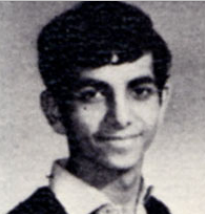 written that despite being afflicted with an acute speech impediment during childhood, which isolated him socially, he was able to thrive academically at the College de Frere elementary school in Jaffa . At the age of fourteen, shortly following the Arab-Israeli War of 1967 (also known as the Six-Day War) he, his parents, and seven siblings emigrated to Canada, settling in Toronto. While attending the Georges Vanier High school just north of the city, Benny became involved in a religious group that planted the seeds of his evangelical career. Attending prayer meetings regularly, where he occasionally taught the Gospel. Hinn “surrendered his heart and life to Jesus Christ,” becoming a born-again Christian in February of 1972. His parents feared he was becoming a “fanatic,” particularly after he dropped out of high school the same year (“About” n.d.). Shortly thereafter, Hinn underwent two more transformative experiences; the first occurred when he claimed to have received a divine appeal to minister the Gospel. The second occurred in December of 1973 during a trip to Pittsburgh , Pennsylvania where he attended a healing service conducted by Kathryn Kuhlman. Hinn claims that while on the pilgrimage, he was assigned to assist an elderly woman crippled by arthritis who, before his eyes, lost “all pain in her legs and ‘untwist[ed]’, as he put it (Bloom 2003:3). Recalling this experience, Hinn acknowledges Kuhlman’s influence in driving him toward
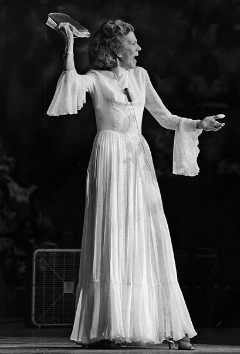 faith healing. He would eventually author a book titled Kathryn Kuhlman: Her Spiritual Legacy and Its Impact on my Life, displaying an inspiration also apparent in his adoption of techniques used in her services, such as “her practice of ‘slaying in the Spirit’ and her use of ‘word of knowledge,’ both of which Hinn uses extensively.” Hinn has stated that Kuhlman has “appeared to him from beyond the grave to give him encouragement and ministerial direction,” although he never met her in person, and those familiar with the services of the two healers have noted a similarity in their manners of speaking, stage presence, and even choice of wardrobe (Peters 2009:1). Upon returning to Toronto with a crystallized mission, Hinn began preaching evangelical services on a local television program. The program’s success led him to expand his teaching to Orlando, Florida (“Do You Believe in Miracles” 2004).
Hinn moved to Orlando 1979, where he met Suzanne Harthern, the daughter of a local pastor, and the two were married on August 4 of that same year. He founded the Orlando Christian Center in 1983; he developed and refined the structure of his self-proclaimed “faith healing” services, propelling him to international recognition. Throughout the decade, Hinn’s ministry grew steadily. He began conducting services in venues across the globe, eventually undertaking scheduled tours that he referred to as “miracle crusades” (Bloom 2003:4). His first nationally televised healing service aired in 1989 from Flint , Michigan , the success of which landed him a television show, “This Is Your Day,” which typically features, in addition to the reading of and responding to viewers’ letters, highlights from Hinn’s miracle crusades (Peters 2009). By the time he passed leadership of the Orlando Christian Center (since 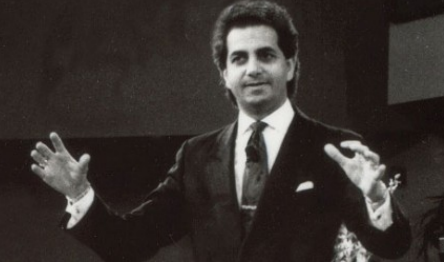 renamed the World Outreach Center) to Clint Brown in 1999, the success of “This Is Your Day,” along with that of his book, Good Morning, Holy Spirit (1990), had projected Hinn to levels of recognition unprecedented in his career. On his increasingly frequent crusades, he would fill stadiums and auditoriums capable of holding thousands of believers and skeptics alike, sometimes multiple times a day.
Hinn had also begun to attract the attention and support of celebrities. One of these was former World Heavyweight Champion boxer Evander Holyfield, who attended one of Hinn’s services in Philadelphia, Florida, seeking a cure for a recently-diagnosed heart condition that had endangered his career. At the service, held on June 10, 1994, Holyfield was invited on stage. After Holyfield described the nature of his disorder, Hinn reportedly laid his hands on him and, “in full view of the 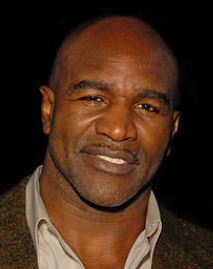 thousands of people in the audience, shook his head and told Evander that there was nothing wrong with his heart” (“You are healed…” 2011). Shortly thereafter, Holyfield underwent an extensive series of tests at the Mayo Clinic, which determined that rather than having been born with a heart condition, the complications had arisen from improper medication following his last fight, but that it was nonetheless a miracle that he had survived and healed so quickly. Holyfield subsequently reimbursed Benny Hinn Ministries with a check for $265,000, and he has spoken out in support of Hinn on multiple occasions.
Following Hinn’s resignation as leader of the World Outreach Center in 1999, he and his family relocated to Grapevine, Texas. On February 1, 2010, Hinn and his wife, Suzanne, filed for divorce, citing “irreconcilable differences.” However, when brought together at a family reunion in 2011, the couple began to settle their disagreements, and the two were remarried at the Holy Land Experience Church in Orlando, Florida on March 3, 2013. They settled in Southern California, “strategically near the ministry-owned television studio and church in Aliso Viejo” (“Benny Hinn Author Profile” n.d.).
DOCTRINES/BELIEFS
The doctrines that Benny Hinn professes in his ministry are eclectic and unsystematic as they are a drawn from various individuals and variants of Christianity. Hunt (2000a:74) characterizes Hinn’s ministries as constituting “almost a `movement within a movement’ and have their own style and ethos, beliefs and practices that are exemplified by the `health and wealth’ gospel which, in many respects, is congruent with contemporary cultural values.” The ministry has also been described as Evangelical “on the fringe of Pentecostalism” (Bloom 2003:2). In developing his distinctive theology, Hinn has often made claims that he asserts stem from Divine Revelation. Some of these revelations, such as “that women were originally designed to give birth out of their sides and that there are nine members of the Godhead” distance him considerably from conventional Christian teachings (Peters 2009:2; Stewart n.d.). In recent years, Hinn has increased the prominence of Gospel teaching in his services despite lacking formal education or ministerial training. He has also issued a number of prophetic statements, such as predicting an imminent endtime and the destruction of homosexuals, which subsequently were not confirmed. At the same time, however, Hinn does not claim to personally possess any prophetic or healing capabilities, but rather he asserts that God speaks to and acts through him (Fisher and Goedelman 1996).
Healing services are at the heart of Hinn’s ministry, and they rely heavily on the Prosperity Gospel and Word of Faith doctrines, which have now spread worldwide (Hunt 2000a, 2000b). In North America, this tradition is represented by figures such as Kenneth Hagin (widely regarded as the “father” of Word of Faith movement), Kenneth and Gloria Copeland, Rodney Howard Brown, and Paula White.
Word of Faith doctrine teaches that spiritual knowledge is ultimate truth and is superior to empirical or sense knowledge. In some strands of the tradition, upon which Hinn draws, God established certain rights for all humans at the time of creation, and God honors those rights. The rights, which were lost at the Fall of humankind, may be regained and activated in the present day through prayer and the force of faith. God will grant believers personal health (physical, emotional, or relational) and prosperity if they express committed faith through “positive confession.” As Hunt (2000a:74) summarizes the doctrine, “the teachings insist that God provides for their physical and material needs, along with their spiritual needs, if His commandments are heeded and there is sufficient faith.” Examples of common positive confessions related to prosperity include “I’ll never be broke another day in my life,” I am expecting supernatural increase this week,” and “I am expecting supernatural debt cancellation this week” (Harrison 2005:4).
A basic belief is that “spoken words are containers of the substance of faith,” and that those with faith can actually talk actions, objects, or circumstances into reality (Peters 2009:2). The spoken word, “rhema,” refers to “the direct revelation of God’s intents, purposes, promises, power, and very character through scripture…” (Harrison 2005:7). Believers express their needs and promises to God as acts of faith and agreements with God, and these may be confessed before they become material realities. As Benny Hinn has asserted, “faith works as a mighty power or force,” and health, healing, and prosperity can be obtained through, and only through, faith (“Benny Hinn” 1997). If positive confessions are not realized, believers typically conclude that results have been impeded by a lack of faith, a failure to follow God’s word, or a “negative confession.”
RITUALS/PRACTICES
The pivotal ritual events organized by Benny Hinn Ministries are faith healing services. Hinn began shaping his preaching 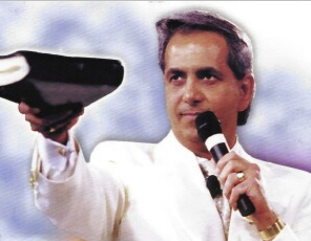 technique after founding the Orlando Christian Center in 1983. Prior to conducting healings, Hinn would dramatically recite scripture in a manner sources have compared to “tent revival meetings of the 19th century,” often also speaking in tongues. He later abandoned glossolalia when his services began to be televised (Bloom 2003:5).
A typical contemporary Benny Hinn Ministries healing service begins in a dimly lit sanctuary with a soft musical backdrop and a repeated vocalization of:
“He touched me, oh, He touched me,
And, oh, the joy that filled my soul!
Something happened and now I know
He touched me, and made me whole…”
Hinn then enters the stage to the strains of the spiritual song “How Great Thou Art.” An animated Hinn moves around the stage announcing the presence of God and the healing potential in the building. He also typically speaks of the current and future state of a sinful world, often noting or predicting natural disasters and disease that are signs of God’s displeasure with human sinfulness. Hinn offers protection to those with faith in the power of the Lord (Bloom 2003:5; Nickell 2002). At some services Hinn has gone into a trance-like state during which he has proclaimed that God is speaking to him, that angels are present in the room, or that demons are flying out of the building.
During the healing portion of services Hinn will typically heal members of the audience “en masse” from the stage. He may announce a specific ailment, such as cancer, the “demon of suicide,” or even witchcraft that is being expelled from the arena. Alternatively he may refer to an area of the body or a section of the audience that is being healed. Hinn also has proclaimed that “he need not name every disease or body part, that God’s power was affecting a multitude of cures all over the arena” (Nickell 2002; Hunt 2000). Consistent with the Word of Faith tradition, healing extends beyond physical conditions to financial circumstances. As Hunt (2000:82) notes, “ There may be an attempt to deal with bank overdrafts or financial insecurity. Bank balances may be commanded to `come in line’ with the `power of Jesus’. Being `in the red’ may be dismissed as `a lie of the devil’. Hands might be lain on members of the congregation for the ‘multiplying of finances’, to cast away `a spirit of unbelief’, to combat `harassing circumstances’ in peoples’ lives by `coming against’ the evil spirits responsible.”
Hinn invites individual members of the audience on stage for personal healings as well. The persons to be healed will provide a 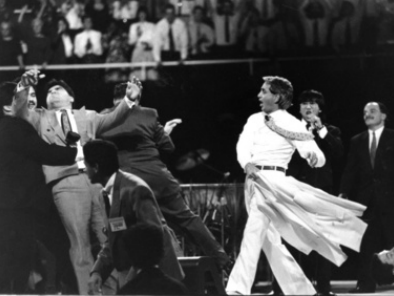 quick synopsis of the condition for which they seek cure. Hinn responds with a prayer or short sermon-like comment. One of Hinn’s “catchers” then stands behind the person as Hinn touches the person’s forehead or holds his or her face between his thumb and forefinger. The person being healed usually falls to the stage floor, sometimes lying motionless and sometimes trembling. The person being healed may then get up and demonstrate some sign of their healing, such as jumping or running around the stage. Hinn conducts several dozen personal healings during each service. It is commonplace for members of the congregation to be slain in the spirit during the service.
In addition to healing services, Benny Hinn Ministries offers internet prayer services. These services, often termed “ePrayers,” have been made available to anyone and can be used with any electronic device with internet access, including computers, tablets, and cellular smartphones (Cooper 2014). The Benny Hinn Ministries’ “Prayer Request” form can be accessed from the homepage of the organization’s website. It requires the user to fill out basic information, such as his or her name, country, and email address before focusing on  the prayer itself. The user must identify for whom the prayer is being submitted and, from a dropdown box, choose the general nature of the prayer request. The box includes an alphabetized list of “needs” from alcohol and drug abuse, to various illnesses, to “the current world situation” (“Prayer Request” 2014). Located below is a box labeled “Prayer Details” where, using a maximum of 1,000 characters, the person submitting the prayer is able to elaborate upon the request. Upon submitting the prayer, the request is documented on a separate webpage, where it can be seen by any given member of a group of Benny Hinn Ministries’ affiliates titled the Mighty Warriors Prayer Army (MWPA).
The MWPA consists of a group of volunteers whose specific and sole responsibility is to fulfill online prayer requests. MWPA members are volunteers who agree to several terms and conditions outlined on Ministries’ webpage. These include a vow to pray at least fifteen minutes per day for those who seek prayer assistance through Benny Hinn Ministries; for Benny Hinn, his family, and the Ministries; for the nation and government; and for fellow “prayer warriors” (Hinn 2014). Hinn claims that with thousands of MWPA members worldwide, prayer requests are fulfilled twenty-four hours per day. However, Hinn has also addressed a larger goal than simply creating a platform for easily-accessible prayer services. He has called for the creation of a prayer community so vast and effective that it will precipitate divine intervention, predicting that “millions will be swept into the kingdom of God and His power will be unleashed for the miraculous as never before” (Hinn 2014).
ORGANIZATION/LEADERSHIP
Benny Hinn began preaching in Toronto , hosting prayer services and eventually a local television show. His success led him to 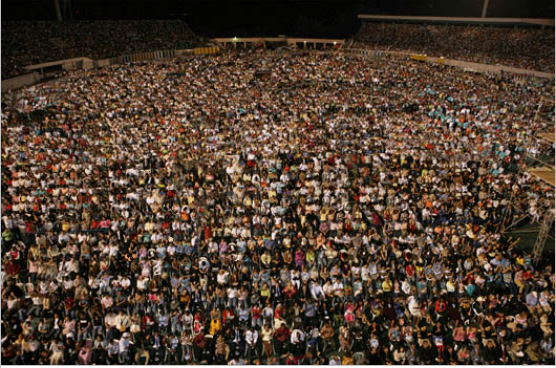 Orlando, Florida, where he founded the Orlando Christian Center in 1983 and began to build his ministry (“Biography: Benny Hinn” n.d.). The church grew rapidly almost immediately and soon required multiple Sunday services to accommodate the growing number of worshipers. Hinn began undertaking Miracle Crusades in the latter half of the decade, holding healing services in large venues across the United States, and later internationally, attracting tens of millions annually (“Benny Hinn Author Profile” n.d.). Benny Hinn’s celebrity status expanded even further following the success of his television show, “This Is Your Day,” which began airing in 1990 on the Trinity Broadcasting Network. At its peak, Hinn’s Center in Florida attracted audiences of over 10,000. However, as his tours gained momentum, Hinn spent more and longer stretches of time traveling (Okello-Kampala 2007).
In 1999, Hinn handed over the church to Clint Brown, “while retaining legal ownership of the ‘World Outreach Center Benny Hinn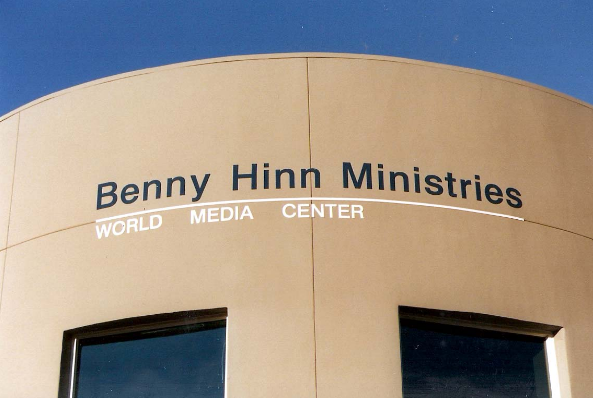 Ministries.” He moved his headquarters to Grapevine, Texas where he claimed God had told him to construct a World Healing Center in Irving. However, the center was never built, and Hinn and his wife subsequently moved to Southern California. There Hinn began hosting his television show “This Is Your Day” from the Ministries’ owned and operated studio, the World Media Center, in Aliso Viejo. Hinn’s thirty-minute program is broadcast on a number of different television networks, including Trinity Broadcasting Network, the Daystar Television Network, Grace TV, and The God Channel. It airs daily in two hundred countries. He reaches millions of followers each year through his television program, Miracle Crusades, online sources, numerous literary works, and the sale of recorded sermons and healing sessions. Hinn claims to have communicated God’s message to over a billion people during his thirty-year career.
ISSUES/CHALLENGES
Benny Hinn Ministries has faced opposition from three primary sources: governmental and private agencies that are chiefly concerned with religious group financial practices, Christian organizations that have called into question Hinn’s claims of miraculous healing and the validity of his interpretation of the Gospel, and media outlets that have frequently challenged both.
Because Word Faith groups are non-denominational, there is no denominational scrutiny of their organizational practices. Throughout his career, Hinn has been under the scrutiny of the Trinity Foundation, a Dallas , Texas based organization that investigates the financial practice of televangelists. In 2005, the organization contacted the IRS concerning Benny Hinn Ministries’ status as a tax-exempt religious organization, claiming that it did not meet exemption guidelines because it is not an actual church. Headed by Ole Anthony, the Foundation posited not only that the Ministries failed to hold regular services, but also that it did not have a stable foundation of directors and therefore lacked legitimacy as a legal religious organization. Further, the Trinity Foundation questioned the appropriation of the Ministries’ supposed $100 million annual income, alleging that Hinn has appropriated money donated to the organization for personal use. At roughly the same time, another “watchdog group,” the Wall Watchers, contacted the IRS with similar allegations regarding Benny Hinn Ministries. According to the Ministries, the IRS responded by sending them a letter that included a series of questions regarding the leadership of the organization, but never conducted a formal audit. Neither the Ministries nor the IRS released Hinn’s response to the letter, but it was reported that the organization cooperated fully and was able to retain its exemption status (Wrolstad 2005; Martin 2005). Benny Hinn Ministries was subject to several such investigations in the following years, perhaps most notably in 2007 when he and five other televangelists were investigated by United States Senate Committee on Finance. On November 6, Senator Chuck Grassley announced the investigation on the grounds that those under scrutiny had abused their tax exemptions for personal gain. The six churches, among them Benny Hinn Ministries, Paula White Ministries, and Creflo Dollar’s World Changers Church, received letters from the Senate committee, posing questions regarding the allocation of church donations and requesting transparency of financial documents. While Hinn initially resisted the inquiry, he eventually agreed to “ fully cooperate…with the investigation and even implemented financial reforms,” and the three-year investigation was closed in January of 2011 (Garcia 2011).
Hinn has also faced opposition from a number of individuals and groups, both within and beyond the Christian community, for a reported refusal to join the Evangelical Council for Financial Accountability. The ECFA, with over 1,1000 members, including Billy Graham and Pat Robertson, requires a degree of financial transparency, aiming to “earn the public’s trust through adherence to seven standards of accountability” (“Do You Believe in Miracles” 2004). Paul Nelson, the CFO of the organization, has reported that Benny Hinn’s extravagant lifestyle and secrecy regarding financial documents and funds appropriation in spite of repeated inquiries have “invited IRS scrutiny” (Wrolstad 2005).
Hinn has rejected allegations of financial impropriety. For example, The Fifth Estate investigatory team obtained financial records from individuals within the Ministries who stated that they “want the public to know how Benny Hinn spends the money entrusted to him” (“Do You Believe In Miracles” 2004). The records the journalists obtained showed what were deemed extravagant travel expenses as well funds given to Benny Hinn, with no reasons specified. Hinn addressed these accusations by stating that the documentary’s portrayal of his traveling expenses was misleading as it failed to take into account expenditures that were deeply discounted and services that were provided to the Ministries free of charge.
Concerns over financial practices have continued. Despite the estimated $100-200 million the Ministries receives annually in donations, in April of 2013, Benny Hinn called upon his supporters to donate $2.5 million, which Hinn claimed would be matched by an undisclosed donor, to lift the organization out of debt (Zaimov 2013a). Earlier in the month, Hinn reportedly asked the attendees, who numbered in the thousands, of a service in Trinidad and Tobago to each donate $100 to the Ministries in order to fund the crusade.
Benny Hinn has also been vulnerable to criticism because he never received formal biblical training or education, rather claiming 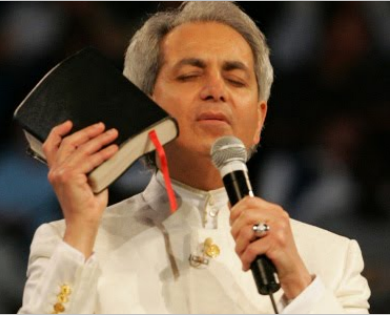 his knowledge to come from the Holy Spirit itself. Conservative Christian critics assert that his teaching of the Gospel is flawed, particularly his acceptance of Word Faith doctrines. They contend that Word Faith adherents, such as Benny Hinn, do not preach the Gospel, but rather, they shape the teachings of the Bible to fit their specific purpose, selecting scripture “out of context and apply[ing] it to a personal interpretation which is claimed to have been given by direct revelation from God” (“Benny Hinn” n.d.). One of the most disputed teachings of Hinn and the Word Faith Movement involves the belief that that Jesus Christ died a spiritual as well as physical death in atonement for the sins of humanity and “descended to Hell where He was tortured” before becoming reborn (Peters 2009:2). Critics have rejected this claim, deeming it heretical and asserting that because God cannot simply cease to be, the spiritual death of Christ would prove that he is not God. Another such teaching is the Little gods Doctrine. Taken from Bible passages such as II Peter 1:4 and John 10:31-39, the “Little gods Doctrine” asserts that since God created humans in his exact likeness, believers are actually “little gods,” who, with faith, are incapable of suffering from illness or poverty (Gilley 1999). This Word Faith interpretation contradicts more traditional interpretations of numerous Bible passages, such as Psalms 50:1 and Romans 16:27. These passages state that there is only one God and humans being created in God’s image “means we as humans have the capacity through a saving relationship with Jesus Christ to know God,” the traditional interpretation of the verse. Further, the Little gods Doctrine is rejected because “not everyone who loved and served the Lord walked in perfect health” and that God does not intend his followers to “be physically healed in this life” (Peters 2009:3).
Benny Hinn Ministries has been the target of several media investigations. The first occurred in 1993. Conducted by Inside Edition , 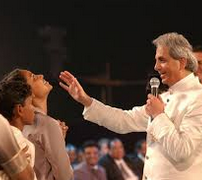 hosted by Bill O’Reilly, the investigation called into question the legitimacy of Hinn’s healings, following up with individuals who had supposedly been healed at one of Pastor Benny’s services. The report stated, for example, that a man who apparently had been miraculously cured of brain cancer on stage found that the tumor was still present after an examination by his doctor; a woman who believed she had been cured of lung cancer refused medical treatment and died two months after she attended a Benny Hinn healing service in Houston; and the doctor of a woman “cured” of deafness reported that she had never actually been deaf at all. Following the airing of this investigation on March 2, 1993, Hinn made a number of media appearances, including an interview on the 700 Club with Pat Robertson. In that interview he vowed to make changes in his ministry, acknowledging the mistakes he had made. In the same year, Ole Anthony of the Trinity Foundation traveled to Florida to interview Hinn. Hinn asserted that he would begin medically verifying all miracles prior to airing them on his program and that he would return to teaching the Gospel. However, shortly after the dust had settled, according to Ole Anthony, Hinn was “back to his old tricks” (Bloom 2003:8). A number of similar investigations were conducted by media programs, including a 2001 documentary aired on HBO titled “A Question of Miracles,” in which reporters followed up on 76 putative healings that occurred during a service in Portland, Oregon. Despite having claimed to possess medical verification for the healings, Hinn withheld the documentation. Several months later, Hinn produced only a list of five names. Upon conducting follow-up interviews with the crusade attendees and their medical examiners, the reporters found results similar to those of the Inside Edition investigation. Another such investigation was conducted by Dateline at a Las Vegas healing and again, the crew tried to contact the five individuals, whose names were provided by Hinn, who reportedly had been healed. Four refused to share their medical records and the fifth, a woman who had purportedly been healed of Lou Gehrig’s Disease at a Hinn crusade, had been misdiagnosed. Possibly the largest news media investigation of Benny Hinn Ministries was conducted in 2004 by the Canadian Broadcasting Corporation’s The Fifth Estate. The documentary, “Do You Believe in Miracles,” used hidden cameras and interviews with former Benny Hinn Ministries’ employees and crusade audience members to assess Hinn’s healing claims, as well as to probe his financial practices. The documentary revealed, for example, a screening process by which audience members were carefully selected for appearance on stage. Those who were visibly handicapped physically, for example, were consistently turned away, presumably to avoid disconfirmation. Hinn has responded to allegations regarding his healing practices, stating that it is not he, but God, who heals the individuals; his crusades simply provide a channel through which those who are ill may become recipients of the Lord’s gift. Successful healing requires complete faith in God’s power and not on Hinn’s personal power.
Despite the substantial controversy surrounding Benny Hinn Ministries, millions of believers from across the globe flock to his  crusades and tune into his daily television show in hopes of experiencing a miracle. “This Is Your Day” is now broadcast in 200 countries, and Hinn undertakes regular Miracle Crusades across the globe. In 2007, Hinn held the largest recorded healing service in history in Mumbai, India, with estimates ranging from five to seven million attendees over the course of the three day “Festival of Blessings” (“Benny Hinn: India Healing Crusade” n.d.). The Ministries receives an estimated $100-200 million in donations annually and contributes heavily to various crisis relief efforts, mission organizations, and schools and orphanages, claiming to “support…over 40,000 children each day” (“How Much Money Does Benny Hinn Make?” (“Salary & Net Worth” n.d.). Hinn also recouped some stature within the Evangelical community when he remarried his former wife in front of an audience of over 1,000 (Zaimov 2013b).
REFERENCES
“Benny Hinn” n.d. Biblical Discernment Ministries. Accessed from http://www.rapidnet.com/~jbeard/bdm/exposes/hinn/general.htm on 25 May 2013.
“Benny Hinn Author Profile.” n.d . New Release Tuesday. Accessed from http://www.newreleasetuesday.com/authordetail.php?aut_id=496 on 25 May, 2013.
“Benny Hinn: India Healing Crusade.” n.d. 700 Club. Accessed from http://www.cbn.com/700club/Guests/Bios/Benny_Hinn_110404.aspx on 25 May 2013.
“Benny Hinn Ministries” n.d. Apologetics Index. Accessed from http://www.apologeticsindex.org/h01.html on 25 May 2013.
“Benny Hinn Ministries – World Media Center.” n.d. Patch. Accessed from http://alisoviejo.patch.com/listings/benny-hinn-ministries-world-media-center on 25 May 2013.
“BIOGRAPHY: Benny Hinn.” n.d. The Fifth Estate. Accessed from http://www.cbc.ca/fifth/amazinggrace/hinn.html 25 May 2013.
Bloom, John. 2003. “The Heretic.” The Trinity Foundation. Accessed from http://www.trinityfi.org/press/heretic.html on 26 May 2013.
Cooper, Travis. 2014. “ePrayer and Online Prayer Rituals.” In The Materiality of Prayer, edited by Anderson Blanton. The Social Science Research Council. Accessed from http://forums.ssrc.org/ndsp/2014/01/13/eprayer-and-online-prayer-rituals/ on 22 January 2014.
“DO YOU BELIEVE IN MIRACLES?” n.d. The Fifth Estate. Accessed from http://www.cbc.ca/fifth/main_miracles.html on 25 May 2013.
Garcia, Elena. 2011. “Benny Hinn Sued by Publisher Over Alleged Relationship with Paula White.” The Christian Post, February 18. Accessed from http://www.christianpost.com/news/benny-hinn-sued-by-publisher-over-alleged-relationship-with-paula-white-49060/ on 26 May 2013.
Harrison, Milmon. 2005. Righteous Riches: The Word of Faith Movement in Contemporary African American Religion. New York: Oxford University Press.
Hinn, Benny. 2014. “Mighty Warriors Prayer Army.” Benny Hinn Ministries . Accessed from http://www.bennyhinn.org/mwia/ on 22 January, 2014.
Hunt, Stephen. 2000a. “Dramatising the ‘Health and Wealth Gospel’: Belief and Practice of a Neo-Pentecostal ‘Faith’ Ministry.” Journal of Beliefs & Values 21:73-86.
Hunt, Stephen. 2000b. “’Winning Ways’: Globalization and the Impact of the Health and Wealth Gospel.” Journal of Contemporary Religion 16:88-105.
Martin, Allie. 2005. “Benny Hinn the Subject of IRS Inquiry.” AgapePress. Accessed from http://www.ministrywatch.com/pdf/article_071205_hinninvestigated.pdf on 25 May 2013.
Nickell, Joe. 2002. “Benny Hinn: Healer or Hypnotist?” Skeptical Inquirer. Accessed from http://www.csicop.org/si/show/benny_hinn_healer_or_hypnotist/ on 25 May 2013.
Okello-Kempala, Raphael. 2007. “ Uganda : Benny Hinn Has a Gift for Country.” Accessed from http://watchmanafrica.blogspot.com/2007/05/pastor-joseph-serwadda-says-benny-hinn.html on 25 May 2015 .
Peters, Justin. 2009. “Benny Hinn.” Watchman Fellowship. Accessed from http://www.watchman.org/profiles/benny-hinn/ on 26 May 2013.
“Prayer Request.” 2014. Benny Hinn Ministries. Accessed from http://www.bennyhinn.org/prayer/prayer-request on 22 January 2014.
Stewart, David J., n.d. “Benny Hinn’s Hidden Heresies.” Accessed from http://www.jesus-is-savior.com/Wolves/benny_hinn-hidden.htm on 25 May 2013 .
Wrolstad, Mark. 2005. “IRS questions Hinn’s Tax-Exempt Status.” The Dallas Morning News, July 6. Accessed from http://trinityfi.org/press/hinn07.html on 25 May 2013.
Zaimov , Stoyan. 2013a. “Benny Hinn Asks Followers for $2.5 Million to Get Out of Debt.” The Christian Post, April 26. Accessed from
http://www.christianpost.com/news/benny-hinn-asks-followers-for-2-5-million-to-get-out-of-debt-94822/ on 26 May 2013.
Zaimov, Stoyan. 2013b. “Benny Hinn Remarries in Front of 1,000 People.” The Christian Post, March 4. Accessed from http://www.christianpost.com/news/benny-hinn-remarries-in-front-of-1000-people-91218/ 25 May 2013.
Publication Date:
26 December 2013

 pastor. Zwingli was popular, and many hoped that he would move quickly to do away with all rituals for which there was not a clear scriptural basis. Nevertheless, Zwingli felt that secular authority should guide reform, and he refused to proceed without the consent of the Zurich City Council, which had taken charge of the church. Zwingli’s decision seemed to privilege secular authority over scriptural and angered several of his young students, most particularly Conrad Grebel (ca.1498-1526), the son of a prominent Zurich family; Felix Manz (ca. 1498–January 5, 1527), another well-educated Zurich native; and Georg Blaurock (ca. 1492-September 6, 1529), a former priest. The conflict between students and teacher ultimately came to a head over the issue of infant baptism, a practice that not only had religious significance but also helped to ensure that children were entered into state records. In other words, it served a secular purpose as well as a religious one, creating both church members and citizens of the state. Grebel, Manz, Blaurock and their followers argued that, because infant baptism was not mentioned in scripture, it had no place in the church. They asserted baptism should be undertaken as a sign of one’s commitment to the church. Further, they argued, the church should be a believers’ church, a position that many in authority feared would bring anarchy. In January, 1525, the Zurich City Council enacted laws requiring that infants be baptized and forbidding the rebaptism of those who had been baptized as infants. In response, Grebel, Manz and Blaurock, rebaptized each other and launched the Anabaptist movement (Hostetler 1993; Hurst & McConnell 2010); Johnson-Weiner 2010; Kraybill et al 2013; Loewen and Nolt 1996; Nolt 2016).
 interact with and even marry non-Mennonites, and he chastised congregations for their apparent failure to shun expelled members. Most of the Mennonite preachers and congregations in Switzerland and the Palatinate region rejected Amman’s call for greater separation from the world, and so, in 1693, Amman excommunicated them. Twenty of the twenty-three Alsatian ministers, along with one in the Palatinate and five in Germany, supported Amman. They and their congregations became known as Amish Mennonites, or, simply, Amish (Nolt 2016).
 the Ausbunds (hymnbooks) are put out on the benches as well.
 regulates much of daily life. While church members will acknowledge that not everything in the Ordnung is scripturally based, what cannot be supported by reference to the Bible is justified by the feeling that to do otherwise would be worldly and disruptive to the community.
 appliance saves the owner time does not necessarily recommend it, nor does it being “modern” condemn it. The question is simply how it will affect the church-community. Most Amish communities use some battery-powered devices, notably flashlights, as well as diesel motors. Some Amish communities have even permitted solar power. Nevertheless, all have determined that connecting the Amish home to power lines “could lead to many temptations and the deterioration of church and family life” (Hostetler 1993; Hurst and McConnell 2010; Johnson-Weiner 2010; Kraybill 2001; Kraybill et al 2013; Nolt 2016; Nolt and Meyers 2007).
 public schools, most attend small one or two-room schoolhouses in their own communities, where they are taught by teachers of their own faith [See photograph of Amish school at right]. While teachers’ meetings in many communities provide teachers with some training and support, in the most conservative Amish settlements, teachers are likely to be young, unmarried, girls from the community with little or no formal training. In their eight years of formal education, Amish children learn English, arithmetic, German, and maybe geography and health. The important lessons (how to manage the farm and the household, how to raise the children, how to be responsible and work hard) are learned at home, where children participate in work, play, and ceremony to the extent of their abilities (Dewalt 2006; Johnson-Weiner 2007).
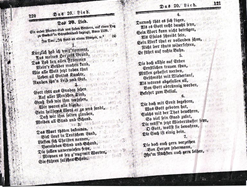 scripture is the final authority. Amish church services are conducted in German, and all Amish sing from the Ausbund [See scan of pages from Ausbund at right], a hymnbook first printed in 1564 that contains songs written by early Anabaptists. The Lobelied, a hymn of praise, is always the second song in the service, but more conservative congregations sing it far more slowly than more progressive ones. The Ausbund does not contain melodies for the songs, and tunes are passed down from one generation to the next, further uniting the community (Hostetler 1993; Kraybill et al 2013).
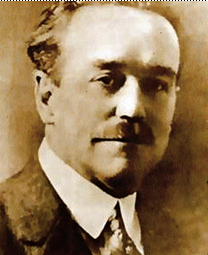 and Ann’s third son, Charles, was born, William was a horse collar maker and painter by trade. Five years later the family moved from Muscatine County, Iowa to Sedgwick County, Kansas, enabling William to join in the agricultural wheat boom of the area.
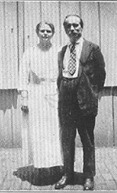 Tonganoxie , Kansas during his first year in the ministry. Her father was influential in teaching Parham about an evangelical view of hell that depicts the total annihilation of the wicked rather than the traditional doctrine of hell of being eternally separated from God.
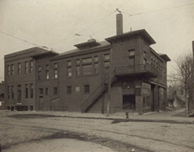 healing, prophecy and various other topics mainly focused on teaching those who were previously involved in religious work. The Healing Home also offered a temporary orphanage that helped to find Christian homes for the orphan children. An ad hoc employment bureau focused on connecting Christian employees with Christian employers. There were fourteen rooms on the second floor that served as living quarters for the Parham family and for the ill and disabled residents. Resident fees ranged from four to seven dollars per week depending on ability to pay; however, there were other options if a person or family was too poor to pay the fees.
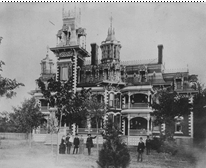 offered him the opportunity to rent an unfinished mansion in Topeka, often referred to as “Stone’s Folly,” which they had purchased from its previous owner, Erastus R. Stone. Parham agreed to rent the mansion from the Society. On October 15, 1900, he opened Bethel Bible College “with about three dozen persons, including “students” and their children in attendance. Most all of them were ministers or religious workers from Methodist, Baptist, Quaker and independent Holiness Churches and Missions and all were seeking a new experience of the Spirit for evangelistic work” (Anderson 1979:51).
 That congregation began the process of having the building listed on the National Historic Register. Members have restored the chapel and regular worship services are being held on Sundays and Wednesdays under the name of Tree of Life Fellowship. There are plans to continue restoring the rest of the building to its original design. Healing rooms and a memorabilia room are expected to open as part of the continuing restoration.
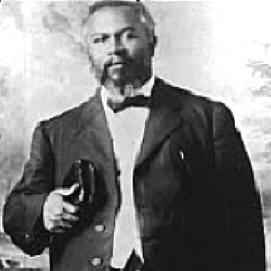
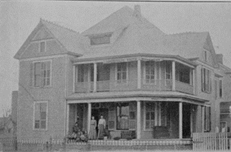 Houston, which at the time was the largest city in Texas. In December, 1905, he opened a ten-week Bible school in a large house on the corner of Rusk and Brazos Streets.
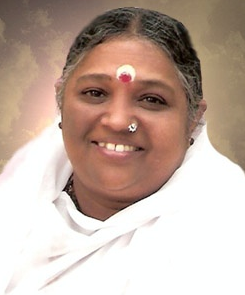 possessing extraordinary powers. According to these accounts, the signs of Sudhamani’s future spirituality began prior to her birth. During pregnancy her mother “began having strange visions. Sometimes she had wonderful dreams of Lord Krishna. At others she beheld the divine play of Lord Shiva and Devi, the Divine Mother” (Amritaswarupanada 1994:13). When Sudhamani was born she had a dark blue complexion and would lay in the lotus position of hatha yoga (chinmudra). By the time that she was six months old “she began speaking in her native tongue, and at the age of two began singing devotional songs to Sri Krishna…[E]even at an early age Sudhamani exhibited certain mystical and suprahuman traits, including compassion for the destitute. In her late teens, she developed an intense devotion to and longing for Krishna…sometimes she danced in spiritual ecstasy, and at other times she wept bitterly at the separation from her beloved Krishna” (Raj 2004:206). Sudhanami reportedly was so absorbed with Lord Krishna that “If she suddenly realized she had taken several steps without remembering Krishna, she would run back and walk those steps again, repeating the Lord’s name” (Johnsen 1994:95).
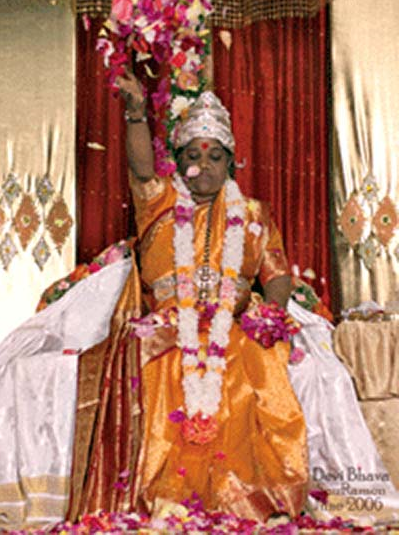 by a female disciple who performs the ritual foot worship (pada puja) by sprinkling water on Ammachi’s feet, then placing sandal paste and flowers on them. Two monks recite from the Sanskritic slokas, followed by the ceremonial waving of a lamp. Another devotee decorates Ammachi with a garland. There is a lecture on Ammachi’s message and spirituality. Finally, Ammachi and an Indian band lead the devotional singing (bhajan). After a period of meditation, Ammachi’s devotees are invited to approach her individually for her trademark embrace.
 Amma embraces or kisses someone, it is a process of purification and inner healing. Amma is transmitting a part of Her pure vital energy into Her children. It also allows them to experience unconditional love. When Amma holds someone it can help to awaken the dormant spiritual energy within them, which will eventually take them to the ultimate goal of Self-realization” (Raj 2005:136-7). One of Ammachi’s devotees communicates the power of this encounter as follows: “Ammachi gives all the time, twenty four hours a day…She lavishes her love freely on everyone who comes to her. She may be firm with them, but she always radiates unconditional love. That’s why people are so shaken after they meet her. She’s a living example of what she teaches, of what all the scriptures teach” (Johnsen 1994:100).
 Two years later Amritapuri, her first formal ashram, was constructed. The ashram has continued to grow and now includes a temple a large dormitory. There are several hundred permanent residents and several hundred more visitors along with a small coterie of initiated, renunciate sannyasis and sannyasinis. The permanent residents at Ammachi’s ashrams, brahmacharins, follow a strict program of discipline (tapas), which “stipulates eight hours of meditation daily in addition to constant social service activities.
 positions. According to Raj (2005:130), “Western disciples seem more attracted to the asceticism of Ammachi’s spirituality….Indians seem more drawn to the devotional tradition Ammachi embodies.” The highest levels of movement leadership continue to be held by male renunciant devotees. Converts from Siddha Yoga and Transcendental Meditation are commonplace (Raj 2004:210).
 yoginis has topped 20,000,000, up 4,000,000 since an earlier 2012 study. (YJ Editors 2017). [Image at right] According to this source, over eighty percent of practitioners are women; over sixty percent are between eighteen and forty-four. One third of practitioners have been practicing for three years or less. Yoga’s connection to the current exercise and fitness movement is reflected in the finding that health, conditioning, fitness, and stress relief were all mentioned as motivations by more than half of practitioners surveyed.
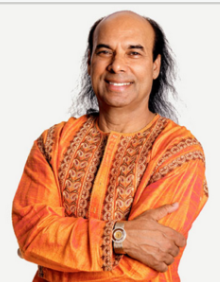
 Rajashree Chakrabarti. (Image at right) Chakrabarti had won the National India Yoga Championship. The couple had a daughter, Laju, and a son, Anurag. Rajashree Choudhury is a yoga therapist and founded the U.S. Yoga Federation and the International Yoga Sports Federation. One of her goals has been to gain acceptance of Yoga as an Olympic event.
 any yoga practice carried out in a heated environment. [Image at right] Proponents of Hot Yoga assert that the heat and resulting sweating are cleansing and loosen tight muscles. Proponents see the high energy/high exertion style of Hot Yoga as quintessentially American. As one yoga instructor put it: “On some level, we’ve Americanized yoga. People are living very frenetic lives, and our nervous systems are used to that…. it’s only logical that a nation of multitaskers would want to do a number of things at once: working out, sweating, balancing and stretching (Theiss 2013).
 eighty four classical yoga poses and are always performed in the same order. [Image at right] When students walks into the studio with their towels and wash cloths in hand, they are immediately struck by a heat wave, as the studios are kept at temperatures ranging from 90 to 105 degrees Fahrenheit. Choudhury believes that this allows the muscles to heat up more quickly, which, in turn, will assist his students in their poses.
 began teaching in the winter in Japan, he claimed that his studio was so cold that his muscles did not work correctly. However, when he heated the small room up, he found that his muscles were able to move more freely. Later, when he was teaching in Hawaii, much warmer outside than Tokyo, he found a similar result. The studio had been so air conditioned that his muscles simply did not move the way he wanted them to. So, in the middle of hot and sunny Hawaii, Bikram turned off the AC and turned on the heat. Further, “As an added benefit, the saunalike temperatures heightened their sense of euphoria and purification after workouts” (Martin 2011). This simple temperature change was a major part of the founding of Bikram Yoga.
 ng students to quickly become certified as teachers. After they completed a rigorous and expensive training course, these teachers could work for him in his schools or open their own franchises that would pay him rights. Bikram has received most of his income, not from the franchises themselves, but instead from the teacher certification course.
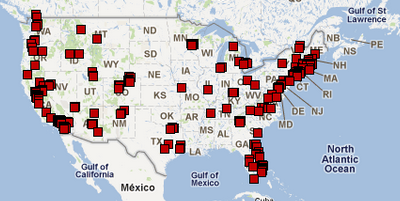 Hills was located in the basement of a former bank building. By 2002, there were 500 Bikram Yoga studios. [Image at right] It is not entirely clear what produced the surge in the number of Bikram Yoga studios. Bikram himself has commented that “It was like this for years,” Choudhury says, drawing a flat line through the air. “Then in the last years it shot up, like this! Like a rocket!”Some factors. The American fascination with Asian spiritual teachers, the physical fitness fascination that swept America, the location in avant garde California, and the celebrities that Bikram attracted all may have contributed.
 competitor is Modo Yoga, founded by a former Bikram practitioner, has revised a number of Bikram precepts and practices (Rubin 2013):
 with creationism, in part due to the struggles over a variety of issues (e.g., science education, sex education, prayer in schools) in the public school system. One outgrowth of these struggles has been the formation of a variety of museums, research institutes, and foundations defending the biblical creation narrative (Numbers 2006; Duncan 2009). Creationist museums are found primarily in the United States, but there is a sprinkling of such museums around the world (Simitopoulou and Xirotitis 2010). The most prominent creationist museums in the U.S. was established by Answers in Genesis.
 CSF board in Australia sent Ham to work with Dr. Henry Morris’s Institute for Creation Research (ICR) in 1987 as a speaker; he remained the Director of the Australian CSF ministry until 2004. Ham went on to lecture not only in the U.S. but also in the U.K.
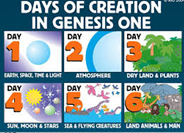 creationists, attempt to validate biblical dating and the biblical creation narrative. Answers in Genesis (AIG) can be categorized as Young-Earth Creationists (YECs). AIG asserts that the Bible is the word of God and the absolute authority on all matters. The Board of AIG explains that any evidence in any area of knowlege must be confirmed by the Bible to be valid. As AIG puts the matter, “no apparent, perceived or claimed evidence in any field, including history and chronology, can be valid if it contradicts the scriptural record” (Answers in Genesis 2012). Therefore, AIG accepts the Bible as the accurate historical account of Earth’s creation recorded in Genesis 3:14-19 (Ross, 2005). From its perspective, the organization of the natural world is “irreducibly complex” and could only have been originally designed (Petto & Godfrey, 2007).
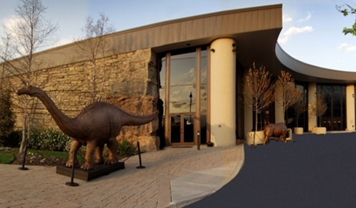 their creation museum. Two efforts to rezone land for the project met strong opposition from evolution proponents and other secular groups. Despite this resistance, hundreds of radio stations began featuring AIG’s Answers program. By 2006, AIG’s website, AnswersInGenesis.org, was chosen out of 1,300 ministries to receive the “Website of the Year” award from the National Religious Broadcasters. The website has gone on to host about 25,000 visitors a day. The AIG magazine, Creation, which was originally published in Australia, is also distributed in the United States. In 2006, however, AIG-US discovered that over half their subscribers did not renew their subscriptions after one year. The organization recognized the need for a new magazine, Answers , which would feature biblical and scientific articles about the origins controversy and emphasize the biblical worldview with practical applications. Further differences between the American and Australian branches caused AIG-US to stop distributing Creation and focus solely on Answers. After only five years in operation, Answers received the “Award of Excellence” from the Evangelical Press Association (Ham n.d.).
 2007. Ham created the Creation Museum to spread “Biblically correct science” to the public and to try and bring Creationism into the mainstream. He preferred a museum to a church because museums are accepted as places of public education and for the display of scientific research findings. Further, a museum is a more engaging environment in which to encourage learning among children. Finally, a museum could connect directly with visitors and AIG’s message would not be filtered through mainstream scientists or the government (Duncan 2009). According to Ham, AIG simply wants the Creation Museum to tell people that “the Bible is true and the Bible is God’s word, that’s what it’s all about” (Jacoby, 1998). The museum features a planetarium, the Johnson Observatory, SFX Theater, a petting zoo, an insectarium, a zip-line course, dinosaur fossils, and animatronic exhibits. The Creation Museum was very successful in its first year, attracting 404,000 visitors but suffered declining visitation, with only 280,000 visitors in 2012.
 located on 800 acres near Interstate 75 in Grant County, Kentucky and is scheduled to open in the summer of 2016 (Ham, n.d.). The Ark Encounter is described as “a 160-acre park with a life-size replica of Noah’s Ark built to stand 500 feet long and 80 feet high” (Goodwin 2012). Initial construction plans were delayed until 2014 due to a weak economy and a decline in visitation to the Creation Museum (Goodwin 2012). Based on outside consulting term estimates, AIG has anticipated 1,600,000 visitors in its first year, as well as improved visitation. The initial financial projections were also optimistic as a result of tax breaks pledged by the State of Kentucky; these were withdrawn after considerable controversy concerning church-state separation (Alford 2010; “Kentucky” 2015). AIG subsequently announced plans to sue Kentucky over the withdrawal (Linshi 2015).
 Homeschool Conventions, Inc. (GHC) voted to disinvite Ken Ham and AIG from “all future conventions [as Ham made] unnecessary, ungodly, and mean-spirited statements that are divisive at best and defamatory at worst” (Blackford 2011) about another speaker at the convention. The board stated that “Ken’s public criticism of the convention itself and other speakers at [the] convention require him to surrender spiritual privilege of addressing a homeschool audience” (Blackford 2011). Ham, in his blog, explained that Peter Enns of the BioLogos Foundation teaches misleading information about Genesis that compromises Genesis with evolution and is an “outright liberal theology that totally undermines the authority of the Word of God” (Answers in Genesis Board of Directors 2011). After the allegations against Ham being un-Christian and sinful were made, AIG launched an internal investigation of GHC, but has yet to find any resolution (Answers in Genesis Board of Directors 2011).
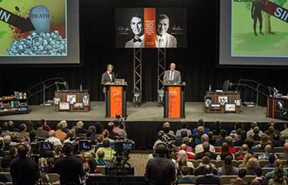 He stated that “If we raise a generation of students who don’t believe in the process of science, who think everything that we’ve come to know about nature and the universe can be dismissed by a few sentences translated into English from some ancient text, you’re not going to continue to innovate” (Lovan 2012). For his part, Ham attempted to substantiate the YEC model of the universe’s origins. He reasserted that Earth was created by God approximately 6,000 years ago and dinosaurs and humans once coexisted, as it is specifically stated in the Genesis. Nye sought to refute Ham’s claims by citing widely supported observations by scientists that the Earth is approximately 4.5 billion years old. Ham responded that “I believe science has been hijacked by secularists…and that there is a difference between historical science and observational science” (“Bill Nye Debates Ken Ham” 2014). Nye pointed out that a variety of methodologies (radiometric dating, ice core data, and the light from distant stars) supports the position that the Earth is much older than 6,000 years (Lovan 2012). When Ham referred to the Genesis flood narrative and Noah’s Ark, Nye pointed out that the Ark as described in the Book of Genesis would not float. Nye also pointed out that, using Nye’s calculations, an ark containing 7,000 kinds of animals would require that approximately eleven new species would have to come into existence every day for the Earth to contain all presently known species (O’Neil 2014). While Ham does not have appeared to have won over a majority of the audience, he seemed unconcerned. From his perspective, the publicity generated by the debate was a source of fundraising for AIG’s construction of the Ark Encounter theme park (Chowdhury 2014).
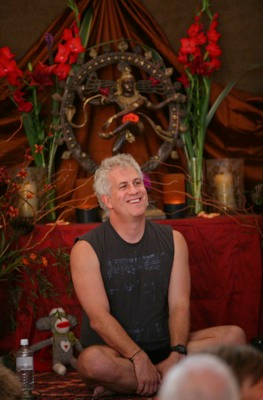 She referred him to Douglas Brooks, a scholar of Tantra who teaches at Rochester University. Brooks was, at that time, translating the Kularnava Tantra while residing at Shree Muktananda Ashram, a major center for Siddha Yoga – a type of meditation-based yoga brought to the United States in the 1970s by Muktananda and now led by Gurumayi. Friend consulted with Brooks just as he was translating a sentence from the scripture as, “By stepping into the current of grace, the student becomes capable of holding what is of value from the guru.” The word anusara comes from saras, which means flowing. The literature of Anusara yoga translates anusara as “flowing with grace,” drawing on the larger context of the sentence. Friend continued to consult scholars of Tantra whom he had befriended during his stays at this ashram as he developed Anusara yoga, but Friend is the ultimate architect.
 1,500 instructors and 500,000 practitioners in seventy countries. All of this came to a grinding halt in 2012 – just at the start of Friend’s “Igniting the Center 2012 World Tour” that was to add yantras (sacred geometry) and pyramid power to the mixture of practices. In February, a website posted incriminating evidence against Friend, which is detailed in the Issues/Challenges section below. Currently, after a brief hiatus for self-reflection and therapy, Friend is back on a touring schedule, acting outside of the Anusara yoga organization as an independent hatha yoga instructor – albeit “one of the most knowledgeable and experienced hatha yoga teachers in the world,” according to Friend’s website (“About John Friend” n.d.).
 teachers are now the owners and managers of the newly formed Anusara School of Hatha Yoga (ASHY) ®: BJ Galvan, William Savage, and Jane Norton.
 William “Doc” Savage specializes in one-on-one yoga therapy sessions. He has been teaching yoga for five years after studying under many teachers, including John Friend, Adam Ballenger, BJ Galvan, and Martin and Jordan Kirk. Savage also traveled to India with Douglas Brooks in order to deepen his understanding of Tantra. Prior to teaching yoga, he spent twenty-two years in the U.S. Air Force. He and his wife, Donna, teach yoga in the Black Hills of South Dakota as well as regionally under the moniker Dakota Yogi.
 recover from injury and chronic pain conditions. From 2005-2007,she toured the United States as Anusara yoga’s boutique manager. Norton lives on the island of Martha’s Vineyard and enjoys cooking, beachcombing, and gardening.
 The body becomes the axis mundi toward which all levels of reality coalesce and which elevates the physical toward the spiritual. Each Anusara yoga class begins with an invocation that Friend had learned from his mother at an early age and which he encountered again during his time with Siddha Yoga. He asked Krishna Das to write a melody for the verses, which serve to unite Anusara yoga students from around the world. The Sanskrit words are rendered on the back of Anusara yoga invocation cards as, “I honor the essence of Being, the Auspicious One, the luminous teacher within and without, who assumes the forms of Truth, Consciousness, and Bliss, is never absent, full of peace. Who is ultimately free and sparkles with a divine luster.” (This is more of an interpretation than direct translation; the first words, for example, namah shivaya gurave translate more directly as, “I bow to the Guru, who is Shiva.”) If the class is being taught in a more secular setting such as a gym, the opening mantra may be omitted or replaced with a simple chant of om three times.
 “opening the heart” is an integral part of the class experience. Following class, community is built in some Anusara yoga studios through chatting over tea. Some Anusara yoga kulas (communities) organize social outings and support each other in times of need by preparing food or offering transportation. Some groups also hold benefits to provide donations to non-profit service organizations.
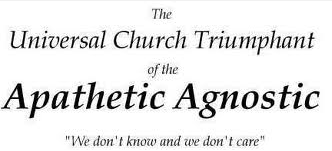 and he had no aspirations of it taking off. Today, it is estimated that UCTAA has over 10,000 members in over 40 countries, but no accurate membership records exist (“History” n.d.). Tyrrell is responsible for the bulk of the website’s maintenance. He personally responds to questions from the public, which he then posts on the site in a section called “Ask the Patriarch.”
 loose rule. There is commentary on the website, but disciples are encouraged to interpret the articles as they see fit. According to the founder, the first article is based on the belief that faith is not the same as empirical knowledge, and thus there is no evidence for or against the existence of a Supreme Being. The only certain position on the matter is that we do not know. The second article proposes that if there is a Supreme Being, it is indifferent to our existence. This is contingent on the understanding that all events in our Universe are explainable regardless of the existence or nonexistence of a Supreme Being. The final article maintains that, based on the first two, there is no reason to trouble oneself with pondering the existence of a Supreme Being.