LAWREN HARRIS TIMELINE
1885 (October 23): Lawren Stewart Harris was born in Brantford, Ontario.
1904–1908: Harris studied art in Berlin.
1907: Harris accompanied journalist Norman Duncan in his travels to the Middle East.
1908: Upon his return to Toronto, Harris became friends with writers and artists interested in Theosophy.
1910: Harris married Trixie Phillips.
1913: Harris started the informal gatherings of artists with spiritualist and Theosophical interests that would later lead to the creation of the Group of Seven.
1920 (May): The Group of Seven was formally established.
1922: Although not yet a member, Harris was appointed to the Decoration Committee of the Toronto Theosophical Society.
1923 (March): Harris joined the Theosophical Society.
1926: Harris, who had emerged as a leading Canadian painter, published a seven-week course on “Theosophy in Its Relation to Art” in The Canadian Theosophist, the leading Canadian Theosophical journal.
1930: Harris was the leading spokesperson for the Canadian Theosophical Society in a radio campaign to spread its ideas.
1934: Harris divorced Trixie Phillips and started living with Bess Housser, a devout Christian Scientist who later became a Theosophist.
1934: Harris married Bess Housser. His first wife, Trixie, claimed his divorce was invalid and accused him of bigamy. The scandal led Harris to leave Toronto and move to Hanover, New Hampshire.
1938: Harris moved to Santa Fe, New Mexico, where he became a founding member of the Transcendental Painting Group.
1940: Harris and his second wife, Bess, relocated to Vancouver.
1970 (January 29): Harris died in Vancouver. The media celebrated him as the greatest artist in Canadian history.
2016: “Mountain Forms” by Harris was sold at Heffel Auctions for Canadian $11,200,000 million (US $8,130,000), marking a record for the artist’s works.
BIOGRAPHY
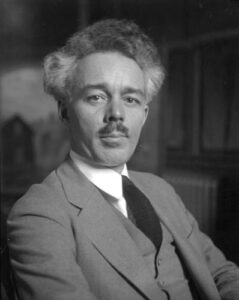 Unlike other Theosophical artists who rarely explored the link between Theosophy and art in-depth, the prominent Canadian painter Lawren Stewart Harris (1885–1970) actively did so. Throughout his career, he produced several articles, manuscripts, and notes on Theosophy [Image at right]
Many artists in the twentieth century faced poverty. Harris was an exception. Born in Brantford, Ontario, on October 23, 1885, he came from a wealthy family that held significant shares in the Massey-Harris agricultural equipment company. His paternal lineage was Protestant, including several prominent Baptist and Presbyterian ministers. In contrast, his mother was a Christian Scientist, which exposed him to a different religious environment (Ambler 2002:19).
In 1884, just a year before Harris’ birth, Toronto journalist Albert Ernest Stafford Smythe (1861–1947) became interested in the Theosophical Society after an unexpected encounter with its American leader, William Quan Judge (1851–1896), while crossing the Atlantic on an ocean liner. Smythe later introduced several Toronto literary elite members to Theosophy, including noted occult enthusiast and novelist Algernon Blackwood (1869–1951). In 1891, Smythe and Blackwood helped establish the Toronto Theosophical Society (McCann 2012:23). As a well-known social figure in Toronto, Smythe enlisted several prominent local literary personalities for this new society, such as fellow journalist and art critic Frederick Housser (1889–1936) and playwright Roy Mitchell (1884–1944).
Housser, an old friend of Harris from their days as students at St. Andrew’s Presbyterian College, influenced Harris’ decision to seriously pursue Theosophy, which matured after he met Mitchell in 1908 (Ambler 2002:25). By then, Harris was already established as a painter, thanks to financial support from his affluent family, which enabled him to study the latest European artistic movements in Berlin. He learned from Franz Skarbina (1849–1910), a founder of the Berlin Secession, a group that championed Edvard Munch (1863–1944) against German academic opposition. Skarbina shared his admiration for Munch with Harris and introduced him to prominent Secession artists, including Paul Thiem (1858–1922) and Max Liebermann (1847–1935). Additionally, through Skarbina, Harris encountered the works of Caspar David Friedrich (1774–1840), the Romantic German painter who was a key influence on the Berlin Secession.
Harris, deeply influenced by Thiem and Friedrich, was introduced through them to what he later called religious “unorthodoxy” (Larisey 1993:10). This opportunity allowed the Canadian artist to delve into a spiritual realm beyond Christianity during his travels with journalist Norman Duncan (1871–1916) in the Middle East. Harris created fifty-nine illustrations to accompany Duncan’s 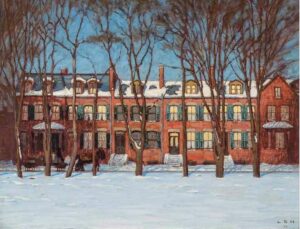 articles on his journeys. [Image at right] Upon returning to Toronto, he remained under the sway of his German instructors, focusing on urban landscapes, particularly in very impoverished areas, a pursuit he maintained for several years.
By 1908, he began to emulate Friedrich by venturing North to capture landscapes with snow and towering mountains. He often traveled to Northern Canada with fellow painter Tom Thomson (1877–1917), whom he greatly respected. Tragically, Thomson died in a somewhat mysterious boating accident at Canoe Lake in Ontario’s Nipissing District in 1917. Some critics observed a specific Theosophical influence in Harris’ early landscapes, especially when analyzing what they later termed his cycles of the North (Adamson 1978; Mesley 1978; Stoeber 2012, 2013).
In the 1910s, Harris was already familiar with Theosophy’s doctrines, although he was initially reluctant to join the Society formally. His skepticism towards organizations played a part in this hesitance, compounded by the fact that his wife, Beatrice (Trixie) Phillips (1886–1962), whom he married in 1910, came from a strict Episcopalian background that viewed Theosophy and similar beliefs as “heresies.” At that time, many of Harris’ closest companions were either members of the Theosophical Society or would become members, 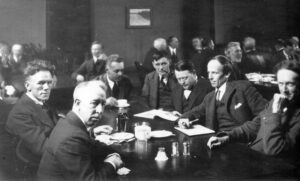 including artists James Edward Hervey MacDonald (1873–1932) and Arthur Lismer (1885–1969). [Image at right] MacDonald and Lismer were among the founders of the Group of Seven, which Harris established in 1920.
The Group of Seven was assembled to foster authentic Canadian art that was as free as possible from foreign influences. Harris, who was instrumental in selecting its members, also sought to use his means to assist less privileged Canadian artists. Despite its relatively brief existence (disbanding in 1933), the Group greatly impacted twentieth-century Canadian art. The Seven were not only connected by their focus on an independent Canadian art; they also had an interest in alternative spirituality. Three of the original Seven were or will become members of the Theosophical Society, while all shared a basic understanding of and affinity for Theosophical doctrines.
An article by Dennis Reid (1943–2023) from 1968 led several Canadian art historians to recognize the influence of the Theosophical Society on the Group of Seven (Reid 1968). However, they often neglected the similar impact of Christian Science, which the artists were exposed to, particularly its fundamental beliefs: that illness does not genuinely exist but is merely a mental error, and that any effort to sway others’ minds embodies a perilous form of “animal magnetism,” which contributes to numerous contemporary ills. Harris’ mother, J.E.H. Macdonald’s wife Joan Lavis (1871–1962), and Frank Hans (Franz) Johnston (1888–1949), one of the Seven, were practitioners of Christian Science. Another Christian Scientist in the proximity of the Seven was Bess Housser (1891–1969), who later became Harris’ cherished second wife and at that time was married to Frederick Housser, a Theosophist and the semi-official publicist and historian for the group (see Housser 1926). Poet and politician W. Gordon Mills (1886–1960: see Mills 1992:8), the closest friend of the Houssers, was also a Christian Scientist.
J.E.H. MacDonald should not be mistaken for James Williamson Galloway “Jock” Macdonald (1897–1969), a later painter influenced by the Group of Seven and by Piotr Demianovitch Ouspensky’s (1878–1945) esoteric ideas. Jock became captivated by Ouspensky’s A New Model of the Universe (Davis 1992:28), where the Russian author’s connections to the Theosophical Society are evident. Later, when Harris relocated to Vancouver, he became good friends with Jock Macdonald, noting with delight how the younger artist was intrigued by Eastern religious systems and Theosophical thought (King 2012:282).
Harris officially became a member of the Theosophical Society in March 1923. However, this does not mean his association with the Society started then. Correspondence shows that several years before 1923, he was already motivating friends to join. In 1922, he was appointed to the Decoration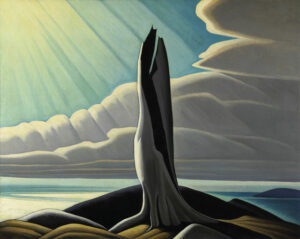 Committee of the Toronto Theosophical Society, serving alongside Mitchell and Lismer (Ambler 2002:31). [Image at right] In the years that followed, Harris created his most renowned Canadian landscapes, including famous works like “North Shore, Lake Superior” (1926) and “Isolation Peak” (1929). His art is characterized by reducing shapes to their essential forms and featuring a stark contrast between light and dark. These elements form part of an aesthetic that Theosophists sought to extract from Madame Helena Blavatsky’s (1831–1891) teachings (Bauduin 2013).
From 1926 to 1933, Harris actively contributed to The Canadian Theosophist, Canada’s leading Theosophical magazine, and was involved in the activities and controversies of the Toronto Theosophical Society. The Toronto group maintained notable independence despite the conflicts that fractured the international Theosophical Society in the 1920s and 1930s (McCann 2012). In 1895, Judge led most American members into a schism from the Theosophical Society, which had its headquarters in Adyar, India, after Blavatsky’s death, with Colonel Henry Steel Olcott (1832–1907) serving as President. Following Judge’s death in 1896, his American branch faced another schism, where most followed Katherine Tingley (1847–1929), the founder of the Theosophical community in Lomaland, California. A minor faction sided with Ernest Temple Hargrove (1870–1939), Judge’s former secretary. Many members of the Toronto Lodge, who had historically allied with Judge, including Smythe and Mitchell, spent several years with Hargrove’s branch before rejoining the Adyar Theosophical Society in 1907 (Davy 2011:111–113). The Theosophical Society in Canada experienced significant turbulence. In 1924, just a year after Harris’ formal membership, what Canadian Theosophists referred to as “the split” or “the break” led to the division of Canadian members into two branches, both recognized by Adyar, referred to as the Canadian Section and the Canadian Federation of the Theosophical Society (Davy 2011:1–76).
In 1926, The Canadian Theosophist unveiled a seven-week course by Harris on “Theosophy in Its Relation to Art” ([Anonymous] 1926:220). In 1930, the artist contributed to the radio campaign organized by the Theosophical Society and was considered its most influential spokesperson (see Harris 1987). A noteworthy incident illustrating Harris’ advocacy for Theosophy involves British Columbia artist Emily Carr (1871–1945). Harris not only helped elevate this relatively unknown local artist to national fame but also sought to pique her interest in Theosophy. Carr first met Harris in Toronto on November 17, 1927. The two maintained regular correspondence for several years, during which Harris asserted that Theosophy could enrich Carr’s life and artistic endeavors. Although Carr never renounced her Protestant faith, she regarded Harris’ views with seriousness and started exploring Theosophical texts. She came to believe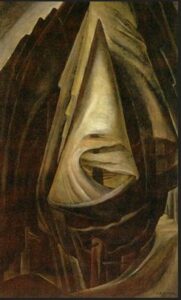 that Theosophy encompassed aspects akin to Native American spirituality, a topic she had previously delved into passionately. [Image at right] In her paintings “Nirvana” (1928) and “Blunden Harbour” (1930), Carr expressed her deep affection for Native American culture through a Theosophical lens. “Grey” (1931) was referred to as “the most Theosophical of her paintings” (Reed 1999:18), depicting the emergence of divine light from the primeval darkness of a Canadian forest. .
Lacking any Theosophical lodges in Victoria, Carr sought a faith she viewed as both Christian and similar to Theosophy: Unity School of Christianity, a loosely pantheistic group rooted in H. Nonetheless, her involvement with Unity did not strengthen Carr’s dedication to Theosophy, and she continued to be suspicious of Madame Blavatsky’s criticisms of Christianity. In 1934, she noted in her journal, “Somehow Theosophy makes me shudder now. It was reading H. Blavatsky that did it, her intolerance and particularly her attitude to Christianity” (Carr 2006:176). Ultimately, Carr destroyed her copy of Blavatsky’s The Key to Theosophy (Reed 1999:22) and told Harris she had reverted to “the beliefs of childhood.”
Harris sent a polite answer, explaining that, as a Theosophist, he believed that “Christianity for the first three centuries was pure Theosophy,” but that later it had become corrupted. Harris also insisted that Theosophy “is not a sect as is Christian Science, Unity, or New Thought, or in the same sense. For it advocates the study of all religions, philosophies, and science. It is the synthesis of all these—that is what makes it difficult” (Davis 1992:112). Carr was not persuaded. Later, she wrote that Theosophy “goes round and round in circles and makes you giddy,” and that it was “a sort of endless voyage with God always way, way beyond… without the love of a real Jesus Christ to bridge the gap” (Street 1979:90).
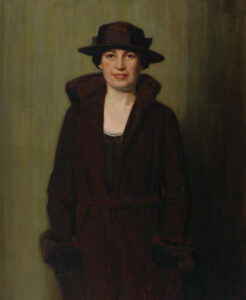
In 1934, shortly after completing some of his most famous paintings, including “Mount Robson” (1929), “Mount Lefroy” (1930), and several Arctic landscapes, Harris went through a significant personal crisis[Image at right] Some sources suggest he had been in love with Bess Housser, the wife of his friend Frederick Housser, since 1920, when he painted her portrait as “The Christian Scientist” (Ambler 2002:37). In 1934, Bess accepted Harris’ offer to move into the apartment where he had his studio. This situation was more than Harris’ wife, Trixie, could endure, leading to the end of their marriage that same year.
The friendship between Harris and Frederick Housser persisted despite these complications. Housser had started a relationship with artist and Theosophist Yvonne McKague (1898–1996) and was waiting for Bess to divorce him so he could marry Yvonne. The only person unhappy with this situation was Trixie Harris, who felt abandoned by Lawren while caring for their three children. In 1934, when Harris quickly obtained a divorce in Nevada and married Bess, Trixie argued that an American divorce was not valid in Canada. She and her influential family claimed that Harris had become a bigamist. Harris’ marriage to Bess was abstinent, and they both insisted that true couplehood needed chastity, aligning with a higher Theosophical and artistic ideal (Larisey 1993:118).
Whether through an abstinent marriage or otherwise, the divorce created quite a scandal in Toronto. In a letter sent to Harris in 1934, Bess described the situation using vintage Christian Science language, despite having joined the Theosophical Society in 1922 (Adamson 1978:132): “Animal magnetism is known with all its brutal and destructive force directed into one’s own life and vision. It seems to create a great vortex and it will with fiendish delight do away with you there if it can” (Adamson 1978:119).
Even after 1934, Harris and Bess occasionally referenced Christian Science while asserting that Theosophy presented a higher form of spirituality. This is evident in their correspondence with Yvonne McKague, the second wife of Frederick Housser, who also felt torn between Christian Science and Theosophy. Harris wrote to her (Davis 1992:114):
Yes, I believe that physical health is an effect of thought, but of right emotion just as much as right thought—and I am not at all convinced that Christian Science has an answer to that… To me the philosophical basis is finer—of Theosophy than it is of C[hristian] S[cience]—much broader and more embracing—it answers my inner questions with a more satisfying sweep and grandeur that thrills something inside me.
Several Christian Scientists were part of Harris’s circle of friends, including Eric Brown (1877–1939), who supported Harris as director of the National Gallery of Canada, and Doris Huestis Speirs (1894–1989), among others (Reid 1985:25). Speirs was a prominent Canadian ornithologist and the former wife of W. Gordon Mills. Bess maintained regular correspondence with Doris for thirty years (Falls 1990).
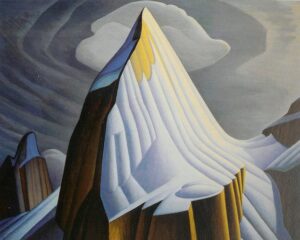
Fleeing the divorce scandal, Harris ultimately decided to leave Toronto and move with Bess to Dartmouth College at the University of New Hampshire in Hanover, where he offered to work for free. During his time in Hanover, Harris deepened his interest in abstract art, a passion that grew after meeting Wassily Kandinsky (1866–1944) and Katherine Dreier (1877–1952). [Image at right] Dreier, both an art patron and an artist, managed the Société Anonyme, and Harris became its only Canadian member (Reid 1985:14). [Image at right] She was crucial in increasing Harris’ international recognition and introduced him to her friend and protégé, Marcel Duchamp (1887–1968). Although not a member, Dreier had a close connection to the Theosophical Society (Fowler 2000).
During this period, Duchamp delved into the concept of a fourth spatial dimension. American art historian Linda Dalrymple Henderson highlights the considerable influence of Theosophy and the works of P.D. Ouspensky on the conceptualization of this spatial fourth dimension (Dalrymple Henderson 1998, 2012). She underlines the pivotal contributions of Theosophist and architect Claude Bragdon (1866–1946), who played a crucial role in articulating a framework for understanding this dimensionality. This notion of a spatial fourth dimension should not be conflated with the temporal fourth dimension that gained prominence following Albert Einstein’s (1879–1955) work.
In Hanover, Harris took the opportunity to explore new artistic ideas, leading him to create his first abstract paintings. His work “Winter Comes from the Arctic to the Temperate Zone” (1935) marks a significant transition from depicting Canadian landscapes to embracing abstract art. Critics (Davis 1973; Adamson 1978:132–35; Davis 1992:116–17) have noted that this evolution may have been influenced by the book Thought-Forms, written by Theosophical Society leaders Annie Besant (1847–1933) and Charles Webster Leadbeater (1854–1934) (Besant and Leadbeater 1905).
Harris’ evolution continued when he moved to Santa Fe, New Mexico, where he and his wife Bess arrived in November 1938. He chose to focus exclusively on producing abstract art. Both Bess and Harris became interested in the concept of “dynamic symmetry,” developed by Canadian-born American artist Jay Hambidge (1867–1924). Dynamic symmetry is based on a mathematical study of proportions in ancient Greek art and has been explored by several Theosophists, including Bragdon. Hambidge was not a Theosophist and asserted his approach was purely scientific. His wife, Mary Crovatt Hambidge (1885–1973), took part in various cultural initiatives started by Eva Palmer Sikelianos (1874–1952), the spouse of Greek poet Angelos Sikelianos (1884–1951). In New York, along with the well-known journalist Alma Reed (1889–1966), Palmer organized a center for the arts that served as the American branch of the Delphic Movement, founded by Eva and Angelos Sikelianos in Greece, which was colloquially referred to as “the Ashram.” Several Theosophists frequented the Ashram, where Annie Besant personally lectured. At the Ashram, Mary Hambidge introduced Mexican muralist José Clemente Orozco (1883–1949) to the principles of dynamic symmetry. Orozco also learned about Theosophy during his time there (Barnitz 1983).
In this unique New York institution, visitors had the opportunity to meet Bragdon and several followers of the Russian Theosophist painter Nicholas Roerich (1874–1947). In 1932, Roerich hosted an exhibition featuring paintings by contemporary Canadian artists at his Roerich Museum in New York. This exhibition was organized in collaboration with Harris and Frederick Housser and laid the groundwork for establishing the Canadian Group of Painters in 1933. The Group, with Harris serving as President and Housser as Secretary, was regarded by many as the successor to the Group of Seven (Reid 1985:21).
Drawn by the favorable climate and the more affordable living expenses, many American artists eventually moved to New Mexico, where they met a diverse Theosophical community (Gibson 1983) influenced by the French astrologer, Theosophist, and artist Dane Rudhyar (born Daniel Chennevière, 1895–1985), who often visited to conduct courses and seminars (Ertan 2009). Rudhyar had contributed articles to The Canadian Theosophist under the pseudonym Zahaz D. Rudhyar (e.g., Rudhyar 1926) and was familiar to Harris. The impact of Roerich on this group remained significant. Among the followers of Roerich in New Mexico were painter Emil Bisttram (1895–1976) and his spouse Mayrion Huth Bisttram (1898–1984), painter Ralph Harris Houston (1908–1976), Chicago artist Raymond Jonson (1891–1982), who had formed the Cor Ardens (Burning Heart) Brotherhood in 1920 based on Roerich’s ideas, and Clyde Gartner (1900–1967), who established the Arsuna school and art gallery in Santa Fe in 1937 (Udall 1999).
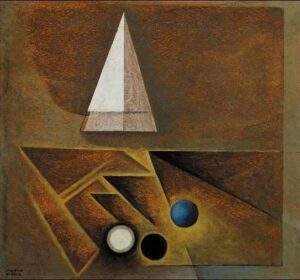
Upon arriving in New Mexico, Harris was naturally drawn to this community, which had also been visited multiple times by Georgia O’Keeffe (1887–1986), who became acquainted with Theosophy through her friendship with Bragdon. O’Keeffe, however, made New Mexico her permanent home only in 1949, after Harris had returned to Canada. [Image at right]
Lawren and Bess Harris formed a close friendship with Raymond Jonson and Emil Bisttram. This bond also included Yvonne McKague Housser, who chose to live temporarily with the Harrises in New Mexico after her husband, Frederick (Bess Harris’ former spouse), passed away in 1936. In 1939, Harris, Bisttram, and Jonson established the Transcendental Painting Group. Most “transcendental” artists were Theosophists, and all were admirers of Kandinsky. However, the group maintained that its goals were exclusively artistic and did not involve promoting any religious or spiritual beliefs. Ultimately, the Group founded the parallel American Foundation for Transcendental Painting, Inc., where Rudhyar was Vice President (Hartel 2002:250). It co-organized several significant exhibitions and successfully engaged Kandinsky in its activities (Ambler 2002:42; Ertan 2009:145–48).
This activity in New Mexico did not endure after World War II, which posed a practical challenge for Harris in 1940. He found it increasingly difficult to receive dividends from his shares in the Canadian family business while in the U.S. Consequently, he and Bess decided to relocate to Vancouver, where they 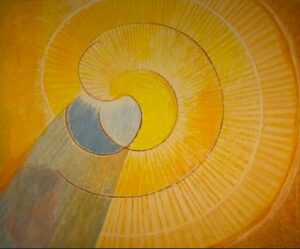 lived until they died in 1970 and 1969, respectively. Once Harris returned to Canada, his approach to abstract art gradually transformed. [Image at right] Initially, his early abstract works in Hanover simplified landscapes into abstract shapes. While he attempted to incorporate mathematical proportions based on dynamic symmetry in New Mexico, in Vancouver he moved away from mathematics and concentrated solely on his inner perceptions of beauty.
In the final years of Harris’ life, he received recognition as Canada’s national painter. However, his later abstract works were often underappreciated by critics, except for the renowned literary theorist Northrop Frye (1912–1991), who praised Harris “best abstractions [as] a unique and major contribution to Canadian painting” (Frye 1948:57). Harris’ reputation was primarily built on his earlier landscapes of Northern Canada. He also engaged in ongoing debates about government policies on the arts and museums, especially after assuming the role of President of the Federation of Canadian Artists in 1944.
Although he was less involved with the Theosophical Society during this time, his artworks and writings indicate that he considered himself a Theosophist until his death (Ambler 2002). The passing of his cherished second wife, Bess, on 28 September 1969, occurred just three months before Harris himself passed away on 29 January 1970. [Image at right] The remains of both Harris and Bess are interred in the small cemetery in the garden of the McMichael Collection of Canadian Art in Kleinburg, Ontario.
Harris cited various authors from Theosophy. However, in a December 1, 1937, letter addressed to Yvonne McKague Housser, he claimed that only Blavatsky and Judge “were in constant and direct contact with the Great Ones [the Masters], and only their works are truly dependable.” He stressed that one should read Blavatsky and Judge to genuinely understand authentic Theosophy, defined by him as “an all-comprehensive philosophy—a synthesis of Religion, science, and philosophy,” which “the West needed” and “the East had always had” (Ambler 2002:238).
In his impactful lectures and radio addresses promoting the Theosophical Society, Harris aimed to portray Theosophy as a straightforward system, centered on three key concepts: monism, karma, and reincarnation. He proposed that our belief in an ideal state reflects evidence of reincarnation. He contended that this conviction cannot stem from our experiences in this present life: “By virtue of what insight do we dare set ourselves up as judges of the imperfections of this world, unless we have known and know a superior realm of being?” (Harris 1933b:164). Is this “superior realm” accessible in our current lives? Yes, Harris affirmed, through what he termed a “sixth sense,” aligning with the “aesthetic attitude” (Harris 1933b:164). While the early Theosophists may have chosen other terms, the idea of a sixth sense recalling a divine plan remains orthodox within Theosophy.
Harris’ writings linked this to a polemical stance, influenced by Blavatsky, that critiques mainstream religion. He accused “religionists” of prioritizing morality over spirituality, thereby fostering a distorted view of God. According to him, “morals” suggest the existence of an external deity, a lawgiver positioned beyond our universe. In contrast, the aesthetic perspective asserts that a divine essence resides within each individual, gradually revealed through personal, creative endeavors and experiences. According to Harris, the moral viewpoint lacks creativity, is unadventurous, and follows rather than leads. Conversely, the aesthetic perspective is innovative, fertile, and embraces the spirit of adventure at the core of our existence (Harris 1993b:164). This text, written a year before Harris divorced, critiques the rigid moral standards of the Toronto Protestant establishment, which generally viewed divorce unfavorably. Yet, in 1922, Harris had already addressed in his sole poetry collection those who “succumb to second hand living” and “say nay, nay, and smile at aspirations, dreams and visions” due to their reliance on “old dead catch phrases” and antiquated beliefs (Harris 1922:80). This indicates that Harris adopted these views long before his family challenges arose.
Harris viewed aesthetic experience as fundamentally rooted in beauty. The arts, he believed, “epitomize, intensify and clarify the experience of beauty for us, as nothing else can” (Harris 1933a:130). Beauty is seen as a powerful force; it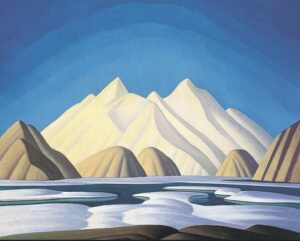 connects us to “the plane of being we Theosophists call buddhi, that is, that eternal plane of being wherein abides the immortal part of man and the universe, and which is beyond sensuality and the intellect and desires, and is the source of all high inspiration and devotion” (Harris 1933a:131). [Image at right] This concept of beauty fosters a dual movement: it lifts us towards the divine, to a higher reality, while simultaneously penetrating “all the secret places in the soul; that leaves no dark corner, no twist of hypocrisy, no petty motive, to its own devices, but shows us the stark truth of our pretenses, and our personal perversions, for exactly what they are” (Harris 1933a:132).
For Harris, art is universal, yet each culture should possess its unique expression. Romanticism brought forth the notion of “the North” as a region particularly conducive to spirituality, influenced by geography and climate. Harris embraced this established “Northern Romantic tradition” (Rosenblum 1975), integrating it with Theosophy, artistic expression, and Canadian nationalism. He critiqued Canadians who depended on European or American models instead of forming a genuinely Canadian art scene. Theosophy added a distinct perspective to his interpretation of Canada’s national tradition, rooted in Blavatsky’s belief that the sixth sub-race of the Aryan root-race was emerging on the American continent (Blavatsky 1888, II:444–445). According to Blavatsky, this sixth sub-race would be more spiritual than earlier sub-races, benefiting from North America’s climate, landscape, and burgeoning economic and technological progress.
In the early nineteenth century, Canadian nationalists asserted that Canada possessed a unique identity, separate from Europe and the United States. This identity was deeply rooted in the concept of the “Great North,” which held both geographical and mystical significance. In embracing this tradition, Harris claimed that being close to the Great North offered Canadians economic advantages, a strategic location, and health benefits, while enhancing their spirituality and fostering mysticism. He partially reframed Canadian nationalism through the perspective of American Transcendentalism, which resonated with many Canadian artists (Davis 1992). Additionally, he drew inspiration from the ideas of German painter Paul Thiem, whom he encountered during his early years in Berlin. Transcendentalists and Thiem posited that specific landscapes, such as vast wildernesses, forests, and abundant snow, heightened spiritual awareness.
The Transcendentalists and Blavatsky mainly focused on the spiritual characteristics of the Northern landscape in relation to the United States. Harris highlighted the uniqueness of Canadian geography: “The very coolness and clarity of its air, the feel of the soil and rocks, the rhythms of its hills and the rolls of its valleys, from its clear skies, great waters, endless little lakes, streams and forest, from snows and horizons and swift silver. These move into a man’s whole nature and evolve a growing, living response that melts his personal barriers, intensifies his awareness and projects his vision through appearances to the underlying hidden reality” (Harris 1926:86). “Indeed, no man can roam or inhabit the Canadian North”—Harris wrote—“without it affecting him […]. The North will give him a different outlook from men in other lands” (Harris 1926:86).
The artist argued that spending merely two months in Northern Canada would suffice to enhance the freedom and creativity of any true artist (Larisey 1993:63; Larisey 1974). Harris recognized that Blavatsky believed a new race was developing in the United States instead of Canada. Nevertheless, he maintained that the environment in Canada was even more favorable for spiritual growth. “The top of the continent,” he explained, “is a source of spiritual flow that will ever shed clarity into the growing race of America, and we Canadians, being close to this source, seem destined to produce an art somewhat different from our southern fellows, an art more spacious, of a greater living quiet, perhaps of a certain conviction of eternal values. We were not placed between the southern teeming of men and the ample, replenishing North for nothing” (Harris 1926:85). Like Harris, his associate, fellow Theosophist, and co-founder of the Seven, Arthur Lismer, also expressed in The Canadian Theosophist his belief that a new sub-race would arise in Canada, as opposed to United States (Lismer 1925).
The faith of Harris’ mother, Christian Science, supported his argument for Canada. Christian Science emphasized that densely populated areas increase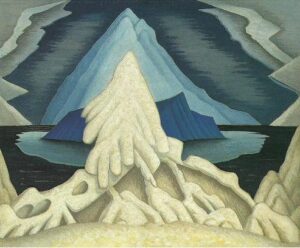 the dangers of negative animal magnetism. Harris wrote, “We in Canada are in different circumstances than the people of the United States. [Image at right] Our population is sparse, the psychic atmosphere comparatively clean, whereas the States fill up and the masses crowd a heavy psychic blanket over nearly all the land” (Harris 1926:86). Critics believe that the already mentioned painting “Winter Comes from the Arctic to the Temperate Zone” epitomized this “clean” Canadian atmosphere (Davis 1992;116).
Harris recognized the importance of steering clear of any potential racist connotations related to Blavatsky’s concept of root races. In 1933, in response to the heightened focus on the Nazi threat by Canadian media, Harris released an analysis of European political affairs through a Theosophical lens. He reiterated his familiar tirades against organized religion and “the glib priests who turn their backs on any god worthy of the name and serve the god of enmities in man, the god of a tribe or class.” But he also lashed against “the devilish moral cowardice of Germany today, a people who under the cloak of a fanatical belief in the superiority of the Aryan-Germanic racial strain—a myth if there ever was one—make a scapegoat of another and utterly helpless people, the Jews” (Harris 1933c:286–89). Harris said that the transition from one race to another should be accomplished through peaceful methods, culture, and the arts rather than violence and warfare.
Harris expanded on his thoughts about art and Theosophy in an unpublished and undated manuscript titled “Abstract Art.” According to Harris, the human “races” progress through artistic expression. What type of art? Not the mere “imitation of anything in visible nature,” which is “nothing less than a prostitution of great powers.” The artistic creative force should transition from the natural world to the realm of art, though not via symbols (Ambler 2002:273). Harris emphasized that symbols hold significant value in Theosophy. “Theosophical Symbols contain the whole of the Philosophy.” Symbols “always refer to something—point to some quality or idea in man or the universe or in nature that is not actually in the symbol—Now the contrary is true of a work of art.” “Any symbol introduced into the work of art, if that symbol refers to something outside of the work tends to destroy or vitiate the unique experience a work of art embodies” (Ambler 2002:281–82).
Harris’ art intentionally avoids the use of symbols. He believed that symbols draw the viewer away from the artwork, and he wanted his audience to fully immerse themselves in his paintings, experiencing a sense of unity with them. While Harris attributed this idea to Blavatsky, the influence of Christian Science is also clear. He viewed the use of symbols to influence others as a form of “animal magnetism,” which is a dangerous evil for a Christian Scientist.
Harris regarded music as the only art form free from symbols, but he acknowledged that most significant religious and spiritual art has been symbolic. By adopting Blavatsky’s evolutionary perspective on history, he argued that modernity was so distinct from previous eras that it necessitated a new (post-symbolic) art form. He claimed that symbolic art was fitting for an earlier time when ideals like sainthood were represented by “beautiful halos.” Modern art should enable us to “experience within ourselves a touch of 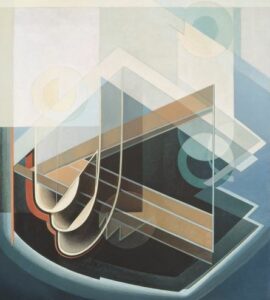 saintliness” without using halos (Ambler 2002:282). [Image at right] Harris contended that Theosophy enabled a genuinely modernist aesthetic, freeing artists from relying on symbols. He forcefully argued that a non-symbolic aesthetic could be drawn from Blavatsky, although the co-founder of the Theosophical Society had encouraged a symbolist and instructional art form.
The rejection of symbolism is vital for understanding Harris. The early researchers who acknowledged the substantial impact of Theosophy on Harris and the artists in his circle found Theosophical symbols in a range of his works. Notable among these scholars are Ann Davis, Father Peter Daniel Larisey, a Jesuit scholar (1928–2020), and Dennis Reid, who analyzed Harris’ later abstract pieces, where identifying symbols becomes more difficult (Davis 1992; Larisey 1993; Reid 1985). However, Harris had already dismissed this interpretation of his artworks: “A recent writer stated that in the Lake Superior, mountain, and Arctic paintings, I imposed forms on nature. I can understand the statement, but I am sure it is not true. I was so far as I know moved by the shapes and forms themselves to eliminate all irrelevant details in an endeavor to make essential forms” (Jackson 1991:31) Again, the idea of reducing forms to their essential elements can be found in Blavatsky (Bauduin 2013), although it was not necessarily understood by the artists she worked with, such as Heinrich Schmiechen (1855–1925) or Reginald Machell (1854–1927), as it would later be by Harris or Piet Mondrian (1872–1944), who was also a committed Theosophist.
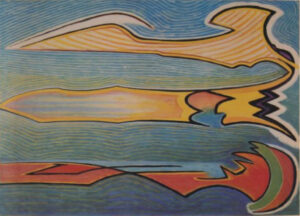
For artists, exceptions exist to every rule. In 1960, at seventy-five, while primarily creating untitled abstractions, Harris produced what many critics consider the finest piece of his later work (Reid 1985). Entitled “Atma Buddhi Manas,” [Image at right] it reflects Harris’ 1960s style and is reminiscent of diagrams in early Theosophical literature. The painting illustrates three forms suspended in an energetic ocean. Atma, the undifferentiated absolute, descends from above into buddhi, which occupies the center as the first differentiation. Below lies manas, representing the consciousness of our current existence. The diagram can also be interpreted from bottom to top: after achieving manas as a higher intellectual state, one may strive to reach buddhi, a more elevated level of spiritual awareness, and gain a glimpse of atma, transcending consciousness. This painting is important as it demonstrates Harris’ continued dedication to Blavatsky’s ideas in 1960. It also implies that we should consider the artist’s strong dismissal of symbols and symbolism with a grain of salt.
This prompts an inquiry into whether, and how, Harris’ art can be defined as “Theosophical.” In a letter approved by her husband, his second wife, Bess, wrote, in 1968, to art historian Dennis Reid that the artist never intended to “paint the ‘dogmas and doctrines’ of the Theosophical Society” (Larisey 1993:50). At first glance, this might appear to be at odds with Harris’ extensive theoretical work regarding the connection between art and Theosophy. In reality, there is no such conflict. Harris maintained that once Blavatsky opened up a new aesthetic, art should no longer communicate doctrines through symbols. Modern art should express an inner experience of beauty for both the creator and the observer. Neither the artist nor the viewer should be directed to step outside the artwork for a separate doctrinal meaning. Harris grappled with this idea throughout his life. He believed it could be discovered in Blavatsky’s remarks about art and form, acknowledging that they could be interpreted in various ways. This partly explains his transition from his early, and quite successful, style to the more debated abstract works of his later years. He felt that while they were beautiful, his early Canadian landscapes could still risk leading the viewers’ thoughts beyond the painting to the actual mountains and lakes “out there.” Harris insisted that the experience of buddhi should happen within the artwork itself. The painter is the first to encounter buddhi through “ecstasy,” a term that Harris often used. Ecstasy is based on creativity as well as a specific type of asceticism.
The chastity observed in Harris’ relationship with his second wife, Bess, was not incidental but stemmed from their religious beliefs. Both he and Bess asserted in their letters that they adhered strictly to this commitment in the most literal sense, despite skepticism from some friends (Larisey 1993:118). This aesthetic asceticism led the artist to forgo any attempts to preach a doctrine or reflect his personality. Ultimately, Harris ceased to title his works and even stopped signing them. He created some pieces on jute, a material known to degrade quickly (Ambler 2002:407–08). He intended to affirm that the individual identity of the artist was unimportant and that even the wish to ensure the lasting material existence of artworks would contradict this Theosophical asceticism (which was influenced by Buddhism), where the artist fades away, leaving only beauty and art.
In an unsigned article published in 1933 in The Canadian Theosophist, whose author was not (contrary to what some later argued) Harris, but rather Frederick Broughton Housser, we read that “from a spiritual point of view the creative artist, not the business man, typifies America. The creative life, which the real artist represents, is the Theosophical life as it was understood and expounded by the founders of the Theosophical Society. The true artist is an occultist.” ([Housser] 1933:252). The article is significant for Harris, as he and Housser collaborated daily during that period. Housser, as an art critic, was considered a representative of Harris’ ideas on art and Theosophy.
Harris’ art was not Theosophical in the sense of illustrating or symbolizing Theosophy (“Atma Buddhi Manas” remains a special case). Instead, Harris contended that it was Theosophical as it represented a divine experience of essential forms. Artists could first encounter this divine reality themselves and then convey it to their audience, without highlighting their identities, instead drawing the viewer into the artwork, thus serving as the ultimate site for buddhi.
Harris theorized that there are four different forms of abstract art. The first is “painting which is abstracted from nature.” The second kind “is non-objective, in that it has no relation to anything seen in nature,” but instead tries to convey an idea or message. The third form is a geometrical organization of shapes and proportions, whose perfection Harris saw in the “best painting of the late Dutch artist Mondrian,” a fellow Theosophist. Harris, however, favored the fourth form, “abstract expressionism” (an expression coined by Jackson Pollock, 1912–1956, who also attended Theosophical meetings in his youth: Hoag 1965; Langhorne 1998, 2013; Solomon 2001), where the artists try to mobilize their “inner resources” (Ambler 2002:285–88).
Harris is still regarded as the most esteemed Canadian artist of the twentieth century. Though the styles of the two art movements he helped establish (the Group of Seven in Canada and the Transcendental Painting Group in New Mexico) faced later critique for being perceived as overly “spiritual” and shaped by the artists’ interest in the esoteric and occult, they played a crucial role in North American contemporary art. Theosophy was essential for Harris’ artistic journey throughout his entire mature career. His fascination with Theosophy was not a fleeting interest. Like Mondrian, he was an engaged member of the Theosophical Society, but he went further than Mondrian by actively promoting Theosophy through writings, lectures, and a radio program.
Mondrian and Harris dismissed symbolism and asserted that authentic Theosophical art should not “preach” Theosophy but instead utilize Blavatsky’s concepts about forms to create new works that evoke simplicity, beauty, and a connection with the deeper, divine essence of the universe. When considering how abstract art, produced by artists knowledgeable about Theosophy, could fulfill this purpose, Harris spoke of Mondrian’s method with respect. Still, he felt that the Dutch artist’s “geometrical” forms were less effective in facilitating the spiritual experiences he sought to evoke compared to “expressionist” abstract art. The differences in their viewpoints indicate that Blavatsky’s ideas on aesthetics and the arts were not fully fleshed out and could lead talented artists, who were also Theosophists, to arrive at varying conclusions.
IMAGES
Image #1: Lawren Harris. Credits.
Image #2: Lawren Harris, “A Row of Houses, Wellington Street” (1910).
Image #3: A meeting of the Group of Seven. Credits.
Image #4: Lawren Harris, “North Shore, Lake Superior” (1926).
Image #5: Emily Carr, “Grey” (1931).
Image #6: Lawren Harris, “The Christian Scientist” (1920).
Image #7: Lawren Harris, “Mount Lefroy” (1930).
Image #8: Lawren Harris, Sketch Painted in Santa Fe, New Mexico (1944).
Image #9: Lawren Harris, “Abstraction” (1964).
Image #10: The author, Massimo Introvigne, at the pyramid under which Lawren and Bess Harris are interred in the garden of the McMichael Collection of Canadian Art in Kleinburg, Ontario.
Image #11: Lawren Harris, “Baffin Island” (1931).
Image #12: Lawren Harris, “Winter Comes from the Arctic to the Temperate Zone” (1935).
Image #13: Lawren Harris, “Abstract No. 7” (1939).
Image #14: Lawren Harris, “ Atma Buddhi Manas” (1960).


REFERENCES**
** Profile text is drawn from a series of articles published in Bitter Winter:
Lawren Harris, Theosophical Painter. 1. Discovering Theosophy
https://bitterwinter.org/lawren-harris-theosophical-painter-1-discovering-theosophy/.
Lawren Harris, Theosophical Painter. 2. Spokesperson for Theosophy.
https://bitterwinter.org/lawren-harris-theosophical-painter-2-spokesperson-for-theosophy/.
Lawren Harris, Theosophical Painter. 3. The Transcendental Painting Group.
https://bitterwinter.org/lawren-harris-theosophical-painter-3-the-transcendental-painting-group/.
Lawren Harris, Theosophical Painter. 4. Harris’ Writings on Theosophy and Art.
Lawren Harris, Theosophical Painter. 4. Harris’ Writings on Theosophy and Art
Adamson, Jeremy. 1978. Lawren S. Harris: Urban Scenes and Wilderness Landscapes, 1906-1930. Toronto: Art Gallery of Ontario.
Ambler, Dawn. 2002. Lawren Harris: A Theosophist Who Painted. Ph.D. Dissertation. Ottawa: University of Ottawa.
[Anonymous]. 1926. “Among the Lodges.” The Canadian Theosophist VII (10) (December 15, 1926):219–20.
Barnitz, Jacqueline. 1983. “Los años ‘délficos’ de Orozco.” Pp. 103-28 in Orozco: una relectura, edited by Octavio Rivero Serrano and Xavier Moyssén. Mexico City: Universidad Nacional Autónoma de México.
Bauduin, Tessel M. 2013. “Abstract Art as ‘By-product of Astral Manifestation’: The Influence of Theosophy on Abstract Art in Europe.” Pp. 429-51 in Handbook of the Theosophical Current, edited by Olav Hammer and Mikael Rothstein. Leiden: Brill.
Besant, Annie, and Charles Webster Leadbeater. 1905. Thought-Forms. London: The Theosophical Publishing House.
Blavatsky, Helena Petrovna. 1888. The Secret Doctrine: The Synthesis of Science, Religion, and Philosophy. 2 Volumes. London: The Theosophical Publishing Company.
Carr, Emily. 2006. Hundreds and Thousands: The Journal of Emily Carr. Madeira Park, British Columbia: Douglas & McIntyre.
Dalrymple Henderson, Linda. 2012. The Fourth Dimension and Non-Euclidean Geometry in Modern Art. Second Edition, Revised. Cambridge, MA: MIT Press.
Dalrymple Henderson, Linda. 1998. Duchamp in Context: Science and Technology in the Large Glass and Related Works. Princeton: Princeton University Press.
Davis, Ann. 1992. The Logic of Ecstasy: Canadian Mystical Painting 1920–1940. Toronto: University of Toronto Press.
Davis, Ann. 1973. An Apprehended Vision: The Philosophy of the Group of Seven. Ph.D. Dissertation. Toronto: York University.
Davy, Ted G. 2011. Theosophy in Canada: “The Split” and Other Studies in Early Canadian Theosophical History and Some Early Canadian Theosophists. Edmonton: Edmonton Theosophical Society.
Ertan, Deniz. 2009. Dane Rudhyar: His Music, Thought, and Art. Rochester, NY: University of Rochester Press.
Falls, J. Bruce. 1990. “Doris Huestis Speirs 1894-1989.” Picoides: Bulletin of the Society of Canadian Ornithologists 4:3–4.
Fowler, Cynthia. 2000. “The Intersection of Theosophy and Feminism: Katherine Dreier and the Modern Woman Artist.” Oculus 3:2–15.
Frye, Northrop. 1948. “The Pursuit of Form. “Canadian Art 6 (Christmas 1948):54–57.
Gibson, Arrell Morgan. 1983. The Santa Fe and Taos Colonies: Age of the Muses 1900–1942. Norman: University of Oklahoma Press.
Harris, Lawren. 1987. “Justice in Human Life.” The Canadian Theosophist LXVIII(1) (March-April 1987):1–4.
Harris, Lawren. 1933a. “Theosophy and Art (I).” The Canadian Theosophist XIV(5) (July 15, 1933):129–132.
Harris, Lawren. 1933b. Theosophy and Art (II). The Canadian Theosophist XIV(6) (July 15, 1933):161–166.
Harris, Lawren. 1933c. “Theosophy and the Modern World: War and Europe.” The Canadian Theosophist XIX(9) (November 15, 1933):281–288.
Harris, Lawren. 1926. “Revelation of Art in Canada.” The Canadian Theosophist VII(5) (July 15, 1926):85–88.
Harris, Lawren. 1922. Contrasts: A Book of Verse. Toronto: McClelland and Stewart.
Hartel, Herbert R., Jr. 2002. The Art and Life of Raymond Jonson (1891-1982): Concerning the Spiritual in American Abstract Art. Ph.D. Dissertation. New York: The City University of New York.
Hoag, Betty Lochrie. 1965. Oral history interview with Frederick Schwankovsky, March 1, 1965. Archives of American Art. Accessed from https://www.aaa.si.edu/collections/interviews/oral-history-interview-frederick-schwankovsky-12611 on 7 August 2025.
[Housser, Frederick B.] 1933. “Art and Artists.” The Canadian Theosophist XIV(8) (October 15, 1933):251–52.
Housser, Frederick B. 1926. A Canadian Art Movement: The Story of the Group of Seven. Toronto: Macmillan Canada.
Jackson, Christopher. 1991. Lawren Harris: North by West. The Arctic and Rocky Mountain Paintings of Lawren Harris, 1924-1931. Calgary: Glenbow Museum.
King, James. 2012. Inward Journey: The Life of Lawren Harris. Toronto: Thomas Allen Publishers.
Langhorne, Elizabeth. 2013. “The Teacher and his Student: Schwankovsky and Pollock in the Search of the Golden Flower.” Paper presented at the conference “Enchanted Modernities: Theosophy and the Arts in the Modern World,” University of Amsterdam, 25–27 September 2013.
Langhorne, Elizabeth. 1998. “The Magus and the Alchemist: John Graham and Jackson Pollock.” American Art 12:46–67.
Larisey, Peter, S.J. 1993. Light for a Cold Land: Lawren Harris’s Work and Life – An Interpretation. Toronto and Oxford: Dundurn Press.
Larisey, Peter, S.J. 1974. “Nationalist Aspects of Lawren S. Harris’s Aesthetics.” National Gallery of Canada Bulletin 23:3–9.
Lismer, Arthur. 1925. “Canadian Art.” The Canadian Theosophist V(12) (February 15, 1925):177–79.
McCann, Gillian. 2012. Vanguard of the New Age: The Toronto Theosophical Society. Toronto: McGill-Queen’s University Press.
Mesley, Roger J. 1978. “Lawren Harris’s Mysticism: A Critical View.” Art-Magazine 10:12–18.
Mills, W. Gordon. 1992. Legends of the Mississaugas. Toronto: Dundurn Press.
Reed, James Eldin. 1999. “Emily Carr in God’s Country.” Part of the project Pacific Northwest. Unpublished manuscript.
Reid, Dennis. 1985. Atma Buddhi Manas: The Later Work of Lawren S. Harris. Toronto: The Art Gallery of Toronto.
Reid, Dennis. 1968. Lawren Harris. ArtsCanada 25:9–16.
Rosenblum, Robert. 1975. Modern Painting and the Northern Romantic Tradition: Friedrich to Rothko. London: Thames and Hudson.
Rudhyar, Zahaz D. 1926. “Theosophy: The Triune Soul of the Cycles.” The Canadian Theosophist VII(2) (April 15, 1926):28–30.
Solomon, Deborah. 2001. Jackson Pollock: A Biography. New York: Cooper Square Press.
Stoeber, Michael. 2013. “Re-imagining Theosophy through Canadian art: Theosophical Influences on the Painting and Writing of Lawren Harris.” Pp. 195–220 in Re-imagining South Asian Religions: Essays in Honour of Professors Harold G. Coward and Ronald W. Neufelt, edited by Pashaura Singh and Michael Hawley. Leiden: Brill.
Stoeber, Michael. 2012. “Theosophical Influences on the Painting and Writing of Lawren Harris: Re-imagining Theosophy through Canadian Art.” Toronto Journal of Theology 28:81–104.
Street, Linda. 1979. Emily Carr: Lawren Harris and Theosophy, 1927-33. MA Thesis. Ottawa: Carleton University.
Udall, Sharyn R. 1999. Arsuna: The Culmination of an Ideal, 1937-1942. Albuquerque: The Jonson Gallery of the University of New Mexico Art Museum.
Publication Date:
16 August 2025
