UNIFICATIONISM TIMELINE
1920 (February 25): Sun Myung Moon was born Mun Yong-Myeong in Jeongju, modern-day North Korea (Gregorian Calendar).
1930: Moon’s traditionally Confucianist family converted to Presbyterian Christianity.
1935 (Easter Sunday): Moon reported that Jesus had appeared to him and asked him to take up the work that was left unfinished by his crucifixion. Moon accepted the mission.
1941-1943: Moon attended and graduated from a technical school in Tokyo associated with Waseda University.
1943 (February 10): Moon’s future wife, Hak-Ja Han, was born in Anju, North Korea.
1943 (November): Moon married Sun-Kil Choi. The couple had a son three years later.
1945 (August 15): Moon began preaching his message in Seoul.
1946 (June 6): Moon traveled alone to Pyongyang, North Korea, and founded a new flock.
1946 (August 11): North Korean officials arrested Moon and charged him with spying for the government of South Korea. After months of beatings and torture, he was left for dead in November but nursed back to health by his followers.
1948 (February 22): North Korean officials arrested Moon for a second time, this time for “disturbing public order.” He was sentenced to five years hard labor in the Hŭngnam labor camp, which was later reduced to three years and four months.
1950 (June): The Korean War broke out.
1950 (October 14): Moon was freed from the labor camp when prison guards abandoned their posts as United Nations troops advanced.
1950 (December 4): Moon and two male disciples commenced trekking south to Pusan to find safety as the war situation deteriorated. He arrived in Pusan on January 27.
1951 (May 11): Moon began writing down the essentials of his teachings, which he called Wolli Wonbon (the Original Divine Principle).
1952 (May 10): Moon finished Wolli Wonbon and began preaching again.
1953 (March): Moon formally changed his name to Mun Sun-Myeong.
1953 (September 17): Moon moved the base of movement operations to Seoul, South Korea.
1953: Moon divorced his first wife, Sun Kil Choi.
1954 (May1): The Holy Spirit Association for the Unification of World Christianity (HSAUWC) was founded in Seoul, South Korea.
1955: Organized opposition coalesced around the Ewha-Yonsei incident, in which six professors and sixteen students were expelled from two universities for not giving up their Unificationist associations.
1955 (May): The HSA-UWC established the Collegiate Association for the Research of Principle (CARP).
1955 (July): Moon and four of his church leaders were arrested by the South Korean government for draft evasion. Moon was acquitted on October 4 and released.
1957 (July 27): The first country-wide, forty-day, summer witnessing campaign commenced. It covered 120 locations.
1958-1959: The first international missionaries were sent out, to Japan in 1958 (July 15), and the United States in 1959 (January 2 and September 18).
1960 (April 11): Moon married for the second time, to seventeen year-old Hak Ja Han. The couple ultimately gave birth to fourteen children.
1961: Moon established the “Blessing” marriage/rededication ceremony. Thirty-six couples were married in the first such ceremony. Moon matched the couples who were not already married.
1962 (May 5): The Little Angels Children’s Folk Ballet of Korea troupe, which subsequently became The Little Angels, was initiated.
1962: The first Unification-owned business, Tong-il Industries, was created to finance church administration and missionary activities.
1962: In Japan, a major breakthrough occurred with the conversion of a few dozen members of the Rissho-kyoseikai sect.
1963: The HSA-UWC was legalized by the Korean Government.
1963 (June-September): Fifteen mobile witnessing teams covered 3,000 locations throughout South Korea. These became the prototype for the later One World Crusades.
1965 (January 28-August 10): Moon embarked on his first World Tour the purpose of which was to sanctify Holy Grounds in forty nations.
1965 (September-December): The Little Angels performed in the United States, its first performance outside Korea.
1965: The Collegiate Association for the Research of Principles (CARP), the Unification student wing, was established in Japan and was subsequently established in other nations.
1966: Unification theology was updated in a new edition, Wolli Kang-Ron (Explanation of the Principle). The English translation was simply entitled Divine Principle.
1967: Organized opposition to the UM in Japan commenced in earnest, largely facilitated by left-wing groups opposed to its anti-Communist work.
1968 (January 13): The International Federation for Victory Over Communism was established in Korea, and a few months later in Japan, to counter the growing influence of Communism in those nations.
1969: Moon and his wife embarked on a second World Tour, during which they Blessed forty-three non-Korean couples for the first time.
1971: Moon moved to the United States while retaining his citizenship in the Republic of Korea.
1970s: Organized opposition to the Unification Church, along with several other new groups, began in the United States.
1971: The Unification Church of the United States had grown to as many as 500.
1972: The first mobile fundraising and witnessing team efforts were organized in the United States and Europe.
1972 (December 21): Moon decided to move his family to the United States and made the U.S. the movement’s World Mission Headquarters.
1973 (November 21): The first International Conference on the Unity of the Sciences (ICUS) was held.
1974: Unificationist members Mose Durst and Onni Soo Lim launched the Creative Community Project in San Francisco.
1974-1976: Moon gave a series of public speeches in the U.S.: Madison Square Garden (1974), Yankee Stadium (1976), Washington Monument (1976).
1975: The Unification Theological Seminary (UTS) was founded in Barrytown, New York to train future movement leaders.
1976: The News World (later renamed the New York City Tribune) was founded by News World Communications in New York City.
1978: The Home Church focus commenced, in which members concentrated on local community involvement.
1980 (December): CAUSA International was founded in New York as an anti-communist educational organization.
1982 (July 1): A Blessing of 2,075 couples in New York’s Madison Square Garden became the first large-scale Blessing held outside Korea.
1982: Moon was convicted in federal court in the United States of income tax fraud and was incarcerated for thirteen months in the Federal Correctional Institution in Danbury, Connecticut.
1982: The Washington Times newspaper was founded.
1983 (May-June): Moon commenced a thirty-city speaking tour.
1985: The UM sponsored the World Assembly of Religions, attracting 600 participants from over eighty nations.
1988-1989: The Black Heung-Jin Revival took place when a Zimbabwean member claimed to be the re-embodiment of the Moons’ second son by Hak Ja Han who died in a car accident in 1983.
1990s: The Daemo-Nim Providence commenced at Cheong-Pyeong Lake during which a spiritualist member reportedly brought spirit messages from Mrs. Moon’s recently deceased mother.
1990’s: The South American Jardim Providence commenced after the movement acquired properties in the Pantanal and surrounding areas that were to become an ecological paradise.
1990 (April): Moon traveled to the Soviet Union and met with the nation’s president, Mikhail Gorbachev.
1991 (December): Moon met with Kim Il Sung, the President of North Korea.
1992 (April 10): Hak Ja Han founded the Women’s Federation for World Peace (WFWP).
1992 (August 19-28): Moon presided over the Blessing of 30,000 couples at the Seoul Olympic Stadium, the largest to that time.
1992 (August): Moon publicly declared for the first time that he and his wife were the True Parents of Humankind and together were the fulfillment of the Second Advent.\
1992: The Unificationist-associated consortium, the Professors World Peace Academy, raised just over $50,000,000 to bail out the failing Bridgeport University in Massachusetts and financially supported it for the next decade.
1994: Moon announced that the era of HAS-UWC had ended, and The Family Federation for World Peace and Unification (FFWPU) was established.
1994: Unificationist investment in Uruguay reached $150,000,000.
1995: For the first time the Blessing was extended to non-members.
1998: The Unification Church constructed a church in North Korea.
2001 (January): Moon conducted a Coronation Ceremony for the Kingship of God.
2001: An African Catholic Archbishop caused controversy when he participated in a Unification Blessing ceremony and married a Korean Unification member.
2001: Moon declared the establishment of Cheon Il Guk, the nation of Cosmic Peace.
2002: A Unification Movement affiliate, Pyeonghwa Motors, invested more than $300,000,000 in North Korea’s automobile industry.
2003: A member of the Unification Movement founded a political party in South Korea, “The Party for God, Peace, Unification, and Home.”
2004 (March 23): The Unification Movement organized a ceremony in Washington’s Dirksen Senate Office Building at which Moon was awarded the “Crown of Peace,” in the presence of a number of government officials.
2008 (April): Moon appointed Hyung Jin Moon, his youngest son, as International President of the Unification Church and heir apparent of the worldwide Unification Movement.
2009: Hyun Jin, the Moons’ eldest surviving son, officially split with his family in disagreement over his younger brother’s church direction, setting off decades of legal battle as he sought to retain assets that had been put in his name.
2012 (September 2): Moon died.
2012: Moon was awarded North Korea’s National Reunification Prize.
FOUNDER/GROUP HISTORY
An estimated 300-500 new religious movements (NRMs) have arisen in Korea over the last 150 years. These have largely innovated from the four main traditions of Daoism, Confucianism, Buddhism and indigenous spiritism. In East Asia, a fusion or overlapping of the main religious traditions has been common, and Korea’s new religious movements carry on that syncretistic impulse, often even borrowing from each other. The catalyst for such extensive religious innovation in Korea was the encounter with Western spirituality. The influence of Christian thought on Korea’s new religions is evident in greater or lesser form, depending on the lineage of the group, but the syncretic blend is very clear in the case of the Unificationism.
Unificationism is not the largest of Korea’s NRMs, but it has the widest spread, with members or associates in 185 nations. It is also one of the thoroughly studied by scholars and pilloried by opponents (Lofland 1966; Sontag 1977; Bromley and Shupe 1979b; Barker 1984; Fichter 1985; Chryssides 1991; Introvigne 2009; Mickler 2023). The movement’s current membership is estimated at from 250,000-300,000 worldwide, the bulk of which is in South Korea and Japan. In addition, there are many people whose belief systems have been influenced by Unification thought, such as those who belong to the several breakaway groups that largely retain Unification teachings and several newer, innovatory groups in Korea and Japan that show some doctrinal similarities.
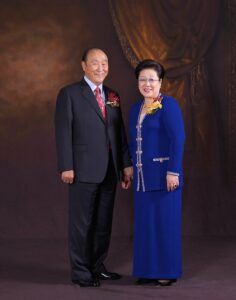
Unificationism was founded by Mun Yong-Myeong, born in on February 25, 1920 (Gregorian calendar) in contemporary North Korea. [Image at right] He changed his name to Mun Sun-Myeong in 1953. His family converted to the Presbyterian denomination of Christianity when he was ten years old. Like many Koreans of that era, he was very devout.
During an all-night prayer vigil on top of a peak near his home he claims that in the early hours of Easter Sunday 1935 he experienced a spectacular spiritual encounter with Jesus Christ. Jesus told him that because of his early death he had been unable to finish his mission and that he wanted Moon to complete it. Over the next nine years Moon relates that he lived an inner life of close spiritual contact with Jesus and the saints in heaven, during which the actual meaning of biblical accounts, particularly the Fall of Man, and other Christian mysteries were gradually revealed to him.
After completing a diploma in electrical engineering in Japan in 1943, he returned to Korea and married, eventually settling in Seoul. He began cautiously preaching the revelations he had received but didn’t make much headway. In June 1946, he was “directed by Heaven” to move to Pyongyang. This meant leaving his wife and baby son behind because the Communists by this time had firmly entrenched themselves in the northern half of the Korean peninsula and it had become very dangerous to enter the north.
He made a few converts but was reported to the local Communist authorities and arrested for allegedly “spying for South Korea.” He was held for a few months during which he almost died as a result of beatings and torture. He made more converts but was arrested again in 1948 for “disturbing the public order” following complaints from some family members of his converts. He was sentenced to five years of hard labor in a large nitrogen fertilizer factory on the mid-east coast of North Korea. The Korean War broke out in June of 1950. In October, when he had served about half of his sentence, the area where the camp was located was bombed by United Nations forces under the command of General Douglas Macarthur. The guards deserted their posts, allowing the surviving prisoners to escape. Moon returned to Pyongyang on foot.
The tide turned against United Nations forces following Chinese intervention on behalf of Kim Il Sung’s Communist government. Hundreds of thousands of Koreans from the north began fleeing south. Starting in mid-December, Moon together with two of his male disciples began a trek to the bottom of South Korea. They reached Pusan at the end of January. Pusan was in absolute chaos. Housing and jobs were almost non-existent, and so it took Moon and his few remaining disciples quite some time to achieve some semblance of safety and stability. In May 1952, he finished a hand-written version of his teachings and began preaching again. At the end of 1953 there were Unification groups in Pusan, Taegu and Seoul.
The Armistice and formal partition of the northern and southern parts of Korea of July 1953 stabilized conditions. The main base of operations of Moon’s group, which by this time was being informally labeled the Unification Church (UC), was moved from Pusan to Seoul at the end of the year. The group was formally established as the Holy Spirit Association for the Unification of World Christianity (HSA-UWC) on May 1, 1954. By then, Moon had a following of about fifty.
By this time Moon had reunited with his wife, Sun Kil Choi, and his son. The couple had wed in 1943 and had a son in 1946, but his wife actively opposed his religious work, and their relationship ended irreparably. He would marry his life partner and ultimate successor, Hak Ja Han, in 1960.
A breakthrough occurred in 1955 when dozens of students from Ewha (Women’s) and Yonsei (Men’s) Universities began attending Unificationist lectures. This alarmed the universities’ heads, and through influential political connections an extensive media oppositional campaign was launched against the Unification Church. Students were then forbidden to further associate with the church. Sixteen students and six professors were expelled for refusing to follow this directive.
In July of that year, Moon and several other Unificationist leaders were arrested for draft evasion, and he was found guilty and sentenced to two years imprisonment. He appealed, and his trial was held on October 4. Able to prove he had received an exemption from military service, he was set free.The negative publicity eventually died down, and in July 1957 the group launched the first of its annual summer forty-day witnessing campaigns. Conversions were reportedly made in thirty locations. These campaigns continued for some time afterwards, and a winter campaign was added. From this point the movement made steady headway growth.
A member named Sang-Ik Choi, using his Japanese name, Nishikawa, (during the Japanese occupation Koreans were required to adopt a Japanese name), made his way to Tokyo in 1958 to become the first permanent missionary outside Korea. Choi had a very slow start, but in 1962 a few dozen members of the Rissho-kyoseikai sect joined en masse. The Japanese branch rapidly progressed from that point. Nishikawa was deported in 1964, and Osami Kuboki assumed leadership.
Two more missionaries, Young-Oon Kim and David San-Chul Kim, relocated to Oregon in the United States (in January and September of 1959, respectively). In the first part of 1960, several converts were made. Also in that year, the Young-Oon Kim contingent relocated to San Francisco where several Germans joined. The new recruits returned to Germany in 1963 to start new branches in Germany and then Austria in 1964. A Dutch convert in Los Angeles moved back to Holland to start a group there in 1964.
A third Unification missionary, Lt. Col. Bo-Hi Pak, who had been appointed Assistant Military Attaché at the Korean Embassy in Washington, D.C., moved to the Washington area in March 1961 with the intention to start a Unification branch there.
On April 11, 1960, Moon, now forty, married a seventeen-year-old girl, Hak Ja Han, who was in her last year of high school. Five days later he and his new wife gave what came to be called the Holy Marriage Blessing to the three chief disciples of the Unification movement and their hand-picked partners. The following year Moon married thirty-three more couples, making thirty-six couples in all, who became “the Elders.” Ever-larger massed wedding Blessings of members continued at various intervals, eventually becoming annual. Mrs. Moon bore fourteen children in all, the first was a daughter named Ye-Jin born in 1961 and the last was another daughter named Jeung-Jin, who was born in 1982.
Moon and a small entourage embarked on Moon’s first world tour in 1965, during which he established Holy Grounds in forty nations. He stayed with the Pak family in Washington from March through June, attempting to reorganize and coordinate the American branch. Young-Oon Kim and Sang-Ik Choi accompanied Moon on much of this world tour. In October, Kim moved to Washington to assume national leadership, while Choi settled in in San Francisco with the intention of establishing a fourth missionary arm, with the assistance of several hand-picked members from Japan.
From September to December 1965, the Little Angels Folk Dance Troupe of Korea, founded by Moon and a few Unification members in 1962, made its international debut in the United States. Its tour started in Washington, where it performed to a socialite-studded crowd. The Troupe also performed before former president Dwight Eisenhower in Gettysburg.
The movement responded to mounting Marxist influence in Korea, Japan and Western universities by establishing the International Federation for Victory Over Communism (IFVOC) in 1968. It sponsored numerous anti-Communist rallies in Korea, Japan and other Asian countries and Victory Over Communism lectures developed by a Korean member outlined the contradictions and fallacies of Marxist ideology. The Japanese and South Korean governments, in an effort to safeguard their young democracies, encouraged police cadets and bureaucratic officials to attend. The Collegiate Association for the Research of Principles (CARP) that developed in Japan in 1965 to meet the needs and aspirations of the many youth who were joining the movement, was also well placed to absorb some of this IFVOC work. At the end of 1980, Confederation of Associations for the Unification of American Societies (CAUSA) was also initiated, which adapted presentations to more specifically counter Marxist penetration of the Americas.
Moon, accompanied by his wife and other Korean church officials, made a second world tour in 1969, during which the first non-Korean Blessings were conducted. This involved forty-three couples, twenty-one of which were Japanese, thirteen American and nine European. Included was one Black American couple.
By 1970, Choi’s Bay area group had attracted both recruits and opponents through the implementation of several novel introductory methods. The Kim group also began to make some headway in Washington. Noteworthy progress was also seen in Berkeley and New York under the leadership of members who were from the Pak Washington lineage. Paul Werner, transferred from Austria to Germany by Moon in 1969, produced a significant number of converts.
In 1972, Moon undertook a third world tour, the focus of which was public speaking engagements in hired halls in a dozen or more different countries. During the American segment of this tour he pressed members into teams to promote his public-speaking events, in the process completely uprooting American branch structures. The Western branches were far behind those of Korea and Japan in terms of initiative and dedication. At the end of this world tour Moon made arrangements to move himself and his family to the United States so that he could take direct charge of the American movement. The United States became the hub of the movement, with the Unification Theological Seminary, administrative headquarters in New York City, and Moon’s personal estate in Tarrytown. A network of profit and not-for-profit organizations soon followed (Bromley 1985, 1998b). During this period Moon stimulated the development of mobile witnessing, fundraising and building procurements, which became significant in financing the American branch of the UM. He encouraged the establishment of newspapers, businesses, academic conferences to discuss world problems and numerous other initiatives.
Over the next few years Moon undertook more speaking tours, which later became known as the Day of Hope tours. There were also large-scale speaking events at Yankee Stadium, Madison Square Garden, and the Washington Monument. He also spoke at an anti-Communist rally at Yoido Island in Seoul that reportedly attracted an audience of over 1,000,000. As always, world expansion was high on his list of priorities, and in May 1975 a missionary each from the United States, Germany and Japan were assigned to break new ground in ninety-five countries after undergoing instruction at the movement’s new training center in New York.
The high public profile Moon adopted in the United States attracted numerous new members but also a great deal of criticism and opposition, both from established Christian denominations and the families of UM recruits (Shupe and Bromley 1980; Cowan 2003). While Christian churches had long campaigned against religious interlopers, families of converts were more immediately threatened by Unificationism and other new religious movements of the 1960s and 1970s (Bromley 2006). Many of these new groups challenged established religious tradition doctrines and practices, and the high demand organization of some of them directly threatened parents’ role in transitioning young adults into conventional family and career trajectories.
In the Unificationism case, families were particularly threatened by rapid “conversions,” assertions by Moon that he and his wife were the True Parents of converts, and Moon’s selection of partners for members eligible for Blessing. Accusations of “brainwashing” or mind control as the source of UM affiliation (Bromley 1998). A new kidnapping and “deprogramming” network arose to “free” those who had been “lured” into these groups (Patrick 1976). The Creative Community Project (CCP), an offshoot of the Choi group in San Francisco established in 1974, was the source of much of the criticism. The CCP continued methods Choi had developed but changed the orientation from Choi’s “ideological community” to a “spiritual community” and it streamlined his methods (Bromley and Shupe 1979b). Because the group was quite successful in attracting new members and proselytized under another name (Creative Community Project), detractors accused it of practicing “heavenly deception” (Bromley and Shupe 1981).
Another movement milestone was reached in 1982 when a large-scale Blessing was staged in Madison Square Garden that involved 2,075 couples. This event was the first mass Blessing held outside Korea, and it made headlines, particularly in the United States.
Shortly after this event, Moon was convicted of tax evasion and was sentenced to two years imprisonment in a federal prison facility in Danbury, Connecticut. He served thirteen months of that sentence before being paroled. Moon’s incarceration did not diminish his leadership of the movement, however, and he presented his willingness to serve his sentence as a self-sacrificial act. Moon immediately reassumed his preaching mission upon his release from prison. Moon’s prosecution also produced some backlash from mainstream religious leaders who viewed the basis of prosecution as one that potentially could be deployed against their churches.
While during the 1970s, a number of new religious movements flourished as a product of the availability of young adults who participated in the various 1960s protest movements, this pattern did not continue. As the protest movements ran their course, so did NRM recruitment, including for Unificationism. The result was that while the recruitment rates declined sharply, the high membership turnover rates that had been present through the movement’s history did not (Bromley 2004). Indeed, by the late 1980s U.S. membership probably matched mid-1970s membership.
By contrast, in the 1980s and 1990s, the Church’s businesses expanded greatly and achieved significant financial success, leading Unificationism to become wealthy despite its declining membership, but with a more secure organizational base. In response, Moon announced in 1991 that members should return to their homes and continue their missionary work locally. In contrast to the two preceding, then, by the mid-1990s many Unification members had received the Blessing and had settled into normal family lifestyles. This brought an end to the earlier full-time proselytization, and greater reliance on procreation for continued movement growth.
The reconceptualization of the movement’s structure and mission was evident in 1994 when Moon announced that a new organization would supersede the Unification Church. This organizational change became official in 1996 when the Family Federation for World Peace and Unification was formally launched. The new leaders included Moon’s second son by Hak Ja Han, Hyun-Jin. They sought to move into a post-church, practical settlement format. The emphasis changed to family, community and peace initiatives. This era saw the sponsoring of soccer teams, the buying properties in South America, and development of the property at Cheong Pyeong Lake, outside of Seoul. The Daemo-Nim Providence also began, in which a member who claimed to be in spiritual contact with Mrs. Moon’s late mother was installed in Cheong Pyeong as the medium supreme. Members began coming to gatherings at a large hall that was built on the property to hear her speak, be healed, and have their ancestors blessed.
A number of Peace organizations were established during this era, one of the most active of which was the Women’s Federation for World Peace (WFWP), which was established in 1992. This brought Moon’s wife Hak Ja Han into the limelight. With her child-bearing years behind her, she spent much of this decade traveling the world headlining or supporting speaking tours that promoted the various initiatives.
What the new leaders envisioned was a spiritual and ecumenical movement that, though funded and largely run by Unificationists, would include anyone of goodwill. This reflected a shift from doctrinal exclusiveness to wider values education and exploration. With this new impetus, the Blessing was opened to non-Unificationists, starting on a very limited scale in 1995 and opening further from the 1997 RFK Stadium Blessing.
This change was not universally welcomed as many members felt disenfranchised within their own church communities. There was a toll on morale, capped by the damaging, tell-all book by the Moons’ eldest son Hyo-Jin’s first wife, published in 1998, which portrayed the Moon family as far from the idyllic model movement leaders projected publicly (Hong 1998).
In the early 2000’s, two major, related initiatives were mounted. The first was the creation of the American Clergy Leadership Conference, an ecumenical movement within clergy. This organization became the backbone of the second, which was the Middle East Peace Initiative. The initiative consisted of peace pilgrimages to Israel that began in 2003 and continued into 2005. In 2005, most of the “peace” initiatives were consolidated under a new organization called the Universal Peace Federation (UPF). The UPF then remained at the center of Unification values-promotion activities.
A restructuring of Unification business interests also occurred during this period. Investments were made in the hospitality industry, with the purchase of hotels and the development of resorts in South Korea. Investment was also made in North Korea, which included a joint venture automotive project. A Peace Center was also built in Pyongyang in 2007, with the top floor of which was retained for Unificationist use.
Moon was a highly active leader until his last days. Toward the end of his life he began addressing the issues of leadership succession. The conflicts that emerged ultimately resulted in the formation of schismatic movements, although his wife was able to maintain control of the largest segment of the movement (See, Issues/Challenges). In August 2012, however, he developed a cold, which developed into pneumonia. He was hospitalized on two occasions and passed away on September 2. In between hospitalizations, he clearly understood that he was in his final moments on earth. He reportedly spent his last conscious hours wandering around his home with his wife, looking at everything as if for the last time. He wrote down some last words, which were: “I have completed everything.” He was succeeded by Hak Ja Han who assumed leadership in a now deeply divided and diminished movement.
DOCTRINES/BELIEFS
The doctrines of the Unification faith are laid out in its Divine Principle (HAS-UWC 1977; Kim 1980). A more philosophical treatment was also developed, called Unification Thought. Unificationist teachings are generally dispensed in a lecture style that has been followed since Moon’s chief disciple Hyo-Won Eu developed that format in the early 1950s. There are three main segments to Unificationist teachings: The Principle of Creation, which largely fuses Korean Neo-Confucian and Christian ontology; The Principle of the Fall, which reinterprets the Christian Fall of Man doctrine as a sexual sin that passed its effects down through the succeeding generations; and the Principle of Restoration, which discusses the various pre-Jewish, Jewish and Christian dispensations it claims God used to retrieve this situation.
God in the Unification system is the Heavenly and loving Parent of all things, but this Parentage is not exclusively male. Lectures use the Yin-Yang, dual but complementary energy, symbol to denote God. God created the universe in goodness, though not yet in maturation. The spiritual maturation of humanity was to have been set in motion by Adam and Eve. They were intended to grow into spiritual maturity under the tutelage of the Archangel Lucifer and become the parents of a sinless society, humanity’s True Parents. Unificationists refer to the “Four Position Foundation” (father, mother, child, God), the family centered on God. Instead, Lucifer tempted them into sexual sin as Eve was physically seduced by Lucifer and then, as a result of a subsequent sexual relationship with Adam, created a human lineage that created a blood-lineage mixture of good and evil as the Four Position Foundation was now centered on Satan. This was the first Fall of Man, which has haunted humanity ever since with crime, war, and rampant promiscuity.
Human history has ever since attempted to retrieve this Original Ideal by restoring the True Parents. There was a second Fall that occurred when Cain slew his brother Abel. This fratricide constituted a division of humankind into two camps, the satanic, Cain-positioned and the righteous, Abel-positioned camp. In the current era, this division is recapitulated through atheistic communism and God-fearing democracy. The true meaning of Messiahship is resolving these two ancient problems haunting humanity by restoring humanity to a God-centered lineage and uniting nations to peace and divinely intended purpose.
Unification teachings outline the missions that various dispensational figures had to fulfill in order to prepare the path for the coming of Jesus. Jesus, a spiritually perfected man, was to wed a similarly prepared woman. He was crucified before he could find this person, and so his mission was only partially fulfilled. His female counterpart was fulfilled through the coming of the Holy Spirit. Jesus and the Holy Spirit established the means for achieving spiritual salvation, but the means of physical salvation, the Kingdom of Heaven on earth, would be fulfilled in the Second Coming.
Another set of cycles was necessary before this third and final attempt at finding the True Parents could be mounted. Moon claimed that in overcoming all the challenges Satan set before him and finally finding the ideal female counterpart to become the True Mother, he and his wife, Hak Ja Han, were the fulfillment of the Second Coming and the historical achievement of the True Parents of Humankind. The Second Advent or Messiah is not one person, a male, but two persons, a united male and female. Followers believe the Moons have met the conditions to be the starting point for a new and spiritually mature civilization, the Kingdom of Heaven on Earth that God originally intended. They believe civilization will grow in spiritual maturity under the influence of Unification thought and values.
While a reconceptualized Christianity was at the heart of Moon’s teachings, he also incorporated a vision of a global theologically led social order, the political reality of a divided Korea, the ongoing hostility of Communist North Korea, and an ordering of national roles in realizing God’s plan for humanity. These are consistent themes in his theology as well as in his organizational network.
As Bromley and Shupe observed (1979b:43):
Moon’s expectations for the worldwide social order to emerge after universal acceptance of his message called for a “worldwide socialist theocracy…” Church and state, theology and science, economy and religion: all were to become one in the ideal society to follow, united under the messiah and restored to God in His realized Kingdom on earth. Separate religions would have no further reason to exist.
Nor would religion and politics be separate spheres (Bromley and Shupe 1979b:112-13). Indeed, Moon taught that Satan thrived on divisions:
…In the Medieval Ages, they had to separate from the cities-statesmanship from the religious field – because people were corrupted at that time. But when it comes to our fate, we must have an automatic theocracy to rule the world. So, we cannot separate the political field from the religious…Separation between religion and politics is what Satan likes most.
Moon’s vision of global unification under messianic leadership illuminates the movement’s missionizing, integration of businesses with the movement, links forged with scientists, academics, and other religious leaders, establishment of newspapers that would provide a Unificationist perspective on world events, and persistent anti-communist campaigns.
Moon’s reinterpretation of the biblical history era as well as his own messianic quest for world restoration included both specific claims for his personal role as messiah and assignments for nations to play in the restoration process. In Moon’s rendering, human history had witnessed a succession of attempts and failures at restoration to original divine purpose. The mysteries revealed to Moon meant that he understood, even more clearly than Jesus, providential history. As he put it “Unless you know the meaning behind it, the Bible can reveal very little….The Divine Principle gives the true meaning of the secret behind the verse (Bromley and Shupe 1979b:45).
Beyond Moon’s conceptualization of his messianic role, he also articulated roles for nations (Bromley and Shupe 1979b:99-101). In his formulation, South Korea was the new Israel, Japan the new Eve, America the new archangel. God had appeared to Moon, a Korean, in Korea, and the Korean peninsula was divided between communist and democratic governments. Defeating communism in Korea was the first step in its worldwide defeat. America was the preeminent military power and Christian nation in the world and had been selected for an historic role in Restoration. This was to be the final battle between God and Satan, with a divided Korea as the front line.
RITUALS/PRACTICES
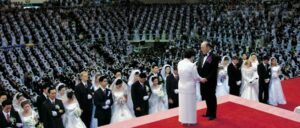 The central Unification ritual is the “Blessing.” This ritual creates the new God-centered lineage that is at the heart of Unificationism’s promise. It unites male and female in imitation of the twin energies of attraction and creativity that underlie the structure of the universe, from micro sub-particles to macro systems. The Blessing is the starting point for a couple to become True Parents in their own right. The most significant moment in the Blessing ceremony is drinking Holy Wine, which contains microscopic amounts of the blood of Father and Mother Moon, thereby changing the recipients’ lineage from the Fallen Parents (birth parents) to the “perfected” new ones. Following the Blessing there is a forty-day separation to “indemnify” humanity’s corrupted history, followed by the Three-Day Ceremony which allows couples to proceed with conjugal relations and the Four Position Foundation envisioned by the Creator.
The children of Blessed marriages are believed to be born free of Original Sin as a result of this change of lineage. Children born in Blessed marriages then become the building blocks of a sinless, God-centered lineage. Early movement members often waited years for the Blessing as that was the moment when they joined the ranks of the elect in a world-transforming movement (Bromley, Shupe and Oliver 1981). Being members of a movement that was going to change the course of human history and being the first generation initiates of that change was extraordinarily empowering to many new members.
The Blessing also symbolizes the achievement of the first milestone in the mission to which every person is born. It symbolizes that the two individuals have changed their life commitment to developing and maintaining high spiritual standards in preparation for the Blessing; they also pledge that following the Blessing they further commit to fostering those standards in their family, community and worldly lives.
The first Blessing ceremony was officiated by the Moons in 1961 for thirty-six couples in Seoul, South Korea shortly after their own marriage in 1960. All the couples were church members. Moon selected Blessing partners (matched) all of the couples, with the exception of twelve who had married prior to joining the church. Subsequent Blessing ceremonies were larger but observed a similar format, with Moon having primary responsibility for matching couples. The first Blessing outside of Korea took place in 1982 when Moon gave the Blessing to 2,000 couples in New York’s Madison Square Garden. Six years later Moon conducted a Blessing of Korean with Japanese members, with the goal of advancing unity between the two traditionally antagonistic nations. Over time Blessings began to be held without Moon’s personal participation, and some Blessings involved a partner who was not a movement member.
The format of congregational worship services evolved gradually. They usually have been held on Sunday morning with different members of the congregation leading individual services. Two large armchairs are positioned at the front of the sacred space, reserving a place for the True Parents. The service typically is initiated with congregational singing, often along with a choir or musicians. There is then prayer and recitation of the Pledge, which commits members to the Cheon Guk vision. Moon described Cheon Il Guk in the following way (Moon 2003):
What is the meaning of Cheon Il Guk. Two persons become one. Up and down, left and right, front and back. Every dimension of the pair relationship is united as one. That is the Kingdom of God on earth. Centered on the blessed family we can build the Kingdom of God.
The service closes following a sermon and prayer.
ORGANIZATION/LEADERSHIP

As a multidimensional movement, Unificationism has consisted of several major components through its history: Moon and his leadership group, several important national organizations, business and outreach organizations, and a supporting membership base.
From Unification’s inception, Moon was its center and apex, performing regularly as the messianic figure he claimed to be. He promulgated the Divine Principle, which outlined a plan for saving humanity from original sin, combating the continuing influence of Satan and restoring humanity to God’s original purpose. He steadily expanded his charismatic stature, ultimately anointing himself the Lord of the Second Advent and he and his wife as the True Parents of Humankind. He launched a number of global speaking tours, courted luminaries from a variety of institutional arenas, and met personally with a range of governmental and religious leaders. His continuing flow of visions, revelations and inspirations reaffirmed his charismatic authority. Toward the end of his life he announced that he had successfully completed the requisite messianic course that he himself had enunciated. His leadership team consisted primarily of a small coterie of largely Korean longtime disciples, supported by a larger contingent of largely figurehead leaders of individual projects and initiatives.
While Moon maintained an often high profile personal presence, particularly in the U.S., Unificationism arguably achieved the impact and influence it did as a product of its complex network of business enterprises that made Moon’s personal agenda and organizational initiatives possible. The organizational network had two primary components, the profit-generating businesses, only a few of which proved to be highly profitable, and non-profit organizations and projects (Bromley 1985). The connection between the two components initially was Unification Church International (UCI), a profit-making (and therefore tax paying holding company) which received funds from the profit-making organizations and redistributed them to the non-profits. UCI therefore “unified” business and religion by funding the Unificationists’ complex network of religiously sponsored programs. From a theological standpoint, the profit and non-profit organizations together were understood within the movement as realigning a broad range of social organizations under messianic leadership.
Moon began building a set of corporate entities in post-war Korea, largely industrial initially, but later a highly diversified network (Bromley 1985). Members sometimes started new businesses and later folded them into the movement’s corporate holdings. Sometimes these business were staffed by movement members, which created a competitive advantage for them. Examples of the diversity in this set of movements includes: industrial corporations (Tong-il Industries, Il Shin Stoneworks), the seafood and ship building companies (International Oceanic Enterprises, Master Marine industry), newspapers (News World and Washington Times), religious and diversified consumer items items (Shiawa Sa Co.Happy World), luxury jewelry ( Christian Bernard ). Some of these businesses clearly linked Unificationist economic and missionary interests. For example, the Tongil Group and the government of North Korea founded Pyeonghwa Motors, the first automotive manufacturer in North Korea, in Nampo, North Korea in 1998 as part of Moon’s attempt to reunify Korea. Happy World sold religious items but also became a primary financial resource for the movement. Some of these businesses, such as the Washington Times, were supported despite incurring major financial losses as their economic cost was perceived as secondary to their movement mission.
The financial resources generated by movement mobile fundraising teams, although helpful in establishing the American wing of the movement, paled in comparison to the funding generated by the business interests along with cash infusions from wealthy benefactors, primarily in Japan. At the same time, for individual movement members fundraising was significant as it constituted visible evidence of their personal contribution to their world-saving cause and also generated spiritual credits toward an eventual Blessing. Since Unificationism was widely rejected as a “cult,” fundraisers often encountered hostility and rejection. However, this too could be interpreted as a test of members’ spiritual commitment and rationalized as giving others an opportunity to participate, even unwittingly, in the restoration of God’s providence.
The corresponding set of outreach mission organizations were established around primary themes in Unificationist theology. Examples of these themes and organizations include anti-communist groups (Confederation of Associations for the Unification of American Societies (CAUSA), International Federation for Victory over Communism), unity of religion and science/education (International Conference on the Unity of Sciences, The Collegiate Association for the Research of Principles), unity of religions (World Assembly of Religions), peace (Women’s Federation for World Peace, Professors World Peace Academy), the arts (Little Angels Folk Dance Troupe), evangelism (One World Crusades).
For ordinary members, participation in achieving movement missions could be extremely empowering. They could understand themselves to be leading edge of realizing world restoration; working closely with the messiah; being the first generation of a new spiritual lineage; generating new members, funds, and spiritually perfect families that were building blocks of a restored world. In short, members were models for a new world just being born.
From a larger movement, messianic perspective this elaborate organizational network constituted the pursuit of world restoration and unification. At an organizational and institutional level this process involved moving economic resources, material goods, and organizational leadership from the Satanic domain to Messianic dominion. Accomplishment of this goal required acknowledgement of Moon’s messianic status by the full range of economic, political, and religious leaders on behalf of their organizations and membership. These leaders would assume the Cain position and offer themselves in service to the Messiah. The economic system that would ultimately emerge would be “altruistic capitalism.”
ISSUES/CHALLENGES
Unificationism has experienced sometimes intense opposition through its history, in Korea and the United States and Japan. Much of the opposition has been centered on Moon personally. He endured nearly fatal incarceration and punishment from communist authorities in North Korea and was arrested for draft evasion, but later exonerated, in South Korea. He served a U.S. prison sentence from the American court system for tax evasion. Somewhat surprisingly, perhaps, Moon’s sexual history did not have the kind of impact that later NRM leaders faced. Given Moon’s doctrines on the sanctity of marriage and requirement that members remain celibate prior to the Blessing, his divorce and remarriage, adultery, fathering a child outside of marriage, and allegations of other sexual relationships had relatively little impact on his leadership.
The larger movement experienced and persistent opposition from countercult and anti-cult groups in Europe, and particularly in the United States, amid a broader “cult scare” (Bromley and Shupe 1981). A range of religious denominations decried Unificationism’s heretical theology, its numerous interfaith initiatives notwithstanding (Cowan 2003). In the case of Judaism, Jewish leaders took exception to Moon’s claim that John the Baptist failed to recognize Jesus as the Messiah. Various Christian groups rejected Moon’s claims that Jesus was intended to marry, that his crucifixion was necessary, and that there would be a literal second coming. Unificationism had a more mixed relationship with Islam, but the movement was sometimes criticized for being islamaphobic. The tax evasion case was one of the few exceptions to religious opposition to Moon as a number of conservative religious opposed his conviction due to concerns that this “selective prosecution” might also affect their financial practices.
The secular anti-cult movement, which later became international (Shupe and Bromley 1994), first emerged in the U.S. While there was organized opposition to a range of new religious movements, for a time Unificationism was a primary target. During the 1970s, media coverage of Unificationism was intense and hostile (Bromley 1988a). Entrepreneurial “deprogrammers” physically abducted “brainwashed” adult movement members and constrained them with the objective of extricating them from the movement. Deprogramming was relatively successful for movement novitiates but also increased movement mistrust and isolation (Bromley 1979a). A shift from abduction to “exit counseling” took place when deprogrammers began to face prosecution for kidnapping and attempts to create legal legitimacy for brainwashing theories failed.
There were ongoing internal challenges to Moon’s charismatic authority. One of the most important of these began in 1974 with the formation of the Creative Community Project branch of Unificationism in San Francisco by members Mose Durst and Onni Soo Lim. That branch developed a more humanistic orientation than its East Coast counterpart, one that made it the most effective recruitment component (Bromley and Shupe 1979b:). Moon ultimately resolved this challenge by appointing Durst as the head of the American church, eliminating his independence (Bromley and Bobbitt 2009). In another incident in the late 1980s, the Black Heung-Jin Revival took place when a Zimbabwean member claimed to be the re-embodiment of the Moons’ second son by Hak Ja Han who died in a car accident in 1983. In the 1990s, the Daemo-Nim Providence commenced at Cheong-Pyeong Lake during which a spiritualist member reportedly brought spirit messages from Mrs. Moon’s recently deceased mother. Moon simply stopped recognizing these messages and claims as legitimate. While there were a number of these incidents, none seriously challenged Moon’s charismatic authority even when he was imprisoned.
The most consequential challenge for Moon and Unificationism began in the years before Moon’s death. In his last decades, Moon obviously was assessing which among his children could best carry the True Parents’ legacy into the future and was willing to grant the two main contenders, Hyun-Jin and Hyung-Jin, some scope in developing their ideas. His last years also saw an effort to consolidate his legacy. He established an official compilation of his speeches and other articulations of his teachings. He declared that the era of Cheon Il Guk (CIG), the Kingdom of Heaven on Earth, as having begun and set the Foundation Day to take place in February 2013. He and his wife conducted various ceremonies and events to demonstrate and define this milestone.
Moon’s efforts to negotiate continuity in the movement did not succeed. Soon after Moon’s death, the Global Peace Foundation, which had been founded in 2009 by Moon and Han’s son Hyun Jin Moon and church leader Chung Hwan Kwak, distanced itself from the Federation for World Peace and Unification led by Hak Jan Han. In 2017 they also founded the Family Peace Association (Introvigne 2017). In 2014 Moon and Han’s younger sons Hyung Jin Moon and Kook-jin Moon founded the Rod of Iron Ministries (also known as the World Peace and Unification Sanctuary Church). It was later to become controversial for its advocacy of private ownership of firearms and for its rhetorical support for the January 6 United States Capitol protest (Chryssides 2017). Although these movements never attracted large followings and Moon’s wife retained control of the largest component of the movement, the conflict created legal and financial consequences that left the movement divided, considerably smaller.
There is little evidence that these divisions will be resolved in the near term, which is perilous for a movement in which family unity is a core value. The potential for membership growth outside of Korea has long since passed, which makes the kind of family unification the movement envisioned unlikely. The splintering of movement financial resources after the schisms deprives the movement of its resource base, which always was its major means of influence. Movement leadership and culture has remained distinctly Korean, and the theology assigns a preeminent place to Korea in the unfolding of history, which runs counter to historical and cultural sacralizations of history and culture in other nations, such as the United States. It appears likely that Unificationism will survive the considerable challenges it has faced but not play a major role in the groups of religions with international impact.
IMAGES
Image #1: Sun Myung Moon and his wife, Hak Ja Han. Credit: WikiCommons. Creative Commons Attribution-Share Alike 4.0.
Image #2: The Blessing Ceremony. Credit: WikiCommons. Creative Commons Attribution-Share Alike 4.0.
Image #3: The Unificationism logo. Credit: WikiCommons. Creative Commons Attribution-Share Alike 4.0.
REFERENCES
Barker, Eileen. 1984. The Making of a Moonie: Choice or Brainwashing? London: Blackwell.
Bromley, David G. 2006. “Affiliation and Disaffiliation Processes in New Religious Movements.” Pp. 42-54 in New and Alternative Religious Movements in America (Volume 1), edited by Eugene V. Gallagher and W. Michael Ashcraft. Westport, CT: Greenwood Press.
Bromley, David G. 2004. “Leaving the Fold: Disaffiliation from New Religious Movements.” Pp. 298-316 in Oxford Handbook of New Religious Movements, edited by James Lewis. New York: Oxford University Press.
Bromley, David G. 1998. The Politics of Religious Apostasy: The Role of Apostates in the Transformation of Religious Movements. Westport, CT: Praeger Publishers.
Bromley, David G. 1988a. “Deprogramming as a Mode of Exit from New Religious Movements: The Case of the Unificationist Movement.” Pp. 166-84 in Falling from the Faith, edited by David G. Bromley. Newbury Park: SAGE Publications.
Bromley, David G. 1988b. “Economic Structure and Charismatic Leadership in the Unificationist Movement.” Pp. 335-64 in Money and Power in the New Religions, edited by James Richardson. Lewiston: Edwin Mellen Press.
Bromley, David G. 1985. “Financing the Millennium: The Economic Structure of the Unificationist Movement.” Journal for the Scientific Study of Religion 24:253–74.
Bromley, David G. and Anson Shupe. 1981. Strange Gods: The Great American Cult Scare. Boston: Beacon Press.
Bromley, David G. and Anson Shupe. 1979a. “Atrocity Tales, the Unification Church, and the Social Construction of Evil.” Journal of Communication 29:42-53.
Bromley, David G. and Anson Shupe. 1979b. Moonies in America. Beverly Hills: SAGE.
Bromley, David G and Rachel Bobbitt. 2009. “Challenges to Charismatic Authority in Unificationism.” Pp. 129-46 in Sacred Schisms: How Religions Divide, edited by James R. Lewis and Sarah M. Lewis. Cambridge: Cambridge University Press.
Chryssides, George D. 2017. “The Sanctuary Church.” World Religions and Spirituality Project. Accessed from https://wrldrels.org/2017/08/03/sanctuary-church/on 1 February 2025.
Chryssides, George D. 1991. The Advent of Sun Myung Moon: The Origins, Beliefs and Practices of the Unification Church. London: Macmillan,
Cowan, Douglas E. 2003. Bearing False Witness? An Introduction to the Christian Countercult. Westport, CT: Praeger.
Cowan, Douglas E. and David G. Bromley. 2008. “The Invention of a Counter-tradition: The Case of the North American Anti-cult Movement.” Pp.97-116 in The Invention of Sacred Tradition, edited by James Lewis and Olav Hammer. Cambridge: Cambridge University Press.
Fichter, Joseph. 1985. The holy family of Father Moon. Kansas City, Mo: Leaven Press
Holy Spirit Association for the Unification of World Christianity. 1977. Divine Principle. HAS-UWC. Washington, DC.
Hong, Nansook. 1998. In the Shadow of the Moons: My Life in the Reverend Sun Myung Moon’s Family. Boston: Little Brown.
Introvigne, Massimo. 2017. “Family Peace Association.” World Religions and Spirituality Project. Accessed from https://wrldrels.org/2017/04/19/family-peace-association/ on 2/1/2025.
Introvigne, Massimo. 2000, The Unification Church, Salt Lake City: Signature Books.
Kim, Young Oon, 1980. Unification Theology. Barrytown, NY: Unification Theological Seminary.
Lofland, John. 1966. Doomsday Cult: A Study of Conversion, Proselytization, and
Maintenance of Faith. Englewood Cliffs: Prentice-Hall.
Mickler, Michael. 2023. The Unification Church Movement. New York: Cambridge University Press.
Moon, Sun Myung. 2003. “What is Cheon Il Guk? Accessed from https://www.tparents.org/Moon-Talks/SunMyungMoon03/SM030131e.htm on 15 February 2025.
Patrick, Ted. Patrick. 1976. Let Our Children Go!. New York: Ballantine.
Pokorny, Lukas. 2018. “Unification Movement.” Pp. 321-42 in Handbook of East Asian New Religious Movements, edited by Lukas Pokorny and Franz Winter and Lukas Pokorny. New York: Brill
Shupe, Anson and David G. Bromley. 1994. Anticult Movements in Cross-Cultural Perspective. New York: Garland Publishers.
Shupe, Anson and David G. Bromley. 1980. The New Vigilantes: Anti-Cultists, Deprogrammers and the New Religions. Beverly Hills: SAGE Publications.
Publication Date
6 February 2025
