BURNING MAN TIMELINE
1977: The Suicide Club was founded by Gary Warne in San Francisco.
1982: The Suicide Club disbanded.
1986: The Cacophony Society was founded in San Francisco by former members of the Suicide Club, including John Law.
1986: Larry Harvey and Jerry James constructed an eight-foot high humanoid wooden effigy and set it on fire with a handful of friends at Baker Beach in San Francisco.
1988: John Law and other members of the Cacophony Society became involved in what is now an annual event called Burning Man.
1990 (June): An estimated 800 people converged on Baker Beach for Burning Man, but the event was halted by law enforcement. In September, fewer than 100 people took the Burning Man to the Black Rock desert in Nevada for a Labor Day weekend campout.
1993: Distinctive artistic and performative elements emerged, including the first “theme camps” and “art cars.”
1996: John Law departed the organizing team following the aftermath of the first accidental death and other serious injuries.
1997: Larry Harvey and a handful of close friends formed the Black Rock City LLC to manage and organize the event.
1998: The first official regional event was Burning Flipside in Austin, Texas.
2000: David Best created a structure called the Temple of the Mind, which led to the development of Burning Man’s annual “Temple” tradition.
2005: Burners Without Borders formed as a volunteer response to Hurricane Katrina.
2007: The first Burning Man Global Leadership Summit (initially named the Regional Leadership Summit) was held at Burning Man headquarters in San Francisco.
2010: Larry Harvey announced the decision to dissolve the LLC and transition the ownership of the event to a 501(c)3 non-profit structure.
2011: Burning Man tickets sold out for the first time, leading to scalping of event tickets.
2014: Burning Man transitioned to becoming a non-profit. The Burning Man Project, a nonprofit organization, succeeded Black Rock City LLC, a for-profit limited liability company.
2014: In addition to the annual Global Leadership Conference gathering in San Francisco, more than 100 European regional contacts, community leaders and regional event “leads” gathered in Berlin with Burning Man staff for the inaugural Burning Man European Leadership Summit.
2016: The Burning Man Project bought Fly Ranch, a 3,800-acre property next to the event site, as a more permanent home for art installations and innovative projects of all kinds.
2018: Larry Harvey died. Marian Goodell took on the leadership role going forward, and as of this writing is current CEO of the Burning Man Project.
2019: A record 78,8500 attended Burning Man.
2020: The Burning Man Project held its first Diversity & Radical Inclusion Town Hall.
2020-2021: In-person Burning Man was canceled and Burning Man went virtual as the “Multiverse” due to the COVID-19 pandemic. The Multiverse was visited by an estimated 500,000 people.
2022: Burning Man returned to the Black Rock Desert with 75,069 participants..
FOUNDER/GROUP HISTORY
In 1977, a man named Gary Warne and a handful of friends formed a group called the Suicide Club as part of San Francisco State University’s experimental “Communiversity.” Drawing loose inspiration from a cultural legacy including Dadaism, Situationism, “happenings,” the Merry Pranksters, and the Yippees, among other predecessors, the group’s activities included ironically modifying commercial billboards, scaling both the Golden Gate and Bay Bridges, infiltrating events sponsored by the Rev. Sun Myung Moon, and exploring subterranean sewers and passages. Members of the Suicide Club “agreed to get all worldly affairs in order, to enter into the world of Chaos, cacophony & dark saturnalia, to live each day as if it were the last.” (“San Francisco Suicide Club” n.d.; see also Evans, Galbraith and Law 2013) The Suicide Club disbanded by 1982, and Warne died from a heart attack in 1983. In 1986, former Suicide Club members, including a man named John Law, formed the Cacophony Society in a similar spirit. This new group declared itself to be: “a randomly gathered network of individuals united in the pursuit of experiences beyond the pale of mainstream society through subversion, pranks, art, fringe explorations and meaningless madness. You may already be a member!” (Evans, Galbraith and Law 2013; see also “You May Already Be a Member” n.d.).
Also in 1986 (and initially unrelated to either the Cacophony Society or the Suicide Club), a man named Larry Harvey and his friend Jerry James cobbled together an eight-foot high wooden effigy and burned it on Baker Beach in San Francisco on Summer Solstice eve. Harvey was born in a rural community outside of Portland, Oregon in 1948, and moved to the San Francisco Bay Area in the late 1970s. Intelligent, self-educated, and talkative, Harvey has described himself as a lifelong misfit (Brown 2005). In his young adulthood, he held a succession of odd jobs and was working as a landscape designer in the mid-1980s when he and a fellow tradesman, James, decided to construct and burn the figure that eventually evolved into the “Burning Man” (although neither of them used this term at the time, nor foresaw the elaborate desert festival that their unpremeditated event would become). Harvey later acknowledged that he had been inspired, in part, by art happenings held by an artist named Mary Graubarger at Baker Beach in the late 1970s and early 1980s, and which he had previously attended with a now ex-girlfriend (Doherty 2004:26-28). However, Harvey has repeatedly stated that neither he nor James had any preconceived meaning in mind when they first erected and burned “the Man.” Approximately twenty people attended this first “burn,” although as Harvey would tell the story in later years, their numbers swelled as the structure caught fire and curious onlookers rushed over. Someone brought a guitar, another a drum, and others began to dance with the burning effigy. Harvey would later describe this spontaneously gathered group as a “temporary community.”
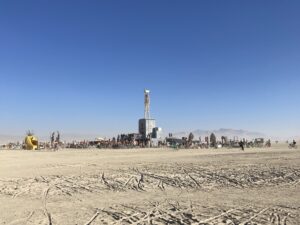
Harvey and James decided to repeat the event the following year, and in 1988 they joined forces with the Cacophony Society, which began to help publicize and organize the event. The effigy had grown to 30-feet high and was now officially dubbed the Burning Man. (Image at right) The burn drew somewhere around 150-200 people. By 1990, the Man was now 40-feet, the gathered crowd had swelled to an estimated 800 participants, and the local park police determined that they could no longer burn the figure at that location. At this point, John Law and others suggested the Black Rock Desert in northwestern Nevada as an alternative location, and he, Harvey, and other core organizers determined to take the Man there to be burned a few months later over the Labor Day weekend.
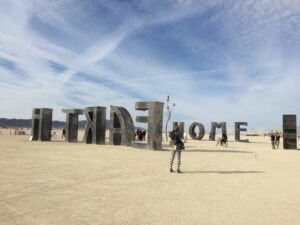
Located approximately 340 miles from San Francisco, and 120 miles north of Reno, the dominant feature of the Black Rock Desert is a 400-square mile prehistoric lakebed called the playa (a vast, starkly flat, utterly empty, and intensely arid plane of cracked hardpan alkali clay). The weather there can be extreme, as temperatures in late summer typically range from below forty overnight to well over one hundred degrees Fahrenheit at midday. Fierce dust storms and white-outs can rage, with winds sometimes exceeding seventy-five miles per hour (Goin and Starrs 2005). For many Burners, the unique location itself is a central attraction and significantly shapes their experiences at the event. Graham St John argues that three natural qualities of the Black Rock Desert playa contribute to Burning Man’s aesthetic: otherworldliness, ephemerality, and limitlessness. As St John explains, the Black Rock Desert playa is both an absolutely remote place and a place that lies “in-between space and time,” creating a “quintessential ‘realm of pure possibility’” (St John 2019:292). These characteristics of the Black Rock Desert contribute to participants’ transformational spiritual experiences at the event (St John 2020).
Somewhere between eighty and one hundred intrepid adventurers made the first trek to the playa in September 1990. A prominent Cacophony Society member named Michael Mikel scratched a line across the surface of the playa and invited the gathered attendees to step across the threshold, thus symbolically initiating these first participants into the “Zone.” (The Cacophony Society had held a few other events they called “Zone Trips,” in which they took road trips into strange and exotic territories. See Beale 2007). The event proceeded to grow exponentially over the following years. In 1992, Mikel took on the moniker “Danger Ranger” and organized a group he called the “Black Rock Rangers” in order to assist participants who became lost or stuck in the vast, empty playa. The Rangers continue as a vital peacekeeping and safety resource that interfaces with the various federal, state, and local law enforcement agencies that now patrol the event.
By 1993, there were approximately 1,000 attendees, and some of the event’s distinctive artistic and performative elements began to emerge. For example, Cacophonist Peter Doty staged “Christmas Camp” by putting a plastic Christmas tree in front of his tent, dressing up as Santa Claus, and handing out gifts to other participants while singing Christmas carols, thus instigating what would become the “theme camp” tradition. Other participants began to bring other artistic and ritualistic elements to the event over time, including a contingent of creatively modified automobiles called “art cars.” The encampment eventually came to be called “Black Rock City” and grew more and more elaborate, with a roughly circular layout, designated roadways, a central café, medical services, a post office, and other civic features.
By 1996, the event had swelled to an estimated 8,000 participants, which began to strain the relatively loose infrastructure the event had developed up to that point. The first accidental death took place a few days before the event had “officially” begun, when participant Michael Fury died while riding his motorcycle (apparently drunk and without headlights) in route back to his encampment on the playa from the nearby town of Gerlach. A few days later, during the main event, two other participants were critically wounded, and one never fully recovered, after their tent was run over by another exceedingly intoxicated participant. In the aftermath of these crises, John Law wanted to stop holding future Burning Man events altogether and departed from the organizing team. He did not return to the event, although he remained a prominent figure in the Bay Area arts and alternative culture communities (Law 2013; see also Evans, Galbraith and Law 2013). Harvey and other friends, however, wanted to continue doing Burning Man and so began to develop a more tightly organized infrastructure. The event perimeter and gate became much more carefully controlled, and driving within the event site was banned, with the exception of art cars. Even these would be limited to five miles per hour and would also eventually be carefully regulated and permitted. In 1997, with a few trusted friends, Harvey formed the Black Rock City LLC as a business structure for the event.
From 1997-2007, the event grew from 10,000 to nearly 50,000 participants, and also developed many of the artistic, ritualistic, and other cultural elements that have come to characterize the event. (These features will be discussed below under Doctrines/Beliefs and Rituals.) The late 1990s were an exciting but challenging time for Burning Man, as organizers learned to manage tremendous growth and create a fiscally stable organization, while also coming to agreeable terms with local and federal governmental agencies, as well as local landowners and residents in the nearby community of Gerlach, Nevada. By the 2000s, the process of building the annual infrastructure for Black Rock City began to achieve some stability, allowing organizers to turn some of their energies outward. For example, a noteworthy moment in the event’s history occurred in 2005, when Burning Man organizers helped to support and build a volunteer response to the Hurricane Katrina Crisis on the Gulf Coast. This group, which came to be called Burners Without Borders, helped to rebuild a Vietnamese Buddhist Temple in Biloxi, Mississippi, demolished scores of damaged homes at no cost to owners, and also rebuilt a private home in Pearlington, Mississippi. This spin-off organization has continued to help organize grassroots disaster response efforts and other initiatives, including in New Jersey following Hurricane Sandy in 2012 (see “Burners Without Borders” n.d.).
Beginning in 2007 when its first annual Global Leadership Conference was held in San Francisco, Burning Man formalized the expansion of its network of events, which were spreading internationally and continued to spread through the first two decades of the twenty-first century. A project called “Burning Progeny,” based at the University of Fribourg and led by Francois Gauthier and Graham St John, brought together researchers to explore the spread of Burning Man events in Europe (Vitos et al 2022). Researchers published work on Burning Man-related events in China (Rowen 2023) and Israel (St John and Vitos 2023), among others.
In another community-building effort, extending the boundaries of Burning Man, in 2016 the Burning Man Project bought Fly Ranch, a 3,800-acre property adjacent to the event site in Nevada, in order to create a more permanent presence in the desert and a “year-round opportunity to explore the potential of the Burning Man community,” according to the Burning Man Project’s Fly Ranch website (Fly Ranch website 2024).
In 2020, Burning Man’s virtual “Multiverse” took place online after the real-life event was canceled due to COVID-19. Burning Man 2020 took place across eight virtual “Universes” on different platforms, including the virtual reality platform, Second Life, as well as through many other events organized by participants in their neighborhoods and local communities. Going against pandemic protocol, there were also unofficial “renegade burns” in the Black Rock Desert. Included in the Multiverse was a virtual version of the typical Man sculpture, that burned on Saturday night, and a Temple that burned on Sunday night, as usual. The virtual 2020 Ethereal Empyrean Temple was conceptualized by Sylvia Lisse and Renzo Verbeck and created by Jeremy Roush. Many Burners were afraid that the emotionally engaging large-scale burns of the Man and the Temple would be video game versions of these powerful events in the Black Rock Desert. However, as Caveat Magister put it in an essay for the online Burning Man Journal, “The Temple is a digital structure made of photons and imagination that we can all visit, place offerings within, and gather around together for the ceremonial burn. The building won’t be real, but the gatherings and messages and loss will be” (Magister 2020). According to the Burning Man Project and many Burners, the virtual events were successful and hundreds of thousands of people entered some part of the Multiverse (Pike 2022). According to the Temple Guardians Discord channel, the virtual Temple contained 3,141 offerings that people had put there, with a file size of 16.6 GB and the offerings were viewed 40,498 times (Pike 2022).
DOCTRINES/BELIEFS
The topic of Burning Man’s doctrines and beliefs is complex. Neither participants nor organizers characterize Burning Man as a “religion,” nor do they profess any shared narratives concerning an unseen or ultimate realm. At the same time, event organizers state a desire to “produce positive spiritual change in the world,” through the experience of Burning Man (“Mission Statement” n.d.). Organizers have also developed a core ideology, encapsulated by “Ten Principles” which organizers and participants alike strive to live out through the event and its surrounding subcultures. These principles are: “radical inclusion, gifting, decommodification, radical self-reliance, radical self-expression, communal effort, civic responsibility, leaving no trace, participation, and immediacy” (Gilmore 2010:38; see also “Ten Principles” n.d.). Participants (often collectively called “Burners”) bring a wide range of distinct concepts and belief structures concerning the meaning of the event and spirituality in general. Religious studies scholar Lee Gilmore’s 2004 survey of Burning Man participants found that roughly half described their personal outlooks as “spiritual” or “spiritual but not religious,” while over a quarter described their outlooks as atheist, agnostic, or simply ambivalent (Gilmore 2010: 48-49). Despite the significant differences between these various points of view, it is likely that most of these individuals would register as “nones” in surveys such as the Pew Forum’s 2014 U.S. Religious Landscape Survey (“Pew Forum” 2014). Relatively few Burning Man participants affiliate with a specific religious tradition. In Gilmore’s survey, those who did name recognizable traditions claimed a wide range of affiliations, including both progressive and conservative forms of Christianity, secular and reconstructionist Judaisms, various strands of Buddhism and Hinduism, as well as varieties of contemporary Paganism.
To experience the event as a spiritual destination, Burners adopt a number of strategies, such as using the language of pilgrimage to describe their travel to the Black Rock Desert. They consciously construct the event as an inversion of the “default” world outside its boundaries and a sacred space away from ordinary life (Pike 2010). It also becomes a site of intensive interpretation because of its ephemerality, as Graham St John persuasively argues in “Ephemeropolis: Burning Man, Transformation, and Heterotopia” (2020). In St John’s view, Burning Man’s transitory nature is part of what makes it a powerful and transformative experience for Burners. Burners even describe the event as their “church,” “tribe,” “real home,” or “religion” (Pike 2010).
In general, Burners display a wide disparity of views as to the nature and meaning of the event itself. In Lee Gilmore’s survey, over half stated quite clearly that they viewed or experienced the event as in some way “spiritual” or “spiritual, but not religious.” What they meant by that varied a great deal, and their views were not necessarily mutually exclusive. Many described a desire for both individual and collective connections with a nebulous “something more,” and many (nearly forty percent) also acknowledged the clear yet complicated parallels between Burning Man and “religion.” But they often saw these connections as problematic, stemming in part from their own general discomfort with “religion.” Another large share (roughly fifteen percent) disavowed either “religion” or “spirituality” as legitimate frameworks for of the event and insisted that any such resemblances between Burning Man and religion were either illusory, offensive, or both. In the end, many (over forty percent) were most comfortable simply acknowledging that the event could “be whatever you want it to be,” and this outlook is indicative of the event’s malleability, as well as the extent to which it reflects deeply embedded patterns of Protestant American individualism (Gilmore 2010:57-62).
Although Burning Man is sometimes called a “pagan” event, it has never been organizationally nor theologically connected with contemporary Paganism, Wicca, or other modern “earth-based” religions. Lee Gilmore’s 2004 survey turned up fewer self-professed Pagans than she had anticipated (Gilmore 2010:49-52). However, she argued that Burning Man be understood as a “lower-case” pagan event, in that its ritualizing and artwork draws on a range of symbolic resources, often including Indigenous and polytheistic imagery. Furthermore, given the shared experience and physical intensity of camping on the Black Rock playa, combined with the event’s ritual rhythms, Burning Man affects many participants on a visceral, embodied level that is often associated with “pagan” religions. In these regards, Burning Man resonates with what Michael York has called the “root religious” aspect of Pagan religions (York 2005).
The internal diversity of opinion about Burning Man is among the driving engines of the event. As participants both debate and perform the event’s values, ideals, and rituals, its nature, meanings, and contexts continue to evolve. Rather than constituting a discrete NRM, Burning Man is instead a venue for acting out, and otherwise ritualizing, a variety of spiritual impulses often described as alternative, esoteric, new age, or “spiritual, but not religious.” In this regard, Burning Man troubles the boundaries around what can be readily designated or defined as “religion,” according to normative Western standards.
RITUALS/PRACTICES
Beginning with the semi-spontaneous inaugural events on Baker Beach in 1986, the burning of a humanoid figure has served as the event’s central, definitive rite. By 1989, the sculpture had assumed what became its characteristic appearance (with occasional minor variations) in the following years: a wooden lattice-work figure, reminiscent of a garden trellis or electrical tower, although the rite of the Burn has changed in several ways over time. In the early years, nearly all attendees participated in raising the Man to a standing position using a winch and pulley. However, since 2001 the Man has stood atop an elaborate platform (which reflects a particular annual theme) and is put in place by a crane days before most participants arrive. There is no particular liturgy or prescribed manner with which to 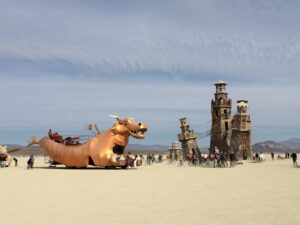 participate in the Burn, but almost all the thousands in attendance at the event converge around the Man for this climactic event. They arrive at the burn in their most elaborate costumes, draped with flashing LED lights to make themselves visible by vehicles driving towards the Man. They ride colorfully decorated bicycles or dance atop elaborate art cars, (Image at right) playing music as they process to the Burn. The burning of the Man is preceded by an extensive fire dance performance, but most participants are too far back in the crowd to observe these activities, though costumed participants art cars festooned with lights give a sense of being part of a huge spectacle.
Other ritualistic events were held at the event from its earliest days. The “theme camp” tradition that began with Peter Doty’s 1993 Christmas Camp, contains performative and ritualistic elements that pull from a global range of cultural, artistic, and symbolic elements that inspire idiosyncratic themes (For examples, see “Theme Camps & Villages” n.d.). In 1994, artist Pepe Ozan began to sculpt ten to twenty foot-high hollow towers made of wire mesh and playa-mud that he called “lingams,” which would be stoked with wood and set on fire. Beginning in 1996, these sculptures evolved into the stages for elaborate “operas.” Scripted and rehearsed, these performances each drew on religious and spiritual themes including Dante’s Inferno, Ishtar’s Marriage and Descent, Vedic Hinduism, Vodou, and the Atlantis mythos (“Burning Man Opera” n.d.). These operas ceased to be prominent aspects of Burning Man after 2000, but the community of artists and performers that had produced them would continue to engage in a variety of collaborative endeavors, including an opera about Burning Man (called How to Survive the Apocalypse ) that was staged in San Francisco in 2009, Los Angeles in 2011, and Las Vegas in 2012 (“How to Survive the Apocalypse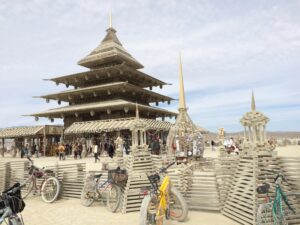 ” n.d.).
Since 2001, a second central ritual around what became known as “The Temple” emerged. (Image at right) These Temples are ornate and large temporary structures in which participants are invited to leave inscriptions and small objects for their beloved dead, as well as other messages concerning burdens from which participants wish to free themselves. Each year, the Temple is burned on Sunday night, the night following the burning of the Man. The Temple tradition was founded by an artist named David Best, who transformed a structure he built for the event in 2000 (constructed out of leftover dinosaur puzzle pieces and called the “Temple of the Mind”) into a temporary memorial for a recently deceased friend. He then decided to repeat the event the following year, with a much larger structure called the “Temple of Tears.” Organized by various artists, including Best, every year since, the Temples have become an integral and much beloved feature of the event. In a stark contrast to the atmosphere on the night that the Man burns, the Temple burns tend to be observed with silence and solemnity. (Pike 2001, 2005, 2010, 2011)
In addition to these large-scale examples, numerous smaller rituals and ritual-like activities take place at Burning Man. In any given year, a perusal through the list of activities and events submitted by participants include yoga classes, Kabbalah classes, Reiki attunement, Vipassana, Zen and other mediation sessions, contemporary Pagan and ceremonial magick rites, Balinese kechack, and sundown Shabbat services (among numerous more clearly “secular” types of events). Lee Gilmore met conservative evangelical Christians distributing bottles of water as a “gesture of prophetic witness” from a theme camp designed to represent the biblical Ein Gedi oasis. She also once sought out the leader of the “Black Rock City JCC” theme camp, who would not let her tape-record their Saturday morning interview in observance of Sabbath requirements. Burning Man has also hosted numerous performances by New York performance artist and social justice activist Reverend Billy and his Church of Stop Shopping (also sometimes known as the Church of Life After Shopping, and the Church of Earth-a-lujuah) (Talen and D. 2010; see “Church of Stop Shopping” n.d.).
Finally, to a limited extent, Burning Man is shaped by a series of annual themes, such as Beyond Belief (2002), The Green Man (2007), Rites of Passage (2011), and Cargo Cult (2013), Radical Ritual (2017), and Metamorphoses (2019) to name just a few. These provide a degree of thematic coherence for the artworks, performances, theme camps, and rituals developed for the event by participants. Finally, there is also a sense in which the entire event can be viewed as a ritual of pilgrimage, as mentioned earlier, with attendant preparations and austerities, travel to a remote and marginal site, threshold crossing, communal activities, culminating rites, and transformative reintegration back into normative, day-to-day society (Gilmore 2010; Pike 2010).
ORGANIZATION/LEADERSHIP
In the early 1990s, Burning Man was owned via a legal partnership between Larry Harvey, John Law, and Michael Mikel that was informally called “the Temple of the Three Guys,” and the event itself was organized primarily by those three, with varying degrees of assistance from and collaboration with a variety of other friends and volunteers. Starting in 1996, Larry Harvey formed a Limited Liability Corporation through which to own and manage the event with a group of trusted friends. The first iteration was called the Burning Man LLC, though this entity would be supplanted by the Black Rock City LLC in 1997. The immense growth of the event necessitated transforming a small, loosely structured collective into a more structured organization with a Board of Directors, paid staff, and vast army of volunteers without losing the creative and participatory community the event was known for (Chen 2009).
In 2010, Harvey announced that Burning Man would begin transitioning from an LLC to a 501c(3) non-profit called The Burning Man Project (Curley 2010). In 2011, a seventeen-member board of directors for this new organization was formed, which included the six long-time members of the LLC along with a dozen other individuals from San Francisco and the West Coast’s arts and business communities. By Larry Harvey’s death in 2018, Marian Goodell had emerged as the main spokesperson for the Burning Man Project, and as of this writing serves as its CEO. Goodell has overseen the ongoing move to make Burning Man a worldwide community of artists and innovators, ongoing and extended from Black Rock City.
As outlined briefly in the timeline above, the peak population of Black Rock City increased from under 100 participants in 1990 to nearly 80,000 in 2019. It is difficult to measure the size of the global community of Burners (that is, individuals who have at some point since the early 1990s attended the event at least once), although the number is likely in the hundreds of thousands.
Geographically, the Burning Man community is centered in the San Francisco Bay Area, although there are significant presences in numerous other U.S. cities, especially Reno, Los Angeles, and Portland, among others. In addition to these being the urban centers closest to the event location, these cities are also home to large artistic and “alternative” subcultures. Organizers have sought to foster a regional network of Burning Man participants in these and other cities, several of which organize and host Burning Man-esque events in their own area. These regional events are as far flung as Canada, the U.K., Ireland, Australia, and South Africa (“Regional Network” n.d). It is not unheard of for some participants to attend only their own regional events, but never the main event in Nevada, and still consider themselves to fully be a Burner.
According to researchers Graham St John and Botond Vitos, the nearly 80,000 participants at the Nevada Burning Man event in 2019 included 10,000 volunteers. That year the Burning Man Project itself included about 125 year-round employees and 800 seasonal employees. The Project also supported a global cultural network that included 232 volunteer regional contacts in 114 regions in 34 countries. St John and Vitos noted that “As of 2019, there were reported to be more than one hundred events holding standing as authorized affiliates of this network, the official status of which is established via a demonstrated accord with the criteria for regional events and an observance of the 10 Principles” (St John and Vitos 2023: 45). They quoted Larry Harvey’s view that “We are no longer staging an event,” stated Harvey after a decade in the desert, “we’re coordinating a global community” (St John and Vitos 2023: 45).
ISSUES/CHALLENGES
The primary issues and challenges faced by Burning Man stem from the event’s rapid growth, related issues concerning financing and commercialization, and broader community disputes about the meaning and nature of the event. Burning Man organizers have long espoused decommodification as one of their Ten Principles, saying: “our community seeks to create social environments that are unmediated by commercial sponsorships, transactions, or advertising. We stand ready to protect our culture from such exploitation. We resist the substitution of consumption for participatory experience” (“Ten Principles” n.d.). Accusations of Burning Man’s having “sold out” have been an issue since at least the mid-1990s, when the first annual theme (The Inferno in 1996) proposed an imagined and satirical take-over of Burning Man by a satanic multinational conglomeration called “HelCo.” In response to accusations of commodification, Harvey gave a speech at the event in 1998 in which he postulated a distinction between “commerce” and “commodification” (Harvey 1998). The organization would eventually state on their website: “We have drawn a dividing line around our desert event in order to separate direct, immediate experience from the commercial world of manufactured desire. It’s not that we are against commerce, but we are against commerce without community, consumption without purpose and profit without value.” (“Marketplace” n.d.; also see Gilmore 2010). Based on this ideal, they attempt to control the commercial use of the Burning Man name, image, and logo, in order to keep others from cashing in on the Burning Man brand (Pippi 2012).
Another example of how these commitments are practiced is the fact that Burning Man has never accepted corporate sponsorship, instead relying almost exclusively on ticket sales to cover the event’s considerable production costs. These costs include the annual construction and clean-up of Black Rock City’s infrastructure, a hefty per person/per day fee charged by the BLM, insurance, payroll, emergency health and other public safety services during the event, grants for select sponsored art projects, as well as numerous other miscellaneous and administrative costs. Participants have continuously complained about the event’s expensive ticket prices, which have risen from $35 in 1995 to $575 in 2024 and an additional $150 for a vehicle pass in 2024. In an attempt to address the cost and make the event more accessible to people with lower incomes, the organization continues to make a limited number of low-income tickets available every year, by application, and tickets are often compensated for some volunteers.
Despite these efforts to stabilize the ticket sale process, and despite the fact that the organization has for many years made some tickets available to select low-income applicants at a discounted price, some participants complain that costs are exorbitantly high. The situation reflects long-simmering external and internal social class pressures within the event and its surrounding communities. On one hand, Burning Man’s cultural roots are squarely in artistic, bohemian communities. Yet since the mid-2000s, the event has increasingly attracted a wealthy, glamorous, international partying set, who can easily afford the high-ticket costs, and who travel in extravagance and luxury. There has also been a growing phenomenon of so-called “plug-and-play” camps that plan, cook, and otherwise organize camps for those willing and able to pay a high premium. And the event has long drawn numerous wealthy participants from the San Francisco Bay Area’s Silicon Valley tech sector (Turner 2009). Rank and file participants, in the meantime, have been vociferous in their dislike of these trends, as reflected in online dialogues and forums about Burning Man (for example, see “Burners.Me” 2012). Beginning in 2014 and ongoing through this writing in 2024, Burning Man organizers have responded to this issue by eliminating “convenience camping” (also called “plug-and-play” or “turnkey camping”). The Burning Man Project website lists their efforts to do so, as part of the organization’s commitment to the principle of decommodification (Burning Man Project 2024).
Burning Man has faced various other challenges and criticism concerning artistic and cultural authenticity over the years. For example, in 2004 and 2005 a group of artists who were long-time contributors to Burning Man (led by Jim Mason) formed an alliance they called “Borg2” that challenged the Burning Man organizers to increase funding for art at the event, and to democratize the way art grants were selected. Although no significant changes in Burning Man’s art grant process or policy resulted from the ensuing controversy, Borg2 demonstrated the extent to which participants are often critical of the increasingly bureaucratic entity that the Burning Man organization has become.
Although “Radical Inclusion” is one of its 10 Principles, Burning Man has been criticized for its lack of diversity and for cultural appropriation (Lucia 2020). According to the 2023 Burning Man Census (Burning Man Census website 2023) people of color still only made up 14.5 percent of attendees. In response to criticism of the event’s inaccessibility and lack of diversity for people of color, in the 2020s the Burning Man Project developed a number of initiatives, including establishing the Radical Inclusion, Diversity, and Equity Stewardship Group (R.I.D.E.), which includes staff and community members from across the Burning Man community (Burning Man Project website 2024. The Burning Man Project started regularly scheduled staff discussions and worked to elevate the voices of people of color in all its communications channels. A village and numerous theme camps focused on BIPOC communities and their allies have become more visible and prominent in the 2020s.
Relations with Indigenous people have also sometimes been tense and the organization works to address local tribes’ concerns. The event takes places on Northern Paiute ancestral lands and most Burners drive through the Pyramid Lake Paiute Tribe’s reservation on their way to the event. Traffic through the tribe’s small communities has long been an issue, as has trash, and not paying fees to visit Pyramid Lake. Tribal Chairman Phoenix noted in a 2023 interview that the organizers have tried to address the tribe’s concerns and that communication has improved over the years. Some tribal members do attend the event and Phoenix was planning to attend for the first time in 2023 (Moyer 2023). In addition to traffic and trash, a different kind of example of event organizers working with the tribe is honoring the tribe’s request that Burning Man participants refrain from placing cremated human remains in the Temple. According to an article on the Temple Guardian site, Dean Barlese, spiritual leader of the tribe, explained that they do not allow ashes to be spread at Pyramid Lake either: “We speak for Peah Deep, Mother Earth, in this matter, and she is crying tears of blood at this time. So we stand up and do our best to protect her.” The Black Rock Desert is, in Dean’s words, “within our aboriginal territory. We have a very strong cultural/spiritual tie to the area” (Temple Guardians n.d.)
Although in some ways the festival itself is not the most earth-friendly event, since participants consume a large number of resources for a short and somewhat wasteful week, organizers and participants make a concerted effort to “leave no trace” by effectively and scrupulously cleaning up the event site following each annual event. They also began purchasing carbon offsets in 2006. Burners have created a number of other sustainable practices to minimize the event’s environmental footprint, especially through Earth Guardians, a community within the larger event that promotes recycling and other initiatives to facilitate leaving no trace, such as training people how to make grey water evaporators to keep wastewater off the desert floor. In response to critiques of the event’s environmental problems from within and outside the community, in 2019 the Burning Man Project released a 2030 Environmental Sustainability Roadmap, stating its goal to turn Black Rock City into a carbon-negative and ecologically regenerative event by 2030. The plan listed three goals: “No Matter Out of Place. Handle Waste Ecologically,” such as buying less in the first place and on-site clean-up practices; “Be Regenerative. Create a net positive ecological and environmental impact”; and “Be carbon negative” (Burning Man Project 2019; Pike 2023).
All of these issues indicate the extent to which participants and observers hold conflicting views about Burning Man. For some, it is spiritual event and an opportunity to re-create themselves through ritual and community; for others, it is simply an extravagant and expensive party. Yet for many, the spiritual and hedonistic aspects of Burning Man are not necessarily mutually exclusive. Participants have found various ways to critique the organizers whenever they appear to fail to live up to Burning Man’s ideals and 10 Principles, whether concerning costs, commercialization, environmental issues, inclusivity, or artistic authenticity. In doing so, they contribute to the larger dialogue surrounding the event, and thereby shape it by refining and expanding its possibilities.
Given changes in infrastructure, the eventual retirement of key players, and Larry Harvey’s death in 2018, it remains to be seen how the event will change in the future and what further challenges might be faced. Many core participants from the 1990s have stopped attending Burning Man, in part because of the event’s growth and changes, but also because they have simply outgrown the festival or otherwise moved on in their lives. The next generation is bringing its own unique aesthetic and concerns to Burning Man, and, as of this writing, there appears to be no shortage of new participants ready to give considerable time and energy to bring this event to life every year.
IMAGES
Image #1: Burning Man. Credit: Sarah Pike.
Image #2: The playa. Credit: Sarah Pike.
Image #3: An art car and sculpture. Credit: Sarah Pike.
Image #4: The Temple. Credit: Sarah Pike.
REFERENCES
“Afterburn Reports.” n.d. Accessed from http://afterburn.burningman.com on 30 January 2014.
Beale, Scott. 2007. “Bad Day at Black Rock (Cacophony Society Zone Trip #4).” Laughing Squid Blog, January 18. Accessed from: http://laughingsquid.com/bad-day-at-black-rock-cacophony-society-zone-trip-4/ on 30 January 2014.
Bey, Hakim. 1991. T.A.Z.: The Temporary Autonomous Zone, Ontological Anarchy, Poetic Terrorism. Brooklyn, NY: Autonomedia.
“Black Rock City 2013 Population.” 2013. Burning Man Blog, September 13, 2013. Accessed from https://blog.burningman.com/2013/09/news/black-rock-city-2013-population/ on 30 January 2014.
Black Rock City Census. 2023. “Black Rock City Census 2023 Population Report.” Accessed from https://blackrockcitycensus.org/sociodemo on 25 September 2024.
Bowditch, Rachel. 2010. On the Edge of Utopia: Performance and Ritual at Burning Man. London: Seagull Books.
Bowditch, Rachel. 2007. “Temple of Tears: Revitalizing and Inventing Ritual in the Burning Man Community in Black Rock Desert, Nevada.” The Journal of Religion and Theatre 6:140-54.
Brown, Damon. 2005. Burning Man: Beyond Black Rock (Film).
Burners.Me. 2012. “Look Dahhling, A Sparkle Pony! Burning Man in Town and Country.” Burners.Me Burning Man Commentary Blog , May 3, 2012. Accessed from http://burners.me/2012/05/03/look-daaahling-a-sparkle-pony-burning-man-in-town-and-country/ on 30 January 2014.
“Burners Without Borders.” n.d. Accessed from http://www.burnerswithoutborders.org on 30 January 2014.
“Burning Man 2014 Ticket Information.” 2014. Accessed from http://tickets.burningman.com on 30 January 2014.
“Burning Man Opera.” n.d. Accessed from http://www.burningmanopera.org/ on 30 January 2014.
“Burning Man Timeline.” 2024. Accessed from http://www.burningman.com/whatisburningman/about_burningman/bm_timeline.html on 24 September 2024.
Burning Man Project. 2024. “Eliminating Convenience Camping in Black Rock City.” Accessed from https://burningman.org/event/participate/camps/cultural-direction-se.tting-decommodification/convenience-camping/ on 25 September 2024.
Burning Man Project. 2024. “Radical Inclusion, Diversity, and Equity.” Accessed from https://burningman.org/about/about-us/diversity-radical-inclusion/ on 25 September 2024.
Burning Man Project. 2019. “2030 Environmental Sustainability Roadmap.” Accessed from https://burningman.org/wp-content/uploads/BMW_Burning-Man-Project_-2030-Environmental-Sustainability-Roadmap.pdf on 12 September 2024.
Chase, Will. 2013. “Burning Man 2013 Ticket Sales.” Burning Man Blog, January 4. Accessed from https://blog.burningman.com/2013/01/news/burning-man-2013-ticket-sales/ on 30 January 2014.
Chen, Katherine. 2009. Engaging Creative Chaos: The Organization Behind the Burning Man Event. Chicago: University of Chicago Press.
“Church of Stop Shopping.” n.d. Accessed from http://www.revbilly.com on 30 January 2014.
Curley, John. 2010. “The State of the Man.” Burning Man Blog , September 1, 2010. Accessed from http://blog.burningman.com/2010/09/eventshappenings/the-state-of-the-man/ on 30 January 2014.
Doherty, Brian. 2004. This is Burning Man: The Rise of a New American Underground. New York: Little, Brown and Co.
Evans, Kevin, Carrie Galbraith and John Law, eds. 2013. Tales of the San Francisco Cacophony Society. San Francisco: Last Gasp Publishing.
Fly Ranch website. 2018. Fly Ranch, Accessed from https://flyranch.burningman.org/ on 24 September 2024.
Gilmore, Lee. 2010. Theater in a Crowded Fire: Ritual and Spirituality at Burning Man. Berkeley: University of California Press.
Gilmore, Lee and Mark Van Proyen, eds. 2005. AfterBurn: Reflections on Burning Man. Albuquerque: University of New Mexico Press.
Goin, Peter and Paul F. Starrs. 2005. Black Rock. Reno: University of Nevada Press.
Harvey, Larry. 1991. Burning Man 1991 (Film).
Harvey, Larry. 1998. “Larry Harvey’s 1998 Speech.” Burning Man Website, September 8. Accessed from http://www.burningman.com/whatisburningman/1998/98_speech_1.html on 30 January 2014.
“How to Survive the Apocalypse.” n.d. Accessed from http://www.burningopera.com/home/ on 30 January 2014.
Jones, Steven T. 2011. The Tribes of Burning Man: How an Experimental City in the Desert is Shaping the New American Counterculture. San Francisco: Consortium of Collective Consciousness.
Kreuter, Holly, ed. 2002. Drama in the Desert: The Sights and Sounds of Burning Man. San Francisco: Raised Barn Press.
Law, John. “Who is John Law.” John Law Website. Accessed from http://johnwlaw.com/about/ on 30 January 2014.
Lucia, Amanda. 2020. White Utopias: The Religious Exoticism of Transformational Festivals. Oakland: University of California Press.
Magister, Caveat. 2020. “A Virtual Temple Made of Photons and Imagination.” Burning Man Journal. Accessed from https://journal.burningman.org/2020/07/burning-man-arts/brc-art/a-virtual-temple-made-of-photons-and-imagination/ on 2 September 2024.
“Marketplace.” n.d. Accessed from http://marketplace.burningman.com/ on 21 September 2013.
Moyer Leslie. 2023. “A Message from the Pyramid Lake Paiute Tribe to All BRC Citizens.” Accessed from https://journal.burningman.org/2023/07/black-rock-city/leaving-no-trace/pyramid-lake-paiute-tribe-message/on 25 September 2024.
“Mission Statement.” n.d. Burning Man. Accessed from http://www.burningman.com/whatisburningman/about_burningman/mission.html on 30 January 2014.
Pippi, Evil. 2012. “How Not to Burn: Commodifying Burning Man.” Burning Man Blog, May 16, 2012. Accessed from http://blog.burningman.com/2012/05/tenprinciples/how-not-to-burn-commodifying-burning-man/ on 30 January 2014.
“Pew Research Center Religious Landscape Study.” 2008. The U.S. Religious Landscape Study. Accessed from https://www.pewresearch.org/religious-landscape-study/database/ on 10 September 2024.
Pike, Sarah M. 2023. “Leaving Traces: Transformative Events and the Porosity of Humans and Environment.” Journal of Festive Studies 5:91-109.
Pike, Sarah M. 2022. “Do Avatars Weep? Ritual and Sacred Space at Virtual Burning Man.” Religion 52: 199–213.
Pike, Sarah M. 2011. “Burning Down the Temple: Religion and Irony in Black Rock City: A Report from Burning Man 2011.” Religion Dispatches, September 11. Accessed from http://www.religiondispatches.org/archive/culture/5082/burning_down_the_temple__religion_and_irony_in_black_rock_city/ on 30 January 2014.
Pike, Sarah M. 2010. “Desert Goddesses and Apocalyptic Art: Making Sacred Space at the Burning Man Festival.” Pp. 154–73 in God in the Details: American Religion in Popular Culture, Second Edition, edited by Eric Michael Mazur and Kate McCarthy. London: Routledge.
Pike, Sarah M. 2010. “Performing Grief in Formal and Informal Rituals at the Burning Man Festival,” Pp. 525-40 in Body, Performance, Agency and Experience, edited by Axel Michaels, Volume II in Ritual Dynamics and the Science of Ritual, edited by J. Weinhold and G. Samuel. Wiesbaden, Germany: Harrassowitz.
Pike, Sarah M. 2005. “No Novenas for the Dead: Ritual Action and Communal Memory at the Temple of Tears.” Pp. 195-213 in Afterburn: Reflections on Burning Man, edited by L. Gilmore and M. Van Proyen. Albuquerque: University of New Mexico Press.
“Regional Network.” n.d. Accessed from http://regionals.burningman.com on 30 January 2014.
Rowen, Ian. 2023. “The Capitalist Surrealism of Chinese Burning Man.” Journal of Festive Studies 5:68-90.
St John, Graham. 2020. “Ephemeropolis: Burning Man, Transformation and Heterotopia.” Journal of Festive Studies 2:289-322.
St John, Graham. 2019. “At Home in the Big Empty: Burning Man and the Playa Sublime.” Journal of the Society for the Study of Religion, Nature, and Culture 13:286–313.
St John, Graham. 2009. Technomad: Global Post-Rave Counterculture. London: Equinox Publishing.
St John, Graham and Vitos, Botond. 2023. “Burnerverse: The Borderland, Midburn, and the Global Event Culture of Burning Man.” Journal of Festive Studies 5: 41-67.
“San Francisco Suicide Club.” n.d. Accessed from http://www.suicideclub.com on 30 January 2014.
Talen, Bill and Savitri D. 2010. The Reverend Billy Project: From Rehearsal Hall to Super Mall with the Church of Life After Shopping. Ann Arbor: University of Michigan Press.
Temple Guardians. n.d. “Paiute Tribe Asks Burning Man Participants to Respect Their Guidance on Human Remains in Temple.” Accessed from https://templeguardians.burningman.org/paiute-tribe-asks-burning-man-participants-to-respect-their-guidance-on-human-remains-in-temple/ on 25 September 2024.
“Ten Principles.” n.d. Accessed from http://www.burningman.com/whatisburningman/about_burningman/principles.html on 30 January 2014.
“Theme Camps and Villages.” n.d. Accessed from: http://www.burningman.com/themecamps/themecamps.html on 30 January 2014.
Turner, Fred. 2009. “Burning Man at Google: A Cultural Infrastructure for New Media Production.” New Media Society 11:73-94.
Vitos, Botond, St John, Graham, and Gauthier, François. 2022. “Burning Man in Europe: Burns, Culture and Transformation. Pp. 87-114 in Festival Cultures: Mapping New Fields in the Arts and Social Sciences, edited by Maria Nita and Jeremy Kidwell. Cham: Palgrave Macmillan.
York, Michael. 2005. Pagan Theology: Paganism as a World Religion . New York: New York University Press.
“You may already be a member!” n.d. Accessed from http://www.cacophony.org/sample-page/ 30 January 2014.
Publication Date:
25 September 2024
