NIGHT WOLVES MOTORCYCLE CLUB (NWMC) TIMELINE
1983–1989: Informal motorcycle and rock communities appeared during the late Soviet perestroika era. Aleksandr “Surgeon” Zaldostanov emerged as a leader, and in 1989 the collective formally adopted the name Night Wolves (Nochnye Volki).
1991–1995: After the Soviet collapse, the Night Wolves expanded nationally as Russia’s leading biker organization. Early gatherings mixed biker culture with patriotic and moral motifs, foreshadowing later Orthodox alignment.
2005: Orthodox clergy blessed biker rallies in Moscow and Rostov (including Night Wolves participants), marking the start of regular Church–biker ritual interaction.
2006: Members joined a cross-procession ride through southern Russia, carrying icons and receiving priestly blessings at parish stops.
2009: The first Sevastopol bike show presented a theatrical blend of Orthodox
ry and WWII commemoration, inaugurating the club’s signature civil-religious spectacle.
2011: The club received a Patriarchal blessing at the Cathedral of Christ the Savior in Moscow, signaling deeper ritual integration into public Orthodoxy.
2014: The Sevastopol show “Redemption” fused Orthodox, messianic, and anti-Western symbolism while the club’s patriotic rhetoric rose to prominence in the Crimea context.
2015: The inaugural “Victory Roads” ride marked the seventieth anniversary of WWII, retracing the route from Moscow toward Berlin through Belarus, Slovakia, Czechia, and Germany (with routes via Austria/Hungary in some years and frequent Polish denials of entry). Blessings, hymns, and icon processions framed the ride as religious-patriotic memory work.
2017–2018: Foreign activity expanded, including Serbia/Republika Srpska church-linked commemorations and a Slovak chapter at Dolná Krupá, hosting joint ceremonies with Orthodox clergy.
2023–2025: Scholarship increasingly identified the Night Wolves as a hybrid religio-political actor whose Orthodox symbolism and ritualized memory practices serve civil-religious and influence functions in Russia and abroad..
FOUNDER/GROUP HISTORY
The Night Wolves Motorcycle Club (NWMC) emerged in 1989 from the late-Soviet underground of heavy-metal musicians and motorcyclists who had gathered informally since the early 1980s in Moscow’s “Sexton Club.” Its formation coincided with perestroika and glasnost, when new subcultures were experimenting with moral and civic identities outside official Soviet (Harris 2020; Zabyelina 2019). Scholars identify the NWMC as the first organized biker community in Russia and the nucleus of a distinctive post-Soviet moral subculture (Komarova 2011; Usov 2005).
In its first decade, the NWMC’s ethos combined rebellion, male camaraderie, and patriotism. Usov (2005) interpreted the early 2000s shift in Russian biker culture as a process of “cultural re-baptism,” in which previously secular communities absorbed Orthodox moral language and symbols. The Night Wolves became the leading example of this hybridization, retaining the aesthetics of Western biker brotherhoods while re-embedding them in a discourse of national morality and redemption (Usov 2005:118–22). Komarova (2011) offered one of the first sustained academic studies of the club’s partnership with the Russian Orthodox Church (ROC). She portrayed the Night Wolves as lay participants in a missionary revival that linked Orthodoxy, patriotism, and civic virtue. According to Komarova (2011:527–34), the club’s events (patriotic rides, war-memorial ceremonies, and charitable drives) functioned as “missionary service of the laity,” extending the Church’s reach into secular youth culture.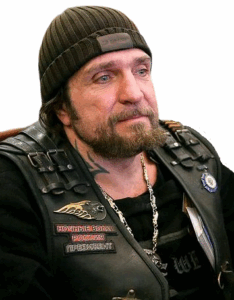
Aleksandr Sergeyevich Zaldostanov, [Image at right] widely known by his moniker Khirurg (“the Surgeon”), trained as a dental surgeon at the Moscow Medical Stomatological Institute before founding the Night Wolves Motorcycle Club in 1989. His nickname, originating from his early medical profession, came to symbolize discipline, healing, and masculine asceticism, traits that would later infuse the club’s self-presentation as a moral order rather than a leisure group (Harris 2020; Losh 2016). Western and Russian scholars alike depict Zaldostanov as a charismatic leader who transformed a marginal subculture into a vehicle of Orthodox-patriotic revival (Molnár et al. 2021; Zabyelina 2019). Under his direction, the club gradually aligned itself with the Kremlin’s civil-religious narrative, blending biker rebellion with Orthodox imagery and state-sponsored nationalism (Harris 2020; Kleiner, Gregor, et al. 2024).
By the early 2010s, Zaldostanov had become a public symbol of “patriotic orthodoxy,” regularly appearing alongside President Putin and receiving ecclesiastical blessings for large-scale biker shows in Sevastopol and Moscow (Losh 2016; Tabor 2015). During Russia’s 2014 annexation of Crimea, he and his followers were reported to have assisted local pro-Russian militias, merging ideological spectacle with logistical participation in hybrid operations (Harris 2020; Shuster 2014). Zaldostanov subsequently co-founded the Anti-Maidan movement to combat perceived Western-backed democratic protests (Walker 2015). His prominence and the club’s role in legitimizing Russian revisionism led to his inclusion on the EU sanctions list for undermining Ukraine’s sovereignty (Council of the European Union 2022).
By the mid-2000s, the NWMC had become an established participant in the ROC’s moral and missionary outreach. Komarova (2014) identified this cooperation as sorabotnichestvo, a partnership of “co-laboring” between clergy and lay activists. In her analysis, the ROC recognized the club’s capacity to reach non-churchgoing youth, especially men, through patriotic events that combined moral discipline with public spectacle. Western scholarship corroborates the institutionalization of this religious partnership. Zabyelina (2019) observes that the Night Wolves openly profess Orthodox belief and regularly seek Patriarch Kirill’s blessing before their long-distance rides, which often resemble pilgrimages to holy sites. She notes that the bikers display Easter symbols such as the letters “ХВ” (Khristos Voskrese, which is Christ is Risen) during public parades and describe the Church as the spiritual guardian of the Russian nation. The recurring blessings, icon processions, and joint commemorations gave the NWMC a measure of ecclesial legitimacy. The partnership transformed its rallies into quasi-liturgical processions where national history, Kremlin´s narratives and influence, and Orthodox piety have started to merge.
From the late 2000s onward, the Night Wolves consolidated their position as Russia’s leading patriotic motorcycle organization, expanding their activities across Russia and into neighboring states. A permanent chapter was founded in Slovakia, centered in Dolná Krupá, where members organize commemorative and religious events with local Orthodox clergy (Kleiner, Gregor, et al., 2024). In the Balkans, the club became especially active in the Republika Srpska, where Jackson and Jeffrey (2021) document joint memorial ceremonies with clergy and political leaders that fused Orthodox ritual, war commemoration (WWII), and expressions of Slavic brotherhood. Harris (2023) and Boichak (2023) also note rides through Serbia and other Balkan sites framed as pilgrimages celebrating Orthodox unity.
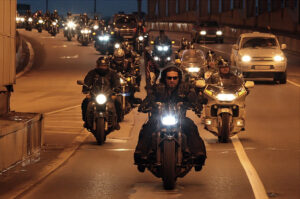
Formally known as the “Victory Roads” rides, inaugurated in 2015 to mark the seventieth anniversary of the Allied victory in World War II, they became the Night Wolves’ most emblematic transnational project. [Image at right] As documented by Kleiner, Gregor et al. (2024), the journey retraced the Red Army’s route from Moscow to Berlin, crossing Belarus, Slovakia, Czechia, and Germany, with later iterations extending into Austria and Hungary. Each stage combined military commemoration and Orthodox ritual: riders visited war cemeteries, received blessings from priests, and carried icons of military saints alongside Russian flags. The pilgrimage thus merged the cult of victory with the moral vocabulary of Orthodoxy, presenting the liberation of Europe as a sacred act and Russia as its redemptive agent. Harris (2020) interprets these journeys as expressions of imperial-Orthodox nationalism, designed to demonstrate unity among Slavic and Orthodox peoples, while Boichak (2023) situates them within Russia’s “human geopolitics,” where civic actors project Russkiy mir narratives abroad. Harris (2023) further emphasizes their theatrical dimension: processions, hymns, and public blessings turned the rides into performative rituals of national salvation. For Kleiner, Gregor et al. (2024), the Victory Roads functioned less as dialogue than as “show-up propaganda,” a moving spectacle of visibility that materialized Russian influence and sharp power through devotional and patriotic display. In this synthesis of religion, memory, and mobility, the Night Wolves translated the domestic alliance of Orthodoxy and patriotism into a transnational performance of Russia’s sacred history.
The international acceptance of the Victory Roads expeditions was uneven and often politically charged. While some segments of the public in Central Europe viewed the rides as commemorative events, others interpreted them as extensions of Kremlin soft (or sharp) power. The reception was particularly cold in Poland, where authorities repeatedly denied entry to Night Wolves convoys, citing security concerns and the group’s role in legitimizing Russian revisionism (Kleiner, Gregor, et al 2024). The tension was rooted in the club’s prior participation in the annexation of Crimea in 2014, when members assisted pro-Russian militias and produced media performances celebrating Crimea’s “spiritual return” to Russia (Harris 2020; Zabyelina 2019). These actions transformed the club from a patriotic motorcycle organization into an 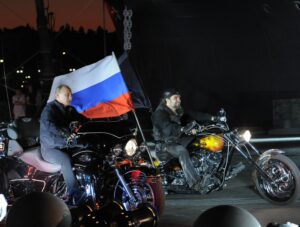 instrument of hybrid warfare, blurring the boundary between religious pilgrimage and political intimidation. As Laruelle (2019) notes, biker culture under Putin’s patronage became a vehicle for demonstrating loyalty and projecting ideological influence abroad. [Image at right] The Victory Roads therefore functioned simultaneously as civil-religious pageants and geopolitical performances, where the sacral language of Orthodoxy and liberation fused with the assertive symbolism of Russia’s post-Crimea foreign policy (Harris 2023).
Domestically, the club deepened its relationship with the ROC and state institutions during the 2020s. Patriarchal blessings at annual Sevastopol shows and joint charitable projects reinforced the group’s status as a lay auxiliary in Russia’s public Orthodoxy (Patriarchia.ru 2022).
By the early 2020s, the Night Wolves had completed their transformation from a marginal post-Soviet biker collective into an institutionalized actor within Russia’s civil religion. Through sustained collaboration with the ROC and endorsement from state officials, the club came to embody the fusion of patriotic ritual, masculine solidarity, and Orthodox moral discourse that characterizes Russia’s contemporary public spirituality (Harris 2023). Their rallies, pilgrimages, and theatrical shows projected a vision of Holy Rus’ that was defended not only by soldiers and clergy but also by lay believers mobilized through spectacle. In this sense, the NWMC illustrates how post-Soviet popular movements can sacralize national identity and translate political loyalty into religious symbolism.
DOCTRINES /BELIEFS
Unsurprisingly, there is no official doctrine when it comes to the NWMC. However, there is a set of “…seemingly incompatible and ideological motifs: Orthodox faith with Stalin´s cult, anti-American values with devotion to Western music and Harley-Davidson motorcycles” (Molnár et al. 2021:81) that the Night Wolves skillfully employ, making them a valuable non-state actor in the Moscow´s arsenal of hybrid warfare means (Kleiner, Mlejnková, et al. 2024)
The Night Wolves’ worldview fuses Orthodox Christianity with patriotic nationalism, producing what scholars describe as a form of Russian civil religion. Rather than emphasizing individual piety, this belief system sanctifies the nation itself as a divine project. The club’s rhetoric and performances portray Holy Rus’ as a moral community chosen to resist the secular and “decadent” West, a vision that mirrors the state’s broader narrative (Harris 2023; Laruelle 2019).
At the heart of this worldview lies the conviction that faith and citizenship are inseparable duties. Patriotism is framed as a religious vocation, and national defense as an act of spiritual service. As Harris (2020) observes, the Night Wolves describe themselves as “imperial-Orthodox supporters” united by “culture, language, and faith,” while their public rituals (parades, pilgrimages, and spectacles) dramatize this unity as sacred performance. Zabyelina (2019) interprets such expressions of Orthodoxy) as the moral language through which the club constructs belonging: Easter greetings, saintly icons, and Orthodox mottos serve as identity markers rather than liturgical obligations.
For Lauder (2018) and Laruelle (2019), this conflation of faith and patriotism reflects a broader political theology in which state and Church share symbolic authority. The biker brotherhood becomes a performative extension of state ideology, dramatizing the ideal of a spiritually regenerated Russia that unites religion, masculinity, and military virtue. The club’s imagery (crosses, angels, resurrected warriors) renders political loyalty as sacred duty and converts national triumph into collective redemption.
In this sense, the NWMC’s Orthodox patriotism does not articulate formal doctrine but rather an emotional theology of nationhood: Russia is holy because it suffers, endures, and protects; Orthodoxy is true because it binds citizens into moral unity. The result is a civil-religious cosmology that frames obedience, remembrance, and resistance to Western liberalism. All of this offers a convenient narrative for the Russian ruling elites with a considerable mobilizing potential.
Underlying the Night Wolves’ religious-patriotic worldview is a pronounced moral dualism that divides the world into two irreconcilable camps: sacred Russia, conceived as Holy Rus’, and a fallen West depicted as spiritually corrupt, consumerist, and aggressive. Harris (2023:1786) cites club leader Aleksandr Zaldostanov’s declaration that “Satan commands [Washington and London],” illustrating how political conflict is elevated into the metaphysical one. This approach is not a new one. The NWMC just reproduces Cold War-era propaganda scripts in which the United States is portrayed as the source of evil and Russia as its moral antithesis (Yatsyk 2018). Within this frame, defending the nation becomes a form of spiritual militancy, a continuation of the “holy defense (war)” narrative that runs from the Great Patriotic War to Crimea, Donbas (Harris 2023), and the full-scale Russo-Ukrainian war (Mefford 2024).
This dualistic language is deeply eschatological. Domańska (2019) and Černá (2022) show how the Kremlin’s myth of the Great Patriotic War has acquired a sacred aura, transforming historical victory into a tale of collective salvation. The NWMC reproduces this myth through symbols of resurrection, martyrdom, and final battle. Their Sevastopol shows and Victory Roads rides enact a story in which Russia’s wars are not episodes of politics but a narrative in which the nation’s suffering purifies the world. The Victory Roads take this type of remembrance outside Russia and enact what Molnár et al. (2023) call migrating memory, a transnational performance that projects Russia’s official narrative of liberation across European borders, embedding Orthodoxy and patriotism into the landscape of war memory.
As hinted by the previous paragraphs, the Night Wolves define themselves as a fraternity of men bound by discipline, loyalty, and spiritual service. Komarova (2018) uses the term “men’s union” (muzhskoi soyuz) that channels Orthodox moral ideals through masculine solidarity. The NWMC´s language of strength and obedience reimagines masculinity as a religious calling: men are defenders of faith and homeland, tasked with shielding “Holy Rus’” from moral decay (Harris 2020). Such an image is accompanied by a deliberate display of order and discipline. The biker aesthetic, once countercultural, is recast as an image of Orthodox virtue and patriotic control (Lauder 2018) that is brought to life by spectacle dramatizing salvation through male courage and featuring biblical scenes of struggle and resurrection performed through the bodies of bikers and soldiers (Černá 2022; Harris 2023). Furthermore, violence is not seen as transgression but purification and a proof of spiritual vitality (Harris 2022).
There is a gnawing question on which analysts disagree. That is whether the Night Wolves’ religiosity represents conviction or performance. On one hand, Harris (2023) describes the club as a hybrid religio-political actor whose rituals merge genuine expressions of faith with overt propaganda. Her examination of the Sevastopol shows demonstrates how Orthodox symbols and patriotic narratives are deployed simultaneously as devotional motifs and as tools of political communication.
Other scholars interpret the Night Wolves primarily as instruments of influence rather than as religious innovators. Both Lauder (2018) and Laruelle (2019) characterize the group as a proxy for the Russian government, arguing that its patriotic activism provides a culturally resonant vehicle for soft-power messaging abroad and they position it within Russia’s wider militia realm, a network of loyalist movements. Recent works expand this argument to the transnational level and view the NWMC as a tool of geopolitics promoting Russkiy mir values and the authority of the ROC (Boichak 2023) or as performances that materialize Russian presence and moral superiority through patriotic and religious spectacle (Kleiner, Gregor & Mlejnková 2024). In this prism, the Night Wolves’ Orthodox imagery functions less as theology and more as a legitimating style. However, pragmatically, the effect is still the same no matter the approach, mobilization of support for Russian-favoring narratives at the expense of Western liberalism.
The Night Wolves are both believers and performers, a movement in which faith, nationalism, and publicity are inseparable. Their Orthodox vocabulary offers moral credibility, while their pageantry projects political loyalty, making the club a prime example of Russia’s fusion of religion and soft or sharp power.
RITUALS/PRACTICES
Riding itself functions as a ritualized act within the Night Wolves’ public religiosity. Komarova (2011) documents early “cross-procession rides” in which bikers carried icons and received priestly blessings at parish stops, describing these events as missionary service of the laity that joined clergy and lay activists in common outreach (sorabotnichestvo). Zabyelina (2019) notes that the club seeks Patriarch Kirill’s blessing before pilgrimages to holy sites and stages Easter processions with balloons marked “ХВ.” She interprets these rides as patriotic pilgrimages that merge Orthodox devotion with demonstrations of civic loyalty. Harris (2020) adds that the Night Wolves organize pilgrimage-style motorcycle rallies, including state-funded journeys to Mount Athos and solidarity rides supporting the ROC after the 2012 Pussy Riot protest. In later work, Harris (2023) identifies the group’s Victory Day and Balkan rides as mobile rituals of sacred memory that reinforce the sacred geography linking Russia and the Slavic Orthodox world.
Across these accounts, blessings, icons, and liturgical greetings recur as fixed ritual elements. The Night Wolves’ rides thus operate simultaneously as patriotic demonstration and as popular Orthodox ceremony, forms of civic pilgrimage that translate ecclesial symbols into public, motorized performance.
Since 2009, the Night Wolves have staged large public bike shows in Sevastopol, Crimea, which have become central to their public image. These events attract tens of thousands of spectators and combine patriotic and religious themes, mock battles, and glorification of Russian leaders including Stalin (Harris 2023). Soviet war history is fused with current conflicts (especially the Ukrainian one) as a perpetuation of the continuous struggle against fascism to mythologize both the Second World War and the annexation of Crimea within one uninterrupted heroic narrative (Černá 2022; Laruelle 2019), which is also aimed to depict the West negatively. The 2015 show, broadcast on Russian state television, portrayed Ukraine as a Western puppet and the Maidan revolution as a fascist uprising, ending with a Russian victory over chaos and imperialism (Harris 2023). Circling back to the instrumentality of the performance, these events are often interpreted as tools of mass mobilization that conflate commemoration and spectacle (Schuler 2021).
Charitable work and war remembrance form the Night Wolves’ most consistent public activities outside their large-scale shows. There are documented early projects supporting veterans, orphanages, and hospitals that extended Orthodox ethics into everyday life (Komarova 2011). These practices fall under what Komarova (2014) identified as the above-mentioned cooperation with clergy (sorabotnichestvo). Club members also routinely visit war cemeteries and memorials, combining patriotic mourning with religious elements such as blessings and moments of prayer (Harris 2020). In her later study, Harris (2023:1791–93) interprets these practices as civic rituals reinforcing loyalty to the Church and the state. Acts of charity and commemoration thus function as moral performances that practically bind Orthodoxy, patriotism, and collective memory.
With the establishment of Victory Roads, the pilgrimages have begun to spill over internationally and have taken on a geopolitical dimension, or, as Boichak (2023) calls it, “human geopolitics.” Within the scope of the above-mentioned “show-up propaganda,” Kleiner, Gregor et al. (2024) document how the Victory Roads rides retrace the Red Army’s advance toward Berlin, combining war commemoration with Orthodox ritual. Each stop features ceremonies at military cemeteries, blessings by clergy, and displays of Russian and Church symbols. In the Balkans, Jackson & Jeffrey (2021) record similar commemorative rides and public events in the Republika Srpska, organized jointly with local Orthodox clergy and political leaders. These gatherings celebrate wartime fraternity and Orthodox unity, echoing the themes presented in the Sevastopol shows. The Night Wolves’ processions abroad thus act as symbolic extensions of Russian soft and sharp power: pilgrimages that have taken the mix of commemoration, Orthodoxy, and political visibility beyond national borders.
ORGANIZATION/LEADERSHIP
The Night Wolves Motorcycle Club is formally registered in Russia but functions as a movement centered on personal leadership rather than bureaucratic hierarchy. All sources identify Aleksandr Zaldostanov (“the Surgeon”) as its founder and enduring head. Zabyelina (2019) notes that the club’s internal organization reflects the U.S. biker model (chapters, hierarchies, and insignia, but that decision-making remains concentrated around Zaldostanov, whose authority rests on charisma and loyalty rather than elected office. Harris (2020) adds that Zaldostanov’s leadership combines biker discipline with patriotic and religious symbolism, turning the club into a moral brotherhood governed by personal obedience. Under his direction, the Night Wolves have developed a network of regional and international chapters, for example, in Slovakia or Serbia, that organize commemorations and public events under Moscow’s guidance. Each foreign unit operates semi-autonomously but maintains ideological alignment through shared imagery (Orthodox icons, military insignia, and Russian national symbols) (Kleiner, Mlejnková et al. 2024).
The club’s activities are supported by close ties to the ROC and state institutions. However, there is a certain distance maintained in order to provide (im)plausible deniability, a crucial component in Kremlin´s hybrid warfare arsenal. In this regard, Laruelle (2019) situates the Night Wolves within Russia’s “militia realm,” a constellation of patriotic organizations that operate alongside formal state structures and serve as loyal auxiliaries in public mobilization. Harris (2023) then describes routine participation of clergy in rallies and shows, while Patriarch Kirill blesses the Sevastopol event (Patriarchia.ru 2022).
Although the Night Wolves present themselves as a civic association, researchers consistently characterize them as a personalist and hybrid organization, part motorcycle club, part patriotic movement, and part state-sponsored actor. Leadership authority flows from Zaldostanov’s dual role as cultural entrepreneur and moral exemplar, ensuring ideological coherence while allowing flexible coordination across domestic and international chapters.
ISSUES/CHALLENGES
The Night Wolves occupy a prominent place in Russia’s public sphere while being perceived dominantly as a political instrument closely aligned with the Kremlin in the West. The group was involved in the 2014 annexation of Crimea directly with their members having boots on the ground. The NWMC provided logistical support and propagandist rallies in that case. As a result, several members, including Aleksandr Zaldostanov, were sanctioned by the United States and the European Union (Harris 2020). Kleiner, Gregor et al. (2024) document repeated bans of Victory Roads convoys in Poland and other EU states, where authorities viewed them as vehicles of Russian influence rather than remembrance. These disputes illustrate how the club’s civil-religious performances have become entangled in geopolitical confrontation which well aligns with their anti-Western rhetoric.
Night Wolves are domestically perceived well by both public and the Russian regime skillfully mixing the almost bizarre features into coherent identity, especially Orthodoxy, Soviet nostalgia, and biker culture (Zabyelina 2019) which is often a counter-cultural phenomenon. The club´s autonomy is thus frequently questioned as they are perceived as being part of the Russia´s “human geopolitics” (Boichak 2023), sharp power (Kleiner, Gregor et al. 2024), or “militia realm” (Laruelle 2019). It is probably due to these aspects that the Night Wolves have retained strong institutional backing, including the religious one. Harris (2023) observes continued participation of Orthodox clergy and state officials in their events. In sum, the NWMC´s challenges lie not at home, but rather abroad where they have to navigate justified more (e.g., in Poland) or less (e.g., in Serbia) anti-Russian hybrid warfare sentiments every time they set on a pilgrimage like Victory Roads or establish a chapter. On the other hand, inciting and feeding these division lines in target populations is one of the hybrid warfare´s goals (McCulloh & Johnson 2013).
As of the mid-2020s, the Night Wolves Motorcycle Club represents one of the most visible intersections of religion, nationalism, and popular culture in contemporary Russia. Over three decades, the group evolved from a late-Soviet subcultural collective into a hybrid religio-political movement that merges Orthodox symbolism, patriotic ritual, and geopolitical messaging. Under the continuous leadership of Aleksandr “the Surgeon” Zaldostanov, the club maintains close relations with the ROC and open endorsement from state authorities, while cultivating a network of affiliated chapters across Europe and the Balkans.
Within Russia, the Night Wolves remain embedded in the state’s patriotic infrastructure, regularly receiving ecclesiastical blessings, participating in public commemorations, and producing large-scale performances such as the annual Sevastopol shows. Abroad, their activities provoke controversy and resistance, particularly in Central Europe, where officials view the club’s pilgrimages and commemorative rides as extensions of Russian influence. Scholars broadly agree that the Night Wolves embody the fusion of civil religion and sharp power in the post-Crimea era. Faith then probably serves as cultural legitimacy for geopolitical messaging, and spectacle becomes a medium of ideological outreach.
Despite international sanctions and travel restrictions, the group continues to operate openly within and outside Russia and maintains symbolic importance in state-sponsored patriotic culture. The Night Wolves’ trajectory, from countercultural bikers to sanctioned emissaries of “Holy Rus’,” illustrates how religious language and ritual performance can be mobilized to sustain national identity, moral order, and political loyalty in twenty-first-century Russia.
IMAGES
Image #1: Aleksandr Sergeyevich Zaldostanov. Credit: Creative Commons Attribution 4.0 International. Courtesy of duma.gov.ru.
Image #2: “Victory Roads” rides. Credit: Creative CommonsAttribution-ShareAlike 3.0. Credit www.volganet.ru.
Image #3: Vladimir Putin with the Night Wolves. Credit: Creative Commons Attribution 4.0. Courtesy of premier.gov.ru.
REFERENCES
Boichak, Olga. 2023. “Mapping the Russian political influence ecosystem: The Night Wolves biker gang.” Social Media + Society 9. Accessed from https://journals.sagepub.com/doi/full/10.1177/20563051231177920 on 10 October 2025.
Černá, Marie. 2022. “The eternal legacy of the Great Patriotic War? The political instrumentalization of the Soviet victory over fascism and its utilization in Czechoslovakia after 1968 and in the Czech Republic today. Soudobé Dějiny / Czech Journal of Contemporary History, 30:725–52.
Domańska, Maria. 2019. “The myth of the Great Patriotic War as a tool of the Kremlin’s great power” (OSW Commentary No. 316). Centre for Eastern Studies (OSW).
Gapova, J. 2011. Patriarkh Kirill blagoslovil “Nochnykh volkov.” Accessed from http://russkiymir.ru/news/29829/ on 10 October 2025.
Harris, Kira. 2023. “A hybrid threat: The Night Wolves Motorcycle Club.” Studies in Conflict & Terrorism, 46:1784–1816.
Harris, Kira. 2022. Russia’s Night Wolves in Australia: ГДЕ МЫ ТАМ РОССИЯ.” Aa. Journal of Policing, Intelligence and Counter Terrorism, 17:135–58.
Harris, Kira. 2020. “Russia’s fifth column: The influence of the Night Wolves Motorcycle Club.” Studies in Conflict & Terrorism 43:259–73.
Jackson, Thomas and Alex Jeffrey, 2021. “Improvising regions: Diplomatic practices between Russia and the Republika Srpska.” Territory, Politics, Governance 9:471–491.
Kleiner, Jan, Milos Gregor, and Petra Mlejnková. 2024. “The Night Wolves: Evidence of Russian Sharp Power and Propaganda from the Victory Roads’ Itinerary.” Problems of Post-Communism 7:145–55.
Kleiner, Jan, Petras Mlejnková, and Milos Gregor. 2024. “Night Wolves Motorcycle Club: A Long Way from Advocates of Democracy to Kremlin Propagandists.” Pp. 369–78 in The Palgrave Handbook of Non-State Actors in East-West Relations, edited by P. Marton, G. Thomasen, C. Békés, & A. Rácz. Springer International Publishing.
Komarova, Anna V. 2018. Subkul’tury v dukhovnoi zhizni obshchestva: Religiozno-nravstvennyi aspekt. Moscow.
Komarova, Anna. V. 2014. “Motoklub “Nochnye Volki” i novye formy patrioticheskogo vospitaniia molodezhi.” Gumanitarnye, Sotsial’no-Ekonomicheskie i Obshchestvennye Nauki 1:45–51.
Komarova, Anna V. 2011. “Uchastie russkikh mototsiklistov v missionerskoi deyatel’nosti Russkoi pravoslavnoi tserkvi.” Gosudarstvo, Religiia, Tserkov’ v Rossii i Za Rubezhom 29:43–46.
Laruelle, Marlène. (with Institut français des relations internationales). 2019. Russia’s militia groups and their use at home and abroad. French Institute of International Relations (Ifri).
Lauder, Matthew A. 2018. “Wolves of the Russian spring: An examination of the Night Wolves as a proxy for the Russian government.” Canadian Military Journal 18:35–16.
Losh, Jack. 2016. “Putin’s Angels: The bikers battling for Russia in Ukraine.” The Guardian, January 29. Accessed from https://www.theguardian.com/world/2016/jan/29/russian-biker-gang-in-ukraine-night-wolves-putin on 17 October 2025.
McCulloh, Tim and Rick Johnson. 2013. Hybrid Warfare. Joint Special Operations University. McCulloh, T., & Johnson, R. (2013). Hybrid Warfare. MacDill AFB FL. Accessed from https://apps.dtic.mil/sti/tr/pdf/ADA591803.pdf on 10 October 2025.
Mefford, Brian. 2024. “Russian Orthodox Church declares “Holy War” against Ukraine and West.” Atlantic Council. Accessed from https://www.atlanticcouncil.org/blogs/ukrainealert/russian-orthodox-church-declares-holy-war-against-ukraine-and-west/ on 10 October 2025.
Molnár, Virág, Karolina Koziura, and Franziska König-Paratore. 2021. “Russia’s Night Wolves, migrating memory and Europe’s eastern frontier.” European Journal of Sociology 62:71–103.
Pravoslavie.ru. (2006). Pravoslavnye baikery Rossii i Ukrainy provedut krestny motopokhod. Accessed from https://pravoslavie.ru/18129.html on 10 October 2025.
Schuler, Catherine. 2021. “Staging the Great Victory: Weaponizing story, song, and spectacle in Russia’s wars of history and memory.” TDR: The Drama Review 65:95–126.
Shuster, Simon. 2014. “Russia ups the ante in Crimea by sending in the “Night Wolves.” TIME, February 28. Accessed from https://time.com/11680/crimea-russia-putin-night-wolves/ on 15 October 2025.
Tabor, D. (2015, October 8). Putin’s Angels: Inside Russia’s most infamous motorcycle club. Rolling Stone. https://www.rollingstone.com/culture/culture-news/putins-angels-inside-russias-most-infamous-motorcycle-club-56360/
Usov, S. V. 2005. “Russkaia subkul’tura baikerov i ee otnoshenie k pravoslavnoi traditsii.” Religiovedenie 2:112–23.
Walker, Shaun. 2015, “Patriotic group formed to defend Russia against pro-democracy protesters.” The Guardian. January 15. Accessed from https://www.theguardian.com/world/2015/jan/15/group-anti-maidan-defend-russia-pro-democracy-protesters on 15 October 2025.
Yatsyk, Alexandra. 2018. “Russia’s anti-American propaganda in the Euromaidan era” (Policy Memo No. 514). PONARS Eurasia.
Zabyelina, Yuliya. 2019. “Russia’s Night Wolves Motorcycle Club: From 1%ers to political activists.” Trends in Organized Crime 22:51–65. Accessed from https://doi.org/10.1007/s12117-017-9314-7 on 10 October 2025.
Publication Date:
20 October 2025
