FIGHT SPORTS MINISTRIES TIMELINE
1869: The New York branch of the Young Men’s Christian Association (YMCA) opened as the first “Y” location planned primarily for fitness activities, including boxing.
1912: Rev. Frederick Wedge, known as “The Fighting Parson,” published his semi-autobiographical novel The Fighting Parson of Barbary Coast.
1930: The Catholic Youth Organization (CYO), with its renowned annual boxing tournaments, began in Chicago.
1986: Jack Butler published a novel in the Southern literature tradition titled Jujitsu for Christ.
1994: The Christian Karate Association’s schools, with various locations, opened.
2003: The Rock Ministry of Calvary Chapel in Kensington, Pennsylvania, with its inner-city boxing program, started.
2005: Mark Galli, former editor of the flagship evangelical magazine Christianity Today, published an opinion piece in that periodical which argued that boxing, as a sport of tightly controlled and expertly restrained violence, is ennobling and redeeming, noting that Biblical violence itself is often related to redemptive acts.
2005: Victory Boxing Club in Omaha, Nebraska, founded by a former gang member to keep youth out of trouble, opened.
2008: Trinity Martial Arts Club of Praise Lutheran Church in Fort Wayne, Indiana, with its balance of self-defense and Bible training, was founded.
2009: A website called “fightpastor.com,” a blog devoted to discussing mixed martial arts, was created by a minister as a Christian outreach to the mixed martial arts (MMA) community.
2010: The New York Times ran a front-page story (“Flock is Now a Fight Team”) about evangelical Christian mixed martial arts ministries and their leaders.
2010: The Catholic Charities Teen Center at St. Peter’s Church in Dorchester, Massachusetts began its boxing program.
2012: Boxing for Christ, a San Jacinto, California non-profit boxing program aimed at providing youth a positive alternative to bad influences, was founded.
2012: Concord Karate Club of Concordia Lutheran Church in Fort Wayne, Indiana began.
2014: Fight Church, a documentary about pastors who practice mixed martial arts and lead MMA ministries in their congregations, was released. The documentary significantly elevated public awareness of fight sports ministries and their related issues.
2014: Christian Today published an article about a pastor’s MMA-based “fight ministry” as an effort to counter a “feminized” church.
2014: The New York Times published an opinion piece and video documentary produced by the directors of Fight Church, addressing the phenomenon of church-based martial arts ministries and, among other things, their effort to combat a “feminized” church.
2014: The Christian Boxing Academy in Jersey City, New Jersey was founded by a police lieutenant and former amateur boxer.
2016: SonRise Church opened its Church Street Boxing program in Salem, Oregon. The gym-like facility included space to train, alongside space to worship.
FOUNDER/GROUP HISTORY
The phenomenon of fight sports ministries began as parts of large-scale national or city-wide organizations, and has over time become mainly the work of individual, local ministries.
Early on, the Young Men’s Christian Association (YMCA, or “Y”) established programs offering physical activity for its participants, to complement its multipronged mission to help those in need, evangelize, and provide opportunities for character building. The New York branch of the Y, opened in 1869, was the first location planned primarily for fitness activities with a well-appointed facility, including boxing equipment (Baker 2007:46-51). Dedicated to ministering to the whole person, the Y’s “four-fold program” sought to develop its participants spiritually, mentally, socially, and physically (Weier 2016:166). Over time, the YMCA deemphasized its evangelical focus in favor of providing more general community services. Still, its programs have included those in boxing, with more and more nowadays including training in martial arts. Similarly, the Chicago chapter of the Catholic Youth Organization (CYO) began its world-famous boxing tournament for similar reasons as the Y’s, but also to raise the profile of the Catholic church. Under the direction of Bishop Bernard J. Sheil, the CYO developed its renowned boxing program, hosting thousands of young boxers and spectators at its annual CYO boxing tournaments. Intended to promote ideals of Christian character through athletic achievement, and thus to combat inner city juvenile delinquency, the CYO also raised the national profile of the Catholic church, helped assimilate immigrants, and fostered integration (Neary 2016). The boxing program was a significant success, lasting through Sheil’s retirement in 1954. Programs such as those of the YMCA and CYO were successful in their use of boxing and martial arts to help achieve religious, social and institutional goals.
In more recent decades, fight sports ministry programs have been the province of local efforts, be these of individual churches, dioceses, community centers, or local civic-minded leaders. In fact, one estimate places the number of mixed martial arts ministries in U.S. evangelical churches alone at more than 700 (Watson and Bolt 2015). Such programs vary in terms of their athletic and religious practices; but all make effective use of popular athletic activities, such as martial arts and boxing programs, to reach those in need, bring followers to a religious organization, and/or reach out to those already in a church to strengthen their engagement. What is most remarkable is the variety of backgrounds of the founders of fight sports ministry organizations.
We find among fight sports ministry founders concerned parents, such as Sonia Ramos of Boxing for Christ in San Jacinto, who started her ministry after moving from a city where a similar boxing program helped keep her own children out of trouble. Finding no such club in her new city, she created one, and Ramos’s own children box in the program. A USA Boxing (the official national organization for amateur boxing) certified club, Ramos says it was her calling to start Boxing for Christ as a program to teach youth “self-defense, discipline and self- esteem.” Having reached more than 700 boxers, with thirty-five to forty participating daily, the program is somewhat rare in its being headed by a woman.
Other founders are ex-gang members and drug enforcement agents. Exemplifying the former is a past gang member who served time in a federal prison for drug-related offenses, Rev. Servando Perales, and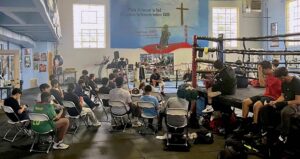 who began Victory Boxing Club in Omaha, Nebraska. [Image at right] The program was first held in his garage and later in a warehouse, after receiving support from local law officers and members of the community. Upon being released from prison, Perales became a minister and, remembering the positive outlet boxing provided him as a youth, felt called to begin a boxing ministry and community center. A faith-based program, Rev. Perales emphasizes Christian values for the youth who participate, offering weekly Bible studies and praying with those who need it.
As for police officers who helped found boxing ministries, an example is retired Drug Enforcement Agency agent and former heavyweight boxing champ Paul Doyle. He and a priest, Father Richard Conway, began a boxing program at The Catholic Charities Teen Center at St. Peter’s Church in Dorchester, Massachusetts, later run by the Colonel Marr Boys & Girls Club under some of the same leadership. Providing an opportunity to counsel youth and help them develop discipline to avoid trouble, this particular outreach did not emphasize religious activity, such as prayer and Bible study. Another example is Cristino Felix, a Lieutenant in the Jersey City Police Department and former amateur boxer, who founded The Christian Boxing Academy in Jersey City, New Jersey. Providing a safe outlet for youth who might otherwise get in trouble on the streets, the after-school boxing program was based upon Christian values, and emphasized character development. While The Christian Boxing Academy was open to youth of all faiths, Felix would nonetheless share inspiring scriptural passages with participants, as well as pray with them. The program ended in 2019 when Felix moved to Texas, where he hopes to begin a similar program.
Still other founders are ministers, such as Pastor Brandon Beals of Canyon Creek Church in Washington; Pastor J. Brown of two Lutheran churches in Fort Wayne, Indiana; and Pastor Mark Morrow of SonRise Church in Salem, Oregon. Pastor Beals, nicknamed the “Fight Pastor,” of Canyon Creek Church in Washington (now Venture Church) began a website called “fightpastor.com,” a blog devoted to discussing mixed martial arts. Beals said on the site that his mission was to be “an ambassador for Christ to the MMA community and to be an ambassador for MMA to the Christian culture.” Canyon Creek would host MMA fight parties, where men would watch televised matches at the church (Schneiderman 2021).
Pastor Brown began Trinity Martial Arts Club of Praise Lutheran Church in Fort Wayne, Indiana complementing physical training with spiritual and personal growth. Teaching self-defense and preparing youth and adults for competitions and tournaments, the program included Bible study, prayer, devotions and scripture memorization. Brown also founded and led Concord Karate Club of Concordia Lutheran Church in Fort Wayne. A similar program to the other, it combined training in faith and karate for self-control and discipline. Brown envisioned the two ministries as outreach to those whom the church might not otherwise reach.
A final example is Pastor Mark Morrow, who led SonRise Church and opened the Church Street Boxing program in Salem, Oregon. The facility had space on one side devoted to boxing, with a ring, heavy bags and other training equipment; and on the other side, a worship space, with a lectern and room for musicians. Set within a church conceived as a ministry for all, including those with addictions or who were gang members or homeless, the boxing program included participants of all ages, but mostly teen-agersd to young adults. The ministry was multifaceted in its appeals: while Morrow offered worship on Sunday mornings, some of the boxers participated, while others did not; and not all of the worshipers boxed.
One pastor-founded fight sports ministry that included various locations (including Post Falls, Coeur d’ Alene; Moscow, Idaho; and Byram, Mississippi) was The Christian Karate Association’s schools, begun by Rev. Steve Wilson, an associate pastor in Idaho. With locations around the world, the CKA approach has combined training in Christian discipleship with that of martial arts, balancing spiritual and physical mentorship. Its program has emphasized character development based upon a dozen principles taught year round, derived from Christian teachings and those of martial arts.
Finally, founders of fight sports ministries include concerned former amateur and professional fighters themselves, such as Cristino Felix (discussed above) and Golden Gloves’ Buddy Osborne of Calvary Chapel’s The Rock Ministry in Kensington, Pennsylvania. The Rock Ministry’s goal is to reach youth before they get into trouble on the streets, and to stop existing juvenile offenders from returning to trouble. Originally geared to boys and young men, the ministry now extends to girls and young women as well. Co-founder Osborne, a Golden Gloves champion who worked with juvenile offenders, works with pastors to provide participants with a place to train, do homework, and engage weekly Bible studies. The program is free and USA Boxing certified. (Wolff 202l: passim, for all outlined ministries, unless otherwise cited.)
The religious affiliations of the founders of fight sports ministries range from Catholic to mainline and evangelical protestant. Their forms include karate, mixed martial arts, jiu-jitsu and boxing. And their aims range from character development and social outreach, to evangelism, and providing masculine programs to what some perceive as a feminized church. Beyond such variety, what these fight sports ministry founders and leaders have in common is their fondness for boxing and martial arts, and an interest in using fight sports to attract participants to church and other religious programs.
DOCTRINES/BELIEFS
Individual fight sports ministry programs may trace their theological lineage back to the muscular Christianity or social gospel movements.
Begun in England in the mid-nineteenth century and reaching the United States not long thereafter, the muscular Christianity faction believes the church has become too feminized and, both to reclaim a masculine identity for the church and appeal to more “traditional” men, its adherents accentuate models of church identity and practice that reinforce a masculine character for the church and its programs, particularly via sport and athletics. Among its philosophical proponents are Thomas Hughes, who wrote 1887’s The Manliness of Christ, a treatise about Jesus’ masculinity, and Tom Brown’s Schooldays (1857), a novel which explicitly advocates for young Christian men to learn boxing (Wolff 2021:78-81). Similarly, evangelist Billy Sunday, who once proclaimed that “Jesus was the greatest scrapper that ever lived,” explicitly distanced himself from “effeminate, sissified, three-carat Christianity” in favor of “the manliest” men who have the guts to follow Jesus (Prothero 2003:94). This approach to Christian ecclesiology and discipleship, highlighting masculine qualities of the church and encouraging masculine forms of character building in sports and other programs, motivates some fight sport ministries. Examples of these are chronicled in Daniel Junge and Bryan Storkel’s documentary Fight Church (2014), which includes interviews with church leaders and others involved in debates about the ethics of fight sports, and a perceived need to appeal to men by creating a masculine identity for the church. Similar debates and motivations are chronicled in ministries discussed in a front-page New York Times article on fight sports ministries (“Flock is Now a Fight Team in Some Ministries”) and in a Christian Today article on Paul Burress, an associate pastor at Rochester’s Victory Church (“Pastor’s ‘fight ministry’ incorporates mixed martial arts; sees it as a counter to ‘feminised’ church”). The use of fight sports ministries to appeal to men and promote a masculine appeal for the church has thus received considerable media attention.
Also influencing some fight sports ministry programs is the social gospel movement. It aimed to create a more just society by addressing social challenges affecting individuals via creating ethical pronouncements, policy advocacy and institutional programs designed to minister to the whole person’s needs, not just the spiritual. Arising in the late nineteenth century and peaking in the early twentieth, the legacy of the movement’s concerns still influence many churches and organizations today in their focus on institutional responses to societal ills and those adversely affected by social conditions (Evans 2017:2-4, 227). These concerns and goals find expression in some fight sports ministries’ attempts to help youth, particularly those in urban centers, avoid the influences of drugs, gangs and crime, and avert undesired involvement with law enforcement and correctional institutions by not only providing positive, supportive programs, but also ones that involve physical activity and play, thereby appealing to the “whole” individual’s needs, not just the spiritual (Wolff 2021:30-31). Ministries such as The Rock Ministry of Calvary Chapel in Kensington, Pennsylvania; Victory Boxing Club in Omaha, Nebraska; Boxing for Christ in San Jacinto, California; and the Church Street Boxing program of SonRise Church in Salem, Oregon, fit this bill.
Finally, fight sports ministry programs are founded on the expectation that they offer opportunities for fellowship and evangelism. To strengthen ties between congregants or believers, and attract newcomers to a church or independent faith-based sports ministry, are among the goals of martial arts and boxing programs. These efforts are not without challenge, as among the issues that arise in such ministries is the extent to which competition among Christians and the pursuit of victory among those who should otherwise work together as fellow disciples may compromise Christian ideals. Other ethical concerns include fight sports’ placing the body, a gift from God, at risk of being damaged in more aggressive forms of fight sports practice. Arguably, providing appropriate approaches are taken, such challenges may be adequately addressed and, as we will see, met for those with ethical and theological concerns about fight sports ministries’ practices (Wolff 2021:164-165).
RITUALS/PRACTICES
While all fight sports ministries involve training techniques, drills, and exercises, they vary in the degree to which religious practice is involved. Some only claim a religious affiliation by name, while others offer group prayer, Bible study, and even worship services. For example, the Catholic Charities Teen Center and Boys and Girls Club of Dorchester did not emphasize religious practice aside from counselling, while the Victory Boxing Club of Omaha, Rock Ministry of Calvary Chapel in Kensington and others regularly offer prayer and Bible study. Some, such as Trinity Martial Arts Club of Praise Lutheran Church and the Christian Karate Association, have added even more religious practice, such as offering devotions, expecting scripture memorization and providing other types of Christian education. SonRise Church of Salem, Oregon even held worship services in the same facility in which it engaged fight sports training (Wolff 2021:passim).
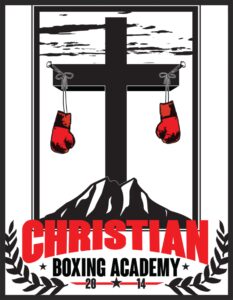
In addition, it is noteworthy that religious iconography finds expression in many fight sports ministry logos. For instance, a cross figures prominently in the Boxing for Christ and Christian Boxing Academy logos, both of which depict boxing gloves hanging from a cross. [Image at right]
ORGANIZATION/LEADERSHIP
That the founders of individual fight sport ministries almost always remain their ongoing leaders says something about the nature of this religious movement: that it is a labor of love for many, arising from their own interests and vision; that the continued success of the ministry often relies upon the dedication of the founder/leader; and that changes in the life circumstance of the leader may impact a fight sports ministry. So, for example, when Boxing for Christ’s founder and leader Sonia Ramos moved to a new city and discovered the need for a fight sports ministry, she established one. And as we’ve seen, when a ministry is part of a larger organization that transforms, such as with the boxing program that became part of the Boys and Girls Club of Dorchester, its continuation often relies upon the program originators to help it continue. When a founder/leader moves, as with Cristino Felix of New Jersey’s Christian Boxing Academy, a ministry may end, even as the possibility of opening a new fight sports ministry in the new location emerges. Some ministries are part of a broader organization, such as the Christian Karate Academy, which includes several individual programs under its charter; but even here, the founder, Rev. Steve Wilson, remains the driving force behind the association. In the end, the existence, character, success and fate of such ministries relies heavily on their founders/leaders (Wolff 2021:111-146).
While many boxing ministry programs are members of USA Boxing, the non-profit national boxing organization overseeing Olympic-style amateur boxing, there is currently no overarching organization, national or local, that advocates for and serves the collective needs of individual fight sport ministries.
ISSUES/CHALLENGES
Given the way many see the Christian church’s character (as an institution that rightly promotes love, care for others, and contemplation of the spiritual) fight sports’ association with aggression, competition, and in some practices potential the harm of the body leads some to question fight sports ministries as appropriate endeavors for churches and believers. This tension is reflected in treatments of boxing and Christianity in general, and fight sports ministries in particular, in popular culture. Hence in literature, Thomas Hughes’ writings (discussed above) address this matter in favor of celebrating a depiction of Christian masculinity that is prepared to fight to meet a challenge or slight. Charles Dickens paints a similar portrait of a good-natured but at-the-ready Christian pugilist in his depiction of Rev. Septimus Chrisparkle of The Mystery of Edwin Drood (1870), writing of him that a “soft-hearted benevolence beamed from his boxing gloves.” Harvard-educated American boxer-turned-minister Rev. Frederick Wedge, known as “The Fighting Parson,” addressed this balance in his semi-autobiographical novel The Fighting Parson of Barbary Coast (1912) in which the protagonist, after killing a man in a ring, is advised by a cleric to consider turning to ministry, saying “I knew that your work in the ring would help you see many things in the right way. Life is a battle. Even the struggle for culture and religion is a warfare.” Thus in true muscular Christian fashion, the hero’s character, forged as a boxer, is deemed an asset to his pursuit of ministry. The Fighting Parson uses his boxer’s grit to address social problems, protect the innocent, and help the needy. Finally, Jack Butler’s Jujitsu for Christ (1986), a work of Southern literature set in Mississippi’s era of desegregation with all its racial tension, features a young, simple-minded-but-sincere martial artist who opens a studio in which he not only teaches people how to fight, but also “flips” them for Christ. An occasional preacher, the protagonist responds to an inquiry about what topic he speaks on at churches by saying “Self-defense and Jesus, mostly” (Wolff 2021:57-63).
Fictional television and film have also addressed the issue of how to involve fight sports in Christian life and ministry. In TV, the long-running Korean War set series M*A*S*H’s (1972-1983) soft-spoken Jesuit priest, Father Mulcahy, was a regular advocate for peace, but also a boxer who became a coach for the Catholic Youth Organization. Similarly, based on the true story of Father Edward J. Flanagan, the movie Boys Town (1938) finds its featured cleric skilled in boxing, and encouraging boys in his charge to not only learn the sport, but also use the ring to solve conflicts. In The Bells of St. Mary’s (1945), Ingred Bergman plays a nun who, while wearing her habit, teaches a bullied boy how to box to defend himself if necessary, while also suggesting that it is best not to fight, if you can. Her conversations with a priest (played by Bing Crosby) explicitly respond to muscular Christianity’s tenets and concerns about a “feminized church”; she replies to the Father’s insistence that boys must learn to fight with her counterpoint that the superior way is to think matters through. The tension between encouraging self-defense and peaceful restraint is depicted in her attempt to train her young protégé to avoid fighting if possible, yet approving response when he defends himself against a bully. The nun beams with delight when the boy follows his act of self-defense with the peacemaking gesture of offering to buy his would-be assailant an ice cream cone. Focusing on fight sports’ emphasis on character building, Kid Monk Baroni (1952) finds a priest using a parish boxing program to teach gang members to better channel their anger, leading one talented boxer (who also enjoys singing in the church choir) to pursue a boxing career, only to lose a big fight in which he nevertheless raises money for a parish recreation center. He learns that winning isn’t everything… and sacrifice can be a form of penance. A spin-off TV series to Walker, Texas Ranger (1993-2001), Sons of Thunder (1999) finds a “preacher’s kid” and former army combat instructor opening a martial arts studio that teaches Biblical principles, and serves as a base for his own crime fighting business; with it, he helps those in need, only resorting to physical violence when necessary. He refuses to use a gun as too-lethal of a weapon, favoring the sole use of his martial arts skills. Finally, the film The Boxer (1997) depicts a former Irish Republican Army operative and pugilist opening up a boxing gym for youth, where he teaches both Catholic and protestant young men during “the Troubles” in Northern Ireland, and fights those using terrorist violence to further divisive goals. He is thus both a strong and peace-loving Christian fighter and fight sports ministry leader (Wolff 2021:63-74). In most of these fictional works of film, TV and literature, the apparent tension between being a Christian involved in fight sports is highlighted and ultimately resolved as each peace-loving apostle only fights when necessary.
As for non-fictional representations of fight sports and the church, both the documentary film Fight Church and the New York Times articles on the phenomenon (discussed above) demonstrate a national media tendency to focus on more sensational and controversial aspects of Christians involved in fight sports. So too does an opinion piece and short video documentary created by the directors of Fight Church that also appeared in the New York Times, titled “Pastor with a punch” (September 8, 2014). It begins with the question “Can you love your neighbor as yourself and at the same time knee him in the face as hard as you can?” and considers the issue of churches’ use of martial arts as a means to combat a feminized church. Amidst talk of the success of his ministry and opportunities it provides for fellowship and evangelism, the pastor at the piece’s center states that Christians need not necessarily be “sissies” and that Christ’s original disciples were “rough necks.” Similar issues are taken up by the news website The Conversation (“Mixed Martial Arts: Where feet, fists and faith collide,” and January 5, 2015) in an article that reflects on evangelistic and ethics matters at the heart of combining fight sports and Christianity; the article focuses on fight sports as a “masculine” spiritual pursuit, observing that MMA is a “manly expression of devotion.” Notably, more local coverage of workaday fight sports ministries, such as many of those outlined above, tend to focus less on controversy and more on the positive social outreach provided by such ministries (Wolff 2021:142-46).
Some theological issues reflected in contemplating the relation of fight sports to Christianity are bound up in broader treatments of the place of competitive sport in the life of Christians and the church. On this matter, Joseph L. Price (2001:15-38) developed a five category taxonomy of how engagement in sport by religions may be considered, finding this relationship to range from sport (1) being in conflict with, (2) commingling with, (3) conscripting, (4) co-opting, or (5) supplementing religion (Price 2001). Each of Price’s categories reflects particular ethical and theological concerns, as they consider various factors at play in the encounter between the two. Many fight sports ministries find themselves in the second category of commingling, which involves uses of sports for mission work or evangelical outreach. And yet, there are those that see the relation of fight sports with the church to fall into other categories, particularly that of being in conflict. Indeed, it is the apparent conflict of fight sports with church values that leads some to question its practice within church programs, and the media occasionally to sensationalize the meeting of the two. In fact, included among the abounding ethical and theological reflections on the relationship of fight sports to the church are well-grounded defenses of the practice of fight sports by the faithful, including in the context of the church. Regardless of the position taken, debates about such practice regularly invoke several theological issues that fight sports ministries face.
One issue concerns the treatment of the body. Christianity posits that humankind is created as imago dei, in the image of God, and is due respect in all its grandeur, seeing the body as a gift. Relatedly, this body is considered a temple, the dwelling place of God’s spirit, and thereby due reverence. Depending on the approach to fight sports as these are practiced, this sets up various ethical considerations. Inasmuch as physical activity may help maintain the body, training the body to work at its optimal capacity is caring for God’s gift. Indeed, training in forms that might help defend that body if attacked, be that one’s own or another’s, may also find theological support for the practice of fight sports, particularly if one pursues such defense only when needed. Where the theology of the body creates more challenges for fight sports is when harm is done to oneself or another. As Mark Galli, former editor of Christianity Today, wrote in an opinion piece in that publication, while it is true that the practice of many sports, including boxing, indulges in a celebration of violence both for participants and the audience, that which is practiced with masterful self-control and clear constraints (using gloves, timed rounds, recovery rules, and a referee’s presence and intervention) makes it not only acceptable but also ennobling and redemptive (in what others have called ritualized violence); indeed, further challenging the theological discussion, Galli observes that acts of Biblical redemption are often achieved through violence (Galli 2005). To be sure, amateur boxing and martial arts tournaments tend to be practiced with restraints and the well-being of participants in mind. Of greater concern is when such practice rises to the extremes of fight sports practice, such as in more competitive and professional matches, where theological and ethical concerns regarding honoring the body as imago dei and God’s temple most fully manifest.
Even so, in any sport, Christian theologians and ethicists acknowledge that one does not honor oneself or an opponent by not engaging in competition to the best of one’s ability. Here is where theologies of play come to bear on the practice of fight sports, particularly as a ministry. Theologians and ethicists of religion and sport, particularly from a Christian perspective, note that believers should ideally be about mutual support of each other, and reflect critically upon competition that pits believers against each other in a way that leads to victors and losers (Linville 2003; Hoffman 2010; Schafer 2015; Wolff 2021:90-110). Discussions of such matters critique engagements in sports competition that make winning and victory over another idolatrous, and praise those that emphasize Christian fellowship. Yet again, not to do one’s best and challenge both another and oneself is not honorable. Guidelines for the best practice of fight sports by Christians come from theologies of play, which suggest that participants should deemphasize the need for victory and dominance over another in favor of perceiving sport as a time for enjoyment, growth, friendship and fellowship. In short, theologies of play suggest the focus should ideally be more on delight in created good and mutual support, rather than outcome, dominance and conquest. So practiced, many suggest, fight sports ministries may properly be enjoyed without running afoul of theological and ethical concerns. Particularly given all the good they do (providing camaraderie, fitness, outreach to youth, and opportunities to learn and practice the Christian faith) those fight sports ministries that mindfully respond to such challenges may provide a meaningful though perhaps unconventional way to participate in fight sports in the context of the church (Wolff:160-62).
IMAGES
Image #1: Rev. Servando Perales (center, to the left of the ring post) leads a Bible study for young boxers at his Victory Boxing Club in Omaha, Nebraska. (Used by permission of Perales).
Image #2: The logo of Cristino Felix’s Christian Boxing Academy, including boxing gloves and the cross. (Used by permission of Felix).
REFERENCES
Baker, William J. 2007. Playing with God: Religion and Modern Sport. Cambridge, MA: Harvard University Press.
Butler, Jack. 1986. Jujitsu for Christ. Atlanta: August House.
Evans, Christopher H. 2017. The Social Gospel in American Religion. New York: New York University Press.
Galli, Mark. 2005. “Punches, Smashes, and Bombs: Boxing Gives Us a Window into the Violence Inherent in All Sports.” Christianity Today, November 1.
Hoffman, Shirl James. 2010. Christianity and the Culture of Sports. Waco, TX: Baylor University Press.
Junge, Daniel and Bryan Storkel. 2014. “Pastor with a Punch.” New York Times, September 8.
Linville, Greg. 2003. “Ethics Competition in Church Setting.” Pp. 187-210 in Recreation and Sports Ministry: Impacting Postmodern Culture, edited by John Garner. Nashville, TN: Broadman & Holman.
Marie, Brownie. 2014. “Pastor’s ‘Fight Ministry’ Incorporates Mixed Martial Arts; Sees it as Counter to ‘Feminised’ Church.” Christian Today, September 12.
Neary, Timothy B. 2016. Crossing Parish Boundaries: Race, Sports, and Catholic Youth in Chicago, 1914-1954. Chicago: University of Chicago Press.
Price, Joseph L. 2001. “From Sabbath Proscriptions to Super Sunday Celebrations: Sports and Religion in America.” Pp. 49-60 in From Season to Season: Sports as American Religion, edited by Joseph L. Price. Macon, GA: Mercer University Press.
Prothero, Stephen. 2003. American Jesus: How the Son of God Became a National Icon. New York: Farrar, Straus and Giroux.
Schneiderman, R.M. 2021. “Flock is Now a Fight Team.” The New York Times, February 1.
Shafer, Michael. 2015. Well Played: A Christian Theology of Sport and the Ethics of Doping. Eugene, OR: Pickwick Publications.
Watson, Nick and Bolt, Brian. 2015. “Mixed Martial Arts and Christianity: ‘Where Feet, Fist and Faith Collide’.” The Conversation, January 5.
Wedge, Frederick R. 1912. The Fighting Parson of Barbary Coast. Washington, D.C.: Frederick R. Wedge.
Weier, Jonathan. 2016. “The Building of Boys for War: The Militarization of Boys’ Work in the Canadian and American YMCAs.” In Children’s Literature and the Culture of the First World War, edited by Lissa Paul, Rosemary Ross Johnston, and Emma Short. New York: Routledge.
Wolff, Richard. 2021. Fight Sports and the Church: Boxing and Martial Arts Ministries in America. Jefferson, NC: McFarland.
Publication Date:
21 July 2025
