THE REVELATION SPIRITUAL HOME TIMELINE
1977 (November 8): Samuel Mbiza (later known as Inkosi yamaKhosi Omoya IMboni uZwi-Lezwe Radebe, or IMboni uZwi-Lezwe Radebe [See Founder/History] was born in Gugulethu, Western Cape, South Africa.
1981–1983: As a child, Radebe experienced visions and spiritual phenomena interpreted as a divine calling.
1993: At sixteen, Radebe joined the Universal Church of the Kingdom of God (UCKG) in Johannesburg, where he became a successful boy preacher.
2006: Radebe reported a revelation at the Vaal River, near Johannesburg, where he saw a golden lampstand with seven colored candles and beings with abnormally large heads. He understood he would be called to found a new African spiritual institution.
2008 (5 December): Radebe performed a pilgrimage to the Ncome River (Blood River), near Vryheid, KwaZulu-Natal. He reported he entered there into a Covenant with his “spiritual guide,” affirming his calling to restore African Indigenous Spirituality (AIS).
2008 (December): Unusual phenomena during a UKCG’s night vigil were interpreted as a confirmation of Radebe’s calling.
2009 (March 22): After leaving the UKCG, Radebe conducted his first service in a restaurant at Gandhi Square, Johannesburg. Services were then held in the basement of a building on Plein Street, and the “institution” (Radebe’s term for his group, rejecting both “religion” and “religious movement”) was temporarily named “African Church.”
2009 (April): Radebe and his followers adopted the name “The Revelation Church of God,” which he claimed he had received by revelation.
2009 (May 10): The group, whose numbers had grown, relocated to the former Great Synagogue in Johannesburg.
2011 (31 December): A ritual was performed along Durban’s coastline, later named “eSibonakalisweni” (the Sea of Revelations), the first of several rituals conducted at this site.
2012 (May–June): Radebe announced he had received spiritual revelations instructing that his followers should enter into the Covenant with him and his Deity.
2014: Radebe acquired a mountain near Clocolan, Free State, later called “Ekuphumuleni” (the Place of Rest), which would become “the permanent resting place” for the Covenant.
2014 (December 5): Radebe went to renew the Covenant at Ekuphumuleni.
2015 (February): Radebe reported a revelation naming the pact the “Covenant of Restoration.”
2015 (June): Radebe’s followers undertook their first pilgrimage to Ekuphumuleni to renew their commitment to the Covenant of Restoration.
2014–2016: Over three consecutive years, a “spiritual act of national cleansing” was performed at FNB Stadium in Johannesburg. In 2016, scholars reported that more than 90,000 attended the event,
2017 (August): Radebe reported that he had received a “profound spiritual revelation” (isibonakaliso), announcing major transformations in Africa and globally beginning in 2019.
2018 (June 8): Radebe shared another isibonakaliso, concerning an impending great revival of African Indigenous Spirituality.
2019 (12 May): Radebe reported yet another isibonakaliso, about an extraordinary event that would mark the beginning of a new era.
2020: TRSH identified the COVID-19 pandemic as the event announced by the May 12, 2019, isibonakaliso.
2020: The name of the institution was changed from The Revelation Church of God to The Revelation Spiritual Home (TRSH).
2023: Radebe inaugurated the African Association for Indigenous Spirituality (AAFIS).
2024 (April 20): The musical The Spirit King premiered in Durban.
2025 (March 15): After one in Ireland, an overseas branch of TRSH was inaugurated in Atlanta, Georgia.
FOUNDER/GROUP HISTORY
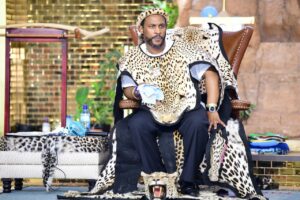
The Revelation Spiritual Home (TRSH) defines itself as a “spiritual institution” and rejects labels such as “religion,” “new religion,” or “new religious movement.” It was founded by Samuel Radebe, born Samuel Mbiza and later known as “Inkosi yamaKhosi Omoya IMboni uZwi Lezwe Radebe” and “IMboni uZwi Lezwe Radebe” [Image at right]. Mbiza is his civil surname, while “Radebe” is his clan name (isithakazelo), which is regarded as central to his genealogy and spiritual identity, affirming both his bloodline and his spiritual position. The names “IMboni” and “iNkosi yamaKhosi oMoya,” according to TRSH, come from revelations and are the principal spiritual titles defining his calling, authority, and role.
Radebe’s biography is central to the institution’s identity, and followers narrate his life story as a sequence of spiritual revelations, struggles, and triumphs that embody the destiny of African Indigenous Spirituality (AIS).
Radebe was born in Gugulethu, a township outside Cape Town, in 1977. According to TRSH, extraordinary experiences marked his childhood. At the age of four, he began to see colored lights and hear voices. He sometimes lost the ability to speak or walk, which caused concern in his family. An older woman renowned for her spiritual gifts explained that he was not sick but chosen by the Izithunywa, spiritual guides who were preparing him for a spiritual mission. Rituals with candles and camphor appeased the spirits, and Radebe regained speech and mobility (Radebe 2022:14) [we also rely on interviews with Radebe and other TRSH members in January 2023, December 2023, December 2024, and November 2025: see Introvigne and Šorytė 2025; these were group interviews including TRSH senior leaders and other members, and we have chosen not to identify individual informants]. Radebe later recalled that his childhood visions were both frightening and empowering, teaching him that ancestral spirits and Izithunywa (higher spirits) were active forces in daily life.
After losing both parents, Radebe moved to Johannesburg. In 1993, at the age of sixteen, he joined the Universal Church of the Kingdom of God (UCKG), a Brazilian Pentecostal movement that had expanded aggressively in South Africa (van Wyk 2014). He quickly became known as a boy preacher and healer, attracting crowds with his ability to cure illnesses.
Yet, he grew disillusioned with the church’s racism and demonization of African spirituality. The UCKG taught that ancestral spirits were demons and that African traditions were obstacles to salvation. Radebe began to question why black South Africans and their culture remained marginalized, including in some Pentecostal churches, even after the end of apartheid. He later concluded that Christianity in all its shapes, far from liberating Africans, had perpetuated colonial hierarchies.
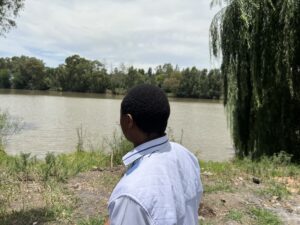
In 2006, Radebe reported a decisive revelation at the Vaal River, near Johannesburg [Image at right]. He saw a golden lampstand with seven colored candles and mysterious beings with large heads. He interpreted this as a call to establish an institution rooted in AIS. The lampstand became central to TRSH’s symbolism, later embodied in izibane, spiritual lamps used in rituals.
Two years later, on December 5, 2008, he undertook a pilgrimage to the Ncome River, also known as Blood River. This site was historically associated with the Afrikaner vow of 1838, when Voortrekkers promised to commemorate their victory over the Zulu as a covenant with God. He was accompanied by followers, which he initially referred to as the “Three Mighty” (and later received by revelation the name “Abofakazi Nabaziyo”). Radebe enacted a counter-covenant at the Ncome River, dissolving what he regarded as a curse imposed on Africans and restoring AIS. This act was seen by followers as a turning point in African history, marking the reclaiming of spiritual sovereignty from colonial powers (Radebe 2022: 18).
Shortly later, during a night vigil at one of the main UCKG branches, where Radebe was conducting a service, a young boy reportedly vomited a lion’s nail. A “spiritual presence” subsequently confirmed that this signified the “dominion as a consequence of the Covenant Radebe had established at the Ncome River” (personal interviews, November 2025).

On March 22, 2009, the first service after the separation from the UCKG was held in a restaurant at Gandhi Square, Johannesburg. This was followed by services held in the basement of a building on Plein Street, Johannesburg, [Image at right] during which Radebe temporarily named the institution the “African Church.”
These humble beginnings were quickly overshadowed by rapid growth. In April, during a large gathering at Johannesburg City Hall to commemorate Good Friday, Radebe and his followers adopted the name “The Revelation Church of God,” which he claimed he had received through revelation. On May 10, 2009, the group moved to the former Great Synagogue in Johannesburg, which the dwindling Jewish community was no longer using as a place of worship. TRCG preserved the synagogue’s heritage while repurposing it as a spiritual center.
The institution attracted thousan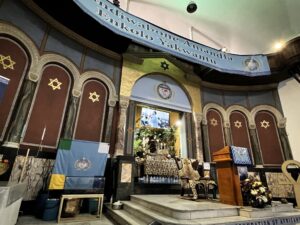 ds of followers, particularly from townships and marginalized communities (Wilhelm-Solomon 2013). Its emphasis on healing, empowerment, and pride in African identity resonated with people who felt excluded from mainstream churches (Malcomess and Wilhelm-Solomon 2016:52–55). [Image at right]
In 2011, Radebe performed a ritual in a location along Durban’s coastline, later called “eSibonakalisweni” (the Sea of Revelations). It was the first of several rituals conducted at this site. He reported visions of spiritual beings emerging from the sea, reinforcing the connection between water and spirituality. The location, associated with Maphithini Thusi (1888–1964), the founder of a previous AIS institution, emaKhehleni (du Toit 1970, 1971), would become a favorite spot for Radebe’s visions and prophecies (African Hidden Voices 2023:96–102).
In May and June 2012, Radebe reported a spiritual revelation instructing his followers to enter into the Covenant with him and his Deity (uMabizwa’Asabele).
In 2014, Radebe acquired a mountain, whose name was later revealed to him as “Ekuphumuleni” (the Place of Rest), near Clocolan, Free State (African Hidden Voices 2023:83). This site was in turn associated with a famous seer and visionary who lived at an Anglican mission but included obvious African non-Christian elements in her preaching: Mantsopa Anna Makhetha (1793 or 1797–1908) [these
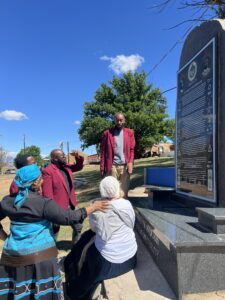 dates are correct, as, according to tradition, she died at age 111 or 115]. The covenant was not new but a reaffirmation of the one at the Ncome River. [Image at right]
Ekuphumuleni will become “the permanent resting place for the Covenant” that Radebe had established at the Ncome River. On December 5, 2014, Radebe went to renew the Covenant there. Until that year, the Covenant had been renewed annually at the Ncome River. December 5 became a date Radebe observes each year to personally renew the Covenant.
In February 2015, Radebe reported a revelation formally designating the pact as “the Covenant of Restoration.” In June 2015, Radebe’s followers undertook their first pilgrimage to Ekuphumuleni to renew their commitment to the Covenant of Restoration. This is their annual pilgrimage, even as its date and location shifted over time.
TRSH reports that “it is through the spiritual mountain, Ekuphumuleni, a mountain concentrated with profound spirituality and regarded as a divine archetype, that the revelations of the corrupted faith began to unfold in successive phases, guiding the restoration of AIS and African identity” (personal interviews, December 2024).
TRSH insists that although the formal process of restoring AIS emerged during the 2010s, Radebe’s spiritual gifts had been present since birth, long before the institution’s founding. They explain that, like other IImboni (plural of Imboni), (i.e., AIS spiritual leaders with national missions, particularly those who appeared in the early twentieth century during the rapid expansion of Christianity in Africa) Radebe grew up in a Christian environment. Nevertheless, “he carried an inherent spiritual destiny that pointed toward a different purpose. This inner calling distinguished him and ultimately led to the restoration work he later embodied. The significance of this restoration lies in the recognition that AIS had always been present within him, even as it found fuller expression through divine revelation and institutional formation. In fact, Radebe’s institution has consistently practiced AIS, while initially incorporating selected elements of Christianity, reflecting the historical and spiritual realities of African spirituality and religious experience” (personal interview, December 2024).
In 2014, Radebe reported that he was led by revelation to perform a “national act of spiritual cleansing:” a ritual of purification for the nation over three consecutive years at the FNB Stadium in Johannesburg, where the venue was filled to capacity. These gatherings focused on the ritual of Uhlanjululo Ngamanzi (the cleansing with water) and were perceived by TRSH as a significant moment in the nation’s collective spiritual renewal. In 2015, the institution publicly proclaimed its mission to restore AIS.
In 2016, the first South African scholars who studied the TRCG reported that more than 90,000 people had gathered at Johannesburg’s main stadium (Malcomess and Wilhelm-Solomon 2016:53), including a sizable contingent of immigrants from Zimbabwe who felt discriminated against in other religious organizations but were welcomed by Radebe (Wilhelm-Solomon, Zulu, and Worby 2016:266–67).
In August 2017, Radebe reported he had received a “profound spiritual revelation” (isibonakaliso) that would later emerge as a significant turning point in South Africa’s political and societal landscape (personal interview, November 2025). He foresaw a major shift beginning in 2019, becoming more pronounced from 2020 onwards, marked by changes in public consciousness, governance patterns, and collective direction. The revelation further extended beyond South Africa, indicating parallel transformations unfolding on a global scale. According to TRSH, these developments, both locally and internationally, carried profound social and spiritual implications, affirming the broader scope and relevance of Radebe’s revelations.
On June 8, 2018, Radebe publicly shared another isibonakaliso concerning an impending African revival, marked by the restoration and widespread awakening of AIS. Yet another isibonakaliso followed on May 12, 2019, concerning “a coming phenomenon—an extraordinary and unprecedented event that would mark the beginning of a new era. He was shown that when this phenomenon occurred, members of his institution were to declare success and dominion, signifying spiritual transition and victory” (personal interview, November 2025). TRSH later saw a confirmation of this revelation in the global outbreak of COVID-19, interpreted as the phenomenon that ushered in a new international era.
In 2020, the institution’s name changed from The Revelation Church of God to The Revelation Spiritual Home (TRSH), marking a decisive shift from Christian references to a fully indigenous spiritual identity.
TRSH continued to expand across Southern Africa, with branches in Zimbabwe, Mozambique, Eswatini, Botswana, Lesotho, and Malawi. By 2025, overseas branches had been established in Ireland and Atlanta, USA.
In 2024, the institution gained further recognition. On April 20, the musical The Spirit King premiered in Durban, dramatizing Radebe’s life and visions. The mainline South African media reviewed it favorably (see, e.g., SABC News 2024). TRSH members were proud of this recognition and of the awards Radebe received in different countries for his contribution to the renewal and spread of AIS.
They proudly noted how, from its origins in a Johannesburg basement, TRSH had become a global institution, presenting AIS to international audiences and asserting its place among the world’s spiritual traditions.
DOCTRINES/BELIEFS
The Revelation Spiritual Home (TRSH) presents itself as the custodian of African Indigenous Spirituality (AIS), insisting that it is the oldest and most authentic spiritual tradition of humanity. Its teachings emphasize the distinction between spirituality and religion. Spirituality is defined as direct knowledge and lived experience, while religion is portrayed as belief imposed by external powers, often through colonialism and missionary activity.
According to TRSH, spirituality is experiential: it is the ability to perceive, communicate with, and be guided by spiritual forces. Religion, by contrast, is a system of doctrines and dogmas that alienates people from their ancestral roots. Radebe frequently stresses that Africans were spiritual (a form of “knowledge”) long before they were religious (a form of “belief:” African Hidden Voices 2023:17), and that religion was introduced as a tool of domination. Christianity and Islam are described as foreign impositions that severed Africans from their ancestral spirits and the Izithunywa.
The distinction between a genuine African spirituality and a colonial religion informs TRSH’s entire practice. Followers are taught that to restore balance in their lives, they must reconnect with AIS, which permeates every aspect of existence: birth, death, marriage, family, diet, dress, grooming, health care, financial decisions, and governance.
TRSH proposes what we may call a “historiosophy,” an esoteric gaze at the world’s history. It situates Africa as the cradle of spirituality. Ancient Egypt is interpreted both through Egyptology and the speculations of (Western) esotericists, often referred to as Egyptosophy. Followers are taught that mystery schools, pyramids, and esoteric traditions originated in Africa and were later appropriated by Europe and the Middle East (African Hidden Voices 2024:147). References to Atlantis and cosmic origins are sometimes invoked, blending indigenous traditions with global esotericism, as another South African spiritual leader who tried to restore
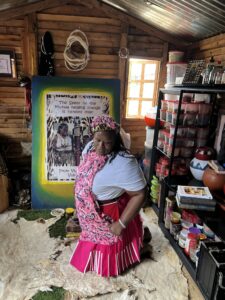 and spread AIS, Credo Mutwa (1921–2020), had done before TRSH (Chidester 2002). This narrative instills pride in African identity. It asserts that AIS is not a local or tribal phenomenon but a universal heritage. [Image at right]
The cosmology of TRSH is expressed through dual hierarchies represented by upward and downward triangles. At the apex is the Creator, uMfihlakalo (“the Mystery”), referred to as “He,” but in fact transcending masculine and feminine energies. The Creator is ineffable, beyond human comprehension, yet accessible through intermediaries. TRSH insists that to regard AIS as monotheistic because of the presence of a single Creator God is a mistake. In fact, AIS is polytheistic as the plurality of the gods, although subordinate to uMfihlakalo, is a defining feature (African Hidden Voices 2024:23–26).
Communication between the Creator God and humans occurs through the Izithunywa, spirits who speak in dreams and revelations to the IIMboni, who are spiritual “guiders” born with foresight and healing powers. TRSH distinguishes between spiritual “guides,” who are disincarnate spirits, and human “guiders” such as the IIMboni. Izithunywa are not ancestors but distinct spiritual beings, each with specific functions, such as hope, war, balance, harmony, fertility, and light.
TRSH insists that an IMboni is more than a prophet. A prophet speaks for the gods, but an IMboni guides a nation, heals spiritually and physically, and is born into a lineage of spiritual “guiders.” Radebe is recognized as a “Spirit King,” a title reserved for those IIMboni who establish spiritual nations.
Historically, African kings were assisted by IIMboni, who conveyed messages from the Izithunywa. Colonialism destroyed this connection by persecuting IIMboni and replacing them with missionaries. TRSH teaches that to restore African sovereignty, the role of IMboni must be revived.
Numerology and symbolism play a central role in TRSH doctrine. Balance is expressed through equations such as “-1 + 0 + 1 = 2,” representing the synergy of negative and positive forces (African Hidden Voices 2024:51–52).
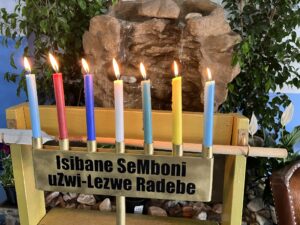
Colors also carry symbolic meaning. The seven izibane lamps represent different Izithunywa and spiritual forces: baby blue for presiding spirits, royal blue for hope, red for war, yellow for balance, green for fertility and female spirits, and white for light and family [Image at right]. These symbols are integrated into rituals and garments, reinforcing the cosmological order.
Ancestors (idlozi) are acknowledged but distinguished from the Izithunywa, who were never incarnated on Earth. Benevolent ancestors may be embraced and pacified, while hostile ancestors who led bad lives may be severed from their descendants. TRSH emphasizes rituals of cleansing ancestral lineages, purifying distortions caused by syncretism, the mixing of AIS with Christianity. Followers are taught that ancestors who converted to Christianity were misled, and their descendants must liberate them through rituals.
This teaching has been controversial, as some critics argue it denies the agency of ancestors who may have freely chosen Christianity. TRSH responds that it is not condemning ancestors but liberating them from colonial distortions (African Hidden Voices 2024:130).
TRSH also critiques African Initiated Churches (AICs), arguing that they were colonial projects rather than genuine revivals. Leaders such as Kimpa Vita (1684–1706), Isaiah Shembe (1865–1935), and Simon Kimbangu (1887–1951) are recognized as IIMboni who camouflaged their message to escape persecution, leading their followers and academic scholars to misunderstand them as Christian leaders. Christianity, even in the Africanized forms of the AICs, is rejected by TRSH as a foreign imposition.
RITUALS/PRACTICES
TRSH’s rituals are central to its identity. They are not borrowed from other groups but revealed directly to Radebe, although they are rooted in AIS’ history.
TRSH conducts two primary weekly services. Sunday services focus on teaching, testimonies, and institutional progress. Videos chronicle the growth of TRSH and its business enterprises. Music plays an important role, with choirs performing songs that blend traditional rhythms with modern styles.
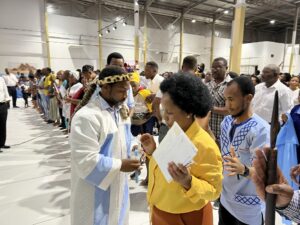
Tuesday, “Services of Enlightenment” are devoted to rituals. These services are more impressive, with participants lined up in rows waiting for blessings. Some carry umkhonto (symbolic wooden spears), others bring children to be blessed, and many display pictures or documents of relatives in need. [Image at right] Manifestations of ancestral spirits are common, with participants shaking or speaking in voices not their own. Radebe discerns whether these spirits are benevolent or hostile.
Water is central to TRSH rituals. It is believed to absorb information about illnesses and transform it into antidotes. Participants are blessed with sanctified water, splattered on their bodies in the weekly intsebenzo yokuchelwa ngamanzi. On the first Tuesday of each month, they bring bottles of water to be blessed in the ibhafu ritual [see Radebe and Hloele 2022 for these different rituals; we also rely on our observation of TRSH from 2023 to 2025].
Every Wednesday, participants drink blessed water from small white cups in the intsebenzo yenkomishi, often followed by vomiting or urination, interpreted as expulsion of illnesses or evil spirits. Sea water is used in the monthly intsebenzo yamanzi, which participants use to bathe or inhale vapors. At the New Year (which TRSH’s “African Spiritual Calendar” (ASC) places in August) sanctified water is placed in a bull’s horn and rubbed on the feet and foreheads.
Eggs are used in the intsebenzo yeqanda ritual to absorb negative energies. Milk is poured on participants in the intsebenzo yoBisi, invoking abundance and good fortune. Salt is distributed at year’s end to protect homes from hostile spirits. Incense is inhaled in the intsebenzo yeMphepho, warding off evil.
Izibane, the spiritual lamps of seven colors that represent different Izithunywa, are placed on a golden lampstand, recalling Radebe’s vision at the Vaal River. Radebe’s garments also carry symbolic meaning. The leopard skin represents lineage and Spirit Kingship. The white and blue ingubo yesambulo symbolizes his role as Spiritual Guider. The white ingubo yamakhosi is used during rituals for kings. The red-yellow ingubo yokubamba wards off evil spirits. The white and blue ingubo yamanzi is used for water rituals.
As mentioned earlier, annual pilgrimages are conducted to Ekuphumuleni Mountain, where the “Covenant of Restoration” is renewed. Durban’s “Sea of Revelations” is another pilgrimage site. These pilgrimages reinforce the institution’s identity and connect followers to sacred geography.
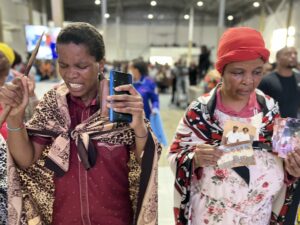
Most followers come to TRSH seeking healing, protection, and good fortune. Rituals are intended to cure illnesses, expel evil spirits, and bring prosperity. Testimonies are central to services, with participants recounting how rituals changed their lives. Singing, dancing, and shouting express joy and gratitude. [Image at right]
TRSH integrates sangomas and traditional healers, some of whom join the institution or participate in the African Association for Indigenous Spirituality (AAFIS), founded by Radebe in 2023. Benevolent healers are distinguished from malevolent witches. TRSH emphasizes that sangomas heal and help, while witches harm and damage. This distinction is crucial in African societies, and TRSH has specific rituals to protect from witchcraft.
ORGANIZATION/LEADERSHIP
By the early 2020s, TRSH had more than seventy70 branches in South Africa, with expansion into neighboring countries such as Eswatini, Botswana, Lesotho, Malawi, Zimbabwe, and Mozambique, as well as into Ireland and the United States. These foreign centers were typically founded not by missionaries sent from Johannesburg but by immigrants or students who had encountered TRSH in South Africa and then carried its message back to their home countries.
TRSH claims to have some 3,500,000 members internationally. Statistics are difficult to confirm, but certainly its services attract large crowds. The headquarters in Marshalltown, Johannesburg, seats approximately 5,000
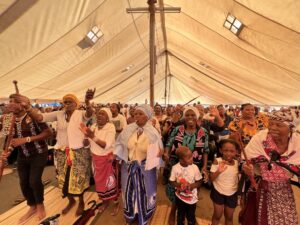 participants, but even this, along with other extensive facilities, cannot contain the crowds that gather for Sunday and Tuesday services. Overflow spaces, tents, and courtyards are routinely used, and services are streamed to branches outside of Johannesburg. [Image at right]
The institution deliberately distinguishes itself from Christian churches by adopting different terminology: it operates “spiritual centers” rather than “churches” and has “leaders” rather than “bishops.” At the apex of the hierarchy stands IMboni iNkosi YamaKhosi oMoya Radebe, a title that emphasizes his recognition as a Spirit King, regarded as both the supreme spiritual authority and the founder of a spiritual nation.
In parallel to its spiritual mission, TRSH operates a vast business and cultural network through Trillion Cart Holdings, a conglomerate founded in 2009 that oversees more than seventy companies. These enterprises range from burial schemes and cosmetics to gyms, restaurants, health supplements, travel agencies,
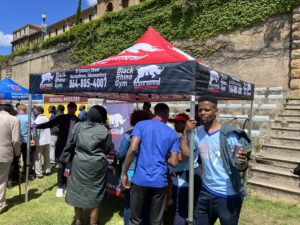 and investment advice. The Siyangakhona Burial Scheme was the first venture, designed to serve individuals excluded from other burial programs. Ubuntu Cosmetics, Black Rhino Gyms [Image at right], and The Burger Joint & Grill, a fast-food chain, are among the most visible enterprises. Trillion Cart also breeds racing pigeons, a passion of Radebe since he was a child (See, Radebe 2023), and Ankole cattle (African Business Quarterly 2024:15), linking economic activity to African heritage and symbolism.
Leadership within Trillion Cart includes women in prominent positions, such as the president and CEO, balancing the male-centered spiritual authority of TRSH. Members are encouraged to become financially autonomous through distributorships and micro-businesses. The distributorship model is presented as direct selling rather than multi-level marketing, with profits shared equally between the company and distributors. In fact, many members move from distributorships to independent businesses, supported by the African Centre of Excellence, which trains entrepreneurs.
TRSH also sponsors cultural and educational initiatives. The Dr. S.B. Radebe Foundation distributes food and blankets, grants and scholarships, and establishes libraries in African townships. The Trillion Dollar Kids Club promotes financial literacy among children, inspired by Radebe’s own childhood experiences with racing pigeons. Sports clubs, choirs, theatrical troupes, and publishing houses further extend the institution’s reach. In 2023, Radebe was elected African coordinator of the African Forum for Religious and Spiritual Liberty, reflecting his commitment to inter-spiritual dialogue and freedom of religion or belief.
TRSH’s organization is deliberately structured to replicate the spiritual hierarchy in the physical world. Just as IMboni Radebe is regarded as the head of a spiritual nation, so too is he seen as the leader of a physical community. His revelations are presented as of national significance, and he is recognized as the Spiritual Guider of Langalibalele II, the reigning king of the AmaHlubi, Radebe’s ethnic group (African Hidden Voices 2023:90).
The institution’s leadership model thus combines spiritual authority, cultural custodianship, and economic empowerment. It is both hierarchical, with Radebe at the apex, and decentralized, with local leaders managing branches and members encouraged to develop agency and autonomy, including by establishing businesses. This dual structure reflects TRSH’s conviction that spirituality and material life are inseparable, and that empowerment must extend from ritual to economics and from healing to entrepreneurship.
ISSUES/CHALLENGES
TRSH has faced scrutiny from South Africa’s Commission for the Promotion and Protection of the Rights of Cultural, Religious and Linguistic Communities (CRL). In 2015, the CRL launched hearings on the commercialization of religion, citing reports of abuses in other groups. Radebe was summoned to present TRSH’s financial records but refused, arguing that the requests violated constitutional protections.
The CRL’s chairperson attempted, unsuccessfully, to have him arrested for contempt. A member of TRSH was jailed for sending a spiritual warning to the chairperson, who felt threatened. Although the CRL proposed legislation requiring all religious organizations to register under umbrella bodies and disclose finances, no such law was enacted. Scholars warned that the proposals risked undermining religious freedom (Mapitsa 2022).
The anti-cult campaign in South Africa reached its zenith in 2017, with CRL releasing a critical report (CRL 2017) and news outlets portraying new religious and spiritual movements as dangerous.
Media coverage during this period depicted TRSH as a powerful and influential institution, often with suspicion. Critics argued that TRSH’s integration of spirituality and commerce risks exploitation, while supporters insisted it offers opportunities otherwise denied to marginalized communities.
Despite controversies, TRSH continues to expand, balancing criticism with enthusiastic support from members who see TRSH as a source of healing, empowerment, and pride in African identity.
The challenges faced by TRSH thus reflect broader tensions in South Africa and, more generally, across Africa. TRSH positions itself as both defender of AIS and innovator in business, a combination that attracts both admiration and hostility. In the words of an early scholar of TRSH, Matthew Wilhelm-Solomon, which we believe are still valid today, Radebe’s institution is successful, particularly in Southern Africa’s problematic megalopolises, because “it speaks to a hope that the failed aspirations of the city can be restored, that its pollutants can be cleansed, and that the people and things lost in its streets will return safely home, wherever that may be” (Wilhelm-Solomon 2013:52).
IMAGES
Image #1: IMboni iNkosi YamaKhosi oMoya Radebe. Courtesy of The Revelation Spiritual Home.
Image #2: A local TRSH leader showing the location of Radebe’s vision at the Vaal River. (All photos by the authors except #1).
Image #3: TRSH leader Thembi Tulwana at the basement in Johannesburg where some of the first services of The Revelation Church of God were held in 2009.
Image #4: Inside the former Grand Synagogue of Johannesburg, now a TRSH spiritual center.
Image #5: TRSH members and co-author Rosita Šorytė at Ekuphumuleni Mountain in December 2024.
Image #6: Credo Mutwa’s daughter shows the authors her father’s sanctuary in Soweto, November 2024.
Image #7: The Izibane lamps.
Image #8: Radebe during a “Service of Enlightenment,” January 2023.
Image #9: TRSH members during a “Service of Enlightenment,” January 2023.
Image #10: A tent housing overflow members during a service at the Soweto Branch, January 2023.
Image #11: Booth promoting Black Rhino Gyms at a TRSH event in Cape Town, December 2023.
REFERENCES
African Business Quarterly [unsigned]. 2024. “Trillion: Creating Sustainable Opportunities for All South Africans.” African Business Quarterly 18:14–17.
African Hidden Voices. 2024. Restoring Africa’s Spiritual Identity. Johannesburg: Isambulo Publications.
African Hidden Voices. 2023. An Introduction into Afrikan Indigenous Spirituality. Johannesburg: Isambulo Publications.
Chidester, David. 2002. “Credo Mutwa, Zulu Shaman: The Invention and Appropriation of Indigenous Authenticity in African Folk Religion.” Journal for the Study of Religion 15:65–85. DOI: 10.4314/jsr.v15i2.6128.
CRL Rights Commission. 2017. Report of the Hearings on the Commercialisation of Religion and Abuse of People’s Belief Systems. Johannesburg: CRL Rights Commission.
du Toit, Brian Murray. 1971. “Religious Revivalism among Urban Zulu.” Pp. 80–103 in Man: Anthropological Essays Presented to O. F. Raum, edited by Eben Jansen de Jager. Cape Town: C. Struik.
du Toit, Brian Murray. 1970. “Emakhehleni—A Revivalistic Cult.” Pp. 42–58 in Culture Change in Contemporary Africa, edited by Brian Murray du Toit. Gainesville, FL: African Studies Center, University of Florida.
Introvigne, Massimo, and Rosita Šorytė. 2025. The Revelation Spiritual Home: The Revival of African Indigenous Spirituality. Cambridge: Cambridge University Press.
Malcomess, Bettina, and Matthew Wilhelm-Solomon. 2016. “Valleys of Salt in the House of God: Religious Re-territorialisation and Urban Space.” Pp. 31–60 in Routes and Rites to the City: Mobility, Diversity, and Religious Space in Johannesburg, edited by Matthew Wilhelm-Solomon, Lorena Núñez, Peter Kankonde Bukasa, and Bettina Malcomess. London: Palgrave Macmillan.
Mapitsa, Cosmo. 2022. “Freedom by Regulation: A Legal Assessment of the CRL Commission’s Report on the Commercialisation of Religion and Abuse of People’s Belief Systems.” Religion & Development 1:58–72. DOI: 10.30965/27507955-20220004.
Radebe, Samuel. 2023. Trillion Dollar Kids: Savings & Entrepreneurship for Children. Johannesburg: Isambulo Publications.
Radebe, Samuel. 2022. The Revelation of Imboni. Johannesburg: Isambulo Publications.
Radebe, Samuel, and Palesa Hloele. 2022. Iintsebenzo zeSambulo. Johannesburg: Isambulo Publications.
SABC News. 2024. “Theatre—‘The Spirit King’ and the Revival of African Spirituality: Mbongeni Moroke.” April 21. Accessed from www.youtube.com/watch?v=1qSdxWP4v8c on 5 January 2026.
van Wyk, Ilana. 2014. The Universal Church of the Kingdom of God in South Africa: A Church of Strangers. Cambridge: Cambridge University Press.
Wilhelm-Solomon, Matthew. 2013. “Prophets of the City.” Pp. 39–52 in Writing Invisibility: Conversations on the Hidden City, edited by Jackee Budesta Batanda, Caroline Wanjiku Kihato, and Matthew Wilhelm-Solomon. Johannesburg: Mail & Guardian.
Wilhelm-Solomon, Matthew, Melekias Zulu, and Eric Worby. 2016. “Angels and Ancestors: Prophetic Mobility and Diversity in the City.” Pp. 239–271 in Routes and Rites to the City: Mobility, Diversity, and Religious Space in Johannesburg, edited by Matthew Wilhelm-Solomon, Lorena Núñez, Peter Kankonde Bukasa, and Bettina Malcomess. London: Palgrave Macmillan.
