ISRAELITES OF THE NEW UNIVERSAL COVENANT TIMELINE
1918: Ezequiel Ataucusi Gamonal was born in Huarhua, Arequipa, Peru.
1930-1936: Ataucusi had his first supernatural experiences.
1940-1943: Ataucusi served in the Peruvian armed forces, rising to the level of Seargent, Second Class.
1953: Ataucusi converted to Seventh-day Adventism in a town near the Andean city of Tarma.
1956: Ataucusi experienced his foundational revelation.
1968: Ataucusi formally founded the Evangelical Association of the Israelite Mission of the New Universal Covenant, commonly referred to as the Israelitas.
1980: Members of a Maoist guerrilla group, Sendero Luminoso, burned ballot boxes in the small Andean town of Chuschi, leading to armed insurrection against the Peruvian government that lasted over a decade.
1989: Ataucusi founded the Frente Popular Agrícola Popular FIA del Perú (FREPAP) as a political party representing the Israelitas fiscally leftist and socially conservative socio-religious agenda.
1990: Ataucusi ran unsuccessfully for the presidency of Peru, earning 69,832 votes (1.04% of the total first round ballots). He subsequently ran and lost in 1995 and 2000.
2000 (June 21): Ezequiel Ataucusi Gamonal died in Lima of renal failure at age seventy-one. His youngest son, Jonás, took leadership of the congregation. Israelitas was estimated to have had between 150,000 and 200,000 members.
2020: Fifteen FREPAP representatives were elected to the Peruvian Congress.
FOUNDER/GROUP HISTORY
The story of the Israelitas begins with the life of Ezequiel Ataucusi Gamonal, a Quechua-speaking Andean man of humble origins. Over the second half of the twentieth century, Ataucusi founded and led one of Peru’s largest non-Catholic religious groups. The Israelitas’ blend of biblical and Indigenous influences, along with a liberatory political message, has attracted many converts and made a significant impact on Peruvian society.
From a historical perspective, the early life of this charismatic leader is opaque. Having been born and raised in a marginal, rural community during a period in which the Peruvian state had little presence in the provinces, we lack documentary evidence for many major life events, including his birth. Most of the information we have on the first forty years of Ezequiel Ataucusi’s life has come from interviews given by the man himself and those close to him.
Ataucusi was born in 1918 into a peasant family that held both Catholic and Indigenous Andean traditions. He was the first of five children and was raised by his single mother and grandparents. He has recalled being a loner and was said to have suffered bullying as a child. At a young age, he began to criticize the Catholic practices of his family, especially the reverence of the saints. During his teenage years, Ataucusi had his first supernatural experiences, which included receiving teachings about the saints from an old man and being rescued from drowning by a giant fish.
Ataucusi was trilingual, with Quechua and Spanish as his dominant languages. He learned Aymara during his years of military service in the early 1940s. His fluency in Quechua and Aymara, Peru’s two largest indigenous languages, helped make his later missionary work particularly successful among people of Andean origin. After leaving the military, Ataucusi held a variety of occupations, including carpenter and shoemaker, spending much of his time in the central Andean and high jungle regions east of Lima. During this period, he married his first wife, Dionisia Ospina, with whom he had seven children.
Around 1953, Ataucusi met a Seventh-day Adventist man who introduced him to the Christian Scriptures and the beliefs of the Adventist church. While the Catholic Church had maintained a presence in most rural Peruvian villages since the sixteenth century, the early twentieth century saw waves of Protestant evangelists from the United States and the U.K. bringing biblical literature and religious pamphlets to remote communities. The Adventists were one of the most prominent of these early Protestant churches in Peru. Ataucusi’s initial Bible study was accompanied by prophetic visions, during which he traveled through the cosmos and encountered God, Jesus, and the Holy Spirit directly.
Ataucusi converted to Seventh-day Adventism but was soon asked to leave the congregation for making predictions that went beyond the faith’s orthodox beliefs. Nearly one hundred other Adventists followed him out of the church, joining him as he began to pursue his own visions (Ossio 2014:119). Shortly thereafter, Ataucusi received a divine commission to carry out his spiritual work, accompanied by an updated version of the Ten Commandments. In this pivotal vision, the central founding spiritual event of the Israelitas, Ataucusi was raised to the “third heaven,” which appeared in the form of a classroom. The Ten Commandments were written on a blackboard, and the Holy Trinity instructed him to write them down and then return to Earth to preach them to the world. This experience became known as the “new covenant.”
Ataucusi recalled facing violence and even imprisonment in these early years of preaching in towns throughout the Andes. In Lima, he met with other dissident Adventists and began to formally develop the system of beliefs and practices that the group began to call the Asociación Evangélica de la Misión Israelita del Nuevo Pacto Universal (Aeminpu), the Evangelical Association of the Israelite Mission of the New Universal Covenant.
In 1962, Ataucusi traveled to the central Amazon region, where he acquired land to establish the first Israelita community in the high jungle near the towns of Oxapampa and La Merced. Over the following decade, this region became home to six additional Israelita settlements. Traveling mainly on foot, Ataucusi visited remote population centers, gaining followers and establishing permanent communities by colonizing parts of the jungle. In Ataucusi’s evolving system of teachings, the Amazon was positioned as a sort of sacred waiting room for the coming apocalypse.
In 1968, Ataucusi formally founded the Evangelical Association of the Israelite Mission of the New Universal Covenant. This same year, General Juan Velasco Alvarado led a leftist military coup and began a series of dramatic political projects that included a major land reform aimed to return monopolized agricultural land to indigenous Peruvians. Ataucusi’s jungle communes fit well within Velasco’s reforms and the government facilitated the Israelitas’ land acquisitions in the Amazon (Ráez Suárez 2022:89).
After founding the first jungle communities, Ataucusi settled in a migrant shantytown of Lima called El Agustino. There, the leader was in intimate contact with Pentecostalism. Ataucusi and his followers in Lima began attending a small, loosely organized Pentecostal church. According to Leoncio, one of Ezequiel Ataucusi’s sons, “All of the church congregation was won for the Israelitas and he [Ataucusi] converted the church into his first Biblical Training Center” (Ossio 2014:96). During this period, Ataucusi’s first wife died and he married his second wife with whom he had three children, including Ezequiel Jonás (b. 1972), who would go on to take leadership of the congregation after his father’s death. Followers revered Ataucusi, treating him as a living representation of God. But he was also approachable. He regularly visited the jungle colonies, where he would stay in a designated Royal House, attended by a select group of important women.
The congregated, as members call themselves, have generally come from poor, rural backgrounds. Many have been part of Peru’s massive migratory class that moved to cities like Lima and Cusco during the late twentieth century. Most have little more than primary school education and generally live on the margins of Peru’s dominant westernized national culture (Ossio 2000:197).
The 1980s were a period of rapid growth and institutionalization. Ataucusi began a formalization process that would help launch the Israelitas into the national political sphere by the end of the decade. A secular side of the organization’s hierarchy was established with Jeremías Ortiz Arcos serving as president The president, Jeramías Ortiz Arcos, was a pragmatic administrator and his approach complemented the charismatic, intuitive leadership of Ataucusi. Under this dual leadership structure, the congregation built a massive compound called la Casa Real in the foothills east of Lima that served as a sort of headquarters for the organization. Along with the main residence for Ataucusi and his family, the extensive project housed a school, a bakery, workshops a print shop, and conference center. Their own magazine, Lucero de la Mańana, published its first issue in 1985. Soon there were communities of believers not only throughout Peru but in Bolivia, Chile, Ecuador, and later Colombia as well (Meneses Lucumí 2021).
The 1980s were also marked by a violent civil war between the Maoist guerrillas of Shining Path (Sendero Luminoso) and the government, leaving nearly 70,000 (mostly poor and Indigenous) people dead. Anthropologist Juan Ossio has argued that Ataucusi’s teaching served as a peaceful alternative to the violence of Sendero Luminoso, which recruited from the same disenfranchised, poor, and Indigenous population as the Israelitas (Ossio 2014).

In 1989, Ataucusi and other leaders formally established a political party called the Peruvian Popular Agricultural Front (Frente Popular Agrícola Popular FIA del Perú, FREPAP) to participate in the 1990 elections. [Image at right] with Ataucusi as the presidential candidate and several candidates to Congress. The party considers itself to be “theocratic,” “nationalist,” “revolutionary,” and “agro-ecological” (Estatuto 2023:1). Ataucusi earned just over one percent of the vote in the first round ballot and none of FREPAP’s congressional or senate candidates were elected. However, during the 1990s, FREPAP did send five candidates to Congress (Ráez Suárez 2022:94).
At the time of Ataucusi’s death, ,just following his third and final bid for the presidency, Aeminpu had grown to around 200,000 members. After the prophet’s death, his twenty-seven-year-old son, Ezequiel Jonás Ataucusi Molina, became the maximum leader of the congregation.
DOCTRINES/BELIEFS
The Israelites of the New Universal Covenant are a messianic and revivalist tradition that creatively blends Indigenous Peruvian influences and Christian scripture. They consider themselves to be the one, true Christian church and draw heavily on the Old Testament for their doctrines. Ezequiel Ataucusi’s visions, teachings, and biblical interpretations form the basis of the movement’s doctrines. Because Ataucusi left behind little in the way of formal, written teachings, Israelita theology is quite diverse and malleable.
The Israelitas are Sabbatarians who draw from Seventh-day Adventism as inspiration for their observation of weekly Saturday rituals. Members believe that Emperor Constantine of the Western Roman Empire broke the original covenant with God when he changed the day of worship from Saturday to Sunday, which they argue began a period of decay in the church (Ossio 2000:196).
Ataucusi is positioned as the second coming of Jesus Christ who will guide believers into the fourth and final age of human history. While the end of the world is believed to be imminent, people can be saved from the apocalypse by joining the Israelitas and following God’s law according to Ataucusi’s interpretation. Ataucusi was a prolific teacher, but did not leave much writing behind. His teachings are most clearly laid out in extended interviews and in recordings and videos. Ataucusi regularly performed public sessions where he read selections ranging widely from throughout the Old and New Testaments to illustrate the group’s theological tenets. He regularly blended scriptural analysis with his own life experiences.
The Ten Commandments, the version that Ataucusi received in his spiritual vision during the 1950s, are the central, “royal law” of the congregation. Ataucusi’s version of the Ten Commandments does not vary much from the accepted Adventist list or that of most other Abrahamic traditions. The main difference is the condensing of several generally separated commandments (for example, the Israelita list combines the commandment to not have other gods with the order to not worship idols), and the inclusion of the New Testament (Matthew 22:37-40, ESV) formula to establish the first two commandments as 1) Love your God with all your heart. and 2) Love your neighbor as you love yourself.
Israelita theology is a living, innovative tradition that interacts creatively with biblical texts. It is common for believers to pull seemingly at random from different parts of the Bible to provide evidence for their beliefs. Many Israelitas have been non-literate or read and write at very basic levels, so orality and free-form interpretation have been key to the development of their theology. They have created a unique biblical linguistics to bring new meaning to key terms and concepts. Jerusalem, for example is broken down this way: Jeru=Peru, salem=people (Ossio 2014:116). Numerology and image interpretation are also key features of Israelita scriptural interpretation. All of these interpretations locate Ataucusi and Peru in a privileged position as the culmination of Christian tradition and history.
Indigenous influences are prominent throughout the congregation’s teachings as well. They believe that the Incas were people of God. Believers often promote the three moral laws of the Inca empire, which in the Quechua language are “ama sua, ama llulla, ama quella” (do not steal, do not lie, do not be lazy). A variety of biblical citations are used to situate Peru as the location of the second coming of Jesus. For example, in Ezequiel 16:4 a reference to the umbilical cord is interpreted as meaning the city of Cusco, which is often referred to as the ombligo (belly button) of Tahuantinsuyo, the Inca Empire (Scott 1990: 43). Some followers believe that the tablets of the Ten Commandments are hidden somewhere at Machu Pichu (Ossio 2014:159). And during community rituals, the rainbow colored Tahuantinsuyo flag (representing the Inca empire) flies alongside the sky blue and white flag of the congregation.
RITUALS/PRACTICES
Ritual practice serves as the most important unifying force in this religious community. While Israelita beliefs are fairly malleable, the congregation’s ritual practices are quite strictly codified and monitored. The majority of their practices are Old Testament-inspired, including their clothing, economic practices, and their rituals. The ritual calendar is outlined in detail in a manual that Israelita priests compiled after Ezequiel Ataucusi’s death. While Israelita guides for ritual consist almost entirely of paraphrased selections from the Hebrew Scriptures, there is innovation and particularity in the congregation’s ritual world. One of these innovative components is the centrality of the Peruvian Amazon in Israelita practice. Since the early 1960s, the organization’s Fronteras Vivas (living frontiers) program has sent tens of thousands of members to live in agricultural communes in the Peruvian Amazon in preparation for the cataclysmic end to the current cycle of human history.
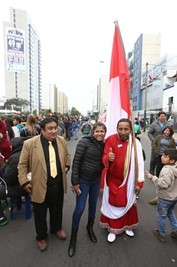
For outside observers, the defining feature of the Israelita congregation is their dress. [Image at right] Members attempt to replicate the dress of ancient Hebrews, especially on Saturdays. They wear tunics and sashes, with women in head coverings and men keeping their hair and beards long. Men wear ritual dress on the Sabbath only, while women wear tunics and veils daily. The colors of their clothing are revealed to them in dreams and correspond to a list of twenty-three spiritual characteristics (Ossio 2014:207).
At the core of Israelita practice is the offering of burnt sacrifices. These rituals are held at each Israelita churche and jungle commune. These offerings, called holocausts by members, follow strict rules of preparation rooted in a variety of biblical passages. The four animals used in the rituals are cows, goats, lambs, pigeons, which are killed and then burned on raised altars at the center of an open ceremonial space. Priests are specially trained to prepare and administer the burnt offerings. Beyond holy days and Saturday services, there are many other occasions for offerings, ranging from touching a dead body to women’s menstruation (AEMINPU 2014:46-48).
For most members, especially those who do not live in Israelita communities, Saturday services offer the most regular point of contact with their peers. These all-day events begin with the burnt offerings in the morning and include multiple priest-led Bible study sessions (Ossio 2014:234). The services are divided by sex, with women and men sitting separately (AEMINPU 2014:70-74). Music and dance are also features of the worship services, with electric guitar and keyboard as the most common instruments (Ossio 2014:253). In some cases, members will enter into trances and even speak in tongues, likely an example of the early congregation’s interactions with Pentecostalism in Lima.
The annual Israelita calendar is oriented around six major holidays. Their year starts in April, which is when Ataucusi calculated the birth of Jesus to have occurred. The week-long Easter celebration is a major attraction, with as many as 5,000 members attending the events held at the Cieneguilla headquarters.
Marriage and death are the two main life-cycle rituals. All members are expected to marry (ideally within the congregation) and to have children that they will raise in the community. Both premarital and extramarital sex are strictly forbidden. Members tend to marry young and have many children. Women are meant to be subordinate to their husbands (Ossio 2014:222). Israelita funerals frame death as a celebration, because the deceased member is believed to be saved from damnation. This celebratory, less emotional approach contradicts most Andean traditions, where deep and expressive mourning are the norm. Children born into the community receive baptism around eight years old, but many members join as adult converts.
Children born into the community receive baptism around eight years old, but many members join as adult converts. After an adult candidate attends services and events for an extended period, they are invited join the community through baptism. These are collective, celebratory events, centered on the application of water to the new member’s head. Members are expected to avoid drugs and alcohol. They pay a modest tithe to the community and those who live in the colonies renounce most personal property. The Israelitas stand firmly against adultery, theft, lying and corruption. Members can receive visions and direct experiences with God. One member named Sofía experienced an extended interaction with God in 1981 during which she spoke in foreign languages (Valderrama Escalante 2005:127).
The Peruvian Amazon holds a central place in Israelita practice. Ataucusi taught that members should move to these utopian communities in preparation for the next stage of human history, which would be the final of four stages before the apocalypse. In 2008, as many 15,000 people lived in communal, agricultural colonies located throughout Peru’s Amazon region (Ossio 2014:267). The congregation owns these properties. The colonies are divided into the old Andean social division of ayllus, with groups of families organized into shared labor units, often based on their region of origin. Each family manages an equal amount of land and resources. The communes collectively produce agricultural goods for local and regional markets. When the end of the third stage in human history comes, all Israelitas will move to these communes.
ORGANIZATION/LEADERSHIP
The Israelita congregation is an extremely hierarchical organization, with the prophetic leader, first Ezequiel Ataucusi and now his son, Jonás, at the top of three distinct branches of authority: spiritual leadership, administrative governance, and the political party (FREPAP). Each of these branches plays a crucial role in the functioning of the community.
The spiritual hierarchy consists of multiple levels of priests and ministers modeled after the Hebrew scriptures (AEMINPU 2014). At the highest level is the International General Priest, followed by National Priests, Departmental Priests, Baptism Priests, and the Levite Priests. While there are two levels of female priests, these roles are quite limited; they are not permitted to prepare or administer animal sacrifice, for example. The majority of the priesthood is composed of married men with children. Priestly duties include overseeing religious ceremonies and running Biblical Training Centers, which provide instruction to lay members. Spiritual authority extends into the Amazonian communities, where male elders form the councils that make religious and administrative decisions. While members have some input in local and church-wide matters, leadership remains highly centralized. For example, all adult members are eligible to vote in national assemblies, but the ultimate decision-making power remains with the prophet.
Since the 1980s, a separate group of leaders has taken responsibility (always under the guidance of Ataucusi) for the congregations logistical, financial, and legal matters. The president makes most major organizational decisions, supported by an inner circle of trusted advisors. Proximity to the prophet is a key determinant of influence and status within the community.
Beyond its religious structure, the movement is also active in electoral politics through the Frente Popular Agrícola FIA del Perú (FREPAP). Though deeply rooted in the Israelita community, FREPAP has consistently drawn votes, and even candidates, from beyond its religious base. Its platform combines primarily leftist economic policies, such as protections for agricultural laborers and the redistribution of wealth to the poorest citizens, with culturally conservative positions on issues like sexuality, marriage, and education. FREPAP has seen electoral success over the years, especially in regional governments where Israelita communes are located, with thirty-three members having been elected as mayors or town councilors (Ráez Suárez 2023:98). In the 2020 elections, the party surprised many observers by securing fifteen seats in Congress (Casey-Pariseault 2020).
ISSUES/CHALLENGES.
Over the years, the Israelitas have faced a variety of challenges, many of which have stemmed from their position as a religious minority. Like other non-Catholic groups in Peru, they have often encountered hostility and, at times, violence at the hands of their fellow Peruvians. Over the years, accusations against the group have been numerous, ranging from economic misconduct to sexual abuse and drug trafficking. Both internal and external sources have raised these allegations, leading to a variety of legal actions. By the 1990s, the Israelitas employed a permanent legal advisor, who became a key member of Ezequiel Ataucusi’s inner circle.
Despite the broader growth of Protestantism in Peru, which now represents approximately twenty-two percent of the population, the Israelitas remain on the fringe of national religious life, even among the Evangelical community (Instituto de Estudios Peruanos 2024). Their isolation has contributed to widespread suspicion, if not outright hostility, from the broader Peruvian society. The national press has played a significant role in shaping negative perceptions of the group. As early as April 11, 1958, the newspaper Última Hora labeled Ataucusi a fraud, accusing him of deceiving poor families into purchasing overpriced land in the high jungle province of Chanchamayo. The headline read, “Smart Aleck Prophet Even Sells Mountains in the Jungle” (de la Torre 2008:98). Beyond negative media portrayals, Israelita members have also faced direct persecution. One convert recalled that after joining the movement in 1975, his Andean community accused him and fellow Israelitas of practicing dangerous magic and threatened to burn them alive (Valderrama Escalante 2005:122).
As a minority religious tradition in a preeminently Catholic society and they have developed a deep-seated anti-Catholicism in response. Among other things, they believe the Catholic Church invented the saints to trick people out of their money and that the Pope submitted himself to the power of the devil (Ossio 2000:198).
Throughout his life, Ezequiel Ataucusi was the subject of numerous legal accusations and was jailed multiple times. Charges against him included murder, sexual abuse of minors, and enslavement, though he was ultimately acquitted in each case (Ossio 2014:99-104; Brehaut 2023a; Loli S. 2015). Because of these accusations, many critics of the community view it as a “cult” with Ezequiel and later Jonás functioning as the corrupting leader figure.
The Israelita settlements in the Amazon have also attracted controversy. Environmental groups have accused the communities of engaging in destructive deforestation practices. Additionally, the Brazilian Federal Police claim to have evidence that some Israelitas are involved in coca cultivation for the international cocaine trade (Brehaut 2023b). However, members of the Monte Santo community insist that those implicated in the drug trade are not legitimate members of the congregation.
Following Ataucusi’s death, a succession dispute briefly shook the movement. When Ataucusi’s lawyer announced that Jonás, the prophet’s youngest son, had been chosen to lead the congregation, several of Jonás’ brothers contested his claim, arguing that they were the rightful heirs (Salazar Vega 2020). Despite this internal conflict, no major schism has taken place, though some dissident factions exist. Compared to his father, Jonás has proven to be a more reclusive and less charismatic leader. His public appearances, often circulated on YouTube, typically show him reading closely from prepared scripts. However, the religious organization seems to have remained stable in membership, and its political wing, FREPAP, has gained influence in recent years.
The Israelita religious community remains strong today, though it is unclear what future growth might look like. One might expect to come across a few members of the congregation in a working-class neighborhood in Lima or in cities and towns throughout the country. Though years of bad press and mistrust have made many Israelitas reluctant to open up to strangers. You would more likely find the blue fish (“pescadito”) symbol of the organization’s political party emblazoned on a whitewashed wall. This young tradition is sure to continue evolving over the coming generations. With many changes in Peruvian society and within the community, the Israelitas seem poised to strike a new balance between the public-facing political presence of FREPAP and the tightly woven ritual world of the faith community.
IMAGES
Image #1: FREPAP Logo. Credit: Creative Commons Attribution-Share Alike 4.0 International license. https://commons.wikimedia.org/wiki/File:FREPAP-Logo-removebg-preview.svg.
Image #2: Israelita David Chauca Quispe (right) wearing traditional ritual clothing at a parade in Lima July 29, 2018. Credit: Attribution 2.0. https://commons.wikimedia.org/wiki/File:David_Chauca_Quispe.jpg.

REFERENCES
AEMINPU, “Manual del sacerdote.” 2014. Accessed from https://issuu.com/traperosdeemaus/docs/manual_del_sacerdote_aeminpu on 4 April 2025.
Brehaut, Ivan. 2023a. “Religión y deforestación en Perú: Los Israelitas del Nuevo Pacto (primera parte).” La Mula, December 1. Accessed from https://ibrehaut.lamula.pe/2023/01/12/religion-y-deforestacion-en-peru-los-israelitas-del-nuevo-pacto/ibrehaut/ on 4 April 2025.
Brehaut, Ivan. 2023b. “Religión y deforestación en Perú: Los Israelitas del Nuevo Pacto (segunda parte).” La Mula, December 1. Accessed from https://ibrehaut.lamula.pe/2023/01/12/religion-y-deforestacion-en-peru-los-israelitas-del-nuevo-pacto-segunda-parte/ibrehaut/ on 4 April 2025.
Casey-Pariseault, Matthew. 2020. “Fringe religious party gains power in crisis-stricken Peru.” The Conversation, February 18. Accessed from https://theconversation.com/fringe-religious-party-gains-power-in-crisis-stricken-peru-130679 on 4 April 2022.
Curatola, Marco. 1992. “Mesías andinos: pestes, apocalipsis y el regreso de Cristo en el Perú privilegiado.” Historia y cultura 21:305-23.
de la Torre, Arturo. 2008. “La utopía viva. Asentamientos israelitas en el oriente Peruano.” Pp 97-122 in Políticas divinas: Religión, diversidad y política en el Perú contemporáneo, edited by Fernando Armas Asín, et. al. Lima: Pontificia Universidad Catolica del Peru.
de la Torre, Arturo. 2013. “El zapatero mesiánico. Hagiografía de Ezequiel Ataucusi.” Pp. 241-68 in Los rostros de la tierra encantada: religión, evangelización y sincretismo. Homenaje a Manuel Marzal, S.J., edited by José Sánchez Paredes and Marco Curatola. Lima: Pontificia Universidad Catolica del Peru – IFEA.
“Estatuto del Frente Popular Agrícola FIA del Perú – FREPAP.” 2023. Jurado Nacional de Elecciones, March 29. Accessed from https://sroppublico.jne.gob.pe/Reporte/ReporteConsulta.ashx on 4 April 2025.
Espinoza-Benavides, Enrique. 2005. “2002: Los israelitas de ahora.” Allpanchis 65:139-43.
FREPAP, “Con el agro al poder, Frente Popular Agrícola Fía del Perú.” No date. chrome-extension://efaidnbmnnnibpcajpcglclefindmkaj/https://aeminpuperu.org/descargas/frepap.pdf
Granados, Manuel. 1998. “Los israelitas.” Socialismo y Participación 41:95-105.
Graziano, Frank.1999. The Millennial New World. New York: Oxford University Press.
Instituto de Estudios Peruanos. 2024. “Informe de opinión de marzo 2024.”
Meneses Lucumí Lucía Eufemia. 2021. “Los Israelitas del Nuevo Pacto Universal en la prensa colombiana.” Revista Colombiana de Sociología 45:417-37.
Loli S., Pamela. 2015. “Ezequiel Ataucusi: a 15 años de la muerte del candidato del ‘Pescadito’.” El Comercio June 19. Accessed from https://elcomercio.pe/blog/huellasdigitales/2015/06/ezequiel-ataucusi-a-20-anos-de-la-muerte-del-candidato-del-pescadito/?ref=ecr on 4 April 2025..
Oak, Len. Prophetic Charisma: 1997. The Psychology of Revolutionary Religious Personalities. Syracuse: Syracuse University Press.
Ossio, Juan.2014. El Tahuantinsuyo Bíblico: Ezequiel Ataucusi Gamonal y el mesianismo de los Israelitas del Nuevo Pacto Universal. Biblioteca Nacional del Perú, Fondo Editorial.
Ossio, Juan. 2000. “Israelites of the New Covenant.” In Encyclopedia of Millenialism and Millennial Movements (VF), edited by Richard Landes. New York: Routledge.
Ráez Suárez, Carlos Ernesto. “El Frepap y la cultura política de los Israelitas del Nuevo Pacto Universal.” Discursos del sur, revista de teoría crítica en ciencias sociales 1, no. 9 (2022): 87-116.
Salazar Vega, Elizabeth. 2020. “Disputas en el Frepap: facciones pelean por bienes y túnicas patentadas.” Ojo Público, February 26.
Scott, Kenneth. 1990. Los israelitas del Nuevo Pacto Universal: Una historia. Ediciones Pusel.
Valderrama Escalante, Gonzalo. 2005. “La segunda reencarnación del verbo de Dios en la tierra de los Incas: una historia sobre el fin del tiempo: mesianismo andino.” Allpanchis 65:109-38.
Publication Date:
7 April 2025
